Thursday, June 16, 2022


As Ukraine crisis rages, Erdogan trains his sights on Kurdish northern Syria


Marc DAOU - Yesterday 
France 24
© Murat Cetinmuhurdar/PPO/Reuters


With international attention focused on the war in Ukraine, Turkish President Recep Tayyip Erdogan appears to be in a good geopolitical position to launch a new military operation against the Kurds in northern Syria. Despite US warnings, Erdogan has threatened an offensive on two strategic Syrian towns near Turkey’s southern border.

Turkish President Recep Tayyip Erdogan has once again started threatening a new military operation in northern Syria in a bid to create his much-wanted buffer zone along the Turkey-Syria border.

Erdogan’s plan, which he was forced to shelve last year, has resurfaced in recent weeks as Ankara has calculated that the war in Ukraine has turned the geostrategic tide in Turkey’s favour.

"We are meticulously working on new operations to fill the gaps in our security line on our southern borders," Erdogan told lawmakers of his AKP party earlier this month. "We will clean up Tel Rifaat and Manbij," two towns west of the Euphrates River, he said before promising to proceed "step by step” in other regions.


Erdogan’s sights are once again trained at territories controlled by the Kurdish People's Protection Units (YPG).

Supported and armed by the US military, the YPG formed the bulk of the Syrian Democratic Forces (SDF), the Arab-Kurdish alliance that fought the Islamic State (IS) group in the US-led international coalition against the jihadist group.

Turkey, however, views the YPG and its parent Kurdish political party, the Democratic Union Party (PYD), as "terrorists". Ankara claims the YPG and the PYD have links to the Kurdistan Workers’ Party (PKK), which is listed as a terrorist group by Turkey, the US and the EU.


Replacing the Kurds with ‘Arab populations’

"Erdogan's threats against the Kurds should always be taken seriously," warned Fabrice Balanche, a professor at the University of Lyon-II and research associate at the Washington Institute.

Officially, Erdogan’s stated objective is to eliminate the PKK, but in reality, Ankara has the Kurdish presence in northern Syria in its sights.

In the immediate aftermath of the Arab Spring, Syria’s Kurdish minority had a de facto embryonic state in the north and northeast of the country as the uprising against President Bashar al-Assad weakened the Damascus regime. In 2016, the Kurds of Syria established the autonomous federal zone of Rojava in areas abandoned by Assad’s forces in what some experts believe was a bid by Damascus to deter the Kurds from joining the ranks of the rebellion.

Ankara, however, rejects the slightest hint of Kurdish autonomy near its borders, perceiving it as a threat to Turkey’s territorial integrity amid fears that military bases and training camps in Kurdish hands will eventually benefit the PKK. Erdogan therefore wants to create a 480 kilometre-long and 30 kilometre-wide buffer zone between Turkey’s southern border and the Syrian territories east of the Euphrates River.


Since the start of the conflict in Syria, Ankara has displayed “complete opposition” to an autonomous Syrian-Kurdish presence south of its border, said Balanche, and has launched several offensives in the region. “The objective has not changed: to replace the Kurds by Arab populations displaced by the conflict and by local pro-Turkish militias loyal to Ankara’s interests in order to constitute an Arab belt, a sort of anti-Kurdish buffer zone, in northern Syria,” he said.

"Eventually, given that the Turks have already created the Syrian National Army (SNA), which includes Islamist militias and has about 70,000 men, the territories taken from the Kurds could become a self-proclaimed Republic of Northern Syria, like the Turkish Republic of Northern Cyprus,” said Balanche.

The Mediterranean island of Cyprus has been divided since 1974, following a Turkish invasion, between the Republic of Cyprus and the Turkish Republic of Northern Cyprus (TRNC). While the Republic of Cyprus is an EU member, the TRNC – which was self-proclaimed in 1983 – is recognised only by Ankara and not the rest of the international community.


A ‘winning’ calculation

Since 2016, Erdogan has launched a number of military operations in northern Syria, including a March 2018 offensive that enabled his troops and their Syrian Islamist fighters to seize control of the northern Afrin district. The Kurdish forces that lost Afrin retreated further south to Tel Rifaat.

During Turkey’s last military offensive, in October 2019, Turkish forces targeted the border towns of Ras al-Ain and Tal Abyad further east, disconnecting Kurdish-held areas and displacing tens of thousands of people.

The threat of a new offensive comes as international attention is focused on the war in Ukraine, presenting Turkey with a geopolitical opportunity that Erdogan does not want to pass.

"Calculating that this is the right time to go on the offensive again in Syria, Recep Tayyip Erdogan wants to take advantage of the situation since the West is focused on the war in Ukraine and on Russia, which is at the heart of their concerns,” explained Balanche. “In a way, he is asking the West what is their priority: to thwart the Kremlin's plans in Europe or to support the PKK? Presented like that, his calculation is not a losing one."

In a June 9 speech delivered in the western Turkish province of Izmir on the final day of military exercises, Erdogan stressed that, “We hope none of our true allies will oppose our legitimate concerns".

"Erdogan's calculation could well be a winning one,” said Balanche, noting that the Turks, “with their aerial and technological superiority, managed to drive YPG forces in just three months from Afrin, located in a mountainous stronghold that the Kurds thought they could never lose.”

A year later, Ras al-Ain and Tal Abyad were taken in a single month. "The Turks could have even gone further were it not for Russian mediation and a ceasefire," explained Balanche. “If Recep Tayyip Erdogan decides to launch an offensive against Kobane or Manbij, where the population is 85 percent Arab, he could easily manage the same results."


US warnings, Russia’s tacit agreement


By all accounts, it appears that nothing can stop the Turkish president from achieving his goals in northern Syria – despite US warnings.


On June 1, at a joint press conference in Washington with visiting NATO Secretary General Jens Stoltenberg, US Secretary of State Antony Blinken noted that, “any escalation there in northern Syria is something that we would oppose, and we support the maintenance of the current ceasefire lines. The concern that we have is that any new offensive would undermine regional stability.”

But Balanche is not sure Washington’s warnings will stop Turkey. “The Americans have protested and will protest even more if Turkey takes action against the Kurds they have promised to protect. But they do not have the means to prevent it," he said.

The Biden administration can place sanctions against Ankara, but Turkey holds too many geostrategic cards, including a veto power on a NATO membership bid by Sweden and Finland.

Like the US, neither the Iranians, nor the Assad regime, nor its Russian sponsors are keen to see the Turks take over parts of Syrian territory.

"The Iranians have set red lines, namely not to touch Shiite areas, nor Aleppo, while Assad’s army is not able to oppose the Turkish military machine,” noted Balanche.

While Russia has said a Turkish operation in northern Syria would be “unwise”, Moscow is not categorically opposed to Erdogan’s plan since the Kurds have refused to return under the Assad regime’s control – and therefore under Russian protection.


And at a time when Russia is facing serious pressure from the West, Moscow is not inclined to sabotage its cordial relations with Turkey, a loose cannon in the NATO fold.

During his visit to Ankara on June 8, Russia Foreign Minister Sergei Lavrov was very understanding of what he called Turkish "concerns" even as Moscow called on Ankara to “refrain from actions that could lead to a dangerous deterioration” of the situation in Syria.

For their part the Kurds, who were abandoned by Donald Trump in December 2018, once again find themselves with their backs against the wall. "They are quite resigned, and no longer believe in the political project of autonomy. The Turkish offensive of 2019 dampened their hopes, since they saw their Western allies, despite their promises, did nothing to support them,” said Balanche. “They are therefore expecting a new Turkish operation and know that they will not be able to hold out for long and that no one will come to their rescue.”

Erdogan also knows this. Back in August 2019, he warned that "as long as the [YPG-controlled areas] have not disappeared, Turkey will not feel safe”. Three years later, and with a war raging in Ukraine, the Turkish leader appears determined to do what it takes to “feel safe”.

This article is a translation of the original in French.


DR Congo to combat sectarian 'stigmatisation' amid Rwanda tensions

Thu, June 16, 2022, 


The Democratic Republic of Congo has pledged to combat stigmatisation and "manhunts," the national broadcaster said Thursday, a day after an anti-Rwanda protest descended into sectarian looting.

Friction between the DRC and its eastern neighbour Rwanda has surged in the past few weeks over the M23 rebel group.

The government in the DRC's capital Kinshasa accuses Rwanda of backing the rebels, a charge that Rwanda has repeatedly denied.

On Wednesday, several thousand people protested against Rwanda in the eastern city of Goma, rushing the border post with the country and later ransacking Rwandan-owned businesses.


According to an AFP reporter present, some protesters also stopped cars to search for Rwandan nationals -- or speakers of the country's national language Kinyarwanda.

The Congolese High Defence Council, which is chaired by the president, has ordered the interior minister and police chief to "take all necessary measures to avoid stigmatisation and manhunts," a government spokesman said.

The council also recommended suspending agreements with Rwanda, spokesman Patrick Muyaya was quoted on DRC's national broadcaster on Thursday as saying.

Relations between Kinshasa and Kigali have been strained since the mass arrival in DRC of Rwandan Hutus accused of slaughtering Tutsis during the 1994 Rwanda genocide.

But relations have nosedived over a recent resurgence on fighting by the M23.

A primarily Congolese Tutsi militia that is one of scores of armed groups in eastern DRC, the M23 leapt to global prominence in 2012 when it captured Goma.

It was forced out shortly afterwards in a joint offensive by UN troops and the Congolese army.

The rebels resumed fighting last November after accusing the Kinshasa government of failing to respect a 2009 agreement under which the army was to incorporate its fighters.

Clashes intensified in March, causing thousands of people to flee, and on Monday the rebels took the trading town of Bunagana.

bmb/mbb/jhd/eml/ri

Fraught ties between DR Congo and Rwanda date back decades


Wed, June 15, 2022


The Democratic Republic of Congo and its smaller eastern neighbour Rwanda are at loggerheads over a rebel group blamed for bloody attacks in eastern DRC.

The row has seen the DRC accusing Rwanda of supporting the M23 group, an allegation Rwanda denies.

Here is a backgrounder on the quarrel, whose roots are decades old:
- Migration and genocide -

During the Belgian colonial era, thousands of Rwandan farmers moved into the fertile hills of Congo's Kivu region, sowing the seeds for rwandophone communities variously known as the "Banyarwanda," "Banyamulenge" or "Banyabwisha."

Further crises in Rwanda and Burundi spurred further waves of migrants into the Congo, and eventually self-defence groups formed as ethnic Rwandans came under pressure on the western side of the border.


The 1994 genocide in Rwanda became a turning point.

More than a million Rwandan Hutus fled into Congo. Many of them were troops or militiamen who had taken part in the bloodletting, which claimed the lives of some 800,000 people, mostly members of the Tutsi minority as well as moderate Hutus.

The influx became a major source of friction. Rwanda's post-genocide regime, led by the country's current president Paul Kagame, accused armed groups of launching attacks on its territory.
- Regional wars -

In 1996, Uganda and Rwanda supported a rebel campaign against the army of Congolese dictator Mobutu Sese Seko, who was overthrown the following year by a coalition led by opposition leader Laurent-Desire Kabila.

But relations between Kabila and his former allies swiftly broke down.

In 1998, a new Rwandan-backed rebellion broke out in Kivu, eventually sucking in other countries around the region and dozens of armed groups.

The conflict was essentially over control of the region's mineral wealth, which in 2000 even prompted a violent confrontation between Rwanda and Uganda over the mining town of Kisangani.

In 2002, Rwanda and the DRC signed a peace agreement, but relations have been marked ever since by suspicion and mutual accusations of cross-border meddling through rebel groups.
- CNDP -

In 2004, an rebellion broke out in South Kivu province and then spread to North Kivu led by two former army officers. The Kinshasa government accused Rwanda of backing them, a charge it denied.

Two years later, one of the rebel leaders, Laurent Nkunda, launched his own militia, the National Congress for the Defence of the People (CNDP), which again the DRC said was backed by Kigali.

But in 2009, in a remarkable but brief about-turn in relations, Rwandan troops entered the DRC with Kinshasa's blessing to conduct an operation against a Rwandan Hutu rebel group, the Democratic Forces for the Liberation of Rwanda (FDLR).

Nkunda was arrested during this operation.
- M23 -

In 2012, a new rebel group emerged among Congolese Tutsi rebels, led by former CNDP members who had been incorporated into the DRC army under a peace deal signed on March 23, 2009.


They used that date as the inspiration for their name -- "the March 23 Movement," or M23. According to a UN report, the M23 was backed by Rwanda.

In November 2012, the group briefly seized DR Congo's eastern city of Goma.

But a year later, the group was defeated and forced out of the country by a joint UN and Congolese army offensive.

In late 2013, in Nairobi, the M23 and Kinshasa signed an accord that included provisions allowing former rebels to be incorporated into the military to reintegrate into civilian life.

But the M23 became aggrieved at what it said was Kinshasa's failure to implement the deal.

The group made an armed comeback last November. Violence escalated in North Kivu in late March, prompting thousands of people to flee.

The DRC accuses Rwanda of supporting, funding and arming the rebels. Rwanda denies the charge, and instead accuses the DRC army of backing the FDLR.

bur-at/mbb/sba/ri/jj
Spain ‘arrests protesting climate scientists’ amid earliest summer heatwave in history

Harry Cockburn
Thu, June 16, 2022

Scientists poured red dye over the front of the Congress building in Madrid in April to highlight global inaction on the climate crisis (Extinction Rebellion)

Scientists in Spain who took to the streets in April to protest lack of action on the worsening climate crisis have reportedly been summoned to Spanish police stations this week, with at least ten activists arrested.

During the protests, which were part of a broader demonstration by thousands of scientists around the world to highlight "the urgency and injustice of the climate and ecological crisis", civil disobedience actions included spraying the facade of the national congress building in Madrid with red paint.

According to an article in newspaper El Periodico, a dozen Spanish scientists were called in to speak to police to answer for their role in the civil disobedience campaign.

The article said the protesters included professors, researchers, doctors, regular members of Spain’s Higher Council for Scientific Research and members of the panel of experts on Climate Change for the UN, who took action to "denounce the criminal climate inaction of successive governments in recent decades".

According to Scientist Rebellion – a sister organisation to Extinction Rebellion – those arrested were charged with criminal damage.

A spokesperson for the organisation told The Independent: "Yesterday, more than 10 scientists and activists of Scientist Rebellion were arrested in a very irregular procedure, some of them spending several hours in police custody. They were all charged with criminal damage and "attack to the state institutions" for their non-violent action in April, that consisted in throwing dyed water to the facade of Congress. The stains were removed in half an hour."

They added: "The second charge relates to the claim that the parliamentary session was interrupted due to the action, a fact that several Spanish politicians have already denied."

Scientist Rebellion said the police in Spain are using "authoritarian" tactics and "trying to intimidate our activists".

In a Twitter post, the group said: "Yesterday, Spanish police phoned up fellow scientists who participated in our global mobilisation in April, asking them to report to the police station this morning.

"As this was not a formal procedure, some of our activists decided not to go."


One of the arrested scientists, Mauricio Misquero, wrote on Twitter: "They have kept me in jail for seven hours, because according to them I am the organiser of the action on April 6 for carrying the megaphone and crying my eyes out."

He added: "This summer we are going to exceed 50 degrees."

Following the demonstrations back in April, Peter Kalmus, a climate scientist at Nasa’s Jet Propulsion lab who recently joined Scientist Rebellion and also got arrested during the April civil disobedience campaign, in which he chained himself to the doors of the JP Morgan Chase building, explained why scientists are taking action.

He said: "We need a billion climate activists. I encourage everyone to consider where we’re heading as a species, and to engage in civil disobedience and other actions.

The time is now. We’ve waited far too long. Mobilise, mobilise, and mobilise. Mobilise before we lose everything."

The police action comes as Spain faces a deadly heatwave, set to worsen this week with temperatures forecast to approach 50C.
Israel police close probe into Shireen Abu Akleh funeral violence
AFP / Jun 16, 2022,


Al Jazeera TV journalist Shireen Abu Akleh

JERUSALEM: Israeli police said Thursday they had concluded an internal investigation into violence at the funeral of slain Al Jazeera TV journalist Shireen Abu Akleh -- without however releasing any findings.

The police launched the probe following an international outcry after the veteran reporter's coffin was almost dropped when police attacked the pallbearers during her funeral last month.

Thousands had attended the service in Israeli-annexed east Jerusalem, and images of the unrest were broadcast live on TV. Israeli authorities blamed Palestinian protesters for the ugly scenes.

Police commander Kobi Shabtai said Thursday that "we cannot remain indifferent to these harsh images and we must investigate so that sensitive events of this order are not violently disturbed by rioters.

"The police under my instructions investigated to assess the action of its forces on the ground in order to draw conclusions and improve the operational progress in this type of event," he said in a statement.

The results of the probe were presented to the minister of public works, said a police spokesperson.

Abu Akleh, a Palestinian-American journalist working for the Qatar-based broadcaster, was shot and killed last month while covering an Israeli army operation in Jenin camp in the occupied West Bank.

A Palestinian probe said that an Israeli soldier shot her dead in what it described as a war crime.

Israel has denied the allegations, arguing that she could have been killed by a Palestinian gunman.

Abu Akleh's brother Anton rejected out of hand the police probe into the unrest at her funeral.

"We don't care what Israel says or does, everything is clear from the photos. The police are the aggressors," he told AFP. "They are trying to cover up their actions and mistakes."


French legislative elections: Macron party neck and neck with left-wing bloc

Issued on: 13/06/2022 - 

01:56 Video by: 
FRANCE 24


French President Emmanuel Macron and a new left-wing union were neck-and-neck in initial estimates of the first round of parliamentary elections, polls showed on Sunday, although it will remain hard to predict if he will get a majority or not. Less than two months after re-election, Macron faces a strong challenge from a united left-wing bloc that polls show could deprive the president of an outright majority even if it does not take control of parliament.
Second round of voting is June 19th.

Hard-left leader sees win in French vote, himself as new PM

Issued on: 12/06/2022 - 


00:43  Video by: FRANCE 24

Leftist parties that had nearly disappeared from the French political landscape have grown wings in the runup to Sunday’s legislative elections and now threaten to weaken President Emmanuel Macron. FRANCE 24's Cole Stangler reports from the France Unbowed headquarters in Marseille.


France parliamentary elections: Abstention rate predicted at 53%, an-all time high

Issued on: 12/06/2022 

03:08
French voters return to the polls on Sunday in the first round of parliamentary elections. Voter abstention is estimated at 53%, an all-time high, according to an Ipsos projection for FRANCE 24. FRANCE 24's James André tells us more.


Grant makes history as first female winner on European men's tour

Sun, June 12, 2022,


Sweden's Linn Grant made history on Sunday when she became the first female winner of a European men's tour event with a nine-shot triumph at the Scandinavian Mixed.

The tournament, featuring men from the DP World Tour circuit and women from the Ladies European Tour (LET) all playing the same course, saw the 22-year-old Swede claim her third title in just six starts this season.

"I just hope that people recognise women's golf, more sponsors go to the LET and hopefully this pumps up the women's game a little bit more," she said.

Grant did not put a foot wrong at Halmstad Golf Club, stretching her overnight lead from two shots to seven with five birdies in the first six holes.


She kept her card clean with three successive pars despite pouring rain before making another birdie on the tenth.

Grant picked up further shots at the 11th and 14th to get to 24 under par and win by the biggest margin on the DP World Tour -- the rebranded European Tour -- so far this season.

"It's huge. Just playing at home and having the crowds here, my family by my side, boyfriend on the bag - it's crazy and I'm proud of myself," Grant told europeantour.com.

"Pontus (Grant's caddie and boyfriend) has been amazing, keeping me calm and doing everything right. The crowds are, like always, amazing. Swedish crowds!"

When asked if she particularly wanted to beat the men this week, Grant said: "For sure - the most important thing!

"It's a nice feeling. All week I just felt like it's the girls against the guys and whoever picks up that trophy represents the field."

Henrik Stenson, the 2016 British Open champion, finished in a tie for second on 15 under alongside Marc Warren.

Tournament co-host Annika Sorenstam hailed Grant, who was born in Helsingsborg where her grandfather settled after leaving Scotland.

"What a performance. I'm so excited and so happy for Linn," 10-time women's major champion Sorenstam told Sky Sports.

"She has played very well, running away from the field, but it has been nice to see her play really solid golf. This golf course is not as she has made it seem.

"This shows that we can play against each other in a fair competition. I hope we can use this and people see the quality of women's golf - Linn couldn't prove it any other way."

dj/pb
Globally, a Waning Gun Culture: Is It a Lesson for America?

Mass killings in other corners of the world have led to serious restrictions and fewer incidents

Muhammad Idrees Ahmad
June 1, 2022
People visit a memorial for the 19 children and two adults killed on May 24th during a mass shooting at Robb Elementary School in Uvalde, Texas
 / Yasin Ozturk / Anadolu Agency via Getty Images


The sparrow that had alighted on the wall was full of avian vitality. It chirruped as it scanned the sky full of brightly colored kites. Its feathers ruffled in a breeze fragrant with the scent of orange blossom. Springtime in Peshawar is full of exuberance, a welcome respite between harsh winters and infernal summers. The city is alive with birdsong.

I noticed none of this as I stared at the bird through the sight of my pump-action air rifle. All I could see was an elusive trophy. I was 11. I had been handling guns since I was much younger. Back in my hometown, my not-always-responsible father had let me carry my own, a folding-stock AK-47 assault rifle. At weddings, I would take my turn with Afghan mujahedeen shooting at static targets. It was the late 1980s, and Chitral in northwest Pakistan was home to many Afghans, a staging post for their operations across the border in Kunar. The place was awash in guns, from cheap Chinese knockoffs to finely crafted German assault rifles. I became an enthusiast. I could dismantle my Kalashnikov and put it back together with my eyes closed.

But unlike my brother, who was a first-rate hunter, I was a failure at the game. I could never hit anything that moved. That is, until the day I saw the sparrow on the wall. I pulled the trigger, and the sparrow toppled over. I had finally scored. But my sense of triumph lasted only the few seconds it took me to reach the bird. The pellet had broken its leg, which was dangling on the side. The bird was in shock, its wings flapping listlessly. I picked it up and felt it struggle in my hand. I had seen plenty of dead game: I had even had “pakoras” (spicy fritters) made of sparrows in Peshawar’s Namak Mandi bazaar. I probably wouldn’t have given a dead bird a second thought. But this one was suspended between life and death, and each quiver of its body made me more conscious of the life that was ebbing away.

I had never felt so small. I bandaged the bird’s leg with a strip of Scotch tape and tossed it into the air. It flew away, heavy and languid. That was the last time I fired a gun. It was the end of my fascination.

In the 1980s, Pakistan’s northwest had been transformed by the war next door in Afghanistan. Unlike the rest of Pakistan, with its feudal hierarchies, the northwest is egalitarian and unruly. People prize their autonomy, and every home has a gun. But before the Afghan war, the gun served mostly a symbolic function: more a defensive necessity than an actual instrument of violence. All we had at our home was a .303-caliber, Lee Enfield rifle and my grandfather’s sword.

But things changed in the 1980s. As guns became freely available, their display became as important as their possession. Public events turned into veritable gun shows. Celebratory gunfire at weddings or childbirth was always a tradition. But it now became a competition — for the loudest, biggest, fastest gun. Even the shooting became more ostentatious. At one wedding, a man accidentally killed both bride and groom when the muzzles of the two AK-47s he had raised on each shoulder dropped on recoil and sprayed the stage with bullets. Deaths from stray bullets became common. My sister was hit by a falling bullet as she sat on her college lawn. A bullet from a neighborhood wedding hit the wall just above our heads one evening as we sat on a friend’s terrace. At one wedding I attended, the gunfire cut the electricity lines.

We didn’t have mass shootings, but the gun culture was a menace. Every sporting victory, every childbirth, every wedding celebration could mean grief to someone else. This culture persisted into the decades after the end of the anti-Soviet jihad. Outside of the tribal areas, where the law offered you little protection and weapons were a necessity, guns were a symbol of status and power. They were to a man what jewelry is to a woman. Ironically, they became less visible when a real threat emerged in the mid-2000s with the rise of the Pakistani Taliban. In the mortal combat between the Pakistani Army and this ruthless new force, there was no room for a third party with guns. But as this threat subsided, men have returned with their lethal jewelry. On New Year’s Eve in Karachi, an 11-year-old was killed and 17 injured in celebratory gunfire.

I’ve been away from the country for two decades. On my first Guy Fawkes Night in Glasgow, in 2004, when fireworks lit the sky, I did not have to hurry indoors as I would have in Pakistan at the sound of explosions. This event was joyous, it didn’t externalize the cost of celebration to others. But — to paraphrase Joseph Conrad — this, too, had been a place of darkness. For the past eight years, on the drive to work, I’d exit the M9 highway toward Stirling University at the roundabout near Dunblane. It is impossible to look at this picturesque Scottish idyll and connect it with one of Britain’s most traumatic events.

On the morning of March 13, 1996, a 43-year-old gunman had entered the Dunblane Primary School and killed 16 children and a teacher, injuring 15 others. The man was carrying four handguns — two Browning Hi-Power pistols and two Smith & Wesson Model 19 revolvers — all purchased legally. The massacre horrified the country and united both major parties. Following an official inquiry, the Conservative government of Prime Minister John Major introduced the Firearms (Amendment) Act 1997, which banned virtually all citizens from owning guns; a year later, Tony Blair’s Labour government expanded the ban to also include.22-caliber, single-shot weapons. There have been no school shootings in the U.K. since, and Dunblane today is better known as Andy Murray’s hometown. (The two-time Wimbledon champion was an 8-year-old pupil at the Dunblane Primary School at the time of the massacre.)

Six weeks after Dunblane, Australia, too, was struck by tragedy when a 28-year-old went on a rampage in Port Arthur, killing 35 and injuring 23. Two children, aged 3 and 6, were killed along with their mother, execution style. The defense psychologist claimed that the shooter had been inspired by the notoriety of the Dunblane killer. The Australian government, however, needed no foreign inspiration. Prime Minister John Howard’s Conservative government was even quicker than Britain’s in introducing highly restrictive gun laws, passing the National Firearms Agreement within 12 days of the massacre, buying back 650,000 guns within a year. Howard defied his own base and Australia’s gun lobby, which was being secretly supported by the National Rifle Association (NRA) and the Christian Coalition to mobilize Australians against the restrictions. The measures proved effective enough that in the years since, there have been no mass shootings (some have tried to define incidents of family homicide as a “mass shooting” to downplay Australia’s success). The numbers of suicides and homicides also dropped. There were 521 deaths from firearms in 1996; by 2019, the number had fallen to 219.

So successful was this policy that two decades later, when an Australian terrorist resolved to kill a large number of Muslims, he had to move to New Zealand to enact his plot. On March 15, 2019, the 28-year-old shooter shot and killed 51 worshippers and injured 40 at two mosques in Christchurch. The six guns he used were all legally purchased. A week later, Prime Minister Jacinda Ardern announced a ban on semi-automatic weapons, and, on April 10, the Arms (Prohibited Firearms, Magazines, and Parts) Amendment Act 2019 was passed by the New Zealand Parliament with support from all parties except one.

A year later, in April 2020, a 51-year-old Canadian dressed as a police officer went on a killing spree through rural Nova Scotia, killing 22 before being killed himself by the police. Three of the four guns he used had been smuggled from the U.S. But within two weeks, Prime Minister Justin Trudeau had announced a ban on assault weapons.

From Britain to Australia, New Zealand and Canada, mass atrocities have been followed by public outrage and political action. The responses were rational, necessary, inexorable. The link between a public issue and political action seemed obvious. But even as the U.S. mourns the victims in the most recent of its painfully frequent mass atrocities, the grief feels enervated by the certainty of inaction. Even the angriest seem resigned to the fact that a country that could live with the killing of 10 people at a supermarket in Buffalo, New York, 10 days earlier can also live with the murder of 19 children and two teachers at a primary school in Uvalde, Texas. Republicans — the main obstacle to political action on guns — require the bereaved to be content with “thoughts and prayers.” Those who fail are accused of making the tragedy “political.”

“Now is not the time for politics,” they say. But given the frequency of mass shootings in America, where every “now” is preceded by tragedy, this precludes any political action lest it profane the moments whose solemnity the Republicans are eager to preserve. The debate has a theological quality, and its presiding deity is Moloch, the malign God from the Old Testament to whom children were sacrificed in fire. The analogy was used to describe America’s consecrated gun by historian and classicist Garry Wills in the aftermath of the Sandy Hook massacre. Wills was perhaps resorting to an emotive reference because with all his careful reasoning and prodigious knowledge, he had failed to penetrate the wall of unreason that surrounds the gun debate.

In a September 1995 essay for the New York Review of Books, Wills had eviscerated the emerging body of scholarship from a group of lawyers, historians and criminologists interpreting the Second Amendment as guaranteeing the right to private ownership of guns. Wills had used etymology, historical context and legal exegesis to show that the amendment guaranteed people’s right to “keep and bear arms” only in a military context, as part of a “well-regulated militia.” But when the Supreme Court dealt a blow to gun reform in District of Columbia v. Heller (2008), for the first time interpreting the Second Amendment as protecting individuals’ rights to possess firearms, the conservative justices drew on the same revisionist scholarship that Wills had criticized.

This has added to the already considerable obstacles to sensible action on guns. A year earlier, the Clinton administration had introduced a 10-year assault weapon ban, which coincided with a fall in murder rates and, according to a 2019 New York University School of Medicine study, saw a 70% decline in mass shootings. But in 2004, the Bush administration allowed the ban to lapse, and the number of mass shootings tripled in the following decade. Things got even worse. According to data collected by the Gun Violence Archive, 2,858 children were affected by gun violence in 2014; the number had risen to 5,692 by 2021. According to the FBI, there were three active shooter incidents in 2000; by 2020 there were 40. (“Active shooter” incidents are only a small fraction of America’s overall firearm deaths, which last year totaled 20,920.)

America today has more guns than there are people, and over half of the guns are owned by just 3% of the population. There is a direct correlation between levels of gun ownership and gun violence, a statistic that holds true within and beyond the U.S. And states with relaxed gun laws have higher incidences of mass shootings, a 2019 BMJ study found.

It all seems obvious. Why the inaction?


It is doubtful that the resistance to regulation by a milksop like Ted Cruz or a sybarite like Donald Trump is based on an unusual devotion to firearms. Even the NRA’s millions don’t fully explain the resilience of the GOP’s opposition to sensible gun laws. But gun possession has become a vector in the culture wars, the racialized politics from which the GOP has historically benefited. It is unlikely to cede this advantage. Republicans exploit resentments by railing against the “elite” who are out to rob law-abiding citizens of their means of self-defense, while simultaneously pathologizing the violence, blaming mental illness for it.

After the Uvalde tragedy, Republican Texas Gov. Greg Abbott claimed the shooter had a “mental health challenge” and suggested that greater investment in mental health could address the crisis. It is possible that he genuinely believes mental illness leads to mass shootings and is committed to addressing this. But as Abbott had to acknowledge, the killer had no history of mental illness or a criminal record. And more broadly, an FBI analysis of 63 active shooter incidents from 2000 to 2013 found that mental illness was diagnosed in only a quarter of the killers; only three were known to have a psychotic disorder. There is reason to doubt Abbott’s commitment to mental health since just last April, he had cut $211 million from the department that oversees the state’s mental health programs. His state ranks last in the U.S. for access to mental health care.

Stigmatizing mental illness, calls for arming teachers, demands to fortify schools have all been used as deflections by the GOP. Yet, despite having facts on their side, Democrats have made little progress. In contenting themselves with rational arguments, they have allowed the GOP to control the narrative with emotional appeals to their base. For any change to occur, Democrats must get more confrontational and seize the narrative. They’ll have to stop making concessions to the Republican framing about America’s supposedly unique culture and history. But more important, Democrats will have to address their broader weakness and learn to wield power. Because when politics changes, so does culture.

America’s love of guns is not unique, unlike its gun culture. The pathology is not so much the perpetrator’s mind as a culture that sees the possession of an assault rifle as something so unexceptional that it shouldn’t even require a background check. In most places, including the country where I grew up, the culture changed with changes in politics. One day when America has finally had enough and the government outlaws combat weapons, even the most committed gun owner will adjust to the new reality, as Brits, Aussies, Kiwis and the Canucks did before them. They’ll discover that they are far more secure surrendering the assault weapons they kept for a hypothetical threat than to use them and be confronted with a real one: the might of the world’s most powerful state.

There is nothing fixed about culture. Cultures evolve; traditions are abandoned. Many once-cherished traditions are abhorrent to us today. It is a measure of our moral evolution. In the end, it is a spell cast over us, through socialization or propaganda, suppressing thoughts, turning actions into reflexes. It can be broken. In Peshawar, I shot a bird thoughtlessly, because it is what boys did. Until then, a gun had felt integral to my identity. But the incident led to an epiphany: A world without the rapport of guns is infinitely more livable than a world without birdsong. Given the link between the easy availability of guns and the proliferation of school shootings, Americans, too, will have to decide what they prize more: the crackle of gunfire or a schoolyard’s rhapsody.

Muhammad Idrees Ahmad is the director of the International Journalism program at Stirling University


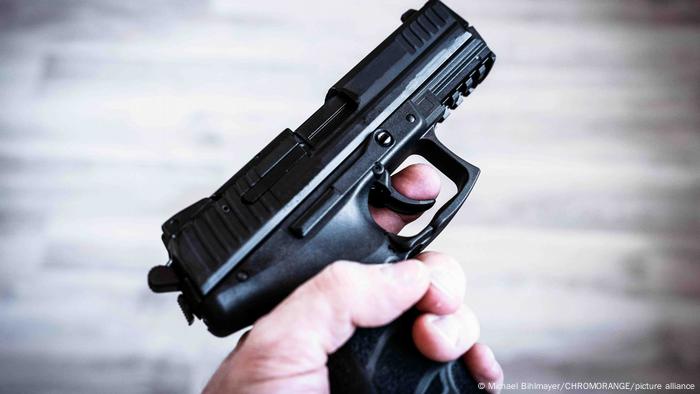
Germany plans to tighten gun control

The German government is planning to make background checks for potential gun owners even tighter. But questions remain over whether authorities are even equipped to carry out such controls.

One million people in Germany own a total of five million firearms

The German government is seeking to impose even stricter background checks on gun ownership in an attempt to prevent political extremists and the psychologically disturbed from buying guns.

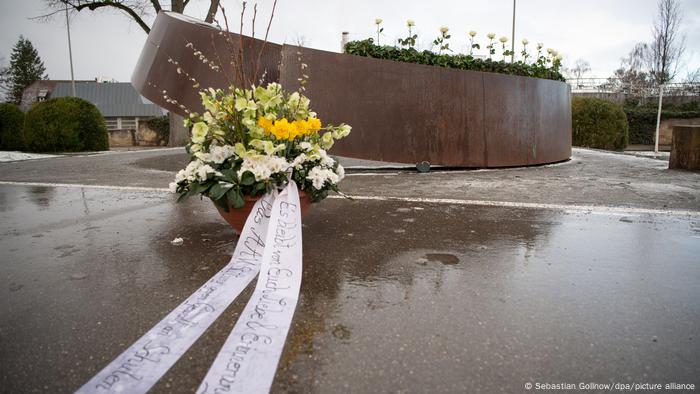
The latest call for restrictions comes partly in response to the killings in Hanau in February 2020, when a racist attacker Tobias R.* murdered nine people of color before killing his mother and himself.

He was able to buy guns legally even though he had been diagnosed with paranoid delusions in 2002 when he told police he was being spied on and "psychologically raped" through the power outlets in his walls. Tobias R. legally owned three guns at the time of the killings, and was able to borrow another from a gun trader.

In a statement to DW, an Interior Ministry spokeswoman confirmed that a draft bill is currently being drawn up, whose intention is to expand the scope of the background checks authorities can and must make before granting or renewing a gun license.

Mental illness and gun ownership

Around one million people in Germany legally own a total of more than five million firearms. Most of them are sport shooters, hunters, or foresters. Though gun violence is relatively rare in Germany, an average of 155 people are killed by gunfire every year.

Marcel Emmerich, a member of parliament for the Green Party and domestic policy spokesman, is convinced that recent incidents show that Germany's rules for gun ownership need to be restricted further. "Fewer weapons being privately owned means more public safety," he said.

The government's plans include requiring authorities that grant gun ownership licenses — often the relevant state police — to check with health authorities whether applicants have a record of mental illness.

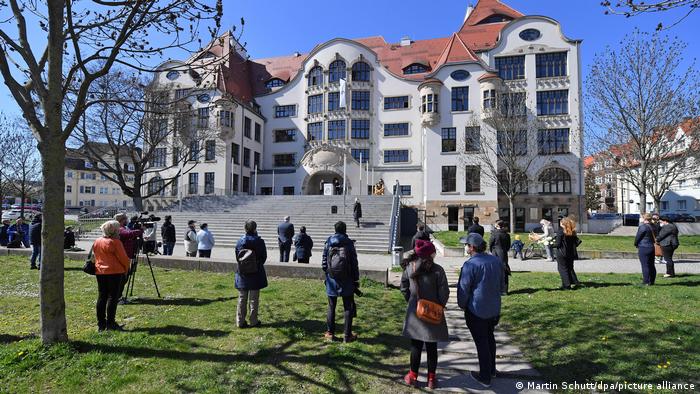
A 19-year old who legally owned a gun, shot 16 people at his school in Erfurt in 2002

But the issue of mental illness raises several problems, according to Dietmar Heubrock, professor of forensic psychology at Bremen University, and once an expert witness on gun control for the German parliament. Health authorities don't necessarily have complete records on mental illness, he argues, and no database can cover the variety of psychological issues that could lead to violence. "Do we even have the right procedures to recognize the potential psychological dangers that might develop in later life?" he said.

"Let's say I already own a gun and then hit a personal crisis — my livelihood gets taken away, and I start developing violent fantasies: I want to avenge myself on society, and I want to go out and kill everyone I see," he tells DW. "No health authority would know about that."

The solution, according to Heubrock, is developing new psychological tests that each applicant for a gun ownership card would have to pass. "The current tests are 20 years old, and any test, whether it's an intelligence test or a personality test, has to be re-standardized after a time," he explains.

Green Party MP Emmerich agrees, saying that the new law could, for instance, require all applicants to pass a psychological assessment test — not just those under the age of 25, as the law demands now.

But the German Shooting Sport and Archery Federation (DSB), which numbers some 1.3 million members, doubts whether gathering sensitive health data will be legally viable and whether anyone without medical expertise is qualified to interpret it properly.

"For example, an official in a regulatory authority can surely not judge whether an entry in a health file is even relevant to weapons law," DSB spokesman Thilo von Hagen told DW in an email.

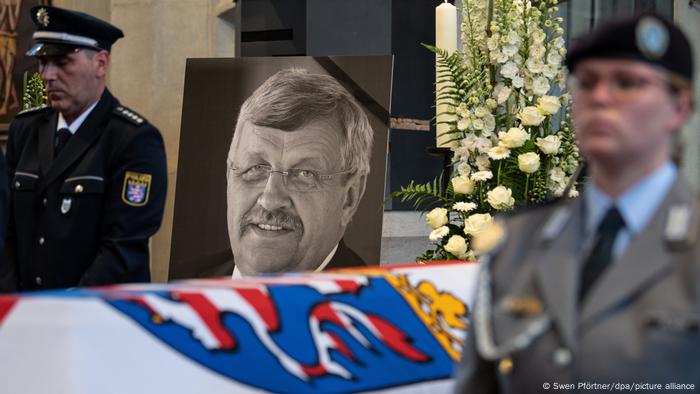
Politician Walter Lübcke was shot and killed by a neo-Nazi who had been a member of a gun club

Several amendments to gun law

Germany has consistently tightened gun laws following mass shootings. Age limits for gun ownership were raised following a school shooting in Erfurt in 2002, and random spot checks on gun owners, to ensure they were storing guns according to regulations, were introduced following a mass shooting in the town of Winnenden in 2009.

Following terror attacks in Paris in 2015, the EU amended its firearms directive, which was incorporated into German law in 2020, the last amendment to date. Since then, the firearms authorities have been obliged to check with the domestic intelligence agency whether an applicant is known to them as an extremist.

Since 2020, authorities are also obliged to check every five years whether registered German gun owners have a legitimate "need" to own a gun: In practice, that often means police will check whether the gun owner is still a member of a shooting club or has a hunting license.

But there have been reports of neo-Nazis joining shooting clubs, and Germany has been shocked in recent years by stories of so-called Reichsbürger (conspiracy theorists who believe the Federal Republic of Germany is not a legitimate state) hoarding firearms. Two recent far-right perpetrators, the Hanau perpetrator Tobias R., and Stephan E., the neo-Nazi who murdered a local governor Walter Lübcke in 2019, both joined shooting clubs.

Gun owners in Germany see no need for more regulations. Torsten Reinwald, the spokesman for the German hunting Association (DJV), which represents some 250,000 registered German hunters, says the problem is the implementation of current laws, rather than the laws themselves.

"Hanau could have been prevented," Reinwald tells DW. "The facts were on the table: It was known that this person was mentally ill, but no action was taken. If the authorities had been better connected, this person could've been pulled out of circulation. That's the basic problem. To make new demands now — they're just 'placebos,' nothing more."

In 2009, a 17-year-old stole his father's gun and killed 15 people in Winnenden

Personal freedom, privacy, and privilege

Authorities already have relatively wide-ranging powers to check gun owners: If they have any suspicions about applicants, they can require an additional health certificate. Reinwald says police spot checks are already "a severe intrusion in personal freedom."

Another concern is privacy. The neoliberal Free Democrats (FDP), the government party most sensitive to personal freedom issues, has already flagged concerns over the Interior Ministry's plans.

Green Party MP Emmerich acknowledges that medical data is "highly sensitive," but added that this will be considered in any new law. "The challenge is handling data responsibly, but also ensuring that certain people don't get their hands on weapons," he said.

Historian Dagmar Ellerbrock from the Technical University of Dresden told Deutschlandfunk public radio that in her view the debate on restrictions was misleading: Owning a gun, she said, is not a basic right that is now being restricted by law. "It's a privilege," she said. "A privilege granted to certain people. And whoever wants to be granted this privilege has to qualify for it."

*DW follows the German press code, which stresses the importance of protecting the privacy of suspected criminals or victims and urges us to refrain from revealing full names in such cases.

Edited by: Rina Goldenberg

If you are suffering from serious emotional strain or suicidal thoughts, do not hesitate to seek professional help. You can find information on where to find such help, no matter where you live in the world, at this website: https://www.befrienders.org/


'This time is different': Tens of

 thousands protest gun violence

 in US

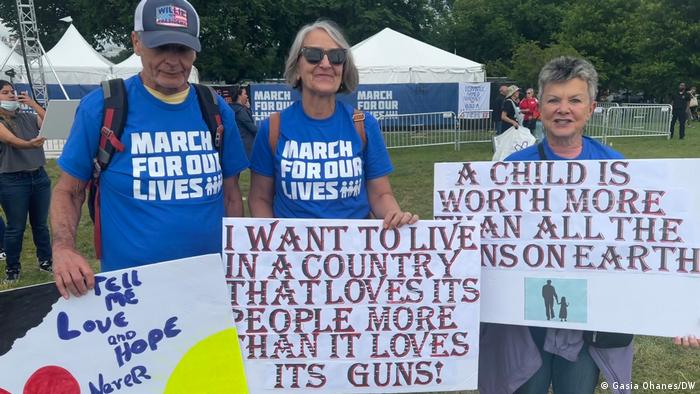
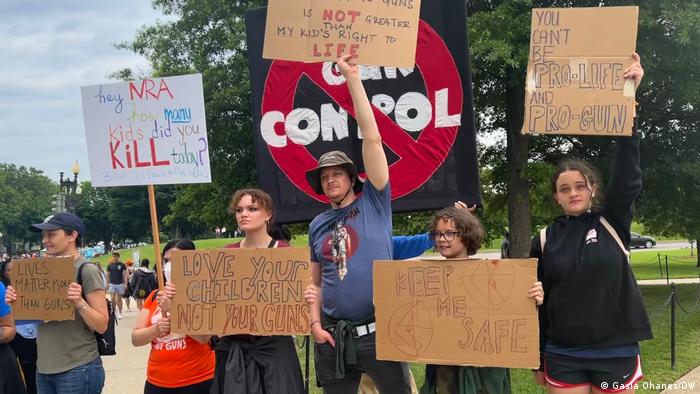
At rallies held across the US, protesters made it clear to politicians they want better gun control. DW was at the Washington march, where a false alarm scattered the crowd and pro-gun demonstrators were escorted away.

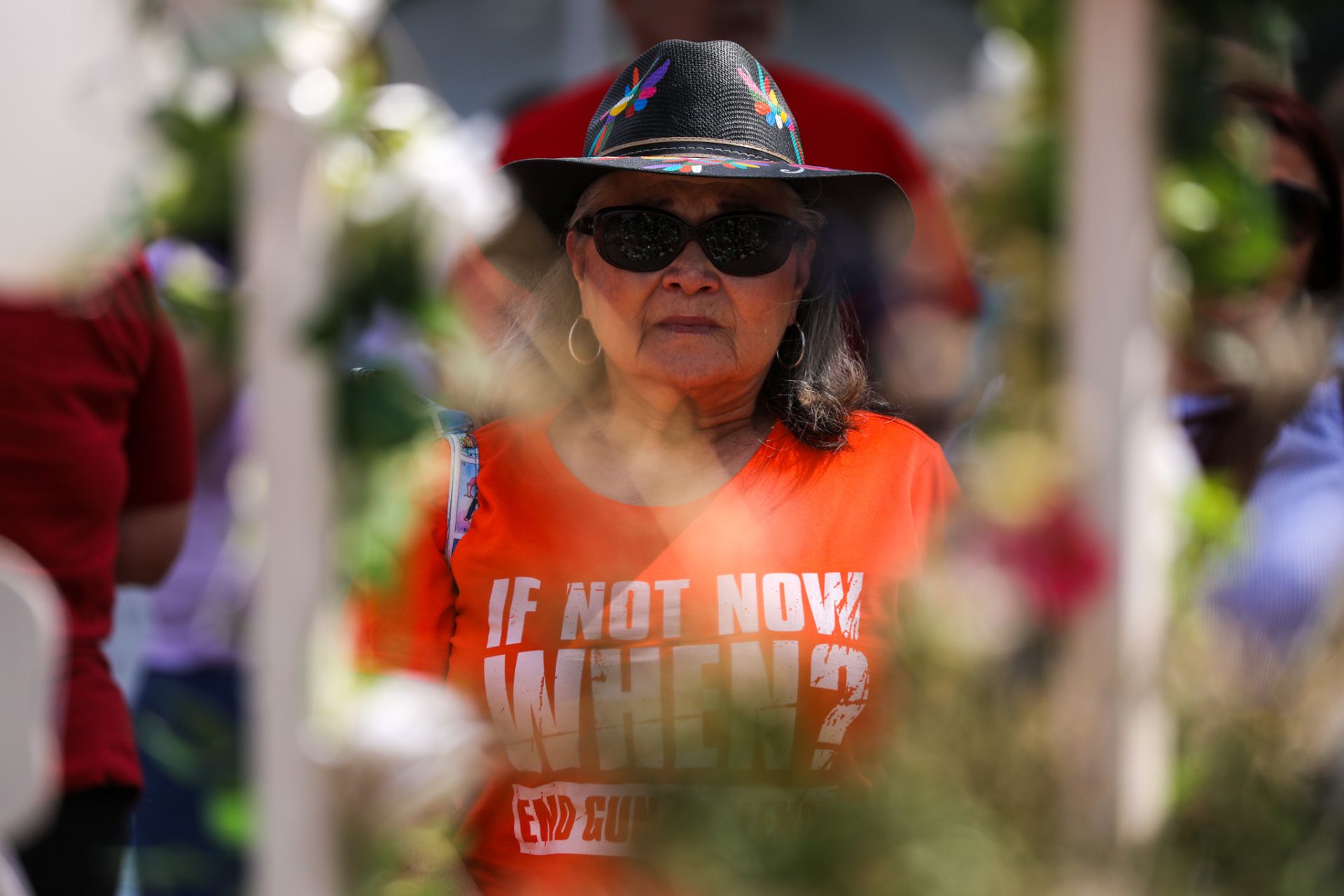
Protesters were sick of 'thoughts and prayers' after each mass shooting

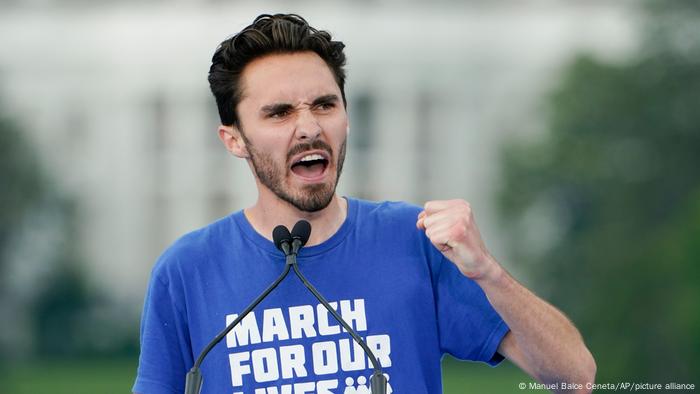
"As we gather here today, the next shooter is already plotting his attack while the federal government pretends it can do nothing to stop it," David Hogg, a survivor of the Stoneman Douglas High School shooting, told a crowd of tens of thousands in the US capital, Washington, on Saturday.

The event, which featured speeches from other survivors, the families of victims and educators, drew an estimated 50,000 attendees, according to the organisers, March for Our Lives. The group was founded by Hogg and other children from the school in Parkland, Florida, to advocate for stricter gun control.

Parkland shooting survivor, David Hogg, said the killings of children in Uvalde 'should fill us with rage'

Addressing the crowd near the Washington Monument, he urged the crowd to imagine seeing the name of a loved one appear on the ever-growing list of gun violence victims in the US. 

"This time is different," Hogg said, before asking the crowd to chant the sentence repeatedly. 

Simultaneous protests look place in around 450 locations across the US, calling for an end to inaction from political leaders.

The marches followed deadly mass shootings in Uvalde, Texas, where a gunman killed 19 children and two teachers, and a supermarket shooting in Buffalo, New York, that left 10 people dead, as well as a shooting at a Taiwanese-American church in Southern California, in which one person was killed and five injured. All those events took place within one month.

"I speak as a mayor, a mom, and I speak for millions of Americans and America's mayors who are demanding that Congress do its job. And its job is to protect us, to protect our children from gun violence," Mayor Muriel Bowser told protestors in Washington. "Enough is enough.''

Re-living the fear

During a moment of silence held for the Uvalde shooting victims, a loud voice pierced through the calm, causing panic among the crowd. People in the front reported hearing the word "gun" and dozens ducked to the ground, while others fled in fear.

"I saw other people running, and people telling others to run. So I ran," Milton Gardner, a 23-year-old student at Virginia Commonwealth University, told DW. "It gave me a flash of how … every second of the day is a risk in this country, no matter where you are and what you are doing."

Gardner added that he had been afraid to even attend the rally after the Buffalo shooting.

Teacher Margaret Tice (middle) was shocked by a false alarm in the middle of the protest

"Everybody hit the ground and I was just standing there because I was in shock," said Margaret Tice, a 63-year-old teacher from West Virginia.

"This woman in front of me broke down and she was sobbing on the ground. It’s real. People are fearful of that every day," she added. 

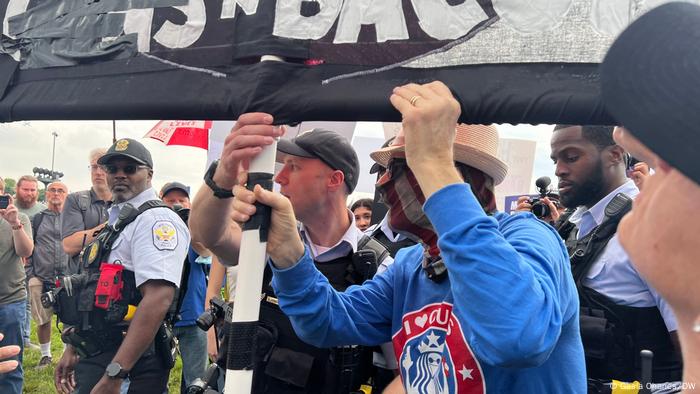
A man obscuring his his face with a US flag scarf and dark sunglasses sparked fury by unfurling a large banner reading “Guns'n'bacon.”

March for Our Lives supporters quickly blocked the banner from view with their signs calling for gun control, before the man was escorted away by police. 

Stephanie Birch, a university librarian, covered the word “guns” on the banner with black tape.  

A man holding a pro-gun placard is led away from the protest by police

"When you have a protest you can expect agitators," the 33-year-old, who flew to the protest from Florida, told DW. “Fortunately there was no violence, and he had no gun. I think that’s something a lot of us have been worried about — the possibility of a shooting happening here today.”  

House passes new gun controls, but Senate holds out

On Wednesday, the Democrat-controlled House of Representatives passed a sweeping set of gun safety measures, but the legislation has little to no chance of advancing in the Senate, where Democrats would need the support of 10 Republicans for the requisite super majority.

Republicans there believe gun limits violate the US Constitution's Second Amendment, the right to bear arms.

At the Washinton rally, Hogg led the crowd in chants of "vote them out," referring to Republican politicians. 

"This time is different because this isn't about politics. It's about morality. Not right and left, but right and wrong, and that doesn't just mean thoughts and prayers. That means courage and action," Yolanda King, granddaughter of Martin Luther King Jr., said.

Protesters like Rebecca Toronto (far right) and her family blocked pro-gun placards at the march

Rallies also took place in Atlanta, New York, Los Angeles and Chicago.

In New York, the state's Attorney General Letitia James, who is suing gun lobby group, the National Rifle Association, joined activists crossing the Brooklyn Bridge.

"Nothing happens in this country until young people stand up, not politicians,'' James said.

Hundreds gathered at an amphitheater in Parkland, where Debra Hixon, whose husband, high school athletic director Chris Hixon, died in the Buffalo shooting, said it is "all too easy'' for young men to walk into stores and buy weapons.

President Biden 'mildly optimistic' about reform

President Joe Biden backed the protests, urged demonstrators to "keep marching" and added that he was "mildly optimistic" about legislative negotiations to address gun violence.

A bipartisan group of Senators had hoped to reach an agreement this week on a framework for addressing the issue and held talks Friday, though they have yet to conclude a deal.

March For Our Lives has called for an assault weapons ban, universal background checks for those trying to purchase guns, and a national licensing system that would register gun owners.

At the same time, opponents of tougher regulations have sought to cast mass shootings as primarily a mental health issue, not one of access to firearms.

More than 19,300 people have died in gun-related incidents in the US so far this year, according to the Gun Violence Archive. More than half of those deaths are due to suicide.

lo/msh (AP, AFP, Reuters)