Thursday, June 16, 2022

STFU

New CNN Boss Wants Staff to Stop Calling Trump Claims ‘The Big Lie’ to Avoid Democratic Party ‘Branding’


Josh Dickey
Wed, June 15, 2022

New CNN honcho Chris Licht is acting on his promise to begin dialing down what he sees as the network’s partisan (left) bias, telling staffers in a conference call this week that he prefers they stop using the term “The Big Lie” when referring to Donald Trump’s false claims of election fraud, Mediaite reported Thursday.

Reason: The term adopts “branding” favored by the Democratic Party.

Licht expressed a “preference” for the adjustment after someone on a Tuesday conference call with management and producers asked his opinion on Trump’s “Big Lie,” Mediaite said – adding that staffers “have taken it as a clear directive from the new boss” nonetheless.

CNN and CNN staffers did not immediately respond to messages seeking comment Wednesday.

Also Read:
CNN ‘Partisan’ On-Air Talent Must Tone It Down Under New Boss – Or Else

Mediaite said Licht encouraged producers to instead use “Trump election lie” or “election lies” in chyrons and elsewhere. CNN staff is expected to gather Thursday for its first town hall since Licht took over at the end of February.

Mediaite spoke to one CNN staffer who said some staff were rankled by the perceived “Big Lie” directive, and speculated that it may be coming from a board member at newly merged parent company Warner Bros. Discovery. Licht has said since taking the job that he planned to return the network to its traditional “facts-first” footing after listing toward leftward commentary for years under ousted boss Jeff Zucker.

The term “The Big Lie” was coined by Adolf Hitler and adopted by Trump critics to describe the former President’s ongoing insistence that the 2020 election was stolen. Mediaite reported that CNN has used the term more than 10 times per day this month, citing the monitoring firm TVEyes.

Axios reported earlier this month that Licht has instructed everyone at CNN to “tone down” the divisive rhetoric – or face possible termination.
U.S. Senator likely would block passage of EV tax credits - Canada minister
THE DIFFERENCE BETWEEN LIBERALS AND DEMOCRATS

U.S. Senator Joe Manchin (D-WV) walks through the Senate Subway during a vote at the U.S. Capitol in Washington

Tue, June 14, 2022
By Steve Scherer

OTTAWA (Reuters) - Canada's minister of natural resources on Tuesday said U.S. Senator Joe Manchin, a key Democrat, would likely block the passage of tax credits that favor U.S.-manufactured electric vehicles (EVs) and are opposed by Ottawa.

Last year, many Democrats in Congress and President Joe Biden proposed boosting EV tax credits to up to $12,500 - including a $4,500 incentive for union-made, U.S.-assembled vehicles and $500 for U.S.-made batteries. The base $7,500 credit would be limited to only U.S. made vehicles starting in 2027.

But those provisions were part of larger infrastructure bill, dubbed "Build Back Better", which has not passed in Congress in large part due to Manchin's opposition.

"I had a long conversation with Senator Manchin... who is not supportive of the EV provision. He is obviously a critical vote if this (bill) comes to another vote," Natural Resources Minister Jonathan Wilkinson told Reuters in a telephone interview.

"While we are continuing to be vigilant and we are continuing to engage on the issue... my understanding is that (the EV tax incentives) may not move forward even if the bill does," he said.

Wilkinson met Manchin last month about two weeks after the senator questioned the need for EV tax credits at a hearing on April 28.

"There's a waiting list for EVs right now with the fuel price at $4 (per gallon). But they still want us to throw $5,000 or $7,000 or $12,000 credit to buy electric vehicles. It makes no sense to me whatsoever," Manchin said at the Senate hearing.

Manchin's office did not respond on Tuesday to a request for comment about whether he specifically objected to the U.S. production provisions, or if he opposed the entire tax credit expansion on grounds it was not needed.

U.S. Energy Secretary Jennifer Granholm told reporters last week the White House was pushing Congress on EV tax credits but acknowledged the proposal's fate is uncertain. "Obviously there's discussions," Granholm said. "The president would certainly encourage his original proposal to be adopted."

Canada's Prime Minister Justin Trudeau, during a trip to Washington last year, directly lobbied Biden to drop the incentives, saying the measures threatened to undermine "50 years of integrated automaking in our two countries".

Canada, the European Union, Germany, Japan, Mexico, France, South Korea, Italy, and other countries wrote U.S. lawmakers last year saying the proposed EV tax credits would violate international trade rules, and Canada pledged to retaliate if they passed.

The pivot to EVs is important to Canada because it is trying to safeguard the future of its manufacturing heartland in Ontario - where major carmakers have long assembled combustion engine vehicles - as the world seeks to cut emissions by embracing EVs.

Canada and the United States want all sales of passenger vehicles to be zero emissions by 2035.

Since the U.S. legislation stalled last year, Canada has teamed up with industry, including General Motors, to retool assembly lines for EVs, and Stellantis, the parent of Jeep and Chrysler, to build an EV battery plant in Windsor in partnership with South Korea's LG Energy Solution.

(Reporting by Steve Scherer, additional reporting by David Shepardson in Washington; Editing by Lincoln Feast.)
NEW YORK CITY RESTERAUNT REVIEW
An Eleven Madison Park worker earning $15 an hour at the $335-a-person restaurant says he was yelled at for scooping ice 'too loudly' in the silent kitchen — and threw away loads of food despite the swanky restaurant's green reputation


Sarah Jackson,Kate Taylor
Wed, June 15, 2022, 

The meal follows recipes by chef Daniel Humm.
Neilson Barnard/Getty Images for Blancpain

New York restaurant Eleven Madison Park went vegan last year, but that choice has led to chaos, Insider's Kate Taylor reported Tuesday.

A junior prep cook who quit the restaurant in November says he was paid $15 an hour. The vegan tasting menu costs $335 a person.

The cook recounted a massive food waste problem and being yelled at for scooping ice "too loudly."

A former employee at acclaimed New York restaurant Eleven Madison Park says he was once chastised for scooping ice "too loudly" in the establishment's notoriously quiet kitchen and that the eatery had a massive food waste problem despite its outward efforts to be environmentally conscious.

From May until November, Chandler Yerves was a commis chef, or junior prep cook, at the upscale eatery, which was once crowned the best restaurant in the world. He recounted his exhausting tenure at the restaurant to Insider's Kate Taylor in a story published Tuesday.

"It was definitely a huge toll on my mental health," Yerves said. "It was definitely the most egotistical restaurant I've ever been in in my life."

World-renowned chef and Eleven Madison Park owner Daniel Humm announced last May that the New York restaurant would no longer serve meat and fish, becoming just the second restaurant with three Michelin stars to serve almost entirely plant-based food.

Yerves recounted a time he was sent out with a ruler onto the streets of New York and told not to return until he had enough 5-inch red peppers for the dish for the evening: fried peppers wrapped in Swiss chard. Two hours later, after visiting three or four Whole Foods stores, Yerves returned with the peppers, only to have half of them thrown away, he says, as part of what a former colleague called the restaurant's "farm to trash" pipeline.

Yerves said he was paid $15 an hour during his Eleven Madison Park tenure. Patrons ordering the vegan tasting menu could expect to pay $335 per person.

Yerves and another former worker said most of the vegetables used at the restaurant came from delivery services rather than farms or local markets and that staff regularly chucked produce that had even a slight imperfection, wasn't the right size, or went unused.


 MY AVATAR

The History of Godzilla (1954)  

#Godzilla #GodzillaHistory #Gojira Sources - Brian Solomon's "Godzilla FAQ" - David Kalat's, "A Critical History and Filmography of Toho's Godzilla Series". - Ed Godziszewski and Steve Ryfle's "Ishiro Honda: A Life in Film, from Godzilla to Kurosawa" - Steve Ryfle's "Japan's Favorite Mon-Star: The Unauthorized Biography of "The Big G".

The History and Evolution of Godzilla
Oct 11, 2017

Cynical Justin

Today, I go through the history of Godzilla and its evolution over more than half a century. This video discusses the origins of Godzilla, the Showa period, the Heisei period, the 1998 American Godzilla film, the Millennium period, the 2014 American Godzilla film, and the latest installment in the franchise, Shin Godzilla.

80 years after an unprecedented attack, Australia is having run-ins with another rival close to home

Benjamin Brimelow
Tue, June 14, 2022, 

A US Navy destroyer patrols by burning Allied warships after a Japanese air raid at Port Darwin, Australia, June 13, 1942.AP Photo

In May and June 1942, Japanese submarines attacked the Australian cities of Sydney and Newcastle.

The attacks were an intense reminder of the war moving closer to Australian shores.

Eighty years later, another powerful adversary is making its presence known off Australia's coasts.


In the early hours of May 29, 1942, a reconnaissance plane launched from Japanese submarine I-21 was spotted over Sydney Harbor. Observers believed it was an Allied plane and didn't raise the alarm.

The plane was in fact doing a final reconnaissance of the harbor for four other Japanese submarines, I-22, I-24, I-27, and I-29, which had arrived off Australia's coast carrying three Type A Kō-hyōteki-class mini-submarines on their decks.

On the night of May 31, the mini-subs were launched toward the harbor, where they delivered a message to Australians about the war inching closer to their homes.

Eight decades later, tensions in the Pacific are rising once again, and the surprise attack on Allied ships in Sydney is a reminder of the proximity of the threat Australia now faces.

A tense time


The USS Lexington explodes after being bombed by Japanese planes during the Battle of the Coral Sea.
AP Photo

By May 1942, the war and its intensity were visible to Australians.

In December 1941, the Japanese dealt the British a devastating defeat by sinking the battleship HMS Prince of Wales and the battlecruiser HMS Repulse in the South China Sea.

In January 1942, Rabaul, in what is now Papua New Guinea, was captured by the Japanese, who turned it into a major base. February saw the Japanese capture Singapore and bomb the port city of Darwin in northern Australia. In early March, the Japanese captured the Dutch East Indies, which is now Indonesia.

Japan's advance was finally checked on May 8 at the Battle of the Coral Sea, which relieved some of the pressure on northern Australia, but Japanese air and submarine attacks were still a great threat.

Southern Australia was believed to be safer because it was far from the fighting, and early in the war Allied capital ships — such as battleships, cruisers, and aircraft carriers — tended to dock there, especially in Sydney Harbor.


USS Chicago in Sydney Harbour at the time of the attack by Japanese submarines, May 31, 1942.Australian War Memorial

At the time, Sydney was not optimally prepared for submarine attacks. There were no regular offshore sea or air patrols and the harbor's anti-submarine net was still under construction.

There were passive detection systems around the harbor entrance, but the Royal Australian Navy didn't have submarines or much experience hunting them, so its personnel didn't quite know what to listen for.

The Japanese Navy was keen to strike Sydney's target-filled harbor and decided to use mini-submarines rather than fleet submarines because their size increased their chances of getting in and out undetected. The cigar-shaped Type As were 78 feet long and 5 feet wide, had a crew of two, and were battery-powered. They were armed with two 770-pound torpedoes and carried scuttling charges.

Five Type As were used unsuccessfully at Pearl Harbor, but the Japanese believed that subsequent upgrades, including cages on the bow and conning tower designed to cut through anti-submarine nets, increased their likelihood of success.

Their targets were any Allied capital ships in Sydney Harbor, especially the heavy cruisers USS Chicago and HMAS Canberra, and the light cruiser HMAS Adelaide.

The raid


HMAS Kuttabul after the Japanese attack on Sydney Harbor in June 1942.
Australian War Memorial

The three subs were launched at 20-minute intervals on the evening of May 31.

The first sub, M-27, entered the mouth of the harbor around 8 p.m. but got stuck in the completed section of the anti-submarine net. It was then spotted and attacked by two Australian navy patrol boats. M-27's crew detonated the scuttling charges to avoid capture, sinking the sub and killing themselves.

The second sub, M-24, had more success. It entered the harbor undetected around 9:48 p.m. but was eventually discovered and fired on by USS Chicago, which had been alerted by M-27's attempt.


A Japanese two-man submarine is recovered from Sydney Harbour, June 1, 1942.
Ronald Noel Keam/Australian War Memorial

M-24 fired its torpedoes at Chicago, but both missed. One ran aground but the other hit a seawall and detonated under the ferry HMAS Kuttabul. The explosion sank the ferry, killed 19 Australian and two British sailors, and slightly damaged a nearby Dutch submarine.

M-24 was hit by machine gun fire as it left the harbor and sank 3 miles off the coast north of Sydney. (It remained undiscovered until 2006.)

The third sub, M-22, entered the harbor after midnight. It was detected and Australian patrol boats pounced before it could attack. The patrol boats crippled the sub in one of the harbor's bays, and both submariners shot themselves.


Governor-General Lord Gowrie inspects damage in Bellevue Hill, Sydney, after Japanese submarines shelled the city, June 9, 1942.
Fairfax Media via Getty Images

The five Japanese fleet submarines spent two nights waiting for the Type As to return. On June 3, they left to hunt merchant ships in the area, attacking seven, sinking three, and killing 50 sailors.

On June 8, I-24 and I-21 returned and surfaced near Sydney. They bombarded the city and nearby Newcastle for 20 minutes with their deck guns, firing some 44 rounds before disengaging when coastal artillery returned fire.

Almost none of the Japanese rounds detonated and there were no casualties, but the attack further frightened the cities' residents.

A new, growing threat


Chinese navy intelligence collection vessel Haiwangxing off of northwest Australia.
Australian Department of Defense

The attacks on Sydney and Newcastle are reminders that distance alone won't protect Australia, especially against an enemy with significant air and naval resources. That has renewed relevance amid Australia's deteriorating relationship with China.

Canberra's call for an independent review of the origins of COVID-19 in April 2020 prompted intense backlash from Beijing. Since then, China has frozen high-level contacts and imposed trade restrictions on Australian goods.

There is also longstanding concern about China's influence in Australian society, and the tensions became a major issue in recent elections.

The situation has been made worse by recent incidents with the Chinese military around Australia.


A Chinese navy Yuzhao-class amphibious transport dock in the Torres Strait north of Australia, February 18, 2022.
Australian government

On February 17, one of two Chinese warships sailing in the Arafura Sea between Australia and western New Guinea shined a laser at a Royal Australian Air Force P-8A Poseidon as it flew by on a patrol flight. Canberra condemned the Chinese crew's actions, calling it "a serious safety incident" with the "potential to endanger lives."

A military laser itself is not a weapon, but it is usually part of a weapon's fire-control system and is used to illuminate a target before firing. As such, lasing a ship or aircraft can be considered aggressive — the US has criticized China for similar actions in the past.

More recently, on May 13, Australia expressed concern about a Chinese intelligence-gathering vessel operating off its west coast, where it sailed by a secretive naval communications base. Peter Dutton, Australia's defense minister at the time, called it an "aggressive act" and said its intention was to "collect intelligence right along the coastline."

In recent years, amid rising tensions with Beijing, Australia has increased efforts to modernize its military and to strengthen its alliances with the US and others in the region — steps meant to counter a threat that will likely only grow in the years ahead.
Trump’s pick for Pa. governor says he sees ‘parallels’ to Hitler’s power grab in Capitol riot

Ryan J. Reilly
Tue, June 14, 2022, 

WASHINGTON — The Donald Trump-endorsed nominee for governor in Pennsylvania compared the Jan. 6 attack to historical events staged by the Nazis, saying that he saw "parallels" between the criticism of the Jan. 6 attack and the 1933 Reichstag fire, which Hitler used to seize more power.

Doug Mastriano was at the U.S. Capitol on Jan. 6.


Mastriano, a Pennsylvania state senator, has been subpoenaed by the House Jan. 6 committee. He organized buses to D.C. that day, according to receipts his campaign's lawyer previously acknowledged turning over to the Jan. 6 committee. Video shows he was just feet away as rioters ripped down police barricades, but he has said he followed police lines “as they existed” and says he left the Capitol when it was “apparent that this was no longer a peaceful protest.”

His primary election victory last month has prompted a renewed look at his role on Jan. 6, including previously unpublished photos that show him in the back of a crowd that breached a police barricade.

He is also receiving increased attention about his comments about Jan. 6.

Last week, Mastriano live-streamed on Facebook as he was interviewed Friday for the podcast "The World According to Ben Stein."

Stein — a former Richard Nixon speechwriter who hosted the 1990s gameshow "Win Ben Stein's Money" and played an economics teacher in the 1986 movie "Ferris Bueller's Day Off" — called the deadly Jan. 6 attack "a ridiculously trivial thing" on the podcast.

Stein said the country is getting "more and more into a dictatorship," and compared Jan. 6 to the 1933 fire on the Reichstag, the legislative branch in Berlin, that Hitler blamed on communists. The Nazis then used the fire as a pretext to suspend civil liberties and assume more power.

"The Nazis immediately seized upon it [the Reichstag fire] to impose emergency measures," Stein said. "I think something like this is happening with the Jan. 6 nonevent."


Stein called the riot a "ridiculously trivial thing."

“It was not an insurrection," he added. "It was not an attempt to take over the government. It was a demonstration by a group that felt frustration by the statistical impossibility of the vote having gone the way the Democrats said it did.”

Mastriano responded to Stein's comparison, saying he concurred with the comparison between Jan. 6 and the Reichstag fire.

“I agree with the political, with the historic analogy laid out there, so using something that was very suspicious in Berlin to advance their agenda, you know, the national socialists there," Mastriano said. "I do see parallels.”

Mastriano, who previously said that those who broke the law on Jan. 6 "must be prosecuted," said on Stein's podcast that law enforcement had taken "extreme, heavy-handed measures" in response to the attack.

"It's just really heartbreaking watching how quickly our country's falling down, and that we have people being publicly arrested for show to send a message," Mastriano said. "I think what we're seeing in America now makes McCarthy in the '50s look like an amateur."

A member of the online sleuths Sedition Hunters — individuals who have spent the past 17 months investigating the Jan. 6 attack and identifying hundreds of rioters to law enforcement — say they have found new photos of Mastriano on the Capitol grounds moments before the rioters breached a police barricade line on the eastern side of the U.S. Capitol. Minutes later, rioters smashed the window of a door leading into the Capitol rotunda, according to timelines the online sleuths have constructed using the videos, photos, press coverage and social media posts of the day.

Online sleuths have assisted the FBI in hundreds of Capitol riot investigations, successfully identifying rioters months before they are arrested.

NBC News has reviewed the videos and images used to construct the timelines and compared other images of Mastriano at the rally with those identified by the sleuths. In the images, Mastriano appears to be wearing the same scarf and hat and is in a consistent place in the crowd. In the series of images, Mastriano is accompanied by a woman who appears to be his wife, and Mastriano has publicly acknowledged that his wife was with him that day. He has never disputed his identification in previous images.

The images, shared with NBC News, appear to show Mastriano holding up his cellphone as rioters in the front of the mob face off with police at the Capitol steps. Reconstructed timelines and other videos filmed nearby show rioters would breach this police line within minutes, ripping away a crowd control rope line and rushing past officers up the stairs. The timelines and videos, including unedited versions, that show Mastriano in the crowd were reviewed by NBC News.


A man who appears to be Doug Mastriano takes photos or video with his cell phone on the steps of the U.S. Capitol on Jan. 6, 2021. (@MichaelCoudrey via Twitter)

Online sleuths also identified a video posted by "Stop the Steal" organizer Mike Coudrey on Jan. 6 that appears to show Mastriano taking photos or video with his cellphone as rioters face off with police on the steps of the U.S. Capitol. Coudrey's tweet celebrated the mob, which he said "broke through 4 layers of security at the Capitol building.

Mastriano’s campaign did not respond to NBC News’ request for comment. Mastriano previously said that he “respected all police lines as I came upon them" and that he never stepped foot on the Capitol stairs. One of his campaign aides, Grant Clarkson, was near the front of the mob, NBC previously reported. There has been no evidence that Clarkson entered the Capitol that day and he has insisted he did not.

Mastriano is facing Pennsylvania Attorney General Josh Shapiro, the Democratic gubernatorial nominee, in November.
NOBEL PRIZE IMPERIALIST
Ethiopia PM moots possible peace talks with Tigray rebels
TIGRAY WAS ATTACKED BY ETHOPIA

Aymeric VINCENOT
Tue, June 14, 2022, 


Ethiopia's Prime Minister Abiy Ahmed on Tuesday spoke for the first time about the possibility of peace negotiations with Tigrayan rebels, who have been locked in a 19-month war with federal forces.

Dispelling speculation that secret talks were already under way with the Tigray People's Liberation Front (TPLF), Abiy said the government had created a committee to consider holding negotiations.

"It is not so simple to conduct negotiations. There is a lot of work to be done (before) and a committee has been set up", Abiy told Ethiopian MPs.

The committee will be headed by Deputy Prime Minister Demeke Mekonen, who also serves as foreign minister, and will draft a report detailing the preconditions for negotiations, he said.


The comments follow the government's declaration of an "indefinite humanitarian truce" in March, paving the way for aid to reach the war-battered region of Tigray for the first time since mid-December.

The conflict has driven hundreds of thousands of people to the brink of famine, displaced more than two million and left more than nine million in need of food aid, according to the United Nations.

"Peace isn't something you hide," Abiy told lawmakers in response to rumoured talks with the rebels.

"We are saying we want peace; doesn't mean we are going to do secret negotiations. Secret negotiations have no substance," he added.
- 'Non-negotiable' -

In an open letter published late Tuesday, but dated Monday, the TPLF said it was ready to take part in a "credible, impartial and principled peace process".

But it lashed out at mediation efforts led by African Union envoy Olusegun Obasanjo, the former Nigerian president.

"The proximity of the High Representative (Obasanjo) to the prime minister of Ethiopia has not gone unnoticed by our people," said the letter by TPLF leader Debretsion Gebremichael, which also denounced "the silence of the African Union over the war and the atrocities perpetrated by the forces ranged against us".

He also for the first time referred publicly to an "existing agreement" among the rivals to meet in Nairobi for negotiations hosted by Kenyan President Uhuru Kenyatta, whose government has been active in efforts to find peace in Ethiopia.

The thorny question of western Tigray -- claimed by both Amharas and Tigrayans -- is among the issues expected to come up in any negotiations.


The TPLF has repeatedly said western Tigray, which has been occupied by Amhara forces since the war erupted in November 2020, is a "non-negotiable" part of Tigray.

"Any lasting solution of the current crisis must be predicated on the re-establishment of the pre-war status quo ante," the TPLF said last week, calling for "the complete and verified withdrawal of all invading forces from every square inch of Tigrayan territory".

The TPLF has already asked the UN Security Council to ensure the withdrawal of Amhara and Eritrean forces from the region.

The conflict began in November 2020 when the government sent federal troops into Tigray to topple the TPLF, the region's former ruling party, saying it was in response to rebel attacks on army camps.

After the TPLF mounted a shock comeback in June, retaking Tigray and then expanding into the neighbouring regions of Afar and Amhara, fighting intensified in the second half of 2021, before reaching a stalemate.

Accounts have emerged of mass rapes and massacres during the conflict, with both sides accused of human rights violations.

The humanitarian situation in Tigray also remains dire, with the region still without essential services such as electricity, communications and banking, while only limited relief supplies are reaching the region.

The UN's humanitarian agency OCHA said in a weekend statement that more than 65,500 tonnes of food had been shipped to Tigray's capital Mekele via road between April 1 and June 6.

"Despite this positive progress, significant gaps remain to address the vast humanitarian needs in Tigray, primarily fuel shortage," it said.

ayv/txw/bp
Phillips and Pereira: two men who loved the Amazon
2022-06-16 


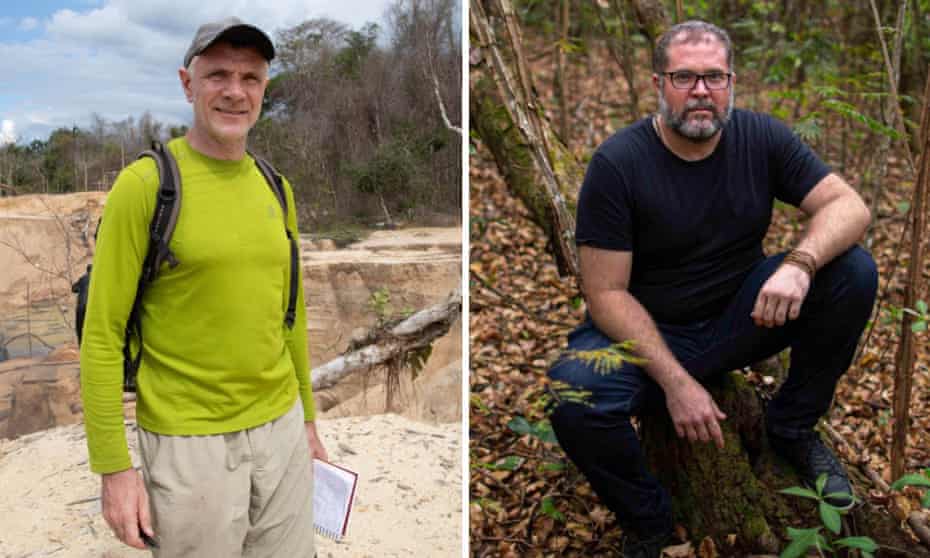
Veteran British freelance journalist Dom Phillips and respected Brazilian Indigenous expert Bruno Pereira shared a passion for the farthest reaches of the Amazon rainforest, where they went missing and were buried, according to a confession obtained by police.

The pair were last seen early on June 5 traveling by boat in Brazil's Javari Valley, a far-flung jungle region near the border with Peru, where Phillips was researching a book.

The region has seen a surge of criminal activity in recent years, including illegal logging, gold mining, poaching and drug trafficking -- incursions Phillips has reported on and Pereira has vigorously fought.

Police said Wednesday that one of two men arrested over their disappearance admitted to having buried their bodies in the jungle. While human remains have been found, they have not been definitively confirmed to be those of Pereira and Phillips.

The two had already traveled there together in 2018 for a feature story Phillips wrote in British newspaper The Guardian on an uncontacted tribe -- one of an estimated 19 in the region.

"Wearing just shorts and flip-flops as he squats in the mud by a fire, Bruno Pereira, an official at Brazil's government Indigenous agency, cracks open the boiled skull of a monkey with a spoon and eats its brains for breakfast as he discusses policy," it began

.

That memorable introduction neatly sums up both men, courageous adventurers who loved the rainforest and its peoples, each defending the Amazon in his own way.

- 'Sharp, caring journalist' -


Phillips, 57, started out as a music journalist in Britain, editing the magazine Mixmag and writing a book on the rise of DJ culture.

Lured by DJ friends, he set off for Brazil 15 years ago, falling in love with the country and the woman who became his wife, Alessandra Sampaio -- a native of the northeastern city of Salvador.

Reinventing himself as a foreign correspondent, Phillips covered Brazil for media including The New York Times, The Washington Post, Financial Times and The Guardian, where he was a regular contributor.

A group of friends and colleagues described Phillips as "one of the sharpest and most caring foreign journalists in South America."

"But there was a lot more to him than pages and paragraphs. His friends knew him as a smiling guy who would get up before dawn to do stand-up paddle. We knew him as a caring volunteer worker who gave English classes in a Rio favela," they said in a statement.

Phillips traveled in and wrote about the Amazon for dozens of stories, winning a fellowship from the Alicia Patterson Foundation last year to fund his project to write a book on sustainable development in the rainforest.

The project took him back to the region he loved.

"Lovely Amazon," he posted on Instagram earlier this month, along with a video of a small boat winding down a meandering river.

- 'Courageous, dedicated' Indigenous advocate -


Until recently working as a top expert at Brazil's Indigenous affairs agency, FUNAI, Pereira was head of programs for isolated and recently contacted Indigenous groups.

As part of that job, the 41-year-old organized one of the largest ever expeditions to monitor isolated groups and try to avoid conflicts between them and others in the region.

Fiona Watson, research director at Indigenous rights group Survival International, called him a "courageous and dedicated" defender of Indigenous peoples.

Pereira was especially revered for his knowledge of the Javari Valley, where he was also FUNAI's regional coordinator for years.

But he was on leave from the agency after butting heads with the new leadership brought in by far-right President Jair Bolsonaro, who faces accusations of dismantling Indigenous and environmental protection programs since taking office in 2019.

Pereira "was effectively forced out at FUNAI, basically because he was doing what FUNAI should be doing and have stopped doing since Bolsonaro took office: standing up for Indigenous rights," Watson told AFP.

Pereira frequently received threats for his work fighting illegal invasions of the Javari reservation.

That includes helping set up Indigenous patrols. He and Phillips were on their way to a meeting on one such patrol project when they disappeared.

"Every time he enters the rainforest, he brings his passion and drive to help others," Pereira's family said in a statement.

msi-mel/wd/bfm

Dom Phillips and Bruno Pereira: Brazil police find two bodies in search for missing men

Police chief says one of the men arrested in connection with the pair’s disappearance had confessed to killing them


Dom Phillips and Bruno Pereira went missing on 5 June, at the end of a four-day trip down the Itaquaí river in the far west of Brazil. Composite: João Laet/AFP/Getty Images (left); Daniel Marenco/Agência O Globo (right)

Andrew Downie in São Paulo and Tom Phillips in Atalaia do Norte
THE GUARDIAN
Thu 16 Jun 2022

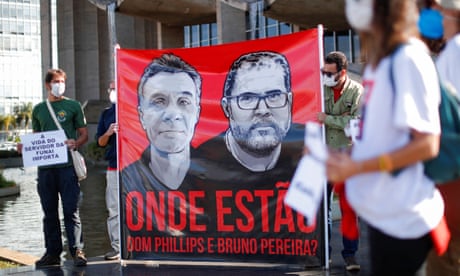
Police in the Brazilian Amazon have found the bodies of two men in the area close to where British journalist Dom Phillips and Indigenous activist Bruno Pereira went missing 10 days ago.

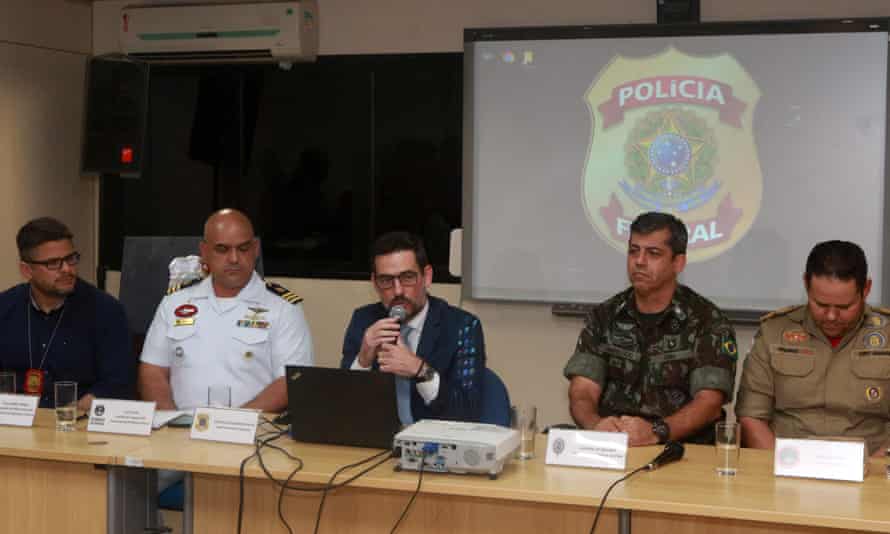
At a press briefing late on Wednesday, regional police chief Eduardo Fontes said one of the two men arrested in connection with the pair’s disappearance had confessed to killing them.


“On Tuesday he informed us the location where the bodies were buried and he promised to go with us today to the site so we could confirm where the bodies were buried,” Fontes told reporters.


The disappearance of Dom Phillips and Bruno Pereira


The announcement brought a sad end to a 10-day search which has horrified the nation and underlined the growing dangers faced by those who dare to defend Brazil’s environment and Indigenous communities, which have faced a historic assault under the country’s far-right president, Jair Bolsonaro.

The location identified by the suspect was 1hr 40min by boat from the river town of Atalaia do Norte and another 3.1km (1.9 miles) by foot into dense forest.

After a day-long operation, involving the army, navy and police force, the Guardian witnessed the bodies being removed from that area, known as the Lago do Preguiça, under the cover of darkness.

Escorted by army troops, they were carried by boat back down the River Itaquaí to Atalaia do Norte, where Phillips and Pereira had begun their final journey.

Scores of locals flocked to the town’s port to watch as officers in camouflage gear loaded the two black body bags on to the back of a federal police vehicle, which set off in a blaze of red and blue lights.

“We are now going to identify the human remains with the most dignity possible,” Fontes said. “When the remains are proved to be those of Dom Phillips and Bruno Pereira, they will be delivered to the families.”

The news was greeted with relief by Phillips’ wife Alessandra Sampaio.

“Although we are still awaiting definitive confirmations, this tragic outcome puts an end to the anguish of not knowing Dom and Bruno’s whereabouts,” she wrote in a statement. “Now we can bring them home and say goodbye with love.

“Today, we also begin our quest for justice. I hope that the investigations exhaust all possibilities and bring definitive answers on all relevant details as soon as possible.”
Superintendent Eduardo Alexandre Fontes speaking during a press conference in Manaus, Amazonas state. Photograph: Ricardo Oliveira/AFP/Getty Images

Fontes said search teams planned to return to the site on Thursday to locate the men’s boat. The men were last seen travelling upriver and Fontes alleged the suspects tossed the boat’s engine in the river and then filled the vessel with sacks of earth so it would sink.

“We are still investigating,” he said, adding that more arrests were expected. “This was a significant advance.”

The press conference was held in Manaus, the capital of Amazonas state, where a series of military and police officials congratulated themselves for the work done, before belatedly recognising the role played by Indigenous people who helped lead the search.

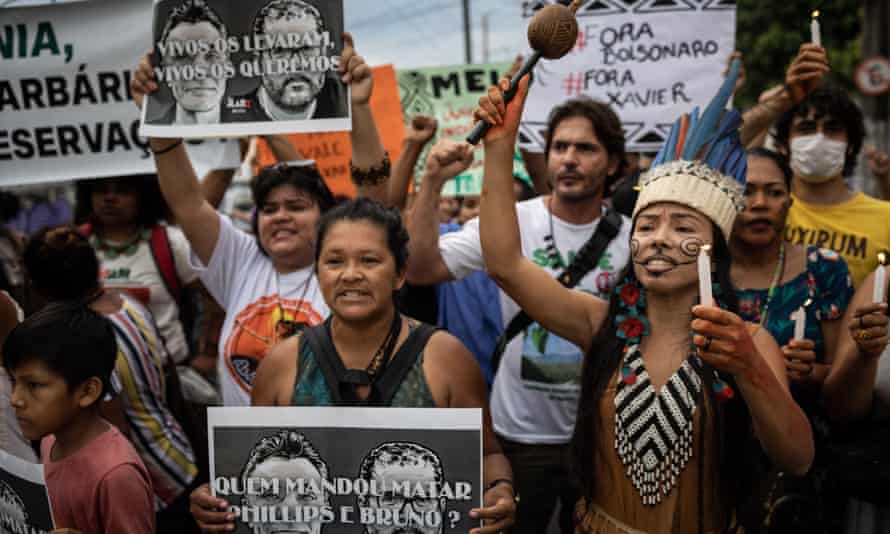
In Atalaia do Norte, Eliseio Marubo, an Indigenous lawyer and close friend of Pereira said: “I feel an indescribable pain because I have lost a brother, I have lost part of my story.”

Tears rolling down his cheeks, Marubo sent a message to the families of the two men who had both sought to champion the Indigenous cause. “You are not alone,” he said. “We will march on together.”
Demonstrators light candles in front of the headquarters of the National Indian Foundation (FUNAI), during a protest against the disappearance of Bruno Pereira and Dom Phillips. Photograph: Raphael Alves/EPA

Phillips, 57, and Pereira, 41 went missing on 5 June, at the end of a four-day trip down the Itaquaí river in the far west of Brazil.

Pereira was accompanying Phillips on a reporting trip for a book about sustainable development in the Amazon but their boat did not arrive as scheduled at Atalaia do Norte, not far from Brazil’s border with Peru.


The writer and the activist: how Dom Phillips and Bruno Pereira bonded over the Amazon


However, when Pereira’s friends raised the alarm, Brazilian authorities were slow to respond and it was the Indigenous communities that made the first unsettling discovery on Saturday when they found rucksacks, clothing and personal items belonging to the two men.

Police detained one man on Wednesday, Amarildo da Costa de Oliveira, and six days later they arrested his brother Oseney and charged him with “alleged aggravated murder”. One of the men gave police the testimony that lead to the gruesome find.

The investigation was dogged by setbacks, from the sluggish response of the army and navy search teams, to the heavily criticised actions of the Brazilian embassy in London, who told Phillips’ family in the UK that his body had been found, only to retract the statement later.

It also comes amid widespread criticism of Brazil’s policies on the environment and the estimated 235 Indigenous tribes living in Brazil.

Deforestation has soared under Bolsonaro, and government agencies devoted to protecting the environment and Indigenous communities have been undermined.

Pereira was a senior figure in the state Indigenous foundation charged with protecting Indigenous communities but was removed from office in late 2019 after he led an operation to destroy illegal mines operating on Indigenous land.

He later began working with Indigenous rights organisations in remote areas of the rainforest to help them map their territories and protect them from invasions by miners, loggers, and drug-traffickers active in the area.

Late on Wednesday, Brazil’s former president Luiz Inácio Lula da Silva said in a statement that Wednesday’s news had prompted “pain and indignation” and linked the crime to the dismantling of policies to protect Indigenous people.

“Democracy and Brazil can no longer tolerate violence, hatred and contempt for the values ​​of civilisation,” he said. “Bruno and Dom will live in our memory – and in the hope of a better world”.

A crowdfunding campaign has been launched to support the families of Dom Phillips and Bruno Pereira. Donate here in English or here in Portuguese.

Australia submits more ambitious 2030 emissions target to UN

Despite being ravaged by floods, fires and droughts, Australia has long been seen as a laggard on climate action
Despite being ravaged by floods, fires and droughts, Australia has long been seen as a
 laggard on climate action.

Australia's new center-left government submitted more ambitious emissions targets to the United Nations Thursday, seeking to end a decade of footdragging on climate change.\

Prime Minister Anthony Albanese raised the country's 2030 emissions reduction target to 43 percent, up from a more modest previous target of 26-28 percent.

The new goal "sets Australia up for a prosperous future, a future powered by cleaner, cheaper energy," Albanese said.

Despite being ravaged by floods, fires and droughts, Australia has long been seen as a laggard on climate action.

The vast continent-country is replete with fossil fuel deposits and is one of the world's top exporters of coal and gas.

Coal still plays a key role in domestic electricity production.

In 2022, MIT ranked Australia 52nd of 76 nations on its Green Future Index, which rates how much countries are shifting towards an environmentally sustainable economy.

The 'climate wars'

But Albanese made emissions cuts a centerpiece of his recent election campaign and pledged to "end the climate wars" that led to decades of policy stasis.

Albanese sought to frame the decision as an economic boon: "What business has been crying out for is investment certainty," he said.

The Business Council of Australia welcomed the raised targets, saying they "should be a line in the sand."

"Australia can't afford to stall progress again because failure will see Australians miss out on new opportunities, new industries and better jobs," the council's chief executive Jennifer Westacott said.

'Seize the opportunity'

Albanese said Thursday that world leaders had "all welcomed Australia's changed position" on  during his conversations with them since taking power last month.

The issue of emissions reduction and fossil fuel exports was a key point of tension between Australia's previous government and Pacific leaders, who have labelled  the greatest threat to their region.

Albanese tried to sidestep criticism that higher targets could harm Australian jobs saying he wanted to "seize the opportunity that is there from acting on  change".

The new targets would give business the certainty it needed to "invest over a longer time frame than the political cycle of three years," he said.

But he has so far refused to set a deadline for phasing out coal, in line with other .

Even before the announcement, Australia's fossil fuel industry was in flux with many major companies seeking to decarbonise their operations.

On Wednesday, global miner BHP announced it had been unable to find a buyer for its  in the Australian state of New South Wales and would instead close the project by 2030.

The news came just a day after fossil fuel giant BP announced it would take out a 40.5 percent stake in a renewables project in Australia, billed as the largest power station on earth.

Anja-Isabel Dotzenrath, BP's executive vice president of gas and low carbon energy, said the company believed that "Australia has the potential to be a powerhouse in the global energy transition".Time's up: why Australia has to quit stalling and wean itself off fossil fuels

© 2022 AFP

Protests spread in India over new military recruitment system


Protest against "Agnipath scheme" in Jehanabad

Thu, June 16, 2022
By Saurabh Sharma and Jatindra Dash

LUCKNOW, India (Reuters) -Angry crowds in India set an office of the country's ruling party on fire, attacked railway infrastructure and blocked roads on Thursday, in widening protests against a new military recruitment system, police officials said.

Prime Minister Narendra Modi's government this week announced an overhaul of recruitment for India's 1.38 million-strong armed forces, looking to bring down the average age of personnel and reduce pension expenditure.

But potential recruits, military veterans, opposition leaders and even some members of Modi's ruling Bharatiya Janata Party (BJP) have raised reservations over the revamped process.

In eastern India's Bihar state, where protests have flared in around a dozen locations, thousands gathered in Nawada city to demonstrate against the new recruitment system, police official Gaurav Mangla said.

"They torched a BJP office, torched tyres in three prominent areas of the city, damaged a bus and many private vehicles," Mangla told Reuters.

Protesters also attacked railway property across Bihar, settling alight coaches in at least two locations, damaging train tracks and vandalising a station, according to officials and a railways statement.

Police said protests also took place in northern Haryana state and western Rajasthan - both traditional recruiting areas for the Indian military.

The new recruitment system, called Agnipath or "path of fire" in Hindi, will bring in men and women between the ages of 17-and-a-half and 21 for a four-year tenure, with only a quarter retained for longer periods.

Previously, soldiers have been recruited by the army, navy and air force separately and typically enter service for up to 17 years for the lowest ranks.

The shorter tenure has caused concern among potential recruits.

"Where will we go after working for only four years?" one young man, surrounded by fellow protesters in Bihar's Jehanabad district, told Reuters partner ANI. "We will be homeless after four years of service. So we have jammed the roads."

Smoke billowed from burning tyres at a crossroads in Jehanabad where protesters shouted slogans and performed push-ups to emphasise their fitness for service.

Bihar and neighbouring Uttar Pradesh saw protests over the recruitment process for railway jobs in January this year, underlining India's persistent unemployment problem.

Varun Gandhi, a BJP lawmaker from Uttar Pradesh, in a letter to India's defence minister Rajnath Singh on Thursday said that 75% of those recruited under the scheme would become unemployed after four years of service.

"Every year, this number will increase," Gandhi said, according to a copy of the letter posted by him on social media.

(Writing by Devjyot Ghoshal;Editing by Andrew Cawthorne, William Maclean)