Thursday, June 16, 2022

#LEGALIZEALLDRUGS
'The power of cannabis': Japan embraces CBD despite drug taboo


Tomohiro OSAKI, Katie Forster
Thu, June 16, 2022, 


With its zero-tolerance cannabis laws, deep social stigma against the drug and moves to tighten rules on consumption, Japan is no stoner's paradise.

But you wouldn't guess it watching Ai Takahashi and her friends twerking, body-rolling and lighting up to the weed anthem "Young, Wild & Free" at a tiny, packed club in Tokyo.

What they're smoking isn't illegal marijuana, but a joint containing cannabidiol (CBD) -- a non-intoxicating component of cannabis that has become trendy worldwide and is fast catching on in Japan.

"When I was a child, I was taught at school and everywhere else that marijuana is an absolute no-no, and that's what I believed too," Takahashi told AFP.


"But being a huge reggae fan, I had a chance to smoke it when I travelled to places where it's legal."

The 33-year-old dancer later became interested in CBD, which is legal in Japan if extracted from the plant's seeds or fully-grown stems, but not other parts like the leaves.

It is sold in vapes, drinks and sweets at specialist cafes, health stores, and even a shop in Tokyo's main airport.


When Takahashi encouraged her mother, who was struggling with depression, to try CBD, it made a big difference, she said.

"That's when I became convinced of the power of cannabis."

Japan's CBD industry had an estimated value of $59 million in 2019, up from $3 million in 2015, says Tokyo-based research firm Visiongraph.

And the government is discussing approving medicines derived from marijuana, already used in many countries to treat conditions like severe epilepsy.

But despite its budding interest in the plant's health benefits, the country is not getting softer on illegal use, with cannabis arrests hitting records each year.
- 'Don't smoke outside' -

It's a curious contrast that has led Norihiko Hayashi, who sells products containing cannabinoids like CBD and CBN in sleek black and silver packaging, to advise discretion.

"It's legal, but we ask customers to enjoy it at home. Don't smoke it outside on the street," the 37-year-old said.

Hayashi thinks Japan could eventually legalise marijuana for medical purposes.

But recreational? "Never. Not in more than 100 years. Maybe I'll already be dead."


A growing number of countries from Canada to South Africa and most recently Thailand are taking a more relaxed approach to weed.

But drug use remains taboo in Japan, where celebrities caught using narcotics of any description are shunned by their fans and employers.

Just 1.4 percent of people say they have tried marijuana, compared to more than 40 percent in France and around half in the United States.

Even so, cannabis-related arrests have been rising for nearly a decade to a record 5,482 last year, with most offenders in their teens or 20s.

"The internet is awash with false information saying cannabis isn't harmful or addictive," health ministry official Masashi Yamane told AFP.

The ministry warns that intoxicating substances like THC, found in cannabis, could compromise learning ability and muscle control as well as potentially increase the risk of mental illness.
- 'Draconian' -

To tackle the issue, authorities are looking into closing a loophole originally meant to stop farmers from being arrested for inhaling psychoactive smoke when growing hemp for items like rope.

It means consumption of marijuana is technically legal in Japan, although possession is punishable by up to five years in jail.

This rises to seven years and a possible fine of up to two million yen ($15,000) if it's to sell for profit, with stricter sentences for growing or smuggling.

Japan's Cannabis Control Act was introduced in 1948, during the post-war US occupation.


The United States "saw marijuana as a problem and a threat, even though consumption was really limited and very much stigmatised," said Miriam Kingsberg Kadia, a University of Colorado history professor who studies narcotics in Japan.


So "these draconian drug laws against a drug that wasn't really a problem remained on the books," she told AFP.

The rules have ensnared stars including Beatle Paul McCartney, who spent nine days in detention in Japan in 1980 after cannabis was found in his baggage.

But the country is not an outlier in Asia, where tough penalties for drug use are the norm, although Thailand now allows users to possess and grow cannabis under complicated new guidelines that still outlaw recreational use.

And while Japan could allow cannabis-derived medicines as soon as this year, there's little sign that politicians or the public back further relaxation of the rules.

"Marijuana is seen as something favoured by outlaws," said Ryudai Nemoto, a 21-year-old employee at a CBD shop in Ibaraki near Tokyo.

"I personally don't see it that way, knowing there are people who gravitate towards it for medical and health reasons, but that's not how general society views it."

kaf-tmo/ssy/oho
Australia's new climate promise meets mining reality


AFP - 

Flood, fire and drought-battered Australia is trying to clean up its act on climate change, but dependence on fossil fuel riches could stymie the national makeover.

Centre-left Prime Minister Anthony Albanese swept to power in May promising weary Australians that he would tackle climate change.

He followed through on a key plank of that promise Thursday, nearly doubling the country's 2030 emissions reduction target to 43 percent.

Albanese faces a thorny dilemma: Australians want real steps to slow global heating, but they live in a country that depends on exporting the fossil fuels that cause it.

Australia's emissions -- while high per person -- account for just over one percent of global emissions.

Much more significant are the fossil fuels dug up in Australia and burned overseas.

Estimates differ, but these could account for anywhere between three and five percent of global emissions, making Australia one of the world's largest carbon polluters.

Another beneficiary of the May election wants to put an end to that.

"You don't end the climate wars by opening up new coal and gas mines," said Australian Greens leader Adam Bandt, whose party now holds the balance of power in the Senate and wants radical energy reform in return for working with the government.

The sticking point for the Greens, Bandt told AFP, was that the government had pledged support for 114 new coal and gas projects already in Australia's investment pipeline.

Modelling by the Greens found these projects would more than double Australia's emissions.

"None of these new projects the government wants to open are factored into their climate modelling," Bandt said.

- Wilder climate -

First discovered in 1791, Australia's vast coal deposits make it the world's second-largest exporter.

It is also one of the top exporters of gas -- mostly natural gas and gas exploited from coal seams.


Related video: How the planned 'hydrogen hub' in SA could help Australia's gas crisis (Dailymotion)

Fossil fuels account for about a quarter of Australian exports, with most destined for Japan, China and South Korea, according to Reserve Bank of Australia analysis.

Domestically, about 70 percent of electricity comes from coal and gas, according to official figures.

Given the economic sensitivities, the Albanese government has so far dodged calls to set a deadline for withdrawal from the sector, arguing international markets will decide when coal is no longer viable.

The approach may quell dissent from the coal and gas industry, used to getting its way after a decade of conservative governments.

But it could cause economic turmoil, with central bank analysts warning coal demand could fall by up to 80 percent by the middle of the century, leaving "stranded assets" that cannot be sold.

Already the strains are starting to show.

Mining giant BHP on Thursday announced it had been unable to sell its coal assets in the populous state of New South Wales.

The country's largest energy producer and carbon emitter AGL is also facing an uncertain future.

When AGL tried to split off the most polluting parts of its business, green-minded tech billionaire Mike Cannon-Brookes sought to buy the company to stop the plan.

His bid was rejected, but Cannon-Brookes successfully lobbied fellow investors to block the demerger, arguing it would hurt shareholders and delay coal-fired power station closures.

Greenpeace Australia's chief executive David Ritter said AGL's experience was a lesson to listen to the call for climate action.

"Every corporation that makes the same mistakes can expect to also run into real turbulence very, very quickly," he told AFP.

This turbulence will come from activists, but also from the Australian public who have seen first-hand how a wilder climate can turn on them.

- After the 'Black Summer' -

Australia's 2019-20 "Black Summer" bushfires scorched 24 million hectares of land, cloaked cities in smoke, and killed more than 30 people along with an estimated tens of millions of wild animals.

In the two subsequent years, dramatic floods swamped Australia's east coast, this year killing more than 20 people as waters reached rooftops and torrents swept cars off roads.

Before the bushfires, veteran firefighter Greg Mullins tried to warn the government it was not prepared for the infernos to come.

For 14 years, Mullins had led the fire service in Australia's largest state, New South Wales, and he was joined by other retired emergency services leaders in sounding the alarm that climate change had dramatically escalated the fire threat.

"It was all political. Because we mentioned climate change, they just locked us out," he told AFP.

He and fellow members of Emergency Leaders for Climate Action are calling for far more ambitious emissions cuts -- 75 percent by 2030.

"We've lost the last decade of climate action, they've got to do a lot of catching up," he said.

mmc-djw-arb/axn/oho
Birthplace of Saudi state becomes tool for 'new nationalism'

AFP - 
Saudi tour guide Nada Alfuraih ushers guests through an 18th-century palace built from mud and straw, the very site where the kingdom's royal family is said to have first plotted its conquest of the Arabian Peninsula.


© Fayez Nureldine Alfuraih displays a model of the site, the birthplace of the Saudi Arabian state

Pausing in an airy assembly hall, she raves about this aspect of her country's origin story. Her only regret is that today, nearly 300 years later, some young Saudis seem unaware of it.

"I meet visitors who have no clue. They must have skipped this part of their education or something," she told AFP.

Later this year, the restored palace, in the historic district of Diriyah on the outskirts of the Saudi capital Riyadh, will open to the public for the first time.

Analysts say it is part of a larger effort by Crown Prince Mohammed bin Salman -- who was made first in line to the throne five years ago next week -- to both stoke Saudi nationalism and reframe Saudi history.

Exhibits dotted throughout the palace spotlight the Al-Saud family's achievements going back well before the kingdom's official founding in the 1930s.

At the same time, they make no mention of its partnership with Mohammed bin Abdul Wahhab, the fiery cleric who lived nearby and championed a purist form of Islam known as Wahhabism. That storied alliance has long fuelled the kingdom's hard-line image.


© Fayez NureldineVenues in Diriyah have already hosted concerts and the 2019 "Clash on the Dunes" heavyweight boxing match between Anthony Joshua and Andy Ruiz

Instead, the new Diriyah features attractions more in line with Prince Mohammed's vision of a modern Saudi Arabia opening up to the world: fine dining, art galleries –- even a Formula-E race track.

"Diriyah perfectly encapsulates the new Saudi nationalism," said Kristin Diwan of the Arab Gulf States Institute in Washington, who has studied its development.

"It puts the Al-Saud front and centre as the primary authors of Saudi history and architects of Saudi unity, while erasing Mohammed bin Abdul Wahhab from the national narrative."

She added: "The change isn't subtle, it's really in your face."

- Defining a dynasty -

While the country that bears the Al-Saud name is just 90 years old, the family dynasty traces its origins to the 1700s.


© Fayez NureldineI nzerillo, hired to bring the new Diriyah to life, dismissed the idea that fundamentalist preacher Mohammed bin Abdul Wahhab, co-founder of the Saudi state, is being written out of history

Diriyah was the family's original power base and the place where, in 1744, it sealed its pact with Abdul Wahhab, whose doctrine spread through the power of the sword.

Rapid expansion followed, but the family would be toppled twice before Abdul Aziz bin al-Saud established the current Saudi state, declaring himself king in 1932.

Oil was struck six years later, eventually transforming the kingdom into one of the world's richest nations.

Through it all, historical ties with Abdul Wahhab conferred legitimacy on the rulers of a country that boasts Islam's two holiest sites, Mecca and Medina.

When Prince Mohammed's father, King Salman, first showed interest in redeveloping Diriyah in the 1970s, he "preserved a place, albeit reduced, to commemorate" the cleric, Diwan said.

But Prince Mohammed, now Saudi Arabia's de facto ruler, has overseen a sidelining of religious authorities, most prominently the stick-wielding religious police who used to chase men out of malls to pray.


© FAYEZ NURELDINE The Bujairi area where Abdul Wahhab once lived, pictured here in 2015, has been transformed into an upscale dining district

As for Diriyah, he "sees it as a global attraction", Diwan said. "And in his programme of arts biennales, world wrestling and raves, Wahhabism doesn't easily co-exist."

- A Saudi 'Acropolis'? -

The man hired to bring this new Diriyah to life is Jerry Inzerillo, an entertainment executive from Brooklyn who had a cameo in the 2006 James Bond film "Casino Royale".


© Fayez Nureldine
Exhibits spotlight the Al-Saud family's achievements

In an interview with AFP, Inzerillo talked up Diriyah's potential, saying it could be for Saudis what the Acropolis is for Greeks and the Colosseum is for Italians.

"There was a generation that said, 'Oh, it's just a bunch of mud houses and that's not our future,'" he said.

"But this king believes that the national identity and the ongoing source of pride has got to be in a rich Saudi past."

The same thinking, he said, was behind a new Founding Day holiday inaugurated in February that honours the Al-Saud family's Diriyah-era leaders.

Asked about Prince Mohammed's role, Inzerillo said he "approves every rendering" of Diriyah and had personally spent up to 30 hours painstakingly reviewing its street layout.

Inzerillo dismissed the idea that Abdul Wahhab was being written out of history, saying "there will be a celebration of him" along with other imams.

Yet opposite the old palace, the Bujairi area where Abdul Wahhab once lived has been transformed into an upscale dining district -- just one of many entertainment highlights.

A restored version of Abdul Wahhab's original mosque is still open on the site but a research centre, built about seven years ago and devoted to his branch of Islam, is not.

The palace itself features zones for historical re-enactment, sword-dancing, falconry and horse shows.

Elsewhere in Diriyah, venues have already hosted concerts by Pitbull and the Swedish House Mafia and the 2019 "Clash on the Dunes" heavyweight boxing match between Anthony Joshua and Andy Ruiz.

Developers have been mindful not to turn Diriyah into "a theme park", Inzerillo said, though he added that, in his view, heritage and entertainment are "highly compatible".

"Diriyah 300 years ago had music. It had the best musicians in the area. It had art, it had painters... What happens is that if a society is going to be fulfilled and happy, it has to be entertained," he said.

"There's not a vulgarity to entertaining."

rcb/th/dv/it
The landmines sowing tragedy, chaos in war-torn Yemen


AFP - 

Mourad al-Marouai was just nine when a landmine killed him on a beach in war-torn Yemen, a tragedy that will haunt his family forever.

After a swim, the little boy "suddenly disappeared" when he and his two brothers were beach-combing for garbage to sell.

"All I saw were hands and legs," elder brother Yahya, 15, told AFP, clasping the rosary that Mourad had found in the sand and given to him.

The chilling incident in January, in the western province of Hodeida, is all too common in Yemen, where mines are a constant threat and hobble economic activity and aid.

Mourad's father, Ahmed, is left grappling with the wrenching memory of his son's remains scattered across the ground.

"I will never forget the sight of birds pecking at my son's flesh as we waited for help to arrive," the 50-year-old told AFP.

"I could not wash him or wrap him in a shroud (according to Muslim tradition). I just buried pieces of him in a plastic bag."

Landmines are part of the legacy of the war in Yemen, long the Arab world's poorest country, where Iran-backed Huthi rebels have been fighting a Saudi-led coalition since 2015.

Hundreds of thousands have died, directly from fighting as well as indirectly, and millions have been displaced in what the UN calls the world's worst humanitarian crisis.

And despite a truce since April that has drastically reduced clashes, stark dangers remain.

This month, the UN said 19 civilians had been killed and 32 injured during the truce, mostly by landmines, home-made bombs and other ordnance.

According to the UN-linked Civilian Impact Monitoring Project, landmines, unexploded shells and other explosive detritus were responsible for 338 civilian casualties in 2021, including 129 fatalities.


© AHMAD AL-BASHA
Jamila Qassem Mahyoub, a Yemeni woman whose legs were amputated after stepping on a landmine while herding her sheep in 2017, leaves her house to go to her shop in the city of Taez on March 20, 2019

They are among victims caused every day around the world by landmines, the United Nations says.

- 'They were all dead' -


Almost a third of Yemen's landmine casualties were reported in Hodeida province, even though it has been spared much of the fighting after a 2018 ceasefire agreement aimed at protecting its Red Sea port, a lifeline for the country.


© KARIM SAHIBA 
Yemeni child whose legs were amputated after a landmine injury plays in the city of Aden on August 9, 2018 during a trip in Yemen organised by the UAE's National Media Council

Hodeida province is "a strategic centre" for the north, which is largely controlled by the Huthi rebels, said Ibrahim Jalal, a researcher at the Middle East Institute in Washington.

"The indiscriminate spread of landmines across multiple Yemeni governorates creates dozens of victims every day, including farmers, travellers and other civilians," he told AFP.

"People are living under numerous uncertainties," he said, explaining that mines complicate the transport of aid and take a heavy toll on the agriculture-dependent economy.

Experts estimate that at least one million mines have been planted during Yemen's years of turmoil, often with tragic results.

In March, Abdou Ali, 23, was in the car with his brother, son and nephews, heading to Hodeida city.

On their way, they passed by their hometown, which they had fled because of fighting, and decided to check to see if it was safe for them to move back.

Abdou refused. He got out of the car and left them to go without him.

"It hadn't been five minutes before I heard a loud explosion. I ran towards the sound, and I heard people talking about a car going over a landmine. I was terrified and prayed it wasn't them.

"But very soon, I discovered it was them and that they were all dead."


© SALEH AL-OBEIDI
A landmine explodes as Yemeni loyalist forces patrol an area near the Red Sea port town of Mocha on January 20, 2017

ste-aem/dm/th/fz/it
In Yemen, BOY child soldiering continues despite Houthi promise

By SAMY MAGDY

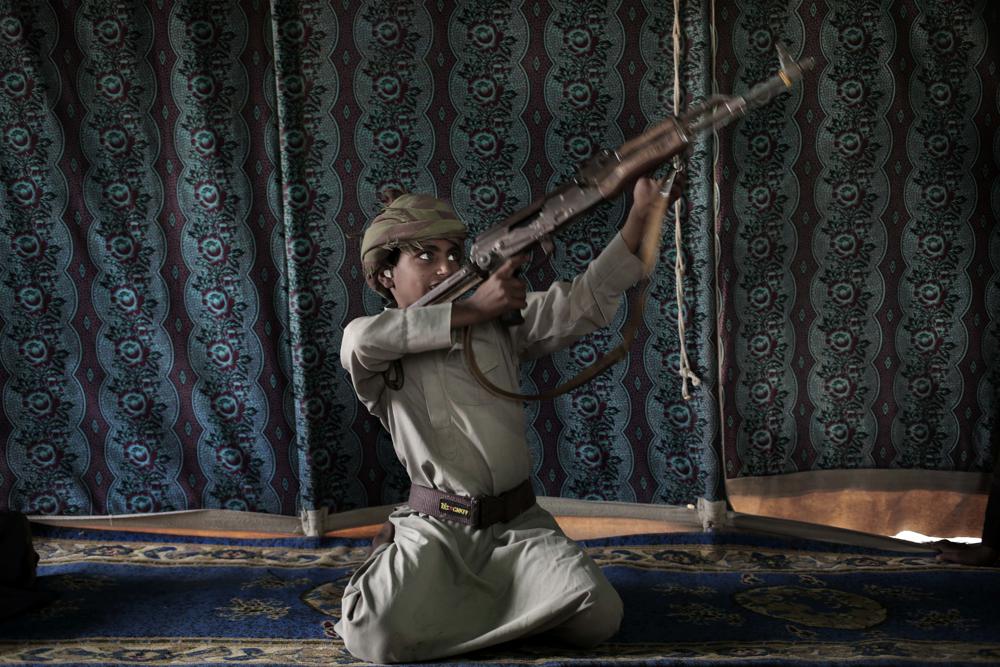
Kahlan, a 12-year-old former child soldier, demonstrates how to use a weapon, at a camp for displaced persos where he took shelter with his family, in Marib, Yemen, July 27, 2018. Yemen’s Houthi rebels continue to recruit children into their military ranks to fight in the country’s civil war, despite an agreement with the U.N. in April 2022, to halt the practice. Two Houthi officials acknowledged to the Associated Press that the rebels have recruited several hundred children, some as young as 10, in the past two months. (AP Photo/Nariman El-Mofty, File)


CAIRO (AP) — Yemen’s Houthi rebels are still recruiting children into their military ranks to fight in the country’s grinding civil war, despite an agreement with the United Nations in April to halt the practice, Houthi officials, aid workers and residents told The Associated Press.

Two Houthi officials told the AP that the rebels recruited several hundred children, including those as young as 10 years over the past two months. They have been deployed to front lines as part of a buildup of forces taking place during a U.N.-brokered truce, which has held since April, one official said.

The officials, both hard-liners within the Houthi movement, said they see nothing wrong with the practice, arguing that boys from 10 or 12 are considered men.

“Those are not children. They are true men, who should defend their nation against the Saudi, American aggression, and defend the Islamic nation,” one of them said. The two spoke on condition of anonymity to avoid friction with other Houthi leaders.

The Houthis have used what they call “summer camps” to disseminate their religious ideology and to recruit boys to fight. Such camps take place in schools and mosques around the Houthi-held part of Yemen, which encompasses the north and center of the country and the capital, Sanaa.

Yemen’s conflict erupted in 2014 when the Houthis descended from their northern enclave and took over Sanaa, forcing the internationally recognized government to flee to the south. A Saudi-led coalition entered the war in early 2015 to try to restore the government to power, waging a destructive air campaign and arming anti-Houthi forces.

The war has killed more than 150,000 people, including more than 14,500 civilians and has plunged the country into near-famine, creating one of the world’s worst humanitarian crises.


Child soldiers have been involved in Yemen’s war for years. Nearly 2,000 Houthi-recruited children were killed on the battlefield between January 2020 and May 2021, according to U.N. experts. Pro-government forces have also used child fighters but to a much lesser degree and have taken greater measures to halt the practice, according to U.N. and aid officials.

Overall, the U.N. says over 10,200 children have been killed or maimed in the war, though it is unclear how many may have been combatants.


In April, the rebels signed what the U.N. children’s agency described as an “action plan” to end and prevent the practice. U.N. spokesperson Stephane Dujarric said the rebels committed to identifying children in their ranks and releasing them within six months.

UNICEF did not respond to requests for comment on the continued recruitment since, nor did spokesmen for the Houthi administration. The Houthis have in the past officially denied enlisting children to fight.

In early June, a high-ranking Houthi, Mohammed al-Bukhaiti, posted a video from a visit he paid to one of the camps in Dhamar province. It shows dozens of children in uniforms standing in a military-like formation and declaring allegiance to rebel movement’s top leader, Abdul-Malek al-Houthi.

“Soldiers of God,” they shout. “We are coming.”

Four aid workers with three international organizations operating in rebel-held areas said they observed intensified Houthi efforts to recruit children in recent weeks. The Houthis’ ranks have been thinned because of battlefield losses, especially during a nearly two-year battle for the crucial city of Marib.

The aid workers spoke on condition of anonymity, fearing for their safety, and said their groups could be barred from working in Houthi-held territory. They said the rebels have pressured families to send their children to camps where they learn how to handle weapons and plant mines, in return for services, including food rations from international organizations.

One aid worker who operates in remote northern areas described watching children as young as 10 manning checkpoints along the road, with AK-47s hanging on their shoulders. Others are sent to the front line. He said children have returned wounded from fighting at Marib.

Thousands of fighters were killed in the battle for government-held Marib. The Houthis’ long attempt to capture it was finally stopped in late 2021, when government forces were bolstered by better-equipped fighters backed by the United Arab Emirates.

Abdel-Bari Taher, a Yemeni commentator and former head of the country’s Journalists’ Union, said that the Houthis are exploiting local customs to the children’s and society’s detriment. Having or carrying a weapon is a tradition deeply rooted in Yemen, especially in rural and mountainous communities, he said.

“It is a source of pride and kind of manhood for the boys,” he said.

The Houthis also condition crucial food aid on children attending the training camps, some say.

Two residents in Amran province said Houthi representatives came to their homes in May and told them to prepare their children for camps at the end of the school year. The residents, who are farmers, spoke on condition of anonymity for fear of reprisals.

They said their five children, aged between 11 and 16, were taken in late May to a training center housed in a nearby school. One father said he was told that if he didn’t send his children, his family would no longer receive food rations.

The U.N. panel of experts said earlier this year that the Houthis have a system to indoctrinate child soldiers, including using humanitarian aid to pressure families.

Children are taken first to centers for a month or more of religious courses. There, they are told they are joining a holy war against Jews and Christians and Arab countries that have succumbed to Western influence. Seven-year-olds are taught weapons cleaning and how to dodge rockets, the experts found.
FIFA reveals host cities for 2026 World Cup; 11 venues in U.S. 3 in Mexico, 2 in Canada


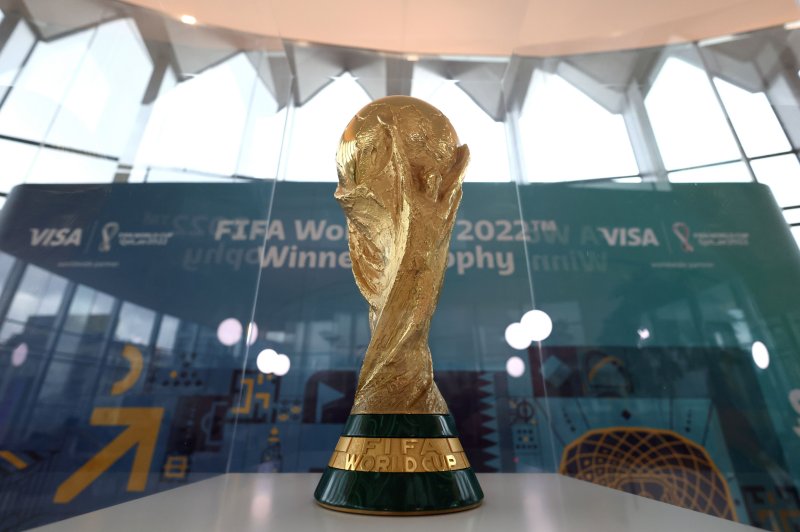
The FIFA World Cup Qatar 2022 Winner's Trophy sits on display Feb. 22, 2022, in Warsaw, Poland. File Photo by Leszek Szymanski/EPA-EFE


June 16 (UPI) -- FIFA on Thursday announced the 16 cities in North America that will host matches for the 2026 World Cup, with 11 venues selected in the United States, three in Mexico and two in Canada.

The 2026 World Cup will be the first tournament hosted by three different countries, and it also will be the first to expand from 32 teams to 48 in the competition.

The U.S. cities officially selected to host World Cup matches in 2026 are: New York/New Jersey (MetLife Stadium); Los Angeles (SoFi Stadium); Dallas (AT&T Stadium); San Francisco Bay Area (Levi's Stadium); Miami (Hard Rock Stadium); Atlanta (Mercedes-Benz Stadium); Seattle (Lumen Field); Houston (NRG Stadium); Philadelphia (Lincoln Financial Field); Kansas City, Mo. (Arrowhead Stadium); and Boston (Gillette Stadium).

The Rose Bowl, which hosted the 1994 World Cup final, wasn't chosen as a venue, with Los Angeles' newer SoFi Stadium being selected instead. With the Rose Bowl not selected, none of the U.S. venues from the 1994 men's World Cup will be used for the 2026 tournament.

"It was the most competitive process ever for the FIFA World Cup," FIFA President Gianni Infantino told Fox Sports about the selection process. "We will be working in clusters, making sure that the teams and the fans don't have to travel too much in different areas: West, Central and East."

The cities and venues chosen to host World Cup matches in Mexico and Canada are: Guadalajara (Estadio Akron); Monterrey (Estadio BBVA Bancomer); Mexico City (Estadio Azteca); Toronto (BMO Field); and Vancouver (BC Place).


In total, 60 games are set to be played in the U.S. for the tournament, while Mexico and Canada each will have 10 matches. Once the event reaches the quarterfinal stage, all remaining knockout round games will be staged in the U.S.

'Dual robot' drone can fly and dive to monitor water quality


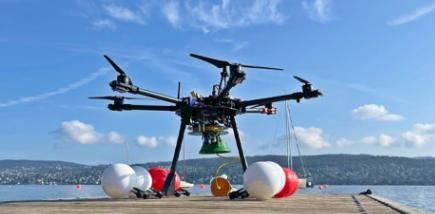
A new "dual robot" drone called MEDUSA can fly and dive to collect data on water quality in hard-to-reach areas like the Arctic. 
Photo courtesy of Aerial Robotics Lab/Imperial College London.

June 14 (UPI) -- A new "dual robot" drone that can fly and dive has successfully collected underwater samples to track water quality changes in hard-to-reach areas.

The drone, which was developed at Imperial College London and called MEDUSA or Multi-Environment Dual robot for Underwater Sample Acquisition, can fly and land on water while dropping a camera with sensors more than 33 feet deep to collect data and samples.

"MEDUSA is unique in its dual robot design, with a flight component that reaches difficult-to-access areas and a diving component that monitors water quality," said Mirko Kovac, department of aeronautics professor at Imperial College London. "Our drone considerably simplifies robotic underwater monitoring by performing challenging tasks which would otherwise require boats."

The drone was recently tested in laboratories and in field experiments on Lake Zurich in Switzerland.


Scientists plan to use the dual drone in areas inaccessible by boat to test waters for signs of microorganisms and algae blooms, which pose hazards to humans and animals. Researchers say the drone could also be used to maintain offshore infrastructure like underwater energy pipelines, as well as to measure temperature and salinity changes in the Arctic for global climate clues.

"We have much to learn about the Earth's water by monitoring ecological parameters we can identify trends and understand the factors affecting water quality and the health of the ecosystem in a changing climate," Kovac said.

MEDUSA is able to travel long distances with heavy payloads to reach remote water environments, such as the Arctic, and bring back data. While the aerial drone design is an industry standard, the underwater component is new.


"MEDUSA's unique ability to reach difficult places and collect aquatic images, samples and metrics will be invaluable for ecology and aquatic research and could support our understanding of local climate in difficult-to-access environments like the Arctic," Kovac said.
Juno diamond sells for $12.9M in Sotheby's New York auction


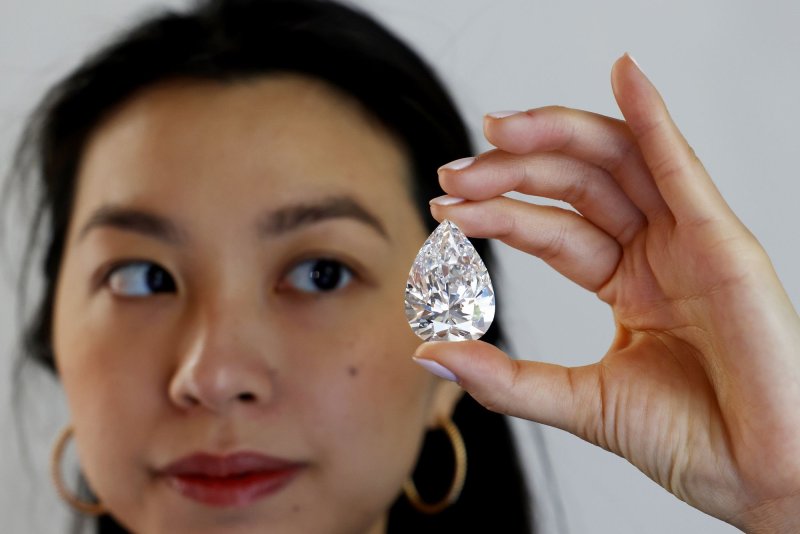
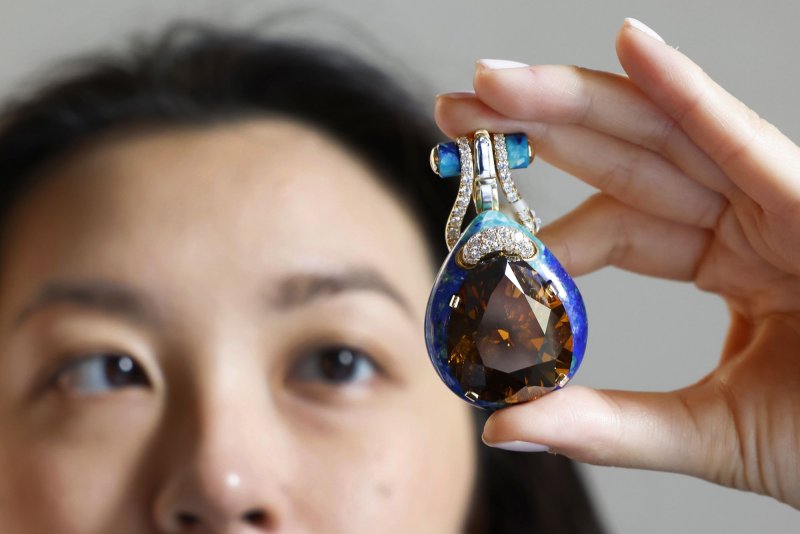
"The Juno" Diamond is held as one of two 100+ Carat Diamonds leading Sotheby's Magnificent Jewels auction at Sotheby's on Wednesday, June 8, 2022 in New York City. 
Photo by John Angelillo/UPI | License Photo

June 16 (UPI) -- The 100-plus carat Juno diamond was auctioned Thursday in New York by Sotheby's, bringing in over $12.9 million. The Earth Star, an orange-brown diamond of 111.59 carats, was expected to bring as much as $2.5 million.

The Juno diamond is a 101.41 carat pear-shaped internally flawless diamond named for the Roman goddess of light and fertility. According to Sotheby's, less than 2% of all gem diamonds are in the Juno diamond's category.


Another view of the "The Juno" Diamond, one of two 100+ Carat Diamonds leading Sotheby's Magnificent Jewels auction in New York City. 
Photo by John Angelillo/UPI | License Photo

"The appearance of a 100-carat perfect diamond at auction is a noteworthy event. Only twelve D color, Flawless or Internally Flawless diamonds have sold at auction since 1990, and Sotheby's has had the privilege of selling seven of these important stones," said a post on Sotheby's web site.


"The Earth Star" Diamond is one of two 100+ Carat Diamonds leading Sotheby's Magnificent Jewels auction at Sotheby's in New York City. 
Photo by John Angelillo/UPI | License Photo

"Just a handful of diamonds over 100 carats have ever been offered at auction," said Quig Bruning, head of jewelry for Sotheby's Americas. "The fact that we have two in one sale is rare beyond rare."

The Earth Star, a 111.59 carat deep orange-brown diamond, was on sale for the first time in four decades.

The Earth Star" Diamond shown at Sotheby's Magnificent Jewels auction at Sotheby's in New York City June 8, 2022. 
Photo by John Angelillo/UPI | License Photo

According to Barron's, the Earth Star is listed in the book "Famous Diamonds" by Lord Ian Balfour and was originally a 248.9-carat rough diamond found in in South Africa in 1967.

Both the Juno and Earth Star are approximately the size of a small egg, according to Sotheby's.


"The Juno" Diamond, one of two 100+ Carat Diamonds leading Sotheby's Magnificent Jewels auction at Sotheby's seen Wednesday, June 8, 2022 in New York City. 
Photo by John Angelillo/UPI | License Photo
Revlon, beauty icon in crowded market, files for bankruptcy


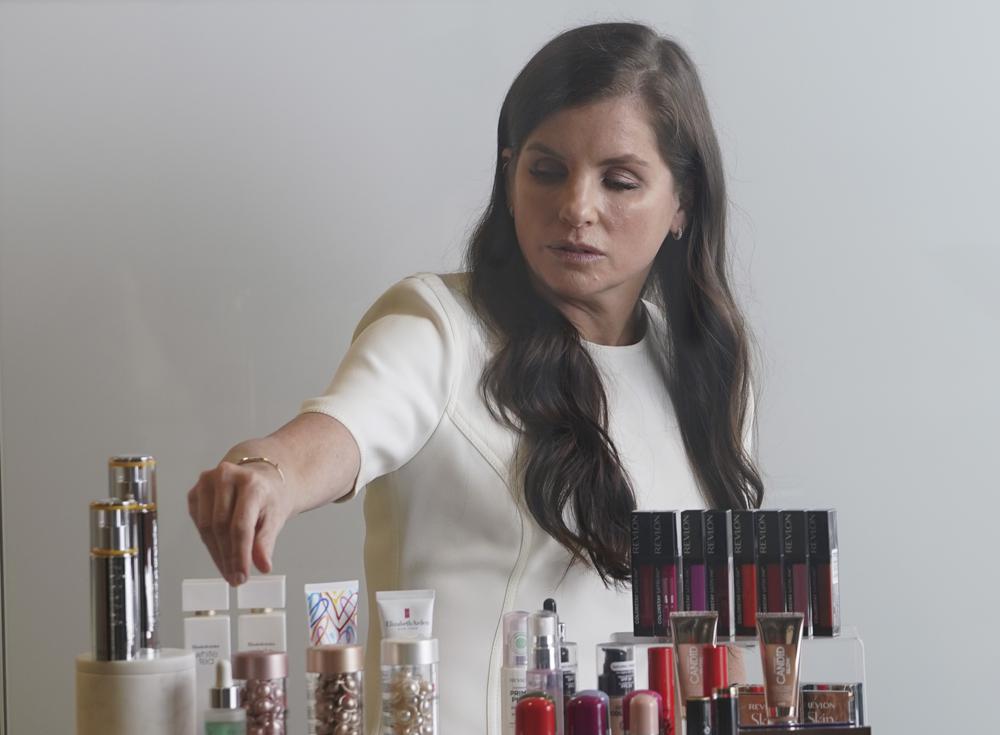
 Revlon CEO Debra Perelman, the company's first woman CEO in its 89-year-old history, show products during an interview, Wednesday Aug. 18, 2021, in New York. Revlon, the 90-year-old multinational beauty company, has filed for Chapter 11 bankruptcy protection, Thursday, June 16, 2022, weighed down by debt load, disruptions to its supply chain network and surging costs. 
(AP Photo/Bebeto Matthews, File)

NEW YORK (AP) — Revlon, a cosmetics maker that broke racial barriers and dictated beauty trends for much of the last century, has filed for Chapter 11 bankruptcy protection.

The company has been a mainstay on store shelves since its founding 90 years ago in New York City, overseeing a stable of household names, from Almay to Elizabeth Arden.

But Revlon failed to keep pace with changing tastes, slow to follow women as they traded flashy red lipstick for more muted tones in the 1990s.

In addition to losing market share to big rivals like Procter & Gamble, newcomer cosmetic lines from Kylie Jenner and other celebrities successfully capitalized on the massive social media following of the famous faces that fronted the products.

Already weighed down by rising debt, Revlon’s problems only intensified with the pandemic as lipstick gave way to a new era in fashion, this one featuring medical-grade masks.

Sales dropped 21% in 2020, the first year of the pandemic, though they rebounded 9.2% in the company’s most recent reporting year with vaccines widespread. In the latest quarter that ended in March, Revlon’s sales rose nearly 8%, but still lag pre-pandemic levels in excess of $2.4 billion a year.

The global supply chain disruptions that are hobbling hundreds of international companies in recent months were too much for Revlon, which barely escaped bankruptcy in late 2020 by persuading bondholders to extend its maturing debt.

There may be more corporate restructurings in the consumer products sector ahead with the threat of a recession and the rising costs of borrowing money.

Revlon said Thursday that upon court approval, it expects to receive $575 million in financing from its existing lenders, which will allow it to keep its day-to-day operations running.

“Today’s filing will allow Revlon to offer our consumers the iconic products we have delivered for decades, while providing a clearer path for our future growth,” said Debra Perelman, who was named Revlon president and CEO in 2018.

Her father, billionaire Ron Perelman, backs the company through MacAndrews & Forbes, which acquired the business through a hostile takeover in 1985. Revlon went public in 1996.


Perelman said that demand for its products remains strong, but its “challenging capital structure” offered limited ability to navigate.

During its heyday in the 20th century, Revlon trailed only Avon in sales. It now holds the 22nd spot among cosmetics makers, according to a recent ranking by fashion trade journal WWD.


Revlon became the first beauty company to feature a Black model in 1970, Naomi Sims. In the 1980s, the company energized the cosmetics industry by putting both famous and yet-to-be-discovered models like Iman, Claudia Schiffer, Cindy Crawford and Christy Turlington front and center, promising to make all women “unforgettable.”

Perelman, in an interview with The Associated Press last year before global supply chains locked up, said she was optimistic about the future. The company doubled-down during the pandemic to get more online with services like one-on-one virtual consultations through its Elizabeth Arden line, she said.

Perelman also said that the company was learning from celebrity launches to be more nimble and that Revlon had regained market share.

None of Revlon’s international operating subsidiaries are included in the proceedings, except for Canada and the United Kingdom.
The filing was made in the U.S. Bankruptcy Court for the Southern District of New York,

The company listed assets and liabilities between $1 billion and $10 billion, according to its bankruptcy filing.

_____

Follow Anne D’Innocenzio: http://twitter.com/ADInnocenzio
Heat stress blamed for thousands of cattle deaths in Kansas


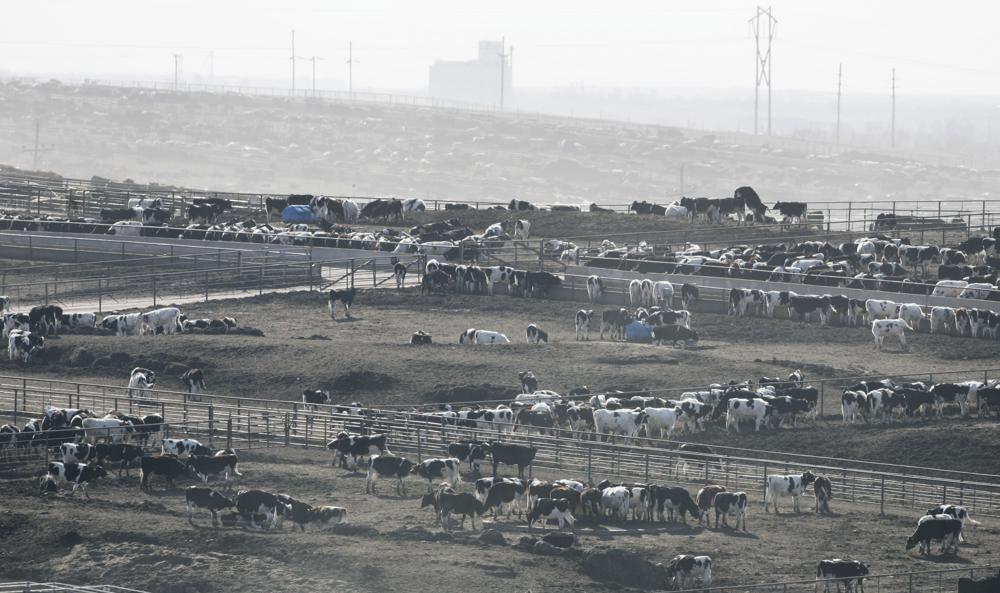
FILE - Cattle feed at a feed lot near Dodge City, Kan., March 9, 2007. Thousands of cattle in feedlots in southwestern Kansas have died of heat stress amid soaring temperatures coupled with high humidity and little wind in recent days, industry officials said Thursday, June, 16, 2022.
 (AP Photo/Orlin Wagner, File)

BELLE PLAINE, Kan. (AP) — Thousands of cattle in feedlots in southwestern Kansas have died of heat stress due to soaring temperatures, high humidity and little wind in recent days, industry officials said.

The final toll remains unclear, but as of Thursday at least 2,000 heat-related deaths had been reported to the Kansas Department of Health and Environment, the state agency that assists in disposing of carcasses. Agency spokesman Matt Lara said he expects that number to rise as more feedlots report losses from this week’s heat wave.

The cattle deaths have sparked unsubstantiated reports on social media and elsewhere that something besides the weather is at play, but Kansas agriculture officials said there’s no indication of any other cause.

“This was a true weather event — it was isolated to a specific region in southwestern Kansas,” said A.J. Tarpoff, a cattle veterinarian with Kansas State University. “Yes, temperatures rose, but the more important reason why it was injurious was that we had a huge spike in humidity ... and at the same time wind speeds actually dropped substantially, which is rare for western Kansas.”

Last week, temperatures were in the 70s and 80s, but on Saturday they spiked higher than 100 degrees, said Scarlett Hagins, spokeswoman for the Kansas Livestock Association.

“And it was that sudden change that didn’t allow the cattle to acclimate that caused the heat stress issues in them,” she said.

The deaths represent a huge economic loss because the animals, which typically weigh around 1,500 pounds, are worth around $2,000 per head, Hagins said. Federal disaster programs will help some producers who incurred a loss, she added.

And the worst may be over. Nighttime temperatures have been cooler and — as long as there is a breeze — the animals are able to recover, Tarpoff said.

Hagins said heat-related deaths in the industry are rare because ranchers take precautions such as providing extra drinking water, altering feeding schedules so animals are not digesting during the heat of the day, and using sprinkler systems to cool them down.

“Heat stress is always a concern this time of year for cattle and so they have mitigation protocols put in place to be prepared for this kind of thing,” she said.

Many cattle had still not shed their winter coats when the heatwave struck.

“This is a one in 10-year, 20-year type event. This is not a normal event,” said Brandon Depenbusch, operator of the Innovative Livestock Services feedlot in Great Bend, Kansas. “It is extremely abnormal, but it does happen.”

While his feedlot had “zero problems,” he noted that his part of the state did not have the same combination of high temperatures, high humidity, low winds and no cloud cover that hit southwestern Kansas.

Elsewhere, cattle ranchers haven’t been so hard hit.

The Nebraska Department of Agriculture and the Nebraska Cattlemen said they have received no reports of higher-than-normal cattle deaths in the state, despite a heat index of well over 100 degrees this week.

Oklahoma City National Stockyards President Kelli Payne said no cattle deaths have been reported since temperatures topped 90 degrees last Saturday, after rising from the mid 70s starting June 1.

“We have water and sprinklers here to help mitigate heat and the heat wave,” Payne said, but “we don’t have any control over that pesky Mother Nature.”