Sunday, September 25, 2022

The Hollow Promise of Small Modular Nuclear Reactors

 FacebookTwitte

Image: OLCF at ORN/Wikimedia Commons.

In 2006, Elizabeth Holmes, founder of a Silicon Valley startup company called Theranos, was featured in Inc magazine’s annual list of 30 under 30 entrepreneurs. Her entrepreneurship involved blood, or more precisely, testing blood. Instead of the usual vials of blood, Holmes claimed to be able to obtain precise results about the health of patients using a very small sample of blood drawn from just a pinprick.

The promise was enticing and Holmes had a great run for a decade. She was supported by a bevy of celebrities and powerful individuals, including former U.S. secretaries of state Henry Kissinger and George Shultz, James Mattis, who later served as U.S. secretary of defense, and media mogul Rupert Murdoch. Not that any of them would be expected to know much about medical science or blood testing. But all that public endorsement helped. As did savvy marketing by Holmes. Theranos raised over $700 million from investors, and receive a market valuation of nearly $9 billion by 2014.

The downfall started the following year, when the Wall Street Journal exposed that Theranos was actually using standard blood tests behind the scenes because its technology did not really work. In January 2022, Holmes was found guilty of defrauding investors.

The second part of the Theranos story is an exception. In a culture which praises a strategy of routine exaggeration, encapsulated by the slogan “fake it till you make it”, it is rare for a tech CEO being found guilty of making false promises. But the first part of Theranos story—hype, advertisement, and belief in impossible promises—is very much the norm, and not just in the case of companies involved in the health care industry.

Small Modular Nuclear Reactors

Nuclear power offers a great example. In 2003, an important study produced by nuclear advocates at the Massachusetts Institute of Technology identified costs, safety, proliferation and waste as the four “unresolved problems” with nuclear power. Not surprisingly, then, companies trying to sell new reactor designs claim that their product will be cheaper, will produce less—or  no—radioactive waste, be immune to accidents, and not contribute to nuclear proliferation. These tantalizing promises are the equivalent of testing blood with a pin prick.

And, as was the case with Theranos, many such companies have been backed up by wealthy investors and influential spokespeople, who have typically had as much to do with nuclear power as Kissinger had to with testing blood. Examples include Peter Thiel, the Silicon Valley investor; Stephen Harper, the former Prime Minister of Canada; and  Richard Branson, the founder of the Virgin group. But just as the Theranos product did not do what Elizabeth Holmes and her backers were claiming, new nuclear reactor designs will not solve the multiple challenges faced by nuclear power.

One class of nuclear reactors that have been extensively promoted in this vein during the last decade are Small Modular Reactors (SMRs). The promotion has been productive for these companies, especially in Canada. Some of these companies have received large amounts of funding from the national and provincial governments. This includes Terrestrial Energy that received CAD 20 million and Moltex that received CAD 50.5 million, both from the Federal Government. The province of New Brunswick added to these by awarding CAD 5 million to Moltex and CAD 25 million in all to ARC-100.

All these companies have made various claims about the above mentioned problems. Moltex, for example, claims that its reactor design “reduces waste”, a claim also made by ARC-100. ARC-100 also claims to be inherently safe, while Terrestrial claims to be cost-competive. Both Terrestrial and ARC-100 claim to do well on proliferation resistance. In general, no design will admit to failing on any of these challenges.

Dealing with any of these challenges—safety enhancement, proliferation resistance, decreased generation of waste, and cost reduction—will have to be reflected in the technical design of the nuclear reactor. The problem is that each of these goals will drive the requirements on the reactor design in different, sometimes opposing, directions.

Economics

The hardest challenge is economics. Nuclear energy is an expensive way to generate electricity. In the 2021 edition of its annual cost report, Lazard, the Wall Street firm, estimated that the levelized cost of electricity from new nuclear plants will be between $131 and $204 per megawatt hour; in contrast, newly constructed utility-scale solar and wind plants produce electricity at somewhere between $26 and $50 per megawatt hour according to Lazard. The gap between nuclear power and renewables is large, and is growing larger. While nuclear costs have increased with time, the levelized cost of electricity for solar and wind have declined rapidly, and this is expected to continue over the coming decades.

300 MW reactor graphic by Moltex, one of the beneficiaries of government funding in Canada.

Even operating costs for nuclear power plants are high and many reactors have been shut down because they are unprofitable. In 2018, NextEra, a large electric utility company in the United States, decided to shut down the Duane Arnold nuclear reactor, because it estimated that replacing nuclear with wind power will “save customers nearly $300 million in energy costs, on a net present value basis.”

The high cost of constructing and operating nuclear plants is a key driver of the decline of nuclear power around the world. In 1996, nuclear energy’s share of global commercial gross electricity generation peaked at 17.5 percent. By 2020, that had fallen to 10.1 percent, a 40 percent decline.

The high costs described above are for large nuclear power plants. SMRs, as the name suggests, produce relatively small amounts of electricity in comparison. Economically, this is a disadvantage. When the power output of the reactor decreases, it generates less revenue for the owning utility, but the cost of constructing the reactor is not proportionately smaller. SMRs will, therefore, cost more than large reactors for each unit (megawatt) of generation capacity. This makes electricity from small reactors more expensive. This is why most of the early small reactors built in the United States shut down early: they just couldn’t compete economically.

SMR proponents argue that the lost economies of scale will be compensated by savings through mass manufacture in factories and as these plants are built in large numbers costs will go down. But this claim is not very tenable. Historically, in the United States and France, the countries with the highest number of nuclear plants, costs went up, not down, with experience. Further, to achieve such savings, these reactors have to be manufactured by the hundreds, if not the thousands, even under very optimistic assumptions about rates of learning. Finally, even if SMRs were to become comparable in cost per unit capacity of large nuclear reactors, that would not be sufficient to make them economically competitive, because their electricity production cost would still be far higher than solar and wind energy.

At this point, there is often an objection from advocates of nuclear power. This is not a fair comparison, they say, because solar and wind energy depend on the sun shining and the wind blowing. But, the idea that the electric grid cannot be reliably operated if much of the electricity comes from variable sources like solar and wind power is just a myth. Suffice it to say that despite the differences in their characteristics, the comparison in generation costs between nuclear power and solar and wind energy is not invalid. And the large difference in these costs means that there is ample scope to pay for complementary technologies needed to accommodate the variability of solar and wind power.

There are other historical reasons to be doubtful of the exuberant promises made by SMR proponents. In reality, the actual cost of projects is much higher than the advertised cost. One independent study showed that 175 of the 180 nuclear power projects examined had final costs that exceeded the initial budget by an average of 117% (and took, on average, 64% longer than projected).

Cost escalations are already apparent in the case of the NuScale SMR, arguably the design that is most developed in the West. The estimated cost of the Utah Association of Municipal Power Systems project went from approximately $3 billion in 2014 to $6.1 billion in 2020—this is to build twelve units of the NuScale SMR that were to generate 600 megawatts of power. The cost was so high that NuScale had to change its offering to a smaller number of units that produce only 462 megawatts, but at a cost of $5.32 billion. In other words, the cost per kilowatt of generation capacity is around $11,500 (US dollars). That figure is around 80 percent more than the per kilowatt cost of the infamous Vogtle project at the time its construction started. Since that initial estimate of $14 billion for the two AP1000 reactors, the estimated cost of the much delayed project has escalated beyond $30 billion. As with the AP1000 reactors, there is every reason to believe that if and when a NuScale SMR is built, its final cost too will vastly exceed current official estimates.

The bottom line—nuclear power, whether from large or small nuclear reactors, is just not economically competitive. But this is not what you will hear from the vendors of small modular reactors.

Timelines

The other promise made by SMR developers is how fast they can be deployed. GE-Hitachi, for example, claims that an SMR could be “complete as early as 2028” at the Darlington site.  ARC-100 described an operational date of 2029 as an “aggressive but achievable target”.

Again, the historical record suggests otherwise. Consider NuScale. In 2008, the company projected that “a NuScale plant could be producing electricity by 2015-16”. As of 2022, the company projects 2029-30 as the date for start of generation. Russia’s KLT-40S, a reactor deployed on a barge, offers another example. When construction started in 2007, the reactor was projected to start operations in October 2010. It was actually commissioned a whole decade later, in May 2020.

The SMR designs being considered in Canada are even further off. In December 2021, Ontario Power Generation chose the BWRX-300 for the Darlington site. That design is based on GE-Hitachi’s Economical Simplified Boiling Water Reactor (ESBWR) design, which was submitted for licensing to the U.S. Nuclear Regulatory Commission in 2005. That ESBWR design was changed nine times; the NRC finally approved revision 10 from 2014. If the Canadian Nuclear Safety Commission does its due diligence, it might be 2030 or later before the BWRX-300 is even licensed for construction. That assumes that the BWRX-300 design remains unchanged. And, then, of course, there will be the inevitable delays (and cost escalations) during construction.

The concern about these long timelines is that the Intergovernmental Panel on Climate Change and other international bodies have warned that to stop irreversible damage from climate change, emissions have to be reduced drastically by 2030. Nuclear power from the BWRX-300 or any of the other SMRs will not even begin to contribute within that time frame.

Waste, Proliferation and Safety

Small reactors also cause all of the usual problems: the risk of severe accidents, the production of radioactive waste, and the potential for nuclear weapons proliferation.

By their very nature, reactors have fundamental properties that render them hazardous. As a result, all nuclear plants, including SMRs, can undergo accidents that could result in widespread radioactive contamination. This possibility was on full display in 2011 when three reactors at Japan’s Fukushima Daiichi nuclear plant melted down. The smallest of these, Fukushima Daiichi-1, had an output of 460 megawatts, only slightly larger than the maximum output of 300 megawatts that characterizes a SMR.

All else being equal, making reactors smaller reduces the risk and impact of accidents. Smaller reactors have a lower inventory of radioactive material and less energy available for release during an accident. But even a very small reactor (say, one that generates under 10 megawatts of electricity) can undergo accidents that result in significant radiation doses to members of the public.

Further, small modular reactor proposals often envision building multiple reactors at a site. The aim is to lower costs by taking advantage of common infrastructure elements. The configuration offered by NuScale, for example, has twelve reactor modules at each site, although it also offers four- and six-unit versions. With multiple reactors, the combined radioactive inventories might be comparable to that of a large reactor. Multiple reactors at a site increase the risk that an accident at one unit might either induce accidents at other reactors or make it harder to take preventive actions at others. This is especially the case if the underlying reason for the accident is a common one that affects all of the reactors, such as an earthquake. In the case of the accidents at Japan’s Fukushima Daiichi plant, explosions at one reactor damaged the spent fuel pool in a co-located reactor. Radiation leaks from one unit made it difficult for emergency workers to approach the other units.

The other undesirable result of any SMR being constructed is increased production of radioactive waste. The physical process underlying the operation of an SMR, i.e., nuclear fission, will always result in radioactive substances being produced. Thus, radioactive waste generation is inextricably linked to the production of nuclear energy, no matter what kind of reactor is used. Despite decades of well-funded research, there is no demonstrated way of safely managing these wastes because of a combination of social and technical problems.

Claims by SMR proponents about not producing waste are not credible, especially if waste is understood not as one kind of material but a number of different streams. A recent paper in the Proceedings of the National Academy of Sciences examined three specific SMR designs and calculates that “relative to a gigawatt-scale PWR” these three will produce up to 5.5 times more spent fuel, 30 times more long-lived low and intermediate level waste, and 35 times more short-lived low and intermediate level waste. In other words, in comparison with large light water reactors, SMRs produce more, not less, waste per unit of electricity generated. As Paul Dorfman from the University of Sussex commented, “compared with existing conventional reactors, SMRs would increase the volume and complexity of the nuclear waste problem”.

Further, some of the SMR designs involve the use of materials that are corrosive and/or pyrophoric. Dealing with these forms is more complicated. For example, the ARC-100 design will use sodium that cannot be disposed of in geological repositories without extensive processing. Such processing has never been carried out at scale. The difference in chemical properties mean that the methods developed for dealing with waste from CANDU reactors will not work as such for these wastes.

Many SMR designs also make the problem of proliferation worse. Unlike the CANDU reactor design that uses natural uranium, many SMR designs use fuel forms that require either enriched uranium or plutonium. Either plutonium or uranium that is highly enriched in the uranium-235 isotope can be used to make nuclear weapons. Because uranium enrichment facilities can be reconfigured to alter enrichment levels, it is possible for a uranium enrichment facility designed to produce fuel for a reactor to be reconfigured to produce fuel for a bomb. All else being equal, nuclear reactor designs that require fuel with higher levels of uranium enrichment pose a greater proliferation risk—this is the reason for the international effort to convert highly enriched uranium fueled research reactors to low enriched uranium fuel or shutting them down.

Plutonium is created in all nuclear power plants that use uranium fuel, but it is produced alongside intensely radioactive fission products. Practically any mixture of plutonium isotopes could be used for making weapons. Using the plutonium either to fabricate nuclear fuel or to make nuclear weapons, require the “reprocessing” of the spent fuel. Canada has not reprocessed its power reactor spent fuel, but some SMR designs, such as the Moltex design, propose to “recycle” CANDU spent fuel. Last year, nine US nonproliferation experts wrote to Prime Minister Justin Trudeau expressing serious concerns “about the technology Moltex proposes to use.”

The proliferation problem is made worse by SMRs in many ways. First, many designs require the use of fuel with higher levels of uranium-235 or plutonium. Second, many SMR designs will produce greater quantities of plutonium per unit of electricity relative to current reactors. Third, in the highly unlikely event that the global market for SMRs is as large as proponents claim, then countries that do not currently possess nuclear technology will acquire some of the technical means to make nuclear weapons.

Conclusion

The saga of Theranos should remind us to be skeptical of unfounded promises. Such promises are the fuel that drive the current interest in small modular nuclear reactors. But, as explained, there are good reasons to expect that small modular reactors will not solve the challenges confronting nuclear power. In particular, they are not economical and thus will fail commercially. Other claims are also often unfounded.

A good example of such flawed claims, with some parallels to Theranos, was Transatomic Power: a company that claimed to have a reactor design that would “consume about one ton of nuclear waste a year, leaving just four kilograms behind”. The company raised at least $4.5 million from investors, including Peter Thiel’s Founders Fund. Subsequently, after Kord Smith, a professor at MIT, reviewed the design and discovered serious flaws, the proponents backtracked on these promises. The causes, according to Smith, were the fact that the original claims did not undergo “any kind of peer review” and also “not listening carefully enough when people were questioning the conclusions they were coming to”.

Rather than seeing the writing on the wall, unfortunately, government agencies are wasting money on funding small modular reactor proposals. Worse, they seek to justify such funding by repeating the tall claims made by promoters of these technologies. It would be better for them to focus on proven low-carbon sources of energy such as wind and solar, and technologies that enable these to provide a much larger fraction of our energy needs.

The path to a world that is secure and ecologically sustainable leads away from nuclear power and small modular reactors.

This article first appeared in Peace Magazine and Beyond Nuclear.

M. V. Ramana is the Simons Chair in Disarmament, Global and Human Security at the School of Public Policy and Global Affairs, University of British Columbia and the author of The Power of Promise: Examining Nuclear Energy in India.

AMCHITKA

The Bomb That Cracked an Island


 SEPTEMBER 23, 2022
Facebook

Amchitka blast. Image: elin o’Hara slavick.

Amchitka Island sits at the midway point on the great arc of Alaska’s Aleutian Islands, less than 900 miles across the Bering Sea from the coast of Russia. Amchitka, a spongy landscape of maritime tundra, is one of the most southerly of the Aleutians. The island’s relatively temperate climate has made it one of the Arctic’s most valuable bird sanctuaries, a critical staging ground for more than 100 migratory species, as well as home to walruses, sea otters and sea lions. Off the coast of Amchitka is a thriving fishery of salmon, pollock, haddock and halibut.

All of these values were recognized early on. In 1913, Amchitka was designated as a national wildlife refuge by President William Howard Taft. But these ecological wonders were swept aside in the early ’60s when the Pentagon and the Atomic Energy Commission (AEC) went on the lookout for a new place to blow up H-bombs. Six decades ago, Amchitka was the site of three large underground nuclear tests, including the most powerful nuclear explosion ever detonated by the United States.

The aftershocks of those blasts are still being felt. Despite claims by the AEC and the Pentagon that the test sites would safely contain the radiation released by the blasts for thousands of years, independent research by Greenpeace and newly released documents from the Department of Energy (DOE) show that the Amchitka tests began to leak almost immediately. Highly radioactive elements and gasses, such as tritium, americium-241 and plutonium, poured out of the collapsed test shafts, leached into the groundwater and worked their way into ponds, creeks and the Bering Sea.

At the same time, thousands of Amchitka laborers and Aleuts living on nearby islands were put in harm’s way. Dozens have died of radiation-linked cancers. The response of the federal government to these disturbing findings has been almost as troublesome as the circumstances surrounding the tests themselves: a consistent pattern of indifference, denial and cover-up continues even today.

There were several factors behind the selection of Amchitka as a test site. One most certainly was the proximity to the Soviet Union. These explosions were meant to send a message. Indeed, the tests were designed to calibrate the performance of the Spartan anti-ballistic missile, built to take out the Soviet nuclear arsenal. Publicly, however, the rationale offered by the AEC and the Defense Department was simply that Amchitka was a remote, and therefore safe, testing ground. “The site was selectedand I underscore the pointbecause of the virtually zero likelihood of any damage,” claimed James Schlesinger, then chairman of the AEC.

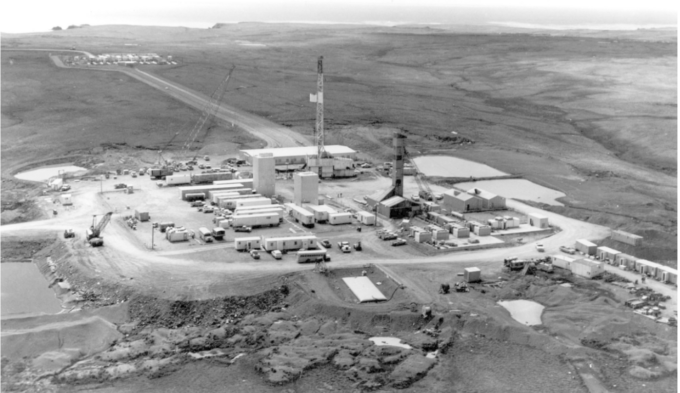
Drilling rigs at the Amchitka test site. Photo: Los Alamos Nuclear Lab.

What Schlesinger and his cohorts overlooked was the remarkable culture of the Aleuts. Amchitka may have been remote from the continental United States, but for nearly 10,000 years it had been the home of the Aleuts. Indeed, anthropologists believe the islands around Amchitka may be the oldest continuously inhabited area in North America. The Aleuts left Amchitka in the 1880s after Russian fur traders had wiped out the sea otter population, but they continued to inhabit nearby islands and relied on the waters near Amchitka for subsistence. The Aleuts raised forceful objections to the tests, pointing to the risk of radiation leaks, earthquakes and tsunamis that might overwhelm their coastal villages. These concerns were never addressed by the federal government. In fact, the Aleuts were never consulted about the possible dangers at all.

In 1965, the Long Shot test exploded an 80 kiloton bomb. The $10 million test, the first one supervised by the Pentagon and not the AEC, was really a trial run for bigger things to come. But small as it was, there were immediate problems. Despite claims by the Pentagon that the test site would not leak, radioactive tritium and krypton-85 began to seep into freshwater lakes almost instantly. But evidence of radioactivity, collected by Defense Department scientists only three months after the test, was kept secret for five years. The bomb site continues to spill toxins into the environment. In 1993, EPA researchers detected high levels of tritium in groundwater samples taken near the test site.

The contamination from Long Shot didn’t deter the Pentagon bomb-testers. In 1969, the AEC drilled a hole 4,000 feet deep into the rock of Amchitka and set off the Milrow nuclear test. The one megaton blast was 10 times as powerful as Long Shot. The AEC called it a “calibration test” designed to see if Amchitka could withstand a much larger test. The evidence should have convinced them of their dangerous folly. The blast triggered a string of small earthquakes and several massive landslides; knocked water from ponds, rivers and lakes more than 50 feet into the air; and, according to government accounts, “turned the surrounding sea to froth.”

A year later, the AEC and the Pentagon announced their plans for the Cannikin nuclear test. At five megatons, Cannikin was to be the biggest underground nuclear explosion ever conducted by the United States. The blast would be 385 times as powerful as the bomb dropped on Hiroshima. Cannikin became a rallying point for native groups, anti-war and anti-nuke activists, and the nascent environmental movement. Indeed, it was opposition to Cannikin by Canadian and American greens, who tried to disrupt the test by taking boats near the island, that sparked the birth of Greenpeace.

A lawsuit was filed in federal court, charging that the test violated the Limited Test Ban Treaty and the newly enacted National Environmental Policy Act. In a 4 to 3 decision, the Supreme Court refused to halt the test. What the Court didn’t know, however, was that six federal agencies, including the departments of State and Interior, and the fledgling EPA, had lodged serious objections to the Cannikin test, ranging from environmental and health concerns to legal and diplomatic problems. Nixon issued an executive order to keep the comments from being released. These documents, known as the Cannikin Papers, came to symbolize the continuing pattern of secrecy and cover-up that typified the nation’s nuclear testing program. Even so, five hours after the ruling was handed down on Nov. 6, 1971, the AEC and the Pentagon pulled the switch, detonating the Cannikin bomb.

In an effort to calm growing public opposition, AEC chief Schlesinger dismissed environmental protesters and the Aleuts as doomsayers, taking his family with him to watch the test. “It’s fun for the kids and my wife is delighted to get away from the house for awhile,” he quipped.

With the Schlesingers looking on, the Cannikin bomb, a 300-foot-long device implanted in a mile-deep hole under Cannikin lake, exploded with the force of an earthquake registering 7.0 on the Richter Scale. The shock of the blast scooped a mile-wide, 60-foot-deep subsidence crater in the ground over the test site and triggered massive rockfalls.

The immediate ecological damage from the blast was staggering. Nearly 1,000 sea otters, a species once hunted to near extinction, were killedtheir skulls crushed by the shockwaves of the explosion. Other marine mammals died when their eyes were blown out of their sockets or when their lungs ruptured. Thousands of birds also perished, their spines snapped and their legs pushed through their bodies. (Neither the Pentagon nor the Fish and Wildlife Service has ever studied the long-term ecological consequences of the Amchitka explosions.) Most worrisome was that a large volume of water from White Alice Creek vanished after the blast. The disappearance of the creek was more than a sign of Cannikin’s horrific power. It was also an indication that the project had gone terribly wrong; the blast ruptured the crust of the earth, sucking the creek into a brand new aquifer, a radioactive one.

In the months following the explosion, blood and urine samples were taken from Aleuts living in the village of Adak on a nearby island. The samples were shown to have abnormally high levels of tritium and cesium-137, both known carcinogens. Despite these alarming findings, the feds never went back to Adak to conduct follow-up medical studies. The Aleuts, who continue their seafaring lifestyle, are particularly vulnerable to radiation-contaminated fish and marine mammals, and radiation that might spread through the Bering Sea, plants and iceflows.

But the Aleuts weren’t the only ones exposed to Cannikin’s radioactive wrath. More than 1,500 workers who helped build the test sites, operate the bomb tests and clean up afterward were also put at risk. The AEC never conducted medical studies on any of these laborers. When the Alaska District Council of Laborers of the AFL-CIO, began looking into the matter in the early ’90s, the DOE claimed that none of the workers had been exposed to radiation. They later were forced to admit that exposure records and dosimeter badges had been lost.

In 1996, two Greenpeace researchers, Pam Miller and Norm Buske, returned to Amchitka. Buske, a physicist, collected water and plant samples from various sites on the island. Despite claims by the DOE that the radiation would be contained, the samples taken by Buske revealed the presence of plutonium and americium-241 in freshwater plants at the edge of the Bering Sea. In other words, Cannikin continues to leak. Both of these radioactive elements are extremely toxic and have half-lives of hundreds of years.

In part because of the report issued by Miller and Buske, a new sense of urgency was lent to the claims of laborers who said they had become sick after working at the Amchitka nuclear site. In 1998, the union commissioned a study by Rosalie Bertell, a former consultant to the Nuclear Regulatory Commission (which replaced the AEC). Bertell found that hundreds of Amchitka workers were exposed to ionizing radiation at five times the level then recognized as hazardous. However, the research is complicated by the fact that many of the records from the Amchitka blast remain classified and others were simply tossed away. “The loss of worker exposure records, or the failure to keep such records, was inexcusable,” Bertell says.

One of the driving forces behind the effort to seek justice for the Amchitka workers and the Aleuts is Beverley Aleck. Her husband Nick helped drill the mile-deep pit for the Cannikin test; four years later, he died of myelogenous leukemia, a type of cancer associated with radiation exposure. Aleck, an Aleut, has waged a multi-year battle with the DOE to open the records and to begin a health monitoring program for the Amchitka workers. For more than four decades promised health surveys of the Amchitka workers have languished without funding.

Will the victims of the Amchitka blasts ever get justice? Don’t count on it. For starters, the Aleuts and Amchitka workers are specifically excluded by the Radiation Exposure Compensation Act from receiving medical assistance, death benefits or financial compensation. There is a move to amend this legal loophole, but even that wouldn’t mean the workers and Aleuts would be treated fairly. The DOE has tried repeatedly to stiff arm other cases by either dismissing the link between radiation exposure and cancer or, when that fails, invoking a “sovereignty” doctrine, which claims the agency is immune from civil lawsuits.

Dr. Paul Seligman, former deputy assistant secretary of the DOE’s Office of Health Studies, writes it off as the price of the Cold War. “These were hazardous operations,” Seligman says. “The hazards were well understood, but the priorities at the time were weapons production and the defense of the nation.”

At a time when the mainstream press and Republican politicians are howling over lax security at nuclear weapons sites and Chinese espionage, a more dangerous betrayal of trust is the withholding of test data from the American public. China may use the Los Alamos secrets to upgrade its tiny nuclear arsenal, but the Amchitka explosions already have imperiled a thriving marine ecosystem and caused dozens of lethal cancers.

The continuing cover-up and manipulation of information by the DOE not only denies justice to the victims of Amchitka, but indicates that those living near other DOE sites may be at great risk. “DOE management of the U.S. nuclear weapons complex is of the old school in which bad news is hidden,” says Pamela Miller, now executive director of Alaska Community Action on Toxics. “This conflicts with sound risk management and makes the entire system inherently risky. The overwhelming threat is of an unanticipated catastrophe.”

This essay is adapted from a chapter of Grand Theft Pentagon.

Jeffrey St. Clair is editor of CounterPunch. His most recent books are Bernie and the Sandernistas: Field Notes From a Failed Revolution and The Big Heat: Earth on the Brink (with Joshua Frank) He can be reached at: sitka@comcast.net or on Twitter @JeffreyStClair3

The American Dream and Other Fairy Tales

 
 SEPTEMBER 23, 2022
Facebook

Image courtesy of Fork Films.

Abigail Disney, who proclaims that “Class traitors are my patron saint,” is probably the Magic Kingdom’s most disloyal royal. As the grandniece of Walt Disney and granddaughter of Roy Disney, Abigail was born into true show business royalty. But increasingly dismayed by the Walt Disney Company’s contemporary unfair business and labor practices, she became a dissenting heiress, who decided to speak out against inequality and injustice at Disneyland and beyond.

To do so, by 2006 Abigail parlayed her inheritance – in terms of both treasure and storytelling panache – into making films that stand up for the underdog. To do so Abigail co-created Level Forward and Fork Films, to make anti-racist, pro-gender equity, gun neutral, progressive pictures. The ensuing nonfiction and fiction productions have scored accolades, including co-winning Emmy Awards for 2012’s The Invisible War, about sexual abuse in the U.S. armed forces, and 2015’s The Armor of Light, about guns and abortion.

Abigail co-produced/co-directed the latter with Kathleen Hughes, who has also co-won two other Emmys for her work on Bill Moyers’ programs. Hughes has also been a veteran filmmaker for other PBS nonfiction outlets, including FrontlineIndependent Lens and Wide Angle. Now, Disney and Hughes have teamed up again to co-make The American Dream and Other Fairy Tales, an 87-minute documentary chronicling Abigail’s critique of the family business gone off the rails in a relentless pursuit of profit, employees be damned. This hard-hitting expose is anything but “Mickey Mouse,” and uses the not-so-Magical Kingdom as a microcosm for what’s wrong with contemporary capitalism.

In this animated, candid conversation, the two co-directors/co-producers discuss: Disneyland’s dehumanization of workers; CEO pay; laissez faire capitalism; the “Asshol-ification of America”; Eugene V. Debs; Walt’s role during the Hollywood Blacklist; socialism; taxing the rich; racism at Disneyland; feminism in Disney movies; Patty Hearst; a certain piece of jewelry; and more. Abigail Disney and Kathleen Hughes were interviewed via Zoom in, respectively, New York City and Yonkers.

Fork Films produced The American Dream and Other Fairy Tales. What is Fork Films, what does it do and how does it select projects?

Abigail Disney: Back in 2006 I started my first film, Pray the Devil Back to Hell. I needed a company in which to situate all the things, the comings and goings, the hirings and firings, and so forth. Fork Films is the legacy film company that came out of the production of that film. It went on to produce Women, War & Peace for PBS and The Armor of Light. It also has grantmaking I did for other films that documentarians were making that I felt were important. I had a committee around me that helped me decide on what projects to support. And mainly I just wanted us to support projects that felt like they were going to move the world forward in some way. I wanted to support voices of people who weren’t normally well-represented or given the chance to speak in their own voices. I’m proud of everything we did.

May the Forks be with you!

[Laughter.] That’s the only pun I haven’t used yet.

What are the main criticisms you have of the Walt Disney Company’s business practices? (CEO pay?)

AD: There are ways and ways to run a company. We are taking issue in this film primarily with the way they pay their employees. But actually, the problems run very deep and they really go to the heart of what a corporation is for and what it should be about. They seem to have swallowed hook, line and sinker the idea that the only thing that matters is shareholder value. They have swallowed hook, line and sinker the idea that the only people who matter are management and boards. And they treat their employees like interchangeable, endlessly replaceable cogs. So, in terms of how they treat their employees, that’s absolutely not in the spirit of what that company is about.

People come to that company – I know you from The Progressive magazine, so there won’t be a lot of Disney fans reading [this]. Yet, everywhere I go, and the most progressive people around me still have a story to tell me about taking their child to Disneyland or seeing a film that really changed their childhood. It affects people very deeply what that company does. And they need to take that very seriously, because it involves some responsibility. And right now, they are living the most Ebenezeer Scrooge version of capitalism when it’s not necessary to do that. And it’s not necessary to do that and make a profit. They’re a storytelling company and should be telling a different story.

KATHLEEN HUGHES: What Abbey is describing can be said for just about every major American corporation. This is a critique of the Disney corporation but it’s also a critique of corporate America. We hope that people walk away thinking that we’re not only looking at Disney.

You say a lot of [progressives] may not be Disney fans, but the very first Black [movie] superstar was Mickey Mouse.

AD: Yes, it’s true. You’re absolutely right about that. Do you know that Walt’s father was a socialist and –

What? Did he vote for Eugene Debs [Socialist Party candidate for president]?

AD: His father did. And then Walt, we found out while we were making this film, learned to draw cartoons by copying cartoons from Debs’ newspaper [the Appeal to Reason].

Your documentary is very critical of Reaganomics and free market capitalism, in general. What are your main critiques of the capitalist system today in the USA?

AD: There’s so much to say, so much to say.

Say it!

AD: It bothers me so deeply that when I talk about employee wages and CEO pay, I get calls on those things from different journalists. So, one guy is covering the pay of workers and then there’s a different guy who’s covering CEO pay. Because Wall Street and their handmaiden, which is the business press, don’t understand those things to be connected. Because they have developed a sensibility in which anybody above a certain level of income or a level of authority inside of a corporation isn’t really the same species really with the people who are pulling down hourly wages.

That is the natural outgrowth of the massive shift in understanding of the nature of money and the value of people that started in the seventies and eighties and was on steroids during the Reagan administration. That’s not the whole problem, but it’s emblematic of the problem, which is that we have ceased to see workers as fully human. We have come to believe managers are more than human. And we need to recast our whole understanding. Because if I were in charge, I would invert that. The people who should be honored, the people who should be lauded, are the people who sweat every day.

KH: What you see in the film, when you watch the work of the Disneyland “cast” members, as they’re called, is that Americans by and large are really hard workers. People go to work every day and do their job. Over the years, the different kind of stories I’ve reported out for Bill Moyers and other place, I’ve always met people who, I watched for 30, 40 years this downward mobility, of hard-working Americans. People who go out, they lose their jobs in the factory and get retrained, they sign on to a new job. But every year it seems that wages and compensation are either flat or going down. There has been this long-term devaluation of labor and workers. We see that at Disneyland, as well. We’re all aware of it but we don’t seem to be able to stop. We don’t say “basta!” this has just now got to stop and we’ve really got to figure out a way to value work. At some point maybe we said factory work has more value than service work. But work is work, and people have families. We really have to think about how we bring everybody back to a living wage.

Abigail, what do you mean by what you call in the film “the asshol-ification of America”?

AD: [Laughs.] Asshol-ification is the process by which our values became inverted. We never lived in a perfect country and fairness was never evenly spread, and we know that. What we called “the American Dream” was not shared broadly across the race lines and so forth – we know that. But the way we talked about ourselves publicly is that people deserved, everybody deserved a chance. That a person who goes to work fulltime, and play by “rules,” quote unquote, as they’re written, should be able to raise his kids, should be able to send them to good schools, all of the components of the American Dream.

And mobility was woven into that idea of the American Dream, too. And interdependence. There was written into this dream the idea that we relied on each other, that your business is my business, and that I care if something is really going wrong for you. That went away so quickly and the only explanation for the way it went away quickly was that it was made to go away consciously. Because a new story started to be told, very conscientiously, very planfully [sic], in every aspect of the media about the role of an individual in a society and the absolute irrelevance of the idea of interdependency. Once we chased interdependency out of the public square we have “asshol-ified.”

KH: I think greed became good. And that made for assholes.

Are you one of the so-called “Patriotic Millionaires” who favor higher taxes for the rich?

AD: Yes, I am.

You don’t pull any punches when it comes to critiquing the Walt Disney Company today. In The American Dream you mention an early strike against Disney Studios. 75 years ago, on Oct. 24, 1947, your granduncle Walt testified before the House Un-American Activities Committee as a “cooperative witness” and denounced what he called “commies.” Walt was a co-founder and served as a vice president of the rightwing Motion Picture Alliance for the Preservation of American Ideals with people like John Wayne.

AD: Yes, he was.

What do you make of Walt’s anti-communist stance during the Hollywood Blacklist 75 years ago? [Watch Walt testify at: https://www.youtube.com/watch?v=kJLQ3efGG4k]

AD: It’s a source of incredible shame for me, personally. Many of us have family histories we’d like to apologize for, if we could, or correct, if we could. History is a crooked and cruel thing. I believe he was a complicated man and a lot of his motivation came from some anxiety and influence type stuff, because he really struggled with his father, and his father was a socialist.

When that strike occurred, as a paternalist he felt very betrayed by the folks that stepped out on strike against him. He felt that he should be able to pay them what he wanted to pay them because he wanted to, and not because it was their right. It was rank paternalism, and I’m ashamed of that as well. I can’t fix that. I know he was a man of his moment, for good or ill. I have to know that my job is to be the best person I can in my moment, and that’s what I’m trying to do.

Ironically, in The American Dream… you’re depicted testifying before Congress and Republicans call your ideas “socialism” and communistic. What do you think of democratic socialism? Do you “dream upon a star” and support a sweeping redistribution of wealth?

AD: [Laughs.] Well, I’m not sure if I’d go as far as the state control of capital. But I do believe there has to be a massive redistribution, in the sense that wealth taxes and considering every billionaire policy error, would be very healthy for this country. We have a long way to go to fairness, we have a long way to go.

The American Dream… makes points about racism, it talks about “white fear.” How did Disneyland play into that?

AD: [Laughs.] That’s a really good question. Disneyland was structured to be a dream, a dream state. And everybody should walk into it and step into a world where the cruel realities were suspended. And not a terrible thought could possibly come into your head. It was impossible for the people who designed and built Disneyland to think about it as somebody who wasn’t a white male sis gender living in mid-century America. They didn’t know how to imagine their way out of the little paper bag they grew up in and lived in all their lives. In many ways they wrote race out of that story, they wrote gender, immigration and disability out of that story as a way of dismissing the questions that may complicate that dream state.

KH: When our editor put together the images of Aunt Jemima waving and happy African American children tapdancing, and Native Americans gladly shaking hands with, you know, proudly being with their conquerors, you understood they were telling a story that white Americans wanted to hear and see. It was shocking to see it on the screen like that. We forget how, it’s a subtle but powerful way of helping us all stick to our own preexisting ideas about how things work.

Kathleen Hughes, you co-made 2015’s Emmy Award-winning The Armor of Light with Abigail. And of course, you also co-made The American Dream and Other Fairy Tales with her. So, what’s it like working for this Disney? How is she as a boss.

KH: [Laughter.] She’s great. “Boss” is not always the word I think of when I think of Abigail. I think of her as an innovative thinker and someone who is tirelessly going out and trying to make a difference in the world, to be honest. It’s actually a lot of fun; sometimes it’s a little crazy because we are doing these – going up against, making a film that’s critical of the largest media conglomerate in the world is something a person might only do with Abigail Disney.

If the film makes money, is there any sort of profit-sharing plan for the four Disneyland employees interviewed throughout The American Dream…?

AD: The four Disneyland employees that appear throughout the movie are going to be fine and I can’t share details with you about that… That’s not paternalism, that is me just choosing not to share things they would find to be very private.

What do you think of the Disney Company’s fight with Florida Gov. Ron DeSantis?

AD: Wow. You know, if you go look at the junta in Argentina and look at the tactics they used to solidify the fascist regime they constructed in that country in the sixties and seventies, you would recognize a fair amount of Ron DeSantis’ playbook. The capricious enforcement of law is a great way to create perpetual anxiety and fear. He deliberately took on the most powerful company in his state, not because he was particularly concerned about that company, but because he was sending a message to every other company in his state. And he was sending a message to every company in the country if he’s elected president. We should be very afraid of what he pulled down there. I’m no fan of the special [tax and district] status Disney has; I don’t think they should have it. Created by my grandfather, by the way – but, you know, what can I do? I can’t be responsible for him. But I can say enforcing a law like that capriciously has the effect of intimidating potential critics and dissenters.

Abigail, in The American Dream… you show a piece of jewelry designed like [a clitoris]. When do you wear it and why?

AD: [Laughs.] I like to wear it wherever I go that is especially patriarchal. So, Congress, boardrooms, things like that. Because it just feels like I have a little superpower on my hand that just helps me, guides me, as I go through my day.

Hopefully multiple times.

AD: [Laughs.] That was funny!

Are any Disney characters over the years feminist?

AD: Oh god, that’s like a dissertation level question. Because the ones that are cast as feminists are very complicated feminists. When we made Pray the Devil Back to Hell way back when, the most difficult, challenging thing about that film, it was about a group of women who helped end the civil war to an end in Liberia. One of the hardest stories to tell is a collective story, a story about people working together towards a common end. It’s so much easier to tell a story of an individual or hero or a particular thing. So, invariably, when Disney tells a story about a feminist they turn her into an individual who isn’t that interested in the collective and they drain all the feminism out of her in that way. Feminism at its most powerful is a collective story and an intersectional story. And a story that is invested in everybody else’s wellbeing. So, the limits to storytelling, the way Disney does it, makes it hard for them to create what I would think of as a genuine feminist.

You also make features, not just documentaries. Forks produced a story about another famous female class traitor, Patty Hearst, called American Woman. How do you go about selecting those narrative, fictional films.

AD: I’m not the only person who does the selection for Level Forward, which is the company I helped co-start a few years ago. I love that film; I think that’s a really important film and I’m so glad you’ve seen it. Because class traitors are my patron saint; I just want to talk about them all day long.

Is there anything you’d like to add about The American Dream?

KH: I hope it stands on its own merits in terms of what it has to say. I don’t see it as partisan, necessarily, in the sense that it has chosen between Democrats and Republicans. We need to stop thinking of the future of this company in terms of two sides at war with each other and understand that we’re a lot closer on a lot of things than we’ve been led to believe that we are. So, when you listen to the folks on Jan. 6 who were talking about the elites and corporations not being trustable, I don’t think they’re wrong when they say that. We need to hear it and we need to figure out a way to bring people together. That may sound very pie in the sky but I think it’s possible.

What’s next for Kathleen Hughes and Abigail Disney?

AD: [Laughs.] What is next, Kathy?

KH: We’re working on it.

The American Dream and Other Fairy Tales’ theatrical release started September 16 at Orlando, near Disneyworld. For more info on other screenings and the film see: https://americandreamdoc.com/.

Ed Rampell is a contributor to the new book on America’s former Poet Laureate “Conversations With W.S. Merwin” and co-author of “The Hawaii Movie and Television Book“.