Thursday, December 01, 2022

Jacinda Ardern shuts down suggestion she met with Finnish leader because of age, gender

Felicity Ripper with wires

Jacinda Ardern shoots down the reporter's question

New Zealand Prime Minister Jacinda Ardern has shut down a suggestion from a reporter she has met with Finland Prime Minister Sanna Marin "just because" of similarities such as their age.
 
Key points:

The comments came as Sanna Marin became the first Finnish prime minister to visit New Zealand

The leaders said trade deals and diplomatic relations were the reasons for the visit

Ms Marin said she was also pushing for more support for Ukraine


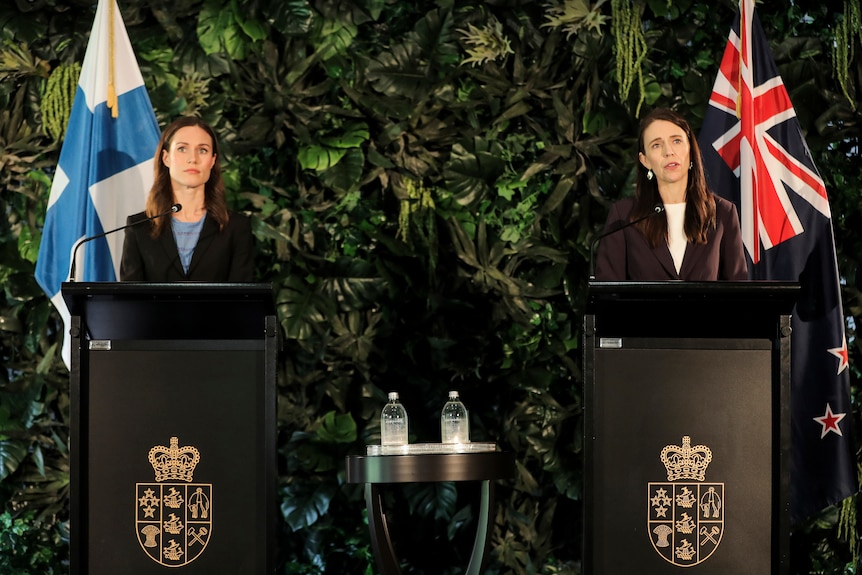
The comments came as Ms Arden held a joint press conference with Ms Marin, who is the first Finnish prime minister to visit New Zealand, in Auckland on Wednesday.

"A lot of people will be wondering are you two meeting just because you are similar in age and got a lot of common stuff there … when you got into politics and stuff," the journalist asked as Ms Ardern took the lectern.

"Or can Kiwis actually expect to see more deals between our two countries down the line?"

Ms Ardern was quick to respond, questioning whether anyone ever asked former New Zealand prime minister John Key and former US president Barack Obama if they met because of their similar age.

"We of course have a higher proportion of men in politics — it's reality," Ms Ardern said.

"Because two women meet, it's not simply because of their gender.

"Finland exports into New Zealand $199 million worth of exports."

She said New Zealand exported $14 million of goods a year to Finland and there was huge potential for future opportunities.

Fellow journalists and members of the public took to Twitter to express their disappointment at the question posed to the women, with one user describing it as "crass".

"It's a shame some journalists spoke to them like they are 1950s housewives organising a coffee morning," another posted.

Further pressed about their roles as women leaders, Ms Ardern said she and Ms Marin felt a responsibility to use their voices on behalf of repressed women, like those in Iran.

"The focus of our conversation is what more we could do together in support of other women in other countries who are facing dire circumstances, where we see the most basic of human rights being repressed and violated," Ms Ardern said


.
Sanna Marin (left) holds a joint press conference with Jacinda Ardern at the Auckland Museum.
(AP: Michael Craig/New Zealand Herald)

Improving diplomatic relations was also among the aims of the visit.

"We need hard power when it comes to Ukraine," Ms Marin told reporters when asked what soft-power influence smaller countries like Finland and New Zealand could exert.


"They need weapons, they need financial support, they need humanitarian support, and we need to also make sure that all the refugees fleeing from Ukraine are welcomed to Europe."

Since the war began, both Finland and Sweden have abandoned their longstanding policies of military non-alignment and applied to join NATO.

Both countries are still seeking endorsement from Türkiye.

Ms Marin said the war felt very close to Finland due to the 1,300-kilometre border the country shared with Russia.

She said Finland had already provided 10 shipments of weapons to Ukraine.

"We have to make sure that they will win," Ms Marin said.

She said Western countries also needed to ensure sanctions were "harder and harder against Russia" because the war was affecting not only people in Ukraine but also people worldwide due to higher energy prices.

Finnish PM sorry for party photo
Finland's PM has apologised after the publication of a photo that showed two women kissing and posing topless at the leader's official summer residence.


Ms Marin also brushed off suggestions she was a partying prime minister — a criticism which has emerged since the leak of a video showing her dancing and singing with friends at a private party.

She said she had more important issues to focus on, including the pandemic, the war in Europe, the energy crisis and a looming economic crisis.

"So I had a couple of free days during the summer," Ms Marin said.

"And if the media wants to focus on it, I don't have anything to say.

"You are free to discuss and write what you want, but I'm focusing on the issues that are in our program."

COP27 and the 10 Rules of Corporate Greenwashing


 NOVEMBER 30, 2022
Facebook

Photograph Source: IAEA Imagebank – CC BY 2.0

With the Coca-Cola sponsored blah-blah-blah festival of COP27 in the Egyptian dictatorship done and dusted – until the next one –  corporate greenwashing has worked its magic again. And this is not just because Rachel Rose Jackson of Corporate Accountability commented that, COP27 looks like a fossil fuel industry trade show.

Egypt’s Sharm El-Sheikh made itself looking green and sustainable – thanks to corporate PR superstar company Hill+Knowlton which also supplied corporate propaganda for ExxonMobil, Shell, Chevron, and Saudi Aramco.

Like whitewashing that seeks to wash things clean, corporate greenwashing is a form of corporate marketing spin telling you that toxic sludge is good for you. In short, greenwashing is designed to make people believe that a company is doing more to protect the environment than it really does. It sells lies.

Corporate greenwashing is deceptively used to persuade the public that a company’s products, their corporate aims, their policies and politics (read: lobbying – a $3.5bn industry) are environmentally friendly.

The top-10 corporate greenwashing corporations are: Volkswagen, BP, Exxon, Nestle, Coca-Cola, Starbucks, IKEA, plastic bottle water companies, major banks, and fashion companies like H&M, Zara and Uniqlo.

By now, one of the more classical textbook-style cases of corporate greenwashing remains that of the German car-giant Volkswagen. VW was forced to admit to cheating emission tests by fitting various vehicles with a so-called defeat device. This is a software that could detect when it is undergoing an emission’s test and then alters the performance to reduce the emission’s level – simple but effective.

This was done while hyping-up the low-emission features of VW vehicles through marketing campaigns. In truth, however, Volkswagen engines were emitting up to 40-times the allowed limit for nitrogen oxide pollutants.

Yet, VW still means Volkswagen and not Very Worried as VW made a whopping $15.5bn in 2021. Corporate greenwashing works – for corporations and that is the raison d’être for doing it. Yet, there are other countless cases.

Take for example, the global fossil fuel giant BP that has even changed its name. Such a move is also known as re-branding. Now, BP wants to be known as Beyond Petroleum – it sounds really green!

To greenwash one of the world’s major corporations, BP even put solar panels on their gas stations – that looks so green! Sadly for BP, the corporation got called out for their self-greening deceptions.

Next, there is also Coca-Cola. Coke also has been accused of greenwashing because of its ‘natural’ sugar claims. Coca-Cola started its marketing campaign as a way to attract more health-conscious consumers. And so, Coca-Cola turned itself into a health drink! More recently, Coca-Cola tried to beef this up through Innocent Drinks – also deemed misleading.

Yet, the reality of the Coca-Cola corporation looks rather different. For example, many of Coke’s plastic bottles probably end up polluting our environment – like oceans. Greenpeace listed Coca-Cola as the leading plastic polluter in 2019. It makes and sells around 100 billion (no spelling mistake!) single-use plastic bottles a year. In the very same year, the Coca-Cola corporationannounced,

Coca-Cola is unveiling the first ever sample bottle made using recovered and recycled marine plastics, demonstrating that, one day, even ocean debris could be used in recycled packaging for food or drinks. This sample is the first ever plastic bottle made using marine litter that has been successfully recycled and reused in food and drink packaging

Yet, their plastic bottles – whether made from recycled material or not – still end up in our oceans. Meanwhile, the Coca-Cola corporation – world’s worst corporate plastic polluter for four years in a row – has resisted legislation intended to force the company into adopting more environmentally friendly practices. At the same time, corporate greenwashing continues, for example, when Coke’s very own website says,

we make brands and products that …

build a more sustainable future

These and plenty of other companies intentionally and deliberately instigate greenwashing PR strategies. Often, they do so in order to distance themselves from their – equally intentional and deliberate – environmental vandalism.

Through corporate greenwashing, even oil corporations can be made to appear green and sustainable. The successes of, for example, oil corporations in circumventing COP27 remains hidden behind a green corporate logo.

Corporate greenwashing means that companies and corporations spend very significant resources on corporate PR advertising the false image of being green. And usually, this comes in three versions:

  1. corporations’ greeewashing makes their products look sustainable;
  2. corporations also greenwash the production process of these products; and
  3. they greenwash themselves – as a business to make them look sustainable.

Corporate greenwashing can range from changing the name of the corporation, the logo, and the label of a certain product to pretend to be supporting the natural environment while these products still contain harmful chemicals.

Yet, there are also multi-million dollar corporate PR campaigns that portray, for example, highly-polluting energy companies as eco-friendly. The key idea behind corporate greenwashing is that it covers up unsustainable and destructive corporate agendas and policies while, simultaneously, allowing corporations to carry on making profits.

Corporate PR firms like Edelman, for example, have even facilitated climate change denial. The corporate PR industry – and more importantly “routinely” – also funds astroturf organizations. These are PR firms that set up other – even more evil – organisations that falsely pretend to be grassroots activists while being paid by corporations. Some examples are: Ethical OilResource Works, and the International Climate Science Coalition.

Of course, there are also well-paid business school professors in the mix supplying the necessary ideology to camouflage corporate greenwashing. The ideologies come – mostly – in three forms:

  1. Business Ethics: is an oxymoron known as business ethics pretending that corporations are ethical;
  2. CSR: next is management’s all-time favourite ideology of corporate social responsibility (CSR); and finally,
  3. Citizenship: there is the business school hallucination that there is something like corporate citizenship – corporations pretending to be like ordinary citizens.

Ideological support for corporate greenwashing also comes from coin-operated corporate-sponsored think tanks in which crypto-academics find additional employment particularly when they are too bad even for a business school. Their junk science contributes to the crypto-academic field of management studies.

The ideologies they create work against democratic regulation and environmental regulation. All this comes as part of an even more important ideology – the global ideology of neoliberalism.

One of the methods used by corporate greenwashing are fake grass roots campaigns involving letter-writing to legislators. This is done on behalf of an – almost always – undisclosed interest group that is in reality, financed by a corporation. Yet, this sort of greenwashing also employs real people posing as volunteers. These corporate stooges speak at public hearings and participate in real grass roots campaigns.

In any case, such planned PR deceptions are central components of the corporate propaganda filling us with doubts – and even self-doubt – as the earth confronts the environmental abyss. Many of such activities amount to very serious corporate greenwashing.

Yet, corporate greenwashing has more tricks up their sleeves. The Chicago Climate Exchange, for example, was set up by global greenwashing polluters like BP, DuPont, and the Ford Motor Company. It was a tool for voluntarily cutting emissions that fancies the neoliberal hallucination of industry self-regulation.

Some evil heretics might argue that there is a reason why, for example, there are drivers’ licenses, why they are regulated by the state, and why people cannot regulate their own driver’s license printed out on their kitchen table. The corporate greenwashing idea behind the self-regulating Chicago Climate Exchange was to reduce pollution. It failed, even as a corporate greenwashing idea.

Ideas like this are only another tool in the box of corporate greenwashing. Perhaps an even more interesting aspect of corporate greenwashing is that multi-national corporations have become bigger sources of global aid than nation states.

And of course, corporations cold-heartedly promote this fact. Their wealth is partly engineered through decades of corporate tax-cutscreated by governments that are under the spell of neoliberalism. Corporate PR sells this as sustainable corporate social responsibility (CSR).

This gives CSR a human face – as applied to capitalism and to make capitalism look human-like. It simply means that polluting corporations get up each morning, get increasingly smeared during the day, and simply wash off at night. That is the basic idea of CSR. CSR-fancying corporate polluters make particular use of greenwashing PR. It comes as part of their search for an environmental-friendly license to operate – a core ideology of CSR.

Of course, this reaches deep into company accounting where much of this is rather cosily sold as triple bottom line – people, profit, planet. Planet being a distant third! This accounting ideology emerged from none other than the corporate consultancy world.

The ideology behind it is to merge corporate profits with human society (people) and the environment (planet). Its goal: justifying profit making. Greenwashing remains a key component of this corporate strategy.

Following this business strategy, many companies and corporations have wrapped themselves in a green cloak. Today, brands even try to outdo one another with their eco-credentials to become the – hopefully undetected – master of corporate greenwashing. To win the green consumer game, companies often exaggerate environmental claims or simply make things up – whatever works best for the corporation.

Worse, criminal polluters even engage in a rather new form of corporate greenwashing. They share positive information about their environmental records while concealing negative aspects which, so the hope goes, can be offloaded onto others. This is known as externalisation. Meanwhile, the public should no longer see what is real – environmental pollution – and what a public relation constructed image of the corporation is.

One of the goals is to blur the boundary between what is reality and what is faked. This is also known as gaslighting. The idea of gaslighting is based on a 1940’s movie called Gaslight in which one is no longer sure whether the flickering of the gaslight is real or not.

Today, gaslighting is a propagandistic and manipulative-psychological tool used by, for example, global warming deniers that seeks to induce the doubting of one’s own reality and even sanity.

One of the goals of the more severe forms of corporate propaganda is that once a person’s underlying reality is lost, the person becomes more open to propaganda as words, images, and signs become self-referential while bypassing reason. Yet, the entire process is driven by the propagandist.

With no residual correspondence to the real anymore, corporate propaganda has achieved its goals. Reality has adapted to corporate propaganda. Reality has become a mere simulation. French philosopher Baudrillard calls this simularcra – the simulation of reality. For corporate greenwashing, this also means that being green and sustainable is just a matter of simulation –pretending.

The simulation of corporate sustainability is about the pretence of a corporation as being environmental. And now comes the crucial bit. This is within the dynamic core of the capitalist economy.

Necessarily, corporate greenwashing has to leave out some very uncomfortable facts, like global environmental vandalism, starvation, sweatshops, slavery, managerial despotism, mass poverty, and global warming – our highway to climate hell. To divert attention away from the pathologies of corporate capitalism, corporate greenwashing does ten things:

1) it pretends that there is a trade-off between consumer choices and sustainability;

2) many corporations offer next to no proof that their supposedly environmental initiatives have a positive impact on nature;

3) corporate greenwashing lives from general statements that are deliberately kept vague and non-specific;

4) corporate greenwashing uses false labelling – often in the form of self-invented “eco-certification” that, in reality, is no certification at all;

5) corporate greenwashing pretends to be sustainable in areas that have next to no relevance to the corporation, their product, and the production process used to make these products;

6) corporate greenwashing presents false choices, at times, framed as the lesser of two evils;

7) of course, corporate greenwashing lies by presenting something – a something that simply does not exist;

8) corporate greenwashing sells false hopes into a corporate-based environmental future that does not exist;

9) corporate greenwashing also covers up serious corporate dangers, harms to the environment, environmentally hazardous products, and negative environmental consequences; and finally,

10) corporate greenwashing converts capitalism’s reality of profits over people and the environment into pretending to be environmentally sustainable.

In the end, corporate greenwashing is an important tool in the arsenal of propaganda and corporate public relations. Capitalism not only lives by flooding us with consumer goods, it also needs an accompanying ideology telling us that two iPads will make us twice as happy.

Part of this necessary ideology to sustain capitalism is not only to hide capitalism’s environmental impact but also the pretence that capitalism and its corporations are environmentally friendly. This marks the moment when corporate greenwashing enters the scene. Corporate greenwashing is the ideological by-product of living in a capitalist society.
Thomas Klikauer is the author of Managerialism (Palgrave, 2013).

COP27 failed. So why continue with these UN climate summits?


David Tindall, Professor of Sociology, University of British Columbia, 
Mark CJ Stoddart, Professor, Department of Sociology, Memorial University of Newfoundland, Marlene Kammerer, Senior researcher, Climate and Environmental Policy, University of Bern, 
and Maria Brockhaus, Professor of International Forest Policy, University of Helsinki

Wed, November 30, 2022 
THE CONVERSATION

Climate conferences provide platforms for collaboration among countries, venues for interaction across levels of governance and critical events to mobilize civil society and media coverage. (AP Photo/Peter Dejong)

Climate change is an existential threat to human civilization and planetary ecosystems. Yet despite 27 UN Conference of the Parties (COP) meetings that have taken place so far, the international community has been unable to ward off imminent disaster.

A number of expert commentators have already declared COP27 — the recent UN climate summit in Egypt — to be a failure. The talks stalled on key issues and failed to secure commitments to stop greenhouse gas emissions from rising beyond thresholds that will lead to dangerous global warming.

Other critical voices are concerned that the whole process is becoming too business-friendly, to the detriment of other perspectives and voices. These yearly big climate conferences have also been criticized as a waste of time and resources.

Given these problems and repeated failures, why continue with the COP meetings? As researchers who study social movements and environmental and climate change politics and policy, we believe that continuing with these climate conferences can still lead to positive outcomes.
Assessing COPs success or failure

Under the United Nations Framework Convention on Climate Change (UNFCCC) agreement, member states meet at the COP summits annually to review the implementation of the decisions taken by COP members and further develop a collective approach to addressing global climate change.

For many, especially those following the COP discussions from the outside, the assessment of the success or failure of the meetings tends to focus on commitments made in the final agreements.

From this perspective, the 2015 Paris conference stands out as a relative success as it set in place a formal commitment — the Paris Agreement — to limit global warming to well below 2 C. Meanwhile the 2009 Copenhagen COP was judged as a failure because it failed to deliver a significant new agreement while the Kyoto Protocol was winding down.

But this failure unfolded while pressure from civil society and other actors grew, and lessons learned from this experience enabled first steps towards a paradigm shift in the international climate change regime that ultimately led to the progress that was made in the Paris Agreement.

It is, therefore, even more difficult to gauge the outcomes of any given specific COP based on the final agreement alone.


Three conditions that can facilitate progress

It is important to look at the bigger picture. From this perspective, we argue that the UNFCCC process creates three conditions for progress on international climate change policy.

First, the UNFCCC meetings create path dependencies — initiatives that might have small effects to start with, but that may result in increasing returns over time — that stabilize co-operation between states, often simultaneously on multiple topics. Even after the failure of the 2009 Copenhagen conference, nation states continued the yearly meetings and began negotiating a new agreement, resulting in the paradigm-shifting Paris Agreement in 2015.

In the recent meetings in Egypt, there was a significant breakthrough on a provisional agreement for a fund for “Loss and Damage” to compensate poorer countries that are disproportionally affected by climate change. This fund, which is a key part of the solution to addressing climate justice, has roots in the 2013 Warsaw COP meeting. But significant progress was not made until COP27.

Second, the UNFCCC process serves as a focal point for the formation of social network among various government and non-government organizations. By bringing together representatives from cities, regions, businesses and civil society organizations, the UNFCCC summits provide a venue that promotes interaction and facilitatesoverlapping multi-level games.”

Put another way, although a lot of the attention directed at COP meetings focuses on the role of national governments, the COP meetings also attract policymakers from other levels of government. These interactions frequently lead to important bilateral or side deals that are often overlooked because news headlines focus on the final COP agreements.

This was seen at last year’s COP26 in Glasgow when the Beyond Oil and Gas Alliance (BOGA) was announced. The alliance was co-led by Denmark and Costa Rica, and involved other provinces and states.

The Beyond Oil and Gas Alliance (BOGA) was announced in one of the side discussions at COP26 in Glasgow in 2021. (AP Photo/Alastair Grant)

Third, COP meetings are “critical events” — episodic and widespread socio-political events — that shape the context for social issues or movements. While critical events are unpredictable, COP meetings are regularly scheduled.

This allows civil society to plan to participate in or support the political opportunities that COP meetings provide. It also attracts significant media attention. Society’s involvement in these critical events plays an important role in changing the discourse about climate policy — including the shift in attention towards climate justice and loss and damage — and putting pressure on climate laggard governments.
Failure: a stepping stone to success

Conference of the Parties fail at delaying or stopping climate change. They will continue to fail until they are able to limit warming to 1.5 C.

In the interim, they provide essential conditions for positive change: a stable platform for trust-building and collaboration among countries, a venue for interaction across levels of governance and a critical event to mobilize civil society and media coverage.

These crucial functions need to be protected and expanded. The parties need to demonstrate courage and be willing to make “concessions” in order to move the process forward. This was seen at COP27 as some Western nations gave up their resistance to the “Loss and Damage” fund.

The diverse groups observing the COPs — from within the climate summit venues and from across the world — must be ensured access to participation in these meetings. This will facilitate transparency and provide opportunities for interaction and co-operation across various sectors. And while the private sector has an important role to play, the creeping shift toward making COP a business fair needs to be curtailed. Or else, the next COP will be yet another business-as-usual affair.

This article is republished from The Conversation, an independent nonprofit news site dedicated to sharing ideas from academic experts. It was written by: David Tindall, University of British Columbia; Maria Brockhaus, University of Helsinki; Mark CJ Stoddart, Memorial University of Newfoundland, and Marlene Kammerer, University of Bern

Read more:


David Tindall receives research funding from the Social Sciences and Humanities Research Council of Canada. This is an agency that provides funding for academic research. The funding is for research expenses, not the salary of the author. David Tindall has a volunteer affiliation with the Climate Reality Project Canada, for whom he periodically gives educational presentations to public audiences on climate change.

Mark CJ Stoddart receives funding from the Social Sciences and Humanities Research Council of Canada (SSHRC).

Marlene Kammerer receives funding from the Swiss Network of International Studies (SNIS).

Maria Brockhaus does not work for, consult, own shares in or receive funding from any company or organisation that would benefit from this article, and has disclosed no relevant affiliations beyond their academic appointment.


Populist Climate Action Requires Thinking About Freedom From Specific Oppressors—Not Just Species Survival

 Facebook

Jim Bridger Power Station in Point of Rocks, Wyoming, one of the largest coal-fired plants in the West. Photo: Jeffrey St. Clair.

In September 2022, an international group of climate scientists published a study showing that the world was close to, or in some cases had even surpassed, key tipping points in the climate crisis that would trigger irreversible changes in the world’s ecosystems. These include the collapse of the Greenland and West Antarctic Ice Sheets, tropical coral reef die-off, the abrupt thawing of Northern permafrost, the loss of Barents Sea ice, the melting of mountain glaciers, the dieback of the Amazon rainforest, and changes to the West African monsoon that will impact the Sahel region of Africa.

These points launch the world into the unknown and unknowable, as they engage feedback loops the consequences of which we cannot accurately predict. And yet those predictions concern the mass suffering and death of tens of millions, and maybe more. We are at a tipping point. And President Biden has yet to declare the climate emergency he publicly pondered in July 2022. He likely (and legitimately) fears a political backlash; populism is seen now as a barrier to climate reforms.

What’s wrong? Threats to our species as a whole, and to our survival, are amorphous things. They are too large, and too slow, for us—for the slowly evolving human brain—to see properly. But threats framed as originating from other persons, from the people around us are not. Our species is quite accustomed to dealing with such threats—this is the history of war. And in the case of things like pandemics, where amorphous threats like contagions were framed as threats by the government to deprive us of liberty, they have triggered terrifying populist responses.

The climate crisis certainly is a form of oppression, exacted upon a vast majority of middle and low-income folks by a wealthy few in a fossil fuel industry that knew and hid the facts of what it was doing, and the relatively few politicians and world leaders that authorized and enabled their acts. And while we are accustomed to scientists and those same politicians framing news regarding the crisis, or very young persons like Greta Thunberg with their angry but relatively muted responses centered on the rights of future generations, we can imagine other framings.

What if the news that climate crisis-driven heat waves are killing people were not framed as a study or science at all, but the still true vision of a handful of wealthy elites and the few thousand political cronies that protect their profits by committing the indiscriminate killing of children, of grandmothers, and of pregnant women. Why not see it this way, in the terms our brains might react to? Why not frame it in terms of class, which triggers action on the right and left, often beyond the margins? Yes, climate change is an ethereal thing we cannot touch, like the bullets of Putin’s army, but that’s merely a choice of how we perceive it. Who pays the price of the crisis and who benefits from it, and the science that shows such a flow of responsibility, is a fact.

It could be that we do not frame it in this way because that framing does not present any particular solution, any better solution, than more amorphous frames. We still need to go to courts and other bodies to determine liability. We still need governments, and their processes to regulate emissions or build systems of sequestration. We still need massive regulatory networks to implement climate mitigation plans.

All of this is true, but it is also true that—like the trials at Nuremberg—the world has faced unprecedented threats and the situations that followed them with unprecedented systems of justice. Perhaps climate change is such an unprecedented threat, justifying solutions—like the demanding particularly culpable corporations follow the lead of companies like Patagonia—and begin to transform their structure accordingly to start to repair the damage they have caused.

That sort of demand, regardless of governments, would be particularly appropriate were the repairs treated as reparations and the beneficiaries future generations—the most likely class of persons to be harmed. Future generations could be best compensated through effective family planning incentives, entitlements, and reparations awarded to their parents through novel devices like private baby bonds that encourage sustainably sized families likely to maximize the resilience of their children. If we believe that government derives from the people, these solutions—ones that involve the creation of those people—precede and exceed the ability of governments, and the companies they protect, to refuse.

Moreover, how we frame the crisis can trigger the governmental processes described above by motivating officials to act, much the way the framing of the pandemic created massive political backlashes. There are many other examples of amorphous threats transformed into tangible ones. Certainly, the harms caused by the crisis, and the irreversible harms the tipping points promise, are cause for a populist backlash, if we just find a way to see it as the oppression of many by a few that it is.

This article was produced by Earth | Food | Life, a project of the Independent Media Institute.

Carter Dillard is the policy adviser for the Fair Start Movement. He served as an Honors Program attorney at the U.S. Department of Justice and served with a national security law agency before developing a comprehensive account of reforming family planning for the Yale Human Rights and Development Law Journal.

IOM Launches Fair and Ethical Recruitment Due Diligence Toolkit to Support Businesses and Protect Migrant Workers

The initiative places the needs of migrant workers at the forefront. Photo: IOM

Manila — The International Organization for Migration (IOM) today is launching the Fair and Ethical Recruitment Due Diligence Toolkit to support business enterprises in conducting comprehensive due diligence to ensure the fair and ethical recruitment of migrant workers.    

When migrant workers are not protected by law or are unable to exercise their rights, migration is irregular or poorly governed, or where recruitment practices are unfair or unethical, migration can lead to situations of vulnerability. 

 “At IOM, we place the needs of migrants at the forefront, and this includes working with the private sector to promote the protection of migrants at every stage of the recruitment process,” said IOM Deputy Director for Management and Reform, Amy Pope.  “We understand that supply chain responsibility is complex and creating sustainable interventions that enable change must be driven by innovation, results, and collaboration,” she added.   

“The development of a comprehensive and practical Toolkit that can be utilized by business enterprises and their supply chain partners to better protect migrants is a direct result of the partnership between IOM and Apple,” continued the Deputy Director General. 

 The Toolkit, developed in collaboration with Apple, aims to promote respect for migrant workers’ rights in global supply chains by strengthening due diligence processes in international recruitment through innovative solutions. It supports enterprises to operationalize and translate the principles and key due diligence processes in UN Guiding Principles on Business and Human Rights, OECD Due Diligence Guidance for Responsible Business Conduct, and IOM’s Migrant Worker Guidelines into practice.  

 “At Apple, people come first in everything we do,” said Sarah Chandler, Apple’s Vice President of Environment and Supply Chain Innovation. “We have long been focused on advancing programs on labor and human rights, including the free movement of people in and out of our supply chain, without exception, everywhere we operate. We’re proud to collaborate with the IOM and to share these tools that can help businesses around the world accelerate progress in responsible labor recruitment in their own supply chains.” 

All businesses have a responsibility to respect human rights and undertake due diligence to ensure any potential adverse human rights impacts are identified and addressed. The Toolkit  helps users facilitate their due diligence processes, keep track of their progress and communicate the results of their efforts to promote fair and ethical recruitment. 

The development and sharing of the Toolkit contribute to a larger multi-stakeholder effort to ensure fair and ethical recruitment in line with the Global Compact for Safe, Orderly, and Regular Migration (GCM) and the Sustainable Development Goals (SDGs). The open-source tools can be adopted by business enterprises across different industries to enhance the ability of migrant workers’ rights to be respected, and the benefits of migration to be fully realized. 

 “To increase impact, it is hoped that such innovative tools are not only utilized by the private sector, but more broadly promoted by governments with due diligence laws to better enable the upholding of human rights in supply chains for migrant workers,” closed Deputy Director General Amy Pope.  

The Fair and Ethical Recruitment Due Diligence Toolkit can be accessed here by enterprises and the general public.

****

For more information, please contact IOM at IOM DD Support iom.dd.support@iom.int and Project Manager Yuko Tomita, ytomita@iom.int