Friday, December 02, 2022

WORKERS CAPITAL
Exclusive-Canadian pension fund CPPI to issue first 'reverse inquiry' bond on investor demand


Fri, December 2, 2022 
By Divya Rajagopal

TORONTO (Reuters) - Canada's largest pension fund CPP Investments (CPPI) is set to raise C$500 million ($372 million) in its first "reverse inquiry" bond, a debt instrument that is issued in response to investor demand, a top official told Reuters.

The bond offer gives Canadian institutional investors a rare opportunity to buy into the pension manager's debt at an attractive coupon. The offer is unique as it is tailored according to the terms determined by the investors or bond dealers instead of an issuer.

It is the first such bond issued by a pension fund in Canada, and is popular among provinces tapping debt markets.


"What we are really attempting to do here is to provide investors greater flexibility by providing stronger voice in the program by providing revise inquiry," Sam Dorri, Managing Director, Financing CPPI to Reuters.

CPPI's three-year bond will open on Dec. 6 and offer a coupon of 3.95% with interest paid out twice a year, Dorri added. In the last couple of months, some bonds in Canada have paid a coupon between 3.95% to 6%, according to bond prospectus.


Royal Bank of Canada and CIBC are the underwriters to the offer, Dorri said.

Unlike regular bonds, the terms of CPPI's offer were determined by investors seeking to buy these debt.


CPPI's issuance is the latest bond offering in the fixed income market that is showing signs of revival as companies prepare to lock in their capital before the next rate hike by the Bank of Canada.

Pension funds such as CPPI issue debt as part of their risk management strategy. The proceeds are used towards private placements or refinance existing investments.

Earlier this year, CPPI issued regular bonds worth C$4 billion with coupon ranging from 2% to 3%, but the latest issuance is highest coupon in at least five years.

After a lull of 10 months, the Canadian corporate bond market has seen a revival. With a glut in the bond market, investors have snapped up the new highly rated issuances that has come with an attractive yield of 6%.

Other pension funds too have been active with their issuances. The Ontario Teachers Pension Plan issued a 10 year green bond worth C$1 billion with a 4.45% coupon in November this year.


($1 = 1.3456 Canadian dollars)

(Reporting by Divya Rajagopal; Editing by Stephen Coates)
BP stands to make 'blood money' from its stake in Kremlin-backed oil giant Rosneft, Zelenskyy aide says

Ryan Hogg
Fri, December 2, 2022

BP holds a near-20% stake in Russian state-owned Rosneft.
Tommy Lee Walker/Shutterstock

BP is set to get "blood money" from its stake in a Kremlin-controlled firm, a Zelenskyy aide said.


It still owns a near-20% stake in Rosneft after saying in February that it would sell its holding.


A BP spokesperson told Insider it had taken a $24 billion hit on its investment in Russia.


One of Volodymyr Zelenskyy's top aides has said that BP stood to make "blood money" from its stake in Kremlin-controlled Rosneft.

In a letter seen by BBC News and The Guardian, the Ukrainian president's economic aide, Oleg Ustenko, accused the oil giant of profiting from its near-20% stake in holding in the Russian company.

A BP spokesperson said it was not making any profit from its Rosneft stake.

Following Vladimir Putin's decision to invade Ukraine in February, BP announced that it would sell its 19.7% holding in Rosneft, but has yet to do so. Two BP-nominated Rosneft board members also stood down from their roles.

Despite sanctions, surging oil prices this year have helped Rosneft deliver bumper half-year profits of $7 billion. Ustenko said that any funds BP received from the Russian company could not be justified.

"This is blood money, pure and simple, inflated profits made from the murder of Ukrainian civilians," Ustenko wrote, per BBC News.

"BP was among the first of the oil majors to announce its intention to exit Russia by selling its stake in Rosneft, the Kremlin's oil company. Yet after nine months of Russian aggression, war crimes and the bombardment of civilian infrastructure, all funded and fueled by Russian oil, gas and coal, BP remains a shareholder in Rosneft."

A BP spokesperson told Insider that the company took a $24.4 billion hit in the first quarter of this year 2022 by writing down the value of its Rosneft stake, while annual profits would be $2 billion lower after removing the contribution from the Russian firm.

"BP is exiting Russia, we have no intention of returning to 'business as usual'. Just three days after Russia's attack on Ukraine, BP announced that we will exit our shareholding in Rosneft and other businesses in Russia – we said the attack was 'a fundamental change.' This is still our position," the spokesperson added.

BP's ability to sell its holding in Rosneft was complicated by western sanctions on Russian companies since the invasion.

Western governments are still trying to find a way to meaningfully hobble Russia's biggest economic weapon. On Thursday, the EU settled on a $60-a-barrel price cap for Russian crude in an attempt to reduce the Kremlin's ability to profit from selling oil.

An ATM art installation mocks wealthy Art Basel guests by ranking their bank balances on an arcade-like leaderboard

Art collective MSCHF have made an ATM which puts your bank balance and photo on a public leaderboard.Atit Phetmuangtong/EyeEm/Getty Images
  • An ATM at Art Basel Miami Beach is ranking users' bank balances with photos of them.

  • One man in a pink t-shirt has had top place since Tuesday, with $2.9 million.

  • The machine displays mocking animations, and jokes about Bitcoin and selling organs.

An ATM is ranking all its customers by displaying their bank balance and photo on a leaderboard at Art Basel Miami Beach.

The art installation was created by Brooklyn-based group MSCHF, and a video shared on Twitter has over 80,000 likes – exposing the participants' bank balances to an even wider audience.

One unidentified man in a pink t-shirt is the ATM's wealthiest user so far, as his $2.9 million has kept him top of the leaderboard since Tuesday.

YouTube video shared by vlogger Joel Franco shows the machine in action, where its artistic license is more obvious.

When a man with a backwards cap and multicolored hair gets second place on the leaderboard with around $500,000, "HIGH SCORE #2" pops up on the ATM in the style of an arcade game.

And when one couple steps forward from a crowd nervously watching the ATM, the man hides his face with a pamphlet as an animation shows money being flushed down the toilet.

"Thanks for playing," says the machine, as the user's $48,000 isn't enough to place in the top twenty.

Of the 93 ATM users seen in one recording, the bottom eight had $0.00.

Other animations displayed by the ATM are futuristic adverts which make ironic statements. For example "Organs 4 Cash" labels the heart for $1 million but the brain for $150, and another jokes "Send 1 Bitcoin Get 2 Free."

Daniel Greenberg, MSCHF co-founder, told CNN that "ATM Leaderboard' is an extremely literal distillation of wealth-flaunting impulses."

The art collective chose the Miami location because "there is a dense concentration of people renting Lamborghinis and wearing Rolexes."

And because the leaderboard keeps a continuous record, MSCHF hopes that they can show the ATM at more events as well.

Walmart's active-shooter training is so old and 'inadequate' that it has become a meme, some workers say

Ben Tobin
Fri, December 2, 2022 


Walmart's active-shooter training has been around in some form for at least a decade, employees say.


It includes information on spotting "concerning behaviors" and how to respond to an attack.


Some workers say Walmart needs to do more on top of the training to address workers' mental health.


Long before the shooting at a Walmart store in Virginia last month, Walmart employees were required to complete a virtual active-shooter training each quarter to prepare them for sudden workplace violence.

The training has been used in some form for at least a decade, Walmart employees told Insider.


But after a team lead fatally shot six colleagues and himself at a store in Chesapeake, Virginia, concerns that the training is inadequate are growing among Walmart employees. Three current and former employees of the retail giant told Insider the active-shooter training wasn't enough to keep them safe. These concerns come with violent incidents accelerating at Walmart and other major grocery-store chains. One survivor of the Chesapeake shooting has accused the company of ignoring her concerns regarding what she describes as the shooter's earlier "threatening" behavior and is suing Walmart for $50 million.

The training is "the absolute bare minimum that could be offered,"
said a manager at a Walmart store in the southwestern US who asked to be anonymous because of fear of retaliation.

According to screenshots obtained by Insider, the training for the fourth quarter of 2022 included slides that instructed associates to look out for concerning and threatening behaviors, "life stressors," and social-media threats among their colleagues. The training also directed them on how they could help their colleagues and report suspicious behavior.

The training also includes a video that depicts a gun-wielding assailant in Walmart and how associates should respond. The video instructs people to "avoid, deny, and defend" — or get out of harm's way, go into a room and barricade it, or "defend yourself by any means necessary" if they can't get away from the shooter. The avoid, deny, defend strategy was developed by a program at Texas State University in 2002.

"Our company is committed to providing a safe and violence-free environment for our associates, members, customers, and vendors," the training says. "Together, we can be better prepared by listening, helping others that are struggling, and understanding the warning signs associated with concerning behaviors."

Walmart didn't respond to questions for this story, including whether the company planned to modify its safety training or add additional training in light of the shooting in Chesapeake.
'It has become a meme'

In 2019, a gunman at a Walmart store in El Paso, Texas, fatally shot 23 people using a semiautomatic rifle — prompting calls for Congress to pass more stringent gun-control legislation. The voices for reform included Walmart's president and CEO, Doug McMillon, who wrote to then-President Donald Trump and Congress to urge stronger background checks and restrictions on sales of certain types of guns.

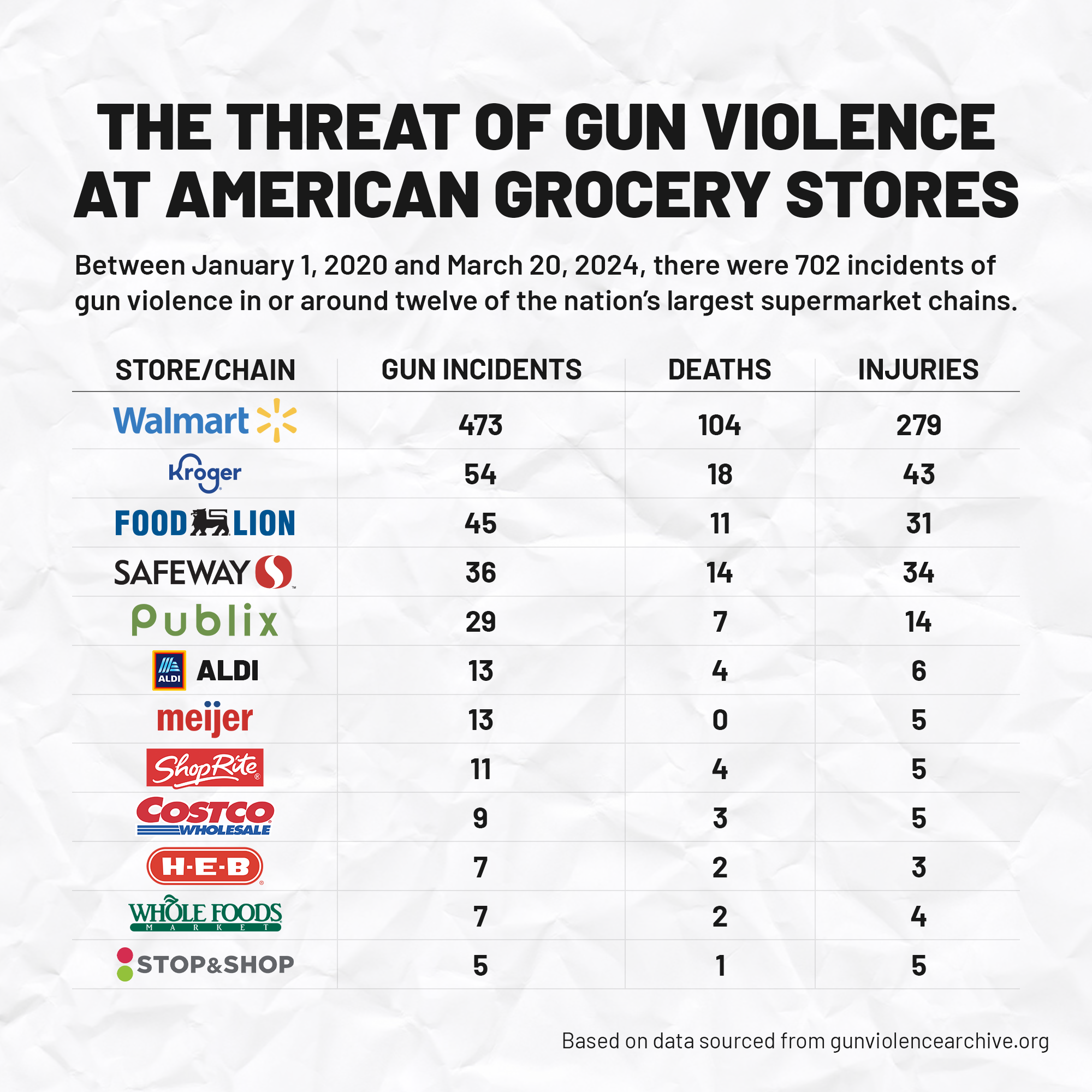
The shooting in Chesapeake is only one of hundreds at Walmart and other US grocery stores in the past few years. Over the past two years, Walmart stores nationwide saw 363 gun incidents resulting in 112 deaths, the most incidents and deaths by far among 12 major grocers tracked by the gun-control-advocacy campaign Guns Down America, citing data from gunviolencearchive.org. Kroger, which has roughly 1,800 fewer US stores than Walmart, had the second-most incidents tracked by Guns Down America, with 45 resulting in 20 deaths.

Walmart employees told Insider they're worried about whether the quarterly active-shooter training had prepared them for violence in stores.

"The issues with the training are abundant," a former Walmart employee from Florida told Insider. "We watch the same video all the time. It has become a meme." He asked to remain anonymous for privacy reasons.


A survey a few months ago in the subreddit r/walmart asked respondents to choose their "weapon of choice" during an active-shooter situation after the video showed employees using telephones and laptops.

A Walmart employee in Michigan, who asked to remain anonymous, citing a fear of retaliation, called the training "mediocre and inadequate."

"It's ridiculous," the employee said. "I'd like to see Walmart pay more attention to the mental wellness of their associates."

The Chesapeake shooting survivor suing Walmart alleges that she reported "disturbing and threatening" behavior from the shooter but he continued to work at the store.

In a lawsuit filed Tuesday in Chesapeake Circuit Court, Donya Prioleau, the Walmart employee, said the gunman — who had been working at the Walmart since 2010 — had been "disciplined on several occasions" and was "demoted by management for his improper and disturbing interactions with others" before being reinstated as a team lead.


The gunman "demonstrated a pattern of disturbing behavior leading up to the shooting, which Walmart knew, or should have known," argued the lawsuit, which was filed against Walmart by the law firm Morgan & Morgan on behalf of Prioleau.

The lawsuit said the shooter had a "personal vendetta" against several Walmart employees and kept a "kill list" of targets before the shooting.

The lawsuit also said the shooter "repeatedly asked coworkers if they had received their active shooter training."

"When coworkers responded that they had," the lawsuit said, the shooter "just smiled and walked away without saying anything."

U$A

November jobs report: 

Payrolls rise by 263,000, 

unemployment rate holds at 3.7%

Job growth slightly abated in November alongside rising interest rates but reflected stronger-than-expected hiring momentum, even as worries of a recession grow.

The Labor Department released the monthly jobs report for November at 8:30 a.m. ET on Friday. Here are the highlights, compared to Wall Street estimates compiled by Bloomberg:

  • Non-farm payrolls: +263,000 vs. +200,000 expected

  • Unemployment rate: 3.7% vs. 3.7% expected

  • Average hourly earnings, month-over-month: +0.6% vs. +0.3% expected

  • Average hourly earnings, year-over-year: +5.1% vs. +4.6% expected

Stock futures tumbled after the report's release, as Wall Street digested the potential implications of the employment beat and stronger-than-expected wage growth.

The numbers will likely reinforce the Federal Reserve's campaign to raise interest rates, even as it prepares to slow the pace of those hikes at its meeting in December.

(This post is breaking. Please check back for updates.)

Alexandra Semenova is a reporter for Yahoo Finance. Follow her on Twitter @alexandraandnyc

'No sacred cows' as pipeline company TC Energy prepares for C$5 billion asset sales
YOU OWE ALBERTA TAXPAYERS
$1 BILLION


Rod Nickel
Fri, December 2, 2022 

WINNIPEG, Manitoba (Reuters) - As TC Energy Corp prepares to unload C$5 billion ($3.7 billion) in assets next year, investors and analysts say the North American pipeline operator has plenty of options without touching its core gas business.

Chief Executive Francois Poirier cleared up any ambiguities this week when asked how much of TC's portfolio is in the shop window.

"I remember reading a book once called, 'Sacred Cows Make the Best Burgers,'" Poirier said at the company's investor day.

"There are no sacred cows."

Calgary, Alberta-based TC is widely known for its Keystone oil pipeline, a critical artery for moving Canadian oil to U.S. refiners that dominated headlines over the past decade for an expansion that ultimately failed.

But moving natural gas around the United States, Canada and Mexico is the bigger part of TC's business.

TC should consider selling Keystone along with its stake in Ontario's Bruce Power nuclear facility, since they are not part of its core business, said Rob Thummel, senior portfolio manager at TC shareholder Tortoise Capital Advisors.

"As far as a strategy, they're trying to figure out, do they want to be a utility company or more of an infrastructure play?" Thummel said. "The stuff that's not core, you could look at selling and implementing a buyback program or look at energy transition ideas."

Keystone could fetch TC C$12.8 billion, said CIBC analyst Robert Catellier in a note. He added that reducing TC's oil exposure would help it reach its emissions-reduction goals.

Selling Keystone, and the rest of TC's oil pipelines, makes sense since other companies are more dominant than TC in liquids, said Brandon Thimer, equity analyst at TC shareholder First Avenue Counsel.

"I think the market is going to applaud some of these dispositions."

TC's fund-raising plans to reduce debt and fund projects, notably the troubled Coastal GasLink pipeline in British Columbia, are critical to reviving investor confidence in a company whose shares have lagged those of rival Enbridge Inc.

The sales may reassure the market that TC will not need to issue common equity to raise funds in light of Coastal's cost over-runs and a deal in August to develop a $4.5 billion pipeline in Mexico, RBC analyst Robert Kwan said.

TC stock has gained less than 1% year to date, while Enbridge has added nearly 12% as of Thursday.

TC's stake in the Millennium natural gas pipeline in New York state is another logical sale candidate and could fetch $1 billion, said Scotiabank analyst Robert Hope. Small Alberta oil pipelines, Grand Rapids and White Spruce, could also be for sale, Hope said.

TC may be in sell mode now, but it has no intentions of shrinking. Poirier said the company needs to reduce debt to below five times its EBITDA to give TC the capacity to buy other assets that it expects to become available in coming years.

"Our highest priority in 2023 is to accelerate our deleveraging because we do see over the ensuing years some opportunities for us potentially to be opportunistic in M&A," Poirier said.

"You can't do that unless you've built some cushion."

(Reporting by Rod Nickel in Winnipeg; additional reporting by Maiya Keidan in Toronto; Editing by Marguerita Choy)
POSTMODERN IMPERIALI$M
India seizes opportunities in African healthcare

Priti Gupta - Mumbai
Fri, December 2, 2022 

India is the world's biggest supplier of generic pharmaceuticals

Like many African doctors, Peter Mativo had to travel overseas to complete his training.

In 2007 he left Kenya for Bangalore to pursue his goal of becoming a neurologist. After 18 months in India, he returned to Kenya and now works at the Aga Khan University Hospital in Nairobi.

"Most of us train in India, as Africa is not a developed continent. We have a very poor economy with no medical infrastructure in place nor specialised training," he says.

"I would have never been able to get a specialised degree if I would have not opted for India," Mr Mativo says.

India is keen to strengthen such ties with Africa. It has identified the healthcare sector as one area where trade between the continents can flourish.

So young African doctors are encouraged to finish their training in India, meanwhile Indian healthcare firms are expanding all over Africa.

Dr Mativo had to travel from Kenya to Banaglore to finish his medical training

"The African market is a natural fit for Indian pharmaceutical companies, as India is the largest provider of generic medicine in the world," says Nisht Dubey.

Generic drugs made in India can sell at a quarter of the price of a branded equivalent, which makes them a popular choice in less well-off parts of the world.

"There is a big gap between demand and supply of medicines in Africa, with a huge disparity among rich and poor," says Mr Dubey.

Spurred by a shortage of medicine and hospital equipment in Kenya during the Covid crisis, Mr Dubey set-up Goodstrain Pharma in 2020. It imports medicine and medical products from all over the world into Kenya.

Goodstrain's warehouse and corporate offices are in Nairobi, but Mr Dubey wants it to expand across East Africa.

"Africa is the only pharmaceutical market where genuinely high growth is still achievable," says Mr Dubey, who is originally from Uttar Pradesh in northern India.

But getting a firm going in Kenya has not been easy. Goodstrain's very first shipment to Kenya was held up at customs for weeks - a major setback for the young firm.

Mr Dubey says they were not ready for the web of regulations covering imports. Now a third party, which specialises in clearing imports, handles that for them.

In Kenya there was an acute shortage of medical supplies during the pandemic

Africure Pharmaceuticals, has gone one step further than Goodstrain, by manufacturing pharmaceuticals in Africa.

The company, only founded in 2017, already has nine manufacturing facilities in Africa, employing 300 people across Cameroon, Namibia, Botswana and Côte d'Ivoire, with plans to build plants in Ethiopia and Zimbabwe.

Africure's factories make medications to treat pain, fever, inflammation, malaria, diabetes andhypertension, as well as a wide range of antibiotics.

"Africa over the years has been dependent on imports of medication from Europe, India, and China, which has resulted in the draining of precious foreign exchange, non-creation of job opportunities, and suffering the vagaries of supply and demand," says Sinhue Noronha, founder and chief executive of Africure Pharmaceuticals.

Originally from Mumbai, Mr Noronha, hopes his firm will help tackle some of the problems in African healthcare.

"Our primary objective is to solve the persistent issues such as affordability, availability, low quality, technological dependence, and reliance on imports.

"All of our plants and distribution setups are engaged primarily to provide an uninterrupted supply of essential medicines."

Goodstrain Pharma imports medicine and medical products into Kenya

Mr Noronha says that Indian firms have a head start over rivals from elsewhere in the world.

"Indian manufacturers and importers are able to understand the African market because of our large diaspora presence in Africa."

Even with those connections, Mr Noronha, has found building a business in Africa a bumpy experience.

"The biggest challenge is political instability. I may get a permission today to set up a manufacturing unit, and tomorrow the government or the health minister may resign. One has to be ready for any kind of eventuality," he says.

He also says that personal safety is a consideration.

"Security is another big concern. murder and kidnapping are common in Africa. We Indians have to be very careful," he says.

Broadly, Indian healthcare firms have a good reputation in Africa, but that hard won image has recently suffered significant damage.

Police in The Gambia are investigating the deaths of 66 children, which have been linked to four brands of imported Indian cough syrup.

In October, the World Health Organization (WHO) issued a global alert over the cough syrups - warning they could be linked to acute kidney injuries and the children's deaths in July, August and September.

"The Gambia incident is an aberration and we should feel bad about it," says Udaya Bhaskar, director general of Pharmexcil, which promotes the export of Indian pharmaceuticals.

"This incident will certainly be a dent in our exports and the image of Indian pharma," he says.

But he thinks the reputational damage will be short-lived.

"The important factor is that Africa is very dependent on other countries and India produces very good quality medicine, so the Gambia impact will be short-term."

Back in Nairobi, Dr Mativo says the problem is the lack of testing facilities in Africa.

"The Gambia incident is sad. The biggest problem is we are not financially strong, nor do we have facilities which can check the standards of medicine supplied to us."

He would like to see more products produced locally.

"In Africa most of the population cannot afford branded medicine... what we need is training and setting up manufacturing units in Africa."
UK opposition wins special election in blow to Sunak's party


Fri, December 2, 2022

Newly elected Chester lawmaker Samantha Dixon

LONDON (AP) — Britain’s opposition Labour Party has handily won a special election for a northwest England seat in Parliament, the first test of voter sentiment since Conservative Prime Minister Rishi Sunak took office in October.

Labour held onto the City of Chester constituency with an increased vote share of 61%, according to results announced Friday. Labour won 50% of the votes in Chester at the last national election in 2019.

Labour leader Keir Starmer said the result showed people are “fed up” with the Conservative government.

Thursday’s election was called after Labour lawmaker Christian Matheson stepped down over allegations that he made inappropriate sexual advances to a member of his staff.

The result is bad news for the Conservatives, whose popularity has been hammered by the scandal-plagued three-year-term of former Prime Minister Boris Johnson, which ended in September, and weeks of turmoil under his short-term successor, Liz Truss. Truss quit in October after her plan for unfunded tax cuts spooked financial markets and rocked the economy.

Sunak replaced her and announced a package of tax increases and spending cuts aimed at restoring confidence in the nation’s finances. But the economic picture remains gloomy: Inflation hit 11.1% in October, many people are struggling to pay soaring energy bills and millions of workers, including railway staff, ambulance drivers and nurses, are staging strikes to demand major pay increases.

Newly elected Chester lawmaker Samantha Dixon said that “people in Chester and across our country are really worried.”


“Worried about losing their homes because they can’t afford the mortgage repayments or the rent, worried about whether they can put the heating on, worried about whether they can put food on the table for their families,” she said. “This is the cost of 12 years of Conservative government.”

Still, a national election does not have to be held until 2024, and pollsters warned that mid-term special elections often don't predict nationwide results.

Conservative peer and polling analyst Robert Hayward said the Tories were likely relieved they had not done worse.


“There are some indications that there are opportunities there for the Tory party,” he told Sky News. “But Rishi has to convince the public at large that he can manage out of this crisis, whichever crisis one’s looking at — and there’s a lot of them.”

___

Follow AP’s coverage of British politics at https://apnews.com/hub/british-politics

Jill Lawless, The Associated Press
Jeanne Dielman: Film directed by woman picked as best ever


Elsa Maishman - BBC News
Fri, December 2, 2022 

A film directed by a woman has been chosen as the greatest of all time by a group of experts.

Jeanne Dielman, 23 quai du Commerce, 1080 Bruxelles, directed by Chantal Akerman, has topped the British Film Institute's Sight and Sound poll.

It is the first time a work directed by a woman has reached the top ten. The poll, which runs every decade, has been criticised for a lack of diversity.

The winning spot was held for 40 years by Orson Welles' Citizen Kane.

It was overtaken in 2012 by Alfred Hitchcock's Vertigo.

Jeanne Dielman, released in 1975, is the story of a Belgian widow who turns to prostitution to make ends meet, but kills one of her clients. The film runs for almost three and a half hours.


Though not as well-known outside the world of film criticism as previous winners, it has been lauded as a "masterpiece", and a ground-breaking piece of feminist film.

Chantal Akerman, the Belgian director, died in 2015 aged 65.

Lillian Crawford, a film critic and writer who contributed to the poll, said the film was the "essential text" in feminist cinema.

Chantal Akerman pictured in 2004

"Jeanne Dielman isn't a film that I would say to someone getting into cinema 'Oh, this is the first film you absolutely must see'," she told the BBC.

"I think if you're going to work through the list, maybe do it in reverse order and sort of build towards it, because it's quite an ask to invite people to see this.

"But in an academic sense and thinking about cinema and encouraging more people to seek out experimental film, films by women, and in terms of the history of feminist cinema, this is absolutely the sort of essential text."

In an article for the British Film Institute, Laura Mulvey, a professor of film studies at Birkbeck University, called the vote a "sudden shake-up".

"Things will never be the same," she wrote.

The poll has been run by the British Film Institute's Sight and Sound magazine each decade since 1952.

It has faced criticism in the past for a lack of diversity in the experts polled and the list of 100 best films chosen.


In 2012, Jeanne Dielman was one of just two films directed by women which made it on to the list, along with one by a black director - Djibril Diop Mambéty's Touki Bouki.

Over the years the number and diversity of people consulted have increased. This year, 1,639 critics, programmers, curators, archivists and academics were asked to choose their top ten films.

Last time's winner, Vertigo, claimed the second spot, while Citizen Kane was third.

Yasujirō Ozu's Tokyo Story came fourth, followed by Wong Kar Wai's In the Mood for Love in fifth place.
CAPITAL STRIKE

Oil giant TotalEnergies to cut North Sea investment over windfall tax


Oliver Smith - Business reporter, BBC News
Fri, December 2, 2022

Oil rig workers

French oil giant TotalEnergies has said it will cut North Sea investment by 25% next year after the windfall tax on oil and gas firms in the UK was extended.

The company will cut £100m of spending on new wells in the region.

The windfall tax - the Energy Profits Levy - was raised from 25% to 35% in last month's Autumn Statement and will now stay in place until March 2028.

The government said the levy "strikes a balance between funding cost of living support while encouraging investment".

"We have been clear that we want to encourage reinvestment of the sector's profits to support the economy, jobs, and our energy security, which is why the more investment a firm makes into the UK, the less tax they will pay," a Treasury spokesperson said.

TotalEnergies is one of the North Sea's biggest oil and gas producers and its decision to cut investment will affect plans to drill a new well at its Elgin gas field.

"Following another change to the fiscal environment for energy investors in the UK, we are now evaluating the impact of this change on our current and planned projects," said TotalEnergies' UK chairman Jean-Luc Guiziou.

"We note that without a price floor to the EPL (Energy Profits Levy), the current regime will affect short-cycle investments, in particular infill wells.

"The energy industry operates in a cyclical market and is subject to volatile commodity prices. We believe that the government should remain open to reviewing the Energy Profits Levy if prices reduce before 2028."

What is the windfall tax on oil and gas companies?

The windfall tax on oil and gas companies operating in the North Sea was introduced in May after oil prices increased sharply.

Oil prices had already been increasing as Covid restrictions were lifted around the world, but they jumped when Russia's invasion of Ukraine led to worries over energy supplies.

The rate for the EPL was set at 25% originally. However, in the Autumn Statement last month, Chancellor Jeremy Hunt announced it would increase to 35% from January 2023, and stay in place until March 2028. It had previously been scheduled to finish at the end of 2025.

Oil and gas firms operating in the North Sea are already taxed differently to other firms. Taxes on their profits are higher - they pay 30% corporation tax on their profits and a supplementary 10% rate on top of that.

Other firms currently pay corporation tax at 19%.

'Extreme burden'


Last week, Brindex, an organisation representing smaller independent oil exploration companies in the North Sea, wrote to the chancellor saying the windfall tax increase represented an "existential threat" to the industry.

Robin Allen, the chairman of Brindex, said in the letter that its members can "no longer shoulder this extreme open ended tax burden", and warned that it could impact jobs and the country's energy security.

Like TotalEnergies, Brindex has called for a price floor mechanism whereby the windfall tax would only be triggered above a certain price level for oil and gas.

"Without such a mechanism and to continue down the path of the current anticipated 75% rate, further investment in the UK has become unviable and so begins a rapid onset of the decline of the North Sea," Mr Allen said.

Both Shell and BP have said that they will review North Sea investments following the tax increase, but have not announced any specific cuts to spending in the region.

The main North Sea industry body, Offshore Energies UK (OEUK), said the decision to increase the EPL was "undermining investor confidence".

Deirdre Michie, chief executive of OEUK, said: "Our industry was planning to invest £200bn in the broader energy sector - this includes low-carbon solutions - by 2030. This would help to ensure that the UK can meet its net-zero and climate goals and boost its energy security while we make that low-carbon transition.

"But... these tax changes really do jeopardise this."