Saturday, December 31, 2022

WHO Asks For More Comprehensive Data On Regular Basis From China On Covid-19 Situation

A high-level meeting took place between officials from WHO and China on the current surge in Covid-19 cases to seek further information on the situation, and to offer WHO's expertise and further support, a WHO statement said on Friday.

31 DEC 2022 

The World Health Organization has again urged China to regularly share specific and real-time data on the Covid-19 situation in the country, amid a surge in coronavirus cases after Beijing relaxed its strict "zero-Covid" policy.

The global health agency has asked Chinese health officials to share data on genetic sequencing, hospitalisations, deaths and vaccinations.

A high-level meeting took place between officials from WHO and China on the current surge in Covid-19 cases to seek further information on the situation, and to offer WHO's expertise and further support, a WHO statement said on Friday


What did WHO ask for?


“WHO again asked for regular sharing of specific and real-time data on the epidemiological situation — including more genetic sequencing data, data on disease impact including hospitalisations, ICU admissions and deaths —and data on vaccinations delivered and vaccination status, especially in vulnerable people and those over 60 years old,” it added.

WHO reiterated the importance of vaccination and booster doses to protect against severe disease and death for people at higher risk.

The statement said that high-level officials from China's National Health Commission and the National Disease Control and Prevention Administration briefed WHO on China's evolving strategy and actions in the areas of epidemiology, monitoring of variants, vaccination, clinical care, communication and R&D.

WHO called on China to strengthen viral sequencing, clinical management, and impact assessment, and expressed willingness to provide support on these areas, as well as on risk communications on vaccination to counter hesitancy.

“Chinese scientists are invited to engage more closely in WHO-led Covid-19 expert networks including the Covid-19 clinical management network,” the WHO statement said.

It said that the WHO has invited Chinese scientists to present detailed data on viral sequencing at a meeting of the Technical Advisory Group on SARS-CoV-2 Virus Evolution on January 3.

"WHO stressed the importance of monitoring and the timely publication of data to help China and the global community to formulate accurate risk assessments and to inform effective responses,” it said.

Millions of Chinese have been infected in the current surge of Omicron variants in the country, causing an alarm over the world.

China's health officials on Friday discussed with the WHO experts the current surge of the Covid-19 cases in the country after the organisation's chief Tedros Adhanom Ghebreyesus asked Beijing to share more information.


The WHO tweeted on Thursday: “As I said at our most recent press conference -- in order to make a comprehensive risk assessment of the Covid-19 situation on the ground in China, @WHO needs more detailed information."

He also defended various countries, including India, to take protective measures against people arriving from China to prevent the virus from spreading.

“In the absence of comprehensive information from China, it is understandable that countries around the world are acting in ways that they believe may protect their populations," he said.

India has joined the United States, Japan, Italy and Taiwan in imposing mandatory Covid-19 tests for travellers from China, amid a Covid-19 surge there after authorities relaxed strict "zero-Covid" rules.

“We continue to call on China to share data and all hypotheses about this pandemic remain on the table," the WHO chief said, referring to the origin of the coronavirus which was first reported in Wuhan city of China in late 2019.

His remarks came against the backdrop of China criticising the countermeasures taken by various countries including the US, Japan and India requiring travellers from China to undergo the required tests.

Official Covid-19 figures from China have become unreliable as less testing is being done across the country following the recent easing of the "zero-Covid" policy.

Beijing's decision to lift all travel restrictions, including scrapping of quarantine for inbound travellers from January 8 ahead of Chinese New Year, has caused alarm around the world.

Millions of Chinese are expected to travel to various parts of the world for holiday during this period.
CAUSES INFLATION
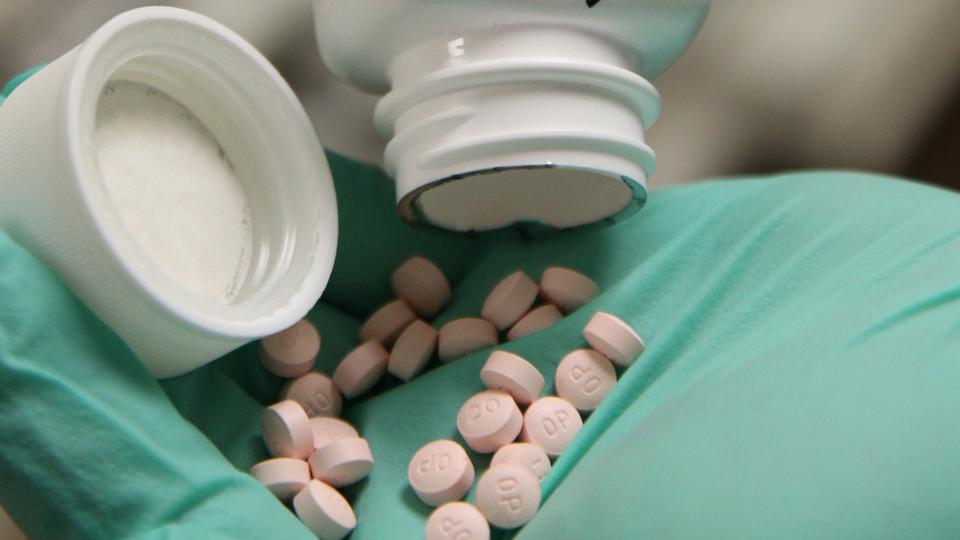
Pharma industry to hike prices on over 350 drugs in US


Increases in January 2023 are expected to come as American pharmaceutical firms prepare for Biden Administration's Inflation Reduction Act.

More drug prices are likely to be announced over the course of January — historically the biggest month for drugmakers to raise prices
(Reuters Archive)

Drugmakers including Pfizer Inc, GlaxoSmithKline PLC, Bristol Myers Squibb, AstraZeneca PLC and Sanofi SA plan to raise prices in the United States on more than 350 unique drugs in early January, according to data analysed by healthcare research firm 3 Axis Advisors.

The increases are expected to come as the pharmaceutical industry prepares for the Biden Administration's Inflation Reduction Act (IRA), which allows the government's Medicare health programme to negotiate prices directly for some drugs starting in 2026.

The industry is also contending with inflation and supply chain constraints that have led to higher manufacturing costs.

The increases are on list prices, which do not include rebates to pharmacy benefit managers and other discounts.

In 2022, drugmakers raised prices on more than 1,400 drugs according to data published by 46brooklyn, a drug pricing non-profit that is related to 3 Axis.

That is the most increase since 2015.

The median drug price increase was 4.9 percent last year, while the average increase was 6.4 percent, according to 46brooklyn.

Both figures are lower than the inflation rates in the United States.

Driving factors in price hikes

To date, Pfizer announced the most increases, with prices rising on 89 unique drug brands and an additional increase on 10 drug brands at its Hospira arm.

That was followed by GSK, with planned increases so far on 26 unique drugs, including nearly a 7 percent increase on its popular shingles vaccine Shingrix.

Notable increases expected include 9 percent price hikes on Bristol Myers Squibb's personalised CAR-T cell therapies Abecma and Breyanzi, both of which were already more than $400,000 for the blood cancer treatments.

A company spokesperson said there were several driving factors in increasing the list price of the two CAR-T cell therapies, including the rate of inflation, the value of the therapies, and the personalised nature of the CAR-T manufacturing process.

Increases for Pfizer include a 6 percent rise on the cost of Xeljanz, a treatment for autoimmune diseases including rheumatoid arthritis and ulcerative colitis, and 7.9 percent increases on cancer drugs Ibrance and Xalkori.

A Pfizer spokesperson said in an email that the company's average list prices for drugs and vaccines in 2023 are well below overall inflation at approximately 3.6 percent, noting that the increases are needed to support investments in drug discovery.

AstraZeneca is set to raise prices in the 3 percent range on blood cancer treatment Calquence, non-small cell lung cancer drug Tagrisso and asthma treatment Fasenra.

"AstraZeneca has always taken a thoughtful approach to pricing, and we continue to do so, considering many factors," said company spokesman Brendan McEvoy.

Sanofi plans to raise prices on 14 of its drugs or vaccines.

A Sanofi spokesperson said the drugmaker's 2023 pricing actions are consistent with its approach to responsible pricing, adherence to government policies, and the need to respond to evolving trends in the marketplace.

The Devil went down to Kyiv 

Scholar Eliot Borenstein examines the worrying ‘video game logic’ behind Moscow’s fundamentalist fight


 December 30, 2022
Source: Meduza
By Dr. Eliot Borenstein


Who, exactly, is the enemy Russia has targeted in its unprovoked invasion of Ukraine? Not Ukrainians, who, as the Russian media continually remind us, don’t actually exist. Not NATO and the “collective West,” however much they might fit the bill; Russian television has been demonizing them for more than a decade, but there is little appetite for a direct confrontation. Throughout most of the war, the “Kyiv Junta” has been labeled a band of homosexuals, drug addicts, and, most prominently, Nazis. Yet somehow even Nazis are not quite evil enough. So, who is the true enemy? Could it be … Satan?

Apparently, yes. 

On November 4, Deputy Chairman of Russia’s Security Council Dmitry Medvedev, who just 15 years ago was the gadget-happy, reformist president on whom the country’s liberals pinned their few remaining hopes, gave a speech worthy of a wannabe suicide bomber: 

We listen to the words of the Creator in our hearts and obey them. These words give us our holy goal. The goal of stopping the supreme leader of hell, whatever name he might use — Satan, Lucifer, or Iblis.

As Artem Efimov notes in his excellent contribution to Meduza’s “Signal” Russian-language newsletter (all the Satanic news fit for pixels, if not print), it was Chechen leader Ramzan Kadyrov who, while apparently moonlighting as a demonologist on his Telegram channel, called for the “desatanization” of Ukraine. This is the sort of language we have come to expect from Kadyrov, who rails against “shaitans” so often that they may as well be one of the odd filler words that notoriously pepper most of his sentences. We not only expect Satan from Kadyrov — we’re disappointed if he forgets to mention him.

If both the Muslim Kadyrov and the Russian Orthodox Medvedev are warring against Satan, then this isn’t simply a matter of the ongoing mind meld between the Russian (Orthodox) Church and State. One need not believe in God to worry about Satan (although it certainly helps). 

The U.S. has been beset by waves of demonically-inflected hysteria since the infamous Satanic Panic of the 1980s, when a confluence of concerned parents, “experts,” and media personalities turned a few unhinged accusations of so-called “satanic ritual abuse” into a threat that stalked America’s schools and daycare centers. The officially atheist Soviet Union was spared this particular wave of hysteria, but, as Efimov points out, the moral panic over new religious movements (“cults”) in the 1990s brought satanism into the Russian popular consciousness.

By the 2000s, activists associated with the Russian Orthodox Church (ROC) were ferreting out Satanists left and right. And they involved the government whenever possible. When the Moscow Education Department banned Halloween in the city schools, it claimed that the holiday promoted a “cult of death” and pointed to concerns about “rituals of Satanically oriented religious sects.” The popularity of the Harry Potter franchise put the morality police into overdrive. In December 2002, a woman filed a complaint with Moscow Prosecutor’s Office against Rosmen, the publisher of Harry Potter, for “occult propaganda” (the prosecutors declined to charge Rosmen, due to a lack of evidence).

Something was spreading throughout Russia since the collapse of the USSR, but it was not Satanism: it was the crusade against Satanism. 

This was a movement that crossed church and state boundaries long before the 2022 invasion of Ukraine. The demonization of “cults” in the 1990s was an important step, but it was only in the past decade that both scholars and state actors indulged in a crucial slippage between the religious and the political. The Center for Combating Extremism, founded in 2008, fights both political opposition and unrecognized religious organizations, tacitly making them equivalent “threats.” In 2020, Roman Silantev, one of the leading experts combating new religious movements, published a book called Destructology, which provides the ideological justification for the Center’s work. For Silantev, undesirable political and social movements such as pyramid schemes, “fascist” and “antifascist” groups, and even the pensioners who insist that the USSR still exists, are structurally exactly the same as “totalitarian cults.” From here to Satanism is just a small step.

IBLIS

Since February 24, disaffected Russians have been asking themselves the grimly ironic question: “So, are we North Korea now, or Iran?” If the country is going to be explicitly fighting Satan, then Iran seems like the better bet. But the irony goes even deeper. There’s something about looking for Satan around every corner that is suspiciously …American.

The rise of the Russian anti-cult movement and the fundamentalist fight against secular culture are part of an ideological pipeline that leads back to the Great Satan itself, with American far-right and evangelical organizations taking a strong interest in the post-Soviet space even before Fox News became Russian television’s favorite American channel.

All of which suggests that we should not take the Russian state’s anti-Satanic zeal at face value. And yet something about Russia’s war in Ukraine has repeatedly activated theocratic, reactionary forces. In November 2014, one of the military leaders of the self-proclaimed “Luhansk People’s Republic” announced plans to forbid women from entering bars, when they should be sitting at home practicing their cross-stitching. (“It’s time to remember that you’re Russian! Remember your spirituality!”)

It’s highly unlikely that Medvedev, Putin, or anyone high up in the Russian government believes they are fighting Satan, but their beliefs matter only so much. They are providing a permission structure for fanatics who are only too happy to stamp out the devil’s work wherever they might find it. Just as Putinism has always been a delicately calibrated mix of top-down initiatives and responses to the more belligerent sentiments in Russian society, so too is this Satanic vocabulary both the logical outcome of decades of mild moral panics and the latest (and possibly last) rhetorical ploy on the part of a regime that has backed itself into a corner.

The escalation from gays to Nazis to Satan follows a kind of video game logic: keeping the players engaged means finding ever-bigger bosses for them to fight. But where can you go after Satan? One hopes that the leadership of the Russian Federation is not charting a deliberately apocalyptic course, despite the disturbing chatter about nuclear warfare and Russians “going to heaven, while their enemies just croak.” But when your enemy is Satan, there is little room for negotiation, retreat, or surrender.

All of which scares the hell out of anyone paying attention. Still, there is one cause for hope: If there is any world leader who must have vast experience in making deals with the devil, it’s Vladimir Putin.


Eliot Borenstein is a professor of Russian and Slavic Studies at New York University. He is the author of two forthcoming books — Marvel Comics in the 1970s: The World Inside Your Head (Cornell) and Soviet-Self-Hatred: The Secret Identities of Postsocialism in Contemporary Russia (Cornell) — and the recently released Meanwhile, in Russia…: Russian Internet Memes and Viral Video (Bloomsbury).


THE KUBASONICS

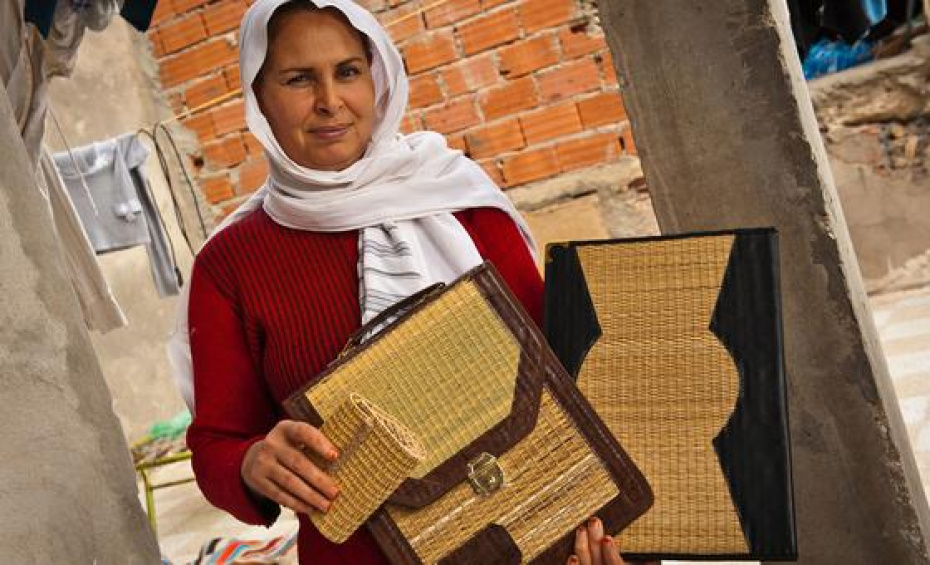
Arab region registers world’s highest unemployment rate, UN survey finds


30 December 2022

According to the latest UN survey, released on Friday, the Arab region registered a 12 per cent unemployment rate in 2022, the highest in the world.


However, the Survey of Economic and Social Developments in the Arab RegionOpens in new window, published by the UN Economic and Social Commission for Western Asia (ESCWAOpens in new window) projects post-COVID-19Opens in new window economic recovery efforts to prompt a very slight decrease next year – to 11.7 per cent.

Mounting poverty


Meanwhile, poverty measured against national lines also surged, affecting 130 million people in Arab countries, revealed the Survey.

Excluding Libya and Gulf Cooperation Council countries, more than one-third of the region’s population is affected.

Moreover, poverty levels are expected to rise over the next two years, reaching 36 per cent of the population in 2024.


Good news in growth

Notwithstanding disruptions triggered by the COVID-19 pandemic and war in Ukraine, the Survey showed an expected 3.4 per cent growth next year throughout the Arab region.

While inflation rates jumped this year to 14 per cent, they are predicted to drop to eight and 4.5 per cent, respectively, in the next two years.
Noteworthy discrepancies

Yet, despite the region’s positive growth outlook, Ahmed Moummi, lead author of the Survey, pointed to significant discrepancies among countries – which were exacerbated by the war in Ukraine.

Noting that repercussions were not the same for all Arab States, he maintained that Gulf Cooperation Council countries and other oil-exporting ones will continue to benefit from higher energy prices.

At the same time, oil-importing nations will suffer from several socioeconomic challenges, including rising energy costs, food supply shortages, and drops in both tourism and international aid inflows.

“The current situation presents an opportunity for oil-exporting Arab countries to diversify their economies away from the energy sector by accumulating reserves and investing in projects that generate inclusive growth and sustainable development”, Mr. Moummi underscored.

Through its annual Survey, ESCWA provides an analysis of the latest social and economic trends in the region to help member States in developing and implementing evidence-based policies, and improving economic planning processes for sustainable and inclusive development.
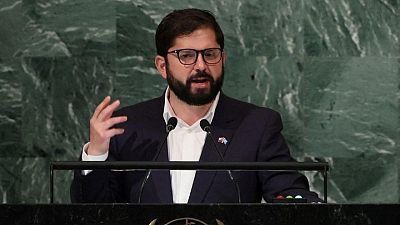
Chile's Boric pardons 12 convicted after 2019 protests

By Reuters • Updated: 31/12/2022 - 12:25

Chile's Boric pardons 12 convicted after 2019 protests -
 Copyright Thomson Reuters 2022

SANTIAGO – Chile’s President Gabriel Boric on Friday pardoned 12 people connected with widespread protests against inequality in 2019 that left more than 30 dead.

Political factions and organizations had called for the release of the people connected to violent protests that shook the South American country. As a candidate, Boric had talked about pardoning some of those convicted for less violent crimes after the protests.

The list of those pardoned included men between the ages of 21 and 38 involved in various crimes such as looting, robbery, handling Molotov cocktails, and others.

The move was celebrated by political allies with senator Fabiola Campillai, who was blinded during the protests before running for office, calling it a “humanitarian act.”

Political opponents decried the move.

“It’s a slap in the face to all Chileans that want more security,” right-wing senator Gonzalo de la Carrera said on Twitter, saying the move disrupts negotiations currently under way to create a national safety council.

Boric also pardoned a member of a rebel group on Friday for a total of 13 pardons. Jorge Mateluna, 48, is linked to the Manuel Rodriguez Patriotic Front (FPMR), had been sentenced to 16 years in prison after being accused of participating in an assault on a branch in Santiago in June 2013.

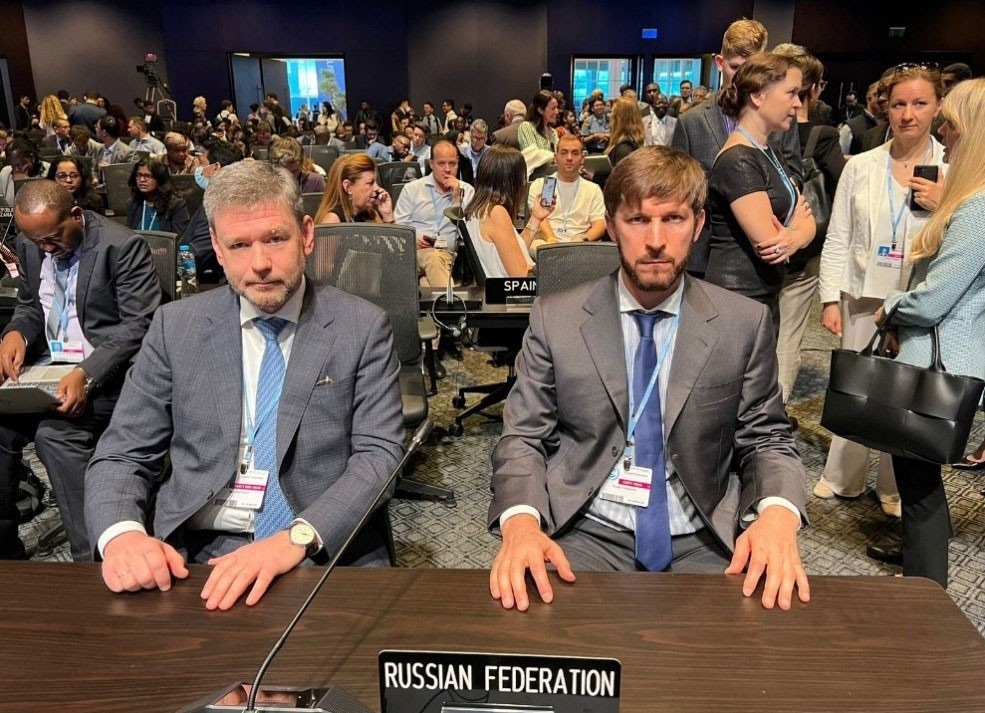
Russian isolation at COP27. And looming climate crisis along Arctic coast

As disgraced negotiators in Sharm El Sheikh ardently lobbied Russian interests, meteorologists from the country published new alarming information about Arctic temperatures.
BARENTS OBSERVER

Leader of meteorological institute Roshydromet Igor Shumakov (left) and presidential aide on climate change Ruslan Edelgeriev at COP27. Photo: Roshydromet

The Russian delegation at the COP27 climate change conference had no easy job to promote Russian positions. Disgraced by the country’s aggressive war against Ukraine, the Russian negotiators were met with lukewarm, if not outright hostile, approaches from international colleagues.

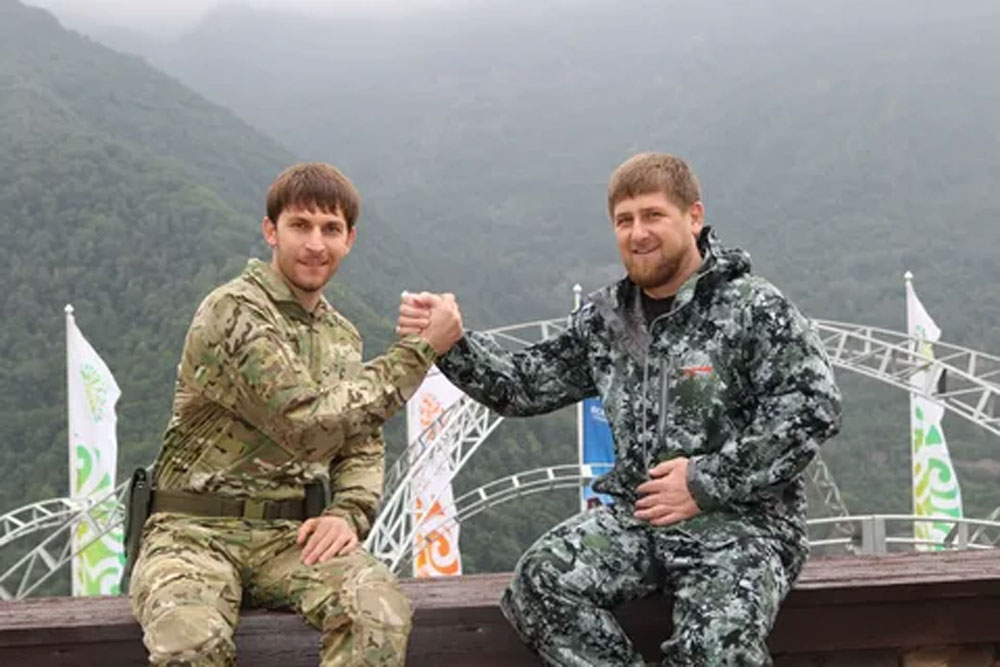
At the head of the delegation was the Kremlin’s special climate envoy Ruslan Edelgeriev, the former Chechen prime minister and close associate of regional strongman Ramzan Kadyrov.

Ruslan Edelgeriev and Ramzan Kadyrov. Photo: gov.chechnya.ru

Ahead of the conference, Edelgeriev underlined to Egypt’s Ambassador to Russia that the climate talks must have “a depoliticised and unbiased approach” and that a “pragmatic and well-intentional position that supports an atmosphere of cooperation” must be pursued.

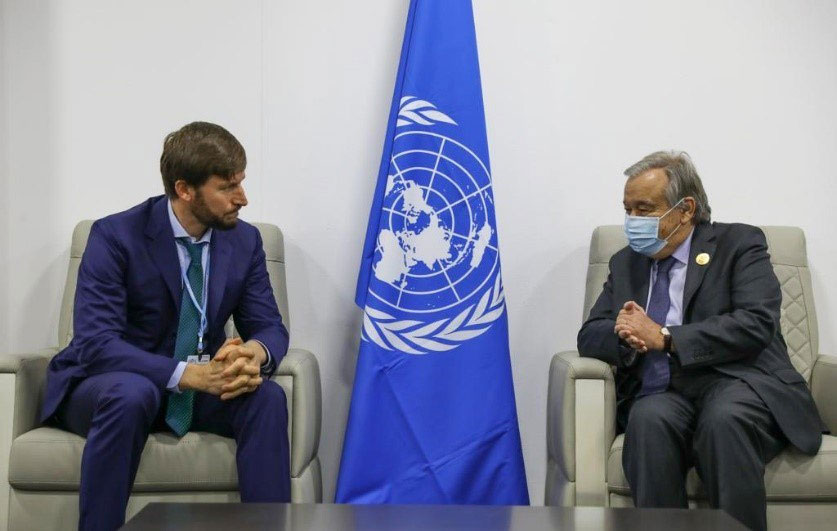
Ruslan Edelgeriev met with UN General Secretary Antonio Guterres. 
Photo. Roshydromet

Edelgeriev later expressed concern about a negative impact of current geopolitics on international climate ambitions, Interfax reported. Previously, he and other Russian officials have also called for eased sanctions in order to facilitate Russian climate policy.

Russia’s losing standing in international climate talks not only comes because of its onslaught in Ukraine, but also because of its dwindling role as energy super-power.

According to Russian climate and anti-war activist Arshak Makichyan, the Russian delegation at COP27 in Sharm El-Sheikh spent two weeks lobbying for nuclear power as a fossil fuel alternative in an attempt to retain its stranglehold on global energy systems.

Makichyan argues that there is no place for a fight against climate change in the ideology of Vladimir Putin.

“Fossil fuel extraction is a Russian tradition on par with corruption and institutionalised racism, and the Kremlin has an interest in protecting all three,” he writes in a column for the Moscow Times.

The COP27 took place as new temperature highs were recorded in the Russian Arctic. Data from the Russia’s Meteorological Institute Roshydromet show that parts of the Taimyr Peninsula in October this year was up to 8°C higher than normal.

A temperature map for the region show that also the Yamal Peninsula and major parts of the Kara Sea and Laptev Sea in the same period was 6°C warmer than normal.

For all of the Russian Arctic, the average temperature was -6,4°C, which is almost 4° higher than normal for the month, Roshydromet informs.

For all of Russia, October 2022 was the third warmest October since measurements started in 1891.

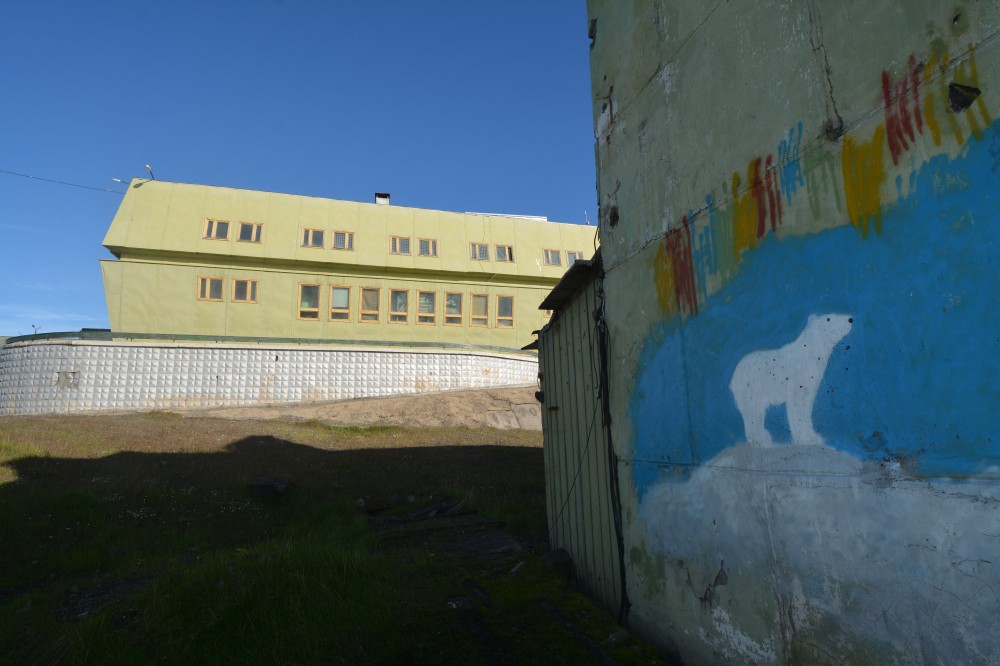
The town of Dikson is located in the middle of last month’s heat belt along the Kara Sea coast. Average temperatures in in town is normally 7,4°C in October. This year, however, the average temperature for the month was only about zero.

The town of Dikson. Photo: Thomas Nilsen

Consequences for livelihoods and wildlife in the region are dramatic. Normally, there would by early November be solid layer of sea-ice on the waters outside town. This year, however, there was only minor ice in the area, maps from the Arctic and Antarctic Research Institute show.

Paradoxically, the small Arctic town is today experiencing a major economic up-swing as it starts large-scale production of the mineral that has a key part of the blame for climate change. Just south of town are major reserves of high-quality coal that is now developed by company Severnaya Zvezda.
Julian Assange to ask for prison release to attend Vivienne Westwood’s funeral

ByLatika Bourke
December 31, 2022 

London: Stella Assange says her husband, Julian Assange, will apply to British authorities for leave from Belmarsh Prison to attend the funeral of their dear friend, Dame Vivienne Westwood.

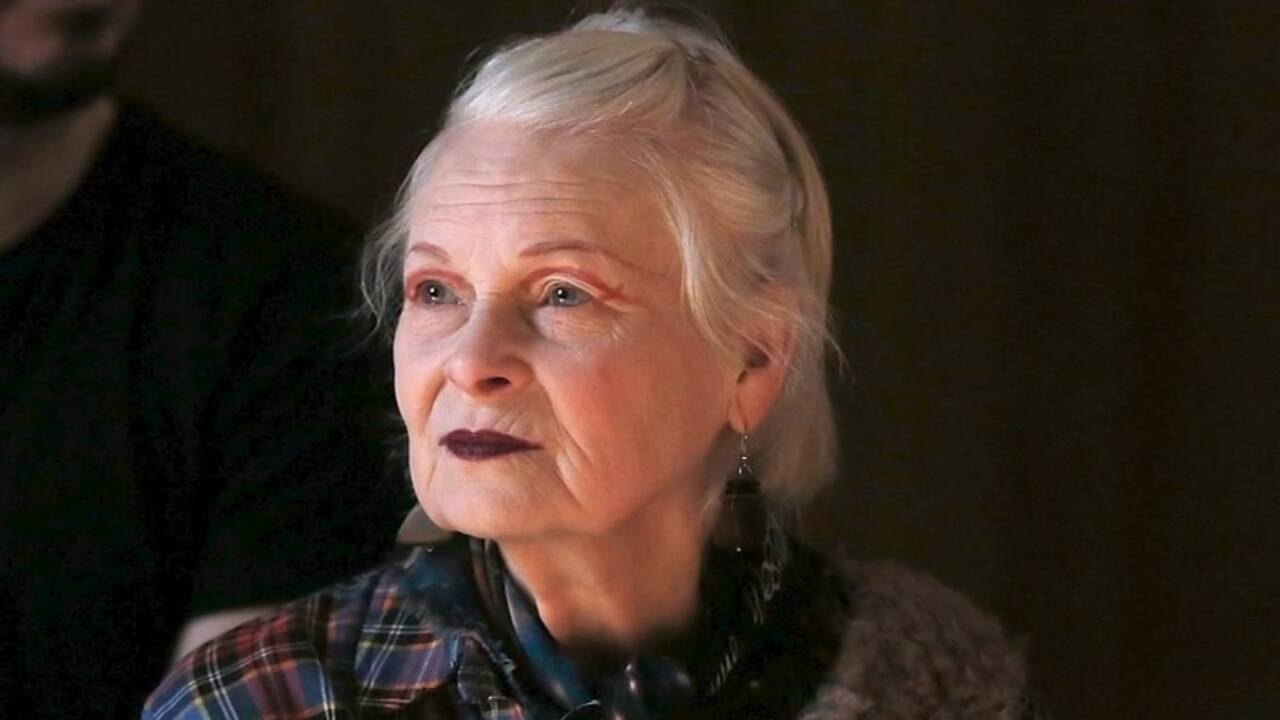
Westwood, one of Britain’s most-loved designers and a long-time political activist and supporter of the WikiLeaks founder, died on Thursday in the UK, aged 81.


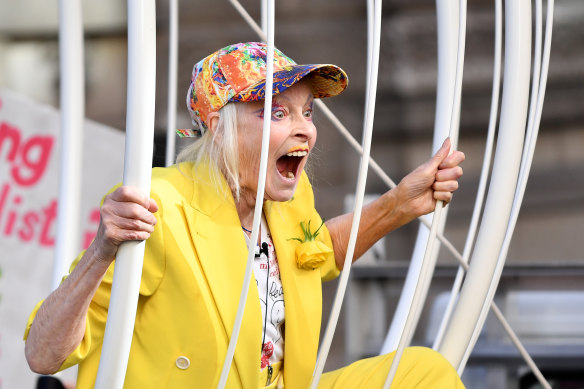
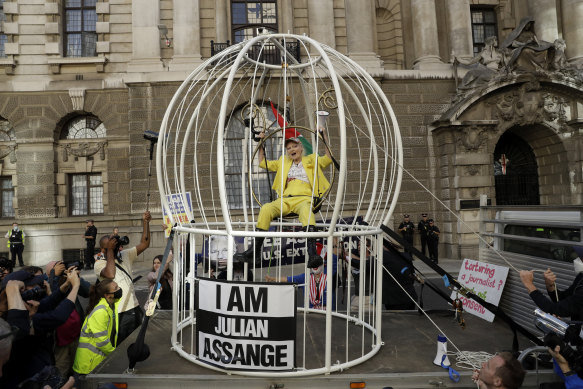
Dame Vivienne Westwood in a suspended giant bird cage in protest for Julian Assange at London’s Old Bailey in July 2020.
CREDIT:GETTY

In an interview with The Sydney Morning Herald and The Age, Stella Assange said she first met Westwood at Julian’s 40th birthday party when he was under house arrest in Norfolk in 2011, and Westwood had remained his friend and supporter “until the end”.

A decade later, Westwood attended celebrations for Julian’s 50th birthday held in his absence because he was in jail.

“Vivienne is irreplaceable. She was a huge friend, a great supporter, and it’s an enormous loss,” Stella said in an interview by phone from Spain, where she spent Christmas with her 91-year-old father as she said she could not visit her husband in prison.


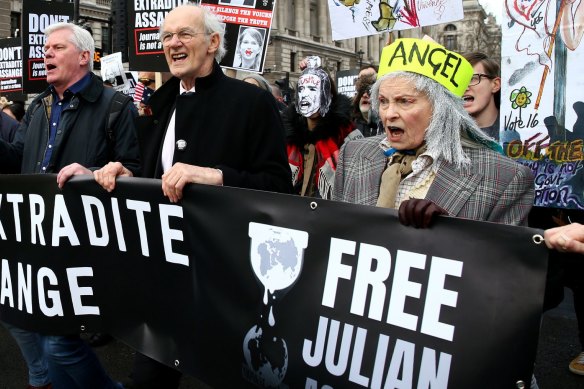
Wikileaks editor-in-chief Kristinn Hrafnsson, Julian Assange’s father John Shipton and fashion designer Vivienne Westwood march in February 2020 in London.
CREDIT:GETTY

“She was such a generous spirit and she really, really cared about the future of the world and future generations and she really saw all of these issues as justice and truth and the destruction of the planet as interrelated causes.

“She used her profile and her fashion to fight for the causes she believed in.”

Stella said she got to know Westwood well during her husband’s seven years in the Ecuadorian embassy, where he lived as an asylum seeker to avoid being extradited to Sweden, where authorities wanted to question him over now-lapsed sexual assault allegations.


“Every couple of weeks, she would come on her bicycle and spend some time with Julian, and they loved each other’s company, and they would spend hours talking about all sorts of things,” Stella said.

“There was so much laughter and she was a very intelligent and curious spirit, she was very creative and they found each other’s company riveting.”


Vivienne Westwood, an influential fashion maverick who played a key role in the punk movement, has died.

Julian Assange is on remand in Belmarsh Prison, a facility in south-east London often used to hold prisoners in high-profile cases involving national security, and is fighting an order for him to be extradited to the United States to face charges over the hacking of classified US intelligence cables, which he published more than a decade ago.

Stella said she spoke to her husband shortly after the news of Westwood’s death was posted on the designer’s social media feeds and that he had provided her with the first quote since he had been in prison.

Julian Assange said Westwood would be “terribly missed”.

“Vivienne was a Dame and a pillar of the anti-establishment,” he said. “Bold, creative, thoughtful and a good friend. The best of Britain.”


Westwood protests against the extradition of Julian Assange to the US, outside London’s Old Bailey Court in 2020.
CREDIT:AP

Asked how she planned to represent her husband at Westwood’s funeral, Stella said: “Julian’s going to put in a request to be able to attend.”

Westwood was one of Julian Assange’s earliest supporters and staged stunts dressed in yellow in a cage outside the Old Bailey to draw attention to the Australian’s case, which Assange and his supporters argue is a political witch-hunt.


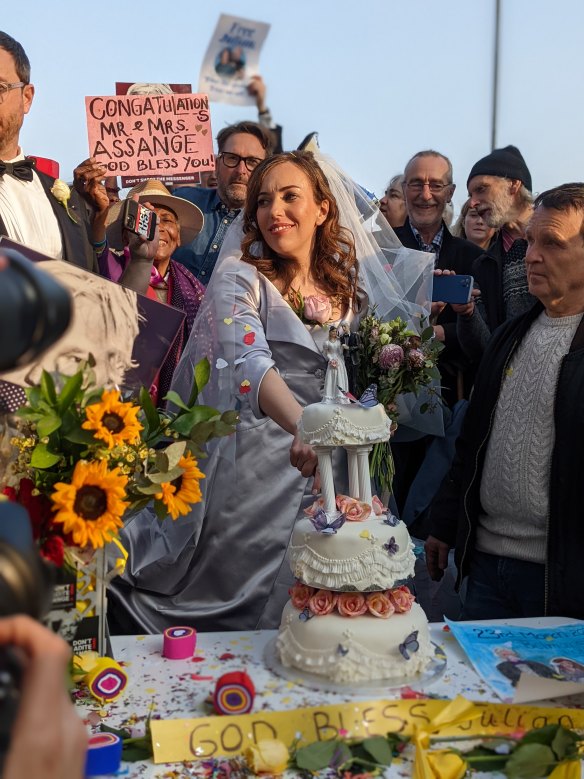
Stella Assange (nee Moris) cuts her wedding cake outside Belmarsh Prison in March 2022 after marrying Julian Assange.
CREDIT:LATIKA BOURKE

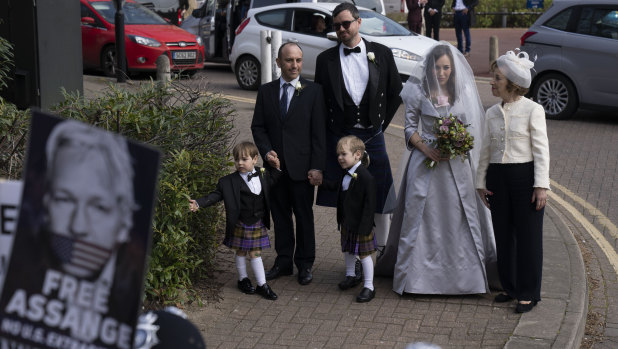
She designed the wedding dress and tartan kilts for the Assanges’ wedding inside Belmarsh Prison earlier this year.

Stella Assange said Westwood made careful alterations for the dress, including replacing the metal boning in the corset so it wouldn’t get caught in metal detectors and sewing a fresh rose into the bodice so that the bride would have a flower during the ceremony.

Her bouquet was taken from her by security and prison staff made her sign an agreement to never share the photographs of her and Assange marrying.

“There was so much detail and love in that dress and it’s really heartbreaking that she didn’t see how much joy she brought to our wedding day,” Stella said.

“But she knew that she had made our wedding day so amazing.


Stella Assange (nee Moris) with family, including sons Gabriel and Max, before her March wedding to Julian Assange. Vivienne Westwood designed the wedding dress and the boys’ kilts.
CREDIT:AP

“It brought a lot of additional attention to our wedding and this was part of her magic and her intelligence to be able to give exposure to important political causes.”

Stella hopes to share the “unique gift” of her Westwood wedding gown and one day exhibit her dress alongside her husband’s kilt.


Crypto journalist slams New York Post and Daily Mail for ‘sexist’ coverage of Bankman-Fried meeting

Critics argued coverage showed misogyny towards women in tech media

Josh Marcus
San Francisco

Crypto journalist Tiffany Fong says she’s received a wave of “gross” sexist coverage in the media after she visited FTX founder Sam Bankman-Fried, who is on house arrest while he’s being prosecuted for wire fraud and money laundering.


Outlets including the Daily Mail and New York Post have focused on Ms Fong’s appearance and gender in their coverage, with the latter running a random photo of Ms Fong in a skimpy outfit with their story, which described her as a “sexy single crypto influencer.”


In a series of Twitter posts, Ms Fong highlighted what she saw as the inappropriate coverage of her conversation with the FTX founder.

“I obviously was not wearing a bikini,” she wrote on Wednesday. “@nypost decided to creep thru old pics on my ig [Instagram] pretty gross.”

She also pointed out how financial journalist Michael Lewis reportedly visited Mr Bankman-Fried but wasn’t subjected to the same insinuations.


Recommended
FTX founder Sam Bankman-Fried to be released on $250m bond to parents' home

“Michael Lewis actually ‘spent several hours’ with Sam Bankman-Fried before I did,” she added on Thursday. “Is Michael Lewis being sexualized & bombarded with questions about whether or not they ‘banged’?”

Ms Fong also alleged that a Daily Mail reporter reached out to her, noted her displeasure with the Post’s coverage, and said it would “get under their skin if you gave us an exclusive,” only for the Mail to later run a photo of her in a bikini in its article on the visit before eventually taking it down.

(In a subsequent post, Ms Fong included an email from Mail reporter Paul Farrell, where he allegedly said, “I had 100 per cent nothing to do with a bikini pic being used in the article. It was done literally while I was asleep by someone on the day shift. I should have given a note to someone letting them know about the circumstances of what I said in my original message to you but that DOES NOT make me a creep.”

The Independent has contacted the New York Post and Daily Mail for comment.

Fellow tech reporters spoke out about the misogynistic slant of the coverage towards Ms Fond, who regularly makes YouTube videos about crypto news and has nearly 20,000 subscribers.

“The misogyny Tiffany Fong is facing from the tabloid media is really gross. She interviews SBF, and they run bikini photos of her and imply she had some sort of fling with him,” Washington Post tech columnist Taylor Lorenz wrote on Twitter.

“It’s intentionally sexualizing and dismissing her bc she’s a woman [and] has gotten big scoops while tirelessly covering FTX. She’s respected by mainstream tech/finance journalists at WaPo, NYT, etc. What she does is journalism, but because she’s a young woman (& using the internet to reach her audience) this is how the media treats her.”

Mr Bankman-Fried, one of the founders of the cryptocurrency exchange FTX, was indicted this month on fraud and money laundering charges, after allegedly diverting investor money to fund a lavish lifestyle and to make risky investments in cryptocurrency.

Judge says 3M can’t escape liability in earplug lawsuits

By Jonathan Lehrfeld
Dec 30, 2022
U.S. Marines cover their ears during call for fire missions.
 (Lance Cpl. Joshua Crumback/Marine Corps)


A federal judge recently told 3M that it may not use “bad faith manipulation” to avoid its responsibility in a slew of cases against the multinational conglomerate for its allegedly defective earplugs.

In a sharply worded order issued on Dec. 22, U.S. District Judge M. Casey Rodgers, the Pensacola, Florida-based judge where the nearly 250,000 lawsuits against 3M are being overseen, said the company deserved the “harshest penalty” for its effort to shift liability for hearing damage suffered by veterans to a subsidiary.

“3M purposely engaged in a nearly four-year campaign to establish itself as the sole responsible party for [earplug] claims, then abruptly reversed course when that narrative no longer suited its strategic objectives,” Rodgers wrote.

According to the judge’s order, 3M’s recent move came after it already awarded nearly $300,000 to 13 plaintiffs over the course of 16 “bellwether trials.”

The lead lawyers for the plaintiffs, Bryan Aylstock and Chris Seeger, in a joint statement welcomed the ruling, Reuters reported.

“We applaud Judge Rodger[s’] order, which shuts the door on 3M’s duplicitous, bad faith attempt to shift blame...in service of its contrived bankruptcy maneuver,” they said.

In August, an attempt by 3M to have one of its subsidiaries, Aearo Technologies LLC, declare bankruptcy was denied by an Indiana bankruptcy judge, Military Times previously reported. This meant the company would not be allowed to halt litigation against it and let Aearo Tech take the fall for one of the largest multidistrict litigations in U.S. history.

RELATED


Bankruptcy denied in 3M earplug lawsuit, legal battle continues
The 3M Company tried to declare bankruptcy in an effort to lessen the financial toll of lawsuits by veterans.   By Rachel Nostrant


“We disagree with this incomplete and inaccurate depiction of our good faith efforts in this litigation,” 3M said in a statement, according to the Minneapolis Star Tribune reported.

The legal fight against 3M began back in 2018. It follows that the Minnesota-based government contractor knowingly sold the military defective combat earplugs — the dual-ended Combat Arms Earplugs, Version 2 — that did not maintain a tight enough seal, which caused all types of hearing damage to service members.

Separately, the most recent move by the judge comes just days after the company announced in a statement that it would stop making per- and polyfluoroalkyl substances — the toxic “forever chemicals” commonly known as PFAS which the military is likewise in a battle to manage — by the end of 2025.

“While PFAS can be safely made and used, we also see an opportunity to lead in a rapidly evolving external regulatory and business landscape to make the greatest impact for those we serve,” 3M CEO Mike Roman said in the statement.

About Jonathan Lehrfeld
Jonathan is a staff writer and editor of the Early Bird Brief newsletter for Military Times. Follow him on Twitter @lehrfeld_media
RIP
Tony Vaccaro, 100, Dies; Photographed War From a Soldier’s Perspective

After carrying a camera across battlefields, he became a magazine photographer known for his images of famous subjects like Georgia O’Keeffe and Greta Garbo.
Tony Vaccaro in 1945. Along with the M-1 rifle he carried in battle, he kept a small 35-millimeter Argus C3 camera that he had bought as a teenager.
Credit...Tony Vaccaro Studio/Monroe Gallery of Photography, via Associated Press

By Richard Goldstein
Dec. 30, 2022

As a high school student in the New York City suburbs, Tony Vaccaro became intrigued by photography. Two months after graduation, when he was inducted into the Army during World War II, he showed a captain the photos he had taken for his yearbook and requested an assignment as a combat photographer with the Signal Corps.

“The pictures are great,” the officer told him. But since he had no experience in combat and was too young to be a seasoned photographer, he was rejected.

At 21, though, he was old enough to be an infantryman.

Private Vaccaro spent 272 days in combat with the 83rd Infantry Division, which fought its way from Normandy to Germany.

Along with the M-1 rifle he carried across Europe, he kept a small 35-millimeter Argus C3 camera that he had bought as a teenager. Army regulations prohibited soldiers from taking photos unless they were with the Signal Corps. But he managed to capture thousands of images of the war, taken close up. They conveyed an intimacy often denied to the photographers of the Signal Corps, whose mobility was limited by their much heavier cameras.

He later received approval to take photos openly, with the admonition that he was a rifleman first and a photographer second.

When Mr. Vaccaro died at 100 on Wednesday at his home in the Long Island City section of Queens, he was remembered for his searing photos — most of them unseen for decades after the war’s end — and for his work as a fashion, travel and celebrity photographer for America’s leading magazines.

His death was announced in a statement by the Monroe Gallery of Photography in Santa Fe, N.M., which is currently presenting “Tony Vaccaro: The Centennial Exhibit.”

Georgia O’Keeffe holding her painting “New Mexico, 1960.” She refused to pose for Mr. Vaccaro at first, but he won her over.
Credit...Tony Vaccaro, via Monroe Gallery

The singer Eartha Kitt, center, with the fashion designer Hubert de Givenchy in 1961.Credit...Tony Vaccaro, via Monroe Gallery

While en route to Normandy 12 days after the D-Day invasion of June 6, 1944, Private Vaccaro hid his camera beneath his raincoat, placed his lens behind a hole he had made in it, and photographed Allied boats in the English Channel.

Two of his best-known photos captured the deaths of two men from his unit, both on Jan. 11, 1945, near Ottré, Belgium, during the Battle of the Bulge.

“The Last Step of Jack Rose” portrays a fellow soldier running with his rifle at the split second when shrapnel from a German shell exploded nearby and killed him, its smoke visible in the picture.

Mr. Vaccaro’s “White Death: Photo Requiem for a Dead Soldier, Private Henry I. Tannenbaum” shows the remains of a soldier whose body was partly covered by snowfall when Private Vaccaro came upon him the morning after he died.

“I wanted this photo to be that of an unknown soldier,” Mr. Vaccaro recalled in the Emmy-nominated HBO documentary “Underfire: The Untold Story of Pfc. Tony Vaccaro.” And then, he said, “I saw who it was — my friend Henry Tannenbaum. We were both from New York. One day he showed me his family and his baby.”


Mr. Vaccaro’s 1945 photograph“White Death: Photo Requiem for a Dead Soldier, Private Henry I. Tannenbaum” shows the remains of a soldier whose body was partly covered by snowfall.
Credit...Tony Vaccaro, via Monroe Gallery


Private Tannenbaum’s son, Samuel, who was 2 when his father died, learned of the photograph many years later and contacted Mr. Vaccaro, who gave him a signed print of the image and, in 2002, accompanied him to the site of his father’s death. They placed a wreath at a marker in the field, which was dedicated by the American World War II Orphans Network to Private Tannenbaum and other members of the 83rd Infantry Division.

“The bullet that killed my father also destroyed my mother’s mind and ended my childhood,” Mr. Tannenbaum said in a 2017 interview. He called his visit to Belgium with Mr. Vaccaro “a trip of a lifetime,” adding: “I may not have had the opportunity to tell my parents that I love them. Through telling their story, I believe I am honoring them.”

Mr. Vaccaro’s “Kiss of Liberation,” taken on Aug. 14, 1944, showed an American soldier, Sgt. Gene Costanzo, kneeling to kiss a little girl, as two smiling women dance a celebratory polka in the square of the newly liberated town of Saint-Briac-sur-Mer in Brittany.
Credit...Tony Vaccaro, via Monroe Gallery

Mr. Vaccaro was able to capture intimate war photos since, like his subjects, he was an infantryman, Anne Wilkes Tucker, a curator emeritus at the Museum of Fine Arts, Houston, said in “Underfire.”

“He was one of them, they trusted him,” she said. “Not only with the pictures that he took, but as the man on one side or another of them as the fighting broke out.”

Private Vaccaro improvised as he moved through Europe, finding his film and his processing chemicals among the ruins of camera shops in towns his unit passed through. He developed the film in Army helmets and hung the negatives on trees to dry when he wasn’t on night duty. He carried them in his backpack.

After the war, worn out emotionally, he stored his photos and vowed that he would never again bring a camera to a battle scene.

Instead, he became a photographer for magazines including Life, Look, Time, Newsweek, Harper’s Bazaar, Town & Country and Flair. His subjects included John F. Kennedy, the Eisenhower family, Pablo Picasso, Georgia O’Keeffe, Jackson Pollock, Frank Lloyd Wright, Sophia Loren, Greta Garbo, Maria Callas and Federico Fellini.

A photo of the actress and dancer Gwen Verdon in New York in 1953, taken for Look magazine
.Credit...Tony Vaccaro, via Monroe Gallery

In 1960, he was assigned by Look to photograph O’Keeffe, the modernist artist, at her New Mexico home.

Expecting a more famous photographer to show up, she refused to pose for him at first. To win her over, Mr. Vaccaro cooked a meal and made a picnic lunch. When the weather turned too windy for the picnic, he gave her a plate of Swiss cheese as she sat in the back of his car. And when she playfully peered through a hole in a piece of the cheese, Mr. Vaccaro went into action.

“I wanted to reproduce emotions, feelings, so I sort of invented a way to take pictures so fast, never giving people a chance to make themselves more flattering,” he told The Santa Fe New Mexican in 2007, when his O’Keeffe photos were exhibited at her museum. “For one, she looked at me through a piece of cheese. That moment was not even a second, but I stopped it. She was amazed by it. She said, ‘I never saw anyone working like you.’”

When Georgia O’Keeffe playfully peered through a hole in a piece of the Swiss cheese Mr. Vaccaro had given her, he quickly took action.
Credit...Tony Vaccaro, via Monroe Gallery

Michelantonio Vaccaro was born on Dec. 20, 1922, in Greensburg, Pa., a son of Italian immigrants. When he was 3, he moved with his parents to Italy, but both his father and mother died, separately, a few years later. His sisters were taken to an Italian orphanage, and he lived with an uncle and aunt.

The children returned to America just before war broke out in Europe and lived together in New Rochelle, N.Y., in Westchester County, where he attended Isaac E. Young High School before going to war.

An undated portrait of Mr. Vaccaro. After the war, he stored his photos away and vowed never to bring a camera to a battle again. Instead, he turned to commercial photography.
Credit...Courtesy Tony Vaccaro Archives

Mr. Vaccaro retired in the early 1980s. His photos have been exhibited at leading museums and at shows, and he sold some privately through the Tony Vaccaro Studio in Long Island City.

Mr. Vaccaro is survived by his sons, Frank and David, from his marriage to Anja Lehto, a Finnish fashion model he had photographed; and two grandsons. His wife died in 2013.

After the war, Mr. Vaccaro spent several years with Stars and Stripes, a publication for the American military community, touring Europe to document its recovery, before turning to commercial photography.

He never put the war behind him. He struggled with trauma from the killing he had taken part in and photographed, and he experienced nightmares.

But, as he said in the 2016 documentary about his nine months enmeshed in unrelenting violence: “It was necessary for me to be evil for 272 days. But not forever.”