Wednesday, January 11, 2023

Feds may expand solar, wind across the West, including in the California desert


Janet Wilson, Palm Springs Desert Sun
Tue, January 10, 2023 
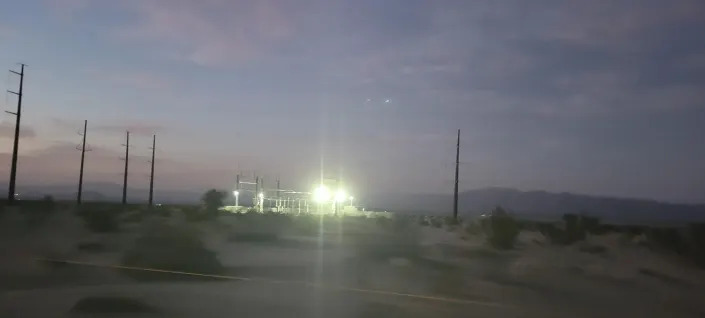
Lights from a solar transfer station taken at night from Lake Tamarisk retirement community in Desert Center, CA. December 2022

Mark Carrington, 72, thought he had found his piece of heaven in the vast California desert two years ago, when he bought a trailer pad in Lake Tamarisk Resort in Desert Center, 70 miles east of Palm Springs. He parked his RV and prepared to live out a peaceful retirement. The dark, star-spangled night skies and soaring mountain vistas of Joshua Tree National Park were a thrill.

Then the jackhammers started pounding and a pall of dust blotted the open sky.

He and other neighbors in the 55-plus community were shocked to learn a large-scale solar project called Oberon was being built on 2,600 acres of land, half a mile from their homes. Mature trees were ripped out, shrubby desert scraped bare, and the birds, rabbits, foxes and occasional desert tortoise disappeared. Then they learned two more huge projects have been proposed, including one 750 feet from their homes, Carrington said.

All told, they calculated the U.S. Bureau of Land Management and Riverside County have now approved nearly 18,000 acres of large-scale solar in the area. Another 6,000 acres of development are being weighed. And the projects, first built several miles away, are coming closer and closer, complete with truck traffic, chain link fencing and searing night lights on workstations and solar inverters.

“It’s very frustrating,” Carrington said. “When these projects are complete this will literally be like a prison compound. We will no longer be an oasis in the middle of a living desert, we will be an island in a solar sea that’s completely dead.”

More could be on the way.

Federal officials are now considering a major expansion and possible modification of designated solar zones on public lands across the West, to include five more states, wind as well as solar projects, and slopes as well as flat areas. The agency will kick off a dozen public “scoping meetings” on the redesign effort on Friday via a virtual session and an in-person meeting in Sacramento on Jan. 18.

BLM Director Tracy Stone-Manning said in a prepared statement that the agency “is committed to expanding renewable energy development on public lands to help lead the nation into a clean energy future, enhance America’s energy security, and provide for good-paying union jobs. She added, ”“We look forward to hearing from the public on effective ways to expand our nation’s capacity for producing solar energy while continuing to ensure robust protection of our public lands and waters.”
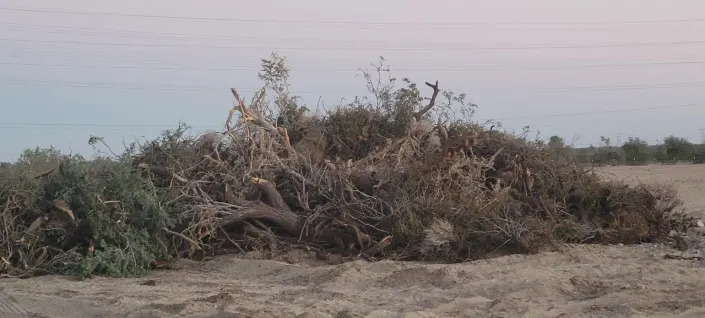
Chopped, destroyed ironwood trees on land cleared for Oberon solar project, Desert Center CA. in late 2022.

For Carrington and others in this tight-knit, isolated hamlet 50 miles from a grocery store, it's the latest blow in what they call the eradication of their community identity and way of life. The study also may look at amending California’s 10 .8 million acre Desert Renewable Energy Conservation Plan, a separate, hard-fought and carefully negotiated compromise agreement between federal and state agencies, developers, environmentalists and others that designated both development zones and conservation areas.

Renewable energy trade representatives say modifying the plans could actually reduce conflicts between rural residents and developers.

"There's plenty of land," said Ben Norris, senior director of regulatory affairs for the Solar Energy Industry Association, based in Washington, D.C. “We actually think certain changes would open up more lands for solar away from populated areas,”

But residents here are not convinced.

"I don't like it," Carrington said, noting many of the slopes and what remains of the open space around them are part of carefully preserved "areas of critical environmental concern" that should not be modified. They're already battling two more proposed projects, the Easley and the Sapphire solar farms, that they knew nothing about until they started sleuthing.

Public notice is an ongoing concern. Residents of the retirement park were not notified of the potential major expansion, despite promises by BLM officials that they would be added to official lists after they discovered the two other huge solar projects.

Carrington and his neighbors in the retirement park say they also were not notified in advance by federal or county officials or the developer, Intersect Power, about the Oberon project. Now they want a 5 mile buffer zone between their rural community and any more renewables, including Easley and Sapphire.

Their timing might or might not be good.
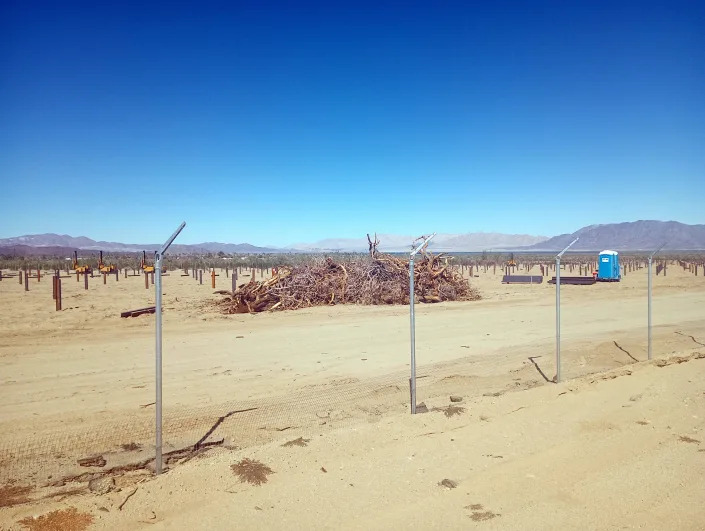

Ironwood trees leveled for new large-scale solar farm in Desert Center, CA
Push is on for large renewables across the West, amid rural objection

With climate change and its impacts taking hold, federal officials are now weighing broadly expanding but also potentially modifying development zones for large-scale solar and wind projects across the West, including in the California desert, where industrial renewables proposals have faced local backlash. Neighboring San Bernardino County in 2019 banned large renewables projects on 1 million acres of private land, including near 14 rural communities, after loud protests from residents.

To do it, the BLM may amend its sweeping 2012 Western Solar Plan and a related "programmatic environmental impact statement" that governs commercial solar development on public lands in six southwestern states: Arizona, California, Colorado, Nevada, New Mexico, and Utah. A new, sweeping environmental impact study designed to cover millions of acres in one fell swoop will weigh adding energy development zones in five more states: Idaho, Montana, Oregon, Washington and Wyoming, and may include wind power areas and hilly slopes left out of the original plan. Ultimately, as with the current plan and its accompanying PEIS, it could streamline renewable development in designated areas, and allow set-asides of other lands when habitat and species destruction can’t be avoided.

Most of the approvals issued by BLM since 2012 for solar projects have actually occurred via variances for work outside the designated areas.

Industry trade officials are highly supportive. They say while initial mapping of so-called solar energy zones, or SEZ’s, was done with good intentions by the Obama administration, they have not worked perfectly on the ground. They say it’s time for an update that might better avoid rural communities and truly expedite clean energy.

Norris with the solar industry group noted the current plan and PEIS only allow projects on flat land and with high solar radiation, which was done to fit now largely out-of-date technology.

“Easing those limits would, first, align the document with current 2023 technologies, and second, allow companies to consider more sites that could present lower potential for issues with surrounding communities.” said Norris. ”We very much appreciate BLM’s efforts to take another look at this high level environmental review document.”

He said North Dakota should also be added, and added that a 2021 Department of Energy report had found up to 10 million acres of renewable projects are needed to decarbonize the country’s electric grid by 2050. The 2012 Western Solar Plan designated about 285,000 acres as priority solar energy zones and excluded about 79 million acres from solar development. The plan also identified 19 million acres available for development under a variance process.

But Carrington and neighbors say despite being told by BLM they would be notified 15 days in advance of any new activity, they learned about the potential huge redesign effort accidentally, when he was searching for a phone number of a local staffer on the proposed Easley project. They’re also not happy that the California meeting will be in Sacramento, not in eastern Riverside County.

“How are we supposed to get there?” Carrington asked. “They should come here, and see where it’s happening.”

BLM press secretary Brian Hires, in response to questions from The Desert Sun, said in an email that the proposed update includes lands across California. ”The BLM determined that holding a meeting in Sacramento would allow for significant public participation.” He also noted the agency “will hold two virtual meetings accessible to the public for those that are not able to attend an in-person meeting.”

The study may also look at California’s 10 .8 million acre Desert Renewable Energy Conservation Plan, a separate, hard-fought and carefully negotiated compromise agreement between federal and state agencies, developers, environmentalists and others that designated both development zones and conservation areas.
Choking dust, lost views and water worries

The clock is ticking. BLM is pushing to meet a 2020 mandate set by Congress under the Trump administration, requiring them to authorize at least 25 gigawatts of renewable power by 2025,, enough to power close to 19 million homes.

Within a week of taking office, President Joe Biden signed an executive climate change order that in part requires the Secretary of the Interior to “review siting and permitting processes on public lands” to increase “renewable energy production on those lands . . . while ensuring robust protection for our lands, waters, and biodiversity and creating good jobs.”

As of last month, BLM, which reports to the Interior Secretary, had permitted 34 projects expected to produce 8,140 megawatts of electricity, about a third of the required 25 gigawatts by 2025, Hines said. Projects to produce nearly 3 gigawatts more are undergoing federal environmental reviews. Those totals include about one gigawatt built or is underway in and around Desert Center, enough to power about 750,000 homes.
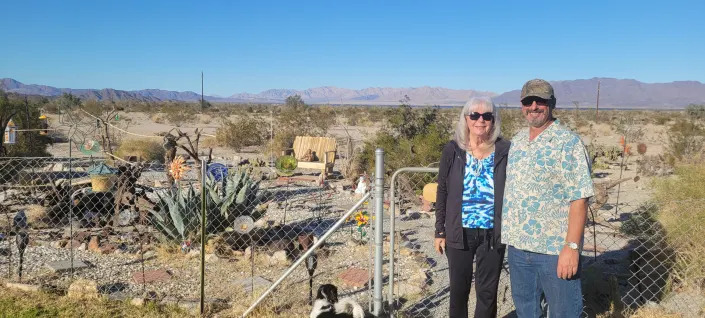

Teresa and Skip Pierce, retiree residents of Lake Tamarisk Resort retirement community in Desert Center, CA

Teresa Pierce, 70, and a resident of the Lake Tamarisk retirement community for six years, is helping spearhead community opposition to more huge projects in their area. She said industrial projects on fragile desert landscapes are the wrong path to slowing greenhouse gas emissions from power production.

“Really it should be on every rooftop in California and the nation,” she said. They “should not destroy deserts, since they sequester the carbon dioxide (the main greenhouse emitted into the atmosphere), and therefore disturbing the soil releases it.”

Norris with the solar trade group and some national environmental groups say rooftop solar and commercial solar are both needed.

Area environmentalists and tribal members who’ve opposed specific projects in the past are keeping a wary eye on the proposal, which they note is in the early stages. They also point out that any increased commercial development must be examined in the context of separate federal and state proposals, dubbed “30 by 30,” to preserve nearly a third of available and valuable open spaces by 2030.

"We look forward to seeing concrete proposals once scoping is complete," said Chris Clarke, associate director of the California deserts program for the National Parks Conservation Association. "We strongly feel that the DRECP should be taken as a working model and not amended or weakened, and that overall landscape level planning in other states is a must, and that planning HAS to protect areas of significant resource conflict from development. This process absolutely must not undermine the administration’s 30 by 30 goals."

Close to home, Pierce said the traffic from Oberon construction is “horrible,” and she and other mostly older residents now suffer from allergies, aggravated COPD and other woes from the dust. Those and other concerns were laid out in a comment letter submitted to Riverside County planners last week about the proposed Easley project, signed by scores of residents. They include the possibility of dangerous silica being present in windblown construction dust, excessive water being drawn from an ancient underground aquifer for the solar projects, and the loss of dark night skies and daytime hiking routes.
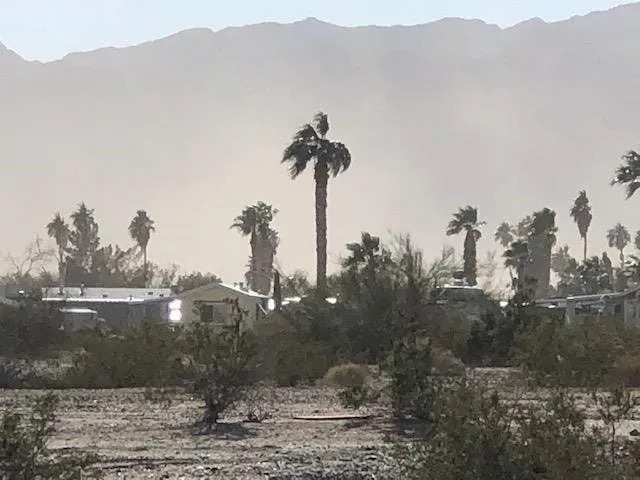
Fugitive dust from the Oberon commercial solar construction project, one-half mile south of Lake Tamarisk retirement community in Desert Center, CA. Taken December 11, 2022 at 9:30am during 16 mph southwest winds, with gusts to 30 mph.

Solar developer pushes back

An Intersect Power representative gave a different version of what has occurred with the Oberon project, and said the Easley project is in the very early stages.

“The Oberon project represents one of the largest habitat mitigation efforts of any single energy development project in California’s history, and is a great example of clean energy and conservation going hand-in-hand,” wrote Elizabeth Knowles, Intersect’s Director of Community Engagement, in an email. “This project will permanently protect nearly 6000 acres of high quality desert habitat for the Mojave desert tortoise, the desert kit fox, migratory birds, and other protected species.”

While that habitat is off-site, she said, “the Oberon … development footprint also avoids about 2,000 acres of sensitive on-site habitat for wildlife, ensuring habitat connectivity between conservation areas north and south of the project. The Oberon project is also complying with hundreds of conservation and mitigation measures to protect public health and safety and the environment.”

In December 2021, as that project neared final approval over objections from area environmentalists,, an Intersect spokesman said in total 80 acres or less of woodlands would be cleared on the 2,600 acre site, and areas of impact in a buffer zone had been reduced to about 55 acres.

Knowles said the public was notified about the Oberon project via BLM press releases and notices published in the Federal Register. The latter is a voluminous daily record of legal activity by more than 400 public agencies and the White House. She said while the Easley project “is in the very early stages of development and design decisions have not yet been finalized,” it could not be moved to a new location.

“We actively explored siting the Easley project in alternative locations, including east of Hwy 177, but the area was technically prohibitive,” she said.

But, she added, “the Lake Tamarisk community is actively involved in the public process for the Easley project. Since being made aware of their concerns, we have been in close contact with (them) and surrounding neighbors to understand and address any questions and concerns they have regarding our projects in the Desert Center Area. We will continue to work with them throughout the planning, construction and operations of the project.”

Carrington and Pierce said Knowles and other Intersect staff had met with them on Pierce’s patio, and the company might consider dimming or redirecting powerful night lights to help keep the skies above dark. But they said such small measures would do little.

“What’s occurring is just a pure disregard for us as a community, and us as human beings,” Pierce said.

In addition to Sacramento, BLM will hold public scoping meetings in Phoenix, Arizona; Grand Junction, Colorado; Washington, DC; Boise, Idaho; Billings, Montana; Albuquerque, New Mexico; Reno, Nevada; Bend, Oregon; Salt Lake City, Utah; Spokane, Washington and Cheyenne, Wyoming. A second virtual meeting will be held on Feb. 13.

Public comments will be accepted for 15 days after the last public scoping meeting. For the most current information, to register for the virtual sessions. and to view related documents, visit BLM’s ePlanning web site at https://eplanning.blm.gov/eplanning-ui/project/2022371/570.

Janet Wilson is senior environment reporter for The Desert Sun, and co-authors USA Today's Climate Point. She can be reached at jwilson@gannett.com and on Twitter @janetwilson66

This article originally appeared on Palm Springs Desert Sun: Feds may expand solar and wind across the West, including the CA desert
Biden's climate agenda has a problem: Not enough workers


A wind farm shares space with corn fields the day before the Iowa caucuses, where agriculture and clean energy are key issues, in Latimer, Iowa

Tue, January 10, 2023 
By Nichola Groom and Valerie Volcovici

(Reuters) - U.S. clean energy companies are offering better wages and benefits, flying in trainers from overseas, and contemplating ideas like buying roofing and electric repair shops just to hire their workers as firms try to overcome a labor shortage that threatens to derail President Joe Biden's climate change agenda.

The Inflation Reduction Act, signed into law last year, provides for an estimated $370 billion in solar, wind and electric vehicle subsidies, according to the White House. Starting Jan. 1, American consumers can take advantage of those tax credits to upgrade home heating systems or put solar panels on their roofs. Those investments will create nearly 537,000 jobs a year for a decade, according to an analysis by BW Research commissioned by The Nature Conservancy.

Graphic: The Inflation Reduction Act's green jobs promise https://www.reuters.com/graphics/USA-LABOR/CLEANENERGY/movakkxyyva/chart.png

But with the U.S. unemployment rate at an historic low of 3.5%, companies say they fear they will struggle to fill those jobs, and that plans to transition away from fossil fuels could stall out. Despite layoff announcements and signs of a slowdown elsewhere in the economy, the labor market for clean energy jobs remains tight.

"It feels like a big risk for this expansion. Where are we going to find all the people?" said Abigail Ross Hopper, president of the Solar Energy Industries Association trade group.

The shortage is anticipated to hit especially hard in electric vehicle and battery production and solar panel and home efficiency installations, forcing some of the companies into bold new approaches to find workers.

Korea's SK Innovation Co Ltd, which makes batteries for Ford Motor Co's F-150 Lightning all-electric pickup truck in Commerce, Georgia, has pumped up pay and benefits as it ramps up its U.S. workforce to 20,000 people by 2025 from 4,000 today.

The battery maker is advertising pay between $20 and $34 an hour, above Georgia’s median hourly wage of $18.43, according to the U.S. Bureau of Labor Statistics. It is also covering 100% life insurance costs and matching retirement plan contributions up to 6.5%, above the national average of 5.6%, according to the Plan Sponsor Council of America. And the company is providing free food on the job.

"Georgia’s talent pool is not really massive. But we are trying to improve some of our policies to better source and retain workers," said an SK official who declined to be named, citing the sensitivity of the matter.

Georgia state officials said SK's hiring has been a success considering how quickly production had to ramp up to meet the company's obligations to automakers.

While national residential solar installer SunPower Corp is recruiting aggressively, Chief Executive Peter Faricy said the company is also looking at what he called "crazy ideas" to secure labor – including buying up companies just for their workers.

"I’m not suggesting we will do this, but I want to give you an order of magnitude of what we’re considering. Like, should we acquire a roofing company and make them all solar installers? Do we go buy an electrical company and acquire 100 electricians?" he said.

SunPower also held talks within the last year with panel manufacturer First Solar Inc about developing a solar panel that would be easier to install, enabling crews to outfit two homes a day instead of just one, Faricy said.

SunPower’s competitor, Sunrun Inc, is deploying drones to survey roofs ahead of installation, reducing the number of workers required to scale roofs. It is also rewarding top crews with office parties.

"As best you can game-ify the experience for the employee... it just makes the industry more fun, more attractive," Chris McClellan, Sunrun's senior vice president of operations, said in an interview.

Offshore wind developer Orsted, a Danish company that is planning to build projects off the East Coast, hopes to fly in employees from projects in the United Kingdom and Asia to help train staff. State reports have indicated that New York and Massachusetts face large offshore wind workforce gaps.

“We’re creating sort of an ecosystem where we don't just have an offshore wind academy, but really train the trainers of the future,” said Mads Nipper, Orsted’s CEO, told Reuters.

The Biden Administration has repeatedly promised that new green energy jobs would be well-paying union jobs.

But many of those jobs have lagged the fossil fuel industry in pay, according to a 2021 study by BW Research, as clean energy companies have sought to contain costs to compete with entrenched industries. The IRA seeks to address that by tying prevailing wage and apprenticeship requirements to the subsidies.

Those provisions -- and the hiring challenges -- have put pressure on some employers to use unionized labor.

Learning from its earlier hiring challenges in Europe and Asia, Orsted signed an agreement with North America's Building Trades Unions to secure workers.

Even Amazon.com Inc, a company that has been embroiled in disputes with workers trying to organize, has used union labor to build the electric charging infrastructure for its fleet of electric delivery vehicles in Maspeth, Queens, NY.

Amazon did not respond to requests for comment.

Corrine Case, an electrician represented by the International Brotherhood of Electrical Workers, said she was paid $43 an hour to install the charging system at Amazon.

A single mother, Case said she was excited about the job security offered by the rising demand for electricians to install charging stations.

“Our field is constantly changing because of new energy sources and to be a part of that is amazing,” she said.

FREE WORKER TRAINING

In their hunt for workers, solar, wind and electric vehicle companies have expanded programs offering free and subsidized training to military veterans, women and the formerly incarcerated.

SK told Reuters that it has been recruiting at military job fairs and American Legion chapters and collaborating with programs like the Georgia National Guard’s Work for Warriors and the Manufacturing Institute’s Heroes MAKE America.

Some solar companies have tried to recruit veterans, saying the skills learned in military life translate well to the industry.

Utility scale solar developer SOLV Energy, SunPower and Nextracker last year teamed up with nonprofit Solar Energy International to fund a women-only training program for solar installers. More than 30 women attended the week-long course in Colorado.

In October, the nonprofit Solar Hands-On Instructional Network of Excellence (SHINE) teamed up with the Virginia Department of Corrections on a pilot program to train 30 prison inmates and recently incarcerated people in solar panel installation. SHINE’s director David Peterson said the group is discussing expanding the program.

In California, the nonprofit Grid Alternatives has trained 150 inmates at the Madera County jail in solar installation since 2017 and is expanding its program this year to other facilities in the state. Potential employers are more open to hiring the formerly incarcerated once they see they have received some training, Tom Esqueda, the nonprofit's outreach manager, said.

In Los Angeles, nonprofit Homeboy Industries, which works to rehabilitate former gang members, is using the potential job opportunities for solar panel installers to help recruits for its state-funded jobs program. Homeboy trains 50-60 people a year as solar panel installers.

More than 80% of the people who have gone through the training in the last year have found jobs in solar, according to Jackie Harper, who oversees the program.

“I’m going to be sticking with this,” said Marco Reyes, 28, who went through the program after his release from prison in February and earns $23 an hour as an installer in Valencia, California.

He now plans to train in the electrical end of solar installation, which would bump up his pay.

“Everyone has a chance to move up the ladder into a better position,” he said. “This job to me is a life changer.”

(Reporting by Nichola Groom and Valerie Volcovici; Edited by Richard Valdmanis and Suzanne Goldenberg.)
Political vacuum in Haiti deepens as senators' terms expire
 

DÁNICA COTO and EVENS SANON
Tue, January 10, 2023 


PORT-AU-PRINCE, Haiti (AP) — Haiti awoke Tuesday stripped of its last democratically elected institution — this time, its Senate — an alarming development that solidifies what some call a de facto dictatorship nominally in charge of a country wracked by gang violence.

While only 10 senators had been symbolically representing the nation's 11 million people in recent years because Haiti had failed to hold legislative elections since October 2019, their terms expired overnight, leaving Haiti without a single lawmaker in its House or Senate amid a spiraling political crisis. Organized crime groups have been running virtually unchecked since the July 2021 assassination of President Jovenel Moïse, who himself had been ruling by decree.

“It's a very grim situation,” said Alex Dupuy, a Haitian-born sociologist at Wesleyan University, "one of the worst crises that Haiti has had since the Duvalier dictatorship.”

The bloody regime of Jean-Claude “Baby Doc” Duvalier, who fled the country in 1986, marked the last time Haiti lacked elected officials.

The Parliament building in downtown Port-au-Prince remained deserted on Tuesday, with only security guards at the gate. Similar scenes were evident outside Haiti's non-functioning Supreme Court and electoral commission.

Meanwhile, Prime Minister Ariel Henry, who assumed leadership of Haiti with the backing of the international community after Moïse was killed, has failed to hold general elections despite multiple pledges over the last year and a half to do so. His latest promise, on Jan. 1, was that the Supreme Court would be restored and a provisional electoral council tasked with setting a reasonable date for elections.

But Henry offered no timeline, even as he asked Haitians to trust each other and “take me at my word when I speak of my government’s desire to do everything possible to reconstitute our democratic institutions.”

“There are no powers to check his decisions,” Dupuy said. “As long as that situation continues, Henry is going to be behaving like a dictator.”

A spokesman for Henry's office declined to comment.

The U.N. has warned that security in Haiti needs to improve before elections are held. Reported kidnappings soared to more than 1,200 last year, double what was reported the previous year, according to the U.N., and at least 280 killings were reported in November alone, the highest monthly record.

Briefing the U.N. Security Council in December, Helen La Lime, who was appointed Haiti’s U.N. special envoy in October 2019, described what she called “alarmingly high levels of gang violence” in Haiti, which has fewer than 9,000 active police officers nationwide.

The gangs increasingly rely on kidnappings to fund their operations, with experts estimating that they control about 60% of Port-au-Prince.

“We are scared to step out of our houses,” said Daniel Jean, 25, who sells phone chargers and other equipment in the capital. “We are cornered: kidnapping, extortions. Gangs are killing people because we don’t have ransom.”

Haitians have lost all trust in the democratic process, Jean said, adding that he won't vote if the same politicians and parties appear on the ballot: “They have more influence than the gangs. They control all the gangs.

“This is why the country is not going to move forward until the international community ... comes in to help,” he said.

Henry requested the immediate deployment of foreign troops in October after the most powerful gang seized control of a key fuel terminal, cutting off supplies to hospitals, schools, businesses and homes.

But the United States and Canada, among others, have responded only by implementing sanctions, not sending troops.

“Haiti needs stability,” decried Andrea Marcele, 29, who sells yams, lemons, carrots and other goods in the streets of the capital after migrating from the northern region of Grand-Anse.

“The country has no president ... no elected officials,” she said. “Everybody is hungry for power. We are paying the consequences.”

As the situation worsens, Haitians increasingly flee by plane or aboard rickety boats, desperately risking their lives to reach some safety and economic security. Many aim for the Bahamas, or Florida. President Joe Biden's administration intercepted tens of thousands last year, sending them back to Haiti.

Rodelie Kator, 49, sells rice, beans and other goods, hoping to send her 18-year-old son to Chile or Brazil, popular destination points for Haitians who then try to reach Mexico and cross into the United States.

“I’m hoping for a better life for my son,” she said. “I don’t want to witness him being killed.”

Kator said she wishes he could stay in Haiti because she has seen in the news “what my brothers and sisters have to go through to get to Mexico. ... being treated like animals.”

But Haiti holds no promise for her son, even as Biden announced last week that his administration would immediately turn away Haitians and other migrants at the U.S.-Mexico border.

Haitian economist Enomy Germain tried to use this moment, with zero elected officials in Haiti, to encourage his countrymen.

“This date will have marked the beginning of the end of a political class without vision — without regard for the common good and without balance — if you good people get involved," he tweeted. "Know that tomorrow will not be better without you.”

But even if elections were to be held, many Haitians wonder whether any candidate will be worthy of their support as they fear for their life.

“It feels like we’re heading toward a civil war,” said Marcele. “You’re walking with a coffin under your arm.”

___

Coto reported from San Juan, Puerto Rico.


Haitian Prime Minister Ariel Henry leaves after attending a graduation ceremony for new members of the country's armed forces in Port-au-Prince, Haiti, Thursday, Dec. 22, 2022. (AP Photo/Odelyn Joseph)


Astronomers Find the Edge of Our Galaxy


Kevin Hurler
Mon, January 9, 2023 

The Andromeda Galaxy captured by the NASA Galaxy Evolution Mapper in 2012.

In the quest to find the outer limits of our galaxy, astronomers have discovered over 200 stars that form the Milky Way’s edge, the most distant of which is over one million light-years away—nearly halfway to the Andromeda galaxy.

The 208 stars the researchers identified are known as RR Lyrae stars, which are stars with a brightness that can change as viewed from Earth. These stars are typically old and brighten and dim at regular intervals, which is a mechanism that allows scientists to calculate how far away they are. By calculating the distance to these RR Lyrae stars, the team found that the farthest of the bunch was located about halfway between the Milky Way and the Andromeda galaxy, one of our cosmic next-door neighbors.

“This study is redefining what constitutes the outer limits of our galaxy,” said Raja GuhaThakurta in a press release. GuhaThakurta is professor and chair of astronomy and astrophysics at the University of California Santa Cruz. “Our galaxy and Andromeda are both so big, there’s hardly any space between the two galaxies.”


Illustration: NASA, ESA, AND A. FEILD (STSCI)

The Milky Way galaxy consists of a few different parts, the primary of which is a thin, spiral disk about 100,000 light-years across. Our home solar system sits on one of the arms of this disk. An inner and outer halo surround the disk, and these halos contain some of the oldest stars in our galaxy.

Previous studies have placed the edge of the outer halo at 1 million light-years from the Milky Way’s center, but based on the new work, the edge of this halo should be about 1.04 million light-years from the galactic center. Yuting Feng, a doctoral student at the university working with GuhaThakurta, led the study and is presenting the findings this week at the American Astronomical Society meeting in Seattle.

“We were able to use these variable stars as reliable tracers to pin down the distances,” said Yuting Feng, a doctoral student at the university working with GuhaThakurta. “Our observations confirm the theoretical estimates of the size of the halo, so that’s an important result.”

Space is vast and lonely—but we can feel a bit cozier knowing that our galactic neighbor is closer than we thought.

Astronomers find the most distant stars in our galaxy halfway to Andromeda


A search for variable stars called RR Lyrae has found some of the most distant stars in the Milky Way’s halo a million light years away

Reports and Proceedings

UNIVERSITY OF CALIFORNIA - SANTA CRUZ

Milky Way halo structure 

IMAGE: THIS ILLUSTRATION SHOWS THE MILKY WAY GALAXY'S INNER AND OUTER HALOS. A HALO IS A SPHERICAL CLOUD OF STARS SURROUNDING A GALAXY. view more 

CREDIT: NASA, ESA, AND A. FEILD (STSCI)

Astronomers have discovered more than 200 distant variable stars known as RR Lyrae stars in the Milky Way’s stellar halo. The most distant of these stars is more than a million light years from Earth, almost half the distance to our neighboring galaxy, Andromeda, which is about 2.5 million light years away.

The characteristic pulsations and brightness of RR Lyrae stars make them excellent “standard candles” for measuring galactic distances. These new observations allowed the researchers to trace the outer limits of the Milky Way’s halo.

“This study is redefining what constitutes the outer limits of our galaxy,” said Raja GuhaThakurta, professor and chair of astronomy and astrophysics at UC Santa Cruz. “Our galaxy and Andromeda are both so big, there’s hardly any space between the two galaxies.”

GuhaThakurta explained that the stellar halo component of our galaxy is much bigger than the disk, which is about 100,000 light years across. Our solar system resides in one of the spiral arms of the disk. In the middle of the disk is a central bulge, and surrounding it is the halo, which contains the oldest stars in the galaxy and extends for hundreds of thousands of light years in every direction.

“The halo is the hardest part to study because the outer limits are so far away,” GuhaThakurta said. “The stars are very sparse compared to the high stellar densities of the disk and the bulge, but the halo is dominated by dark matter and actually contains most of the mass of the galaxy.”

Yuting Feng, a doctoral student working with GuhaThakurta at UCSC, led the new study and is presenting their findings in two talks at the American Astronomical Society meeting in Seattle on January 9 and 11.

According to Feng, previous modeling studies had calculated that the stellar halo should extend out to around 300 kiloparsecs or 1 million light years from the galactic center. (Astronomers measure galactic distances in kiloparsecs; one kiloparsec is equal to 3,260 light years.) The 208 RR Lyrae stars detected by Feng and his colleagues ranged in distance from about 20 to 320 kiloparsecs.

“We were able to use these variable stars as reliable tracers to pin down the distances,” Feng said. “Our observations confirm the theoretical estimates of the size of the halo, so that’s an important result.”

The findings are based on data from the Next Generation Virgo Cluster Survey (NGVS), a program using the Canada-France-Hawaii Telescope (CFHT) to study a cluster of galaxies well beyond the Milky Way. The survey was not designed to detect RR Lyrae stars, so the researchers had to dig them out of the dataset. The Virgo Cluster is a large cluster of galaxies that includes the giant elliptical galaxy M87.

“To get a deep exposure of M87 and the galaxies around it, the telescope also captured the foreground stars in the same field, so the data we used are sort of a by-product of that survey,” Feng explained.

According to GuhaThakurta, the excellent quality of the NGVS data enabled the team to obtain the most reliable and precise characterization of RR Lyrae at these distances. RR Lyrae are old stars with very specific physical properties that cause them to expand and contract in a regularly repeating cycle.

“The way their brightness varies looks like an EKG—they’re like the heartbeats of the galaxy—so the brightness goes up quickly and comes down slowly, and the cycle repeats perfectly with this very characteristic shape,” GuhaThakurta said. “In addition, if you measure their average brightness, it is the same from star to star. This combination is fantastic for studying the structure of the galaxy.”

The sky is full of stars, some brighter than others, but a star may look bright because it is very luminous or because it is very close, and it can be hard to tell the difference. Astronomers can identify an RR Lyrae star from its characteristic pulsations, then use its observed brightness to calculate how far away it is. The procedures are not simple, however. More distant objects, such as quasars, can masquerade as RR Lyrae stars.

“Only astronomers know how painful it is to get reliable tracers of these distances,” Feng said. “This robust sample of distant RR Lyrae stars gives us a very powerful tool for studying the halo and testing our current models of the size and mass of our galaxy.”

This study is based on observations obtained with MegaPrime/MegaCam, a joint project of CFHT and CEA/IRFU, at the Canada-France-Hawaii Telescope (CFHT), which is operated by the National Research Council (NRC) of Canada, the Institut National des Sciences de l’Univers of the Centre National de la Recherche Scientifique (CNRS) of France, and the University of Hawaii.


Iran executions quash protests, push dissent underground


Protesters sentenced to death for allegedly killing members of security forces during protests after Mahsa Amini's death, in Isfahan


Tue, January 10, 2023 
By Parisa Hafezi

DUBAI (Reuters) -Iran's hanging of protesters -- and display of their lifeless bodies suspended from cranes -- seems to have instilled enough fear to keep people off the streets after months of anti-government unrest.

The success of the crackdown on the worst political turmoil in years is likely to reinforce a view among Iran's hardline rulers that suppression of dissent is the way to keep power.

The achievement may prove shortlived, however, according analysts and experts who spoke to Reuters. They argue the resort to deadly state violence is merely pushing dissent underground, while deepening anger felt by ordinary Iranians about the clerical establishment that has ruled them for four decades.

"It has been relatively successful since the number of people on the streets has decreased," said Saeid Golkar of the University of Tennessee at Chattanooga, referring to the crackdown and executions.

"However, it has created a massive resentment among Iranians."

Executive Director at the Campaign for Human Rights in Iran, Hadi Ghaemi said the establishment's main focus was to intimidate the population into submission by any means.

"Protests have taken a different shape, but not ended. People are either in prison or they have gone underground because they are determined to find a way to keep fighting," he said.

Defying public fury and international criticism, Iran has handed down dozens of death sentences to intimidate Iranians enraged by the death of Iranian-Kurdish woman Mahsa Amini, 22.

Her death in the custody of morality police in September 2022 unleashed years of pent up anger in society, over issues ranging from economic misery and discrimination against ethnic minorities to tightening social and political controls.

At least four people have been hanged since the demonstrations started, according to the judiciary, including two protesters on Saturday for allegedly killing a member of the volunteer Basij militia forces.

Amnesty International said last month Iranian authorities are seeking the death penalty for at least 26 others in what it called "sham trials designed to intimidate protesters".

The moves reflect what experts say is the religious leadership's consistent approach to government ever since the 1979 Islamic Revolution that brought it to power -- a readiness to use whatever force is needed to crush dissent.

"The regime's primary strategy has always been victory through terrorizing. Suppression is the regime's only solution since it is incompetent and incapable of change or good governance," said Golkar.

ECONOMIC MISERY

Protests, which have slowed considerably since the hangings began, have been at their most intense in the Sunni-populated areas of Iran and are currently mostly limited to those regions.

And yet, the analysts said, a revolutionary spirit that managed to take root across the country during the months of protest may yet survive the security crackdown -- not least because the protesters' grievances remain unaddressed.

With deepening economic misery, largely because of U.S. sanctions over Tehran's disputed nuclear work, many Iranians are feeling the pain of galloping inflation and rising joblessness.

Inflation has soared to over 50%, the highest level in decades. Youth unemployment remains high with over 50% of Iranians being pushed below the poverty line, according to reports by Iran's Statistics Center.

"There is no turning point (back to the status quo), and the regime cannot go back to the era before Mahsa's death," Ghaemi said.

Alex Vatanka, director of the Iran Program at the Middle East Institute in Washington, said Tehran was banking on repression and violence as its way out of this crisis.

"This might work in the short term but ... it won’t work in the long term," Vatanka said, citing reasons such as Iran's deteriorating economy and its fearless young population who want "big political change, and they will fight for it."

There are no signs that President Ebrahim Raisi or other leaders are trying to come up with fresh policies to try and win over the public. Instead, their attention appears to be fixed on security.

The clerical leadership appears worried that exercising restraint over protesters could make them look weak among their political and paramilitary supporters, the analysts said.

Reuters could not reach officials at Raisi's office for comment.

Golkar said an additional motive for the executions was the leadership's need to satisfy core supporters in organisations like the Basij, the volunteer militia that has been instrumental at countering the spontaneous and leaderless unrest.

KHAMENEI BACKS CRACKDOWN

"The regime wants to message its supporters that it will support them by all means," Golkar said.

To send shockwaves, the authorities imposed travel bans and jail terms on several public figures from athletes to artists and rappers. A karate champion was among those executed.

Iran's Supreme Leader Ayatollah Ali Khamenei on Monday signalled the state has no intention of softening its crackdown, saying in a televised speech that those who "set fire to public places have committed treason with no doubt".

Wielding uncompromising state power has been a central theme of Raisi's career. He is under U.S. sanctions over a past that includes what the United States and activists say was his role overseeing the killings of thousands of political prisoners in the 1980s.

When asked about those 1980s killings, Raisi told reporters shortly after his election in 2021 that he should be praised for defending the security of the people.

Ghaemi said the main officials pushing for the executions today were deeply involved in the 1980s killings of prisoners.

"But this is not the 1980s when they carried all those crimes in darkness," he said. "Everything they do gets on social media and attracts huge international attention."

(Writing by Parisa HafeziEditing by Michael Georgy, William Maclean)


Iran Is Using Facial Recognition to Enforce Modesty Laws


Mack DeGeurin
Tue, January 10, 2023 

People gather in protest against the death of Mahsa Amini along the streets on September 19, 2022 in Tehran, Iran.


When the Iranian government announced last month it would move to disband its so-called “morality police” following weeks of historic anti-authoritrain protests, dissidents in the country and abroad saw the concession as a potential turning point for women’s rights. Among its compromises, government officials said they would consider loosening the country’s strict obligatory hijab laws, which have been in place since 1979. However, while accounts of police prying people from city streets for refusing to wear head coverings appear to have dwindled, some advocates fear those same dress-code-defying defectors are instead being targeted by facial recognition systems and penalized afterwards.

“Many people haven’t been arrested in the streets,” Sarzamineh told Wired. “They were arrested at their homes one or two days later.”

University of Oxford researcher Mahsa Alimardani discussed the possibility of facial recognition being used to enforce Iran’s hijab laws in a recent interview with Wired. Alimardani recounted reports of women in Iran who claim to have received mail citations for violating the law without warning or any face-to-face interaction with law enforcement. Those descriptions matched up with first hand accounts from Iranian expat Sarzamineh Shadi, who told the magazine she was aware of multiple women who received citations for flouting hijab rules during protests days after the actual protest occurred.

Iran’s theocratic government has been engaged in a brutal crackdown against protesters following the September death of a 22-year-old Kurdish woman named Mahsa Amini who was detained by the country’s morality police for not wearing a hijab while visiting Tehran and died in police custody. The ensuing nationwide protests have reportedly resulted in more than 19,000 arrests and left at least 300 people dead. And while those dissidents have already won major concessions, broadened efforts by protestors calling for real regime change are squaring off with an advanced state surveillance system years in the making.

Though it’s difficult to confirm the exact methods used to identify individuals on a case-by-case basis, Iranian officials have said they are using facial recognition to enforce its hijab laws. Last September, The Guardian cited an interview with Mohammad Saleh Hashemi Golpayegani, the Secretary of Iran’s Headquarters for Promoting Virtue and Preventing Vice, where the official said the government intended to use surveillance technology in public spaces.

Those detection efforts are made possible in the first place thanks to a seven-year-old government ID system in the country that requires face scans and other biometric identifier. Speaking with Wired, Alimardani said the same database system used to create the country’s national ID cards could simultaneously be used by officials to identify presumed hijab law violators or others considered to have run afoul with the regime.

The Iranian government’s surveillance vision extends far beyond facial recognition too. Since at least 2016, officials have attempted, with varying degrees of success, to create its own internal intranet separated from the world-wide-web and rely solely on Iranian server farms. That effort follows in the footsteps of similar isolated internet systems in China and, more recently, Russia. In the meantime, Iranian officials have repeatedly intervened to shut down access to global internet communications platforms, including during the most recent protests.

Iran sentences former president's daughter to a five-year prison term


FILE PHOTO: Faezeh Rafsanjani, daughter of former Iranian president Akbar Hashemi Rafsanjani, speaks to a journalist as she attends a reformist campaign for upcoming parliamentary election, in Tehran

Tue, January 10, 2023 

DUBAI (Reuters) - The activist daughter of former Iranian president Akbar Hashemi Rafsanjani has been sentenced to five years in prison, her lawyer said on Tuesday.

The lawyer did not give detail of the charges against Faezeh Hashemi. But Tehran's public prosecutor indicted Hashemi last year on charges of "propaganda against the system", according to the semi-official ISNA news agency.

State media in September reported she had been arrested for "inciting riots" in Tehran during protests triggered by the death of a young Kurdish woman in police custody.

The demonstrations have posed one of the biggest challenges to Iran's clerical rulers since the 1979 revolution.

"Following the arrest of Ms. Faezeh Hashemi, she was sentenced to five years in prison but the sentence is not final," defence lawyer Neda Shams wrote on her Twitter account.

In 2012, Faezeh Hashemi was sentenced to jail and banned from political activities for “anti state propaganda” dating back to the 2009 disputed presidential election.

Her father died in 2017.

Former president Rafsanjani’s pragmatic policies of economic liberalisation and better relations with the West attracted fierce supporters and equally fierce critics during his life. He was one of the founders of the Islamic Republic.

(Reporting by Dubai Newsroom; Editing by Andrew Heavens)


Iran regime divided on how to tackle protests: analysts


Ian Timberlake
Sat, January 7, 2023


Iran's Islamic clerical regime is divided in its response to months of unprecedented protests, wavering between repression and what it views as conciliatory gestures trying to quell the discontent, analysts say.

"The conflicting messages we are getting from the Iranian regime suggest an internal debate on how to deal with ongoing protests," said Nader Hashemi, director of the Center for Middle East Studies at the University of Denver.

"In most authoritarian regimes, there are hawks and doves" who disagree on how repressive the state should be during crises, he said.

The granting of retrials to several death-row protesters, and the release from detention of prominent dissidents, are signs that some seek to take a softer approach.


But a reminder of the hardline tack came Saturday when Iran executed two men for killing a paramilitary member during protest-related unrest.

Demonstrations began after the September 16 death in custody of Kurdish-Iranian Mahsa Amini, 22. She had been arrested by morality police who enforce a strict dress code which requires women to wear a scarf-like covering over their hair and neck.


The protests have escalated into calls for an end to the Islamic regime, posing the biggest challenge for the clerics since the 1979 revolution deposed the shah.

Authorities have responded with deadly violence that has left hundreds dead.

Thousands have been arrested and 14 detainees sentenced to hang, many for killing or attacking security force members, according to the judiciary.

- 'Experimenting' -

The Supreme Court has upheld some of the death sentences and a total of four men have now been executed. The judiciary has also announced retrials for six of the 14.

This reflects a "political calculus", said US-based Iran expert Mehrzad Boroujerdi, co-author of "Post-Revolutionary Iran: A Political Handbook".

"They know that mass executions will bring more people into the streets and further agitate them. On the other hand, they want to send a signal that they are not reticent to execute protesters so that people are intimidated."

In what analysts see as another attempt to calm the situation, two prominent dissidents arrested early during the protests, Majid Tavakoli and Hossein Ronaghi, were freed weeks later. Ronaghi had been on a hunger strike.


The regime is using "everything from pressure release valves to long prison terms and executions. They are experimenting with these as they struggle to formulate a more clearly articulated policy," Boroujerdi said.

Anoush Ehteshami, director of the Institute for Middle Eastern and Islamic Studies at the UK's Durham University, said the retrials partly reflected mounting foreign and domestic pressure.

"But also within the regime there is division about how to handle this," Ehteshami said, with hardliners on one side and others who see executions as further encouraging resistance.

Retrials and the release of dissidents are "measures of appeasement... to try and throw a bone" to the protesters, he added.

While such measures may appear insignificant, from the perspective of a "securitised, beleaguered regime... they think they are being magnanimous and responding to public pressure".

- Survival -


Celebrities have also been detained, but often for far shorter periods. Star actor Taraneh Alidoosti was freed on bail Wednesday after being held for almost three weeks over her support for the protests, her lawyer said.

Some analysts see this hold-and-release strategy as intimidation but it is also, according to Hashemi, part of the regime "testing the waters, seeing what the reaction is".

The "leniency" sometimes displayed by authorities "is an attempt to prevent further factionalism within the security establishment" as some of its members are alienated by the deadly bloodshed, said Afshin Shahi, associate professor in Middle Eastern studies at Keele University in the UK.


The regime "doesn't seem to have a clear strategy" in response to public anger, he added.

Despite some releases, other prominent figures have spent months in prison. These include longtime activist Arash Sadeghi and the two Iranian journalists who helped expose Amini's case.

In early December, Prosecutor General Mohammad Jafar Montazeri said the morality police had "been abolished". But no one else has confirmed this.

The announcement reflects the internal debate and shows that "at least one section of the ruling regime" favours a less brutal way of enforcing the female dress code, said Hashemi.

According to Ehteshami, some in authority "are now beginning to talk about a compromise", though it is too early to know what that would be.

But "in broad terms I don't think they have what the people want", which is wholesale change, the details of which have not been defined, he said.

The regime, however, has historically shown an ability to "make concessions when it has to", according to Hashemi.

"People forget that this regime has survived for 44 years because it can be very intelligent, very clever, very Machiavellian in terms of what it has to do to survive," he said.

it/jkb/lg/leg

IT'S A JEWISH STATE NOT A DEMOCRACY
Israeli Democracy May Not Survive Netanyahu's New Government

Etan Nechin
Tue, January 10, 2023

Israeli protester dressed in a convict uniform and a

Israeli protester dressed in a convict uniform and a Benjamin Netanyahu mask lifts his handcuffed arms in the air next to a Crime Minister protesters during the demonstration. Thousands rally in Tel Aviv to protest against Netanyahus far-right government and judicial overhaul. Credit - Matan Golan-SOPA Images/LightRocket

Less than two weeks in, it’s becoming apparent that Israel’s new government led by Benjamin Netanyahu is the most hardline extreme-right Israel has ever known. But even more disturbingly it is actively working to dismantle Israel’s fragile checks and balances and to give unprecedented powers to the executive and legislative branches.

In his inaugural speech, Netanyahu said, speaking to his opponents, that “losing in an election doesn’t spell the end of democracy.” But many fears that this government spells a threat to democracy and civil society.

On January 3, newly appointed Security Minister, Itamar Ben-Gvir, a convicted terrorist-sympathizer who in the past incited against assassinated Prime Minister Yitzhak Rabin, visited Al Aqsa Mosque, an act security experts warned might spark a regional war.

A day later, Yariv Levin, the newly appointed Justice Minster, laid out his plan to reform the judicial system. The plan includes giving the Knesset—Israel’s legislative branch—the power to override court rulings with a simple majority of 61 lawmakers out of 120, including legislation struck down by the Supreme Court for constitutional reasons; to greater government power in appointing justices; and having ministers appoint their legal counsels and not from the Justice Ministry.

Levin’s plans could be labeled a constitutional crisis, but Israel does not have a constitution, and the separation between the legislative and executive is almost non-existent. For Israel’s liberal society, the Supreme Court is seen as the only institution that can curb governmental actions and legislation passed by a parliamentary majority.

The opposition is calling this plan a regime change designed to get Netanyahu out of his ongoing trial for bribery and corruption and to enable Arye Dery, the leader of the Orthodox party Shas, to be appointed a cabinet minister despite being convicted and sentenced to a suspended prison term.

If this plan succeeds, it will have a broader impact than just getting Netanyahu and Dery out of their political woes. An untethered right-wing, Orthodox government with a majority in parliament will be able to disqualify Arab parties from running, annex the West Bank without giving rights to Palestinians, give surplus budgets for preferred sectors, discriminate against the LGBT and other marginalized communities, crush state education, dismantle social services, and silence dissent.

It could spell an end to the religious status quo that has kept Israel in balance without a clear separation between church and state, like exists in the U.S. There has been a give and take between Jewish institutions and civil society: an Orthodox rabbinate that oversees Jewish life, shutdown of public life on Saturdays and funding for Yeshivas in exchange for the Orthodox leaders not intervening in everyday life, economy, the military, and culture.

Now that Orthodox parties have unprecedented power, they’re demanding more concessions from liberal society. The United Torah Party has secured extra funding for their communities, especially men who don’t work and don’t serve in the army. This is a measure that will increase the burden on working taxpayers. More so, Netanyahu gave power over schools to Avi Maoz, the head of the homophobic Noam party, who claimed that forms of ‘liberal religion’ are ‘darkness’ that must be expelled and whose party had a list of LGBTQ media workers.

The new government is shaping to be the biggest challenge to Israel’s civil society. It aims to alter the fragile balance of power that has kept Israel afloat, both nationally and internationally. The possibility of a full-scale annexation isn’t far-fetched. Given the right circumstances, like another Trump win in 2024, along with strengthening ties with the Gulf states against Iran, Israel might take over more and more areas in the West Bank and even return to Gaza, as some lawmakers are hoping, turning Israel into a pariah state.

Netanyahu has been trying to calm liberals, mostly abroad, but his words don’t seem to align with the members of coalition: He boasts that his coalition has a gay Speaker of the Knesset while homophobic, racist lawmakers and ministers in his coalition suggest doctors could refuse to treat gay patients and warn against intermarriage. He speaks about free market capitalism with Jordan Peterson while subsidizing Orthodox communities and the settlements project.

Netanyahu has effectively provided the most vitriolic elements in Israeli-Jewish society political immunity and ministries from where they can advance their extreme agendas. Beyond rolling back the policies of the previous short-lived government, they will exact revenge on the left, Arab citizens of Israel, and Palestinians.

The question now is can liberal Israelis respond?

Since the ebb of the Second Intifada and the failed Arab Spring, Israelis have been living with the belief they will never pay the price for the occupation: The separation wall, limited Israeli casualties in operations, normalization with Arab states through the Abraham Accords, a transformation of the Israeli market from quasi-socialist to American-style capitalism, made the occupation invisible, and Israel largely palatable to investors and tourists.

Under Netanyahu’s previous reign, many voices on the left were marginalized, attacked, and muzzled. In the November 2022 elections, Meretz, that party that is the bastion of liberal Israel failed to cross the threshold for the first time in its existence. The reason why so many young people and soldiers voted for the hard right isn’t just demographic. Twenty years of right-wing governments that stalled any chance for peace negotiations and sowed divisions within Israeli society resulted in a generation that grew up with little ability to articulate a different, hopeful vision for the future.

But while Israelis did vote for this coalition, polls show that so far the majority aren’t backing his agenda to weaken the judiciary. Even for the many who voted for him, the specter of this coalition has served as a rude awakening.

Israeli hi-tech executives penned an open letter warning Netanyahu that this government will have “devastating consequences for the economy.” More than 200 Israeli activists and human rights organizations sent a letter to U.S. Ambassador Thomas Nides of ” inciting genocide against the Palestinian people. “More than 50 municipal officials and 300 school principals said they would resist Maoz’s educational reforms. On Saturday, January 7, thousands took to the streets to protest the government. Organizers vowed to turn up the pressure on for the weeks and months to come.

This backlash comes as more voices are warning about the corrosive power of the new government, U.S. lawmakers who are slowly working to hold Israel accountable, and a U.N. resolution passed to ask the International Court of Justice (ICJ) to give an opinion on the legal consequences of Israel’s occupation of the Palestinian territories.

With the ascension of this unapologetic extreme-right government, it seems that the world is finally awakening to the fact that Israel isn’t the only democracy in the Middle East. Many Israelis are awakening to the fact that Netanyahu, who for three decades has been at the center of Israeli and world politics, isn’t the protector of Israel, but a threat to Israel’s fragile and tenuous democracy.
India is about to pass China as the world's most populous country


Marquise Francis
·National Reporter
Tue, January 10, 2023 

India is projected to see an explosion in its urban population in the coming decades, but its cities are already overburdened. (Punit Paranjpe/AFP via Getty Images)

India is expected to surpass China and become the world’s most populous nation within the next three months, according to a recent report by the United Nations’ population division, marking a seismic shift on the global stage in a trend with significant social and economic impact for both countries.

“Most people think India's economy is still a fraction of what it could be in the future, which means there's so much promise,” Dr. Audrey Truschke, an associate professor of South Asian History at Rutgers University, told Yahoo News, adding that much of the potential is due in large part to India being “such a young country.”

Of the rapidly growing 1.41 billion people in India, about 1 in 4 are under the age of 15 and nearly half are under 25. By comparison, China’s population is about 1.45 billion, but those under 25 make up only a quarter of the population.


“The Indian subcontinent has always supported a robust human population,” Truschke said. “India has also long been compared to China, and they have for a long time traded with one another. So as much changes over the course of human history, that's something that recurs — both the dense population of the subcontinent, as well as the comparison with China.”

Shoppers crowd a market area in New Delhi on Nov. 12, 2022. (Anindito Mukherjee/Getty Images)

Since 1950, India and China have accounted for an estimated 35% of the world’s population growth, with China emerging as a global industrial power. Combined, the two population epicenters are a significant slice of the world’s roughly 8 billion people.

But China’s one-child policy, which was introduced in 1980, drastically reduced its birth rate — and redirected its economic prospects. In recent years, women have been allowed to have up to three children, but the average birth rate still sits at 1.2. China's population is set to peak in the coming years and projected to decline. This means that the older, nonworking population will have to rely on individual single children, many of whom will probably face economic difficulties caring for two parents and four grandparents. As a result, many elderly Chinese will be left to rely on a public pension system that is reportedly set to run out of money by 2035, despite recent efforts by the government to boost revenue.

“Without a quality pension support system, young people would be reluctant to get married and have children, [and] middle-aged people are double-burdened to care for the young and the elderly,” Zhang Jingwei, a researcher at Chongyang Institute for Financial Studies at Renmin University, told the South China Morning Post. “Only when the elderly can enjoy the fruits of the reforms and are guaranteed institutionally happy twilight years, anxiety at different age groups can be solved and all of society’s energy can be released.”

An elderly man and woman are pushed in wheelchairs along a street in Beijing on May 11, 2021. (Wang Zhao/AFP via Getty Images)

Population growth in China is flatlining, and its supply of cheap labor may follow suit. Despite stubborn unemployment in pockets of the country, the shortage of skilled manual labor is becoming more evident.

India and its growing population of more than a billion people could pick up some of the slack, but its growth rate is also declining, and its industrial infrastructure is not as robust as China’s. And much of India’s population growth is centered in its poorer regions, especially in the north.

By 2050, data shows that India is expected to provide more than a sixth of the world’s population of working age (15 to 64 years old).
Death Toll in Peru Rises to 46 Amid Extraordinary Violence


Mitra Taj and Julie Turkewitz
Tue, January 10, 2023 

LIMA, Peru — At least 17 people were killed in southern Peru in a matter of hours Monday amid ongoing protests over the ouster of the former president, an extraordinary spasm of violence that led to criticism of excessive force by the military and the police.

The clashes heightened concerns that the protests would spread and lead to more bloodshed.

Peru, the fifth-most-populous nation in Latin America, has been the scene of violent demonstrations since mid-December, when the country’s leftist president, Pedro Castillo, who had promised to address long-standing issues of poverty and inequality, attempted to dissolve Congress and rule by decree. The move was widely condemned as unconstitutional, and Castillo was arrested and replaced by his vice president.

Supporters of Castillo, many of them living in impoverished rural regions, quickly took to the streets to demand new general elections, with many saying they had been stripped of the right to be governed by the man they had voted into office just one year earlier.

The violence, in the southern city of Juliaca near the border with Bolivia on Monday, marked the deadliest clash between civilians and armed actors in Peru in at least two decades, when the country emerged from a dictatorship as well as from a long and brutal fight with a violent guerrilla group, a conflict that left at least 70,000 people dead, many of them civilians.

On Tuesday, Jennie Dador, executive secretary of the National Human Rights Coordinator of Peru, an accountability group, blamed “indiscriminate use of force” by state security forces for Monday’s deaths.

“What happened yesterday was really a massacre,’’ she said. “These were extrajudicial killings.”

Peru’s interior minister, Victor Rojas, said that the protests in Juliaca had begun peacefully but that they turned violent around 3 p.m., when about 9,000 protesters tried to take control of the airport and people armed with makeshift guns and explosives attacked police.

Rojas said that security forces had acted within legal limits to defend themselves. “It became impossible to control the mob,” he said.

The country’s demonstrations began shortly after authorities arrested Castillo on charges of rebellion on Dec. 7. Over the past month, some protests have been peaceful; in other cases marchers have used slingshots to fling rocks, set up roadblocks on vital highways, burned government buildings and taken over airports.

When the new president, Dina Boluarte, a former ally of Castillo’s, declared a state of emergency in December, the military took to the streets to maintain order.

Monday’s violence brings the national death toll since Castillo’s ouster to at least 46 people, according to Peru’s ombudsman’s office. All of the dead have been civilians, the office said, with 39 people killed amid protests and seven killed in traffic accidents related to the chaos or as a result of protesters’ blockades.

Hundreds of police officers and civilians have been injured.

Not included in that count is the body of a person found dead Tuesday in a burned police vehicle in Juliaca, after the interior minister said that the vehicle had been attacked.

The violent convulsions in Peru come as South America faces significant threats to many of its young democracies, with polls showing exceptionally low levels of trust in government institutions, politicians and the media.

On Sunday, supporters of Brazil’s former far-right president, Jair Bolsonaro, stormed Congress and other buildings in the capital, fueled by a belief that the election Bolsonaro lost in October had been rigged. In nearby Bolivia, protests have erupted in the economic hub of Santa Cruz following the arrest of the opposition governor, whose supporters say he is being persecuted by the ruling government.

In Peru, the most recent bloodshed occurred in the region of Puno, a heavily Indigenous part of the country, after villagers from remote Aymara communities arrived by the thousands to the city of Juliaca.

Many are calling for Castillo to be returned to office, a political nonstarter in the capital of Lima, and a move that would be illegal.

The chief demand is new general elections, which electoral authorities said could happen as early as late this year. Congress has rejected such a tight time frame, with many representatives reluctant to give up their seats, but has backed a proposal for a vote in April 2024.

By early Tuesday afternoon, Boluarte still hadn’t commented on the unrest since confirming the first civilian killed a day earlier, when she sounded exasperated with protesters’ demands.

“The only thing in my hands is bringing forward elections, and we’ve already proposed it,” Boluarte said at an event Monday. “During peace, anything can be achieved, but amid violence and chaos it gets harder.”

© 2023 The New York Times Company