Wednesday, January 11, 2023


Why are heat pumps so hot right now?

Why are heat pumps so hot right now?

Heat pumps have never been hotter. And it's not just that everyone is suddenly clamouring for the latest in home-heating technology. Many experts are hailing heat pumps as the key to sustainable heating and a way to reduce global fossil fuel emissions.

A heat pump extracts heat from outside and redirects it inside, and then in a cooling cycle, it would extract heat from inside your house and send it outside.

“Everybody who has a fridge has a heat pump in their house,” explained Jeremy Sager, a Research Engineer for Natural Resources Canada in an interview with The Weather Network.

“The fridge has a heat pump, so it extracts heat from inside the fridge and rejects that heat to the surrounding air. If you've ever put your hand under or around the fridge when it's running, you'll fear feel some warm air. And that's as a result of the heat pump doing its work.”

HEAT PUMP TECH VICTORIA Moment

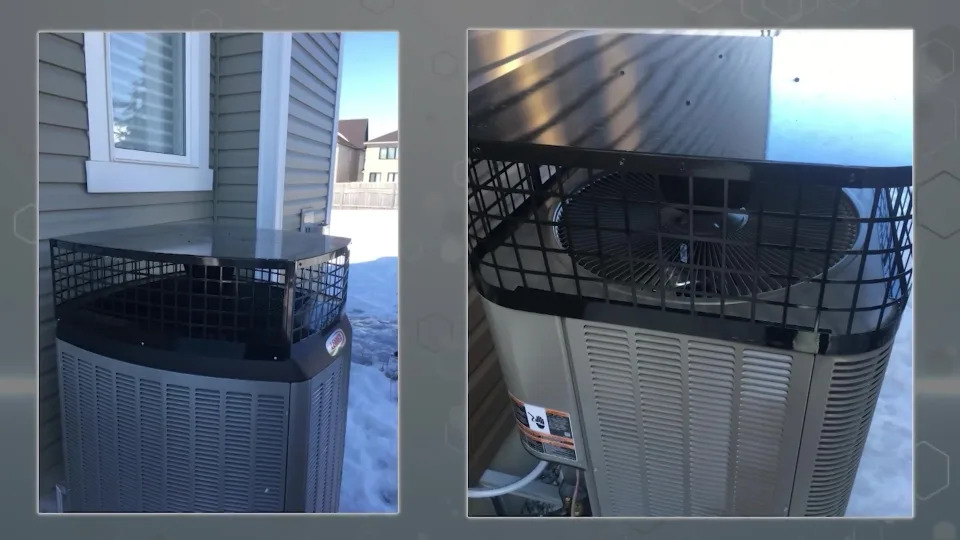
Air Sourced Cold Climate Heat Pump Installations. (Images via Natural Resources Canada.)

A recent study by Natural Resources Canada shows that heat pumps were much more efficient than any other system.

While the efficiency findings differ based on the province you live in due to climate and temperature differentials, Sager said, “Savings were highest when compared to oil heating systems. With the instability of the gas market, switching to an electric solution is a more stable way to save money yearly.”

“If you've heated with oil, propane, or natural gas, the heat pump is going to dramatically reduce your, your greenhouse gas emissions,” he added.

Thinking of making the switch? The Canadian government offers the “Greener Homes Grant” incentive, where you could get up to a $5,000 rebate on installing this technology in your home.

Thumbnail image courtesy of [Erik Mclean (Pexels)](https://www.pexels.com/photo/aerial-photography-of-a-residential-area-10894368/)

ARCTIC CANADA

Caribou at the crux of culture and industry

Mon, January 9, 2023 

Reconciling industrial and enviromental interests is a continual problem for the Yukon Environmental and Socio-economicAssessment Board (YESAB).

Projects have quickly become controversial when caribou are involved. BMC Minerals’ Kudz Ze Kayah project affecting the Finlayson herd is now before the courts for judicial review; Western Copper and Gold’s Casino project in Klaza caribou territory is now into its eighth year of assessment; and conditions have been recently imposed on Fireweed Zinc to mitigate effects of their drilling program on the Tay River caribou herd. Conditions for Fireweed’s project in the MacMillan Pass included that “if caribou are observable within one kilometre of active work areas, activities shall cease until the caribou have moved away on their own accord.”

There are 26 woodland and boreal caribou herds in the territory, plus the larger migratory herds that traverse international borders. There used to be many hundreds of thousands of caribou roaming the Yukon, but numbers have been drastically reduced since contact. Biologists admit there is a natural ebb and flow to caribou populations, and that the factors affecting mortality, health and migration patterns are complex.

The Fortymile herd has been growing since 2017 and in 2022 was hunted on both sides of the border, though to a significantly greater extent on the Alaska side. Tr’ondëk Hwëch’in allowed a small hunt to proceed for cultural practices to continue. In August 2022, the Alaska Department of Fish and Game assessed the herd’s current habitat as too small to nutritionally sustain the animals and set a hunt quota of 1,200 bulls, saying that the herd needs to be reduced for its own survival. This move has not been well-regarded in Yukon.

The draft Dawson land use plan process only protects a small portion of the herd’s habitat. Ivvavik National Park, Vuntut National Park and Old Crow Flats Special Management Area in northern Yukon pale in comparison to the size of the 78,000 sq. km (19.2 million acres) Arctic National Wildlife Refuge (ANWR) on the U.S. side of the border.

Vuntut Gwitchin elders foresaw the devastation that would occur to their way of life if the Porcupine Caribou herd went into decline. Elders instructed their young people to travel to Washington, D.C., in the 1980s to lobby for the calving grounds’ protection. Efforts to protect ANWR from oil development continue to this day.

Caribou are sensitive

Because caribou move around and adjust to different circumstances, they are viewed as adaptive. However, moving from well-suited prime habitat to less rich settings has consequences for the health and survival of the animals.

“Caribou are really disturbance sensitive. They only have so much energy (fat reserves) in the winter to take to running, to take flight,” said John Meikle, a planner who has worked in the Yukon for decades.

This means that caribou are easily frightened, but tend not to flee in order to conserve their energy. This makes them susceptible to collision with vehicles.

In 2021, there were eight caribou-vehicular collisions in the vicinity of the Southern Lakes. This number runs constant with previous years, with the majority of collisions in the Jake’s Corner area. Data shows that more female animals tend to be killed than the larger males.

But not all the collisions that affect Yukon caribou take place in the territory. In spring of 2022, the Carcross/Tagish First Nation (C/TFN) was devastated with the news of a fast-moving truck colliding with a group of animals on the British Columbia section of the South Klondike highway. Two of the four animals were pregnant, increasing the loss for the herd.

Kelsey Russell, a Yukon government caribou biologist, says an “intergovernmental interdepartmental wildlife collisions working group” has been established. The fish and wildlife management board has created posters and highway signage has been placed in some high-risk areas. Vehicles are one threat, but habitat fragmentation is another.

One of the main complaints by C/TFN elders is about problems arising from frequent lot subdivisions – which means more dog team trails and recreational snowmobiles to startle sleeping caribou.

“There’s a lot of ways that human disturbance on the landscape can affect caribou beyond just that direct removal of habitat, but you’re also fragmenting habitats— you don’t have those large intact areas,” said Russell. The Southern Lakes area is without any regional land use plans and is home to over 2,000 residences scattered throughout the traditional caribou areas.

There is also the problem of noise. A BMC Minerals screening report cites a mitigation strategy that calls for regularly scheduled flights from its airstrip so to not disturb caribou in their wintering grounds.

“That’s getting more of that sensory side of things, so the habitat might still be there. But they are displaced from it because of sensory disturbances — people or vehicles or blasting or whatever, the activity around that area. And then there’s other things like increased predation,” Russell said. Mine development by its very definition is problematic for caribou on many fronts — surface disturbance, traffic, blasting and aircraft.

Spiritual connections

Yukon First Nations have traditionally followed food and animals in accordance with the changing seasons. Signs of the changing Chinook salmon run were first noticed in Teslin when the age and size of the fish changed. Population growth and residential infill drastically reduced the Southern Lakes caribou.

C/TFN voluntarily stopped harvesting caribou over 30 years ago with the establishment of the Southern Lakes caribou recovery program. Now three generations have gone without, and children are losing the cultural instruction that comes with knowing the ways of the caribou.

The Hatchet Lake voyeur canoe team told the News in June that the reason Denesuliné (a Dene language) was spoken as a first language in their northern Saskatchewan community was because of the caribou. “We take the children on the land and we teach them how to harvest in our language,” said Chief Bart Tsannia.

So just as the near extinction of chinook salmon has eliminated the family experience of “fish camps” along the Yukon River and its tributaries, the loss of caribou also threatens the demise of a “way of life.” Efforts continue to protect the various herds to sustain the people who depend on them— with different First Nations using different approaches, from the lobbying efforts of the Vuntut Gwitchin to the legal strategies of the Kaska Nations.

This past November, C/TFN hosted the Southern Lakes Caribou Summit with the six southern lakes nations. A summation of the event reads, “There were sentiments of incredible hope and appreciation for the caribou as well as pride for the recovery plan, implemented 30 years ago, which has allowed their population to grow.”

The Indigenous How We Walk the Land and the Water initiative stresses seasonal considerations respecting the movement of animals across the land — for instance the movement of caribou from high summer ranges to lower wintering grounds and on to more clustered calving areas. As anyone who has travelled the Dempster Highway during migration knows — cars and vehicles must wait for the caribou to cross the road.

Lawrie Crawford, Local Journalism Initiative Reporter, Yukon News
Virgin Orbit reports 'anomaly' in satellite launch from UK

Mon, January 9, 2023 


LONDON (AP) — A mission to launch the first satellites into orbit from Western Europe suffered an “anomaly” Tuesday, Virgin Orbit said.

The U.S.-based company attempted its first international launch on Monday, using a modified jumbo jet to carry one of its rockets from Cornwall in southwestern England to the Atlantic Ocean where the rocket was released. The rocket was supposed to take nine small satellites for mixed civil and defense use into orbit.

But about two hours after the plane took off, the company reported that the mission encountered a problem.

“We appear to have an anomaly that has prevented us from reaching orbit. We are evaluating the information,” Virgin Orbit said on Twitter.

Virgin Orbit, which is listed on the NASDAQ stock exchange, was founded by British billionaire Richard Branson. It has previously completed four similar launches from California.

Hundreds gathered for the launch cheered earlier as a repurposed Virgin Atlantic Boeing 747 aircraft, named “Cosmic Girl,” took off from Cornwall late Monday. Around an hour into the flight, the plane released the rocket at around 35,000 feet (around 10,000 meters) over the Atlantic Ocean to the south of Ireland.

The plane, piloted by a Royal Air Force pilot, returned to Cornwall after releasing the rocket.

Some of the satellites are meant for U.K. defense monitoring, while others are for businesses such as those working in navigational technology. One Welsh company is looking to manufacture materials such as electronic components in space.

U.K. officials had high hopes for the mission. Ian Annett, deputy chief executive at the U.K. Space Agency, said Monday it marked a “new era” for his country's space industry. There was strong market demand for small satellite launches, Annett said, and the U.K. has ambitions to be ”the hub of European launches."

In the past, satellites produced in the U.K. had to be sent to spaceports in other countries to make their journey into space.

The mission was a collaboration between the U.K. Space Agency, the Royal Air Force, Virgin Orbit and Cornwall Council.

The launch was originally planned for late last year, but it was postponed because of technical and regulatory issues.

Sylvia Hui, The Associated Press

UK rocket launches robot factory to forge cutting-edge alloys in space


Sarah Knapton
Mon, January 9, 2023 

LauncherOne rocket containing the ForgeStar satellite is attached to wing of former Virgin Atlantic 747 - UK Space Agency/PA Wire

The Welsh have a proud history of cutting-edge metalworking.

So it may come as no surprise Wales’ first satellite is a robotic space factory, capable of forging alloys and other materials which are impossible to make on Earth.

Welsh startup Space Forge was due to launch its ForgeStar-0 satellite on board Virgin Orbit’s ‘Start Me Up’ mission from Spaceport Cornwall in Newquay on Monday evening.

The inaugural trip into Low Earth Orbit will test the satellite’s ability to return to Earth, but subsequent satellites will autonomously manufacture metal alloys, electronic components and even pharmaceuticals over several months, before bringing them home.

Creating materials in space has major advantages, because there is no oxygen, very cold temperatures and microgravity.

Under such perfect conditions, the suitcase-sized space factory should be able to produce better and lighter metal alloys than can be created currently on Earth, where gravity can cause the metals to separate into two layers, with the densest at the bottom.

It could also usher in a new era of flawless semiconductors, which are found in electronic devices, from mobile phones and televisions to refrigerators and computers.

At around 35,000ft the LauncherOne rocket detaches and launches into space, discharging its cargo when it reaches orbit - UK Space Agency/PA Wire

Semiconductors are made from crystal lattices of molten silicon, but the gravity of Earth can cause defects which impact performance.

Making them in space could dramatically improve the quality of silicon crystals, the company believes, which could extend the lifespans for everyday equipment.

A space factory can also work in temperatures close to absolute zero, which allows for ultra-fast ‘curing’ and again avoids flaws. The manufacturing will take a few months, before the precious space-built cargo is brought back down to Earth.

Space Forge co-founder Joshua Western said: “It will be the world’s first fully returnable and re-launchable satellite platform to create materials in space which are impossible to manufacture on Earth.

“Space Forge will leverage the benefits of the space environment, namely microgravity, vacuum and temperature.”

Virgin Orbit was scheduled to make its inaugural UK flight shortly before 10pm on Monday evening in the first historic lift-off from British soil.

Unlike traditional vertical launches, the ‘LauncherOne’ rocket containing the ForgeStar satellite and eight others is attached to a wing of a former Virgin Atlantic 747 passenger plane - dubbed ‘Cosmic Girl.’

The plane takes off as normal, and at around 35,000ft the rocket detaches and launches into space, discharging its cargo when it reaches orbit.

Newquay Airport was chosen as Britain’s first spaceport because it had a runway suitable for 747 aircraft, and a flight path close to the sea, in case of mishaps.


Other satellites making their maiden voyage include Open Cosmos’ DOVER-Pathfinder satellite.

Named after the Dover Strait, the narrowest part of the English Channel which has the densest shipping lanes, the satellite will help craft navigate the waters.

University College London (UCL) is also sending up two tiny instruments aimed at monitoring space weather and its effects on the Earth’s atmosphere as part of the CIRCE mission.

Usually Earth is protected by its magnetic field and even when solar storms penetrate they are usually only responsible for the spectacular auroras seen at the North and South Poles.

It is the more violent outbursts which can be catastrophic. The most severe incident - known as ‘the Carrington Event’ - happened in 1859, shorting telegraph circuits, starting fires and causing the Northern Lights to dance in the sky as far south as Hawaii.

If it happened today researchers estimate there is a 71 per cent chance the British power grid would be affected, while mobile phone reception could die, and airlines would be grounded without GPS.

The CIRCE mission consists of two nano satellites known as CubeSats, which each contain an instrument, and will fly in tandem 344 miles above the Earth’s surface.

Professor Anasuya Aruliah (UCL Physics & Astronomy), part of the science team who will be analysing the data from CIRCE, said: “Predicting space weather requires constant monitoring of the sun through to the response of the Earth’s environment.

“Meteorological weather forecasting relies on a worldwide network of weather balloons launched every 12 hours.

“The CIRCE mission will provide some of the first ever ‘space weather balloons’ to provide high spatial resolution in-situ measurements for research and forecasting models.”

Western Europe's first satellite launch mission takes off


UK's First launch of Virgin Orbit's LauncherOne rocket in Newquay

Mon, January 9, 2023 
By Paul Sandle

NEWQUAY, England (Reuters) -Virgin Orbit's "Cosmic Girl" carrier aircraft took off from Newquay's spaceport in Cornwall on Monday night, the initial stage of Western Europe's first ever satellite launch.

The modified Boeing 747 with a rocket under its wing took to the air and then soared out over the Atlantic Ocean, where after an hour the LauncherOne rocket with a payload of nine small satellites will be released at 35,000 feet (10,670 meters).

Virgin Orbit, part-owned by British billionaire Richard Branson, said the satellites would be deployed into lower Earth orbit (LEO) in its first mission outside its United States base.


More than 2,000 space fans cheered when the aircraft lifted from the runway in the seaside resort in southwest England.

The "horizontal" launch in Newquay - population 20,000 and famous for its reliable Atlantic waves - enabled Britain to beat Sweden, Norway and others in launching orbital satellites.

Britain's Minister for Science George Freeman said it was a historic moment.

"Assuming all goes according to plan, we will have won the European Space Race and be the first country to launch satellites from Europe," he told Reuters before take-off.

"We are sending a big signal tonight that we are intent on being a force in the space economy of tomorrow."

The new spaceport will launch small satellites at a critical time after the Ukraine war cut access to its use of Russian Soyuz vehicles. The European Space Agency's (ESA) Ariane 6 rocket, which launches from Kourou in French Guiana, is designed to carry large satellites and has also had delays.

The Ukraine war has highlighted the importance for tactical military purposes of smaller satellites, like those being launched from Newquay, which can get into low orbit at much shorter notice than bigger ones.

The UK Space Agency said it would be a moment of national pride for Britain's growing space industry.

Deputy Chief Executive Ian Annett said more small satellites were built in Britain than anywhere outside of the United States, and the country hosted operation centres for companies like Inmarsat.

"So we have the full spectrum except launch," he told Reuters. "If you have launch, you have everything."

The mission, called "Start Me Up" after the Rolling Stones track, will deploy breakfast cereal boxes-sized satellites to fulfil tasks such as maritime research and detecting illegal fishing, as well as national security, Virgin Orbit said.

The company has previously launched from California. Chief Executive Dan Hart said the protocols would stay the same, joking to reporters: "Pasties versus hamburgers, it's a significant shift."

He added that partnerships with the UK Space Agency, Spaceport Cornwall, the British aviation regulator and the Royal Air Force had made the launch possible.

START ME UP

Space enthusiasts with tickets for the launch secured positions in a viewing area as rock group Europe's "Final Countdown" blasted from loudspeakers on Monday evening.

Retired teacher Pauline Clifton, who had come from Falmouth in the south of the county, said she was always confident that the spaceport would come to fruition. "To be leading the way in anything is quite something for Cornwall," she said.

Virgin Orbit's focus on LEO satellites is at the other end of the scale from the large satellites in geostationary orbit that are launched by vertical rockets.

UKSA's Annett said the LEO economy had boomed in recent years, noting Jeff Bezos' Kuiper Systems and Elon Musk's rival Starlink constellations.

But he said smaller satellites were also doing vital research in climate change, and they were a growing opportunity for an industry employing 47,000 people and worth 16.5 billion pounds ($20.09 billion) a year in Britain.

Getting the mission off the ground has taken time. It was delayed from late last year due to the myriad regulatory clearances needed for the inaugural flight.

Virgin Orbit Shares Readiness For UK Rocket Launch


Anusuya Lahiri
Mon, January 9, 2023 


Virgin Orbit Holdings, Inc (NASDAQ: VORB) shared its readiness for the Start Me Up mission for a historic U.K. launch on January 9.

Start Me Up is a collaborative effort between the U.K. Space Agency (UKSA), Cornwall Council, the Royal Air Force, and Virgin Orbit.

The Start Me Up mission will carry satellites from seven customers to space, including commercial and government payloads from several nations and a collaborative U.S.-U.K. mission.

The LauncherOne system that will conduct the mission is now a modified Boeing Co (NYSE: BA) 747, dubbed Cosmic Girl, at Spaceport Cornwall.

Virgin Orbit's LauncherOne system completed an end-to-end launch rehearsal verifying the system's health and readiness of the team.

Ian Annett, Deputy CEO at the U.K. Space Agency, said: "The development of new orbital launch capabilities is already generating growth, catalyzing investment, and creating jobs in Cornwall and other communities across the United Kingdom. This will lead to new careers, improved productivity, and inspire the next generation of space professionals, and this is just the beginning."

Virgin Orbit, which usually operates from the Mojave Desert, put plans for a pre-Christmas U.K. launch on hold amid last-minute snags, Bloomberg reports

Are N.W.T. residents eligible for boarding home compensation?

Tue, January 10, 2023 at 6:58 a.m. MST·3 min read

Lawyers for the Federal Indian Boarding Homes (Percival) class-action lawsuit say an agreement-in-principle has been reached with the federal government.

The lawsuit, initiated by Reginald Percival of Nisga'a Nation, was filed in 2018. It focuses on what Indigenous children experienced not at residential schools, but at boarding homes where they were forcibly placed in order to attend public schools.

"Probably almost all of us lived under the same kind of conditions that they had in the residential schools, which was a lot of abuse," Percival said in an interview with the CBC.

"The abuse was not only physical. It was sexual. It was mental. We had to deal with a lot of systemic racism. We were not allowed to contact family. We weren't allowed to write letters or make phone calls."

The class action covers Indigenous students who were placed in boarding homes between 1951 and 1992. Claimants will receive between $10,000 and $210,000. Between 11,000 and 220,000 people are estimated to be eligible.

But David Klein, a managing partner of Klein Lawyers and lead counsel for the case, isn't sure how many will be Northwest Territories residents.

While records show that many N.W.T. children were placed in boarding homes to attend school, the issue comes down to the same legal technicality that has prevented other N.W.T. survivors from collecting compensation: confusion over which government is legally responsible for what happened.

"My understanding is that Canada continued to place children in the boarding homes program in the Northwest Territories past that time, but I don't have all the documentation to confirm that," said Klein.

"If the children were placed by the territorial government, they would not be members of the class. So that's something we'll have to look at carefully. But I don't have an answer for you today."

In 1969, the federal government transferred authority over all N.W.T. schools to the territorial government, but in many cases remained active in funding and operating the schools.

The issue is further complicated by the fact that the territorial government didn't fully devolve from the federal government until 2014.

There is legal precedent to suggest Northwest Territories residents could prove they qualify for federal claims.

In 2018, a Nunavut judge ruled that Canada should still be held responsible for residential schools the federal government asked the GNWT to run. “The funding of the GNWT by Canada and the project of devolution between them was still evolving. Canada remained involved in education-related matters in the Northwest Territories," that ruling stated.

But the issue remains a legal grey area, even for class action litigators.

"It's an important point, it's just something I hadn't looked at. And it absolutely has to be looked at," said Klein. "Because we have to be able to provide clarity to the people who contact us."

An online form for survivors, to see if they qualify for the boarding home class action, is already open to the public.

With the deadline to submit a claim to the Federal Indian Day School class action rapidly approaching on January 13, it's unlikely these questions will be resolved in time for many survivors of those schools to benefit from compensation.

But as this lawsuit's deadline has yet to be determined, there may still be time for boarding home survivors to make their case. For many, the moral and financial recognition these claims present have both a spiritual and practical significance.

"It represents an acknowledgement of a harm that was done to thousands of Indigenous children from coast to coast to coast, and an opportunity to have that recognized, compensated, and for the healing process to begin," said Klein.

Caitrin Pilkington, Local Journalism Initiative Reporter, Cabin Radio
Europe had second-warmest year on record in 2022, EU scientists say

Kate Abnett
Tue, January 10, 2023 


By Kate Abnett

BRUSSELS (Reuters) - Europe experienced its second-warmest year on record in 2022, European Union scientists said on Tuesday, as climate change unleashed record-breaking weather extremes that slashed crop yields, dried up rivers and led to thousands of deaths.

The EU's Copernicus Climate Change Service (C3S) said 2022 was also the world's fifth-warmest year, by a small margin. C3S records date back to 1950, but other, longer datasets confirm 2022 was the world's fifth-warmest year since at least 1850.

The last eight years were the world's eight hottest on record, C3S said.

GRAPHIC: How climate change unfolded in 2022 https://www.reuters.com/graphics/CLIMATE-CHANGE/EU-SCIENCE/zgvobrbbxpd/graphic.jpg

The planet is now 1.2C warmer than in pre-industrial times, as a result of human-caused climate change, C3S said. Copernicus said temperatures in Europe have increased by more than twice the global average over the last three decades.

"We are already experiencing the devastating consequences of our warming world," said C3S deputy director Samantha Burgess, who called for urgent action to cut CO2 emissions and adapt to the changing climate.

Last summer was Europe's hottest on record, smashing temperature records in countries including Italy, Spain and Croatia. Severe heatwaves caused more than 20,000 "excess" deaths in countries including France, Germany, Spain and Britain.

GRAPHIC: Record breaking temperatures in Europe

Combined with a dearth of rain, the heat triggered a widespread drought that initial analysis ranked as Europe's worst in 500 years. Low water levels delayed shipping along Germany's Rhine, while the lack of rain hit hydropower generation and slashed maize and soybean crop yields.

The hot, dry spell fuelled intense wildfires in countries from Spain to Slovenia, unleashing more emissions across the EU and Britain than in any summer of the last 15 years.

Britain experienced its hottest year on record in 2022, its national weather service said on Wednesday.


Global temperatures will only stop rising if countries reduce their emissions to "net zero" - meaning they release no more greenhouse gases into the atmosphere than they remove.

The 27-country EU, Britain, Canada, Japan and others have pledged to reach that goal by 2050, with China and India aiming to achieve it later.

Despite those long-term pledges, global emissions continue to rise. Carbon dioxide concentrations in the atmosphere averaged around 417 ppm in 2022 - the highest level for over 2 million years, C3S said.

Other parts of the world faced a year of climate devastation, as global warming continued to hit the world's poor and vulnerable populations hardest. Flooding in Pakistan killed at least 1,700 people, while drought decimated livestock populations in Somalia.

(Reporting by Kate Abnett; Editing by Raissa Kasolowsky)
WHITE COLLAR CRIME PAYES
Tips on shady finances 'may not get investigated' amid police constraints: RCMP note


Tue, January 10, 2023 


OTTAWA — The RCMP says many tips from Canada's financial intelligence agency about possible crimes "may not get investigated" due to a lack of policing resources and conflicting priorities.

The Mounties make the candid admission in a briefing note prepared for Public Safety Minister Marco Mendicino on the working relationship between the national police force and the Financial Transactions and Reports Analysis Centre of Canada, known as Fintrac.

The Canadian Press used the Access to Information Act to obtain the briefing memo, which was approved by RCMP Commissioner Brenda Lucki last Sept. 1.

The RCMP receives financial intelligence from Fintrac, which could shed light on money laundering or terrorist financing, in two ways.

The first is through a response to a voluntary information record, which advises Fintrac of potential criminal activity and might prompt the centre to release information related to suspects.

The second is through proactive disclosures from Fintrac when they point to possible criminal activity gleaned from analysis of information the centre receives from banks, casinos and reporting organizations.

The RCMP briefing note says Fintrac's analysis is of "significant tactical importance" to the force, as it may uncover previously unknown conspirators, assets, transfers and relationships.

"In some files, assets may only be identified through Fintrac intelligence — which is key for the RCMP to obtain restraints and forfeitures," it goes on.

However, receipt of intelligence through voluntary information records, or VIRs, "can be a lengthy process," the note says.

Fintrac's turnaround time to produce a non-urgent financial disclosure can take several months, "which affects the ability to investigate in a timely manner" and can hinder probes.

"Many of the proactive disclosures provided may not get investigated based on the capacity of law enforcement to analyze the information in a timely manner, as well as conflicting operational priorities," the briefing note adds.

"Fintrac should prioritize the disclosure of intelligence based on VIRs provided by law enforcement before any proactive work."

Asked about the note, Fintrac said its proactive disclosures to law enforcement and national security agencies are key to helping protect vulnerable Canadians, fulfilling the centre's "detection" mandate and meeting international obligations.

It pointed to Project Protect, a public-private partnership combatting human trafficking for sexual exploitation, in which 90 per cent of the centre's disclosures to law enforcement were done proactively, "identifying criminals and criminal networks that were previously unknown and helping to rescue and save the lives of numerous victims across the country."

Overall, Fintrac's financial intelligence contributed to 335 major, resource-intensive investigations in 2021-22 as well as hundreds of other individual investigations at the municipal, provincial and federal levels, the centre said.

"Many of the recipients of Fintrac's disclosures have told the centre that they will not start a major project-level investigation without seeking out its financial intelligence."

The addition of almost $90 million in the last federal budget is helping Fintrac upgrade tools to ensure its financial intelligence "is even more timely and responsive," the centre added.

Mendicino's office declined to comment on the briefing note.

RCMP spokeswoman Robin Percival had little to add, saying the force's partnership with Fintrac is key in the fight against money laundering and terrorist financing.

"The RCMP continues to work collaboratively with Fintrac in both an investigative context and on proactive crime prevention efforts."

The RCMP note suggests the government consider broadening the scope of federal proceeds of crime and terrorist financing legislation to include other criminal offences, as the "current narrow focus" limits Fintrac's analysis.

Percival said changes to information-sharing practices between the RCMP and its partners require legislative change, which takes time.

"The RCMP continues to work closely with the Department of Finance and Public Safety, providing recommendations on potential improvements to the anti-money laundering regime."

This report by The Canadian Press was first published Jan. 10, 2023.

Jim Bronskill, The Canadian Press
'No amnesty!': Brazilian protests demand jail for rioters


Mon, January 9, 2023 


RIO DE JANEIRO (AP) — “No amnesty! No amnesty! No amnesty!”

The chant reverberated off the walls of the jam-packed hall at the University of Sao Paulo’s law college on Monday afternoon. Hours later, it was the rallying cry for thousands of Brazilians who streamed into the streets of Rio de Janeiro and Sao Paulo, penned on protest posters and banners.

The words are a demand for retribution against supporters of former President Jair Bolsonaro who stormed Brazil’s capital Sunday, and those who enabled the rampage.

“These people need to be punished, the people who ordered it need to be punished, those who gave money for it need to be punished,” Bety Amin, a 61-year-old therapist, said on Sao Paulo’s main boulevard. The word “DEMOCRACY” stretched across the back of her shirt. “They don’t represent Brazil. We represent Brazil.”

Protesters' push for accountability evokes memories of an amnesty law that for decades has protected military members accused of abuse and murder during the country's 1964-85 dictatorship. A 2014 truth commission report sparked debate over how Brazil has grappled with the regime's legacy.

Declining to mete out punishment “can avoid tensions at the moment, but perpetuates instability,” Luis Felipe Miguel, a professor of political science at the University of Brasilia, wrote in a column entitled “No Amnesty” published Monday evening. “That is the lesson we should have learned from the end of the military dictatorship, when Brazil opted not to punish the regime’s killers and torturers.”

Brazilian police on Monday had already rounded up roughly 1,500 rioters, with some caught in the act of trashing Brazil's Congress, the Supreme Court and the presidential palace, while the majority were detained the following morning at an encampment in Brasilia. Many were held in a gymnasium throughout the day, and video shared on pro-Bolsonaro social media channels showed some complaining about poor treatment in the crowded space.

The Federal Police’s press office told The Associated Press the force plans to indict at least 1,000 people, and has begun transferring them to the nearby Papuda prison.

The administration of President Luiz Inácio Lula da Silva says that is only the start.

Justice minister Flávio Dino vowed to prosecute those who acted behind the scenes to summon supporters on social media and finance their transport for crimes including organized crime, staging a coup, and violent abolition of the democratic rule of law. He also said authorities would investigate allegations that local security personnel allowed the destruction to proceed unabated.

“We cannot and will not compromise in fulfilling our legal duties," Dino said. "This fulfillment is essential so such events do not repeat themselves.”

Lula signed a decree ordering the federal government to assume control of security in the capital Sunday. It was approved by Congress' Lower House on Monday night, and now proceeds to the Senate.

The riot in Brasilia was a reminder of the threat to democracy posed by far-right elements that refuse to accept Bolsonaro’s electoral defeat. Since his Oct. 30 loss, they have camped outside military barracks, pleading for intervention to allow Bolsonaro to remain in power and oust Lula. When no coup materialized, they rose up themselves.

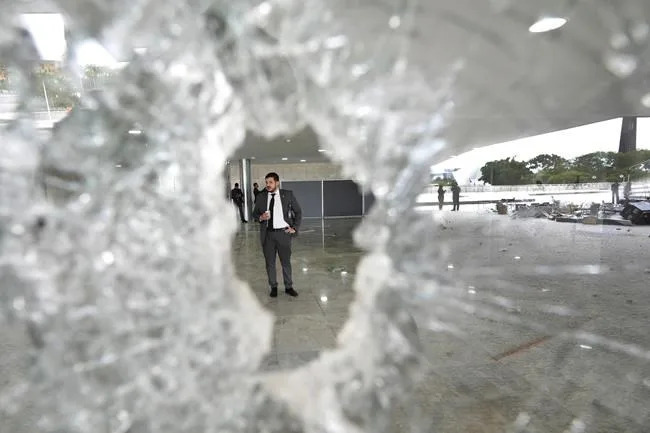
Decked out in the green and yellow of the national flag, they broke windows, toppled furniture and hurled computers and printers to the ground. They punched holes in a massive Emiliano Di Cavalcanti painting at the presidential palace and destroyed other works of art. They overturned the U-shaped table where Supreme Court justices convene, ripped a door off one justice’s office and vandalized a statue outside the court. Hours passed before police expelled the mob.

"It's unacceptable what happened yesterday. It's terrorism," Marcelo Menezes, a 59-year-old police officer from northeastern Pernambuco state, said at a protest in Sao Paulo. “I’m here in defense of democracy, I’m here in defense of the people.”

Cries of “No amnesty!" were also heard during Lula's Jan. 1 inaugural address, in response to the president detailing the neglect of the outgoing Bolsonaro administration.

Bolsonaro, a former army captain, has waxed nostalgic for the dictatorship era, praised a notorious torturer as a hero and said the regime should have gone further in executing communists. His government also commemorated the anniversary of Brazil’s 1964 coup.

Political analysts had repeatedly warned that Bolsonaro was laying the groundwork for an insurrection in the mold of that which unfolded in the U.S. Capitol on Jan. 6, 2021. For months, he stoked belief among hardcore supporters that the nation’s electronic voting system was prone to fraud — though he never presented any evidence and independent experts disagreed.

Results from the election, the closest since Brazil's return to democracy, were quickly recognized by politicians across the spectrum, including some Bolsonaro allies, as well as dozens of other governments. The outgoing president surprised nearly everyone by promptly fading from view, neither conceding defeat nor emphatically crying fraud. He and his party submitted a request to nullify millions of votes, which was swiftly dismissed by the electoral authority.

None of that dissuaded his die-hard backers from their conviction that Bolsonaro belonged in power.

In the immediate aftermath of the riot, Lula said that the so-called “fascist fanatics” and their financial backers must be held responsible. He also accused Bolsonaro of encouraging the uprising.

Bolsonaro denied the president’s accusation Sunday. Writing on Twitter, he said peaceful protest is part of democracy, but vandalism and invasion of public buildings cross the line.

Authorities are also investigating the role of the federal district's police in either failing to halt protesters' advance or standing aside to let them run amok. Prosecutors in the capital said local security forces were negligent at the very least. A supreme court justice temporarily suspended the regional governor, who oversees the force, for what he termed "willful omission". Another justice blamed authorities across Brazil for not swiftly cracking down on “homegrown neofascism.”

The upheaval finally prompted municipal and state governments to disperse pro-Bolsonaro encampments outside military barracks that have lasted since the election. Their tents and tarps were taken down, and residents were sent packing.

But pro-democracy protesters on Monday sought to ensure that their message — “No amnesty!” — was heard by the authorities responsible for investigating and prosecuting, as well as far-right elements who might dare defy democracy again.

“After what happened yesterday, we need to go to the street,” said Marcos Gama, a retiree who protested Monday night in Sao Paulo. “We need to react.”

___

AP videojournalist Mello reported from Sao Paulo.

David Biller And Felipe Mello, The Associated Press
MANITOBA

School airflow upgrades years away


Mon, January 9, 2023

The COVID-19 pandemic will all but certainly be over by the time highly-anticipated ventilation assessments and upgrades to limit infectious disease transmission in Manitoba public schools are complete.

A total of $11.3 million, a combination of provincial and federal dollars, was earmarked to improve air quality in K-12 buildings during the ongoing global health crisis.

The Winnipeg School Division, the largest in the province, was allocated approximately $2.5 million — about $85 per student — for projects scheduled in 78 facilities, according to a breakdown of grant distribution.

“Testing, adjusting and balancing (TAB) contract work is underway and is expected to take at least another two years to complete and be analyzed for optimization,” division buildings director Mile Rendulic said in a statement.

To date, maintenance teams have been allowing heating, ventilation, and air conditioning (HVAC) units to run continuously throughout the school day so air exchange is maximized, Rendulic said.

The school division has already purchased standalone air filters for portable classrooms and used ventilation-specific dollars to update central systems with new MERV 13 air filters, where possible, and CO2 sensors.

The Pembina Trails School Division has purchased upwards of 150 CO2 sensors for its buildings’ central HVAC systems to date. These sensors monitor return airflow from all classrooms and adjust fresh air intake accordingly.

These devices were “the most sustainable solution” to bettering air quality, given the capital city division’s existing infrastructure, per its facilities and operations department.

In Seven Oaks, superintendent Brian O’Leary said priority has been placed on ensuring maximum airflow in each respective building and commissioning older HVAC systems; he likened the latter to a tune-up to ensure a vehicle is running smoothly.

“The things that can be done quickly are limited to cleaning coils, recommissioning, some duct work, but it takes a while to do whole systems,” O’Leary said, adding ventilation challenges are generally in older buildings and K-12 facilities built as open-area schools.

Public and independent schools have used grants to replace aging windows with new ones that open, upgrade bathroom fans, retrofit air handling units, buy control valves, and undertake duct cleaning — a general maintenance service not recommended for infectious disease control.

The most modern and advanced HVAC systems are still not good enough to 100 per cent protect a building’s occupants from airborne diseases, said Amy Li, assistant professor of civil and environmental engineering at the University of Waterloo.

The Ontario researcher, who studies indoor air quality and filtration devices, is a vocal proponent for a multi-layered approach — with mandatory masks as a starting point — when it comes to reducing the risk of COVID-19 transmission indoors.

“There is a hierarchy of approaches to improve indoor air quality: the first one would be source removal, the second one is ventilation, and then after that, it is air cleaning,” she said.

Li said following proper HVAC maintenance is critical and can be complemented with portable air filters effective at removing particulate matter from the air, although she indicated frequent monitoring is necessary to know when to swap out dirty filters.

One University of Toronto academic said his school-age daughter informed him a machine running a HEPA filter placed in her classroom early on in the pandemic was unplugged soon after it arrived because “it was too loud.”

As far as civil engineering Prof. Jeffrey Siegel is concerned, there is one extremely underrated, low-cost way to improve air quality: educating occupants on risk and response.

Siegel said school staff should be equipped with knowledge to make informed decisions to protect their communities during high-risk activities — be it by opening windows, promoting temporary mask-wearing, moving outdoors or cranking up a HEPA filter, among other options.

If a classroom has a CO2 sensor, the ability to observe readings over time can prove useful to identify riskier periods, he said.

“Schools, in particular, are very strapped for cash and as parents, we don’t tend to care about the HVAC system in our kids’ schools — but we really should,” Siegel said, adding emerging research shows there is reduced transmission of viruses in classrooms when ventilation and filtration is improved.

Not only does improved overall air quality reduce the COVID-19 risks, he noted, but it can also address concerns about asthma, allergies and respiratory illnesses overall — and ultimately, result in higher attendance and academic performance.

Maggie Macintosh, Local Journalism Initiative Reporter, Winnipeg Free Press
WAIT, WHAT?!
Canada to purchase U.S. missile defence system for Ukraine


Tue, January 10, 2023 

Prime Minister Justin Trudeau meets with U.S. President Joe Biden at the InterContinental Presidente Mexico City hotel in Mexico City on Tuesday. (Adrian Wyld/The Canadian Press - image credit)

The Prime Minister's Office (PMO) has announced that Canada will buy a U.S.-made missile defence system for Ukraine and will welcome U.S. President Joe Biden for a visit in March.

The news came during the North American Leaders' Summit in Mexico City on Tuesday, following a meeting between Prime Minister Justin Trudeau and Biden.

A PMO readout of the meeting said Trudeau informed Biden that Canada will purchase a National Advanced Surface-to-Air Missile System (NASAMS) for Ukraine.

The Department of National Defence (DND) confirmed the purchase in a news release later Tuesday.

"Canada's NASAMS donation will help Ukraine strengthen its air defence systems against destructive air attacks on military sites, civilian critical infrastructure and population centres," DND said in the news release.

The release said the donation would cost approximately $406 million and would come from $500 million in aid to Ukraine that Trudeau announced in November 2022. The release did not say when the system is expected to arrive in Ukraine.

In an interview airing Tuesday on CBC's Power & Politics, Defence Minister Anita Anand told guest host Catherine Cullen the government is "working with the United States to get it to Ukraine as soon as possible."

"All options will always be on the table in terms of our support for Ukraine," Anand said.

The missile defence system was designed and developed jointly by the American defence company Raytheon and Norway-based Kongsberg Defence & Aerospace.

"NASAMS provides air defenders with a tailorable, state-of-the-art defence system that can maximize their ability to identify, engage and destroy current and evolving enemy aircraft, unmanned aerial vehicles and emerging cruise missile threats," Raytheon says on an online information page.

Ukrainian President Volodymyr Zelenskyy has asked for air defence systems in his requests for military aid.

Zelenskyy thanked Trudeau for the donation in a tweet Tuesday.

"Dear @JustinTrudeau, your true leadership in standing for democracy and human rights has been vividly proven again," Zelenskyy said in the tweet.

"Thank you for helping us to protect our sky. NASAMS procured for us by Canada will be a strong shield for our cities and citizens."

Anand said she spoke with her Ukrainian counterpart Oleksii Reznikov earlier Tuesday about Ukraine's defence needs.

"I spoke with Ukrainian Defence Minister @OleksiiReznikov this morning and heard it directly: air defence systems are Ukraine's top priority," Anand said in a tweet.

"That's why Canada is purchasing a National Advanced Surface-to-Air Missile System (NASAMS) from the United States to donate to Ukraine."

Anand said in a followup tweet that this is the first air defence system Canada has purchased for Ukraine.

"In the face of Russia's brutal airstrikes on Ukraine, this air defence system will help to protect Ukrainian population centres and critical infrastructure against drone, missile and aircraft attacks," she said.

In November of last year, the United States government awarded Raytheon a $1.2 billion contract to supply Ukraine with six NASAMS units.

Canada has provided over $3.4 billion in military and humanitarian aid to Ukraine since Russian President Vladimir Putin ordered an intensified invasion of the country in February of 2022.

Alexandra Chyczij, national president of the Ukrainian Canadian Congress (UCC), said the UCC welcomes the purchase.

"Assisting Ukraine with the weapons Ukraine requires to defeat Russia is the best investment in the future peace, stability and prosperity of all Europe," Chyczij said in a statement.

"Ukraine needs assistance defending its cities, its hospitals, its schools, its infrastructure from vicious Russian air and missile attacks."

Biden to make first visit to Canada

The readout said Trudeau invited Biden to Canada and that the president will visit in March. It did not give a location or date.

It will be Biden's first official trip to Canada since he became president in January 2021.

A readout from the White House on the meeting confirmed the March visit.

"During the meeting, the President also stated he looks forward to traveling to Canada in March of this year," the readout said.

The PMO readout said Trudeau and Biden discussed trade issues between the two countries, including the Biden administration's "Buy America" policy and the softwood lumber dispute.


CBC Young Calgary

Teen entrepreneur uses childhood illness as launchpad to help other Black girls and women


Tue, January 10, 2023

Eleora Ogundare has turned her experience as a child suffering sickle cell disease into a business, creating a line of products to help other women and girls with specific hair types and needs. (Jo Horwood/CBC - image credit)

Eleora Ogundare was diagnosed with sickle cell disease when she was eight years old.

During the course of treatments and chemotherapy for the red blood cell disorder, her hair started falling out.

"My hair was my confidence because the kids I was around, they had like the long, nice long hair," said Eleora, who decided with her mum to cut her hair and make the change quick, hoping kids in school wouldn't make comments.

"I felt, like, naked almost because, the thing that was like giving me confidence, I didn't have it anymore. I had to cut it all off."

Eleora is now a healthy 15-year-old, but instead of closing that chapter of her life, she decided to help others facing a similar challenge with their hair — and their sense of identity.

Strands of identity


While Eleora was battling for her health, her mum was trying to find solutions for her young daughter's hair, and with it, her sense of self.

"The struggle for them is identity, you know, trying to understand why their hair is not as silky as the next person in her class," said Eugenia Ogundare, Eleora's mother, who says hair for a Black women is "her crown."

"But then having to lose that hair was a whole different ball game altogether."

Jo Horwood/CBC

Eugenia says during months of treatments, they spent time trying out different oils, butters, and creams, eventually determining their own formula and using it to launch a line of products geared toward Black hair types.

"One of the problems Black women actually face would be the edges, so that's the first thing we get, that, 'Oh, it actually works for my edges'," said Eugenia, who has received plenty of positive feedback about the products she and her daughter work together on.

"And then we get the mothers who say, 'Oh, my daughter's hair was hard to manage. It's more manageable [now]'."

Adedoyin Omotara sells the Eleora Beauty line through both her salon, Adoniaa Beauty, and the Adoniaa Collective, a store for Black entrepreneurs at Westbrook Mall.


Jo Horwood/CBC

"It's a huge part of what makes us us, especially physically, but we need to understand the impact it has on us inside," said Omotara, who says she understands the pressures to conform that can sometimes arise for Black kids as they become more conscious of their environment and who they are.

Omotara says her own three-year-old has already questioned why his hair is so curly or difficult to comb compared to the hair of his friends.

"Especially for younger people, they need to understand that there are products that can actually work for our hair so that they don't start to put toxic product in their hair, just to want to look like another Sharon on the street or another Anita on the street."

Regaining health, hair, and herself


Now long past the illness she suffered as a child, Eleora hopes that the products created through her experience help other young Black girls feel empowered to be themselves.

"Our hair is beautiful the way it is and it's different in a good way ... it just expands our culture and really shows who we are," said the teen, who recently chose to cut her hair again.

"It wasn't as bad this time. Like, I'm more confident in it, and I also just want to teach other, like, young Black girls that, you know, like short hair or like long hair. You can rock it either way."

Jo Horwood/CBC

Omotara says the young entrepreneur's story is one that should give hope to their community.

"Whatever problems we have in our community, we remain the solution to those problems because we know where it bites the most, right? And that is why we are the ones to proffer the solution."

"I think we're making a difference in like, young girls lives," said Eleora.

"When I was younger, I kinda wish I had something like this too, to make me feel more confident. But I'm happy that I'm doing it now to help other people."