Tuesday, February 14, 2023

Survey: Only 35% of US Catholic parents highly value passing on faith


J-P Mauro
Aleteia - published on 02/14/23

With only about a third of Catholic parents placing high value on their kids' faith, the future of Mass attendance may be bleak.

The rise of the “nones” — those who claim no religious affiliation — may have longer reaching ramifications than previously considered. A recent poll from Pew Research Center found that only about a third (35%) of US Catholic parents consider it extremely or very important to raise their children to their faith. The report paints a bleak picture for the future of Catholic Mass attendance, which has already fallen significantly since the pandemic began.

The 35% of parents who place high value on passing on their faith is mirrored exactly by the portion of parents who said they place little value on raising their kids Catholic (35%). In the middle ground, 30% of Catholic parents said it is somewhat important. White non-Hispanic Catholics were 10% more likely (39%) than Hispanic Catholics (29%) to place great importance on the issue.

Most Protestant denominations had higher rates of responding that passing down their faith was extremely important. White Evangelicals were the most likely to place a high value (70%) on their children’s faith, followed by Black Protestants at 53%. Only White non-Evangelical Protestants cited lower levels of importance on passing on their faith than Catholics, with just 29% answering in the affirmative.

When examining respondents by rate of Mass attendance, it was found that the religious tendencies of parents corresponded with the value they place on the faith of their children. Those who attend religious services weekly were three times as likely to want their children to have a strong faith (76% vs 21%).

Catholics once again mirrored the total of American responses on the topic of raising their kids to help those in need (81%), as well as on the topic of accepting people who are different than themselves (80%).

Overall, Americans are more likely to say they want their children to be raised in the same faith than to be raised in the same political party (35% vs 16%).

When asked if parents were raising their kids as they themselves were raised, there was an even split of 43% raising their kids similarly, and 44% raising their kids differently. Sixty-three percent of parents who are raising their kids similarly to their own upbringing cited religion as very important, while only 13% of parents raising their kids differently cited religion as an important factor. Very few parents who are raising their kids differently said they were incorporating religion into their children’s lives.

Read the full survey results at Pew Research Center.
In Pictures
Photos: Valentine’s Day celebrations around the world
The February 14 occasion is marked in many countries but traditions are often very different.


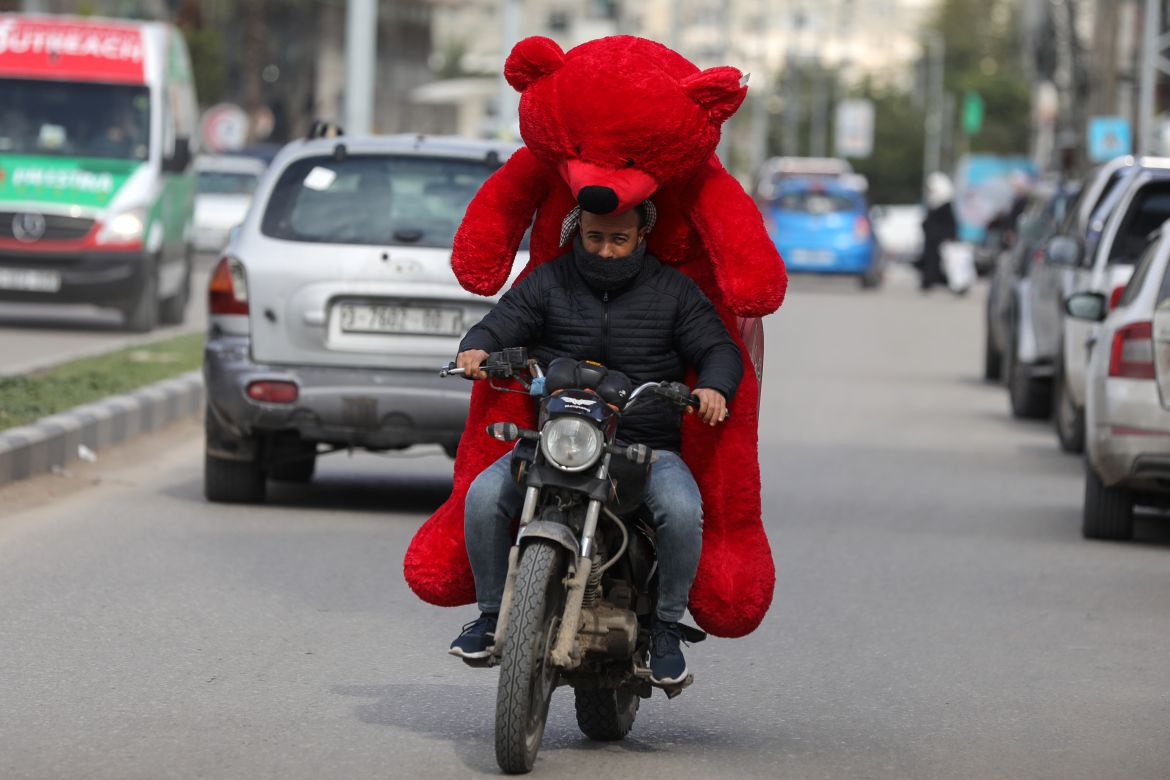
A Palestinian man balances a giant teddy as he rides a motorcycle on Valentine's Day in Gaza City. 
[Majdi Fathi/NurPhoto via Getty Images]


AL JAZEERA
Published On 14 Feb 2023

Valentine’s Day, named after a Christian saint, may now be marked in countries around the world but traditions are often very different – and sometimes have nothing at all to do with romance.

While in Europe it is all about couples celebrating their relationship, in the United States it is as much about schoolchildren marking friendships, while in Japan women give chocolates to their bosses.

The origins of the annual February 14 occasion are shrouded in mystery but the day is, of course, associated with the cult of Roman Christian martyr Saint Valentine, who lived in the third century AD.

He literally lost his head over love – decapitated on the orders of Emperor Claudius II, they say, for secretly performing weddings. According to the legend, Valentine cured his jailer’s blind daughter and the day before his death slipped her a note signed “Your Valentine”.

In England, the exchange of messages known as “Valentines” on February 14 developed with the rise of the postal service in the 19th century, with the sender often signing off “Your Valentine”.

The celebration took a commercial turn in the mid-19th century in the US, with the invention of mass-produced greeting cards. Promoters quickly got the idea to extend the “tradition” beyond lovers, with schoolchildren often expected to bring a Valentine card for every one of their classmates.

Today it has become a $20bn business.

The Japanese Valentine tradition began after World War II when confectionery makers came up with the idea of having women offer chocolates to their bosses and boyfriends on February 14.

A half-century later, the practice has become an annual ritual, with millions of Japanese women giving pralines or ganaches to show affection, friendship or professional respect.

But elsewhere, the holiday – a relatively recent import from the West – often clashes with conservative cultural forces as well as anti-capitalist sentiment in parts of society.

A bouquet made of onions, tomatoes and garlic is displayed at a flower market in Manila, the Philippines. The bouquet is part of a Valentine's Day gimmick by a flower store owner who says it is more practical than giving flowers because you can cook it afterwards. [Aaron Favila/AP Photo]

People walk past a heart-shaped balloon displayed in a shop window in Krakow, Poland. [Beata Zawrzel/NurPhoto via Getty Images]
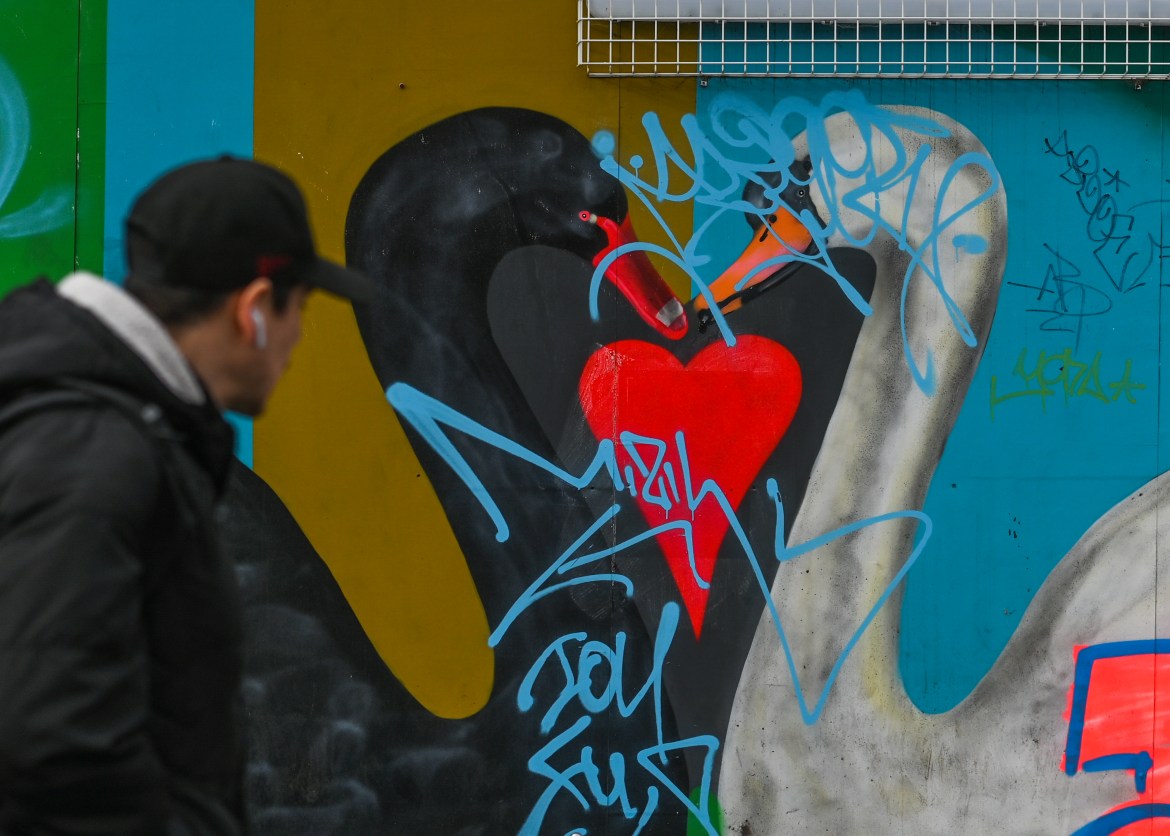
A man walks past a mural with swans in Dublin, Ireland. 
[Artur Widak/NurPhoto via Getty Images]
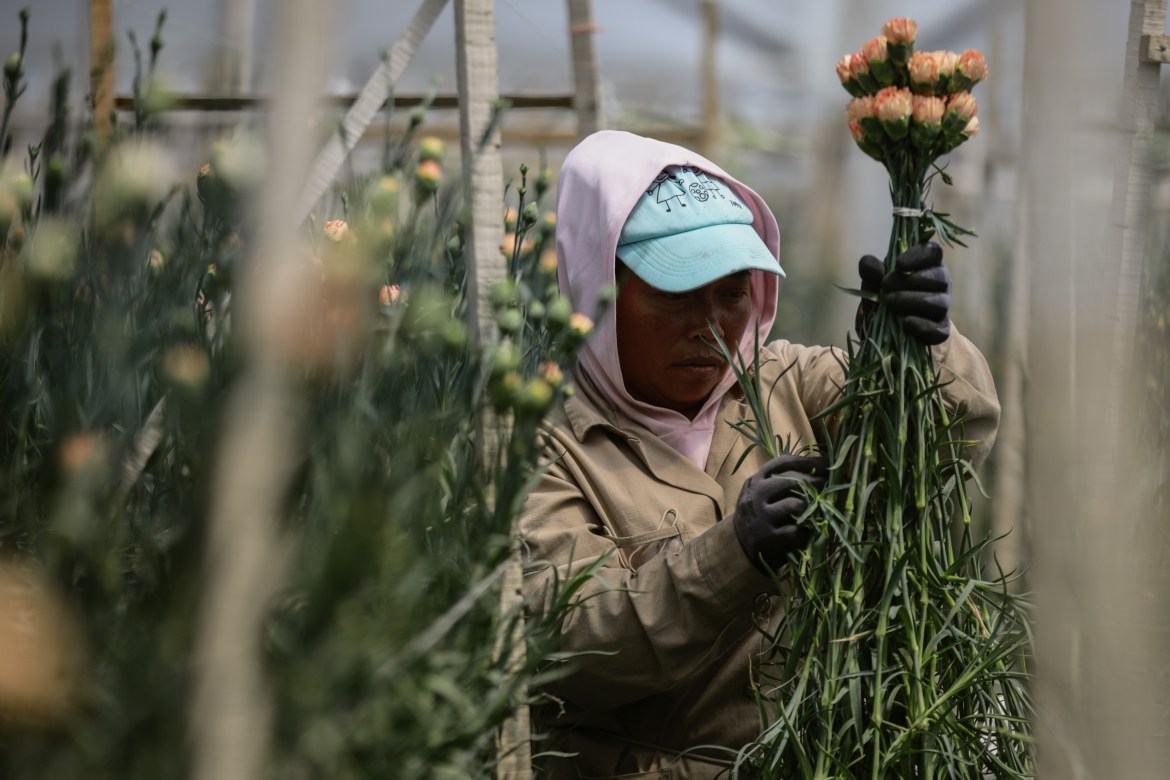
A worker in Sesquile, Colombia, collects carnations to be trimmed and packaged for shipment to the US and different Asian and European countries for Valentine's Day. [Juancho Torres/Anadolu via Getty Images]
Trimmings and flowers are seen near the feet of floral designers working to arrange bouquets for customers on the eve of Valentine's Day at a florist in Louisville, Kentucky, US.
 [Jon Cherry/Reuters]
A newlywed couple poses for pictures on Valentine's Day at a marriage registration office in Hangzhou, Zhejiang province, China. 
[China Daily via Reuters]
A girl burns incense at Ha Pagoda (Chua Ha) on Valentine's Day in Hanoi, Vietnam. Ha Pagoda is known as the pagoda to pray for love in Hanoi, where many young people go to pray for luck in their love lives, especially on Valentine's Day.
 [Luong Thai Linh/EPA]
A couple on elephants receive their marriage licence during a ceremony at the Nong Nooch Tropical Garden in Chonburi, Thailand. 
[Athit Perawongmetha/Reuters]

Kabul florists heartbroken over Taliban Valentine's Day ban

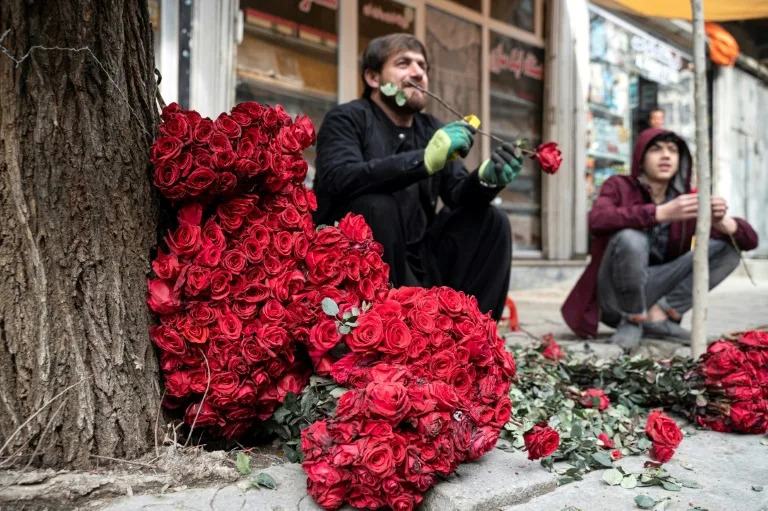
Florists with wilting bouquets of red roses and street vendors clutching unsold balloons were heartbroken in the Afghan capital on Tuesday after the Taliban's morality police banned Valentine's Day celebrations.

While Valentine's Day has never been widely celebrated in Afghanistan, some well-off residents in cities have developed a tradition of marking the lovers' day in recent years.

In Kabul's famed Flower Street, shops were full of heart-shaped garlands and red stuffed animals, but hopelessly empty of customers.

In the window of one outlet, a poster signed off by the Ministry for the Promotion of Virtue and Prevention of Vice warned shoppers: "Avoid celebrating lovers' day!"

The poster said Valentine's Day "is not Islamic and is not part of the Afghan culture but a sloganeering day of the infidels".

"Celebrating the day of lovers is showing sympathy to the Christian Pope," it read.

Officers from the ministry patrolled the area in their white uniforms, trailed by an armed escort, an AFP correspondent reported.

A poster on the window of a shop in Kabul warns residents to "Avoid celebrating lovers' day!" © Wakil KOHSAR / AFP

Kneeling in front of his shop, Omar -- who did not share his surname -- pruned thorns and withered petals from his stock of flowers.

"[The Taliban authorities] published and distributed their order to every shop," he told AFP.

"I don't think I could sell these flowers today, people aren't buying," he said.

"You can see we have no customers -- the situation is very bad."

An AFP reporter saw a young couple furtively buy flowers and quickly leave the scene when they saw the morality police patrol.

"The situation has changed -- we can't celebrate it like other years," said browsing shopper Zahrah, married for seven years.

"But we do celebrate it. There are some restrictions and the situation is not good, but we celebrate it at home."

The vice ministry could not be reached for comment on the exact nature of the ban.

The Taliban authorities have issued various restrictions on social life in the country since they came to power in August 2021.

Music, social media apps and video games have all come under scrutiny by the ultra-conservative government.

The authorities have particularly cracked down on Afghan women, effectively squeezing them out of public life.


Afghan men are reflected on the glass of a gift shop along Flower Street in Kabul © Wakil KOHSAR / AFP


Explained: How Instant Noodles Are 'Burning' Children And Sending Them To Hospitals

The research team at UChicago Medicine’s Burn Center found out that in all pediatric patients, who were admitted with scald injuries caused by hot liquids between 2010 and 2020, most of them had them caused by instant noodles. 

Representative image of noodles. Image credit: Shutterstock.com

UPDATED: 14 FEB 202

A cup of instant noodles could save your hunger. But it can also end your children in a hospital. Shook? Well, that’s what recent studies have found. Piping hot noodles have been found to cause instant burns in children.

A recent study published by the University of Chicago researchers in the journal “Burns” found out that instant noodles are responsible for the burns of almost a third of children.

Related Stories
Maggi Noodles '100% Safe For Consumption', Assures Nestle India


What has the study found?

The research team at UChicago Medicine’s Burn Center found out that in all pediatric patients, who were admitted with scald injuries caused by hot liquids between 2010 and 2020, most of them had them caused by instant noodles.

“Anecdotally, it felt like every other child we were consulted on for a burn was injured by instant noodles, so we wanted to dive into the data to see what the trend really was,” said senior author Sebastian Vrouwe, MD, assistant professor of surgery at UChicago Medicine. “Our hope is to develop the groundwork for future burn prevention programming, as essentially all childhood burns are in some way preventable.”

According to the survey, out of the 790 burn cases that were reviewed, 31 per cent were children.

Further, African American children and children who lived in areas with lower Childhood Opportunity Index (COI) scores were more likely to suffer these scald burns than their peers. Unsupervised children also faced higher risk: 40 per cent of instant noodle burns occurred when children were reported to be alone during a time of injury, the study found it.

Although the survey has a restricted geography, researchers hint at a larger narrative of the dangers being posed by instant food items.
 
How do instant noodles cause burns?

The starchy liquid of instant noodles can cause severe injury to the skin. Although it comparatively causes less harmful scald burns than others, it could still lead to situations where children could be hospitalised.

Despite prevention initiatives and caregiver education, an estimated 100,000 children in the United States each year suffer scald burns from food and beverages alone, the study notes.

What are the preventive measures?

Burns of this sort can be caused while removing containers from the microwave, along with spills while eating due to the narrow bases of instant noodle cups.

In terms of preventing noodle burns, researchers say that caregivers should always have an adult remove noodles from the microwave and keep them out of reach until sufficiently cooled. Eating at a table as opposed to on a lap, he said, is another way to reduce burn risk.

Israel Is Sitting on a Powder Keg


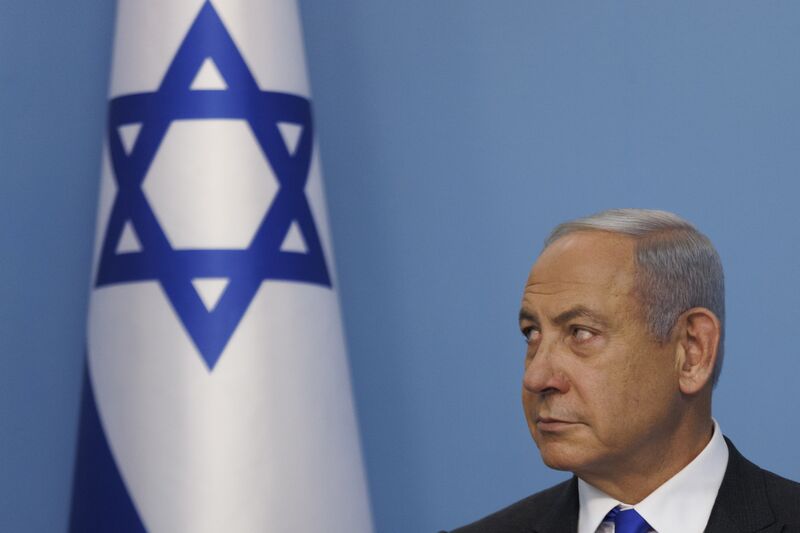
Israeli Prime Minister Benjamin Netanyahu during a news conference in Jerusalem on Jan. 11. Photographer: Kobi Wolf/Bloomberg
By

Gwen Ackerman
February 14, 2023
Bloomberg 

When President Isaac Herzog said Israel faces a “constitutional and social collapse,” he became the latest high-profile official to sound the alarm over the planned overhaul of the judicial system by Prime Minister Benjamin Netanyahu’s far-right government.

The drive to shift power away from the country’s top court to parliament will make it easier for the ruling coalition to appoint judges and limit the judiciary’s authority to strike down laws.

Key reading
Major Israeli Protests Against Judicial Overhaul Threaten Unrest
Israel’s Top Central Banker Evokes Economy in Courts Debate
Summers Sees Risk to Israel Economy From Rushed Judicial Reform
What to Know About Israel’s New Far-Right Government

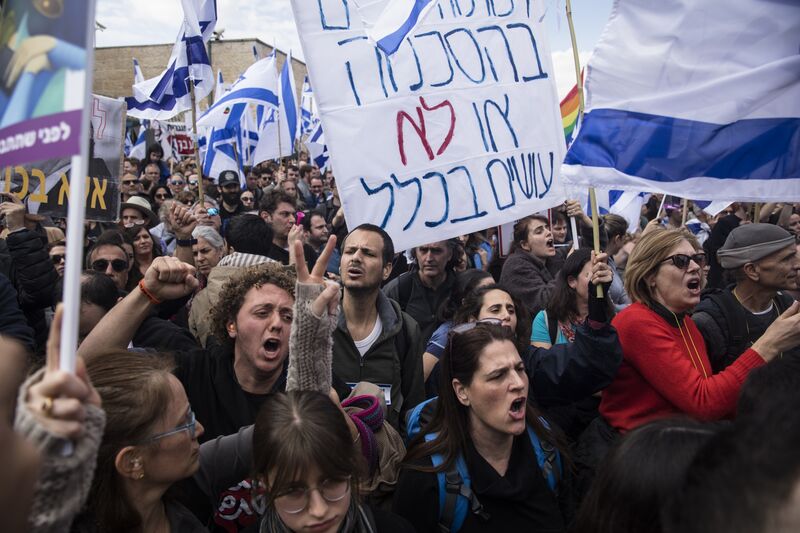
It has also brought tens of thousands of Israelis onto the streets. Scores of economists, business leaders, retired security chiefs and legal scholars have gone on record against the proposal that they say endangers the economy, relations with close allies and the future of Israel’s democratic system itself.

Even US President Joe Biden weighed in, telling a New York Times columnist that Israel’s democracy is based on institutional checks and balances, such as an independent judiciary.

Public discourse in Israel over the issue is growing uglier, at a time when spiraling violence with the Palestinians in both the West Bank and East Jerusalem is fanning domestic tensions and social anxiety.

“This powder keg is about to explode,” Herzog warned in an emotional televised appeal, urging the government to stop the legislative process and sit down to compromise with its opponents.

Herzog suggested a framework for the start of those talks, and while both opposition leaders and the government signaled they’re open to discussions, the justice minister said they wouldn’t halt advancement of the changes, which was one of the coalition’s main election planks.

Dialogue is the only way for Israel to emerge from “an emergency,” Herzog said. So far, few appear to be listening.

Protesters in front of the Israeli parliament yesterday.
Photographer: Amir Levy/Getty Images

Strikes Are Costing the UK Economy Millions in Lost Days


December was the worst month for strikes since July 1989

Sources: Office for National Statistics

The UK economy lost nearly 2.5 million working days to strikes last year in the most severe industrial action since Margaret Thatcher was in power. Prime Minister Rishi Sunak’s government has refused to lift public-sector remuneration for the current fiscal year beyond levels proposed by pay review bodies. Unions say they will keep fighting.

UK Suffers Worst Year for Strike Action Since 1989


TEHRAN (FNA)- The United Kingdom recorded the highest number of working days lost to labour disputes in 2022 for more than 30 years, official data showed on Tuesday, as a cost-of-living crisis led employees to walk out in demand of higher pay.

The Office for National Statistics (ONS) said nearly 2.5 million working days were lost to industrial action last year, the highest since 1989 when 4.1 million days were lost, Reuters reported.

With inflation at its highest in four decades, workers across a range of sectors from train drivers to teachers and healthcare workers have held strikes over the last few months.

The ONS data showed 843,000 days were lost to strike action in December alone, with border force staff, around 100,000 nurses and thousands of ambulance workers among those who staged walkouts either in the run up to or during the Christmas period.

While some smaller disputes have been resolved, the most high-profile show little sign of abating.

Up to half a million teachers, civil servants, and train drivers walked out earlier this month in the largest coordinated strike action for a decade and many trade unions have further days of strike action scheduled.

The British government has so far refused to budge on public sector pay and is instead in the process of tightening laws to make it harder for those in key sectors to strike.

It says the pay rises being demanded are unaffordable and hiking pay to match inflation would only worsen the problem.
Cybersecurity and Outer Space


January 29, 2023

The dramatic expansion of space capabilities has transformed space systems into critical infrastructure for many aspects of human society and for national security. With opportunities for global societal benefits come risks. The global governance framework remains weak and contested. Vulnerabilities now exist with space systems, and these are especially pronounced in the face of cyberthreats. We now confront a volatile “space-cyber nexus,” which the Cybersecurity and Outer Space essay series explores across a diverse and wide range of perspectives. The series is organized around three themes: space security and risk; international governance challenges; and global perspectives and the pursuit of inclusivity.


Introduction

Foreword: Is the Earth’s Orbit Becoming a Lawless Frontier?
Paul Samson

Securing the New Space Domain: An Introduction
Aaron Shull, Wesley Wark and Jessica West
Space Security and Risk

Where Outer Space Meets Cyberspace: A Human-Centric Look at Space Security
Jessica West

The Five Eyes and Space: A New Frontier for an Old Intelligence Alliance
Wesley Wark

Responding to the Cybersecurity Challenges of the New Space Environment
Robert Mazzolin

The Growth of the Space Economy and New Cyber Vulnerabilities
Brian Gallant and Jordan Miller

The Cyber Counterspace Threat: Coming Out of the Shadows
Victoria Samson

Commercial Space Operators on the Digital Battlefield
Laetitia Cesari Zarkan
International Governance Challenges

Formulating, Interpreting and Applying International Law in Space
Aaron Shull and Timiebi Aganaba

Cyberproofing India’s Space Assets
Tobby Simon

International Humanitarian Law in the “Grey Zone” of Space and Cyber
Cassandra Steer

The Ungoverned Space of US Space-Cyber Governance
Gregory Falco

The Cyber Phantom Menace to Space Security
Almudena Azcárate Ortega
Global Perspectives and the Pursuit of Inclusivity

Cybersecurity of Space Infrastructure and Space Sustainability: Japan’s View
Aya Iwamoto and Quentin Verspieren

Space and Cyber Global Governance: A View from the Global South
Rajeswari Pillai Rajagopalan

Chinese Thinking on the Space-Cyber Nexus
Yue Yuan

NATO versus Non-kinetic Threats: Implications and Opportunities
Giulia Pavesi


ABOUT THE AUTHORS
Aaron Shull

Aaron Shull is the managing director and general counsel at CIGI. He is a senior legal executive and is recognized as a leading expert on complex issues at the intersection of public policy, emerging technology, cybersecurity, privacy and data protection.
Wesley Wark

Wesley Wark is a CIGI senior fellow.
Jessica West

Jessica West is a CIGI senior fellow and a senior researcher at Project Ploughshares, a Canadian peace and security research institute, where she focuses on technology, security and governance in outer space.
Timiebi Aganaba

Timiebi Aganaba is a CIGI senior fellow and holds several positions, including assistant professor of space and society in the School for the Future of Innovation in Society, at Arizona State University.
Almudena Azcárate Ortega

Almudena Azcárate Ortega is an associate researcher in the Space Security and Weapons of Mass Destruction programs at the United Nations Institute for Disarmament Research.
Laetitia Cesari Zarkan

Laetitia Cesari Zarkan is a consultant at the United Nations Institute for Disarmament Research.
Gregory Falco

Gregory Falco has been at the forefront of space system and critical infrastructure security in both industry and academia for the past decade. He is an assistant professor at Johns Hopkins University’s Institute for Assured Autonomy and the Department of Civil and Systems Engineering.
Aya Iwamoto

Aya Iwamoto is the director of Japan space policy at Astroscale Japan.
Jordan Miller

Jordan Miller is the Calian marketing lead for global defence and training solutions.
Giulia Pavesi

Giulia Pavesi is finishing her Ph.D. in space law at the Leuven Centre for Global Governance Studies, Institute for International Law, KU Leuven.
Rajeswari Pillai Rajagopalan

Rajeswari (Raji) Pillai Rajagopalan is the director of the Centre for Security, Strategy & Technology at the Observer Research Foundation, New Delhi.
Paul Samson

Paul Samson is president of CIGI. He has 30 years of experience across a range of policy issues with partners from around the world. He is a former senior government official and also served for many years as co-chair of the principal G20 working group on the global economy.
Victoria Samson

Victoria Samson is the Washington, DC, office director for Secure World Foundation and has 20 years of experience in military space and security issues.
Tobby Simon

Tobby Simon is the president and founder of Synergia Foundation, an India-based think tank that works closely with academia, industry and government to establish impactful solutions in the areas of geoeconomics and geosecurity.
Cassandra Steer

Cassandra Steer is deputy director of the Australian National University Institute for Space, focusing on mission specialists.
Quentin Verspieren

Quentin Verspieren is assistant professor in the Science, Technology, and Innovation Governance program at the University of Tokyo’s Graduate School of Public Policy and associate research fellow at the European Space Policy Institute.
Yue Yuan

Yue Yuan is a Ph.D. candidate at China Foreign Affairs University and the Moscow State Institute of International Relations.
ANY MENTION OF ISRAEL LOBBY IS 'ANTISEMITIC'
Biden yanks human rights candidate over anti-Israel comments

By MATT LEE and JOSHUA GOODMAN

WASHINGTON (AP) — The Biden administration has withdrawn its pick of a human rights activist for a post at the Organization of American States for calling Israel an “apartheid state” and blasting a top House Democrat as being “Bought. Purchased. Controlled” by pro-Israel groups.

The U.S. announced Friday the candidacy of James Cavallaro to serve as an independent member of the Inter-American Commission on Human Rights, a watchdog monitoring the Americas, praising him as “leading scholar and practitioner of international law” with deep expertise in the region.

ZIONIST PRESS ATTACK
But on Tuesday the State Department said that his candidacy was pulled in the wake of an article by a New York-based Jewish publication, the Algemeiner, which revealed Cavallaro’s history of posts critical of Israel and U.S. support for the Jewish state.

In one Dec. 2022 tweet, deleted as the Algemeiner article was being readied for publication, Cavallaro used language viewed by many Jews as layered with anti-Semitic tropes to accuse House Minority leader Hakeem Jeffries, Democrat of New York, of being in the pocket of pro-Israel lobbyists.

“Bought. Purchased. Controlled,” Cavallaro wrote alongside a link to an article about Rep. Jeffries’ donations from AIPAC and other pro-Israel groups


State Department spokesman Ned Price said Tuesday that the Biden administration was unaware of Cavallaro’s past comments on Israel prior to announcing his candidacy, adding that they don’t reflect U.S. policy and were “inappropriate.”

Cavallaro, who served previously on the commission from 2014 to 2017, pushed back at the notion he was being insensitive. He said that his views on Israel are entirely consistent with international human rights organizations and international bodies and in no way would impact his work advancing human rights in the Americas.


““It’s clear I hit a raw nerve,” he said in an interview Tuesday following a meeting with the State Department.

He also pointed out that elected commissioners serve in a personal capacity and are not supposed to represent the foreign policy views of the governments backing their candidacy. He said that he discussed with the State Department his active social media presence prior to his candidacy being announced, if not specific tweets, and committed to cleaning up his timeline and rigorously refraining from speaking out if elected to serve on the commission

Cavallaro’s shortlived candidacy recalls the blow up over Harvard University’s decision to rescind a fellowship that it had offered another human rights activists for similar criticisms of Israel. Kenneth Roth, who was the executive director of Human Rights Watch, or HRW, until last year, was recruited by the Harvard Kennedy School’s Carr Center for Human Rights Policy to become a fellow. But the offer was rescinded a few weeks later over what Roth said was HRW’s longstanding record of criticizing Israel for possible war crimes against Palestinians.

Cavallaro, a co-founder and Executive Director of the University Network for Human Rights who previously taught at Harvard, Stanford and Yale law schools, has also accused Israel of committing “atrocities,” according to the Algemeiner’s scan of Cavallaro’s now deleted social media activity.

His candidacy to serve on the Inter-American Commission on Human Rights was to be voted on by the OAS’ 34 member states at a meeting this summer.
Palestinians seeking Security Council resolution condemning Israel’s settlement drive

In letter to SC members, head of Palestinian UN mission accuses Israel of 'attempting to impose fait accompli in occupied Palestine'

Itamar Eichner, Einav Halabi|
 Ynetnews

The Palestinians are seeking to advance a resolution at the United Nations Security Council condemning Israel for its decision to advance construction plans for 10,000 new settlement homes and legalize nine wildcat outposts in the West Bank, Ynet learned on Tuesday.

Head of the Palestinian mission to the UN Riyad Mansour addressed a letter to all 15 members of the Security Council in which he accused Israel of trampling international law and "attempting to impose a fait accompli in occupied Palestine, through increasing illegal measures of colonization, annexation and collective punishment."

 
ILLEGAL
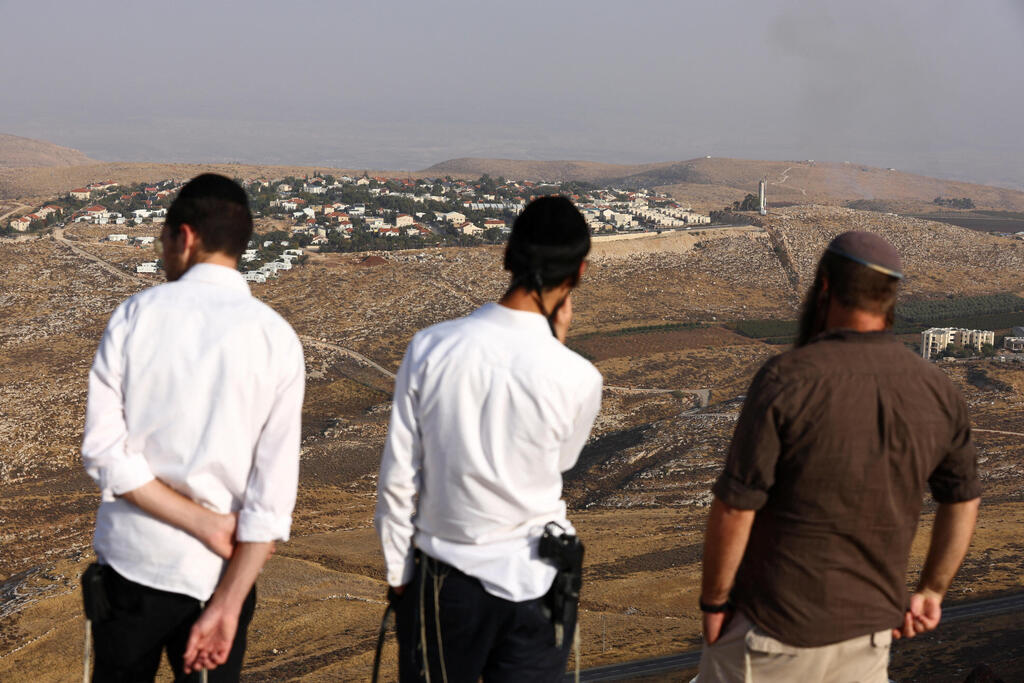
Settlers 
 overlook the Jewish West Bank ILLEGAL  settlement of Kokhav Hashahar
(Photo: Reuters)

In his letter, Mansour mentioned the Israeli Cabinet's recent decision to authorize nine illegal outposts, connect dozens more to electricity and water, and the advancement of plans for thousands new settlement housing units.

"Such decisions and accompanying statements by Israeli officials are further proof of the Israeli policy to annex the territory, which constitutes a war crime,” the letter read.
“The cruel irony is that Israel is forcibly uprooting Palestinian families and at the very same time it is building tens of thousands more housing units for the Israeli settlers, continuing to illegally transfer population to the occupied Palestinian territory, including East Jerusalem, with the direct aim of forcing an artificial change in the demographics, character and status of the territory.


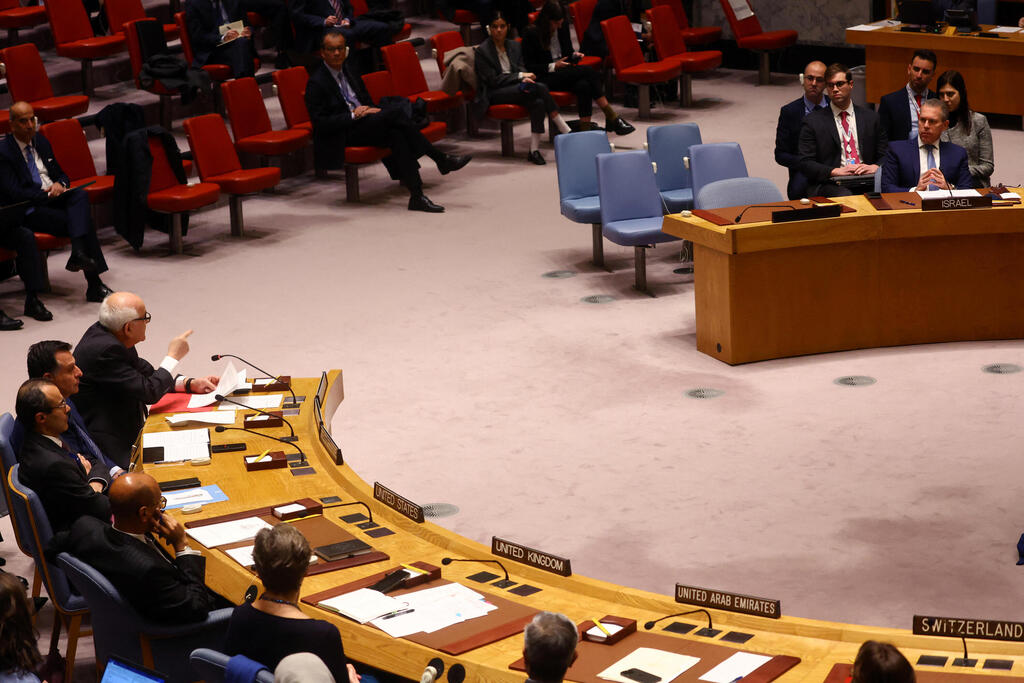
Head of the Palestinian mission to the UN Riyad Mansour scolds Israel's Ambassador to the UN Gilad Erdan during a Security Council hearing, January 5, 2023

The Palestinians will try to raise the matter in the international body’s periodic hearing on the Middle East conflict next Monday.

Such actions constitute serious violations of international humanitarian law and also serious violations of international human rights law."

Bringing such a resolution to a Security Council vote could place the United States in a tight spot. Washington officially opposes Israel’s settlement expansion policy but supporting or abstaining on such a resolution could embarrass it in front of its long-standing Middle Eastern ally.
Details of Trump, Kushner relationship with Saudi crown prince revealed - report

The reported relationship with the Saudis puts Trump’s integrity into question as the 2024 US presidential election approaches.

By BOAZ EDIDIN
Published: FEBRUARY 14, 2023 

THEN-US PRESIDENT Donald Trump, flanked by White House senior adviser Jared Kushner, meets with Saudi Arabia’s Crown Prince Mohammed bin Salman in Riyadh in 2017.

Former US president Donald Trump and his former senior advisor and son-in-law Jared Kushner are still receiving financial benefits after fostering a close relationship with Saudi Arabian crown prince Mohammed bin Salman (MBS) during their time in office, the Washington Post reported this week.

This murky relationship with the Saudis puts Trump’s integrity into question as the 2024 US presidential election approaches.

The Saudis provided both Trump and Kushner with sizable investments after their term, during which they bolstered MBS’s grip on the country by arranging that Trump’s first presidential trip be to Saudi Arabia, meeting with him in the US, and siding with him in several controversies.

Saudi Arabia's relationship with the Trump administration

Both up-and-coming proteges of powerful families, Mohammed and Kushner connected shortly after the onset of Trump’s 2016 term. Over the course of Trump’s presidency, their relationship would prove advantageous for all sides.

Trump’s support helped MBS rise to power, blockade his neighboring Qatar, and get away with his role in the murder of Washington Post opinion columnist Jamal Khashoggi. Trump and Kushner benefited from the relationship through several successful Israel-related foreign policy deals, as well as significant financial investments after his presidency.

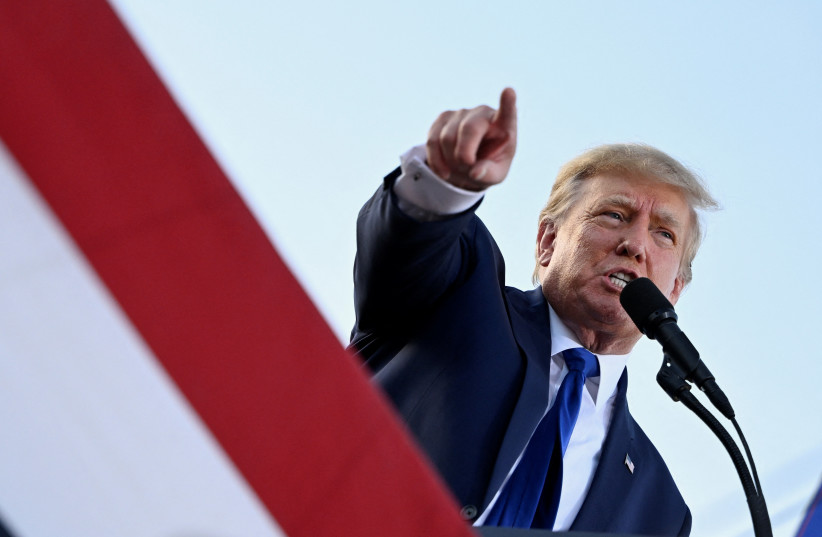
Former US President Donald Trump speaks during a rally to boost Ohio Republican candidates ahead of their May 3 primary election, at the county fairgrounds in Delaware, Ohio, U.S. April 23, 2022. (credit: REUTERS/Gaelen Morse)

Mohammed and Kushner remained in close contact throughout the term, to the concern of his White House colleagues. Kushner kept other officials in the dark on many projects he led, according to two former White House officials who spoke on the condition of anonymity.


“I didn’t really know what Jared was doing with the Saudis,” a former White House official told the Post. “That was part of the problem. We didn’t know what Jared was doing generally. And, you know, other governments had decided that you want to get close to Trump, the way to do it is through Jared.”

Kushner’s newfound power was all the more concerning to these officials due to his lack of experience. After a 2016 post-election meeting with Kushner, Mohammed’s advisers wrote: “Kushner made clear his lack of familiarity with the history of Saudi-American relations.” In his memoir, Kushner himself wrote that he “was learning diplomacy on the fly.”

In March 2017, MBS visited D.C. and Trump and Kushner met with him against the advice of Trump's national security council. Later that month, Kushner requested that Trump choose Saudi Arabia as his first foreign destination to jump-start the administration’s Middle East policy by laying the groundwork for a diplomatic breakthrough between Saudi Arabia and Israel. MBS and the Saudis would condemn terrorism in the region, purchase US arms, and create American jobs, Kushner promised. After substantial deliberation, Trump decided to fly to Riyadh. This effort was the first of Kushner’s many favors to MBS, who utilized Trump’s visit to solidify his then-imminent rise to the crown prince.

In return, MBS gave Trump his support for an anti-terrorism center and the Abraham Accords, a deal restoring relations between Israel and the United Arab Emirates, as well as other Middle Eastern nations.

In October 2018, Khashoggi, a journalist who commonly criticized the Saudi government, was ambushed and murdered by Saudi assassins. The CIA discovered that MBS had sanctioned the operation––an accusation that put his recent rise to power at risk.

However, Trump “saved his ass,” according to Bob Woodard’s The Trump Tapes. Trump denied MBS’s involvement in the scandal, refuted the CIA’s report, and vied for continued arms sales with the Saudis.

After leaving the White House, Trump and Kushner faced pivotal financial hurdles sparked by their political polarity. Trump’s policies weren’t exactly consensus, and the January 6 attack on the capitol didn’t help his company’s already nosediving revenues. Kushner’s senior advising position put him in a similarly difficult situation.

Shortly after Trump’s term ended, Kushner created a private equity fund for which he needed investors––a seemingly suboptimal situation for someone with little-to-no experience in the private equity space. However, according to The Washington Post and the New York Times, he received a $2 billion investment from the Saudi’s Public Investment Fund, which is chaired by MBS. His firm structured the funds so that they did not have to disclose the source, using a common strategy that equity firms use to classify funding sources, The Post reported.

Four out of the five people on the Saudi fund’s advising panel spoke out against the investment in a private meeting due to Kushner’s inexperience. Nevertheless, MBS led the full board in pushing the deal towards approval, according to the New York Times.

After the PGA Tour cut ties with Trump, his golf courses began hosting tournaments for the LIV Golf, a Saudi-backed venture. Additionally, Trump closed a deal with a Saudi real estate company to build a Trump hotel as part of a $4 billion golf resort in Oman.

“The financial links between the Saudi royal family and the Trump family raise very serious issues,” said Sen. Ron Wyden (D-Ore.), the chair of the Senate Finance Committee who is investigating the Saudis’ ties with Trump and Kushner, “and when you factor in Jared Kushner’s financial interests, you are looking right at the cat’s cradle of financial entanglements.”

There are ethics laws against retired military personnel working with foreign governments like Saudi Arabia’s, yet there are none against former presidents or senior white house officials.

“I think the Congress had a certain vision in mind for what the post-presidency looks like, such as creating a library and museum and some speaking and writing a memoir,” said Don Fox, former acting director of the Office of Government Ethics. “I don’t think it ever occurred to the drafters of these ethics laws that a former president would actually try to cash in on his years of office this way.”
Remains of 1884 shipwreck discovered on Massachusetts beach

Steven Yablonski, FOX Weather
February 14, 2023 

Here’s something you don’t see every day – the remains of a historic shipwreck were discovered by a woman walking her dog on a Nantucket, Massachusetts, beach last week.

Video recorded by Nantucket resident Jesse Ahern showed a large section of the shipwreck on Miacomet Beach.

According to a report from the Nantucket Current, the remains of the discovered shipwreck belonged to the three-masted schooner Warren Sawyer, which was lost on the night of December 22, 1884.

It wrecked in the area after being blown off course during its journey from New Orleans to Boston.

Ahern told Storyful that when she first noticed the wreck, she immediately thought it may have belonged to the 19th-century ship after smaller parts were discovered weeks earlier.

“That schooner wrecked on the beach in Miacomet December 1884 and was recently discovered this past December,” Ahern said. “So we walked up to what we thought was that, and I noticed it didn’t look like the images I saw from the first wreck.”

A large section of the shipwreck washed up on Miacomet Beach.
Jesse Ahern via Storyful
The remains of the discovered shipwreck belonged to the three-masted schooner Warren Sawyer.
Jesse Ahern via Storyful

The Warren Sawyer was lost on the night of December 22, 1884.Jesse Ahern via Storyful


She was correct. The remains were quickly identified as a larger piece of the Warren Sawyer.