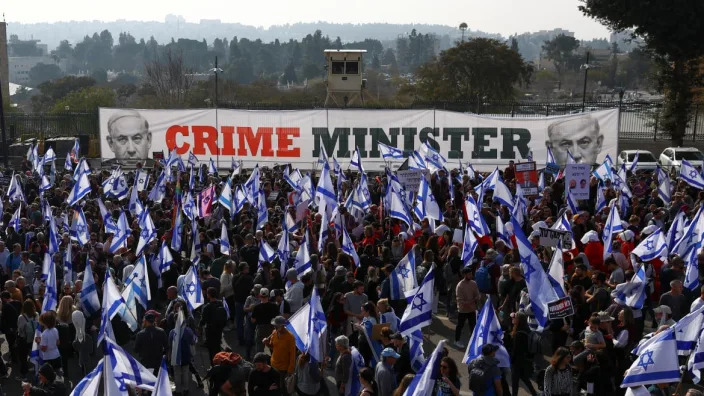
Taken together, this looks awfully like a culture war. The underpinnings of the scrum seem to be about who is already living inside the figurative house, makers and takers, who worships, and how often.
The right claims that it won the election and possesses a legal and popular mandate to enact a series of changes that would shift power to the Knesset at the expense of the courts. To be sure, the right’s claim to wanting more democracy can easily sound like a mask for illiberal parliamentary majoritarianism. They would never buy into a mechanism for direct voter-initiated referenda. Meanwhile, the left has done little to dispel charges of unvarnished elitism.
Overall, the opposition represents better educated and wealthier Israelis, heavily weighted toward the top fifth of the income ladder. They rightly fear that the government effort to curb the role of the judiciary will serve as a smokescreen for gutting civil liberties and permanently enshrining parliamentary dominance of the right. Beyond that, they worry that the overhaul would erode the status of the courts as an adjudicator of commercial disputes.

Arab politician Ahmad Tibi visits Palestinian families after an Israeli settlers' rampage in Huwara, the Israeli-occupied West Bank, March 5, 2023.
Raneen Sawafta/Reuters
There are also deep cultural divides. For instance, Bezalel Smotrich, the finance minister, previously referred to himself as “a proud homophobe.” Against the more recent backdrop of a lethal Palestinian terror attack and settler reprisals, Smotrich announced that the Palestinian “village of Huwara should be wiped out.” (He has since walked back those remarks.) As a coda, on Thursday the Biden administration granted Smotrich a diplomatic visa to visit the U.S. Likewise, Orit Struck—a Netanyahu and Smotrich ally—declared that her party would seek to revise anti-discrimination legislation to effectively permit hospitals to discriminate against gays.
As for the political left, it has proven itself incapable of addressing the grievances of the Sephardic community (Jews who came to Israel from Arab lands, as opposed to the Ashkenazi descendants of eastern and central European Jews). Israeli Sephardics play an outsized role in Netanyahu’s political base. They are generally, more traditional, religiously observant, and blue-collar compared to their Ashkenazic counterparts.
They also know when they are being condescended to. And yet for decades, the political left has demonstrated a consistent incapacity to meet them halfway.
In politics and life, respect is a big deal. In the present conflict, they wish for capitulation by the opposition, an impossible outcome. More broadly, they seek greater acceptance of their budgetary and social demands.
Already, the battle within Israel has reached the White House and the halls of Congress. Amichai Chikli, Israel’s minister of Diaspora Affairs, unloaded on Tom Nides, Washington’s ambassador to Jerusalem, after Nides had said that Netanyahu’s government should slow down its efforts.
“Some official, I don’t know who he is, I never met him, suggested I should stay out of Israel’s business,” Nides clapped back. “I really think that most Israelis do not want America to stay out of their business.”
On Capitol Hill, Republicans have rushed to Netanyahu’s defense, while Democrats appear divided. Sen. Mitch McConnell, the Republican leader in the Senate, expressed his view that the skirmish in Israel is an internal matter. GOP Sen. Tom Cotton of Arkansas attacked the Biden administration for purportedly undermining Netanyahu.
In the House, 80 Democrats signed a letter addressed to the president that urges him “to use all diplomatic tools available to prevent Israel’s current government from further damaging the nation’s democratic institutions.”
How much self-inflicted punishment Israelis can endure remains to be seen. One thing is certain, its allure and deterrence rest on it retaining its technological and military edge.
A lasting cold civil war helps no one but Israel’s enemies. “A house divided against itself cannot stand,” Abraham Lincoln intoned in June 1858. Things turned real hot in Lincoln’s country three years later.










.png)