Thursday, March 30, 2023

Turkey’s Cataclysmic 1999 Earthquake Foretold a Future Catastrophe

How the state intentionally suppressed the warnings and ignored the lessons from the Marmara temblor a generation ago
Turkey’s Cataclysmic 1999 Earthquake Foretold a Future Catastrophe
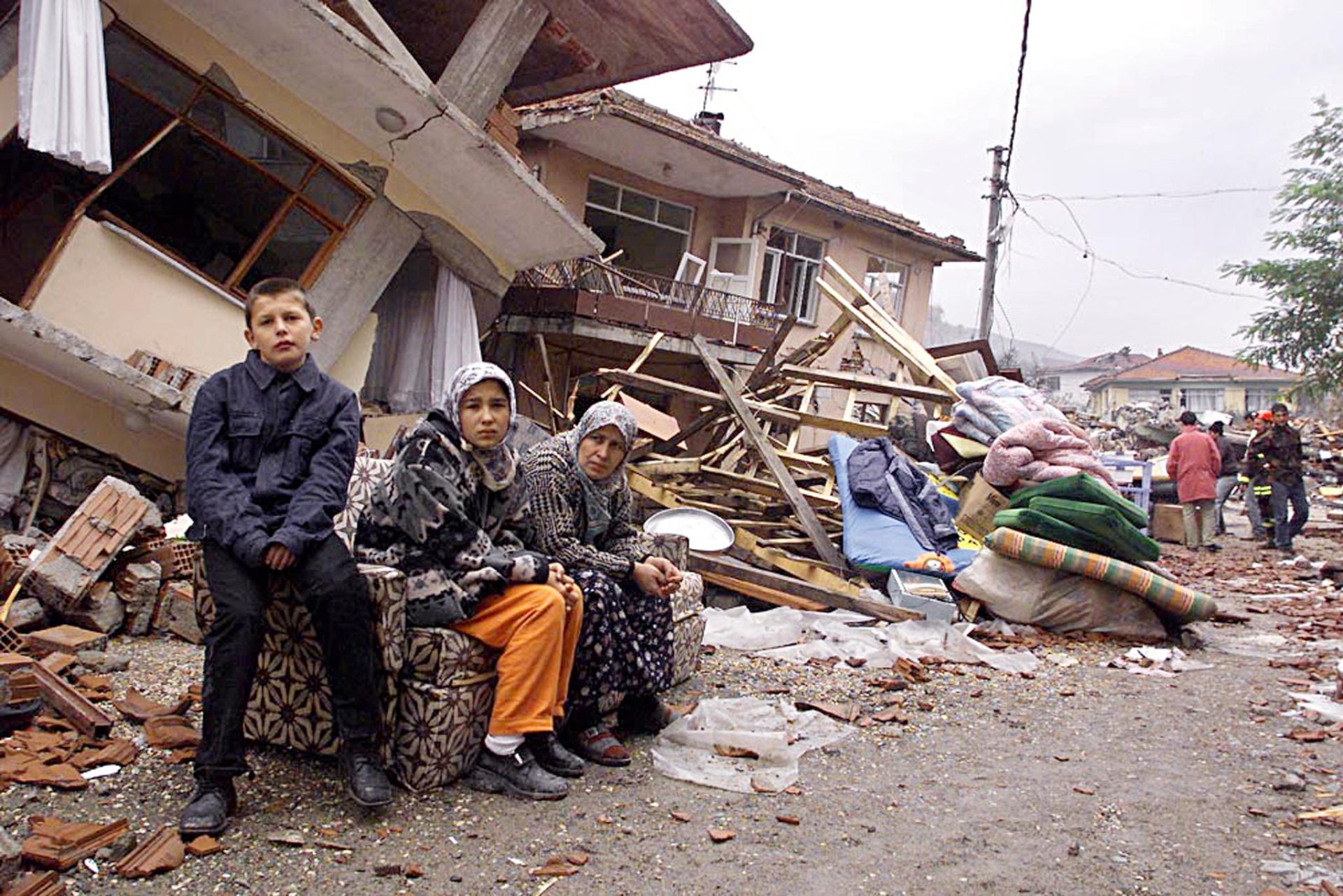
Residents sit on the debris of their house in Turkey’s Kaynasli on Nov. 17, 1999, following an earthquake. (Manoocher Deghati/AFP via Getty Images)

Aman stands in front of the rubble, not crying exactly, but wailing, sometimes roaring like a wounded animal, at one point jumping into the air and slamming his feet down in an act of raw emotion. He holds a bright scarlet piece of clothing and presses it against his face, inhaling the scent, swaying back and forth on his feet as though dancing. As others stand nearby in helpless silence, the man sifts desperately through the debris, collecting anything that still carries their smell, scooping up a tiny jacket, screaming incoherent words at the jagged shards on the ground. He has lost his daughter, son-in-law and grandson.

“I keep repeating to myself, ‘the horror, the horror, the horror,’” wrote the artist Anil Olcan, finding the word insufficient to describe what he had witnessed after visiting Hatay, the worst-hit area in the 10-city-wide zone of devastation in southern Turkey. “Is there a word in Turkish that alludes to the intertwining of panic, chaos, fear of death and the struggle to hold on to life?”

This inexpressible blight of trauma casting its shadow over all of Turkish society in the wake of the republic’s deadliest-ever earthquake nearly two months ago has long roots. When I first lived in Istanbul in 2006 as an English teacher, the school warned me to never broach certain topics with my students. This included the usual forbidden taboos, such as the Armenian genocide and the Kurdish conflict, but also earthquakes.

“Don’t even say the word,” a colleague said to me. To do so touched the still-raw wound of being abandoned by the state when the need was most dire and reinstilled the fear of another quake.

Turkey, a country cursed by geology, is one of the most earthquake-prone regions on the planet. The ground beneath your feet can shake in virtually any part of the country because, as the media keeps repeating, Turkey is a “deprem ulkesi,” an “earthquake country.” It balances precariously on the Anatolian tectonic plate that is squeezed and twisted counterclockwise by the Eurasian, African and Arabian plates, creating not one but two long, highly active fault lines, encompassing the entire north of the country as well as much of the south and east. There have been at least a dozen major earthquakes, causing over 1,000 deaths, in the past century in Turkey, but even before the recent quakes in the south, there was one in particular that left an enormous collective trauma on the country, shaking society’s faith in the state and planting the roots of Turkish civil society.

It unfolded one hot and muggy night, when the sea was calm and the stars bright. It was Aug. 17, 1999, at precisely 3:02 a.m., residents recalled when I interviewed them, that their breezy bayside town of Değirmendere was jolted awake to the sound of “a roar,” or “a strong wind,” depending on whom you ask. İrem Aydemir, who was 7 years old then, said it sounded “more like a beehive.” Before she knew what was happening, her mom had scooped her up from the bed in her aunt’s place where they were staying and raced out onto the street with her grandma and cousins. İrem looked around and realized that nothing was as it should be. Trees were in the middle of the sea. Some of the buildings were missing. Neighbors were standing outside in dead silence, women draped in tablecloths and curtains to cover themselves. Elsewhere in her town, residents lurched awake to find their homes full of seawater with mussels and fish flopping around. At first, some thought war had broken out, others that a meteorite had struck and still others that the apocalypse had been visited upon them.

Just 50 miles southeast of Istanbul, Değirmendere is known for its hazelnut festival and international arts events, its sweet cherries, a seaside park with giant plane trees and a waterfront with seafood restaurants, ice cream shops and tea houses. Nestled in Izmit Bay in Kocaeli, a heavily populated industrial province between the Sea of Marmara in the south and the Black Sea to the north, Değirmendere is a military town, as nearby Gölcük hosts Turkey’s largest naval base, where 24,000 people live and work. It is thus secular and considered modern, the kind of place where women can walk around in shorts without getting harassed and young people drinking beer flirt and gaze into the chilly Marmara. As in other coastal regions in Turkey, the “sahil” (seaside) is something almost sacred, the basis of an entire way of life, and İrem spent most of her childhood near it.

The epicenter of the earthquake — a devastating 7.4 magnitude tremor that roiled Kocaeli for 45 seconds, releasing the equivalent of 236 Hiroshima blasts and creating a tsunami as high as 8 feet deluging more than 100 yards inland — was just a few miles away. So much time had passed since the last deadly earthquake convulsed the region in 1894 that many people either didn’t know or had seldom pondered the fact that they had built their lives directly on top of one of the most active fault lines on Earth.

An immense inferno blazed at Turkey’s largest oil refinery just across the bay, spewing dark smoke almost 200 feet into the air. Minarets snapped like matchsticks. Buildings crumbled like sandcastles, for indeed they were made from concrete mixed with sand from the beach. Those who emerged from their homes in their pajamas, covered in cement dust, staggering about in a daze, will forevermore be known as “depremzede” — “earthquake victims.”

In nearby Izmit, at the end of the bay, 13-year-old Bahar Topçu, a typical middle-class teenager, was spending the night at her aunt and uncle’s apartment. She studied ballet and piano, took swimming lessons in the local pool, spent hours sipping tea and exchanging stories with her friends, and dreamed of moving to Istanbul and studying international relations. She loved how common it was to run into people you knew in the center of the small city, and everyone had their go-to baker, butcher and greengrocer with whom they exchanged the daily gossip.

Bahar struggled to stay upright as the ground shook for what felt like an eternity. She couldn’t straighten her legs. Her impulse was to run away, to escape somehow, but when the ground itself is shaking there’s nowhere to go. Bahar’s older cousin dashed into her room and wrenched her into the doorway where they clutched onto each other for dear life.

Finally it stopped, and they descended the stairs with her aunt and uncle and congregated with neighbors in a children’s park. Miraculously, this neighborhood was built on hard ground, and none of the buildings was heavily damaged. With the electricity out, Bahar had never seen Izmit enveloped by such total darkness, and the salty sea seemed present in the air in a way she had never felt before. Everyone stood there in stunned silence.

“Should I cry? Should I run? What should I do?” Bahar thought to herself, worried about her parents at home in another neighborhood. But soon they arrived by car, shouting her name, overjoyed to find her safe and sound. They drove away, passing through neighborhoods that looked starkly different from their own. Their headlights illuminated the rubble of ghostly buildings crumbled along silent, empty streets. At that moment, the family could not fathom where all the people were.

Their minds were fixated on an urgent task — finding a pay phone to call Bahar’s sister Pinar, who was studying in France, to tell her they were OK before she woke up and saw the news. At last they located one, and her mom called Pinar’s facility, only to remember that she didn’t speak a word of French. “Pinar’s momma, Turkey,” she said, and the person at the other end responded enthusiastically in a long stream of French. “Mama — bonne. Papa — bon,” (“Mama — good. Papa — good”) was all she could manage, a story they would recount many times in the future.

Back in Değirmendere, people sat on the ground and listened to news reports on the radio that played through the open doors of cars. İrem’s dad, who was at their home in another neighborhood, set out to reach them but had a hard time getting through because everyone stopped him, begging for help to dig out their loved ones. Later, he would work for weeks in the rubble, digging out the body of his wife’s cousin, who could only be identified by her wedding ring. The dead piled up so quickly that they were forced to use the local skating rink in Izmit as a makeshift morgue.

İrem’s uncle came directly from working a night shift in a glass factory and met them before going home to his pregnant wife. But before he left, the radio announced that his neighborhood had been destroyed, and he blacked out from shock and despair. They revived him with kolonya, the perfume ubiquitous in Turkey; he later discovered that his wife and future son had slept over at her mom’s place in a different neighborhood and survived.

Meanwhile, in Istanbul, 21-year-old university student Çağlar Akgüngör rushed to join the relief effort. Unlike almost everyone scrambling to help, he was trained and ready. Three years earlier, he had joined an organization called AKUT, which had been founded by one of the trainers at his university mountaineering club. AKUT was a pioneering search-and-rescue group established to help endangered rock climbers, cave divers and victims of natural disasters. After a training seminar at Boğaziçi University’s Kandilli Observatory and Earthquake Research Institute, they realized that Istanbul was built on a major earthquake zone and that Turkey had very little capacity for dealing with such a disaster. When municipalities demolished buildings, they let AKUT members practice working on the ruins.

Akgüngör met his AKUT colleagues in Avcilar, a coastal district on Istanbul’s European side where, despite being 55 miles from the epicenter, the quake pulverized over 60 shoddy buildings constructed on soft, sandy soil. Since few people owned cellphones and service was intermittent, they communicated by radio, soon learning that the damage in Kocaeli was far worse, and immediately headed to Gölcük.

Nothing could have prepared Akgüngör for the scenes of mayhem that met him there. Some buildings looked as though they had been swallowed into quicksand, as the temblor had liquefied parts of the ground. Others lay completely intact but on their sides. Many buildings had been opened up like dollhouses, exposing frozen scenes of domestic life inside. In the worst areas, several buildings were blended together into a single mass of concrete, metal, furniture, kitchen appliances, clothing and curtains, all of it covered in dust. Everyone was eager to help, but they lacked training, coordination and equipment. As countless people begged his team to rescue their loved ones, Akgüngör felt powerless, and it was hard to know where to start. AKUT had no more than 50 members and 2,000 volunteers, and lacked heavy or specialized equipment.

Desperate residents tried to remove giant chunks of concrete with their bare hands. The naval base had been hit hard, and sailors were busy working on their collapsed headquarters, digging out hundreds of buried officers who’d gathered for a celebration. Aside from the soldiers, the state was nowhere to be found.

There was no disaster management agency to coordinate a response and no state of emergency or martial law was declared (despite the military’s apparent recommendation). The state’s earthquake fund, established in 1972, was found to have just 1 million lira, then worth $2. The 78-mile-long fault rupture severed the primary fiber-optic cable connecting Istanbul and Ankara, leaving the government in the dark, and damaged the highway and railways between the two cities. Prime Minister Bülent Ecevit blamed the slow response on this, but he couldn’t explain how the media and foreign rescuers were able to reach the area within hours.

“Is Ankara or America further away?” asked Mustafa Yılmaz, a state minister.

The corruption-riddled relief organization, Kizilay (Turkish Red Crescent), was absent for days. When it eventually showed up, the few tents it scrounged together were of poor quality and leaked in the rain that drenched the region in the days following the quake. Four months later, a study found that only 10% of survivors reported having been helped by any state services, including the military, in the initial days following the quake.

“Where is the state?” people cried into the many cameras carried by Turkey’s new private news broadcasters who managed to show up long before officials.

Newspaper headlines were merciless: “The state is under the rubble”; “We’re victims of the state”; “The people abandoned.” For a society in which many venerated the near-sacred “papa state” as beyond reproach, both the failure of the authorities and the fury directed toward them were a shock.

In Cumhuriyet, Turkey’s oldest newspaper, Abdülkadir Yücelman wrote, “It’s not the Marmara that collapsed, but the system itself.” Trust in the state was “below zero,” Fatih Altayli declared in Hürriyet, another newspaper, warning that “the damage done to society by this lack of trust is far more destructive than the earthquake.” Ömer Çelik, a future minister for the Justice and Development Party (AKP), wrote, “When those who can’t govern act like they can run this unmanageable mechanism, it costs thousands of lives,” rebuking those who were silencing criticism in order to preserve “national unity and solidarity.”

Even the beloved military was no longer infallible, at least for a few days. “In the first two days the people searched for soldiers in vain,” wrote Can Atakli in Sabah. “The soldiers get everything and we get nothing,” a bitter woman screamed to a journalist from The Guardian.

In the absence of an official rescue effort, a massive civilian mobilization unlike anything seen before in Turkey began from the earliest hours, with student groups, Islamic charities, businesses, doctors, engineers and ordinary citizens descending on the earthquake zone from across Anatolia schlepping water, bread, boxed milk and tinned food, clothing, cranes and bulldozers, and all other manner of supplies they could carry. Later, they provided eyeglasses, laundry services, soup kitchens, psychological support and even legal aid and media advocacy to give voice to the victims.

“The people are running towards the disaster zone without waiting for the state,” proclaimed Hürriyet’s front page. The TÜSİAD business association estimated that 10 million of Turkey’s 14 million households contributed aid.

Many of the groups would go on to form NGOs, and the relief effort marked a renaissance for Turkey’s embryonic and heavily factionalized civil society, in large part organized and financed by the business owner and philanthropist Osman Kavala, then 42, who raced to Değirmendere to offer any help he could. After the earthquake, Kavala devoted himself solely to civil society and founded some of Turkey’s most important arts and cultural organizations. Many of the most prominent activists, urban planners and architects who would later play a major role in the 2013 Gezi uprising, which was in part a protest against turning a designated meeting place in the event of an earthquake into a shopping mall, first met during the 1999 relief effort.

Foreign rescue teams, some coming from halfway around the globe, arrived days before state officials, bringing the rescue dogs and specialized equipment that Turkey lacked. The German daily, Bild, published its headline in Turkish: “Arkadaslar, Almanya acinizi paylasiyor” (“Friends, Germany shares your pain”). As the mayor of Athens collected donations and called for borders to disappear, headlines in Turkey’s rival Greece gushed: “We are all Turkish,” and “Mehmet, my brother, be brave.” Hürriyet responded with a headline in Greek: “Efharisto poli file” — “Thank you, neighbor.” Later, when U.S. President Bill Clinton and his family visited the tent cities, children followed him in droves, shouting, “Uncle Clinton.”

One by one, the dogmas that had been drilled into Turks since primary school — that their country was surrounded by enemies, that “the only friend of a Turk is a Turk,” that the people must put the state before themselves — collapsed.

“We always thought that the only friends of Turks were Turks. We know now that we were manipulated,” proclaimed Tourism Minister Erkan Mumcu. “We should open our society to the world.”

A spirit of boundless hope took hold, and commentators compared the atmosphere to the falling of the Berlin Wall. “The earthquake is the starting point for the establishment of a new mentality, a new spirit, a modern new administrative, scientific and technical vision for all of Turkey,” raved the journalist Orhan Bursali in Cumhuriyet.

When President Süleyman Demirel finally visited the areas of devastation, insisting that it was not the time for placing blame, he was confronted by a woman who said, “The ones left under the rubble are my loved ones.” She was promptly removed by officials. Demirel called the quake “fate” and an “act of God,” harped on about the “mighty power” and “omnipotence” of the state, and complained about those who “demean” it. Hürriyet fired back: “It wasn’t fate. It was a crime.”

Demirel insisted that “nobody estimated when, where and [to which degree] such kinds of disasters would happen.” In reality, two years before the earthquake, scientists pointed out in a prestigious journal that “the port city of Izmit is most vulnerable to an earthquake.” Just months prior to the quake, Turkey’s most respected union of architects and engineers held a conference in Kocaeli that was titled “Is Kocaeli Ready for an Earthquake?” In case the answer hadn’t already been clear, local and foreign media soon got to work exposing the deplorable quality of nearly all of the most damaged buildings.

Construction experts told the Los Angeles Times that “virtually all” of the collapsed buildings weren’t up to code. The New York Times reported that an “astonishing” number of the collapsed buildings were built in the last five years. In Eskişehir, about 75 miles away from the epicenter, a disgusted police chief described a seven-story building that collapsed and entombed 27 souls as “made completely from sand and soil.”

Following the horrendous 1939 Erzincan earthquake, national standards for earthquake-resistant buildings were implemented in 1944 and updated numerous times over the years. In defiance of laws, contractors scrimped on materials, eschewed soil tests and added extra stories to buildings, encouraged by politicians eager to collect bribes to look the other way. They could even hocus-pocus their slapdash buildings into legality by paying a fee to the government, the notorious “construction amnesties.”

The public was livid. “Murderers,” ran a blistering Hürriyet headline. Furious mobs stoned the homes of corrupt builders. The media directed its ire at one in particular. Veli Göçer (whose last name means “collapses”), dubbed the “death contractor,” had built 500 of the collapsed buildings in Yalova from concrete made with sea sand and bits of garbage. He expressed no guilt in an interview at the time, declaring he was a literature graduate and didn’t know anything about construction: “I’m a poet, not a structural engineer.” Despite 2,100 lawsuits filed against contractors, he was the only one who ended up going to prison, serving seven and a half years of an 18-year sentence. He opened a new construction firm in 2018.

Officials were happy to pin the blame on contractors but lashed out when public ire was directed toward them. Ankara prosecuted the critical broadcaster, Kanal 6, for “provoking hatred among the public towards the state,” and shut it down for a short time. Ecevit warned the media against “demoralizing” coverage, saying no one had a right to “hurt the feelings” of state officials. The governor of Bolu actually slapped an earthquake victim who criticized him.

Three days after the quake, Chief of the General Staff Hüseyin Kivrikoğlu held a press conference where he castigated the media for its critical coverage and for not showing his 53,000 soldiers in the area. The old red lines were immediately reestablished, and the media dutifully changed its tone overnight, at least toward the military.

Yet no one matched the sheer vindictiveness of the ultranationalist Health Minister Osman Durmuş, who refused aid from the United States and other foreign countries (particularly Armenia) that “do not suit our culture,” telling survivors they could wash in the sea and use the toilets in mosques, and insisting that Turks should not accept donated Greek blood.

“I take being called ignorant and racist as a compliment,” he sneered during a press conference. Durmuş even threatened to file charges against AKUT, the heroes of the relief effort who managed to rescue 200 souls, and accused other non-state relief workers of “putting on a show.” On Aug. 24, a week after the quake, he woke up to a screaming Hürriyet headline directed to him personally: “Shut up.”

By the fourth day, when there were almost no survivors left to rescue, the state at last started to organize its response. “Finally,” read Hürriyet’s sardonic headline. But Ankara resolved to seize complete control over the aid so that the people would regain their confidence in the almighty state, allowing only state-friendly NGOs to continue operating in the area. Religious, leftist and human rights NGOs were kicked out, their water shut off, their bank accounts frozen. Several NGOs, including AKUT, were investigated for accepting foreign aid. The Ministry of Public Works refused to allow the TMMOB union of architects and engineers to inspect the damaged buildings, as evidence was thrown into the sea.

When the rescue efforts wrapped up and the foreign teams headed back home, the true scale of the devastation was calculated: 365,000 damaged buildings, over 110,000 of them heavily damaged or collapsed. A quarter of a million people were left homeless, some staying in prefabricated housing units for as long as a decade. No one seemed to take the government’s death tolls seriously. “These numbers are not convincing,” future President Abdullah Gül told the press. A 2010 parliamentary commission later put the figure at 18,373, with a further 5,840 missing. Many experts think the figure is far higher, and a study from 2004 estimated with a confidence level of 90% that the toll was, at minimum, 45,000.

The collective trauma left on Turkish society by the Marmara quake never disappeared.

“Society became more anxious; a sense of loneliness entered people’s lives. A sense of insecurity increased and individuals and groups suffered fragmentation,” the psychotherapist Deniz Altinay told New Lines in an email. Studies put the PTSD rates among the survivors as high as 76%.

In the weeks and months following the quake, not just Kocaeli but all of Istanbul was terrorized by constant aftershocks. Some jumped from their balconies for fear their building would collapse. Many slept outdoors. Because the earthquake happened at 3:02 a.m., millions of people refused to go to sleep until after that time, something Akgüngör, the AKUT rescue worker, called the 3:02 syndrome. “In Istanbul, we’d go out at 2, 3 in the morning in October, November 1999. We’d look around and all the lights would be on,” he told me.

İrem, now a doctoral student of anthropology at the University of California, Davis, still gets anxiety attacks during which she swears she can feel the ground moving. Her mom, who had to prepare her own cousin’s body for the funeral in 1999, suffered from fainting spells for 15 years. Many who survived feel guilty.

Değirmendere was never the same afterward.

“I always felt like a part of me was gone, because a part of the town was gone,” İrem said. Much of the population left. After the tsunami, a sea-worshiping people became traumatized by the water. The sea swallowed much of the coastline and never gave it back. In 2004, an AKP mayor won the election, and the party went on a massive construction spree, paving over open wounds with concrete.

“I guess people thought that’s how we’ll heal our wounds. Not with any accountability, but by building stuff,” İrem said. “But we were never healed because we never found justice.”

The scholar Gönül Tol participated in the relief effort in 1999 while a university student and was near the earthquake zone on Feb. 6 of this year, where she lost family members after no state rescue workers showed up for days. She remembers hoping that things would change after 1999 but said the response from hollowed-out institutions this time is far worse. Earthquakes are inevitable, but the real catastrophe is one-person rule.

Her voice shook with anger as she described all the same cascading institutional failures of 1999 magnified, made worse by President Recep Tayyip Erdoğan’s centralization of power. “At least before, the government and state were different entities. Now, one man has become everything,” she said. “You see agency after agency, official after official, just frozen, waiting for orders from Erdoğan.” The stronger his rule becomes, the less capable he is of governing.

Today, Turkey’s media is a shadow of its former self, almost fully kowtowed to the government, with vanishingly little freedom to report critically. Erdoğan himself has become the living personification of the ostensibly infallible, sacrosanct state. Rather than simply ignoring experts, the government now throws them into prison, including many of the most prominent figures who participated in the 1999 earthquake relief effort and the 2013 Gezi protests — the philanthropist Kavala, the architect Mücella Yapici and the former head of Istanbul’s Department of Earthquake Risk Management and Urban Improvement, Tayfun Kahraman.

After the 1999 earthquake, the writer Orhan Pamuk wrote about how deep the rot runs that led to such unnecessary devastation. “[I]t was all too likely that the politicians, state officials and bribe-taking mayors being railed against would again run for office and again find favor with these voters. It was also likely that these people complaining so bitterly had at some point in their lives paid bribes to the city council to circumvent the construction codes and would have considered it stupid not to do so.”

It’s too early to say what the repercussions of the Feb. 6 earthquakes will be, or if any lessons will be learned this time. İrem, who studies natural disasters, said an earthquake is like an opened Pandora’s box, laying bare all of a society’s hidden or unspoken problems. She finds it hard to watch countries like Japan or Chile transform and adapt their cities to protect themselves from earthquakes. “And then look at us. It’s not fair.”

Bahar, now an anthropology graduate student at Leuven University in Belgium, said that after a short time, most people stopped talking about earthquake preparations in Izmit. “People didn’t care,” she said, recalling that politicians talked about it for a couple of years and then stopped.

Akgüngör, who decided to study disaster management and wrote a dissertation about Turkey’s historical responses to earthquakes, said the pattern is generally the same: The initial state response is poor; there’s an outpouring of criticism; the response improves; and the criticism eventually dies off.

“You see the cycle again and again, yet you don’t observe a substantial political or social change.”

That change must be radical and sweeping, which scares people and threatens powerful structures and entrenched interests. Akgüngör said there is only a short window following a catastrophe in which society demands changes.

“But that window closes very fast.”

The Disarming of Iraq: What Went Wrong and What Went Right


Inspection teams found and destroyed the country’s WMDs. So why did the US and UK invade in 2003?

The Disarming of Iraq: What Went Wrong and What Went Right
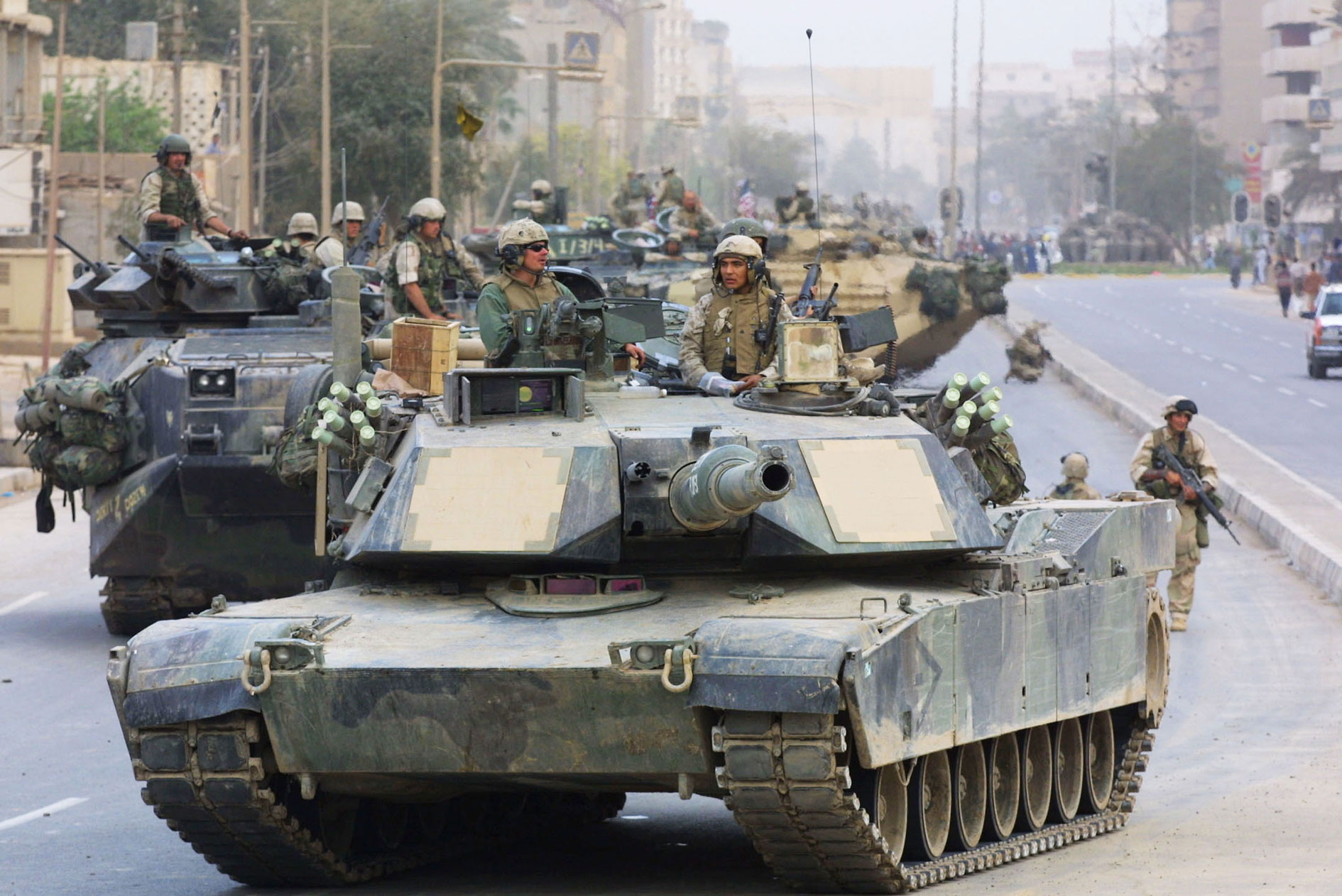
U.S. Marines patrol Baghdad on April 10, 2003, in Baghdad, Iraq. (Sean Smith/Getty Images)

LONG READ

On the night of Sept. 25, 1991, Chief Inspector David Kay and his deputy, Robert Galluci, had a strange request for a group of Iraqis who were stopping them from leaving a car park. If you’re going to beat anyone up, they asked, will you make sure it’s us?

It was three days into a weeklong standoff involving a team of unarmed inspectors mandated by the U.N. Security Council and their armed Iraqi inspection hosts. The issue at stake was that the international inspectors had just found a tranche of documents proving the existence of Iraq’s illegal nuclear weapons program. The Iraqis couldn’t let them leave with this evidence, but the inspectors refused to leave without it.

During the daylight hours, the Iraqi regime engineered irate protests at the site. Television cameras captured events and broadcast footage around the world, and the inspectors reasoned that the media coverage provided their teams with some protection; surely the Iraqi inspection hosts would not be reckless enough to rough up international inspectors on camera.

But the nights were different. Protesters and TV crews were gone for the day, and Kay and Gallucci feared that the Iraqis who were trying to keep them from taking the documents might use force, a concern that grew when they noticed the numbers of Iraqi soldiers ramping up. Knowing that their teams included combat-trained personnel, they worried that some of their crew might retaliate if provoked and that a resulting confrontation could get out of hand. If there was going to be violence, Kay and Gallucci preferred it to be directed against them. At least they knew they would not react and escalate the problem.

In the end, a resolution arrived before it came to this. Miles away in New York, the executive chair of the United Nations Special Commission (UNSCOM), which had been set up to supervise the declaration and destruction of Iraq’s chemical and biological warfare capabilities and long-range missiles, had been carefully keeping the Security Council informed about the situation, and the council issued an ultimatum that insisted Iraq comply with the inspections.

The Iraqi regime had no choice but to reluctantly let the inspectors leave with their findings. According to some accounts, a senior Iraqi official asked whether Kay and Galluci’s offer to be beaten up still stood, as acting on it could help him save some face. Gallucci and Kay declined.

The “car park incident” illustrates the complex dynamics among the weapons inspectors, Iraq and the Security Council during the early-to-mid-1990s, through which, despite many challenges, the inspectors managed to find and oversee the destruction of Iraq’s outlawed weapons by 1997. This history is often overshadowed by the 2003 U.S.-U.K. military invasion that was publicly justified with flawed claims that Iraq had weapons of mass destruction (WMD). But the forgotten history of the international weapons inspections shows that safe and verified disarmament is possible, even in difficult circumstances, and that cooperative approaches offer better options for achieving lasting security than poorly conceived military interventions based on a misuse of national intelligence.

The international inspectors were in Iraq as part of the cease-fire that ended the 1991 Gulf War, mandated by the Security Council in response to Iraq’s invasion of Kuwait. The cease-fire agreement (formalized in Resolution 687, adopted on April 3, 1991) stipulated that Iraq declare and eliminate its WMD and long-range missiles and that it do so under international supervision. To ensure this could happen, Iraq agreed to allow inspections “anytime anywhere” and to permit the establishment of a monitoring system that would verify that the country had never resumed outlawed weapons programs.

The Security Council appointed two international inspection bodies to oversee these processes: UNSCOM and the International Atomic Energy Agency (IAEA), the Vienna-based international organization responsible for monitoring compliance with the nuclear Non-Proliferation Treaty (NPT), which was given the task of finding and supervising the elimination of Iraq’s nuclear weapons and which established an action team to do this. UNSCOM was the senior partner, as only it could authorize inspections at undeclared sites. While separate, the groups often coordinated their work.

Before the 1991 intervention, there was little firm knowledge about the extent of Iraq’s WMD ambitions. While Iraq’s history of chemical weapons attacks against Iran and its own Kurdish population throughout the 1980s clearly demonstrated that it had chemical weapons and was prepared to break international norms to use them, the international community did not know the full details of the country’s capabilities or whether it had biological or nuclear weapons as well. In fact, while there were suspicions of the latter, the IAEA, during its ongoing work within the tight confines of the NPT monitoring provisions, had not detected any problems before the 1991 war. In fact, the IAEA had affirmed that Iraq’s declared nuclear materials had not been diverted to non-peaceful purposes — widely taken as giving Iraq the all-clear that it did not have a military nuclear program.

The 1991 cease-fire seemingly offered the international community a means to clarify the extent of Iraq’s WMD, and to safely and securely get rid of them. Iraq had clearly promised to declare and destroy its WMD and associated programs and to let the weapons inspectors see anything they needed in order to confirm that the job had been done. Given that Iraq agreed to cooperate — albeit under duress — the expectation was that the whole process would be over quickly.

However, it was immediately clear that this was not going to happen. Iraq lied in its very first declaration, setting an ongoing pattern in motion in which Iraq would initially submit inaccurate and incomplete declarations that it judged to be consistent with what the international community already knew, then grudgingly change the story only when confronted with contradictory evidence. And the country consistently impeded the inspectors, despite the “anytime, anywhere” commitment in the cease-fire.

This typified an awkward three-way wrangling. The Iraqi regime worked to thwart the international inspections while noisily claiming that the international community was violating its sovereign rights, all the while trying to divide the Security Council’s commitment to uphold the terms of the cease-fire. On the ground, the inspectors doggedly persisted but had few options to persuade the Iraqis to comply, beyond their own skills, creativity and opportunistic cunning. (One time, for instance, an inspector fell ill, or perhaps feigned illness, and was sent home with key documents stuffed up his shirt.) Their main support was in New York, from where UNSCOM Executive Chair Rolf Ekéus followed the teams’ work, judging when and how to present their case to the Security Council.

Despite the difficulties on the ground, the international inspectors succeeded beyond anyone’s expectations, with the IAEA Action Team inspectors finding proof of an illicit nuclear weapons program within the first few months of inspections and UNSCOM uncovering evidence of Iraq’s well-hidden and extensive biological weapons program a few years later. By 1997 (some say 1995), the inspectors were confident that they had built up a coherent picture of Iraq’s illegal weapons, that these weapons had been destroyed and that the key weapons infrastructure had been eliminated.

But if the weapons were destroyed, how did the United States and United Kingdom build their case to invade Iraq? Given the inspectors’ achievements, it is perplexing that Washington and London were able to claim that Iraq still had illegal weapons of mass destruction, in the public justifications for their 2003 military invasion. Problems started in the late 1990s. Iraq denied entry to the inspectors in 1998 and did not allow them back into the country until 2002, meaning that they were unable to carry out the ongoing monitoring mandated by the 1991 cease-fire. While the inspectors continued their work remotely, without on-the-ground access, they could not be sure that Iraq hadn’t resumed its WMD programs. Iraq’s behavior reinforced the concerns; the Iraqis who were involved with the processes had repeatedly lied in declarations and obstructed inspections from 1991 onward, which led many to believe that they had something to hide. This mistrust continued beyond the 1997 milestone achievements. At the same time, the collective resolve of the Security Council also started to unravel. While the U.S. and U.K. wanted inspections to continue, Russia and France wanted them to end so sanctions could stop and they could resume trade with Iraq.

This combination — the absence of information from on-site inspections, coupled with suspicions of illicit behavior and the collapse of Security Council unity — created an opportunity for incorrect reports to flourish. In making their case for the 2003 invasion, the U.S. and U.K. cited intelligence that was derived from uncorroborated closed sources — some seemingly based on single human testimony. Some former weapons inspectors think that just a very few people from U.S. intelligence agencies were inclined to believe the lies from a very few defectors and misrepresent more accurate accounts, and that these people were given disproportionate credence by decision makers. George W. Bush and Tony Blair convinced themselves of the need for war for various reasons and were able to cherry-pick the intelligence that suited their purpose.

The international inspection processes did not support their views. On March 7, 2003, the IAEA Director General reported to the Security Council that there was no “evidence or plausible indication of the revival of a nuclear weapons program in Iraq.” The inspectors called out at least two of the detailed claims.

The first concerned documents that suggested that Iraq had imported uranium oxide from Niger from 1999 to 2001, which, according to U.S. and U.K. officials, showed that Iraq had resumed its nuclear weapons program. The nuclear weapons inspectors conclusively showed that the documents had been forged.

The second claim focused on CIA assessments that aluminum tubes found in Iraq were equipment for technology to enrich uranium for a resumed nuclear weapons program, which nuclear weapons inspectors refuted by showing that the aluminum tubes were for permitted small military rockets. But by this stage, the inspectors’ findings did not garner enough visibility to make a difference.

History ultimately proved the international inspections right, while the cited intelligence was wrong. Why the difference? Unlike the misuse of distorted intelligence based on uncorroborated single sources, the international inspections relied on multifaceted data collection and analysis. Prevented from the comparatively straightforward sequential tasks of verifying Iraqi WMD declarations and elimination anticipated by the cease-fire, they devised multiple approaches to find overlapping indicators of illicit weapons programs instead. By collecting and comparing diverse data points, they slowly built up an understanding about Iraq’s ambitions, activities and resources, useful in itself, and in allowing the inspectors to spot gaps and errors in Iraq’s declarations, which in turn signaled other areas to investigate.

The inspection leads provided an invaluable foundation. For example, UNSCOM inspectors frequently acknowledge Rolf Ekéus’s contribution, first in recruiting and managing their diverse teams and in giving them the space and support they needed to solve the problems they faced. They also note the nuance and skills he used in managing the Security Council.

Given the differences in findings between the flawed intelligence and the inspections, it is curious that the inspection teams’ multiple data sources included nationally provided information, including intelligence from France, Russia, the U.K., the U.S. and other countries. Moreover, alongside scientific, industry and diplomatic experts, some inspection teams included members that had experience of working within their national intelligence communities. All inspection teams were hybrid, in that they included combinations of permanent paid staff and external experts temporarily assigned by their national governments because of their particular expertise. The exact composition of different inspections depended on their focus: while paid IAEA staff and civilian experts were invaluable in resolving the inventories of nuclear materials found in Iraq, nearly all the specialist nuclear weapons inspectors had experience in working on confidential weapons technologies, which involved access to highly classified intelligence.

However, the international inspector bodies were circumspect in their use of national intelligence. Carefully vetting all incoming sources, they found that while some intelligence was invaluable, a lot was unreliable. Intelligence tips were particularly useful in the early stages of the work, helping both UNSCOM and the IAEA Action Team to identify which sites to inspect and what to look for. For example, the location of the inspection that led to the September 1991 car park incident was based on information derived from U.S. intelligence.

Over time, as the inspection teams built their own expertise on Iraq, these pointers became less useful. Hans Blix, who led both the IAEA (1981 to 1997) and UNSCOM’s successor organization, the United Nations Monitoring, Verification and Inspection Commission (UNMOVIC) (2000-2003), assesses that, after 1998, national intelligence was the least useful component of the international inspections’ data sources. He reasoned that most of it was based on information from defectors, who had limited knowledge of Iraq’s current weapons program and had a vested interest in saying what they thought intelligence agencies wanted to hear. In many ways, processing intelligence at this time often proved a waste of the inspectors’ time.

While the inspections drew on national intelligence at different times, there are clear concerns about such arrangements. For example, national intelligence may attempt to influence international efforts by supplying inspectors with dubious information or attempt to use them as a cover for espionage. In fact, UNSCOM demonstrated this problem when it became embroiled in much-publicized allegations of spying, which the Iraqi government played up, and was forced to cease operations. Unable to resolve the controversy, UNSCOM was replaced by UNMOVIC in 1999.

There are fundamental tensions that need to be resolved when designing and implementing international anti-WMD endeavors. It is perhaps inevitable that effective anti-WMD-proliferation efforts involve some people with experience of working within national intelligence communities — after all, the necessary portfolio of skills and knowledge needed to find illicit WMD is not widespread and tends to reside in people who have security clearances. But including such people doesn’t automatically lead to good outcomes. It may lead to questions about who they are working with and how they are using the inspection results, and, whatever the answers, these questions may be used to undermine the overall credibility of the undertaking. Further, access to intelligence doesn’t guarantee that it will be good intelligence or that it will be carefully used.

The history of the Iraq inspections from 1991 to 1997 demonstrates a sweet spot in cooperation. National and international understanding of Iraq’s WMD benefited from on-the-ground information contained in the official inspection reports prepared for the Security Council. Meanwhile, carefully managed access to and use of nationally provided information, including some national intelligence, facilitated the effectiveness and accuracy of the international inspections. In finding and getting rid of Iraq’s WMD, the international inspections were able to fulfill their objectives as well as enhance regional and international security.

The international inspectors’ successes are now widely forgotten. Their achievements were neither inevitable nor easily won — they relied on hard work by talented and committed individuals who put themselves in danger to do their jobs. Through all the very real challenges, as well as eliminating Iraq’s illicit weapons, they also built connections and respect for the Iraqis they met through their work, recognizing the difficulties these people faced and their personal integrity. After 2003, former weapons inspectors supported their Iraqi counterparts, including in at least one instance by providing them with a reference that helped them get a job.

On top of this, the inspections leave a lasting legacy in the form of a small but invaluable pool of experience, expertise and experts to draw on in global efforts against WMD. The need is great: The world now faces increasingly intractable threats of WMD proliferation and use in Iran, North Korea and Syria and in the fact that all the world’s nuclear weapons possessor states are modernizing their arsenals. At the same time, the U.S. and Russia are downgrading the Cold War systems of mutual restraint, seen in their withdrawals from painstakingly negotiated arms control and disarmament treaties as well as in Vladimir Putin’s threats to use nuclear weapons in Russia’s war against Ukraine.

Understanding and acting to prevent the spread and use of WMD requires people who can track and uncover potential proliferation pathways. This means people who know what to look for and how to look for it in order to get to the truth about obscure and complex secrets, who are prepared to work in difficult circumstances and who won’t exacerbate security risks by revealing sensitive information to the wrong people, including would-be proliferators. The Iraq weapons inspections trained a generation of inspectors who devised and operationalized innovative monitoring techniques. Some of the inspectors continued to play a role in efforts preventing WMD and holding to account the people who have been prepared to acquire and use them.

Among other examples, former Iraq inspectors have been involved in understanding and monitoring developments in Iran’s nuclear weapons program. And UNSCOM experiences have informed international investigations into the use of chemical weapons in Syria, contributing to building the knowledge that enabled the findings of the Organisation for the Prohibition of Chemical Weapons (OPCW) that “there are reasonable grounds to believe that the Syrian Arab Air Forces were the perpetrators of the chemical weapons attack on 7 April 2018 in Douma, Syrian Arab Republic.”

These achievements are often eclipsed by the long shadow of the 2003 invasion and its disastrous consequences for the whole of Iraq, especially the Iraqi civilians killed and harmed in the conflict, as well as the loss of essential infrastructure and resources, and the ongoing insecurity of the country and its region. But we would do well to remember the lessons of the international weapons inspections about the possibilities and practicalities of cooperative approaches to security that combine multiple paths and span national boundaries. Finding and eliminating Iraq’s WMD was difficult but possible. When they were allowed to get on with their work, the international weapons inspectors corrected damaging misinformation and uncovered and supervised the destruction of Iraq’s illicit weapons.

This essay is one of a series marking the 20th anniversary of the invasion of Iraq. Read Rasha Al Aqeedi on her vivid memories of the invasion 20 years later as an Iraqi, Ambassador Robert Ford reflecting on his experiences as a former U.S. official in Iraq during the occupation, and Muhammad Idrees Ahmad on the “lesson of Iraq” and retreat to fatalism.

‘Pantry porn’ on TikTok and Instagram makes obsessively organized kitchens a new status symbol


THE CONVERSATION
Author Jenna Drenten 
Associate Professor of Marketing, 
Loyola University Chicago
Published: March 14, 2023

Neatly aligned glass spice jars tagged with printed white labels. Wicker baskets filled with packages of pasta, crackers and snacks. Rows of flavored seltzer water stacked in double-decker plastic bins.

In today’s consumer culture, “a place for everything and everything in its place” isn’t just a mantra; it’s big business. Nowhere is this more evident than the kitchen pantry.

Most people can relate to finding half-empty cereal boxes squirreled away in the cupboard or letting produce sit just a bit too long in a refrigerator drawer.

But for a subset of social media denizens, such sacrileges would never grace their feeds.

Get news that’s free, independent and based on evidence.Sign up for newsletter

As someone who studies digital consumer culture, I’ve noticed an uptick in glamorized, stylized and fully stocked pantries on TikTok and Instagram, giving rise to a content genre I dub “pantry porn.”

How did the perfectly organized pantry become so ubiquitous in the digital age? And what does it say about the expectations of being a good homemaker?
When pantries became pretty

The pantry – derived from the Latin word for bread, “panis” – was originally a hidden space for storing food. It was purely functional, not a place to show off to others. In the late 1800s, the butler’s pantry emerged as an architectural trend among high society. This small space, tucked between the kitchen and dining room, was a marker of status – an area to hide both the food and the people who prepared it.

Throughout the next century, pantries started being built in middle-class homes. As open floor plans became popular in the 1950s, kitchens emerged into plain view. This design shift paved the way for many modern American pantries to feature sweeping floor-to-ceiling, wall-to-wall cabinetry and walk-in storage spaces.

Bigger homes meant more space to store food.
GraphicaArtis/Hulton Archive via Getty Images.

Today, over 85% of new homes built in America that are over 3,500 square feet feature a walk-in pantry, reportedly the most desirable kitchen feature for new homebuyers, according to a 2019 report.

Celebrities can be credited – at least, in part – for making the pantry a modern-day status symbol. The Kardashian-Jenner family has long been an exemplar for #pantrygoals, and former “Real Housewives” star Yolanda Hadid has social media fan pages dedicated to her fridge.

In the digital age, social media influencers have stepped in as trickle-down tastemakers who translate symbols of celebrity culture into accessible markers of status for the rest of us.

Meticulously arranged pantries appeal to middle-class sensibilities: Maybe you can’t have a designer kitchen, but you can beautify your bulk food storage.


Move over food porn – make way for pantry porn


Throughout the 2010s, food porn dominated social media. The so-called “camera eats first” phenomenon introduced user-generated images of cooking, eating and staging food.

Consumers’ controversial obsession with food photography resulted in some restaurants banning smartphone photography while other businesses created veritable wonderlands for food-inspired selfies such as the Museum of Ice Cream and The Egg House.

New technology did not invent food porn, but it did catalyze it in new ways. Consumers armed with camera phones could suddenly fetishize meals for the voyeuristic pleasure of their friends and followers. This dynamic of watching and being watched is a hallmark of modern digital consumer culture where nonsexual things are linguistically tethered to porn: food porn, travel porn, book porn, real estate porn. Coupling social media content with the “porn” descriptor acts as shorthand for desirability, gratification and gawking.

Pantry porn is a mashup of infotainment, how-to, lifestyle content and ASMR, a form of sound-driven content intended to relax viewers.

Influencers film themselves shopping for supplies, prepping food, refilling containers, and organizing their pantries – often coupled with hashtags like #pantryrestock, #pantryASMR, and #pantrygoals. They transfer dry goods from the store-bought bags into matching glassware; they stock the home coffee bar with coffee pods and flavored syrups; they refill stackable bins with single-serving snacks; they create multiple types of ice cubes – each with its own dedicated freezer section. Much of this pantry porn is performed against a backdrop of rhythmic ASMR-inspired clinks, glugs, snaps, rips and thunks that appeal to viewers’ pleasure centers.

Screenshots of snack drawer restock videos on TikTok. TikTok

Like its food porn predecessor, pantry porn thrives on stylizing everyday life in exaggerated ways. But where food porn elicits a desire for gluttonous indulgence, pantry porn taps into a different cultural desire: the orderly arrangement of abundance.
Excess is bad, but organized excess is good

The past decade has ushered in a home organizing revolution.

An entire cottage industry of blogs, books and television shows have introduced people to terms like “decluttering,” “minimalism” and “simple living.”

Minimalism once represented a countercultural lifestyle rooted in anti-consumption: Use less, buy less, have less.

But if pantry porn is any indication, the new minimalism means more is more, as long as the more is not messy. Consumers don’t need less, they need more: more containers, more labels, more storage space.

Storing spices in coordinated glass jars and color coordinating dozens of sprinkles containers may seem trivial. But tidiness is tangled up with status, and messiness is loaded with assumptions about personal responsibility and respectability.

Cleanliness has historically been used as a cultural gatekeeping mechanism to reinforce status distinctions based on a vague understanding of “niceness”: nice people, with nice yards, in nice houses, make for nice neighborhoods.

What lies beneath the surface of this anti-messiness, pro-niceness stance is a history of classist, racist and sexist social structures. In my research, influencers who produce pantry porn are predominantly white women who demonstrate what it looks like to maintain a “nice” home by creating a new status symbol: the perfectly organized, fully stocked pantry.

Perhaps it’s not surprising that pantry porn found its foothold during the COVID-19 pandemic, when shortages in the supply chain surged. Keeping stuff on hand became a symbol of resilience for those with the money and space to do so. This allure of strategic stockpiling is evident in other collector subcultures like doomsday preppers and extreme couponers.


The pressure of the perfect kitchen

The work required to restock, refill, and reset the kitchen is a central element in producing everyday pantry porn.

In my research, I’ve found that this work often falls to women in the household. One TikTok mom goes on a “snack strike,” stating she will not restock the pantry until her children and husband eat what they already have.

Magazines like Good Housekeeping were once the brokers of idealized domestic work. Now online pantry porn sets the aspirational standard for becoming an ideal mom, ideal wife and ideal woman. This grew out of a shift toward an intensive mothering ideology that equates being a good mom with time-intensive, labor-intensive, financially expensive care work.

Sure, all of those baskets and bins serve a functional purpose in the home: seeing what you need, when you need it. But the social pressure to curate a perfect pantry might make some women work overtime. They can’t just shove store-bought boxes of snacks into a cupboard; they must neatly place the grab-and-go snacks into a fully stocked pantry that rivals a boutique corner store.

Pantry porn, as a status symbol, relies on the promise of making daily domestic work easier. But if women are largely responsible for the work required to maintain the perfectly organized pantry, it’s critical to ask: easier for whom?

 Florida bill would ban young girls from discussing periods in school

As Florida Republicans are introducing and advancing a wave of bills on gender and diversity that are likely to be signed into law by Republican Governor Ron DeSantis, one GOP lawmaker acknowledged this week that his proposed sexual health bill would ban girls from talking about their menstrual cycles in school.

During a Florida House Education Quality Subcommittee hearing Wednesday, state Representative Ashley Gantt (Democrat) questioned her Republican colleague, state Representative Stan McClain, on his proposed legislation that would restrict certain educational materials used in state schools, which Democrats and critics have likened to banning books.

House Bill 1069 would also require that instruction on sexual health, such as health education, sexually transmitted diseases and human sexuality, "only occur in grades 6 through 12," which prompted Gantt to ask whether the proposed legislation would prohibit young girls from talking about their periods in school when they first start having them.

"So if little girls experience their menstrual cycle in fifth grade or fourth grade, will that prohibit conversations from them since they are in the grade lower than sixth grade?" Gantt asked.

READ MORE:
Florida makes transgender girls playing on school teams against the law
In Florida, showing mental health struggles could get a child detained
Her baby has a deadly diagnosis - her Florida doctors refused an abortion

McClain responded, "It would."

The GOP lawmaker representing Ocala, Florida, later clarified that it "would not be the intent" of the bill to punish girls if they came to teachers with questions or concerns about their menstrual cycle, adding that he'd be "amenable" to amendments if they were to come up.

The bill ended up passing, 13-5, on Wednesday in a party-line vote, as GOP legislators make up a supermajority in the chamber.

McClain did not immediately respond to a request for comment early Friday. Gantt decried the bill to The Washington Post as "egregious."

"I thought it was pretty remarkable that the beginning of a little girl's menstrual cycle was not contemplated as they drafted this bill," she said on Friday.

Gantt was echoed by advocates such as Annie Filkowski, the policy and political director of the Florida Alliance of Planned Parenthood Affiliates, who told The Post that "young Floridians will suffer if this legislation becomes law."

"This bill shines a bright light on Florida's political leaders' perpetual thirst for power and control," Filkowski said in a statement, adding that it was "ridiculous" to prohibit young girls from discussing menstruation with their teachers.

McClain's proposed legislation is among a spate of new Republican-sponsored bills that could reshape K-12 and higher education in Florida.

Bills filed by GOP state representatives and senators in recent weeks range from requiring teachers to use pronouns matching children's sex as assigned at birth to establishing a universal school-choice voucher programme.

Other proposed legislation would eliminate college majors in gender studies, cut diversity efforts at universities and job protections for tenured faculty, strengthen parents' ability to veto K-12 class materials and extend a ban on teaching about gender and sexuality - from third grade up to eighth grade.

Democrats, free-speech advocates and LGBTQ groups say the Republican bills would restrict educators' ability to instruct children honestly.

Even with the blowback, Florida Republicans advanced two bills that would ban gender-affirming care for minors and eliminate diversity programmes in colleges.

Another proposal was advanced Tuesday that would ban classroom lessons on gender identity and sexual orientation through the eighth grade. The expansion of the controversial bill, which critics have labelled "Don't Say Gay," has vocal support from DeSantis, a potential Republican presidential candidate in 2024.

Menarche, when girls first start to menstruate, typically occurs between the ages of 10 and 16, according to the National Library of Medicine at the National Institutes of Health. Doctors, parents and studies from around the world have reported a surge in early puberty cases for girls during the pandemic, with some girls getting their periods as young as 8.

Restricting girls from talking about their periods in school is not the only item in McClain's bill, which was introduced last month. The bill calls for schools to teach how "sex is determined by biology and reproductive function at birth" and "these reproductive roles are binary, stable, and unchangeable."

Part of the proposed legislation would require that the Florida Education Department approve all education materials used in sexual health. It would also give parents the right to limit the kinds of library books their children can check out.

On Wednesday, Gantt denounced McClain's bill, and the limits around what educational materials can be accessed by children, as a form of "book banning" that would weaken students' education, according to the News Service of Florida.

"I hope that we all understand that we are taking away the ability for our children to be critical thinkers, by telling them we want to protect their innocence," Gantt, who represents Miami, said during the hearing. "They're going to be adults one day, and they need to be informed adults."

McClain refuted the claims against and criticism of the bill, arguing that "a lot of the things that were brought forward were misinformation."

"This idea that book banning is taking place, and all of that, is a myth and is not true," McClain said. "Members, what we're trying to do is ensure that our parents continue to have the opportunity to know what materials are being used to instruct [their children] and to have the ability to challenge that."

The bill next heads to the floor of the state House. If it passes the Republican-controlled chamber, it still needs to pass through the state Senate before it is likely signed into law by DeSantis.

Whether any amendments will be made to the bill to allow young girls to talk about their periods in school remains unclear, Gantt told The Post. She again criticised the bill for not preparing children to eventually become informed adults.

"We don't get do-overs with children, we don't get that opportunity again," she said. "So why are we implementing or proposing policies from stopping little girls from understanding their body?"

Hannah Natanson, Lori Rozsa and Susan Svrluga contributed to this report.