Thursday, March 30, 2023

Globally, a Waning Gun Culture: Is It a Lesson for America? 

Mass killings in other corners of the world have led to serious restrictions and fewer incidents
Globally, a Waning Gun Culture: Is It a Lesson for America? 
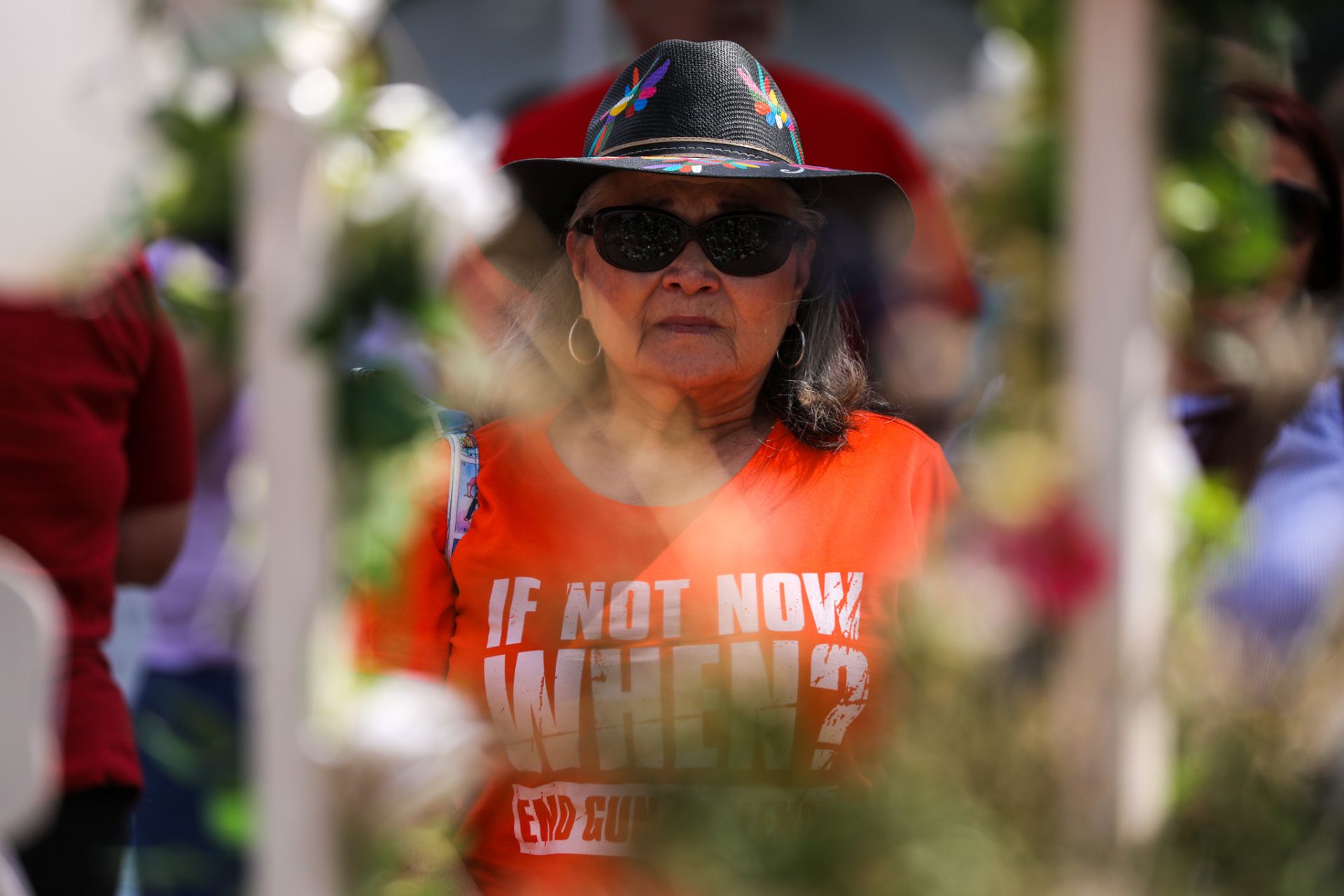
People visit a memorial for the 19 children and two adults killed on May 24th during a mass shooting at Robb Elementary School in Uvalde, Texas / Yasin Ozturk / Anadolu Agency via Getty Images

The sparrow that had alighted on the wall was full of avian vitality. It chirruped as it scanned the sky full of brightly colored kites. Its feathers ruffled in a breeze fragrant with the scent of orange blossom. Springtime in Peshawar is full of exuberance, a welcome respite between harsh winters and infernal summers. The city is alive with birdsong. 

I noticed none of this as I stared at the bird through the sight of my pump-action air rifle. All I could see was an elusive trophy. I was 11. I had been handling guns since I was much younger. Back in my hometown, my not-always-responsible father had let me carry my own, a folding-stock AK-47 assault rifle. At weddings, I would take my turn with Afghan mujahedeen shooting at static targets. It was the late 1980s, and Chitral in northwest Pakistan was home to many Afghans, a staging post for their operations across the border in Kunar. The place was awash in guns, from cheap Chinese knockoffs to finely crafted German assault rifles. I became an enthusiast. I could dismantle my Kalashnikov and put it back together with my eyes closed. 

But unlike my brother, who was a first-rate hunter, I was a failure at the game. I could never hit anything that moved. That is, until the day I saw the sparrow on the wall. I pulled the trigger, and the sparrow toppled over. I had finally scored. But my sense of triumph lasted only the few seconds it took me to reach the bird. The pellet had broken its leg, which was dangling on the side. The bird was in shock, its wings flapping listlessly. I picked it up and felt it struggle in my hand. I had seen plenty of dead game: I had even had “pakoras” (spicy fritters) made of sparrows in Peshawar’s Namak Mandi bazaar. I probably wouldn’t have given a dead bird a second thought. But this one was suspended between life and death, and each quiver of its body made me more conscious of the life that was ebbing away.

I had never felt so small. I bandaged the bird’s leg with a strip of Scotch tape and tossed it into the air. It flew away, heavy and languid. That was the last time I fired a gun. It was the end of my fascination. 

In the 1980s, Pakistan’s northwest had been transformed by the war next door in Afghanistan. Unlike the rest of Pakistan, with its feudal hierarchies, the northwest is egalitarian and unruly. People prize their autonomy, and every home has a gun. But before the Afghan war, the gun served mostly a symbolic function: more a defensive necessity than an actual instrument of violence. All we had at our home was a .303-caliber, Lee Enfield rifle and my grandfather’s sword. 

But things changed in the 1980s. As guns became freely available, their display became as important as their possession. Public events turned into veritable gun shows. Celebratory gunfire at weddings or childbirth was always a tradition. But it now became a competition — for the loudest, biggest, fastest gun. Even the shooting became more ostentatious. At one wedding, a man accidentally killed both bride and groom when the muzzles of the two AK-47s he had raised on each shoulder dropped on recoil and sprayed the stage with bullets. Deaths from stray bullets became common. My sister was hit by a falling bullet as she sat on her college lawn. A bullet from a neighborhood wedding hit the wall just above our heads one evening as we sat on a friend’s terrace. At one wedding I attended, the gunfire cut the electricity lines. 

We didn’t have mass shootings, but the gun culture was a menace. Every sporting victory, every childbirth, every wedding celebration could mean grief to someone else. This culture persisted into the decades after the end of the anti-Soviet jihad. Outside of the tribal areas, where the law offered you little protection and weapons were a necessity, guns were a symbol of status and power. They were to a man what jewelry is to a woman. Ironically, they became less visible when a real threat emerged in the mid-2000s with the rise of the Pakistani Taliban. In the mortal combat between the Pakistani Army and this ruthless new force, there was no room for a third party with guns. But as this threat subsided, men have returned with their lethal jewelry. On New Year’s Eve in Karachi, an 11-year-old was killed and 17 injured in celebratory gunfire. 

I’ve been away from the country for two decades. On my first Guy Fawkes Night in Glasgow, in 2004, when fireworks lit the sky, I did not have to hurry indoors as I would have in Pakistan at the sound of explosions. This event was joyous, it didn’t externalize the cost of celebration to others. But — to paraphrase Joseph Conrad — this, too, had been a place of darkness. For the past eight years, on the drive to work, I’d exit the M9 highway toward Stirling University at the roundabout near Dunblane. It is impossible to look at this picturesque Scottish idyll and connect it with one of Britain’s most traumatic events. 

On the morning of March 13, 1996, a 43-year-old gunman had entered the Dunblane Primary School and killed 16 children and a teacher, injuring 15 others. The man was carrying four handguns — two Browning Hi-Power pistols and two Smith & Wesson Model 19 revolvers — all purchased legally. The massacre horrified the country and united both major parties. Following an official inquiry, the Conservative government of Prime Minister John Major introduced the Firearms (Amendment) Act 1997, which banned virtually all citizens from owning guns; a year later, Tony Blair’s Labour government expanded the ban to also include.22-caliber, single-shot weapons. There have been no school shootings in the U.K. since, and Dunblane today is better known as Andy Murray’s hometown. (The two-time Wimbledon champion was an 8-year-old pupil at the Dunblane Primary School at the time of the massacre.)

Six weeks after Dunblane, Australia, too, was struck by tragedy when a 28-year-old went on a rampage in Port Arthur, killing 35 and injuring 23. Two children, aged 3 and 6, were killed along with their mother, execution style. The defense psychologist claimed that the shooter had been inspired by the notoriety of the Dunblane killer. The Australian government, however, needed no foreign inspiration. Prime Minister John Howard’s Conservative government was even quicker than Britain’s in introducing highly restrictive gun laws, passing the National Firearms Agreement within 12 days of the massacre, buying back 650,000 guns within a year. Howard defied his own base and Australia’s gun lobby, which was being secretly supported by the National Rifle Association (NRA) and the Christian Coalition to mobilize Australians against the restrictions. The measures proved effective enough that in the years since, there have been no mass shootings (some have tried to define incidents of family homicide as a “mass shooting” to downplay Australia’s success). The numbers of suicides and homicides also dropped. There were 521 deaths from firearms in 1996; by 2019, the number had fallen to 219. 

So successful was this policy that two decades later, when an Australian terrorist resolved to kill a large number of Muslims, he had to move to New Zealand to enact his plot. On March 15, 2019, the 28-year-old shooter shot and killed 51 worshippers and injured 40 at two mosques in Christchurch. The six guns he used were all legally purchased. A week later, Prime Minister Jacinda Ardern announced a ban on semi-automatic weapons, and, on April 10, the Arms (Prohibited Firearms, Magazines, and Parts) Amendment Act 2019 was passed by the New Zealand Parliament with support from all parties except one. 

A year later, in April 2020, a 51-year-old Canadian dressed as a police officer went on a killing spree through rural Nova Scotia, killing 22 before being killed himself by the police. Three of the four guns he used had been smuggled from the U.S. But within two weeks, Prime Minister Justin Trudeau had announced a ban on assault weapons.

From Britain to Australia, New Zealand and Canada, mass atrocities have been followed by public outrage and political action. The responses were rational, necessary, inexorable. The link between a public issue and political action seemed obvious. But even as the U.S. mourns the victims in the most recent of its painfully frequent mass atrocities, the grief feels enervated by the certainty of inaction. Even the angriest seem resigned to the fact that a country that could live with the killing of 10 people at a supermarket in Buffalo, New York, 10 days earlier can also live with the murder of 19 children and two teachers at a primary school in Uvalde, Texas. Republicans — the main obstacle to political action on guns — require the bereaved to be content with “thoughts and prayers.” Those who fail are accused of making the tragedy “political.” 

“Now is not the time for politics,” they say. But given the frequency of mass shootings in America, where every “now” is preceded by tragedy, this precludes any political action lest it profane the moments whose solemnity the Republicans are eager to preserve. The debate has a theological quality, and its presiding deity is Moloch, the malign God from the Old Testament to whom children were sacrificed in fire. The analogy was used to describe America’s consecrated gun by historian and classicist Garry Wills in the aftermath of the Sandy Hook massacre. Wills was perhaps resorting to an emotive reference because with all his careful reasoning and prodigious knowledge, he had failed to penetrate the wall of unreason that surrounds the gun debate. 

In a September 1995 essay for the New York Review of Books, Wills had eviscerated the emerging body of scholarship from a group of lawyers, historians and criminologists interpreting the Second Amendment as guaranteeing the right to private ownership of guns. Wills had used etymology, historical context and legal exegesis to show that the amendment guaranteed people’s right to “keep and bear arms” only in a military context, as part of a “well-regulated militia.” But when the Supreme Court dealt a blow to gun reform in District of Columbia v. Heller (2008), for the first time interpreting the Second Amendment as protecting individuals’ rights to possess firearms, the conservative justices drew on the same revisionist scholarship that Wills had criticized. 

This has added to the already considerable obstacles to sensible action on guns. A year earlier, the Clinton administration had introduced a 10-year assault weapon ban, which coincided with a fall in murder rates and, according to a 2019 New York University School of Medicine study, saw a 70% decline in mass shootings. But in 2004, the Bush administration allowed the ban to lapse, and the number of mass shootings tripled in the following decade. Things got even worse. According to data collected by the Gun Violence Archive, 2,858 children were affected by gun violence in 2014; the number had risen to 5,692 by 2021. According to the FBI, there were three active shooter incidents in 2000; by 2020 there were 40. (“Active shooter” incidents are only a small fraction of America’s overall firearm deaths, which last year totaled 20,920.)

America today has more guns than there are people, and over half of the guns are owned by just 3% of the population. There is a direct correlation between levels of gun ownership and gun violence, a statistic that holds true within and beyond the U.S. And states with relaxed gun laws have higher incidences of mass shootings, a 2019 BMJ study found. 

It all seems obvious. Why the inaction? 

It is doubtful that the resistance to regulation by a milksop like Ted Cruz or a sybarite like Donald Trump is based on an unusual devotion to firearms. Even the NRA’s millions don’t fully explain the resilience of the GOP’s opposition to sensible gun laws. But gun possession has become a vector in the culture wars, the racialized politics from which the GOP has historically benefited. It is unlikely to cede this advantage. Republicans exploit resentments by railing against the “elite” who are out to rob law-abiding citizens of their means of self-defense, while simultaneously pathologizing the violence, blaming mental illness for it. 

After the Uvalde tragedy, Republican Texas Gov. Greg Abbott claimed the shooter had a “mental health challenge” and suggested that greater investment in mental health could address the crisis. It is possible that he genuinely believes mental illness leads to mass shootings and is committed to addressing this. But as Abbott had to acknowledge, the killer had no history of mental illness or a criminal record. And more broadly, an FBI analysis of 63 active shooter incidents from 2000 to 2013 found that mental illness was diagnosed in only a quarter of the killers; only three were known to have a psychotic disorder. There is reason to doubt Abbott’s commitment to mental health since just last April, he had cut $211 million from the department that oversees the state’s mental health programs. His state ranks last in the U.S. for access to mental health care. 

Stigmatizing mental illness, calls for arming teachers, demands to fortify schools have all been used as deflections by the GOP. Yet, despite having facts on their side, Democrats have made little progress. In contenting themselves with rational arguments, they have allowed the GOP to control the narrative with emotional appeals to their base. For any change to occur, Democrats must get more confrontational and seize the narrative. They’ll have to stop making concessions to the Republican framing about America’s supposedly unique culture and history. But more important, Democrats will have to address their broader weakness and learn to wield power. Because when politics changes, so does culture. 

America’s love of guns is not unique, unlike its gun culture. The pathology is not so much the perpetrator’s mind as a culture that sees the possession of an assault rifle as something so unexceptional that it shouldn’t even require a background check. In most places, including the country where I grew up, the culture changed with changes in politics. One day when America has finally had enough and the government outlaws combat weapons, even the most committed gun owner will adjust to the new reality, as Brits, Aussies, Kiwis and the Canucks did before them. They’ll discover that they are far more secure surrendering the assault weapons they kept for a hypothetical threat than to use them and be confronted with a real one: the might of the world’s most powerful state. 

There is nothing fixed about culture. Cultures evolve; traditions are abandoned. Many once-cherished traditions are abhorrent to us today. It is a measure of our moral evolution. In the end, it is a spell cast over us, through socialization or propaganda, suppressing thoughts, turning actions into reflexes. It can be broken. In Peshawar, I shot a bird thoughtlessly, because it is what boys did. Until then, a gun had felt integral to my identity. But the incident led to an epiphany: A world without the rapport of guns is infinitely more livable than a world without birdsong. Given the link between the easy availability of guns and the proliferation of school shootings, Americans, too, will have to decide what they prize more: the crackle of gunfire or a schoolyard’s rhapsody. 

A Leadership Race Exposes the Myth of Scottish Exceptionalism

Scotland's new first minister, Humza Yousaf, is the country's first Asian leader — but progressives shouldn’t celebrate just yet

A Leadership Race Exposes the Myth of Scottish Exceptionalism
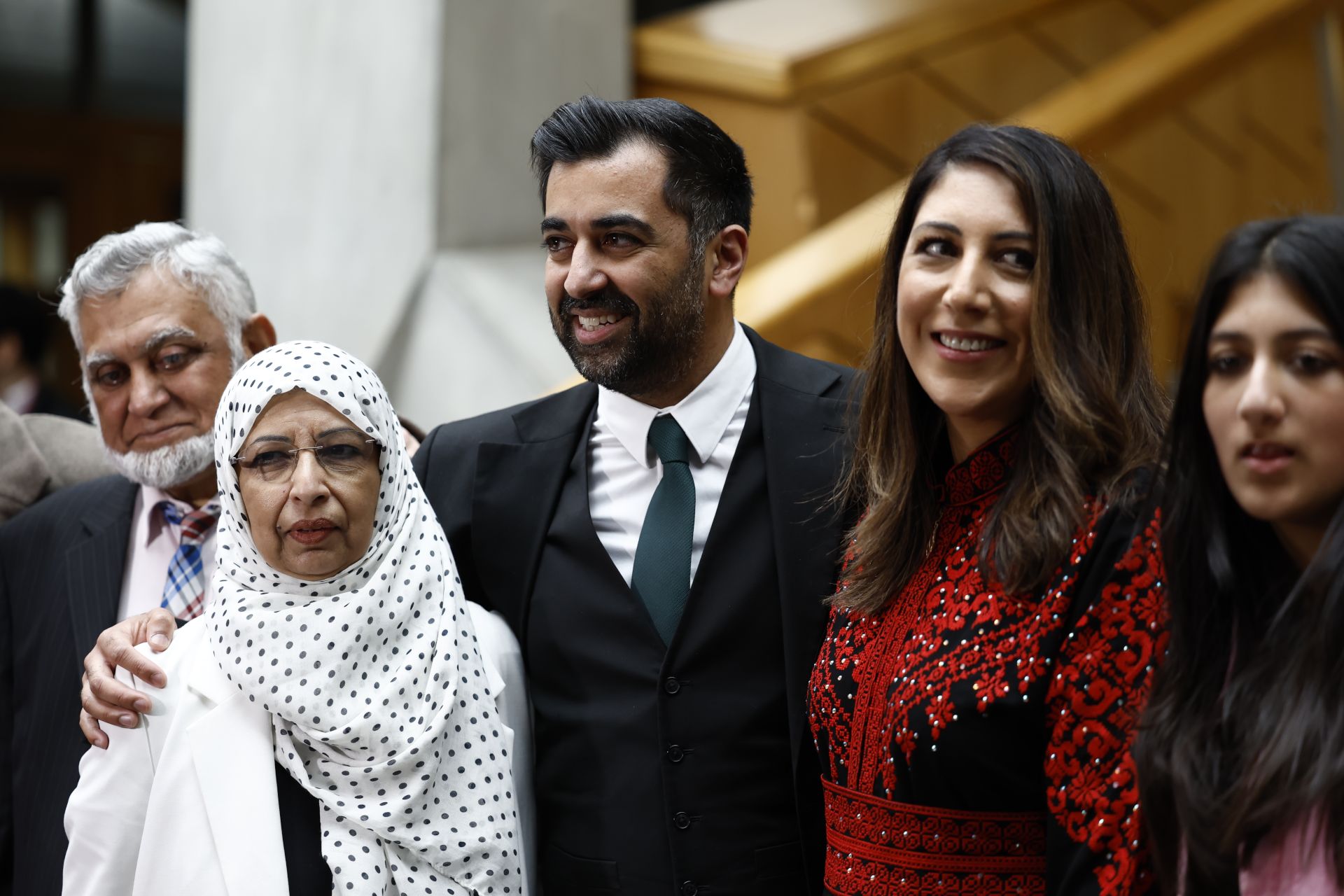
Humza Yousaf, the newly elected leader of the Scottish government, poses with his family at the Scottish Parliament on March 28, 2023, in Edinburgh, Scotland. (Jeff J Mitchell/Getty Images)

“Spotlight” is a newsletter about underreported cultural trends and news from around the world, emailed to subscribers every Monday and Wednesday. Sign up here.

In 2016, when Humza Yousaf took his oath of allegiance in the Scottish Parliament — in both English and Urdu — he paired the kilt with a gold-embroidered sherwani, a traditional South Asian jacket. This was not the first time he had fused the two cultures with which he most identified. Ever since he used the phrase “bhangra and bagpipes” to describe his heritage and the multiculturalism of Scotland in a 2010 blog, the media have often used it to describe the politician. Bhangra is the traditional folk dance of Punjab, a region that spans both India and Pakistan, while the bagpipes are the quintessential musical instrument of Scotland.

This week, South Asians in the U.K. and elsewhere have been celebrating the ascent of Yousaf as Scotland’s first minister — the head of the devolved Scottish government. Sunder Katwala, director of the think tank British Future, called Yousaf “the history maker” on Twitter, urging that his inauguration “be recognized across the partisan divides in Scottish and British politics.”

“The Empire strikes back,” tweeted Jelina Berlow-Rahman, a human rights lawyer in Scotland. It was a historic moment for British politics, she said, given that the British-Indian Rishi Sunak became the British prime minister last year, while Sadiq Khan was reelected as mayor of London in 2021. Others pointed out that King Charles III would be inviting both a Hindu prime minister of the U.K. and a Muslim first minister of Scotland to his coronation in May.

Yousaf’s father was born in Mian Channu, a small town in Pakistan’s Punjab province, while his mother hails from Nairobi, Kenya. Both migrated to Scotland in the 1960s. In a speech given shortly after becoming the leader of the Scottish National Party (SNP), Yousaf recalled his grandparents — Muhammad Yousaf, who worked in the Singer Sewing Machine Factory in the town of Clydebank, and Rehmat Ali Bhutta, who stamped tickets on the Glasgow Corporation Buses. “As immigrants to this country, who knew barely a word of English, they could not have imagined their grandson would one day be on the cusp of being the next first minister of Scotland,” Yousaf said. “They couldn’t have imagined, in their wildest dreams, that two generations later their grandson would one day be Scotland’s first minister.”

The leader of Scottish Labour, Anas Sarwar, is also the child of immigrants. While describing the SNP as “chaotic and divided” in a statement on Twitter, he added that it was important to reflect on the fact that Yousaf will be the first first minister from an “ethnic minority background,” calling it a “significant moment” for Scotland.

The SNP and the British government have been embroiled in a political battle over a second referendum on Scottish independence, which the SNP have promised to deliver as their flagship policy. The fact that Yousaf would now go head-to-head with Sunak in any future negotiations was an irony not lost on observers, given the two men’s family backgrounds.

“A Hindu and a Muslim are discussing the partition of Britain,” tweeted Hari Kunzru, a British-Indian novelist, recalling the 1947 Partition of India and Pakistan at the hands of British colonial administrators. Anand Menon, director of the think tank UK in a Changing Europe, tweeted: “Much excitement in the family whatsapp group this morning at the prospect of an Indian and a Pakistani bringing about the partition of Britain.”

Yet if, at first glance, the result appears to be cause for celebration among Scottish progressives, there is far more cause for concern. The difficulty of the leadership battle and the narrow margins on which it was won have broken the edifice of Scottish exceptionalism — the once-popular notion that Scotland is uniquely progressive, especially compared to its neighbor to the south, and is therefore insulated from the global tilt toward the radical right. Scotland, it turns out, is no less vulnerable to those forces than the rest of the world.

Yousaf beat his primary rival, the former Finance Secretary Kate Forbes, by a mere 1,000 votes. A defeat, yes, but still a pretty strong performance for a candidate who appeared to have suddenly and spectacularly self-immolated at the very beginning of her campaign. Forbes is a member of the evangelical and anti-Catholic Free Church of Scotland, though she herself has disavowed its sectarian outlook. She quickly grabbed headlines with her hard-line socially conservative religious views: She opposes gay marriage; she believes trans women are men; sex outside of marriage is wrong; and LGBTQ+ conversion therapy should be legal if someone consents to it. These views are significantly to the right of mainstream opinion in both Scotland and the rest of the U.K.

An openDemocracy investigation found that Forbes’ first job in the Scottish Parliament had been sponsored by the evangelical lobby group CARE (Christian Action, Research and Education), which openly seeks to replicate the successes of the U.S. anti-abortion movement in the U.K. According to the investigation, “Almost 10% of her meetings as an MSP with registered lobbyists have been with representatives of ultraconservative groups, including CARE, the Evangelical Alliance and the Christian Institute.”

While the SNP has always been a big-tent party, uniting many different political persuasions behind the cause of Scottish independence, in practice it governs from the left-of-center. Yet Forbes’ statements didn’t dent her momentum in the party’s leadership contest nearly as much as had been predicted. Given that Yousaf was backed by most of the party leadership and positioned himself as the continuity candidate to his popular predecessor Nicola Sturgeon — whose surprise resignation in February kicked off the leadership process — the result was shockingly close.

That continuity might have been Yousaf’s problem. “The SNP is at least two parties — the Old SNP, and the New SNP,” a party insider, who wishes to remain anonymous, told New Lines. “The Old SNP is small-c conservative, socially. It’s rural, small town. Sturgeon was mercilessly urban, and she wasn’t afraid to show it.”

It’s no coincidence, then, that Forbes represents the rural Highland constituency of Skye, Lochaber and Badenoch in Parliament. But where the division really came to a head was over transgender rights, an issue on which Scotland looks markedly more like its English neighbor than other Western European countries. The furious culture war over the proposed Gender Recognition Act, which would allow transgender people to change their legal genders on official documents, is a distinctly British phenomenon — Ireland and Spain, for instance, have passed similar legislation without anywhere near the same degree of controversy. Though the Scottish Parliament did eventually pass the legislation last December, the debate split the country and the SNP itself down the middle. “Any time an SNP politician mentions it, we lose votes,” the party insider said. In an unprecedented move, the U.K. government has intervened to block it.

Yet the influence of Yousaf’s personal reputation cannot be discounted either. Reportedly branded a “lightweight” by senior party figures, he emerged as the front-runner largely because no other prominent minister wanted the job. His record in government has been questionable at times, and he is notoriously prone to gaffes.

The immediate practical question facing Yousaf is that of independence, which has undergone a number of setbacks in the past year — the British government has ruled out a second referendum, and an attempt to force the issue in court failed last November. These setbacks, as well as its internal divisions, have left the party’s base demoralized and without an obvious way forward on independence.

“The challenge this new SNP leader faces is trying to reenergize that base,” a senior adviser to the Yes Scotland campaign told New Lines.

“Make no mistake, the new [first minister] has his work cut out for him,” the SNP insider added. “He’s the first leader in the modern era who will have to properly confront the party’s internal dichotomy.”

In the face of these challenges, and the skepticism about Yousaf’s capacity to overcome them, British media outlets have been quick to pronounce the cause of independence “dead.” We’ve been here before, of course. When Sturgeon’s now-disgraced predecessor Alex Salmond resigned in 2014, predictions that the SNP’s demise would follow fast proved to be greatly exaggerated. An old-school political silverback with a brash and overbearing style, Salmond was too often assumed to be keeping the independence movement alive through sheer bluster and force of will. The words “cult of personality” were bandied around by the press to the point of indignity. It all looked more like wishful thinking than sober analysis, and with the same old takes being dusted off for another round, it still does. The reality, obvious not only to Scots but also to almost everyone outside of the English press, is that the “Yes” movement was always bigger than a single person. Movements almost always are. Is it bigger than a single party? Depending on Yousaf’s performance, we’ll see.

But what’s true of the independence movement will be equally true of whatever it was that Forbes was tapping into. Recent years have seen a marked rise in far-right groups like the Scottish Family Party. Scotland may so far have avoided the far-right populist phenomenon that has engulfed much of the rest of Europe, but the surprisingly strong support for Forbes highlights that the potential is there. It would be naive to think that Scotland is somehow immune.

Condemned to Death for Blasphemy in Pakistan, She Lives a Life of Poverty in Exile

The first woman to be sentenced to execution under the country's notorious law, Asia Bibi, gives a rare interview about her new life in Canada

Condemned to Death for Blasphemy in Pakistan, She Lives a Life of Poverty in Exile
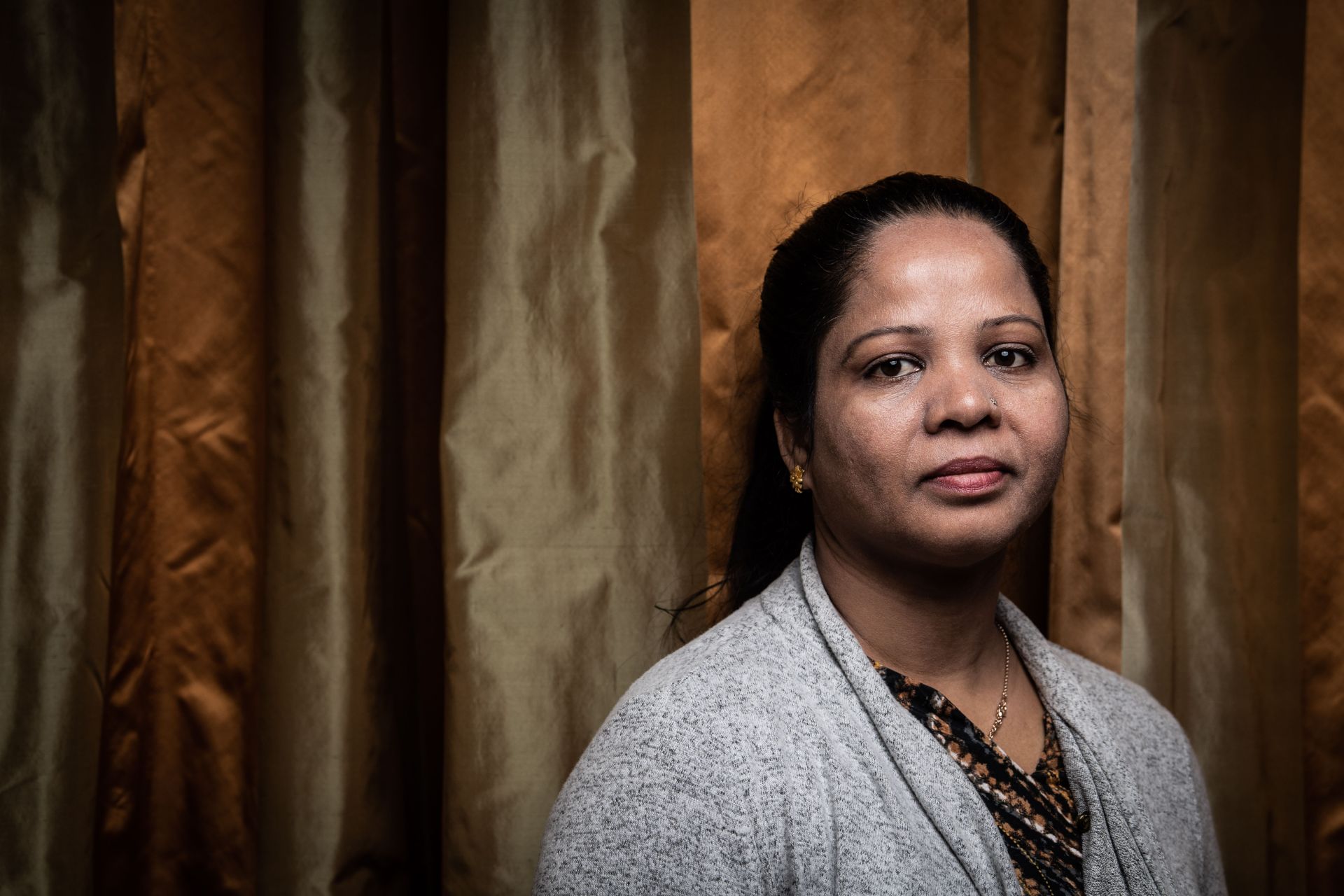
Asia Bibi, a Pakistani Christian woman sentenced to death for blasphemy in 2010, photographed in Paris on Feb. 25, 2020. (Martin Bureau/AFP via Getty Images)

“Spotlight” is a newsletter about underreported cultural trends and news from around the world, emailed to subscribers every Tuesday and Thursday. Sign up here.

After spending more than eight years on death row over false blasphemy allegations in Pakistan, Asia Bibi, a Christian woman, managed to escape to Canada in 2019 following her acquittal by Pakistan’s supreme court. On social media, right-wing propagandists then claimed that a life of luxury awaited her abroad and that she was being backed by “anti-Pakistan” and “anti-Islam” powers. Nothing could be further from the truth. In exile, Bibi has been living a life of poverty, abandoned by both the state of Pakistan that wronged her and the human rights groups that once avidly advocated for her release.

Over the past two years, her health has deteriorated as she suffers from a joint ailment.

“I think I only have a few years left to live,” the 52-year-old Bibi told New Lines in her first public interview since 2020. Like many Pakistani dissidents and victims of extremism who are hounded out of the country, Bibi’s plight continues even in exile. She works a menial job, sometimes for over 14 hours a day, to cover her rent and her family’s expenses. The modest financial support the family initially received from the Canadian government was discontinued a year later. The authorities help refugees only for a year after their arrival, after which they are expected to fend for themselves.

In 2010, Bibi, a farm laborer who hails from a village near the Nankana Sahib district of Pakistan’s Punjab province, became the first woman to be sentenced to death under the country’s controversial blasphemy laws for allegedly insulting the Prophet Muhammad during an argument with Muslim neighbors over sharing a cup of water. She was arrested and imprisoned, then sentenced to be executed by the local court, a judgment that was upheld by the Lahore High Court.

When Salman Taseer, who was then the governor of Punjab province, visited Bibi in prison and vowed to persuade then-President Asif Ali Zardari to issue a presidential pardon for the woman on humanitarian grounds, a hateful campaign against Taseer ensued. He was himself accused of blasphemy by extremist clerics who declared him an apostate for supporting a “blasphemer.” Still, Taseer remained steadfast in his opposition to the blasphemy law. In 2011, one of his own bodyguards, Malik Mumtaz Qadri, shot him 27 times with an AK-47 assault rifle near his home in Islamabad, killing him.

Similarly, Shahbaz Bhatti, who was the federal minister for minorities affairs and belonged to the minority Christian community in Pakistan, had extended support to Bibi and condemned the misuse of blasphemy law. He too was assassinated in 2011, with the Pakistani Taliban claiming responsibility.

Pakistan inherited its blasphemy laws from the British, who codified them in 1860. More than a century later, in the 1980s, as part of his Islamization policy, Pakistan’s military dictator, Gen. Zia-ul-Haq, introduced a number of clauses that made the laws more stringent. Following this, the number of blasphemy-related cases skyrocketed. Between 1987 and 2014, over 1,335 people were accused of blasphemy. Prior to the new clauses, only 14 such cases had been recorded.

After the murders of Taseer and Bhatti, Bibi’s case garnered global attention, highlighting the growing violence toward Pakistan’s religious minorities and those who stand up for them at the hands of uncontrollable mobs of extremists. Her fate, observers said, would in part determine the future of religious minorities in the country.

When Bibi was finally absolved of blasphemy charges in 2018, a wave of violent protests erupted across Pakistan, led by right-wing groups, most prominently the Tehreek-e-Labbaik Pakistan (TLP — “I Am Present Pakistan”). Protesters brought the country to a standstill, setting fire to rickshaws and cars. Traffic blockades due to the riots forced authorities to shut schools in most parts of the country. Shoes were hurled at pictures of the then-chief justice of Pakistan, Saqib Nisar, while extremist clerics leading the protests called for mutiny in the armed forces. Police were given no clear instructions by the government on how to deal with the protesters and seemed unable to handle the mobs.

Two days later, as the unrest expanded across the country, the government — led by the Pakistan Tehreek-e-Insaf (PTI – “Pakistan Movement for Justice”) party — signed an agreement with the TLP by which the government agreed to “initiate a legal process” to place Bibi’s name on the country’s Exit Control List, or ECL, a government-maintained roster of suspected criminals who are barred from leaving the country. It also vowed not to oppose a review petition filed against the supreme court’s verdict acquitting Bibi. The countrywide protests were then brought to an end and the TLP celebrated the agreement as its victory. The official actions were seen by many as an act of capitulation by the government.

Though the government did not put Bibi’s name on the ECL, it kept her in protective custody for six months after her release from prison. Posters calling for her execution continued to be displayed in public places, and the TLP’s social media team ran hateful hashtags against her.

Six months later, she was flown out of the country in secret and reunited with her husband and two daughters in Canada, where the family was granted asylum. International human rights watchdogs, as well as the European Union, were reportedly in touch with the government of Pakistan to ensure Bibi’s safe exit from the country. The government released no information about her departure.

Despite being cleared by the country’s highest court and having spent eight years in prison, Bibi was forced to leave Pakistan in the manner of a criminal.

“When I landed in Canada three years ago, the first thing I thought was that I am here because I was thrown out of the land of my birth,” Bibi tells New Lines, her voice breaking. Her husband is unemployed, as he is on heavy medication and cannot work without falling sick. Her two adolescent daughters are disabled. She also has three other children still in Pakistan. Bibi could not meet with them or her father, who is over 100 years old, before leaving Pakistan. Her mother passed away while Bibi was in prison.

“My biggest sorrow is that I could not get to meet my father before coming to Canada. I will carry this grief in my heart for the rest of my life,” she says, tears welling up in her eyes.

Bibi misses her three children who could not join her in Canada because the support she was offered at the time of her departure was limited. She now has no one to advise her on how to bring them to the country. “I wonder if I will ever see my children again,” she sighs.

Even after three years, Bibi and her family have not truly adjusted in Canada, due to the language barrier, cultural differences and an overall lack of support.

“My husband and I are illiterate,” Bibi says. “Our children could not get an education either. You could imagine how hard it would be for someone like us.” Neither Bibi nor her husband knows how to read and write in English or French. They speak Urdu but cannot write or read fluently in it.

Even though there are government-run programs available for her children and husband in Canada, it is all too overwhelming for her to handle on her own. Being a laborer on a farm in a small village in Pakistan, Bibi had never imagined she would be living and managing her family in a foreign country all by herself.

Her case also highlights how difficult it is for people who have fled violence and trauma to acclimatize to life in a completely different environment like Canada. The country grants asylum to high-profile oppressed individuals. Yet the care offered to such individuals in many instances does not extend to supporting them through their trauma and PTSD. This was highlighted when the Egyptian LGBTQ activist Sarah Hegazi died by suicide in 2020 after being given asylum in Canada.

Asked if the Pakistani Consulate in Canada ever reached out to her, Bibi says she does not expect them to offer her any support, because back home she is still considered a blasphemer. During the riots that broke out after her acquittal, banners seeking her execution were openly displayed as protesters chanted hateful slogans against her and the Christian community. Incitement to violence and hate speech is a crime in Pakistan, but extremists groups are able to get away with it.

“Tehreek-e-Labbaik was asking the government to kill me,” she says. “Under such circumstances, how can the government offer me support?”

Bibi’s death sentence drew international outrage, prompting strong condemnations from organizations defending persecuted Christians as well as human rights groups. Pope Benedict XVI issued a public call for clemency for Bibi. In addition to the extensive media coverage, a number of campaigns were organized through online petitions, social media trends and concerts the world over. There were songs dedicated to her, along with books and documentaries. Bibi’s acquittal and subsequent escape from Pakistan were likewise covered globally, but when the media attention eventually subsided, she was left with little or no support.

“Many individuals who used my name to make money have also forgotten me,” she says.

Bibi says she was uncertain as to whether she would gain freedom even after the acquittal. “After my release, I felt like I had been moved from a small jail to a bigger one. During the six months I spent in protective custody, I feared I would be killed or sent back to jail.”

The type of persecution Bibi survived is an ongoing phenomenon in Pakistan and continues regardless of the government in power. According to news reports, at least 80 people have been extrajudicially killed in connection with blasphemy allegations in the country since 1990. Last month, a mob in Punjab’s Nankana Sahib district lynched a prisoner accused of blasphemy after attacking the police station in which he was held. His body was later set on fire. In December 2021, the case of the Sri Lankan national Priyanta Kumara, who was burned to death in Sialkot over blasphemy allegations, sparked global outrage.

Governments in Pakistan tend to capitulate to extremist mobs every time they take to the streets. Public figures, including state officials, who are accused of blasphemy are quick to avow their faith and issue clarifications to avoid the dreadful fate of Taseer. The TLP, the group that led violent protests against Bibi’s release, is still going strong and continues to hold violent protests on a regular basis.

Far from doing anything to curb this violence, Pakistan has made efforts to strengthen the blasphemy law. In January, the National Assembly passed a bill seeking to increase the punishment for blasphemy committed against the prophet’s companions and his progeny, which is already a crime in Pakistani law under Section 298-A. The bill proposes an increase in the period of confinement from three years to at least 10 years, extendable up to lifetime imprisonment as well as a fine of 1 million rupees (about $3,600). If the bill is signed into law, blasphemy will become a non-bailable offense in Pakistan.

While rights defenders celebrated Bibi’s safe departure from Pakistan, the persecution once meted out to her remains a reality for many others. In January 2022, a 27-year-old woman, Aneeqa Ateeq, was sentenced to death by a court in Rawalpindi over a “blasphemous” message sent over WhatsApp and Facebook. She claims her accuser used the messages against her as revenge after she rejected his sexual advances.

Junaid Hafeez, a Fulbright scholar and academic who taught at a university in the city of Multan, has been languishing in prison on blasphemy charges for nine years. The blasphemy campaign against him was initiated by a religious group at his university opposed to his liberal ideas. In 2019, Hafeez was convicted of blasphemy and sentenced to death. About 40 people in Pakistan are currently on death row or serving life sentences after being convicted under the blasphemy law.

As the fate of the victims is left hanging in the balance, Bibi still longs to return home one day.

“I know the people who want to kill me are still very powerful in Pakistan, but I don’t want to stop hoping.”


Turkey’s Cataclysmic 1999 Earthquake Foretold a Future Catastrophe

How the state intentionally suppressed the warnings and ignored the lessons from the Marmara temblor a generation ago

Turkey’s Cataclysmic 1999 Earthquake Foretold a Future Catastrophe
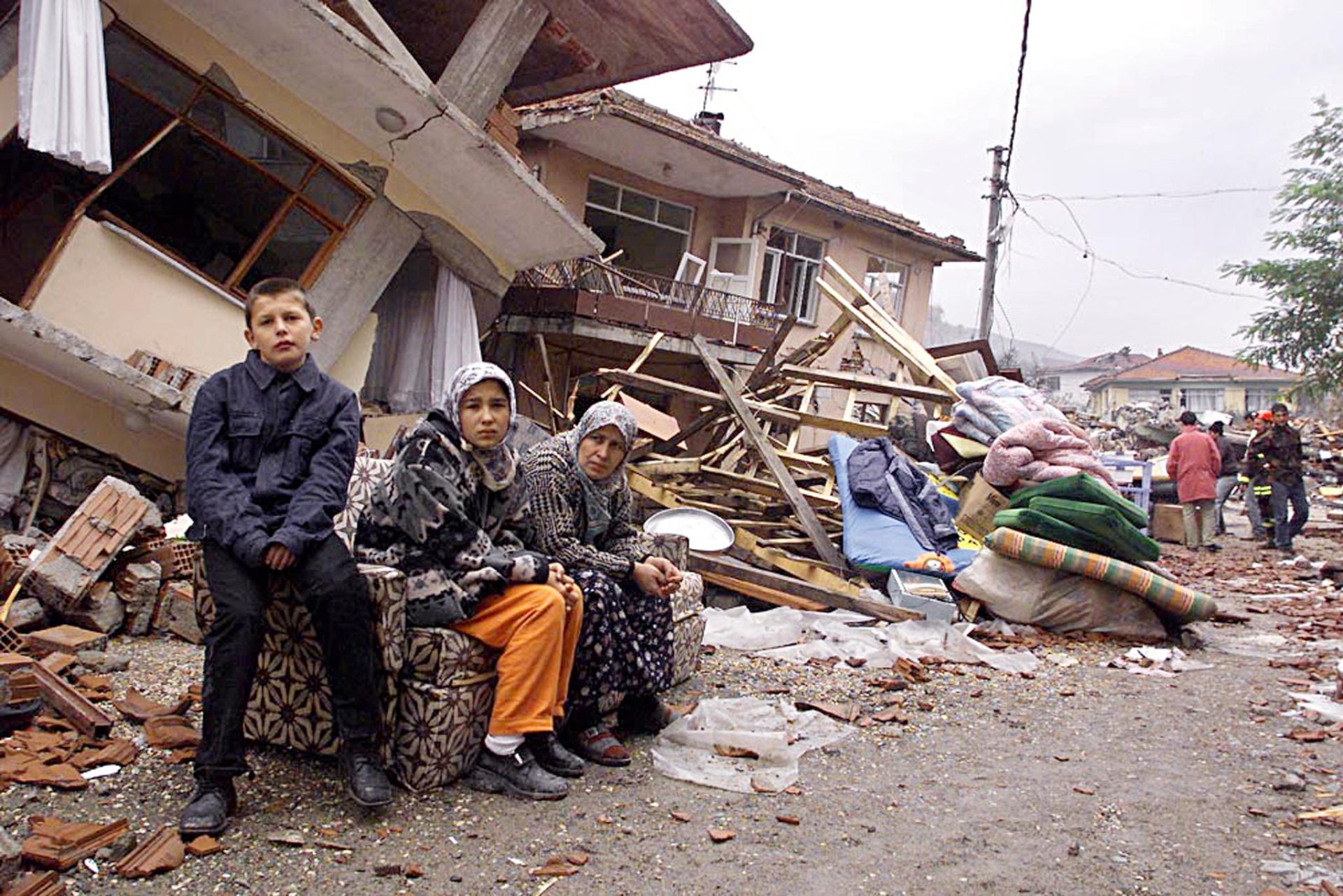
Residents sit on the debris of their house in Turkey’s Kaynasli on Nov. 17, 1999, following an earthquake. (Manoocher Deghati/AFP via Getty Images)

Aman stands in front of the rubble, not crying exactly, but wailing, sometimes roaring like a wounded animal, at one point jumping into the air and slamming his feet down in an act of raw emotion. He holds a bright scarlet piece of clothing and presses it against his face, inhaling the scent, swaying back and forth on his feet as though dancing. As others stand nearby in helpless silence, the man sifts desperately through the debris, collecting anything that still carries their smell, scooping up a tiny jacket, screaming incoherent words at the jagged shards on the ground. He has lost his daughter, son-in-law and grandson.

“I keep repeating to myself, ‘the horror, the horror, the horror,’” wrote the artist Anil Olcan, finding the word insufficient to describe what he had witnessed after visiting Hatay, the worst-hit area in the 10-city-wide zone of devastation in southern Turkey. “Is there a word in Turkish that alludes to the intertwining of panic, chaos, fear of death and the struggle to hold on to life?”

This inexpressible blight of trauma casting its shadow over all of Turkish society in the wake of the republic’s deadliest-ever earthquake nearly two months ago has long roots. When I first lived in Istanbul in 2006 as an English teacher, the school warned me to never broach certain topics with my students. This included the usual forbidden taboos, such as the Armenian genocide and the Kurdish conflict, but also earthquakes.

“Don’t even say the word,” a colleague said to me. To do so touched the still-raw wound of being abandoned by the state when the need was most dire and reinstilled the fear of another quake.

Turkey, a country cursed by geology, is one of the most earthquake-prone regions on the planet. The ground beneath your feet can shake in virtually any part of the country because, as the media keeps repeating, Turkey is a “deprem ulkesi,” an “earthquake country.” It balances precariously on the Anatolian tectonic plate that is squeezed and twisted counterclockwise by the Eurasian, African and Arabian plates, creating not one but two long, highly active fault lines, encompassing the entire north of the country as well as much of the south and east. There have been at least a dozen major earthquakes, causing over 1,000 deaths, in the past century in Turkey, but even before the recent quakes in the south, there was one in particular that left an enormous collective trauma on the country, shaking society’s faith in the state and planting the roots of Turkish civil society.

It unfolded one hot and muggy night, when the sea was calm and the stars bright. It was Aug. 17, 1999, at precisely 3:02 a.m., residents recalled when I interviewed them, that their breezy bayside town of DeÄŸirmendere was jolted awake to the sound of “a roar,” or “a strong wind,” depending on whom you ask. İrem Aydemir, who was 7 years old then, said it sounded “more like a beehive.” Before she knew what was happening, her mom had scooped her up from the bed in her aunt’s place where they were staying and raced out onto the street with her grandma and cousins. İrem looked around and realized that nothing was as it should be. Trees were in the middle of the sea. Some of the buildings were missing. Neighbors were standing outside in dead silence, women draped in tablecloths and curtains to cover themselves. Elsewhere in her town, residents lurched awake to find their homes full of seawater with mussels and fish flopping around. At first, some thought war had broken out, others that a meteorite had struck and still others that the apocalypse had been visited upon them.

Just 50 miles southeast of Istanbul, DeÄŸirmendere is known for its hazelnut festival and international arts events, its sweet cherries, a seaside park with giant plane trees and a waterfront with seafood restaurants, ice cream shops and tea houses. Nestled in Izmit Bay in Kocaeli, a heavily populated industrial province between the Sea of Marmara in the south and the Black Sea to the north, DeÄŸirmendere is a military town, as nearby Gölcük hosts Turkey’s largest naval base, where 24,000 people live and work. It is thus secular and considered modern, the kind of place where women can walk around in shorts without getting harassed and young people drinking beer flirt and gaze into the chilly Marmara. As in other coastal regions in Turkey, the “sahil” (seaside) is something almost sacred, the basis of an entire way of life, and İrem spent most of her childhood near it.

The epicenter of the earthquake — a devastating 7.4 magnitude tremor that roiled Kocaeli for 45 seconds, releasing the equivalent of 236 Hiroshima blasts and creating a tsunami as high as 8 feet deluging more than 100 yards inland — was just a few miles away. So much time had passed since the last deadly earthquake convulsed the region in 1894 that many people either didn’t know or had seldom pondered the fact that they had built their lives directly on top of one of the most active fault lines on Earth.

An immense inferno blazed at Turkey’s largest oil refinery just across the bay, spewing dark smoke almost 200 feet into the air. Minarets snapped like matchsticks. Buildings crumbled like sandcastles, for indeed they were made from concrete mixed with sand from the beach. Those who emerged from their homes in their pajamas, covered in cement dust, staggering about in a daze, will forevermore be known as “depremzede” — “earthquake victims.”

In nearby Izmit, at the end of the bay, 13-year-old Bahar Topçu, a typical middle-class teenager, was spending the night at her aunt and uncle’s apartment. She studied ballet and piano, took swimming lessons in the local pool, spent hours sipping tea and exchanging stories with her friends, and dreamed of moving to Istanbul and studying international relations. She loved how common it was to run into people you knew in the center of the small city, and everyone had their go-to baker, butcher and greengrocer with whom they exchanged the daily gossip.

Bahar struggled to stay upright as the ground shook for what felt like an eternity. She couldn’t straighten her legs. Her impulse was to run away, to escape somehow, but when the ground itself is shaking there’s nowhere to go. Bahar’s older cousin dashed into her room and wrenched her into the doorway where they clutched onto each other for dear life.

Finally it stopped, and they descended the stairs with her aunt and uncle and congregated with neighbors in a children’s park. Miraculously, this neighborhood was built on hard ground, and none of the buildings was heavily damaged. With the electricity out, Bahar had never seen Izmit enveloped by such total darkness, and the salty sea seemed present in the air in a way she had never felt before. Everyone stood there in stunned silence.

“Should I cry? Should I run? What should I do?” Bahar thought to herself, worried about her parents at home in another neighborhood. But soon they arrived by car, shouting her name, overjoyed to find her safe and sound. They drove away, passing through neighborhoods that looked starkly different from their own. Their headlights illuminated the rubble of ghostly buildings crumbled along silent, empty streets. At that moment, the family could not fathom where all the people were.

Their minds were fixated on an urgent task — finding a pay phone to call Bahar’s sister Pinar, who was studying in France, to tell her they were OK before she woke up and saw the news. At last they located one, and her mom called Pinar’s facility, only to remember that she didn’t speak a word of French. “Pinar’s momma, Turkey,” she said, and the person at the other end responded enthusiastically in a long stream of French. “Mama — bonne. Papa — bon,” (“Mama — good. Papa — good”) was all she could manage, a story they would recount many times in the future.

Back in DeÄŸirmendere, people sat on the ground and listened to news reports on the radio that played through the open doors of cars. İrem’s dad, who was at their home in another neighborhood, set out to reach them but had a hard time getting through because everyone stopped him, begging for help to dig out their loved ones. Later, he would work for weeks in the rubble, digging out the body of his wife’s cousin, who could only be identified by her wedding ring. The dead piled up so quickly that they were forced to use the local skating rink in Izmit as a makeshift morgue.

İrem’s uncle came directly from working a night shift in a glass factory and met them before going home to his pregnant wife. But before he left, the radio announced that his neighborhood had been destroyed, and he blacked out from shock and despair. They revived him with kolonya, the perfume ubiquitous in Turkey; he later discovered that his wife and future son had slept over at her mom’s place in a different neighborhood and survived.

Meanwhile, in Istanbul, 21-year-old university student ÇaÄŸlar Akgüngör rushed to join the relief effort. Unlike almost everyone scrambling to help, he was trained and ready. Three years earlier, he had joined an organization called AKUT, which had been founded by one of the trainers at his university mountaineering club. AKUT was a pioneering search-and-rescue group established to help endangered rock climbers, cave divers and victims of natural disasters. After a training seminar at BoÄŸaziçi University’s Kandilli Observatory and Earthquake Research Institute, they realized that Istanbul was built on a major earthquake zone and that Turkey had very little capacity for dealing with such a disaster. When municipalities demolished buildings, they let AKUT members practice working on the ruins.

Akgüngör met his AKUT colleagues in Avcilar, a coastal district on Istanbul’s European side where, despite being 55 miles from the epicenter, the quake pulverized over 60 shoddy buildings constructed on soft, sandy soil. Since few people owned cellphones and service was intermittent, they communicated by radio, soon learning that the damage in Kocaeli was far worse, and immediately headed to Gölcük.

Nothing could have prepared Akgüngör for the scenes of mayhem that met him there. Some buildings looked as though they had been swallowed into quicksand, as the temblor had liquefied parts of the ground. Others lay completely intact but on their sides. Many buildings had been opened up like dollhouses, exposing frozen scenes of domestic life inside. In the worst areas, several buildings were blended together into a single mass of concrete, metal, furniture, kitchen appliances, clothing and curtains, all of it covered in dust. Everyone was eager to help, but they lacked training, coordination and equipment. As countless people begged his team to rescue their loved ones, Akgüngör felt powerless, and it was hard to know where to start. AKUT had no more than 50 members and 2,000 volunteers, and lacked heavy or specialized equipment.

Desperate residents tried to remove giant chunks of concrete with their bare hands. The naval base had been hit hard, and sailors were busy working on their collapsed headquarters, digging out hundreds of buried officers who’d gathered for a celebration. Aside from the soldiers, the state was nowhere to be found.

There was no disaster management agency to coordinate a response and no state of emergency or martial law was declared (despite the military’s apparent recommendation). The state’s earthquake fund, established in 1972, was found to have just 1 million lira, then worth $2. The 78-mile-long fault rupture severed the primary fiber-optic cable connecting Istanbul and Ankara, leaving the government in the dark, and damaged the highway and railways between the two cities. Prime Minister Bülent Ecevit blamed the slow response on this, but he couldn’t explain how the media and foreign rescuers were able to reach the area within hours.

“Is Ankara or America further away?” asked Mustafa Yılmaz, a state minister.

The corruption-riddled relief organization, Kizilay (Turkish Red Crescent), was absent for days. When it eventually showed up, the few tents it scrounged together were of poor quality and leaked in the rain that drenched the region in the days following the quake. Four months later, a study found that only 10% of survivors reported having been helped by any state services, including the military, in the initial days following the quake.

“Where is the state?” people cried into the many cameras carried by Turkey’s new private news broadcasters who managed to show up long before officials.

Newspaper headlines were merciless: “The state is under the rubble”; “We’re victims of the state”; “The people abandoned.” For a society in which many venerated the near-sacred “papa state” as beyond reproach, both the failure of the authorities and the fury directed toward them were a shock.

In Cumhuriyet, Turkey’s oldest newspaper, Abdülkadir Yücelman wrote, “It’s not the Marmara that collapsed, but the system itself.” Trust in the state was “below zero,” Fatih Altayli declared in Hürriyet, another newspaper, warning that “the damage done to society by this lack of trust is far more destructive than the earthquake.” Ömer Çelik, a future minister for the Justice and Development Party (AKP), wrote, “When those who can’t govern act like they can run this unmanageable mechanism, it costs thousands of lives,” rebuking those who were silencing criticism in order to preserve “national unity and solidarity.”

Even the beloved military was no longer infallible, at least for a few days. “In the first two days the people searched for soldiers in vain,” wrote Can Atakli in Sabah. “The soldiers get everything and we get nothing,” a bitter woman screamed to a journalist from The Guardian.

In the absence of an official rescue effort, a massive civilian mobilization unlike anything seen before in Turkey began from the earliest hours, with student groups, Islamic charities, businesses, doctors, engineers and ordinary citizens descending on the earthquake zone from across Anatolia schlepping water, bread, boxed milk and tinned food, clothing, cranes and bulldozers, and all other manner of supplies they could carry. Later, they provided eyeglasses, laundry services, soup kitchens, psychological support and even legal aid and media advocacy to give voice to the victims.

“The people are running towards the disaster zone without waiting for the state,” proclaimed Hürriyet’s front page. The TÜSİAD business association estimated that 10 million of Turkey’s 14 million households contributed aid.

Many of the groups would go on to form NGOs, and the relief effort marked a renaissance for Turkey’s embryonic and heavily factionalized civil society, in large part organized and financed by the business owner and philanthropist Osman Kavala, then 42, who raced to DeÄŸirmendere to offer any help he could. After the earthquake, Kavala devoted himself solely to civil society and founded some of Turkey’s most important arts and cultural organizations. Many of the most prominent activists, urban planners and architects who would later play a major role in the 2013 Gezi uprising, which was in part a protest against turning a designated meeting place in the event of an earthquake into a shopping mall, first met during the 1999 relief effort.

Foreign rescue teams, some coming from halfway around the globe, arrived days before state officials, bringing the rescue dogs and specialized equipment that Turkey lacked. The German daily, Bild, published its headline in Turkish: “Arkadaslar, Almanya acinizi paylasiyor” (“Friends, Germany shares your pain”). As the mayor of Athens collected donations and called for borders to disappear, headlines in Turkey’s rival Greece gushed: “We are all Turkish,” and “Mehmet, my brother, be brave.” Hürriyet responded with a headline in Greek: “Efharisto poli file” — “Thank you, neighbor.” Later, when U.S. President Bill Clinton and his family visited the tent cities, children followed him in droves, shouting, “Uncle Clinton.”

One by one, the dogmas that had been drilled into Turks since primary school — that their country was surrounded by enemies, that “the only friend of a Turk is a Turk,” that the people must put the state before themselves — collapsed.

“We always thought that the only friends of Turks were Turks. We know now that we were manipulated,” proclaimed Tourism Minister Erkan Mumcu. “We should open our society to the world.”

A spirit of boundless hope took hold, and commentators compared the atmosphere to the falling of the Berlin Wall. “The earthquake is the starting point for the establishment of a new mentality, a new spirit, a modern new administrative, scientific and technical vision for all of Turkey,” raved the journalist Orhan Bursali in Cumhuriyet.

When President Süleyman Demirel finally visited the areas of devastation, insisting that it was not the time for placing blame, he was confronted by a woman who said, “The ones left under the rubble are my loved ones.” She was promptly removed by officials. Demirel called the quake “fate” and an “act of God,” harped on about the “mighty power” and “omnipotence” of the state, and complained about those who “demean” it. Hürriyet fired back: “It wasn’t fate. It was a crime.”

Demirel insisted that “nobody estimated when, where and [to which degree] such kinds of disasters would happen.” In reality, two years before the earthquake, scientists pointed out in a prestigious journal that “the port city of Izmit is most vulnerable to an earthquake.” Just months prior to the quake, Turkey’s most respected union of architects and engineers held a conference in Kocaeli that was titled “Is Kocaeli Ready for an Earthquake?” In case the answer hadn’t already been clear, local and foreign media soon got to work exposing the deplorable quality of nearly all of the most damaged buildings.

Construction experts told the Los Angeles Times that “virtually all” of the collapsed buildings weren’t up to code. The New York Times reported that an “astonishing” number of the collapsed buildings were built in the last five years. In EskiÅŸehir, about 75 miles away from the epicenter, a disgusted police chief described a seven-story building that collapsed and entombed 27 souls as “made completely from sand and soil.”

Following the horrendous 1939 Erzincan earthquake, national standards for earthquake-resistant buildings were implemented in 1944 and updated numerous times over the years. In defiance of laws, contractors scrimped on materials, eschewed soil tests and added extra stories to buildings, encouraged by politicians eager to collect bribes to look the other way. They could even hocus-pocus their slapdash buildings into legality by paying a fee to the government, the notorious “construction amnesties.”

The public was livid. “Murderers,” ran a blistering Hürriyet headline. Furious mobs stoned the homes of corrupt builders. The media directed its ire at one in particular. Veli Göçer (whose last name means “collapses”), dubbed the “death contractor,” had built 500 of the collapsed buildings in Yalova from concrete made with sea sand and bits of garbage. He expressed no guilt in an interview at the time, declaring he was a literature graduate and didn’t know anything about construction: “I’m a poet, not a structural engineer.” Despite 2,100 lawsuits filed against contractors, he was the only one who ended up going to prison, serving seven and a half years of an 18-year sentence. He opened a new construction firm in 2018.

Officials were happy to pin the blame on contractors but lashed out when public ire was directed toward them. Ankara prosecuted the critical broadcaster, Kanal 6, for “provoking hatred among the public towards the state,” and shut it down for a short time. Ecevit warned the media against “demoralizing” coverage, saying no one had a right to “hurt the feelings” of state officials. The governor of Bolu actually slapped an earthquake victim who criticized him.

Three days after the quake, Chief of the General Staff Hüseyin Kivrikoğlu held a press conference where he castigated the media for its critical coverage and for not showing his 53,000 soldiers in the area. The old red lines were immediately reestablished, and the media dutifully changed its tone overnight, at least toward the military.

Yet no one matched the sheer vindictiveness of the ultranationalist Health Minister Osman DurmuÅŸ, who refused aid from the United States and other foreign countries (particularly Armenia) that “do not suit our culture,” telling survivors they could wash in the sea and use the toilets in mosques, and insisting that Turks should not accept donated Greek blood.

“I take being called ignorant and racist as a compliment,” he sneered during a press conference. DurmuÅŸ even threatened to file charges against AKUT, the heroes of the relief effort who managed to rescue 200 souls, and accused other non-state relief workers of “putting on a show.” On Aug. 24, a week after the quake, he woke up to a screaming Hürriyet headline directed to him personally: “Shut up.”

By the fourth day, when there were almost no survivors left to rescue, the state at last started to organize its response. “Finally,” read Hürriyet’s sardonic headline. But Ankara resolved to seize complete control over the aid so that the people would regain their confidence in the almighty state, allowing only state-friendly NGOs to continue operating in the area. Religious, leftist and human rights NGOs were kicked out, their water shut off, their bank accounts frozen. Several NGOs, including AKUT, were investigated for accepting foreign aid. The Ministry of Public Works refused to allow the TMMOB union of architects and engineers to inspect the damaged buildings, as evidence was thrown into the sea.

When the rescue efforts wrapped up and the foreign teams headed back home, the true scale of the devastation was calculated: 365,000 damaged buildings, over 110,000 of them heavily damaged or collapsed. A quarter of a million people were left homeless, some staying in prefabricated housing units for as long as a decade. No one seemed to take the government’s death tolls seriously. “These numbers are not convincing,” future President Abdullah Gül told the press. A 2010 parliamentary commission later put the figure at 18,373, with a further 5,840 missing. Many experts think the figure is far higher, and a study from 2004 estimated with a confidence level of 90% that the toll was, at minimum, 45,000.

The collective trauma left on Turkish society by the Marmara quake never disappeared.

“Society became more anxious; a sense of loneliness entered people’s lives. A sense of insecurity increased and individuals and groups suffered fragmentation,” the psychotherapist Deniz Altinay told New Lines in an email. Studies put the PTSD rates among the survivors as high as 76%.

In the weeks and months following the quake, not just Kocaeli but all of Istanbul was terrorized by constant aftershocks. Some jumped from their balconies for fear their building would collapse. Many slept outdoors. Because the earthquake happened at 3:02 a.m., millions of people refused to go to sleep until after that time, something Akgüngör, the AKUT rescue worker, called the 3:02 syndrome. “In Istanbul, we’d go out at 2, 3 in the morning in October, November 1999. We’d look around and all the lights would be on,” he told me.

İrem, now a doctoral student of anthropology at the University of California, Davis, still gets anxiety attacks during which she swears she can feel the ground moving. Her mom, who had to prepare her own cousin’s body for the funeral in 1999, suffered from fainting spells for 15 years. Many who survived feel guilty.

DeÄŸirmendere was never the same afterward.

“I always felt like a part of me was gone, because a part of the town was gone,” İrem said. Much of the population left. After the tsunami, a sea-worshiping people became traumatized by the water. The sea swallowed much of the coastline and never gave it back. In 2004, an AKP mayor won the election, and the party went on a massive construction spree, paving over open wounds with concrete.

“I guess people thought that’s how we’ll heal our wounds. Not with any accountability, but by building stuff,” İrem said. “But we were never healed because we never found justice.”

The scholar Gönül Tol participated in the relief effort in 1999 while a university student and was near the earthquake zone on Feb. 6 of this year, where she lost family members after no state rescue workers showed up for days. She remembers hoping that things would change after 1999 but said the response from hollowed-out institutions this time is far worse. Earthquakes are inevitable, but the real catastrophe is one-person rule.

Her voice shook with anger as she described all the same cascading institutional failures of 1999 magnified, made worse by President Recep Tayyip ErdoÄŸan’s centralization of power. “At least before, the government and state were different entities. Now, one man has become everything,” she said. “You see agency after agency, official after official, just frozen, waiting for orders from ErdoÄŸan.” The stronger his rule becomes, the less capable he is of governing.

Today, Turkey’s media is a shadow of its former self, almost fully kowtowed to the government, with vanishingly little freedom to report critically. ErdoÄŸan himself has become the living personification of the ostensibly infallible, sacrosanct state. Rather than simply ignoring experts, the government now throws them into prison, including many of the most prominent figures who participated in the 1999 earthquake relief effort and the 2013 Gezi protests — the philanthropist Kavala, the architect Mücella Yapici and the former head of Istanbul’s Department of Earthquake Risk Management and Urban Improvement, Tayfun Kahraman.

After the 1999 earthquake, the writer Orhan Pamuk wrote about how deep the rot runs that led to such unnecessary devastation. “[I]t was all too likely that the politicians, state officials and bribe-taking mayors being railed against would again run for office and again find favor with these voters. It was also likely that these people complaining so bitterly had at some point in their lives paid bribes to the city council to circumvent the construction codes and would have considered it stupid not to do so.”

It’s too early to say what the repercussions of the Feb. 6 earthquakes will be, or if any lessons will be learned this time. İrem, who studies natural disasters, said an earthquake is like an opened Pandora’s box, laying bare all of a society’s hidden or unspoken problems. She finds it hard to watch countries like Japan or Chile transform and adapt their cities to protect themselves from earthquakes. “And then look at us. It’s not fair.”

Bahar, now an anthropology graduate student at Leuven University in Belgium, said that after a short time, most people stopped talking about earthquake preparations in Izmit. “People didn’t care,” she said, recalling that politicians talked about it for a couple of years and then stopped.

Akgüngör, who decided to study disaster management and wrote a dissertation about Turkey’s historical responses to earthquakes, said the pattern is generally the same: The initial state response is poor; there’s an outpouring of criticism; the response improves; and the criticism eventually dies off.

“You see the cycle again and again, yet you don’t observe a substantial political or social change.”

That change must be radical and sweeping, which scares people and threatens powerful structures and entrenched interests. Akgüngör said there is only a short window following a catastrophe in which society demands changes.

“But that window closes very fast.”