Thursday, March 30, 2023

Religious Zionism and the Struggle for Israel’s Soul

The far right’s foothold in the new government has been in the making for a while
Religious Zionism and the Struggle for Israel’s Soul
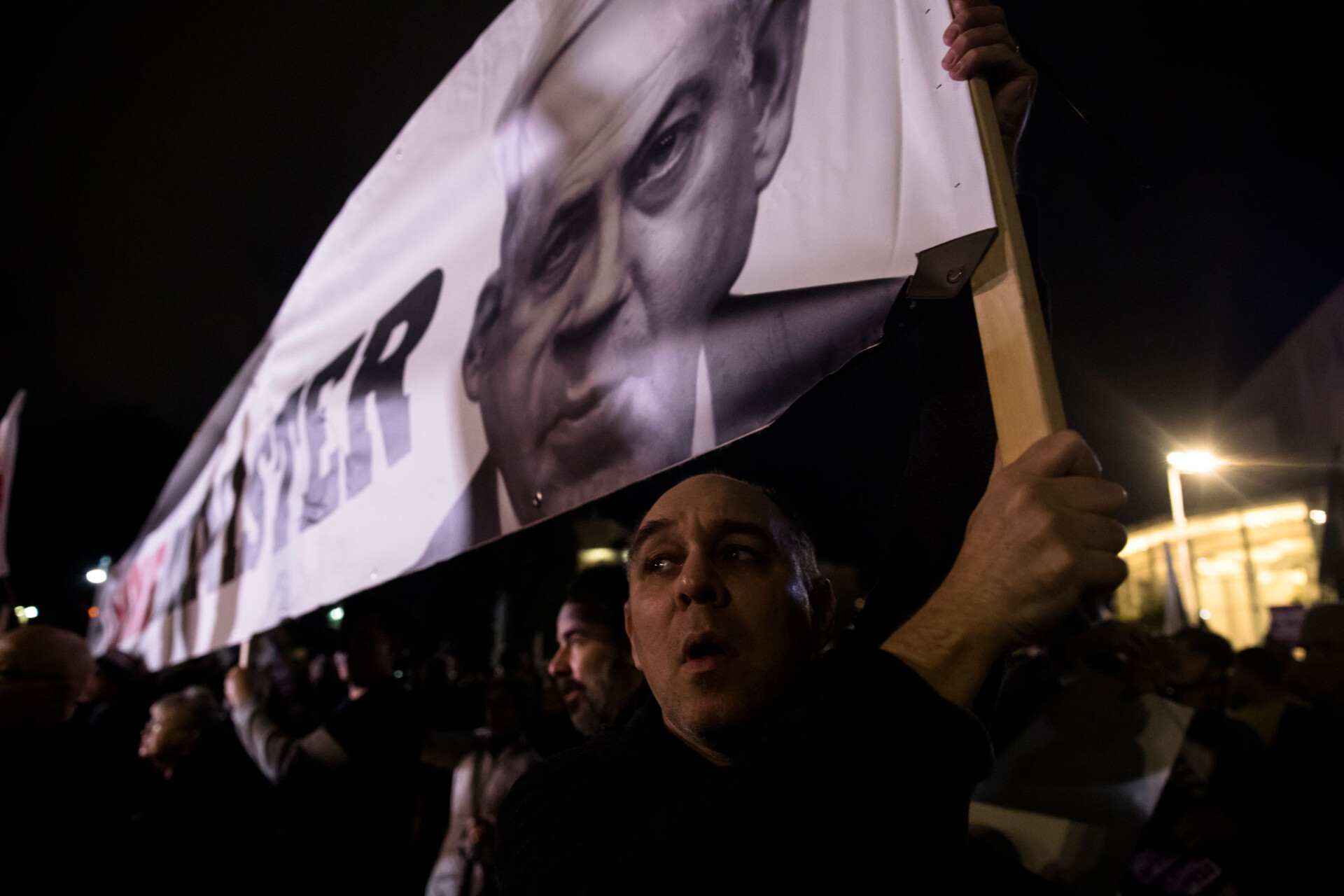
A protester in Tel Aviv holds a placard with a photo of Israeli Prime Minister Benjamin Netanyahu on January 8, 2023. (Amir Levy/Getty Images)

Editor’s note: In the shadow of a series of weekly mass demonstrations in Israel against right-wing Prime Minister Benjamin Netanyahu’s bid to curb the powers of the country’s Supreme Court, matters came to a head over the weekend when the premier fired Defense Minister Yoav Gallant after the latter took the side of the protesters and urged negotiations with Netanyahu’s political opposition. Among the most prominent of those calling for Gallant’s dismissal was National Security Minister Itamar Ben-Gvir, a member of the Religious Zionist bloc critical to Netanyahu’s narrow governing majority. Subsequently, Netanyahu said he would pause in his power grab against the judiciary. Below is an excerpt from our spring print edition from an essay that offers a more exhaustive look at the history of the Religious Zionist movement and how it has grown in power to affect current politics in Israel.

Consider this stance: The Religious Zionist bloc, which, in agreeing to be part of the new Israeli government has helped Benjamin Netanyahu cling to power as prime minister, is, along with the Likud and the ultra-Orthodox parties in the coalition, a crew of Bible-thumping fundamentalists and hardcore racists in open rebellion against the modern world, wielding two of the most destructive forces known to man: religion and nationalism. There comes a time when secular liberals, peaceful and pluralist though we may be, must fight hard, and that time is now.

Does that make you feel better? It shouldn’t. Nearly everything I’ve just stated is self-defeating and wrong.

The remarkable recent successful efforts by the Religious Zionists and the ultra-Orthodox parties to gain inclusion in Netanyahu’s government are, like all politics, not only about money and power but also about personalities, principles and passions. Today’s Religious Zionist party, like other illiberal movements around the world, has seized on the global failure of post-Cold War liberalism to answer many basic questions, not only of resources and power but also of purpose and meaning. Liberals around the world regularly and blithely assume that their worldview is transparent and is modernity’s only reasonable option, yet Religious Zionism has emerged out of the same historical cauldron that yielded modernity, the nation-state and, yes, liberalism as well.

Israel is now in the midst of the most profound domestic crisis in its history, and the place of the judiciary, constitutionalism, liberalism and religion are at its heart. The struggle being waged throughout the country — with mass demonstrations, unprecedented numbers of military reservists saying they won’t serve an undemocratic state and those in the governing coalition arguing that they are all that stand between the will of the people and an arrogant, traitorous and globalist elite — demands close attention to all its moving parts, for what it tells us about deep currents in world politics today and tomorrow.

Israel’s moderate center and left have been adrift for years. They are now raising their voices with a volume and clarity we haven’t heard for decades. An optimist may wonder whether this will be the beginning of a new center-left that grapples with fundamental questions of national identity and belonging.

Personalities matter as well, of course; in this case, one remarkable figure, Netanyahu, is Israel’s prime minister for the sixth time. As with all long-lasting Middle Eastern figures, Netanyahu is a genius of survival, propelling his political longevity forward with a mixture of strategic caution and tactical audacity: no big moves but anything to get through another day. Though he has had the opportunity to declare war several times, he rarely has. Both his defense and economic policies can be described as conservative and tactical. Brilliant and petty, despised and admired, Netanyahu sees himself as the sole person standing between Israel and its destruction, a lonely world-class statesman and thinker in a sea of job seekers, Davos creatures, romantics and bureaucrats. He doesn’t believe anyone’s vision of Jewish redemption — whether it is rebuilding the Temple in Jerusalem or an EU-style Middle East. He offers his disenchantment in service to a noble goal: Jewish survival in a world that will never be redeemed.

Netanyahu is, in many ways, a stuck man in a stuck country. His belief in himself and his mission justifies the alleged actions — bribery, corruption and fraud — for which he has been indicted by the legal system he once championed and now abhors. Over the years, Netanyahu’s self-centeredness, paranoia and inability to see past his personal grievances have alienated and embittered almost everyone who has worked with him.

Now, desperate to stay out of jail and to secure his legacy, Netanyahu has turned to hard-right coalition partners whom he once kept at arm’s length and who never would have achieved this sort of power without him.

Making up part of that coalition are the Religious Zionist bloc’s two leaders, Bezalel Smotrich and Itamar Ben-Gvir, who genuinely differ from each other. One comes out of a deeply ideological, decidedly Ashkenazi (a catchall term for Jews of European origin as opposed to Sephardic Jews, a catchall term for Jews originating in MENA and Ottoman lands) camp that has spent decades on the hilltops of Judea and Samaria (the West Bank) working out its ideas. The other — from a traditionalist but not Orthodox Sephardic urban milieu — of Shabbat afternoon soccer games and running street battles with police officers and Arabs. Crucial for both are interlocking sets of traumas — the First Intifada, the Oslo Accords (which put Israelis and the Palestinians on a potential path for national coexistence), the assassination of Prime Minister Yitzhak Rabin and the Second Intifada. Finally, they must deal with the 2005 disengagement from the Gaza Strip, during which Israel unilaterally dismantled settlements and evacuated Israeli forces, and its aftermath.

To their voters, they are defenders of the people, not only from Arab violence but also from a tired, neurotic, dishonest, globalist elite (military high command included) whom they have been fighting since they were in their late teens on the roads to Gaza and in the alleyways of Jerusalem. For their voters, two overriding, related issues are governability (“meshilut”) and the judiciary.

First, governability. The starting point for any and all discussions of the stunning rise of Ben-Gvir and Smotrich is a mounting sense of lawlessness, manifest especially in the May 2021 riots in the mixed Arab-Jewish cities of Jaffa and Lod, which occurred simultaneously with Israel’s military operations in Gaza. But additionally, there is grave concern about the mounting terror attacks, the stunning internal violence among Israeli Arabs, the rise of all sorts of protection rackets, the chaotic relations between Bedouin and others in the Negev Desert in the southern part of the country, not to speak of carnage and road rage on the highways. In other words, Israel lacks security on the doorstep.

Second, the judiciary. Israel has no written constitution. Instead there are a series of (ungainly named) structural basic laws (e.g., “Basic Law: The Knesset”) and, from the early years of the state, a robust culture of judicial review. In recent decades, many think the judicial reviews have gone into overdrive. In 1992, Israelis saw the passage of a basic law that incorporated human rights principles and put the concepts “Jewish” and “democratic” on an equal legal footing (whether “Jewish” means religious, national identity or a broad set of values, and whether “democratic” means populist or liberal, has been and will continue to be a matter of debate, beyond the scope of this essay). In Israel, as in the U.S., the judiciary came to see themselves as liberal flame-keepers in the face of an increasingly nationalist and conservative electorate, and Israel’s court waded deeper into political decisions and policymaking than its American counterpart. The judiciary also came to be seen, not without reason, as one of the last strongholds of the country’s long-dominant liberal elite.

Arguments over the judiciary (this or that particular ruling aside) are also about the very meaning of “a Jewish and democratic state,” leading in 2018 to a new basic law, pointedly establishing Israel as “the nation-state of the Jewish people.” Far from settling the issue, the new law sparked only more debate, and the criminal charges against Netanyahu added fuel to the flames. Israel’s growing ultra-Orthodox sector, now one third of the governing coalition, is pushing hard to roll back the judiciary, which it perceives as an ideological opponent and an obstacle in its struggle for power.

Some in the newer generation of Religious Zionists, raised entirely during the troubled settlement movement in the West Bank, have taken away a bitter lesson: The state and its institutions didn’t care about them or even want to listen to their ideas. And so, those who cared about the settlers’ future decided that the state would have to be taken over, year by year and bit by bit. One of them was a 25-year-old activist who had once closed down a highway to protest Israel’s withdrawal from Gaza, leaving him in administrative detention. His name is Bezalel Smotrich. 

A rabbi’s son, Smotrich grew up in Beit-El, a religious settlement in the West Bank. Unlike most young Religious Zionists, he spent years in a yeshiva, and, well past combat age, did only partial military service as an assistant adjutant. He studied law one day a week, not at an elite university but at Kiryat Ono Academic College, one of the small colleges that arose to meet the needs of students who are ineligible for or uninterested in the country’s public universities.

Israeli society was getting used to a new kind of Religious Zionist — Naftali Bennett — elite commando officer, successful hi-tech entrepreneur, politically right, socially moderate, halakhically observant, but far from religiously intense. For many he seemed to validate a long-cherished dream among an early Religious Zionist party — the National Religious Party (NRP) — of full integration into Israeli society. Smotrich and others on the hard right viewed him and his ilk with scarcely disguised contempt. 

Smotrich entered public life as the founder of the “Regavim” movement (“Clods of Earth”), which seeks to counter what it sees as anarchic Bedouin land grabs in the Negev Desert. Smotrich became a member of the Knesset in 2015, in one of the factions into which the old NRP was splintering, beginning a political career in which he formally called for the dissolution of the Palestinian Authority in 2017, advocated for Israel to annex the West Bank and sought that Palestinians be given status as residents but not citizens unless they swore full allegiance to Israel. In a brief tenure as transportation minister, he proved himself an adept and capable administrator. 

An ideologue through and through, Smotrich thinks that he has a full understanding of the deeper currents of world history, Jewish history and the innermost processes of Israeli societal structures — to such an extent that anyone can, with accuracy, pinpoint people’s ideological errors and correct them to align with a proper understanding of society and the state. Unlike Religious Zionists of the past, Smotrich and his followers see themselves not as bridging figures between the state and society but as its true, deserving leaders: an intellectual avant-garde, like the Labor Zionist revolutionaries of old but with God on their side. 

And that is just one of the differences between him and his co-leader, Ben-Gvir. 

Born in Jerusalem to second-generation immigrants from Iraq and Kurdistan, Ben-Gvir grew up in the middle-class Jerusalem suburb of Mevaseret Zion. Like many Mizrahim (Jews from the Middle East and Central Asia), his family was neither Orthodox nor secular but lived a life best described as traditional: respect for Jewish religion, a deep sense of peoplehood, religious observance less rigorous but deeply felt and faithful and (crucially) not spelled out in ideological terms. 

The vehicle of Mizrahi politics in Israel’s recent decades has been the Shas Party, which rose under the magisterial spiritual leadership of the late Rabbi Ovadia Yosef and the cunning genius of his political lieutenant Aryeh Deri, now the party’s head and close confidante of Netanyahu. Sephardic traditionalism had long avoided the hard-and-fast ideological categories of the religious and secular borne out of the European experience. But starting in the 1980s, after decades of humiliation at the hands of the Ashkenazi establishment, Shas finally adopted the European paradigm, turning its broad traditionalism into a marching ideology. 

Ben-Gvir’s own religious-ideological awakening at age 12 during the First Intifada of the late ’80s and early ’90s, though derived not from Shas but from the teachings of American-born Rabbi Meir Kahane, the founder of the far-right Jewish Defense League who emerged from the heady, radicalized New York of the 1960s and brought its furies to Zion.

A central element of Kahane’s theology was revenge — the Holocaust has so bent the horizons of morals and theology that only Jewish revenge can restore God’s place in the world.

Ben-Gvir never met Kahane, who was killed in New York by an Egyptian-born American who was later implicated in the 1993 World Trade Center bombing. But coming of age in the furies of the intifada and the convulsions of Oslo and seeking a deep religious identity other than the new Sephardic ultra-Orthodoxy of Shas or the, by now, sectoral ranks of Religious Zionism, Ben-Gvir found himself amid the ranks of Kahane’s followers. He first came to public attention in 1995 through the theatricality that has marked his public life; brandishing for the cameras a hood ornament he claims he had taken from Rabin’s car, he said that “the same way we got to this ornament, we can get to Rabin.”

He became head of the youth wing of Kach (Kahane’s political party) and, after high school, studied in Kahane’s yeshiva. His youthful radicalism was so extreme that the Israel Defense Forces chose not to induct him into the army.

Over the years, Ben-Gvir became a regular target of Israeli police surveillance, and by early 2009, he had been indicted more than 45 times. Eventually, he went to law school and, after repeated appeals and an acquittal for an outstanding indictment, was admitted to the bar. He regularly represented Jewish activists from the farthest right of the spectrum, who assaulted mosques along with Israeli soldiers, hoping to inflame what to them are the unbridgeable tensions between being both a Jewish and democratic state.

As an attorney, Ben-Gvir proved himself an able advocate and talented showman and slowly made his way toward the political establishment, first as a parliamentary aide to a hard-right Knesset member and then as a candidate for a Kahanist party. Following a series of factional splits in the party, Ben-Gvir was elected to the Knesset in 2021 and subsequently merged his Otzma Yehudit (Jewish Power) party with Smotrich and another one-person party. They ran again in 2022 and met with astonishing success.

In the Knesset, Ben-Gvir kept up his showmanship, moving his office to the deeply contested East Jerusalem neighborhood of Sheikh Jarrah, the site of years of protests over the government’s plans to evict Palestinian families who had lived there for generations to make way for Israeli settlements. To his mind, the prerequisite to coexistence with the Palestinians is their not harboring any national aspirations at all.

At the same time, Ben-Gvir has shown some signs of moderation. Unlike the severe Smotrich, Ben-Gvir is affable, at times even charming, and seems genuinely to like people, even those in other camps, and to want to be liked by them. Former colleagues of his on the ultra-right tell me they think he has “gone establishment” and soft. When a few months ago he spoke, as he usually does, at an annual memorial service for Kahane and told the crowd that on a number of issues he has come to think Kahane was wrong, he was booed. 

During the most recent election campaign last November, I stepped into Jerusalem’s open-air market to buy some fruit, and there was Ben-Gvir, cameras and security people in tow, trying to explain to a supporter why he was in favor of Covid vaccines. I got close to him, he put his arm around me, and I asked him what he thought of religious leftists. Kahane would have said, “They’re heretical, deluded fifth columnists who need to be on a plane to Damascus.” Ben-Gvir smiled at me and said, “They’re my brothers.”

Smotrich is now finance minister — with an avowed preference for hard-line, free-market ideology, except for settlements and ultra-Orthodox yeshivot, which to him are the essence of the national interest. He has also been given an unprecedented role as a defense official responsible for the civil administration in the territories. Even good-faith observers acknowledge that the administration is a mess badly in need of capable tending, as Israel’s decadeslong ambivalence about the territories has led to what even left-leaning observers say is chaos in land-use planning and housing.

But this deliberate blurring of civil-military functions within a single office while handing these powers to the person who decides on all state budgets is breathtaking. It is also characteristic of Smotrich, who has spent years studying the levers of government and carefully considering how to take them over one at a time.

Smotrich’s close ally, Simcha Rothman, is chair of the Knesset’s Constitution, Law and Justice Committee and, along with Justice Minister Yariv Levin, spearheading the program of undoing judicial review and, to many, including this writer, the very rule of law, which has brought hundreds of thousands of Israelis into the street. 

Though far more excitable than Smotrich, Rothman, too, has been thinking. His doctrine is a metastasizing of the populist idea of the will of the people. To him, the will of the people and the various compromises entailed in a governing coalition’s internal agreements are one and the same. Outside the coalition and its decisions, there is no democratic legitimacy. In Rothman’s view, which may indeed become law, the farthest ends of judicial restraint, Rousseauist will of the people and the Religious Zionist identification of the will of the Jewish people with the will of God come to a terrifying juncture. 

Last January I had dinner with an old friend, a veteran Israeli general and deeply committed Religious Zionist who has deep respect for his nonreligious colleagues, for shared state and societal institutions and for international law. He told me he had recently been discussing something with Smotrich. “And do you know what he said to me?” my friend asked.

I replied, “He said to you: ‘You just don’t understand.’”

“That’s right,” my friend said. “He told me, ‘You just don’t understand.’”

Ben-Gvir asked for and received the portfolio for the Ministry of Internal Security, now rechristened as the Ministry of National Security. Early on, there were discussions of expanding responsibilities, which would have been reasonable to talk about if we were speaking of any other minister but him.

He ran as a law-and-order candidate, and that is what he must now deliver. The problems are real, to be sure. Crime in the Palestinian community is real, organized or not, shootings and protection rackets abound, and it seems some Palestinian citizens of Israel (Israeli Arabs) may even have voted for Ben-Gvir. Whether he is willing to listen to criminologists and consider workable ideas, such as community-based policing, remains to be seen. 

For now, his most visible action has been his open conflict with the police forces he controls — endlessly second-guessing them on tactics, denouncing officers who fail to heed his dictates, urging severe retaliations against whole Palestinian communities against his officers’ better judgments, and generally trying to politicize the police force beyond all recognition. 

Taken together, Ben-Gvir and Smotrich represent a new kind of religious populism, utterly fusing “democracy” with the will of their electorates. They are the tribunes of a new, rising subculture, with no humility toward the old elites. Indeed, the fact that neither of them did conventional military service seems not to diminish their confidence in their own judgments but to deepen it. Unlike their center-left opponents, they convincingly couch their ideas in terms and language reminiscent of Jewish history. Most of all, unlike so many on Israel’s battered center-left, they know their own minds. 

Religious Zionism’s stunning rise was facilitated by the Israeli center-left’s long ideological collapse. Netanyahu’s assault on not only the center-left but on civil society and the rule of law has been swifter and more sweeping than anyone could have imagined. The existential questions are now on the table, as the center-left fights for its very life.  

When the Zionist genius worked, however, it was with a remarkable mix of pragmatism and vision— which, yes, was a moral vision as well. If the center-left doesn’t recapture both the pragmatism and the vision, it will vanish — and not only in West Jerusalem and Tel Aviv.


Israeli crisis: This is not about democracy, it's about liberal Zionist supremacy

Israel is an apartheid state based on Palestinian dispossession, with half the people living under its direct rule denied the vote. So much for the protesters' precious liberal democracy

Sai Englert
28 March 2023 

People attend a demonstration after Israeli Prime Minister Benjamin Netanyahu dismissed the defence minister for urging a pause to its judicial overhaul, in Jerusalem, on 27 March 2023
(Reuters)

Following three months of mobilisation across Israeli society, which has seen hundreds of thousands of demonstrators take to the streets, the repeated blocking of major highways, mass refusal by reservists to report for military duty, and a mixture of strike action and employer lockouts, the government of Benjamin Netanyahu appears - at the time of writing - to have been forced to concede at least partially to the demands of the social movement.

On Monday evening, Netanyahu announced he was delaying his government’s contentious remake of the country’s courts.

"Out of a sense of national responsibility, out of a will to prevent a rupture among our people, I have decided to pause the second and third readings of the bill,” he told the country’s legislature.

After firing his defence minister, Yoav Gallant, over the latter’s calls to pause the government’s judicial reform, Netanyahu appeared to lose control over an already chaotic situation. Employers’ organisations and the Histadrut - Israel’s largest trade union federation and a historic pillar of the Zionist colonial movement - announced jointly that they would shut down the economy. Malls, universities, hospitals and factories, as well as Israel’s only airport, were closed down, alongside kindergartens and schools.

The current political crisis emerged at the end of last year when Netanyahu was re-elected as prime minister at the head of a right-wing coalition, which ranged from his own Likud party and his usual ultra-Orthodox allies, to the most radical organisation of the settler right.

Stay informed with MEE's newsletters
Sign up to get the latest alerts, insights and analysis, starting with Turkey Unpacked

Aggressively anti-Palestinian and in favour of an even-more rapid expansion of the settlements in East Jerusalem and the West Bank, the coalition promised more of the same for Palestinians: Israeli colonial violence, theft and murder - but on steroids.

At the same time, the coalition made central to its narrative that the Israeli left had controlled the levers of power of the state for too long and that it would put an end to this as quickly as possible. Central to this programme stands a proposed judicial reform that would limit the power of Israel’s high court and put it under the control of parliament - that is of the ruling coalition.
All-out assault on democracy

Under these reforms, the appointment of judges would become a parliamentary decision, while rulings made by the court could be overturned by a parliamentary majority. This, critics of the reform argue, is an all-out assault on Israeli democracy and would usher in the end of a much acclaimed Israeli liberal democratic order.

Adding fuel to the fire, the government has also proposed and fast-tracked a series of other laws that have been widely perceived - even by right-wing commentators and supporters of the government - as nakedly self-interested. Ranging from legalising "gifts" to public servants and lifting the ban on convicted politicians serving in the government, to limiting journalists’ ability to publish recordings of politicians, the government’s wish list infuriated an already hostile opposition.

The crown jewel in this pack of reforms was last week’s successfully passed bill which makes impeaching a sitting PM so difficult that Netanyahu effectively achieved immunity, protecting him from the potential outcomes of his ongoing corruption trial.
 

Israel judicial crisis: What are the reforms causing outrage?
Read More »

The scene was set for a full-frontal confrontation between the pro- and anti-Netanyahu camps in Israeli society.

Indeed, pro- and anti-Netanyahu - or pro- and anti-coalition - camps is a better way to understand the current struggle in Israel. Traditional ideas of left and right do not quite capture political divisions in Israel in general, and in the current moment in particular.

As mentioned above, key participants in the opposition to the government’s reforms have been employers’ organisations and reservists in military units considered as "elite" in Israel, that is battle-hardened.

Central to these have been the fighter pilots - the same pilots who have made an international name for themselves in regularly carpet-bombing the inhabitants of the Gaza Strip with the horrendous consequences that are so well documented.

Benny Gantz, the leader of the opposition and a key figure of the movement, made his political career on the back of the 2014 massacre in Gaza, which he oversaw as the Israeli army’s chief of staff. He told demonstrators in February that they had to defend the high court because: "For decades, I guarded you. And while I guarded you, the court guarded me."

None of these groups is helpfully understood as left-wing.

Widespread horror

Similarly, the traditional organisations of the Israeli labour movement, such as the Histadrut or the Labor Party, have historically been the key architects of Palestinian dispossession.

It is worth restating, in the midst of the current debates, that it was the Israeli labour movement - through its union federation, its kibbutzim (collective farms), its militias, and its political party - who fought for the exclusion of Palestinians from the state and the labour market, and imposed military rule on Palestinian citizens of the state until 1966 and Palestinians in the Occupied Territories after 1967.

It is difficult to consider these organisations as particularly progressive - let alone as defenders of democracy

It was these same actors that expelled over 700,000 Palestinians from their homes, razed more than 500 villages and urban centres to the ground, and barred any refugees from returning to their homes in its aftermath - in direct contravention of international law. It is again difficult to consider these organisations as particularly progressive - let alone as defenders of democracy.

This tension was illustrated well in the recent furore which surrounded Bezalel Smotrich’s statements at a conference in France, in which he said: ‘There is no such thing as a Palestinian nation. There is no Palestinian history. There is no Palestinian language."

Smotrich is the current minister of finance, a settler in the West Bank, and the first civilian politician (as opposed to a military official) to have been put in charge of Israel’s illegal rule over the occupied Palestinian territories.

His comments generated widespread horror - as they should - in their overt racist denial of even the most basic fact of Palestinian existence. Even the Gulf states, normally so happy to collaborate with Israel, found it necessary to call on the US to intervene.
Democracy - for whom?

However, the sentiments expressed by Smotrich are neither new nor surprising.

Indeed, they are the obvious ideological presupposition for the ongoing colonisation of Palestine by Israel. As the old Zionist slogan had it: "A land without a people for a people without a land." Most famously, Golda Meir - a stalwart of the Histadrut and the Labor Party, who served as Israel’s first and only female PM - declared in 1969 that “there were no such thing as Palestinians”.

An armed settler gestures to a Palestinian after settlers attacks against Palestinians in Burin village, occupied West Bank on 25 February, 2023 (AFP)

For all the denunciations, then, of the Israeli right, it would be good to remember that the Israeli left has always shared similar ideas. The problem, it seems, is Zionism.

Restating these basic historical facts is important because it allows us to make sense of the shape - and the limits - of the current social movement in Israel.


Is a colonial society that legalises its expansionist policies through its high court more democratic than one that does so through its parliament?

While some of the international coverage about the reforms has focused on their potential effects for Palestinians - allowing, for example, for the legalisation of settler outposts against the rulings made by the high court - these same issues have been virtually absent from both the movement and public debate.

Instead, demonstrators have draped themselves in Israeli flags and positioned themselves as the defenders of the state, and its institutions, against illegitimate intruders - the very institutions which have developed and institutionalised Israel’s apartheid regime against the Palestinians.

The few Palestinian citizens of the state who have tried, out of ideological conviction, to intervene in the movement, have found themselves excluded, silenced or censured. Reem Hazzan, for example, was invited to speak at an anti-Netanyahu rally in Haifa. She was made to submit her speech in advance to the organisers, who then demanded that she alter it.

Hazzan had planned to tell demonstrators that there is a direct connection between the rollback of Israel’s democratic institutions and the ongoing, decades-long military occupation of, and racial discrimination against, Palestinians on both sides of the green line. This, it seems, is not what the movement’s struggle for "democracy" is about.
'Jewish supremacy'

Hazzan is not alone. So egregious is the systematic exclusion of Palestinians, and so total is the refusal to examine what the reality of Israeli "democracy" has been for the millions of Palestinians who live under its rule, either as second-class citizens or as subjects of its military regime, that Tajammu (Balad), a key Palestinian political party which operates inside Israel, released a statement that read:

“Ignoring the immediate connection between the ongoing violation of the rights of the Palestinian people on both sides of the green line and the judicial coup informs us that it is not for a genuine democracy and substantial citizenship that the masses are currently taking to the streets, but for the preservation of the “Jewish and democratic” equation, which focuses on a procedural democracy that is founded on the concept of Jewish supremacy … Expecting the Palestinian-Arab public to mobilise for this struggle is more than unfounded; it also amounts to insolence.”


Netanyahu has taken Israel to the abyss. What is his exit strategy?
Read More »

The exclusion of Palestinians and their demands is all the more egregious since the election of the Netanyahu government has been understood - rightly - by the military and settler movement as an indication that they now have free rein in the West Bank. Over 80 Palestinians have been killed since the beginning of the year, with military assaults intensifying in frequency and violence, particularly in the cities of Jenin and Nablus.

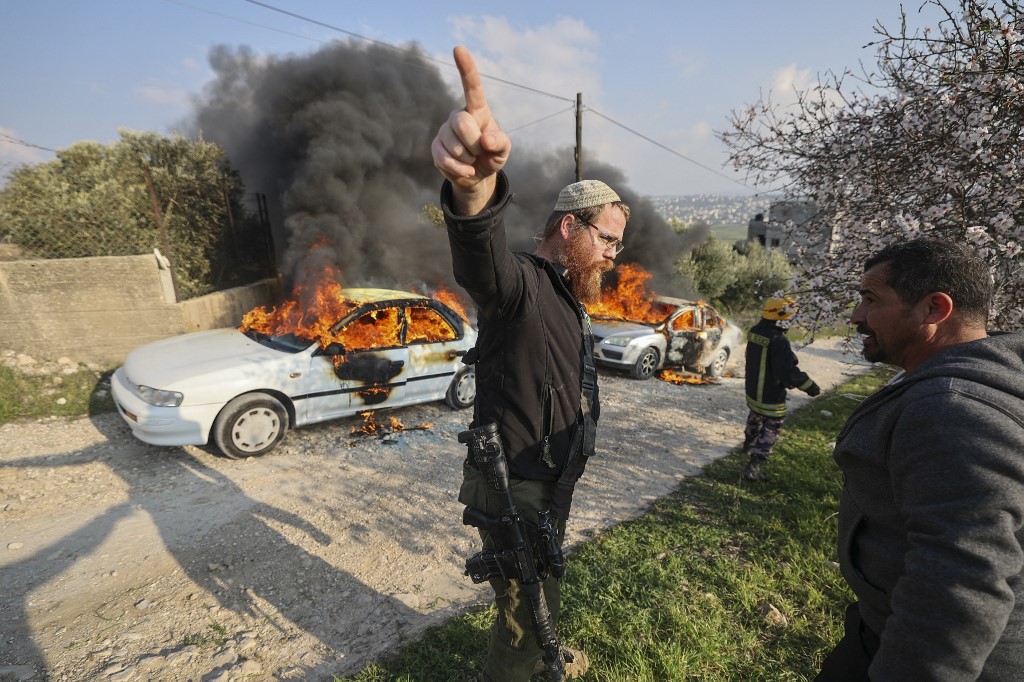
The most striking example of the increased confidence the government has given settlers was the pogrom in the town of Huwwara, where hundreds of settlers rampaged for hours, attacking residents, burning cars and destroying shops and houses.

Nearly 400 Palestinians were wounded and one killed. The whole attack unfolded under the watchful eye of the military. In response, Smotrich stated: "Huwwara needs to be wiped out. I think the state of Israel should do it."

It is disturbing, to say the least, that in such a context it is to save the separation of powers that hundreds of thousands are taking to the streets - refusing to even give a hearing to the victims of Israel’s "liberal democratic" regime.
What liberal democracy?

The current protest movement in Israel is not a movement to transform Israeli politics. It is not even a movement for democracy. It is a movement that fights to maintain the Israeli status quo: a society built on stolen land and the ongoing exclusion of Palestinians, which rubber stamps its colonial rule through a legal system that only itself recognises.

The social groups and the institutions that participate in the movement repeatedly make this clear, and the power relations which they repeat within it confirm it further. One would be forgiven to ask if a colonial society that legalises its expansionist policies through its high court is better, or more democratic, in any meaningful sense, than one that does so through its parliament.

What does it mean to talk about Israel as a liberal democracy, when its institutions maintain the deadly blockade on Gaza, continue to expand settlements in the West Bank, Jerusalem and the Golan Heights, and maintain over 65 laws specifically targeted at Palestinians on both sides of the green line?


The truth is that there can be no democracy under racial supremacy. An apartheid regime is by definition illiberal

Is there any sense in discussing a state as a liberal democracy, which not only expelled hundreds of thousands of its citizens-to-be, but continues to refuse them and their descendants the right to return? What sort of democracy - liberal or otherwise - is based on the denial of the basic right to vote to roughly half of the population - about six million people - that live under its direct rule?

It is worth remembering that all these decisions were made and carried out under the watchful eye of the Israeli high court.

The truth is that there can be no democracy under racial supremacy. An apartheid regime is by definition illiberal. Settler colonial domination requires the forceful rule of one group over another. Netanyahu’s coalition might fall. It might weather the storm.

Either way, democracy will not emerge victorious between the river and the sea.

It would require challenging the most basic ideas of Zionism to achieve such an outcome: that a democratic state should be for and of all of its inhabitants.

That struggle is not being waged in the streets outside the Knesset nor carried out by Israeli unions, soldiers and employers. Its victory is, and always was, dependent on the achievement of the demands formulated so long ago by the Palestinian national movement: liberation and return.

The views expressed in this article belong to the author and do not necessarily reflect the editorial policy of Middle East Eye.

Sai Englert is a lecturer in political economy of the Middle East at Leiden University. He is the author of Settler Colonialism: an Introduction. His research focusses on the consequences of neoliberalism on the labour movement in Israel. He also works on settler colonialism, the transformation of work, and anti-Semitism. He is a member of the editorial board of both the Historical Materialism journal and Notes from Below.


Liberal Israelis and the US empowered the settler right. Now it's out of control

Authoritarian tools forged to control Palestinians are now being turned on elements of the Israeli Jewish population


Zaha Hassan , Daniel Levy
30 March 2023 

Israelis protest against plans by Prime Minister Benjamin Netanyahu's government to overhaul the judicial system, in Tel Aviv on 9 March 2023 (AP)

As Israel’s economy was shuttered and Prime Minister Benjamin Netanyahu became convinced of the need to temporarily suspend his judicial reform legislation this week, one final deal was necessary to hold together his governing coalition.

Itamar Ben Gvir, a serial racist who leads the Jewish Power party and serves as national security minister, was promised by Netanyahu that the state would move forward with creating a national guard under Ben Gvir’s authority - dubbed by some commentators as his “private militia”.

This deal speaks volumes to the intimate connection between the two crises simultaneously gripping Israel: the internal polarisation around judicial reforms, and the government-empowered escalation of extremism against Palestinians.

That connection is glaringly obvious, but rarely acknowledged in Israeli political circles. US President Joe Biden has commented acerbically on the judicial overhaul, while maintaining his studied silence on Israel’s criminal violations of Palestinian rights - indicating that Washington, too, is failing to connect the dots.

The US administration’s convening of Israeli and Palestinian officials, alongside their Jordanian and Egyptian counterparts, in Sharm El Sheikh this month and Aqaba in February, shows that Washington is set on continuing its woefully inadequate template for managing relations with Israel and the accompanying consequences for Palestinians.

While it is not every day that western journalists use words such as “pogrom” to describe attacks on Palestinians, as we saw after the recent events in Huwwara, it is every day that Palestinians experience violence and have their basic human rights trampled by Israeli soldiers, police, settler militias or a combination thereof.

When Netanyahu compared the actions of the settlers in Huwwara to those of pro-democracy protesters across the country, many people were outraged. But the strong link between Israeli policies and violence towards Palestinians, and the contestation around Israeli democracy, is incontrovertible - even if inconvenient.

Israeli society is experiencing what French-Martinique anti-colonial author and politician Aime Cesaire called the “boomerang effect of colonisation”. The work of Cesaire and others looked at how policies used on the colonised by colonial states could then be brought back to the imperial metropole and deployed against citizens.
Curtailing freedoms

Under Israeli settler-colonialism, the geographic distinction between colony and metropole is barely present - but we are now witnessing that phenomenon, whereby some of the authoritarian tools forged by the Israeli state to control Palestinians are being turned on elements of the Israeli Jewish population. Parts of that population fear the curtailment of their own freedoms.

The Israeli right’s push for judicial reforms was heavily motivated by the goal of entrenching occupation, permanently disenfranchising Palestinians, and cementing Jewish supremacy. While the courts have not prevented the gradual attainment of those goals - the massive matrix of settlements being one example of the Israeli court system’s colossal failure to uphold Palestinian rights - they nevertheless have served to obstruct and delay, and will likely be an obstacle to realising full annexation and mass expulsion.

This helps to explain why the last holdouts to Netanyahu’s stopgap compromise, both in parliament and on the streets, were from the hard-right, religious settler camp.

While Palestinians have always paid the price for Israel’s impunity, many Israelis are now discovering that it carries costs for them too

The biggest affront to democratic governance between the Jordan River and the Mediterranean Sea is not the role of Israel’s parliament in selecting judges or overriding their rulings, but rather a permanent occupation that denies democratic rights to Palestinians beyond the 1967 lines, alongside structural discrimination that confers second-class status on Palestinians within those lines.

This ongoing situation has led the main global human rights organisations, Amnesty International and Human Rights Watch, to rightly designate this reality as meeting the legal definition of apartheid. Similar conclusions have previously been drawn by Israeli human rights groups, Palestinian civil society activists, academics and politicians.

The Biden administration has expressed concerns on both the escalating violence in Israel/Palestine and the proposed judicial reforms. The US prescription seems to be the same for dealing with each: a return to the status quo ante. To put it another way, a return to security and democracy for Jewish Israelis, while neither are available to Palestinians.

There is a well-rehearsed Israeli phenomenon of screaming “crisis” whenever a US official disagrees with an Israeli policy. That is now in overdrive, including pushback from Israel’s leadership, after Biden said Netanyahu is not currently invited to the White House and Israel cannot “continue down this road” on judicial reforms (apparently, more than half a century of occupation can continue).

But words have not translated into action; there is no crisis. Indeed, a more level-headed analysis tells a different story - that Washington’s massive leverage vis-a-vis Israel remains untouched, and that the carrot-giving machine is still very much switched to “on”.

Silencing Palestinian voices


As recently as February, the US again guaranteed it would veto a resolution that was not to Israel’s liking at the UN Security Council. The Biden administration continues to nudge and cajole third countries to normalise and upgrade relations with Israel, and it is advancing Israel’s acceptance into the US Visa Waiver Program. From the spokesperson’s podium, all manner of linguistic gymnastics are employed to avoid uttering or confirming that there is an occupation.

To be clear, on the domestic front, Netanyahu has - for now - pulled back from the brink, not in response to US pressure, but rather amid unprecedented domestic opposition. Ironically, this opposition is centred on the threat of economic losses and conscientious objection to military service. Such tools, long advocated by anti-occupation and anti-apartheid advocates, have in that context been pilloried across the Zionist political spectrum as illegitimate or worse.

If negotiations on a judicial reform compromise fail, and Netanyahu resumes the shelved legislation, do not expect the US to play saviour.

For so long, the centrist and liberal Israeli political establishment invested great efforts in silencing Palestinian voices, criminalising the Boycott, Divestment and Sanctions movement, and weaponising spurious accusations of antisemitism in response to legitimate criticisms of Israel. That success is now part of their problem: the international impunity built up by Israel over decades of violating Palestinian rights is now being enjoyed by the hard-line architects of the judicial overhaul.


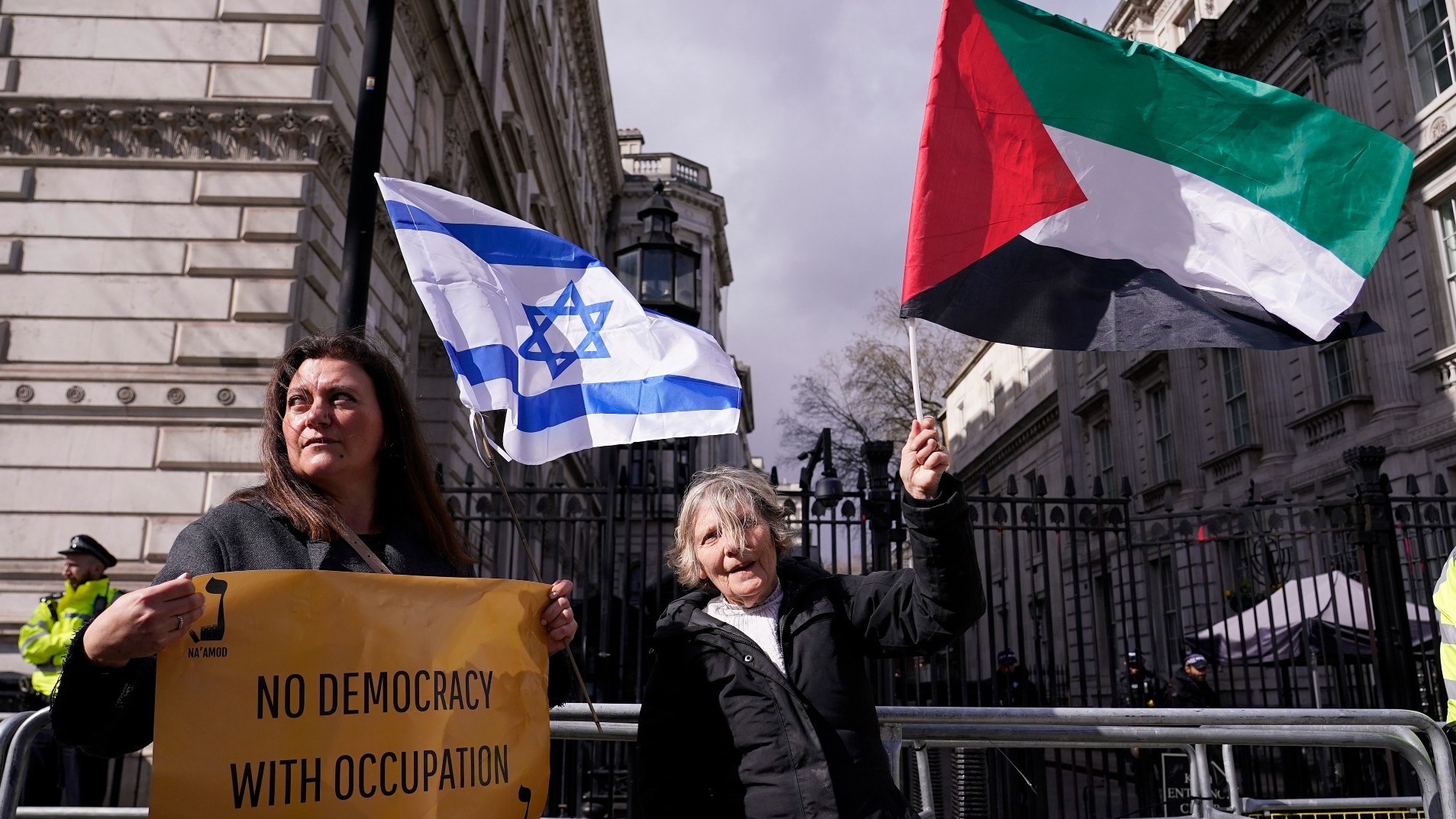
Protestors demonstrate during the visit of Israeli Prime Minister Benjamin Netanyahu to 10 Downing Street in London on 24 March 2023 (AP)

The US approach on the Palestinian front was spelled out most recently in the joint communique from this month’s meeting in Sharm El Sheikh, Egypt. The communique largely repeated the statement issued in February after a similar meeting in Aqaba, Jordan with the same group of participants - now apparently being referred to as the Quintet.

The gaping chasm between western rhetoric on Ukraine and its cover for Israel’s illegal actions carries real costs for the US and Europe

Full of high-sounding aspirations towards trust and peace-building, the Sharm El Sheikh communique is as dead on arrival as its Aqaba equivalent proved to be.

The most devastating inadequacy of this approach is that the US emphasis on de-escalation translates in practice into calm only for Israeli Jews, alongside continued occupation, insecurity and daily humiliation for Palestinians.

The US insistence on both sides avoiding “unilateral measures” might sound reasonable, but this both sides-ism equates Israel’s violations of international law (settlement construction, home demolitions, land confiscation, disproportionate use of force, and collective punishment for the civilian population in Gaza and elsewhere) with Palestinian efforts to uphold that same law via international fora such as the United Nations and International Criminal Court.
High geopolitical stakes

By pushing to intensify military cooperation between Israel and the Palestinian Authority, while ignoring the underlying injustice of indefinite occupation, the US is taking the position that the occupier and occupied should work together to stabilise the occupation. This helps to explain why the Palestinian ruling party, Fatah, bleeds popularity and legitimacy - and why the US (and indeed Palestinian President Mahmoud Abbas himself) refuses to support Palestinian elections, which have not taken place for 17 years.

In short, the continuing US and western policy of guaranteeing Israeli impunity - ensuring that Israel’s actions are cost- and consequence-free - acts as the handmaiden to Israel’s growing extremism. The Israeli public has empowered politicians such as Ben Gvir and Bezalel Smotrich, and Netanyahu has included them in his governing coalition, safe in the knowledge that no meaningful sanctions will follow for Israel.


Israel’s long war between the generals and extremists is not going awayRead More »

Two years ago, we were two of the co-authors of a report titled “Breaking the Israel-Palestine Status Quo: A Rights-Based Approach”, which raised the alarm about the dangerous trajectory of developments, and how US policy exacerbates this situation.

But for the US and the West as a whole, the geopolitical stakes are even higher today. The gaping chasm between western rhetoric on Ukraine and its running cover for Israel’s illegal actions carries real costs for the US and Europe in the international arena. This is frequently cited as “Exhibit A” in the Global South’s dismissal of the moral claims about a western-led “rules-based” order.

Huwwara is the present, but it also offers a link to the past and a glimpse of a potential future. A second Nakba is something that Israeli right-wing politicians openly threaten with increased frequency, and for which settler militias under Israeli military cover are testing the ground.

The insipid politics of the Zionist centre and centre-left cannot reverse these trends. For outside powers, the choice is between complicity in apartheid or holding Israel accountable. And while Palestinians have always paid the price for Israel’s impunity, many Israelis are now discovering that it carries costs for them too.

The views expressed in this article belong to the author and do not necessarily reflect the editorial policy of Middle East Eye.


Zaha Hassan is a human rights lawyer and visiting fellow at the Carnegie Endowment for International Peace. Previously, she was the coordinator and senior legal advisor to the Palestinian negotiating team during Palestine’s bid for UN membership, and was a member of the Palestinian delegation to Quartet-sponsored exploratory talks between 2011 and 2012.

Daniel Levy is the president of the U.S./Middle East Project and a former Israeli negotiator with the Palestinians at Taba under Prime Minister Ehud Barak and at Oslo B under Prime Minister Yitzhak Rabin.

Akbar the Great: How the Mughal emperor set an example for religious tolerance in India

The Indian ruler was known for his military conquests but also his respect for his non-Muslim subjects, especially India's majority Hindu population


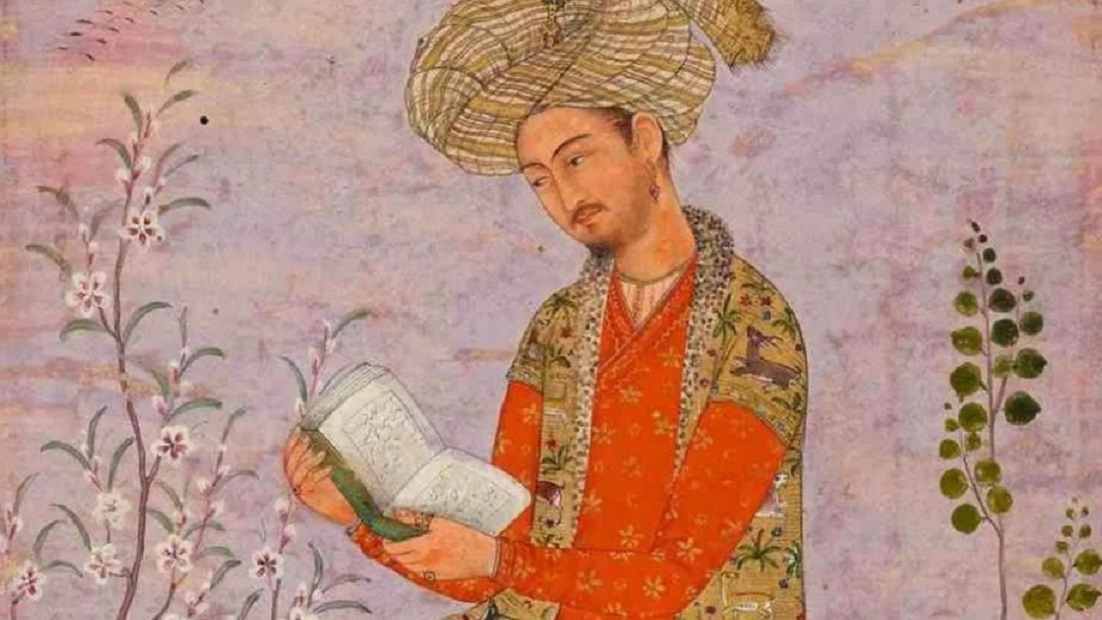
Akbar as depicted by the Indian artist Goverdhan in this painting made in 1630 (Wikimedia)

By Imaan Qureshy
23 March 2023 

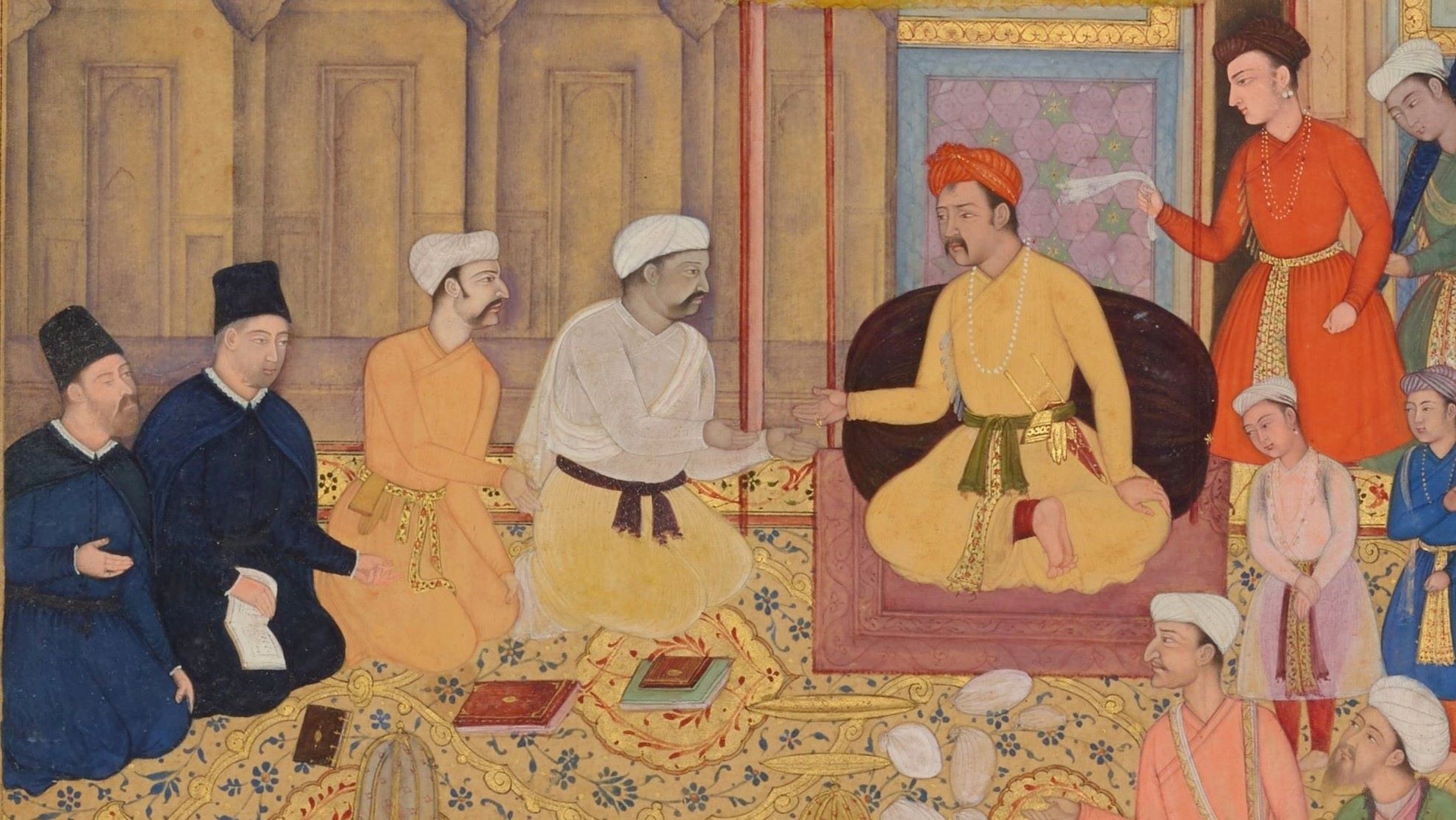
In a famous anecdote, the Mughal Emperor Akbar holds court with representatives of the major religions, who each take turns to make the case for their faith being the correct one.

With their arguments exhausted, the Indian ruler took time to consider what he has heard and make his judgement. But his announcement shocked those present.

“The God of everyone is the same,” he said, repeating the chant of a fakir outside the palace gates instead of the men of religion present within the palace.
Mukarram Jah: An Indian prince and claimant to the Islamic caliphateRead More »

While the story is likely exaggerated, it summarises the popular modern recollection of a ruler whose realm stretched from Afghanistan to the Deccan Plateau of the Indian subcontinent.

While many Hindu nationalists will disagree, memories of Akbar's rule recall a period of relative intercommunal calm in India, and for some Indians a model of religious pluralism and tolerance.

Formally named Abul Fath Jalal-ud-din Akbar, Akbar the Great was the third emperor of the Mughal Empire.

Born in 1542 in Umerkot, in what is now Pakistan’s Sindh province, he is remembered for his rejection of religious intolerance and the measures he took to ensure the security of non-Muslims under his reign.
Ascending to the throne

Akbar was the grandson of the founder of the Mughal Empire, Babur, a Timurid prince who conquered large swathes of the Indian subcontinent in the early 16th century.

The Mughals were descendants of the famed Turco-Mongol conqueror, Timur, who claimed to be a descendant of the famous Mongol leader Genghis Khan.

But despite his royal pedigree, there was no guarantee that Akbar would go on to lead the fledgling empire during his early years.

His father, Emperor Humayun, was beset by rebellions and ultimately forced out of power by Afghan tribesmen.

He was only able to reclaim his throne with help from the Safavid Persians while the Afghans were preoccupied fighting amongst themselves.

The Timurid prince, Babur, established a dynasty that would go on to rule most of the Indian subcontinent (Public domain)

When Akbar was 14, Humayun died and the young man ascended to the throne. He was trained to rule by Bairam Khan, a military commander and regent at the Mughal court.

Khan continued to advise Akbar until the young ruler came of age and was able to establish his own leadership.

Unlike his father, Akbar established a reputation for his inclusive leadership style and he was able to stabilise the Mughal Empire, and even expand its borders.

Under his military leadership, the Mughals captured fertile regions, such as Bengal, and secured access to the Arabian Sea through their conquest of the regions of Sindh and Gujarat.

These newly acquired territories contained religiously-diverse populations that were often majority Hindu, even when their former rulers had been Muslim.

As a result, the success of Akbar’s rule depended on how well he could manage relations with his non-Muslim subjects.

Relations with Hindu subjects


With a mixture of political pragmatism and a genuine interest in Hindu tradition, Akbar sought to protect freedom of religion for all those in the areas he ruled.

For example, after subduing the Rajput tribes in Northern and Central India, he respected their religious needs by guaranteeing their right to public prayer and granting them permission to construct and repair temples.

Many within his court questioned Akbar's decision to allow Hindus to worship freely.

Even his own son, Salim, is reported to have asked why Akbar allowed Hindu ministers to spend state money building a temple.

Akbar is said to have responded by saying: "My son, I love my own religion... [but] the Hindu (minister) also loves his religion. If he wants to spend money on his religion, what right do I have to prevent him... Does he not have the right to love the thing that is his very own?"

The Mughal emperor also attended Hindu religious festivals and had Hindu literature translated into Persian for use by his courtiers.

Birbal, depicted in this 19th-century miniature, was Akbar's close confidante and the commander of his armies (Wikimedia)

Interestingly, Akbar’s relationship with his Hindu minister, Birbal, has had a long-lasting influence in India, and collections of anecdotal exchanges between the two are still popular in the country.

These accounts probably incorporate earlier fables and are today used as children’s stories with an accompanying moral or lesson.

Akbar was also an avid fan of Hindu devotional performances by Mirabai, the wife of Prince Boka Raj of Chittar.

Akbar is said to have shown his appreciation by laying a diamond necklace at the base of her statue of the Hindu deity Krishna.

The Mughal emperor also married several Hindu princesses, such as Jodha Bai, Bikaner, and Jaisalmer, who were allowed to keep their faith.

In addition, a Christian wife named Mary was also given a personal chapel in one of his palaces.

Religious syncretism

Described as an illiterate bibliophile and possibly dyslexic, Akbar liked to have books read out to him in court, particularly on topics like philosophy and religion.

According to statements made in a court biography written by his son, Salim, Akbar "was always with the learned of every religion and creed" and "was always talking with the learned and the wise".

Such was his intellectual curiosity that foreign visitors reported being amazed at his huge personal library, which contained more than 24,000 volumes in Sanskrit, Persian, Greek, Latin, Arabic, and several south Asian languages.

A proponent of interfaith dialogue, Akbar conducted religious discussions at his court in Fatehpur Sikri with theologians, poets, scholars, and philosophers of the Christian, Hindu, Jain, and Zoroastrian faiths.

In this miniature from 1605, Akbar meets with European Jesuits who are seated furthest left (Wikimedia)

The Mughal ruler was also a follower of the Chishti order, a Sufi school of thought known for emphasising love, acceptance, and tolerance.

He was well-versed in Sufi practices and is remembered for instituting "Suleh-e-Kul," a policy of peace that was designed to encourage tolerance and harmony between people of all backgrounds.

His belief in religious tolerance is further demonstrated in a letter Akbar sent to King Philip II of Spain, where he claims to have interacted with "educated men of all religions" rather than relying solely on Muslim experts for his education.


How Shah Rukh Khan's Pathaan will strengthen Hindu nationalism
Read More »

This interest in religion and policy of tolerance culminated in Akbar’s founding of Din-e-Ilahi (literally meaning, "God's religion").

This concept brought together different beliefs and schools of thought and was inspired by the idea of "Wahdat al Wujud" (Unity of Existence), a philosophy first developed by the Sufi mystic Ibn al-Arabi and later adopted by other Sufis.

This idea asserts that all creation is an illusion and that God alone is the source of true reality.

By establishing the Din-e-Ilahi, Akbar encouraged the notion that all religions are interconnected and they all lead back to one ultimate truth, which is God.

It was less a traditional faith than an umbrella religion that sought to find the commonalities in different faiths.
India today

Akbar’s legacy, both real and imagined, has provided a vision of an India where Muslims, Hindus, and other minorities can enjoy religious freedom.

While warfare and conquest were certainly a part of Akbar’s reign, once subdued, conquered peoples of different faiths and cultures were encouraged to coexist in relative peace and harmony.

However, Akbar’s legacy is now being erased by Hindu nationalists.

For example, India’s ruling BJP party has been accused of erasing Mughal history from school textbooks, including references to Akbar.

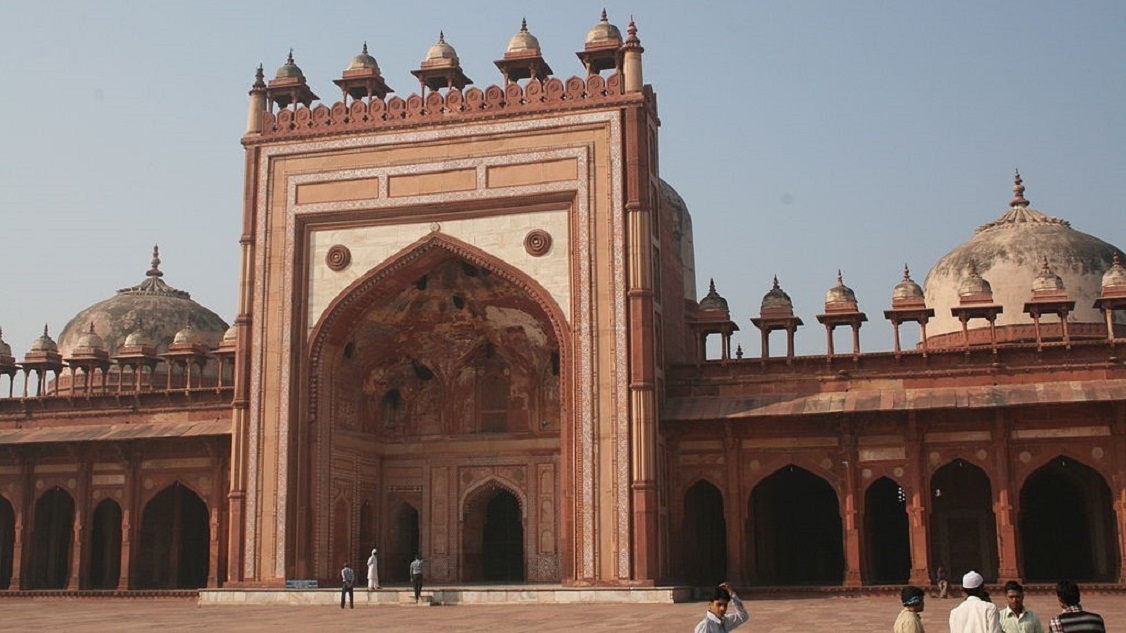
A mosque built in the classical Mughal style at Fatehpur Sikri, Akbar's capital (Wikimedia/Diego Delso)

Underlying this is the belief amongst Hindu nationalists that Muslims are not native to the subcontinent and so deserve to be excluded from Indian history.

Mughal rule, alongside that of other Muslim empires in India, is being recast in terms of foreign invaders conquering and subjugating native Hindus.

According to Indian historians, such readings of history ignore the fact that Hindus and other religious minorities were often part of the ruling class within these dynasties and that the rulers themselves were thoroughly assimilated into Indian culture.

In light of this revisionism, Akbar’s message of religious tolerance and mutual respect between communities remains acutely relevant.

Akbar did more than bring unity to his fragmented country. Under his rule, the Mughal empire tripled in size and became the wealthiest and most powerful Muslim empire of the early modern period.

The ruler left a solid framework for his successors to build on, and he continues to serve as a timely reminder of the need for pluralism.
Egypt and the British colonial origins of the military regime

The authoritarian state security apparatus seen in Egypt today is a direct inheritance from British attempts to tackle radical anti-colonialism in the years surrounding 1919

Kyle J Anderson
28 March 2023 

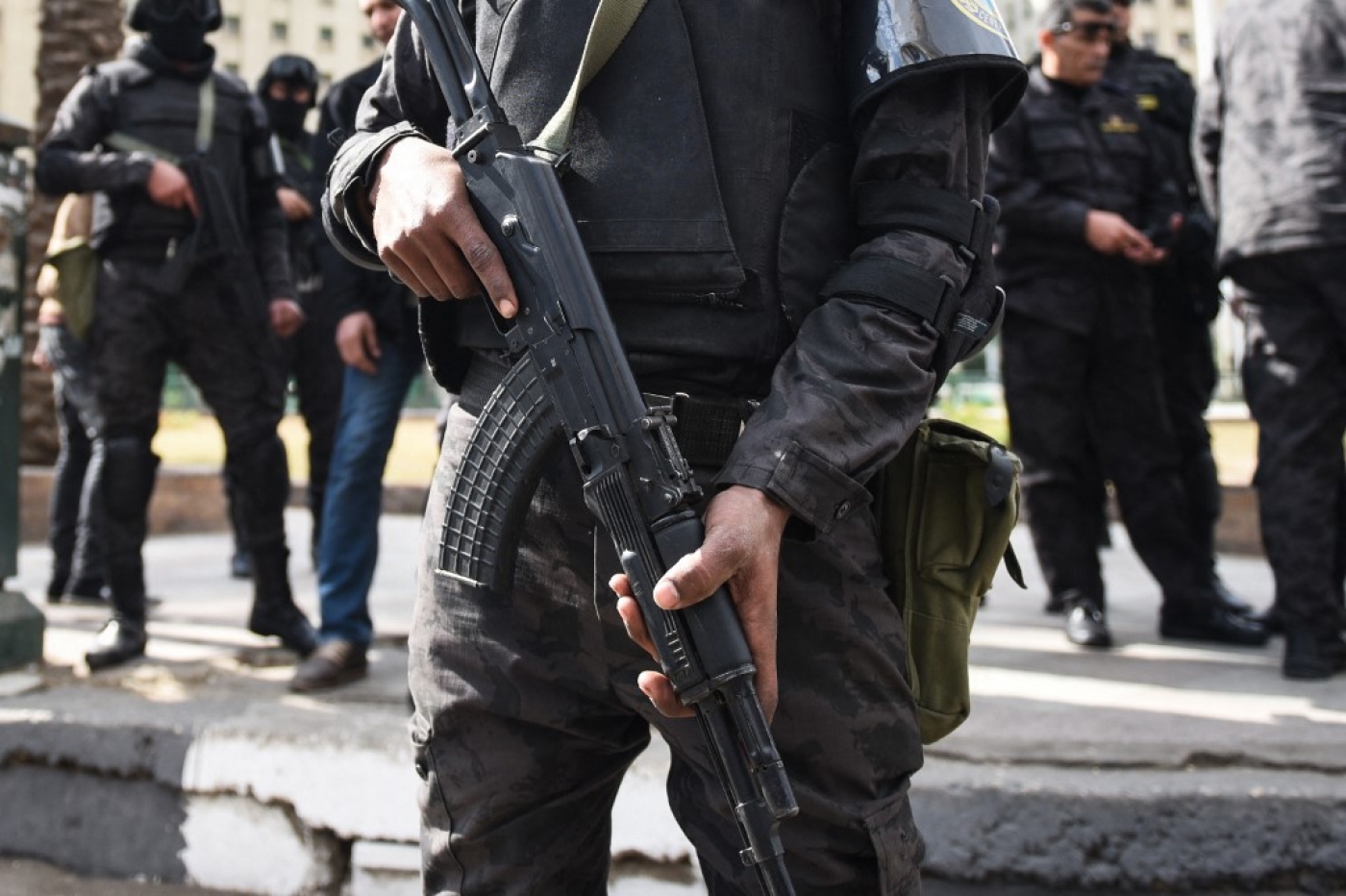
Members of the Egyptian police special forces stand guard in Cairo's Tahrir Square on 25 January 2016, as the country marked the fifth anniversary of the 2011 uprising 


The impulse to compare the 1919 Egyptian revolution with the 2011 revolution of the “Arab Spring” has proven irresistible. Political scientists have drawn parallels between them in terms of the role of youth movements, the activation of social networks and the consolidation of new constitutions.

One thorough attempt is put forth by Robert Springborg in a new edited volume. He compares the military regime that clung to power through the turbulent events of 2011-2013 with the British colonial regime, which maintained its occupation but allowed space for lasting change in the wake of 1919. He concluded that colonial rule was a “softer target” than the military regime, “less violent and more conciliatory”.

Setting aside the actual violence perpetrated by the British army to suppress the rural rebellions in 1919, what most bothers me about this impulse to compare is how events around 1919 and 2011 are treated as distinct, sealed off from one another, and placed in juxtaposition.


Egypt: New books challenge old narratives of the 1919 Revolution
Read More »

In reality, the current military regime that governs Egypt has inherited and developed important technologies of counter-revolution and repression originally created by the British colonial state in response to radical forms of anti-colonial activism in the years surrounding 1919.

Since 2013, the tens of thousands of people that human rights groups estimate have been jailed in Egypt were largely apprehended by police from the National Security division of the Egyptian Ministry of Interior, incarcerated in the infamous Tora prison and tried in State Security courts.

It was the British colonial government that founded the first state security apparatus in Egypt in 1911. Similarly, it was a British doctor, Harry Crookshank, who converted the old military hospital at Tora - which sat at the base of a great limestone quarry - into a public works prison.

Attempts to compare the government of Egypt today with that of a century ago thus miss crucial ways that the latter set the stage for the former. Political sociologist Aly El Raggal has provided the best analysis of this historical relationship that I’ve read so far, but the story of the state security’s founding, and its crucial influence on the Egyptian underground, remains underexplored.

Assassinations


The state security apparatus has its roots in the British response to the assassination of Prime Minister Boutros Ghali in 1910. His assassin, Ibrahim al-Wardani, was the son of a deceased senior police officer in the provinces.

Wardani used his inheritance to fund his studies in Lausanne, Paris and London. While abroad, he mixed with anti-colonial radicals including Indian revolutionary Madan Lal Dhingra, and imbibed the spirit of the anarchist international.

Wardani travelled to Geneva, where he became acquainted with Egyptian nationalist leader, Muhammad Farid. When Wardani returned to Egypt in 1909, he joined Farid’s Nationalist Party and began pursuing politics as a career in earnest.

It was the first political assassination in modern Egyptian history, but it would not be the last

Wardani also joined the secret political society associated with the Nationalist Party, known as “The Society of Brothers’ Solidarity”. New members of the society were subjected to a thorough background check and only admitted after they had sworn on the Quran to help their fellow Muslims. Meetings were held every two weeks, and members also exercised together according to a strict regimen.

Wardani was the treasurer of the society, and also headed their paramilitary fida’i committee, which consisted of men who were willing to sacrifice their lives for the cause. Their membership roster was kept a secret, even from the society’s executive board.

A target for assassination was chosen: Boutros Ghali. Ghali was a long-serving employee in the colonial government who was, at that time, the prime minister. He stood accused of many traitorous acts, perhaps most importantly, his presiding over the extension of the British concession in the Suez Canal.

The deed took place in the early afternoon of 20 February 1910, while Ghali was climbing into his carriage after a visit to the Ministry of Justice. Wardani drew a revolver and shot him in the back six times. The sixth bullet punctured the prime minister’s liver and stomach, and he died the following morning. It was the first political assassination in modern Egyptian history, but it would not be the last.
State security apparatus

Wardani did not even try to escape capture after the shooting. He was caught by Ghali’s driver and the guards at the Ministry of Justice, and brought to the Cairo parquet for interrogation.

The murder investigation was carried out by three groups of police officers; one questioned Wardani and those known to be associated with him; a second examined his papers and those of his associates; and a third arrested and questioned the people mentioned in these documents.

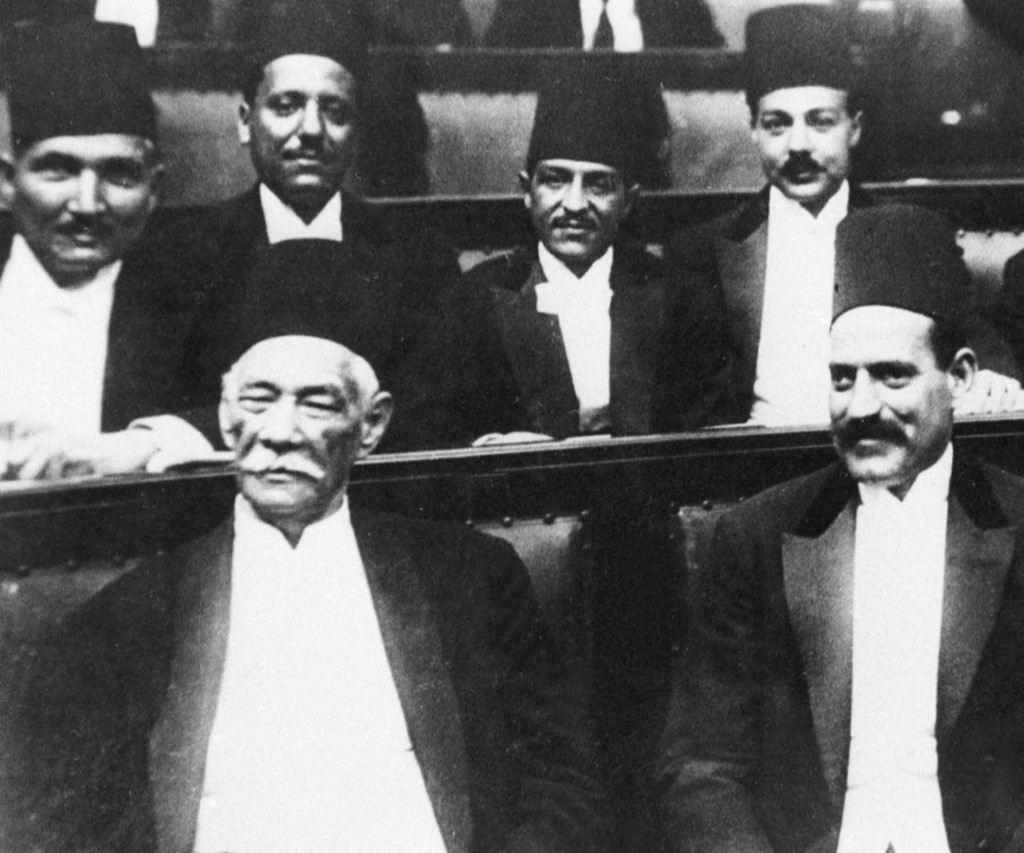
An undated picture from the early 1920s shows Saad Zaghloul (L), the leader of Egypt's 1919 revolution, with Mustafa Pacha al-Nahas (R), his successor, attending a parliament session (AFP)

Following the investigations, Wardani and eight others were put on trial. While investigators had discovered the existence of the Society for Brothers’ Solidarity, other members were acquitted because of the lack of a conspiracy law on the books in Egypt. Wardani himself was found guilty and executed on 28 June.

The British adviser to the Ministry of Interior then decided that a special secret service bureau was needed to collect information about the Egyptian secret societies. The police had already been used to break up anti-colonial protests, but they lacked a real detective force that could combat the anti-colonial underground.

The commandant of the Cairo police, George Harvey, was instructed to form an intelligence organisation within the police. Harvey was a military man who had taken part in the battles to subdue the ‘Urabi revolt and conquer the Mahdist state in Sudan. According to historian Eliezer Tauber, Harvey believed “force should be fought with more force”. His group targeted Egyptian youths involved in politics.
Authoritarian policing

Harvey brought in a police detective from Port Said named George Philippides to help him lead his secret intelligence service. A Christian from Syria, Phillipides cultivated a network of informers run by plainclothes police officers. They created a report on 26 existing secret societies in Egypt, but Tauber finds that they were often confused, construing changing names as separate organisations, and failing to grasp relationships between groups and subgroups.

Furthermore, a number of the new secret service’s practices created perverse incentives. Financial rewards meant that informers could offer reports with barely a hint of truth and collect large sums. Other informers played on officers’ overzealousness and fed them false information. Finally, the brutality of secret service interrogations became well known, and witnesses often claimed their confessions were obtained through torture.


'Terrible things happened here': The battle for Egypt's collective memory
Read More »

The so-called “Shubra plot” is a perfect example of how these practices could impact an investigation. In July 1912, police received a report from a young man who claimed to be involved in a conspiracy. The investigation led to a stakeout in the Cairo suburb of Shubra, where three conspirators were overheard discussing plans to kill the new prime minister and the British consul-general.

One of the conspirators, Muhammad Abd al-Salam, was brought in by the secret service. After denying the charges against him for 22 days, he finally confessed. According to Malak Badrawi, “he broke down and wept, saying that the police had threatened his wife with horrible deeds”. The sources leave it up to us to surmise what these deeds could have been.

When the trial took place in August, Philippides’ testimony lasted for over an hour. The three conspirators were found guilty, and each sentenced to 15 years' imprisonment. The perceived “leader” of the conspiracy, Imam Wakid, served his time at Tora breaking stones.

Four years later, Philippides was found guilty of accepting bribes. According to Badrawi, “a reliable source mentioned that after Philippides was sentenced, he admitted that the case had been concocted by police”. Nevertheless, the three alleged conspirators from the Shubra plot served their full terms.
Infamous informer

The most infamous police informant of the era was Muhammad Nagib al-Hilbawi, a schoolmaster in Alexandria who was known to the secret intelligence service for his nationalist sympathies.

After Ghali’s assassination, the Cairo branch of the Society for Brothers’ Solidarity was disbanded, but the Alexandria branch continued its activities. It was mainly involved in assisting the Sanussi state in Libya in its war against the Italians.

When an old leader of the Cairo branch returned from self-imposed exile in 1914, he resumed interest in assassination as a political tactic, and integrated with the Alexandrian committee.


Hilbawi’s accomplice was half-starved and kept in a dark cell with only a dirty mat to lie on

The target was Husayn Kamil, the new sultan of Egypt, who had controversially accepted the title when the British formally declared martial law at the beginning of the First World War. The 24-year-old Hilbawi was selected to carry out the killing.

An apartment was rented above the main road on the way to the sultan’s palace at Ras al-Tin. On 9 July 1915, as the sultan was headed out to Friday prayer, Hilbawi lit the fuse of the bomb with a cigarette he was smoking as he sat perched on a windowsill.

The cigarette failed to ignite the fuse, and when Hilbawi threw the bomb, it did not explode. He ran off, jumping from roof to roof across the houses nearby. A policeman picked the bomb up later, thinking it was a child’s ball, but noticed it had a smouldering fuse.

Police began questioning the crowd. Several witnesses had noticed a man throw something from the upper story of a certain building. Officers went up to the apartment and found it deserted, with cigarettes still lightly emitting smoke from the ashtray, and one window partially overlooking the street of the sultan’s procession.

A reward of 500 pounds was offered for information leading to the arrest of the perpetrators. By the end of August, nine people had been detained by police, seven of whom appeared before a special military tribunal convened under martial law. Only Hilbawi and one other, the young man who had rented the apartment, were charged.
State’s witness

Police treated the detainees terribly. Hilbawi’s accomplice was half-starved and kept in a dark cell with only a dirty mat to lie on. He was given one pail containing brackish water for drinking, and a dirtier pail for going to the bathroom. He said he once went for 32 hours without food.

Another one of the accused, Mahmud ‘Inayat, had fallen ill during his time in jail. While he was ultimately released, he died from his illness.


Is Egypt on the brink of another uprising?
Read More »

Hilbawi initially faced his imprisonment with steadfastness. Yet after a while, when no one from the Society for Brothers’ Solidarity came to visit him in jail, he became bitter.

When he was released in February 1924, after almost 10 years of cutting stone in the quarries of Tora, he was convinced by the new commandant of police, Thomas Russell, to turn state’s witness.

Hilbawi began hanging out in his old nationalist circles, and heard that his old colleague ‘Inayat’s younger brothers had become known for their assassination campaign during the heady days of the 1919 revolution.

The ‘Inayat brothers carried out the infamous assassination of Sir Lee Stack on 19 November 1924. When Hilbawi’s police handler told him about the attack, he rushed to the society’s headquarters and found the younger ‘Inayats discussing their exploits.

Soon, the ‘Inayats were arrested on information provided by Hilbawi, and investigations into their activities put the final nail in the coffin of the Society of Brothers’ Solidarity in 1926. Afterwards, there was a noticeable lull in political assassination attempts in Egypt.
Centralisation of police state

Investigation into the ‘Inayat’s campaign of assassinations after the 1919 revolution led to the reorganisation of the state security and intelligence apparatus.

Up until that point, each major city and town had its own police chiefs who were largely autonomous, with their own detectives and informants. In February 1920, a new special section was created within the Ministry of Interior that would centralise the collection and analysis of police intelligence throughout the country.

In February 1922, the British unilaterally declared Egypt independent, but “reserved” their right to protect the foreign communities in Egypt. British officials thus continued to run the secret intelligence service in the country. In 1925, after Stack’s assassination had highlighted the political police deficiencies, the Cairo police special intelligence service was closed, and files were transferred to the Ministry of Interior.

It was not until the 1936 Anglo-Egyptian treaty that the secret intelligence organisation within the Ministry of Interior was “Egyptianised”. But this only meant the substitution of British police chiefs with Egyptian men who had been brought up in the same system.

Without a full reform of the police state, tackling its authoritarian tendencies, decolonisation remains an unrealised dream in Egypt.

The views expressed in this article belong to the author and do not necessarily reflect the editorial policy of Middle East Eye.

Kyle J. Anderson is an Assistant Professor in the Department of History and Philosophy at SUNY Old Westbury. He is the author of The Egyptian Labor Corps: Race, Space, and Place in The First World War (Austin, TX: University of Texas Press, 2021).
Iraq war: 20 years later and no lessons learned by war's proponents, experts say

Ahead of the 20th anniversary of the US invasion of Iraq, foreign policy experts warn 'absolutely it could happen again'


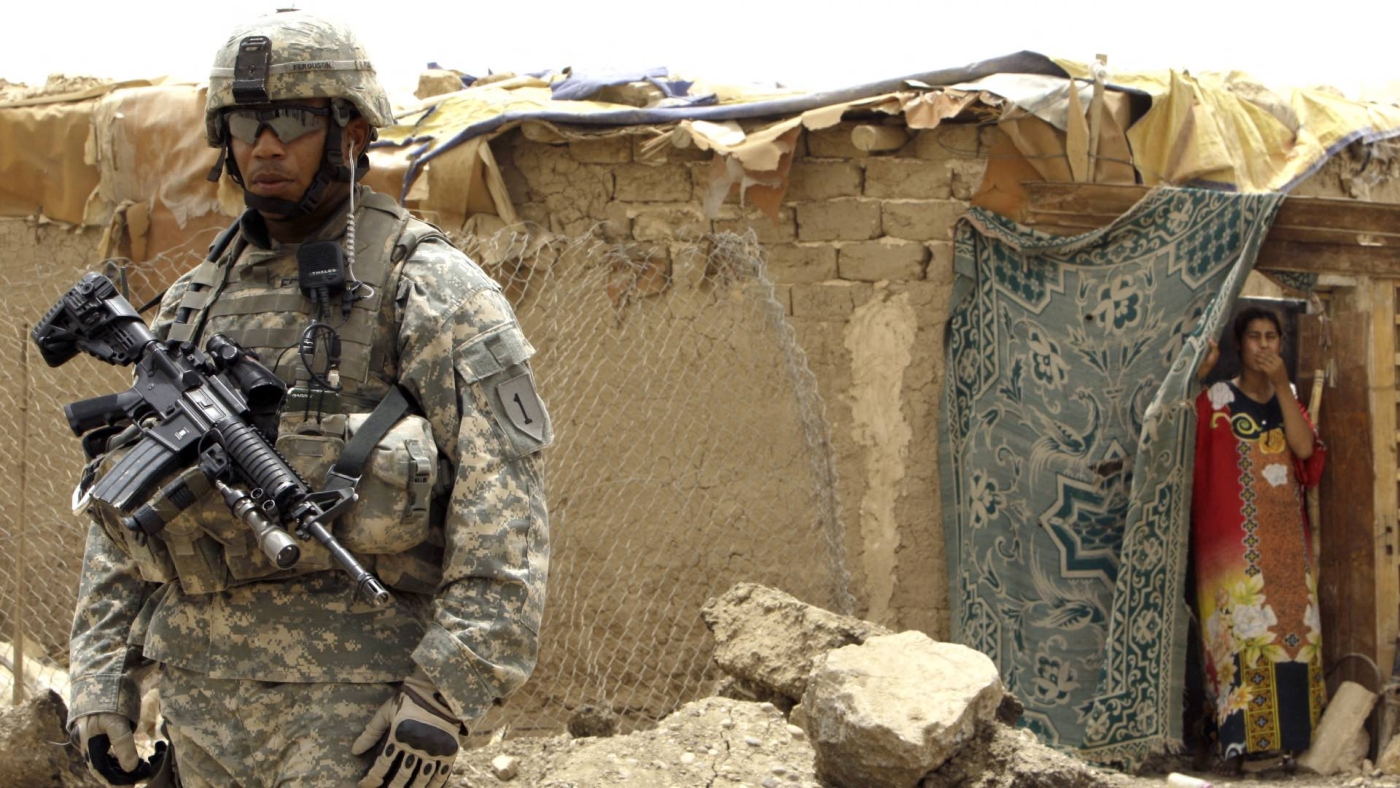
An Iraqi woman looks on as a US soldier secures the Chikuk complex in the Kadhimiya district of northwest Baghdad, on 21 July 2009 (AFP)

By MEE staff in Washington
Published date: 17 March 2023

Looking back at the past two decades since the US invasion of Iraq in March 2003, foreign policy experts warn that Washington has learned few lessons since then, and the lack of accountability for the war's proponents has created an environment where a similar American-led war could occur.

"My basic answer to the question of 'could it happen again?' is for sure, absolutely it could happen again," Ahsan Butt, an associate professor at George Mason University, said during a panel hosted on Thursday by the Cato Institute in Washington.

"The real lessons of the Iraq war really haven't been learned."
- Ahsan Butt, George Mason University

In the leadup to the US invasion of Iraq, top officials in the American government, including former President George Bush, said that Saddam Hussein was in possession of weapons of mass destruction (WMDs).

They cited US intelligence, including on the basis of information from a now-discredited Iraqi opposition group, which turned out to be false. Nevertheless, Washington launched an invasion with little opposition from Congress, leading to a war that killed hundreds of thousands of people in Iraq, and later in Syria.

And leading up to the invasion, there was near unanimous support for the war in Washington, with few news outlets - with the exception of Knight Ridder - pushing back against the links between Iraq's Hussein, WMDs, and al-Qaeda.

The Cato Institute was one of the few think tanks in the US to push back against the US invasion, and for doing so was slammed with criticism and censure from Washington's circle of foreign policy experts.

But individuals like Bush, former deputy defence secretary Paul Wolfowitz, former secretary of state Condoleeza Rice, and many others who supported the war efforts, did not face any consequences for their mistakes nor did their reputations suffer.

"We have to be honest that the worst advocates, cheerleaders and purveyors of the worst lies of the Iraq war have not been held accountable. They continue to exercise outsized influence in most of our key institutions and the media," said Don Caldwell, vice president of the Center for Renewing America and a veteran of the Iraq War.

"The worst thing though, is the fact that there has not been a repudiation of the mindset that led us to the war in Iraq."
Partisan polarisation

According to the Pew Research Center, 66 percent of Americans said they believed that Saddam Hussein was involved in the 9/11 attacks on the World Trade Center and the Pentagon. In April 2003, more than 70 percent of Americans polled said that the US was right in going to war in Iraq.

"I think that's the median voter's position that this is a reasonable idea badly executed, not a bad idea. And so I think that's another big reason why something like this could happen relatively soon and relatively easy because no one's actually dealt with the implications of why the US went into Iraq," Butt said.

However, the experts noted that in the past two decades, several factors have changed in the US that help to create more opposition to US policy decisions.


Iraq War: When Baghdad fell, the country's treasures were lost
Read More »

One is that the US political landscape is more partisan than it was in 2003, which makes it more difficult to come to unanimous decisions about going to war.

"Generally partisan polarisation is sort of this, quote-unquote, bad thing in the US," Butt said.

"But I think when it comes to starting dumb or idiotic or aggressive wars, it's probably a good thing because it's hard for any one leader or any one president, any one cabinet to have that bipartisan support you need in this country that was quite common in the 2000s."

Caldwell also noted that there are many more institutions in place in Washington that would push back against the drums of war.

"You have more scholars spread across more centres and institutions and academia and in the policy space on both the right and left and I think that is a positive development," Caldwell said.

However, the ability of the president to go to war without the approval of Congress was established in the wake of the 9/11 attacks and the later invasion of Iraq. There are several authorisations for the use of military force (AUMF) currently in place, including the 1991 AUMF passed during the First Gulf War, the 2001 AUMF passed after the 9/11 attacks, and the 2002 AUMF for Iraq.

While Congress is moving closer towards shuttering the 1991 and 2002 AUMFs, the wider-ranging 2001 authorisation remains on the books and gives the White House extensive authority to go after anyone linked to the perpetrators of the 9/11 attacks.

According to Sumantra Maitra, a senior editor at The American Conservative, the worldview and framework of many in the current Biden administration is not far from that of the Bush administration. US President Joe Biden himself, then as a senator, spoke of war with Iraq several years before the invasion.

"The calculation of the worldview of this administration is not very different from the previous administrations," Maitra said during the panel at Cato.

UK

Can we stop the government criminalising protest? With Jodie Beck of Liberty

Netflix’s “Farha” Depicts Palestinian Struggle To Preserve History

A new film portraying the 1948 Nakba triggers generational trauma for Palestinians and a slander campaign by Nakba-deniers

Netflix’s “Farha” Depicts Palestinian Struggle To Preserve History
Official still from FARHA by Darin J. Sallam. Source TaleBox.

Every Palestinian you meet is a living historical archive who carries with them the stories and trauma of a time before their own, from a place on which many can never step foot. The vast majority of Palestinian stories can be traced back to the Nakba, or “catastrophe,” in 1948, when around 750,000 Palestinians were ethnically cleansed from more than 400 villages by the Zionist Irgun and Lehi (aka “Stern Gang”) militias.

In the past, these stories rarely made it past the barriers of their households. Even if they did find their way into books, documentaries or movies, they were unable to penetrate the thick walls of the Western media to find a prominent platform. This year, the walls have begun to crack. First- and second-generation Palestinians watched their clashing Western and Palestinian identities (and, for myself, the very small and niche Palestinian-Texan identity) acted out in the Netflix original limited series “Mo.” Now, older generations can see their own stories of exile reflected in the film “Farha.”

“Farha,” which is now streaming on Netflix, is the brainchild of Darin Sallam, a Jordanian of Palestinian descent. When Sallam was a young girl, her mother told her the story of a friend she met in Syria who had fled Palestine in 1948, when her entire village was sent into exile. This friend was forced to hide in a basement for days, hoping her father would return for her. It was there that she witnessed an entire family, including two children and a newborn baby, murdered outside her home. This story — of an ambitious 14-year-old girl transitioning from the daughter of the village mayor to an orphan refugee, all within the four walls of her basement — stuck with Sallam for years, and eventually became the film chosen by Jordan as its Best International Film Oscar entry for 2022. Yet, along with this acclaim, “Farha” has also become the target of a widespread slander campaign led by the Israeli government.

“It’s crazy that Netflix decided to stream a movie whose whole purpose is to create a false pretence and incite against Israeli soldiers,” read a statement issued by Israel’s finance minister, Avigdor Lieberman. In the same statement, Lieberman threatened to withdraw state funding from the Al Saraya Theater in Yaffa (or Jaffa) for screening the film.

On the day before, Israel’s Culture Minister Chili Tropper accused the film of making “false plots against IDF soldiers,” saying, “It describes the massacre of a family while comparing it to the behavior of the Nazis in the Holocaust, [which] is particularly outrageous.”

The ministers’ comments incited a public grassroots campaign calling on audiences to cancel their Netflix subscriptions and give the film poor ratings on IMDB, Google and Netflix.

In response, Palestinians led a defense campaign, spreading the word of the importance of “Farha” and advocating in order to boost the low reviews. Along with this call to action, Palestinians felt the need to provide proof of their history, sharing statistics about the Nakba and the stories of their own ancestors as well. They also highlighted the irony of having to pause from talking about the exiles happening today in East Jerusalem’s Silwan and Sheikh Jarrah districts in order to defend the validity of their ancestors’ exiles. The evidence of the Nakba isn’t hiding in documents; it can easily be seen in the current state of the refugee crisis and the ongoing displacement of Palestinian residents today.

In the end, Netflix made no comment and continued with the release of the film, which remains on the streaming platform. The ratings have proven favorable, with a 4.9/5 on Google and an 8.5/10 on IMDB, along with a spot in the top 100 Most Popular Movie rankings on the latter. Thousands of Palestinians have sat with one another in their living rooms, watching the portrayal of an event that many claim never happened.

If you were to ask any Palestinian about the film, their immediate responses would likely not be about the cinematography, the soundtrack or the set. Rather, the focus would probably be on the emotional response triggered by the depiction of a series of events that are difficult to remember, yet must not be forgotten. This is not to say the movie does not have the typical marks of production value. It does. Many parts of it feel detailed and intentional, whether they be the authenticity of the specific Palestinian thobe (a traditional embroidered dress handmade and worn by women) donned by the title character Farha and her friends, or the village dialect they speak. Driving this impression further is the fact the audience never leaves Farha’s presence (whether looking at her or looking out from her point of view), a stylistic decision that drills in Sallam’s point of sharing the singular experience of the Nakba.

The film’s reception is monumental in illustrating that Palestinians do not yet have the privilege of critiquing how our history is portrayed; we are still processing the emotions of just seeing ourselves on screen in a way that is subject to our own agency, rather than the decision-making of the Hollywood elite, who have been all-too-comfortable with portraying us in nasty stereotypes — when not ignoring our stories altogether.

I have never before had the chance to see what my grandmother’s girlhood looked like before the Israeli occupation began, or to hear the songs my elders still sing at weddings in our village. I’ve only ever seen black-and-white photos of barefoot Palestinians fleeing their homes with their belongings on their heads. I’ve never thought of what the Nakba sounded like — the shrieks of women and children amidst the sounds of explosions — or the conversations that took place between the family members who chose to stay and defend their homes and those who fled for safety.

Unlike the majority of Palestinians in the diaspora, none of my ancestors were displaced by the Nakba. My family’s village, Mazaraa al-Sharqiya, was one of the “lucky” ones located in the West Bank, which came under Jordanian rather than Israeli control after 1948. It still exists today, under Israeli military occupation. For those who do have grandmothers and grandfathers who were exiled, and have much more traumatic stories than Farha’s, it is an even heavier viewing. In fact, it is so heavy that “healing circles” have been organized online for those who need a space in which to talk about their thoughts and feelings after watching the film.

It is true that this heaviness comes from generational trauma. But it also stresses the importance of artistic development as a tool for documenting history. Steve McQueen’s “12 Years a Slave” showed the horrific treatment of slaves. Elie Wiesel’s “Night” detailed the extreme evils committed during the Holocaust. No matter the artistic critiques, these are pieces of art that make one feel history rather than just know it. And though the main purpose may be to educate other people on the importance of an experience or event, these books and films are also useful for those within the affected communities, as tools for healing and validation.