It’s possible that I shall make an ass of myself. But in that case one can always get out of it with a little dialectic. I have, of course, so worded my proposition as to be right either way (K.Marx, Letter to F.Engels on the Indian Mutiny)
Thursday, March 30, 2023
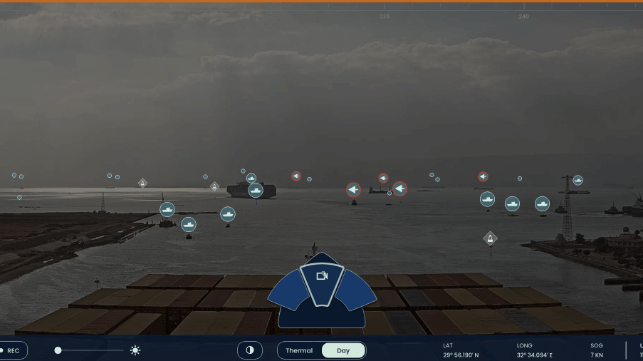
Study: AI Situational-Awareness System Reduces Close Encounters
Advocates of situational-awareness / navigation-assist tools have long argued that AI technology can make shipping safer, and now it appears that they may have the data to prove it. In an analysis of navigation outcomes, Israeli startup Orca AI found that close encounter events declined by 27 percent and sharp maneuvers decreased by 22 percent aboard ships using its collision avoidance system.
The analysis was conducted on 110 tankers, boxships, bulkers and ro/ros which were equipped with the Orca AI platform throughout 2022. The data set covered 10 million nautical miles of navigation in open waters, and an average of three close encounter events every 1,000 nm sailed. Each close encounter was evaluated by CPA, TCPA, crew reaction time, average speed over ground, average cross-track error and weather conditions.
"The masters, officers and fleet managers we worked with quickly realized that Orca AI generates a real, tangible impact, and helps to mitigate the associated costs of safety incidents, downtime and reputational damage," said Orca AI CTO and co-founder Dor Raviv. “The impressive numbers are a result of our cutting-edge technology, and a close collaboration with our innovative and forward-thinking customers."
Orca AI's system draws on computer vision technology, onboard infrafred and visible-spectrum cameras, and advanced data processing to identify and evaluate marine traffic situations. Its shipboard nav-assist tool informs the crew of impending hazards ahead, and its shipmanagement tool allows the home office to watch the crew's navigation performance and COLREGS compliance, including benchmarking against the fleet.
This system makes recommendations without taking direct control of the helm, but well-financed competitors are racing to develop autonomous navigation systems that can make and execute collision-avoidance decisions automatically. South Korea's Big Three - HD Hyundai,Samsung Heavy Industries and DSME - are all testing in-house autonomy systems, with assistance from class and from third-party technology vendors.
New York City to Commission its First Hybrid, Electric Ferry in 2024
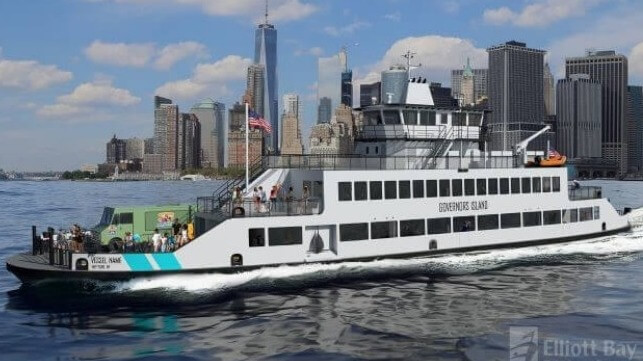
New York City will commission its first electric, hybrid ferry in 2024 (Elliott Bay)
New York City is joining the growing list of operators of hybrid-electric ferries as it ordered its first vessel for public operation in New York harbor. The City’s Mayor Eric Adams announced yesterday, March 29, that a contract has been awarded for the construction of the first public, hybrid-electric ferry for the city. They expect the vessel to begin transporting tourists from Lower Manhattan to Governors Island in the summer of 2024.
The first vessel of its kind to provide public transportation within New York Harbor, the new ferry will be equipped with a hybrid propulsion system that will reduce air pollution by allowing it to toggle between zero-emission battery-only power and battery-assisted hybrid with diesel backup. It will have a capacity for up to 1,200 passengers and will have a cruising speed of 10 knots. The passenger amenities will include a lower-level ADA-accessible lounge and restrooms on each level.
The ferry was designed for New York City by the Elliott Bay Design Group, which previously worked with New York City on the design and construction of three new ferries operating to Staten Island. In a 2021 request for proposals, the vessel was described as being 190 feet in length, doubled-ended with the ability to transport both vehicles and passengers. battery hybrid diesel-electric propulsion system. Propulsion was described as a two variable?speed, reversing permanent magnet motors rated for 540 kW at 670 rpm with one propeller at each end of the vessel.
“As New Yorkers transition to greener forms of transportation, the city and our partners are leading the way with cleaner, more efficient ways to go just about anywhere,” said Mayor Adams. “The next generation deserves a green city and a vibrant Governors Island, and this first-of-its-kind ferry will help us deliver both.”
The ferry will have the ability to operate either fully on battery power or in dual-power mode. The battery-assist mode will allow the new ferry to reduce carbon dioxide emissions by approximately 600 tons annually. Future plans for rapid vessel charging installation will enable the ferry to operate with zero-emission battery-only propulsion, at which point emissions will drop to nearly zero.
“Ferries are a vital part of transportation infrastructure, lasting 40 to 60 years or more said John W. Waterhouse, principal in charge of Elliott Bay Design Group. “We work closely with our clients and their teams to ensure the vessel is fit for purpose and engineered to match a long life.”
The new ferry will replace the diesel-powered Lt. Samuel S. Coursen, which is currently operated by the Trust for Governors Island. The current vehicle and passenger ferry was commissioned by the U.S. Army in 1956 and has been in continuous use since.
The construction contract for the Conard Shipyard’s facility in Morgan City, Louisiana. During the announcement, the city said the ferry is under construction with delivery due by mid-2024. The ferry will be operated by the Trust for Governors Island on trips that last for about 15 minutes between Manhattan and the island.
As part of the announcement of the ferry, New York City and the Trust also began a citywide competition to name the new vessel. New Yorkers are invited to suggest names for the vessel.
“This hybrid ferry marks a historic step forward in expanding access to Governors Island while promoting state-of-the-art and sustainable technology to power our ferry fleet,” said Trust for Governors Island President and CEO Newman. “Each year, hundreds of thousands of visitors board our vessels and journey to Governors Island to experience our rich recreational, cultural, and educational resources. We are thrilled to make the journey easier for our visitors while helping to lead the charge in electrifying the vessels of New York Harbor.”
A historical part of New York Harbor, the island was used by the U.S. Army, and in 1966, the Island was transferred to the United States Coast Guard. It became the Coast Guard's largest installation with over 3,000 people living on the island at its peak. The Coast Guard closed its base in September 1996 and in the early 2000s a portion of the island became a national park. The remaining 150 acres were sold to New York State 20 years ago and became a public park.
Insurers Agree to Take Claims for Princess Empress Spill
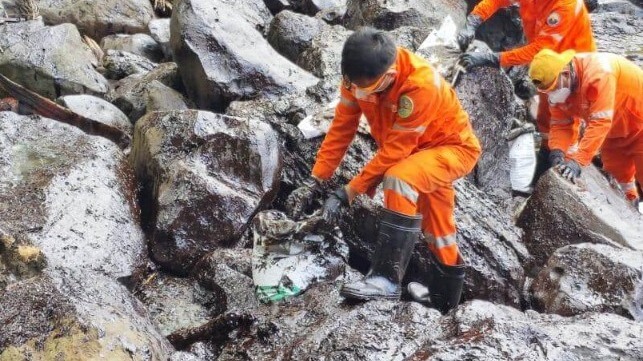
Spill response workers clean the waterfront at the town of Pola, where the spill had the greatest impact (PCG)
The International Oil Pollution Compensation Funds and specialty insurer Shipowners' P&I have agreed to open up a joint office in Oriental Mindoro to gather claims for compensation related to the Princess Empress fuel oil spill. The decision dispels Philippine lawmakers' concerns that the insurer would attempt to cancel coverage and avoid paying out damages because of irregularities with the vessel operator's licensing paperwork.
The small product tanker Princess Empress went down off Pola, Oriental Mindoro on February 28 with a cargo of 900,000 liters of fuel oil. The crew were rescued safely by a good samaritan vessel, but petroleum began to leak out of the wreck's cargo tanks, threatening a wide swath of the central Philippines with pollution. The spill has come ashore on beaches and reefs from Calapan and Verde Island in the northwest to the Caluya Islands in the south. Remnants of the slick have been detected as far away as Palawan, 200 nm to the southwest of the wreck site. An estimated 175,000 people have been affected, and thousands of fishermen are out of work because of an ongoing fishing ban.
Based on the extent of the spill, the damages may exceed the P&I club's limit of liability, triggering additional coverage from the IOPC Funds, the insurers said in a statement Wednesday. After discussions with all parties, the insurers have agreed to start collecting claims for compensation from affected residents beginning this week. The central claims office is located in Calapan, and smaller offices will open around the region within a few weeks.
Spill response efforts are ongoing, and more assets are joining the operation. The insurers have hired French oil spill response company Le Floch Depollution (LFD), and the firm is activating its resources now. Japan, South Korea and the United States are all providing advice and material assistance; Japan has dispatched a salvage ship with an ROV, which has conducted inspections of the Princess Empress' wreck site. An American-chartered ship, the Pacific Valkyrie, is under way with an additional ROV to join the work on site. The ultimate objective is to remediate the remaining oil aboard the tanker and limit further pollution.
According to the Philippine Coast Guard, the ROV inspections show that Princess Empress sustained extensive damage in the sinking. Four of the vessel's eight tanks are believed to have released most or all of their contents, amounting to about 400,000 liters of fuel oil.
Barges Break Free and Are Wedged Against Ohio River Dam
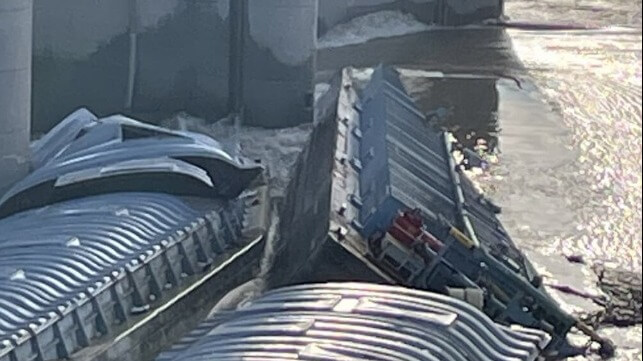
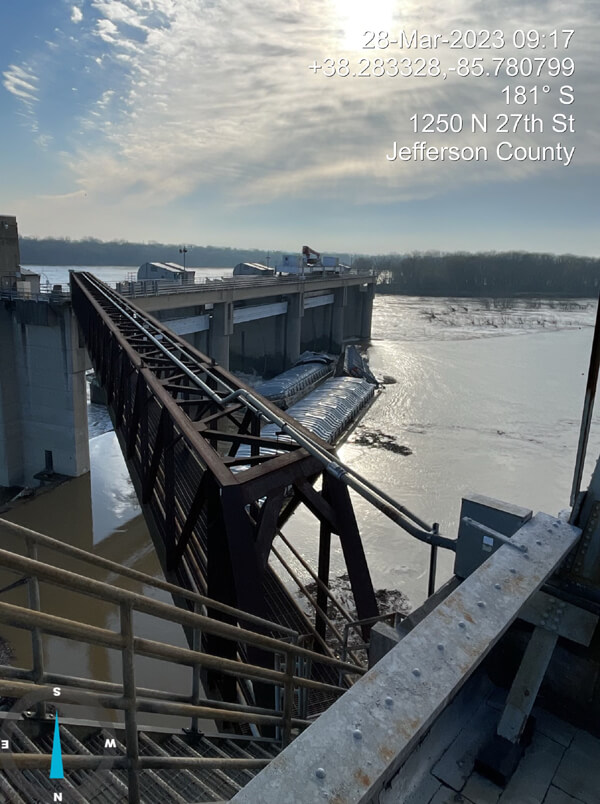
Three barges including one carrying methanol are wedged against an Ohio River dam (Kentucky Energy and Environment Cabinet photos)
Emergency response teams from the U.S. Coast Guard along with state and local officials are responding to a tug and barge accident on the Ohio River near Louisville, Kentucky that is disrupting river traffic. After breaking loose, several of the barges including one transporting toxic methanol have become wedged against a dam structure on the river.
The Kentucky Energy and Environment Cabinet is reporting that the incident began around 2:00 a.m. on March 28 when a tugboat towing 11 barges made contact with the structure at the entrance to the Portland Canal near the McAlpine Lock and Dam which is at mile 606.8 on the Ohio River. They report that 10 barges broke free of the tow as a result of the allision while one remained attached to the tug.
The barges drifted along the river with three becoming wedged up against the dam structure and a pier for the Louisville and Indiana bridge. One of the barges, the one loaded with the methanol cargo, has become partially submerged and according to the U.S. Army Corps of Engineers in Louisville, which is responsible for the lock, the barge is now partially submerged and taking on water.
Seven of the barges in the tow were loaded with corn and soy, while one has 1,400 metric tons of methanol and the remaining three were empty. City and state officials are emphasizing that there has been no leak and that the local water remains safe at this time. However, they are also cautioning about the toxic nature of methanol and if there should be a leak, the methanol could explode if ignited.
“We had to shut down traffic. There’s going to be salvage operations, and it’s going to be dangerous,” Chris Davis, a spokesperson for the U.S. Coast Guard told reporters.
The Army Corps also reports that the locks at the McAlpin Locks and Dam are closed to traffic. They are saying that the locks will remain closed until the barges pinned up against the dam are stabilized.
The U.S. Coast Guard, Army Corps, as well as organizations from Kentucky and Louisville, are participating in a Unified Command structure for the salvage operation. They are reporting that the seven barges floating free on the river were recovered with the focus being on the one that is partially submerged and the other two that were damaged in the pile up and remain up against the structures.
Bill Proposes Limits on China and its Influence on Ocean Shipping
Bill sponsors say there is more to do to complete the 2022 reforms while also targeting China
Following up on a promise to address certain shortcomings in the 2022 Ocean Shipping Reform Act and to increase the scrutiny of Chinese influence over the shipping industry, U.S. Representatives Dusty Johnson and John Garamendi both of California introduced the Ocean Shipping Reform Implementation Act. Calling their proposed legislation “Ocean Shipping Reform 2.0,” the sponsors said it would further protect American agriculture and exports by clarifying the role of the Federal Maritime Commission while also focusing on China and the role of shipping exchanges. This bill is in addition to a proposal introduced last week to revoke the anti-trust exemptions for ocean carriers.
“Last June, Congress passed our landmark reform to the nation’s ocean shipping laws for the first time in nearly a quarter century to protect American businesses and consumers from price gouging by foreign-flagged ocean liners,” said Garamendi. “Congressman Johnson and I are committed to seeing that bipartisan 2022 law implemented fully to support American exporters and correct our nation’s longstanding trade imbalance with countries like China. After years of endless happy talk in Washington, we are finally making free trade fair trade and stopping Chinese state-controlled companies from ripping off our country and gutting our manufacturing jobs. Our implementation bill introduced today will finish the job.”
The representatives are being joined by a broad coalition of U.S. agricultural organizations and trade groups in supporting the additional legislation. The groups broadly recognize the success of last year’s reforms while saying additional action is needed to ensure the free flow of goods through U.S. ports and to hold ocean carriers accountable for their responsibilities to keep trade flowing.
“We’ve seen the positive results of the Ocean Shipping Reform Act, but there is more to be done to stay tough on China,” said Johnson. “The Ocean Shipping Reform Implementation Act gives the FMC the authority to protect U.S. ports, shippers, and manufacturers from the CCP’s influence. Fair trade practices benefit all parts of the supply chain from producer to manufacturer, shipper to consumer.”
The new bill proposes prohibitions on U.S. ports from using the National Transportation Logistics Public Information Platform (LOGINK), which the sponsors contend is Chinese state-sponsored software. It would also allow the FMC to investigate foreign shipping exchanges to preempt improper business practices, with the sponsors specifically targeting the Shanghai Shipping Exchange. If passed, it would also direct the U.S. Department of Transportation to contract an independent auditor to examine the influence of the People’s Republic of China on the business practices of the Shanghai Shipping Exchange and report to Congress.
Other sections address elements the sponsors believe got lost in the reconciliation between the House and Senate versions of last year’s bill. For example, it codifies the definition of “controlled carrier” under the Shipping Act to encompass state-controlled enterprises in non-market economies like the People’s Republic of China, while also streamlining data standards for maritime freight logistics, removing some duplicate reporting requirements and clarifies that Federal Maritime Commission may also stipulate additional minimum requirements for service contracts by ocean common carriers, at the agency’s discretion.
All of this comes as the FMC continues to move forward with the implementation of the 2022 reforms. Last week, the FMC reported that it is actively seeking information to confirm that ocean carriers and marine terminal operators are complying with the law following a 2022 decision addressing when per diem detention charges can be billed. The commission, through its Vessel-Operating Common Carrier Audit Program, is contacting the 11 largest ocean carriers calling the United States to confirm these shipping lines are adjusting their demurrage and detention practices to reflect the ruling that that the charging of per-diem when a port was closed and equipment could not be returned was unjust and unreasonable.
The FMC has also defined new processes for filing complaints and how it will review complaints. It is also moving forward to complete the definitions and implementation of other elements of the legislation.
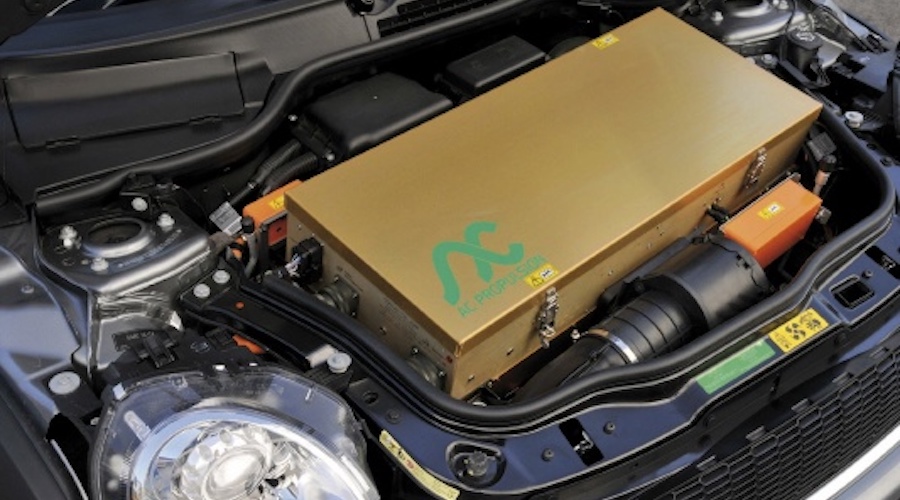
US and EU near critical minerals accord to unlock US subsidies Bloomberg News | March 29, 2023 | e-Mini Cooper battery. (Reference image by Underway in Ireland, Flickr.)
The European Union and the US are nearing an agreement on critical minerals that would provide EU companies access to some of the massive green subsidies offered in President Joe Biden’s Inflation Reduction Act.
The deal will likely be similar to an agreement the US signed with Japan this week that also included a commitment to not impose restrictions or export duties on cobalt, graphite, lithium, manganese and nickel that are used in electric car batteries, according to people familiar with the talks.
Biden and European Commission President Ursula von der Leyen announced earlier this month in Washington that they were trying to reach a deal on critical minerals. Bloomberg previously reported that the minerals accord would be seen as equivalent to a free-trade agreement, giving EU companies some of the benefits of the IRA.
“We are currently discussing with the US the exact content and the potential legal procedures” for this FTA-equivalent deal on raw materials, the EU’s trade chief, Valdis Dombrovskis, said Tuesday at an event hosted by Generali.
The EU has been seeking concessions from the law, which will offer as much as $369 billion in handouts and tax credits over the next decade for clean-energy programs in North America. The EU has said that aspects of the bill would unfairly discriminate against European companies and was seeking an exemption for European firms.
The minerals agreement, and an earlier US concession covering leased electric vehicles made in the EU, are unlikely to address all of Europe’s concerns, said the people who spoke on the condition of anonymity. The US is expected to issue guidance on the legislation this week.
An deal has yet to be finalized but will likely be completed soon, the people said. The Financial Times reported some of the details of the agreement earlier.
Dombrovskis added that the US guidance “can lead to stricter or less strict application” of the massive subsidy plan. That is why the commission has been discussing with the US Treasury an interpretation that is less disruptive for European companies.
(By Alberto Nardelli and Jorge Valero)
Scientists figure out how to improve lithium metal batteries’ durability
Staff Writer | March 30, 2023 | Electric vehicle. (Reference image by Manuel Alvarez, Pixabay.)
A team at Korea’s National Research Council of Science and Technology and Gwangju Institute of Science and Technology have developed a solution to improve the durability of lithium metal batteries, which involves using carbon fibre paper as the anode material.
In an article published in the journal Advanced Energy Materials, the scientists explain that even though lithium metal batteries have been recognized as promising rechargeable batteries because their anodes exhibit theoretical capacity 10 times higher than commercial graphite anodes, commercialization has been hampered by the fact that lithium dendrites tend to grow on the anode as charging-discharging cycles accumulate.
Dendrite formation leads to poor battery performance and short circuits.
To address this issue, the research team replaced the usually employed lithium metal-coated copper thin film with a thin carbon fibre paper containing lithium metal. The carbon fibre paper possessed a hierarchical structure on the carbon monofilament composed of amorphous carbon and inorganic nanoparticles, resulting in enhancing the lithium affinity and preventing the growth of lithium dendrites.
Previous research showed that copper thin film anodes short-circuit after approximately 100 cycles. The new carbon fibre paper anode, on the other hand, exhibits excellent cycling stability for 300 cycles.
Lithium metal batteries using the carbon fibre paper show a high energy density of 428 Wh/kg, which is approximately 1.8 times higher than that using copper thin films.
According to the scientists, in addition to improved performance, the new solution simplifies the electrode manufacturing process because the molten lithium is quickly infused into the carbon fibre paper.
“Considering the five times lower density and lower cost of carbon fibre compared to copper, our proposed anode material is an important achievement that can accelerate the commercialization of durable and lightweight lithium metal batteries,” lead researcher Sung-Ho Lee said in a media statement.
A new gold rush? Mining waste with micro-organisms to extract metals
There’s a new gold rush, with tailings ponds replacing riverbeds as a metal source for modern-day prospectors.
Tailings – waste produced by mining operations – have until recently been considered waste, and an environmental liability that needed to be monitored and remediated.
But academics and mining industry stakeholders are taking a closer look at the value that may be stored in the tailings ponds of British Columbia-based mines.
Copper and gold, for example, make up the majority of the metals found in tailings, at 46% and 21%, respectively. But this waste can also includes iron, nickel, coal and other metals, according to the International Council on Mining and Metals.
In total, Natural Resources Canada estimates that there is C$10 billion in metal value waiting in Canadian gold-mining waste. So why not mine it?
Several companies have entered the race to develop and commercialize technology to help reclaim this value and extract minerals from tailings ponds.
Burnaby-based Tersa Earth Innovations has developed a way to use micro-organisms to filter out metal, including gold and copper, from waste. The company’s bioelectrical fuel cell uses the action of micro-organisms to generate an electric current that pulls out dissolved metals. It does this in a continuous flow process as opposed to the batch-process method used by many other companies.
“Our uniqueness is two-fold. One is the type of micro-organisms we use. So we have specifically engineered these microorganisms to behave in a particular way. The second is the way in which we have assembled and constructed our system that allows them to be operated in a continuous manner,” said Vikramaditya Yadav, CEO of Tersa Earth.
Tersa Earth is not the only company using micro-organisms to filter metals out of tailings ponds. Toronto-based BacTech is using bacteria to extract an estimated C$27 billion worth of metals from Sudbury mine waste.
Aside from biotech solutions to extract metals from tailings ponds, companies are also utilizing chemical solutions. Phoenix Tailings, a company associated with the University of Connecticut, developed technology that uses a chemical compound to extract various materials from tailings ponds.
The business model behind mining mine waste can depend on the mine, said Yadav. For orphaned mines, Tersa Earth is able to retain 100% of the value they extract. For active mines, Yadav said he hopes to license his company’s technology and profit-share with the mining project.
This new gold rush has been made possible by the closing of a technological gap, thanks to life sciences.
“That entire toolbox is synthetic biology. The way in which we are contemplating and using systems did not exist in its current form as recently as 10 years ago. It has really flourished because of enabling developments in the life sciences,” said Yadav.
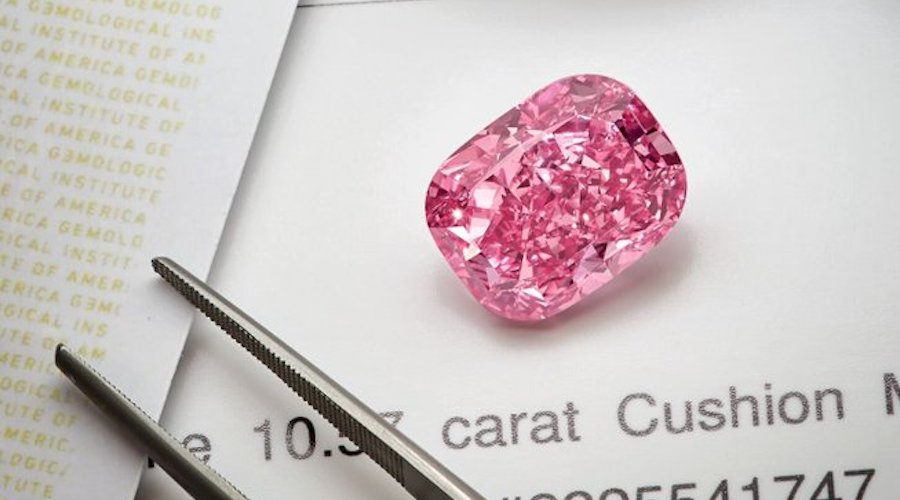
GEMOLOGY “Eternal Pink” diamond could fetch more than $35 million at auction Cecilia Jamasmie | March 30, 2023 | “The Eternal Pink,” a 10.57-carat internally flawless fancy vivid purplish-pink diamond. (Image courtesy of Sotheby’s | Twitter.)
A rare pink diamond of “unparalleled colour and brightness” is expected to fetch over $35 million when it goes under Sotheby’s hammer in New York next June, potentially becoming one of the most valuable gems ever sold at auction.
The 10.57-carat diamond, named The Eternal Pink, was discovered four years ago by De Beers at its Damtshaa mine in Botswana, weighing 23.87 carats — more than twice as much as it does now.
Over the course of six months, polishers at Diacore fashioned the gem into an cushion cut to better showcase its “purplish pink”, “bubblegum” colour.
The auction house’s head of jewellery for the Americas, Quig Bruning, said in a statement that the stone was the most vivid pink diamond to ever to come to market. “This colour is the most beautiful and concentrated shade of pink in diamonds that I have ever seen.”
The flawless rock also carries the highest price per carat estimate placed on any diamond or gemstone ($3.3 million), according to Sotheby’s.
The Eternal Pink will be shown at Sotheby’s Hong Kong from April 1 to 7. The diamond will then be exhibited in Dubai, Singapore, Shanghai, Taiwan and Geneva. Its world tour will culminate with the auction in the Big Apple on June 8.
The Eternal Pink was fashioned from a 23.78 carat rough diamond into a cushion cut over six months by a team of expert artisans that sought to maximize the gem’s “bubblegum” colour to full potential. (Screenshot from Sotheby’s video | Instagram.)
Coloured diamonds, especially pink ones, have been lately achieving top prices. They are expected to soar to new highs in the coming years as Rio Tinto closed its iconic Argyle mine. The operation was the world’s biggest diamond mine and the main global source of high-quality pink gems.
Sotheby’s set the record for any gem ever sold at an auction in 2017, with its $71.2 million sale of the 59.6-carat Pink Star to Hong Kong-based jewelry retailer Chow Tai Fook Jewellery Group.
Until then, the most expensive coloured diamond ever sold at auction was the “Oppenheimer Blue,” which fetched 56.8 million Swiss francs (about $58 million) in May 2016.
Ford in $4.5 billion deal for EV battery materials plant
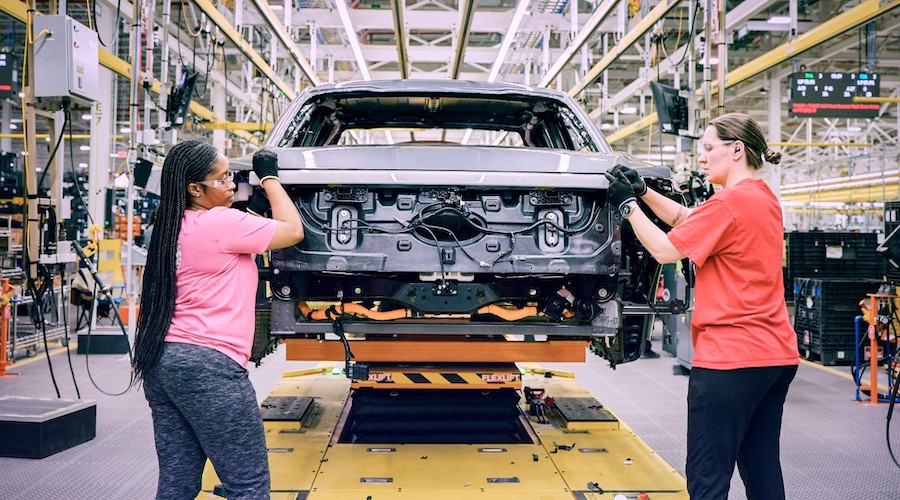
Reuters | March 30, 2023 | Rouge electric vehicle center. (Image: Ford Motor.)
US carmaker Ford has joined PT Vale Indonesia and China’s Zhejiang Huayou Cobalt’s as their new partner in a $4.5 billion nickel processing plant in Indonesia, the companies said on Thursday.
The investment is Ford’s first in the Southeast Asian country and underscores growing appetite among automakers for raw materials used in producing electric vehicle (EV) batteries, which account for about 40% of a vehicle’s sticker price, aiming to cut costs and close the gap on EV market leader Tesla
Volkswagen, Europe’s biggest automaker, this month said that it would invest 180 billion euros ($196 billion) over five years in areas including battery production and the sourcing of raw materials.
Indonesia, which has the world’s biggest nickel reserves, has been trying to develop downstream industries for the metal, ultimately aiming to produce batteries and electric vehicles.
The proposed high-pressure acid leaching (HPAL) plant will be located in Pomalaa in Southeast Sulawesi, where Vale operates a nickel mine.
Vale and Huayou began construction of the plant in November and commerciaoperation is expected to start in 2026.
Febriany Eddy, chief executive of Vale Indonesia, said the deal is unique in bringing the US automaker into an upstream nickel business.
She said that Vale has a 30% stake in the project, with the remainder being controlled by Ford and Huayou.
The companies did not say how much Ford will invest in the plant, which is expected to produce 120,000 tonnes per year of mixed hydroxide precipitate, a material extracted from nickel ore for use in EV batteries.
“Ford can help ensure that the nickel that we use in electric vehicle batteries is mined, produced within the same ESG standards as part of our business around the world,” Christopher Smith, Ford’s chief government affairs officer, said at the signing ceremony.
Indonesia’s government has banned exports of unprocessed nickel ore since 2020 to ensure supply for existing and potential investors while it also courts global EV makers such as Tesla and China’s BYD Group to invest in the country.
($1 = 0.9205 euros)
(By Gayatri Suroyo; Editing by Martin Petty and David Goodman)
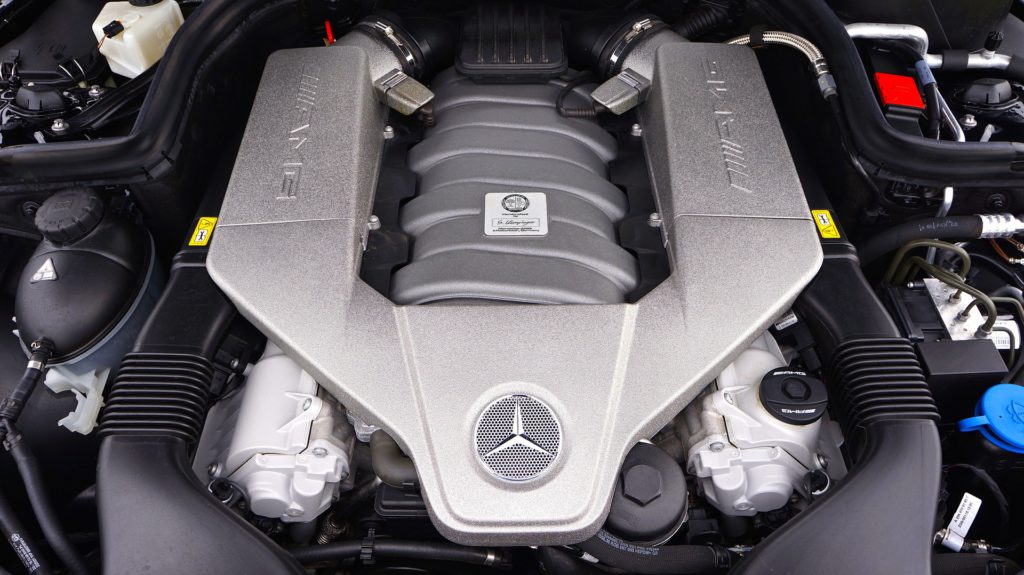
Mercedes-Benz is “able and willing” to invest capital in mining – CEO
Mercedes-Benz is willing to allocate capital to support or ramp up a mining business, chief executive Ola Kaellenius said on Thursday at the carmaker’s annual environmental, social and governance conference.
“We have fundamentally made the decision that if a deep sourcing opportunity presents itself down to the mine, we are able and willing to allocate capital to that,” Kaellenius said.
The company had opened up a raw materials office in Canada to further discussions in the region on sourcing raw materials following the signature of a battery material cooperation agreement with the Canadian government last year, chief technology officer Markus Schaefer added.
(By Victoria Waldersee; Editing by Friederike Heine)