Friday, March 31, 2023

CELIBACY FAILURE COVER UP
Public face of Pope Francis' efforts to root out child sex abuse in the Catholic Church resigns
Sky Palma
March 29, 2023

German Jesuit priest Hans Zollner talks to journalists following a press conference held by an independent commission for the study of sexual abuse of children in the Portuguese Catholic Church last month. (PATRICIA DE MELO MOREIRA / AFP)

The public face of Pope Francis' efforts to root out child sex abuse in the Catholic Church has quit his position after growing "increasingly concerned" over how the papal advisory body works, Agence France Presse reported.


Hans Zollner's resignation from the Pontifical Commission for the Protection of Minors comes as the agency continued to be dogged by controversy.

“The protection of children and vulnerable persons must be at the heart of the Catholic Church’s mission,” he wrote in a statement. “Over the last few years, I have grown increasingly concerned with how the commission, in my perception, has gone about achieving that goal, particularly in the areas of responsibility, compliance, accountability and transparency.”

Contradicting Zollner's statement, Pontifical Commission for the Protection of Minors head Cardinal Sean O’Malley claimed that Zollner resigned because of his busy workload.

"Zollner was the last remaining founding member of the group, which was set up by Pope Francis in 2014 as he strove to rid the Catholic Church of the scourge of sex abuse by clerics," AFP's report states. "Problems emerged as early as 2017, when abuse survivor Marie Collins resigned as a member of the commission, saying the body was under-resourced and faced fierce resistance within high echelons of the church. Fellow commission member and survivor Peter Saunders also quit later that year."
Fears of Monarch butterfly extinction as numbers plummet 22% in annual count

Brett Wilkins, Common Dreams
March 23, 2023

Monarch Butterflies www.monarch-butterfly.com

Wildlife conservationists sounded the alarm Wednesday as an annual count of monarch butterflies revealed a sharp decline in the number of the iconic insects hibernating in Mexican forests, stoking renewed fears of their extinction.

The annual survey—led by Mexico's National Commission of Natural Protected Areas and the Mexican branch of the World Wildlife Fund for Nature (WWF)—showed a 22% drop in the hibernating monarch population amid accelerating habitat loss driven primarily by deforestation.

"Despite heroic efforts to save monarchs by planting milkweed, we could still lose these extraordinary butterflies by not taking bolder action," Tierra Curry, a senior scientist at the Center for Biological Diversity (CBD), said in a statement.

"Monarchs were once incredibly common," she added. "Now they're the face of the extinction crisis as U.S. populations crash amid habitat loss and the climate meltdown."

Renowned for its epic annual migrations from the northern U.S. and southern Canada to Florida, California, and Mexico, monarchs have suffered a precipitous plunge in population in North America this century.

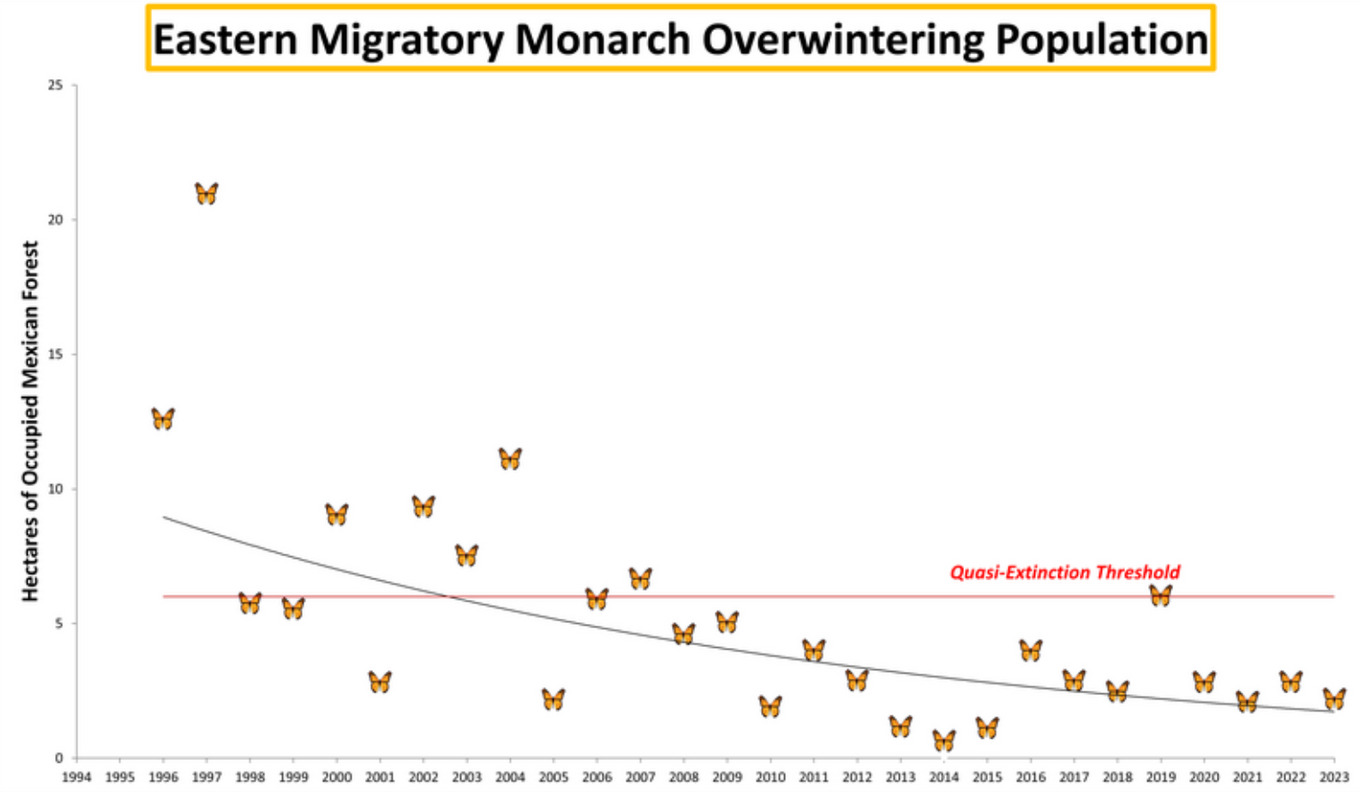
According to the U.S. Fish and Wildlife Service (FWS), the number of eastern monarchs fell from around 384 million in 1996 to 60 million in 2019, and in the West their numbers declined from 1.2 million in 1997 to fewer than 30,000 last year.

As CBD noted:

At the end of summer, eastern monarchs migrate from the northern United States and southern Canada to high-elevation fir forests in central Mexico. Scientists estimate the population size by measuring the area of trees turned orange by the clustering butterflies...The eastern population has been perilously low since 2008.

Last year, the International Union for Conservation of Nature formally listed the monarch butterfly as endangered, citing critical threats posed by the climate emergency, deforestation, pesticides, and logging.


(Graphic: Center for Biological Diversity)


In the United States, the Trump administration in 2020 placed monarchs on the wait list for consideration for Endangered Species Act protection. FWS has until next year to make a final listing determination.

"It is not just about conserving a species, it's also about conserving a unique migratory phenomenon in nature," said WWF Mexico general director Jorge Rickards. "Monarchs contribute to healthy and diverse terrestrial ecosystems across North America as they carry pollen from one plant to another."

"With 80% of agricultural food production depending on pollinators like monarchs, when people help the species, we are also helping ourselves," he added.

New 'glass-like' orchid species discovered in Japan
Agence France-Presse
March 23, 2023

The new species of orchid was discovered by Japanese scientists, who found the pink and white plant hiding in plain sight in gardens and parks 
© Kenji Suetsugu / Courtesy of Kenji Suetsugu/AFP

A new species of orchid with delicate, glass-like blooms has been discovered by Japanese scientists, who found the pink and white plant hiding in plain sight.

Despite its presence in Japan's parks and gardens, it took researchers at Kobe University a decade to confirm that the plant -- dubbed the "Spiranthes hachijoensis" -- was a previously unknown species.

"It was a surprise to discover a new species of spiranthes, which is so common that you can see it in parks, gardens and among potted plants," lead researcher Kenji Suetsugu told AFP Thursday.

Some of the samples were "from potted plants and gardens", including ones kept at a high school in Japan's central Gifu region, the phytology professor said.
Recommended videos

"From its curious look and dainty blooms that resemble glasswork, this flower has long been loved by people," the university said in a press release.

The plant, with its spiralling blossoms, was even mentioned in Japan's oldest anthology of poems, the eighth-century "Manyoshu".

The discovery of the new type of spiranthes, sometimes known as "ladies' tresses", was announced last week in the Journal of Plant Research. It was given the name "hachijoensis" because many samples were found on Tokyo's Hachijojima island.

FETUS FETISHIST WANTS TO KILL WOLF CUBS
Lauren Boebert brings photos of human fetuses to hearing on endangered species

David Edwards
March 23, 2023


YouTube/screen grab FAKE PHOTO

Rep. Lauren Boebert (R-CO) on Thursday presented photos of human fetuses at a hearing on endangered species.

During Water, Wildlife and Fisheries Subcommittee hearing, Boebert was recognized to present her bill to remove the Gray Wolf from the list of endangered species.

"I appreciate this time today and thank you so much for everyone who's attending here and traveling so far to be here," Boebert began. "I do want to say before my opening remarks, you know, since we're talking about the Endangered Species Act, I'm just wondering if my colleagues on the other side would put babies on the endangered species list."

The lawmaker held up photos of fetuses as she spoke.

"These babies were born in Washington, D.C. full term,
"
she added. UNTRUE

"I don't know, maybe that's a way we can save some children here in the United States."

Boebert then launched into her presentation on the gray wolf.

"For far too long, the Endangered Species Act has been weaponized by extremists, extremist environmentalists, to obstruct common sense multiple-use activities that they disagree with," she said.


Watch the video below or at this link.


Why thousands of volunteers are transcribing the notebooks of the scientist who inspired Mary Shelley’s Frankenstein

The Conversation
March 24, 2023

An etching of a Royal Institution lecture by James Gillray (1802). 
Davy is on the right, holding the bellows
Science History Images/Alamy Stock Photo

Sir Humphry Davy (1778-1829) is usually remembered as the inventor of a revolutionary miner’s safety lamp. But his wild popularity came as much from his influence on popular culture as it did from his contributions to chemistry and applied science.

In the first few years of the 19th century, there was no hotter spectacle in London than Davy’s lectures at the Royal Institution. The carriage traffic jams caused by his keen audience led to the introduction of London’s first one-way street.

Hundreds of members of the public, many of them women, crowded into the lecture theatre to hear the charismatic Davy speak about his cutting edge research. They would watch demonstrations of his work, which often included elaborate explosions and other breathtaking displays.

In more recent times, Davy’s star has waned. Through our work on the Davy Notebooks Project, we aim to change that. Thanks to the help of thousands of volunteers, we’re creating the first digital edition of Davy’s 83 manuscript notebooks, an exciting and important collection that we’ll soon be able to share with readers all over the world.
The video player is currently playing an ad.

The first lecture Davy gave at the Royal Institution was on the subject of galvanism (the electricity generated by chemical actions). The force was thought at the time to be capable of animating matter – or of bringing something dead to life.

Davy was born in Penzance, Cornwall and despite a lack of formal education, he rose quickly from obscurity to become an important force at the centre of Britain’s scientific community.

As a young chemist, he spent several years in Bristol, where he experimented with new gases, including nitrous oxide (laughing gas) which he frequently inhaled himself to test its effect.


The Royal Institution by Thomas Hosmer Shepherd
(c. 1838)
Wiki Commons


Moving to London, Davy eventually became director of the Royal Institution’s programme of chemical research and, later, President of the Royal Society. In his scientific life, he isolated more chemical elements than anyone before or since.

Davy’s famous lectures on the animating power of electricity at the Royal Institution may have inspired a young Mary Shelley as she came up with the idea for Frankenstein (1818), a novel that questioned the boundaries of creation using emerging scientific ideas.

Shelley may have even modelled aspects of the charming but reckless Victor Frankenstein on Davy himself. In fact, many of the things that Davy said in his lectures were borrowed word-for-word to craft the fictional scientist’s dangerous experiments.


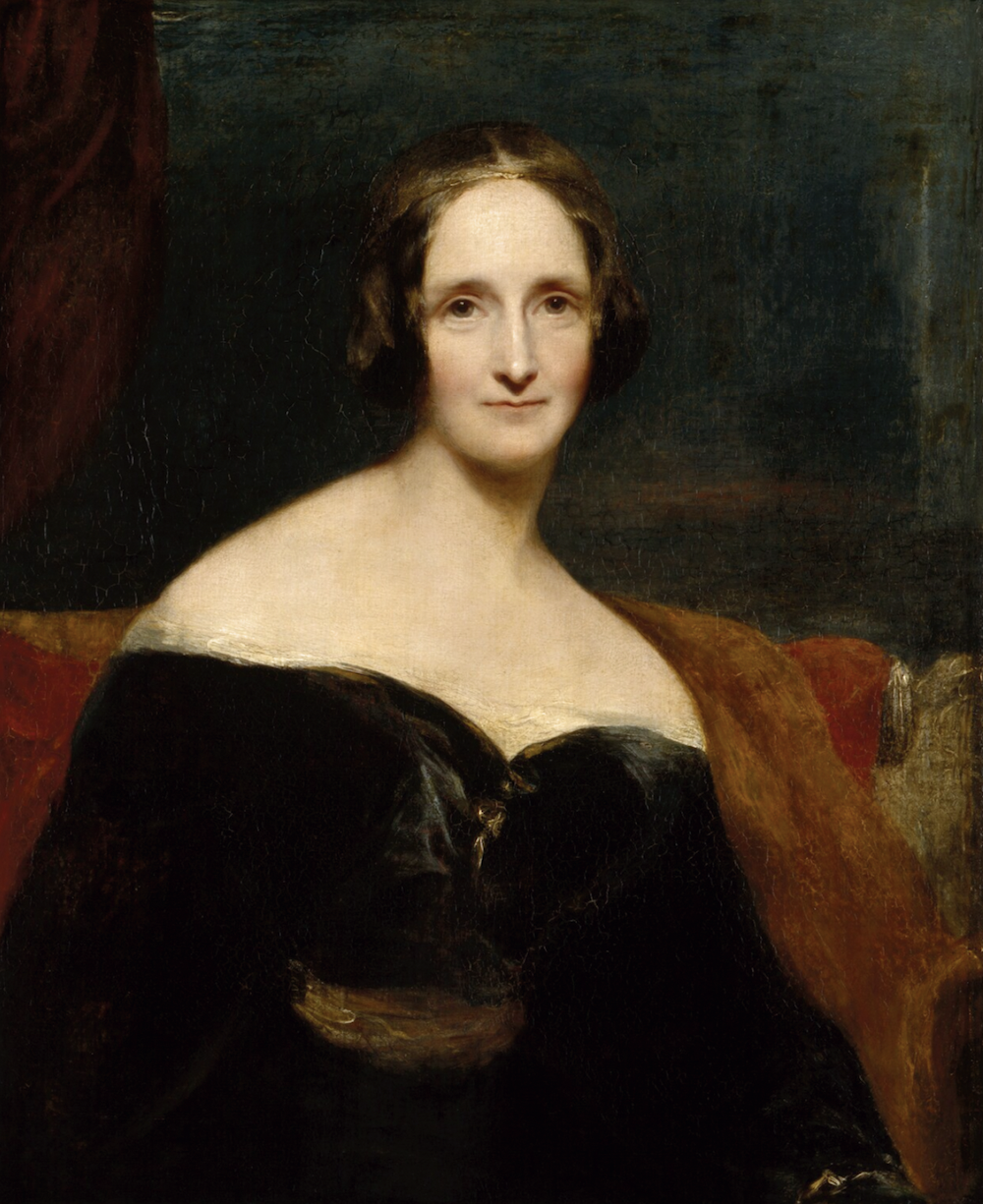
Portrait of Mary Shelley by Richard Rothwell (1831-1840).

National Portrait Gallery, London, CC BY

But, as Mary Shelley probably would have known, Davy was also a writer himself with close ties to the leading authors of his day.

He was friends with poets Lord Byron and Robert Southey and had a hand in the creation of some of the greatest works of the Romantic period. This included editing the second edition of William Wordsworth and Samuel Taylor Coleridge’s Lyrical Ballads (1800).

And he wrote his own poetry – lots of it. The pages of Davy’s dozens of surviving notebooks are crammed full of poems, both published and obscure, which share space with the complex records of his scientific experiments, alongside the notes for Davy’s jaw-dropping lectures.

Discovering Davy’s poetry

Our project aims to make these notebooks – which have never been transcribed in their entirety – available in a free to read, online edition based on crowd-sourced transcriptions provided by nearly 3,000 volunteers.

Their hard work has enabled us to bring Davy’s fascinating work in the arts and sciences to a whole new generation.

Davy’s notebooks give invaluable insights into how his mind worked. His firm conviction in the powers of the intellect, coupled with an unshakeable self belief, lay at the heart of his considerable success. As he declares in notebook 19E, containing drafts of lectures dating from around 1802:
Man is formed for pure enjoyments / his duties are high his destination / is lofty and he must then be / most accused of ignorance and folly / when he grovels in the dust having / wings which can carry him to the / skies.


These manuscript discoveries show how Davy influenced others, including Mary Shelley, through fantastical ideas rooted in scientific enquiry. While he may not be widely known today, his outsized achievements and towering public personality jump from their pages.

Whether influencing some of the greatest works of literature, or pioneering new modes of experimentation, Davy’s notebooks tell a fascinating story about the intertwined history of the arts and sciences in British history.

Understanding Davy’s legacy – and his possible influence as Victor Frankenstein’s role model – reminds us that these two arenas are much more closely, and importantly, linked to one another than we often hold them to be.

Alexis Wolf, Research Associate on the Davy Notebooks Project, Lancaster University and Andrew Lacey, Senior Research Associate on the Davy Notebooks Project, Lancaster University

This article is republished from The Conversation under a Creative Commons license. Read the original article.
ICYMI; CLIMATE CRISIS
Himalayas: The climate time bomb threatening India
Agence France-Presse
March 25, 2023

REPORTERS © FRANCE 24

In the world's highest mountain range, global warming threatens thousands of glaciers, resulting in increasingly frequent natural disasters: landslides, avalanches and glacier collapses. Our reporters Alban Alvarez and Navodita Kumari travelled to the small northern Indian state of Uttarakhand, where these disasters are compounded by a rush to develop infrastructure such as hydroelectric dams.

Up in the foothills of the Himalayas, the region of Uttarakhand is getting the Indian government’s attention. The state of 10 million inhabitants, bordering both China and Nepal, has become a vast open-air building site. The government of Indian Prime Minister Narendra Modi fully intends to take advantage of the region’s geographical position to make it a hub for renewable energy.

India, the world’s third-biggest carbon emitter, which gets 80 percent of its electricity from coal, is counting on the large-scale construction of hydroelectric power stations in the region to achieve carbon neutrality by 2070. Uttarakhand certainly has assets: the state is home to dozens of rivers, especially the Ganges and the Yamuna, the country’s largest waterways. But in addition to being located in a seismic zone, Uttarakhand is threatened by global warming, resulting in the accelerated melting of its glaciers.

For the past decade, the region has experienced natural disasters every year: landslides, avalanches, glacier collapses and even "cloudbursts" – sudden storms that can destroy a valley in a few minutes. In 2013, some 10,000 Hindu pilgrims died there during sudden bad weather while praying at a religious site. The bodies of almost 4,000 of them were never found.
Scientists find water inside glass beads on the Moon
Agence France-Presse
March 27, 2023

Blue Moon

Scientists said Monday they have discovered water inside tiny beads of glass scattered across the Moon, suggesting that one day it could be extracted and used by the "explorers of tomorrow".

The Moon was long believed to be dry, but over the last few decades several missions have shown there is water both on the surface and trapped inside minerals.

Mahesh Anand, a professor of planetary science and exploration at the UK's Open University, told AFP that water molecules could be seen "hopping over the lunar surface" when it was sunny.

"But we didn't know where exactly it was coming from," said Anand, a co-author of a new study published in the journal Nature Geoscience.

The study, carried out by a team led by the Chinese Academy of Sciences, said that the glass beads are "probably the dominant reservoir involved in the lunar surface water cycle".

The team polished and analyzed 117 glass beads which were scooped up by China's Chang'e-5 spacecraft in December 2020 and brought back to Earth.

The beads are formed by tiny meteorites that bombard the surface of the Moon, which lacks the protection of an atmosphere.

The heat of the impact melts the surface material, which cools into round glass beads around the width of a strand of hair.

As well as finding water in the beads, the scientists detected "a telltale signature of the Sun," Anand said.

Investigating further, they determined that the hydrogen necessary to make up the water was coming from solar wind, which sweeps charged particles across the Solar System.

'Sustainable' source of water?


The other ingredient for water, oxygen, makes up nearly half of the Moon, though it is trapped in rocks and minerals.

This means that solar wind could be equally contributing to water on other bodies in the Solar System lacking an atmosphere, such as Mercury or asteroids, Anand said.

The glass beads may make up around three to five percent of lunar soil, according to the study.

A "back of the envelope" calculation suggested that there could be around a third of a trillion tonnes of water inside all the Moon's glass beads, he added.

And it only takes mild heat of around 100 degrees Celsius (210 Fahrenheit) to liberate the water from the beads, Anand said.

While much more research is needed, he said that heating and processing these materials could supply the "explorers of tomorrow" with water -- or even oxygen -- to help them search "other worlds in a sustainable, responsible manner".

The European Space Agency's robotic drill PROSPECT, scheduled to launch for the Moon in 2025, could be the first to be able to collect and extract water in such a way, Anand said.

NASA's VIPER mission, planned to launch late next year, will head to the Moon's South Pole aiming to analyze water ice.


And in the coming years NASA's Artemis mission plans to return humans to the lunar surface for the first time since 1972.

© 2023 AFP


PDF
THE GLASS BEAD GAME
Hermann Hesse's last major work, appeared in Switzerland in. 1943. When Thomas Mann, then living in California, received the two volumes of ...
288 pages
A new psychology study has uncovered cultural differences in perceptions of heroes

2023/03/27


In the field of social psychology, the study of heroes has attracted growing interest over the past decade, as heroes have been found to be an important part of everyday life and provide important psychological functions to children and adults. However, most research in this area has focused on predominantly WEIRD (white, educated, industrialized, rich, and from developed countries) samples and may not reflect wider conceptions of heroes across cultures.

A recent study by my colleagues at the University of Limerick and myself delved into the cultural differences in lay perceptions of heroes, examining the impact of individualistic and collectivistic values on the perception of various types of heroes. The study has been published in open access format in the Personality and Social Psychology Bulletin

The research first investigated the prototypical features of heroes (i.e., in your own view, what are the features that you associate with heroes and heroic actions), and determined which features were most important in the prototype of heroes among Chinese participants. We found that some exemplars, such as heroes should love their country, related to the feature of patriotism, have been reported frequently by Chinese participants. However, the feature of patriotism was not mentioned by previous prototype analyses of heroes among Western participants.

We argued that one reason could be the different cultural values people hold. People from collectivistic cultures are more likely to define themselves as aspects of groups and to prioritize in-group goals. Patriotism, at a group level, fulfills important functions for building group unity and mobilizing individuals to act in ways that will favor their group or country.

Our subsequent studies revealed both cultural differences and similarities in lay conceptions of heroes between Chinese and American participants. For example, the findings demonstrated that Chinese participants rated patriotic, masculine, righteous, dedicated, responsible, respected, and noble as being more related to their personal view of heroes than American participants. In contrast, American participants rated strong, powerful, altruistic, personable, honest, leader, proactive, courageous, caring, and talented as being more related to their personal view of heroes than the Chinese participants. Several features did not discriminate well between the groups: saves, humble, fearless, determined, risk-taker, moral integrity, brave, intelligent, conviction, protects, exceptional, decisive, sacrifice, selfless, helpful, compassionate, and inspiration.

We argued that these features were endorsed similarly by the two groups and may represent a common understanding of heroes across both cultures. Furthermore, the findings demonstrated participants were more likely to identify a hero when their cultural features were used to describe the target person, emphasizing the role of cultural differences in hero perception.

We further investigated cultural differences in the perception of civil heroes, martial heroes, and social heroes. Civil heroes risk themselves to save others from physical harm or death, but there is no training or military code to help them deal with emergencies. An example of a civil hero could be a bystander performing an emergency rescue when someone collapses on the sidewalk. Martial heroes include people who are trained to handle dangerous situations and who are bound to a code of conduct. Examples of martial heroes could be police officers and paramedics. Social heroes typically do not involve an emergency situation but act with courage and kindness to serve or foster their community and its values. An example of a social hero could include a martyr or political leader.

We found that while there were no cultural differences in identifying civil and martial heroes between American and Chinese participants, Chinese participants perceived social heroes as more heroic than their American counterparts. Research showed that the perception of social heroes (e.g., martyrs, political figures, and religious leaders who lead a nation or inspire a movement for civil rights and freedom) is associated with collectivistic value orientations among Chinese participants and perception of social heroes is associated with individualistic value orientations among American participants.

As we explained in our article: “People from individualistic cultures (e.g., the United States) may be more sensitive to the personal causes of social heroes, such as their individualistic characteristics. Compared with other types of heroes, social heroes strongly emphasize collectivistic features, and they incorporate features (e.g., loyalty to the country and willingness to sacrifice their own interests for the country) that are strongly related to values that Chinese people tend to adopt. Hence, Chinese participants, compared with American participants, are likely to perceive social heroes as being more heroic than the other two types of heroes.”

Overall, the research offers valuable insights into the cultural differences in perceptions of heroes and the influence of individualistic and collectivistic values on these perceptions. Furthermore, the study contributes to the advancement of cross-cultural psychology methodology by using prototype analysis to explore cultural differences in lay understandings of a concept. Using the data-driven, bottom-up approach to collect lay conceptualization of heroes gives voice to the participants as active producers of definitions of heroes rather than based on researchers’ assumptions and expectations.

Human societies differ in a variety of psychological and behavioral tendencies, and therefore, it is interesting to explore how we conceptualize heroes in different societies. Importantly, examining lay conceptions of heroes in a non-Western culture can be helpful for contributing to understanding how heroes are used in everyday life in diverse cultures and promoting hero-related education initiatives.

The study, “On Cultural Differences of Heroes: Evidence From Individualistic and Collectivistic Cultures“, was authored by Yuning Sun, Elaine L. Kinsella, and Eric R. Igou.
We’ve been connecting brains to computers longer than you’d expect. These 3 companies are leading the way

The Conversation
March 27, 2023

Shutterstock

Since it was founded in 2016, Elon Musk’s brain-computer interface (BCI) company Neuralink has had its moments in biotech news.

Whether it was the time Musk promised his “link” would let people communicate telepathically, or when the whole company was under investigation for potentially violating the Animal Welfare Act, the hype around Neuralink means it’s often the first mental reference people have for BCI technology.

But BCIs have been kicking around for much longer than you’d expect. Musk’s is just one in a growing list of companies dedicated to advancing this technology. Let’s take a look back at some BCI milestones over the past decades, and forward to where they might lead us.

An expanding sector

Brain-computer interfaces are devices that connect the brain with a computer to allow the user to complete some kind of action using their brain signals.

Many high-profile companies entered the BCI field in the 2010s, backed by millions of dollars in investment. Founded in 2016, the American company Kernel began by researching implantable devices, before switching to focus on non-invasive techniques that don’t require surgery.

Even Facebook gave BCIs a go, with an ambitious plan to create a headset that would let users type 100 words per minute. But it stopped this research in 2021 to focus on other types of human-computer interfaces.

First contact

Developed in the 1970s, the earliest BCIs were relatively straightforward, used on cats and other animals to develop communication pathways. The first device implanted in a human was developed by Jonathan Wolpaw in 1991, and allowed its user to control a cursor with their brain signals.

Advances in machine learning through the years paved the way for more sophisticated BCIs. These could control complex devices, including robotic limbs, wheelchairs and exoskeletons. We’ve also seen devices get progressively smaller and easier to use thanks to wireless connectivity.

Like many newer BCI devices, Neuralink has yet to receive approval for clinical trials of its invasive implant. Its latest application to the US Food and Drug Administration was rejected.

There are, however, three notable groups conducting clinical trials that are worth keeping an eye on.

1. BrainGate

Founded in 1998 in Massachusetts, the BrainGate system has been around since the late 1990s. This makes it one of the oldest advanced BCI implant systems. Its device is placed in the brain using microneedles, similar to the technology Neuralink uses.

BrainGate’s devices are probably the most advanced when it comes to BCI functionality. One of its wired devices offers a typing speed of 90 characters per minute, or 1.5 characters per second. A study published in January released results from data collected over 17 years from 14 participants.

During this time there were 68 instances of “adverse events” including infection, seizures, surgical complications, irritation around the implant, and brain damage. However, the most common event was irritation. Only six of the 68 incidents were considered “serious”.

Apart from communication applications, BrainGate has also achieved robotic control for self-feeding.


2. UMC Utrecht

The University Medical Centre in Utrecht, Netherlands, was the first to achieve fully wireless implanted BCI technology that patients could take home.

Its device uses electrocorticography-based BCI (ECoG). Electrodes in the form of metal discs are placed directly on the surface of the brain to receive signals. They connect wirelessly to a receiver, which in turn connects to a computer.

Participants in a clinical trial that ran from 2020 to 2022 were able to take the device home and use it every day for about a year. It allowed them to control a computer screen and type at a speed of two characters per minute.

While this typing speed is slow, future versions with more electrodes are expected to perform better.

3. Synchron (originally SmartStent)

Synchron was founded in 2016 in Melbourne, Australia. In 2019, it became the first company to be approved for clinical trials in Australia. Then in 2020 it became the first company to receive FDA approval to run clinical trials using a permanently implanted BCI – and finally did this with a US patient this year.

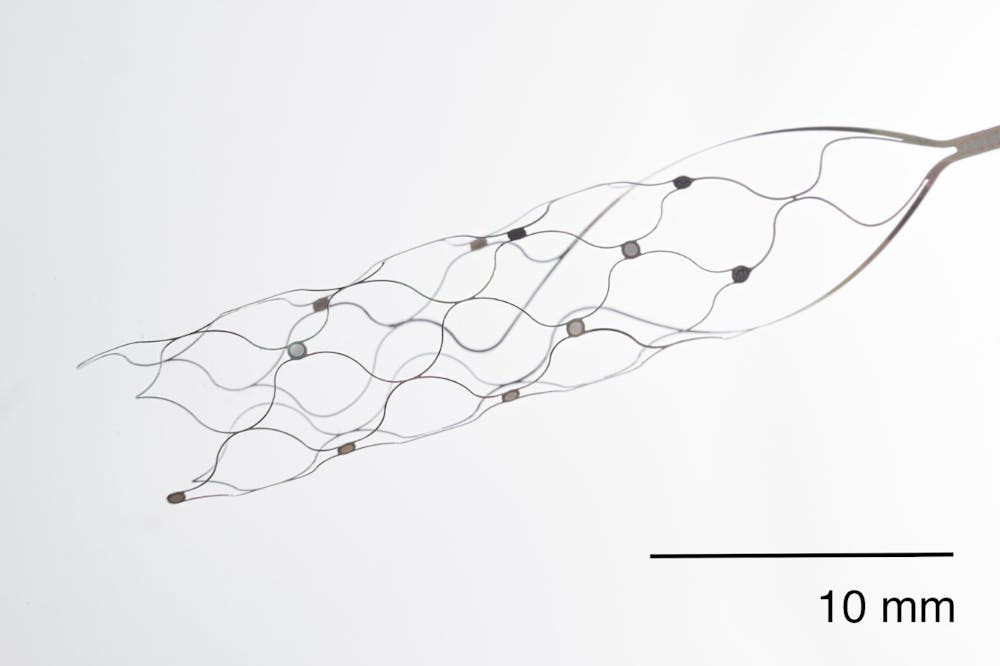
Synchron’s approach is to bypass full brain surgery by using blood vessels to implant electrodes in the brain. This minimally invasive approach is similar to other stenting procedures routinely performed in clinics.


Synchron’s very small ‘stentrode’ can be implanted with a minimally invasive procedure. Synchron

Synchron’s device is placed in the brain near the area that controls movement, and a wireless transmitter is placed in the chest. This transmitter then conveys brain signals to a computer.

Initial clinical results have shown no adverse effects and a functionality of 14 characters per minute using both the BCI and eye tracking. Results were not reported for BCI use alone.

Although its device efficiency could be improved, Synchron’s approach means it leads the way in achieving a low barrier for entry. By avoiding the need for full brain surgery, it’s helping to bring BCI implantation closer to being a day procedure.

The benefits must outweigh the risks


The history of BCIs reveals the immense challenges involved in developing this technology. These are compounded by the fact that experts still don’t fully understand the links between our neural circuitry and thoughts.

It’s also unclear which BCI features consumers will prioritize moving forward, or what they’d be willing to sign up for. Not everyone will happily opt for an invasive brain procedure – yet the systems that don’t require this collect “noisy” data that aren’t as efficient.


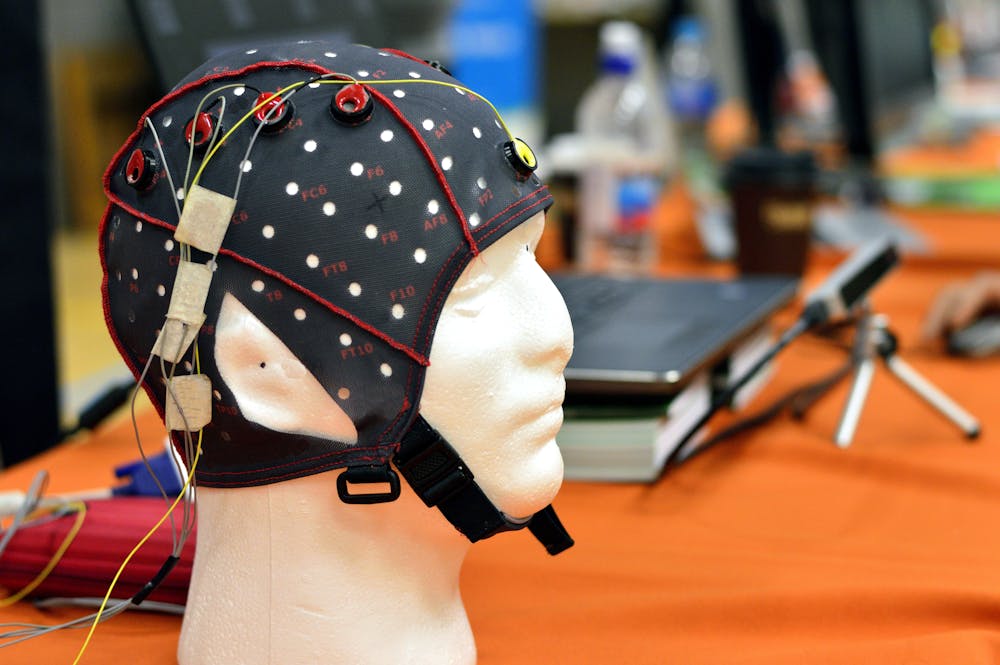
Electroencephalogram-based (EEG) BCIs don’t require surgery, but being less invasive means they’re also less effective
. Shutterstock

Answers will emerge as more devices gain approval for clinical trials and research is published on the results.

Importantly, developers of these technologies must not rush through trials. They have a responsibility to be transparent about the safety and efficacy of their devices, and to report on them openly so consumers can make informed decisions.

Sam John, Senior Lecturer in Neural Engineering, The University of Melbourne

This article is republished from The Conversation under a Creative Commons license. Read the original article.
Microplastic pollution impairs seabird gut health

Agence France-Presse
March 27, 2023

Plastic-infested digestive tracks from two species of Atlantic seabirds, northern fulmars and Cory's shearwaters, showed a decrease of mostly beneficial 'indigenous' bacteria and more potentially harmful pathogens © JEWEL SAMAD / AFP/File

Scientists have long known that wild seabirds ingest bits of plastic pollution as they feed, but a study Monday shows the tiny particles don't just clog or transit the stomach but can subvert its complex mix of good and bad bacteria too.

Plastic-infested digestive tracks from two species of Atlantic seabirds, northern fulmars and Cory's shearwaters, showed a decrease of mostly beneficial "indigenous" bacteria and more potentially harmful pathogens.

There was also an increase in antibiotic-resistant and plastic-degrading microbes, researchers reported in the journal Nature Ecology & Evolution.

Certain types of microplastic, the findings suggested, may be leeching chemicals that disrupt the birds' so-called gut microbiome.

Microplastics -- produced when plastic products break down in the environment -- are directly and indirectly ingested across most animal food chains.

They can be found in every corner of the world, from the deepest oceans trenches to top of Mount Everest.

In humans, they have been detected in the blood, breast milk and placentas.

The new study supports previous findings that prolonged ingestion of microplastics causes an imbalance of healthy and unhealthy bacteria in the stomach, a condition known as gut dysbiosis.

The implications are far-reaching.

Like humans, birds have evolved with a vast network of microbes, including bacteria, that live in our bodies in communities called microbiomes.

Some microbes cause diseases, but most exist as "friendly" bacteria with a critical role in digestion, immune response and other critical functions.

"There's a symbiosis that goes on -- and that's the case in the seabirds as well as in humans," lead author Gloria Fackelmann of Ulm University in Germany told AFP.

Little is known about the effects of individual microbes on the body.

But overall, a growing body of research points to the harmful impacts of microplastics on animal health.

The tiny particles -- less than five millimeters in diameter -- can cause cell death and allergic reactions in humans.

Chemicals in microplastics have also been linked to increased risks of cancer, reproductive problems, and DNA mutations.

The authors hope the findings in seabirds will spur related studies for humans.

"If this manmade substance could alter our microbiome, I think that should make people think," said Fackelmann.

© 2023 AFP