Friday, March 31, 2023

Opposition demonstrations spark clashes in Senegal
Main opposition force calls on its activists to hold series of nationwide demonstrations

Aurore Bonny |30.03.2023 - 

DOUALA, Cameroon

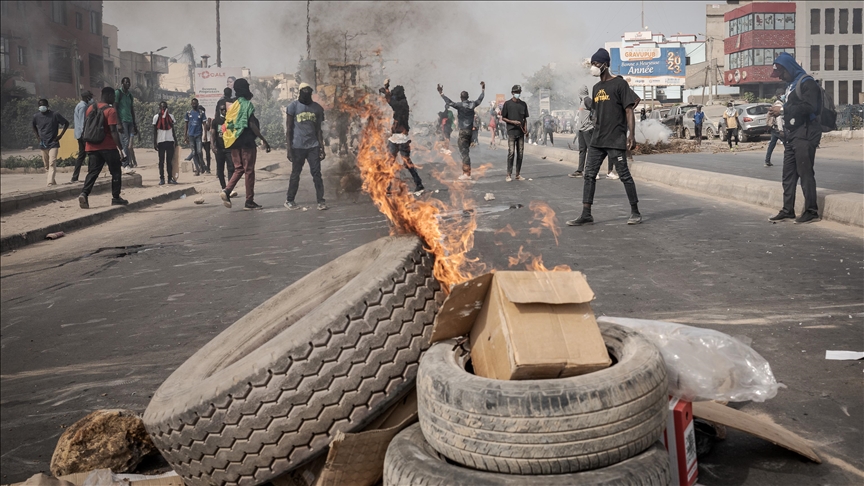
Opposition activists in Senegal staged demonstrations Wednesday in several cities in support of an opponent and to denounce recent arrests, local media reported.

Mame Mbaye Niang, Minister of Tourism and an activist of the main political party in power, has filed a defamation lawsuit against Ousmane Sonko, the leader of the African Patriots of Senegal for Work, Ethics and Fraternity (Pastef) party, who came third in the 2019 presidential election.

On the sidelines of the trial, which is being held Thursday, the Yewwi Askan Wi (YAW) coalition, the main opposition force created by Sonko in this West African country, called on its activists to hold a series of demonstrations throughout the country on March 29 and 30 and April 3.

In a statement issued Wednesday, it invited the population to come out "massively" and to stick to the upcoming demonstrations despite a ban issued by the prefecture in Dakar, the capital.

"The forces of order prevented the leaders of the Yewwi Askan Wi coalition from holding a press briefing at the PRP headquarters of Dethie Fall, one of the leaders of this formation. Opposition leaders were shot at with tear gas. During the stampede, a Web Witness camerawoman was hit by a vehicle and taken to the hospital," reported Seneweb, a local online media outlet.

The local press also reported peaceful demonstrations in Ziguinchor and Kolda in the south, Saint Louis in the north and Mbour.

Pastef activists in Sedhiou "denounced the 'injustices' they say their political leader, Ousmane Sonko, is suffering," the Senegalese Press Agency (APS) reported.

They believe that the defamation suit filed against him by Niang is aimed at preventing him from running in the 2024 presidential election, according to APS.

Violent demonstrations also took place on March 16 during the libel trial between Sonko and Niang.

Three deaths were recorded and more than 400 people were arrested, according to the coalition.

El Malick Ndiaye, Yaw's vice president for communications, was released after prolonged police custody. Nevertheless, he considers himself a "political prisoner of Macky Sall," the Senegalese head of state, because he is wearing an electronic bracelet.

Following these demonstrations, Sonko denounced "yet another assassination attempt" and reported that he was suffering from physical discomfort, lower abdominal pain and breathing difficulties. He accused the Senegalese president. He said he felt unwell because of tear gas fired by the police during his forced transfer to the court in Dakar as part of his trial against the minister.

Other charges and trials are weighing on Sonko, who is used to the courts. He will be tried before a criminal court for his indictment in March 2021 for rape and death threats against an employee of a beauty salon in Dakar where he was getting a massage for a backache.

This opponent "threatens so many interests. The authorities fear him and he would not make gifts to outside interests. He is part of a generation of African opposition leaders like Success Masra of Chad who are totally uninhibited and assume to go to the end of their convictions," said Regis Hounkpe, a pan-African geopolitical expert in a phone call with Anadolu.​​​​​​​

This situation "will become even tenser" according to him.
UN votes to ask world court to rule on countries’ climate duties

The call for the International Court of Justice to provide a legal opinion on the climate crisis follows a campaign led by the Pacific island of Vanuatu.

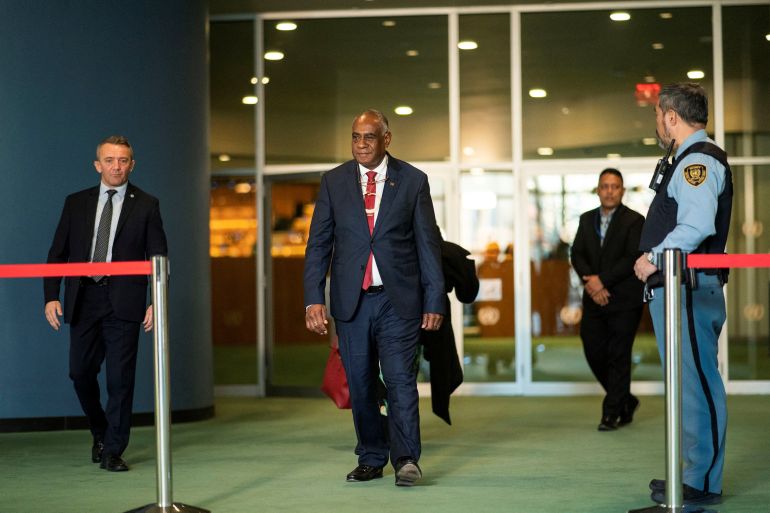
'I can now say to my kids and to the kids of the world that leaders of the world are listening to their concern,' Vanuatu's Prime Minister Ishmael Kalsakau told Al Jazeera [Eduardo Munoz/Reuters]


29 Mar 2023

The United Nations General Assembly (UNGA) adopted a landmark resolution asking the world’s top court to define the obligations of countries to combat climate change.

Advisory opinions of the International Court of Justice (ICJ) “have tremendous importance and can have a long-standing impact on the international legal order,” UN chief Antonio Guterres said on Wednesday as the resolution passed with a consensus vote.

“If and when given, such an opinion would assist the General Assembly, the United Nations and member states to take the bolder and stronger climate action that our world so desperately needs,” Guterres added. An advisory opinion would not be binding on any jurisdiction, but could influence future negotiations.

The resolution comes after a four-year campaign led by the Republic of Vanuatu – an archipelago of roughly 80 islands spread across 1,300km (807 miles) that was hit by two Category 4 cyclones within three days earlier this month.

“I can now say to my kids and to the kids of the world that leaders of the world are listening to their concern,” Vanuatu’s Prime Minister Ishmael Kalsakau told Al Jazeera.

The original idea for a UNGA resolution came from law students from Vanuatu during a class project. They then suggested it to the island’s officials.

“We are just ecstatic that the world has listened to the Pacific youth and has chosen to take action” on the idea that “started in a Pacific classroom four years ago,” said Cynthia Houniuhi, the Solomon Islands-based president of Pacific Islands Students Fighting Climate Change.

Vanuatu and other vulnerable countries are already grappling with the powerful impacts of a heating planet. On the eve of the vote, Vanuatu diplomats were still trying to win support from China and the United States – or at least convince the two biggest greenhouse gas emitting countries not to raise objections.

Countries will submit input over the next year. It could take the court around 18 months to issue an advisory opinion that could clarify financial obligations countries have on climate change; help them revise and enhance national climate plans submitted to the Paris Agreement; and strengthen domestic policies and legislation.

Some campaigners wonder, though, whether countries will really abide by the ICJ’s opinions or whether they will seek to narrow down the resolution’s scope, said Al Jazeera’s James Bays.

“UN insiders will tell you that the resolution went through with all those countries agreeing with it, but privately they don’t really do [so],” Bays said, reporting from UN headquarters in New York. “No one wants to put their head above the parapet and be the country that objected to this resolution.”


The US did not support the resolution.

“We believe that diplomacy – not an international judicial process – is the most effective path forward for advancing global efforts to tackle the climate crisis,” a senior official from the administration of US President Joe Biden told Reuters. “We have expressed that directly to our partners, and made that clear at the UN.”

Vanuatu’s campaign to involve the ICJ in climate justice follows the latest Intergovernmental Panel on Climate Change (IPCC) report, which delivered a dire warning that “human-caused climate change is already affecting many weather and climate extremes in every region across the globe”.

The global surface temperature has increased by 1.1°C in the past century and is projected to continue increasing. The latest IPCC report details how, if the trend continues, the surface temperature will “likely” exceed 1.5°C in this century and “make it harder to limit warming below 2°C”.

The resulting advisory opinion could offer vital input to burgeoning climate-driven lawsuits worldwide. There are upwards of 2,000 cases pending around the globe.

Other international courts and tribunals are also being asked to clarify and define the law around climate obligations, including the Inter-American Court of Human Rights and the International Tribunal for the Law of the Sea.

SOURCE: AL JAZEERA AND NEWS AGENCIES
China’s ‘art factory’ painters turn from fakes to originals

By AFP
March 29, 2023

Dafen has been producing near-perfect copies of timeless masterpieces for years
 - Copyright AFP GREG BAKER

Greg Baker

Painters in a Chinese village once known for churning out replicas of Western masterpieces are now making original art worth thousands of dollars, selling their own works in a booming domestic art market.

Home to more than 8,000 artists, southern China’s Dafen has been producing near-perfect copies of timeless masterpieces for years.

In its heyday, three out of five oil paintings sold worldwide were made in the village, and for years village painters sold their copies to buyers across Europe, the Middle East and the United States.

Exports began to dip after the 2008 global financial crisis, and all but dried up when China slammed shut its borders in 2020 because of the coronavirus pandemic.

A few artists gave up and closed their studios. But others saw in the obstacles an opportunity to establish themselves as painters in their own right by catering to China’s art market — the second-biggest in the world, with sales jumping by 35 percent in 2021.

Self-taught artist Zhao Xiaoyong used to sell replicas of Vincent van Gogh’s work for about 1,500 yuan ($220) each, while his original pieces fetch up to 50,000 yuan, he said.

When Zhao moved to Dafen from central China in 1997, his family shared a tiny two-bedroom apartment with five other tenants.

“Those days, there was an assembly line-style system, with each artist painting a small section of a larger piece, like an eye or a nose, before passing the piece to another painter to draw a limb or a shirt sleeve,” he told AFP.

After years of cranking out mock masterpieces, Zhao eventually saved enough money to visit the Van Gogh Museum in Amsterdam and the Saint-Paul Asylum in southern France, where the artist famously painted “The Starry Night”.

“I felt I could finally enter into his world instead of just copying his brush strokes,” Zhao said.

“I realised I had to come out of Van Gogh’s shadow and give life to my thoughts.”

Now he chronicles how the Dafen oil painting village has changed, using Van Gogh’s style: one canvas shows Zhao in a crowded workshop holding one of the Dutch painter’s self-portraits, while fellow artists nap on their desks.

– Tourist boost –


Since China’s dismantling of its zero-Covid policy in late 2022, the streets of Dafen are once again bustling with visitors, crouched in front of easels, slapping paint on canvases.

As well as immersing themselves in the artistic culture with painting lessons, many of the tourists come to buy pieces from the villagers, but their hunt for a good deal is another factor behind the fading market in handmade fakes.

In one alleyway, workers brush paint onto printed canvases of Duccio’s “Madonna and Child”.

These are sold for a knock-down price as low as 50 yuan per piece, while a hand-painted copy costs up to 1,500 yuan.

“We paint a few strokes over the printed image to make it look like an authentic oil painting,” said one artist, who declined to be named.

“Buyers think the printed background is painted using watercolours.”

– ‘Chinese aesthetic’ –

Another Dafen-based artist on a mission to move on from painting imitations is Wu Feimin, who has carved out a niche selling Buddhist-themed art.

“I used to copy Picasso’s work, and now I have my distinct style,” Wu said, painting a giant face of the Buddha with a palette knife.

“It takes weeks, sometimes months, to complete one painting,” the artist said as he was getting ready for exhibitions in the village and the rich industrial hub of Guangzhou.

“It’s risky, but the margins are better.”

Other artists told AFP that they went back to school during the pandemic to learn how to draw mountains and weeping-willow trees seen in traditional Chinese landscape paintings.

“Wealthy Chinese buyers want art that reflects a Chinese aesthetic,” said Yu Sheng, a fine-art teacher who used the opportunity to retrain in the classical style.

While he continues to make ends meet by exporting replicas of Western works, he also creates his own pieces, determined to crack the more lucrative domestic market and become a portrait painter for the wealthy.

And he is confident in his abilities over those of artists from well-known schools.

“Our technique is better because we paint every day, but we don’t have contacts with art dealers in big cities,” he said.

“Our survival depends on whether our work is recognised by China’s art buyers — we must learn to bend like bamboo.”

PAKISTAN

The futility of a social media crackdown
The PTI’s response to censorship is a lesson on why politics can no longer be constricted.

Ramsha Jahangir 
Published March 31, 2023

“Across the country, women and children belonging to families of those who write and speak on social media against government policies and regime change operation are being threatened to be ‘eliminated’. They’re also forced to deliver pre-written statements after being kidnapped. This was not even the case during Musharraf’s martial law,” reads Azhar Mashwani’s pinned tweet on his personal Twitter account.


“The law of nature is that the more cruelty increases, the more hatred and anger increase,” he continued in a follow-up tweet.

A week ago, on March 23, while Pakistan Day celebrations occupied television screens, Mashwani, the focal person (social media) to PTI chief, Imran Khan, went missing. He disappeared for over a week while police investigators remained ‘clueless’ about his whereabouts.

Mashwani returned today but many other PTI social media activists remain missing, have been arrested, had their homes raided, surveilled, and family members detained or threatened.


Repeated attempts have also been made to contain the PTI’s ‘hatred’ and ‘anger’ on the mainstream. Amid repeated Pemra bans on airing former Prime Minister Imran Khan’s jalsas and speeches, the country’s authoritarian machine is eager to tame the insaf tsunami. This brazen, legally questionable, and sweeping crackdown recipe is not new to Pakistan’s political spectrum.
Old tricks, new faces

“Respect for the freedom of speech including on social media is the constitutional responsibility of the government and suppressing political views of opponents is condemnable,” PML-N’s Nawaz Sharif, then recently ousted prime minister, said in a statement following the arrests of his party’s social media activists in 2017.


More recently, under the aegis of Imran Khan’s government and the country’s military, journalists faced a sustained campaign of censorship, comprising media blackouts, arrests, abductions and FIRs. Those wielding powers have long exercised their archaic censorship pulses on critical quarters. Ironically, those testing and those tested, neither have learnt the lesson: it simply doesn’t work anymore.
Tit for tat

In October 2020, under the PTI government, television broadcast of a Pakistan Democratic Movement (PDM) rally in Gujranwala was interrupted as PML-N supremo Nawaz Sharif addressed the gathering via video link from London. Internet and mobile services were also disrupted soon after Nawaz began his speech. The event was, however, streamed live by political parties and supporters across social platforms, including YouTube and Twitter’s Periscope.

While mainstream media had been restrained from giving airtime to Nawaz by the Pemra, business was booming for digital news outlets and YouTube channels, who marketed exclusive streaming of the “full speech”.

Today, it’s the PTI’s turn to bear the full brunt of the state’s might — though, censoring digital mammoth PTI is no easy task. Despite the draconian crackdown, the party’s social media team, backed by its global supporter base, continues to use sure-footed social media strategies to highlight the ongoing human rights violations in the country.

From crowdsourcing a list of international human rights organisations and influential individuals to tag on Twitter, to urging amplification from overseas Pakistanis, as well as producing a dossier documenting human rights violations under the incumbent regime, the PTI has once again displayed its formidable command on narrative politics.


If anything, the party’s coordinated cry for help has amplified the case against enforced disappearances — an alarming cause that political leaderships, including the PTI, have been reluctant to address in the past.


Haunted by the spectre of social media, Pakistan’s authoritarian machine, whether under the PTI or the incumbent PDM government, has been using the Prevention of Electronic Crimes Act (PECA), 2016 as the go-to tool to control political discourse online.

The playbook features arbitrary bans on social media platforms, the filing of bizarre cases to intimidate journalists, activists, and party workers, and pushing tech companies to comply with its censorship requests.

Last year, the Islamabad High Court struck down Section 20, which criminalises defamation, and the controversial Peca ordinance (promulgated by President Dr Arif Alvi during PTI’s rule).

More recently, the Lahore High Court struck down Section 124-A of the Pakistan Penal Code, commonly known as sedition law, which pertains to the crime of sedition or inciting “disaffection” against the government, terming it inconsistent with the Constitution. Regardless of the courts’ interventions, the executive continues to extend its abuse of power and lead the saga of illegal harassment and intimidation of citizens.

The PTI’s response to censorship is a lesson on why politics can no longer be constricted. Due to the nature of the internet, politics now transcends national boundaries giving access to international scrutiny.

The Pemra can force newsrooms to bleep the army chief’s name on TV but it cannot dictate live streams. Arrests and abductions of social media activists cannot silence a narrative. Parties in power, backed by the state, may lose track of its record of grave human rights violations, but the internet never forgets.

Header image: Shutterstock
Indian authorities in mad chase of Amritpal Singh

Monitoring Desk Published March 30, 2023

India is discussing the mysterious disappearance and hiding of the wanted Sikh preacher Amritpal Singh as authorities expand the search of their circle, BBC News reported.

According to journalists in India, the Sikh activist was seen in four different cities in India, yet authorities are still unsuccessful in catching him.

After his arrest warrant was issued in the state of Punjab, he has been successful in avoiding police. An operation followed by Punjab police on March 28 in the village of Hoshiarpur was in vain as Mr Singh could not be arrested, sparking a debate over the possibility that Mr Singh could still be hiding in the Punjab, according to a BBC report.

Mr Singh has been under fire lately after his popularity rose among people in demand for a separate Sikh country from India.

The attempt to arrest Mr Singh first took place on March 18, when he and his supporters stormed a police station with the demand to release his associate, which resulted in a clash between police and his supporters. Later, several cases were registered under his name for attempted murder and spreading hate.

Several claim Sikh activist was seen in four different cities

Mr Singh was successful in evading the authorities in an extensive chase in which he changed three vehicles, according to reports, and since then the authorities are not aware of his whereabouts. To catch Mr Singh instantly, the authorities blocked the internet service in the entire province of Punjab, which has a population of 27 million people. Various media reports claim from time to time to have seen Mr Singh in different cities of India, including Delhi, the capital city of India.

These reports included the fact that Mr Singh was disguised as a Hindu preacher at a known bus terminal. After which, police were deployed and arrested a few of his supporters. Followed by the arrest of a woman from the state of Haryana, who revealed during the interrogation that she and Mr Singh have been in contact for over a year. Following a failed attempt to catch Mr Singh, the Indian Embassy alerted Nepal and requested that they add his name to a surveillance list in case he escaped to Nepal.

As of now, the authorities are still hunting for the man, with little hope of catching him soon. Several CCTV footage from different cities has been highlighted by the Indian media, which has told the people to alert the police as soon as possible if seen by anyone. Different stories are circulating about Mr Singh’s escape as well as his arrest by his own lawyer, who claims that he has been in police custody illegally.

People are questioning the police on how a single man can still be on the run with thousands of law enforcement personnel after him and access to the latest technology to track him. As of now, police claim to be close to arresting Mr Singh.

Published in Dawn, March 30th, 2023
WAGE THEFT
$14,700 fine, pay cut: Japanese man lands in trouble for 4,500 smoke breaks at work

A Japanese man landed in hot water for smoking on the job more than 4,500 times in 14 years. 

The man was hit with a fine worth around $14,700 for the same.

India Today World Desk
New Delhi ,UPDATED: Mar 30, 2023

The man was asked to return 1.44 million yen of his salary, in addition to his disciplinary wage reduction (Photo: Pixabay/Representational)

By India Today World Desk: A 61-year-old Japanese civil servant recently got in trouble for smoking on the job more than 4,500 times in 14 years. He was slapped with a fine worth around 1.44 million yen (S$14,700) for taking smoke breaks during office hours, the Straits Times reported.

The report stated that the authorities in Osaka took strict action against the government employee, along with two colleagues in the prefecture's finance department. They also imposed a 10 per cent pay cut for six months for repeatedly smoking during work hours despite multiple warnings.

In 2022, the human resources office received a tip-off that the trio were secretly stashing tobacco. The employees were then summoned by their supervisor and warned they may face consequences if they are caught smoking again. However, the three continued smoking and lied about it when interviewed in December 2022.

The report said that out of the three, a 61-year-old director-level employee was deemed to have violated the "duty of devotion" under the Local Public Service Act. The man was asked to return 1.44 million yen of his salary, in addition to his disciplinary wage reduction.

The prefectural government revealed that the man clocked up 355 hours and 19 minutes of smoking on duty.

Osaka has some of the strictest smoking laws in the world and, in 2008, it introduced a total ban on government premises such as offices and public schools. Government employees have also been banned from lighting up while on duty since 2019.

Reacting to the penalty, some argued that having to go off-site for a puff would have meant wasting more time, while others found the fine harsh, saying one can waste time by drinking tea, eating snacks or just chatting, but those are not punishable offences, so neither should be smoking tobacco.

In 2019, a high school teacher in Osaka was similarly disciplined with a temporary pay cut after he was found to have taken around 3,400 illicit smoke breaks. He was also asked to return one million yen of his salary to the education ministry.

France probes case of man gravely injured at water protest

By AFP
March 29, 2023

Police said firing thousands of tear gas grenades was a 'proportionate' response to violent demonstrators - Copyright AFP Oliver Contreras

French prosecutors said Wednesday they were probing the case of a man seriously wounded at a demonstration over access to water, after his family filed a criminal complaint.

The 32-year-old has been fighting for his life in a coma since Saturday’s thousands-strong environmental protest against a new “mega-basin” gathering water for irrigation in the western Deux-Sevres region.

The probe was prompted by his parents, who filed a complaint alleging attempted murder as well as the prevention of access by first responders.

Protest organisers said Tuesday that the man, from the southwestern city Toulouse, was seriously wounded when he was struck in the head by a tear gas grenade fired by police.

“People close to him are determined to bear witness and uncover the truth about what happened,” they added.

The case is being investigated by military prosecutors in western city Rennes who have jurisdiction over France’s gendarmes — police officers belonging to the armed forces.

Warlike scenes of Saturday’s clashes between around 5,000 protesters and 3,200 police in the open fields made headlines over the weekend.

Fielding helicopters, armoured vehicles and water cannon, security forces fired thousands of tear gas grenades and dozens of other projectiles in a response the DGGN police authority described as “proportionate to the level of threat”.

Authorities say officers were faced with “an unprecedented explosion of violence” and targeted with Molotov cocktails and fireworks.

– Ambulance access –

But Human Rights League (LDH) observers on the scene said police made “unrestrained and indiscriminate use of force” against all the demonstrators, rather than targeting violent groups or individuals.

AFP journalists saw police begin using tear gas as soon as the marchers arrived.

Prosecutors in nearby Niort counted 47 wounded police and seven demonstrators requiring medical aid, including two in danger for their lives — one of whose condition has since improved.

Protest organisers complained of 200 wounded, 40 seriously including one person who lost an eye.

In an audio recording published by daily Le Monde, a member of the ambulance service told the LDH that “commanders on the ground” were holding them back from the scene, without identifying individuals.

The service said on Twitter Tuesday that “sending an ambulance with oxygen into an area with clashes is not recommended given the risk of explosion”.

Deux-Sevres’ prefect — the top government official in the region — wrote in a Tuesday report to the interior ministry that it was “very difficult” for ambulances to reach wounded demonstrators as “the clashes had not stopped or were starting again”.

Interior Minister Gerald Darmanin has responded to the clashes by vowing to ban one of the associations that organised the protests.

MONOPOLY CAPITALI$M
Spain competition watchdog opens Google probe


By AFP
March 29, 2023

The European Union and several member states have in recent years taken steps to stop US tech giants like Google from stifling competition - Copyright AFP/File STR

Spain’s competition watchdog has launched an investigation into Google for alleged anti-competitive practices affecting news agencies and press publications.

The probe seeks to determine if Google and its parent company Alphabet abused their “dominant position” in the Spanish market, competition watchdog CNMC said in a statement late on Tuesday.

“Specifically, these practices consist of the possible imposition of unfair commercial conditions on publishers of press publications and news agencies established in Spain for the exploitation of their copyrighted content,” it added.

The watchdog said it opened its probe following a complaint from the Spanish Reproduction Rights Centre (CEDRO), a non-profit association of authors and publishers of books, magazines and newspapers.

It did not specify the period covered by the investigation, nor what sanctions Google could face if it is proven that Google had abused its dominant position in Spain.

The European Union and several member states have in recent years taken steps to stop US tech giants like Google from stifling competition, avoiding tax and profit from news content without paying.

The digital giants are regularly criticised for dominating markets by elbowing out rivals.

In July 2022, the European Parliament adopted the Digital Markets Act to curb the market dominance of Big Tech, with violators facing fines of up to 10 percent of their annual global sales.

Brussels has slapped over eight billion euros in fines on Google alone for abusing its dominant market position.

The EU has also created a form of copyright called “neighbouring rights” that allows print media to demand compensation for use of their content.

After initial resistance, Google and Facebook agreed to pay French media, including AFP, for articles shown in web searches.
UK defence minister would ‘love’ return of conscription
VERY SUCCESSFUL IN VIETNAM WAR
ByAFP
March 29, 2023

Britain's Defence Secretary Ben Wallace said reservists were important given the reliance of modern armed forces on specialists - Copyright AFP Oliver Contreras

UK Defence Secretary Ben Wallace said Wednesday he would “love” to see Britain emulate Finland and Sweden by bringing back military conscription.

Britain scrapped national service for all young men in 1960, and occasional calls for its return have been confined to right-wing politicians and media.

Wallace, a former army officer, was briefing reporters alongside Swedish Defence Minister Pal Jonson about Sweden and Finland’s bids to join NATO after Russia invaded Ukraine.

He conceded that “a different cultural thing” was at play after both Nordic countries persisted with conscription in the decades since World War II, albeit with a seven-year break for Sweden.

But Wallace said: “I think we’re all envious of both Sweden and Finland, in (their) reserves.”

He said reservists were especially important given the reliance of modern armed forces on specialists, for example in cyberwarfare, who could be activated in time of need.

“And I think we’ve got to recognise that again the lesson of Ukraine is how do we work on our resilience, and part of that is about reserves,” he said.

“I would love to have a model like that.”

Erdogan embarks on his toughest election test

ByAFP
March 31, 2023

Erdogan has been touring quake-hit cities to revive his re-election campaign 


President Recep Tayyip Erdogan travels to the heart of Turkey’s earthquake disaster zone on Friday to formally kick off the toughest election campaign of his two-decade rule.

One poll released on the first official day of campaigning showed the 69-year-old trailing his secular rival by nearly 10 percentage points in the May 14 presidential and parliamentary vote.

The gap appears to have widen due to seething anger at the government’s response to a massive earthquake in February that claimed more than 50,000 lives and displaced millions.

But secular opposition leader Kemal Kilicdaroglu — a 74-year-old former civil servant who has never won a national race — is facing his own problems from an unlikely source.

Kilicdaroglu has cobbled together a six-party alliance that groups politicians with radically different views and the shared goal of defeating Erdogan.

The opposition views this as their best chance yet to defeat Erdogan and end his Islamic-rooted party’s control of growing facets of the highly polarised country’s social life.

Turkey’s worst economic crisis of Erdogan’s era should also boost his rival’s hand.

But a last-minute entry of maverick opposition leader Muharrem Ince threatens to upset Kilicdaroglu’s plans.

Ince challenged Erdogan in the last election and refused Kilicdaroglu’s offer to bow out of the race this week.

– Healing wounds –


Polls show Ince’s support small but growing. The opposition fears the 58-year-old will split the anti-Erdogan vote.

Analysts also point to Erdogan’s stellar election record, as well as the government’s control of the media and state institutions during the campaign.

Political risk consultancy Eurasia Group said Erdogan’s re-election “remains the baseline (scenario), though the odds are falling”.

Erdogan’s decision to launch his campaign in the ethnically mixed southeastern city of Gaziantep is telling.

He enjoyed some local support during his early efforts to negotiate an end to a Kurdish struggle for an independent state that has claimed tens of thousands of lives.

A breakdown of those talks led to a resurgence of violence and a crackdown on Kurdish leaders that has seen hundreds jailed.

The main pro-Kurdish party — seen as a kingmaker with roughly 10 percent of the vote — has given its tacit support to Kilicdaroglu.

But Erdogan appears to be trying to break through to Kurdish voters via pledges of more social support.

He will be attending the groundbreaking ceremony for a relief centre in quake-hit Gaziantep — one of several he has opened in the past few weeks.

– Kitchen chats –


Many point to the similarities with an earlier government failing in its response to an earthquake in 1999 in which more than 17,000 people died.

“We are working day and night to heal the wounds caused by the quake,” Erdogan said at a similar groundbreaking ceremony in nearby Adiyaman this week.

Kilicdaroglu has taken a radically different approach.

He has played up his humble upbringing in video chats that he records from his formica-tiled kitchen. These regularly gather millions of YouTube and Twitter views.

He appeals directly to the estimated six million teens who grew up during Erdogan’s time in power and will be voting for the first time.

Other messages are addressed to religious conservatives who form the core of Erdogan’s support.

“I want to appeal to conservative young women,” Kilicdaroglu said in one message.

Erdogan prides himself on removing religious restrictions in the officially secular state.

Kilicdaroglu has fought hard to show that his secular party will not curb conservative women’s right to stay veiled at work or school.

“We will not allow your achievements and freedoms to be destroyed,” Kilicdaroglu told conservative women in the message.

– Outsiders –


Election officials announced on Friday that the presidential ballot will have four names on it.

Ince’s outside candidacy is joined by that of Sinan Ogan — a far-right politician who obtained his doctorate degree at a prestigious Moscow university.

Ogan’s support languishes in the low single digits.

But that of Ince is edging up thanks to support from Turkey’s younger male voters, who sympathise with his secular nationalist views.

One poll showed Ince picking up 10 percent of the vote in May.

The opposition Halk TV news site pointed out that Ince was the first politician to reach the quake’s epicentre and the most visible in the disaster zone in the past few weeks.

“His voters are not satisfied with the opposition and are against the government,” one Halk TV analyst wrote.