It’s possible that I shall make an ass of myself. But in that case one can always get out of it with a little dialectic. I have, of course, so worded my proposition as to be right either way (K.Marx, Letter to F.Engels on the Indian Mutiny)
Tuesday, June 13, 2023
Strikes at UK’s Heathrow Airport Expected to Impact Travel to Portugal This Summer
The decision of the UK’s Heathrow Airport security staff to strike on the upcoming weekends of the summer has impacted Portuguese airports, including those in Lisbon, Faro, Porto and Madeira.
According to local media, there might be concerns about delays and cancellations and the overall travel experience for passengers travelling between the two countries can be troubled by disruptions caused by the strikes, SchengenVisaInfo.com reports.
Every weekend there are sixty flights coming to and from Portugal every weekend, while British Airways and TAP are the main carriers.
Following these developments, passengers flying between the UK and Portugal can be subject to significant delays or even flight cancellations due to strikes.
Longer wait times for security checks and baggage screening can also be some of the effects of the decreased security staffing levels at Heathrow Airport, as well as the resulting congestion and increased workload for the remaining staff. Consequently, this might have a robust effect on the times that flights depart from and arrive from Portuguese airports.
The strikes are also expected to escalate as well as be a hassle for passengers going to or from Faro as well as other airports. The disruption can lead to flight reschedules, missed connections and extended layovers, for the prevention of which travellers are advised to stay informed about their flights, keep in contact with their airlines and arrive earlier at the airport when they are travelling.
The major airports in Portugal are among those expected to be impacted by the planned security staff strikes at Heathrow Airport, with the holiday season experiencing major issues. The possibility of flight delays, cancellations, and longer lines at security checkpoints should be expected, while strikes are expected to stretch all weekends in the summer.
However, the weather in Portugal has been stormy recently, which has adversely affected travel plans for thousands of people. In recent weeks, eight flights from and to Madeira Airport have been cancelled due to storms, leaving passengers stranded or locked in their hotel rooms as rain showers scattered throughout.
The weather is expected to improve next week, but only some regions will experience nice sunny weather. The weather in Lisbon improved this week, while the northern region is expected to experience an increase in temperatures only by Wednesday.
Rain showers might continue all throughout the week in the central region, while the southern region, although it will experience storms at the beginning of the week, it is expected to clear out by Tuesday.
Sportswashing is the hot topic once again after Manchester City's Champions League triumph and a ground-breaking merger in the world of golf. DW explains what it is and what, if anything, can be done to stop it.
Manchester City's Champions League triumph has brought sportswashing back to the fore
Manu Fernandez/AP Photo/picture alliance
What is sportswashing?
Sportswashing refers to the practice of using sports to improve a country or organization's image by investing in high-profile sporting events or teams. This investment can come through sponsorship from state-run organizations or the nation itself or by acquiring equity in clubs, teams or sporting organizations.
The term gained popularity through the 2010s, a decade in which authoritarian governments, such as China, Russia and Middle Eastern states, such as Saudi Arabia and Qatar, began funneling vast funds into sports. Critics have often accused these ventures of attempting to distract from human rights abuses at home. What are examples of sportswashing?
As Nicholas McGeehan, the director of Fair/Square Research, a human rights think tank, tells DW, sportswashing is "nothing new."
"You can go further back to Roman times. Sport has always been used to serve a political purpose," McGeehan says. "Sport is powerful, and it can be used for nefarious ends."
Posters for the 1936 Summer Olympics in Berlin and the Winter Olympics in Garmisch-Partenkirchen
Decades before the term existed, Nazi Germany and fascist Italy hosted major sporting events in the 1930s. Tennis tournaments were held in apartheid-era South Africa; while Mohammed Ali boxed in totalitarian Zaire, now the Democratic Republic of Congo, and in the Phillippines, then under martial law.
This century, the term is most commonly associated with China, Russia and Middle Eastern states. In 2010, FIFA, football's governing body, famously came under fire for awarding World Cup hosting rights to Russia in 2018 and Qatar in 2022. Similarly, the International Olympic Committee's "political neutrality" approach has come under fire after allowing Sochi and Beijing to host Winter Olympic Games in 2014 and 2022, respectively.
Meanwhile, football fans have lamented recent Middle Eastern takeovers of European clubs, most notably an Abu Dhabi takeover of Manchester City in 2008, a Qatari one of Paris Saint-Germain (PSG) in 2011 and the recent sale of Newcastle United to a consortium that includes Saudi Arabia's sovereign wealth fund, or PIF.
Sportswashing, even before the term was coined, has also applied to private companies. For decades, critics have accused apparel companies like Nike of using prominent athletes to draw eyes away from the poor working conditions in which their products are made. More recently, retired NFL quarterback Tom Brady and basketball Steph Curry featured prominently in advertising campaigns by FTX, a now-bankruptcryptocurrency exchange whose founder, Sam Bankman-Fried, has since been charged with fraud, money laundering and campaign finance offenses. What impact does sportswashing have?
Given how the practice comes with much financial investment, several sporting markets have become distorted.
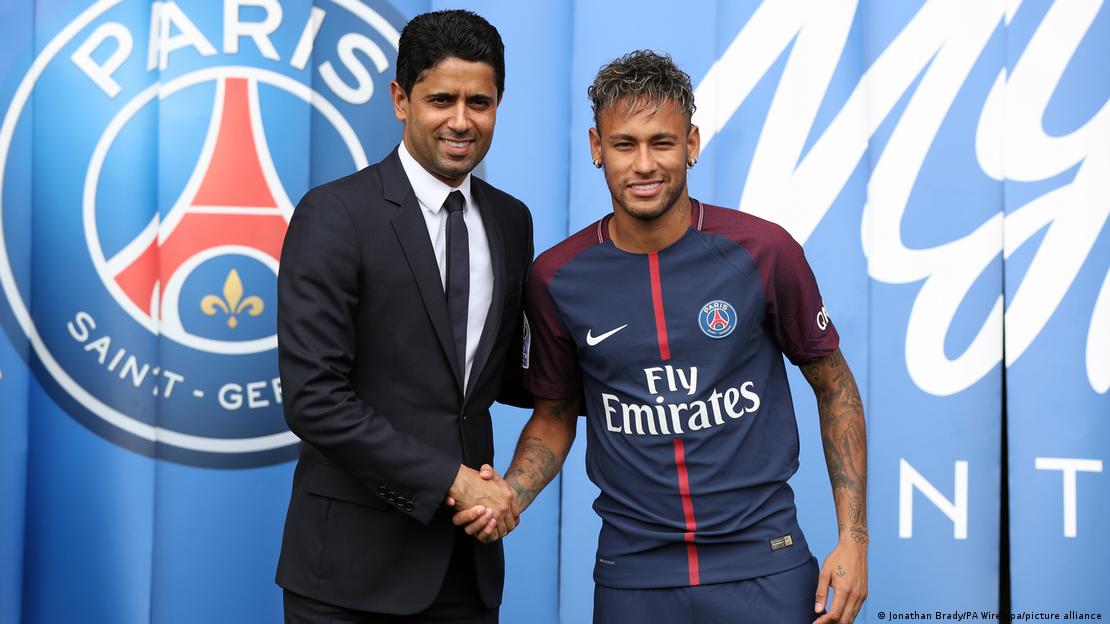
For example, PSG's purchases of forwards Neymar (€230 million, or $247.4 million, in 2017) and Kylian Mbappe (€180 million in 2018) have upended football's transfer market. Recent contracts given by Saudi Pro League clubs to superstars Cristiano Ronaldo (reportedly a $200 million per year total salary) and Karim Benzema (reportedly $107 million) threaten to have a similar effect.
Neymar's record transfer to PSG completely distorted the football transfer market
Image: Jonathan Brady/PA Wire/dpa/picture alliance
Golf could be facing a similar financial crisis. In 2022, the Saudi-backed LIV Golf International Series courted former major winners like Phil Mickelson and Brooks Koepka away from the well-established PGA Tour with jaw-dropping salaries. But after an announced merger of the two golf competitions, the compensation of top golfers, especially those loyal to the PGA Tour, remains to be seen.
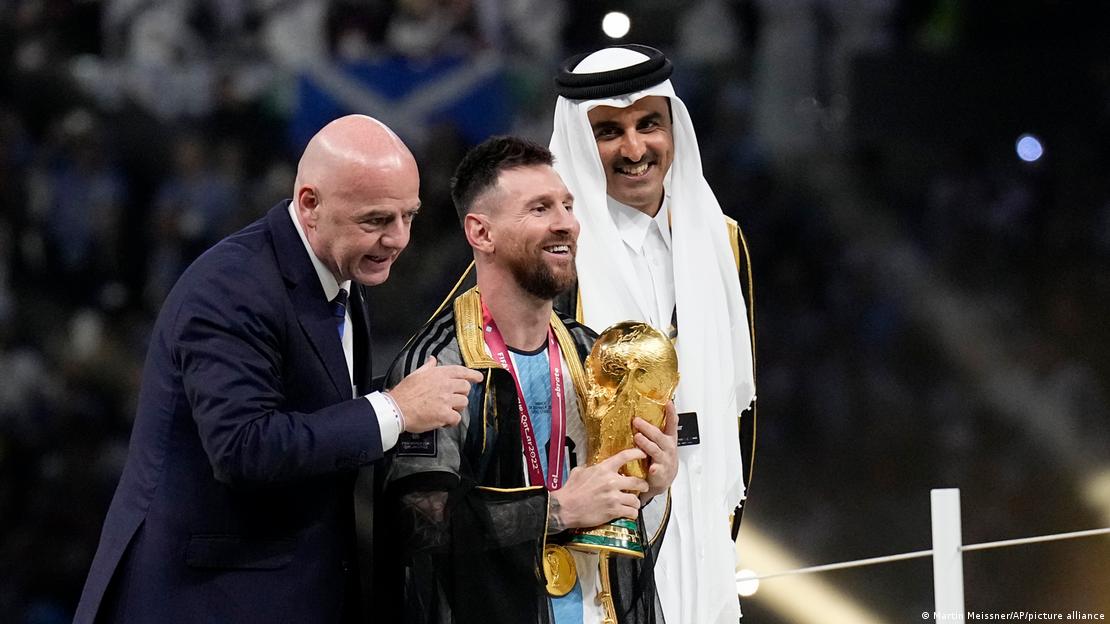
Otherwise, while many have decried the rise of sportswashing, the entities that practice it only stand to gain. Take the 2022 World Cup in Qatar, which, leading up to it, had extensive reporting on horrid working conditions for migrant workers in the country. Though some Western countries, including Germany, saw a drop in TV audience figures, FIFA reported record viewership numbers for the group stage and a 1.5 billion global TV audience for the final — a match which heavily featured Mbappe and Lionel Messi, teammates at the time with Qatar-funded PSG.
Lionel Messi receives the World Cup trophy while draped in a bisht
Image: Martin Meissner/AP/picture alliance
What have athletes said about sportswashing?
Throughout history, sportwashing has occasionally been synonymous with boycotts and activism. The response to sportswashing has varied when it comes to sportsmen and women.
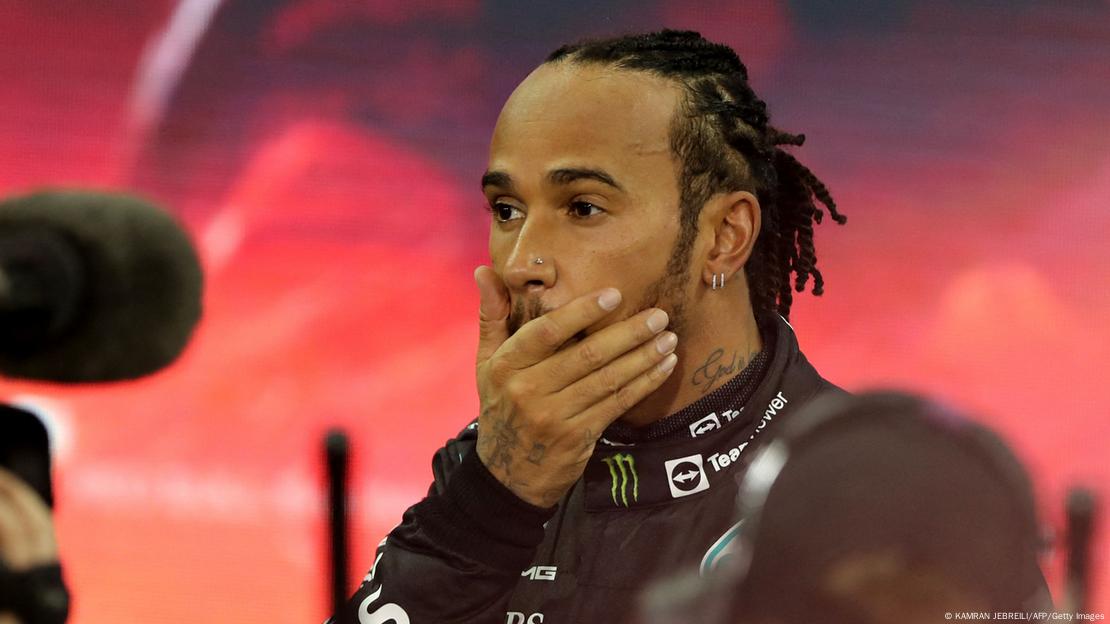
Many have opted to take the money and do what is asked of them on or off the pitch. But as athlete activism has continued to rise, so have critical outlooks on sportswashing countries. Formula One driver Lewis Hamilton said ahead of the Saudi Arabia Grand Prix he was uncomfortable racing in the country and that the sport should "raise awareness for things that the people are struggling with."
Lewis Hamilton said he was 'uncomfortable' racing in Saudi Arabia due to its treatment of the LGBTQ community
KAMRAN JEBREILI/AFP/Getty Images
Ahead of the Qatar World Cup, Germany, the Netherlands and Norway conducted on-field protests directed at human rights abuses in the Gulf country. Germany famously covered their mouths in their team photo before their opening World Cup match against Japan after FIFA prohibited the "OneLove" captain's armband, which advocated for the LGBTQ community which has limited rights in Qatar.
Nevertheless, many feel limited in what they can say, fearing ramifications of their choice to speak out. For instance, though some athletes chose to speak out about China's human rights abuses against the nation's muslim Uyghur community ahead of the Winter Olympics in Beijing, many decided not to, fearing it would affect their ability to compete.
What can be done about sportswashing?
Even in a world that has become ever more politically, culturally and socially aware, many decry the impact of sportswashing. As a result, bucking the trend may become more challenging.
Occasionally, a sportswashing arrangement becomes so untenable that change finally comes. Russia's invasion of Ukraine caused much of the sports world to rethink their relationship with the nation, which led to canceling sponsorships or banning Russian and Belarusian athletes and teams from competing. But despite the atrocities in Ukraine, some backtracking has begun, and as Saudi Arabia's ongoing involvement in Yemen's Civil War can attest, the new precedent of handling sportswashing doesn't seem to apply to everyone.
As the main actors, the athletes can continue to take power into their own hands. The outcry from players like Germany captain Alexandra Popp and US superstar Alex Morgan over a Saudi sponsorship of the upcoming Women's World Cup led to FIFA eventually reversing course.
Fans also have a role to play, and it's one they've taken up in Germany, where the 50+1 rule limits outside investment in football clubs. Bayern Munich supporters have strongly criticized the club for its relationship with Qatar, where the first team has made annual midseason trips since 2011.
Bayern Munich fans hold up a banner critisizing the club's relationship with Qatar
Imago/B. Fell
But the big governing bodies are the ones who have to take a stand against sportswashing. FIFA President Gianni Infantino's brash defense of the Qatar World Cup and the IOC's choice to act only when forced to, suggest they're not yet ready to make that stand.
Edited by: James Thorogood
EU moves step closer to strengthened gig workers' rights, as ministers reach agreement
A deliveroo logo is seen on a bicycle in London, July 11, 2017
. - Copyright Frank Augstein/AP Photo
By Aida Sanchez Alonso • Updated: 13/06/2023 Some countries argue the deal does not go far enough.
The EU has moved a step closer to improving the working conditions of platform workers, after months of impasse was overcome on Monday by the bloc's labour ministers.
An agreement was reached in Brussels between member states on what their negotiating position should be with the other EU institutions, granting a certain number of rights to drivers and delivery riders in the process.
The deal establishes that platform - or gig - workers have to fulfil three out of seven criteria to be considered employees. These include the ability to fix the amount of money for a ride, turning down work or choosing their appearance.
If they are considered employees, they will be entitled to labour rights like paid holiday or sick leave.
The agreement also reduces the power of the algorithms that distribute tasks and preferences in the allocation of time slots.
But five countries, including Germany and Spain consider it not ambitious enough and hope that the next step - negotiations with the European Parliament - push the agreement forward.
Ludovic Voet, Confederal Secretary at the European Trade Union Confederation (ETUC), is in agreement with this position.
"It is for sure less ambitious because it's discussing putting extra hurdles with three criteria and not two criteria. It is also discussing the possibility to have national derogations," Voet told Euronews.
"So, it's not taking the first principle of the objective of the Commission proposal that is granting the workers the rights that they deserve."
The battle and the intense lobby by companies, such as Uber, will continue as they still believe the text does not give them enough certainty.
'Inadequate progress': World awaits climate verdict that will shape Cop28
Talks end in Germany on first ever 'global stocktake' to conclude in Dubai
Scientists warn flooding and other natural disasters will intensify with every half a degree of warming beyond 1.5°C. EPA
The world faces a scathing verdict on its efforts to tackle climate change after talks ended on Tuesday on an appraisal that the designate UAE presidency says will “frame all of our work” at the Cop28 summit in Dubai.
The host will oversee the first five-yearly “global stocktake” ordered by the Paris Agreement, the deal that set the target of limiting global warming to 1.5°C.
With the next progress report not due until 2028, the stocktake in Dubai is considered a key moment for countries to rethink their national go-green plans.
Hana Al Hashimi, the UAE’s chief climate negotiator at Cop28, said it would be a milestone moment to “course correct for 2030 and beyond, for the future we all want”.
Talks on the “technical phase” of the stocktake ended in Bonn, Germany on Tuesday, clearing the way for a “political phase” at Cop28 where leaders and policymakers could issue a joint call to action.
The two scientists tasked with reporting back on the talks, Farhan Akhtar from the US and Harald Winkler from South Africa, have made clear they see global emissions as “not in line” with the 1.5°C goal.
“It’s clear that we’ve made significant yet inadequate progress,” Mr Akhtar said.
Negotiators and lobbyists who spoke to The National said the stocktake should call for urgent emissions cuts to keep 1.5°C within reach – preferably without overshooting the target first and trying to claw temperatures back later.
“We think that 1.5°C is where we should focus our attention. It is still feasible,” said UK negotiator Iliana Cardenes on the sidelines of the talks in Bonn.
PARIS AGREEMENT
Article 14
1. [The Cop] shall periodically take stock of the implementation of this Agreement to assess the collective progress towards achieving the purpose of this Agreement and its long-term goals (referred to as the "global stocktake")
2. [The Cop] shall undertake its first global stocktake in 2023 and every five years thereafter
The stocktake is a “vehicle for action” that can “set out really clear next steps for climate action in the critical decade that we have left”, she said.
Carlon Mendoza, a negotiator from Trinidad and Tobago, argued that any delay in phasing out fossil fuels would be unfair to future generations.
“We should be focusing on pathways to 1.5°C and not an overshoot,” he said.
Events involving high-ranking figures are planned in the first week of Cop28 to address the stocktake, said the summit’s chief executive Adnan Amin.
Those talks could produce “key political messages and recommendations” that inform a final decision or declaration on the stocktake, he said. The summit starts in Dubai's Expo City on November 30.
A critical moment for us to embark on a new and ambitious pathway Adnan Amin
The talks in Bonn were mired in familiar climate controversies, with rich countries urged to shoulder the burden of a crisis that poorer countries did little to bring about.
Cuban diplomat Pedro Luis Pedroso Cuesta, speaking on behalf of 134 developing countries including China, piled pressure on rich countries to lead the way in emissions cuts.
“Historical emissions are unequal. The impacts and risk associated with warming are also unevenly distributed,” he said.
India said it did not want to see “prescriptive messages” in the stocktake that order developing countries down a path of “constraining energy consumption and income growth”.
Chimneys at the Scholven coal-fired power plant in Gelsenkirchen, Germany, in May last year. Bloomberg
Some ways of getting to 1.5°C modelled by scientists “project a future for us that we do not want”, said the Indian delegation, which succeeded at Cop26 two years ago in securing committments to phase down coal.
The US hit back by saying development needs “cannot be an excuse” to delay emissions cuts.
Washington believes that “collective progress” is not on track and that the stocktake should stress the need for everyone to ditch fossil fuels, end deforestation and cut methane emissions, US diplomats said in Bonn.
Mr Akhtar said parties had expressed a wish to “convey both hope and urgency” and deliver a report that could inspire further action.
Experts warn that missing the 1.5°C target by even half a degree would bring a higher risk of floods, droughts, tropical cyclones, melting of ice sheets and a devastating rise in sea levels.
The top UN science panel advising on climate change said in a March report that humans had unequivocally caused about 1.1°C of global warming above pre-industrial levels already.
Small island states want the report to stress that the threat of rising sea levels is already hanging over them.
Activists in Bonn said the stocktake should include “strong political signals” about a switch to renewable energy
. Talks in Bonn have been preparing the ground for Cop28 in the UAE. Getty
Fernanda Carvalho of the World Wildlife Fund said countries should be asked to rethink their 2030 targets and given a “strong call” to phase out fossil fuels.
“We have two elephants in the room. One is ambition – the targets are not going to get us to where we need to be – and the other is implementation,” she said.
“We don’t have the right targets, but even the wrong targets are not being implemented.”
Another key question is finance, which India described as “nowhere near” the desired scale, and several countries said should figure prominently in the report handed to politicians.
Canada and Germany have expressed optimism that a promise of $100 billion in funding for global climate action will finally be ready this year after it was promised in 2009, a delay the UAE presidency has described as a distraction.
The stocktake must drive systems transformations
Adnan Amin
The total cost could run into the trillions and Algeria, speaking on behalf of a group of Arab countries, said the stocktake “needs to identify solutions” to put more money in reach for developing countries.
Lidy Nacpil, a campaigner from the Asian Peoples’ Movement on Debt and Development, said the stocktake should also address progress on adapting food production to warmer temperatures.
Ms Nacpil acknowledged that demands for a total end to fossil fuels might seem unrealistic at present.
“We’re working very hard to make sure that what we actually get in the end is not what is realistic now,” she said.
Mr Amin promised diplomats on Monday that the stocktake “will frame all of our work” when the UAE assumes the summit presidency.
The global stocktake “is a critical moment for us to embark on a new and ambitious pathway to a sustainable future”, Mr Amin said.
“The stocktake must drive systems transformations that enable us to collectively meet the ambition of the Paris Agreement and to keep the 1.5°C goal within reach,” he said.
A formal report on the Bonn talks is expected to be published in September, before Cop28 starts on November 30.
The response in Dubai could include a joint call to action, or a formal decision of the 194 parties to the Paris Agreement, that sets out plans for key sectors or identifies good practices.
There is a 2025 deadline for countries to hand in an updated climate plan and they are expected to take the stocktake into account.
The UN’s top climate official Simon Stiell has said the stocktake “must be a turning point”.
While scientists have called for drastic emissions cuts by 2030, the stocktake “will show that we are not yet on that path”, he said.
Updated: June 13, 2023,
WAR IS ECOCIDE
War and Water at Center of Kherson’s Devastation as Jewish Community Dwindles
NICOLE JANSEZIAN
06/13/2023
Still under daily artillery fire, residents now apprehensive about ecological impact after the flooding recedes
Before Russia’s invasion of Ukraine in February 2022, Ihor Papernyi owned a yacht club on the Dnipro River with a fleet of 60 to 80 boats. However, with the onset of the war, business ran dry and only a few of Papernyi’s boats survived the Russian takeover of Kherson. Now those few remaining boats are being put to use in the flooded streets of Kherson and surrounding towns, following a dam collapse on Tuesday.
“I’ve been using the boats to rescue people and animals. It’s not just me but the police, the army—everyone is out there working. People are still stuck on higher floors,” Papernyi told The Media Line in an interview on Thursday night. “There is a lot of wildlife that is running around the city too.”
The city of Kherson was already a ghost town, having lost some 80% of its population since the Russian invasion began. But following the explosion of the Nova Kakhovka Dam on Tuesday, subsequent flooding swallowed entire neighborhoods and forced the evacuation of residents, including the dwindling Jewish population.
Speaking from Kherson on Thursday, Chabad emissary Rabbi Yossef Wolff told The Media Line that the river rose again overnight, plunging more streets underwater and putting even more neighborhoods in jeopardy.
The flooded streets of Kherson. (Courtesy Ihor Papernyi)
“All of the places that are close to the river are underwater,” Wolff said. “The water level is up to the signs on the sidewalks—more than 3 meters [10 feet] at least.”
Wolff and Papernyi helped evacuate residents who lived closest to the explosion.
“We immediately contacted 20 families in the Jewish community that live near the water and got them out on Tuesday. Now we need to find them temporary housing,” Wolff explained. “Every person who lives in the area by the river will be out of their homes for at least two weeks when the water is expected to recede.”
Built in 1895, Kherson’s only synagogue is situated some 20 meters above the river’s level and will likely remain out of reach of the flood waters. Since the war began, the synagogue has been a focal point for providing food, water, and other essentials including electricity and internet connection when the power went out in other areas of the city.
While the main focus of Chabad is to provide for the Jewish residents, the community has welcomed anyone—and many have turned up.
“We are the address for everybody. Everyone in the city knows they will not be kicked out from the synagogue, and they are coming here for help,” Wolff said. “I’m not a military man, I’m here as a rabbi. We didn’t close up the synagogue even for one day.”
Kherson, a key port city on the Black Sea, was temporarily occupied by Russia from March through November 2022 when it was recaptured by Ukrainian troops. But despite its liberation, the city has not been safe.
“We are still under bombing every day,” Wolff said.
The Jewish community in Kherson was established when Jews were permitted to settle in the southern Ukrainian city on the Black Sea in the late 1700s. Before the Ukraine-Russia war which began in February 2022, there were an estimated 10,000 Jews, according to Wolff. A general exodus of residents since then has left the Jewish community at barely 1,000 while the overall population has decreased from 350,000 to about 60,000.
Humanitarian aid organizations, including Jewish groups such as IsraAID, the American Jewish Joint Distribution Committee, and Chabad, are delivering food, medicine, and basic goods to the city.
Supplies have been distributed from the Kherson synagogue since the beginning of the war in February 2022. (Courtesy Chabad)
The Jewish Agency in Israel said it is closely monitoring developments and “is in contact with the community and its leaders, as well as with other leaders in the area.”
“As of now, the Jewish community is being assisted by the rescue teams on the ground and are receiving the help they need,” the Agency said in a statement to The Media Line.
The Jewish Relief Network Ukraine estimated that this week, at least 2,000 homes flooded and 20,000 buildings have lost power. Authorities estimate that the flooding could ultimately impact up to 40,000 people in 80 towns.
For now, residents have enough food, water, and other supplies, Papernyi said. Their primary concern is what they will find once the water recedes, which ironically could be more damaging than the war itself.
“What has happened to the farms, businesses, chemical plants, gas plants? What kind of air quality will we have? Water quality? Diseases? All of this plus war. Residents are more worried about the ecological impact than the war at the moment,” he said.
Ukraine’s President Volodymyr Zelenskyy, who visited Kherson on Thursday, called the explosion “the largest man-made environmental disaster in Europe in decades.”
Similar concerns are rampant on the Russian-occupied side of the river, where a nuclear power plant received its cooling water from the river. Last year, Zelenskyy accused Russia of placing mines on the dam when they occupied the city, which may have lent to the force of the explosion.
However, it isn’t clear what either side would gain from collapsing the dam.
In official statements, Israeli officials steered clear of blaming Russia.
“Such deliberate targeting of critical infrastructure and people must be strongly condemned by the entire international community. Our thoughts and prayers are with the Ukrainian people in this difficult hour,” Lior Haiat, spokesperson for the Foreign Ministry, said in a press release.
Papernyi, 52, lived in Israel from 2000 to 2007 when he returned to Kherson for business.
Asked whether he would consider returning now, his answer was simple: He can’t. Ukrainian men ages 18 to 60 are banned from leaving Ukraine due to the war.
And while he isn’t worried that the Russian army will take advantage of the city’s vulnerability after the flood, as the waters also pushed back their troops, Papernyi didn’t imagine his country would be in the throes of war for this long.
“It’s a year and a half of tragedy,” he lamented. “We thought it was just war, but now we see there are no limits. What’s next? Nuclear?”
UN says oil transfer from abandoned Yemeni tanker to 'start soon'
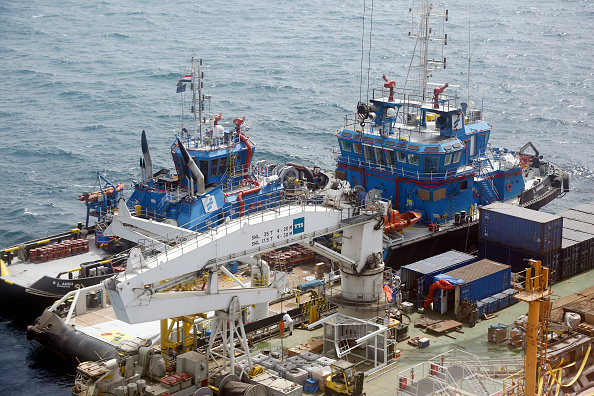
The FSO Safer, long used as a floating storage platform and now abandoned off the rebel-held Yemeni port of Hodeida, has not been in use since conflict broke out in Yemen over eight years ago.
The operation will see private company SMIT Salvage pump the oil from the Yemeni tanker to the Nautica, a super-tanker the UN bought for the operation [Getty]
Salvage teams are close to starting the transfer of more than one million barrels of oil from a decaying tanker anchored off Yemen after two weeks of preparatory inspections, the United Nations said.
The FSO Safer, long used as a floating storage platform and now abandoned off the rebel-held Yemeni port of Hodeida, has not been serviced since the Arabian Peninsula country plunged into civil war more than eight years ago.
A team of experts last month started inspecting conditions aboard the vessel and kickstarted preparations for the operation intended to avert a major oil spill.
"I think we are getting very close to the point where we can start the ship-to-ship transfer which will be the next and perhaps most important phase," David Gressly, the UN Resident and Humanitarian Coordinator for Yemen, told a news conference in The Hague on Monday.
"We have a few steps to take care of in terms of insurance and other issues that we need to resolve before bringing in" a replacement vessel, he said.
The operation will see private company SMIT Salvage pump the oil from the Safer to the Nautica, a super-tanker the United Nations purchased for the operation, then tow away the empty tanker.
"After two weeks of inspection, our crew are convinced that the Safer is strong enough for such an operation," said Peter Berdowski, CEO of Boskalis, the parent company of SMIT Salvage.
"I think we are almost there. As far as we are concerned, we are ready to start the ship-to-ship transfer any day in the coming days."
Berdowski was speaking on the same panel as Gressly ahead of the opening of the Yemen International Forum in The Hague on Monday.
Berdowski said the removal of the oil could take between one week and one month, depending on how easily it can be pumped.
"The most important next step obviously is the arrival of the Nautica" replacement vessel, he said.
Berdowski said some issues still needed to be resolved, including inspections to determine whether there is any oxygen inside the oil tanks which could result in an explosion if exposed to a spark.
His team would also need to embark on an underwater inspection of the Safer's hull to make sure it is strong enough for a ship-to-ship transfer.
The Safer is carrying four times as much oil as that which spilled in the 1989 Exxon Valdez disaster off Alaska, one of the world's worst ecological catastrophes.
A spill could cost up to $20 billion to clean up, to say nothing of the environmental and human toll, and the UN is negotiating with an insurance consortium to insure the operation.
Oligarchs, Minorities, Corrupt Judges: EU’s Venice Commission Addresses Three Sore Spots for Ukraine
The EU’s Venice Commission, which advises countries on how to bring its laws in line with the EU, gave rulings on three problematic areas of Ukrainian legislation.
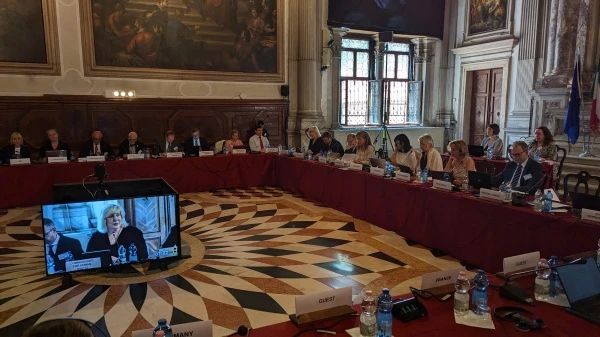
The European Commission for Democracy through Law, better known as the Venice Commission, gave rulings on three problematic areas of Ukrainian legislation during its 135th Plenary Session held on June 9-10, 2023, in Venice, Italy.
The Venice Commission acts as the Council of Europe’s advisory body on constitutional matters. Its role is to advise states on how to align their legal and institutional structures with European standards in the areas of democracy, human rights and the rule of law.
The Commission gave opinions on three areas of Ukrainian legislation at the request of chairperson of the Verkhovna Rada of Ukraine. These requests – which had been pending since the autumn of 2021 and spring of 2022 – were delayed by the full-scale invasion of Ukraine.
Opinion 1: Reducing the influence of “oligarchs”
Legislation designed to prevent threats to national security, resulting from the excessive influence of individuals with significant economic or political influence, so-called oligarchs, was proposed.
The Venice Commission expressed the view that Ukraine’s proposed “Law on Oligarchs” was too sweeping and incompatible with the European Convention on Human Rights. They suggested ten areas which should be addressed and incorporated into the law before it became acceptable.
Suggestions included a need for systemic review of areas relating to corruption, media ownership, public procurement, money laundering legislation, financing of political parties, tax legislation and independence of regulatory bodies.
The commission also said that more work needed to be done to ensure that judicial independence, integrity and impartiality was in line with European standards.
Opinion 2: Law on National Minorities
The commission commented favorably on Ukraine’s efforts towards the protection of minorities and made only four recommendations, largely in the use of minority languages, which would allow this legislation to meet EU standards.
The recommendations concerned the freedom to organize events in minority languages; remove the obligation to provide Ukrainian translation and interpretation at minority events; to legislate for the right to have official documentation available in minority languages; to legislate for the right to conduct activities with administrative authorities in minority languages.
Opinion 3: Need for competitive selection of constitutional judiciary
The commission noted that Ukraine had adjusted its draft legislation, based on earlier commission recommendations, to develop an independent body tasked with assessing the integrity and professional competence of candidates for the position of judge in Ukraine’s Constitutional Court. Its opinion was that the legislation could now move forward on that basis which should include recommending candidates for the posts in the Advisory Group of Experts (AGE), who would advise on candidates’ suitability.
Young people are abandoning news websites – new research reveals scale of challenge to media
THE CONVERSATION Published: June 13, 2023
ournalism caused by the traditional news media’s struggles to cope with the digital revolution has been well documented over many years. But news organisations now face a much more fundamental change driven by generations who have grown up with and rely almost entirely on various digital media.
Data published in this year’s Reuters Institute Digital News Report shows an acceleration in the structural shifts towards more digital, mobile and media environments. This is where news content is delivered via social media and now, increasingly video-led platforms such as TikTok, rather than via what to a new generation of media consumers look like the more formal and stuffy traditional of “legacy” media, including newspapers and television.
Not only is consumption of traditional television news and print formats continuing to decline at a relentless rate, but online websites are also struggling to engage news users, despite the tumultuous times in which we live.
One benchmark of this shift is a question we ask about key gateways that people use to access news. Using average data across all 46 countries surveyed in our annual report, we found that more people choose social media each year, mostly at the expense of direct access via a traditional news website or app. Access via search and other aggregators has also increased slightly over time.
Use of news websites/apps versus social media to access news: Which of these was the main way in which you came across news in the last week? Base: All who used a news gateway in the last week in each market-year ≈ 2000. Note: Number of markets grew from 36 in 2018 to 46 from 2021 onwards. Markets listed in online methodology. Reuters Institute for the Study of Journalism, Oxford University, Author provided
These are averages, and it is important to point out that direct connection remains strong in some markets – mainly in northern Europe, where there is keen interest in news and relatively high trust. But elsewhere – especially in parts of Asia, Latin America, and Africa – social media or other aggregators are by far the most important gateways, leaving news brands much more dependent on third-party platforms for traffic.
Generational differences are also a big part of the story. In almost every country we find that younger users are less likely to go directly to a news site or app and more likely to use social media or other intermediaries.
The following chart for the UK shows that over-35s (blue line) have hardly changed their direct preferences over time, but that the 18–24 group (pink line) has become significantly less likely to use a news website or app.
This is just one indication of how the generation that has grown up in the age of social and messaging apps is displaying very different behaviours as they come into adulthood.
Percentage of people using a news website or app: Thinking about how you got news online (via computer, mobile, or any device) in the last week, which were the ways in which you came across news stories? Base: 2018–22; 18–24 ≈ 200, 25–34 ≈ 300, 35+ ≈ 1500. Reuters Institute for the Study of Journalism, Oxford University, Author provided
Dependence on social media may be growing, but it is not necessarily the same old networks. Across all age groups, Facebook is becoming much less important as a source of news – and by implication as a driver of traffic to news websites. Just 28% say they accessed news via Facebook in 2023 compared with 42% in 2016, based on data from 12 countries we have been tracking since 2014.
This decline is partly driven by Facebook pulling back from news and partly by the way that video-based networks such as YouTube and TikTok are capturing much of the attention of younger users.
Twitter usage is also reportedly declining following the chaotic set of changes introduced by Elon Musk, even if our survey shows relatively stable weekly reach overall. New platforms
TikTok is the fastest growing social network in our survey, used by 44% of 18–24 year-olds for any purpose and by 20% for news (up five percentage points compared with last year). Our survey results also show that the Chinese-owned app is most heavily used in parts of Asia, Latin America and Africa. Which, if any, of the following have you used for news in the last week? Base: Total sample in each market ≈ 2000. Note: TikTok has been banned in India and does not operate in Hong Kong. Reuters Institute for the Study of Journalism, Oxford University, Author provided
The report also provides evidence that users of TikTok, Instagram and Snapchat tend to pay more attention to celebrities and social media influencers than they do to journalists or media companies when it comes to news topics. This marks a sharp contrast with “legacy” – or more established – social networks such as Facebook and Twitter, where news organisations still attract most attention and lead conversations.
Although news organisations have been experimenting with TikTok accounts, many are struggling to adapt to the more informal tone where creativity is the key to attracting an audience.
These shifts are additionally challenging for publishers because they often require expensive bespoke content to be created and there are few ways to monetise short form videos, with limited linking opportunities back to websites or apps. Younger people less likely to read online
These platform shifts are part of a wider move away from reading and towards watching or listening to news content online. While all age groups say they still prefer to read news online because of the speed and control if offers, younger groups are more likely to express preferences for watching or listening to news content, as the chart below shows. And this translates into greater consumption of short-form videos and podcasts by this group, according to our data.
News consumption preferences by age and media: In thinking about your online habits around news and current affairs, which of the following statements applies best to you? Please select one. Base UK= 1740 (excl. DKs) Reuters Institute for the Study of Journalism, Oxford University, Author provided
Our research over more than a decade has captured the way that all age groups have adopted digital media, alongside more familiar formats such as TV and print. But now we are seeing the emergence of a generation of social natives that are not bound by traditional definitions of news.
As our previous research has shown, younger groups expect news to be engaging, participatory and to be available on their terms – in the networks and platforms where they spend their time. Trust is not a given, it needs to be earned – as much by journalists as by any other creator of content.
For all the difficulties this entails – around trust, attention and business models – this is the media environment that the public is increasingly choosing for themselves. It is one where journalists and news media will need to carve out their place if they want to maintain their relevance and connection with the wider public.
In the throes of Canada’s raging wildfires, a glance at this century’s major blazes paints a troubling picture of a globe marked by climate change.
The 21st century has seen many of these destructive events, with Australia’s 2019-20 season and Russia’s 2021 wildfires scorching immense tracts of land.
The fire seasons of 2009 and 2015, one in Australia and another in Russia, saw an alarming loss of life, unlike most other major fires.
The current Canadian situation, although dwarfed by the Australian and Russian fires at this point in time, parallels the 2014 Northwest Territories fires in its severity, according to data from the Canadian Interagency Forest Fire Center as of June 5.
As both American and Canadian cities choke on smoke, these numbers remind us that the climate crisis is a tangible, immediate threat.
Albinism is a rare genetic condition that results in a lack of pigmentation (melanin) that normally gives colour to hair, skin and eyes.
People with albinism commonly experience sensitivity to bright light, which can lead to blindness and skin cancer. Additionally, in some countries, people with albinism suffer discrimination, violence and even death.
To promote a better understanding of albinism and combat discrimination against people with albinism, the United Nations designated June 13 as International Albinism Awareness Day.
What causes albinism?
Albinism is caused by mutations in specific genes that are responsible for melanin production. This gene is recessive, meaning that both parents must carry the gene for it to be passed on. Albinism is not a disease, but is a genetic condition that people are born with.
There are several different types of albinism and the degree of pigmentation varies depending on the specific type one has.
Individuals with albinism face a high risk of skin cancer which is responsible for at least 80 percent of deaths, according to the UN. This risk is so significant that 98 percent of people with albinism do not live beyond the age of 40.
While there is no cure for the absence of melanin that is central to albinism, the condition can be managed by avoiding direct sunlight, wearing high-quality sunglasses that can block ultraviolet rays and wearing sun-protective clothing and hats when outdoors.
How common is albinism?
While albinism is generally uncommon, some forms of the condition are extremely rare.
Albinism occurs worldwide regardless of ethnicity or gender. While reliable data are not available for many parts of the world, it is estimated that in North America and Europe one in every 17,000 to 20,000 people have some form of albinism.
Albinism is most prevalent in sub-Saharan Africa with estimates of one in 5,000 to one in 15,000.
What is the preferred term?
The term “albino” has historically been used in a derogatory way, so “person with albinism” is preferred when referring to those with the condition. “Albino” defines a person by his or her appearance, while “person with albinism” puts the person before the condition.