BBC News Jun 13, 2023
It’s possible that I shall make an ass of myself. But in that case one can always get out of it with a little dialectic. I have, of course, so worded my proposition as to be right either way (K.Marx, Letter to F.Engels on the Indian Mutiny)
Tuesday, June 13, 2023
BBC News Jun 13, 2023
June 13, 2023

Palestinians stage a protest in front of the Supreme Court of Israel after the court's postponed its decision on the objection of the Palestinian families on forced eviction in Sheikh Jarrah Neighborhood in Jerusalem on August 02, 2021
June 13, 2023
The Palestinian Authority has condemned the forced eviction by Israel of Palestinian residents in occupied East Jerusalem as a "war crime". The comment was made by the PA Ministry of Jerusalem Affairs after the Israeli occupation authorities ordered a Palestinian family to leave their home in favour of illegal settlers in a case dating back to 1978.
Israeli settlers claim that Jews lived in the house before Israel's creation in 1948, and Jordan later took over the administration of East Jerusalem. They base their claim to ownership of the property on an Israeli law dating back to the 1970s that allows Jews to recover property that allegedly belonged to Jews prior to 1948. According to this law, even those who are not related to the original owners of the property can claim it back.
"The forced eviction of the [Palestinian] family… amounts to a war crime," said the PA ministry. "This is part of attempts by the occupation and settler groups to seize as many Palestinian houses as possible in Jerusalem's Old City and Silwan town near Al-Aqsa Mosque." It is also, added officials, part of the apartheid system imposed by Israel on Palestinians.
The ministry called on the international community to act urgently "to stop all forced evictions, home demolitions, settler colonial activity, attempts to divide Al-Aqsa Mosque, and attacks on [other religious] sanctities."
Dozens of Palestinian families in East Jerusalem face expulsion from their homes in favour of Israeli settlers, even though all Israeli settlers and the settlements in which they live are illegal under international law. Israel occupied East Jerusalem during the 1967 Six Day War, and annexed the entire city in 1980 in a move never recognised by the international community.
READ: 150 Palestine families in Jerusalem face forced eviction by Israel says UN Envoy
Decrease in number of building permits granted to Palestinians by Israel

Israeli security forces gather around a construction site on March 14, 2017
June 13, 2023
The rate of building licences Israel has granted Palestinians in the occupied territories has decreased by ten per cent during the first quarter of this year, Wafa news agency reported.
A total of 2,530 building licences were issued in the occupied Palestinian territories (OPT) in the first quarter of 2023, which included 1,625 for new buildings, the Palestinian Central Bureau of Statistics said today.
The new statistics show a ten per cent decrease in the number of permits granted to Palestinians, compared to the fourth quarter of last year.
Palestinians are rarely granted building permits by the Israeli occupation authorities, especially in occupied East Jerusalem.
Moreover, the data revealed that the number of permits issued during the first quarter of 2023 decreased by 18 per cent compared with the fourth quarter of 2022 and a further 23 per cent compared with the first quarter of 2022, added the PCBS.
It comes after the UN Office for the Coordination of Humanitarian Affairs (OCHA) reported last week that the Israeli occupation authorities have demolished, forced local people to demolish or seized 290 Palestinian-owned structures across the West Bank and Jerusalem in the first quarter of 2023.
"All but 19 of the structures were targeted for lacking building permits, which are nearly impossible for Palestinians to obtain," explained OCHA. "As a result, 413 people, including 194 children, were displaced, and the livelihoods or access to services of over 11,000 others were affected."
The building permits are charged at extortionate prices and are unaffordable for most Palestinians, creating a legal loophole for Israel to annex more land and to leave Palestinians in limbo by preventing them from developing infrastructure. Palestinians who do apply for permits often have no response for years or have their applications rejected.
OCHA added that "The number of structures targeted in the first quarter of 2023 has increased by 46 per cent compared with the same period in 2022, which already saw the highest number of demolitions recorded in the West Bank and Jerusalem since 2016."
Israel's widely practised policy of home demolitions targeting entire families are acts of illegal collective punishment and come in direct violation of International Human Rights Law.

Karim Khan, the International Criminal Court's chief prosecutor holds a press conference in Khartoum, Sudan on 12 August 2021
June 13, 2023
One hundred and thirty-five prominent figures and several human rights groups have sent a letter today to Karim Khan, urging the Chief Prosecutor of the International Criminal Court (ICC) to discharge his duty and address the ongoing breaches of international humanitarian law committed by the state of Israel against Palestinians living under its occupation.
The signatories of the letter include major figures in the world of politics, law and academia. They have raised concerns over the ongoing delay in pursuing an investigation into Israeli war crimes since Khan took over from his predecessor Fatou Bensouda. Under the former Chief Prosecutor, on 3 March 2021 the ICC initiated a formal investigation into war crimes committed in Palestine.
"Many of us had hoped that the ICC investigation, started under your predecessor, would continue under your leadership. However, despite mounting evidence of crimes committed by the Israeli regime, your office has apparently taken no further action," said the signatories. "Since you assumed the position as the Chief Prosecutor of the International Criminal Court, no one has heard anything from you on the Palestinian case, while your office announced speedy investigations into the alleged war crimes committed by Russia during its ongoing war against Ukraine, and issued an arrest warrant for President of Russia Vladimir Putin."
Pointing out that it's nearly a decade since Palestinians called on the ICC to open an investigation, the signatories insisted that there is no valid reason for the delay. The government of Palestine had first called for an ICC probe into allegations of crimes "in the occupied Palestinian territory, including East Jerusalem, since June 13, 2014, and became party to the Rome statute on 1 April 2015," the letter pointed out.
Read: Why Karim Khan froze the Palestine file: The ICC and Israeli war crimes in Gaza
Expressing their frustration further, the signatories noted that Bensouda's announcement to open an investigation into the situation in Palestine followed the Pre-Trial Chamber's decision on 5 February, 2021, providing that the ICC's jurisdiction does indeed extend to Gaza and West Bank, including East Jerusalem.
In a list of alleged Israeli war crimes carried out since Khan's appointment, the letter mentioned "the systematic killing of civilians, ongoing building of settlements, collective punishment, open-ended occupation, laws targeting only Palestinians, the state-backed seizure of Palestinian land by settlers and the regular targeting of civilian infrastructure by bulldozers in the West Bank."
The incitement to violence and genocide of Palestinians by Israeli Finance Minister Bezalel Smotrich was also mentioned. The far-right Israeli minister called for the Palestinian village of Hawara to be "wiped out" by the Israeli government. His comments followed what one officer in the Israel Defence Forces called a "pogrom" in the village, where settlers killed one Palestinian, injured dozens more and torched multiple homes.
The signatories appealed for an end to Israeli "impunity" and called on Khan to take the "courageous" next step in the ICC probe. Last year almost two hundred Palestinian and international organisations representing civil society called on Khan to end the ICC's procrastination; he announced that he will visit Palestine this year, but no further details about such a trip have been released.

Iranian President Ibrahim Raisi (L) is seen at an inter-delegation meeting with Venezuelan President Nicolas Maduro during his official visit in Caracas, Venezuela on June 13, 2023 [Iranian Presidency/Anadolu Agency]
June 13, 2023
Iran and Venezuela want to increase bilateral trade to $20 billion, up from $3 billion, Iranian President, Ebrahim Raisi, said on Monday during a visit to Caracas.
During the visit, the two countries signed a Memorandum of Understanding to expand cooperation in petrochemicals with a view to carrying out joint projects, building on their already-close cooperation in oil, Reuters reports.
"We have decided to increase the cooperation between the two countries," Raisi said, through translation, in a statement with Venezuelan President, Nicolas Maduro, after the petrochemical deal and a dozen other cooperation deals were signed.
"The goal we have for commercial and economic cooperation, the first step is to take the level of cooperation to $10 billion," Raisi said. "The next step, we want to take it to $20 billion."
He provided no time frame on the goal.
The governments, both under US sanctions, provided no details of the petrochemical deal.
READ: Iran President to visit three Latin American countries next week
Venezuelan state television said the accord between Venezuelan state petrochemical firm, Pequiven, and its Iranian counterpart would facilitate cooperation in oil exploration and development and assess the possibility of joint projects.
The countries also signed a deal to expand cooperation in mining, but provided no details.
Maduro hailed Raisi's visit and the two countries' bilateral relationship and said further deals and investments were on the horizon.
The Caracas visit is the first stop on a Latin American tour by Raisi, who will also travel to Cuba and Nicaragua.
Iran and Venezuela signed a 20-year cooperation plan in Tehran last year, pledging partnership on oil, defence and other issues.
That deal includes repairs to oil refineries in Venezuela, which has the world's largest crude reserves but has struggled to produce enough gasoline and diesel, leading to intermittent shortages that have forced drivers to queue for hours.
Iran has provided fuel and diluents to convert Venezuela's extra-heavy crude into exportable varieties and, since 2020, has supplied parts for repairs to the refining circuit.
A unit of Iran's state-owned refiner signed a 110-million-Euro ($119 million) contract in May 2022 to make repairs at Venezuela's smallest refinery, El Palito, which has a capacity of 146,000 barrels per day.
Iran is also set to be involved in a modernisation project at Venezuela's largest refinery complex, partly to restore distilling capacity.
READ: Saudi Arabia hosts Venezuela President Maduro, welcoming yet another US adversary

African immigrants, who have settled in the al-Buhaire region in the north of the capital Tunis of Tunisia continue their lives on the streets with limited opportunities on March 05, 2023
June 13, 2023
"Today, it became clear why Italy wants to assist Tunisia and consider it a safe country, in order to deport Tunisian and foreign migrants to it," said Majdi Al-Karbawi, a former parliamentarian and a specialist in migrant rights. "This was the reason for the recent visit of European officials. Tunisia has officially become a border guard for Europe or an advanced border point. As for the language of projects and energy, they are projects that deplete Tunisia's natural resources in favour of Europe."
Former Minister Khaled Choukat was more forceful in his comment: "One aspect of the hypocrisy of some fascist European regimes is that they do not desire the presence of respected democratic political systems on the southern shore of the Mediterranean. Instead, they only want guards and servants who receive rewards based on their loyalty and engagement in the European agenda." The failure to understand the democratic lesson, it seems, is not limited to some of Tunisia's elites, he noted. "They are sick with their ideological animosities and addicted to the discourse of exclusion, but a part of the European elite remains captive to a condescending and colonial view that sees us as inferior peoples to be dealt with only through force."
READ: Anonymous scholars accuse African migrants of 'invading Tunisia'
According to the Tunisian Observatory for Human Rights, the issue of migration and asylum is no longer primarily a humanitarian issue; it is a highly political matter, with Europe insisting on combining the two paths. "We reject the trap of Tunisia accepting financial aid and reaching an agreement with the International Monetary Fund in exchange for accepting new measures regarding the migration file and turning it into a backstage platform for gathering irregular immigrants coming from sub-Saharan countries," the organisation wrote on Facebook. "Moreover, we are surprised at the step taken by the European Union countries to amend the Dublin Convention on the repatriation of migrants arriving in Europe back to safe transit countries." It added that it also rejects what it called "the policy of extortion and exploitation of the security, economic and social conditions prevailing therein."
The group called on the Tunisian authorities to shoulder their historical responsibilities, enforce their sovereignty, and not succumb to diktats regardless of the constraints. "Tunisia is a transit country and not a land for refuge and resettlement, and it will not become a backyard for European Union countries."
Activists also sent a message to Saied, which was circulated on social media, saying that they support his concept, decisions and patriotism in saving the Tunisian people from bankruptcy and hunger caused by the aftermath of the Mafia [sic] during the black decade, a reference to the period when Ennahda governed the country. "However, we would like to emphasise and warn that the sale, trade or violation of the sanctity of Tunisian land and the dignity of the Tunisian people cannot be justified by a handful of money under the pretext of assistance. We do not want to fall into the traps of the European Union, the main supporter of impoverishing, plundering and starving the African continent and Arab countries, especially Tunisia, due to its strategic location."
READ: EU considering major Tunisia aid package as migration surges
Researchers at Sao Paulo state’s Unicamp university have tracked a more than 10-fold rise in the number of neo-Nazi cells in Brazil since 2015.
June 13, 2023,
ITAJAI, Brazil — Last November, just hours before a social gathering for Haitian immigrants in the town of Itajai in the southern Brazilian state of Santa Catarina, event organizer Andrea Muller received a chilling message.
“Cancel the Haiti exhibition or we will commit a massacre,” read the subject line of the email, seen by Reuters.
“Santa Catarina is a land of WHITE PEOPLE, FOR WHITE PEOPLE,” the anonymous sender wrote, signing off with the Nazi salute “SIEG HEIL.”
Ultimately, the event went ahead without any problems and with police present. Yet the email, which police in Santa Catarina are still investigating, is indicative of a small but rising number of cases of neo-Nazism in Brazil that have increased as far-right politics flourished during former President Jair Bolsonaro’s 2019-2023 term.
Bolsonaro, a former army captain, was widely criticized for his long-standing defense of Brazil’s military dictatorship from 1964 to 1985, his anti-democratic attacks on the country’s voting system in last year’s election and policies that critics say endangered the country’s indigenous peoples.
Brazil’s Federal Police said the number of investigations opened into alleged incitement of neo-Nazism had jumped since 2019, with a “significant increase” this year.
Brazil’s 1989 racism law punishes the use of symbols linked to Nazism and speech considered “apologies for the regime of Adolf Hitler” is not protected under freedom of expression statutes in Brazil.
The police force said 21 probes into the alleged manufacture, sale, distribution or brandishing of swastikas “for the purpose of propagating Nazism” have been opened so far this year, up from just one in 2018, the year Bolsonaro was elected.
Some experts say those numbers fail to capture the nationwide scale of the problem. In April, a day after a 25-year-old man with an axe killed four children at a Santa Catarina kindergarten, Justice Minister Flavio Dino ordered police to probe neo-Nazi organizations possibly operating across state lines. Perpetrators wore arm-bands with Nazi swastikas in two previous school attacks this year in Brazil.
Brazil’s National Jewish association CONIB said it had noted “an unprecedented increase in the number of extremist groups, the majority of which are openly neo-Nazis.”
Researchers at Sao Paulo state’s Unicamp university have tracked a more than 10-fold rise in the number of neo-Nazi cells in Brazil since 2015. In a YouTube video presenting their findings, the Unicamp researchers said Bolsonaro had “fueled” the rise of such groups with his “inflammatory” speeches.
Although others question the scale of those findings, no one doubts the numbers are on the rise.
Guilherme Franco de Andrade, an expert on the far right at the Federal University of Mato Grosso do Sul in central-west Brazil, said neo-Nazism was clearly a growing problem.
But he was wary of pinning it all on the former president. Instead, he said its growth was more likely tied to growing conservatism after years of graft-stained leftist administrations, than to Bolsonaro.
“To credit Bolsonaro directly with any leadership ... is a mistake,” he said.
Bolsonaro’s spokesperson did not respond to requests for comment.
Southern hate
The problem of neo-Nazism is particularly acute in Santa Catarina, a state where many have German and Italian ancestry. The state has the largest proportion of white residents in Brazil, with 84% declaring as white in the last census.
Arthur Lopes, a police detective who leads probes into neo-Nazi groups, said that ethnic makeup has led some in the state to believe in white superiority.
Lopes, whose office in the Santa Catarina state capital of Florianopolis is cluttered with boxes of seized Nazi paraphernalia, said he now spends much of his day on the dark web, where fascists congregate to avoid the prying eyes of law enforcement.
In November, Lopes’ team carried out its biggest ever bust, arresting eight alleged neo-Nazis holed up in a rural property who called themselves Crew 38. Several of the men were tattooed with Nazi symbols and English phrases like “White Power.”
During the raid, Lopes’ team found red, white and black flags, T-shirts with the logo of the Hammerskins, an offshoot of a U.S. neo-Nazi organization, and CDs of what Lopes referred to as “white supremacist bands.” Lopes said he suspects they were selling the items to Hammerskins cells in the United States and Europe.
Luis Eduardo de Quadros, a lawyer representing the eight men, said his clients were old friends who enjoy listening to that style of rock music, but “have nothing against Blacks or Jews.” He said he had received death threats for defending them.
Lopes said prosecuting those linked to Nazism can be tricky under Brazilian law, which he said was “weak” and “outdated” since the use of symbols other than the swastika that allude to the Nazi regime and speech that denies or defends the Holocaust generally goes unpunished.
Itajai local Talita de Almeida, a 32-year-old programmer who attended the Haitian event in November, said the threatening email had opened her eyes to a new reality in Brazil.
“I was scared, because I’m Black and I’m LGBT,” she said. “It’s a step backwards.”
LAWFAREBLOG.COM

Spill of classified documents in a storage room at Mar-a-Lago, June 8, 2023. (Department of Justice, United States of America v. Donald J. Trump and Waltine Nauta, https://s3.documentcloud.org/documents/23839647/govuscourtsflsd64865330.pdf
Nine pages into the newly unsealed indictment against former president Donald Trump, special counsel Jack Smith cites several public statements that Trump made on the 2016 campaign trail about the importance of guarding classified information. In August 2016, for example, candidate Trump vowed: “In my administration I’m going to enforce all laws concerning the protection of classified information. No one will be above the law.” A few weeks later, Trump reiterated: “One of the first things we must do is enforce all classification rules and to enforce all laws relating to the handling of classified information.”
As president, Trump was no less vocal on the topic, with his ire frequently directed at individuals who revealed unflattering information about him or his administration to the press. In response to a series of damaging stories early in his presidency, for example, Trump insisted that “That is the most confidential stuff. Classified. That’s classified. You go to prison when you release stuff like that.” Shortly after the confirmation of Trump’s first attorney general, Jeff Sessions, Trump told a group of reporters, “I’ve actually called the Justice Department to look into the leaks. Those are criminal leaks.” Within a few months, Sessions announced that the Justice Department had dramatically ramped up the number of leaks under investigation since the end of the Obama administration, telling reporters: “I strongly agree with the President and condemn in the strongest terms the staggering number of leaks undermining the ability of our government to protect this country.”
By the end of the Trump Administration, the Justice Department had criminally charged eight individuals for leaking information to the press. Five of them were charged under the same provision of the Espionage Act—18 U.S.C. § 793—under which Trump has now been indicted. Two of the five were charged under § 793 for unlawfully retaining, in addition to leaking information.
The Trump administration’s record of Espionage Act prosecutions further casts doubt on the notion that Trump’s own indictment is a witch hunt. To the contrary, the allegations against Trump are more troubling than those against some of the individuals prosecuted under the Espionage Act during his administration. For example, one could very plausibly argue that Reality Winner acted in the public interest when she leaked a report on Russian interference in the 2016 election. According to former President George W. Bush’s former classification “czar” William J. Leonard, Winner’s leak—for which she was sentenced to more than five years in prison—“was the first time the vulnerability of our election system to foreign interference had been brought to the attention of many Americans, including state and local election officials.” Similarly, former FBI agent Terry Albury was sentenced to more than four years in prison for disclosing Bureau practices that he considered abusive. His leaks resulted in several stories in The Intercept, including one revealing the FBI’s practice of acquiring journalists’ phone records without notifying the journalists or their news organizations. ” (Disclosure: I co-authored an amicus brief to Albury’s sentencing court in 2018, urging them to weigh first amendment interests as a mitigating factor in his sentence. Since that time, Albury and I have corresponded occasionally by email, and I consider him a friend).
Unlike Winner and Albury, who leaked discrete pieces of information that they reasonably believed to be in the public interest, Trump is alleged to have moved hundreds of highly sensitive documents to his residence at Mar-a-Lago and to Bedminster, New Jersey after his presidency, including presidential intelligence briefing materials and information on domestic and foreign military operations and capabilities. Furthermore, there has been no indication to date that Trump planned to use the information to serve what he reasonably believed to be the public interest. The indictment alleges, rather, that Trump sought to keep the materials in his possession through a pattern of secrets and lies. It also cites two occasions in which Trump allegedly shared materials with staffers and political allies who did not possess security clearances in order to impress them.
At the same time that the Trump administration’s prosecution record undermines the notion that Trump’s indictment is political persecution, both things should lead us to rethink the Espionage Act’s capaciousness. Indeed, the gulf between Trump’s alleged behavior and that of the media sources prosecuted by his administration illustrates the extraordinary breadth of the act. Trump was indicted under § 793(e) of the act. Three of the media sources were prosecuted under § 793(e), one under § 793(d), and one under both provisions. Section 793(e) applies to individuals who had unauthorized access to materials “relating to the national defense” and either willfully conveyed it to “any person not entitled to receive it,” or “willfully retain[ed] the same and fail[ed] to deliver it on demand to the officer or employee of the United States entitled to receive it.” Section 793(d) is virtually identical, but applies to those who accessed the materials lawfully.
Courts have narrowed this far-reaching statutory language only slightly over the years. They have read two requirements into the term “relating to the national defense”: The materials must be “‘closely held in that [they] . . . have not been made public and are not available to the general public,” and their disclosure must be “potentially damaging to the United States or [potentially] useful to an enemy of the United States.” Courts have also interpreted the act’s willfulness requirement to signify a knowing violation of the law. Finally, although the Espionage Act does not mention the classification system, which post-dated the act’s passage, courts have used classification status to inform their assessment as to whether materials were “closely held,” and to determine who was “entitled to receive” information.
The Espionage Act’s capaciousness further betrays the emptiness of claims that the special counsel’s indictment marks an unprecedented act of persecution against a man who has done no wrong in the eyes of the law. It also lays bare what these complaints really are—a call not to treat a former president fairly, but to treat him better than others precisely because of his status as a former president and still-active political figure. As Smith said in a press conference last week, “We have one set of laws in this country and they apply to everyone.”
At the same time, the current moment is an opportune one in which to reevaluate the Espionage Act’s breadth. The act leaves the door open for prosecutors to target a stunningly wide array of actions that entail conveying or retaining classified information. These actions include outright spying, and, yes, piling boxes and boxes of classified information into bathrooms and ballrooms in one’s largely unsecured luxury resort and refusing to return them upon request. However, the act also can extend to revelations to the press and the public regarding government lies and abuses.
The use of the act to target media sources is a fairly recent development. Between its enactment in 1917 and the end of the George W. Bush administration, the act had only been applied in this way on three occasions. For reasons not entirely clear—though surely related in part to technological changes that make it easier for the government to find leakers—such uses of the Espionage Act increased dramatically during the Obama administration, a practice that the Trump administration enthusiastically embraced. More concerningly still, the Trump administration became the first to use the act against a publisher of information when it indicted Julian Assange in 2020. The Biden administration continues to seek Assange’s extradition to the United States, despite calls by press freedom groups to drop the charges against him.
There is no magic formula that will strike a perfect balance between the secrecy that national security requires and the transparency that fuels a healthy democracy. But recent prosecutions and indictments have revealed the 1917 Espionage Act for what it is: a blunt, rusty old instrument. An amended version of the legislation should make the public’s interest in any leaked information a relevant factor, whether by prescribing a balancing test for courts to apply or creating a public interest defense against liability. Courts, too, can play a role, by paying more attention to the First Amendment interests at stake at both liability and sentencing phases in cases involving media leaks that implicate the public interest.
Since news broke of Trump’s indictment, many commentators have remarked that the indictment, whether right or wrong, marks a sad day for our country. Perhaps so, but it is also an occasion for hope. For one thing, the indictment backs up Smith’s assertion that no one, however high in status, is above the law. But looking ahead, the Trump indictment may also precipitate the reexamination of an old law that does a poor job of serving another American ideal: that of an informed citizenry and a vibrant press.
SPACE RACE 2.0
JUNE 13,2023
Al Neyadi has made a significant milestone in space exploration. WAM
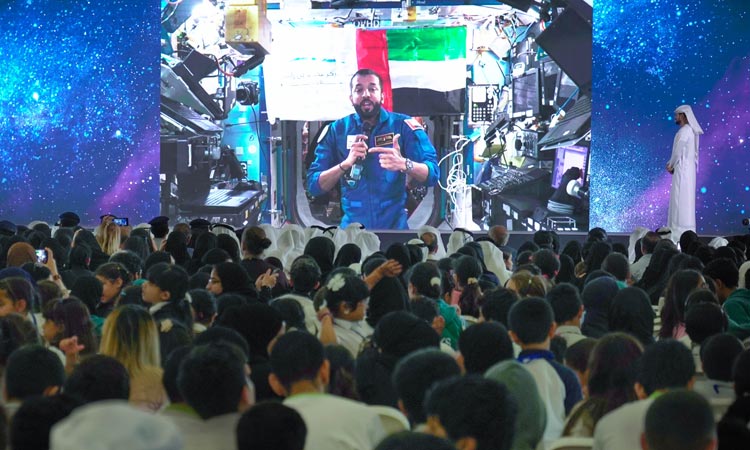
The Mohammed Bin Rashid Space Centre (MBRSC), in partnership with the General Secretariat of Ras Al Khaimah’s Executive Council, will hold the next edition of ‘A Call from Space’, an exclusive event featuring Emirati astronaut Sultan AlNeyadi, in Ras Al Khaimah on Wednesday, 14th June at 2pm. The sixth instalment in the series will take place at Higher Colleges of Technology – Ras Al Khaimah Women’s Campus.
The event will provide invitation-only attendees from schools, universities and government entities in Ras Al Khaimah the opportunity to interact live with Al Neyadi, who is currently on the International Space Station (ISS) undertaking the longest Arab space mission in history. They will also have the chance to learn about Al Neyadi’s experiences and ask him questions about life in space. Close to 5,500 people have taken part in the past five editions of the event, giving attendees a glimpse in to AlNeyadi’s life on the ISS and the opportunity to interact with him.
The first event in the series was held at the Dubai Opera, followed by the second for media at the Museum of the Future. The third edition was held in Mauritius, while the fourth session was held at the United Arab Emirates University in Al Ain. The last session that took place on 7th June was a special medical science edition held at MBRU in Dubai.
Milestone in Arab history Al Neyadi has been on the ISS for more than three months now, marking a significant milestone in Arab space exploration. Over the course of his mission, he has gone on to conduct several scientific experiments, performed maintenance work and even aided in the relocation of the Dragon spacecraft. During his current mission, Al Neyadi also became the first Arab astronaut to perform a spacewalk.
The spacewalk, which was performed alongside astronaut Stephen Bowen, spanned seven hours and one minute and involved skilfully executing a number of preparatory tasks, which included routing power cables and laying the groundwork for the upcoming installation of the ISS Roll-Out Solar Array (iROSA). The UAE Astronaut Programme is one of the projects managed by MBRSC under the UAE’s National Space Programme and funded by the ICT Fund of the Telecommunications and Digital Government Regulatory Authority (TDRA), which aims to support research and development in the ICT sector in the UAE and promote the country’s integration on the global stage.
Recently, the Mohammed Bin Rashid Space Centre (MBRSC) announced the successful completion of the ‘A Call from Space’ – Medical Science edition, hosted by UAE astronaut Sultan Al Neyadi from the International Space Station (ISS), in Dubai. The event, held in partnership with the Mohammed Bin Rashid University of Medicine and Health Sciences (MBRU), attracted close to 400 attendees, including medical professionals and students from universities in the UAE.
Addressing the attendees before the live call, Salem Humaid AlMarri, Director General of MBRSC said: “Over the past few months, through the longest Arab space mission in history, Sultan has provided us invaluable scientific data. Each one of the experiments he is part of is fuelling our drive towards unprecedented advancements in science. These research initiatives reflect our commitment to integrating space exploration with diverse scientific disciplines.
Thus, ensuring that our space programme contributes not just to the field of space science but to multiple sectors.” The fifth instalment of the live call series with Al Neyadi, who is on the longest Arab space mission in history, was focused exclusively on the medical science field. During the event, Adnan Al Rais, Mission Manager, UAE Astronaut Programme, gave an overview of the UAE Astronaut Programme and briefed the attendees on updates about the mission.
“This mission is a platform for international collaboration, as well as to advance our science and technology. We are working very close with the international space community, to share our knowledge and experience and are also giving access to our scientists, researchers and students to this unique environment to conduct experiments,” said Al Rais.
MBRSC prepares for a new phase of space exploration as the UAE sets its sights on being a global space power
DUBAI, 12th June, 2023 (WAM) – When the UAE’s Sultan AlNeyadi stepped outside the airlock of the International Space Station to begin a seven hour spacewalk over a month ago, he etched his name in history books as the first Arab astronaut to venture into the unknown depths of space. The remarkable feat was the highlight of the Arab world’s longest space mission, Zayed Ambition 2, one of a series of ambitious projects that have entrenched the UAE’s place in the orbit of elite spacefaring nations.
AlNeyadi’s journey to the ISS announced the country’s aspirations to be a major player in the world of crewed space flights. Despite being a relatively new entrant into the club of spacefaring nations, the UAE seeks to launch human space missions every three to five years, a goal that is one among a long list of groundbreaking space projects.
The role of the founding fathers
“The remarkable achievements of the UAE National Space Programme have been made possible by the vision of the country’s founding fathers and the strategic investments made by its current leadership in developing the infrastructure, technologies and talent needed to make it a frontrunner in the global space industry,” says Hamad Obaid AlMansoori, Chairman of the Mohammed Bin Rashid Space Centre (MBRSC).
In a tribute to its founding fathers, the UAE’s crewed missions were named after the late Sheikh Zayed, the Father of the Nation, whose passion for space shaped national aspirations in the sector. The early vision for the UAE National Space Programme was formulated by Sheikh Zayed who held many meetings to discuss space in the 70s, including a memorable gathering in Abu Dhabi with three American astronauts. The UAE’s first lunar rover, built by Emirati engineers, was named ‘Rashid’ after the late Sheikh Rashid bin Saeed Al Maktoum, the architect of modern Dubai.
Consistent with the ambitious vision of the country’s founding leaders, the UAE has made massive investments in groundbreaking projects in the space sector Last year the UAE Space Agency announced an AED3 billion ($816 million) investment fund for the development of the UAE’s capabilities in the sector.
Building a space industry from scratch
The Mohammed Bin Rashid Space Centre (MBRSC), an organisation launched in 2006, has been at the centre of efforts to catapult the UAE into the big league of space powers. MBRSC jump-started the development of an advanced space industry from scratch in a short period. The UAE’s ambitious goals meant that MBRSC had to create the advanced technological and scientific capabilities, innovation and knowledge needed to be a space power in a short period of time.
“Starting with just five engineers, MBRSC put together a comprehensive programme to develop the sophisticated capabilities needed to undertake ambitious space missions. MBRSC also forged collaborations with a multitude of entities, both in the public and private sector, including other space agencies, international organisations, and universities and faculties specialising in space science. With rapidly created local capacities, the MBRSC launched a range of trailblazing space missions covering advanced indigenous satellites, interplanetary missions and crewed space journeys,” says HE Hamad Obaid AlMansoori.
UAE Satellite Programme
The maiden project undertaken by MBRSC was the development of the country’s first satellite as part of the UAE Satellite Programme. A team of Emirati engineers worked closely with South Korean experts to design and manufacture the country’s first two observation satellites, DubaiSat-1 and DubaiSat-2 launched in 2009 and 2013 respectively, and its first nanosatellite, Nayif-1.
In October 2018, the MBRSC built and launched the first 100% UAE-designed and manufactured Earth observation satellite KhalifaSat, cementing the country’s position amongst leading space technology manufacturers. The launch of the satellite saw the UAE’s emergence as a new player in the satellite imaging data market. KhalifaSat’s high-resolution images of Earth can be used for everything from urban planning to disaster relief. In 2024, MBRSC plans to launch MBZ-SAT, a satellite that will break new ground in high-resolution imaging from outer space.
Interplanetary missions
In 2014, the UAE announced the Emirates Mars Mission, also known as Al Amal, a project to send the Arab world’s first mission to the red planet. The UAE’s first excursion into deep space, the mission became a reality in February 2021 when the Hope Probe successfully entered orbit around Mars. Since then, the extraordinarily complex interplanetary mission has generated unique insights that have added significantly to the global body of knowledge about the Martian atmosphere.
In another landmark initiative, the UAE announced in 2017, the ‘Mars 2117’ programme led by MBRSC to develop the first ever human settlement on the red planet in the next 100 years. Driven by the passion of the UAE's leadership to uncover new knowledge, the project represents a major contribution to humanity's interplanetary endeavours.
Crewed missions
The UAE’s space forays have been driven by a number of programmes created to develop national talent in various areas of the industry. Six years ago, MBRSC launched the UAE Astronaut Programme to prepare Emirati astronauts for manned missions to the International Space Station (ISS) and other destinations in space. In the first initiative of its kind in the Arab world, the Programme focused on providing training, expertise, and qualifications for Emiratis to represent the UAE and the Arab world in future space missions and conduct scientific experiments that support global space exploration.
In 2018, astronauts Hazzaa AlMansoori and Sultan AlNeyadi were selected to form the first batch of the UAE Astronaut Programme, while the second batch selected in 2021 featured Nora AlMatrooshi, the first female Arab astronaut, and Mohammad AlMulla. In September 2019, the UAE sent its first astronaut to the International Space Station, making Hazzaa AlMansoori the first Arab to visit the orbiting laboratory. This was followed by the Zayed Ambition 2 mission featuring Emirati astronaut Sultan AlNeyadi, which arrived at the International Space Station in March this year.
Global player
The outcomes of these ambitious projects have transformed the UAE’s standing in the global space landscape. MBRSC’s missions have led to the development of new technologies and innovations that have applications in various industries, says Hamad Obaid AlMansoori. The Emirates Mars Mission, for example, has spurred the development of technologies in fields such as robotics, autonomous systems, and remote sensing, which can be applied to industries like agriculture, mining, and oil and gas.
Over the course of more than two years, the Emirates Mars Mission has also provided never-before-seen insights into the Martian atmosphere, which have enhanced understanding of the planet's history and evolution. The Hope Probe has collected over 1.7 TB of data on the Martian atmosphere, weather patterns and climate history, providing critical information that will help predict climate changes on Earth and support future Mars missions and planetary explorations.
Another project, the UAE Analog Mission, an offshoot of the Mars 2117 programme, is also playing a vital role in preparing humans for future exploration of Mars and other planets. By simulating space-like conditions on Earth, the Mission is contributing to advancing spaceflight research by enabling space scientists to conduct experiments, develop countermeasures for space-hazards, and test new technologies. The first UAE Analog Mission, the eight-month SIRIUS-21 programme, was completed by Emirati crew member Saleh AlAmeri in July 2022, after achieving all its objectives to test the effects of isolation on human psychological and physiological conditions.
Similarly, the UAE Astronaut Programme through its missions to the ISS is supporting research in fields such as biomedical science, transportation and manufacturing, which can be leveraged to improve life on Earth. At the ISS, Sultan AlNeyadi is conducting more than 200 experiments assigned by NASA and 19 by UAE universities on diverse topics including cardiovascular and immune systems, back pain, epigenetics, fluid science, plant biology, material science, sleep analysis and radiation.
Over the last couple of months, AlNeyadi has shared on social media photos of the unique experiments he is conducting on board the ISS. Experiments that have caught the interest of the public include the cultivation of tomatoes in space for scientific studies. His botanical space experiment seeks to understand how plants and vegetables can be grown in a microgravity environment and whether they could provide astronauts with a sustainable food source in the future. AlNeyadi is also conducting experiments that may provide potential treatments for neuro-degenerative diseases like Alzheimer’s.
Thriving space ecosystem
MBRSC’s satellite projects and interplanetary missions are helping create the strong base necessary for the UAE space industry to be a top-ranked global player, notes Hamad Obaid AlMansoori. “The Centre’s programmes are fostering the development of a large pool of UAE national talent and competencies in various areas of the space industry and space exploration, the creation of new economic opportunities and industries in the UAE, and the advancement of scientific knowledge through research and development,” he said.
Further, MBRSC's partnerships and collaborations with international organisations are providing opportunities for UAE nationals to work on joint projects and gain international experience and expertise, which will contribute to the development of the space industry ecosystem in the UAE.
The MBRSC’s Space Ventures initiative, a project launched under the umbrella of the Mars 2117 programme, serves as a launchpad for promising startups in the space sector by facilitating partnerships with the Centre on long-term projects, and providing them with the regulatory know-how and technology to attain viability and sustainable growth for the future. MBRSC offers a high-level work environment for partner companies and gives them access to the Centre’s expertise in space research and exploration, creating channels with space tech specialists and networks.
Adding value to the economy
The manufacture of satellite components and development of local expertise in the field has led to the creation of new job opportunities and contributed to the growth of the UAE economy. The development of MBZ-SAT, for example, has been pivotal in supporting the rapid expansion of the local space industry. As much as 90% of the mechanical structure and 50% of the electronic modules of MBZ-SAT are being built in the UAE. MBRSC has collaborated with local companies such as aerospace manufacturing company Strata, engineering solutions company EPI, Rockford Xellerix, Halcon and Falcon Group to manufacture and supply the components necessary for the development of the new satellite. Recently local company Strata Manufacturing achieved a historic milestone by indigenously manufacturing aluminium honeycomb panels required for building satellites, in partnership with MBRSC.
These outcomes are helping build a strong and sustainable UAE space sector that contributes to the diversification and growth of the economy. The growing industry ecosystem has helped boost the UAE’s scientific and technological capabilities and engrained a culture of innovation in the sector.
Commercial services
In a short period of time, the UAE has also become a notable player in the global commercial space services landscape. The expertise gained in designing, manufacturing, assembling, and launching a number of satellites over the years has enabled it to provide diverse services to countries around the world. These include ground station services covering satellite tracking, telemetry, and command operations and state-of-the-art products and services in geo-science and remote sensing.
The Centre provides end-to-end earth observation solutions through its fleet of satellites, including KhalifaSat, one of the world’s most technologically advanced remote sensing satellites. Featuring Artificial Intelligence and big data analytics, these services support project monitoring, 3D mapping, monitoring and analysis of environmental conditions, disaster management and much more.
MBRSC employs its cutting-edge technologies to conduct research and solve problems in a wide range of areas, including providing information on urban land cover and changes over time. This has helped monitor project construction progress including big projects such as Expo 2020 Dubai, the Dubai Canal and artificial islands. The Centre has also collaborated with Al Ain Municipality to develop AI technology for analysing palm tree cover in various regions. MBRSC was able to detect 45,000 trees in less than a week, with an accuracy of 98.7%.
Through images from its sophisticated satellites, MBRSC also supports the management of water, land surfaces, aquatic ecosystems and biodiversity. MBRSC is a part of Sentinel Asia, an international initiative for applying remote sensing and Web-GIS technologies to support disaster management in the Asia-Pacific region. Over the years, it has harnessed space technologies that help mitigate the impact of natural and man-made disasters.
Other commercial services provided by MBRSC include training and education programmes to help countries and other entities develop their space capabilities. As part of a collaboration with the United Nations Office for Outer Space Affairs (UNOOSA), MBRSC is providing opportunities to host a payload on its 12U PHI modular satellite platform, for which they have already signed agreements with Bahrain and Nepal. The Centre has also signed a framework agreement with Mauritius for significant space development and satellite technology-related R&D growth.
Future missions
Not content to rest on its laurels, MBRSC has started planning for new large-scale interplanetary missions that are set to further accelerate the nation’s space engineering, scientific research and exploration capabilities.
Over the next decade, the UAE is set to cross new frontiers in space, propelling a transformation of local technology, innovation and skills in the sector. The country’s determination to undertake complex missions that few countries have attempted, let alone succeeded, is set to make it a frontrunner in the global space economy expected to reach $1 trillion in value by 2040.
June 13, 2023

In this photo International Monetary Fund (IMF) logo is seen in Washington D.C., United States on April 11, 2023
June 13, 2023
A report issued by the International Monetary Fund (IMF) regarding the size of economic losses incurred in Egypt in the aftermath of the January 25 2011 revolution, has presented figures that are much less than estimates presented by the Egyptian President Abdel Fattah Al-Sisi.
According to the report, Egypt's cumulative losses in the decade following the 2011 revolution were only about ten per cent compared to what would have been expected in the event that no major political events occurred in the country.
According to the Mada Masr website, the IMF has calculated "the impact of the Arab Spring on Egypt's economy, based on a specially developed methodology for evaluating similar effects, by comparing economies affected by sudden shocks with several other similar economies that were not affected by those shocks."
The IMF estimates concluded that the Egyptian economy would have grown had the revolution not occurred, from 9.28 points on the IMF's scale in 2010 to approximately 9.38 points by 2020. However, the revolution has slowed the economic growth to 9.28 points, a difference of only 0.1 point.
The IMF estimates refute the statements repeatedly presented by Al-Sisi regarding the size of losses that Egypt suffered due to the outbreak of the January 25 revolution.
In October 2021 Al-Sisi claimed the losses reached $400 billion while in September 2022, he said the losses amounted to $450 billion.
Dairy cows are shown near Hanford, California, where a cow sickened with mad cow disease was found at a rendering plant during routine testing, in this still image from video April 25, 2012.
Reuters
Published: 13 June ,2023:
Drugmaker AstraZeneca is switching to biogas produced from cow manure and food waste in the United States, it said on Tuesday, in a deal to cut its carbon emissions there.
The Anglo-Swedish drugmaker said the long-term agreement with Massachusetts-based Vanguard Renewables would enable it to transition to biogas from natural gas and cut its emissions across its US research and manufacturing sites.
“Doing the right thing costs a little bit more, but it is not punitive,” said Pascal Soriot, chief executive of AstraZeneca, which makes 26 medicines in the US.
Given the easy availability of natural gas in the US, the price of biogas is relatively much higher, Soriot said, as well as being less competitive than it is in Europe.
Manure from three farms, which each have about 900 cattle, will be combined with food waste and placed in an area the size of a big ice-skating rink with apparatus above to capture methane, which will purified and piped into AstraZeneca’s gas grid, said Andy Wirths, its SVP of supply for the Americas.
The heating and cooling processes used in the making of pharmaceutical ingredients can be energy intensive and by the end of 2026, AstraZeneca said, the deal will produce as much as 650,000 million British thermal units per year, equivalent to the energy needed to heat more than 17,800 US homes annually.
An analysis published in November found the carbon output of THE global pharmaceutical and biotech industry eclipsed emissions from the forestry and paper sector.
AstraZeneca aims to reduce greenhouse gas emissions it directly produces by 98 percent by 2026, from a 2015 baseline.
However, much of the global pharmaceutical and biotech industry has yet to set targets for reducing carbon emissions in line with the Paris Agreement, researchers have found.