Tuesday, June 13, 2023

PEW RESEARCH
How people in 24 countries view same-sex marriage
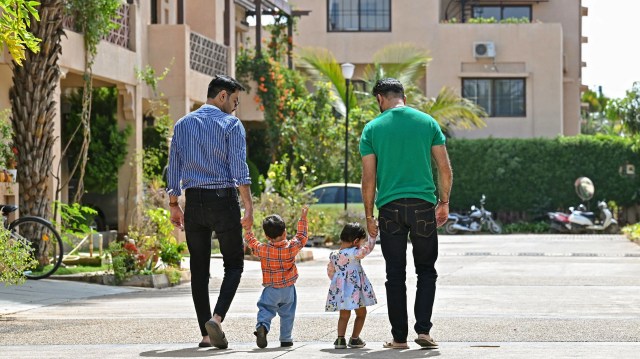
A same-sex couple walks outside their home with their children in Bengaluru, India. (Manjunath Kiran/AFP via Getty Images)

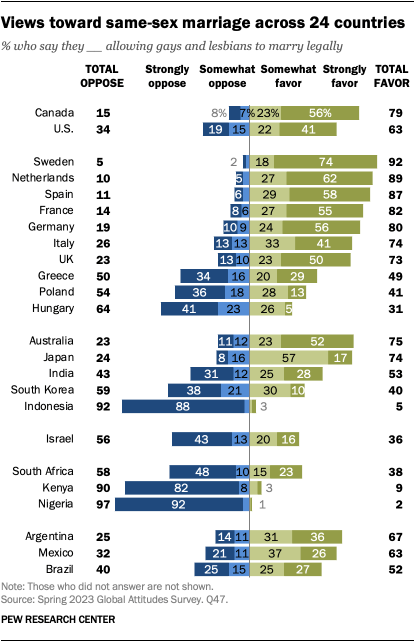
Attitudes about same-sex marriage vary widely around the world, according to a new Pew Research Center survey fielded in 24 countries. Among the surveyed countries, support for legal same-sex marriage is highest in Sweden, where 92% of adults favor it, and lowest in Nigeria, where only 2% back it.
How we did this
A bar chart that shows views toward same-sex marriage across 24 countries.

In the United States, where the Supreme Court legalized same-sex marriage nationally in 2015, 63% of adults support it and 34% oppose it. But views are highly fractured along political and demographic lines.

For example, Democrats and independents who lean toward the Democratic Party are nearly twice as likely as Republicans and Republican leaners to support same-sex marriage rights (82% vs. 44%). Similarly, nearly three-quarters (73%) of Americans under the age of 40 say they favor allowing gays and lesbians to marry legally – 16 percentage points higher than the share of Americans 40 and older who agree (57%).

RelatedIn places where same-sex marriages are legal, how many married same-sex couples are there?

Below is a closer look at how attitudes about same-sex marriage differ around the world, based on the new survey. The analysis looks at how attitudes vary by geography, demographic factors, political ideology and religion, as well as how views have changed over time.
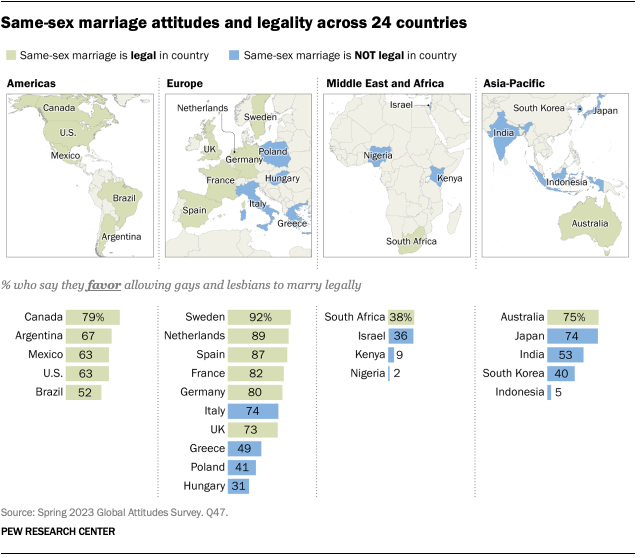
A map and bar chart that shows same-sex marriage attitudes and legality across 24 countries.

How attitudes about same-sex marriage vary geographically

Europe

People in Western Europe stand out as staunch supporters of same-sex marriage. At least eight-in-ten adults support it in Sweden (92%), the Netherlands (89%), Spain (87%), France (82%) and Germany (80%). In each of these countries, the practice is legal.

In Italy, where issues on LGBTQ+ rights are in the headlines, 74% of adults favor same-sex marriage rights, though it is not legal there.

Around three-quarters (73%) of adults in the United Kingdom also support same-sex marriage. The practice is legal in England, Wales, Scotland and Northern Ireland, although those laws were approved at various times over the last decade.

At the other end of the spectrum in Europe, just 41% of adults in Poland and 31% in Hungary support same-sex marriage. In both countries, same-sex marriage is not legal, and LGBTQ+ rights are a political and social flashpoint.

Americas

In North America, around eight-in-ten Canadians (79%) support same-sex marriage, as do 63% in both the U.S. and Mexico. Same-sex marriage is legal in all three countries.

RelatedAbout six-in-ten Americans say legalization of same-sex marriage is good for society

In South America, 67% of Argentinians and 52% of Brazilians support the right of gay and lesbian people to marry. Both countries have also legalized the practice.

Asia-Pacific

Around three-quarters of adults in Australia and Japan favor legal same-sex marriage (75% and 74%, respectively). But while many Australians who favor same-sex marriage say they strongly support it (52%), support is weaker in Japan, where a 57% majority of adults somewhat favor legal same-sex marriage. Australia has legalized same-sex marriage, but Japan has not.

In India53% of adults say same-sex marriage should be legal, while 43% oppose it. The Indian Supreme Court is currently deciding a case on whether to legalize same-sex marriage.

In South Korea, same-sex marriage is not legal and the debate is making headlines. Among South Koreans, 40% favor legal same-sex marriage and 59% oppose it.

Indonesians are highly opposed to same-sex marriage legalization. Roughly nine-in-ten in Indonesia oppose allowing gays and lesbians to marry, including 88% who say they strongly oppose it. Just 5% of Indonesians support same-sex marriage.

Africa and Middle East

South Africa remains the only country in Africa where same-sex marriage is legal, having codified it in 2006. Nevertheless, 58% of South Africans oppose the practice.

Nigerians and Kenyans are the least supportive of same-sex marriage rights among the African countries surveyed. In Nigeria, where homosexuality is illegal, only 2% adults say they support the right of gays and lesbians to marry. And in Kenya, just 9% favor it.

In the Middle East, Israelis are also opposed to making same-sex marriage legal, with 56% opposed. Religious affiliation and political leanings heavily shape views on the issue of same-sex marriage rights in Israel.

How attitudes about same-sex marriage vary by demographic factors

Age
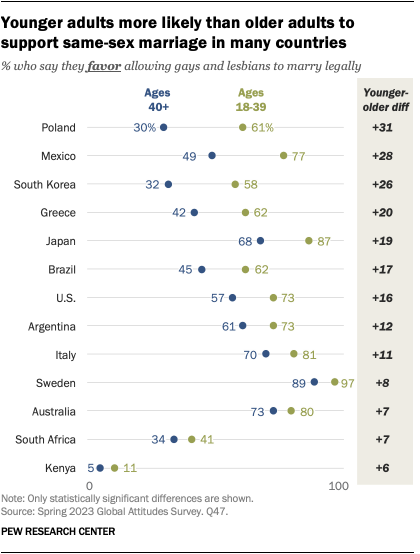
A dot plot showing that younger adults are more likely than older adults to support same-sex marriage in many countries.

In 12 of the countries surveyed, adults under 40 are more likely than their older counterparts to say they favor allowing gays and lesbians to marry legally. In the other countries surveyed, there are not significant differences by age in support of same-sex marriage.

The age gap is greatest in Poland, where about six-in-ten of those under 40 express support for same-sex marriage, compared with three-in-ten among those 40 and older.

Gender

In 14 of the surveyed countries, women are more likely than men to say they support allowing gays and lesbians to marry legally.
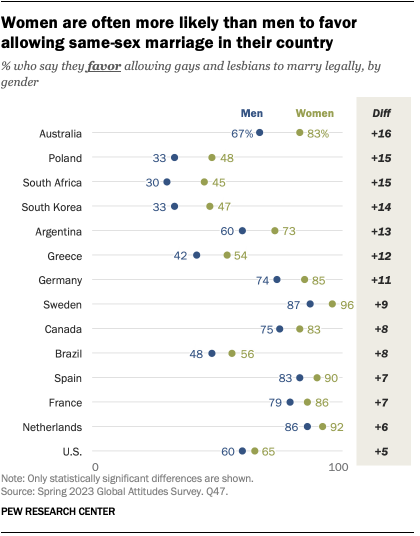
A dot plot showing that women are often more likely than men to favor allowing same-sex marriage in their country.

For example, in Australia, 83% of women favor it, compared with 67% of men.

There are similar gender differences in Poland, South Africa, South Korea, Argentina, Greece and Germany.

Education and income

In 17 of the surveyed countries, people with more formal education are more likely than those with less education to support allowing gays and lesbians to marry.

Similarly, in 13 of the countries, people with incomes over the national average are much more likely to support same-sex marriage than those with incomes below the country median.

How attitudes about same-sex marriage vary by political ideology
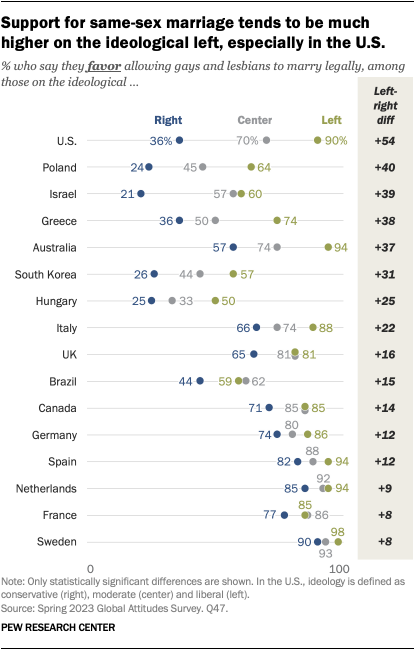
A dot plot that shows support for same-sex marriage tends to be much higher on the ideological left, especially in the U.S.

Views on same-sex marriage are related to political ideology in 16 of the 18 countries where the Center asked about respondents’ ideology this year. In these countries, those on the ideological left are significantly more likely than those on the right to favor allowing gays and lesbians to marry legally.

The ideological difference is greatest in the U.S., where liberals are 54 points more likely than conservatives to support same-sex marriage (90% vs. 36%). Still, in nine surveyed countries, majorities of those on both the right and left say they support same-sex marriage.

How attitudes about same-sex marriage vary by religion

Support for legal same-sex marriage tends to be lower in countries where more people say religion is somewhat or very important in their lives. Support is higher in countries where fewer people consider religion important.
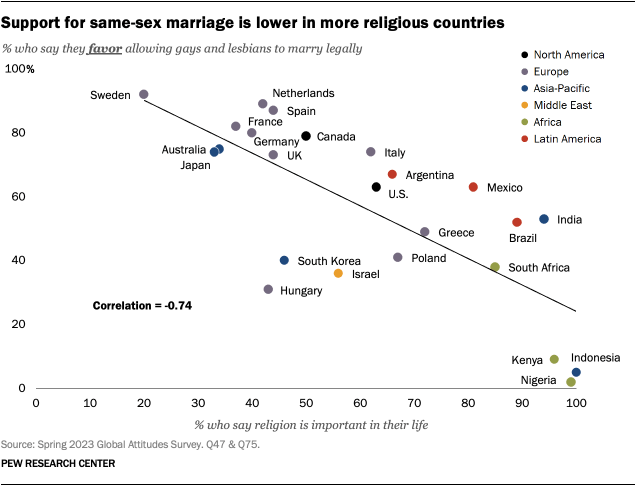
A scatter plot showing that support for same-sex marriage is lower in more religious countries.

In Nigeria, 99% of adults say religion is at least somewhat important in their lives but only 2% favor legal same-sex marriage. In Sweden, by comparison, just 20% of adults consider religion important to them and 92% favor allowing gay and lesbian people to wed.

Similarly, people who are not affiliated with a religion are much more likely to say they support same-sex marriage. In Australia, for example, 89% of religiously unaffiliated adults say they favor same-sex marriage, compared with 64% of adults with a religious affiliation.

The survey shows some additional patterns by religion:

  • Religiously unaffiliated Americans (85%) – especially atheists (96%) – are the most likely to favor same-sex marriage legality. White, non-Hispanic evangelical Protestants are the least likely religious group to say they favor it (30%). Around two-thirds of American Catholics (65%) favor same-sex marriage, as do 70% of White non-evangelical Protestants.
  • In Brazil, Catholics (56%) are more likely than Protestants (32%) to support same-sex marriage.
  • In Israel, Jewish adults (41%) are more likely than Muslims (8%) to support same-sex marriage. Among Israeli Jews, 4% of those who are Haredi (“ultra-Orthodox”) or Dati (“religious”) support legal same-sex marriage, compared with 29% of Masorti (“traditional”) Jews. Around three-quarters of Hiloni (“secular”) Jews support this policy.
  • Christians and Muslims in Nigeria are equally likely to oppose same-sex marriage (97% and 98%, respectively).

How attitudes about same-sex marriage have changed over time

It is difficult to make direct comparisons between these new survey findings and past surveys on whether people favor or oppose same-sex marriage. Earlier Center surveys focused more on religion and its influence in society, rather than political attitudes and international affairs. And in some countries, the mode of the survey (e.g., face-to-face versus phone versus web) has changed over time.

However, a comparison with surveys conducted in Latin America in 2013-2014, in Europe in 2015-2017, and the long-term trend in the U.S. generally shows increased public support for the legalization of same-sex marriage over the last decade.

Note: Here are the questions used for the analysis, along with responses, and the survey methodology.
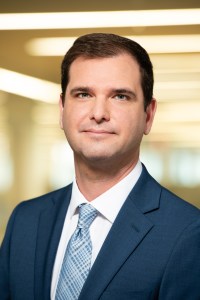
Jacob Poushter  is an associate director focusing on 
global attitudes at Pew Research Center.
Sneha Gubbala  is a research assistant focusing on 
global attitudes research at Pew Research Center.
Christine Huang  is a research analyst focusing on 
global attitudes at Pew Research Center.

In places where same-sex marriages are legal, how many married same-sex couples are there?

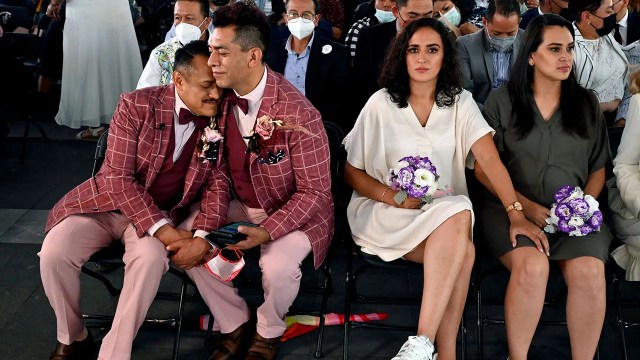
Couples wait to get married in a collective wedding held to celebrate LGBTQ Pride Month in the esplanade of the Civil Registry in Mexico City on June 24, 2022. (Alfredo Estrella/AFP via Getty Images)

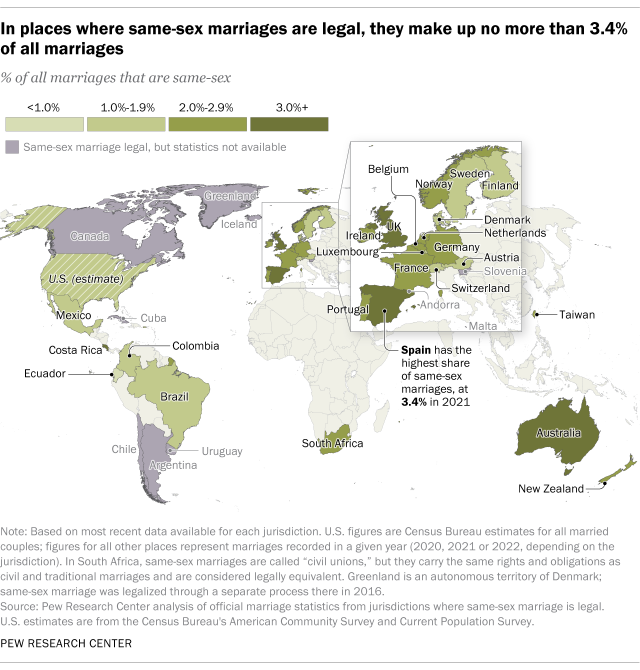
Same-sex marriage is now legal in more than 30 countries and territories around the world, according to a new Pew Research Center analysis. In 24 of these places where detailed statistics are available, same-sex marriages in recent years have ranged from less than 1% to 3.4% of all marriages.
How we did this
A map that shows in places where same-sex marriages are legal, they make up no more than 3.4% of all marriages.

In Spain, where same-sex marriage has been legal since 2005, 3.4% of the 148,588 marriages registered in 2021 were same-sex – the highest share among the countries and territories for which data is available. (The latest year available is 2020, 2021 or 2022, depending on the jurisdiction.)

The lowest rate of same-sex marriage was in Ecuador, where the Constitutional Court legalized it in a 2019 ruling. In 2021, only 250 out of 56,921 marriages registered in the country, or 0.4%, were between same-sex couples.

Related: How people in 24 countries view same-sex marriage

The United Kingdom had the second-highest share of same-sex marriages among the countries with data available, at 3.3%. However, in the UK, data is reported for three subnational jurisdictions – England and Wales together, Scotland and Northern Ireland – rather than for the country as a whole.

In 2020, the most recent year figures are available for all three units, same-sex marriages accounted for 3.3% of all marriages in England and Wales, 3.5% in Scotland, and 4.2% in Northern Ireland – making the same-sex marriage share 3.3% for the entire UK. Scotland and Northern Ireland have since published marriage data for 2021, with same-sex marriage rates that year of 3.4% and 5.0%, respectively, but the Office for National Statistics for England and Wales has yet to do so.
A bar chart that shows in most places where same-sex marriages are legal, a majority of them are between two women

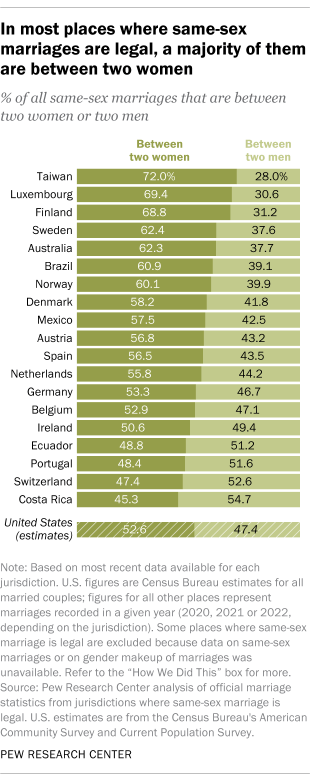
Twenty of the jurisdictions that had data on same-sex marriages distinguished marriages between women from those between men. In 16 of these places, a majority of same-sex marriages were between two women. The biggest disparity was in Taiwan, where 1,794 of the 2,493 same-sex marriages recorded in 2022, or 72.0%, were between two women. The highest share of marriages between men was in Costa Rica, where they comprised 370 of the 677 same-sex marriages (54.7%) recorded in 2022.

Directly comparable figures for the United States aren’t available because marriage registrations are kept at the state and local levels rather than nationally, and not all jurisdictions keep separate counts of same-sex and opposite-sex marriages. However, the Census Bureau estimates that as of 2021, 711,129 of the nation’s 61.3 million married-couple households, or 1.2%, involved same-sex married couples. As in many other countries, households with two married women were more prevalent than households with two married men in the U.S., accounting for 52.6% of all same-sex married-couple households.

Overall, Gallup estimates that as of 2022, 7.2% of American adults identify as “lesbian, gay, bisexual, transgender or something other than straight or heterosexual.”
Drew DeSilver  is a senior writer at Pew Research Center.
EU pushing for watermark on AI-generated contents

EU lawmakers to vote on world’s first law regulating artificial intelligence

Agnes Szucs |13.06.2023 
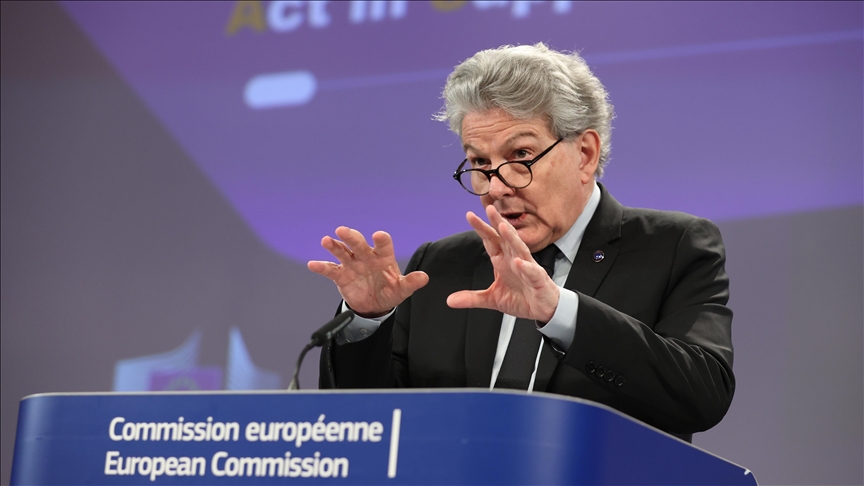
European Union Commissioner for Internal Market Thierry Breton holds a press conference on EU plan to accelerate ammunition production in Brussels, Belgium on May 03, 2023.
 ( Dursun Aydemir - Anadolu Agency )


BRUSSELS

The European Union wants tech companies to put a watermark on contents generated by artificial intelligence, EU Commissioner for Internal Market Thierry Breton said on Tuesday.

“We need to label anything that is AI-generated by tagging them with watermarks,” Breton said at a European Parliament debate on AI systems in Strasbourg, France.

“It is essential to build confidence for providers and consumers” and to ensure transparency in the case of generative AI systems, such as ChatGPT, he added.

Breton also said the EU is “gradually phasing in a new world order” by working on the world’s first legislation on AI.

For her part, EU Commissioner for Competition Margrethe Vestager underlined that the new EU legislation would not hamper technological innovation.

Instead, democracy will be “shaping how we use technology in the best interest of the human being,” she asserted.

Once adopted, the legislation will ensure that AI is used in a “safe, transparent and non-discriminatory way,” explained Italian EU lawmaker Brando Benifei, the file’s rapporteur.

On the initiative of the European Parliament, the law would strictly ban systems based on manipulative techniques, social profiling, and most forms of biometric surveillance.

The full parliament will vote on a law on Wednesday to adopt the negotiating mandate that will guide European Parliament representatives during talks with EU member states and the European Commission.

The law is expected to enter into force in 2026 at the earliest.
#KASHMIR IS #INDIA'S #GAZA
Most Pakistanis think Kashmir issue can be resolved within their lifetime: Survey

Edited By: Sneha Swaminathan
Islamabad, Pakistan
Updated: Jun 13, 2023, 

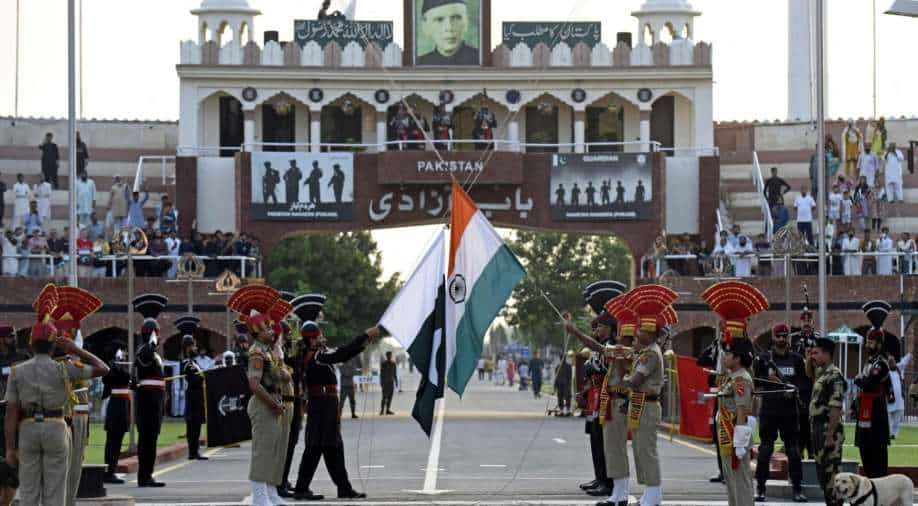
Indian Border Security Force (BSF) soldiers (in brown) and Pakistani Rangers take part in the Beating the Retreat ceremony at the India-Pakistan Wagah border post, Amritsar, India, Aug. 1, 2022. Photograph:(AFP)


STORY HIGHLIGHTS

The question "Do you think the Kashmir problem can be solved during your lifetime?" was posed to an adult, nationally representative sample of both men and women from all around the nation. 54 per cent of respondents replied "yes," while 46 per cent disagreed.

Nearly half (54 per cent) of Pakistanis, according to a Gallup & Gilani Pakistan study, think the Kashmir conflict may be resolved during their lifetime.

The question "Do you think the Kashmir problem can be solved during your lifetime?" was posed to an adult, nationally representative sample of both men and women from all around the nation. 54 per cent of respondents replied "yes," while 46 per cent disagreed.

The Gilani Research Foundation, a Pakistani subsidiary of Gallup International, commissioned Gallup & Gilani Pakistan to conduct the survey in Pakistan and publish the results. A sample of 1,535 men and women from urban and rural regions of all four provinces of the nation participated in the current poll, which was conducted from March 29 to April 7, 2023. At a confidence level of 95 per cent, the error margin is expected to be between two and three per cent. Telephonic surveys (CATI) were the method of data collection.

Graph

Why India and Pakistan fight over Kashmir?

Kashmir is a Himalayan region that is around 86,000 square miles (222,738 square kilometres) in size and is well-known for the beauty of its lakes, meadows, snow-capped mountains, and a variety of ethnic groups.

Before India and Pakistan achieved their independence from Britain in August 1947, the region was a contentious one.

Kashmir was allowed to join either India or Pakistan under the terms of the partition plan outlined in the Indian Independence Act, as reported by the BBC.

Hari Singh, the maharaja (local king), initially wanted Kashmir's independence; nevertheless, in October 1947, he decided to join India in exchange for the country's assistance in repelling a Pakistani tribesman invasion.

India approached the UN and requested its intervention when a conflict broke out. To decide whether the state will ally with India or Pakistan, the UN suggested conducting a vote. But before the referendum could be held, the two nations were unable to come to an agreement to demilitarise the area.

The UN had advised India and Pakistan to draw a ceasefire line, and they did so in July 1949, dividing the territory.

In 1965, a second conflict broke out. Then, in 1999, India engaged in a brief but bloody fight with forces supported by Pakistan.

At that point, both Pakistan and India had proclaimed themselves nuclear powers.

Today, Kashmir is claimed by both Delhi and Islamabad in its entirety although only a portion of it is really under their authority. These areas are known internationally as "Indian-administered Kashmir" and "Pakistan-administered Kashmir."

IAEA's Grossi visits Kyiv ahead of trip to nuclear plant

Reuters
June 13, 2023

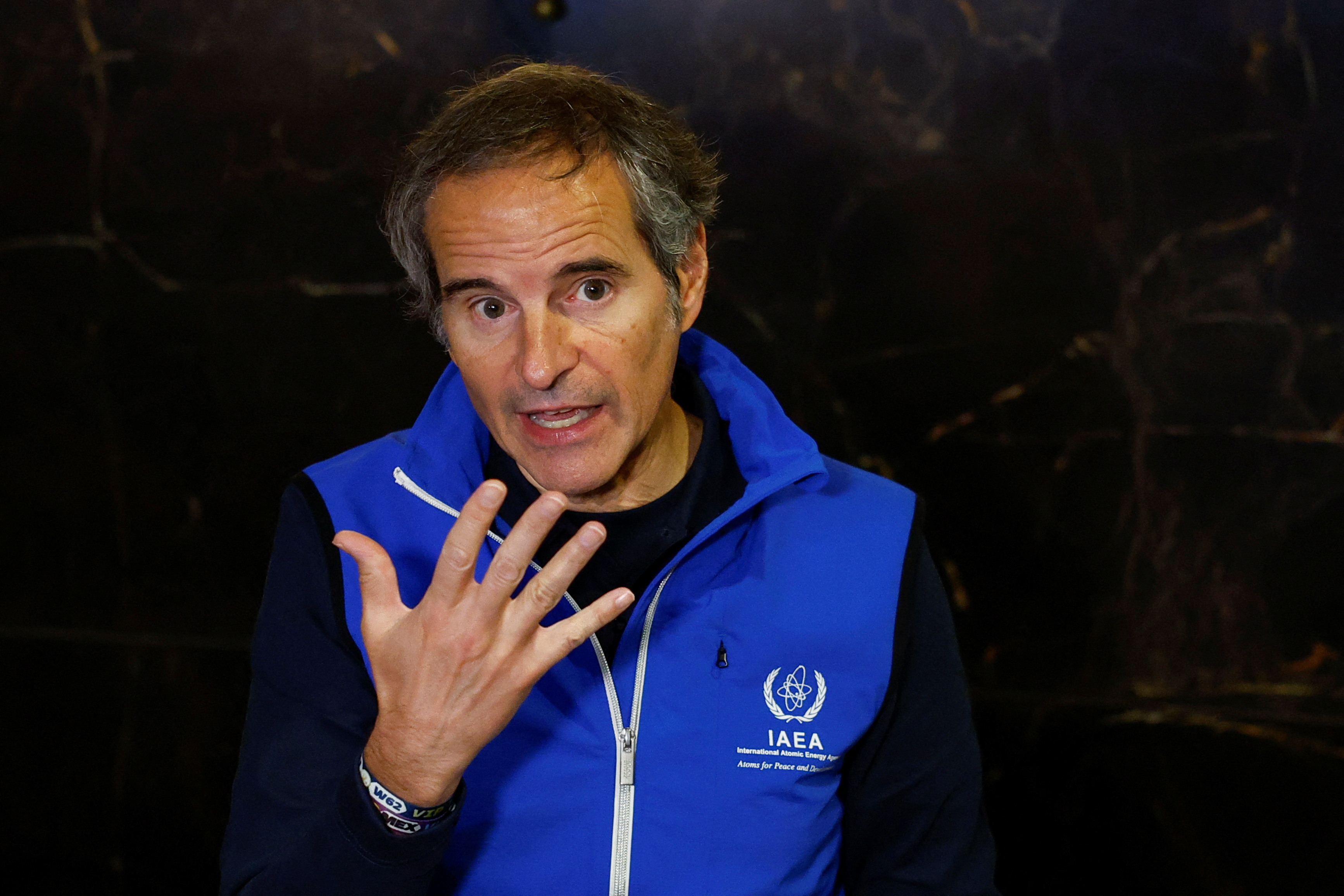
International Atomic Energy Agency (IAEA) Director General Rafael Grossi holds a press conference, amid Russia's attack on Ukraine, in Kyiv, Ukraine June 13, 2023. 
REUTERS/Valentyn Ogirenko

Summary

Nuclear chief to visit plant on Tuesday evening

Situation 'serious' but no immediate danger

Water level enough to meet nuclear plant's needs

No sign Russia moving military equipment to plant


KYIV, June 13 (Reuters) - U.N. nuclear chief Rafael Grossi visited Kyiv on Tuesday, where he met President Volodymyr Zelenskiy before travelling to Ukraine's Russian-occupied Zaporizhzhia nuclear plant near where a huge river dam was destroyed last week.

The International Atomic Energy Agency (IAEA) said on Sunday it needed access to a site near the plant to check water levels after the reservoir lost a large portion of its water because of the destruction of the Kakhovka dam downstream.

Both sides have accused each other of sabotaging the dam, leading to catastrophic flooding. Western countries say they are still gathering evidence but believe Ukraine would have had no reason to inflict such a disaster on itself.

Russian forces captured the hydroelectric dam and the nuclear plant in southern Ukraine shortly after their February 2022 invasion.

The Zaporizhzhia nuclear plant uses a cooling pond to keep its six reactors from potentially disastrous overheating.

Ukraine's nuclear energy company said on Tuesday that the level of the pond was stable and that the water was high enough.

As of Tuesday morning, the water level stood at 16.67 metres (54.69 feet), which Energoatom said was "quite enough to meet the needs of the station".

Speaking to reporters in Kyiv, Grossi said there was no immediate danger but that it was a "serious situation".

"It is a step in the wrong direction," he said. "It is yet another step into the weakening of the safety net that one has in any nuclear power plant."

Grossi said his visit to the facility, Europe's largest, on Tuesday evening would provide a more accurate assessment of the risk.

The Kakhovka reservoir was normally used to refill the pond but cannot do so now because of its falling water level, Ukrainian nuclear authorities have said.

Instead, the pond, which is separated from the reservoir, can be replenished using deep underground wells, they said.

The water in the pond is also expended very slowly because the reactors are not producing power and water does not evaporate quickly during the cooling process.

Grossi also said he was "very concerned" that the nuclear plant could be caught in Ukraine's counteroffensive to retake Russian-occupied territory.

He added that there was no sign Russian forces had moved heavy military equipment to the site, but that his visit would aim to clarify that.

"We do not have any indication at this point, but it could not be excluded," he said.
Reporting by Anna Pruchnicka and Dan Peleschuk; editing by Tom Balmforth, Gareth Jones, Mark Heinrich & Conor Humphries


UN concerned by ‘discrepancy’ in Ukraine nuclear plant water levels after dam collapse


IAEA head Rafael Grossi, who will visit Zaporizhzhia nuclear plant, says there is a difference of about 2 metres from the reservoir that cools the plant


Reuters
Mon 12 Jun 2023 

The UN atomic watchdog has said it needs wider access around the Zaporizhzhia nuclear plant to check “a significant discrepancy” in water level data at the breached Kakhovka dam used for cooling the plant’s reactors.

International Atomic Energy Agency head Rafael Grossi, who is to visit the plant this week, said that measurements the agency received from the inlet of the plant showed that the dam’s water levels were stable for about a day over the weekend.

“However, the height is reportedly continuing to fall elsewhere in the huge reservoir, causing a possible difference of about 2 metres,” Grossi said in a statement.


A visual guide to the collapse of Ukraine’s Nova Kakhovka dam

“The height of the water level is a key parameter for the continued operability of the water pumps”.

The water from the reservoir is used to cool the facility’s six reactors and spent fuel storage, the IAEA said.

The agency has said earlier that the Zaporizhzhia plant can fall back on other water sources when the reservoir’s water is no longer available, including a large cooling pond above the reservoir with several months’ worth of water.

The destruction of the Kakhovka hydropower dam in southern Ukraine last week has flooded towns downstream and forced thousands of people from their homes.

Both the Kakhovka hydropower dam and the Zaporizhzhia nuclear plant have been occupied by Russia since the early days of its invasion in February 2022.

“It is possible that this discrepancy in the measured levels is caused by an isolated body of water separated from the larger body of the reservoir,” Gross said in the statement. “But we will only be able to know when we gain access to the thermal power plant.”

Grossi said the thermal power plant “plays a key role for the safety and security of the nuclear power plant a few kilometres away,” hence the need for access and independent assessment.

Ukraine dam collapse: what scientists are watching

Extensive flooding could have severe consequences for farming, health and the environment.

Miryam Naddaf
NEWS EXPLAINER
NATURE
09 June 2023

Large sections of the Kakhovka dam have collapsed, unleashing catastrophic floods. Credit: Satellite image (c) 2023 Maxar Technologies via Getty

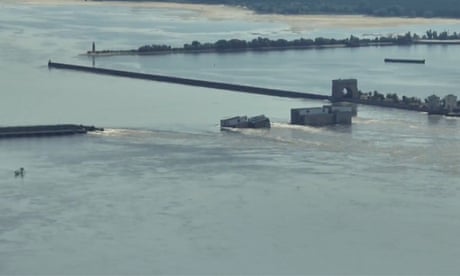
The 66-year-old Kakhovka dam on the Dnieper River in south Ukraine collapsed on the morning of 6 June after a suspected explosion, triggering a catastrophic humanitarian and environmental crisis.

Spanning an area of more than 2,000 square kilometres, the dam’s reservoir is the country’s largest in terms of water volume. The dam has been controlled by Russian forces for more than a year.

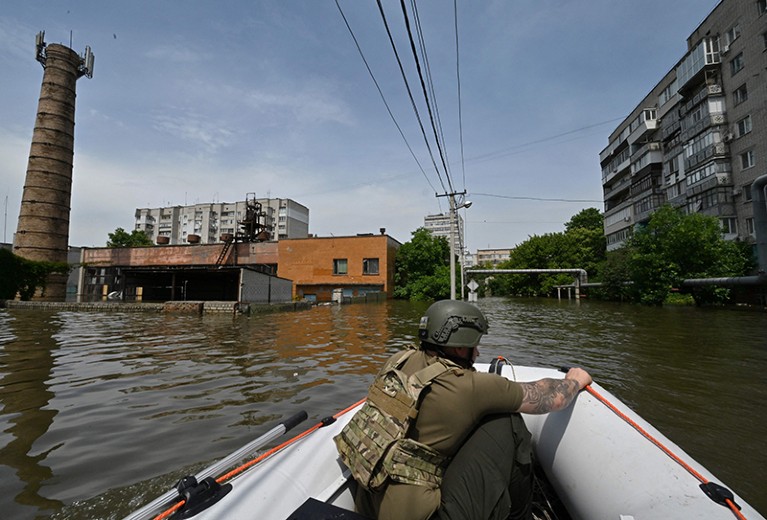
The breach triggered extensive flooding, which peaked at a depth of 5.6 metres in Kherson on 8 June and has already displaced more than 20,000 people across dozens of settlements, including in Russian-held areas on the river’s lower-left bank. The deluge is expected to continue for at least a week.

Nature spoke to researchers and specialists on rivers and environmental science about the continuing impacts of the disaster.

What are some of the immediate consequences?

Before the breach, the Kakhovka reservoir held more than 19 cubic kilometres of water. “Now, there are only 11 cubic kilometres of water left,” said Oleksandr Krasnolutskyi, Ukraine’s deputy minister of environmental protection and natural resources, in Kyiv, at a press briefing on 8 June.

The reservoir provides water for more than 700,000 people in south Ukraine. Cities on the Dnieper River, including Kherson, Nikopol, Marhanets and Pokrov, are short of water supplies, according to the United Nations.

And the flood waters themselves have caused extensive damage — destroying houses, roads and other crucial infrastructure.

How might the flooding affect farming and food security?

As the water level continues to drop, there will not be enough water for the irrigation canals that the reservoir usually serves, says Roger Falconer, a water engineer at Cardiff University, UK, who specializes in modelling dam failures. “It could affect crops both downstream and upstream.”

Flood water has inundated large areas of farms and arable lands, washing away their topsoil layers, according to Ukraine’s environment ministry. “We will not be able to cultivate agricultural plants on this soil for many years,” said Krasnolutskyi. Falconer adds that the floods could wash fertilizers used on agricultural land into the river, where they could disrupt aquatic ecosystems.

What are the other environmental impacts?

The sudden surge of water downstream has had immediate and far-reaching impacts on the biodiverse ecosystems. “Nearly 160,000 animals and 20,000 birds are under threat because of the catastrophe,” said Krasnolutskyi.

Some of those species are rare, or found only in this area. These include the vulnerable Nordmann’s birch mouse (Sicista loriger) and the endangered sand mole rat (Spalax arenarius), according to a report by the Ukrainian Nature Conservation Group (UNCG) in Vasylkiv.

The Kakhovka reservoir itself is home to dozens of fish species. The rapid draining of its water means that vast numbers of fish will be either stranded in shallow, dried-up zones, or swept away to sea, where they will perish in the salt water.

“What we have seen is the tip of the iceberg,” says Oleksii Vasyliuk, an environmentalist and co-founder of UNCG. “This is ecocide.”

Nearby national parks have also been flooded, which will cause irreparable damage to their flora and fauna.

Nine sites in Ukraine’s Emerald Network, a Europe-wide conserved area, as well as five internationally important wetlands have been flooded. Around 55,000 hectares of forest have been inundated with water that is predicted to remain stagnant for 20 days, according to the environment ministry.


A member of Ukraine’s National Guard brings food to Kherson residents stranded by flooding.
Credit: Genya Savilov/AFP via Getty


Does the dam’s proximity to a nuclear power plant pose a danger?


Europe’s largest nuclear power plant, in Zaporizhzhia, is located around 150 kilometres upstream of the Kakhovka dam. The plant’s six reactors have been shut down for more than eight months — but it needs cooling water to manage the residual decay heat. The reactor is continuing to pump cooling water in from the reservoir, according to the International Atomic Energy Agency.

If the water level in the Kakhovka reservoir drops too low to be able to supply cooling water, Zaporizhzhia can switch to alternative water supplies. There are also two cooling towers that use the atmosphere for cooling, and require only a small amount of water to operate, says Malte Jansen, an energy scientist at the University of Sussex in Brighton, UK.

Perhaps more concerning is the potential dispersal of toxic compounds. More than 150 tonnes of machine oil from the Kakhovka hydroelectric power station, which sits on the dam, have spilled into the Dnieper River, according to the environment ministry. The flood water also carried garbage, together with construction waste and sewage, into the Dnieper watershed, according to Krasnolutskyi, where it could potentially contaminate supplies of drinking water.

What can be done to address the situation?

If the reservoir’s water level continues to fall, it will eventually return to the baseline level before the dam was built, says Falconer.

He adds that the collapse will ultimately change the reservoir’s bed topography, and that it could also increase shear stress, the force of water flowing against the river bed, which would disturb any toxic sediment there.

“It will be necessary to either plant [upstream] areas with a forest, or sow meadow grasses so that the wind does not blow away this silt at the bottom of the dried reservoir, because it is contaminated with waste from Zaporizhzhia,” says Vasyliuk.

The environment ministry says that a scientific survey will be needed to explore whether the dam should be rebuilt. But a complete assessment of the flood’s impact is unlikely at present: Russian forces currently control the south side of the river, where most of the flooding has occurred. “Nothing can be done to minimize the consequences,” says Vasyliuk. “This is a zone of both an environmental disaster and active hostilities.”

Nature 618, 440-441 (2023)
 https://doi.org/10.1038/d41586-023-01928-8
The politics of teaching US history

A university professor reflects on the uneasy task of showing students how the US national story is told and retold

TEONA TSINTSADZE/GETTY IMAGES/CREATIVE COMMONS/BOLDFRONTIERS/NICOLAS RAYMOND


BY ERICA HELLERSTEIN
13 JUNE 2023
Q&A
CODA

For the better part of the last decade, Megan Threlkeld has been leading students on a tour of a nation at war with its past.

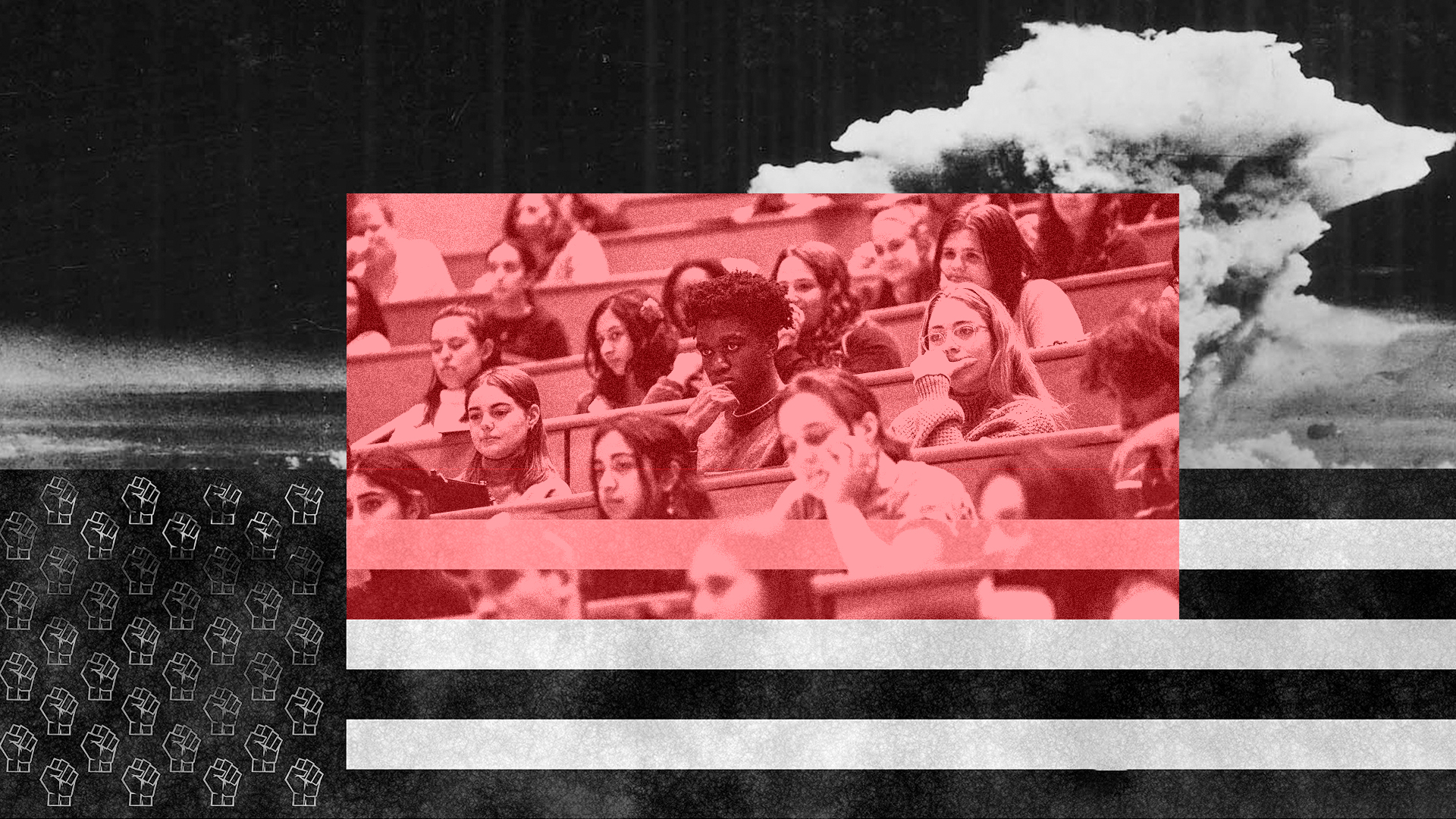
Threlkeld, a history professor at Denison University in Ohio, teaches a seminar for first-year students focused on how American history has been taught through the centuries, parsing textbooks to explain how national narratives evolve. The course dissects some of the country’s most notorious battles in the great culture war over historical memory — from the 1990s-era clashes about how to commemorate the atomic bombings of Hiroshima and Nagasaki to the conservative uproar in the mid-2010s over a U.S. history course framework emphasizing the country’s legacy of racism. The last few years of her course have coincided with a new front in America’s culture wars: how this legacy is discussed in public schools.

Since 2021, at least 18 states have passed laws banning schools from teaching critical race theory or “divisive concepts” about racism and sexism. In the same period, universities and colleges have become a key battleground for conservative lawmakers intent on codifying an “anti-woke” view of history in the classroom, with nearly two dozen states introducing bills targeting history instruction and diversity training in higher education.

Threlkeld’s students have been studying these fights in real time and reflecting on the future of a country afraid of its past. I spoke to her about what they make of this fraught political moment and the continuities between history wars of the past and present.

When you started teaching this class nearly a decade ago, what was the dominant history war captivating the public? And do you see any connections between that feud and what people are fighting over today?

Starting around 2010, the College Board decided to revisit the AP U.S. history framework. So they brought in historians and teachers and all the kinds of people you would expect. And it was a multi-year process that was all done by the College Board. And then in 2014, they released the revised framework around which schools could design the AP courses that fit with what they do in those districts. The right-wing reaction was exactly what you would expect, which was, ‘Why are these people listed and not these people?’

So for those first few years of teaching this class, I was able to show my students these reactions and to show them the responses from the College Board and the responses from school districts and ordinary teachers who were dealing with this in their classrooms every day. I could tell that students had never really thought about the politics behind all of this because they’re just in class. They’re just learning what they’re being taught. One of the experiences that stays with me most strongly from this class is just seeing students realize how political history is.

Many students can probably study a specific battle over a textbook and not understand that history itself is often contested and politically weaponized. How do you explain this concept of history wars to your students? How do they react?

It’s a hard thing to do. I’ve tried a lot of different ways over the years. The thing that I have done the last few times that I have taught the course is just to give them one of these bills. The last time I taught this course was the fall of 2022. And in the spring of 2022, the Ohio House of Representatives had proposed one of these ‘divisive concepts’ bills. So we talked through the process of how these bills work, and I just gave them the text and said, ‘Take a look at this and tell me what you think.’ And that was more powerful than anything I had tried before.

Some of the other things I had done before were giving students two very different textbook excerpts of the same event and talking about why these excerpts would be so different. Even then, getting them to understand the political stakes always took more time. But with these bills, all I have to do is hand them the text of one, and they’re just immediately thinking, ‘What is going on?’

Do students buy lawmakers’ rhetoric that these laws are intended to protect them from harmful and divisive concepts?

Their first reaction is usually disbelief that anyone thinks that there are topics in U.S. history that high school and college students shouldn’t learn about. They are very thoughtful when it comes to thinking about younger children. But by the time students get to their age — 16, 17, 18 — they just can’t wrap their heads around the idea that there is something dangerous in learning about slavery or learning about racial discrimination of any kind. And some of them who come through this course and start to understand how little they know about American history, some of them are angry that they weren’t taught the things that they’re learning.

We do have some really interesting discussions about patriotism and what it means to be patriotic. Because they pick up on a lot of that rhetoric, too, that the purpose of public education is to make students patriotic citizens. And so, I do always get a couple of students who ask things like, ‘Well, how can I learn all these terrible things that the United States has done and still be patriotic?’ And I think that’s an incredible question. Where a lot of them come to by the end of the semester is that they need to know these things in order to be patriotic. That being ignorant is not patriotism.

I grew up in California, but I have reported from and lived in the South. And while I was there, I learned that students were taught a very different version of Civil War history — including one that glorified the so-called ‘Lost Cause’ mythology of the Confederacy. For me, learning about the regional and geographic differences in U.S. history education was very eye-opening. Taking this a step further, I wonder what this course is like for students who aren’t from the U.S. Have they drawn comparisons to places they come from?

I love it when international students in this class feel comfortable enough to start talking about their experiences. At Denison, we have a lot of students from Vietnam, a lot of students from China, a lot of students from India. And when they do start to open up and start to reflect on the kind of history they were taught in high school, it’s clear that they do understand how much of what they learn is controlled by the state.

I’m thinking about Vietnam in particular because I had this one really smart, thoughtful student in my class this past fall who was from Vietnam. And he was very conscious of the fact that in Vietnam, history education has been tied very closely to reunifying and rebuilding the country over the last 50 years.

And so he was actually able to talk in a way that I don’t think most 18-year-olds can about the political uses of history in that nationalist context. And for some of my students who are from the U.S., I could see the wheels turning in their heads, when they start to realize, ‘Oh, this stuff serves a political purpose. And what might be the purpose it’s serving in my state? Let me think about that.’

This conversation has been edited for length and clarit
Why are most US historians against Critical Race Theory?

Most of my colleagues appear determined to protect a version of our national history shaped by white supremacy.

Donald Earl Collins
Visiting Professor of African American History with Loyola University Maryland
9 Jun 2023
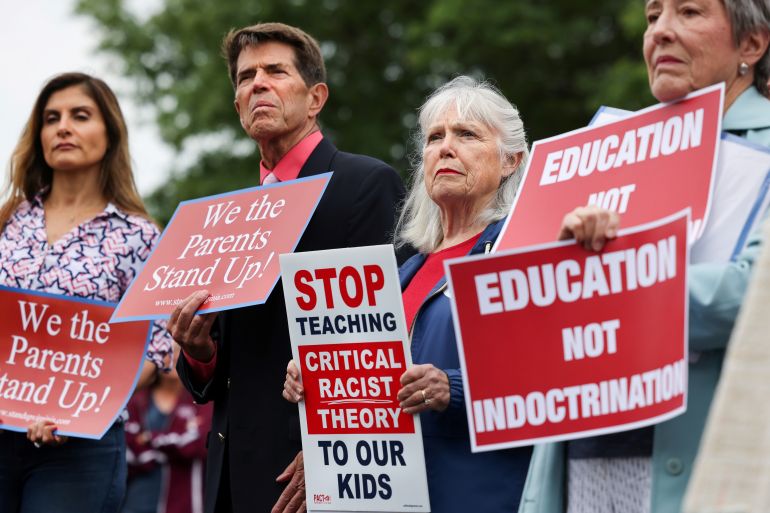
Opponents of Critical Race Theory protest outside of the Loudoun County School Board headquarters, in Ashburn, Virginia, US June 22, 2021.
[Evelyn Hockstein/Reuters]

Any number of absurdities have been noted in the arguments of those attempting to make a boogeyman out of Critical Race Theory in order to exclude Black and Queer curricula and books from K-16 education in the United States.

Perhaps none of these arguments is more narcissistic and weird than the one put forward by the short-lived 1776 Commission – an advisory committee formed by President Donald Trump to respond to The 1619 Project and other attempts to advance a more complicated narrative of the American past.

“To be an American means something noble and good…[America’s principles]…laid the groundwork for [virtues like honesty, optimism, and determination] to grow and spread and forge America into the most just and glorious country in all of human history,” the Commission concluded in its criticism of Critical Race Theory-based projects in 2021. Anyone who believes that racism is central to the founding of the United States, the Commission argued, is toxic to the point of being anti-American and anti-patriotic.

It isn’t just that such arguments are unable to they do not withstand even the mildest scrutiny. There is another, more sinister problem with these efforts to attack histories that centre Black, Queer, and other marginalised people’s experiences in the US through attacks on Critical Race Theory: professional historians are behind most of them.

As a professional historian myself, I know that an overwhelming majority of academically-trained historians in this country have a problem with Critical Race Theory and with the idea that racism, queerphobia and other ills are DNA-deep in American and wider Western culture. The few historians like me who have claimed Critical Race Theory as a critical component in their writing and research are on the margins of the profession.

One of the biggest dustups over Critical Race Theory among leading historians was in 2021. The 1619 Project, which was first published by The New York Times Magazine in 2019 to mark the 400th anniversary of slavery in the US, had by then gone through two years’ worth of mostly ill-informed attacks. That September, veteran American historians Richard D Brown, Gordon Wood, Carol Berkin and three others published an open letter on Medium critiquing both The 1619 Project and those historians who have defended its work.

Offering what was by 2021 a well-worn critique of editor Nikole Hannah-Jones’s introductory essay to the project, the six wrote, “The [American] Revolution was a complicated event, subject to different interpretations; but the idea that the colonists – or even, in the Times’s amended version, ‘some of the colonists’ – revolted in order to protect slavery is beyond farfetched.”

What all critics of The 1619 Project, including those who penned this letter, seem to have in common is an unwavering belief that the American Revolution was a good thing. They all appear to see it as a world-changing event that forged a nation-state based on equality, freedom, and “the pursuit of happiness”. Thus they treat the existence of chattel slavery and the litany of laws that were in place to protect it in the 13 colonies as a mere aberration. They view the years between 1763 and 1789 as a sacred space, too sacred to sully with the accusation that preserving slavery – or really, systemic racism – might have been a motivating factor for independence.

This is why US historians like the ones who signed the open letter were so enraged by Hannah-Jones’s claim that “one of the primary reasons [some of] the colonists decided to declare their independence from Britain was because they wanted to protect the institution of slavery.”

As The 1619 Project explains, along with several other experts, prior to independence, those in the colonies were concerned that “the British would seek or were already seeking to disrupt in various ways the entrenched system of American slavery.” The British threat to American slavery at the time was perhaps only indirect. Yet Hannah-Jones and other experts are correct in their interpretation that those who wanted the American Revolution joined the fight in part to preserve their privileged positions and sources of income.

In the end, the American Revolution, as modern revolutions go, was a tepid one. It ended British rule only to put the colonies’ rich slave-owning leaders, the people who ran the 13 colonial governments, in charge of running the new nation-state. But this was not a failure. The revolution was always aimed at preserving – and not uprooting – the social order that placed the Founding Fathers and those like them on top and enslaved Africans at the bottom.

And this years-long, heated discussion over whether preserving slavery was a motivation for the American Revolution was only the tip of a mythmaking iceberg. The 1619 project and other historic accounts guided by Critical Race Theory faced many similar attacks and empty criticisms in recent years – many from professional historians. America’s leading historians appear determined to protect at any cost a version of American history that they deem correct and sacred.

Thankfully the practitioners of Critical Race Theory – who view neither the founding fathers nor the revolution as “sacred” – are confronting and debunking all such myths and misrepresentations of America’s beginnings in quick succession. And they are not attempting to be apolitical or objective while doing so. They have a strong bias against social injustice and are very much activists working hard to show the world how deeply embedded systemic racism has always been in the DNA of the US and the West.

Of course, the efforts to demonstrate the centrality of racism to the fundamentals of the US and the West did not start with the coining of the term Critical Race Theory in 1989 – Black folk have been speaking out about the endemic nature of racism in the US for two centuries.

Black abolitionist Martin R Delany in his 1852 book The Condition, Elevation, Emigration, and Destiny of the Colored People of the United States is but one example of this intellectual tradition. W E B Du Bois discussed the centrality of racism and slavery to the US and its founding in Black Reconstruction (1935). Afrofuturist writers like Ralph Ellison and Octavia Butler too had similar discussions in their works. And legal scholars like the late Derrick Bell, Patricia J Williams, and Kimberlé Crenshaw were readily busting myths about the beginnings of the US in the 1980s.

However, with Du Bois a prominent exception, most practitioners of what we now call Critical Race Theory have not been professional historians. And many professional historians who discuss Critical Race Theory today, even indirectly, appear to reject it for being “presentist”.

American Historical Association president James H Sweet articulated as much in a newsletter essay last August. “Doing history with integrity requires us to interpret elements of the past not through the optics of the present but within the worlds of our historical actors … History is not a heuristic tool for the articulation of an ideal imagined future,” he wrote.

Sweet, like many other historians, accuse those who practice Critical Race Theory of being political, subjective, moralistic, and too concerned with the present to deal with the past on its own imperfect terms.

As a professional historian who practices Critical Race Theory, I do not give much weight to such accusations of presentism, subjectivity and politicisation directed at my work and the works of other critical theorists. I do not care for these critiques because I know that all history is political, rooted in one biased interpretation or the other, and most importantly, is filtered through the lens of the present. Not all bias is bad, especially when it comes to social justice. Bias is actually much welcome when an approach like Critical Race Theory paves the way for the historian to infuse with history a real understanding of the human condition – past and present.

“We believe in social justice, but not at the expense of historical truth. Distorting history in the hope of achieving justice cannot bring justice, but it can harm every American, Black and White.” That was what Wood, Brown, Belkin and others wrote in their open letter about The 1619 project and the work of University of South Carolina historian Woody Holton defending it.

I find this idea self-serving, both as a professional historian and a Black man living in a virulently racist world and nation-state. Critical Race Theory is all about “historical truth”. Like a radio telescope, all who practice it are desperately trying to filter out as many of the distortions in the historical record about the nature and history of racism in the US and in the West as they can.

That cannot be said of the many historians who hide their petty jealousies of the success of writers, journalists, and legal scholars in the name of some fantasy notion of apolitical objectivity. They urgently need to stop and reassess their position, if they are to avoid inflicting further harm to our profession, and the American nation.

The views expressed in this article are the author’s own and do not necessarily reflect Al Jazeera’s editorial stance.


Donald Earl Collins
Visiting Professor of African American History with Loyola University Maryland
Collins is the author of Fear of a "Black" America: Multiculturalism and the African American Experience (2004). He is a Visiting Professor of African American History with Loyola University Maryland (on leave from American University).
How a 3.2-million-year-old human relative named Lucy walked

By Ashley Strickland, CNN
Tue June 13, 2023

A sculptor's rendering shows what Australopithecus afarensis looked like 3.2 million years ago.
Dave Einsel/Getty Images


Editor’s Note: Sign up for CNN’s Wonder Theory science newsletter. Explore the universe with news on fascinating discoveries, scientific advancements and more.
CNN —

When the remains of an early human ancestor were found in Ethiopia in 1974, the discovery provided an unprecedented look at a species that lived millions of years before humans walked the Earth.

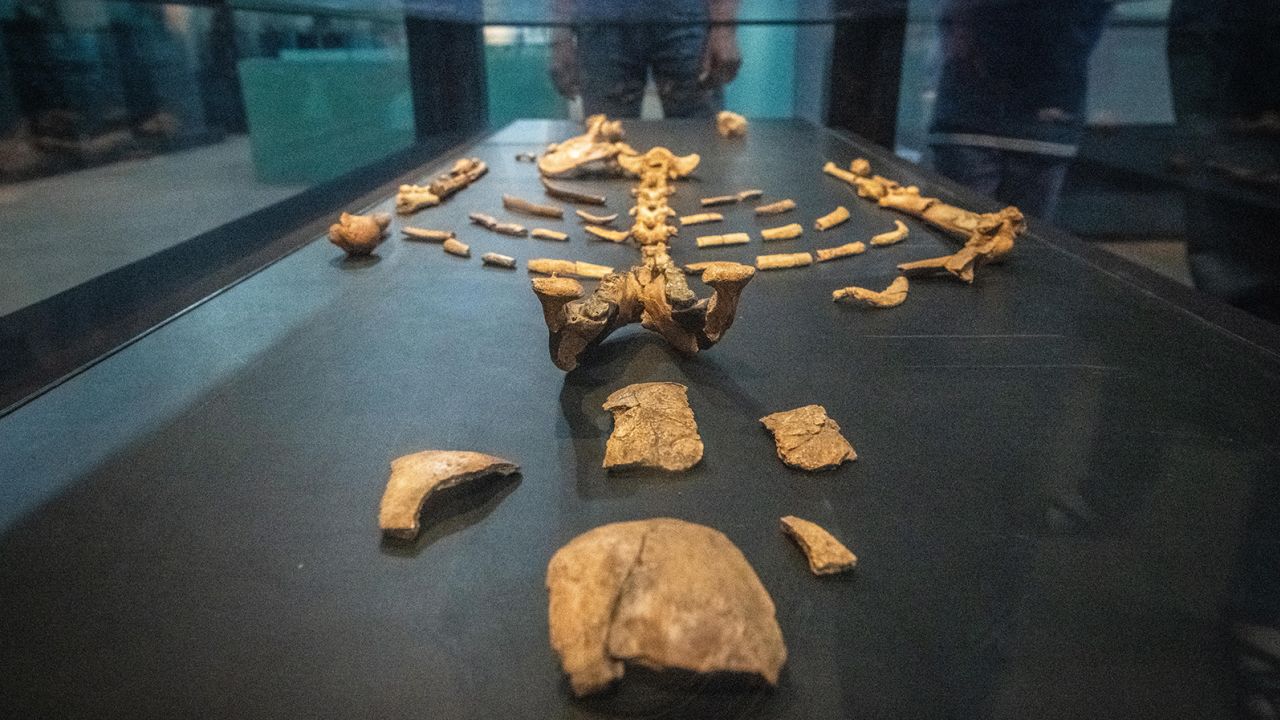
The rare fossil, representing 40% of a skeleton belonging to a female Australopithecus afarensis, was named “Lucy,” for the Beatles song “Lucy in the Sky With Diamonds.”

Now, researchers are using the skeleton to figure out how this ancient human relative moved 3.2 million years ago. The findings of the study were published Tuesday in the journal Royal Society Open Science.


Lucy was shorter than the average human, reaching about 3.3 feet (1 meter) in height, had an ape-like face and a brain about one-third the size of a human brain.

Lucy's fossil includes 40% of her skeleton, one of the most complete Australopith fossils found to date.
Edwin Remsberg/Alamy Stock Photo

Analysis of Lucy’s fossil over the past 20 years has suggested that she and others of her species walked upright. But lead study author Dr. Ashleigh L.A. Wiseman, a research associate at the University of Cambridge in the United Kingdom, wanted to take things a step further and recreate a component of Lucy that didn’t fossilize: her muscles.


Early humans left Africa and reached Asia earlier than thought, fossil discovery reveals


“The defining aspect of what makes us human is the ability to walk on two legs, but understanding how and why this evolved has been debated for a long time,” said Wiseman, who is the Leverhulme Trust Early Career Fellow and Isaac Newton Trust Fellow at the McDonald Institute for Archaeological Research.

“With recent advances in computational modeling, it is now possible to investigate these questions. Of course, in the fossil record we are left looking at the bare bones. But muscles animate the body — they allow you to walk, run, jump and even dance. So, if we want to understand how our ancestors moved, we first need to reconstruct their soft tissues.”

Studying fossils of Australopithecus afarensis can provide insight into the evolution of bipedalism, or walking upright, and when it emerged in early human ancestors. Wiseman’s reconstructions of Lucy’s muscles could also be used to determine how Lucy moved in other ways.
Rebuilding Lucy’s muscles

Wiseman and her colleagues developed a method called polygonal muscle modeling and initially used it to reconstruct the missing soft tissues of extinct reptiles called archosaurs that lived 247 million years ago.

Then, Wiseman applied to same method to Lucy for the first time to understand the shape and size of her muscles and how she used them to move, assessing whether it was like the crouched waddle of an upright chimpanzee or the stance of a human.

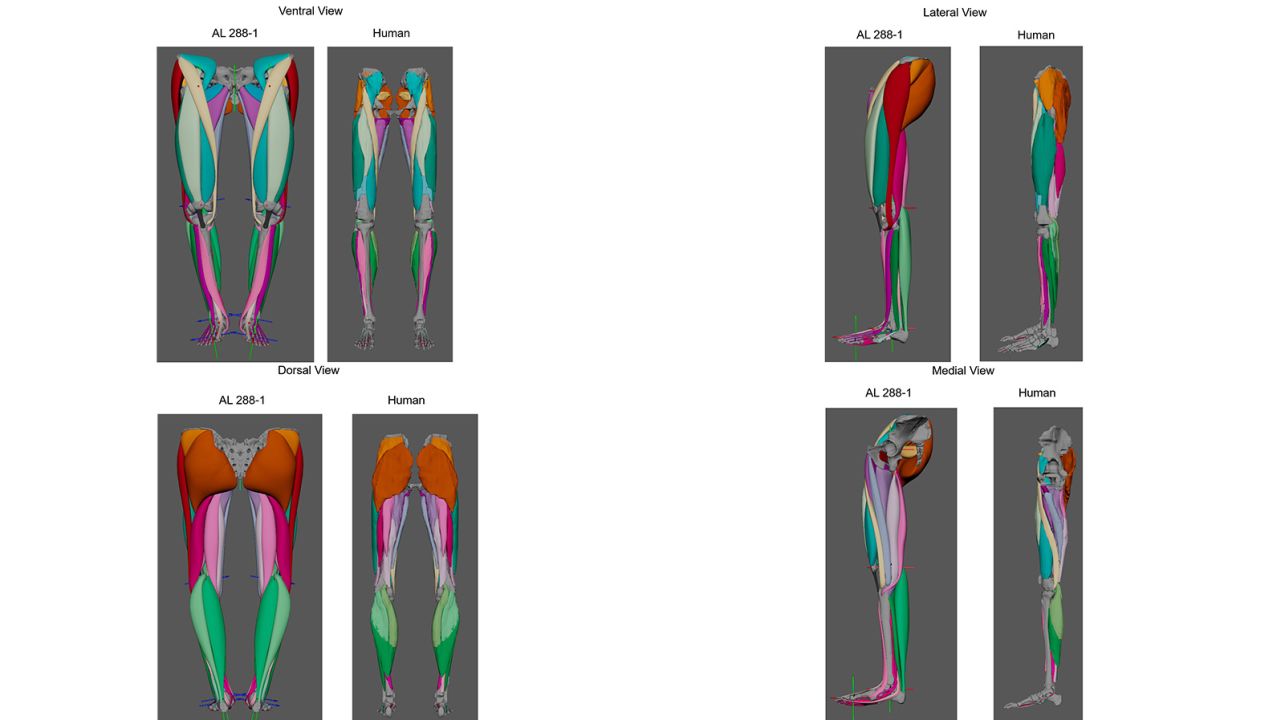
Wiseman used scans of Lucy’s fossil and data from humans to build a three dimensional model of the leg and pelvis muscles of Australopithecus afarensis. After collecting data from MRI and CT scans of muscle and bone structures in modern humans, the researcher digitally created a musculoskeletal model.

Then, she used scans of Lucy’s fossil to determine how her joints were articulated and moved in life. Wiseman layered in 36 muscles in each leg using the “muscle map” from the modern human data, combined with “muscle scarring,” or the discernible traces of muscle connection that are detectable in fossils.

Muscle modeling of Lucy, dubbed "AL 288-1," is compared side by side with human muscle maps.
Dr Ashleigh Wiseman/University of Cambridge

Lucy’s skeleton differs from humans because she had shorter legs and a more platelike pelvis (when viewed from the top down).

Wiseman’s model showed that while a modern human’s thigh was about 50% muscle mass, with the rest attributed to fat and bone, Lucy’s thigh would have been nearly 75% muscle. Overall, Lucy’s leg muscles were much larger and took up more space than those of modern humans.

“Lucy lived 3.2 million years ago on the African savannah. She would need to have walked over uneven ground and explored a mixture of forested environments and open grassland,” Wiseman said.

“Larger muscle mass typically means greater muscle force, and it is very unsurprising to find that the reconstructions of Lucy’s muscles demonstrates that she had greater muscle mass than a human, enabling her to move freely between these different environments.”
Standing upright

Paleoanthropologists have wondered about Lucy’s posture because her skeleton differs from modern humans.

Humans have a stable stance with fully straightened legs, but when chimpanzees stand upright, they can’t straighten their legs. They walk with a crouched posture due to their bent hips and knees, which is why chimps largely walk on all fours.


Mysterious species buried their dead and carved symbols 100,000 years before humans


The 3D model showed that the leverage of Lucy’s knee extensor muscles meant that she could stand erect like modern humans.

“I was very surprised to find that the knee extensors (those muscles that produce and maintain a straight knee when you stand upright) were so comparable to the human,” Wiseman said. “This means that Lucy could stand and likely walk as efficiently as we can.”

Australopiths such as Lucy lived in an environment that included both open grasslands and dense forests, and had bodies adapted to thrive both on the ground and in trees.

“Lucy likely walked and moved in a way that we do not see in any living species today,” Wiseman said.

“If Lucy was a biped just like we are and walked exclusively on two legs, then she should be able to move in similar ways as we can,” Wiseman said.
1 in 3 Children Suffer from Lead Poisoning—so Why is Lead Reduction Such a Heavy Lift?
by Karen Mathiasen and Rachel Silverman
JUNE 13, 2023
BLOG POST


This Thursday, the Center for Global Development is hosting a half-day event—Get the Lead Out—to shine a much-needed spotlight on the far-reaching social and economic consequences of lead poisoning.


Lead is an insidious toxin. In most cases, it has no overt, easily detectable symptoms when ingested—yet it causes lasting and irreversible brain damage, especially for children under five. It is linked to poor schooling outcomes, increased crime and violence, and heart and kidney damage. In different ways, lead is also dangerous to adults; estimates suggest that lead causes 900,000 premature deaths per year from increased risk of cardiovascular disease (likely an undercount). Though heart disease primarily affects older adults, the absolute death toll is higher than the attributable burden for malaria (620,000) and close to the burden of HIV/AIDS (940,000).

Lead is not an equal opportunity poison—94 percent of the disease burden (i.e., years of healthy life lost) from lead exposure occurs in low- and middle-income countries (LMICs), with India alone accounting for 275 million out of 800 million at-risk children. By contrast, rates of lead poisoning in developed countries are low—with remaining lead exposure concentrated among the poor and disenfranchised.

Getting the Lead Out—a Call to Action

Lead has been a feature of human activity for millennia, with estimates of its first use ranging from 3,000 to 2,000 BC., and descriptions of its toxicity documented since 200 BC. This makes it all the more remarkable that data on the prevalence and impact of lead poisoning are relatively new. The Lancet Commission on pollution and health, released in 2017 (and updated in 2019), and a 2020 report by UNICEF, provide the first estimates of the global burden of health attributable to lead poisoning. The biggest take-away—that one-third of the world’s children have unsafe blood levels—should have spurred decisive action. Instead, lead pollution has been sorely neglected by the international community.

And things are getting worse, not better. The Lancet Commission also found that global lead exposure increased by an estimated 40 percent between 1990 and 2017. This alarming trend reflects both the range of lead sources and its increased use, especially in fast-growing, emerging markets. Key origin points include batteries, paint, corroded pipes, contaminated spices, cosmetics, artisanal pottery, aluminum pots, and e-waste.

Because lead poisoning is preventable but not curable, every day represents a permanent loss in human potential, as well as elevated health, social, and economic costs—and every new use of lead adds permanently to the stock of lead contamination of our shared environment, increasing the challenge of lead mitigation for future generations. The outcome of continued indifference is that the prevalence and impact of this silent killer will grow and spread.

The good news is that a significant and rapid reduction in lead poisoning is an achievable goal, especially compared to other global problems consuming international attention and funding. 
Why? Because:
Major sources of lead poisoning are well documented;
Progress is quantifiable and measurable, enabling countries to establish benchmarks and set targets;
Remediation policies used by advanced countries in lead eradication are relevant to middle-income countries and low-income countries and can be duplicated;
The highest-impact strategies to combat lead poisoning are cost-effective (e.g., leveraged public health, awareness, and regulatory interventions) and therefore do not need major new allocations of scarce Official Development Assistance funds; and
We all agree that lead is bad! Unlike other global challenges, lead poisoning is not a divisive or polarizing issue.

Getting the Lead Out—Mobilizing Action

Our collective challenge as stakeholders in the international development community is to persuade policymakers in affected countries to make the prevention of lead poisoning a priority. First and foremost, this requires effectively disseminating knowledge about the costs and risks of lead poisoning as many governments and communities are simply unaware of its toxicity.

An encouraging sign is that the G7 has recently taken up the cause—in late 2022, environmental ministers hosted a workshop to discuss options for reducing lead poisoning in LMICs. In support of their efforts, CGD issued a report, offering practical solutions for a way forward. The resulting outcomes document issued by the environmental ministers proposed actions to build awareness, strengthen institutions, and encourage decisive action by governments and other stakeholders. Unfortunately, lead did not merit a mention in subsequent statements issued by the G7 finance ministers or leaders—omissions that increase the risk of further inaction.

G7 advocacy for a lead-eradication campaign would be a major win, so ideally Italy will champion the cause as 2024 chair. But an even more promising political channel would be the G20 because success will ultimately depend on actions in the countries where lead poisoning is most prevalent, like India and China, both of whom are G20 members. A recent policy brief from CGD makes the case, noting that “G20 leadership can kickstart a virtuous cycle of policy intervention by shining a high-level light on the problem while facilitating learning, exchange, and shared accountability for progress at the national level.”

As chair of the G20, India has a truly unique opportunity to become a leader in the fight against lead poisoning by launching a process to eradicate it. India should be highly motivated by the fact that lead poisoning is a major public health crisis—no country has more to gain from a successful course of action. But the window is short; the G20 Summit will be held on September 23.

Getting the lead out is a long-term commitment, requiring sustained attention. But the case is easy to make: the body of evidence on the impact of lead exposure is large and growing; designing an effective eradication strategy is eminently doable thanks to data on sources of lead, contamination sites, and populations most at risk; and cost-effective remediation practices are well established. Conversely the price of inaction would be high, erasing human potential, increasing health and social costs, and creating a bigger and more complex challenge for future generations.

Concerted international action is long overdue. The world’s children—and future generations—deserve nothing less.


Disclaimer

CGD blog posts reflect the views of the authors, drawing on prior research and experience in their areas of expertise. CGD is a nonpartisan, independent organization and does not take institutional positions.

Image credit for social media/web: Adobe Stock