Sunday, July 09, 2023


RELEASED WITH BAIL CONDITIONS

After return from Syria, two Canadian women appear in Edmonton courtroom on Terrorism Peace Bond

By Josh Hall (Twitter: @Vancan19)
Jul 8, 2023 | 1:26 PM

Two Canadians who returned from Syria this week have been arrested.

The RCMP Federal Policing Integrated National Security Enforcement Team (INSET) arrested Helena Carson, 33, and Dina Kalouti, 42, upon their arrival to Montreal-Trudeau International Airport on July 7.

Mounties say that with the consent of the Attorney General of Canada, the RCMP commenced proceedings against the two individuals by way of a Terrorism Peace Bond, pursuant to Section 810.011 of the Criminal Code.

Carson and Kalouti were transported to Alberta and appeared in an Edmonton provincial courtroom for a bail hearing. They were then released and are subject to a number of bail conditions pending a hearing of the application.

Meantime, Global Affairs Canada (GAC) said in a July 6 statement on this matter that it had taken extraordinary steps to repatriate five people — the two women, plus three children. This was done through the Bring Our Loved Ones Home litigation.

“Canada remains steadfast in prioritizing the safety and security of its citizens, both at home and abroad, and has been particularly concerned about the health and well-being of Canadian children in northeastern Syria,” says GAC.

“Canada extends its gratitude to the Autonomous Administration of North and East Syria for its cooperation in conducting another operation under difficult security circumstances. We also thank the United States for its assistance in the repatriation of Canadians and for continuing to play a key role in resolving the ongoing humanitarian crisis in the region.”

Canada remains steadfast in its commitment to the fight against Daesh, or ISIS, and global terrorism while vigorously defending human rights both domestically and abroad, GAC adds.

“Where there is sufficient evidence, law enforcement and public safety agencies will independently take the necessary steps to keep our communities safe,” it continues.

“We reiterate that it is a serious criminal offence for anyone to leave Canada to knowingly support a terrorist group and those who engage in these activities will face the full force of Canadian law. We remain committed to taking every possible step to ensure the safety and security of Canadians.”

Due to privacy considerations, GAC could not provide information about the repatriated individuals at the time of its statement, though RCMP later did name the adults. For operational security reasons, GAC can also not share details of the repatriation.

RCMP say that because the criminal investigation remains ongoing, there will be no further comment at this time.

They were asked, but could not confirm to rdnewsNOW where in Alberta the two women are from.

Edmontonians 'needn't worry' about peace bonds issued for detainees returning from Syrian camps
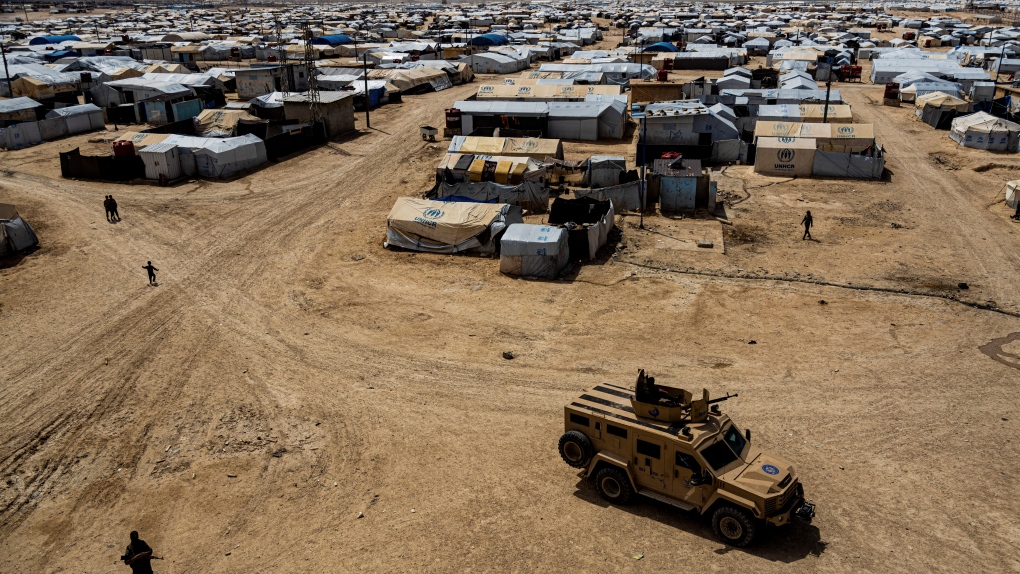

Kurdish forces patrol al-Hol camp, which houses families of members of the Islamic State group in Hasakeh province, Syria, Wednesday, April 19, 2023.
 (AP Photo/Baderkhan Ahmad)


Craig Ellingson
CTVNewsEdmonton.ca 
Digital Producer
Updated July 7, 2023 

The lawyer for two women and three children returning home to Edmonton on Friday after spending about five years in Syrian detention camps says despite a federal court ordering peace bonds for the adults, the public has nothing to fear.

While a peace bond is a protection order made by a Canadian court under the Criminal Code, it does not imply people placed under them are suspected of committing a crime.

Ottawa lawyer Lawrence Greenspon, who represents the women and three others who returned to Canada in April, said people "needn't worry" that they would be a threat to public safety.

"What’s happened here is the rights of Canadians overseas have been violated for a period of five years, and now, they’re going to be brought home, be reunited with their families and integrated back into Canadian society," Greenspon said of the group, who had been held in the camps because they are wives, widows and children of foreigners suspected of joining the Islamic State during the Syrian civil war.

RELATED STORIES

Two Canadian women and three children on way home from detention camps in Syria

The peace bond is a way of imposing conditions on them, such as mandatory use of electronic monitoring bracelets, curfews, and denial of access to the internet and social media, Greenspon said.

The sisters-in-law and the three children, whose mother is one of them, were part of a group of 19 Canadians that Global Affairs Canada agreed to bring home after they sued the federal government. A settlement was reached in January.

Fourteen of them arrived in Canada in April. The other five failed to show up for that flight, with neither their lawyers nor the Canadian government seemingly aware of what had happened to them for several days.

One of their lawyers later said that the women and children had been detained by Kurdish guards who would not allow them to travel and board the plane at that time.

On Thursday, the five returned to Canada. On Friday, the RCMP said the two women had been taken to Alberta and appeared in Provincial Court for a bail hearing in relation to Terrorism Peace Bond applications.

The women were released from custody, Mounties said, and are subject to a number of bail conditions pending the hearing of the application.

Global Affairs Canada said in a statement it could not provide information or details of the recent repatriation due to reasons of privacy and operational security.

"Canada remains steadfast in its commitment to the fight against Daesh and global terrorism while vigorously defending human rights both domestically and abroad," the federal agency said in a statement. "Where there is sufficient evidence, law enforcement and public safety agencies will independently take the necessary steps to keep our communities safe.

“We reiterate that it is a serious criminal offence for anyone to leave Canada to knowingly support a terrorist group and those who engage in these activities will face the full force of Canadian law. We remain committed to taking every possible step to ensure the safety and security of Canadians."

Greenspon called bringing the five repatriated Canadians home a "life-changing" milestone for them.

“These women and children have been in detention camps in horrible conditions for five years. They’re Canadians," he said. "The government has now seen fit, thankfully and finally, to bring them home … Clearly, the women and children are going to need some support. They’re going to need some counselling. Those things are already in place, ready to go.”

With files from CTV News Edmonton's Nahreman Issa, CTV National News correspondent Judy Trinh and The Canadian Press


EU envoy tours Jenin refugee camp, says IDF operation violated international law

Leading delegation, diplomat accuses Israel of disproportionate use of force, urges end to ‘cycle of violence’
8 July 2023

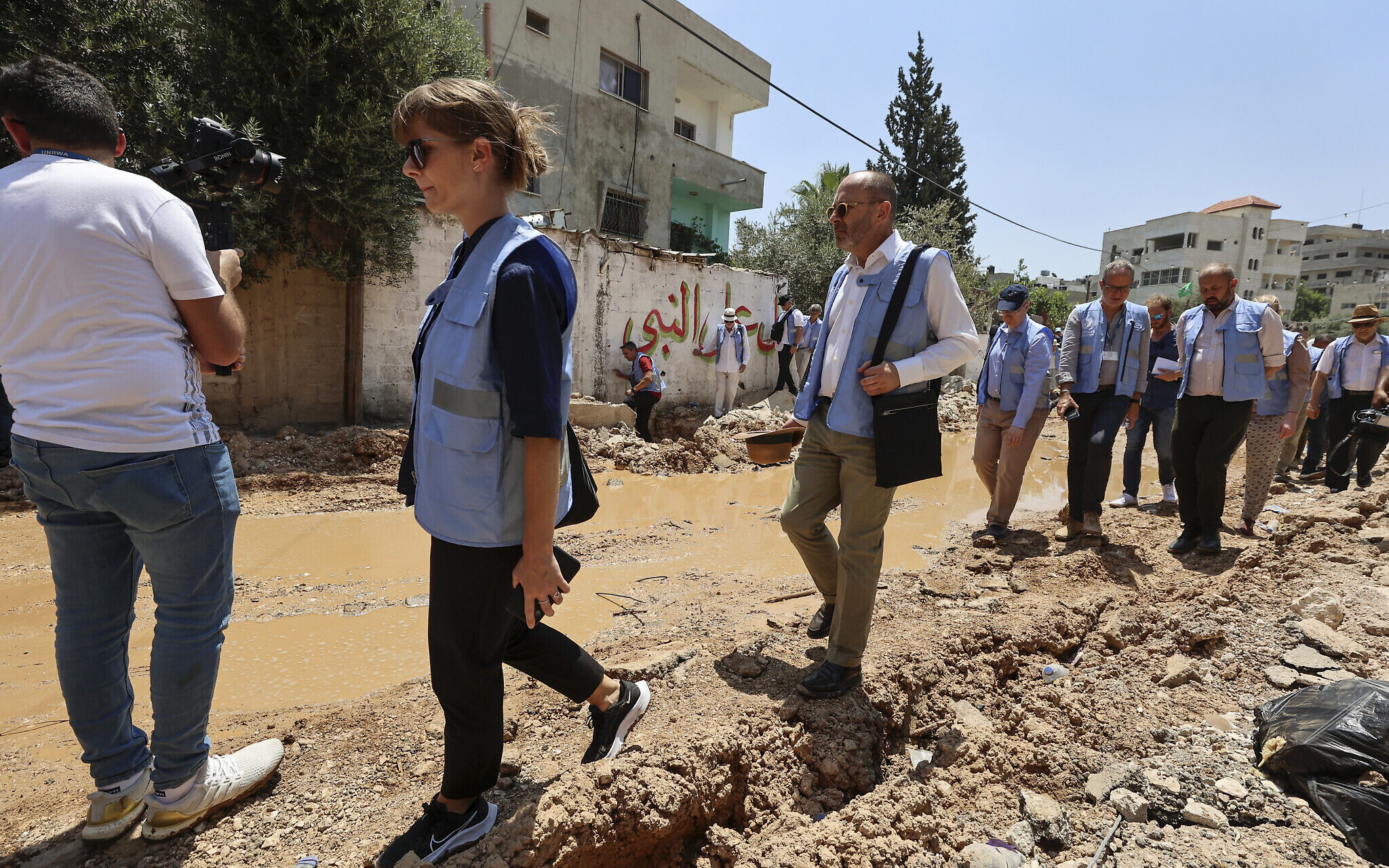
European Union representative to the Palestinian territories Sven Kuehn von Burgsdorff speaks to reporters as he and a delegation of international envoys visit the Jenin refugee camp in the West Bank, on July 8, 2023. (Zain JAAFAR/AFP)

A European Union envoy criticized Israel Saturday over the “proportionality” of the force it used in its recent military operation in Jenin, and accused Jerusalem of violating international law, as envoys toured the refugee camp in the West Bank following this week’s raid.

His remarks echoed those of UN chief Antonio Guterres, who on Thursday told reporters “there was an excessive force used by Israeli forces” in its 48-hour operation, the largest Israel has staged in the Palestinian territory for years.

It included air strikes and armored bulldozers ripping up streets. Twelve Palestinians were killed, though Israel has asserted that all were combatants. Most have been claimed by terror groups. Some of the dozens of injured were non-combatants, the IDF said. One Israeli soldier was killed.

Jenin is a hotspot for the activities of multiple Palestinian terror groups, and Prime Minister Benjamin Netanyahu has called the refugee camp a “terrorist nest.”

European Union representative to the Palestinian territories Sven Kuehn von Burgsdorff made his comments as he led a delegation of UN officials and diplomats from 25 countries to the camp in the northern West Bank.

“We are concerned about the deployment of weaponry and weapons systems which question the proportionality of the military during the operation,” Kuehn von Burgsdorff said of the operation.


Members of an international delegation walk on a devastated road during a tour of the Jenin refugee camp in the West Bank, on July 8, 2023. (Zain Jaafar/AFP)

Burgsdorff told reporters that the “painful” raid violated international law and urged Israel to bring an end to the conflict.

“This cycle of violence has to end, it cannot continue. If there is no political solution to the conflict, we are going to stand here in a week’s time, in a month’s time, in a year’s time, with nothing changed,” he added.

As the delegation toured the camp, residents peered out of holes left in the walls by Israeli rockets, and local authorities tested a new camp-wide alarm system to warn of future raids.

Tensions between Israelis and Palestinians have been high across the West Bank for the past year and a half, with the military carrying out near-nightly raids, amid a series of deadly Palestinian terror attacks.

Since the beginning of this year, Palestinian attacks in Israel and the West Bank have killed 25 people.

According to a tally by The Times of Israel, 148 West Bank Palestinians have been killed during that time — most of them during clashes with security forces or while carrying out attacks, but some were uninvolved civilians and others were killed under unclear circumstances.

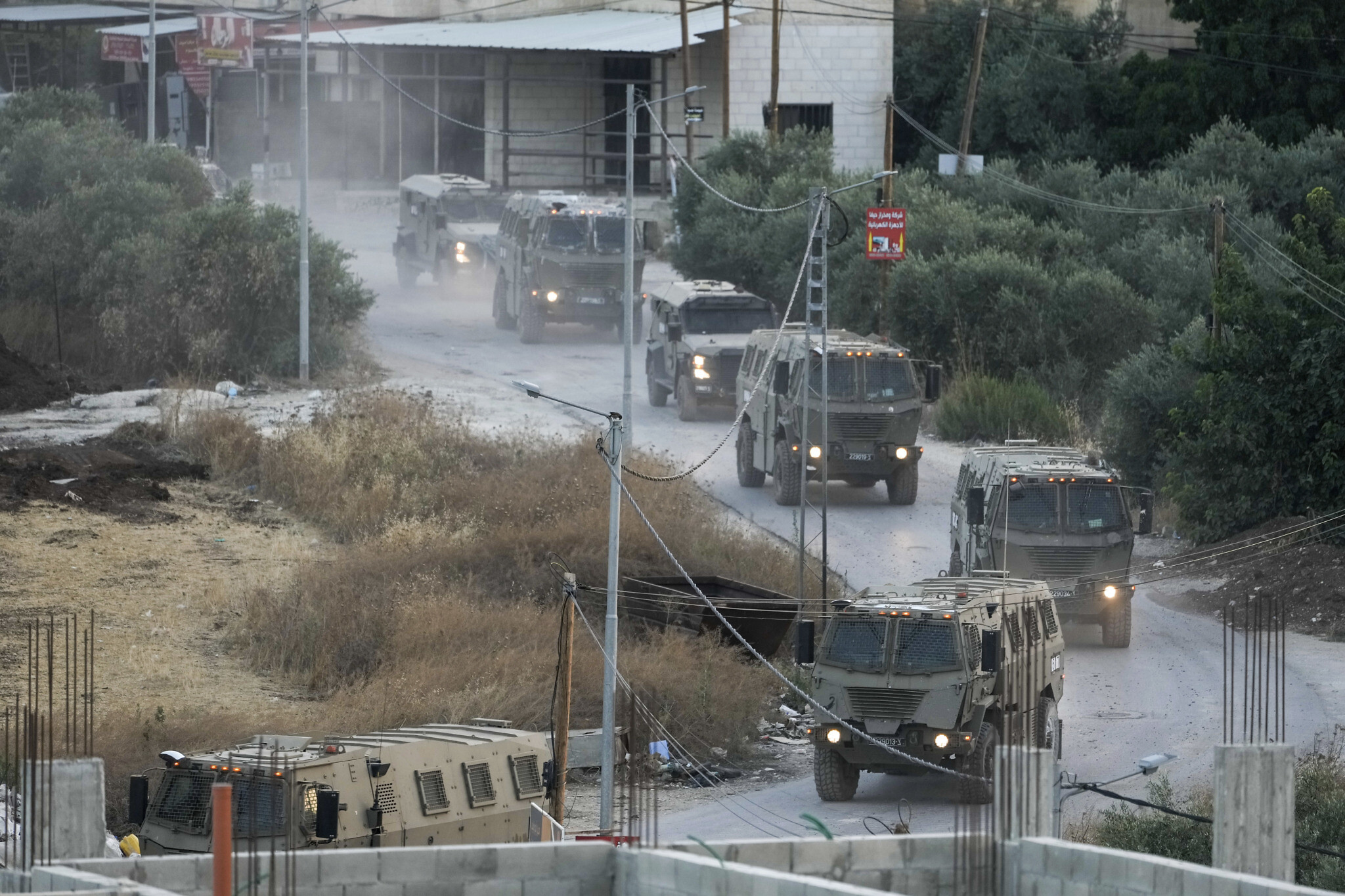
A convoy of army vehicles is seen during a military raid in the Jenin refugee camp, a militant stronghold, in the West Bank, July 4, 2023.
 
(AP Photo/Majdi Mohammed)

UN plea for funds

The Jenin camp has been the site of several large-scale raids by the Israeli military this year, but this week’s was the biggest such operation in the West Bank since the Second Intifada of the early 2000s.

The camp’s infrastructure was severely damaged during the raid, which Israel said was targeting terrorists who have repeatedly launched attacks throughout the West Bank in recent months.
ADVERTISEMENT

Eight kilometers (five miles) of water pipes and three kilometers (two miles) of sewage pipes were destroyed, the UN said. More than 100 houses were damaged and a number of schools were also lightly damaged.

The refugee camp is one of the poorest and most densely populated in the West Bank, with some 18,000 people living in just 0.43 square kilometers (0.16 of a square mile).

UN officials on Saturday made a plea for funds to help rebuild the camp.

“To restore services and scale up support to the children, we need cash… our appeal is desperately underfunded,” Leni Stenseth, deputy commissioner-general of the UN agency for Palestinian refugees, said.

“I would urge you to consider announcing your support for the work we are going to do here in Jenin camp in the coming weeks and months as soon as possible,” she added.

On Thursday, Algeria announced $30 million to “help rebuild the Palestinian city of Jenin after the barbaric and criminal attack” by Israel, and the United Arab Emirates, which normalized ties with Israel in 2020, said Wednesday it “will provide $15 million.”

France: Hundreds stage protests in Paris against police violence | Latest World News | WION

1:53


A week after violent riots in Paris were sparked by the assassination of a teenager in a suburb, hundreds of protesters disobeyed a city-wide ban on marches to decry police brutality and racial profiling. They assembled in downtown Paris for a memorial rally. 


Delhi's earliest crimes revealed by 1800s police records

  • PublishedShare
IMAGE SOURCE,RAJENDERA KALKAR
Image caption,
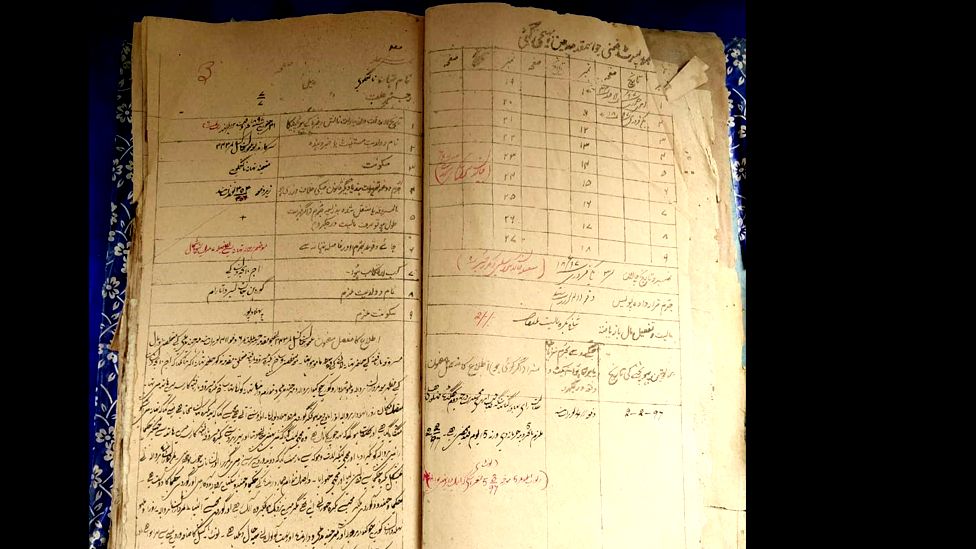
Some 30 police complaints filed between 1860-1900s Delhi have resurfaced

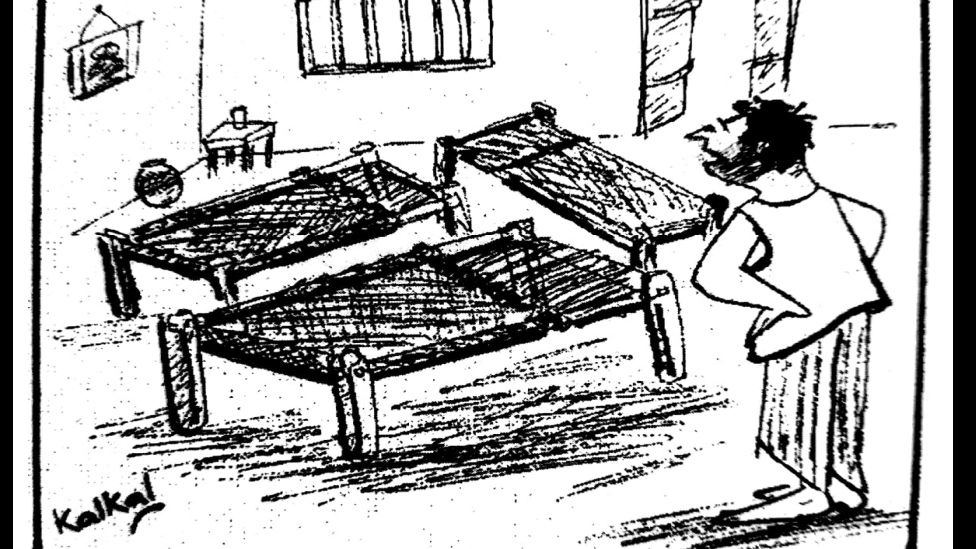
On a cold January night in 1876, two weary travellers knocked at Mohammed Khan's house in Delhi's Sabzi Mandi - a thriving labyrinth of narrow alleys in India's capital - and asked if they could stay the night.

Khan graciously decided to let the guests sleep in his room. But the next morning, he found that the men had disappeared. Also missing, was Khan's bedroll which he had given the men to rest. Khan had been robbed, he realised, in a way like no other.

Nearly 150 years on, the story of Khan's ordeal now features in a list of the earliest crimes reported in Delhi, records for which were uploaded on the city police's website last month.

The "antique FIRs" provide details into some 29 other similar cases that were registered at the city's five main police stations - Sabzi Mandi, Mehrauli, Kotwali, Sadar Bazar and Nangloi - between 1861 to the early 1900s. In Khan's case, the police caught the men and sent them to three months in jail on charges of theft.

Originally filed in the tenacious Urdu shikastah script - which also has words in Arabic and Persian - the FIRs were translated and complied by a team led by Assistant Commissioner of Delhi Police Rajendra Singh Kalkal, he also illustrated each of the cases himself.

IMAGE SOURCE,DELHI POLICE
Image caption,
Mohammed Khan lodged a police complaint against three men in 1876

Mr Kalkal told the BBC the records "spoke to him" because of the fascinating insights they offered into the lives of people in a city which has survived waves of conquests and change. "The files are a window to the past as well as the present," he says.

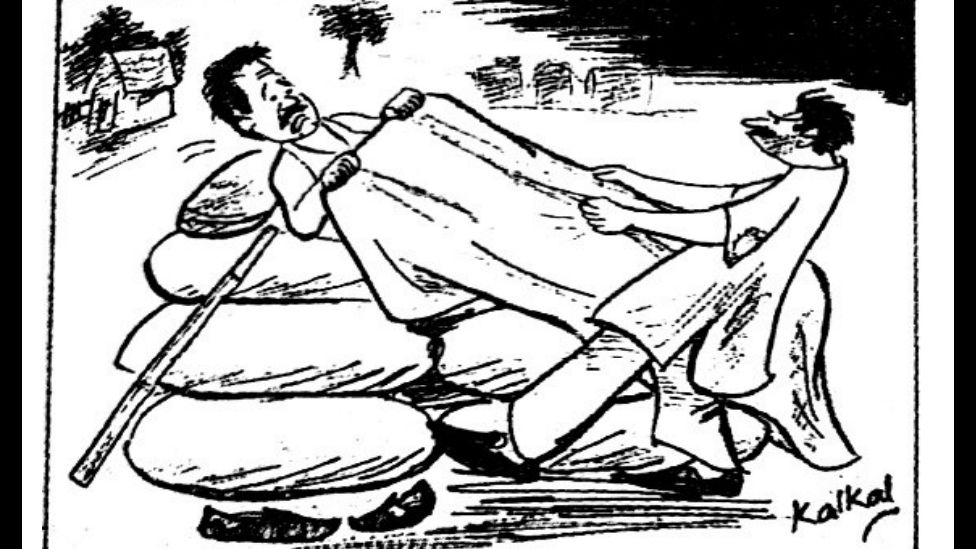
Most of the complaints involve petty crimes of theft - of stolen oranges, bedsheets and ice cream - and carry a comical lightness to them. There's a gang of men who ambushed a shepherd, slapped him and took away his 110 goats; a man who nearly stole a bedsheet but got caught "at a distance of 40 steps"; and the sad case of Darshan, the guardian of gunny bags, who gets beaten black and blue by thugs before they snatch his quilt and a shoe - just one of the pair - and run away.

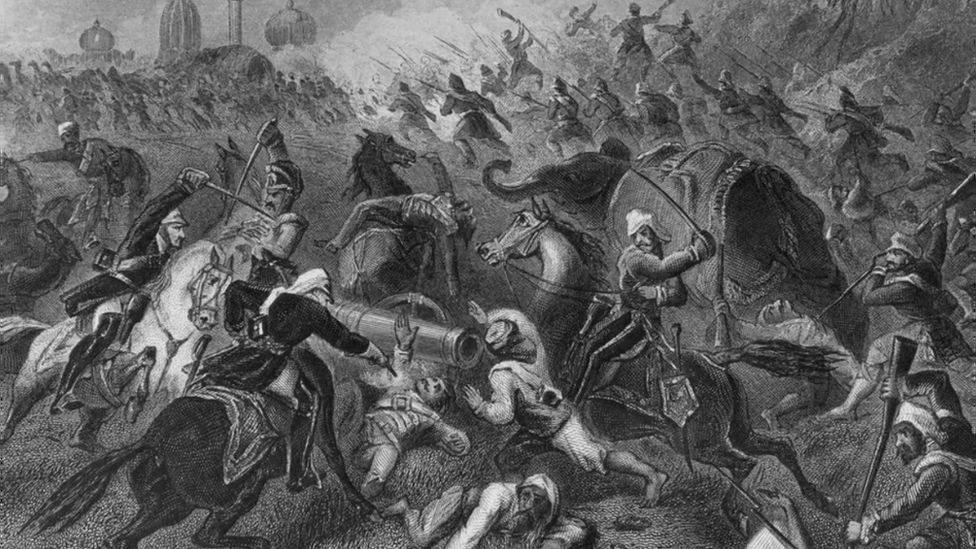
For anyone familiar with India's past, this might seem odd given how the 1860s was a particularly grim period in Delhi's history. The Mughal rule had just ended after the British suppressed the revolt of 1857, often referred to as India's first war of independence. The city - once an idyll of pleasure gardens, Sufi devotion, arts and Mughal regalia - now laid in ferment, sacked and looted.

IMAGE SOURCE,DELHI POLICE
Image caption,
Mr Kalkal has made cartoons for all the cases

Artist and historian Mahmood Farooqi says that one possible reason why no serious crimes occurred at that time was that people had become deeply intimidated by the British, who continued to run a an iron-fisted rule in the years after the revolt.

Men, women and children were brutally massacred. Many were forced to leave Delhi forever and move to the surrounding countryside, where they lived the remaining years in abject poverty. And a few of those, who managed to remain within the city walls, had to live under the constant threat of getting shot or being hanged to the gallows. "This was a time of carnage. People were terrorised and brutalised so much that they bore its trauma for years."

Mr Farooqui adds that unlike other cities such as Kolkata (formerly Calcutta) where modern policing had already taken shape, Delhi continued to run on a unique, "a purana, or old" system of policing, laid under the Mughal rule, which was hard to dismantle and replace completely. "So discrepancies or gaps in records are not entirely out of question."

IMAGE SOURCE,GETTY IMAGES
Image caption,
Indian soldiers of the British Army revolted against the Raj in 1857

The records, which lie in the Delhi Police Museum, were discovered sometime last year. Mr Kalkal, who was in-charge of the research and preservation of the museum's artefacts, said he found them while he was browsing through the musty old archives one fine day. "I saw hundreds of FIRs lying in obscurity. When I read them I realised how its format has remained unchanged even after 200 years."

Mr Kalkal says he too was struck by the innocuous nature of the offences, a time when stealing objects like cigars, pyjamas and oranges was "the worst imaginable thing".

But the fact that relatively benign crimes were being reported to the cops does not necessarily mean that a lot of heinous crime weren't already happening - Mr Kalal suspects the first case of homicide would've surfaced as early as 1861 itself, when an organised form of policing was established by the British under the Indian Police Act.

"Finding murder cases was not the focus of our research but I am sure they are there, somewhere," he says.

In many complaints, the outcome of the case is marked as "untraceable", suggesting that the culprit was never caught. But in several other, such as Khan's case, swift punishment appears to have been delivered with severity ranging from whippings, beating with canes to a few odd weeks or months of jail time.

IMAGE SOURCE,RAJENDERA KALKAR
Image caption,
The original files are kept in the Delhi Police Museum in the Indian capital

One such crime took place at the city's most graceful grande dame, the 233-room Imperial Hotel, in 1897. A chef from the hotel was sent to the Sabzi Mandi police station with a "complaint letter in English" stating that a band of thieves, in an act of unimaginable travesty, had nicked a liquor bottle and a pack of cigars from one of the rooms. The hotel announced a handsome reward of 10 rupees for catching the men. But the case turned cold and could never be solved.

"Today, crimes have become so sophisticated that it takes months and years to solve them. But life was much simpler back then, you either cracked a case or didn't," Mr Kalkal says.

Mr Kalkal's team couldn't be happier about the compilation but he says the initial process of translation was hardly delightful. The difficulty of reading the Urdu shikasta script wore him down on multiple occasions and for cracking that, his team had to seek the skill and persistence of Urdu and Persian scholars and maulvis brought in from every corner of the city.

"But we always knew the effort was worth it," he says.

He was particularly charmed by one passage which described a police officer's annoyance after he was forced to park his "vehicle" - his beloved horse - out in the heat while investigating a theft case.

"The details really make you wonder how far we've come, isn't it?"

HINDUTVA IS FASCISM


Video: Dalit Man Slapped, Forced To Lick Slipper In Uttar Pradesh

PUBLISHED ON: JULY 8, 2023 | DURATION: 0 MIN, 50 SEC

Seated on a wooden bed, the man thrust his right foot forward for the Dalit man to lick it following an altercation. On cue, the Dalit man squatted down on his haunches, his hands touching the ground, and began licking the slippers of the man, who sat nonchalantly through it with hands on his waist and a pen in his breast pocket, showed a video. The incident, which took place earlier this week and is now in wide circulation, was reported from Uttar Pradesh's Sonabhdra district.


MODI'S INDIA NOT A DEMOCRACY
Setback After Setback For Rahul Gandhi | Now Cong Put Courts In The Dock? | India Upfront


TIMES NOW
Jul 7, 2023 #rahulgandhi #gujarathighcourt

#rashidalviIn today's episode of India Upfront, anchor Padmaja Joshi will be discussing how the Gujarat High Court rejected Rahul Gandhi's petition. Rahul Gandhi's petition was heard by the Gujarat High Court today, four months after his conviction. Rahul was stripped of his parliamentary Membership after the Surat Session Court found him guilty in the Modi Surname defamation case. This followed a huge ruckus in Parliament. Rahul Gandhi was expecting relief from the Gujarat High Court Today. We are joined by a few panellists." In the Teesta Setalvad case, the SC questioned the Gujarat HC about the reason for such haste. This shows the SC doesn't always uphold the judgements of the Gujarat HC." said Lokesh Jindal.

 
An Indian high court has rejected an appeal to suspend opposition leader Rahul Gandhi's conviction for defamation. The interim order means he will not be allowed to either return to Parliament or suspend his two-year jail term.
Killing of Sikh Leader in Canada Sparks Dueling Protests
Police arrest a Sikh protester during a demonstration for the independence of Khalistan in front of the Indian Consulate in Toronto, Canada, on July 8, 2023.
Share

TORONTO - A few hundred members of Canada's Sikh community demonstrated outside the Indian Consulate in Toronto on Saturday to protest the unsolved killing of one of their leaders last month in the Vancouver, British Columbia, area.

They accused the Indian government of being responsible for the gunning down of Hardeep Singh Nijjar, president of a Sikh temple and campaigner for the creation of an independent Sikh state that supporters hope to call Khalistan.

"When an Indian agency and system commit a crime, they have to be held accountable," Kuljeet Singh, spokesperson for Sikhs for Justice, a US-based organization behind the rally, told AFP.

Nijjar, whom India had declared a wanted terrorist, was killed on June 18 in Surrey, a suburb of Vancouver that is home to one of the largest Sikh populations in Canada.

Nijjar advocated for the creation of an independent Sikh state to be carved out of parts of northern India and perhaps part of Pakistan. India accused Nijjar of carrying out terrorist attacks in India, a charge he denied.

The demonstrators, almost exclusively men, carried yellow flags with blue logos representing their separatist movement, and shouted "Khalistan! Khalistan!"

Setting off from the Toronto suburbs, they arrived in front of the Indian Consulate, where they were greeted by around 50 members of the diaspora in support of the Indian government.

"They have a poster here calling to kill Indian diplomats. We are concerned because these groups have committed terrorist acts in the past and politicians are not taking actions," one of the counterdemonstrators, Vijay Jain, an IT consultant, told AFP.

A line of 20 police officers intervened to separate the two groups, and one Sikh protester was taken away after forcing down a barrier and running to the other side.

Since the killing of the Sikh leader, tensions have risen between Canada and India.

New Delhi regularly accuses Ottawa of laxity in its handling of Sikh protesters in Canada.

"We have asked the Canadian government to take all necessary measures to ensure the safety of our diplomats," Arindam Bagchi, spokesperson for India's foreign minister, said Thursday.

Canada is home to the largest number of Sikhs outside their home state of Punjab, India.

Police arrest a Sikh protestor during a demonstration for the independence of Khalistan in front of the Indian Consulate in Toronto, Canada, on July 8, 2023. (AFP)


CANADA: PUNJABI ACTIVISTS PLAN PROTESTS IN OTTAWA, TORONTO, AND VANCOUVER JULY 8 NEAR INDIAN CONSULATES TO DENOUNCE INDIAN GOVERNMENT.

Punjabi activists plan protests in Ottawa, Toronto, and Vancouver in Canada July 8 to denounce Indian government. Tight security likely.

Event

Activists associated with the Sikhs for Justice group plan to demonstrate in Ottawa and Toronto, Ontario Province, as well as Vancouver, British Columbia Province, July 8 to denounce the Indian government and show support for the Khalistan independence movement. Protesters will center their action on the Indian High Commission in Ottawa and the Indian consulates in Ontario, Toronto, and Vancouver amid allegations of the Indian high commissioner's and consul-general's involvement in the June 18 killing of pro-Punjabi activist Hardeep Singh Najjar in the Vancouver area. In Toronto, demonstrators will start with a rally at the Great Punjab Business Centre in Malton at 12:30 before proceeding to the Indian Consulate in central Toronto. Start times for other protests are currently unclear. Sikhs for Justice has reportedly called for supporters to "besiege" Indian government buildings within Canada.

A heightened security presence is almost certain near Indian consulates in Canada and near any protest sites. Related demonstrations are also possible near Sikh gurdwaras or near locations associated with Indian communities. Localized transport and business disruptions are likely near protest sites. Counterdemonstrations are possible. Clashes may occur between police and protesters or rival activists.

Context

Hardeep Singh Najjar was a controversial Punjabi activist supporting the cause of Khalistani independence. Najjar was the president of the Guru Nanak Sikh Gurdwara, head of the Khalistan Tiger Force (KTF) separatist group, and was involved in the Sikhs for Justice (SFJ) activist group. The government of India designated Najjar a terrorist for involvement in separatist activities and allegedly conspiring to kill a Hindu priest. Two assailants shot Najjar in his car in the parking lot of the Guru Nanak Sikh Gurdwara in Surrey, British Columbia, in the Vancouver area, the evening of June 18.

The aftermath of the killing of Najjar occurs in the midst of heightened tensions between elements of the Canadian Sikh and Punjabi community and the government of India. The Vancouver and Toronto areas, particularly Surrey, British Columbia, and Brampton, Ontario, contain sizeable populations of Punjabi Sikhs; some members of this community support the "Khalistan" movement, calling for the independence of the Indian state of Punjab. In response to posters affiliated with the July 8 demonstrations alleging Indian government figures' involvement in the Najjar killing, Indian Minister of External Affairs Subrahmanyam Jaishankar called on the Canadian government to do more to protect Indian government officials. On June 8, Jaishankar urged the Canadian government to apologize for the presence of a parade float in Brampton that allegedly positively depicted the 1984 killing of Indian Prime Minister Indira Gandhi by her Sikh bodyguards. On March 25, the Indian government summoned the Canadian High Commissioner in India to discuss protests outside the Indian Consulate in Vancouver in support of Sikh separatist Amritpal Singh, who was wanted in India.

CRISIS24

07 JUL 2023 | 


Geologists track the mysterious origin of giant 'gravity hole' in the Indian Ocean

Of course, this isn't an actual "hole" as one might assume after hearing the term.


Mrigakshi Dixit
Created: Jul 04, 2023
SCIENCE


A massive, mysterious "gravity hole" deep beneath the Indian Ocean has perplexed scientists for decades.

Of course, this isn't an actual "hole" as one might assume after hearing the term.

Instead, it is a huge anomaly in the Earth's crust with significantly lower gravity than the average.

This depression is scientifically known as the Indian Ocean geoid low (IOGL), and it covers over two million square miles and sits around 600 miles beneath the Earth's crust.

It was found in 1948 by Dutch geophysicist Felix Andries Vening Meinesz during a ship-based gravity study.

However, what causes this "gravity hole" is still being studied.

'The Blob' deep below may be triggered by intense seafloor heatwaves

Scientists finally crack the reason behind unusual deformation in Earth's crust

And researchers from the Indian Institute of Science in Bangalore have illustrated one probable explanation for this mysterious gravity anomaly.

Tracing the origin of the hole

It is not the first time geologists have researched the IOGL. Multiple previous studies concentrated on its current status without looking into its origins. And this new study focuses on the latter to establish how ancient influences shaped IOGL's current condition.

The researchers investigated the gravity dip using multiple computer models that were fed information on how the region altered over the last 140 million years due to the movement of Earth's tectonic plates. They also employed several factors to simulate molten material convection within the mantle

The findings indicated that IOGL exists due to a different mantle structure combined with another mantle anomaly, the African blob or large low-shear velocity province (LLSVP).

They discovered that certain tectonic plate portions had plunged into the mantle beneath Africa, triggering plumes under the Indian Ocean.

“What we’re seeing is that hot, low-density material coming from this LLSVP underneath Africa is sitting underneath the Indian Ocean and creating this geoid low,” Attreyee Ghosh, one of the authors of this study, told Scientific American.
This geoid started to form 20 million years ago

The team believes the geoid gained its current form some 20 million years ago and will likely continue as long as mantle material flows.

Geologists believe that this mantle structure beneath the Indian Ocean was probably produced by the leftovers of a long-lost Tethys Ocean's seabed. About 200 million years ago, this ancient ocean divided two supercontinents, Laurasia and Gondwana.

Africa and India were formerly part of Gondwana, but around 120 million years ago, what is now India drifted north into the Tethys Ocean, establishing the Indian Ocean behind it.

The authors highlight that there could also be other underlying facts for the IOGL's existence. Nevertheless, the "Gravity Hole" serves as a reminder that the Earth still harbors many mysteries that must be studied and understood.

The results have been published in Geophysical Research Letters.

Study abstract:

The origin of the Earth's lowest geoid, the Indian Ocean geoid low (IOGL), has been controversial. The geoid predicted from present-day tomography models has shown that mid to upper mantle hot anomalies are integral in generating the IOGL. Here we assimilate plate reconstruction in global mantle convection models starting from 140 Ma and show that sinking Tethyan slabs perturbed the African Large Low Shear Velocity province and generated plumes beneath the Indian Ocean, which led to the formation of this negative geoid anomaly. We also show that this low can be reproduced by surrounding mantle density anomalies, without having them present directly beneath the geoid low. We tune the density and viscosity of thermochemical piles at core-mantle boundary, Clapeyron slope and density jump at 660 km discontinuity, and the strength of slabs, to control the rise of plumes, which in turn determine the shape and amplitude of the geoid low.

Tesla commits to promoting 'core socialist values' in pledge with Chinese auto companies

The pledge Tesla made in China includes not engaging in 'abnormal' pricing and prioritizing quality


Published July 7, 2023 
By Aislinn Murphy FOXBusiness

Tesla on Thursday reportedly agreed to promote "core socialist values" with over a dozen Chinese car manufacturers.


The Texas-based electric vehicle (EV) and clean energy company run by Elon Musk did so as part of a pledge to the Chinese auto industry, The Wall Street Journal reported.

The four-point pledge reportedly involved agreeing not to engage in "abnormal" pricing, to prioritize quality and not use false publicity. The plege promises to "take on the heavy responsibility of maintaining steady growth, strengthening confidence and preventing risk," according to the outlet.


The signing reportedly took place in Shanghai at a conference.

TESLA'S ELON MUSK MEETS CHINA'S FOREIGN MINISTER, SAYS HE IS OPEN TO EXPANDING BUSINESS IN COUNTRY: OFFICIAL


FOX Business reached out to Tesla about the pledge but did not receive a response by the time of publication.

The Journal identified BYD, NIO, XPeng, SAIC Motor, FAW Group and Geely as some of the other signatories. Apart from Tesla, all of them reportedly were Chinese.

The EV market in China has seen a price war as Tesla and some other companies have reduced prices to encourage more sales. That, according to the Journal, has had a particular impact on smaller EV makers, though prices for some brands of cars have since experienced increases.

The factory Tesla operates in Shanghai had over 93,000 deliveries in June, according to the Journal, which cited the China Passenger Car Association. The company described its Shanghai factory as its "main export hub" in its first-quarter shareholder deck, reporting it had an "installed annual vehicle capacity" of over 750,000.

Tesla recently started offering its buyers an opportunity to earn extra incentives through referrals from existing customers via a "Refer and Earn" program that is becoming available in markets including the U.S., China, Germany and others.


An aerial view of the Tesla Shanghai Gigafactory June 2, 2023, in Shanghai. (VCG/VCG via Getty Images / Getty Images)

For customers in China, the company said it would give those buying a Model Y or Model 3 a rebate worth $484 with a referral.

Musk, who has been Tesla’s CEO since 2008, went to China in late May, at points getting together with the communist country’s foreign minister and stopping by the Shanghai factory.

CEOs of other American companies have also visited for conferences and various events in recent months, FOX Business previously reported.


Tesla CEO Elon Musk gets in a Tesla as he leaves a hotel in Beijing May 31, 2023.
 (REUTERS/Tingshu Wang / Reuters Photos)

Tesla released overall vehicle production and delivery figures earlier in July, with the former coming in at about 479,700 and the latter at roughly 466,100 for the second quarter.

Tesla Inc

The value of Tesla shares has risen nearly 154% from the start of the year.

Joe Toppe contributed to this report.

KILLS 2, 1 MIA

Mexican Pemex estimates platform fire shut in 700,000 barrels of oil

MEXICO CITY (Reuters) - Mexican oil company Pemex estimates that a deadly fire on a major offshore platform off the southern edge of the Gulf of Mexico has led to the loss of 700,000 barrels of crude oil production so far, while one person remains missing, the CEO of the state company, Octavio Romero, said on Saturday.

The fire started early Friday on the Nohoch-A link platform of the company's Cantarell Field and later moved to a compression complex, killing two people. The fire has since been controlled, the company said.

"Today, 700,000 barrels of losses have been reflected (...) because we closed practically all the wells in the area," Romero said via the company's Twitter account.

As of Saturday afternoon, 600,000 barrels of production had resumed, the executive added.

The company said that searchers were still looking for the person who disappeared after the fire in Cantarell, an emblematic asset that produces some 170,000 barrels of oil per day (bpd).


Located in the Bay of Campeche, about 85 kilometers from Ciudad del Carmen, Cantarell is made up of a series of fields in the marine area, and was once one of the world's most productive.

Pemex has suffered a number of industrial accidents in this highly productive zone in recent years. Most of Mexico's crude production, approximately 1.6 million bpd, comes from the shallow waters of the Gulf of Mexico.

(Reporting by Marion Giraldo; Writing by Anna-Catherine Brigida; Editing by Kim Coghill)