Monday, August 21, 2023

How conservatives use ‘verbal jiu-jitsu’ to turn liberals’ language against them

 Analysis by John Blake, CNN •1d

The two frontrunners for the White House in 2024 are tied in a hypothetical rematch. Congress is paralyzed. Every big election seems to be decided by razor-thin margins.

By almost any measure, the struggle for political dominance in the US seems deadlocked between Republicans and Democrats. At times, the two parties resemble a pair of punch-drunk boxers, slugging away at one another in a contest that neither can end.

But there is one political battleground where Republicans triumph virtually every time — and control of this arena could determine who wins the White House in 2024.

Republicans are masters of verbal jiu-jitsu. It’s a form of linguistic combat in which the practitioner takes a political phrase or concept popularized by their opponent and gradually turns into an unusable slur. Like the Japanese martial art known as jiu-jitsu, its devotees avoid taking opposing arguments head on and instead redirect their opponents’ momentum to beat them.

If this sounds abstract, consider the evolution of “ woke.” The word is defined as being “actively aware of social injustice.” But it has been transformed into a contemporary scourge, one that a politician compared to a “virus more dangerous than any pandemic, hands down.”

Mention almost any touchstone phrase adopted by the left in recent years — “critical race theory,” “diversity,” “global warming,” even the word “liberal” itself — and it has been redefined or tarnished by conservatives.
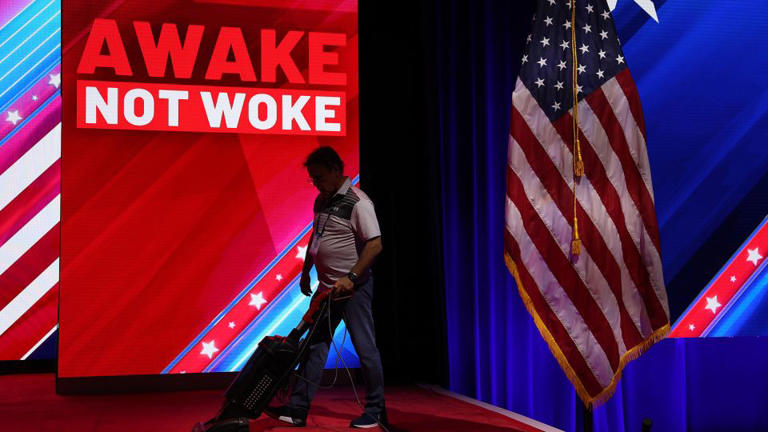

“Woke” is defined as being “actively aware of social injustice.” But Republicans have turned it into a slur. - Joe Raedle/Getty Images© Provided by CNN
WOKE: BLACK CUSTODIAN CLEANING UP AFTER WHITE SUPREMACISTS

Meanwhile, Republicans continue to proudly use words and pet phrases such as “family values,” “conservative” and “patriot” – no matter who or what is associated with the terms.

As candidates prep for the first 2024 GOP presidential debate Wednesday in Milwaukee, it’s a good time to ponder this question: Why are Republicans so good at this form of verbal combat, and Democrats so bad?

Part of the answer comes down to effort and discipline — Republicans devote more time to turning words into weapons and do a better job of sticking to their message, says Lindsey Cormack, a political scientist who focuses on race, gender, communications and politics at Stevens Institute of Technology in New Jersey.

“I’ve been studying their communications for 15 years and it sort of blows me away because I think Democrats are good at doing plenty of things, but they really dropped the ball on the communications piece a lot,” Cormack says.

Cormack says conservatives have built a think-tank ecosystem of linguists and focus groups to test words and phrases for political battle. Democrats do some of the same, but with not the same level of commitment, she says.

“They (conservatives) think about what words resonate, what words cue other sorts of thoughts or what sort of images come to mind with people when they’re hearing messages,” Cormack says. “They seem to have more invested in that, and they have more people who write about that sort of work and linguists who do these sorts of things for them.”

How conservatives flipped the script on race

Verbal jiu-jitsu is not new in American politics. Conservatives have long employed it on racial issues. During the civil rights movement of the ‘50s and ‘60s, conservatives in both the Democratic and Republican parties often used a series of verbal feints that changed the direction of their opponent’s moral arguments.

They didn’t say they opposed integration; they said they were for “state’s rights.”

They didn’t say they didn’t want their children sitting next to Black or brown kids when opposing desegregation of public schools; they said they were against “forced busing.”
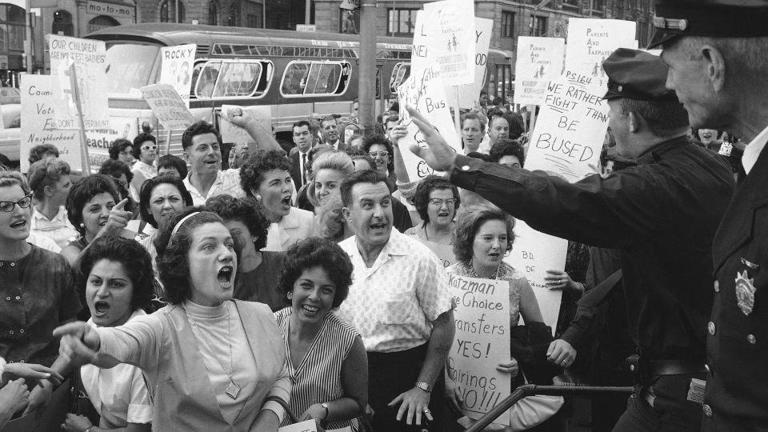

Conservatives didn’t directly say they opposed school integration. They, like these New York City parents pictured here, said they opposed “forced busing.”
- Harry Harris/AP© Provided by CNN

They didn’t say they opposed civil rights leaders’ efforts to make the US a genuine multiracial democracy; they called those leaders “communists” or “socialists.”

They flipped the script by offering new words to replace other terms that were hard to attack head-on.

Sometimes they disarmed a liberal phrase by transforming its meaning.

“Social justice warrior,” for example, didn’t start off as an insult. What’s wrong with someone fighting on behalf of the poor and exploited? Then the term was turned by conservatives and internet culture into something else: a “whiny,” self-righteous progressive who can’t take a joke.

Recent years have brought numerous headlines about another liberal term that has been dismantled by the right.

Critical race theory was once an obscure academic discipline that insisted that racism is more than individual prejudice; it’s embedded in laws, policies and institutions. But conservatives redirected the discussion and turned the term into a catchall phrase that criticizes virtually any examination of systemic racism or history that could make White people uncomfortable.


Parents at a Virginia rally opposing critical race theory. Conservatives have changed this once obscure academic study into a hot-button political slur. - Andrew Caballero-Reynolds/AFP/Getty Images© Provided by CNN

Whatever the method, this form of verbal jiu-jitsu is used for one purpose, says Robin DiAngelo, author of “White Fragility,” a popular book that spawned another popular liberal catchphrase.

“The function is to silence the conversation and to protect the status quo,” DiAngelo says. “It doesn’t have to make sense. It just has to work and get race off the table and prevent any challenges to the status quo.”

How ‘diversity’ and ‘equity’ became dirty words

Next on the hit list are two other terms favored by liberals: “diversity” and “equity,” DiAngelo says.

Those words originally meant values that were virtually universally accepted. Not many people would openly argue for exclusion or inequity.

In recent years many institutions have launched initiatives around Diversity, Equity and Inclusion (DEI) to make their workplaces more fair and diverse.

But Republican leaders are now comparing DEI initiatives to “wokeness” and “loyalty oaths.” They have introduced bills cutting DEI programs in public universities and corporate America.

Paulette Granberry Russell, president of the National Association of Diversity Officers and Higher Education, recently told a reporter she doesn’t use the acronym DEI anymore because it’s been “weaponized.”

Republicans also have sought to reframe “equity,” which means “being fair or impartial,” by calling the word “a “mandate to discriminate.” And they have attempted to delegitimize “diversity” by expanding the term to “diversity industrial complex,” which a critic described as “a bureaucratic juggernaut running roughshod over every aspect of national life.”

“I’m going to tell you as somebody who’s been in this work for decades, there’s no diversity industrial complex,” DiAngelo says. “When an organization has a diversity program, there’s often one person up against the entire institution. And they maybe have a staff of one or two people on a minimal budget. But using language like that implies that it’s some kind of getting over on people, like it’s some kind of trick.”

When ‘global warming’ becomes ‘climate change’

Some of the most skillful practitioners of verbal jiu-jitsu are able to disarm their opponents without them knowing that they’ve given ground. As a result, liberals eventually end up using the terms favored by their conservative opponents.

The phrase “global warming” was popularized by the media and some scientists in the 1980s. It’s been virtually eliminated from public discourse by verbal jiu-jitsu. Some of that change is due to science. Some scientists believe climate change is a more accurate description of the environmental challenges facing the planet.
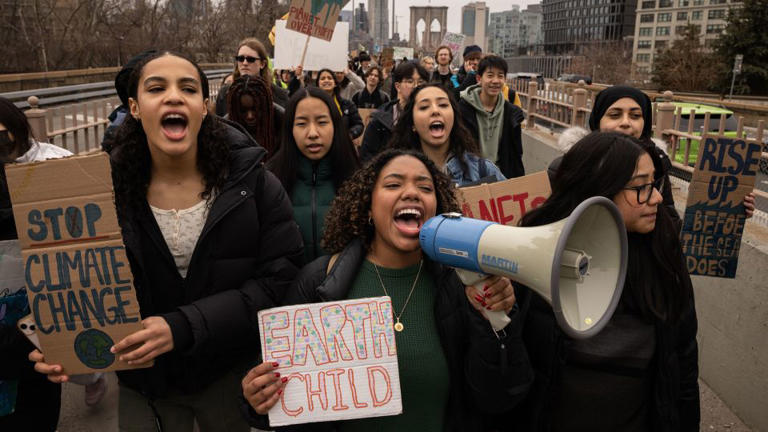


Demonstrators march across the Brooklyn Bridge during a climate change protest in New York on March 3, 2023. - Yuki Iwamura/Bloomberg/Getty Images© Provided by CNN

But it was Republicans who initially pushed for the name change, for reasons that had little to do with scientific accuracy. Instead of acknowledging the science pointing toward a looming environmental disaster, one Republican pollster offered another phrase to mute the alarm: climate change.

That term was popularized in part by Frank Luntz, a Republican pollster who advised GOP politicians in the early 2000s to stop using the term “global warming” because it had “catastrophic connotations” and reframe the issue as the more benign “climate change.” (Luntz has since disavowed his efforts to cast doubt on global warming.)

Two decades later, many liberal politicians and activists continue to use the phrase “climate change, the cognitive scientist George Lakoff noted.

“The word ‘climate’ sounds nice – like palm trees or something – and the word ‘change’, well, ‘change’ just happens,” Lakoff said in an interview. “It’s not a big deal. Nothing you can do about it. Not humanly caused. So, the term itself is a right-wing position that people on the left just innocently adopted instead of saying, well, this is a climate disaster that’s approaching.”

One famous liberal fought back against verbal jiu-jitsu

Lakoff, an authority on political language and author of “Don’t Think of an Elephant: Know Your Values and Frame the Debate,” says Democrats consistently get outplayed by Republicans on the linguistic battleground because they make a false assumption about human nature.

“They assume all you have to do is tell people the facts and they will reason to the right conclusion,” he said in another interview. “This is utterly ridiculous. Thought is mainly metaphorical. The frames trump all the facts.”

Take the word liberal, which is defined as someone who is “open-minded,” “tolerant,” someone who believes in “personal freedom” and that society should change “so that money, property and power are shared more fairly.”

By the 1960s conservatives had successfully twisted liberalism’s connotations to what one commentator described as a “bureaucracy-loving, freedom-depriving, taxation-and-entitlement ideology of largesse.”
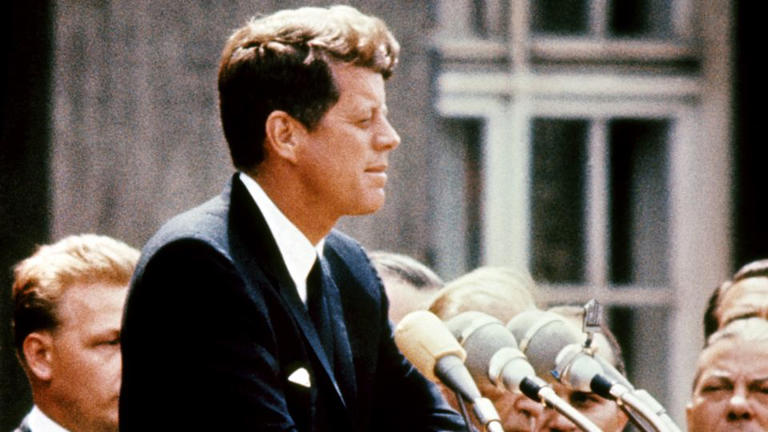


As a presidential candidate, John F. Kennedy beat back an attempt to smear him with the term “liberal” with a clever defense that disarmed his political opponents. - AFP/Getty Images© Provided by CNN

But one famous Democrat knew better. He gave a master class in defeating attempts to tarnish him with the word “liberal.”

John F. Kennedy met that perception head-on when he ran for president in 1960, in a speech at a New York hotel. Instead of dodging the label, Kennedy proudly embraced it.

“If by a ‘liberal’ they mean someone who looks ahead and not behind, someone who welcomes new ideas without rigid reactions,” he said, “someone who cares about the welfare of the people – their health, their housing, their schools, their jobs, their civil rights and their civil liberties… if that is what they mean by a ‘liberal,’ then I’m proud to say I’m a liberal.”

Kennedy may have been a profile in linguistic courage, but many left-leaning people in recent decades still chose to call themselves “progressives” in subsequent decades after conservatives continued tarnishing the term.

The term, though, is making a comeback. Kennedy’s lesson endures.

Verbal jousting could help decide the 2024 race

Debates over the meaning of words and phrases may seem trivial given the high-stake political battles ahead. But the 2024 presidential election and former President Trump’s looming court battles won’t just be fought in the voting booth or in the courts – they’ll also be fought on the verbal battlefield.

If that sounds like hyperbole, consider some momentous recent political battles around the meaning of words and phrases.

Was what happened at the US Capitol on January 6, 2021, an “insurrection”? Or was it what some GOP leaders have called “legitimate political discourse”?

Was former President Trump exercising “free speech” when he questioned the 2020 presidential election results? Or did he attempt to “defraud” the US?

And will words like “diversity” and “inclusion” be turned into another version of “woke” – terms so tarnished by relentless attacks that even their proponents are reluctant to use them?

Some form of verbal jiu-jitsu may determine the answers to those questions. It’s shaped the nation’s history more than many people realize.

John Blake is the author of “More Than I Imagined: What a Black Man Discovered About the White Mother He Never Knew.”

RIP
John Warnock, who helped invent the PDF and co-founded Adobe Systems, dies at age 82
PDF GREATEST INVENTION SINCE THE FAX MACHINE

Mon, August 21, 2023


SALT LAKE CITY (AP) — John Warnock, who helped invent the PDF and co-founded Adobe Systems, has died. He was 82.

The Silicon Valley entrepreneur and computer scientist died Saturday surrounded by family, Adobe said in a statement. The company didn't give a cause of death or say where Warnock died.

“John’s brilliance and innovations left an indelible mark on Adobe, the technology industry and the world,” Adobe said.

Warnock worked for Xerox before he and colleague Charles Geschke created a company around a rejected idea in 1982. Nearly a decade later, Warnock outlined an early version of the Portable Document Format, or PDF, transforming the way documents are exchanged.

Originally from the Salt Lake City suburb of Holladay, Warnock described himself as an average student who later flourished in mathematics.

He earned an undergraduate in math and doctorate in electrical engineering, or computer science, from the University of Utah and maintained close ties with his home state after he retired as CEO of Adobe.

Warnock was the son of a prominent local attorney but was an average student until a teacher at Olympus High School took an interest in him, he told the University of Utah’s alumni magazine, Continuum, in 2013.

“I had an amazing teacher in high school who, essentially, completely turned me around,” Warnock said. “He was really good at getting you to love mathematics, and that’s when I got into it.”

He continued to be a self-described “mediocre” student as he earned his bachelor’s degree in mathematics and philosophy, but he made a mark while working on his master’s degree.

In 1964, he solved the Jacobson radical, an abstract algebra problem that had been a mystery since it was posed eight years before. The following year he met his wife, Marva Mullins, and married her five weeks later.

After a summer spent working at a tire shop, he decided the low-paying field of academia wasn’t for him and applied to work at IBM, starting his training in computer science. He earned a doctorate at the University of Utah, where he joined a group of cutting-edge researchers working on a Department of Defense-funded precursor to the internet in the 1960s. Even then, Warnock was working on rendering images on computers.

In the late 1970s, Warnock moved to Palo Alto, California, to work for Xerox on interactive computer graphics. There, he met Geschke and went to work developing InterPress, a printing and graphics protocol that they were convinced would be the wave of the future. When Xerox balked, they decided to create their own company.

They founded Adobe in 1982 and created PostScript, a program that helped make small-scale printing feasible for the first time. The company later created the PDF, which let people create electronic versions of documents that could be preserved and sent it to other users, who could search and review them.

With that, Adobe took off, and PDF eventually replaced many paper copies in legal, business and personal communication.


Other iconic programs, such as Adobe Illustrator and Photoshop, followed before Warnock stepped down as CEO in 2000. He and Geschke remained as co-chairs of the company’s board of directors until 2017, and Warnock remained a board member until his death.

“John has been widely acknowledged as one of the greatest inventors in our generation with significant impact on how we communicate in words, images and videos,” Adobe chair and CEO Shantanu Narayen said in an email to company employees.

After his retirement, Warnock and his wife devoted more time to hobbies such as collecting rare books, many of which he’s scanned and put online at rarebookroom.org. They also collected Native American art, including moccasins, shirts, and beadwork that has toured the country in exhibitions.

Warnock is survived by his wife and their three children.

Lindsay Whitehurst, The Associated Press
Manager with Colorado cannabis business is tapped to lead New Mexico's team of marijuana regulators

Mon, August 21, 2023 at 5:42 p.m. MDT·1 min read

SANTA FE, N.M. (AP) — A manager with one of Colorado’s largest cannabis companies will serve as the next director of New Mexico’s Cannabis Control Division.

New Mexico announced the hiring of Todd Stevens on Monday, saying he has years of experience working in Colorado’s marijuana industry. He most recently served as the manager of training and development at Native Roots Cannabis Co.

Stevens’ appointment follows a year of turnover at the division and comes as regulators try to ramp up enforcement against non-compliant businesses. Most recently, a state district judge granted the division’s request to halt operations at an Albuquerque business that regulators claimed was unlawfully selling out-of-state cannabis products and manufacturing extracts without a proper license or permit.

Stevens said in a statement that he wanted to help the industry become an economic driver while protecting consumer safety.

“In the past year, New Mexico has established a thriving new industry, licensed more than 2,000 cannabis businesses, and held those businesses to the high standard that comes with an adult-use cannabis market,” he said.

During his time in Colorado, Stevens was part of the design and development of training and recertification for more than 200 retail employees and oversaw operations at five dispensaries.

The Associated Press
I was a USPS letter carrier for 44 years. To protect us from extreme heat, the postal service needs to provide more training and air-conditioned trucks.

Story by khawkinson@insider.com (Katie Hawkinson ) •23h

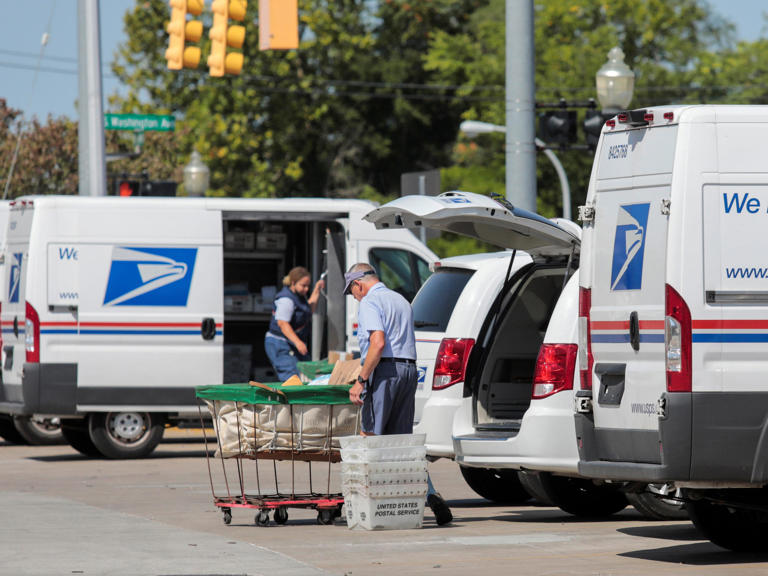
Mike Kurz retired this summer after 44 years as a USPS letter carrier. 
Rebecca Cook/Reuters© Rebecca Cook/Reuters
Mike Kurz worked as a USPS letter carrier for 44 years before retiring this May.
Kurz says he experienced varying degrees of heat-related illness throughout his career.
He hopes the USPS improves conditions by providing training and air-conditioned vehicles.


This as-told-to essay is based on a series of conversations with Mike Kurz, a 65-year-old recently-retired USPS city letter carrier from Elizabeth City, North Carolina about heat-related safety for USPS employees. It's been edited for length and clarity.

When I had to undergo treatment for sepsis in May and take a break from work, I wasn't planning on retiring from my job as a letter carrier for the US Postal Service. In fact, I planned on staying on for another two or three years.

But I'm glad I did because ever since the beginning of July, temperatures have been in the upper nineties. And in the past couple of years, there's been a handful of letter carriers who have died from heat-related illness.

I worked as a letter carrier for 44 years. Throughout my career, I experienced varying degrees of heat-related illness more times than I can count. I can't stress enough how bad it gets in the heat.
I learned the signs of heat-related illness, and it saved me

Throughout my career, I suffered heat-related illness often, with at least one incident every few years.

My most recent incident of heat-related illness happened over two summers ago, at the height of the COVID-19 pandemic. I was delivering mail and had to pull over to go into an air-conditioned church because I was dizzy and nauseous, which are two symptoms associated with heat illness. Plus, it was a day with high heat and humidity — and I had no air conditioning in my truck.

I always worried during the pandemic. People were secluded in their houses so if I fainted in my truck or while I was walking outside because of the heat, nobody would be out there to actually see it happen.

Thankfully, that never happened, and I didn't have to go to the hospital that day because I was able to tell the signs before they escalated. I took off the rest of the day and went home.

But some letter carriers don't have the same experience I do to recognize the signs.


Kurz says the USPS should implement further training to keep letter carriers safe in the heat. 
Andrew Kelly/Reuters© Andrew Kelly/Reuters


The USPS must improve their heat safety training and give us air-conditioned trucks

While the USPS has the Heat Illness Prevention Program, we need further education. In order to protect letter carriers from heat-related illness and death, the postal service should improve the quality of their heat-safety training and invite experienced letter carriers like me to lead them.

As the president of my local union branch, I've given several talks on heat safety to employees. Having someone like me come in and talk to them — who has on-the-ground experience — rather than reading from a script that comes from national headquarters, would help improve education. Someone like me could elaborate a lot more thanks to on-the-ground experience.

Some national employees were former letter carriers, but people like the current postmaster general, Louis DeJoy, were not. We get blurbs from the national office, but they're not long enough. And since we've had DeJoy as the postmaster, they haven't explained a lot.

We also need air-conditioned trucks. Many of our trucks have been in use since 1989 and do not come with air conditioning. I've been saying for 25 years we need air conditioning.

The USPS has gotten wise to it and is now building new ones with air conditioning. Several of them are supposed to be electric vehicles or hybrids, too. This will help because letter carriers won't be dealing with heat from the engine either.
Letter carriers have to remember their health is more important than the mail

I also tell my fellow letter carriers to use wet towels on their heads and neck to keep cool. I recommend materials like terry, which works best for cooling. I also often brought several bottles of water with me on shift.

In the last 15 years, I've had two employees at my union branch go to the hospital for heat-related illness because they worried more about delivering mail.

If it's between your health and the mail, you should always prioritize your health.
Zoom's scrapped proposal to mine user data causes concern about our virtual and private Indigenous Knowledge

Story by Andrew Wiebe, PhD Student, Information, University of Toronto 

Platforms like Zoom have been helpful in bridging geographical distances. However, a recent proposal to mine data raises questions about ownership of Indigenous Knowledge.
© (Chris Montgomery/Unsplash)

As reported on Aug. 6, Zoom recently attempted to rewrite its Terms of Service with ambiguous language that would permit the extraction of user data for the purpose of training AI.

However, after public pushback, Zoom began to rectify that clause the very next day, fully committing to a “no AI training” set of policies by Aug. 11.

Even though Zoom pedalled back this time, their drive to gather data highlights the possibility of future hidden data extraction by them and other big tech companies.

More specifically, as a researcher working with and looking at Indigenous communities and their data, I am concerned about the privacy of these valuable data sets from Indigenous communities on Turtle Island.

Vulnerable Indigenous Knowledge

Over the past three years, Zoom calls have become a tool for organization and activism for many Indigenous communities.

For my own work, I use video and voice chat which lets us balance geographical differences to collaborate and share, as well as access communities that are hard to reach. Discussing issues with queer community members of different Indigenous Nations is often private and perhaps even sacred.

These conversations have elements that are public facing, but they also contain wisdom from Elders or Knowledge Keepers specifically trained to know what they can and cannot share in specific spaces. Some of this knowledge is sacred and is part of promoting and preserving Indigenous (and sometimes queer) ways of being.

A valuable commodity

This private information is constantly at risk of extraction from companies seeking to monetize or otherwise gain from our data.

Indigenous Knowledge represents a large gap in current big data. AI only works with large data sets which enables predictive technology to operate.

With knowledges that are primarily oral, it is difficult to gather proper data sets that often come from writing. The possibility for big companies to gather audio and visual data, could render this oral information visible by machines.
Protecting communities

“Refusing research” has been an important concept for protecting marginalized communities from the extractive practices of researchers aiming to obtain data.


Related video: M&A is a strong possibility for Zoom, it needs to acquire new technologies, says CFRA's Keith Snyder (CNBC)
Duration 4:45 View on Watch


However, if platforms are extracting data without our knowledge, or demand our consent in order to use a service, a conflict emerges.

The conflict becomes one of free choice versus free-to-leave: If we do not consent to use the infrastructure, we simply do not get access to that service. Access to voice and video sharing infrastructure has been a fundamental component of activism and community research, especially post COVID-19.

Can we ‘opt-out?’

Can we accept or refuse to be turned into research data?

Even though there is a permissions element, organizations are often gathering our data in exchange for using their services. For example, Fitbit gathers massive amounts of health data from users (with permission) that can be used to train AI.

Each individual who is opting for nearly any big service is being tracked to some capacity. And so, there needs to be a critical element of what is considered private.

Likewise, Zoom has the ability to gather this data, whether or not they use it for AI with consent. There is an anxiety that next time, the ambiguity will go unnoticed or perhaps force consent to access a seemingly necessary service.

As someone who looks at ethical data collection and mobilization, I believe we all need to be critical of those requests to have access to our private data when using these services.


In the future, will we find ourselves agreeing to give up our data just to use video platform software like Zoom?© (Unsplash)

Crucial access to data

The relationship between data and Indigenous communities and the Canadian government has always been fraught. However, after the work of the Truth and Reconciliation Commission in Canada (which concluded in 2015), it became even more clear that access to data and information is crucial to achieving justice and truth in relation to our histories.

For Indigenous peoples whose history has been systematically erased, demanding that organizations return records and data has become an important element of achieving the truth behind the experiences of Indian Residential School survivors. Communities have both the desire and need to have their data returned so that they can maintain ownership, control, access and manage permissions to access information.

Ease of Zoom for communication

In-person collaboration between Indigenous communities can be difficult because of things like geographical differences, the lack of public transportation, and interruptions in Indigenous sovereignty. These issues continue the social and political fragmentation caused by settler colonialism to isolate these communities from one another.

Many of these challenges have been alleviated by information technologies like Zoom. And a platform like Zoom has been potentially unifying by bridging space. However, it could also become a tool to recreate the problem of data extraction in a new way.

We need to be attentive to these kinds of data gathering possibilities that offer to extract data from users.

These technological infrastructures may disproportionately harm Indigenous communities by making their private and sacred knowledges legible by AI. Data collection for AI could lead to the commodification of this sacred knowledge for profit.

Protecting this kind of data is not just the responsibility of Indigenous communities but a shared commitment that has a present and future urgency.

This article is republished from The Conversation, a nonprofit news site dedicated to sharing ideas from academic experts.


Read more:
Zoom-bombings disrupt online events with racist and misogynist attacks
'Passages' filmmaker Ira Sachs battles shameful censorship for beautifully passionate movie

"Basically what the MPA is doing is saying, 'if you create images like these, you will be punished,'" the filmmaker said about the movie's NC-17 rating


Elisabetta Bianchini
August 11, 2023

Veteran filmmaker Ira Sachs' movie Passages, starring Ben Whishaw, Franz Rogowski and Adèle Exarchopoulos, beautifully depicts the complexities of power and desire in relationships, but was unfortunately hit by shameful censorship.

In Passages we're first introduced to Tomas (Rogowski) a self-involved filmmaker in Paris who's married to Martin (Whishaw). Following his personal feelings and attraction, and not particularly thinking about his husband at all, Tomas has an affair with a young woman, Agathe (Exarchopoulos), unravelling his marriage.

"It was the dark days of the pandemic and I wanted intimacy," Sachs told Yahoo Canada. "When I imagined the movie that I might one day get to make, it was a film of actors and bodies and sex, and something that cinema uniquely can offer to the viewer, which is a kind of closeness that turns into pleasure."

"I also wanted to make a film that was driven by desire, and the gap between what the characters have and what they want. So a love triangle was kind of the answer for us."


L to R: Franz Rogowski (Tomas) and Ben Whishaw (Martin) in Passages (Courtesy of MUBI)

'I had great examples of men in movies behaving badly'


Tomas is a particularly interesting character. He easily has narcissistic tendencies, but as the film progresses, we see that he does have empathy for others, at least in some capacity. Sachs expertly puts his own stamp on a lead character that engages in behaviour that's not particularly admirable.

"I had great examples of men in movies behaving badly, specifically James Cagney was an inspiration," Sachs said. "I watched a lot of film noir during the making of this movie and beforehand, every film is about a guy doing the wrong thing."

"That lineage going through Marlon Brando on to Travis Bickle [from the movie Taxi Driver], these are all interesting cinematic characters. So I found it very natural. I also knew that Franz is creating a performance, which is different than just watching someone like Donald Trump, for example. Someone playing Donald Trump is different than being Donald Trump, and I think the play is really part of the pleasure of the performance."

In looking at this love triangle, Sachs isn't particularly quick to bring the audience into the room, so to speak. That very much evolves as the story progresses. As the filmmaker explains, it's a movie that is "a series of middles."

"I'm comfortable with the audience being disoriented in the beginning, because I believe that with time, they will become central, they will become inside the film," Sachs said. "What's important is that every scene have authenticity and that it be constructed with narrative direction."

"I'm telling the story, but I want the audience to feel like there is an atmosphere of freedom. So that becomes a balance and editing becomes very important. Working with Sophie Reine, the French editor on the film, you want the audience to not know where they're going, but feel comfortable that someone is taking them there."


L to R: Franz Rogowski (Tomas) and Adèle Exarchopoulos (Agathe) in PASSAGES (Courtesy of MUBI)
'We're going into some time of repression and denial'

A movie with a similar storyline, created by someone with less commitment to authenticity, would be quick to label what the love triangle is. But Sachs avoids that construct entirely. This relationship isn't confined to a specific definition, it's just the result of passion and feeling. But that's something the filmmaker said he took from his actors.

"The actors taught me where to go, really," Sachs said. "They are from a generation following my own and I think they exist in a moment in which the labels don't seem to work, the way that they were needed to when I was their age."

"It'd be very interesting to make this film again with three 70 year-olds. It would be a very different story, because identity means something different for queer people, and also for non-queer people, then it [did] 30 years ago. That is one form of progress. I think in terms of imagery, I'm not sure we're making progress, I think we're going into some time of repression and denial, that I want to be a part of challenging."


This image released by Mubi shows Ben Whishaw, left, and Franz Rogowski in a scene from "Passages." (Mubi via AP)

'If you create images like these, you will be punished'


In advance of the film's wider release to the public, Passages received an NC-17 rating from the Motion Pictures Association (MPA). Mubi, the film's distributor, has decided to release the film unrated.

In a widely shared interview with the Los Angeles Times, Sachs called the decision "cultural censorship."

"It’s really about a form of cultural censorship that is quite dangerous, particularly in a culture which is already battling, in such extreme ways, the possibility of LGBT imagery to exist," he told The Times back in July.

What's clear is that the rating is linked to a particular sex scene between Whishaw and Rogowski, while the MPA, in a statement to The Times, said "sexual orientation of a character or characters is not considered as part of the rating process."

Sachs stressed that he's not necessarily particularly worried about this censorship for his own filmmaking, but he's more worried about the precedent this sets for other filmmakers.

"I'm not worried about myself because I got to make the film that I wanted to make, and I feel very supported both by my producer Saïd Ben Saïd and by my distributor Mubi," Sachs said. "I'm more worried about the warning shot that this kind of censorship makes towards other filmmakers who want to create free images."

"Basically what the MPA is doing is saying, 'if you create images like these, you will be punished.' Foucault would consider this a nightmare of control. That's what it is."

The filmmaker added that the significant question is not necessarily the rating for this movie, but why does the MPA still exists at all.

"This should actually be a moment you go, 'Wait a minute. Why do we follow a nameless group of parents,'" Sachs said. "That's also such a creepy naming of a group, 'nameless parents.'"

"In America, when you start hearing about nameless parents, you think about libraries in Texas. So why is this progressive industry, a modern industry, an industry that supports individuality, supposedly, following a nameless board of parents telling them what should and should not be seen?"

Foucault would consider this a nightmare of control. That's what it is.

Sachs went on to stress that it's not just the MPA, but other key stakeholders, people and organizations with power, that are participating in this censorship.

"It's the festivals run by men who want to hold on to power. It's the distribution companies run by men who want to hold on to power. It's the government's run by men who want to hold on to power," Sachs stressed. "There's a lot of systems that you have to try to resist to make original, personal work."

"And I'm a man of great privilege. So consider all the people with less privilege, and where are those voices."

Passages opens Aug. 11 in select Toronto and Vancouver theatres, Aug. 18 in Montreal, Quebec City and Ottawa, and throughout the summer in other Canadian cities

ONTARIO
Facing a rising tide of hatred, North Bay Pride picks protest over parade

Story by Aya Dufour •2w

North Bay community members will see a protest instead of a parade during this year's Pride celebrations in the northern Ontario city.

Jason Maclennan, North Bay Pride's director of communications, said the switch is necessary to reflect the need for change.

"A Pride parade is people celebrating who they are," he said. "A march is people demanding change, and that's what we need to have right now."

Instead of having a festive tone, the Sept. 16 event will focus on demanding more equity and inclusion.

Maclennan said community members have been facing increased hate, including online comments, death threats, and the normalization of anti-trans and anti-LGBTQ discourse in public life.

"People need to stop sharing hate and misinformation about the community."

He said hate groups tend to comprise only a few people, but they are organized.

"They will use buzzwords like grooming, and instead of actually researching and looking into it, [people] fall for that narrative.

"It's an emotional response," he said. "Then they share it, and it becomes bigger, and bigger and bigger."

He added this kind of discourse is detrimental to the 2SLGBTQ+ community in North Bay.

"It's forcing people back in the closet, denying who they are," he said.

"It contributes to suicide rates in youth and people not understanding their children when they come out."

Maclennan said the group has struggled to meet with local elected officials to express their concerns.

Related video: Thousands take in Vancouver Pride Parade (Global News)
Duration 1:48 View on Watch


"It's so important that political leaders step up against hate and if they aren't doing that, they shouldn't be in politics," he said.

The riding's member of Parliament, Anthony Rota, was not available to comment on this before publication of this story, and MPP Vic Fideli did not respond to CBC's request for comment.

Anti-LGBTQ+ hate crimes rising elsewhere

Laur O'Gorman, chair of Fierté Sudbury Pride, said the organization also wanted to plan a march instead of a parade during their events in July.

"Especially this year, with all the pushback, we felt like we really had to do a march, something that is stronger and more political," they said.

However, disagreement with the city over the police's role in the event led Fierté Sudbury Pride to drop the march altogether from this year's program.

At the time, the Greater Sudbury Police Service (GSPS) said in an email to CBC News that it respected Sudbury Pride's decision to cancel the parade and would "continue to work towards repairing and creating relationships built on mutual respect and understanding."

Still, O'Gorman believes actions are needed to slow down the pace of anti-LGBTQ+ hate.

"I frequently find things about myself coming up online," they said. "There are posts saying that I'm friends with pedophiles and that we have pedophiles on the Pride board. Not true at all."


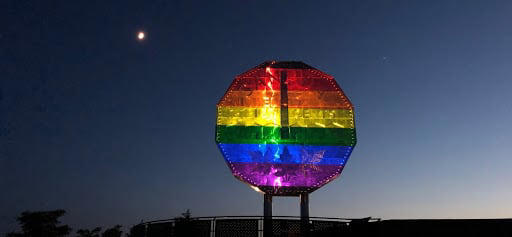
Fierté Sudbury Pride has lit up the Big Nickel with the Pride colours in past Pride events.
 (Submitted by Alex Tétreault)© Provided by cbc.ca


O'Gorman said they have also received threats, including one captured on video.

"That person said: 'I know where you live, I know when you're home, I know when you're away, and I'm going to do something Sudbury will be remembered for.'"

Another incident included being followed in the street and having insults hurled at them.

O'Gorman said they brought evidence of these threats to the police, but added no action was taken as authorities do not consider these to be "direct threats."

Contacted by CBC News to respond to O'Gorman's comment, Sudbury police said in an email Tuesday: "We would be happy to review the matter once provided the specifics regarding the incident."

O'Gorman believes North Bay Pride is doing the right thing in holding a protest.

"We would have loved to march, because it's badly needed. For us, though, we needed to do it without the police leading the way."


A store owner was killed over a Pride flag she flew in front of her California business

CEDAR GLEN, Calif. (AP) — A dispute over an LGBTQ+ pride flag at a California clothing store spiraled into deadly violence this weekend when a man shot and killed the 66-year-old business owner right in front of her shop, authorities said.

The man ran away from the store after the shooting Friday night but was later found and killed in a confrontation with officers from the San Bernardino County Sheriff’s Department.

The agency said Laura Ann Carleton was pronounced dead at Mag.Pi, the store she owned and operated in Cedar Glen. The small community in the San Bernadino Mountains is roughly 60 miles (96 kilometers) east of downtown Los Angeles.

Before the shooting, the man “made several disparaging remarks about a rainbow flag that stood outside the store,” sheriff's officials said.

It was not immediately clear what happened when officers confronted the man, whose identity hadn't been released as of Sunday.

Carleton, who preferred to be called “Lauri,” is survived by her husband and nine children in a blended family.

An LGBTQ group in nearby Lake Arrowhead said Carleton didn’t identify as a member of the LGBTQ+ community. But she spent time helping and advocating for everyone, and was defending her Pride flags placed in front of her shop on the night of the shooting, the group said.

There was an outpouring of support on social media over the weekend, with commenters expressing shock and sadness on the store's accounts. Many included rainbow flag emojis.

Law enforcement agencies in several states have investigated the destruction of rainbow Pride flags as potential hate crimes in recent years.

The Associated Press

Four dead after scissor lift topples at house under construction
NOT SCISSORLIFT OPERATROR CERTIFIED

The Canadian Press
Sun, August 20, 2023


MONTREAL — Four family members are dead after a construction project turned tragic over the weekend in Quebec's Bas-St-Laurent region, provincial police say.

Investigators said two men and two women were working on a new house atop a scissor lift on Saturday in St-Léandre, a rural municipality of fewer than 400 people, when the device toppled for an unknown reason.

"The occupants fell several meters. On the spot, we found the death of one of them," said provincial police spokesman Stéphane Tremblay, referring to a 27-year-old man.

He said three others were badly injured and were taken to hospital but died during the night.


Tremblay confirmed Sunday that the four people were part of the same family.

The victims include a 27-year-old man and a 24-year-old woman from St-Léandre and a 53-year-old woman and 60-year-old man from Rivière-du-Loup.

Officials said a coroner's inquest is underway, while an investigation by Quebec's workplace health and safety board aims to determine whether an equipment breakdown occurred.

TOO MANY ON THE SCISSOR LIFT

This report by The Canadian Press was first published Aug. 20, 2023.


Canada considering foreign student visa cap to address housing shortage

Reuters
Mon, August 21, 2023 

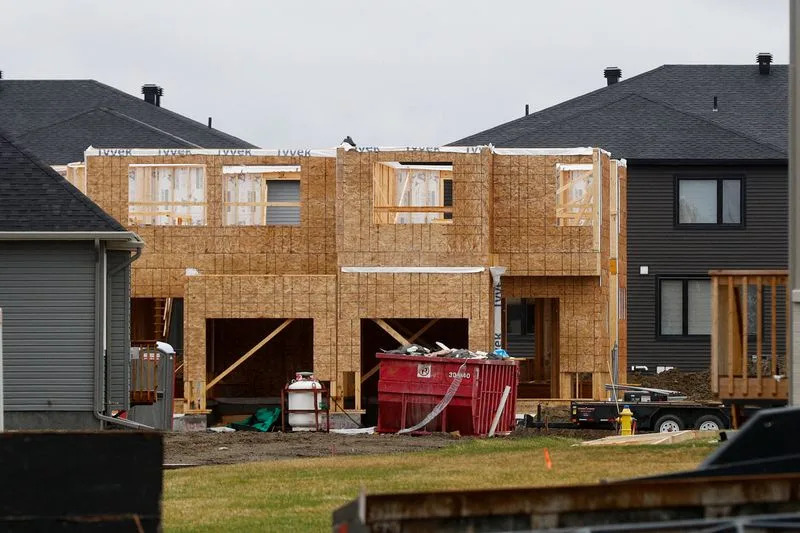
FILE PHOTO: Houses are seen for sale and under construction in a neighbourhood of Ottawa


OTTAWA (Reuters) - The Canadian government, under pressure over the rising cost of housing, could consider capping foreign student visas, which have rocketed in recent years, new Housing Minister Sean Fraser said on Monday.

Official data show there were more than 800,000 foreign students with active visas in 2022, up from 275,000 in 2012. Canada is a popular destination for international students since it is relatively easy to obtain a work permit.

Fraser, who was immigration minister before taking up his job last month, said the sharp rise in the number of students was putting pronounced pressure on some housing markets.

Asked whether a cap could be imposed on the number of foreign students, he said, "I think that is one of the options that we ought to consider." The government has not yet made a decision, he added.

"We've got temporary immigration programs that were never designed to see such explosive growth in such a short period of time," Fraser told reporters on the sidelines of a cabinet retreat in the Atlantic province of Prince Edward Island.

The official opposition Conservative Party, ahead in the polls of a federal election which must be held by October 2025, say the Liberal government of Prime Minister Justin Trudeau is not doing enough to tackle the housing issue.

Canada, which has a population of around 39.5 million people, plans to take in a record 500,000 new permanent residents in 2025. Fraser said limiting the number of newcomers was not the answer.

(Reporting by David Ljunggren; Editing by Josie Kao)
Post comparing 2003, 2023 Kelowna wildfires misses the mark: 'Photos are not enough'

Dr. Sylvain Charlebois, also known as 'The Food Professor,' tweeted two pictures comparing wildfires in Kelowna in 2003 and 2023

On Aug. 20, Dr. Sylvain Charlebois, the director of the Agri-Food Analytics Lab at Dalhousie University, posted two pictures of the Kelowna fires that took place in B.C. 20 years apart, suggesting the two fires don’t look all that different.

This comes after the wildfire season has gotten significantly worse for Canada in 2023, becoming the worst on record according to government figured reported by BBC News.

A July 2023 article titled Why Canada's Wildfires Are So Bad This Year" by the College of Natural Resources in North Carolina found: “The release of carbon dioxide and other greenhouse gases continues to drive changes in the climate, contributing to warmer-than-average surface temperatures and shifting precipitation patterns — trends that are expected to increase the frequency, intensity and duration of wildfires.”

Since its posting, Charlebois’ tweet has gotten major attention on the platform. While some people were quick to jump on the train and support his theory, others were upset at the apparent denial of climate change. Some suggested that there is more to climate change than photo comparisons.

In an interview with Yahoo Canada, Ryan Ness, the Director of Adaptation at the Canadian Climate Institute, said that we may see the kind of wildfires that affect Kelowna much more often than every 20 years in the future.

"We have to recognize that what we're seeing is the beginning of our new climate reality. Wildfires are going to be more frequent and more severe than they ever have been before on average," Ness said.

While Canada has always had extreme weather and climate-related disasters, Ness added that the current state of the fires is not something to be brushed off.

"It's always possible to point to some historic example of a flood or a wildfire and say, 'Oh well, it's always been this way,'" Ness said.

"While it is true that we've always had floods and we've always had wildfires, the difference now is how often they're occurring, how big they are when they do occur, and how much they're happening just about everywhere."

On X, the platform formerly known as Twitter, more users quote-posted Charlebois' post, lambasting the notion that the wildfires are alike.

How do the wildfires in 2003 compare to 2023?

The McDougall Creek wildfire burns on the mountainside above houses in West Kelowna, B.C., on Friday, August 18, 2023. THE CANADIAN PRESS/Darryl Dyck

The Okanagan Mountain Park Fire in 2003 was unquestionably tragic. The fire consumed 250 square kilometres, an area that is nearly twice the size of the city of Vancouver. More than 33,00 people were forced to leave their homes and it caused approximately $200 million in damages.

While the fire died on its own weeks later in mid-September, it was the biggest interface fire B.C. has had until this year.

The current McDougall Creek wildfire featured in Charlebois' post has now caused 30,000 people to be under evacuation orders while another 36,000 were under alert to be ready to flee, according to the Guardian.

As of Sunday afternoon, 410 square kilometres were covered in the area by the blaze. Currently, 3,400 workers are involved in firefighting in B.C. with West Kelowna fire chief Jason Brolund, announcing that 500 firefighters are specifically engaged in managing the McDougall Creek wildfire.

With more than 13 million hectares already burned, Canada is in the midst of its worst wildfire season on record, with weeks more to go — though some suggest some of the fires can burn well into winter, offering no usual reprieve from the changing seasons.

This is about double the size of the previous record of 7.3 million hectares in 1989 and is roughly the size of Greece.

Since posting his initial tweet, Charlebois has updated it to include a call for people to set politics aside and concentrate on helping those who have been impacted by these terrible incidents.