It’s possible that I shall make an ass of myself. But in that case one can always get out of it with a little dialectic. I have, of course, so worded my proposition as to be right either way (K.Marx, Letter to F.Engels on the Indian Mutiny)
Tuesday, August 22, 2023
Milder weather brings relief from 'apocalyptic' Canada wildfires
by Paula RAMON, with Michel COMTE in Ottawa
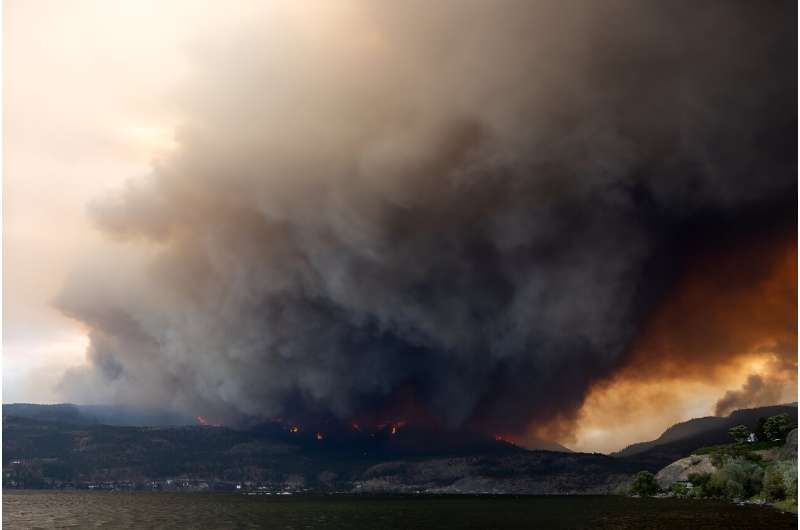
The McDougall Creek wildfire burns in the hills of West Kelowna. Evacuation orders were put in place in the area of Kelowna, with a population of 150,000, as the fire threatened the city.
Cooling weather on Monday gave firefighters a slight edge against what the prime minister described as "apocalyptic" wildfires blazing across western Canada, after tens of thousands were evacuated or put on alert.
Two fires threatening large parts of the scenic Okanagan Valley, including the cities of Kelowna and neighboring West Kelowna in British Columbia, merged over the weekend.
Around 30,000 people in the province where 385 fires are now burning—out of almost 1,040 nationwide—had been under evacuation orders while another 36,000 were under alert to be ready to flee.
British Columbia's emergency management minister, Bowinn Ma, warned that the situation was "highly dynamic."
West Kelowna Fire Chief Jason Brolund, however, sounded a note of optimism, telling a news conference late Sunday: "We're finally feeling like we're moving forward, rather than we're moving backwards."
Temperatures in the major wine-producing region around Kelowna were expected to stay cool through Monday, creeping into the low 20 degrees Celsius (68 Fahrenheit) in the afternoon.
There was also some rain forecast starting Tuesday.
Officials said it was too soon to start planning a staged return of evacuees as thick smoke continued to choke the area.
Prime Minister Justin Trudeau at a cabinet retreat in Charlottetown, Prince Edward Island, to discuss the national fire crisis said Canadians "are watching in horror the images of apocalyptic devastation."
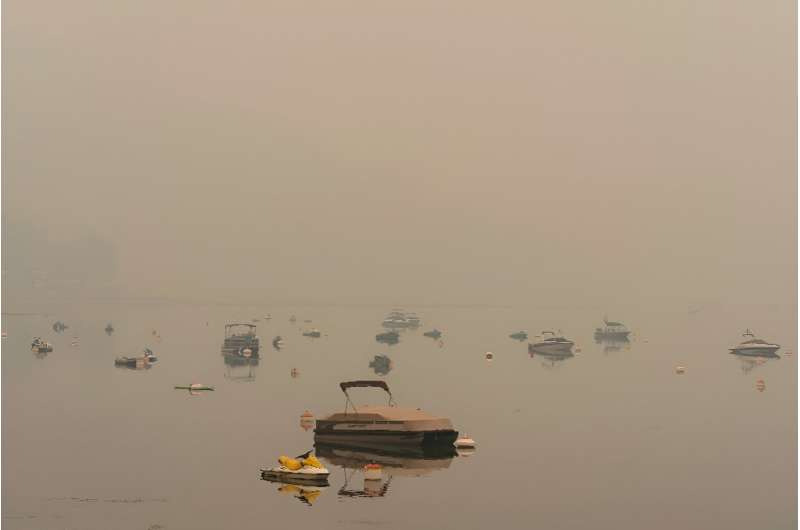
Boats sit amongst smoke from the nearby Bush Creek East Wildfire on Shuswap Lake in Gleneden, British Columbia. Two fast-moving "extreme" wildfires merged overnight in western Canada, threatening hundreds more homes and forcing continued evacuations in a wide swath of British Columbia province.
"It's a scary and heartbreaking time," he said as "people flee for their lives and worry about their communities."
This summer in Canada, more than 14 million hectares (34.6 million acres) has already burned—roughly the size of Greece and almost twice the area of the last record of 7.3 million hectares. Four people have died so far.
Scientists say human-caused global warming is exacerbating natural hazards, making them both more frequent and more deadly.
'Horrible to breathe'
Kelowna, a city of 150,000, has become the latest population center hit.
"It has been horrible to spend the week with this air. It is horrible to breathe," Mary Hicks, a 29-year-old IT worker who had been visiting the region from Montreal, told AFP on Sunday. "I really want to go home."
But she was stuck for now, with her return flight canceled. The airport hopes to resume flights this week, depending on visibility.
"When I had to pack, in the moment I was crying, crying, crying," said April, 39, who with her two small children fled her home east of Kelowna and was staying in a hotel outside the city.
On the other side of Okanagan Lake, a number of homes on the outskirts of West Kelowna had been burned.
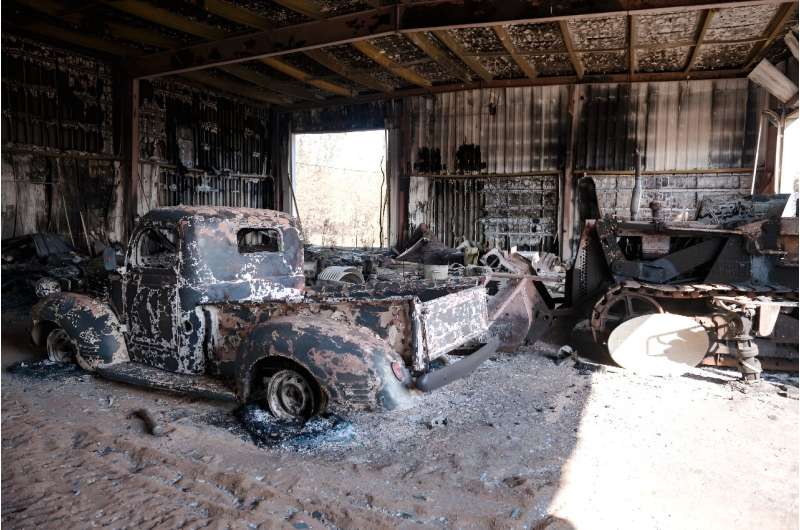
Charred remains are seen on the side of the road on the highway in Enterprise. The tiny hamlet, a key junction on the road south from Yellowknife in the Northwest Territories, has been almost completely destroyed by fires.
"My sister's boyfriend's house has burnt down. He lives in the West Kelowna side and it was so windy that the fire was spreading and they couldn't control it," said Bogi Bagosi, a 16-year-old student.
"It's kind of heartbreaking to watch the city burn down. They are doing their best to stop it but it is not enough."
The confusion and terror of the fires and evacuations have been compounded by Meta's blocking of Canadian news on Facebook and Instagram, in response to a new law requiring digital giants to pay publishers for articles.
"It is inconceivable that a company like Facebook is choosing to put corporate profits ahead of (safety)... and keeping Canadians informed about things like wildfires," Trudeau said Monday.
Cooler with rain 'a bit of help'
In Canada's far north, crews held back a massive fire threatening Yellowknife, the capital of the Northwest Territories. They were helped by some rain over the weekend.
Yellowknife—now a ghost town, except for emergency personnel who stayed behind to build fire barriers and lay out sprinklers—and many small communities in the near-Arctic region have been evacuated, leaving two thirds of the population of the Northwest Territories displaced.
"With a little bit of help from the weather over the past few days and a lot of good firefighting work we've been able to keep this thing at bay for the time being," local fire information officer Mike Westwick told a briefing.
In May 2016, all 90,000 residents of Fort McMurray, Alta., were evacuated shortly before wildfires engulfed 2,400 homes and businesses with a total cost of more than $4 billion.
Let's not forget the June 2021 heat dome resulting in temperature records being broken across British Columbia three days in a row. The heat wave culminated in Lytton, a village in the southern part of the province, recording 49.6°C on June 29, the hottest temperature ever observed anywhere in Canada and breaking the previous record by five degrees. The next day, wildfires engulfed Lytton, destroying more than 90% of the town.
"The area burned by forest fires in Canada has increased over the past four decades, at the same time as summer season temperatures have warmed. Here we use output from a coupled climate model to demonstrate that human emissions of greenhouse gases and sulfate aerosol have made a detectable contribution to this warming. We further show that human-induced climate change has had a detectable influence on the area burned by forest fire in Canada over recent decades."
It appears little has been done to prepare rural Canada for what's in store as governments deal with immediate, rather than transformational approaches to wildfire management.
This, despite the existence of the national FireSmart program designed to assist homeowners, neighborhoods and communities decrease their vulnerability to wildfires and increase their resilience to their negative impacts.
Pressure is certainly mounting on decision-makers to become more proactive in both mitigating and preparing for the impacts of climate change.
An Aug. 14 pivotal ruling from the Montana First Judicial District Court sided with a group of youth who claimed that the State of Montana violated their right to a healthy environment.
A similar case brought by seven youth against the Ontario government after the province reduced its greenhouse gas reduction targets has also been heralded as groundbreaking.
As the number of such court cases grow, governments and corporations will need to do more to both protect their citizens from the impacts of climate change, and to aggressively decarbonize energy systems.
While attention is currently turned to the evacuation of Yellowknife, it's sobering to remind ourselves that they are not alone. The village of Lytton, burnt to the ground just two years ago, has been put on evacuation alert as wildfires approach.
Kelowna has just declared a state of emergency as the McDougall Creek fire starts consuming homes in the region. And this, coming on the heels of the 20th anniversary of the Okanagan Mountain Park fire, when more than 27,000 people had to be evacuated and 239 Kelowna homes were lost.
Canadians will take solace as summer turns into winter and the immediacy of our 2023 wildfire situation wanes. Unfortunately, it will be Australia's turn next to experience the burning wrath of nature in response to human-caused global warming and the 2023 El Niño.
Rather than waiting to respond reactively to the next fire season, proactive preparation is the appropriate way forward. For as the old adage states: an ounce of prevention is worth a pound of cure.
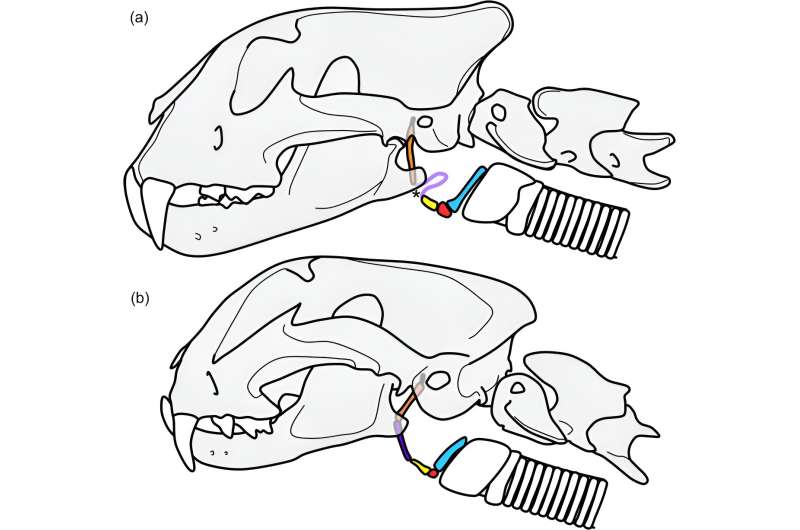
Schematic of felid hyoid anatomy in situ in (a) Panthera tigris and (b) Caracal caracal. Stylohyoid is orange, epihyoid (* = ligamentous in Panthera) is purple, ceratohyoid is yellow, basihyoid is red, and thyrohyoid is cyan. Credit: Journal of Morphology (2023). DOI:10.1002/jmor.21627
When a sabertooth tiger called out, what noise did it make—a mighty roar or a throaty purr? A new study from North Carolina State University researchers has examined the data behind the arguments for each vocalization and found that the answer was more nuanced than they thought—and that it could depend on the shape of a few small bones. The work appears in the Journal of Morphology.
Modern cats belong to one of two groups: either the pantherine "big cats," including the roaring lions, tigers and jaguars; or Felinae "little cats," which include purring cats like lynxes, cougars, ocelots and domestic cats.
"Evolutionarily speaking, sabertooths split off the cat family tree before these other modern groups did," says Adam Hartstone-Rose, professor of biological sciences at NC State and corresponding author of the research. "This means that lions are more closely related to housecats than either are to sabertooths.
"That's important because the debate over the kind of vocalization a sabertooth tiger would have made relies upon analyzing the anatomy of a handful of tiny bones located in the throat," Hartstone-Rose continues. "And the size, shape and number of those bones differ between modern roaring and purring cats."
Although vocalization is driven by the larynx and soft tissue in the throat, not bones, anatomists noticed that the bones responsible for anchoring those tissues in place—the hyoid bones—differed in size and number between roaring and purring cats.
"While humans have only one hyoid bone, purring cats have nine bones linked together in a chain and roaring cats have seven," says Ashley Deutsch, a Ph.D. student at NC State and lead author of the research. "The missing bones are located toward the top of the hyoid structure near where it connects to the skull."
"Because sabertooth tigers only have seven bones in their hyoid structure, the argument has been that of course they roared," Hartstone-Rose says. "But when we looked at the anatomy of modern cats, we realized that there isn't really hard evidence to support this idea, since the bones themselves aren't responsible for the vocalization. That relationship between the number of bones and the sound produced hasn't ever really been proven."
Credit: North Carolina State University
The researchers looked at the hyoid structures of four species of roaring cats: lions, tigers, leopards and jaguars; and five species of purring cats: cougars, cheetahs, caracals, servals and ocelots. They compared these to 105 hyoid bones from the iconic sabertooth tiger Smilodon fatalis.
"You can argue that since the sabertooths only have seven bones, they roared, but that's not the whole story," Hartstone-Rose says. "The anatomy is weird. They're missing extra bones that purring cats have, but the shape and size of the hyoid bones are distinct. Some of them are shaped more like those of purring cats, but much bigger."
According to the researchers, if the missing bones (called epihyoid bones) were key to different vocalizations, the bones most closely connected to them should look different between the two groups. However, those bones looked very similar in shape whether they came from purring or roaring cats.
In fact, the researchers saw more shape variation in the bones closer to the vocal apparatus; i.e., the thyrohyoid and basihyoid bones. The uniformity of the upper bones between the two groups suggests that if the hyoid structure plays a role in vocalization, the lower bones are more important than the upper ones. So having these key hyoid bones shaped like those of purring cats could indicate that they purred rather than roared.
"We found that despite what history has told us about the number of bones in the hyoid structure, no one has validated the significance of that difference," Hartstone-Rose says. "If vocalization is about the number of bones in the hyoid structure, then sabertooths roared. If it's about shape, they might have purred. Due to the fact that the sabertooths have things in common with both groups, there could even be a completely different vocalization."
"It is perhaps most likely that the size of the hyoids plays a role in the pitch of vocalization," says Deutsch. "Although Smilodon wasn't quite as big as the largest modern cats, its hyoid bones are substantially larger than those of any of their living relatives, so potentially they had even deeper vocalizations than the largest tigers and lions."
Brian Langerhans, associate professor of biology at NC State, and former NC State undergraduate Deanna Flores also contributed to the work.
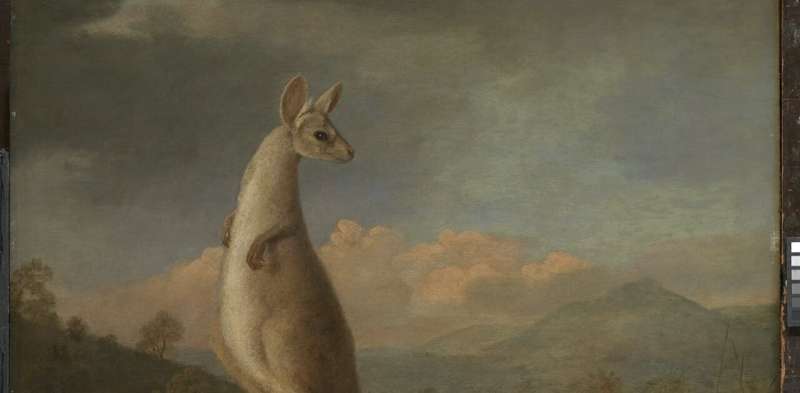
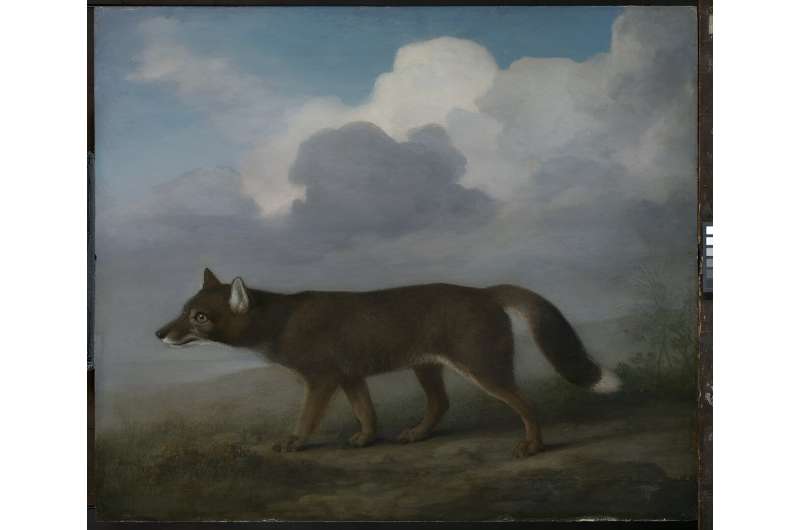
The Kongouro from New Holland, 1772. Credit: George Stubbs National Maritime Museum, Greenwich, London
In 1772, Joseph Banks commissioned the foremost painter of animals in England, George Stubbs, to paint a dingo and a kangaroo.
To our modern eyes the paintings lack the vitality and strength of the animals we are familiar with in Australia. The kangaroo more closely resembles a rodent than a bipedal marsupial. The dingo's glassy-eyed stare lacks any animation.
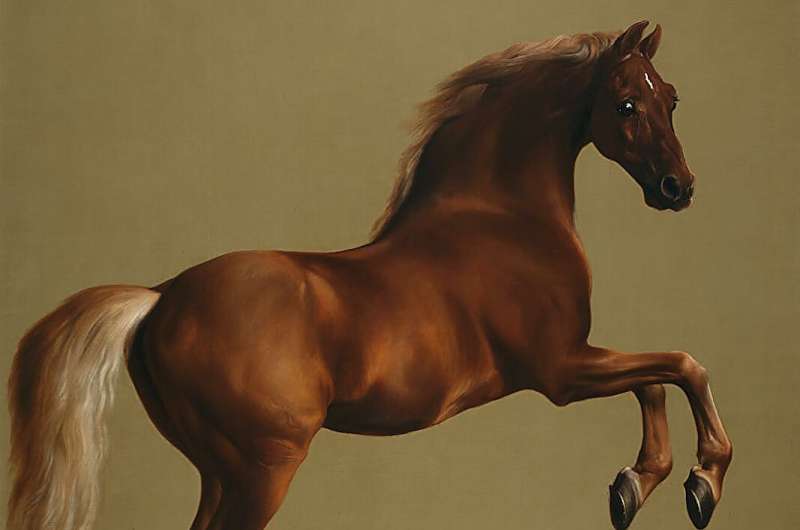
Stubbs was renowned for how well he captured horses and dogs. Even today, those paintings of his capture the lifelike individual essence of his subject. So why did his paintings of the dingo and kangaroo—some of the earliest European representations of Australian animals—look so strange?
'To compare it would be impossible'
Stubbs had not traveled with the 1768 Endeavour expedition to the South Seas. Instead, Banks commissioned him to paint from skins collected during the voyage.
While the journey was officially to chart the transit of Venus across the sun from the vantage point of Tahiti, King George III also secretly instructed James Cook to search for the fabled Terra Australis Incognito and "with the consent of the Natives […] to take possession of a Continent or Land of great extent […]in the Name of the King of Great Britain."
Banks collected the skins of a "large dog" and a "kongouro" (thought to be a misinterpretation of the Guugu Yimidhirr word gangurru, which refers to the Grey Kangaroo) when the Endeavour pulled into safe harbor for repairs after striking the Great Barrier Reef in June 1770.
Banks recorded his first impressions of this very unfamiliar animal in his journal entry dated July 14 1770.
"To compare it to any European animal would be impossible as it had not the least resemblance of any one I have seen. Its fore legs are extremely short and of no use to it in walking, its hind again as disproportionately long; with these it hops 7 or 8 feet at each hop in the same manner as the Gerbua, to which animal indeed it bears much resemblance, except in size […]"
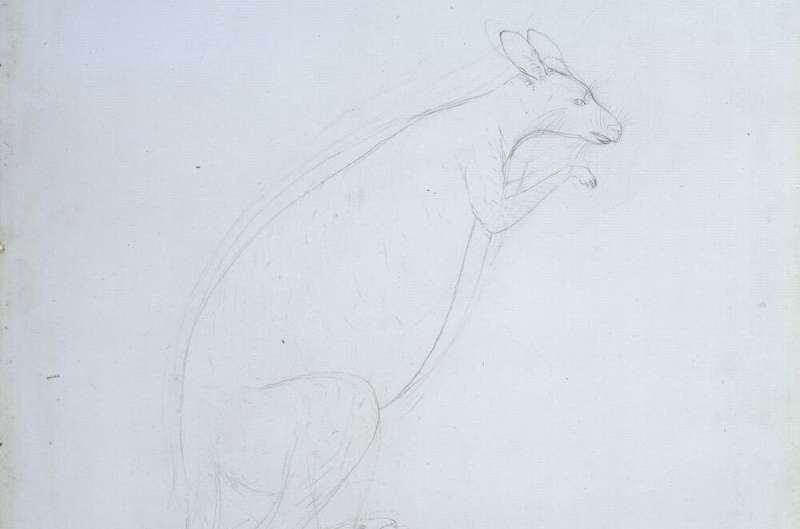
The first European drawing of a kangaroo, by Sydney Parkinson in 1770. Credit: Trustees of the Natural History Museum, London
Sydney Parkinson, one of the artists who accompanied Banks, made five sketches of the dead animal after it was shot by one of the ship's gamekeepers.
These sketches, the flayed (and possibly inflated) skins, Banks' journal entry and his personal memories were the material that informed Stubbs as he made his preparations to paint these very unfamiliar animals.
The semantic memory
Stubbs was lauded for his anatomically correct forms of horses and dogs. On occasion, Stubbs also painted exotic animals like the lions housed in the Royal Menagerie.
But his paintings of the dingo and kangaroo were the first time he painted animals he had never studied from life.
Stubbs capitalized on the swell of interest in the return of the Endeavour by exhibiting the paintings at the Society of Artists in London 1773.
This brought the dingo and the kangaroo to the scientific community and public's attention. The animals became the two most associated with the new world of Australia—adding greatly to Great Britain's sense of national pride as the conqueror of new worlds.
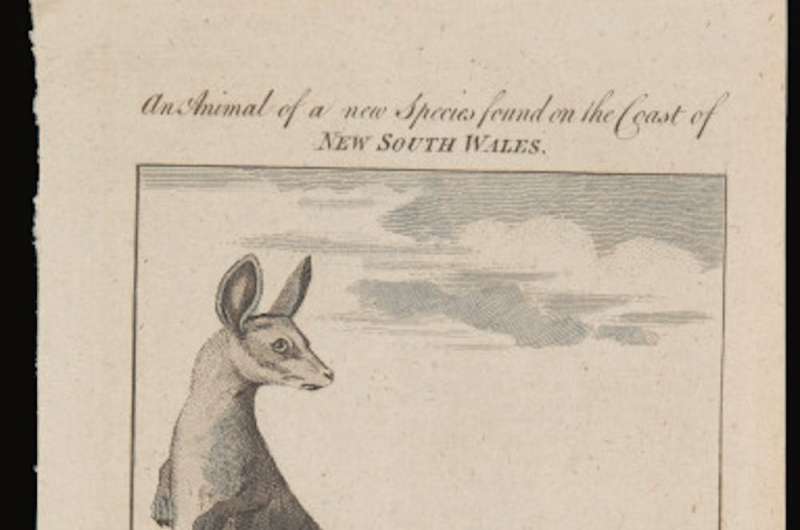
Stubbs' kangaroo painting set the standard for future representations of the animal until well into the 19th century, serving as a model for engravings and illustrations used in scientific and popular publications.
But Stubbs' kangaroo more closely resembles the rat-like Gerbua of Banks' description than the creature we know today. This can perhaps be explained by Stubbs's unfamiliarity with the animals.
An animal of a new species found on the coast of New South Wales. 1773 engraving based on Stubbs’ painting. Credit: National Museum of Australia
As an artist who had made a lifelong study of the anatomy and movement of animals, he would normally have relied on what psychologists refer to as "implicit memory" when painting his subject in the studio. That is, the unconscious memory he would instinctively rely on from years of painting animals he was familiar with.
It's a bit like riding a bicycle: once learned, it's never forgotten.
In this case, Stubbs primarily relied on "semantic memory," or general knowledge of his experiences in the world, to paint the unfamiliar by utilizing the knowledge, written material and personal recollections Banks had given to him.
Having been told a kangaroo was a giant rat-like gerbua by Banks, it is understandable that Stubbs also relied on his implicit memory of rats and gerbuas to depict the kangaroo.
Rendering the unfamiliar
As an artist, I can relate to this. My paintings of unfamiliar landscapes in Scotland and Ireland always seem to depict trees that look like eucalypts.
Despite using the same brand of watercolors I have used my whole artistic life, the way I paint the interplay of light, shadow and hue on mountain passes, birch groves and fields of heather and gorse usually seems more gaudy than the dull blue-gray colors of the Australian bush.
Unconsciously, I overlay the hues of the Australian landscape onto my paintings of the British landscape in order to tone the gaudiness down—much like the English painters who conversely depicted the Australian bush as English landscapes.
One particularly ingenious image showcases an orca posed as a sickle crossed with a hammer. The cheeky caption reads, "Eat the rich," a nod to the orcas' penchant for sinking lavish yachts.
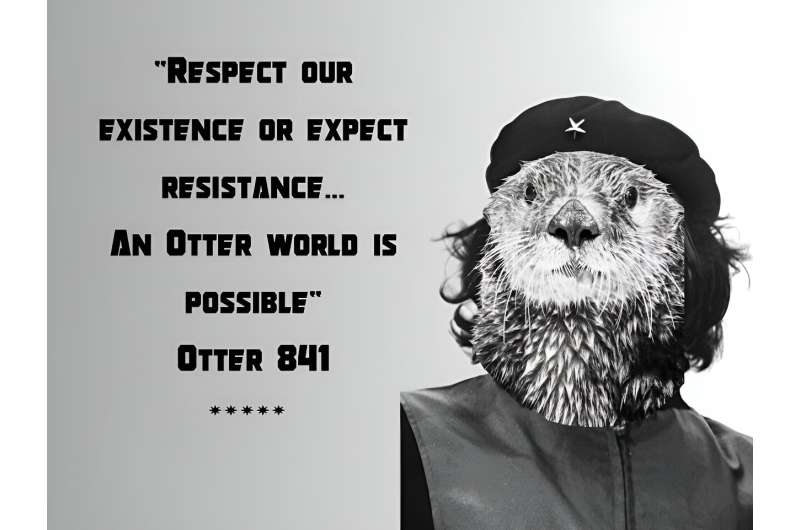
Memes conjure her in a beret like the one donned by socialist revolutionary Ché Guevara. In one caption, she proclaims, "Accept our existence or expect resistance … an otter world is possible."
My scholarship centers on animal-human relations through the prism of social justice. As I see it, public glee about wrecked surfboards and yachts hints at a certain flavor of schadenfreude. At a time marked by drastic socioeconomic disparities, white supremacy and environmental degradation, casting these marine mammals as revolutionaries seems like a projection of desires for social justice and habitable ecosystems.
A glimpse into the work of some political scientists, philosophers and animal behavior researchers injects weightiness into this jocular public dialog. The field of critical animal studies analyzes structures of oppression and power and considers pathways to dismantling them. These scholars' insights challenge the prevailing view of nonhuman animals as passive victims. They also oppose the widespread assumption that nonhuman animals can't be political actors.
So while meme lovers project emotions and perspectives onto these particular wild animals, scholars of critical animal studies suggest that nonhuman animals do in fact engage in resistance.
Nonhuman animal protest is everywhere
Are nonhuman animals in a constant state of defiance? I'd answer, undoubtedly, that the answer is yes.
The entire architecture of animal agriculture attests to animals' unyielding resistance against confinement and death. Cages, corrals, pens and tanks would not exist were it not for animals' tireless revolt.
Even when hung upside down on conveyor hangars, chickens furiously flap their wings and bite, scratch, peck and defecate on line workers at every stage of the process leading to their deaths.
If they didn't mind having their infants permanently taken from their sides, dairy cows wouldn't need to be blinded with hoods so they don't bite and kick as the calves are removed; they wouldn't bellow for weeks after each instance. I contend that failure to recognize their bellowing as protest reflects "anthropodenial"—what ethologist Frans de Waal calls the rejection of obvious continuities between human and nonhuman animal behavior, cognition and emotion.
The prevalent view of nonhuman animals remains that of René Descartes, the 17th-century philosopher who viewed animals' actions as purely mechanical, like those of a machine. From this viewpoint, one might dismiss these nonhuman animals' will to prevail as unintentional or merely instinctual. But political scientist Dinesh Wadiwel argues that "even if their defiance is futile, the will to prefer life over death is a primary act of resistance, perhaps the only act of dissent available to animals who are subject to extreme forms of control."
Otter 841 is the wild sea otter off Santa Cruz, California, who some observers suspect has had it with surfers in her turf.
Philosopher Fahim Amir suggests that depression among captive animals is likewise a form of emotional rebellion against unbearable conditions, a revolt of the nerves. Dolphins engage in self-harm like thrashing against the tank's walls or cease to eat and retain their breath until death. Sows whose body-sized cages impede them from turning around to make contact with their piglets repeatedly ram themselves into the metal struts, sometimes succumbing to their injuries.
Critical animal studies scholars contend that all these actions arguably demonstrate nonhuman animals' yearning for freedom and their aversionto inequity.
Sharing memes that cheer on wild animals is one thing. But there are more substantive ways to demonstrate solidarity with animals.
Legal scholars support nonhuman animals' resistance by proposing that their current classification as property should be replaced with that of personhood or beingness.
Nonhuman animals including songbirds, dolphins, elephants, horses, chimpanzees and bears increasingly appear as plaintiffs alleging their subjection to extinction, abuse and other injustices.
Citizenship for nonhuman animals is another pathway to social and political inclusion. It would guarantee the right to appeal arbitrary restrictions of domesticated nonhuman animals' autonomy. It would also mandate legal duties to protect them from harm.
Everyday deeds can likewise convey solidarity.
Boycotting industries that oppress nonhuman animals by becoming vegan is a powerful action. It is a form of political "counter-conduct," a term philosopher Michel Foucault uses to describe practices that oppose dominant norms of power and control.
Political scientists recognize that human and nonhuman animals' struggles against oppression are intertwined. At different moments, the same strategies leveraged against nonhuman animals have cast segments of the human species as "less than human" in order to exploit them.
I believe quips about the marine mammal rebellion reflect awareness that our human interests are entwined with those of nonhuman animals. The desire to achieve sustainable relationships with other species and the natural world feels palpable to me within the memes and media coverage. And it's happening as human-caused activity makes our shared habitats increasingly unlivable.
Solidarity with nonhuman animals is consistent with democratic principles—for instance, defending the right to well-being and opposing the use of force against innocent subjects. Philosopher Amir recommends extending the idea that there can be no freedom as long as there is still unfreedom beyond the species divide: "While we may not yet fully be able to picture what this may mean, there is no reason we should not begin to imagine it."
Just days after the Russian military launched a full-scale invasion of Ukraine in February 2022, stories of Ukrainian resistance were already circulating with a ferocity all their own.
Part of this was due to the Ukrainian government's savvy use of social media.
On March 7, 2022, for example, the government posted a video on Twitter, the platform now known as X, showing clips of Ukrainian farmers using John Deere tractors to tow away disabled Russian tanks and equipment. The image came with a simple message, complemented by a tractor icon: "Don't mess with Ukrainian farmers."
This video caught my attention—and that of my colleague Andrew Pyle, who, like me, studies the strategic use of communication.
We decided to study all of the posts that the Ukrainian government and the city of Kyiv posted to their official Twitter accounts during the first days of the Russian invasion. We found that the governments strategically used the platform as a form of crisis communication and public diplomacy.
While Ukraine was battling the Russian army on its land, it was also fighting for the hearts and minds of people following the conflict on social media from afar.
The process
We analyzed 163 tweets posted by the verified @Ukraine government and @Kyiv government accounts from Feb. 1, 2022, until May 1, 2022. We found many examples of Ukraine and Kyiv using the theme of resilience to boost their own image on the platform. Both of the accounts posted almost exclusively about the war during this period, with posts ranging from fundraising campaigns to appeals for users to "tag @Russia and tell them what you think about them."
Kyiv's account, which has 2.1 million followers and describes itself as "the city of courage" on its page, posted an image on March 9, 2022, that depicted a woman breastfeeding an infant against the backdrop of a map of the city's subway system. The imagery here closely resembles Catholic iconography of the Virgin Mary with baby Jesus.
Ukraine's account has 2.3 million followers and the playful description, "Yes, this is the official twitter account of Ukraine." It posted a similarly religious-themed post about the war on Christmas Eve in 2022.
Digital public diplomacy
Other tweets over the past two years seem directed at strengthening relationships with the United States and other countries that have helped Ukraine defend itself against Russia.
One tweet from Ukraine's official account in 2022 thanked the U.S. for its support by wishing its "American friends" a happy Fourth of July. It posted another similar message directed at Americans in 2023, presenting Ukraine as a freedom-and-independence-loving country.
In this way, Ukraine's social media approach closely reflects what some scholars have called "selfie diplomacy"—or how a country uses social media to "draw its own self-portrait."
While scholars have begun to examine the role of social media for public diplomacy, relatively little is known about how countries can use X and other social media platforms to influence how people see them during a time of conflict.
But the broader use of technology to manipulate public opinion about war is far from new.
A strong historical precedent
The Woodrow Wilson administration, for example, enlisted the theorist Edwards Bernays, who is often referred to as the "father of public relations," to help its war effort during the 1910s.
Within months, Bernays and the committee helped shift public support for a war Americans had initially been reluctant to join by promoting the idea that the U.S. was involved in the fighting to bring democracy to Europe.
In particular, Bernays directed the CPI's Latin News Service in order to build support for the war among Latin American allies. He enlisted American companies doing business overseas to distribute literature about America's reasons for entering the war.
Bernays, a nephew of Sigmund Freud, knew that the use of symbols and images could sell the idea of war to the public. As Bernays wrote in 1942, "Arms and armaments are not the only weapons … ideas are weapons too."
These same principles apply in the case of the Ukraine war today.
Connecting with people
Ukraine has been trying to join NATO ever since the country gained independence from the Soviet Union in 1991.
Throughout the conflict, Ukraine has made numerous appeals on X to its allies in Europe and North America to accept its application to join the alliance.
It has also relied heavily on interactions with Western social media and culture to connect with people in foreign countries in creative ways.
For instance on Feb. 25, 2022, the Twitter account for the widely popular American television series "The Simpsons" posted an image of the namesake family stoically holding Ukrainian flags. A few hours later, Ukraine replied to the tweet with blue and yellow heart emojis along with a GIF from a "Simpsons" episode.
While our study does not contain data beyond May 2022, Ukraine and Kyiv's X accounts have continued to publish content that reflects these general themes of national resilience and diplomacy.
As the war in Ukraine continues, the government's strategic use of social media could serve as a model, or at least a point of consideration, to other countries also trying to advance their public images—especially during war and other times of hardship.