Monday, September 25, 2023

Case Studies

How Journalistic Teamwork Uncovered Years of Regulatory Failure in Texas


by David Leffler and Savanna Strott, 
SEJournal • August 16, 2023

This post was originally published on the Society of Environmental Journalists (SEJ) website through SEJournal Online and is reprinted here with permission. Its authors, David Leffler and Savanna Strott, are reporters for Public Health Watch that conducted an investigation into what caused one of largest fires in Texas history.

“Everybody freaked out when ITC happened. We were all waiting for the other shoe to drop.”

Suddenly, environmental justice was at the forefront of local politics.

It was July 2022, and our investigation into the US Environmental Protection Agency’s reputed ineffectiveness in Texas — a state ravaged by petrochemical pollution — was in its infancy. At the time, our story’s direction was hazy at best. Everything changed after we heard those two sentences from a longtime employee at the EPA’s Region 6 office in Dallas.

“ITC” was Intercontinental Terminals Company, a storage facility for millions of barrels of volatile chemicals.

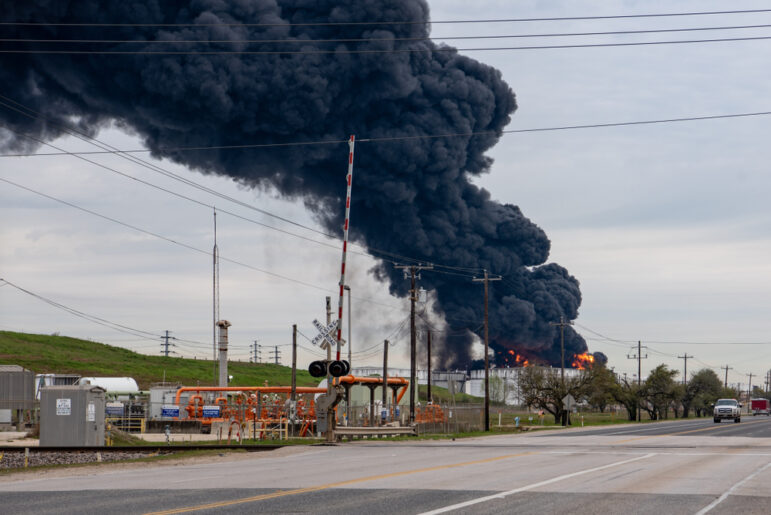
On March 17, 2019, a fire had consumed the Houston-area compound, shooting flames 150 feet into the air and sending out billows of ink-black smoke. The blaze burned for three days, spurring shelter-in-place warnings across the region and making headlines across the country.

ITC was one of the biggest chemical fires in Texas history — so big that it shifted the political priorities of Harris County, the third-most-populous county in the United States and the epicenter of North America’s petrochemical industry.

Following the disaster, county leaders allocated nearly $12 million to track and fight industrial pollution. Suddenly, environmental justice was at the forefront of local politics.

But how much did ITC matter three years later? A lot, our source told us.

Retired Regulators Provide Crucial Roadmap

That was the beginning of what became a two-part investigation into federal and state regulatory failure and previously unknown public health threats connected to the chemical fire.

Public Health Watch and its partner, The Texas Tribune, discovered that the EPA and Texas had ignored warning signs at ITC for nearly two decades prior to the 2019 catastrophe. After the fire was extinguished, dangerous levels of the carcinogen benzene infused nearby neighborhoods for weeks while residents unknowingly went about their daily lives.

Our investigation was built on the backs of a small group of retired regulators who tried to sound the alarm about ITC years ago and decided to speak up in hopes of preventing similar disasters.

Finding these regulators took dozens of calls to advocates, experts and government insiders. Earning their trust took dozens more.

Over the course of 10 months, these regulators took us into their world — one of hazardous chemicals, complex science, and labyrinthine air pollution rules.

They helped us understand the nuances and limitations of the EPA’s power, especially in places like Texas, where federal intervention is often akin to a declaration of war. They also explained the intricate pollution-tracking technologies and convoluted processes needed to pinpoint and analyze chemical leaks.

Smoke is visible from the storage facility fire in Deer Park, Houston. Image: Shutterstock

Most important, these regulators gave us a roadmap leading to thousands of pages of state and federal documents we wouldn’t have found otherwise.

With their help, we crafted Freedom of Information Act and state open-records requests that unearthed never-before-seen facility inspection reports and pollution data going back to 2002.

These documents exposed years of negligence by the Texas Commission on Environmental Quality, or TCEQ, and the EPA’s Region 6, which oversees federal environmental regulations in Texas and four other states.

Recurring Issues Ignored for Years

“Something bad was going to happen at ITC. It was just a matter of time.” — Ken Garing, former EPA chemical engineer

The documents were damning. Both agencies had inspected ITC several times. Both had identified significant problems, including recurring mechanical issues within the cluster of large, white chemical tanks that ultimately caught fire in 2019.

“I remember thinking, ‘Holy cow.’ They had by far the highest benzene numbers we’d ever seen inside a facility,” Ken Garing, a chemical engineer who spent 30 years with the EPA’s National Enforcement Investigations Center, told us. “Something bad was going to happen at ITC. It was just a matter of time.”

Neither agency took meaningful action against the facility, though there had been ample opportunity to do so.

From 2002 until the 2019 fire, ITC was penalized only $270,728 by the TCEQ, the EPA, and Harris County combined. That was barely a blip on the balance sheet for ITC’s owner, the Japan-based Mitsui Group, which recorded $7.2 billion in profits in 2018 alone.

These regulatory failures had flown under the radar for years, but the damage they helped inflict was extraordinary.

For three days, the ITC fire blanketed the Houston area with fine particulate matter, which can settle deep into lungs and wind up in bloodstreams. Chemicals lingered in the air for weeks in Houston suburbs including Deer Park, where ITC is located.

Cancer Concerns, Memories of Terror

It was one thing to sift through pages of EPA data showing that residents were exposed to startling levels of benzene following the ITC fire. It was another to find people to bring that experience to life.

Many Deer Park residents still aren’t aware of what they breathed in during the 2019 fire.

Deer Park isn’t your typical environmental justice community. It’s comfortably middle class and predominantly white. It’s a town of 30,000 whose neighborhoods feature clean streets, large yards, and spacious two-story homes.

The petrochemical industry, which has been intertwined with Deer Park for nearly 100 years, is the largest local employer and a major philanthropic supporter of civic activities. The industry has especially close ties to Deer Park’s highly-rated schools, which, along with well-paying industry jobs, are draws for families.

Those factors made Deer Park an intriguing place to profile. But they also presented challenges.

There are no local advocacy groups, and residents tend to have a pro-industry perspective. Noxious odors are often described as “the smell of money” — a saying long evoked by Texas politicians boasting about the petrochemical industry’s economic benefits.

We started going door-to-door in search of people to speak with about the fire. Many seemed surprised to see strangers on their doorsteps. That feeling sometimes shifted to discomfort or anger after they learned we were journalists. A few threatened to call the police.

But those experiences were outliers. The more we knocked, the more we were greeted with enthusiasm.

Families welcomed us into their homes and described to us the terror they’d experienced during the 2019 fire. Parents wondered if the school district had moved too quickly to open campuses once the flames were extinguished. Some children wondered if they’d someday be diagnosed with cancer because of the fumes they were forced to breathe.

Sharing these residents’ stories gave our project more heft and humanity. By pairing their accounts with hard data and shocking evidence of regulatory failure, we ensured that our project would be neither bogged down by scientific jargon nor larded with narrative fluff.

An Unfinished Story

Our aim, however, was accountability. As journalists, our responsibility isn’t just to tell a good story. It’s to give readers an outlet for their anger and anxiety: Who dropped the ball? What new laws need to be enacted? Which politicians need to step up?

At the direction of our editor, Susan White, we never write a story like this and think, “We’re done.” Follow-up pieces are critical to keeping readers engaged and holding people in power to account. To that end, we’ve written several stories about ITC since our two-part investigation came out in late April — an effort we’ll expand upon in the coming months.

Many Deer Park residents still aren’t aware of what they breathed in during the 2019 fire. And too little has been done to safeguard against the next catastrophe in the four years since ITC burned. The Texas Legislature has not taken substantive action to punish even the most egregious polluters. ITC is operating as usual and recently applied to renew its operating permit. The facility’s only pending Clean Air Act violations rest with Texas Attorney General Ken Paxton, who was recently impeached by the Texas Legislature for alleged bribery and abuse of public trust.

In short, there’s a lot more work to do.

Additional Resources

Investigating Environmental Crimes and Climate Change

Aggressive Reporting, Fierce Writing, and FOI Requests: How a Small Town Editor Won a Pulitzer

Investigating Toxic Military Bases and Their Links to Cancer

David Leffler is an investigative reporter for Public Health Watch covering chemical pollution and environmental health issues, based in Austin. He is a finalist for the 2023 Livingston Awards.

Savanna Strott is a contributing reporter for Public Health Watch, where she covers chemical pollution and environmental health issues. She is a finalist for the 2023 Livingston Awards.

Study finds views of German voters shifting to the right

The latest study, released on Thursday, found that the proportion of Germans with far-right extremist views is now 8.3%, a substantial increase from the 2% to 3% found in previous years

22 September 2023
Фото: Mika Baumeister on Unsplash

According to a new study, far-right extremist attitudes have increased sharply in Germany since 2021, with the researchers determining that one in 12 adults now hold an extreme right-wing worldview, writes German news agency DPA.

The study, conducted by researchers at Germany’s Bielefeld University, was commissioned and published by the Friedrich Ebert Foundation, which is closely tied to the centre-left Social Democratic Party of Germany (SPD).

The survey, which is conducted every two years, examines right-wing extremist attitudes among German voters.

The latest study, released on Thursday, found that the proportion of Germans with far-right extremist views is now 8.3%, a substantial increase from the 2% to 3% found in previous years.

The study’s authors said that extreme right-wing attitudes were found across the political spectrum and not only among supporters of far-right politicians.

“Among those who clearly position themselves as ‘left-wing,’ there are more people who share an established right-wing extremist worldview (12%) than is the case in the political centre (7%),” noted the researchers, who were led by social psychologist Andreas Zick.

The telephone survey, conducted between January 2 and February 28 by the Duisburg-based UADS Institute, asked 2,027 to position themselves in response to various statements, such as whether they would support a dictatorship.

Based on the total sample, the authors said the survey carries a margin of error of plus or minus 2.2 percentage points.

The study’s authors define the central characteristic of right-wing extremism as “an ideology of inequality and violence or the approval of violence to implement the ideology.”

Polls of German voters have found a similar shift toward the right, with the far-right populist Alternative for Germany (AfD) surging in support while the SPD and Greens tumble.

Study co-author Beate Küpper said the results suggest that the AfD is succeeding in winning over “particularly xenophobic non-voters.”

Compared to previous years, significantly more survey respondents said they felt their freedom of expression has been curtailed.

The study also found more people sharing the far-right view that “different peoples should not mix with each other.”

The survey also found more Germans now consider themselves politically right-of-centre, rising to 15.5% from just under 10% in the most recent survey.

Voters who back the centre-right CDU/CSU bloc, the party of former chancellor Angela Merkel, are comparatively unlikely to support far-right views. Küpper said pundits in mainstream debate in Germany seem to underestimate the commitment of CDU/CSU voters to democratic values.

The survey found that 30% agreed with the statement, “The ruling parties are deceiving the people” – almost twice as many as two years earlier. The proportion of those who approve of political violence more than doubled from 5.3% to 13.2%.

This year’s survey also asked Germans what worries them most in connection to Russia’s ongoing invasion of Ukraine.

The study found that while concerns about an expansion of the war are relatively dominant (62%), worries about rising energy prices top the list (66%). Women were generally more concerned about the effects of war than men.

There are also significant differences between people living in the former West Germany and the former East Germany. According to the data, around 45% of people in the former West Germany fear that they will not be able to maintain their own standard of living in the long term as a consequence of this war.
European cities must do more to address the legacy of colonialism

Edgar Pieterse
September 22nd, 2023

The EU’s approach to Africa has done little to challenge exploitative power relations between Europe and the Global South, writes Edgar Pieterse. But could partnerships between European and African cities offer a better route to fostering solidarity?

What is the function of cities – arguably the apogee of cultural achievement – when an empire dies? What does a good death look and feel like? Can Europe’s cities become the midwives to usher in new sources of identity and pride that challenge defensive nostalgia for the continent’s fading “greatness”?

The slow death of the European imperial project has been delayed by stubborn cultural chauvinism; a hard-to-expunge belief that, ultimately, the future of the world is some form of liberal democracy, seen as an inheritance of European enlightenment. The subtext being that imperialism couldn’t have been all that bad if Europe endowed the world with its future.

Coming to terms with the Anthropocene and its runaway environmental dystopia should once and for all dislodge European chauvinism and confidence. But it won’t. Europe makes a lot of noise about its commitments to Africa’s sustainable development and more equitable trading relations, but its flagship EU Green Deal does little to challenge exploitative power relations between Europe and the Global South. Its carbon border adjustment mechanism (CBAM), for example, sets out to reposition European firms as global leaders in an emerging low-carbon and circular economy, but fails to commit Europe to addressing the true cost of climate mitigation in the Global South and carries dire economic development impacts for many African countries.

Given the hard realities of geopolitical realpolitik, and in spite of the warm and fuzzy rhetoric of Europe’s just transition, might it be too much to wish for that European cities see a role for themselves to call out contradictory and unjust EU strategies? Might African and European cities forge direct agreements of solidarity and partnerships for just transitions? In this short reflection I want to hold on to a fictional European city with the audacity to figure out what it might mean to recover a Europeanness rooted in the values of freedom and solidarity. How might this city consider its role in relation to interdependent futures?

The decolonial current that is slowly but surely finding space and resonance in the Global North is perhaps a good starting point. European cities that want to acknowledge their culpability in the continued aftermath of colonialism and its distortionary effects in contemporary economic and political systems can proactively pursue three interwoven imperatives: (1) recognition; (2) reparations; and (3) redistribution.

Recognition

Most African cities reflect the original colonial imperative to have a base station to manage extractive industrialisation. Over time, divisions between the luxurious trappings of small colonial elites and the neglected dormitories for essential workers were fixed in space through racialised modernist design principles obsessed with functional division.

These regimes of control were designed to guarantee uninterrupted extraction of raw materials and minerals and required the erasure of languages, cosmologies, tacit knowledge systems and social values of reciprocity and interdependence. This cultural violence was mobilised by racialised norms in Europe that both justified the grand imperial projects and the establishment of international and trade relations that would safeguard the unfair technological and financial benefits accrued through intergenerational injustice.

Coming to terms with these deep, multi-generational and compounded forms of exploitation is the central focus of a politics of recognition. The much-publicised debates about returning African cultural artefacts, for example, the Benin Bronzes, is but the tip of the iceberg of what we need. What can European cities do to normalise recognition policies and practices and acknowledge both historical and contemporary wrongs?

Reparations


It is not especially viable for European cities to finance and effect reparations, but they can lend their political capital and voice to the symbolic importance of such action. At COP27, a report was tabled that clearly defined the investment needed for mitigation, adaptation, resilience, damage and natural capital.

The authors underscore that the US$100 billion per annum investment committed to at COP21 in Paris in 2015 had not yet been realised by 2022, demonstrating a shocking lack of commitment and follow-through. Furthermore, they suggest that in any case, the US$100 billion figure is a gross underestimation. “The world needs a breakthrough and a new roadmap on climate finance that can mobilise the $1 trillion per year in external finance that will be needed by 2030 for emerging markets and developing countries (EMDCs) other than China.”

By raising the ambition and consistency of European governments and the EU, cities can generate powerful political pressure for progress. Reparations must go beyond financial investment to include technical know-how, technology and skills development for a new generation of low-carbon, circular cities. This would be consistent with the social justice values of the New Leipzig Charter that morally anchors the political ambitions of European cities.

Redistribution

A lot of work remains after reparations to ensure that uneven playing fields are systematically rebalanced. Cities will need capital, research and development, and institutional and digital learning to put into practice circular, regenerative built environments and explore new models of citizenship based not on consumption, but on generating public goods.

As the global community figures out post-carbon urban futures, learning and resources must be shared equitably in open-source forums. To be sure, practical approaches to redistribution are inconceivable without cultural work to shift norms, expectations, dispositions and demand structures inside European cities. The current framing and management of the so-called migration crisis is a powerful litmus test of whether European cities are ready for this heavy cultural lifting.

European cities are indeed the midwives for a zero-carbon, circular city of the near future. But this societal learning project must also incorporate a reckoning with the bloody history of extraction and pillage that enabled industrialisation and post-industrialisation.

This article is based on a contribution to Old Cities New Ambitions: The Future of Urban Europe, published by LSE Cities

Note: This article gives the views of the author, not the position of EUROPP – European Politics and Policy or the London School of Economics. Featured image credit: Tayvay/Shutterstock.com


About the author

Edgar Pieterse is Founding Director of the African Centre for Cities at the University of Cape Town.

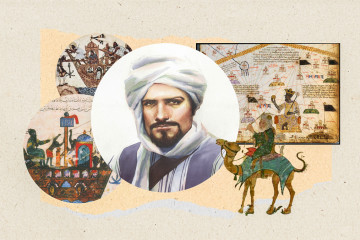
Was Ibn Battuta the greatest explorer of all time?

Medieval Moroccan traveller Ibn Battuta can lay claim to being the greatest explorer of all time. His exhaustive 'Rihlah' - "travels" in Arabic - chronicles his journeys, covering some 75,000 miles from North Africa to China.


Ufuk Necat Tasci
31 August, 2023

Travel is an essential part of our rights and freedoms, and it's great to have the opportunity to indulge in it once more. When it comes to historical travel and exploration, many people think of Marco Polo as the most famous adventurer. However, Ibn Battuta, an Islamic scholar, actually travelled to even more places than Marco Polo.

Over a period of almost thirty years, he journeyed through the Islamic world, India, China, Southeast Asia, and the Horn of Africa. His incredible voyage covered an impressive 75,000 miles (120,000 km).

"Ibn Battuta is renowned for his extensive travels spanning over 75,000 miles within and beyond the Islamic realm"

Ibn Battuta is an exceptional traveller in pre-modern history. He explored different countries by crossing oceans and travelling with camel caravans, covering over 40 contemporary countries on foot. Despite risking his safety to satisfy his love for adventure, he gained recognition as the most prominent explorer of his time.

Born in Morocco, his birth name was Abu Abdullah Muhammad ibn Battuta, and he lived in the 14th century.

Starting from his birthplace in Tangier, Morocco, in 1325, Ibn Battuta embarked on a significant journey that lasted almost thirty years. He travelled through a range of terrains across Africa, the Middle East, Central Asia, India, Southeast Asia, and China. While his initial motivation was the Hajj pilgrimage to Mecca, his expeditions surpassed this goal. He explored various cultures, and societies, and documented his observations.

Three orphaned brothers from Baghdad, known as the Banu Musa, paved the way for the Arabic school of mathematics and also pioneered advances in geometry & mechanics. This is their story https://t.co/UIH9TV5sJj


Ibn Battuta is renowned for his extensive travels spanning over 75,000 miles within and beyond the Islamic realm. The renowned travelogue of Ibn Battuta, titled "Rihla" — "journey" in Arabic — documents his many travels across Africa, the Middle East, and Asia.

Originally called "Tuhfat Al-Anzar fi Gharaaib Al-Amsar wa Ajaaib Al-Asfar" or "A Gift for Those Who Contemplate the Wonders of Cities and the Marvels of Travel," this compilation provides a valuable historical account of the societies he encountered along the way.

Ibn Battuta had an education in Islamic law, but his true passion was for adventure. When he was 21 years old, he set out on his journey in 1325, beginning with the Hajj pilgrimage. The pilgrimage lasted for an astonishing 16 months, but Ibn Battuta's thirst for exploration only grew stronger after it was over.


Culture  Ufuk Necat Tasci

Ibn Battuta travelled with caravans to reduce risks and wrote about his experiences, including battles, shipwrecks, and uprisings, providing insight into medieval Islamic history.

He sailed through the Red Sea towards Mecca and travelled through the vast Arabian desert. After that, he crossed Iraq and Iran. Later in 1330, he embarked on another journey through the Red Sea and continued on to Tanzania via Aden.

In 1332, Ibn Battuta decided to explore India and passed through Khwarizm, Bukhara, and Afghanistan before finally reaching the Muslim territory of Delhi. He sailed through the Red Sea towards Mecca and travelled through the vast Arabian desert.

After that, he crossed Iraq and Iran. Later in 1330, he embarked on another journey through the Red Sea and continued on to Tanzania via Aden. In 1332, Ibn Battuta decided to explore India and passed through Khwarizm, Bukhara, and Afghanistan before finally reaching the Muslim territory of Delhi.

Ibn Sina: The 10th-century Muslim who reinvented reason

After being welcomed by the Sultan of Delhi, he was selected as a judge and spent approximately eight years in the Indian subcontinent before embarking on another expedition.

In 1345, he arrived in Quanzhou, China, beginning his travels in China. During his journey, he visited various cities such as Beijing, Hangzhou, and Guangzhou. He also explored the Great Canal, admired the Great Wall, and interacted with the Mongol Khan who was in power at the time.

Battuta's journey took a significant turn when he arrived in China. After exploring the farthest corners of the world, he retraced his steps back home to Morocco in 1349. Since his parents had passed away, he stayed there only briefly before travelling to Spain. He embarked on a multi-year trip that involved crossing the Sahara desert and reaching the Malian Empire, culminating in his visit to Timbuktu.

Culture Ufuk Necat Tasci

During his travels, he faced many dangers, including attacks by bandits, almost drowning, and encountering oppressive rulers. In 1355, he finally returned to his home in Tangier, Morocco, for good. Although he didn't keep a personal journal during his expeditions, he was asked by Sultan Abu Inan to write about his adventures. He spent over a year recounting his experiences to a scribe named Ibn Juzayy.

It is believed that after finishing his "Rihla," Ibn Battuta worked as a judge in Morocco for a few years before his death in approximately 1368. Upon the request of Sultan Abu Inan, he began recording his travels. Alongside Ibn Juzayy, he spent a year narrating and documenting his journeys, creating a priceless historical record.

Dr Ufuk Necat Tasci is a political analyst, academic, and journalist. His research areas and interests include Libya, the foreign policy of Turkey, proxy wars, surrogate warfare, and new forms of conflict and history
Follow him on Twitter: @UfukNecat


Sidelined by society, Sheikha Helawy's short stories animate the lives of Palestinian Bedouins stuck in limbo

Book Club: The plight of Bedouins living in Palestine is seldom written about in novel form. Sheikha Helawy, herself hailing from a Bedouin town, has written a collection of 18 short stories that unveils the culture of Bedouin women in modernity.


They Fell Like Stars from the Sky and Other Stories is a powerful ode to the Bedouin women and girls of Palestine and their spirit for every form of freedom [Neem Tree Press]

Noshin Bokth
20 September, 2023

Amid constant and violent deracination, the stifling patriarchy, and the radiance within the mundane, women remain lambent in They Fell Like Stars From the Sky and Other Stories.

Award-winning author Sheikha Helawy has crafted 18 short stories in which young women and girls soliloquies, memories, and tragedies are celebrated and scrutinised.

The literary canon is rife with Palestinian tales that have expounded on its trauma, resilience, and people.

Book Club Ramona Wadi

However, translated by Nancy Roberts, Helawy has animated the life of Palestinian Bedouins and the life that prevails in their villages. She is one of the few authors who has revealed an intimate portrait of the inner worlds of Bedouiness to a global audience.

"Helawy focuses each story on the spirit of one or two girls. The psychological acuity with which she writes demands to be lauded. Adolescence is a perplexing transition for girls, and the added trauma of occupation and societal fixation on female bodies and chastity only convolutes their worlds further"

Helawy herself is from the forgotten village of Dhail El E'rj. Roberts prefaces that the residents of this village, including Helawy, were forcibly displaced by the Israeli occupation.

The town was eradicated, delineated as unrecognised, and replaced with an Israeli railway. Thus, Helawy has reanimated the people of this plundered town and the little girl within her who resisted and triumphed. Her lyrical vignettes are interlaced with Bedouin dialect and examine those girls just entering into womanhood to those with years of wisdom.

She pens stories in which their experiences are universal yet distinctive to Bedouin's existence. Not only are these tales a homage to her roots, but they were written as a spiritual purging to reconcile, dismantle, and confront the cultural stereotypes that sought, yet ultimately failed to diminish, women.


The ethics and principles governing these villages' girls are subtly interwoven. The tales are succinct, each merely three to four pages long. Many of them explore the psyches of adolescent girls coming to terms with their changing bodies and minds and the contradictory regulations imposed on them.

In the first story, Haifa Assassinated My Braid, a young girl convinces her mother to take her to the salon to cut off enough hair so she can no longer boast the braids precious to girls of her Bedouin culture.

She is a student at a school in Haifa and is relentlessly teased for all the features that betray her Bedouiness. So, in an effort to transiently disavow her identity and become a Haifa girl, she chops off her braid despite the Bedouin mentality equating braids with virginity.

Book Club Noshin Bokth

In the eponymous story, They Fell Like Stars From the Sky, a group of boys tie a tire to a tree to create a makeshift swing that provides the illusory effect of flying over the neighbouring Jewish settlement.

This innocuous pastime of children worldwide has turned into a scandal. Jawaher, the young girl the story centres on, contemplates the repercussions of enjoying the swing and decides to get a taste of the air above with her friends. Such an act is borderline shameful for growing women like themselves. In their defiance, the swing snaps, scattering the girls like fallen stars, injuring Jawaher, and bringing dishonour to her mother.

In Pink Dress, another girl haphazardly shaves her leg hair in contempt of her mother's anxiety so that her feminity may illumine through her dress.


"Many of the other tales contemplate love, marriage, and family. How are relationships defined in a society consumed with a woman's virginity or in the precarious environment under apartheid?"

Helawy focuses each story on the spirit of one or two girls. The psychological acuity with which she writes demands to be lauded. Adolescence is a perplexing transition for girls, and the added trauma of occupation and societal fixation on female bodies and chastity only convolutes their worlds further.

An unnamed character from I'll Be There is caught in limbo between the oppressive rules of the British Nun at her school and her puritanical Bedouin mother. Her only crime is that she enjoys jewellery and music.

Selma is a girl on the edge of puberty whose bosom is blooming in the tale The Door to the Body. Her burgeoning femininity prompts caustic arguments between her parents about whether they should send her to boarding school. As she ponders with innocence, "What bothered her most was her parent's preoccupation with a part of her body that didn't even mean much to her!"

Throughout the collection, we see that the Israeli occupation is not a central force in this collection. However, key players are insidiously intertwined in the characters' lives, such as the British nuns and the bordering Israeli settlements that boast luxuries near dwindling villages. While their shadow eclipses the prosaic concerns of teenagers, we are made to witness the silent but resounding fortitude of the Palestinian people.

Book Club Ramona Wadi

Many of the other tales contemplate love, marriage, and family. How are relationships defined in a society consumed with a woman's virginity or in the precarious environment under apartheid?

Ali is the meditation of a young man who ponders on his beautiful wife, Wadha, comparing her to coffee beans. He asserts that coffee beans require an expert, and so does a woman, only to learn that his wife's heart is beholden to another man named Ali. A dead woman's body horrifies the village elders when her body is found to be adorned with snake tattoos.

A private act for the sensual pleasure of her husband haunts and scandalises those she leaves behind. Hasna is told, "We don't have girls who fall in love," in Umm al-Zeinat. A betrothed teenager is ridiculed for the love of her donkey, and Habiba's grandmother's devotion to singer Umm Kulthum sustains her. Love and connection survive pillaging, tirades, and war in Helawy's world. Moreover, it manifests beyond romance and through the bonds of feminity and life itself.

Book Club Aisha Yusuff

The tales' brevity affects the sentiment of entering someone's private memories and consciousnesses. They are an eloquent sketch of the interminable metamorphosis' of a woman's identity and the power she possesses to resist.

When girls experience puberty, they leave behind their childhood to enter a life driven by ambiguous morals while navigating through their unique womanliness. It is a harrowing task further compounded by the perilous political atmosphere of life under occupation.

The individual is shaped by discrepancies in their national identity and constraints of tradition, so the women in Helawy's stories provide a catharsis for the readers. Being cognizant of oneself and how your environs permeate your psyche requires adroitness and candour, a skill that Helawy has conquered.

Noshin Bokth has over six years of experience as a freelance writer. She has covered a wide range of topics and issues including the implications of the Trump administration on Muslims, the Black Lives Matter movement, travel reviews, book reviews, and op-eds. She is the former Editor in Chief of Ramadan Legacy and the former North American Regional Editor of the Muslim Vibe

Follow her on Twitter: @BokthNoshin
Little Amal: Syrian refugee puppet leads march to US Capitol

Last week, hundreds gathered in downtown Washington, DC, clapping and dancing around Amal, a giant puppet, whose Arabic name was chosen to symbolise hope The group then marched together toward the Capitol, as a local marching band performed.


Brooke Anderson
Washington, D.C.
20 September, 2023

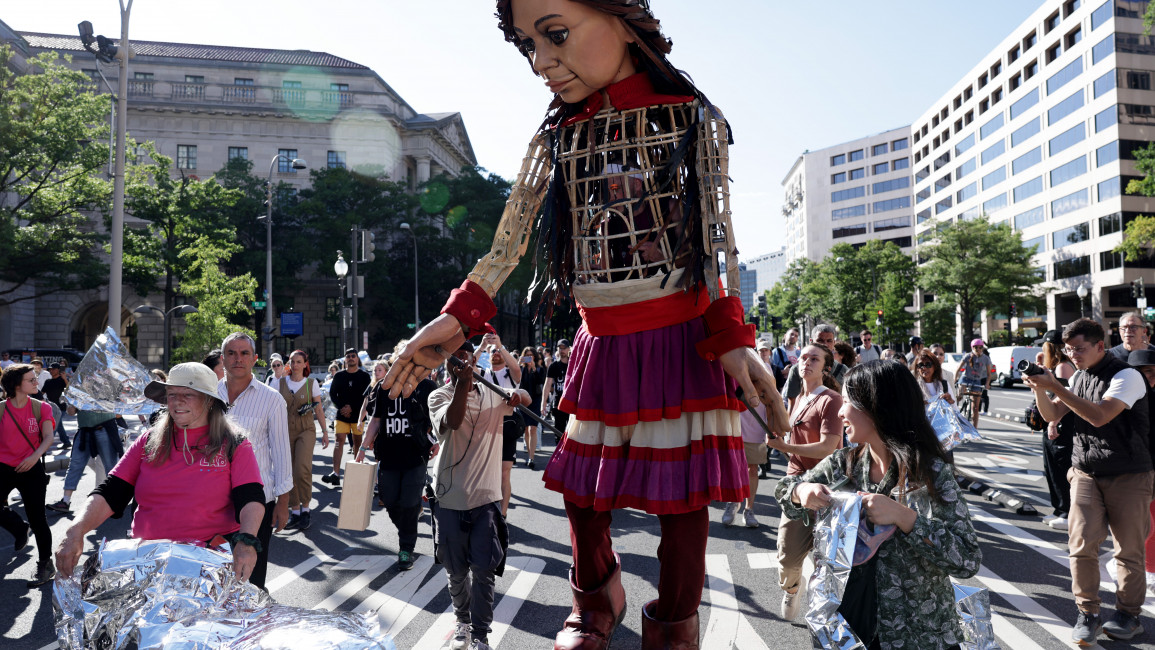
Little Amal, the 12-foot Syrian refugee puppet, made stops in Washington, DC this week as part of a global tour to promote human rights and to raise awareness of refugees.

On Tuesday afternoon, hundreds gathered at Freedom Plaza downtown, clapping and dancing around Amal, whose Arabic name was chosen to symbolise hope, as music was played for the occasion.

Society  Oliver Mizzi

The group then marched together toward the Capitol, as a local marching band led them down Pennsylvania Avenue.

Many people waved metallic blankets, what's often used to give warmth to migrants after a gruelling journey, and others carried children's shoes in a show of solidarity with child refugees.

"It's really to get empathy for people who are on the move, and not because they want to move most of the time but because they have to. We don't make policy. We want to change the world through empathy and to create better empathy"

"We created this event to welcome Amal. For us, it was really important to create an event and welcome Amal because our mission is humanising global politics through performance, and that's exactly what Amal does," Ersian Francois, general manager of the Laboratory for Global Performance and Politics, told The New Arab, as the crowd was getting ready to march to the Capitol.

"It's not about putting children and different people in different categories. It's really to get empathy for people who are on the move, and not because they want to move most of the time but because they have to. We don't make policy. We want to change the world through empathy and to create better empathy," she said.

Little Amal is the 12-foot-tall puppet of a 10-year-old Syrian refugee child who's a global symbol of human rights, especially for those of refugees. She calls for people’s attention to the huge numbers of children fleeing war, violence and persecution, each with their own story 
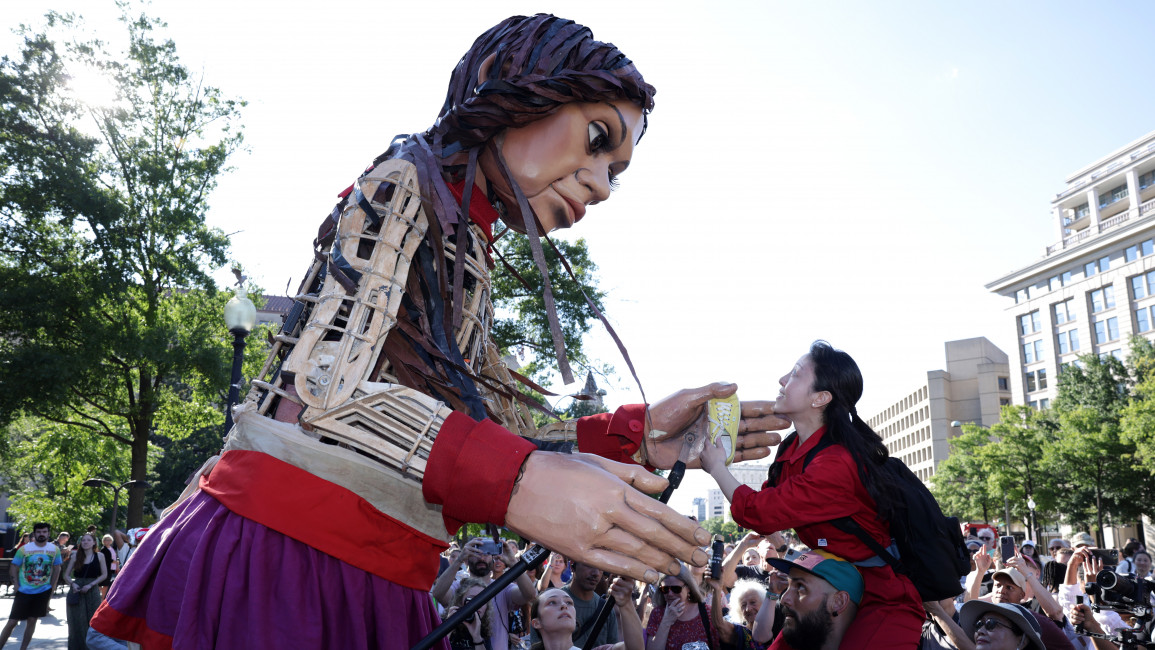
The puppet, manoeuvred by an individual inside the structure and by two people walking on either side moving the arms, was able to dance and interact with people along the route.

Through their well-timed and careful movements, they were able to give the puppet a sense of warmth and vulnerability, showing why so many around the world have been moved by the puppet's presence.

The New Arab Staff

Little Amal, not that little standing at 12 feet, is designed to depict a 10-year-old Syrian refugee girl. The animatronic puppet, which made her walking tour debut in 2021, has made stops in cities around world, including London, Brussels, Rome, and Geneva.

Since beginning "The Walk" in July 2021, Amal has travelled over 6,000 miles to 97 towns and cities in 15 countries and has been welcomed by more than a million people on the street, according to the project's website.

A woman hands a shoe to the puppet Little Amal as they walk towards the US Capitol on Pennsylvania Avenue on September 19, 2023, in Washington, DC 

The puppet has appeared at festivals and other gatherings in an effort to bring attention to children fleeing conflict.

Between 7 September and 5 November 2023, Amal is travelling 6,000 miles across the United States, stopping in 40 towns and cities from Boston to San Diego, with more than 100 public events expected to host the puppet.
Three new dams 'to be built' in storm-stricken Derna

The New Arab Staff
25 September, 2023

A Libyan Government of National Unity official says three new dams will be built in the stricken city of Derna following floods which killed thousands.


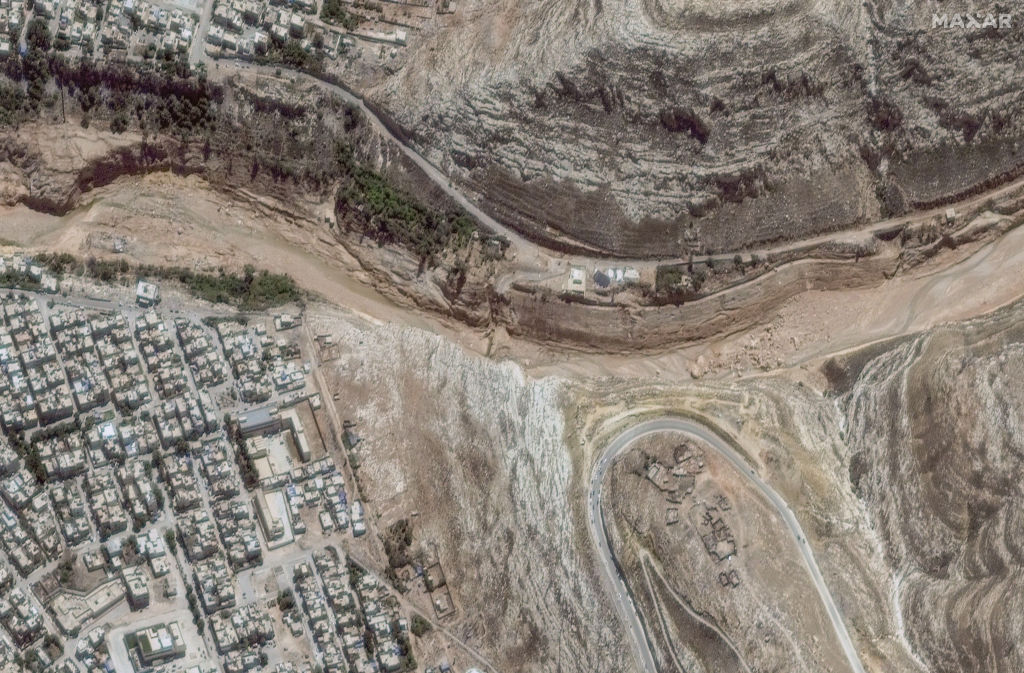
The dams which collapsed in Derna had suffered years of neglect [Maxar Technologies]
advertisement

Three new dams will be built in the Libyan city of Derna in the coming months, where thousands of people were killed by Storm Daniel earlier this month.

Omar Al-Maghribi, the Director of the Dams Administration at the Libyan Government of National Unity's Ministry of Financial Resources told The New Arab's sister site Al-Araby Al-Jadeed that companies had been contracted for the project.

He did not name the businesses contracted for the project or reveal their estimated costs.

Two dams collapsed in Derna during Storm Daniel, which was viewed as the main factor behind the catastrophic loss of life, property, and infrastructure in the city.

Reports suggest that the dams have been chronically neglected over the past decade amid Libya's conflict and political chaos, with the foreign company responsible for the two dams halting work there.

The Tripoli-based Government of National Unity does not control Derna, which like most of eastern Libya is held by forces loyal to warlord Khalifa Haftar.

Storm Daniel caused the Bou Mansour Dam, which has a capacity of 22.5 million cubic metres and is located 13 kilometres from Derna, to give way. This resulted in water inundating the nearby second dam, situated just a kilometre from the coastal city with a capacity of 1.5 million cubic metres.

Following the storm, a Libyan Audit Bureau report stated that the Ministry of Water Resources neglected the maintenance of the Derna dam, especially the non-payment of 2.286 million euros in maintenance expenses to the Turkish company, Bressel, in 2020.

A 2018 Al-Araby Al-Jadeed report pointed out that some dams in Libya require an equivalent of $7.27 million for annual maintenance. However, official figures indicated that the financial allocations did not exceed $364,000.

Derna, with its dam reservoirs, has witnessed at least five floods since 1942, as per a study from Sabha University. These dams, built between 1973 and 1977 by a Yugoslavian firm, have not seen any significant maintenance since 2002.
NATO NATION BUILDING
The political failures behind Libya's deadly floods

In-depth: Libya's divided and dysfunctional political system bears part of the blame for the magnitude of loss in the catastrophic flooding.


Ufuk Necat Tasci
18 September, 2023

Libya has been left reeling from the aftermath of Storm Daniel, a hurricane-strength storm that hit the central and eastern Mediterranean over a week ago.

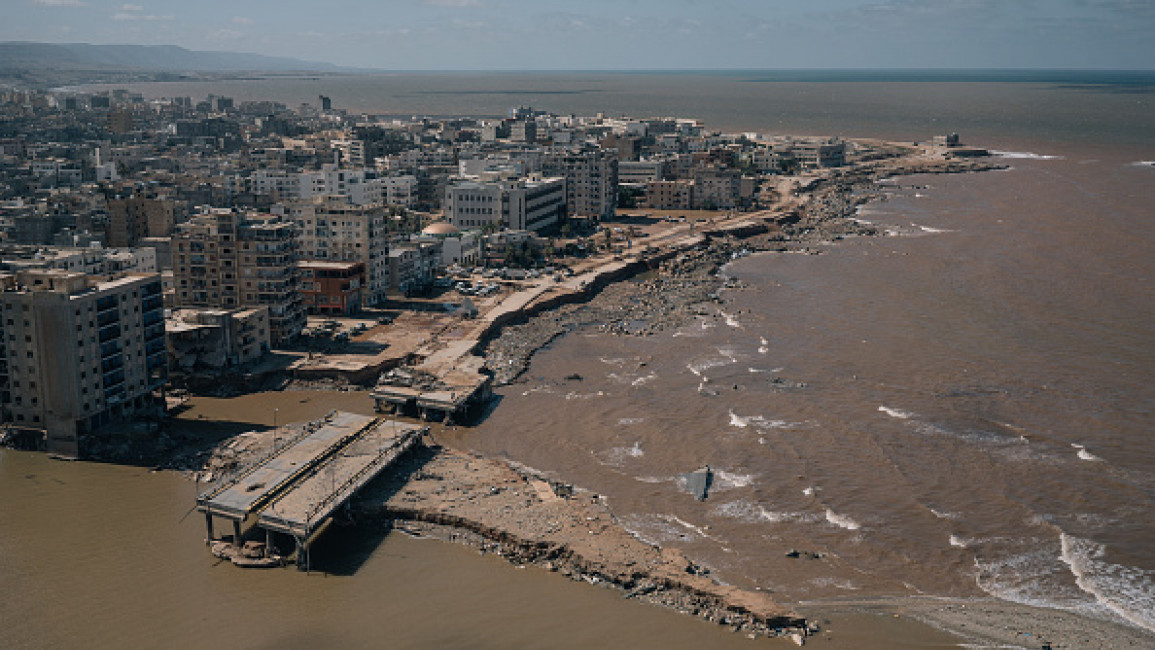
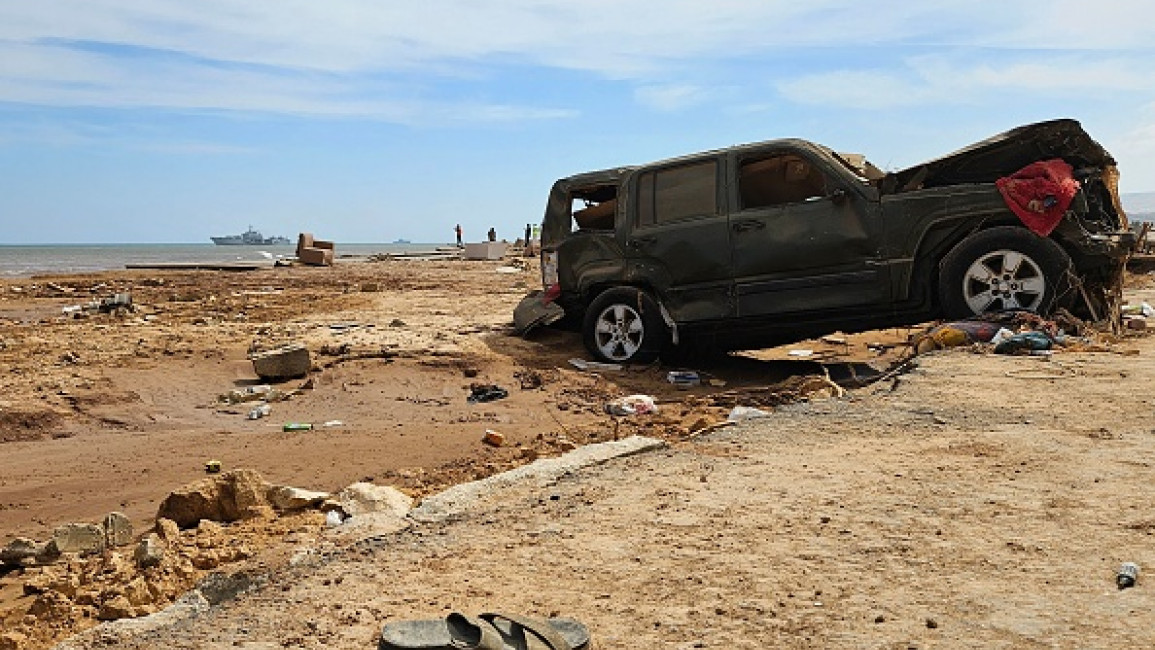
Striking Benghazi, Al Bayda, Merc, and, in particular, Derna in eastern Libya, officials have so far put the death toll at well above 11,000, but the tally could rise even higher.

Over 10,000 remain missing a week after the disaster, with Yale University professors recently declaring that the storm could be the worst in the continent's recorded history.

The collapse of dams built five decades ago in the port city of Derna, home to 90,000 people, unleashed devastating walls of water that swept away entire neighbourhoods and decimated infrastructure.

"Neglect and corruption have been rampant for some time, and the flood response has exposed this for all to see"

Despite the unprecedented magnitude of the storm, the extent to which the city was prepared for such a disaster has raised a number of concerns, most notably surrounding state neglect, which is now exacerbated by a divided political authority and widespread insecurity.

Furthermore, the challenges in getting aid to Libya following the tragedy, as well as the lack of coordination and administrative power, highlight the absence of strong public institutions across the country.

Since 2014, eastern Libya has been under the control of Libyan National Army (LNA) leader Khalifa Haftar, while the rival western-based government located in Tripoli oversees infrastructure projects and has access to national funds.

The lack of maintenance for the dams, however, goes back further. A decade after they were damaged following storms in 1986 a Libyan government study showed cracks and fissures in their structures.

Analysis Ufuk Necat Tasci

Two years later, an Italian engineering firm recommended the construction of a third dam to protect the city after confirming the cracks.

In 2007, the government of Muammar Gaddafi hired a Turkish company to conduct repairs, but payment issues delayed the work until 2010 and, eventually, they halted after the revolution in the country.

A state-run audit agency reported in 2021 that the two dams hadn’t been maintained despite $2 million being allocated for the project in 2012 and 2013.

Libya’s top prosecutor Al-Siddiq Al-Sour has said an investigation will be launched into the collapse of the dams, which will include scrutinising previous governments and local authorities.

Officials have so far put the death toll at well above 11,000. 

But the degree to which a fractured and dysfunctional political system can respond to the disaster, and create safeguards for the future, remains unclear.

"Neglect and corruption have been rampant for some time, and the flood response has exposed this for all to see," Sami Hamdi, editor-in-chief of the International Interest, told The New Arab.

The dominance of individual warlords and militia alliances means that institutions have little weight across the country, impacting service provision and general governance, the analyst said.

"Popular opinion is not considered of particular importance among the militias or political factions, and their control and authority is one that is imposed through the use of force and patronage"

“The first point of contention is why orders were issued to stay indoors rather than evacuate when everyone knew a storm was on its way. Second, and more significantly, there is little evidence of or hope for accountability, given the lack of trust in local institutions or processes," Hamdi added.

"There have been no resignations or admissions of fault."

Instead, Hamdi says, the established powers and militias are engaging in a PR race to evade accountability, reaffirm their 'wise' leadership (in the words of Haftar's son), and cement their legitimacy by insisting that all help must go via them.

Even within the West-East political divide, which shows no signs of abating, the city of Derna itself had remained isolated within the wider eastern region.

Analysis   Samira Elsaidi

"Derna has always been a peculiar, contrarian city, characterised by a spirit of rebellion and protest," Jalel Harchaoui, an associate fellow at the Royal United Services Institute (RUSI), told The New Arab.

"Partly for this reason, Haftar developed an enmity against Derna, a violent phase that lasted until early 2019. Hostility still existed in 2023, as Derna's municipal elections in August 2023 were interrupted and prevented by Field Marshal Haftar," Harchaoui added.

According to the analyst, deep antagonism between the Haftar regime and Derna remains a serious issue that must be monitored in the wake of the deadly floods.

"For this and other reasons, the Haftar family and its friends will be tempted to divert, distort, and subvert international aid efforts meant for Derna," Harchaoui added.


Over 10,000 remain missing a week after the disaster. 

A 2018 report by a UN panel of experts said that the behaviour of militias and various groups had resulted in the “misappropriation of Libyan State funds and the deterioration of institutions and infrastructure”.

But despite a consensus among the Libyan public that political factions are unpopular, the continued delay in elections or a political roadmap means that for the foreseeable future national divisions look set to continue.

"Rather than uniting, political factions are more likely to begin competing over aid routes, reconstruction contracts, and financing frameworks in order to entrench their positions"

"In this regard, popular opinion is not considered of particular importance among the militias or political factions, and their control and authority is one that is imposed through the use of force and patronage rather than a willingly conferred mandate from the Libyans," Hamdi told TNA.

Rather than uniting, political factions are more likely to begin competing over aid routes, reconstruction contracts, and financing frameworks in order to entrench their positions further following the natural disaster, Hamdi adds.

Indeed, jostling to be the contact point for relief efforts and international aid is a means of claiming political legitimacy that Libyans would not grant them at the ballot box.

Dr Ufuk Necat Tasci is a political analyst, academic, and journalist. His research areas and interests include Libya, the foreign policy of Turkey, proxy wars, surrogate warfare, and new forms of conflict and history

Follow him on Twitter: @UfukNecat


Israel's 'African problem': After Eritrean clashes, anti-migrant racism flares

Alessandra Bajec
20 September, 2023

In-depth: Violent clashes in Tel Aviv involving Eritrean asylum seekers, and ensuing calls to deport all migrants, have put the spotlight on Israel's widespread and long-standing police brutality and racism against African migrants.

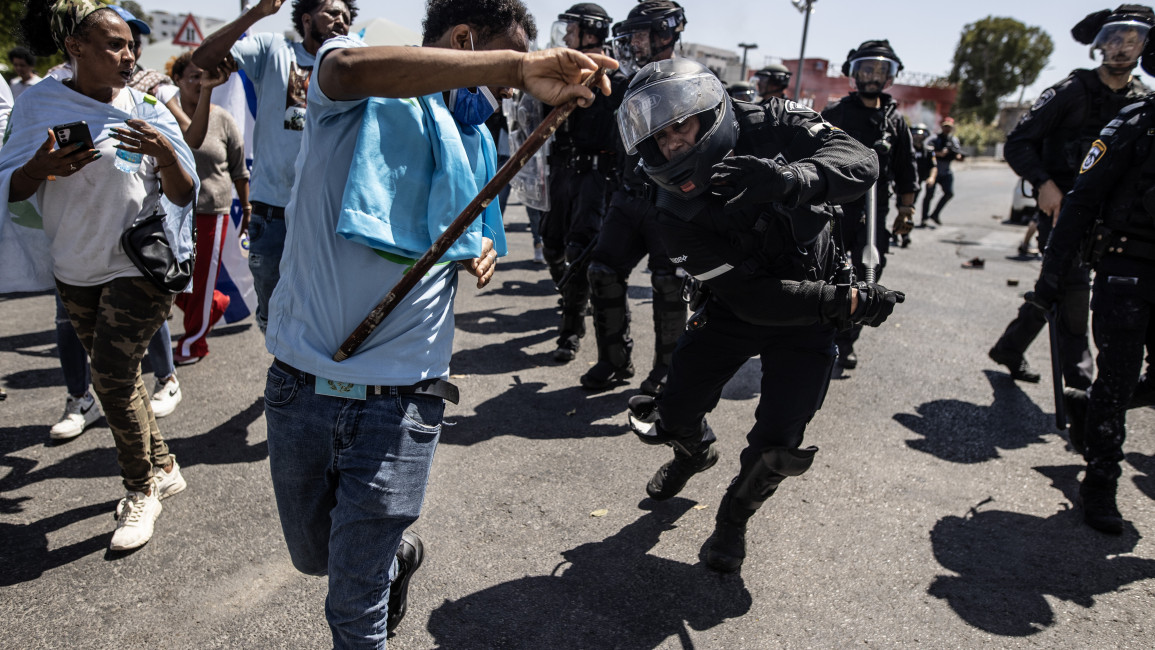
In the wake of violent clashes during protests by rival groups of Eritreans in south Tel Aviv at the beginning of this month, the Israeli government has launched a full-scale offensive against African migrants.

The unrest erupted after opponents of the Eritrean government asked Israeli authorities to cancel an embassy event, and clashed with government supporters. The involvement of the Israeli police dramatically intensified the street fight as officers fired on protesters with live ammunition, arguably a disproportionate response.

In the aftermath of the altercations between pro- and anti-regime Eritreans, Israeli Prime Minister Benjamin Netanyahu vowed to deport the “illegal infiltrators” involved in the skirmishes. More than 50 Eritrean protest participants were detained without charge or trial.

Just a week later, the Israeli cabinet approved $5 million to incentivise African migrants and refugees to depart, the latest of several measures the Israeli regime has taken over the years to try to kick asylum seekers out of the country. It also announced plans to strengthen the police presence in south Tel Aviv, where many migrants live.


"The recent crackdown on Israel's Eritrean minority points to an escalation in the Israeli right's anti-migrant campaign, which has long sought to target non-Jewish immigrants"

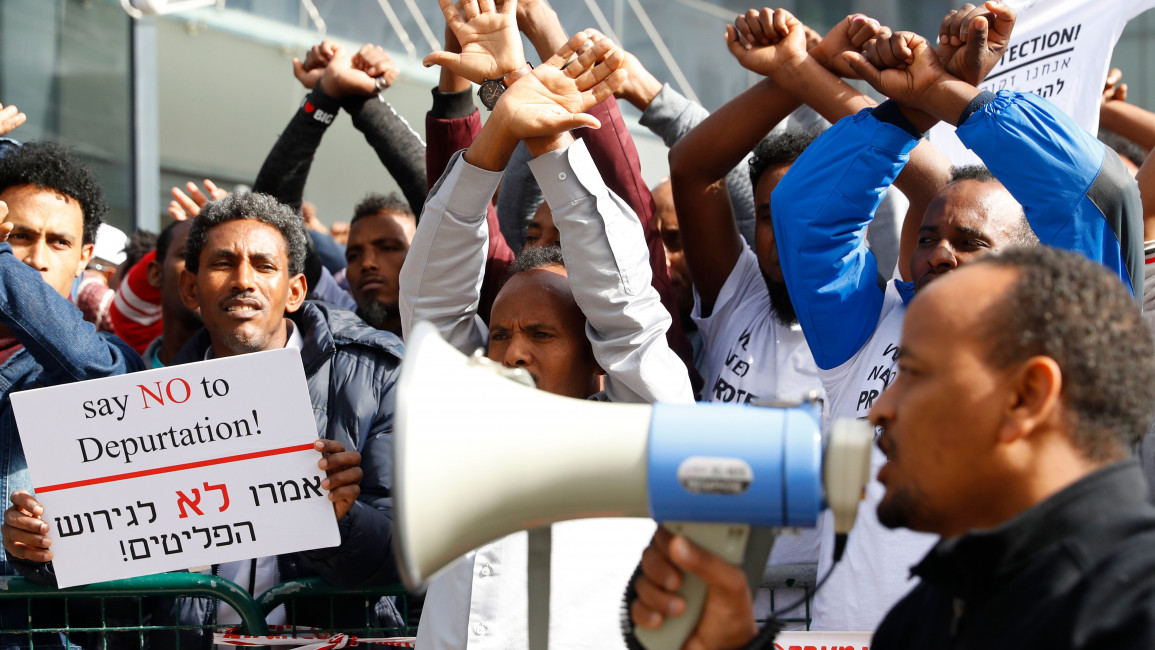
Halefom Sultan, an Eritrean asylum-seeker and activist living in Tel Aviv, thinks police violence in the events at the Eritrean embassy “reflects” the Israeli government’s policies, observing a recurring use of excessive force on non-Jews in the country.

“Every time there’s an incident of violence, police forces will turn against us [refugees],” he told The New Arab.

The refugee activist hinted that it is possible that Israeli officials purposefully left these politically opposed Eritrean groups to clash with each other to fuel the perception that asylum seekers are “criminals”.

“Whenever refugees get into a fight, Israeli police will just stand by until it’s all over,” Sultan said, emphasising that the non-intervention seemed deliberate.

Netanyahu called migration from African countries a “threat” to the state of Israel, hailing the construction of a barrier on the southern border with Egypt which he claimed blocked “hundreds of thousands, if not millions, of Africans”.


Analysis Fatih Şemsettin Işık

The Israeli PM said there remains a “problem” in south Tel Aviv and elsewhere that needs to be resolved, and ordered a plan to remove all of the country’s African migrants, claiming that they are a threat to the “future of Israel as a Jewish and a democratic state”.

Netanyahu and others in his government have blamed the Supreme Court for previously standing in the way of forcing migrants out of Israel.

The recent crackdown on Israel’s Eritrean minority points to an escalation in the Israeli right’s anti-migrant campaign, which has long sought to target non-Jewish immigrants. Consecutive Israeli cabinets, mostly under Netanyahu’s leadership, have manifested this hostility towards African asylum seekers, the majority of whom are from Sudan and Eritrea.

Between the years of 2005 and 2012, Israel began implementing several policies to dissuade immigration as many Africans arrived in the country via Egypt, before building a fence along the desert border which largely stemmed the numbers of incoming migrants.

More than 100 people were injured when Israeli police intervened in clashes between rival Eritrean factions in southern Tel Aviv on 2 September 2023.

“The Israeli government has initiated so many directives to make [African migrants’] life miserable in order to coerce them into leaving,” Sigal Rozen, public policy coordinator at the Israeli rights group Hotline for Refugees and Migrants (HRM), commented speaking to The New Arab.

Under international law, Israel cannot return people entitled to refugee protection to a country where their life or liberty may be at risk. But in recent years, Israeli authorities have tried various tactics against asylum-seekers to push them out.

In 2013, in response to a policy of incarcerating migrants indefinitely, Israel’s High Court overruled legislation that permitted migrants to be jailed for up to three years without trial. The detention period was later reduced to the current three-month period.

The Court also ordered the closure of Holot refugee detention centre in southern Israel’s Negev desert in 2014, which the government finally shut down in 2018.


"There are an estimated 25,000 African immigrants living in Israel, mainly from Sudan and Eritrea, who fled conflict or persecution. Very few have been granted refugee status"

Since 2013, Israel has encouraged asylum-seekers to leave ‘voluntarily’, often under the threat of imprisonment, by offering plane tickets, travel documents and cash payments.

Notably, it struck secret agreements with Rwanda and Uganda, where it started transferring Eritreans and Sudanese under a contentious “voluntary return” programme whereby immigrants had to choose between indefinite imprisonment in Israel and signing a document to “willingly” leave.

Those departing under this policy were not granted protection in Rwanda or Uganda, forcing them to embark on a dangerous journey in search of safety in Europe.

In 2018, the Israeli government took a harsher step by announcing a plan to forcibly deport African asylum seekers residing in the country to third African countries, however the deportation plan was cancelled following months of both local and international outrage and mobilisation.

Analysis  Muhammad Shehada

Israeli authorities have also been incentivising immigrants to return home or relocate by means of economic pressure. A 2017 law required employers to deposit 20% of asylum seekers’ wages into a fund that they could only access if they agreed to leave the country. The High Court repealed the law in 2020.

Last year, the Interior Ministry decided to prohibit the employment of asylum seekers in 17 Israeli cities, where most of them live, unless they work in certain industries (hospitality, construction, agriculture, and institutional caretaking) that rely on migrant labour.

Even though it has not been enacted, the directive puts refugees and migrants in limbo not knowing if they would be ordered to relocate to a city where they are authorised to live and work.

Another coercive governmental proposal was announced in June of this year to train asylum seekers and refugees professionally on the condition that they will leave Israel willingly.

For years, the Israeli government has implemented a range of tactics aimed at driving African migrants in the country out. 

“The most horrible of all measures is this constant instability. Every day, asylum seekers learn that Israeli decision-makers are discussing them or making new plans to try to expel them,” Rozen told The New Arab.

She stressed that, regardless of who is in charge, the Israeli political establishment has been steadily hostile toward African immigrants. “All governments during these years have wanted to see migrants out,” she explained.

There are an estimated 25,000 African immigrants living in Israel, mainly from Sudan and Eritrea, who fled conflict or persecution. Very few have been granted refugee status, with only a minuscule 0.5% of asylum seeker claims accepted as of today.

In contrast, Israel grants automatic citizenship to Jews from anywhere in the world, without requiring any justifying circumstances.

In-depth   Jessica Buxbaum

Those seeking asylum in Israel are only allowed to stay under a temporary permit. They are not officially allowed to work, and are not entitled to healthcare or welfare services, except in extreme cases.

Most of them reside in south Tel Aviv, characterised by a relatively lower cost of living, or economically deprived neighbourhoods of Jerusalem, Eilat, Haifa, Arad, and Ashkelon. Israeli residents in those areas complain of increased crime, a rise in rents, and lack of jobs, often blaming migrants.

Immigrants with little to no rights have already lived with an uncertain future amid ongoing efforts to push them out of the county.

Now, Israel’s right-wing government is leveraging the rise in hostility towards migrants in the aftermath of the Tel Aviv clashes to further its racist campaign against the non-Jewish migrant community.

Alessandra Bajec is a freelance journalist currently based in Tunis.

Follow her on Twitter: @AlessandraBajec