Tuesday, November 21, 2023

CANADA

Concerns emerge over NextStar's plans to hire foreign workers for battery plant

NextStar Energy Inc.'s plans to bring foreign workers to help build a heavily subsidized battery plant in Windsor, Ont. has drawn concerns about why the jobs aren't going to Canadians. 

Federal Conservative Leader Pierre Poilievre said he is pushing for a full inquiry into the issue to find out how many workers the company plans to bring in from abroad. The plant is expected to receive upwards of $15 billion in publicly funded incentives.

"Our money should fund our paycheques," he said in Ottawa on Monday. "We want a commitment that none of the money should go to temporary foreign work."

It's not clear how many workers NextStar Energy, a joint venture between automaker Stellantis and South Korea's LG, plans to bring from outside Canada.

Concerns were raised in part from a social media post last week by Windsor police, who said that after meeting with South Korean ambassador Woongsoon Lim, it expected about 1,600 workers from South Korea to come to the community next year to help build the plant.


NextStar Energy chief executive Danies Lee said in a statement Monday that the company is committed to hiring Canadians to fill more than 2,500 full-time jobs at the battery plant, and engage with up to 2,300 more local tradespeople to help with construction and installation.

He said, however, that the company has to bring in workers to help build the advanced manufacturing plant.

"The equipment installation phase of the project requires additional temporary specialized global supplier staff who have proprietary knowledge and specialized expertise that is critical to the successful construction and launch of Canada's first large scale battery manufacturing facility." 

The claim that the company needs to bring in foreign workers was challenged by politicians, including Brian Masse, the NDP member of Parliament for Windsor West. 

"There's no question in my mind that we have the skill set in Windsor, Essex County, in Ontario for these jobs," he said in Ottawa.

"This is about Canadian jobs that we can get to build a Canadian facility, with Canadian taxpayers money."

He called for more transparency on the multi-billion dollar contracts with automakers, including what kind of labour provisions are included.

Industry Minister spokeswoman Audrey Champoux said the details of the contracts can't be shared because of their commercially sensitive nature, but that benefits to Canada are at the heart of negotiations with global automakers.

Farrah-Lilia Kerkadi, a spokeswoman for Employment Minister Randy Boissonnault, said in a statement that the government has approved only one employee for this specific project through the temporary foreign worker program, and expects all businesses to make use of skilled labour in Canada.

"We have not yet seen a reasonable justification for needing to bring in large numbers of foreign workers and would ask NextStar to prioritize Canadian talent," she said.

At the provincial level, with Ontario footing a third of the plant subsidies, politicians were also raising concerns about the foreign hiring. 

Ontario NDP Leader Marit Stiles said she's also concerned that some jobs going to foreign workers could be done by local employees. 

"These jobs were promised to Ontarians, to Ontario workers, good union jobs." 

She said Ontario's Progressive Conservative government should have made sure there were clauses in the public funding contracts that ensured the jobs would go to local workers.

Ontario Labour Minister David Piccini deflected responsibility for foreign workers to the federal Liberals, while maintaining that local workers have the necessary skills.

"The work that we know needs to be done can be done by Ontario workers," he said. 

Plans to bring in temporary foreign workers also raised serious flags for Unifor, national president Lana Payne said in a statement.

She said Lee's clarifying statements Monday have, however, alleviated some of the union's immediate concerns.

"Our union will closely monitor the hiring process to ensure Canadian workers are first to benefit from this historic investment in the auto sector and that NextStar fulfils its stated commitment to good jobs in Canada,” she said.

With files from Liam Casey

This report by The Canadian Press was first published Nov. 20, 2023.


Champagne expects NextStar to bring in 'very few' foreign workers to help build plant

Federal ministers on Tuesday downplayed the number of foreign workers NextStar Energy Inc. will likely bring in to help build its heavily subsidized battery plant in Windsor, Ont., without providing specifics as to how many they expect will come.

Industry Minister François-Philippe Champagne said the company, jointly owned by Stellantis and South Korea-based LG Corp, needs to bring in a limited number of workers with expertise to help establish an electric vehicle battery industry in Canada.

"So you'll have a few people, very few people, selected people, who need to come to transfer technology, because this is a new industry."

He said he spoke with the CEO of NextStar on Monday, along with the head of Stellantis, and was reassured by their commitments to hire Canadians. 

Labour groups and politicians raised concerns in recent days after Windsor police said that they were helping prepare for a potential 1,600 workers from South Korea to come and help build the plant, which is expected to cost upwards of $15 billion in public support.


NextStar chief executive Danies Lee confirmed Monday that the company still plans to hire about 2,500 Canadians to run the plant, and is also engaging up to 2,300 local and regional tradespeople to help build it.

He said the company would still need to bring in additional temporary staff who have "proprietary knowledge and specialized expertise" to help in the factory's construction and launch.

NextStar however didn't specify how many workers it expects to bring in, a question Ontario's Minister of Labour, David Piccini, and Minister of Economic Development, Vic Fedeli, pushed the federal government on Tuesday.

In a letter to their federal counterparts, they called for the disclosure of the number of foreign workers already on the ground working on building the plant, and how many will be arriving under federal programs.

"Taxpayers and workers deserve to know that every job related to this project that can be filled by a Canadian worker is filled by a Canadian worker and that no Canadian worker is displaced," they said in the letter.

Federal Employment Minister Randy Boissonnault said to reporters Tuesday that only one worker has been approved so far through the temporary foreign worker program, which assesses if there are Canadians available to fill the roll before allowing a foreign hire.

At the same event, Immigration Minister Mark Miller noted that because Canada has a free-trade agreement with South Korea, companies are able to bring in employees on work visas, or visa free, to carry out some work. 

Fewer than 100 people have come in as foreign workers, said Miller, a category distinct from temporary foreign workers.

"They are training people up," said Miller. "Not a single Canadian job that has been promised will be affected by this, but people do come and go as part of our free trade agreement with South Korea."

Champagne said they expect NextStar to prioritize Canadian workers, but that it's also important to keep in mind the bigger picture of the future of battery manufacturing industry.

"We're going to have a transfer of knowledge, allowing us to be successful for decades."


This report by The Canadian Press was first published Nov. 21, 2023.

With files from Stephanie Taylor in Ottawa


 CANADA

Small businesses left behind in rapidly-changing digital economy: report

Many Canadian small businesses are struggling to adjust as the global economy becomes increasingly dependant on digital technology, according to a new report from Deloitte Canada.

A shortage of digitally-skilled workers, the cost of software, and uncertainty about which technology to adopt are just some of the challenges laid out in the report on “digital equity” from Deloitte’s Future of Canada Centre.

The report, published Tuesday, included results from a survey of Canadian business executives.

It found that leading organizations across all sectors are leveraging new technologies to improve productivity, efficiency and resilience, and it’s becoming increasingly difficult for other businesses to succeed without following suit.

“The ability to participate and succeed in the digital world has become essential for organizations across all sectors… but not all organizations are equipped to seize digital opportunities,” the report said. 


It said that small and medium-sized businesses face disproportionate challenges when it comes to tech adoption, which has only exacerbated the disparity between businesses that do and don’t succeed.

TECH ADOPTION BARRIERS

According to Deloitte’s survey respondents, the cost of new software is the biggest barrier to digital tech adoption, with 67 per cent of business leaders saying the cost of licenses and subscriptions is somewhat or very challenging, with another 25 per cent saying it is a great challenge.

The report added that not only do businesses struggle to afford new technology, but many organizations simply aren’t sure which digital tools are best for them. 

“Faced with an ever-evolving marketplace of technologies, many leaders are struggling to determine which tools are the most useful, the most user-friendly, and offer the best value for money,” it said.

The report said that the challenge is even greater for small and medium-sized businesses, as those organizations often don’t employ people who provide digital tech guidance, and therefore end up investing in solutions that “don’t quite meet their needs or aren’t quite what they paid for.”

DIGITALLY-SKILLED WORKER SHORTAGE

The report also said that the demand for digitally-skilled workers able to operate and maintain new technologies is far greater than the supply in Canada – and that demand is only expected to increase.

Again, the report noted that small and medium-sized businesses are at a particular disadvantage when it comes to attracting the best digitally-skilled talent.

“Larger organizations tend to have more financial and human resources available to support their recruitment and hiring efforts,” the report said. “They are also better positioned to offer competitive compensation packages.”

SKILLS GAP

Organizations are also grappling with a digital skills gap in their existing workforces, the report said.

Less than half of surveyed business leaders said at least three-quarters of their employees had the skills to create and modify content online. And less than a third of business leaders said at least three-quarters of their employees were able to protect digital devices and avoid cybersecurity risks.

Despite the gap, the report noted that many businesses, particularly smaller ones, don’t offer or facilitate digital skills training opportunities for their staff.

In 2021, Canada ranked 25 out of 29 countries for the proportion of businesses that provided training to develop information and communication technologies (ICT) skills for persons not already employed in the sector, according to the report.

“Just 11.3 per cent of businesses with 10 or more employees indicated that they had provided any type of such training for non-ICT specialists compared to the Organisation for Economic Co-operation and Development (OECD) average of 19.5 per cent,” it said.

METHODOLOGY

Deloitte surveyed 804 senior business executives across Canada from Sept. 7 to Oct. 11, 2022. Respondents included executives from both for-profit and not-for-profit organizations of varying sizes and economic sectors, as well as governments, Crown corporations, and other public sector organizations.

The survey explored the current state of digital investment in Canadian organizations, as well as the challenges leaders have faced in the course of adopting new digital technologies.


Addressing Indigenous inequities could boost economy by 0.5%: RBC report

Inequities related to housing, wages and education are hampering the economic participation of Indigenous Peoples in Canada, and a new report from RBC Economics says closing those gaps could boost Canada’s economy as a whole.

RBC’s report, released Wednesday, looked at gaps in key housing, education and internet infrastructure that it said is holding back Indigenous Peoples’ participation in the economy. The report pegged the overall infrastructure gap as totalling $350 billion, citing figures from the Assembly of First Nations. 

For the purposes of its report, RBC said it was defining Indigenous Peoples as individuals who self-identify as First Nations, Inuit and Metis.

The economics researchers said that the infrastructure gap is contributing to higher unemployment and lower labour participation rates in the Indigenous population, as well as lower wages for Indigenous workers compared to the wider Canadian population.

Investing in closing the infrastructure gap would significantly increase Indigenous production and help increase Canadian GDP, the report said.

“Boosting Indigenous participation rates and employment rates to current non-Indigenous rates would not only boost Indigenous output by up to 17 per cent, but would add half a percent to the productive potential of the Canadian economy annually,” it said.

LIVING CONDITIONS

Indigenous populations are more likely to live in remote regions, the RBC report said, which is one factor that could be contributing to the wider infrastructure gap.

“In the face of high costs for essentials alongside logistical challenges and poor infrastructure, Indigenous communities face limited access to building materials,” it said.

As a result, one in six Indigenous people live in homes in need of immediate repair, and Indigenous individuals are twice as likely as non-Indigenous Canadians to live in over-crowded housing arrangements, according to the report.

Another barrier that exists for Indigenous people living in remote communities is the lack of reliable access to high-speed internet, which “limits access to educational and economic opportunities present in more connected communities.”

‘PERNICIOUS WAGE GAP’

The report said the infrastructure gap also contributes to a significant wage discrepancy between the Indigenous and non-Indigenous populations in Canada.

“Canada’s Indigenous population is younger and works longer hours than their non-Indigenous counterparts but a pernicious wage gape persists,” it said.

“Working-age Indigenous employees earned 92 cents in average hourly wages for every dollar earned by the non-Indigenous population in 2022.”

The report noted that a lack of education infrastructure plays a significant role in the wage gap, which is more pronounced amongst those with lower education levels.

Currently, it said there is also a gap between the Indigenous and non-Indigenous population when it comes to obtaining post-secondary education, “with the Indigenous population almost three times less likely to hold a university degree.”

BRIDGING THE EMPLOYMENT GAP

The report said that improving educational outcomes for Indigenous Peoples in Canada would also likely improve overall participation in the labour market and reduce a “historically elevated unemployment rate.”

“While Indigenous Peoples make up five per cent of the population, the Indigenous economy accounted for 2.5 per cent of Canadian output ahead of the pandemic,” it said. 

Improved Indigenous participation would also fill a growing need in Canada as demographics continue to shift, the report said, noting that 40 per cent of the population falls under the age of 24, compared to only one-quarter of the non-Indigenous population.

“As the Canadian population ages and labour shortages become more acute, with the right infrastructure in place, Indigenous youth are well-positioned to fill these gaps as demographics shift,” it said.


Proposed Toronto-Chicago rail corridor draws attention, as Via tempers expectations

The mayor of Windsor, Ont., has drawn renewed attention to a push from Amtrak and Via Rail to link their lines across the U.S.-Canada border and revive passenger service between Toronto and Chicago before the decade is out.

Drew Dilkens shed new light last week on the proposal by showcasing a "fact sheet" provided by the railroad operators. The document states that they aim to connect two of North America's biggest cities as soon as late 2027, as well as 21 other communities in between. Ten of the stops are in Ontario, including Toronto, Brantford, London and Windsor.

The internal document projects annual ridership of 66,500 passengers, or 182 per day, on a once-daily round trip between Toronto and Chicago. In addition to touting economic benefits, it lays out track upgrades, crossing improvements and a joint customs facility to be built at Via Rail's station in Windsor.

Via confirmed it is in private discussions with Amtrak and other partners about the possibility of connecting Windsor and Detroit to re-establish the long-defunct corridor.

"However, Via Rail did not release the project fact sheet shared by some media outlets last week and we believe it is premature to be holding a discussion on this project in the public sphere," spokesman Karl Helou said in an email.

While Dilkens said Amtrak and Via would pay for the project, Via says it has made no funding requests or commitments to finance the undertaking.

Amtrak confirmed it is in conversations with local, state and provincial officials about the would-be route.

The quasi-public passenger railway first sought to restore a connection between Toronto and Michigan via the 113-year-old Detroit River Rail Tunnel in 2019, with the Biden administration's US$1.2-trillion infrastructure bill now breathing new life into hopes of revitalized service. Some US$66 billion of the total is allocated for passenger rail, marking America's biggest investment in the sector since Amtrak's inception in 1971.

The aging tunnel is owned by Canadian Pacific Kansas City Ltd., which would have to give the green light for any service through the underwater route, where passenger trains have not operated since 1967.

This report by The Canadian Press was first published Nov. 14, 2023.

Trudeau faces calls to exit with his party trailing in polls

Slumping badly in opinion polls, with voters angry about housing and inflation, Justin Trudeau is facing calls to leave, even from stalwarts of his own political party.

The prime minister may not have to face voters until 2025, thanks to a power-sharing deal with the NDP, which gives him some runway to try to turn things around.

But that’s also enough time for Trudeau to resign or be forced out of the leadership of the Liberal Party by his increasingly restless caucus of 158 members of parliament — especially as surveys find a strong desire for change among Canadians.

For months, polls have shown the Conservative Party, led by Pierre Poilievre, ahead by 10 to 15 points and gaining ground nearly everywhere. Those numbers, if they were to hold up in an election, would likely produce a large majority government for the 44-year-old opposition leader and end Trudeau’s reign with a thud.

It’s the deepest funk Trudeau has endured during his eight years in power.

“This has been something that’s been building for a while,” said Andrew Enns of the polling firm Leger. “When there’s a strong change in sentiment, people make up their mind about the leader. And in this case with Mr. Trudeau, they’ve decided that he just doesn’t have it for the problems they’re currently facing.”

He attributed the Liberal slide to voter fatigue with Trudeau as well as Poilievre’s relentless focus on the economy.

The Conservative leader is the most formidable challenger Trudeau has faced, and has channeled Canadians’ anger about the rising cost of living — dubbing it “Justinflation.” Poilievre’s constant refrain is: “After eight years of Justin Trudeau, everything costs more.”

Poilievre has embraced social media as a way to energize his base. A recent video of him chomping an apple while batting down a journalist’s questions attracted 1.5 million views on X, the platform formerly known as Twitter, and drew praise from Elon Musk and Fox News.

Excitement within the party about his leadership has translated into record fundraising — money the Conservatives have pumped into television ads meant to soften his image, featuring his wife, kids and childhood photos of him playing hockey.

The Liberals, meanwhile, have only just recently started to aggressively hit back at Poilievre, painting him as a Canadian version of Donald Trump.

In public and private, Trudeau and his advisers say he has no intention of resigning before the next election. His inner circle believes the government needs to weather the storm caused by the surge in inflation and show voters Trudeau can still deliver results when it comes to the cost of living.

Inflation has slowed to 3.8 per cent from a peak of 8.1 per cent, but Trudeau has still faced relentless pressure over costs and has started to buckle.

CARBON CLIMBDOWN

A national carbon tax is his signature environmental policy, but last month he suspended it on home-heating oil — an expensive, dirty fuel used largely in Canada’s east-coast provinces, where Poilievre has drawn big crowds with “Axe the Tax” rallies.

The move sparked furor among premiers of other provinces and alienated environmentalists. The decision “broke my heart,” said Catherine McKenna, who was Trudeau’s environment minister when the carbon levy was enacted.

The policy is designed in a way that cushions to blow for lower- and middle-income Canadians — most get more back in the form of quarterly rebate checks than they pay, according to the government. But it’s complex and poorly understood, making it an easy political target at a time when financial stress is rising.

“The challenge with the decision is that it creates the impression that the affordability issue is pricing, which it’s not. It’s revenue-neutral. We give all the money back,” said McKenna, who left politics in 2021 and is the founder and chief executive of Climate and Nature Solutions.

Pierre Poilievre, whose Conservatives are ahead in the polls, has dubbed the sharp rise in the cost of living under Trudeau’s government ‘Justinflation.’

The big question is whether Trudeau can win back support among Canadians after having lost so much of it during eight years in power.

During that time, housing costs have gone up nearly 70 per cent. The country’s households are the most indebted in the G7 and interest rates have risen so quickly that many are now paying little to no principal on their mortgages. Price increases on rents and food still outpace headline inflation.

Over the fall, Trudeau and his cabinet have rolled out a series of announcements meant to spur housing construction, and met with the heads of major grocery firms to demand a plan to stabilize food prices. The problem is that many solutions are outside Trudeau’s grasp, according to Dan Arnold, who oversaw the Liberals’ research management program during their 2015, 2019 and 2021 election victories.

“Nothing that government’s going to do is going to suddenly make housing affordable for a young person or suddenly make life more expensive or less expensive,” said Arnold, chief strategy officer at Toronto-based polling firm Pollara and a senior adviser at Alar, an Ottawa consultancy. “But maybe at the very least it can minimize some of the frustration and the anger out there.”

Even if the polls were better, Trudeau would already be taking a risk by running again. It’s been more than a century since a Canadian leader won four straight elections. The last one to try, Stephen Harper, was decisively beaten by Trudeau after governing for nine years.

Trudeau entered this year in a strong position, having secured the deal with the New Democrats and quieted succession talk in his party. He rode out the political crisis caused by the trucker protests in 2022, during which he invoked rarely-used emergency powers to clear blockades from Ottawa’s streets and from U.S. border crossings. A subsequent judicial inquiry found Trudeau’s actions were justified.

But 2023 has been brutal for the Canadian leader. He became embroiled in foreign controversies, including allegations he failed to respond to Chinese interference in Canadian elections, which have now led to another judicial inquiry.

More recently, he touched off a furor after accusing India’s government of orchestrating the assassination of a Sikh activist in Vancouver. So far, the evidence behind Trudeau’s claim hasn’t been shared publicly because the murder is under police investigation.

His annus horribilis even extended to his personal life. In August, he and Sophie Gregoire Trudeau announced they were separating after 18 years of marriage. They have continued to co-parent their three children.

‘WALK IN THE SNOW’

Throughout it all, whispers about Trudeau’s future have grown louder. Senator Percy Downe, who once served as chief of staff to Liberal Prime Minister Jean Chretien, penned an opinion piece blaming the slide in the polls on Trudeau’s lack of fiscal responsibility and arguing that a new leader would give the party “a chance” of re-election.

In subsequent interviews, he said many Liberal members of parliament shared his view. But no currently elected Liberal has openly called for Trudeau to go.

John Manley, a former Liberal deputy prime minister, told BNN Bloomberg that the mood for a change is so strong, Trudeau’s choices are to quit or lose. “There’s what I call the Seinfeld Rule at play,” he said. The TV show ran for nine seasons, and through recent Canadian history, that’s usually about as long as a prime minister can last.

Some have pointed out the providence of 2024 being a leap year: Feb. 29 will mark 40 years since Trudeau’s father, Pierre Elliott Trudeau, announced his resignation as prime minister, a day after a solitary walk in an Ottawa snowstorm. (Since then, a “walk in the snow” has become Canadian political shorthand for making a decision to leave.)

Justin Trudeau, however, believes he can stay in place. “The next elections are two years away. I’m continuing to do my job,” he told reporters this fall. “There’s a lot of important work to do, to deliver for Canadians in these difficult moments. I remain enthusiastic and relentless with regards to this work.”


Bell seeks to appeal CRTC decision allowing carriers' access to its fibre network

BCE Inc. is seeking to appeal a regulatory decision that will allow independent companies to sell internet services to their customers using its fibre network in Ontario and Quebec, saying it is at risk of suffering irreparable harm.

The parent company of Bell Canada filed documents with the Federal Court of Appeal late Thursday requesting permission to appeal the CRTC's temporary ruling, and for a stay of the decision pending the outcome of the court process.

"The decision will have far-reaching impacts on Canadians’ access to high-speed internet beyond the interim period in which it is in effect," the company said in its filings.

The CRTC announced on Nov. 6 it would require large telephone companies, namely Bell and Telus Corp., to provide competitors with access to their fibre-to-the-home networks within six months.

The regulator said the timeline would allow companies to prepare their networks and develop information technology and billing systems.

The move is meant to stimulate competition for internet services in Ontario and Quebec, where independent internet providers now serve 47 per cent fewer customers than they did two years ago.

The regulator said its ruling was in line with Industry Minister François-Philippe Champagne's direction earlier this year for the CRTC to enhance consumer rights.

It represented a partial decision in a broader review launched by the CRTC in March into the rates that smaller competitors pay the major telecom companies for access to their networks.

That review, which could potentially determine whether the CRTC's direction will be made permanent and applied to other provinces, remains ongoing. The next public hearing set for Feb. 12, 2024.

The CRTC also set interim rates that smaller competitors will pay for access to fibre networks.

In its court filings, Bell called its fibre service its "flagship" home and business internet offering which provides speeds at least twice as fast as cable internet. The company said the technology is "exceedingly expensive," having spent around $4 billion per year every year on it over the past decade.

The service "is a distinguishing factor for Bell and is crucial to Bell’s competitive position in the market," it wrote, arguing the CRTC's decision will "undermine Bell’s competitiveness and its multibillion-dollar investment in network infrastructure."

Hours after the CRTC announced its decision last week, Bell said it would cut network investment plans by more than $1 billion in 2024-25, including a minimum of $500 million next year. Bell said that was on top of having already decreased its 2023 spending plans by $100 million in anticipation of the CRTC's decision.

Based on a cost study, Bell said it would have to spend more than $30 million to adhere to the CRTC's decision and allow smaller companies to access its fibre network infrastructure, of which around $14 million will be "unrecoverable."

"This capital would otherwise be available for projects that would benefit Bell’s competitive positioning and revenues," it said.

Bell noted the CRTC's decision did not apply to all carriers that build networks — cable companies such as Rogers Communications Inc. were unaffected — and that the regional focus disproportionately targets areas where only Bell has built its fibre network.

"If the decision is not stayed and is ultimately overturned by this court, then Bell will suffer irreparable harm through the loss of customer and revenue," it said.

Bell argued the regulator erred in law when it made its decision because it did not use the correct test to arrive at it, nor did it inform stakeholders of the test it would use.

This report by The Canadian Press was first published Nov. 17, 2023.

BNN Bloomberg is owned by Bell Media, which is a division of BCE.

NO DEEP SEA MINING
The promise and risks of deep-sea mining
Reuters | November 15, 2023 | 1

Credit: The Metals Company

LONG READ

The International Seabed Authority is working to set regulations for deep-sea mining as companies engaged in the clean energy transition clamor for more minerals. That transition will be a central focus at the United Nations’ COP28 climate summit in Dubai from Nov. 30 to Dec. 12.


The most-prominent of the three proposed types of deep-sea mining involves using a giant robot that is sent down to the ocean floor from a support vessel.

This robot travels to depths of roughly 5,000 meters to the ocean floor — the least explored place on the planet.

The seafloor, especially in parts of the Pacific Ocean, is covered by potato-shaped rocks known as polymetallic nodules that are filled with metals used to make lithium-ion batteries for electric vehicles.

Many scientists say it’s unclear whether and to what extent removing these nodules could damage the ocean’s ecosystem. Automaker BMW, tech giant Google and even Rio Tinto, the world’s second-largest mining company, have called for a temporary ban on the practice.

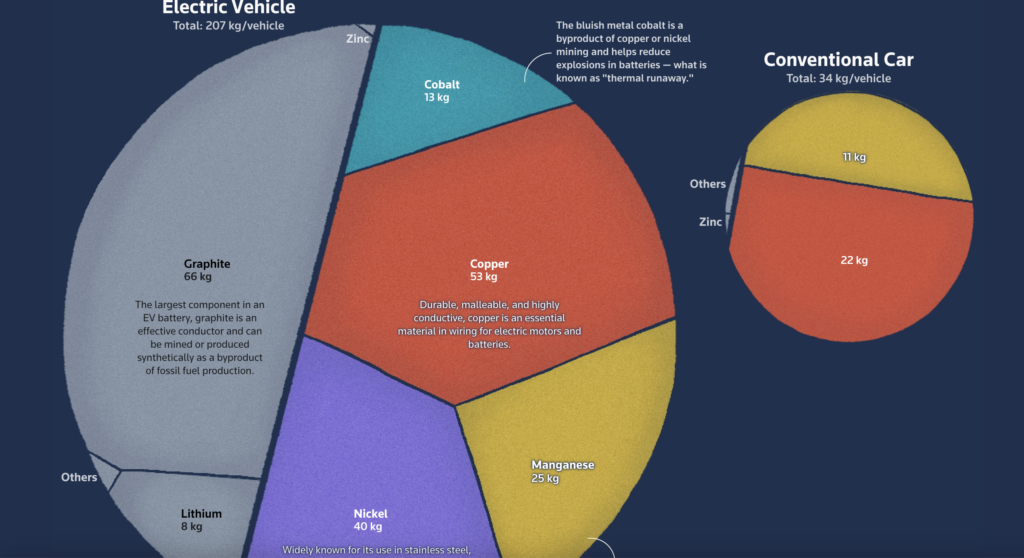
Composed of manganese, nickel, copper, cobalt and other trace minerals, these nodules hold some of the key ingredients needed to fuel the energy transition.

The metals in those nodules can be used to build electric vehicle (EV) batteries, cell phones, solar panels and other electronic devices. They are separate from rare earths, a group of 17 metals also used in EVs.

With climate change escalating, governments are under pressure to rein in emissions – especially from the transportation sector, which was responsible for about 20% of global emissions in 2022.

By 2040, the world will need to use twice the amount of these metals as it is using today in order to meet global energy transition targets, according to the International Energy Agency. And the world will need at least four times today’s amount in reaching net-zero greenhouse gas emissions.

Many of the minerals that go into making an EV are becoming harder to find on land, pushing up mining costs in recent years. That’s increased prices for EVs and other electronics after they had fallen for years up to 2020. A typical EV needs six times more minerals in total than a vehicle powered by an internal combustion engine.

Source: IEA (2021), The Role of Critical Minerals in Clean Energy Transitions

The scarcity and rising demand has made some governments and companies eager to allow mining in the oceans, which cover more than 70% of the planet’s surface.

First discovered by British sailors in 1873, the potato-shaped polymetallic nodules take millions of years to form as minerals in the seawater precipitate onto pieces of sand, shell fragments or other small materials.

Minerals are also found near deep-sea hydrothermal vents, where they’re called vent sulfides, and within seamounts known as ferromanganese crusts. Processes for extracting these minerals are similar to land-based mining, but harder to do underwater. That’s partly why the nodules are so appealing.
Land vs sea?

The mining industry has long had a mixed reputation on land. While it supplies the materials used to build our modern lives, it has contributed to deforestation, produced large amounts of toxic waste and in some parts of the world has fueled a rise in child labor. In 2019, a tailings dam — a structure that stores the muddy waste byproduct of the mining process — collapsed and killed hundreds of people at an iron ore mine in Brazil.

The average grade of mines on land — that is, the percentage of minerals extracted with every metric ton of rock — has declined over the last decade, requiring miners to dig deeper to extract the same amount of minerals.

All of these factors make deep-sea mining more appealing, supporters say. Environmentalists, however, say it’s a false dichotomy, as land mining will continue whether or not deep-sea mining is allowed.

Any country can allow deep-sea mining in its territorial waters, and Norway, Japan and the Cook Islands are close to allowing it. The International Seabed Authority (ISA), which is backed by the United Nations, governs the practice in international waters. The ISA missed a July 2023 deadline for setting standards for acceptable sediment disturbance, noise and other factors from deep-sea mining – a bureaucratic misstep that now allows anyone to apply for a commercial mining permit while the ISA continues negotiations.

“What are the alternatives if we don’t go to the ocean for these metals? The only alternative is more land mining and more pushing into sensitive ecosystems, including rainforests,” said Gerard Barron, CEO of Vancouver-based The Metals Co, the most-vocal deep-sea mining company and one of 31 companies to which the ISA has granted permits to explore for – but not yet commercially produce – deep-sea minerals.

Other companies with exploration permits include Russia’s JSC Yuzhmorgeologiya, Blue Minerals Jamaica, China Minmetals, and Kiribati’s Marawa Research and Exploration. Their potential future activities are seen as augmenting mining on land.
Where are these minerals?

The Metals Co — which is backed by metals giant Glencore — plans to use the robot to vacuum polymetallic nodules off a vast plain of the Pacific Ocean between Hawaii and Mexico known as the Clarion-Clipperton Zone (CCZ).

The company wants the ISA to set deep-sea mining standards, but said it reserves the right to apply for a commercial permit after July 2024 if the regulatory process stalls again. The ISA has said its work may not finish before 2025.

Companies need ISA members to sponsor them before they can apply for exploration or commercial permits. The island nation of Nauru, which is slowly being engulfed by the Pacific Ocean and sees deep-sea mining as key to the world’s energy transition, has sponsored The Metals Co.

Slowing the pace of climate change will be key for climate-vulnerable countries like Nauru if they hope to have a chance of adapting.

“Our existence is being threatened by the global climate crisis,” said Margo Deiye, Nauru’s ambassador to the United Nations and ISA. “We don’t have the luxury of time. This is quite a new nascent industry. Having clear guidelines in place, including standards, would be really helpful.”

Data from the U.S. Geological Survey and others show that the CCZ – which covers roughly 1.3% of the world’s ocean floor – contains more nickel, cobalt and manganese than all on-land deposits, a staggering volume that supporters say shows the practice should move forward. For copper, the CCZ’s deposits are roughly equal with those on land.

Multiple companies have been collecting small numbers of nodules as part of their robot tests in the Abyssal Zone, the part of the ocean below 2,000 meters. One such study is being conducted during November. If the ISA grants The Metals Co a commercial permit, the nodules will be sent to a refinery in Japan where the metals will be processed. The company says it will sell all parts of the nodules and thus there will be no waste byproduct beyond extraneous sand.

The Indian Ocean and parts of the Pacific Ocean are also rich in mineral deposits.

A March 2023 study conducted by the metals consultancy Benchmark Mineral Intelligence found that The Metals Co’s plans for the CCZ would cut mining emissions by at least 70%. The study focused on seven criteria, including contributions to ozone depletion and global warming. The study did find that on-land cobalt mining used less water, however. “We’re not talking about mining all of the ocean,” said Barron of The Metals Co, which funded the Benchmark study but said it had no control over its results. “We’re talking about one little patch.”

Deposits of nodules, crusts, and vent sulfides can be found globally, but only a fraction of these areas are being explored and are considered areas of economic interest.

The ISA has granted 19 exploration contracts for nodules, seven for vent sulfides and five for crusts. The Metals Co holds one; others are held by governments or state-controlled companies in China, Russia, France, India, Poland and Japan.

Decades of research has shown that deep sea mining could harm marine life or ecosystems. For example, sediment plumes kicked up by the robotic vacuum could disrupt animal migrations, according to one study published in February in Nature Ocean Sustainability.

The full importance of the nodules within the ocean ecosystem is unclear, and nodule regrowth could take millions of years. The nodules provide homes for anemones, barnacles, corals and other life forms, while bacteria and other invertebrates thrive on the ocean floor.

“These nodules are essential ecosystem architects. If you remove the nodules, you will remove the architecture supporting the entire oceanic ecosystem,” said Beth Orcutt, an oceanographer at Maine’s Bigelow Laboratory for Ocean Sciences who participated in the ISA standards debate.

What can be lost forever

The lively nodules

Once thought of as a desert devoid of life, the seabed is now estimated to have an extensive range of biodiversity. A 2016 study found a statistically significant correlation between aquatic life in the CCZ and nodule abundance.

Source: Reuters


The sediment plume

As the robot moves across the ocean floor, sediment clouds are stirred up and can irritate filter-feeding animals such as the corals and sponges that make nodules their home.
Regrowing corals

Bamboo corals on seamounts, as all corals, grow slowly, just millimeters per year. However, plumes distort habitat and can disrupt growth. When the corals are covered by sediment, their larvae will have trouble finding new sites to attach, some scientists warn.

Octopus nurseries

Four octopus nurseries have been discovered at hydrothermal springs around seamounts in parts of the Pacific Ocean near the CCZ. These springs act as a kind of “warm spa” and boost the metabolic rate of developing octopuses, thus speeding embryonic development. These springs are difficult to find, and mining may destroy some undiscovered springs before they can be protected, Orcutt said.
Hydrothermal vents

Mining is targeted at inactive vents, which have unique habitats that are even less understood than the ecosystems around active vents. The Scaly-foot snail, for example, is found only in a 300 square-km patch of the Indian Ocean near certain vents. It is the first animal listed by the International Union for Conservation of Nature as endangered due to the threat of deep-sea mining.
Essential microbes

The most susceptible species are those that depend on the unique chemistry of the waters that vent from the seafloor. The nodules have evolved symbiotically with microbes that can turn those weird chemicals into food. Mining also threatens conditions for these tiny microbes, some scientists say.
Irreversible damage

In the deep sea, it takes roughly 10,000 years for the ocean floor sediment layer to grow by just 1 millimeter, a process that includes sequestering carbon. The robotic vacuum’s disturbance reaches 10 centimeters into the seafloor, “basically resuspending a million years’ worth of time of carbon,” says the marine biologist Orcutt.
Discharge plumes

The nodules, once collected, are washed and stored on a ship, with the excess sand dumped back into the ocean. Scientists worry the discarded sand could harm aquatic life, including the plankton at the bottom of the food chain and tuna. The Metals Co says it will discharge sediment at depths below 1,000 meters to avoid most marine life.
Industrial noise

Studies show that loud noises can travel as far as 500 kilometers, impacting communications among marine animals like whales and causing behavioral stresses.
Light pollution

On the seabed, the robotic vacuum’s floodlights can harm shrimp larvae, studies have shown. On the surface, light from vessels that support the robots may affect squid and other aquatic creatures, as well as seabirds. More study is needed, scientists say, to understand potential harm from artificial light.
Human impact

In a March 2023 petition to ISA, more than 1,000 signatories from 34 countries and 56 Indigenous groups called for a total ban on deep-sea mining. Some Indigenous island communities are intimately connected to the ocean for fishing and other cultural traditions and oppose deep-sea mining, setting up a conflict with Nauru, the Cook Islands and other island nations that support it.
Is there a better way?

As the world’s hunger for metals and minerals to go green increasingly clashes with the realities of the mining process, the deep sea has become the latest focal point. Ultimately, manufacturers aim to create a circular “closed-loop” system, where old electronics are recycled and their metals are used to build new products.

But reaching that goal is expected to take decades. Debate about whether sensitive ecosystems on land should be dug up have empowered deep-sea mining advocates. Some companies competing with The Metals Co believe that the robotic vacuum is the problem, and are offering potential solutions.

The startup Impossible Metals has developed a robotic device with a large claw that collects nodules as the claw glides along the seafloor. Using artificial intelligence, the robot’s claw is able to distinguish between nodules and aquatic life, the company says.

“From day one, we are focused on preserving the ecosystem,” said Jason Gillham, the CEO of Impossible Metals. However, while the Impossible Metals robot is battery-powered, its energy comes from a diesel generator on a ship at the ocean’s surface, fueling charges that the company’s methods are not fully green.

A Japanese company plans to start mining next year in territorial waters controlled by Tokyo. Chinese officials have acknowledged they lag behind other nations in the deep-sea race, but are vowing to vigorously compete in this “new frontier for international competition.” China is already exploring a massive part of the Pacific seabed west of Hawaii – an area that dwarfs the CCZ. Norway, already a prolific offshore oil producer, is on track to be the first country to allow deep-sea mining if its parliament approves, as expected, plans to mine hydrothermal vents.

For now, the ISA’s members are hotly debating the best standards for deep-sea mining.

“Nothing we do will have zero impact,” said Joe Carr, a mining engineer with the metals consultancy Axora. “We’re going to need mining for the green energy transition.”
Sources:

NOAA Ocean Exploration and Research, the International Energy Agency, Monterey Bay Aquarium Research Institute, Beth Orcutt at Bigelow Laboratory for Ocean Sciences, Pradeep Singh at Research Institute for Sustainability, Kira Mizell at U.S. Geological Survey, The Metals Co., Impossible Metals, Natural Earth, Blue Earth Bathymetry, International Seabed Authority, InterRidge Vents Database.

(By Daisy Chung, Ernest Scheyder and Clare Trainor; Editing by Julia Wolfe, Katy Daigle and Claudia Parsons)
This Union Is Famous for Opposing South African Apartheid. Now It’s Standing With Gaza.

In 1984, ILWU Local 10 refused to unload goods shipped from South Africa. Today it’s demanding a cease-fire.

BY WORKDAY STAFF AND SARAH LAZARE | 2 hours ago

This article is a joint publication of Workday Magazine and The Nation.

In 1984, Larry Wright and his coworkers in International Longshore and Warehouse Union (ILWU) Local 10 refused to unload goods shipped from South Africa in solidarity with that country’s anti-apartheid movement. This boycott at the San Francisco pier, which lasted 11 days, sent reverberations throughout the US labor movement, where major players like the AFL-CIO still were not yet willing to endorse the anti-apartheid movement’s boycott campaign.

Now, nearly 40 years later, 81-year-old Wright is involved in another effort to move the labor movement toward global solidarity: As a retiree who can speak but not vote at union meetings, he was part of a successful push within the same Local 10 to pass a resolution demanding an immediate cease-fire in Gaza. The measure passed unanimously at a November 18 general membership meeting of the union, which is based in the Bay Area and has around 1,700 members.

“It’s really important that as many people as possible are opposing what’s happening, and Local 10 is one of the unions that leads the way with supporting a struggle like this,” he said over the land line at his house in Oakland. “So I think it’s really important that the unions come out and oppose this terrible violence on the Palestinians.”

The resolution, which was sent to Workday Magazine and The Nation, cites the appeal from the Palestinian General Federation of Trade Unions (PGFTU) for union solidarity with Palestinians. Over the past 45 days, the Israeli military has killed at least 13,300 people in Gaza, including 5,600 children, according to the Health Ministry, which amounts to one out of every 200 people in Gaza. Local 10’s resolution sends “a message to the PGFTU expressing our solidarity and determination to take action in their defense consistent with our actions in the past and ILWU’s principled position of defending Palestinian rights.”

The resolution calls the October 7 Hamas-led surprise attack that killed an estimated 1,200 Israelis “indefensible,” and states that “the UN calls Gaza an ‘open air prison’ of 2.2 million Palestinians. Under such repressive conditions it is no surprise that there would inevitably be a rebellion but this in no way justifies Israel’s genocidal bombing of civilians in Gaza.”

“We additionally call on other trade unions both nationally and internationally to support PGFTU, a ceasefire and an end to Israeli apartheid oppression,” the resolution says. (Numerous human rights groups say Israel’s treatment of Palestinians amounts to apartheid.) A Local 10 official will read the resolution to the Oakland and San Francisco city councils, and the union will encourage the ILWU International and District Councils to pass similar resolutions, the resolution states.

Trent Willis, a current member and former president of Local 10, voted in favor of the resolution at the general membership meeting, which was attended by roughly 200 people. “Our members are very concerned about news we’re hearing about innocent civilians being killed in the Gaza Strip right now,” he said over the phone. “And it’s not only our membership, but there are protests going on all around this country for a cease-fire.”

A growing number of local, state, regional, and even some national unions have issued similar calls for a cease-fire, a demand that is supported by a majority of people in the United States. The United States is supplying and politically backing Israel’s actions, and the Biden administration is seeking a significant increase in US military aid, even as humanitarian groups warn that Israel is indiscriminately targeting civilians. Among US labor’s supporters of a cease-fire are the United Electrical, Radio and Machine Workers of America (UE) and the leadership of the American Postal Workers Union. Yet, most national unions, and the AFL-CIO, have so far declined to follow suit.

Peter Cole, a professor at Western Illinois University and the preeminent historian of Local 10, says dock workers are well-positioned to push this effort forward. “Maritime workers, dock workers, and sailors look outwards, not inwards,” he said over the phone. “They are constantly interacting with people and cargo around the world.” Local 10 members operate cranes that take containers on and off ships, drive trucks that move containers within the port, load and unload cargo from international shipping vessels, and secure containers on those vessels, among other jobs.

“Back in the ’90s, the San Francisco Labor Council called Local 10 the conscience in the labor movement,” he said. “I think that holds true.”

Local 10 is perhaps best known for taking a principled stand against South African apartheid. This organizing goes back to at least 1962, when Local 10 refused to cross a community picket of South African goods at San Francisco Pier 19, in what Cole wrote was very possibly the “first anti-apartheid action ever taken by a labor union in the United States.” In response to a 1976 uprising in the Black segregated Soweto Township, when police opened fire on Black students, killing an estimated 176 to 700 people, Local 10 members formed the Southern Africa Liberation Support Committee. Led by Leo Robinson, a Black longshoreman in Oakland, this committee was endorsed through a rank-and-file vote, which provided infrastructure for anti-apartheid organizing in Local 10, alongside other solidarity with liberation movements.

Wright, who was active on this committee, remembers “setting up literature tables in union halls, and collecting clothing, food, and books” to ship to African liberation movements in South Africa, Mozambique, Angola, Zimbabwe, and Namibia, as a show of material support. These donations were a physical presence in union life, he said, which also made them an “educational opportunity.”

Wright said that “for me, personally, I was involved in supporting the struggles in southern Africa because they were struggles against imperialism and colonialism, against the exploitation of peoples in those countries.”

Local 10 organized a series of actions in the late 1970s, but its biggest protest came in 1984. For 11 days, members boycotted South African goods carried aboard the Nedlloyd Kimberley, docked at San Francisco’s Pier 80. “We voted at a union meeting that we wouldn’t work this ship,” said Wright. “We had support from churches, from the gay community, from other unions. We had community supporters come picket. It’s easier to refuse to work if there’s a picket line. But even if there hadn’t been a picket, members wouldn’t have worked, because it was union policy not to work that ship.”

The union took this move even though its contract did not permit such a work stoppage, putting it at risk of retaliation. As word spread, crowds of community supporters flocked to Pier 80, “singing, chanting, and making witness,” Cole wrote in a historical essay. For the duration of the boycott, all of the South African cargo remained in the hold of the ship, even as workers handled goods from other countries. It was only when a federal judge threatened an injunction, which could include prison times, that the boycott ended. “The workers, having made their point, unloaded the cargo,” Cole noted.


The 1984 boycott at the pier where Nedlloyd Kimberly was anchored. 
(Photo: courtesy of the Archive of Candy Wright)

By taking this action, Local 10 was ahead of the leadership of the AFL-CIO. While the federation opposed apartheid, AFL-CIO president Lane Kirkland “was hesitant to support a full-blown boycott and divestment campaign against South Africa, worried about the African National Congress and Nelson Mandela being too far left,” explained Jeff Schuhrke, an assistant professor of labor studies at SUNY Empire State University in New York City, who has written a book about the foreign policy of the AFL-CIO, which will come out next year. “Meanwhile, the whole South African anti-apartheid movement was saying we want you to boycott and divest, this is a tactic that will help us end apartheid.”

Local 10 was not alone. Other unions in the AFL-CIO—like the United Mine Workers, United Auto Workers, and AFSCME—would soon be stepping up their boycott and divestment efforts. These efforts almost certainly played a role in pressuring the AFL-CIO to eventually endorse the boycott and divestment strategy in 1986, alongside pressure from Black South African trade unionists, Schuhrke explained. In 1990, speaking at the Oakland Coliseum, Nelson Mandela saluted Local 10 for the 1984 boycott, declaring that the workers “established themselves as the front line of the anti-apartheid movement in the Bay Area.”

This 1984 action is part of a longer history that continued through the 2000s. “The ILWU has been one of the more internationalist oriented unions, recognizing the importance of solidarity around the world and standing up for freedom and justice and against imperialism and colonialism and apartheid,” Schuhrke explained. On May Day, 2008, workers at 29 West Coast ports launched a one-day strike to protest the wars in Iraq and Afghanistan, and ILWU members refused in 2010, 2014, and 2021 to handle cargo on Israeli ships, in response to community pickets against the repression of Palestinians. As labor journalist Kim Kelly reported for In These Times, “In 2020, the ILWU also shut down ports for 8 minutes and 46 seconds in solidarity with George Floyd, Breonna Taylor and all other victims of racist police violence.”

Today, opposition to Israel’s military actions in Gaza is animating protest movements throughout the world. This includes mass marches and a flurry of direct actions throughout the United States, where union members have been numbered among those taking to the streets, and demanding that members of Congress support a cease-fire. Lara Kiswani, a Palestinian American and executive director of the Arab Resource and Organizing Center (AROC), said that “we are particularly heartened by Local 10’s commitments to put its resolution to action.”

“For generations, our movement has found inspiration in Local 10’s commitments to social justice and internationalism—from its militant fights for worker power here in the US, to its unrelenting support of the South African anti-apartheid struggle, to its refusal to work Israeli ships profiting from the oppression of the Palestinian people.”

Throughout his organizing, Wright spent years working out of Local 10’s union hall, where he was dispatched to a variety of jobs, from laboring in the hull of the ship to latching containers, before switching to operating cranes and moving containers once he obtained more seniority. (He eventually switched to ILWU Local 91 after a promotion.) He saw how his union held moral power, because of their long history fighting against oppression.

“The ILWU is so respected,” he said, “that when it makes a call for people to join in opposing what’s happening to the Palestinian people, I think it carries a little extra significance, because of our history of supporting people’s struggles.”

Larry Wright (right), Leo Robinson (center), members of Local 10’s South African Liberation Support Committee (SALSC), which formed in response to the 1976 Soweto uprising.
(Photo courtesy of the Archive of Candice Wright)

By Workday Staff and Sarah Lazare|
Sarah is the Editor for Workday Magazine.