Tuesday, November 21, 2023

Chinese company gives leftover hotpot oil second life as jet fuel

Rebecca Bailey, with Jing Xuan Teng in Shanghai
Mon, 20 November 2023

A company in China is refining leftover hotpot oil so it can be transformed into sustainable jet fuel (Hector RETAMAL)

At an upmarket restaurant in the hotpot-loving Chinese city of Chengdu, diners plunge sliced meat and vegetables into cauldrons of spicy, oily broth, largely unaware that their leftovers are set to take on a second life as jet fuel.

With around 150,000 tonnes of used hotpot oil thrown out by restaurants in the city each year, local business Sichuan Jinshang Environmental Protection has found a niche processing the greasy waste and exporting it to be turned into aviation fuel.

"Our motto is, let oil from the gutter soar in the sky," Ye Bin, the company's general manager, told AFP.

Ye said his company, which launched in 2017, was now producing up to 150,000 tonnes of industrial-grade oil annually from a combination of hotpot restaurants and other eateries across Chengdu, including KFC outlets.

On a typical night, collectors hired by Jinshang visit hundreds of these restaurants around the southwestern metropolis.

The process begins right after customers leave, with waiters emptying their hotpot broth -- so rich it is used purely as a cooking medium -- into a special filter that separates oil from water.

Donning thick aprons and elbow-length rubber gloves, collectors then arrive to pick up jerrycans of the scarlet grease.

"It's a great job -- I play mahjong during the day and work at night," one collector named Zheng told AFP as he packed a minivan with containers of the pungent sludge.

That sludge is then ferried to a business park on the city's outskirts where Jinshang's mostly spotless plant is based.

The only trace of the oil there is a faint scent of hotpot at the unloading dock and telltale orange stains at the bottom of some equipment.

The oil is piped into massive vats and undergoes a refining process that removes remaining water and impurities, resulting in a clear, yellow-tinged industrial-grade oil.

That is exported to clients based mainly in Europe, the United States and Singapore, who further process it to make what industry insiders call "sustainable aviation fuel" (SAF).

SAFs are critical to decarbonising the aviation sector, which was responsible for two percent of global energy-related CO2 emissions in 2022, according to the International Energy Agency.

But they are still not widely used -- making up less than 0.1 percent of all aviation fuels consumed -- because of processing costs and the relatively small number of suppliers.

The International Air Transport Association estimates their widespread adoption could "contribute around 65 percent of the reduction in emissions needed by aviation to reach net-zero in 2050".

Jinshang has plans to expand into its own SAF-producing facility soon, using equipment from US firm Honeywell to produce 300,000 tonnes annually.

- Food waste problem -

Jinshang's business model is part of wider efforts in China to tackle the mountains of food waste generated by its population of 1.4 billion.

Around 350 million tonnes of farm produce -- over a quarter of annual output -- goes to waste in the country each year, discarded by restaurants, supermarkets or consumers, according to a 2021 Nature study.

In landfills, rotting food waste emits atmosphere-warming methane gas more quickly than most other materials, according to the US Environmental Protection Agency.

It's a massive headache for Chinese cities and a major threat to global climate goals -- one Beijing has vowed to tackle in a recent methane emissions plan that calls for the construction of innovative food waste processing projects across the country in the next few years.

In Shanghai, municipal waste treatment facilities have turned to the humble black soldier fly to turn tonnes of food waste each year into fertiliser and animal feed.

At the Laogang waste treatment plant, a cavernous sealed room houses 500 million maggots, which chomp their way through up to 2,500 tonnes of food waste each day, according to plant deputy director Wu Yuefeng.

The wriggling grubs excrete a fine, black, dirt-like substance that is repurposed as fertiliser, while the larvae themselves are killed and harvested at peak plumpness to be turned into livestock feed.

Back in Chengdu, the thought that his dinner will have a long, productive afterlife brings comfort to hotpot fan Dong.

"This utilisation and circulation of waste throughout the whole of society is more beneficial," he told AFP.

tjx-reb/je/smw/kma
Diddy’s alleged abuse of Cassie is a sad reminder of how power works in society

About one in four women will experience partner violence, yet domestic violence still seems shrouded by myths and silence


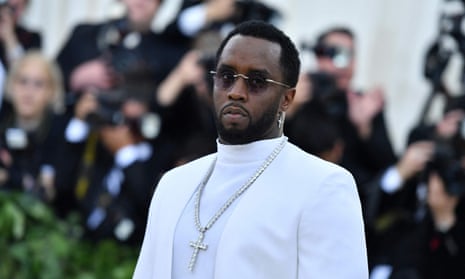
‘Ventura also alleges that after she was romantically linked to another man, Combs told her that he would blow up the man’s car.’ Photograph: Angela Weiss/AFP/Getty Images

GUARDIAN
Tue 21 Nov 2023 

The settlement came almost immediately. Cassandra Ventura, the R&B singer better known by the stage name Cassie, had filed her blockbuster lawsuit in federal court against the hip-hop mogul Sean Combs only a day before Combs, a rapper and producer, paid her to drop the suit. In her complaint, Ventura described a pattern of coercive control, abuse, drugging and sexual violence perpetrated against her by Combs throughout their more than 13-year relationship, which began in 2005, when Cassie was 19 and had just signed to the 37-year-old Combs’ Bad Boy Records, and ended in 2019.

Jann Wenner’s bias against women and Black musicians is shocking – but not surprising
Margaret Sullivan


The complaint alleges that Combs plied Ventura with drugs, such as ecstasy and ketamine; that he beat her, including in one incident in Los Angeles in 2009, after Combs saw Cassie talking to another business agent, which required her to recuperate for a week; that he raped her repeatedly, including an incident in which he hired male sex workers to gang-rape Ventura, which Combs filmed, and again in 2018, when he broke into her house and assaulted her after she attempted to leave the relationship; and that he controlled nearly all aspects of her life, including not only her career, which he allegedly leveraged to keep her silent, but also access to her own medical information and when she was allowed to see her family. Ventura also alleges that after she was romantically linked to another man, Combs told her that he would blow up the man’s car. A vehicle belonging to the rival exploded in a driveway shortly thereafter.

Ventura filed her lawsuit under New York’s Adult Survivors Act, a one-time window of opportunity for victims of gender violence to sue their attackers in civil court, even after the statute of limitations has ended. The law expires this week, on 23 November.

Combs – who throughout his career has adopted and then discarded a series of monikers, including “Puff Daddy”, “Puffy”, “P. Diddy”, “Diddy”, and, most recently, the improbable “Love” – denies all wrongdoing. After the speedy settlement, both parties said that they had “amicably” resolved the issue. It is likely that Combs paid Ventura substantially to drop the suit. In that case, the filing followed by a speedy settlement may be about the best that an alleged victim of such violence can hope for: Cassie was able to tell her story in public, and then, without having to endure the humiliation and upheaval of the legal process, or the public degradation that so often accompanies such cases for women, was able to get paid.

Ventura’s lawsuit comes just weeks after the actor Keke Palmer filed for a restraining order from her former partner Darius Jackson, with whom she shares an infant son. Palmer’s declaration to a Los Angeles court included screenshots from home security footage that appeared to show Jackson beating Palmer. She alleged that Jackson had abused her repeatedly over the years, including by breaking into her house and grabbing her by the neck. Domestic violence experts caution that strangulation is a sign of dangerously escalating abuse that could lead to homicide.

And Palmer’s request came just days after the rapper Megan Thee Stallion released Cobra, a single that tackles depression, isolation, self-medication and suicidal ideation in the wake of her experience of being shot by former partner Tory Lanez, and the public ridicule and demonization she faced during his criminal trial.

There’s a quiet revolution happening in Hollywood, one that is founded on tremendous pain but has the hallmarks of liberating, transformative potential: a new group of high-profile women, many of them Black, are speaking out about their experiences with domestic abuse. These women have sparked a vibrant, nuanced and long-overdue conversation among their fanbases – mostly online communities of Black women – about intimate partner abuse. Because of both algorithmic audience siloing and the passive racism of white disinterest, the conversation has so far not spilled over into the feminist mainstream. But it should. It is long past time that feminism picks up where #MeToo left off and embarks on a popular reckoning with both the horror and the ubiquity of domestic abuse.

Domestic violence is as pervasive as it is misunderstood: about one in four women will experience intimate partner violence in their lifetime, according to the National Coalition Against Domestic Violence, a figure similar to the one in five women who are estimated to experience attempted or completed rape in their lifetime. And yet domestic violence remains shrouded in many of the same myths and oversimplifications that feminists have long worked to chip away at with regard to sexual violence.

Victims are routinely labeled unreliable, smeared as vengeful and dishonest or as hysterical and incompetent. They are asked why they did not leave their abusers, or why they did not leave sooner than they did, or why they did not anticipate the abuse before it happened. When they report, they are seen to be airing dirty laundry, making private something which ought to be kept private. When they defend themselves or fight back, they are smeared as abusers themselves, their actions cast as morally equivalent to those of their attackers.

This all was on extremely public display just a year ago, over the summer of 2022, when the actress Amber Heard was subjected to a defamation lawsuit by her ex-husband, Johnny Depp, after seeking a restraining order from him and obliquely alluding to his alleged abuse in an op-ed. The disastrously mismanaged trial, fed on by a prurient media hungry for clickbait, became a gruesome spectacle of gleeful collective misogyny, all of it leveraged on that very same public misunderstanding of abuse.

Heard lost the suit, was pilloried in the press and will now have her name linked forever to the man she says abused, coerced, assaulted and controlled her for years. After what happened to her, it is a wonder that any women have come forward. That these women have is a testament, perhaps, to both their desperation and their courage.

With the benefit of several years’ hindsight, it is easy to see the places #MeToo failed, and in particular, the places that its conversations were not permitted to go. Workplace harassment was considered fair game for women to complain about, at least some of the time; boorish, violent or otherwise sexually entitled behavior in the private sphere was not, at least not according to accused men’s angry defenders. A line seemed to be emerging in the discourse at that time: public behavior is something women are allowed to complain about; private behavior is something they are expected to endure.

Such have been the rules of male violence since time immemorial. The home, the family, the marriage or the relationship are supposed to be sites of men’s unquestioned control, places where neither the law nor public judgment are supposed to intrude. Confronting domestic violence does not allow this rule to be followed: it demands that we treat women as whole, worthy persons, in public and in private alike. We can only hope that more women will have the courage to make this demand.

Moira Donegan is a Guardian US columnist

In the US, the domestic violence hotline is 1-800-799-SAFE (7233). In the UK, call the national domestic abuse helpline on 0808 2000 247, or visit Women’s Aid. In Australia, the national family violence counselling service is on 1800 737 732. Other international helplines may be found via www.befrienders.org.

Political attack on human rights is a ‘dangerous’ assault on UK democracy, says HRW director
A police officer arrests a Just Stop Oil activist in Bishopsgate, London, in July. Photograph: Guy Bell/Shutterstock

Yasmine Ahmed says government actions regarding asylum seekers, climate activists and pro-Palestine protesters are starting to ‘look very much like authoritarianism’


Annie Kelly
GUARDIAN
Tue 21 Nov 2023 

The British government’s aggressive politicisation of human rights is a dangerous assault on democracy that must be halted before irrevocable damage is done, the UK director of Human Rights Watch (HRW) has warned.

In an exclusive interview with the Guardian, Yasmine Ahmed, who has been the UK director of HRW since November 2020, said the government indicating it could “disapply” the Human Rights Act to an emergency bill that will allow it to send asylum seekers to Rwanda – despite the supreme court ruling the policy illegal – is part of an escalating attack on human rights.

Yasmine Ahmed has been UK director of HRW since November 2020.

“With previous governments there was always an attempt to at least try to appear as if they were complying with domestic or international human rights law and to respect the courts and human rights institutions,” Ahmed said. “Now there is no attempt to do this – in fact, it’s quite the opposite.”

She continued: “Rishi Sunak’s government must know that even scrapping the Human Rights Act will not prevent it from facing significant legal barriers to its Rwanda policy, but what we’re seeing is the UK moving towards a place where the government feels it can undermine the integrity of the judiciary, undermine or scrap human rights laws that don’t serve its current political agenda, and create new laws that do. This is a dangerous place to find ourselves in. This can start to look very much like authoritarianism.”

Ahmed says that since she took up the UK directorship of Human Rights Watch three years ago, the government has launched an unprecedented attack on human rights enshrined in British and international law.

“Not only is the government talking about ripping up domestic human rights law and ignoring its international obligations, it has launched an open attack on the right to peacefully demonstrate, is locking up climate protesters, criminalising refugees and has given the police unprecedented powers over citizens,” Ahmed said.


UN human rights chief says UK should rethink plans to deport asylum seekers to Rwanda

“This approach not only discredits and undermines our ability to hold other human rights violators to account on the international stage, but it creates a model of governance that puts political ideology over a state’s legal obligation to uphold basic human rights that were put into law to protect us all. Once you attack, discredit and tear up these laws and frameworks it could be almost impossible to put them back together.”

She says that in recent weeks, attempts to stop pro-Palestinian protests by the then home secretary, Suella Braverman, and the government’s attacks on the supreme court’s ruling that its Rwanda asylum policy is illegal shows how emboldened the state has become in showing contempt for human rights.

“They have been successful in making us believe that ripping up human rights laws and putting new ones in place will only affect vulnerable and controversial groups,” she said. “But all of us, at any time, may need to exercise our rights or hold the state to account and suddenly discover that we have lost the power to do so.”
First images show Indian workers trapped in collapsed tunnel

Some of the 41 men stuck for over a week seen standing in confined space as rescuers prepare to resume drilling

Screengrab showing one of the 40 workers trapped inside the collapsed tunnel in Silkyara, in northern Uttarakhand state.
Photograph: AP

India
Reuters in Silkyara
Tue 21 Nov 2023 


The first images have emerged of 41 men trapped for more than a week in a highway tunnel in the Indian Himalayas, showing them standing in the confined space and communicating with rescue workers.

The men have been stuck in the 3-mile (4.5km) tunnel in Uttarakhand state since it caved in on 12 November and are safe, authorities said, with access to light, oxygen, food, water and medicines.


They have not said what caused the cave-in but the region is prone to landslides, earthquakes and floods. Efforts to bring out the 41 men have been slowed by difficulties in drilling through the debris in the mountainous terrain.

A 30-second video provided by authorities showed about a dozen of the trapped men standing in a semi-circle in front of the camera, wearing helmets and construction worker jackets over their clothes against the backdrop of the lights in the tunnel.

A rescue worker outside could be heard telling the men to present themselves before the camera one by one, and to confirm their identities on the walkie-talkies that had been sent in
.
A 30-second video provided by authorities showed about a dozen of the trapped men standing in a semi-circle. 
Photograph: Department of Information and Pu/AFP/Getty Images

The video was shot through a medical endoscopy camera that was pushed through a second, wider pipeline of 15cm (6in) in diameter, drilled through the debris on Monday, authorities said.


In the clip, the trapped men appeared to be in good condition, answering that they were all right in response to queries about their wellbeing, said one official in the rescue control room who spoke to Reuters on condition of anonymity.

Rescuers are set on Tuesday to resume drilling horizontally through a 60-metre (195ft) pile of debris to push through a pipe large enough for the trapped men to crawl out.

Drilling had been suspended on Friday after a machine snag and fears of a fresh collapse.

Authorities are simultaneously working on five other plans to pull out the workers, including drilling vertically from the top of the mountain.

Abhishek Sharma, a psychiatrist sent to the site by the state government, said he had asked the 41 men to walk within the 1.2-mile area where they are confined, do light yoga exercises and talk regularly among themselves to keep occupied.

“Sleep is very important for them … and as of now they have been sleeping well and not reported any difficulties in sleeping,” Sharma told Reuters, adding that the men were in good spirits and keen to emerge soon.

Another doctor at the site, Prem Pokhriyal, said the men had been asked to avoid heavy workouts that could increase accumulation of carbon dioxide gas in the confined space as they breathe out.

The trapped men are low-wage workers, most of them from poor states in India’s north and east.

“He said he is doing fine,” Sunita Hembrom, the sister-in-law of one of the workers trapped in the tunnel, Surendra Kisko, told reporters after she spoke to him. “He said, ‘Take care of yourselves, the children and parents. Just tell us what they are doing to get us out of here.’”

Shere Hite: remembering the feminist sex researcher forgotten by time


A new documentary examines the work of bestselling author Shere Hite and her absence from the feminist canon


Adrian Horton
@adrian_horton
GUARDIAN
Tue 21 Nov 2023 

Depending on your age, you probably either have some feelings about Shere Hite or know nothing about her. In 1976, Hite, an independent researcher of qualitative experience, sparked a “revolution in the bedroom”, as Ms Magazine put it, with her anonymous surveys on female sexuality. Namely, as she stated often and without equivocation, that women knew how to have orgasms when and how they wanted, with or without intercourse.
‘I really passionately wanted to know how she did that, and why she was hated for it and forgotten’ … Shere Hite‘I really passionately wanted to know how she did that, and why she was hated for it and forgotten,’ said Nicole Newnham, director of The Disappearance of Shere Hite. Photograph: AP

The Disappearance of Shere Hite review – persuasive portrait of a feminist trailblazer


The Hite Report was an immediate bestseller – it has sold over 48m copies worldwide – and turned Hite into a media fixture. She was a frank interviewer and thus a lightning rod for criticism, having committed the cardinal sin of promoting female pleasure, which many took as demoting men, and then, in subsequent books, describing how men really felt (lonely, isolated, emotionally stifled) and women’s feelings on love. Facing intense backlash and lack of support from her longtime publisher, she eventually decamped to Europe for self-imposed exile, where she remained until her death in 2020. Her books went out of circulation and her notoriety as a feminist trailblazer waned. The Hite Report is, by some estimates, the 30th bestselling book of all time, yet many young feminists have never heard of her.

Such is the conundrum underscoring The Disappearance of Shere Hite, a new documentary which, for the first time, explores Hite’s complicated legacy and interrogates her erasure from the feminist canon. Hite’s story “gives us the opportunity to see this phenomenon play out in real time, of how iconoclastic women are discredited and then forgotten”, said Nicole Newnham, the film’s director.

Newnham, the co-director of the Oscar-nominated documentary Crip Camp, first heard of The Hite Report as a young girl, when she found the book by her mother’s bedside. She remembers being struck by the women quoted from Hite’s surveys, who “responded to her in such an intimate, open fashion, with sort of idealistic hope that they could be a part of Shere’s mission to un-define sex and take it away from this kind of narrow patriarchal definition that we all are still living under, and make it something that works for people, for individuals”.

As she got older, Newnham would think back on the Hite Report with gratitude – “thank God I know this is something other women experience, because otherwise I would never know. I thought about it a lot,” she said. After reading Hite’s obituary in 2020, Newnham grew interested in the afterlife of the book and its reclusive author, who could appear both disarmingly frank and glamorously aloof. She partnered with NBC News studios, who were working on a similar project, to dig into Hite’s vast and largely unexplored archive, particularly on the work behind the bestselling book. “I really passionately wanted to know how she did that, and why she was hated for it and forgotten,” said Newnham.


The Disappearance of Shere Hite, indeed, captures a workhorse of sharp intellect and striking pre-Raphaelite beauty. A sylphic strawberry blonde, Hite initially made money to fund her graduate studies at Columbia University by working as a model for retail, erotic film and book covers and occasionally for Playboy. In journal entries brought to life by the voice of Dakota Johnson, Hite describes her ambivalence at using her body to pay the bills and, more pressingly, people’s reactions to it. Her first exposure to the women’s movement came from a protest for a sexist ad campaign for Olivetti typewriters (“a typewriter that’s so smart, she doesn’t have to be”) in which she appeared. Feminism provided Hite not only with community but a sense of purpose and an outlet for her burgeoning political consciousness – “the movement’s intellectual debates made Columbia University’s look pale and anemic,” she wrote. “Brilliant ideas were a daily occurrence.” She abandoned graduate studies for organizing and for distributing anonymous surveys on the female sexual experience.

What began as a curiosity became a massive undertaking, self-funded through gigs and loans, to capture the complexity and scale of female pleasure. A fraction of survey responses quoted in the film reveal the excitement with which other women, even those not identified with the movement, greeted the project. The candid answers, from lonely to ecstatic, were revelatory then, and still remarkable now.

Going through Hite’s archive of surveys and personal effects, now housed at Harvard’s Schlesinger Library, “felt like terra incognita, like this thing that hadn’t been explored yet”, said Newnham. The more she and her team read, the more they shed “the calcified media perception of her that one had been left with by the time she left this country”. That she was distant and cold, without a sense of humor, obsessed with her appearance. Surveying the records of Hite’s nascent political consciousness, bittersweet observations and exhortations to hold on to herself in the maelstrom of fame “felt like the flat 2D caricature of her coming into 3D relief”, said Newnham. “It felt like getting to know a friend.”

Shere Hite in 1996. Photograph: Action Press/Rex/Shutterstock

According to friends, several of whom appear in the film, Hite was reluctant to talk about her past, and the film echoes that reticence. Only in the second half does Newnham peel back the layer to Hite’s life before New York: she was born to a teenage mother and soldier father, both of whom left in her early childhood; she was raised by her grandparents in the midwest, recalled briefly through a few photos. Hite remembered, in a later journal entry, discovering her own capacity for sexual pleasure. Newnham deliberately obscures more biographical detail, particularly of Hite’s early life. “We so badly did not want to make this a film that was about psychoanalyzing her, and thereby taking away from the import of the work itself,” she explained. We meet Hite at her desk, piled with work and her various tchotchkes; the focus is on “how she created her workspaces, how she endeavored to give herself the time to actually do the thinking and working and researching that she did”.

That researching – which, as her friends attest, consumed Hite’s time, attention and money – nevertheless attracted harsh criticism from mainstream media. The film’s collage of clips from Hite’s final public-facing years are difficult to sit through. In one interview, a panel of men dismiss her work outright, because it “doesn’t describe anyone I know”. In another, Maury Povich ambushes her with the driver of a limousine who claims she hit him; her anger and frustration, he implies, invalidates her work.

Newnham acknowledges some critiques of her methodology, which used non-compulsory anonymous responses so that, as Hite said, women would be comfortable to say only what they wanted to say. “There’s things about her methodology that could fairly be questioned against this accepted social science methodology,” said Newnham. But the tone of the criticism was “often really disturbing and upsetting … really, she was somebody who did something, who got at the truth in a different way”.

Which makes the belated recognition of Hite’s legacy all the more bittersweet. Her disappearance represents what Newnham called a “cycle of feminist progress and then backlash against that, and then the forgetting of something, and then having to reinvent the wheel all over again – it happens and we’re not really aware of it”. Her remembrance offers an opportunity to confront it. It wasn’t Shere Hite alone who celebrated female pleasure and masturbation, “but she played such an instrumental role in it”, said Newnham. “And I think that’s inspiring, to think that a change like that can happen. I hope that if we can see this cycle for what it is and how it plays out, that we can have more ammunition to try to break it.”

The Disappearance of Shere Hite is out in US cinemas now and in the UK at a later date
Zimbabwean ranger brings unloved painted dogs back from brink

Jealous Mpofu wins Tusk’s ranger of the year award for his work with a maligned and misunderstood species

Richard Assheton
Tue 21 Nov 2023 

When Jealous Mpofu was a boy, he overheard his father’s bosses talking negatively about painted dogs, wild African canines with distinct marble coats that are among the world’s most endangered species.

“They said they didn’t kill an animal, they grabbed the flesh. They said they were rough animals,” Mpofu said.


His father was a farm labourer on the edge of Hwange national park in Zimbabwe. Painted dogs, contrary to what the bosses of Mpofu’s father said, are not scavengers. Nor are they hyenas, which are much larger, only distantly related and steal their prey. But farmers still shoot them. Conservationists and tourists show little interest in them. Poachers aiming for antelopes ensnare them. Cars run them over.

Starved of habitat, maligned and hunted, painted dogs have plummeted in number from an estimated half a million to fewer than 7,000, surviving on the edge of oblivion in a few pockets of southern Africa. Scientists believe climate change threatens to wipe them out completely. As underdogs go, they are hard to beat.
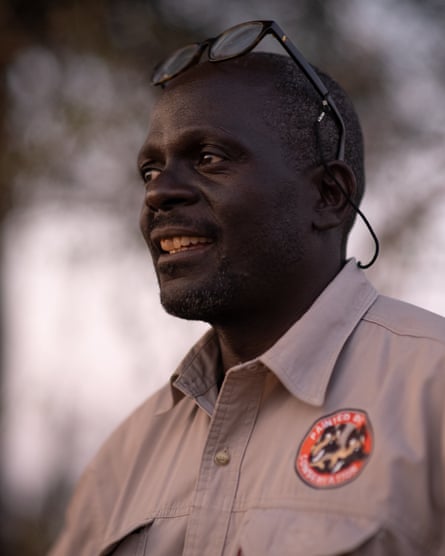
Jealous Mpofu. Photograph: Tusk

But they do have some friends, and none more friendly than the man who has been recognised by the charity Tusk as its ranger of the year for his work over a quarter of a century bringing these curious animals back from the brink.

Mpofu, 54, had never seen a painted dog until 1997, he said in an interview from his office to reveal news of his award. He grew up trekking barefoot to school and worked for years as a casual labourer in Zimbabwe’s national park system, but left the job when he saw the country “going down”.

His life changed when he met Peter Blinston, a Briton who founded Painted Dog Conservation after learning about the animals in a Jane Goodall documentary at the age of eight.

Mpofu became the charity’s first ranger, and as money trickled in he crisscrossed Hwange searching for dogs, often walking 20 miles to the nearest mechanic when the charity’s one vehicle broke down.

Tragedy struck in 2006 when the alpha male in Hwange’s last pack was killed and the group dispersed. Mpofu and the team brought the alpha female into a new rehabilitation enclosure. For six months Hwange had no painted dogs in the wild.


They released the female and chose an alpha male from the enclosure. In the years that followed the female dog raised as many as 30 puppies. “Now we are following some of these offspring,” he said. “So we did a nice job.”

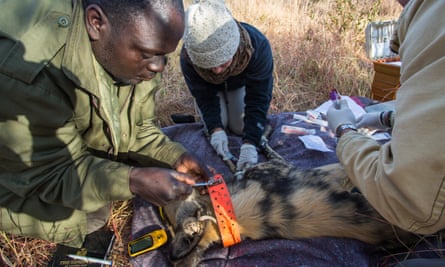
Mpofu is in charge of six rangers who track the five packs the project looks after. Together they amount to between 150 and 200 dogs, roaming more than 1,000 square miles. Each morning he wakes at 4am and heads off into the bush with his radio equipment, sometimes staying days at a time and alerting anti-poaching units to sweep an area for snares when he finds a pack. He knows each of his dogs by the unique markings on their left and right sides.

Blinston credits Mpofu with saving dozens of dogs’ lives. Last year he found four in one pack ensnared together. “One by one, as I found them, we got the snares off,” he said.skip past newsletter promotion

Privacy Notice: Newsletters may contain info about charities, online ads, and content funded by outside parties. For more information see our Privacy Policy. We use Google reCaptcha to protect our website and the Google Privacy Policy and Terms of Service apply.

after newsletter promotion
Mpofu at work. Photograph: Will Burrard-Lucas/Tusk

With his wages he has been able to send his four children to school, including one to boarding school. Mpofu is having a classroom built at his old school and has begun to teach rural children his skills.

This month he will fly to London to receive his prize, most likely from Prince William, who helped to establish the awards in 2013. Mpofu said he shivered with shock when Blinston told him he had won.

He was not aware that he would be receiving a grant of £30,000, and laughed when he was told. He said he would spend it on his wife Tendai and family, but also the community.

“I need to show to other people as well that if you get the money you give a little bit to other people,” Mpofu said. “I share that with painted dogs.” They regurgitate food for each other, and puppies get first dibs on meat.

“They are not selfish like lions,” Mpofu said. “They always share.”
Canadian writers ask Giller prize to drop charges against pro-Palestinian protesters

More than 1,800 writers and publishers have signed an open letter in support of the pro-Palestinian protest at the prestigious literary award last week


Ella Creamer
GUARDIAN 
Tue 21 Nov 2023 

More than 1,800 writers and publishers have signed an open letter in support of the pro-Palestine protesters who disrupted the ceremony of a prestigious Canadian literary award last week.

Among the signatories is Canadian author Sarah Bernstein, the winner of the C$100,000 (£58,000) Scotiabank Giller prize

The Giller prize event was first interrupted when protesters jumped onstage with signs that read “Scotiabank funds genocide”, while another protester shouted that Scotiabank “currently has a $500m [£398.7m] stake in Elbit Systems” and that “Elbit Systems is supplying the Israeli military’s genocide against the Palestinian people”.

The event was interrupted a second time when the winner’s announcement was being made. As Bernstein’s name was called, a protester posing as a photographer began shouting, so the organisers repeated the announcement.


Pro-Palestine protesters disrupt Canadian book prize


The letter states that protesters were booed by the audience, forcibly removed, detained by police for three hours after the event ended and are now facing charges, which it says should be dropped.

Bernstein said she “was only made aware what had happened at the Giller ceremony after the event”, which she attended via a one-way video link. “I support the right to protest, and I hope the charges against the protesters will be dropped,” she added. “I’m proud to join fellow Canadian writers in also calling for an immediate ceasefire in Gaza.” She won the prize for her novel Study for Obedience, which is also shortlisted for this year’s Booker prize, announced on Sunday.

“We ask all of our literary institutions to be loud where our governments and news outlets have been silent,” reads the letter. “To call for a ceasefire; to express condemnation for the collective punishment of Palestinians and the war crimes being enacted by the Israeli government; to exert pressure on the Canadian government to stop its military funding to, and diplomatic support for, the Israeli government; to call for a release of all hostages: Israeli hostages and the 5,000 Palestinian civilians (including 170 children) who are illegally incarcerated in Israeli prisons; and to urge Israel to end the 75-year occupation of Palestine.”

Along with Bernstein, other signatories include Noor Naga, co-winner of this year’s Arab American book award for her novel If an Egyptian Cannot Speak English. “Activists do not disrupt peace; they disrupt the silence of complicity,” Naga wrote in a post on X. “They do not disrupt order; they identify the disorder. We owe these activists our awareness, our aliveness. They did what we celebrate literature for doing: wake us up”.

Elbit Systems is an Israel-based arms manufacturer that has long been criticised by activists for supplying the Israeli military. In April, American investigative news outlet the Intercept reported that Scotiabank’s stake in the company was estimated to be $500m, making it the largest foreign shareholder.
Billionaires are lining up to fund Donald Trump’s anti-democratic agenda

The more disturbing Trump’s public proclamations become, the more US plutocrats seem to want him to win

Robert Reich
Tue 21 Nov 2023

As an ever-greater portion of the nation’s total wealth goes to the top, it’s hardly surprising that ever more of that wealth is corrupting US politics.

In the 2020 presidential election cycle, more than $14bn went to federal candidates, party committees, and Super Pacs – double the $7bn doled out in the 2016 cycle. Total giving in 2024 is bound to be much higher.


The public doesn’t understand the risks of a Trump victory. That’s the media’s fault
Margaret Sullivan

That money is not supporting US democracy. If anything, that money is contributing to rising Trumpism and neofascism.

There is a certain logic to this.

As more and more wealth concentrates at the top, the moneyed interests rationally fear that democratic majorities will take it away through higher taxes, stricter regulations (on everything from trade to climate change), enforcement of anti-monopoly laws, pro-union initiatives and price controls.

So they’re sinking ever more of their wealth into anti-democracy candidates.

Donald Trump is going full fascist these days and gaining the backing of prominent billionaires.

Earlier this month, on Veterans Day, Trump pledged to “root out the communists, Marxists, fascists and the radical-left thugs that live like vermin within the confines of our country”, whom he accused of doing anything “to destroy America and to destroy the American dream”. (Notably, he read these words from a teleprompter, meaning that they were intentional rather than part of another impromptu Trump rant.)

Days before, Trump claimed that undocumented immigrants were “poisoning the blood of our country”. The New York Times reported that he was planning to round up millions of undocumented immigrants and detain them in sprawling camps while they wait to be expelled.

Trump has publicly vowed to appoint a special prosecutor to “go after” Joe Biden and his family, and has told advisers and friends that he wants the justice department to investigate officials who have criticized his time in office.

This is, quite simply, full-throated neofascism.


Who’s bankrolling all this? While Trump’s base is making small contributions, the big money is coming from some of the richest people in the US.

During the first half of the year, multiple billionaires donated to the Trump-aligned Make America Great Again, Inc Super Pac.

Phil Ruffin (net worth of $3.4bn), the 88-year-old casino and hotel mogul, has given multiple $1m donations.

Charles Kushner (family net worth of $1.8bn), the real estate mogul and father of Jared, who received a late-term pardon from Trump in December 2020, contributed $1m in June.

Robert “Woody” Johnson (net worth of $3.7bn), Trump’s former ambassador to the United Kingdom and co-owner of the New York Jets, donated $1m to the Maga Pac in April.

And so on.

But Trump is not the only extremist pulling in big dollars.

Nikki Haley – who appears moderate only relative to Trump’s blatant neofascism – claimed in her campaign launch that Biden was promoting a “socialist” agenda.

During her two years as UN ambassador under Trump, Haley was a strong proponent of his so-called “zero tolerance” policy under which thousands of migrant children were separated from their parents and guardians.

She supported Trump’s decision to pull out of the UN human rights council and to withdraw from the Iran nuclear deal.

Though she briefly criticized Trump for inciting the mob that attacked the US Capitol on 6 January 2021, Haley soon defended Trump and called on Democratic lawmakers to “give the man a break” when they impeached him for a second time.

Haley recently told Kristen Welker of NBC’s Meet the Press that while Trump’s floating the idea of executing retired Gen Mark Milley might be “irresponsible”, it is not enough to disqualify Trump from running for the White House again.

Haley’s billionaire supporters include Stanley Druckenmiller and Eric LeVine. The Republican mega-donor Ken Griffin has said he is “actively contemplating” supporting Haley.

Notably, Haley has also gained the support of JPMorgan Chase’s chief executive, Jamie Dimon, who’s about as close as anyone in the US comes to being a spokesperson for the business establishment. Dimon admires Haley’s recognition of the role that “business and government can play in driving growth by working together”.

The moneyed interests have been placing big bets on other Trumpist Republicans.

Peter Thiel, the multibillionaire tech financier who once wrote that “I no longer believe that freedom and democracy are compatible,” contributed more than $35m to 16 federal-level Republican candidates in the 2022 campaign cycle, making him the 10th largest individual donor to either party.

Twelve of Thiel’s candidates won, including Ohio’s now-senator JD Vance, who alleged that the 2020 election was stolen and that Biden’s immigration policy has meant “more Democrat voters pouring into this country”.

The Republican House majority leader, Steve Scalise, is creating a new fundraising committee which will be soliciting contributions of up to $586,200 a pop.

Elon Musk is not a major financial contributor to Trump nor other anti-democracy candidates, but his power over one of the most influential megaphones in the US gives him inordinate clout – which he is using to further the neofascist cause.

Witness Musk’s solicitude of Trump, his seeming endorsement of antisemitic posts, his embrace of Tucker Carlson and “great replacement” theory, and his avowed skepticism towards democracy.

Democracy is compatible with capitalism only if democracy is in the driver’s seat, so it can rein in capitalism’s excesses.

But if capitalism and its moneyed interests are in charge, those excesses inevitably grow to the point where they are able to extinguish democracy and ride roughshod over the common good.

That’s why Trump’s neofascism – and the complicity of today’s Republican party with it – are attracting the backing of some of the richest people in the US.

What’s the alternative? A loud pro-democracy movement that fights against concentrated wealth at the top, humongous CEO pay packages, a politically powerful financial sector, and tax cuts for the wealthy and large corporations.

And fights for higher taxes on the top (including a wealth tax) to finance Medicare for all, affordable housing, and accessible childcare and eldercare.

The willingness to make this a fight – to name the moneyed interests backing neofascism, explain why they’re doing this, and mobilize and energize the US against their agenda and in favor of democracy – is critical to winning the 2024 election and preserving and rebuilding US democracy.

Biden and the Democrats must take this on, loudly and clearly.


Robert Reich, a former US secretary of labor, is a professor of public policy at the University of California, Berkeley, and the author of Saving Capitalism: For the Many, Not the Few and The Common Good. His newest book, The System: Who Rigged It, How We Fix It, is out now. He is a Guardian US columnist. His newsletter is at robertreich.substack.com


This article was amended on 21 November 2023 to clarify Ken Griffin’s position
Of course working-class people care about the climate crisis: they emit the least, but will suffer most

The implications of policy are felt very differently depending on how well-off you are. It’s time for politicians to recognise this


Roger Harding
Tue 21 Nov 2023 

Many of Rishi Sunak’s political decisions are baffling, but one that’s easy to understand is his recent rowing back from the UK’s climate commitments: he, like many creatures of Westminster, thinks working-class people don’t care much for climate action. This is a lazy stereotype and, predictably, did nothing for his poll numbers.

The simple truth is this: when it comes to the climate crisis, working-class people are often the first to spot the changes occurring because even slight fluctuations can make or break family finances. That doesn’t mean this is the first subject working-class people raise when a canvasser knocks at the door or a pollster asks, but it is there in the background when deciding who to trust with our futures.

It’s the people who think twice before turning on a fan or know their homes aren’t fully insured who are most attuned to the fact that summers are getting hotter and the rain is increasingly heavier than their drains can cope with. If you use the calculator app when you shop to avoid embarrassment at the tills, you have a keener sense that flooded farmers’ fields today mean higher food prices tomorrow.

Above all, working-class people know they have done far less to contribute to our national emissions than those in the private-jet class or the investment managers who have grown rich on fossil fuel. It is therefore unsurprising that many working-class people are slightly suspicious of a climate movement that seems to be whiter and more middle-class than the communities on the sharpest end of climate consequences.

I’m nobody’s idea of a climate radical. I had spent my career working for charities that fight for families on low incomes and tackle inequality, driven by growing up in a council house and seeing my mum struggle (as many more people are sadly doing today). I have never forgotten how tough we had it growing up, so I am determined that working-class families like the one I grew up in won’t bear the brunt of the climate crisis. That’s why my new organisation, Round our Way, highlights the impact the climate crisis is having on working-class communities today, and gets more of our voices into the debate about what we do about it.

This isn’t abstract or something to worry about in the future: the implications are showing up right now in everyday life. Last year, for example, research by the Energy and Climate Intelligence Unit (ECIU) found the average food bill was £400 higher thanks to climate impacts and fossil-fuel costs. Working-class communities are significantly more likely to be flooded, and have less money and insurance to weather the storms.

And later this week, Round our Way will be jointly publishing research showing that community and lower-league football clubs, such as Whitby Town, are facing huge bills to cope with the wetter weather that the climate crisis brings. Whole communities are changing because of this.

Given all of this, we shouldn’t be surprised that polling last month by More in Common found what the group calls “loyal nationals” (a term for “red wall” voters) had the climate crisis and the environment fourth on their list of priorities. Politicians have got it wrong if they think attacking climate action presents an easy path to popularity.

Five years on, the world is failing to learn the gilets jaunes’ lesson about class and climate
Oliver Haynes


All of this is good news for those of us who want to see a fairer and greener future, but this cross-class consensus on climate action is fragile and needs reinforcement. Plenty of working-class people worry that climate policies won’t be applied fairly, and we need only look to recent experiences in Germany to see how quickly things can go badly wrong. There, proposals to ban new gas boilers and replace them with green options created huge splits in the governing coalition over whether enough was being done to help people on modest incomes.

Climate politics curdle when one of two things happen. The first is when effective populists pose as working-class champions. You can spot these fairweather class warriors by the speed at which working-class concerns become their calling card only when climate action is proposed. They are the people who don’t say a word when the youth club closes, job cuts are made or bills spiral, but you can’t get them off news programmes when they can use our worries as a stick to beat the climate consensus.

The second is when the actual climate movement becomes dominated by people whose lives are sufficiently comfortable that they don’t think about the distributional consequences of policy, or recognise that its implications will be felt very differently depending on how well off you were to start with.

Thankfully, both these problems have the same solution. A climate movement of and for ordinary people is the foundation on which a durable climate consensus can be built. That’s what Round our Way is doing. If you are ever tempted to think people can’t simultaneously focus on the daily slog and the future, remember all the heroic single mums battling every day to keep their families afloat precisely because they want a future where their kids won’t have to do the same.

Roger Harding is the founding director of Round our Way
‘Ghosts from the past’: fears of abortion setback after Milei wins in Argentina

Newly elected president and far-right libertarian has vowed to repeal country’s 2020 landmark legalisation of abortion


Ashifa Kassam and Josefina Salomón in Buenos Aires
Mon 20 Nov 2023

Three years after Argentina made history as the first large Latin American country to legalise abortion, women’s rights campaigners are gearing up to again go to battle after the election of Javier Milei as president.

“It’s a very bleak picture,” said Soledad Deza of the Fundación Mujeres x Mujeres. “This is a government that is promising us greater inequality and – from the first minute – that the autonomy, sovereignty and independence of our bodies is not going to be supported by the state.”

Milei, a volatile, far-right libertarian, has routinely taken a hardline stance on women’s issues; vowing to hold a plebiscite on whether to repeal the country’s 2020 landmark legalisation of abortion, describing social justice as an “aberration” and promising to shutter the country’s ministry of women, gender and diversity.

He’s denied the existence of a gender pay gap, despite statistics that suggest women in the country earn 27% less than men, and has been accused of ignoring the existence of gender violence and discrimination in a country where one woman was murdered every 35 hours on average last year.

“Without a doubt, the results are a blow to the heart,” said Deza. “For those of us who work in these issues, I think we have a lot of struggle and organising ahead of us.”

The discourse unleashed by Milei echoes that of Donald Trump in the US or Jair Bolsonaro in Brazil, hinting at what may lie ahead for Argentina, said Giselle Carino of Fòs Feminista, an international alliance of women’s rights organisations focused on reproductive justice. “The result of the election, while expected, is devastating for all of us working on these issues.”

While analysts have suggested that the country’s highly fragmented congress may force Milei to temper some of his more radical proposals, Carino said it was too early to tell. “What we have learned, most unfortunately, is that when people put forward declarations on our issues like he did, we have to take that seriously.”

The election saw a shift in tone that could have far-reaching effects, said Claudia Laudano, a researcher and professor of feminist studies at the University of La Plata. “The legitimacy of all the work we have been carrying out for so long is being put into question, and that is very worrying,” she said.


She pointed to Milei’s efforts to play down violence against women as an example. “Publicly recognising how violence affects women in particularly is something we have worked on for a long time and Milei is saying that all violence is the same. This fuels a discourse that is very dangerous.”

Members of the LGBTQ+ community said they were also bracing for a rollback of their rights in the wake of the election. “My first feeling was fear, ghosts from the past,” said Mariana Gisela Tissone, 50, a trans woman and activist who said she was able to transition thanks to a law implemented during the administration of Cristina Fernández de Kirchner.


‘It was hell’: trans women testify on Argentina’s secret prisons of the past


“I never thought the far right was going to win here, specially with those messages supporting the dictatorship,” she added. “I’m not sure what Milei will do tomorrow, no one knows, but I’m worried about a setback when it comes to human rights, those we have conquered. I feel the same way I felt 20 years ago.”

The campaign saw Milei and his La Libertad Avanza party seek to repeatedly marginalise LGBTQ+ people, said the journalist Adriana Carrasco, citing as an example comments made by a Milei spokesperson that likened same-sex marriage to choosing not to bathe, getting lice and later complaining that people don’t like those who have lice.

For many in the community, the discrimination by politicians had translated into a barrage of personal insults and abuses, she said. “During this whole time we’ve suffered many attacks from their followers, particularly on social media.”

Some of the election result could be interpreted as a backlash to the progress made in recent years, she said. “There is a hard nucleus of La Libertad Avanza voters who are young men, some of them quite financially hard off and others who are not, who are resistant to the advances of women and the LGBT community.”

Argentina has long ranked as a regional leader when it comes to progressive policies on gender equality and LGBTQ+ rights, ushering in Latin America’s first gender quota law in 1991 and legalising same-sex marriage in 2010. In 2021, legislation was brought in that allowed non-binary people to mark their gender with an X.

But Carrasco believed that the bulk of those who voted for Milei were driven by their pocketbooks, hoping to shake up an economy that has left 40% of the country’s 45 million citizens grappling with poverty amid inflation rates that have climbed to more than 140%.

Even so, she was certain that Milei would seek to capitalise on his win to usher in social reforms alongside his economic policies. “They’re going to take advantage of it to do everything they want,” said Carrasco.

Any push in this direction would likely yield a fierce standoff with Argentina’s vibrant social movements, said Carino of Fòs Feminista. “We are going to keep fighting,” she said. “These laws didn’t just happen in congress. These laws happened because people fought on the streets. And we will continue doing that.”