Tuesday, November 21, 2023

Elon Musk’s X sues media watchdog Media Matters over report on pro-Nazi content on the social media site


Brian Fung and Clare Duffy, CNN
Mon, November 20, 2023

After a devastating advertiser exodus last week involving some of the world’s largest media companies, X owner Elon Musk is suing the progressive watchdog group Media Matters over its analysis highlighting antisemitic and pro-Nazi content on X — a report that appeared to play a significant role in the massive and highly damaging brand revolt.

The lawsuit filed Monday accuses Media Matters of distorting how likely it is for ads to appear beside extremist content on X, alleging that the group’s testing methodology was not representative of how real users experience the site.

“Media Matters knowingly and maliciously manufactured side-by-side images depicting advertisers’ posts on X Corp.’s social media platform beside Neo-Nazi and white-nationalist fringe content and then portrayed these manufactured images as if they were what typical X users experience on the platform,” the complaint filed in the US District Court for the Northern District of Texas said. “Media Matters designed both these images and its resulting media strategy to drive advertisers from the platform and destroy X Corp.”

The lawsuit simultaneously names Media Matters and Eric Hananoki, its senior investigative reporter, as defendants. It calls for a judicial order forcing Media Matters to remove its analysis from its website and accuses Media Matters of interfering with X’s contracts with advertisers, of disrupting their economic relationships and of unlawfully disparaging X.

In a statement Monday evening, Media Matters President Angelo Carusone vowed to defend the group against the suit.

“This is a frivolous lawsuit meant to bully X’s critics into silence,” Carusone said. “Media Matters stands behind its reporting and looks forward to winning in court.”

On Monday evening, X CEO Linda Yaccarino chimed in defending the social media site.

“If you know me, you know I’m committed to truth and fairness,” Yaccarino posted. “Here’s the truth. Not a single authentic user on X saw IBM’s, Comcast’s, or Oracle’s ads next to the content in Media Matters’ article.”

Following the lawsuit’s filing, Texas Attorney General Ken Paxton piled on, announcing he would be investigating Media Matters to determine whether its study of content on X might constitute “potential fraudulent activity” under Texas law. He also called the group a “radical left-wing organization” that “would like nothing more than to limit freedom by reducing participation in the public square.”

A number of major companies stopped their advertising on the platform after Musk endorsed the antisemitic claim that Jewish communities push “hatred against Whites.”

Musk had teased the litigation on Saturday after those major brands including Disney, Paramount and CNN’s parent, Warner Bros. Discovery, halted their advertising on X. Musk threatened a “thermonuclear lawsuit” against Media Matters and “ALL those who colluded in this fraudulent attack on our company,” including, he said in a follow-up post, “their board, their donors, their network of dark money, all of them…”

In previewing X’s argument, Musk appeared not to dispute the results of Media Matters’ analysis, instead targeting the group for having created a test account and allegedly refreshing the account until X’s advertising systems ran an ad for a major brand beside extremist content. The result generated by the test would almost never happen in the real world, Musk’s complaint alleged.

Legal experts on technology and the First Amendment widely characterized X’s complaint on Monday as weak and opportunistically filed in a court that Musk likely believes will take his side.

“It’s one of those lawsuits that’s filed more for symbolism than for substance—as reflected in just how empty the allegations really are, and in where Musk chose to file, singling out the ultra-conservative Northern District of Texas despite its absence of any logical connection to the dispute,” said Steve Vladeck, a law professor at the University of Texas and a CNN legal analyst. “The choice of venue can best be described as trying to shore up a weak claim on the merits with a bench more likely to be sympathetic even to weak claims.”

“This reads like a press release, not a court filing to me,” said Joan Donovan, a professor of journalism and emerging media studies at Boston University. “X does admit the ads were shown next to hateful content, but argues it was ‘rare.’ This is the same strategy employed by advertisers that got YouTube to demonetize political content in 2017.”

Ken White, a First Amendment lawyer and criminal defense attorney based in Los Angeles, said the decision to file in Texas may have been intended to circumvent laws passed by California, the District of Columbia and dozens of states barring frivolous lawsuits meant to stifle public criticism.


“X filed this in federal court in Texas to avoid application of an anti-SLAPP statute,” White said on the X alternative BlueSky, using the acronym that refers to so-called “strategic lawsuits against public participation.”

In the federal appeals court that oversees Texas, anti-SLAPP statutes do not apply, White added.

“X’s purpose is to harass and abuse and maximize the cost of litigation, and anti-SLAPP statutes interfere with that aim,” he wrote.

Monday’s case has been assigned to District Judge Mark Pittman, a Donald Trump appointee who has previously been at the center of some of the nation’s biggest legal battles. Last November, Pittman blocked President Joe Biden’s plan to forgive up to $20,000 in student loan debt, one of two such decisions to reach the Supreme Court.


Last August, Pittman ruled that a Texas law that bans people ages 18 to 20 from carrying handguns in public is unconstitutional and inconsistent with the Second Amendment and US history.

Contributing: CNN’s Jon Passantino and Dan Berman


Elon Musk’s X Sues Media Matters Amid Advertiser Exodus

Winston Cho
The Hollywood Reporter
Mon, November 20, 2023


In the wake of major advertisers pausing their spending on X shortly after Elon Musk’s reply to an antisemitic conspiracy theory, the social media service formerly known as Twitter has sued left-wing advocacy group Media Matters for allegedly defaming the platform by reporting that ads for major companies appeared next to antisemitic content.

The lawsuit, filed in Texas federal court on Monday, claims that the media watchdog group “knowingly and maliciously manufactured” the report to mislead advertisers into believing that the ad pairings were organic. X seeks monetary damages, as well as a court order directing Media Matters to “immediately delete” the report that led to the exodus of advertisers.

More from The Hollywood Reporter

Linda Yaccarino: "Deceptive Attacks" Are Fueling X Advertiser Exodus


Disney Joins Advertisers In Pausing Spend On X Amid Reported Rise in Antisemitic Speech

White House Condemns Elon Musk for Promoting "Antisemitic and Racist Hate" on X

The filing of the lawsuit comes on the heels of Musk posting Saturday that X would file a “thermonuclear” complaint against Media Matters. The message came in response to the organization issuing findings that the platform was placing ads for major companies such as Apple, NBCUniversal, IBM, Bravo and Oracle “next to content that touts Adolf Hitler and his Nazi Party.” Many of those firms — plus Apple, Lionsgate, Warner Bros. Discovery and NBCUniversal — halted ad spending with the service.

Media Matters didn’t respond to a request for comment.

The complaint centers on allegations that the organization “systematically manipulated the X user experience” to issue its report. The social media service claims that Media Matters artificially manufactured the findings by exploiting user features.

“Media Matters did not find pairings that X passively allowed on the platform,” states the suit. “Media Matters created these pairings in secrecy, to manufacture the harmful perception that X is at best an incompetent content moderator, or even worse that X was somehow indifferent or even encouraging to Nazi and racist ideology.”

According to the complaint, users control the content on their feeds by showing interest in certain topics, which in turn generates ads related to those topics. X takes issue with Media Matters representing a “exceedingly (and demonstrably) rare” ad pairing as commonplace. It points to methodology in the report in which the group made a profile that only followed 30 accounts belonging to fringe figures or major national brands, which allegedly tricked the algorithm into thinking that user “wanted to view both hateful content and content from large advertisers.”

“Media Matters exploited these features by creating a secret X account precision-designed to evade normal safeguards, manipulating every aspect of the system through which posts and advertisements appear, ultimately creating the side-by-side images of objectionable content and advertisements,” writes John Sullivan, a lawyer for X, in the suit.

An internal review by X revealed that the Media Matters account altered its scrolling and refreshing activities in an “attempt to manipulate inorganic combination of advertisements and content” when the group didn’t get its desired result, the suit says.

X claims that Media Matters “intended to harm” its revenue stream because it’s the “most prominent online platform that permits users to share all viewpoints, whether liberal or conservative.”

The complaint claims interference with contract, business disparagement, and interference with prospective economic advantage.

Elon Musk Sues Media Matters for ‘Knowingly and Maliciously’ Misrepresenting Amount of Antisemitic Content on X


Sharon Knolle
Mon, November 20, 2023

Elon Musk has followed through on his threat to sue watchdog organization Media Matters, albeit later in the day than he threatened over the weekend. In a suit filed on Monday, Musk claims that the group “knowingly and maliciously” misrepresented the amount of antisemitic content on the social media platform formerly known as Twitter.

Watchdog organization Media Matters released a report on Thursday that accused X of placing ads for brands next to pro-Hitler and white nationalist accounts. Musk announced on Saturday that he would be filing a “thermonuclear lawsuit” against Media Matters the “split second court opens on Monday.”

“Not a single authentic user on X saw IBM’s, Comcast’s, or Oracle’s ads next to the content in Media Matters’ article,” Linda Yaccarino asserted in a post on X. “Only 2 users saw Apple’s ad next to the content, at least one of which was Media Matters.”

While not naming a specific dollar amount, the suit seeks “actual and consequential damages caused by Defendants’ misconduct,” along with an injunction to take down its article from both its site and social media that alleged X was placing ads for major brands next to antisemitic content.

In Musk’s weekend post, he threatened to sue “ALL those who colluded in this fraudulent attack on our company.” However, the only codefendant named on the suit, besides Media Matters, is the report’s author: Eric Hananoki, a senior investigative reporter for the organization. Media Matters journalist Kat Abu posted on X following the suit’s filing defending her colleague, but has since deleted her post.

The day after the article, which was titled “As Musk endorses antisemitic conspiracy theory, X has been placing ads for Apple, Bravo, IBM, Oracle, and Xfinity next to pro-Nazi content,” a number of high-profile companies halted ads on the platform. Among those boycotting X are entertainment companies Disney, Warner Bros., Paramount, Sony and Lionsgate. IBM and Apple are also among those suspending ads.

After advertisers started leaving, Musk called those advertisers “oppressors” of “free speech” and pushed X’s premium subscription service.

Following the filing of Musk’s suit, Texas Attorney General Ken Paxton announced that he is opening an investigation into Media Matters for what his office describes as “potential fraudulent activity.” Paxton, a Republican, said in a statement, “We are examining the issue closely to ensure that the public has not been deceived by the schemes of radical left-wing organizations who would like nothing more than to limit freedom by reducing participation in the public square.”

The legal paperwork calls the Media Matters article “false, defamatory and misleading.” Musk alleges that the outlet did not “find” the offensive ads next to more reputable ones, but “created” them via “inorganic” use of the site to “manufacture the harmful perception that X is at best an incompetent content moderator … or even worse that X was somehow indifferent or even encouraging to Nazi and racist ideology.”

In a statement over the weekend, Media Matters president/CEO Angelo Carusone wrote, “Far from the free speech advocate he claims to be, Musk is a bully who threatens meritless lawsuits in an attempt to silence reporting that he even confirmed is accurate. Musk admitted the ads at issue ran alongside the pro-Nazi content we identified.”

Carusone concluded, “If he does sue us, we will win.” Since the suit was filed, Carusone has made several posts linking to pages for those who want to donate to the media watchdog, as well as retweeting a post showing X brand ad placements next to more antisemitic content.

Musk himself was called out on Friday for agreeing with a post that boosted the conspiracy theory that “Jewish communities have been pushing the exact kind of dialectical hatred against whites that they claim to want people to stop using against them.”

“You have said the actual truth,” replied the SpaceX founder in a post that has since been deleted.

The White House condemned the post, calling it “unacceptable to repeat the hideous lie behind the most fatal act of Antisemitism in American history at any time.”

Musk’s suit charges Media Matters with “interference with prospective economic advantage.” The X owner has asked for a jury trial.

Earlier in the day, right-wing host Megyn Kelly was among those defending Musk and attacked Media Matters, claiming that the organization was intent on getting conservatives “fired, ruined, canceled.”

This month, it was announced that a biopic would be produced about the controversial businessman. It looks like his career keeps producing new potential material.

The post Elon Musk Sues Media Matters for ‘Knowingly and Maliciously’ Misrepresenting Amount of Antisemitic Content on X appeared first on TheWrap.


Bill Ackman defends Elon Musk against antisemitism accusations after leading the charge against Harvard students who slammed Israel

Eleanor Pringle
Mon, November 20, 2023 

Left: Christopher Goodney/Bloomberg - Getty Images. Right: Nathan Laine/Bloomberg - Getty Images


Elon Musk hasn't got many people in his corner at the moment: the White House has accused him of spreading a "hideous lie," major advertisers have pulled their spending and investors are slamming his actions.

Musk's troubles come after he endorsed an antisemitic post on X—the social media site formerly known as Twitter—which Musk bought last year.

"Jewish communities have been pushing the exact kind of dialectical hatred against whites that they claim to want people to stop using against them," the post on X read, which Musk responded was "the actual truth."

The Tesla CEO has been hit with a wave of backlash—as well as veteran investors in his EV maker turning against him—though some high-profile individuals have come to his defense.

Among those who are backing Musk is billionaire investor Bill Ackman, who has been a vocal critic of Harvard University's response to claims of antisemitism on its campus.

Writing on X, Ackman declared: "Elon Musk is not an antisemite."

"It is remarkable how quickly the world stands ready to attack Musk for his shoot-from-the-hip commentary," Ackman continued. "Musk is not perfect, but the world is a vastly better place because of him."


In the post, the founder of Pershing Square Capital Management added he agreed with conservative podcaster Ben Shapiro, who said Musk's comments had been taken out of context.

Shapiro highlighted that following his "actual truth" response, Musk had added: "This does not extend to all Jewish communities, but it is also not just limited to ADL."

The ADL—Anti-Defamation League—is a Jewish nonprofit fighting the spread of bigotry and anti-Semitism, which Musk previously said he plans to sue for defaming the reputation of X publicly.

Late last night Musk doubled down on his denial of antisemitism, saying: "This past week, there were hundreds of bogus media stories claiming that I am antisemitic. Nothing could be further from the truth."

"I wish only the best for humanity and a prosperous and exciting future for all," he finished.

It's not the first time Ackman has shown his support for Musk—just last month the billionaire said he would "absolutely" be interested in a deal with X Corp following the launch of his new investment vehicle.

Ackman vs Harvard


Ackman, worth roughly $2.2 billion according to Bloomberg, has pushed his alma mater hard to eradicate antisemitism on the Harvard campus.

The investor asked Harvard University to reveal the names of students who signed a statement holding Israel “entirely responsible” for the deadly conflict in the country, saying he—and other high-profile CEOs—wanted to see the names so that “none of us inadvertently hire any of their members.”

Harvard University has condemned the violence in Israel and distanced itself from the statement from student society Palestine Solidarity Committee (PSC) holding Israel solely responsible for the deadly conflict.

Ackman later wrote to Harvard to urge it to suspend students who were involved in an alleged attack on a Jewish individual during a demonstration on Oct. 18.

In the letter shared on Nov. 4 he also called on university president Claudine Gay to take immediate steps to reduce antisemitism on campus, a situation he called “dire” after meeting with students and faculty a week prior week.

A Harvard spokesperson pointed to the university’s prior comments over campus safety and community conduct but declined to directly address Ackman’s letter.

This story was originally featured on Fortune.com


Elon Musk loves a good lawsuit

Jeff John Roberts
Mon, November 20, 2023 


In a one-week period this fall, Elon Musk was hit with three separate lawsuits. The Securities and Exchange Commission sued to compel him to testify about his acquisition of Twitter shares before he purchased the company. The lawsuit came a day after a Jewish man filed a defamation lawsuit alleging Musk had labeled him a neo-Nazi. And the day before that, the singer Grimes had sued the billionaire for the right to see their three children.

Getting hit by three unrelated lawsuits in one week is highly unusual for a CEO—unless that CEO is Musk. In his case, the trio of lawsuits are just a few of the dozens of legal claims that have piled up against Musk and his companies in recent years, and are a reflection of both the man and how he does business. (Musk did not respond to a request for comment sent via Tesla.)

While most people, including CEOs, regard litigation as stressful and expensive and do their best to avoid it, Musk treats lawsuits as an extension of his outsize personality. Ashlee Vance, a journalist who has written a popular biography of the Tesla CEO, says this has always been the case. “Elon has long had a pronounced litigious streak. He tends to feel very strongly about his version of the truth and goes to any and all lengths to stand his version of the truth up in court,” Vance noted.

Legal experts say that for now, Musk has come out a winner in his legal gambits, but in a handful of cases he faces an “existential” threat that could make a courtroom the potential site of his undoing.

Musk’s legal exposure

Musk’s 2022 takeover of Twitter, which he has rebranded as X, led to trouble with the SEC but also lawsuits from workers who claim he failed to pay their severance. Meanwhile, other employees filed a spate of suits alleging illegal dismissals on the basis of age, gender, and disability. Workers at Musk’s other companies, Tesla and SpaceX, had previously filed similar lawsuits.

While employment-related lawsuits are not uncommon at big companies, the nature of the claims at Twitter and the other firms suggests they arose not from Musk stumbling over a legal trip wire—but from his explicit contempt for regulations related to labor and discrimination laws that he has displayed on social media.

Musk has expressed a similar contempt for regulators themselves. When the SEC sued him in 2016 for allegedly misleading investors with a Tesla-related tweet, he settled the case two years later under pressure from his lawyers, but then promptly took to Twitter to mock the agency as the “Shortseller Enrichment Commission.” Since then, Musk has returned to court multiple times in a bid to undo the settlement’s requirement for him to run any Tesla-related tweets by a lawyer—known colloquially as his “Twitter sitter”—before he publishes them.

All of this is just the tip of the iceberg when it comes to Musk’s legal predicaments. He is also facing consumer class actions over insider trading and his pay package, a criminal investigation over Tesla fatalities, and an investigation by the National Labor Relations Board—plus numerous other lawsuits and regulatory probes. Meanwhile, Musk has filed lawsuits himself, including one against a nonprofit group that opposes hate speech, alleging the organization hurt the site formerly known as Twitter by driving away advertisers. He also threatened to sue a high-profile Jewish group, the Anti-Defamation League, for billions of dollars on similar grounds. Legal observers have described Musk’s claims against the groups as far-fetched.

The torrent of litigation, much of it unnecessary, is frightfully expensive—senior lawyers in some of these cases reportedly bill as much as $2,000 an hour—and often highlights the worst aspects of his character. So why does Musk engage in this behavior?

Musk’s motivations

As the richest man in the world, Musk is far wealthier than most CEOs and, in many aspects of life, can operate entirely within his own set of rules. That includes his legal strategy.

“He’s very wealthy, and so he can do this,” said Ann Lipton, a corporate and securities law professor at Tulane University. “It works because individual actors in the legal system don’t have the resources, time, and motives as Musk.”

Unlike other CEOs, Musk also enjoys a large cult following among his customers and the general public—most of whom are indifferent to his crass or insensitive behavior, or even relish the sight of their billionaire hero thumbing his nose at critics and the law.

“His audience for this isn’t bothered by him being in litigation. There’s no reputational cost for him, unlike there might be for a company like Walgreens,” said Verity Winship, a business law professor at the Illinois College of Law.

Senior lawyers in some of these cases reportedly bill up to $2,000 an hour.

Winship noted that Musk’s eagerness to pick legal fights is unusual for a CEO, but that there are other examples—typically involving those who operated their companies since the very early days. She cites the since-ousted chief executives of Uber and WeWork.

But even as much of Musk’s behavior may be driven by impulse, observers say it also has a strategic purpose. Lipton, the Tulane professor, says his reputation for being litigious serves as a deterrent to critics who might challenge him. She says that over his career, Musk has regularly “stiffed contractors” who, along with other adversaries, have often simply walked away rather than tangle with a billionaire—an assessment shared by his biographer. “He certainly does seem to use lawsuits as a tool to keep his detractors at bay. It’s effective. For as long as I’ve been reporting on Musk, people have been cautious to speak out of fear of litigation,” said Vance.

There is one further reason likely driving Musk’s penchant for litigation: So far, he has been winning.

Musk is victorious—for now

In two of Musk’s most high-profile legal battles—one against angry Tesla shareholders, and another a defamation case against a cave diver—he has gone to court and come out on top. Lipton, however, maintains that two ongoing cases do pose an existential threat to the billionaire and his companies. One of these is a claim in Delaware where investors say his $56 billion pay package at Tesla is unreasonable, in part because Musk has at times required employees at the carmaker to work on projects at his other companies. If the claim succeeds, Musk could be compelled to hand back some of his fortune and potentially to reconsider his cavalier view of legal threats.

Lipton says the other potentially existential case confronting Musk comes in the form of the Justice Department’s investigation into Tesla’s autopilot and “full self-driving” features that have allegedly caused numerous fatalities. The company disclosed in late October that the agency has expanded the scope of its probe with additional subpoenas, and that the investigation could result in material losses. This means criminal charges against both Tesla and its CEO are a real possibility—a development that could hobble the carmaker and result in a massive loss to Musk’s personal fortune.

This story was originally featured on Fortune.com


‘Racism in medieval England’ may have led to black people dying of bubonic plague

Craig Simpson
Tue, 21 November 2023 

The Black Death is thought to have killed a third of the population of Europe - Art Directors & TRIP/Alamy

Racism in medieval England may have contributed to black people dying of bubonic plague, academics have suggested.

Researchers employing “black feminist archaeology” have studied remains in 14th-century plague cemeteries in London.

The study has claimed that black people may have succumbed to the plague in disproportionate numbers compared to whites because of “structural racism” in medieval England.

It concludes that critical race theory, an academic field devoted to examining how Western institutional power upholds racism, should be used by archaeologists in future.

Research conducted by Dr Rebecca Redfern, of the Museum of London, also suggests that “misogynoir”, prejudice against black women, created a particular risk of death by plague.

The study suggests that the findings show “structural racism’s devastating effects” at work in 14th-century England, when the plague bacteria yersinia pestis caused mass death.

Dr Redfern studied 145 sets of human remains interred in plague cemeteries when the Black Death swept through London and killed about 35,000 people. Of those buried, 49 succumbed to plague and 96 to other causes.

By measuring skull features, Dr Redfern and her colleagues claimed to have established that there were nine people of black African ancestry among the plague dead, and eight among the others.

‘Black population suffered disproportionately’

Dr Redfern’s research paper, published in Bioarchaeology International and focusing on “anti-black structural racism”, claims that the purported black population in London suffered disproportionately more deaths during the plague which struck in 1348.

The paper cites studies that show death by plague was more likely for those with underlying nutritional or health problems, perhaps caused by poverty or other stresses, and concludes that the black population of medieval London may have suffered the “health outcomes of structural and anti-black racism”.

The paper models the number of females of African descent in the graves, and concludes that they had health outcomes that were worse still, amid a pestilence that killed a third of the population of Europe.

The paper states: “Intersectionality – the compounded harm of race and gender and misogynoir – may have impacted mortality during medieval pandemic disease.” The recent neologism “misogynoir” is a portmanteau of “misogyny” and the French word for black, “noir”.

The paper makes apologies for the disciplines of its authors and the “double whiteness” and “twinned whiteness of both anthropology and medieval studies”, and states that it has set out to “prioritise the methodologies of black feminist archaeology”.

This theoretical approach to archaeology seeks to focus on race, class, gender, and inequality, including in prehistory.

The paper concludes: “We recommend that intersectionality and critical race theories become integrated” into archaeological studies, with intersectionality being the crossover of various traits such a race and class which could lead to inequality.

Dr Redfern has based her conclusions on research into the non-white population in medieval London, a population that she claims made up 30 per cent of the sample population in the plague burial sites.

Their ancestry is based on forensic studies of their skull features, and comparisons with modern populations their skulls appear similar to, a method which has proved controversial.

Studies of the skull of the Roman-era remains of Beachy Head Lady in East Sussex suggested she was of sub-Saharan African ancestry, before DNA testing revealed she was in fact from Cyprus.

It is understood the Museum of London will not conduct any DNA testing into the plague burial remains.

The diversity of Britain has become a prominent issue, and a number of claims about the racial makeup of past populations have been disputed.
‘Every single Briton comes from a migrant’

A book titled Brilliant Black British History was criticised for its claim that “every single British person comes from a migrant” and that black people built Stonehenge.

Genetic studies have shown that the inhabitants of Britain in the period when Stonehenge was completed, around 2,500 BC, were pale-skinned early farmers whose ancestors had spread from Anatolia.
Vauxhall owner in talks with Chinese rival for European EV battery factory

Howard Mustoe
Tue, 21 November 2023 

A Vauxhall Combo Electric van at Ellesmere Port, the UK's first electric vehicle-only manufacturing plant - Getty Images

Vauxhall owner Stellantis is in talks with a Chinese battery-maker to build a European factory for car cells, in spite of warnings by its chief executive over the threat of Beijing’s dominance in the motor industry.

Stellantis is in negotiations with CATL, the world’s biggest maker of batteries for electric vehicles (EVs), over a joint venture to make cheaper power cells, which Carlos Tavares, the Stellantis chief executive, hopes will help lower car prices.

The deal comes months after Mr Tavares warned of an “invasion” of cheap Chinese cars into Europe and predicted a “terrible fight” between domestic manufacturers and Asian rivals.

Up to 30 new EV brands are eyeing up the UK car market, most of them Chinese.

Companies such as BYD and Ora, which already have agreements in place with UK dealers, will be joined by a raft of other car makers including Chery, Dongfeng and Haval.

Mr Tavares said: “CATL is the industry leader in this sector and together with our iconic vehicle brands, we will bring innovative and accessible battery technology to our customers while helping us achieve our carbon net zero ambition.”

The deal would focus on making lithium iron phosphate batteries, which are cheaper to manufacture than the current generation of cells made for Stellantis vehicles, and have a long life and better stability.

Last month Stellantis bought a 21pc stake in a Chinese EV company to benefit from what its chief executive called the “Chinese offensive”.

The European carmaker agreed to invest €1.5bn (£1.3bn) in Hangzhou-headquartered Leapmotor, an eight-year-old EV manufacturer.

Mr Tavares told reporters at the time: “The Chinese offensive is visible everywhere.”

However, he said the Leapmotor deal meant “we can be benefitting from this Chinese offensive, rather than being a victim”.

Chinese carmakers have been ramping up exports to Europe in order to boost sales as the local economy slows.

EVs produced in China are much cheaper than European competitors because they benefit from state subsidies and a rich supply of locally made batteries.

In September, Brussels launched an investigation into Chinese EV imports, with European Commission chief Ursula von der Leyen claiming prices were “kept artificially low by huge state subsidies”.

Stellantis’ big European rival Volkswagen last month said it would deepen cost cuts as demand for its cars falls in China, its biggest market, and Europe.

Robin Zeng, chairman and general manager of CATL, said: “We will remain dedicated to delivering more competitive and sustainable solutions for our partners to promote global energy transition.”
BBC's Gary Lineker endorses video that accuses Israel of ‘textbook genocide’

Dominic Penna
Tue, 21 November 2023 

In this article:
Gary Lineker
English footballer and TV presenter


BBC's Gary Lineker shared a link to academic Raz Segal accusing Israel of 'textbook genocide' - ANDY KELVIN/PA

Gary Lineker has endorsed a video by journalist Owen Jones in which an academic accuses Israel of “genocide” and dismisses comparisons between Hamas and the Nazis.

The Match of the Day presenter shared a tweet by Mr Jones, a columnist with the Guardian, of his interview with Raz Segal, an Israeli-American historian, and added the caption: “Worth 13 minutes of anyone’s time.”

In his conversation with Jones, Prof Segal – an associate professor of the Holocaust and genocide studies at Stockton University – attacks the Israeli military response to the Oct 7 terror attacks carried out by Hamas.


“I do think that what we’re seeing in front of our eyes is a textbook case of genocide,” he said.

While describing Oct 7 as “horrendous”, Prof Segal downplayed comparisons between Hamas and the Nazis, arguing that the persecution of Jews during the Second World War had a “very different context” from “Palestinians … [living] for decades under Israeli settler colonial rule”.


Historian Prof Raz Segal, who said Israel's actions amount to genocide

Stephen Pollard, the editor-at-large of the Jewish Chronicle, accused Lineker of “universe-bending ignorance”, while Greg Smith, the Conservative MP for Buckingham, said: “It is inconceivable any right-minded person would give that video the time of day.”

Lineker has previously called for a ceasefire between Israel and Hamas, backing the pro-Palestinian protesters who marched through London on Armistice Day.

The 62-year-old broadcaster briefly stepped back from hosting Match of the Day in March after comparing language used by Suella Braverman, then home secretary, to “Germany in the 30s”. After he was reinstated by the BBC, Lineker vowed to continue airing his political opinions on social media

Last month, the Guardian was criticised by the Board of Deputies of British Jews after publishing a piece by Prof Segal entitled: “Israel must stop weaponising the Holocaust”.

UK
UPDATED
Johnson and Sunak were happy to let people die from Covid, inquiry hears

Jane Kirby and Nina Massey, PA
Mon, 20 November 2023 

Johnson and Sunak were happy to let people die from Covid, inquiry hears
Coronavirus – Thu Oct 22, 2020


Boris Johnson wanted to let Covid “rip” despite the fact people would die, while Rishi Sunak also thought that was “okay”, the public inquiry has heard.

In further revelations from Sir Patrick Vallance’s pandemic diaries, the inquiry heard of the “shambolic” day on October 25 2020, when the country was heading towards a second national lockdown.

The diary entry highlights how the former prime minister wanted to let the virus spread, while his most senior adviser, Dominic Cummings (DC), suggested Mr Sunak, then chancellor, also thought it was “okay” to just let people die.

Former prime minister Boris Johnson during a Covid media briefing (Tolga Akmen/PA)


The extract read: “PM meeting – begins to argue for letting it all rip. Saying yes there will be more casualties but so be it – ‘they have had a good innings’.

“Not persuaded by (Jon) Edmunds, (Neil) Ferguson, (Jeremy) Farrar. PM says ‘the population just has to behave doesn’t it’.

“Heat maps ‘I have the necrotising maps’ so depressing.

“DC says trajectory will leave us in Nov – much as where we were in 1st week of April.

“Chris quite bullish about being able to take the brakes off more in April…

“Goes on about Gulf War Syndrome again… PM getting very frustrated – throwing papers down.

“PM then back on to ‘most people who die have reached their time anyway’.

“DC arguing we need to save lives – it is not democratically possible to follow another route…

The inquiry heard that Rishi Sunak thought it was ‘okay’ to let people die during the pandemic (Henry Nicholls/PA)

“DC argued again (rightly) that a lockdown’s coming and therefore do it sooner rather than later.

“PM concludes, ‘Looks like we are in a really tough spot, a complete shambles.’

“‘I really don’t want to do another national lockdown’.

“PM told that if he wants to go down this route of letting go, ‘you need to tell people – you need to tell them you are going to allow people to die’…

“Conclusion – beef up the tiers – consider a national lockdown – decide by when.

“DC says ‘Rishi thinks just let people die and that’s okay’.

“This all feels like a complete lack of leadership.”

Asked about the diary entry, Sir Patrick told the inquiry he was recording what must have been “quite a shambolic day”.

However, the following day’s entry shows Johnson had taken a different view and described the Covid death toll as “terrible”.

The inquiry also heard that Sir Patrick wrote that “we have a weak indecisive PM” and described the right-wing press as “culpable” in decision-making on Covid measures.

Asked about the diary entries, Downing Street declined to say whether Mr Sunak thought it would be OK to “just let people die” during the pandemic, saying it would be for the Prime Minister to set out his position during evidence before the Covid Inquiry.

“The Prime Minister is due to give evidence before the inquiry at the time of their choosing. That’s when he’ll set out his position,” Mr Sunak’s official spokesman said.

The spokesman said a number of people will be setting out their views of the period, but “rather than respond to each one in piecemeal, it’s right that it is looked at alongside other evidence”.

Science given undue weight over economics in pandemic decisions, says Sir Patrick Vallance

Gordon Rayner
Mon, 20 November 2023 

Undue weight was given to scientific advice over arguments for protecting the economy during the Covid pandemic, one of the most high-profile supporters of lockdowns has said.

Sir Patrick Vallance, the former chief scientific adviser, said deficiencies in the economic arguments being put forward caused “a real problem in terms of how decisions could be made”.

Sir Patrick, who was among those pushing for what was described as a “go hard, go early” policy on curbing freedoms, also said it was a “mistake” for the Government to use a worst-case scenario projection of 4,000 deaths per day to help justify the second lockdown in autumn 2020.

Along with Prof Sir Chris Whitty, the chief medical officer, Sir Patrick was an almost constant presence on the nation’s television screens during the pandemic, flanking Boris Johnson at daily press conferences to update the nation.

Giving evidence to the Covid Inquiry in London, Sir Patrick said he had referred to Sir Chris in his diary as “a delayer” because his colleague was worried about the long-term health risks associated with shutting down t
he country, whereas Sir Patrick felt there was a clear need for early lockdowns.


He said: “He was definitely of the view that the treatment and the result of that treatment needed to be considered together and pulling the trigger to do things too early could lead to adverse consequences … I didn’t have exactly the same worry. I was more on the side of ‘we need to move on this’.”

Despite his enthusiasm for locking down the country, Sir Patrick said the Treasury had failed to push back hard enough when the Government insisted it was “following the science”.

He said: “The science advice was there for everybody to see. The economic advice wasn’t and it wasn’t obvious what it was based upon and therefore [it] unduly weighted the science advice in the public mind, I think, and created a real problem in terms of how decisions could be made.”

He said he had suggested that an economic advisory group, similar to the scientific advisory group Sage, should be set up and “it had one meeting but it wasn’t pursued”.

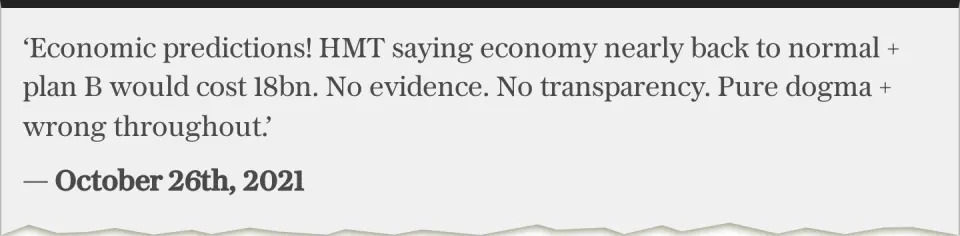
In private diary entries he criticised the Treasury, then under Rishi Sunak as chancellor, saying that its internal predictions for the economy were based on: “No evidence, no transparency, pure dogma and wrong throughout.”


‘Mistake’ to show slide detailing worst-case scenario for deaths

Sir Patrick said that when Mr Johnson announced a second national lockdown on Oct 31 2020, he was told to show the public an information slide with a worst-case scenario for deaths, which he insisted was a bad idea.

He said: “The message came back several times that the PM thought that as he had seen the slide it was only right that the public should see it.

“It was agreed that I should show that slide but try to move on to the medium-term projection which was the real thing. I think I made a mistake by agreeing to show it.”

Less than a week later, the Office for Statistics Regulation criticised Sir Patrick for failing to release the data and assumptions behind the worst-case scenario projection of 4,000 deaths per day by December 2020 if no action was taken.

Mr Johnson had been forced into a hasty announcement of the lockdown after plans for it were leaked to the media, and Sir Patrick said the then prime minister spent three to four hours on the phone before that day’s press conference trying to explain his reasoning to Tory MPs and other critics.

He said there was nothing wrong with the 4,000 deaths projection in terms of its scientific validity, but: “I just thought it was not a sensible science slide to show.”

The inquiry was shown another entry from Sir Patrick’s diaries in October 2020 in which he noted that Dominic Cummings, Mr Johnson’s senior adviser, had claimed: “Rishi thinks just let people die and that’s okay.”


Patrick Vallance's diaries: Eight extracts that lift the lid on No 10's Covid chaos

Blathnaid Corless
Mon, 20 November 2023 

Sir Patrick Vallance, right, gave regular public briefings during the pandemic alongside Boris Johnson and Sir Chris Whitty - Paul Grover for The Telegraph

Boris Johnson was “bamboozled” by the science, an unnamed woman sang The Wheels On The Bus to her child during a virtual Cabinet meeting and Matt Hancock told “untruths”.

Over the course of several hours of testimony at the Covid Inquiry, Sir Patrick Vallance, the former chief scientific adviser to the Government, lifted the lid on the chaos and dysfunction inside Downing Street.
A prime minister ‘bamboozled’ by the science

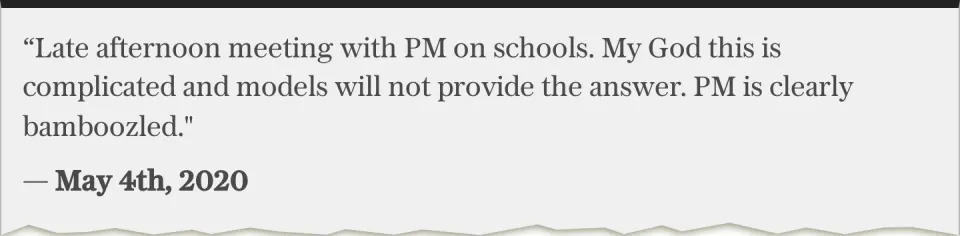
Sir Patrick Vallance said Mr Johnson was “bamboozled” by science in a series of scathing diary entries.

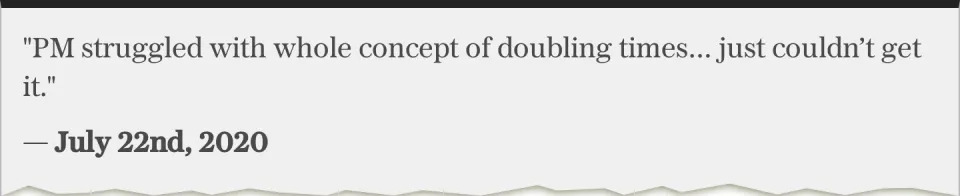
Several extracts from Sir Patrick’s notes, written throughout the pandemic after meetings he and other experts held with the then prime minister to explain the various graphs and statistics, revealed his frustration at Mr Johnson’s incomprehension of the scientific evidence.

He described watching the former prime minister trying to get his head around statistics as “awful” and questioned whether Mr Johnson was “colour blind” because of his apparent inability to read graphs.

In one diary entry from May 4 2020, Sir Patrick wrote:


Another diary entry written by Sir Patrick more than a week later reveals the former prime minister also struggled to retain information for more than one meeting:


Sir Patrick wrote in another entry in June 2020:


In a later entry from September, he recalled how “difficult” it was to explain graphs relating to the virus to Mr Johnson:


Despite his apparent frustration with the former prime minister in his diary entries, Sir Patrick told the inquiry there was not “a unique inability” on the part of Mr Johnson, as many other countries’ scientific advisers were having similar problems explaining concepts to politicians.

Sir Patrick told the inquiry of Mr Johnson: “I think I’m right in saying that the prime minister at the time gave up science when he was 15 and I think he’d be the first to admit it wasn’t his forte and that he did struggle with some of the concepts and that we did need to repeat them often.”
Sunak kept scientists in dark over Eat Out to Help Out

Sir Patrick Vallance directly contradicted Rishi Sunak’s claim to the inquiry that scientists had not expressed concerns over his Eat Out to Help Out scheme.

The measure encouraged people to go to restaurants in August 2020 with the promise of 50 per cent off meals, subsidised by the taxpayer. It was pushed through by Mr Sunak, who was Chancellor at the time.

In a witness statement from Mr Sunak shown to the Covid-19 inquiry , the prime minister said: “I don’t recall any concerns about the scheme being expressed during ministerial discussions, including those attend by the CMO [Whitty] and CSA [Vallance].”

But Sir Patrick said the reason he hadn’t raised concerns was because advisers had been kept in the dark about the scheme.

He told the inquiry: “We didn’t see it before it was announced and I think others in the Cabinet Office also said they didn’t see it before it was formulated as policy. So we weren’t involved in the run up to it.”

Sir Patrick added: “I think it would have been very obvious to anyone that this inevitably would cause an increase in transmission risk, and I think that would have been known by ministers.”

When asked about Mr Sunak’s understanding of the risks, Sir Patrick said: “If he was in the meetings, I can’t recall which meetings he was in. But I’d be very surprised if any minister didn’t understand that these openings carried risk.”

Sir Patrick said Eat Out to Help Out “completely reversed” previous policy of trying to stop people from different households mixing indoors. He said that under Mr Sunak’s scheme the public was effectively saying “we will pay you” to do just that.

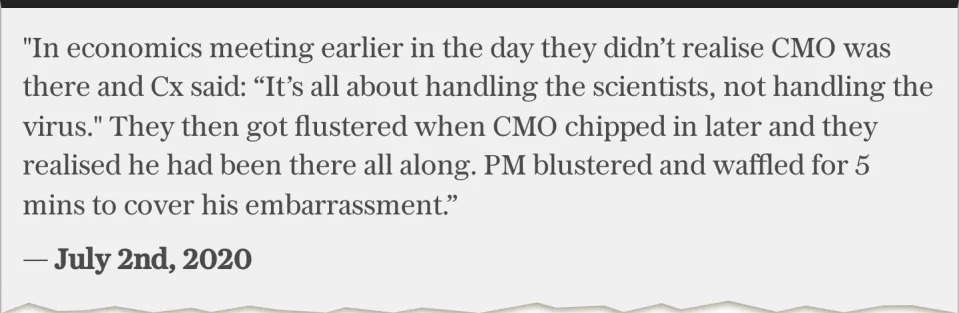
Mr Sunak also appeared dismissive of scientific experts, telling a meeting that Covid was about “handling the scientists, not handling the virus”. He was unaware when he said it that Sir Chris Whitty, the chief medical officer, was in attendance.

Sir Patrick wrote in a diary entry in early July 2020:


The Wheels On The Bus sung in Cabinet

Sir Patrick referred to Cabinet ministers as “meek as mice” and said a woman singing The Wheels On The Bus to her baby during one Cabinet meeting over Zoom was “symbolic of the shambles” in Government.

In a diary entry on Oct 11 2020, the former chief scientific adviser wrote:

“Cabinet call. Whilst waiting someone clearly not on mute - baby crying and then she starts singing ‘the wheels on the bus’ - somehow symbolic of the shambles.”

At the meeting, Mr Johnson tussled over whether to plunge the country into a new lockdown or stick with tiers. Sir Patrick was clearly agitated at the vacillation.

Sir Patrick noted in his diary:

“PM said on call, ‘The package we have as a baseline is unlikely to get R < 1 [reproduction rate] unless local leaders go further ... Hancock says this is our last shot at avoiding national lockdown...meek as mice from Cabinet ministers.”
Worries that Britain was ‘licked as a species’

Boris Johnson wondered out loud if Britain was “licked as a species” weeks before introducing a second national lockdown.

Sir Patrick Vallance disclosed details of five hours of meetings with the prime minister in late September 2020 at which Mr Johnson also said “We [the UK] are too s***” to avoid a fresh lockdown. The entry also highlights Mr Johnson’s seeming inability to make a decision and stick to it.

In his diary entry of Sept 20, Sir Patrick wrote:


‌Tension between Vallance and Whitty revealed

A “palpable tension” emerged between the Government’s chief scientific adviser and chief medical officer over lockdown policy during the pandemic.

Sir Patrick Vallance privately referred to Sir Chris Whitty as “a delayer” of a national lockdown, as he wanted to impose tough restrictions more quickly than the then chief medical officer, who was worried about the knock-on effects of shutting down the country.

The inquiry was shown an extract from the memoir of Sir Jeremy Farrar, a member of the Sage group of scientific advisers chaired by Sir Patrick, in which he spoke of a “friction” between the two experts and described a “a palpable tension between Patrick and Chris in the early weeks of 2020, particularly given the apparent absence of political leadership in that period”.

Sir Patrick wrote in his own nightly diary, following a meeting in Feb 2021 attended by Sir Chris:


Asked by Andrew O’Connor KC, counsel for the inquiry, if there was tension between him and the chief medical officer in the early days of the pandemic, Sir Patrick told the inquiry Sir Chris was concerned about “indirect harms” for mental health, loneliness, economic impacts and non-virus deaths, meaning he felt “pulling the trigger to do things too early could lead to adverse consequences”.

Sir Patrick added: “He would bring in views that were broad public health views looking at the consequences of interventions, as well as the direct consequences of the virus, and I think sometimes I would want to push and he might not and sometimes he was right, and sometimes I think we should have gone earlier.”
Hancock tells ‘untruths’

Sir Patrick said Matt Hancock had a habit of saying things “too enthusiastically” and without the evidence to back them up.

He also admitted that the former health secretary said things that were not true while working in No 10 during the pandemic.

Sir Patrick told the inquiry: “I think he had a habit of saying things which he didn’t have a basis for. And he would say them too enthusiastically, too early, without the evidence to back them up, and then have to backtrack from them, days later.

“I don’t know to what extent that was over-enthusiasm versus deliberate. I think a lot of it was over-enthusiasm, but he definitely said things which surprised me because I knew the evidence base wasn’t there.”

Asked if that meant Mr Hancock had said things that were untrue, Sir Patrick replied: “Yes.”

In another diary entry after a meeting which included talk about Long Covid in Sept 2020, Sir Patrick wrote that Matt Hancock had “explained things well for once”.
Rule of Six and schools rows

Sage, the Government’s Covid science advisory body, wanted to exempt children from the “Rule of Six” - but the idea was pushed back by ministers.

In a diary entry from Oct 15 2020, Sir Patrick wrote:

“Sage pushing for ‘Can’t we exempt children from rule of 6’. We said no, not unless CO (Cabinet Office) want to revisit.”

The rule, which limited the number of people who could gather in one place, was criticised at the time by the Children’s Commissioner who said it effectively kept large households in lockdown.

Scotland and Wales included an exemption for children under 12, but the Government in Westminster refused to implement a similar exemption in England until April 2021.

The Telegraph previously revealed in messages from its Lockdown Files that the Government knew there was no “robust rationale” for including children in the rule, but backed the policy regardless.

In a separate diary entry from Sir Patrick, he said Boris Johnson insisted all pupils needed to “get back to school” in August 2020, saying he would “no longer take this Covid excuse stuff”.

Sir Patrick wrote on Aug 6 2020:


Second lockdown graph ‘a mistake’

Sir Patrick Vallance told the Covid inquiry it was “a mistake” to present a graph to the public showing that up to 4,000 people a day could die in the second Covid wave.

Modelling from a range of universities leaked to the press on Friday Oct 30 2020 which included a “reasonable worst case scenario” from Public Health England of several thousand daily deaths.

This document was taken directly into No 10 and shown to the Prime Minister, Sir Patrick told the inquiry, who admitted he was “rather blindsided” by the emergence of the graph, which had been meant only for the SPI-M sub-committee of Sage.

Sir Patrick said at the time to Mr Johnson that he should not take much notice of this particular projection and should instead focus on the six-week medium term projections, which are far more likely and “pretty grim”.

A decision was made overnight to go back into lockdown which necessitated an emergency press conference on Saturday Oct 31 2020.

Sir Patrick thought the graph should not be shown to the public via a press conference and instead wanted to focus the messaging around lockdown on Sir Simon Stevens, then CEO of the NHS, warning of collapse of the health service.

“The message came back several times that as he had seen this slide, it was only right that the public saw it and that we had to show it,” the inquiry heard.

“In the end we agreed that we would show the slide.”

He added that Mr Johnson’s thought process “carries some legitimacy” and said the data was valid and correct.

“I just didn’t think this was a sensible thing to show at a press conference,” Sir Patrick said. “These are complicated things to explain and it wasn’t really the issue. The issue is what is going to happen in the next six weeks, not what the theoretical unmitigated scenario looks like over the next several months.

“So, I think I made a mistake to agree to show it and I think, in retrospect, I should have phoned Simon Case and said I’m being put under a lot of pressure to do something I don’t want to do.

“But I didn’t have any worries about the scientific legitimacy, I just thought it was not a sensible slide to show.”


‘Following the science’ became millstone around our neck, says Whitty

Gordon Rayner
Tue, 21 November 2023 

Sir Chris Whitty said the Government's reliance on taking expert advice was a hinderance - PA

Boris Johnson’s insistence that the Government was “following the science” during the pandemic became a millstone around the necks of his advisers, the Chief Medical Officer has said.

Prof Sir Chris Whitty told the Covid Inquiry he was initially glad that the then prime minister was committed to taking expert advice on board, but later came to see it as a burden.

During an entire day in the witness box, Sir Chris also said more people died from other illnesses than Covid-19 throughout the pandemic and denied claims of tensions between him and Sir Patrick Vallance, the former chief scientific adviser.

Sir Chris and Sir Patrick were Mr Johnson’s two most senior scientific advisers during the global crisis, and became household names as they flanked the prime minister at daily press conferences.


Sir Chris, who will continue giving evidence for a second day on Wednesday, said that when ministers first told the public they were following the science, both he and Sir Patrick “thought, ‘well, this was a good thing, the Government is recognising that science is important.’

“Very soon we realised it was a millstone round our necks and it didn’t help the Government either.”

On Monday, Sir Patrick had said that the phrase was unhelpful as there was no such thing as “the science” and it suggested that there was a single agreed position from scientists, rather than a range of opinions that were constantly evolving as more information became available.


More people died from other illnesses

Sir Chris said it would have been “wrong” for the whole medical profession to focus on Covid-19 in early 2020 and that even at its height more people died of other causes.

Asked about discussions before the World Health Organisation (WHO) declared a pandemic, he said that by February that year the “great majority” of his work was around the new virus and “we were moving increasingly far away from a probability this could go back to nothing.”

However, he added that that point was still “a long way” from the WHO declaring a pandemic on March 11 2020 or having evidence of transmission within the UK.

Sir Chris argued that it is “important to recognise that it would have been wrong to swing the whole of the medical profession over to this” in February 2020.

“Even at the height of the pandemic, more people died of causes not Covid than died of Covid,” he said. “Every one of those deaths is tragic on both of those sides.”
Sage discussed downsides of lockdown

Sir Chris said Sage had discussed the downsides of lockdown, and that he had personally warned that restricting liberties would hit the poorest and most isolated in society hardest.

He said: “I did have a stronger concern, I would say than some, that the biggest impacts of everything we did – and I was confident we were going to have to do them to be clear – but when we started, the disadvantages of all the actions, not just for lockdown, but other actions before that, for example, what was initially called cocooning and then shielding as an example, and stopping schooling as another.

“The biggest impacts of those would be areas of deprivation and those in difficulties and those living alone and so on.”

Asked if he warned of the danger that if the country “went too soon, too rapidly, there would be other perhaps indirect but other significant consequences”, he said he did not deviate from the advice of Sage.


Cheltenham had no ‘material effect’


One of the biggest controversies at the start of the pandemic was the Government’s decision to allow major sporting events, including the four-day Cheltenham Festival, to go ahead.

Cheltenham began on March 10, 2020 and on March 11 Liverpool hosted a Champions League match against Atletico Madrid. The first lockdown was announced on March 23.

Sir Chris said the decision not to cancel mass gatherings was “technically correct”.

He said he was “taking ownership” of the advice given at the time by the Sage group of expert advisers, who told the Government that the risks of outdoor events was relatively low.

He said: “The problem was not the gatherings themselves, which I don’t think there is good evidence that they had a material effect directly, but the impression it gives of normality at a time when you are trying to signal anything but normality.”

He said it risked sending a message that “the Government couldn’t be that worried” about the threat of Covid-19 if it was allowing big sporting events to go ahead, so the decision was “in a sense technically correct and logically incoherent to the general public”.

No war with Sir Patrick

Sir Chris was asked about a description by his Sage colleague Sir Jeremy Farrar of “palpable tension” between him and Sir Patrick over lockdown policy.

He said: “Well Sir Jeremy, who is a good friend and colleague, had a book to sell and that made it more exciting, I’m told.”

Sir Patrick said Sir Chris had been more cautious about imposing restrictions on the public than he was, but Sir Chris said: “My own view is that actually the differences were very small. And the main one … was that I saw as part of my role within Sage … to reflect some of the very significant problems for, particularly areas of deprivation.”

Sir Chris dismissed Sir Patrick’s description of him in his private diary as “a delayer”, saying he had only reflected the overall opinion of Sage at the time in trying to balance the risk of going too early with restrictions and going too late.

We relied on foreign experts

Sir Chris was asked if England had consulted overseas experts about the response and experience of the pandemic, but said that the country was “absolutely dependent” on information from abroad at the start of the pandemic.

He explained that he spoke with officials from the WHO, including the director general, and his counterparts in other countries as the pandemic progressed.

“We did and we were absolutely dependent on that,” he said.
Pandemic plan was out of date

Sir Chris has admitted that a government strategy document published on March 3, 2020, was “out of date” when it was published.

“Once you are in an exponential curve you get out of date remarkably quickly,” he said.

Asked by Mr Keith about the plan and whether it was outdated at the time of publication Sir Chris agreed but claimed much of the advice was still useful. He denied hopes of containment were “lost weeks before” and that around the time the strategy was published was “close to the point where you had to abandon it”.

“The problem with this document is essentially there is nothing wrong with the document, it’s just too late,” he said. “If it had been published when it was first conceived it would be much more in date. This is one of the problems of trying to develop these kind of documents on the hoof during an exponential rise. That’s just a reality”.

Sir Chris added that he would “stand behind the publication” and “some document is better than no document”.

Ministers ‘not electrified’ by warnings

Sir Chris said there was an “opportunity where we could probably have moved up a gear or two across Government” in early February 2020 if the system had been “electrified” by the information it already had on Covid-19.


He said if MI5 had warned that 100,000 people could die in a terrorist attack, the chance the system would have carried on as it did would have been “quite small”.

He told the inquiry “the system is surprisingly bad, in my view, at responding to threats of this kind which are not in the national security system”.


Asked why no one “appears to have been electrified by the information that there was a massive threat”, Sir Chris added: “I mean, I think, in a sense that is my point, is the system is surprisingly bad at, in my view, responding to threats of this kind which are not in the traditional national security system ... I think it is largely to do with the way that the national security apparatus interprets its role.”

Sir Chris also claimed that those in government did not understand the concept of exponential growth prior to the pandemic.


“I think that one of the things that, however, we really did not find easy to get across, and I found this surprisingly, surprising, given that so many people in both politics and in the official system are trained in economics, is the extraordinary power of exponential growth to get you from small numbers to large numbers very quickly, people just don’t get that intrinsically.”

Under questioning from Mr Keith about claims of “oscillation and chaos” in government decision-making during the pandemic, Sir Chris said: “That’s correct but I think it’s a matter of record that many other nations had similar problems.”

He described Mr Johnson as having a “quite distinct style”, adding: “I think the way Mr Johnson took decisions was unique to him.”

Mr Keith replied: “If I may – that’s a euphemism if ever I’ve heard one.”