Sunday, November 26, 2023

Calls for ‘conditions’ in aid to Israel add to Democrats’ divisions

Mike Lillis
Fri, November 24, 2023 


The battle among Democrats over U.S. policy on Israel has found a new front this month in the form of liberal calls to set “conditions” on any new military aid delivered to Tel Aviv.

A number of leading progressives in both the House and Senate have warned in recent days that they would oppose any aid package that fails to apply new limits on Israel’s forceful engagement with Palestinians in the wake of Hamas’s brutal attacks on Israeli civilians last month, including strikes in Gaza that have killed thousands more Palestinian civilians.

Behind Sen. Bernie Sanders (I-Vt.), the liberal critics of Israeli Prime Minister Benjamin Netanyahu’s tactics want to withhold new aid to his government unless it agrees to new constraints designed to minimize those civilian casualties.

“The blank check approach must end,” Sanders wrote in a New York Times op-ed published Wednesday. “The United States must make clear that while we are friends of Israel, there are conditions to that friendship and that we cannot be complicit in actions that violate international law and our own sense of decency.”

The demands have sparked a backlash from some of Capitol Hill’s most ardent pro-Israel Democrats, who are lashing out at the pro-Palestinian bloc with warnings that restricting Israel’s response to the Oct. 7 attacks would only empower Hamas, which the United States deems a terrorist group, and heighten the threat it poses to Israel.

“Neither Palestinians nor Israelis will know peace so long as Hamas holds hostages, controls Gaza, and retains its ability to attack Israelis,” Rep. Brad Schneider (D-Ill.), a staunch Israel supporter, said over the weekend. “Conditioning aid to Israel will move peace further away, threatening both Israeli and Palestinian lives rather than saving them.”

The internal clash has highlighted the long-standing Democratic divisions when it comes to the decades-old Israel-Palestine conflict, creating fresh challenges for party leaders, including President Biden, who are backing Israel’s forceful response while also scrambling to placate the liberal critics — a key branch of the party’s base — who are accusing Israel of committing human rights crimes in Gaza.

Those ruptures have been on full display within the House Democratic Caucus since Oct. 7, arising during a pair of votes to affirm Congress’s support for Israel — both rhetorically and financially — and later in another series of votes that ended in the formal censure of Rep. Rashida Tlaib (D-Mich.), one of just three Muslims in Congress and the only Palestinian American, for her sharp criticisms of Israel.

The tense debate is sure to resurface in the coming weeks when Democratic leaders are hoping to approve Biden’s $14.3 billion request for Israel aid — part of a much broader proposal that also features military funding for Ukraine and humanitarian assistance in Gaza — in the short window that remains before year’s end.

Sanders, a liberal icon with an army of followers, foreshadowed the tough battle to come when he issued a statement over the weekend outlining the stipulations needed to win his support for more Israel aid.

His six-point plan calls for an immediate end to what he considers “indiscriminate bombing” in Gaza that’s resulted in the deaths of thousands of civilians; a “significant pause” in Israel’s military operations to allow for the delivery of humanitarian aid; affirmation that displaced Gazan families will retain the right to return to their homes; assurances that Israel will neither continue its blockade on Gaza, nor occupy the region long-term, when the hostilities end; a prohibition on the expansion of Israeli settlements in the West Bank; and a commitment to earnest peace talks designed to clinch an elusive two-state solution.

“The Netanyahu government, or hopefully a new Israeli government, must understand that not one penny will be coming to Israel from the U.S. unless there is a fundamental change in their military and political positions,” Sanders said in the statement.

He is hardly alone. Alongside Tlaib, a number of House liberals — many of them representing the far-left “squad” — have also been highly critical of Israel’s historic policies toward Palestinians broadly and Netanyahu’s handling of the current military operations in Gaza in particular.

Rep. Alexandria Ocasio-Cortez (D-N.Y.) argued that the United States applies conditions to “virtually all other … allies,” and doing the same toward Israel is simply “the responsible course” to ensure that American taxpayers aren’t financing human rights abuses.

“The United States has a legal and moral responsibility to ensure that public resources do not facilitate gross violations of human rights and international law,” Ocasio-Cortez wrote on X, the platform formerly known as Twitter.

Israel’s most vocal Democratic defenders have different ideas. Rep. Jared Moskowitz (Fla.), a first-term lawmaker, denounced the conditional approach, vowing to block any such provisions from an Israel aid package if they were under consideration in the House.

“I am absolutely for humanitarian aid to Gaza,” Moskowitz wrote on X. “But if Bernie Sanders puts political requirements on the Aid to Israel, I will work in the House to remove those conditions or condition Aid to Gaza that requires the removal of Hamas.”

The Democratic collision over Israel reflects the broader debate around the country, pitting those supporting Israel’s military strategy, in the name of self-defense and self-preservation, against those critical of Tel Aviv’s human rights record in Gaza and the West Bank.

That debate has grown more fierce as both the country and Congress have grown more diverse. Some lawmakers said it’s only natural that the conversation would change with the arrival of new members with distinctive backgrounds and unique perspectives.

“We’ve never had this before,” said Rep. Jamaal Bowman (D-N.Y.), a member of the squad. “We’ve never had three Muslims before, two Muslim women before. So if we’ve never had that … it’s going to be very contentious and difficult and challenging to understand each other on Day One.

“My hope is that on Day 1,000 there is a collective understanding and we begin to have conversations that center on empathy and compassion and humanity — for all people. And we don’t have that right now. It’s pro-Israel, and that’s it,” he continued. “We don’t even talk about the occupation, the conditions in Gaza, the 50 percent poverty, the 50 percent children, a siege happening when the language that’s being used is clearly to dehumanize, conflating Hamas with Palestinian.

“That’s what’s happening — from the White House on down.”

Across the aisle, Republicans are largely united in their support for Israel aid, though there are disagreements within the GOP over whether the new funding should be accompanied by other budget changes designed to defray the costs.

Newly installed Speaker Mike Johnson (R-La.), as his first legislative act with the gavel, passed a $14.3 billion Israel package earlier in the month, which also featured steep cuts in IRS funding to satisfy conservatives — an addendum that added billions of dollars to deficit spending and eroded almost all support from Democrats.

The next steps on Israel aid are expected to begin in the Senate, which is controlled by Democrats who oppose any offsets to emergency spending bills. It remains unclear how, or if, Johnson would bring such a bill to the House floor and risk a conservative revolt.

Biden: Conditions on aid to Israel a ‘worthwhile thought’


Nick Robertson
THE HILL
Fri, November 24, 2023 
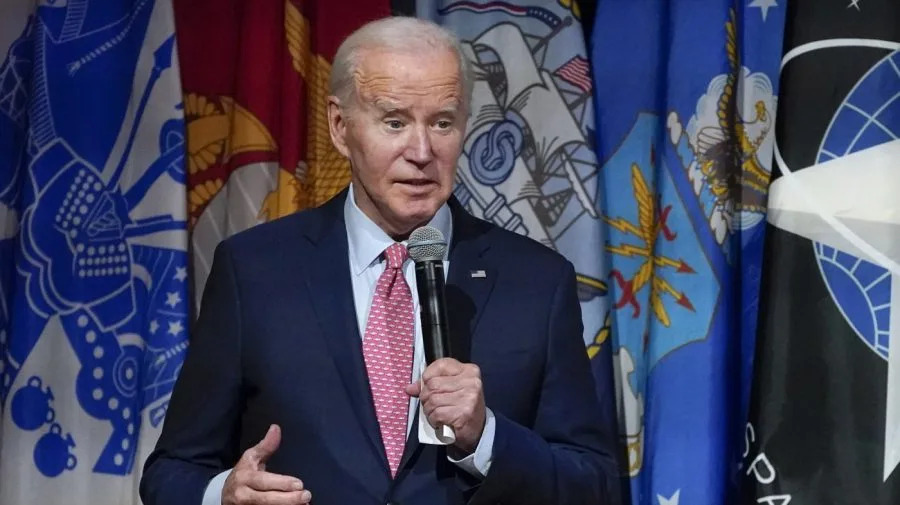

President Biden conceded to critics within his party Friday that calls to put specific conditions on aid to Israel are a “worthwhile thought” amid the country’s war against Hamas in Gaza.

But at a press conference marking a four-day truce in the war to free 50 hostages taken by Hamas, Biden also implied that those conditions could hamper diplomacy.

“I think that’s a worthwhile thought, but I don’t think if I started off with that we ever would have gotten to where we are today,” Biden said. “We have to take this a piece at a time.”

The president has been under immense pressure from a growing group of Democrats who have criticized the Biden administration for strongly backing Israel in the conflict, despite a growing number of civilian casualties in Gaza.

“The blank check approach must end,” Sen. Bernie Sanders (I-Vt.) wrote in a New York Times op-ed published Wednesday. “The United States must make clear that while we are friends of Israel, there are conditions to that friendship and that we cannot be complicit in actions that violate international law and our own sense of decency.”

The war in Gaza has killed more than 12,000 Palestinians, including more than 4,600 children, since it began early last month, according to the Gaza Health Ministry.

Biden said he has repeatedly pressured Israeli Prime Minister Benjamin Netanyahu to better consider the lives and well-being of Gazan civilians.

“I’ve encouraged the Prime Minister to focus on trying to reduce the number of casualties while he is attempting to eliminate Hamas, which is the legitimate objective use,” Biden said. “That’s a difficult task.”

“And I don’t know how long it will take,” he continued. “My expectation and hope is that as we move forward, the rest of the Arab world and the region is also putting pressure on all sides to slow this down to bring this to an end as quickly as possible.”

Progressive Democrats have pushed the Biden administration to call for a long-term cease-fire in the conflict, arguing that the Israeli military strategy puts too many Palestinian civilians at risk. They have been joined by hundreds of former Biden campaign staffers and have sparked division in the State Department.

In his op-ed this week, Sanders described the Israeli strategy as one of “indiscriminate bombing.”

“The Netanyahu government, or hopefully a new Israeli government, must understand that not one penny will be coming to Israel from the U.S. unless there is a fundamental change in their military and political positions,” Sanders said in the statement.

The U.S. already requires that all counties that receive military aid, by law, abide by international law. The progressives argue that the measure has entirely been ignored in the case of Israel.

Rep. Alexandria Ocasio-Cortez (D-N.Y.) said the U.S. applies conditions for “virtually all other … allies,” and doing so for Israel is “the responsible course.”

“The United States has a legal and moral responsibility to ensure that public resources do not facilitate gross violations of human rights and international law,” she wrote on X, formerly Twitter.
    Israel's liberal use of large US-made bombs accounts for the high civilian casualty toll in Gaza, military experts say: 'It's beyond anything that I've seen in my career'

    • Israel's use of US-made bombs is contributing to high Palestinian civilian casualties, experts say.

    • The rate of death in Gaza has outpaced some of the century's "deadliest moments," The New York Times reported.

    • One expert said Israel's use of aerial bombs is "beyond anything that I've seen."

    Israel's use of large, American-made bombs is contributing to the massive death toll in Gaza, passing some of the deadliest conflicts in recent memory.

    The killing in Gaza, aided by the use of 2,000-pound US-made bombs, is outpacing many of this century's "deadliest moments," including the United States campaigns in Iraq, Syria and Afghanistan, according to The New York Times.

    The massive scale of Israel's attacks along with the use of large, US-made bombs in dense, urban areas have contributed to the massive death toll, according to the report.

    While it's not entirely possible to calculate the exact number of civilian casualties in Gaza, researchers believe the 10,000 women and children reported dead by the Hamas-led Gaza Health Ministry to be an approximate, if conservative, estimate of civilian killings, according to the report.

    The Gaza Health Ministry's most recent death toll released on November 10 included 11,078 deaths, according to the Associated Press.

    Marc Garlasco, a military adviser for Dutch peace organization PAX and former senior Pentagon intelligence analyst, told The Times that the use of such bombs by Israel is "beyond anything that I've seen in my career."

    The closest instances Garlasco could point to for a historical comparison, when such large bombs were dropped on such densely populated areas, were "Vietnam, or the Second World War," according to the outlet.

    According to the report, US military officials often believed that the most common American-made aerial bomb, which weighs 500 pounds, was too large to be used when fighting the Islamic state in Iraq and Syria. In contrast, Israel has been liberally using 2,000-pound bombs, which are also made in America, and are capable of crumbling entire apartment complexes, The Times reported.

    Brian Castner, an Amnesty International weapons investigator and former US Air Force explosive ordnance disposal officer, told The Times that the bombs used in Gaza are larger than bombs used by the US to fight ISIS in Mosul in Iraq and Raqqa in Syria. Castner told the outlet that the explosives are more consistent with targeting underground structures such as tunnels.

    "They are using extremely large weapons in extremely densely populated areas," Castner said. "It is the worst possible combination of factors."

    Israel has noted that Gaza is a unique battlefield — small and dense with civilians living next to and on top of Hamas-run tunnel networks, The Times reported.

    Israel acknowledges that women and children have been killed in Gaza, but said the reported death toll in the Hamas-run region can not be trusted, according to The Times. Israel's military did not provide a casualty count of its own, but denied targeting civilians, the newspaper said.

    "We do a lot in order to prevent and, where possible, minimize the killing or wounding of civilians," Jonathan Conricus, an Israeli military spokesman, told the outlet. "We focus on Hamas."

    On Friday, Israel agreed to a four day cease-fire in exchange for the release of hostages held by Hamas inside Gaza. Hamas released 25 total hostages, 13 Israelis and 11 foreigners, including 10 from Thailand and one from the Philippines, on the same day.

    The Israel Defense Forces did not immediately return Insider's request for comment.

    DEMINING
    Dispatch: The invisible killer haunting Laos 50 years after the Vietnam War

    Sarah Newey
    Sun, November 26, 2023 

    A technician in the fields of Laos prepares for a controlled explosion - Jack Taylor/Jack Taylor


    At first glance, the scene is unremarkable: women in wide-brimmed hats are dotted across a rice paddy field nestled in the Laotian mountains, toiling under the relentless sun.

    But instead of sickles, the women are carrying heavy metal detectors. Their buckets aren’t full of the staple crop, but scraps long buried in the ground. And at the edge of the plot, an ominous sign with red skulls screams “DANGER”.

    At this site just outside the tiny village of Sop Hun, decontamination technicians are meticulously clearing up the legacy of a “secret war” so intense it earned Laos – then home to fewer than three million people – the grim status of the world’s most bombed nation per capita.


    Between 1964 and 1973, as the US attempted to suppress communism in southeast Asia and cut off North Vietnam’s supply lines, American pilots unleashed more than two million tonnes of ordnance on this landlocked county in 580,000 attack sorties. On average, a planeload of bombs was dropped on Laos every eight minutes for almost a decade.

    “The bombing was constant, people used to hide in caves underground to survive it,” says Khamsone Laomany, a war veteran who fought with the Americans. Lying on the floor beside him is his prosthetic – 53 years ago, the 78-year-old lost his right leg when he collided with an undetonated explosive as he was racing across the mountains to escape enemy fire.

    Though brutal, incidents like this are expected during war – but in Laos, they never stopped. Since the Paris Peace Accords were signed 50 years ago at least 25,000 people, half of them children, have been killed or injured by unexploded bombs – including 63 in 2021 alone.

    Many of these accidents have involved cluster munitions, a controversial weapon now banned in more than 120 countries yet – to Laos’ disbelief – deployed by both sides in Ukraine.

    These bombs are indiscriminate; they break apart mid-air and scatter hundreds of smaller submunitions, known here as “bombies”, across a wide area. And while they’re meant to detonate on impact, the “dud rate” is high: up to 30 per cent of the 270 million dropped on Laos never exploded.

    Instead they are littered, dormant but deadly, across huge areas of the country – remnants of a long-forgotten “shadow war” that ended five decades ago, but continues to stymie development and turn daily activities into a “game of Russian roulette”. Ukraine, people here say, should take note – Laos may offer a glimpse of the European nation’s future.

    “We’re still affected by the conflict, people still have difficulty surviving after all this time,” says Ket, a section commander for the NGO Humanity and Inclusion (HI) in Phongsaly, the northernmost province, tucked between China and Vietnam.

    “It used to make me angry, but now I think anger is not a positive thing,” adds the softly spoken 30-year-old, known only by her first name. “I would like to bring to the power countries and leaders: think of the impacts of war, especially the impacts of cluster munitions. I don’t want to see this happen again. Please, see Laos as a case study and stop.”

    Instead of sickles, the women are carrying heavy metal detectors, scanning for UXO - Jack Taylor/Jack Taylor

    Later that day, Ket slips into a bright blue blast suit and heads back out to set the fuses. After some six hours methodically combing the rice paddy field for “war trash”, the team of eight – including seven women – has uncovered two Blu 26 submunitions and a 20mm artillery bullet.

    Now it’s time to blow them up.

    “This is the most challenging part of my day,” says Ket. “If I did some small mistake, I might kill myself as well. It’s high risk for me, but I think it is part of my duty.”

    Ket was compelled to join HI by personal experience; a neighbour was killed while farming at a plot near her home in the Hampheung province. Most here have similar stories. The team leader’s father was injured by UXO when she was four – he was lucky to escape with his eyesight – while the field medic’s friend had both her legs amputated after a blast.

    “Of course my family worry that this job isn’t safe,” says Ket. “They ask, can’t you do something with less risk? But I tell them just living in Laos is a risk. I’m proud of my tasks here, that I am a person to help clear the UXOs and make this land safe. Accidents are too common.”

    As Ket readies the ignition to detonate the munitions in-situ, the rest of the team fan out around a 300-metre radius to ensure the site is clear and warn the nearby school – children’s laughter fades away as pupils are told to return indoors. Soon, everything is set.

    “Haa, sii, sam, song, nung,” a man shouts, counting down from five to one before deep, powerful blasts puncture the peace and reverberate around the valley with surprising force. Two plumes of thick smoke seep into the air above the spots the bombies once laid, hidden for decades under layers of soil.

    It’s hard to know how many of these cluster munitions remain scattered across Laos, though estimates suggest just 10 per cent of some 80 million left when the war finished have been cleared. In 2019, the US Congressional Research Service said it could take at least another 100 years to decontaminate the country.

    “The most horrific thing about this is the amount of bombs dropped … and the amount of war trash left, which people have to figure out a way to live with,” says Sera Koulabdara, the chief executive of the advocacy group Legacies of War. Now based in the US, her family left Laos when she was six, after a school friend lost her leg in an incident outside their home.

    “It’s not just about the tragic fatalities and injuries, the land has been held hostage,” she adds. “Laos has a highly agricultural economy – but how do you expect the people to move forward, the economy to move forward, when dealing with this situation? Lots of the challenges [Laos] faces today come from the legacy of war, the chaos left behind.”

    A controlled demolition of a munition found in a rice paddy - Jack Taylor/Jack Taylor

    Clearing this land is a slow, repetitive process which got off to a slow start. Nationwide, bomb clearance organisations eventually launched operations from 1994; North Vietnam’s communist allies Pathet Lao took control after the war, and for two decades the nation was largely isolated from the wider world.

    But in Phongsaly, it was only last year that work to rid the region of UXOs began, part of a government-led strategy to map contamination levels nationwide and redistribute resources.

    Despite being a Pathet Lao stronghold, the province was not as heavily bombed as contested central or southern Laos. But Route Four – a winding road that snakes through forested mountain peaks – was a strategically important supply chain and access point for the North Vietnamese army, making it a regular target for the US Air Force.

    “The northern provinces have been less invested in, just because of the scope of the contamination elsewhere and limited resources,” says Alexandra Letcher, a regional Armed Violence Reduction Specialist with HI, a French organisation which has launched awareness, rehabilitation and decontamination programmes across Phongsaly.

    “But since we started here, we’ve found everything from huge aircraft bombs – their size is just really incredible – to bombies, which are most common.”

    The lack of clearance operations until now has forced locals to live and work alongside these explosives for decades, even in places known to be contaminated.

    Roughly 30 years ago, Bounsuly Soulinthong’s little brother Samly was one of three children who died in a blast while foraging for sweet potatoes on a hillside above Khoua – a small village on the Nam Ou river, an hour southwest of Sop Hun.

    “The scraps hit my brother in the head. I saw him as they rushed him to get help, the side of his face was completely blackened from the explosion,” says Mr Soulinthong. Samly died not long after he reached the hospital; he was only seven years old.

    “Everyone used to say we looked quite similar,” adds Mr Soulinthong. “I often think about what he’d look like now, and what his life might have been like – especially now my daughters are his age … I’ve told them they never can go to the hills near here.”

    Many have adopted this approach, with development projects abandoned and farmland avoided due to UXOs. But this has not been an option for others, including Bouaphai Boutsady. The steep plot where Samly died is her only land, farming her only income.

    For three decades she’s still grown vegetables and rubber trees there, developing ad hoc strategies in the hope of reducing her risk – all for a yearly income equivalent to £800.

    “Of course the accident is in my mind still when I worked on my land, but what choice do I have? I just try to be careful – I dig softly and slowly and not too deep,” she says. “But I need to eat, I need to provide for my family.”

    Somehow, and despite spotting several more UXOs, the 63-year-old has had no accidents. And now she never will: her half hectare plot was among the first to be cleared when HI arrived last year.

    With contamination so widespread and the region’s steep peaks making work laborious and slow, the NGO works with the government to prioritise clearance sites – farmland, areas near schools or health clinics, and sites earmarked for development are top of the list.

    “I no longer have fear when I go to my land,” says Ms Boutsady. “It is strange not to feel that emotion there anymore. It was like anything could happen to anyone at any time – the bombies had a huge impact on every part of our lives.

    “I don’t know if the people who dropped them realised the impact would last to the next generation? But they should know now. People in power, people who create war, I would encourage them to look and see that bombies kill people, kill villages, for a long time.”

    A huge number of cluster munitions remain scattered across Laos - Jack Taylor/Jack Taylor

    This sentiment is widespread across Laos; almost everyone The Telegraph spoke to said they struggle to comprehend why cluster munitions, which have caused so much harm here for so long, are still being deployed elsewhere.

    In recent decades, Laos has been increasingly vocal about this issue on the international stage, and played a major role in the creation of the Convention on Cluster Munitions in 2008.

    More than 120 countries have since joined this international treaty, including the UK, but there are notable absences – including Russia, Ukraine and the US. As the fighting continues in Europe, all three have been involved in their use.

    “As the world’s largest victim of cluster munitions… [Laos] expresses its profound concern over the announcement and possible use of cluster munitions,” the foreign ministry said in July, when reports that America would send several shipments to Ukraine first emerged.

    “[Laos] calls upon any state or actor to refrain from all use, production, transfer and stockpiling of cluster munitions as prescribed in the Convention on Cluster Munitions, so that no one in the world would be victimised by such [a] heinous weapon.”

    The US has since sent three shipments to Ukraine, with the White House arguing that while it recognises the risks for civilians, the threat to Ukrainian people if Russia gains more territory is “intolerable”.

    “I’m really trying to inspire my country, the USA, to adopt a more humane policy,” says Ms Koulabdara. “The reason we’re so against it is obvious, we need to learn from history, learn from our last use in Laos.

    “But we also know that these weapons will eventually harm Ukrainian men women and children, potentially for decades … Because of their indiscriminate nature, these weapons should be treated in the same way as chemical weapons.”

    For Mary Wareham, advocacy director of the Arms Division at Human Rights Watch, the US transfer demonstrates the importance of destroying stockpiles – “if countries have them, they’ll use them”. And because many of the cluster munitions being sent are relatively old, it’s not clear what the “dud rate” will be.

    “The US transfer does also bring into question the emerging norm, stigmatising any use by any actor under any circumstance,” she says. “The US is basically saying this is a special case and nothing else will work … that chips away at the norm everybody’s been trying so hard to put in place over the last 15 years.”


    The field operators taking their lunch break - Jack Taylor/Jack Taylor

    Back in Sop Hun, three boys kick a ball around a dusty clearing in front of the village hall. As darkness descends the boys, sporting Manchester City and Paris Saint Germain football shirts, pause to talk to The Telegraph. Have they ever come across a bombie?

    “I saw one by the river and picked it up,” says 12-year-old Anaithap, gesturing down the slope behind the concrete building. “When I told my parents they were so angry, they kept saying I was so lucky to be alive still. But I didn’t know it was a UXO, it looked like a pétanque ball.”

    Later, as the decontamination team shares dinner and Beer Lao at a long table in the village hall – their makeshift home while they work in the nearby fields – they explain this confusion is common.

    Pétanque, a game similar to boules, has been popular here since the French introduced it in the former colony. But children often see the round, metal cluster munitions and mistake them for lost pétanque balls.

    “Many children pick up bombies thinking they’re toys, we hear this a lot,” says Ket. It’s why awareness and education programmes are as important as the land clearance operations, she adds.

    But there are concerns that some of these projects are under threat; in recent few months, HI has had to downsize its teams in Hampheung due to financial constraints.

    “It’s been very, very difficult [to raise funds],” said Ms Letcher. “It’s tough when you come to the end of a project and there’s no visibility on other funding, we have no option but to scale down operations. Hopefully, hopefully, we can find something soon.”


    HI is the only organisation operating in Laos that does not currently receive US funding, which has been steadily increasing since Barack Obama became the first sitting president to visit the country in 2016.


    Still, aid to clean up the UXOs pales in comparison to the cost of the bombardment – in 2023 dollars, the US spent $16 million every day bombing Laos for nine years. According to Legacies of War, funding to decontaminate now stands at just $45 million per year.

    “The bombs that were dropped on Laos … are American bombs,” says Ms Koulabdara. “So from my perspective, this should be a top priority and funding should be guaranteed until we get the job done.”

    But as the decontamination team refill their glasses and tuck into plates of sticky rice and larb salad, they admit they’re unsure if Laos can ever truly be free.

    “I think we have to try for the next generation, but I don’t know, there are so many…” says Ket, shaking her head instead of finishing the sentence. “It’s just a very big task.”
    Bottled-water giant Poland Springs faces public backlash in attempt to crush critical bill: ‘All this happened behind closed doors’

    Rick Kazmer
    Sun, November 26, 2023 at 4:00 AM MST·3 min read


    An effort in Maine to protect local springs is facing pushback from Big Water, specifically BlueTriton, which owns the well-known Poland Spring brand.

    As of 2019, Poland Spring, in the water business since 1845, pumped approximately a billion gallons of water from the ground, selling it to around 13 million people in the U.S. annually, according to a report from Vox.

    The water use is concerning to experts studying water tables in Maine, and elsewhere, according to extensive reporting by The New York Times.

    What’s the problem?

    Poland Spring’s website has a virtual tour of 10 springs, located around the state, where it pumps groundwater to bottle and sell. Maine lawmakers are seeking to safeguard the process with a seven-year sunset date on contracts for “large-scale freshwater pumping by corporations that ship water” out of the state. It also provides more power to local authorities, per the Times.

    BlueTriton seeks up to 45-year pumping contracts, perhaps part of the reason they worked to stall the proposed legislation with an “amendment” from a powerful lobbyist that would “gut” the measure, the Times reported.

    “We couldn’t believe it. Their amendment strikes the entire bill,” Maine State Rep. Christopher Kessler said. “Because all this happened behind closed doors, the public doesn’t know that Poland Spring stalled the process.”

    Why is it important?

    Part of the onus for protecting the springs is due to droughts. Maine is coming off periods of “significant” droughts in 2016 and from 2020-22, according to the National Oceanic and Atmospheric Administration.

    By 2050, some experts predict that over 75% of the world’s population will face water scarcity.


    What’s more, the bottled water industry produces millions of “throwaway” bottles, per the Times. Even with recycling programs, there’s a deluge of bottles that pile up in trash heaps and other places. More than 10 million tons of plastic ends up in our seas yearly, Plastic Oceans reported.

    For their part, both Poland Springs and BlueTriton claim to be operating with the environment’s health, and providing high-quality water, in mind.

    “[W]e maintain sustainable solutions for our springs and the land around them, keeping high standards for all our products,” says the Poland Springs website.

    Officials from other supporters, including utilities, told the Times that profits made from selling water to bottlers are good for the local economy, reducing costs for “ratepayers.”

    But the legislative battle in Maine highlights a concern among some experts about the bottled water industry and its impact on water sources across the country.

    “Withdrawals, no matter what the use, influence movement of groundwater,” U.S. Geological Survey hydrologist Cheryl Dieter, who is studying the topic, told the Times.

    What’s being done to help?

    At-home filters (like this one for under $40) are simple tools to make your faucet water safer for drinking, eliminating the need for plastic bottles.

    You can also cut down on plastic waste and the need for single-use options like Poland Spring’s typical offerings by snagging one of The Cool Down’s recommendations for the best reusable water bottles.
    India's LGBTQ+ community holds pride march, raises concerns over country's restrictive laws

    SHONAL GANGULY
    Sun, November 26, 2023 
     
    India Gay March
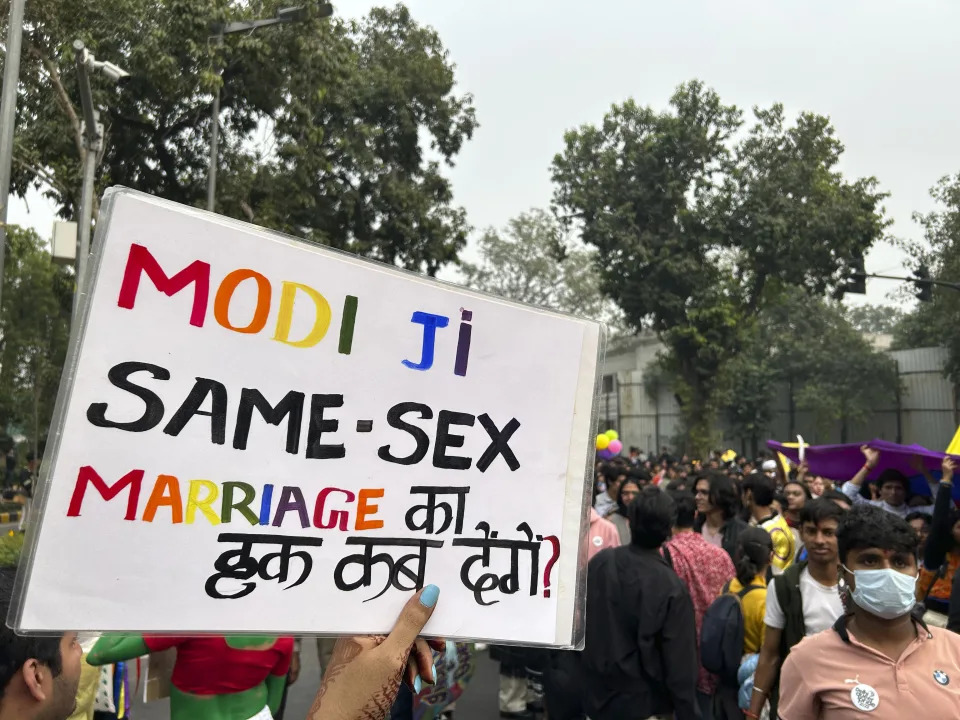
    Participants of the Delhi Queer Pride Parade carry a banner during the march in New Delhi, India, Sunday, Nov. 26, 2023. This annual event comes as India's top court refused to legalize same-sex marriages in an October ruling that disappointed campaigners for LGBTQ+ rights in the world's most populous country. 
    (AP Photo/Shonal Ganguly)

    NEW DELHI (AP) — More than 2,000 people took part in a gay pride event in New Delhi, waving rainbow flags and multicolored balloons as they celebrated sexual diversity in India but also raised concerns over the country's restrictive laws.

    Dancing to drums and music, the participants walked for more than two hours to the Jantar Mantar area near India’s Parliament. They held banners reading “Equality for all” and “Queer and proud.”

    The annual event comes after India’s top court refused to legalize same-sex marriages in an October ruling that disappointed campaigners for LGBTQ+ rights in the world’s most populous country.


    “It’s not about marriage. It's about equality. Everybody should have the same right because that’s what our constitution says,” said Noor Enayat, one of the volunteers organizing this year’s event.

    Earlier this year, the Supreme Court’s five-judge bench heard 21 petitions that sought to legalize same-sex marriage in India.

    The justices called for steps to raise awareness among the public about LGBTQ+ identity and to establish hotlines and safe houses for those in the community who are facing violence. They also urged the state to make sure same-sex couples don’t face harassment or discrimination in accessing basic needs, like opening a joint bank account, but stopped short of granting legal recognition to same-sex unions.

    Legal rights for LGBTQ+ people in India have been expanding over the past decade, mostly as a result of the Supreme Court’s intervention.

    In 2018, the top court struck down a colonial-era law that had made gay sex punishable by up to 10 years in prison and expanded constitutional rights for the gay community. The decision was seen as a historic victory for LGBTQ+ rights.

    Despite this progress, Prime Minister Narendra Modi’s Hindu nationalist government resisted the legal recognition of same-sex marriage and rejected several petitions in favor. Some religious groups, too, had opposed same-sex unions, saying they went against Indian culture.

    Homosexuality has long carried a stigma in India’s traditional society, even though there has been a shift in attitudes toward same-sex couples in recent years. India now has openly gay celebrities and some high-profile Bollywood films have dealt with gay issues.

    According to a Pew survey, acceptance of homosexuality in India increased by 22 percentage points to 37% between 2013 and 2019. But same-sex couples often face harassment in many Indian communities, whether Hindu, Muslim or Christian.


    Thousands march across globe to denounce violence against women

    Washington (AFP) – Thousands of people took to the streets across the world on Saturday to condemn violence against women on the international day highlighting the crime.


    Issued on: 25/11/2023 \
    Marches in Italy against violence on women came after the killing of a 22-year-old university student shook the country 
    © Alberto PIZZOLI / AFP

    On the UN-designated International Day for the Elimination of Violence against Women, protesters marched in Europe and the Americas.

    "The scourge of gender-based violence continues to inflict pain and injustice on too many," US President Joe Biden said in a statement.

    "An estimated one in three women globally will experience physical violence, rape, or stalking at some point in their lifetimes. It’s an outrage."

    "Particularly in areas of conflict, countless women and girls suffer at the hands of perpetrators who commit gender-based violence and use rape as a weapon of war."


    In Guatemala, candles wrote out "438" -- the number of women killed so far this year 
    © Johan ORDONEZ / AFP

    In Guatemala, protesters kicked off commemorations on Friday evening, placing candles to write out 438 -- the number of women killed so far this year.

    In the Chilean capital of Santiago, some 1,000 protesters marched through the streets Friday night, chanting "Not one step backward" and demanding action by the government to protect women.

    A women's advocacy group estimates that 40 femicides have occurred in the country this year.

    A woman takes part in a demonstration to demand justice for the victims of femicide in Guatemala City on November 25, 2023
     © Maria Jose BONILLA / AFP

    Along Rio de Janeiro's famed Copacabana Beach, protesters lined up 722 pairs of women's shoes, from high-heels to sneakers, each pair before a woman's name to represent the femicides recorded in 2022 -- the highest number since 2019, according to the non-governmental Brazilian Forum on Public Safety.

    And in Argentina, demonstrators -- including those concerned by the election of incoming president Javier Milei -- in Buenos Aires combined a protest on violence against women with a show of support for the Palestinian people.

    Milei has suggesting eliminating the Ministry of Women, Genders and Diversity -- in charge of preventing gender violence -- and has taken hardline stances on issues including abortion and equal pay

    Italy murder

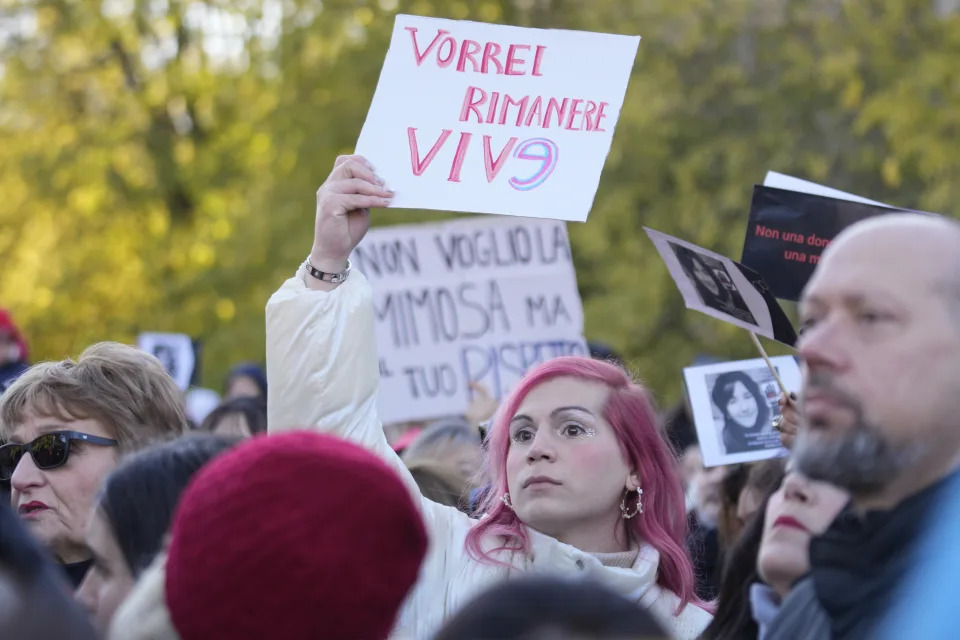
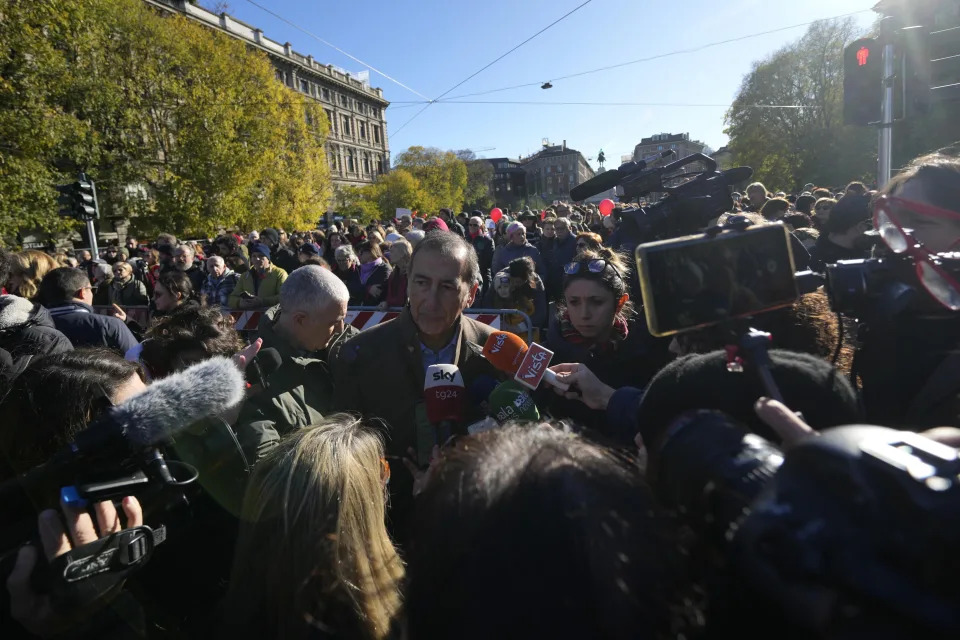
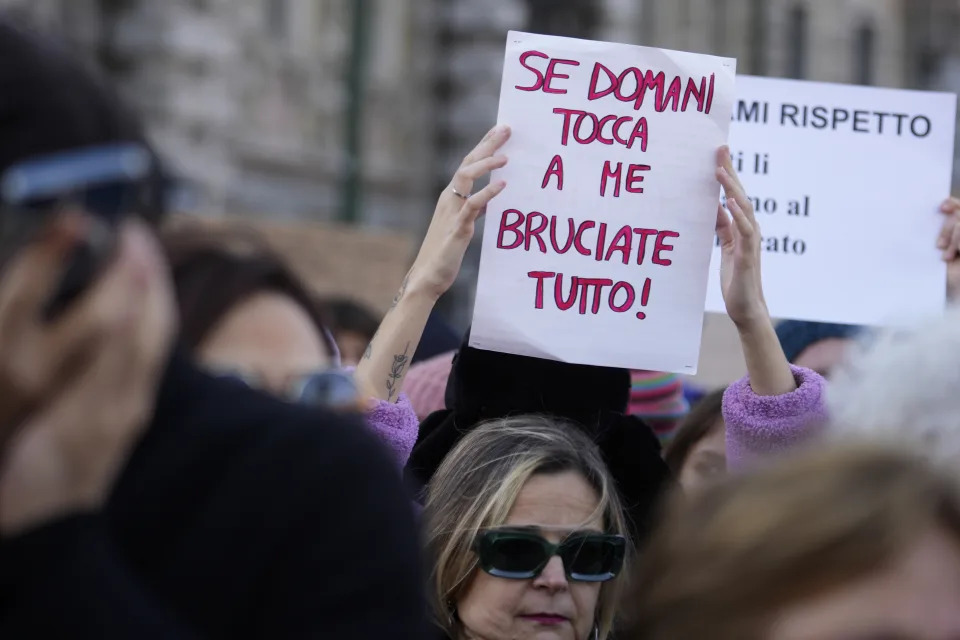
    In Italy, which has been shaken by the murder of a 22-year-old university student allegedly by her former boyfriend, some 50,000 people, according to the AGI news agency, demonstrated in Rome, where the Colosseum was to be lit up in red later on Saturday.

    The country has been horrified by the case of Giulia Cecchettin, who went missing for a week as she was due to receive her degree in biomedical engineering from the University of Padua.

    Thousands of people attended a demonstration in Rome
     © Alberto PIZZOLI / AFP

    Her body was eventually found in a gully about 120 kilometers (75 miles) north of Venice, and her former boyfriend, 22-year-old Filippo Turetta, was arrested in Germany.

    "This year... takes on particularly important connotations for us... for those in this country who care about the rights, claims and emancipation of all women, following yet another femicide, the killing of Giulia Cecchettin," said Luisa Loduce, a 22-year-old librarian.

    In the year to November 12, there have been 102 murder cases with female victims in Italy, 82 of them by family members or current or former partners, according to the interior ministry.

    Marches took place in countries around the globe on the International Day for the Elimination of Violence against Women 
    © MARTIN BERNETTI / AFP

    In Turkey, some 500 women gathered in the Sisli district in Istanbul, as riot police stood by, unfurling banners reading "We will not remain silent" and "Women are united and fighting against male-state violence."

    Protesters also took to the streets in Ankara.

    'Educate your boys'

    In France, several thousand people, many wearing purple, the color of women and gender equality, wove through the chilly streets of Paris and other cities, carrying signs reading: "One rape every six minutes in France" and "Protect your girls, educate your boys".

    "We don't want to count the dead any more," Maelle Lenoir, an official from the All of Us activist group, told reporters, urging the government to devote more money to eradicating violence against women.

    In Turkey, protesters marched in Ankara and Istanbul 
    © Adem ALTAN / AFP

    France has recorded 121 women killed so far this year in femicides, the killing of a woman due to her gender, compared with 118 in 2022, according to government data.

    Leonore Maunoury, 22, said that the justice system needed to be changed to deal effectively with the phenomenon, as she marched in the eastern city of Strasbourg.
    Protesters marched in Paris and other cities across France 
    © Geoffroy VAN DER HASSELT / AFP

    "Sexual violence is difficult to prove. Many cases are dismissed. The justice system is ill-adapted" to deal with the issue, she said.

    burs/yad/pvh/bbk

    © 2023 AFP


    Thousands march in France to condemn violence against women

    Several thousand people marched in France on Saturday to condemn violence against women on the international day to combat the scourge.


    Issued on: 25/11/2023 -
    A woman holds a placard that reads "Christmas arrives within the murder of 15 women", in reference to the rate of femicides in France, during a demonstration on the International day for the Elimination of Violence Against Women in Paris on November 25, 2023. 
    © Geoffroy Van der Hasselt, AFP

    By: NEWS WIRES

    Many wearing purple, the colour of women and gender equality, demonstrators wove through the chilly streets of Paris and other cities, carrying signs reading: "One rape every six minutes in France" and "Protect your girls, educate your boys".

    "We don't want to count the dead any more," Maelle Lenoir, an official from the All of Us activist group, told reporters, urging the government to devote more money to eradicating violence against women.

    France has recorded 121 women killed so far this year in femicides, the killing of a woman due to her gender, compared with 118 in 2022, according to government data.

    "Continued violence against women is not inevitable," President Emmanuel Macron said in a video posted on social media earlier on Saturday.
    "We must put an end to it and we will".

    Leonore Maunoury, 22, said that the justice system needed to be changed to deal effectively with the phenomenon, as she marched in the eastern city of Strasbourg.

    "Sexual violence is difficult to prove. Many cases are dismissed. The justice system is ill-adapted" to deal with the issue, she said.

    (AFP)


    Thousands rally in Italy over violence against women after woman's killing that outraged the country

    GIADA ZAMPANO
    Updated Sat, November 25, 2023

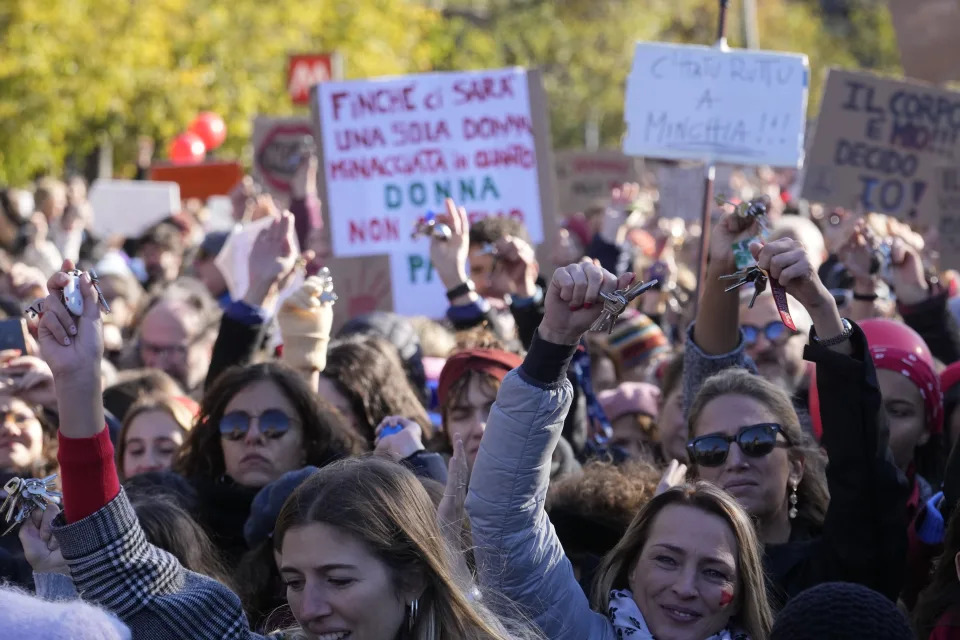
    ROME (AP) — Tens of thousands took to the streets of Italy’s main cities on Saturday to mark International Day for the Elimination of Violence against Women, just as an Italian man suspected of killing his ex-girlfriend was extradited from Germany.

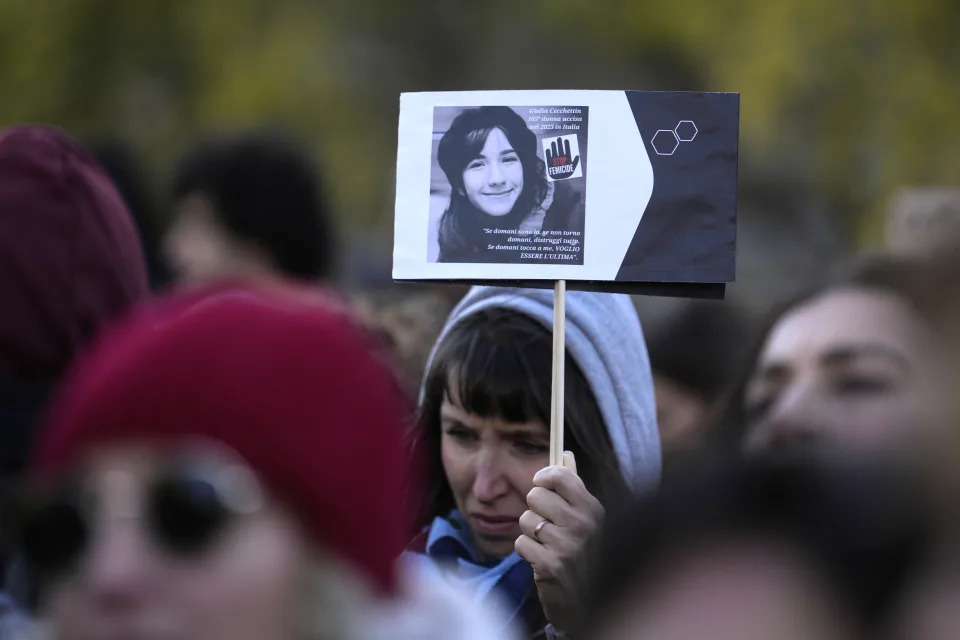
    The slaying of 22-year-old university student Giulia Cecchettin, allegedly at the hands of her former boyfriend, sparked outrage across Italy, where on average one woman is killed every three days.

    Suspect Filippo Turetta, 21, landed at the Venice airport around mid-morning on Saturday. He was immediately transferred to a prison in the northern city of Verona to face questions in the investigation into Cecchettin’s death, Italian media reported.

    Cecchettin had disappeared after meeting Turetta for a burger at a shopping mall near Venice, just days before she was to receive her degree in biomedical engineering. The case gripped Italy.

    Her body was found on Nov. 18 — covered by black plastic bags in a ditch near a lake in the foothills of the Alps. Turetta was arrested the following day in Germany.

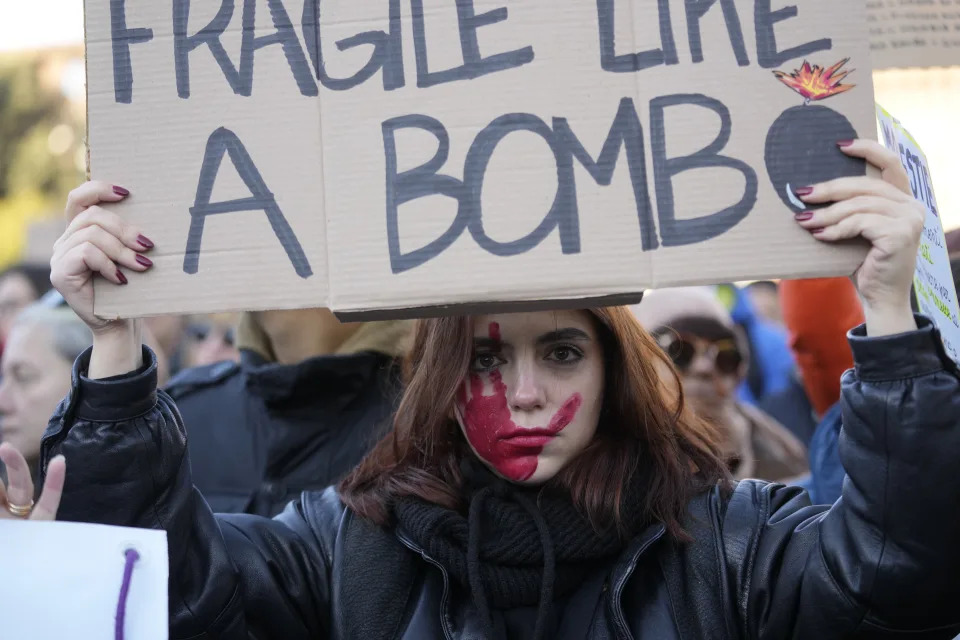
    Cecchettin’s killing has sparked an unprecedented wave of grief and anger in Italy, where many women say patriarchal attitudes are still entrenched.

    Data from the Italian Interior Ministry show that 106 women have so far been killed in Italy this year, 55 of them allegedly by a partner or former partner.

    Italy’s RAI state TV reported that in the days since Cecchettin’s body was found, calls to a national hotline for women fearing for their safety at the hands of men have jumped from some 200 to 400 a day — including from parents of young women.

    “Rome has been invaded … we are 500,000,” said activists from Non Una Di Meno (Not one less), the anti-violence feminist association that organized the rally in the capital.

    Many of the demonstrations that took place across Italy remembered Cecchettin and her striking story.

    “Male violence is something that personally touched me and all of us, at every age,” said Aurora Arleo, a 24-year-old student, who went to the demonstration from Ladispoli, a town close to Rome. “We have united also in the name of Giulia, because her story struck us, and I hope it will change something.”


    Monica Gilardi, 46, noted that her generation was probably “the one that suffered in silence more than others,” despite having experienced years of women’s battles and emancipation.

    “Now that I’ve reached a different awareness, I hope to be able to share it with my sisters,” she said.

    Thousands of men of all ages also responded to the call for joining Saturday's initiatives against gender violence.

    “I think it was important to be here today,” said Leonardo Sanna, 19, who took part in the Rome demonstration with female friends. “It’s not my first time, but I believe that Giulia’s death changed in part the perception of this problem among youths. And I hope this is not going to be short-lived.”

    Earlier this week, the Italian parliament approved new measures to clamp down on violence against women, following unanimous support from the two chambers.

    Among the measures being introduced is a campaign in schools to address sexism, machismo and psychological and physical violence against women.

    “A human society that aspires to be civilized cannot accept, cannot endure, this string of attacks on women and murders,” Italy’s President Sergio Mattarella said on Saturday. “We cannot just counter this with intermittent indignation.”

    In his message to mark the battle against gender violence, Pope Francis said it is a plague that must be rooted out from society and called for educational action.

    “Violence against women is a poisonous weed that plagues our society and must be pulled up from its roots,” the Pope wrote in a post on X, formerly Twitter, on Saturday.

    “These roots grow in the soil of prejudice and of injustice; they must be countered with educational action that places the person, with his or her dignity, at the center,” he added.

    Violence against women and girls remains one of the most pervasive human rights violations in the world. According to the most recent U.N. data, globally, over 700 million women — almost one in three — have been subjected to physical and sexual intimate partner violence, non-partner sexual violence, or both, at least once in their life.

    Thousands of people also rallied in Paris on Saturday to demand more government action to prevent gender violence. Protesters marched behind a large banner saying “women are angry, stop violence: actions and resources, now.”

    France has taken steps in recent years to toughen punishment for rape and sexual misconduct. But while President Emmanuel Macron has promised to tackle deadly domestic abuse and other violence against women, activists say France still has a long way to go.

    ___

    Associated Press writer Sylvie Corbet contributed to this report from Paris.


    Italy Women Violence
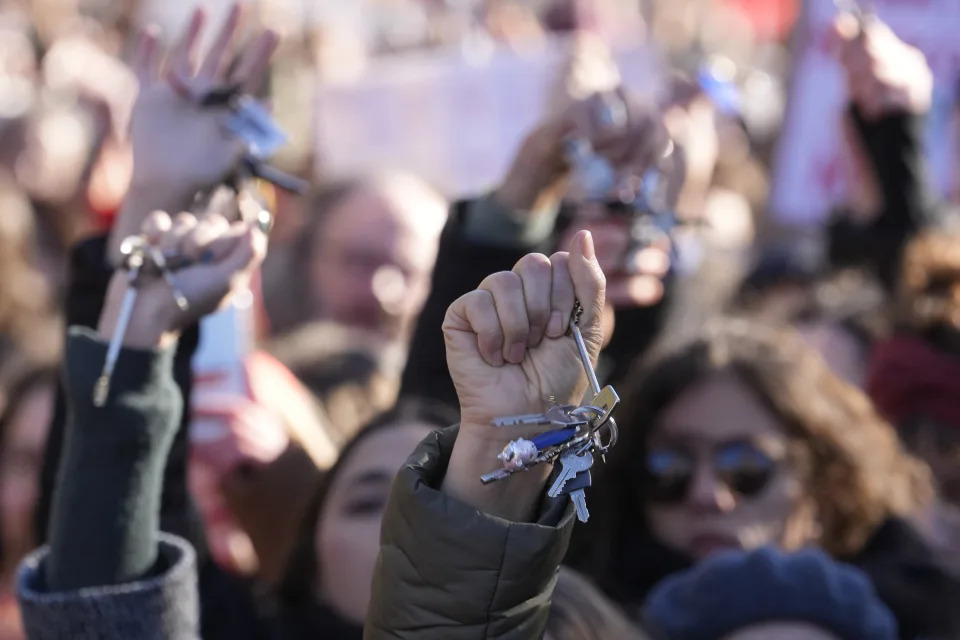
    Women show keys as they gather on the occasion of International Day for the Elimination of Violence against Women, in Milan, Italy, Saturday, Nov.25, 2023. Thousands of people are expected to take the streets in Rome and other major Italian cities as part of what organizers call a "revolution" under way in Italians' approach to violence against women, a few days after the horrifying killing of a college student allegedly by her resentful ex-boyfriend sparked an outcry over the country's "patriarchal" culture.
     (AP Photo/Luca Bruno)


    DR Congo's Nobel Prize winner Mukwege stages large presidential campaign rally


    DR Congo's Denis Mukwege, a Nobel-winning gynaecologist, staged a rally in his hometown on Saturday, promising to tackle corruption and conflict if elected president next month.


    Issued on: 25/11/2023 - 
    Nobel Prize-winning doctor and presidential candidate Denis Mukwege is greeted by supporters outside the airport of Kavumu-Bukavu, in the east of the Democratic Republic of Congo, on November 25, 2023. 
    © Alexis Huguet, AFP

    By: NEWS WIRES

    Addressing supporters in the eastern city of Bukavu, the renowned doctor said he would use political power to "put an end to war, put an end to famine" and to fight graft.

    "Today it is normal to steal in the Congo, it is normal to corrupt," said 68-year-old, in Swahili.

    Mukwege founded the Panzi hospital and foundation in conflict-torn eastern Democratic Republic of Congo after witnessing the horrific injuries and diseases suffered by rape victims.

    In 2018, he was jointly awarded the Nobel Peace Prize alongside Yazidi activist Nadia Murad for efforts to end sexual violence as a weapon of war.

    The doctor announced a presidential bid in October -- ending months of speculation over his political ambitions.

    The DRC, an impoverished and conflict-torn central African nation of about 100 million people, is scheduled to hold presidential and parliamentary elections on December 20.

    Incumbent President Felix Tshisekedi, 60, is running for re-election. The official campaigning season kicked off on November 19.

    Mukwege chose his hometown of Bukavu to host his first large campaign rally, to which thousands of people came on Saturday, according to an AFP correspondent.

    "During my five-year term of office, [I am going] to give the Congolese people back their dignity, their rights," he said, criticising the country's dependence on foreign aid, including foreign military aid.

    "Internationally, we are going to do everything we can to ensure that foreign armies leave Congolese soil, and that the Congolese people learn to take responsibility for their own security," Mukwege said.

    Dozens of armed groups are active in eastern DRC, a legacy of regional wars that flared during the 1990s and 2000s.

    One such group, the M23, has seized swathes of territory in the region since launching an offensive in late 2021, triggering a vast humanitarian crisis with over one million people driven from their homes.

    Eastern Congo is also home to an array of foreign military forces, including United Nations peacekeepers of various nationalities, and troops deployed in the East African Community.

    (AFP)
    Heat, disease, air pollution: How climate change impacts health

    Paris (AFP) – Growing calls for the world to come to grips with the many ways that global warming affects human health have prompted the first day dedicated to the issue at crunch UN climate talks starting next week.

    Issued on: 26/11/2023 -
    Air pollution, such as the extremes seen in India's capital New Delhi, are just one way that fossil fuels affect human health © Arun SANKAR / AFP/File

    Extreme heat, air pollution and the increasing spread of deadly infectious diseases are just some of the reasons why the World Health Organization has called climate change the single biggest health threat facing humanity.

    Global warming must be limited to the Paris Agreement target of 1.5 degrees Celsius "to avert catastrophic health impacts and prevent millions of climate change-related deaths", according to the WHO.

    However, under current national carbon-cutting plans, the world is on track to warm up to 2.9C this century, the UN said this week.

    While no one will be completely safe from the effects of climate change, experts expect that most at risk will be children, women, the elderly, migrants and people in less developed countries which have emitted the least planet-warming greenhouse gases.

    On December 3, the COP28 negotiations in Dubai will host the first "health day" ever held at the climate negotiations.

    - Extreme heat -

    This year is widely expected to be the hottest on record. And as the world continues to warm, even more frequent and intense heatwaves are expected to follow.

    Heat is believed to have caused more than 70,000 deaths in Europe during summer last year, researchers said this week, revising the previous number up from 62,000.


    Climate change increasing dangerous heat © Maxence D'AVERSA, Sabrina BLANCHARD / AFP

    Worldwide, people were exposed to an average of 86 days of life-threatening temperatures last year, according to the Lancet Countdown report earlier this week.

    The number of people over 65 who died from heat rose by 85 percent from 1991-2000 to 2013-2022, it added.

    And by 2050, more than five times more people will die from the heat each year under a 2C warming scenario, the Lancet Countdown projected.

    More droughts will also drive rising hunger. Under the scenario of 2C warming by the end of the century, 520 million more people will experience moderate or severe food insecurity by 2050.

    Meanwhile, other extreme weather events such as storms, floods and fires will continue to threaten the health of people across the world.
    Air pollution

    Almost 99 percent of the world's population breathes air that exceeds the WHO's guidelines for air pollution.

    Outdoor air pollution driven by fossil fuel emissions kills more than four million people every year, according to the WHO.

    It increases the risk of respiratory diseases, strokes, heart disease, lung cancer, diabetes and other health problems, posing a threat that has been compared to tobacco.

    The damage is caused partly by PM2.5 microparticles, which are mostly from fossil fuels. People breathe these tiny particles into their lungs, where they can then enter the bloodstream.

    World map showing the concentration of fine PM2.5 particles in the air © Valentin RAKOVSKY, Sabrina BLANCHARD / AFP

    While spikes in air pollution, such as extremes seen in India's capital New Delhi earlier this month, trigger respiratory problems and allergies, long-term exposure is believed to be even more harmful.

    However it is not all bad news.

    The Lancet Countdown report found that deaths from air pollution due to fossil fuels have fallen 16 percent since 2005, mostly due to efforts to reduce the impact of coal burning.

    Infectious diseases

    The changing climate means that mosquitoes, birds and mammals will roam beyond their previous habitats, raising the threat that they could spread infectious diseases with them.

    Mosquito-borne diseases that pose a greater risk of spreading due to climate change include dengue, chikungunya, Zika, West Nile virus and malaria.

    Health risks linked to climate change © Gal ROMA / AFP

    The transmission potential for dengue alone will increase by 36 percent with 2C warming, the Lancet Countdown report warned.

    Storms and floods create stagnant water that are breeding grounds for mosquitoes, and also increase the risk of water-borne diseases such as cholera, typhoid and diarrhoea.

    Scientists also fear that mammals straying into new areas could share diseases with each other, potentially creating new viruses that could then jump over to humans.
    Mental health

    Worrying about the present and future of our warming planet has also provoked rising anxiety, depression and even post-traumatic stress -- particularly for people already struggling with these disorders, psychologists have warned.

    In the first 10 months of the year, people searched online for the term "climate anxiety" 27 times more than during the same period in 2017, according to data from Google Trends cited by the BBC this week.

    © 2023 AFP