Saturday, December 23, 2023


COP28’s Unrealistic Tripling of Nuclear Power

 
 DECEMBER 22, 2023
Facebook

Image by Ondrej Bocek.

UN climate conferences since 1992 have failed to follow thru with results, as CO2 emissions continue higher and higher with every passing year. In fact, post climate conference impact of adopted proposals has become something 0f an inside joke. The most recent conference, COP28, embraced nuclear power as a godsend challenging climate change.

“Triple Nuclear Power” still echoes throughout the halls of COP28. If one stands at the podium in the convention center now empty and listens intently, echoes reverberate “triple nuclear power” spewing out of red-faced maniacs from over 20 countries that committed to tripling nuclear power to bail our global asses out of a crazed climate system of epic proportions.

The US, UK, UAE, and others signed a declaration. Since they couldn’t budge oil and gas, it was decided to favor nuclear power as a surrogate for fixing the rip snorting global heating imbroglio found from pole to pole, from ocean to ocean. It’s real, it’s palpable; it’s now, much earlier than forecasts, as 1.5C prematurely comes to surface during irregular episodes.

Yet, according to the Bulletin of the Atomic Scientists, the declaration by 22 countries calling for a tripling of nuclear energy by 2050 is more fantasy than reality: “Even at best, a shift to invest more heavily in nuclear energy over the next two decades could actually worsen the climate crisis, as cheaper, quicker alternatives are ignored for more expensive, slow-to-deploy nuclear reactors.” (Bulletin of the Atomic Scientists, Dec. 13th, 2023)

Building nuclear power facilities has a long history that unfortunately casts a doubtful shadow over the idea of tripling by 2050. A now-famous plan by Princeton University in 2004 called for a “stabilization wedge” to avoid one billion tons of carbon emissions per year by 2055 by building 700 large nuclear reactors over 50 years.

In 2022, there were 416 operating reactors in the world. Starting in 2005 when the Princeton plan was announced, it would have meant building 14 reactors per year, assuming all existing reactors continued to function. However, over the 50-year cycle aging reactors and those going into retirement would ultimately require 40 new reactors per year. But throughout the entire history of nuclear power, on average 10 nuclear power plants connected to the electricity grid per year, and the number of new units was only 5 per year from 2011-2021.

Once again, like the sticky issue of direct carbon capture, achieving the scale of proposed solutions to climate change’s biggest weapon, or global warming, is beyond reality. Talk is cheap.

Meanwhile less expensive safer wind and solar easily trounce nuclear power’s newly installed output, by a country mile, to wit:

New nuclear energy capacity 2000-2020 42 GWe

New wind capacity from 2000-2020 605 GWe

New solar capacity from 2000-2020 578 GWe

Nuclear costs are prohibitively high: It’ll cost $15 trillion to triple nuclear capacity, assuming existing reactors continue to function, which will not be the case, raising this big bet well over $15T. Who’s putting up $15T?

And is there enough time to triple by 2050? From design to projected operation of the NuScale VOYGR plant takes 13 years. According to the International Energy Agency, the design and build phase for a country’s first nuclear reactor is 15 years. Several countries that signed on to the declaration to triple nuclear power are newbies.

According to a Foreign Policy article, Dec. 13th 2023 entitled: COP28’s Dramatic But Empty Nuclear Pledge: several reasons for skepticism about the nuclear energy triple buildout were enumerated, concluding: “The combination of macroeconomic pressures and regulatory restrictions means that neither pledges such as those made at COP28 nor memorandums of understanding with various industries, utilities, and governments should give anyone much confidence that a major expansion of nuclear energy is forthcoming.”

Nuclear expert Mycle Schneider, the lead author of the prestigious World Nuclear Industry Status Report (500 pgs.) now in in its 18th edition known for its fact-based approach on details of operation, construction, and decommissioning of the world’s reactors was recently interviewed by the Bulletin: Schneider’s publication is considered the landmark study of the industry.

Regarding NuScale, the US-based company that develops America’s flagship SMR (Small Nuclear Reactors), the company initially promised in 2008 to start generating power by 2015. As of 2023, they haven’t started construction of a single reactor. They do not have a certification license for the model they promoted for a Utah municipality. NuScale’s six module facility would cost $20,000 per kilowatt installed, twice as expensive as the most expensive large-scale reactors in Europe. And SMRs will generate disproportionate amounts of nuclear waste. No bargain here, assuming it even works efficiently enough, which is doubtful.

Schneider: “The entire logic that has been built up for small modular reactors is with the background of climate change emergency. That’s the big problem we have.” A sense of urgency cannot be met: “Considering the status of development, we’re not going to see any SMR generating power before the 2030s. It’s very clear: none. And if we are talking about SMRs picking up any kind of substantial amounts of generating capacity in the current market, if ever, we’re talking about the 2040s at the very earliest.”

Schneider on COP’s pledge to triple nuclear power: “From an industrial point of view, to put this pledge into reality. To me, this pledge is very close to absurd, compared to what the industry has shown.”

Looked at another way: “It took 70 years to bring global nuclear capacity to the current level of 370 gigawatts (GW), and the industry must now select technologies, raise finance and develop the rules to build another 740 GW in half that time… Why would anyone spend a single dollar on a technology that, if planned today, won’t even be available to help until 2035-2045?’ said Mark Jacobson, an energy specialist at Stanford University.” (Source: Nuclear Sector Must Overcome Decades of Stagnation to Meet COP28 Tripling, Reuters, Dec. 7, 2023) How about $15 trillion?

COP28 did not deliver on phase down of fossil fuels, and it’ll likely miss on tripling nuclear power. But once the results are finally known, it’s too late. The heat’s already on.

Robert Hunziker lives in Los Angeles and can be reached at rlhunziker@gmail.com


Τhe Climate Summit in the United Arab Emirates did the Bidding of the Petroleum Billionaires


 DECEMBER 22, 2023
Facebook
A poster of a planet with a coat on it Description automatically generated

Carbon dioxide, CO2, is a greenhouse gas in the atmosphere. It increased by 50 percent since 1750. NASA, JPL-Caltech., 2022.

Prologue

The final draft document of the December 2023 Climate Summit, COP28, thousands of pages long, included the magic words “fossil fuels” – just once. This daring, of including fossil fuels and their inevitable phase out in the testimony of COP28, said David Gelles, a New York Times reporter, “marks a potentially trajectory-altering moment in the fight against climate change.”

I am not sure I buy this exaggerated hope. I watched on the Internet the last two hours of the closing discussion at COP28 at the United Arab Emirates. Al Jaber, oil minister of UAE, presided over the chaotic closing ceremony. Delegates from Bangladesh, Pakistan, and the United States, for example, praised al-Jaber for his leadership. A-Jaber also thanked his family, his “excellency,” the president of UAE, and his team for the achievement of saying softly what is a deafening cry by the natural world and millions of humans who have died and have been suffering from the ceaseless burning of fossil fuels for more than a century.

Phasing out or down fossil fuels or more drilling?

Listening to these nauseating “thanks,” I imagined the deals al-Jaber had worked out behind the scenes for more oil exploration and more drilling. Then the praises turned to the “take-home” of the global conclave to reach a consensus for “transitioning away from fossil fuels in energy systems, in a just, orderly and equitable manner.”

Gelles says that al-Jaber “ultimately muscled language about ending fossil fuels into the final COP agreement.” He did. Yet the Abu Dhabi National Oil Company, which has al-Jaber as director, is investing some $ 150 billion in the next 5 years for more drilling. And, in a fundamental way, Jaber’s muscled language continues the drilling for another 27 years.

The revised advanced version of the COP28 final decision document states that about 200 countries are urged to triple renewable energy while they double the efficiency of all the energy they employ. Moreover, all nations need to speed up their moving away from fossil fuels – this decade. But these nations are given all the way to mid-century to finish phasing out petroleum, natural gas, and coal.

The handicaps of this new consensus are basically two. First, waiting for a complete phase out of the main causes of planetary overheating by 2050 is foolish and irresponsible. Scientists are warning that unless we phase out 43 percent of all fossil fuels by 2030, we will raise the planetary temperature to more than 1.50 Celsius above pre-industrial levels. So, saying go on and drill until 2050 guarantees explosive global temperatures, deadly heat waves on land and seas, droughts, massive fires, floods, and severe worldwide famine. Nature, helpless and perpetually abused, will experience another massive extinction of species.

Second, the Climate Summit agreement is toothless. No mechanism exists to enforce it. No wonder thousands of fossil fuel lobbyists traveled to UAE Climate Summit. They worked with al-Jaber and his team and created a very lengthy legal paper full of loopholes and propaganda, decorated by a green lipstick about transitioning to renewable energy.

Triumph of petroleum billionaires

Meanwhile, the world’s largest oil producer, the United States, is celebrating an oil boom. American oil companies are cracking a gush of oil, about 13.2 million barrels of petroleum per day. This means gasoline prices are dropping. More cars and trucks and private airplanes and yachts will indulge driving and flying and sailing much more. Burning more petroleum, however, nullifies the voluntary advice of the Climate Summit. The result? Ballooning of the already high emission of greenhouse gases, which capture solar energy and increase global temperature.

Small island-nations were unhappy with the outcomes of COP28. Anne Rasmussen, the chief negotiator of Samoa, was angry because the deal happened in the absence of 39 island-nations. The powerless island-nations were not in the room. “The course correction that is needed has not been secured,” she said. However another delegate from Samoa, Cedric Schuster, did not mince words. She said: “We will not sign our death certificate. We cannot sign on to text that does not have strong commitments on phasing out fossil fuels.”

Another woman with experience in state and UN bureaucracy, Mary Robinson, was also angry. She had caught al-Jaber saying that science was irrelevant on issues of fossil fuel use or phase out. She said: “It is not good enough to say you recognize and respect the science but then fail to take heed of its dire warnings in the collective action you commit to … It is not good enough to use weak language or to permit loopholes for the fossil fuel industry to continue to contribute to the very problem countries are meant to be committed to tackling here in Dubai … this current version of the COP28 text is grossly insufficient.”

The COP petroleum managers also ignored indigenous people. “We watched first-hand as the fossil fuel polluters and wealthy governments manipulated developing countries to undermine real action on climate change,” said Tom Goldtooth, the director of the Indigenous Environmental Network, “[while] our strong messages of fossil fuel phase-out fell on deaf ears and instead more false solutions will accelerate climate change and deforestation… The UN climate change conference has failed humanity and Mother Earth.”

Another powerful voice for the impoverished tropical countries is that of Nina Lakhani, a reporter for the Guardian. She attended the Climate Summit in the UAE and was discouraged and outraged by witnessing the blatant influence and power of the fossil fuel lobbyists and petroleum-rich countries. She said:

“The biggest polluting countries and industries in the world, including the U.S., the U.K., the EU, Canada, Australia, Denmark, Norway, and the fossil fuel industry itself were extremely happy with the result [of the COP28]. The language [of the draft document]… says… that there will be a transition away from fossil fuels. There is no timeline. There is nothing more concrete than that… this is business as usual… There is no language that basically… acknowledges the historic responsibility of rich, developed countries like the U.S. and the U.K. and others in the current climate catastrophe. And it places no… extra responsibility on them to get rid of fossil fuels fast, or any timeline at all. And in addition to that… through pressure from the U.S. and the EU and others, there’s actually a huge get-out clause. There’s a paragraph that says that transition fuels… are OK. And by that, they’re talking about gas… the Biden administration has been expanding [the extraction of petroleum and gas] — the U.S. is the biggest oil and gas producer in the world this year, by a long way. It also has the plans to expand oil and gas at a much greater and faster scale than any other country in the world.”

True, I don’t like hypocrisy, either. I would have hoped that President Biden had the courage to, finally, put the lives and health of Americans and the planet above the profits of fossil fuel companies. But that’s an illusion. He is too much into supporting the wars in Ukraine and Israel. He would not be able to invite China, India, the European Union, and Russia for a real climate summit to, in fact, put into practice and policy the phase out of fossil fuels. Such a step, in theory, would guarantee his reelection. A Nobel Peace Prize would probably follow.

So, in real America, people should wake up and stop both misguided wars funded by us behind our backs. Then Americans must face the battle of their lives, saving themselves and our beloved planet Earth from the pernicious and thoughtless appetites of the billionaire class.

Evaggelos Vallianatos is a historian and environmental strategist, who worked at the US Environmental Protection Agency for 25 years. He is the author of seven books, including the latest book, The Antikythera Mechanism.

Wages and Prices: Who Is Keeping Up with What?

 
 DECEMBER 22, 2023
Facebook

Since President Biden took office, the media have run a constant stream of news stories about how high various prices were and telling their audiences that this has led to mass suffering. These stories appear less frequently now, although we still hear Republican politicians and people posting in social media that they are paying $5 for a gallon of gas or $90 for a turkey.

It is impossible to know what specific people pay for an item. Who knows, some stores charge outrageous prices and maybe people purchased a specialty item rather than the standard fare version.

But, it’s not worth spending time on the anomalies. We do have good data on the averages from the Bureau of Labor Statistics (BLS), which puts a great deal of effort into tracking prices and rents around the country. I thought it would be worth just posting some of the price increases on key items since the pandemic and comparing them with wage increases for various groups of workers.

Source: Bureau of Labor Statistics and author’s calculations.

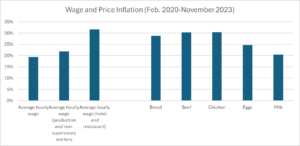
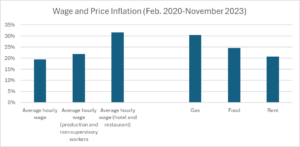
The graph above shows the increase in the average hourly wage since February of 2020 for all workers, for production and non-supervisory workers, and for production and non-supervisory workers in the hotel and restaurant industries. The average hourly wage for all workers increased 19.4 percent, for production and non-supervisory workers it increased 21.9 percent, and for workers in the hotel and restaurant industry it increased 31.6 percent.

There are a couple of points worth making here before comparing these increases to the price increases over this period. First, the 19.4 percent increase for all workers is a hair more than the 18.8 percent rise in the overall Consumer Price Index over this this period, but clearly not a great picture. However, it is a better story than many periods in the past, like the 1980s, early 1990s, and 2000s, when wages were not keeping pace with prices.

It is also important to remember that we were hit with a worldwide pandemic during this period. The impact of the pandemic caused wages to fall behind prices in almost every other country. As some people may recall, we actually had rationing (anyone got toilet paper?) in 2020 at the start of the pandemic. So, coming out slightly ahead is not a bad picture when confronted with a natural disaster.

The other point is that, in contrast to the pattern for most of the last four decades, lower-paid workers are doing better now than higher-paid workers. The category of production and non-supervisory workers includes roughly 80 percent of the workforce force. It excludes managers and higher-paid professionals like doctors and lawyers. In the last three and half years, this group is doing better on average than the 20 percent at the top. This has substantially reduced the wage inequality we have seen develop since 1980.

This story is seen even more clearly with the 31.6 percent rise in the pay for production and non-supervisory workers in the hotel and restaurant industries. This is the lowest-paying major sector in the economy. The tight labor market has forced employers in this sector to cough up more money to get and keep the workers they need to run their businesses.

Okay, now for the comparisons. The 30.4 percent rise in gas prices would outpace the wage increases for most workers, but the workers in the hotel and restaurant industry still come out slightly ahead. It is worth noting that gas prices are hugely erratic.

Gas prices were relatively low at the start of the period and then were driven up by supply disruptions associated with the reopening from the pandemic (the Trump administration negotiated worldwide supply reductions during the pandemic) and then the Russian invasion of Ukraine. Prices have been falling sharply in recent months, as supply returned to normal (U.S. production is at a record high). The December prices are likely to be a few percentage points lower than the November data shown here, as prices are continuing to fall.

Food prices rose on average 24.7 percent since the pandemic. There were shortages of many items early in the pandemic. We expect shortages to lead to rising prices, but it seems that major manufacturers also took advantage of these shortages to jack up their profit margins. As the supply chain problems have been largely ended, profit margins are still elevated. This has caused most workers’ pay to lag somewhat behind food prices.

Here too it is worth noting that prices are hugely erratic. Since February, the price of store-bought food has increased at just a 0.7 percent annual rate. It is likely that wage increases will break even with food prices in the next year.

The third category shown is rents, which have risen on average by 20.7 percent. This is a bit more than the rate of wage growth for all workers, but more than a percentage point less than the increase for production and non-supervisory workers. It is more than 10.0 percentage points less than the wage growth seen by workers in the hotel and restaurant industries.

Here too there is a better story on the way. Rents shot up in 2021 as people working from home decided they needed more space and were prepared to spend some of the money they saved commuting to get themselves larger apartments or houses. This was a one-time effect.

While people are still working from home, the number is no longer surging. And much new housing is coming on line after pandemic disruptions limited supply in 2021-2022. The result is that rents have stabilized and in many areas are actually falling. The rent indexes in the CPI will lag the market, since they measure rents in all units, however we can already see the stabilization in the rents of units that turn over. This will show up in the CPI next year.

Source: Bureau of Labor Statistics and author’s calculations.

The graph above shows the prices of some of the food items that have been highlighted by the media when they rose rapidly earlier in the recovery. The price of bread has risen 28.8 percent since the pandemic, outpacing most workers’ wages, but not those of the low-paid workers in the hotel and restaurant industry. This was driven in part by a jump in wheat prices following Russia’s invasion of Ukraine, but wheat prices are now back to their pre-invasion level. This is an area where increased profit margins are likely a big deal.

The next item is beef, the price of which has risen by 30.3 percent. Here there is more of an explanation with the price of the underlying commodity, with wholesale prices having also risen by close to 30 percent. Interestingly, most of this rise was in 2020, when much of the economy was shutdown.

Chicken prices have risen by 30.3 percent since the start of the pandemic, but this is also a case where good news is on the way. The big issue here was an Avian flu epidemic that devastated the chicken stock. This has more recently been brought under control. The stocks have been rebuilt and chicken prices have been flat over the last year.

Egg prices are largely the same story. They soared last year, capturing headlines and were highlighted in numerous news stories. In the last year, prices have plummeted, and egg prices are now up by 24.7 percent since the start of the pandemic. We can look forward to egg prices being stable or falling somewhat in the next year.

The last item is milk, which also captured headlines when its price rose rapidly in 2021 and 2022. This was likely driven largely by supply chain disruptions, as people were buying more milk in stores and less in restaurants. Milk prices have since stabilized and have fallen over the last year. They are now up by 20.4 percent since the start of the pandemic, somewhat more than the rise in wages for all workers, but slightly less than the increase for production and non-supervisory workers and more than 10.0 percentage points less than the wage increase for workers in the hotel and restaurant industries.

This is a very quick snapshot of some wage increases and the prices of some items that have featured prominently in news stories. There are many items whose price has risen far less than wages, like appliances, clothing, and college tuition. The prices of these items have not gotten much attention, but they are also part of people’s shopping basket.

Obviously, everything is not great in the economy, but most people are coming out ahead of inflation. With wages still growing at a healthy pace and inflation slowing, it looks like the picture will improve further in 2024, as we push the pandemic further into the past.

Productivity has grown at an extraordinary 4.4 percent annual rate in the last two quarters. That compares to an average of rate of just 1.1 percent in the decade prior to the pandemic. We expect wages to roughly keep pace with productivity. No one expects the 4.4 percent rate to continue, and the productivity data are highly erratic, but with the spread of AI and other new technologies, it is plausible that we are on a faster productivity growth path.

Also, if we can sustain a tight labor market (we’ve had 22 months of below 4.0 percent unemployment, the longest stretch in half a century), we should expect to see profit margins eroded, as income shifts back from profits to wages. In short, we look to be on a promising economic path, but bad things can always happen.

This first appeared on Dean Baker’s Beat the Press blog.  

Dean Baker is the senior economist at the Center for Economic and Policy Research in Washington, DC. 

Foreignlanguages.press

https://foreignlanguages.press/wp-content/uploads/2020/08/C02-WLCWPP.pdf

Wages, Price and Profit. Karl Marx, 1865. Preliminary. 1. Production and Wages. 2. Production, Wages, Profits. 3. Wages and Currency. 4. Supply and Demand.


Archive.org

https://archive.org/download/valuepriceprofit00marx/valuepriceprofit00marx.pdf

during the Hfetime of Marx. It was found amongst his papers after the death of En- gels. Among many other characteristics of. Marx, this paper shows two ...


What Swedish Mechanics Remind Us About Labor Justice


BY ANDREW MOSS
DECEMBER 22, 2023


Image by Austin Ramsey.

When Swedish mechanics working for Tesla walked off the job in late October, their action may not have seemed consequential to most Americans. But, by way of contrast, these workers now powerfully remind us not only of some of the most glaring defects of American labor relations, but also of pathways that can return the U.S. to a greater measure of economic equality and labor justice.

The Swedish mechanics struck because they wanted a collective agreement with Tesla, posing the first such challenge to that company in its 20 years of existence. Represented by the union IF Metall, they understood such agreements as foundational to a social fabric defined by a strong social safety net and a relatively low level of economic inequality. Despite recent declines, Sweden has one of the highest levels of union density in the world, with approximately seven out of ten workers represented by unions.

Once the Swedish mechanics took the initiative, workers in other unions and other countries soon followed suit. Danish dockworkers represented by Denmark’s 3F labor union refused to unload or transport Teslas intended for Swedish consumers. Other transport unions in Norway and Finland soon joined the stoppage, and a Swedish court rejected a Tesla lawsuit that attempted to prevent Swedish postal workers from refusing to deliver license plates for Teslas. A labor-run pension fund, Pension Danmark, divested $57 million in Tesla stocks.

In response, Tesla CEO Elon Musk reiterated his opposition to unions, stating recently that they create a “lords and peasants situation with the work force and naturally try to create negativity within a company.” He labelled the growing wave of strikes in Nordic countries “insane.”

This Nordic wave brings into sharp relief the contrast with the U.S. labor scene, where American workers have to contend with right-to work laws and union busting, hurdles particularly onerous to workers attempting to secure first-time collective agreements. In 26 states, right-to-work laws undermine the capacity of unions to maintain strong financial footings, and union busting practices, enabled by weak labor laws, place workers at a severe disadvantage when organizing. The practices range from employers’ foot-dragging in collective bargaining, to shut-downs of unionized stores or plants, to political maneuverings that prevent unions from getting any kind of initial foothold.

All these obstacles have driven down U.S. union density over the past several decades, so that only one in 10 Americans (10.1 percent) is now represented by a union, a profound contrast with union densities in countries like Sweden (70 percent), Denmark (67 percent) and Finland (74 percent). Because levels of union representation contribute to comparative levels of economic equality or inequality in nations, it’s not surprising that recent studies confirm not only greater inequality in the U.S. than in countries like Denmark or Sweden, but also more rapidly increasing inequality.

And inequality impinges on significant markers of well-being, including poverty rates and rates of infant and maternal mortality, the latter being a key index of a nation’s health. It’s no surprise that the U.S. lags behind the Nordic nations in these markers as well.

At this time, it’s unclear how the conflict between the Nordic unions and Tesla will play out. It’s unlikely that the unions will capitulate, and Elon Musk’s unwillingness to accept collective agreements has provoked strong pushback from many sectors, including powerful institutional investors in Nordic countries.

What the conflict signals to America, however, is the power of labor militancy and inter-union solidarity, factors that proved essential to U.S. union victories in 2023. In taking on the most valued automaker in the world, the Swedish mechanics and their fellow unionists remind us that it wasn’t long ago (the early 1950’s) when one in three American workers belonged to a union, with union power playing a significant role in reducing American economic inequality to the lowest levels it had ever reached before or since.

The road back to greater economic equality requires a shared vision of the essential contributions that unions make to collective well-being. And, as the Nordic unions remind us, it also requires the political will that only a shared culture and broad institutional supports can empower.


Andrew Moss is an emeritus professor from the California State Polytechnic University, Pomona, where he taught a course, “War and Peace in Literature,” for 10 years.
The Balance Of Power Between U$ Workers And Employers Shifted In 2023. We Don’t Yet Know How Far It’ll Shift.

This year’s historic Hollywood and UAW strikes aren’t labor’s whole story — the total number of Americans walking off the job remained relatively low

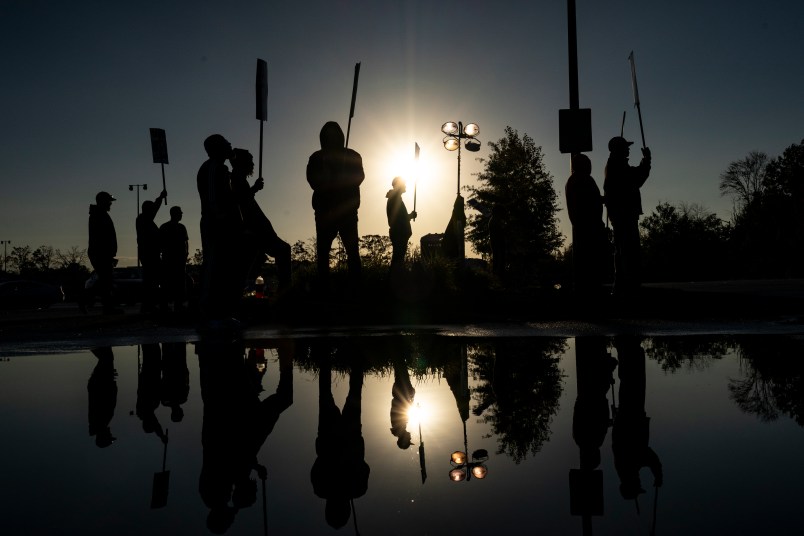
LOUISVILLE, KENTUCKY - OCTOBER 14: Factory workers and UAW union members form a picket line outside the Ford Motor Co. Kentucky Truck Plant in the early morning hours on October 14, 2023 in Louisville, Kentucky. 

By Judith Stepan-Norris and Jasmine Kerrissey
TPM
December 23, 2023 

This article is part of TPM Cafe, TPM’s home for opinion and news analysis. It was originally published at The Conversation.


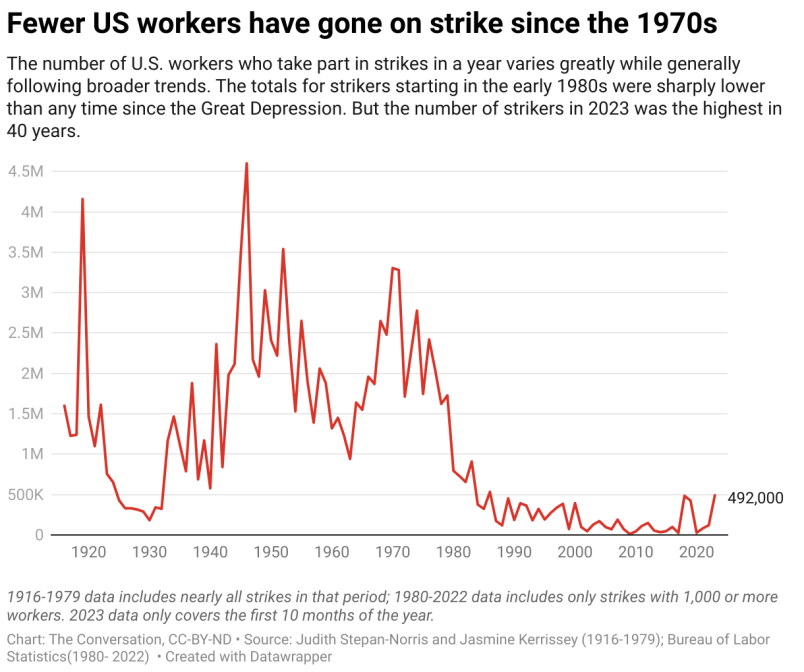
More than 492,000 workers — including nurses, actors, screenwriters, autoworkers, hotel cleaners, teachers and restaurant servers — walked off their jobs during the first 10 months of 2023.

That includes about 46,000 autoworkers who went on strike for about six weeks, starting in mid-September. The United Auto Workers union won historic gains that have the potential to transform the industry in its contracts with General Motors, Ford and Stellantis — the company that includes Chrysler.

In addition, more than 75,000 Kaiser Permanente workers took part in the largest strike of U.S. health care workers to date.

This crescendo of labor actions follows a relative lull in U.S. strikes and a decline in union membership that began in the 1970s. Today’s strikes may seem unprecedented, especially if you’re under 50. While this wave constitutes a significant change following decades of unions’ losing ground, it’s far from unprecedented.

We’re sociologists who study the history of U.S. labor movements. In our new book, “Union Booms and Busts,” we explore the reasons for swings in the share of working Americans in unions between 1900 and 2015.

We see the rising number of strikes today as a sign that the balance of power between workers and employers, which has been tilted toward employers for nearly a half-century, is beginning to shift.


Maryam Rouillard raises her fist on Aug. 8, 2023, while taking part in a one-day strike by Los Angeles municipal workers to protest contract negotiations. 
Apu Gomes/Getty Images
Millions on strike

The number of U.S. workers who go on strike in a given year varies greatly but generally follows broader trends. After World War II ended, through 1981, between 1 million and 4 million Americans went on strike annually. By 1990, that number had plummeted. In some years, it fell below 100,000.

Workers by that point were clearly on the defensive for several reasons.

One dramatic turning point was the showdown between President Ronald Reagan and the country’s air traffic controllers, which culminated in a 1981 strike by their union — the Professional Air Traffic Controllers Organization. Like many public workers, air traffic controllers did not have the right to strike, but they called one anyway because of safety concerns and other reasons. Reagan depicted the union as disloyal and ordered that all of PATCO’s striking members be fired. The government turned to supervisors and military controllers as their replacements and decertified the union.

That episode sent a strong message to employers that permanently replacing striking workers in certain situations would be tolerated.


There were also many court rulings and new laws that favored big business over labor rights. These included the passage of so-called right-to-work laws that provide union representation to nonunion members in union workplaces — without requiring the payment of union dues. Many conservative states, like South Dakota and Mississippi, have these laws on the books, along with states with more liberal voters — such as Wisconsin.

As union membership plunged from 34.2% of the labor force in 1945 to around 10% in 2010, workers became less likely to go on strike.

Wages kept up with productivity gains when unions were stronger than they are today. Wages increased 91.3% as productivity grew by 96.7% between 1948 and 1973. That changed once union membership began to tumble. Wages stagnated from 1973 to 2013, rising only 9.2% even as productivity grew by 74.4%.


Prime conditions

In general, strikes grow more common when economic conditions change in ways that empower workers. That’s especially true with the tight labor markets and high inflation seen in the U.S. in recent years.

When there are fewer candidates available for every open job and prices are rising, workers become bolder in their demands for higher wages and benefits.

Political and legal factors can play a role, too.

In the 1930s, President Franklin D. Roosevelt’s New Deal enhanced unions’ ability to organize. During World War II, unions agreed to a no-strike pledge — although some workers continued to go on strike.

The number of U.S. workers who went on strike peaked in 1946, a year after the war ended. Conditions were ripe for labor actions at that point for several reasons. The economy was no longer so dedicated to supplying the military, pro-union New Deal legislation was still intact and wartime strike restrictions were lifted.

In contrast, Reagan’s crushing of the PATCO strike gave employers a green light to permanently replace striking workers in situations in which doing that was legal.

Likewise, as we describe in our book, employers can take many steps to discourage strikes. But labor organizers can sometimes overcome management’s resistance with creative strategies.
New economic equations

Between 1983 and 2022, the share of U.S. workers who belonged to unions fell by half, from 20.1% to 10.1%. The COVID-19 pandemic didn’t reverse that decline, but it did change the balance of power between employers and workers in other ways.

The “great resignation,” a surge in the number of workers quitting their jobs during the pandemic, now seems to be over, or at least cooling down. The number of unemployed people for every job opening reached 4.9 in April 2020, plummeted to 0.5 in December 2021, and has remained low ever since.

Meanwhile, many workers have become more dissatisfied with their wages. The strikes by teachers that ramped up in 2018 responded to that frustration. U.S. inflation, which soared to 8% in 2022, has eroded workers’ purchasing power while company profits and economic inequality have continued to soar.

Technological breakthroughs that leave workers behind are also contributing to today’s strikes, as they did in other periods.

We’ve studied the role technology played in the printers’ strikes of the 1890s following the introduction of the linotype machine, which reduced the need for skilled workers, and the longshoremen strike of 1971, which was spurred by a drastic workforce reduction brought about by the introduction of shipping containers to transport cargo.

Those are among the precedents for the actors and screenwriters strikes of 2023, which hinged on the financial implications of streaming in film and television and artificial intelligence in the production of movies and shows.

Working conditions, including health and safety concerns and time off, have also been at the root of many recent strikes.

Health care workers, for example, are going on strike over safe staffing levels. In 2022, rail workers voted to strike over sick days and time off, but were blocked from walking off the job by a U.S. Senate vote and President Joe Biden’s signature.

Time and again, when the conditions have been right, U.S. workers have gone on strike and won. Sometimes more strikes have followed, in waves that have the potential to transform workers’ lives. But it’s still too early to know when this wave will crest.

This is an updated version of an article originally published Aug. 24, 2023, with nearly complete data for the number of strikers in 2023 and additional details about several strikes. This article is republished from The Conversation under a Creative Commons license. Read the original article.