Tuesday, January 09, 2024

Press Freedom Group Demands Probe Into Israel’s Killing of Reporters in Gaza

“Journalists are civilians, not targets,” said one advocate for press freedom.
TRUTHOUT
January 8, 2024
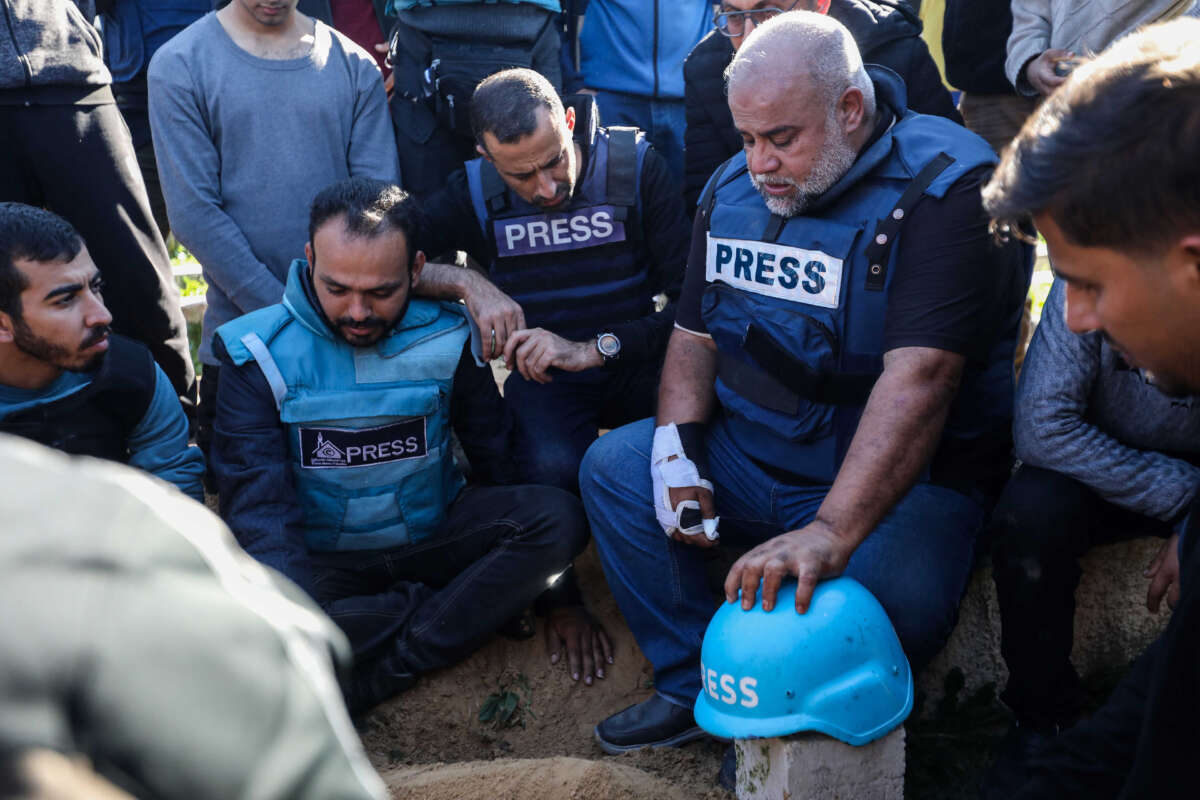
Family and friends, including Al Jazeera reporter, Wael Al-Dahdouh (2nd right), bid farewell to the bodies of journalists Hamza Al-Dahdouh and Mustafa Thuraya on January 7, 2024, in Rafah, Gaza. The journalists, Hamza Al-Dahdouh and Mustafa Thuraya, were reportedly killed when their car was bombed after reporting from an air strike on a building that morning.
AHMAD HASABALLAH / GETTY IMAGES

The Committee to Protect Journalists (CJP) has called for an impartial investigation into the Israeli drone strike on Sunday that killed freelance journalist Mustafa Thuraya and Al Jazeera reporter Hamza Al Dahdouh, son of Wael Al Dahdouh, the Gaza bureau chief for Al Jazeera.

Hamza Al Dahdouh is the fifth member of Wael Al Dahdouh’s family to be killed by an Israeli airstrike; on October 25, an airstrike targeting the Nuseirat refugee camp killed Wael Al Dahdouh’s wife, daughter, son, and grandson.

“The killings of journalists Hamza Al Dahdouh and Mustafa Thuraya must be independently investigated, and those behind their deaths must be held accountable. The continuous killings of journalists and their family members by Israeli army fire must end: journalists are civilians, not targets,” Sherif Mansour, CPJ’s Middle East and North Africa Program Coordinator, said in a statement on Sunday.

Since October 7, Israeli forces have killed at least 79 journalists and media workers in Gaza and the West Bank. The International Federation of Journalists (IFJ) found that Israel’s genocidal bombing campaign in Gaza has killed more than one journalist a day since it began, accounting for 72 percent of all journalist deaths worldwide in 2023.

RELATED STORY

Palestinian Journalists Targeted, Killed Amid Israel’s Onslaught on Gaza
Free press advocates have called for the perpetrators of crimes against Palestinian journalists to be held accountable.
By Zane McNeill , TRUTHOUT  October 10, 2023

“Since 7 October, more than one journalist a day has lost their lives during the war in Gaza, a scale and pace of loss of media professionals’ lives without precedent,” the group said in a press release. “In 2023 Palestinian journalists in the Gaza Strip have been the victims of indiscriminate bombing by the Israeli army. The IFJ calls on international authorities to ensure that international law is respected and to put an end to the massacre of journalists in Gaza.”

In December, a CJP report revealed that the number of journalists killed in the initial ten weeks of Israel’s assault on Gaza surpassed the total number of journalists killed in any single country throughout an entire year.

“The Israel-Gaza war is the most dangerous situation for journalists we have ever seen, and these figures show that clearly,” Mansour said in a statement. “The Israeli army has killed more journalists in 10 weeks than any other army or entity has in any single year. And with every journalist killed, the war becomes harder to document and to understand.”

CJP also found that in addition to Israel’s systematic killing of Palestinian journalists, which is a tactic that has been used by the Israeli military for over 20 years, Israel has begun targeting journalists’ families.

“CPJ is particularly concerned about an apparent pattern of targeting of journalists and their families by the Israeli military,” CJP said in a statement. “In at least one case, a journalist was killed while clearly wearing press insignia in a location where no fighting was taking place. In at least two other cases, journalists reported receiving threats from Israeli officials and IDF [Israeli Defense Forces] officers before their family members were killed.”

Recent investigations by Amnesty International, Human Rights Watch, Reuters and AFP into an Israeli strike in southern Lebanon on October 13 found that the IDF attack was most likely a deliberate assault targeting Reuters videographer Issam Abdallah and six other journalists.

“Israel says it does not target journalists. It needs to explain whether it used one of its drones for a precision attack on these two journalists and why it launched strikes on those like Reuters journalist Issam Abdallah, who was clearly wearing press insignia and away from direct fighting,” said Mansour.

Advocacy groups believe that the Israeli Defense Forces are attempting to suppress media coverage of the genocide in Gaza by killing journalists in violation of international law. In November, Reporters Without Borders filed a case with the International Criminal Court, asking it to investigate “war crimes committed against journalists during the Israeli-Palestinian conflict in Gaza.”


This article is licensed under Creative Commons (CC BY-NC-ND 4.0), and you are free to share and republish under the terms of the license.

ZANE MCNEILL is a trending news writer at Truthout. He has a Master’s Degree in Political Science from Central European University and is currently enrolled in law school at the University of Denver Sturm College of Law. 
They can be found on Twitter: @zane_crittheory.
How Can Philosophy Speak to a World in Crisis? The Answer May Lie in Our Bodies.


Pain and vulnerability can isolate us — or be the source of our deepest bonds, says philosopher Drew Leder.
January 7, 2024
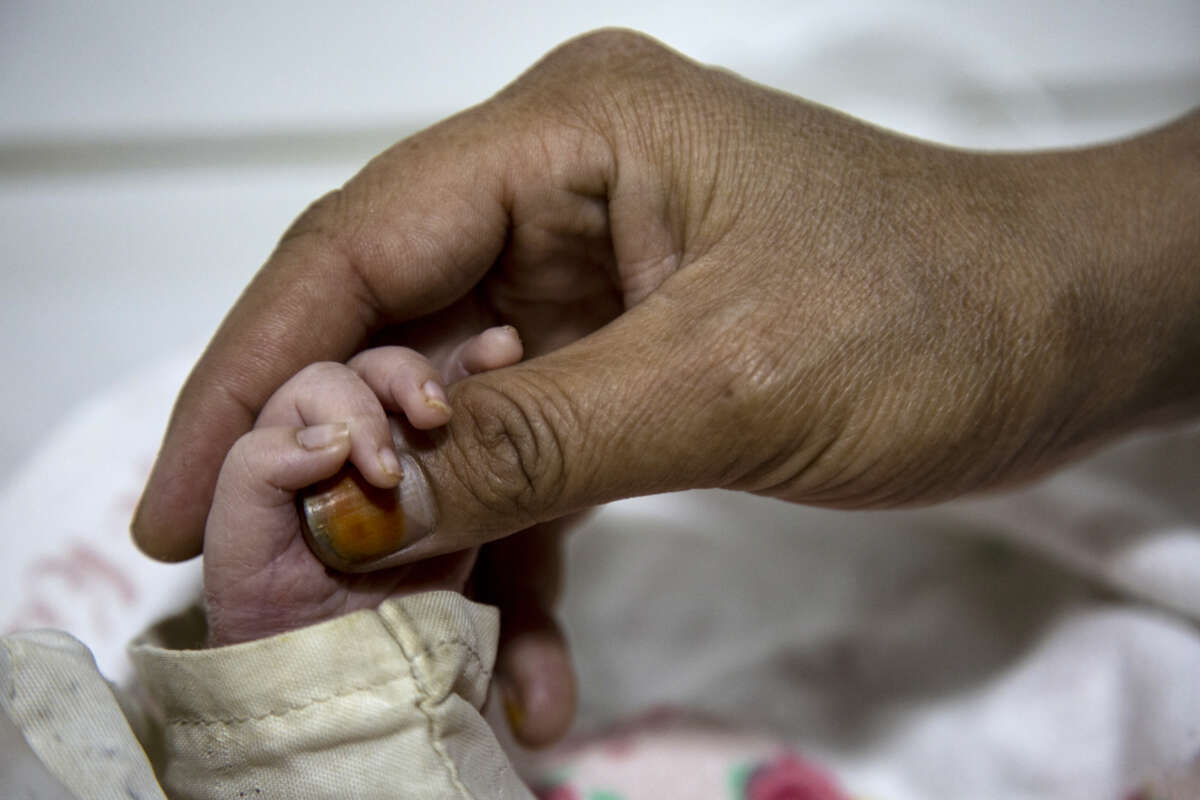
A woman holds the hand of her newborn child at the Doctors Without Borders (MSF)-run maternity hospital in Khost, Afghanistan, on December 8, 2023.
KOBRA AKBARI / AFP VIA GETTY IMAGES

The body is precarious. That is, as embodied people, we are all precarious, interdependent, fragile, vulnerable. As much as neoliberalism would like us to believe otherwise, we are not totally independent and asocial. My body is aging as I write this sentence. Indeed, none of us are impervious to growing old. In doing so, we will need to confront the adverse conditions that come with aging: loss of physical strength, difficulty walking, standing, possible illness, and so on. Because I am not bodily impervious, there are times when I feel a distinct sense of foreboding. Yet, other times, I feel a sense of grace, where there is the recognition that we are all part of this existential (for me deeply mysterious) collective journey, from birth to the grave.

Yet, it isn’t just the passage of time or our finitude that impacts us. There is also something that philosopher Drew Leder insightfully calls embodied injustice. For me, embodied injustice recalls anti-colonial psychiatrist and revolutionary Frantz Fanon’s concept of sociogenesis, which points to the various ways in which embodiment is linked to socially deleterious and violent oppressive hierarchical structures. Leder is painfully aware of those who deal with “socially imposed limits and setbacks, which could include poverty, being a refugee, growing old in an ageist country, struggling with racism, sexism and homophobia.” What makes Leder’s work powerfully ethical is the fact that he refuses to look away from embodied injustice. And as a philosopher and a medical doctor, he is also profoundly committed to addressing what it takes to heal under conditions of embodied injustice. That is the gift that Leder gives us.

For this reason, and so much more, I am honored to interview Leder, who is an internationally known philosopher who engages topics ranging across medicine, the criminal legal system, aging and cross-cultural spirituality. The author of seven books, both scholarly and popular, Leder’s most recent book is entitled, The Healing Body: Creative Responses to Illness, Aging, and Affliction (2023). The interview that follows has been lightly edited for clarity and length.

George Yancy: As a philosopher, I find myself struggling to find the words to communicate moments like these, moments when the world is filled with so much violence, suffering, dread and injustice. As philosophers, we are taught to think with clarity, to reason, to be philosophical — that is, to remain calm in the face of great difficulty. I’m not always convinced that the academic study of philosophy has what it takes to tarry with the burden of human suffering, to face it, to describe its horror, and to provide ways of freeing us from our individual and collective nightmares. Those nightmares, by the way, are not in short supply. Think of the horrors that are encircling us: wars, genocide, xenophobia, femicide, anti-Black racism, mass incarceration, the rise of unabashed white nationalism within the U.S. and the spread of far right populism globally, the breakdown of democracy, climate crisis. Add to this the killing of over 1,200 people in Israel and the over 22,000 Palestinians killed in Gaza. Over 5,000 Palestinian children have been wiped from the face of the Earth by Israel’s continued genocidal war. When I write “add to this” the impersonal language is not lost on me. Yet isn’t this what we are witnessing in how many people are reacting to what’s happening in Gaza — not precious lives gone forever, but numbers that continue to increase exponentially and circulate on the news and on social media? That is also part of this terror and dehumanization. Given the bloody wreckage that we are witnessing, I have had to fight against a feeling of cynicism. For me, it is the feeling of needing to scream. My sense is that those in power, which includes leaders in the U.S., don’t really give a damn about the sanctity of human life, the oppressed, the stranger, the colonized.

In your illuminating book, The Healing Body: Creative Responses to Illness, Aging, and Affliction, you write about what you call “embodied injustice.” You argue that such bodies are seen as intrinsically problematic. Indeed, you write, “These deviant bodies — be they Black, Latino, Asian, gay, female, Jewish, disabled, old, transgender, transsexual, and so on — are seen as in need of control and surveillance, and are in many cases subject to scorn or punishment.” I’ve written a great deal about anti-Black racism, and have critically engaged in meaningful dialogues about ableism, anti-Asian racism, misogyny and patriarchy, and antisemitism. What do you think lies at the core of all these horrors we witness within our society and around the world? Does the discipline of philosophy have anything to contribute in this time of need, and how so?


Clinging to Whiteness Offers False Safety — True Liberation Requires Upending It
Racism must be understood as systemic to challenge white people’s claims to being “innocent” in a racist society.
By George Yancy ,  TRUTHOUT December 25, 2023


Drew Leder: Well, you’ve not started off with an easy question! I am moved by the openness of your heart to the painful, senseless tragedies unfolding around the world. I think to empathize with others, even those far away or very different from oneself, is to bear a burden of deep sorrow and outrage.

I think your capacities here inspire, but also exceed, my own. I must go on periodic “news fasts” because sometimes I feel too overwhelmed, saddened and angered by what I read in the daily newspaper. I know this can be a form of willful ignorance. On the other hand, I’m not sure the human nervous system has evolved in such a way that it can handle simultaneously all the worst things going on around the planet. If one’s reaction (as is all too often the case for me) is despair, bitterness and anxiety, that does not seem like a platform for personal or world healing.

But what can I, we, do to remain contributory as “public philosophers?” It might be a drop in the bucket, but how else is a bucket filled but by many drops? The philosophic emphasis on reasoning clearly — searching for truth — may never be more needed than at this time. We are surrounded by toxic conspiracy theories and misinformation fed by social media, racists, billionaires and cynical politicians. Socrates was a “gadfly” wandering the marketplace of Athens. He challenged fuzzy thinking, misplaced priorities, injustice — until he was executed for doing so.

There are, of course, many types of philosophy. Political philosophers can clarify the structures of oppression that crush people’s lives — for example, the critique of mass incarceration in the U.S. that is starting to provoke some systemic changes. “Critical race theory” must constitute a threat to the established order or there wouldn’t be so many state initiatives to ban it from the classroom.

My own discipline, and one you share, is that of “phenomenology.” This method seeks to put aside metaphysical theories and look closely, and I think lovingly, at the texture of human experience. (And animal experience — I’ll add the horrors of factory farming and habitat destruction to the many others you mention.) If I had to say what lies at the core of all these horrors, there is an inability to enter into each other’s experience.

To counter this, I also look beyond Western philosophy to the resources of world philosophy — for example, the teachings of Buddhism. Tibetan Buddhism stresses the “exchange of self and other,” a practice that teaches us to no longer privilege our own interests but to render central the experience and welfare of others. Meditative methods (such as metta meditation and tonglen) are used to foster loving-kindness and send out healing energy. The Buddhist perspective is that the heart needs to be trained to care, just as the mind to think.

At the same time, there is an emphasis in this tradition on the maintenance of one’s joy and equanimity even amidst a sorrow-filled world. Thich Nhat Hanh, the Vietnamese Zen monk nominated by Martin Luther King Jr. for the Nobel Peace Prize, just recently died. Practicing the Bodhisattva vow, he was dedicated to the relief of suffering for all sentient creatures. Yet as a socially engaged Buddhist, he also sought and taught equanimity. He advocated “smiling meditation.” As one walks slowly (his most well-known book is Peace Is Every Step), he suggested following the breath, enjoying the beauty of a flower, the taste of a cookie, simply being alive — and while doing all this, maintaining a half-smile, a Buddha-smile. This, too, is philosophy in action. This, too, prepares us to be peacemakers in a distressed world, listening for the particular ways in which we feel called.

What I deeply admire about your work is the scope of its concern for all sites of embodied injustice. I especially like how you understand the overlapping or intersectional reality of embodied injustice. For example, regarding illness, you write, “When the body suffers injury, sickness, incapacity, or disfigurement, this can inaugurate changes in the corporeal schema [ways of experiencing and comporting one’s own body] analogous to those brought about by embodied injustice.” And while you don’t conflate illness with what it means to be Black under conditions of anti-Black racism, you do emphasize how the body that is ill “surfaces as an object, not just a subject; one may feel constrained, fragmented, and marginalized, not relieved, by contact with a depersonalized and disempowering medical system.” It is the sense of being treated like an object and the sense of feeling fragmented and marginalized that interests me here. Anti-Black racism precisely leaves Black people feeling objectified, fragmented and marginalized. Of course, with respect to policing, Black people are also killed with impunity. What happens to the body when constantly placed under racialized surveillance, when subjected to stop-and-frisk, and the school-to-prison pipeline? In Black Skin, White Masks, Frantz Fanon writes, “All I wanted was to be a man among other men. I wanted to come lithe and young into a world that was ours and to help to build it together.” Maurice Merleau-Ponty would describe Fanon’s desired state as the “I can,” where the world is open and one’s sense of embodiment is experienced as unimpeded. Under anti-Black racism and the oppressive structures and dehumanizing norms of colonialism, Fanon says that he was “sealed into that crushing objecthood,” realizing that as a Black person, one encounters profound difficulties comporting one’s body with ease, where one’s own body appears to oneself as an obstacle. This can be described, following the work of philosopher Sara Ahmed, as the “I cannot,” the sense of being “prohibited” and where one’s bodily comportment is constantly in a process of being placed under erasure. Talk about how the work that you do in philosophy, especially as it is linked to social justice, helps to lay bare the subtleties of embodied injustice vis-à-vis Black embodiment.

I will start, George, by saying that I have been educated and sensitized to the effects of anti-Black racism by reading your excellent work. In your recent book, Backlash: What Happens When We Talk Honestly About Racism in America, you illuminate the destructive effects of white supremacy, and how even white “progressives” like myself are participants, albeit often in denial. Knowing the truth of this, I would hesitate as a white man to describe Black experience — except insofar as you are “author-izing” me in this exchange.

To be Black in a racist society, or a woman surrounded by misogyny, or a gay person in a homophobic environment, is to be subject to cascading effects. First, one tends to be associated with the body itself rather than mind or spirit, and a reduced part of the body at that: skin color, gender, sexual orientation. This body part or function is essentialized as one’s identity — you thus become labeled a “Black man,” as if that summarized your personhood. In a racist society, this bodily identity is also systematically devalued, distrusted, demeaned. To have a Black body is to be identified with a variety of pejoratives — “lazy,” or “oversexualized” or “criminal.” Of course, these associations “legitimize” many forms of anti-Black discrimination and violence — for example, the police executions of young Black men that triggered the movement for Black lives.

But on a subtler level, the individual is always already damaged by the racist gaze. One has to bear with a “doubled consciousness” — in Black Bodies, White Gazes: The Continuing Significance of Race in America, you give the example of getting into an elevator, but ever-aware of the white woman next to you fearfully clutching her purse. You are not free to be an unselfconscious subject acting in the world, but are inhibited by the awareness of yourself as an object, distrusted and surveilled, by this woman and others like her.

Added to this subject/object doubled consciousness, the person discriminated against is placed in double binds. A sexually active woman risks being called a “slut,” but if inactive, perhaps a “tease” or “frigid.” A Black person who speaks up about injustice risks being labeled as “angry,” “irrational” or “a racist” (you have experienced this); however, to remain quiet is to acquiesce to mistreatment. It can feel like “damned if you do, damned if you don’t.”

All of these modes of objectification, dispossession, double consciousness and double binds, can do great psychological and physical damage. It can sink right into one’s viscera, causing the inner constrictions that lead to digestive issues, high blood pressure, heart attacks and strokes. It literally is hard to digest and strikes at the heart of what it is to be human.

The connection that you make between anti-Black racism and health is incredibly important, especially as it acknowledges just how impactful a social and historical phenomenon (like racism) leaves its traces and damages on the body itself. I want to remain focused on the structures and norms that leave the body feeling objectified. In her book, The Politics of Reality, philosopher Marilyn Frye defines oppression like this: “Something pressed is something caught between or among forces and barriers which are so related to each other that jointly they restrain, restrict or prevent the thing’s motion or mobility. Mold. Immobilize. Reduce.” For me, this brought to mind the oppressive structure and processes of mass incarceration. In The Healing Body, you share that since the early 1990s, you have served as a volunteer teacher with men at maximum-security prisons. When I think about mass incarceration that disproportionately impacts Black and Brown bodies, I think of barriers that restrict and prevent mobility. To be imprisoned is to inhabit a world that is truncated, where physical space is condensed. From both your philosophical orientation and from your personal pedagogical experiences, discuss how embodied injustice is manifested under such carceral conditions. Indeed, how does incarceration impact embodiment?

In our age of mass incarceration — one of the great scandals of our society — more than a million people, most Black or Latino, do suffer a multidimensional disruption of the embodied self and lifeworld. First, as you say, there is a constriction of lived space. When incarcerated, a human being is deprived of most of their liberty of movement. Taken from home and community, they are confined, potentially for decades, in a small cell, perhaps the size of a bathroom in a large house.

Incarceration also triggers a disruption of lived time. The judge pronounces a temporal sentence — for example, “30 years.” Hereafter, the prisoner will have to “serve time,” or “do time.” They may experience being trapped in a static present, each day like the last. Unable to move purposefully toward the future, they must await its slow approach, that inaccessible day of release as they are likely turned down over and over for parole.

Nonetheless, I should say that many of the men and women I have worked with as a prison volunteer teacher do find ways not only to “pass the time” but to make time work for them as they build new selves and futures. Just recently, I was telling my Loyola University students, “You may feel trapped in this class, part of your required curriculum — but for incarcerated persons, the classroom is a space of freedom.” There I see philosophy come alive.

Along with the disruption of lived time and space, there is the reality of one’s removal from home and community. One is socially exiled. Behind bars one’s ability to communicate with the outer world is drastically reduced, as are civil liberties: materials in and out are censored; family visitations are intermittent, made so unpleasant that they often fall away over time; and solitary confinement is applied in an arbitrary and prolonged way, becoming a form of sanctioned torture.

Then too, come all the forms of reduction and objectification described above as “embodied injustice.” One is a “criminal”: that is, essentially identified with perhaps the worst action one has ever committed (and of course many are wrongfully convicted). No longer a subject with liberty of action, one is now an object under near-constant surveillance. The penitentiary is filled with closed-circuit cameras, and “count-outs” are taken multiple times during the day to keep track of each person’s position and actions.

Along with this subject/object doubled consciousness comes the double binds mentioned earlier. In order not to receive a “ticket” that may prolong one’s sentence or lead to solitary confinement, the incarcerated person must make sure his body is docile, his actions nonthreatening. At the same time, to protect himself from victimization within the prison population, he must project an air of strength, defend his bodily borders against invasion, and perhaps even commit an act of violence to establish his “credentials.” The prison may be considered a “maximum-security” environment for the society at large but certainly not for its inhabitants.

In The Healing Body, I discuss how many of these forms of constriction, objectification, isolation and tension are similar to those experienced when one is suffering from a severe chronic illness. As such, I see long-term incarceration as something like a socially caused disease. Can this be healing for the larger society, or the individual? As mentioned above, the pressures of incarceration, like other forms of embodied injustice, can also saturate the visceral body, causing diseases inadequately treated by the prison health care system: Quite a number of the men I taught have prematurely died.

Happily, others have finally been released and are doing great things, working with prestigious universities and community organizations, completing their degrees, reuniting with families and building careers. But it’s not easy. I am now working with individuals experiencing “reentry,” which can at times be as disorienting and obstacle-filled as that phase of initial imprisonment.

I began this discussion by mentioning nightmares. I would like to end on the theme of healing. There is so much violence and existential suffering that it is hard to imagine what the process of healing looks like across so many sites of heart-wrenching agony. Just when I begin to experience a modicum of hope, cynicism raises its ugly head. The process of healing is necessary at this moment as we exist amid so much catastrophe. You have the distinction of being both a philosopher and a medical doctor. First, how does being a medical doctor inform the fact that you are a philosopher and vice versa? Second, while realizing just how broad this question is, what does the process of healing look like under conditions of embodied injustice? I’m thinking here, as you’ve spoken to, of various forms of control and surveillance (racial or not). Are there shared features of what healing looks like? While not conflating all forms of embodied injustice, is there a form of healing that is necessary for our world at this moment?

I do think my dual background in medicine and philosophy has led me to thematize the importance of embodiment, and the various ways it can be “distressed” by social injustice, and by the existential challenges of illness, aging and mortality. (In fact, my previous book was called The Distressed Body). In The Healing Body, I did want to investigate the many ways in which people creatively find wholeness and reintegration, even when injustice or illness has dis-integrated the body and the world. I have gained a tremendous respect for the resilience of human beings, our ability to rebound and rebuild in the face of severe challenges.

I don’t know that there is a single form of healing to recommend to all. Different strokes for different folks. In The Healing Body, I outline a “chessboard of healing” with some 20 different possible moves that people can and do make in the face of embodied restriction and breakdown. For example, they can choose to “escape” the body, ignoring or refusing limitations, or transcending them through intellect, imagination and spirituality. Conversely, they can choose to “embrace” the body, listening more carefully to its messages and befriending one’s embodied self. Clearly, we also need one another — healing is not accomplished alone. Even prior to birth we are formed from the coupling of bodies, the umbilical connection to the mother, and afterwards we continue to be shaped and nourished by each other. In Merleau-Ponty’s words, we are “intercorporeal” beings. Our sense of pain and vulnerability can isolate us off but can also be the source of the deepest of bonds. We have all experienced this. We reach out and care for one another during hard times.

But my last comment has to do with the redemptive power of beauty. Since 2016, not coincidentally the time of Donald Trump’s election, I have been working with John Keats’ Endymion (1818), which begins:


A thing of beauty is a joy for ever:

Its loveliness increases; it will never

Pass into nothingness; but still will keep

A bower quiet for us, and a sleep

Full of sweet dreams, and health, and quiet breathing.

Therefore, on every morrow, are we wreathing

A flowery band to bind us to the earth,

Spite of despondence, of the inhuman dearth

Of noble natures, of the gloomy days,

Of all the unhealthy and o’er-darkened ways

Made for our searching: yes, in spite of all,

Some shape of beauty moves away the pall

From our dark spirits.

You and I have been speaking of despondence — of the inhuman dearth of noble natures — gloomy days — unhealthy and o’er-darkened ways. But I think Keats has hit on something. Whether we are ill, depressed, anxious, suffering from injustice, a refugee, incarcerated — having contact with beauty can lift our spirits, rehumanizing us. Thankfully, beauty comes in many forms. A poem like the above. A sacred mandala. Music that touches the soul. A caress from a loved one. A simple act of kindness. Dancing. Watching the clouds float by. A walk in the woods. Birdsong. Then “some shape of beauty moves away the pall/from our dark spirits.” We are consoled and re-souled.


GEORGE YANCY is the Samuel Candler Dobbs professor of philosophy at Emory University and a Montgomery fellow at Dartmouth College. He is also the University of Pennsylvania’s inaugural fellow in the Provost’s Distinguished Faculty Fellowship Program (2019-2020 academic year). He is the author, editor and co-editor of over 20 books, including Black Bodies, White Gazes; Look, A White; Backlash: What Happens When We Talk Honestly about Racism in America; and Across Black Spaces: Essays and Interviews from an American Philosopher published by Rowman & Littlefield in 2020.
OP-ED

Harvard President’s Ouster Makes Visible the Rising Power of the Far Right


The same forces targeting Palestine solidarity work are trying to end all campus discussions of anticolonial politics.
January 7, 2024
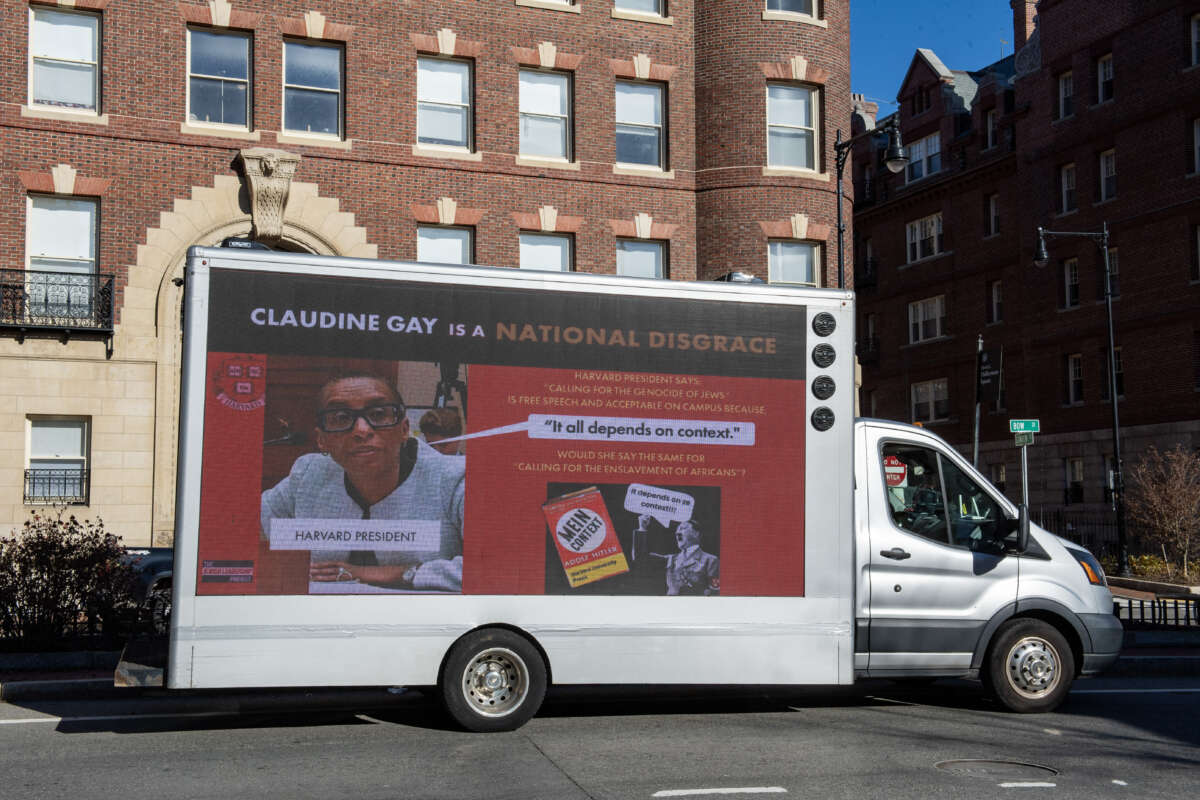
A truck calling the president of Harvard a "national disgrace" drives around Harvard University in Cambridge, Massachusetts, on December 12, 2023.
JOSEPH PREZIOSO / AFP VIA GETTY 

The recent resignation of Harvard’s first African American president, Claudine Gay, which was brought on by an orchestrated campaign mobilized by the far right, made visible the threat of organized fascism on university campuses. Claiming victory, the far right propagandist Christopher Rufo posted on social media: “SCAPLED: Harvard President Claudine Gay Resigns” (and quickly clarified that he meant to write “SCALPED”).

Antisemitism across the U.S., including at universities, is a critical concern. But attempts to identify and counter actual antisemitism are now being muddied by a disingenuous Zionist campaign to suppress all who express solidarity with Palestine by falsely labelling any criticism of the settler-colonial state of Israel and its policies as antisemitism. The organizing logic of this far right project is to surveil, silence and discipline those on university campuses across the U.S. who are speaking up against Zionist settler colonialism and witnessing the violence carried out by Israel. This is done by threatening students and faculty and by targeting their current or prospective employment. Students and faculty who express solidarity with Palestinians have been consistently doxxed and harassed, turned into objects of far right and Zionist hate campaigns.

On October 7, 2023, fighters from Gaza took control of Beit Hanoun crossing and breached the wall Israel had erected alongside the Gaza Strip to keep its 2.3 million residents under permanent imprisonment. Israel responded by bombarding Gaza, and protests emerged across the globe in solidarity with Palestine. Across university campuses, student protests sought to draw attention to the apartheid conditions imposed by Israel’s colonial occupation, outlined the role of colonization as the foundational driver of violence, and called for a ceasefire. In a statement authored by the Harvard University Palestine Solidarity Committee and signed by 33 other student organizations, Israeli settler colonialism has been described as the root cause of the violence. This analysis is aligned with the analysis of the violence offered by Amnesty International: “The root causes of these repeated cycles of violence must be addressed as a matter of urgency. This requires upholding international law and ending Israel’s 16-year-long illegal blockade on Gaza, and all other aspects of Israel’s system of apartheid imposed on all Palestinians.”

An organized campaign by Zionists, working alongside far right propagandists, has targeted protests that stood in solidarity with Palestine and critiqued Israeli settler colonialism, manufacturing a campus crisis. At the City University of New York (CUNY), the chancellor deployed additional security on campus in spaces where Arab, Muslim and Jewish students gather, and several events expressing solidarity with Palestine were cancelled. The chancellor’s letter to the campus community noted, “University property and platforms, including CUNY computers and email addresses, cannot be used to promote political activities or agendas.”

Frank Wu, the president of Queens College at CUNY flagged a social media post by the school’s Muslim Student Association to the New York City Police Department. At Columbia, the student chapter of Jewish Voice for Peace and local Students for Justice in Palestine group were both suspended.


Ivy League Presidents at Congress Hearing Threw Student Protesters Under the Bus
Not one of the university leaders questioned the baseless premises of many claims, says professor Nivedita Majumdar.
By Daniel Falcone , TRUTHOUT December 22, 2023


It is critical to note here that a range of students, organizations and activists speaking in solidarity with Palestine have issued statements challenging the disinformation crafted around them. For instance, they have debunked the lies that have circulated falsely alleging that Palestine protest groups have called for genocide of Jews. Devoid of facts, however, the disinformation campaign waged by Zionists has continued to amplify affect to create a moral panic, mobilizing the organizing forces of Zionists alongside the repressive tactics of the far right to target academic freedom, police organizing and crush dissent.

Responding to the protests, the hedge fund billionaire Bill Ackman wrote a post on X calling on Harvard to release the names of the student members of the organizations that had signed onto the statement, building a campaign of fear by threatening their career prospects.

Zionist donors are driving efforts to target students and faculty who express support for Palestine, exerting pressure on universities by pulling funding or threating to pull their funding for allowing pro-Palestine protests. Consider the role of the Wexner Foundation in pulling funding from Harvard. The foundation produced the “Wexner Analysis: Israeli Communication Priorities 2003” as a strategic blueprint for pro-Israel activists seeking to covertly influence U.S. public opinion around Israel, working in conjunction with the public relations firm the Luntz Research Companies and The Israel Project.

The Zionist billionaire donor Seth Klarman, owner of the investment company The Bauman Group, with a building on Harvard’s campus named after him, wrote an open letter with Mitt Romney criticizing the Harvard leadership. The letter noted: “The expressions of hate and vitriol against Jews have continued and strengthened over the last week on Harvard’s campuses. The threatening, violent protests by pro-Palestinian groups on Harvard campuses become more heinous with each passing day.”

Klarman runs the Klarman Family Foundation, and is the co-founder and chair of the right-wing Israeli newspaper, The Times of Israel. The Klarman Foundation donates to a range of pro-Israel and Zionist advocacy organizations including The Israel Project, The David Project, Anti-Defamation League, Friends of the Israel Defense Forces, the Jewish National Fund, the Simon Wiesenthal Center, Stand With Us, the United Israel Appeal and the Zionist Organization of America. He was one of the largest donors to the 2020 Biden campaign.

For the far right, a crisis is an opportunity. Over the last three years, the GOP has been organizing a repressive campaign across university campuses targeting the teaching of critical race theory, starting with Donald Trump’s memo ordering the Office of Management and Budget to stop funding training for federal employees. According to CRT Forward (an initiative launched by the UCLA School of Law Critical Race Studies Program), since September 2020, across 44 states in the United States, far right extremist politicians have been running campaigns seeking to censor the teaching of critical race theory, having introduced 783 “anti-Critical Race Theory bills, resolutions, executive orders, opinion letters, statements, and other measures.”

Far right propagandists are trying to broaden the current repression of Palestine solidarity activists to escalate the repression of all scholars and activists who discuss postcolonial and anti-colonial politics, arguing that calls for Palestinian sovereignty on Western university campuses emerge from the pedagogy of postcolonial and decolonization studies. Here’s Christopher Rufo, tweeting on October 14:


Conservatives need to create a strong association between Hamas, BLM, DSA, and academic “decolonization” in the public mind. Connect the dots, then attack, delegitimize, and discredit. Make the center-left disavow them. Make them political untouchables.

The narrative is reiterated by Bari Weiss. In a speech to the Federalist Society titled “The last line of defense,” Weiss pins the crisis of protests demonstrating solidarity with Palestine to decolonization. She states:


In other words, everyone can now see how very deep these ideas run, and we see clearly that there are not just metaphors. Decolonization isn’t just a clever turn of phrase, or a new way to read novels. It is the sincerely held political view that serves as a predicate to violence.

Claudine Gay’s resignation comes as a result of an orchestrated racist campaign that started with a hearing before the House Committee on Education and the Workforce on December 5, 2023, when the presidents of Harvard, the University of Pennsylvania and the Massachusetts Institute of Technology were pressed on the policies of the universities in addressing antisemitism on their campuses. This had earlier led to the resignation of the University of Pennsylvania President Liz Magill. The hearing, one of the most watched hearings of all time, sends out a warning to other higher education institutions about the consequences for not repressing campus support for Palestine.

The architecture of the hearing was based on the false premise that since October 7, there have been widespread calls for Jewish genocide across U.S. university campuses. There is no empirical evidence to back this up, and the politicians participating in the December 5 hearing couldn’t provide evidence to substantiate the claim.

Critical to the manufactured frenzy around the hearing was the questioning and subsequent social media posts produced by the far right MAGA politician, Elise Stefanik, who has platformed the extremist antisemitic Great Replacement theory (the same ideology that resulted in the Buffalo mass shooting), peddled in antisemitic narratives, circulated QAnon conspiracy theories and actively disseminated the Trump lie about a stolen election.

The structure of Stefanik’s questioning sets up a discursive trap, repeating “Does the call for the genocide of Jews on your campus constitute harassment, yes or no?”

Implicitly referring to Palestinian solidarity protests, and mislabelling slogans voiced in the protests — “From the river to the sea, Palestine will be free,” and “Intifada” (some version of it) — as calls to genocide, the five-hour questioning was built to censor campus speech in solidarity with Palestine. The communicative act of mislabelling Palestinian slogans for freedom as antisemitic, terrorist, and as calls to genocide forms the racist discursive infrastructure of white settler colonialism that works actively to erase the voices of the colonized claiming sovereignty while carrying out genocidal violence. At the core of the questioning was the demonization of Palestinians and solidarity with the Palestinian struggle.

For large cross-sections of Palestinian and Global South voices, the call “From the river to the sea, Palestine will be free” expresses the human right to justice and liberty, challenging the apartheid condition and Israeli occupation of Palestine. Similarly, the reference to Intifada is a call for resistance, mobilized to challenge a colonial occupation and protected by international law.

Once the campaign saw its first trophy with the resignation of the University of Pennsylvania President Liz Magill, a victorious Stefanik posted on social media: “One down. Two to go.”

Stefanik claimed that this is the first of more congressional hearings on “all facets of their institutions’ negligent perpetration of antisemitism including administrative, faculty, and overall leadership and governance.” In a piece published in the right-wing British tabloid The Daily Mail, she states, “We must DEFUND the rot in America’s higher education.”

Claiming credit for the resignation of President Gay, Stefanik tweeted: “TWO DOWN,” accompanied by three red siren emojis. She further tweeted “I will always deliver results…” By falsely framing pro-Palestinian protests as antisemitic, by falsely identifying the cause of antisemitism as diversity, equity and inclusion (DEI) programs, and by stoking manufactured frenzy around DEI diversity, equity and inclusion programs, Stefanik seized the opportunity to consolidate her position within the Republican Party.

The manufactured crisis over false rumors about “calls to Jewish genocide” is synergized with the broader far right campaign attacking the teaching of critical race theory on university campuses, turning to DEI programs.

Rufo claimed that, “Powerful forces — including Elon Musk, Bill Ackman, and many others behind the scenes — are boosting our story about the Claudine Gay plagiarism scandal. They do not want to let this one go. They realize that DEI is death to merit, accomplishment, and the American spirit.” Weiss chimes in, arguing that, “Lots of organizations claim to be defending young Jews on campus. Simple litmus test: do they oppose DEI? If not, do not take them seriously.”

Yet what continues to be ignored is the actual threats against antisemitism across the U.S. — which arise not from support for Palestine but from white supremacy. In 2014, the white supremacist Frazier Glenn Miller Jr. shot and killed three people outside a Jewish community center and retirement home in suburban Kansas City. In 2019, the white supremacist John Earnest opened fire, attempting a mass killing of Jews attending services inside a synagogue in Poway, California, killing one person and injuring several. The white nationalist Robert Bowers shot and killed 11 worshippers at the Tree of Life synagogue in 2018, the deadliest antisemitic attack in U.S. history. Each of these attacks was driven by white supremacy, with Bowers specifically drawing on Great Replacement theory, blaming Jews in the U.S. for catalyzing “an invasion of nonwhite immigrants who would slaughter the white race.” Note the mainstreaming of the Great Replacement theory, an extremist ideology that has resulted in a growing wave of white extremist terrorism in the U.S. and abroad, including in Norway and Christchurch.

The study and discussion of anti-colonial theory at universities exists in continuity with anti-colonial struggles in communities and on the streets. In spite of the far right extremism seeking to terrorize universities, the actual work of decolonization will continue. As long as conditions of oppression, exploitation, apartheid and occupation continue, the voices of the global majority will stand in resistance.

MOHAN J. DUTTA is dean’s chair professor of communication at Massey University of New Zealand. He is the director of the Center for Culture-Centered Approach to Research and Evaluation (CARE), developing culturally centered, community-based projects of social change, advocacy and activism that articulate health as a human right. Mohan Dutta’s research examines the role of advocacy and activism in challenging marginalizing structures, the relationship between poverty and health, political economy of global health policies, the mobilization of cultural tropes for the justification of neocolonial health development projects, and the ways in which participatory culture-centered processes and strategies of radical democracy serve as axes of global social change.

ETHNIC CLEANSING 

INTERVIEW


Armenians Suffering in Nagorno-Karabakh Are Going Largely Ignored in US Media

One key reason is Israel, which maintains close ties with the dictatorship in Azerbaijan, trading weapons for cheap oil.

AZERBAIJAN IS A PROVINCE OF TURKIYE 
January 6, 2024

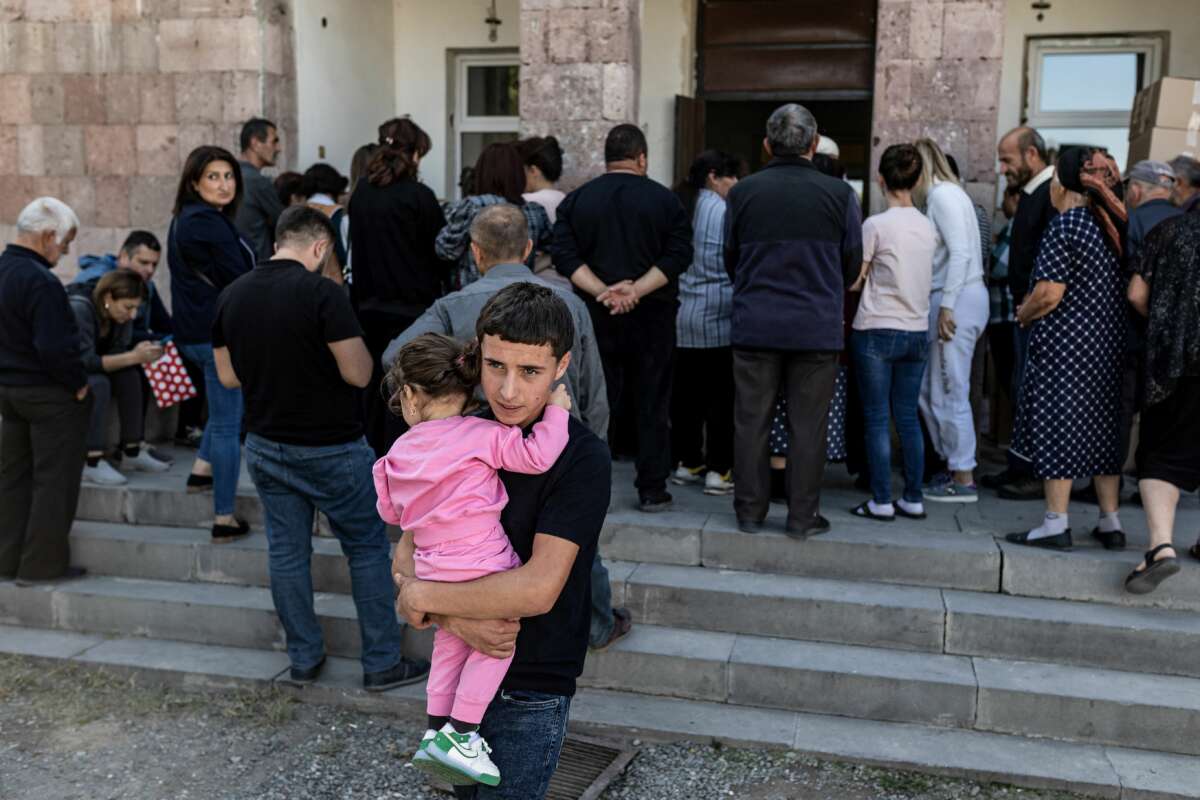
Refugees from Azerbaijan-controlled region of Nagorno-Karabakh wait for humanitarian aid in the village of Hayanist, Armenia, on October 8, 2023
.DIEGO HERRERA CARCEDO / AFP VIA GETTY IMAGES


Honest, paywall-free news is rare. Please support our boldly independent journalism with a donation of any size.

In this exclusive interview for Truthout, sociologist Artyom Tonoyan discusses the ongoing Nagorno-Karabakh territorial conflict between Armenia and Azerbaijan. In this under-reported case of cultural genocide involving political persecution, strains on due process rights, torture, lack of healthcare and food supplies, tens of thousands of ethnic Armenians have fled from Nagorno-Karabakh region after surrendering to Azerbaijan on September 20. Azerbaijan is currently seeking reassurances from the United States to continue peace talks with Armenia.

Tonoyan lays out the conflict’s historical background, its geopolitical ramifications, as well as the ways in which it is discussed in the agenda-setting U.S. press. He argues that not only is the issue overshadowed by larger conflicts relevant to U.S. interests but that a lack of social, economic and political power renders thoughtful and knowledgeable Armenians and Azerbaijanis silent. The following transcript has been lightly edited for length and clarity.

Daniel Falcone: Can you provide a brief historical background regarding the Nagorno-Karabakh Conflict

How did we get to where we are now?

Artyom Tonoyan: Armenians first appeared on the scene in history as a coherent ethnic group in the seventh century BCE. Nagorno-Karabakh has been pretty much populated by Armenians and the Armenians are Indigenous to the region. This is a place of continual habitation. At the tail end of the Russian empire at the beginning of the 20th century, Armenians and Azeris fought brief wars over the control of the territory.

When the Russian empire finally collapsed in 1917 because of the Bolshevik Revolution, the Russians retreated from the South Caucasus. They had only a small presence in Georgia and so Azerbaijan and Armenia were no longer in the Russian empire, and they proclaimed independence. In 1918 Armenia, Azerbaijan and Georgia proclaimed independence and brief wars again ensued over Nagorno-Karabakh in South Armenia. As a result, in 1920, the Armenians, Azeris and Georgians lost independence, and Soviet rule was established over the region. The Azerbaijani government, an early Soviet government, recognized Armenian sovereignty over Nagorno-Karabakh.

RELATED STORY
INTERVIEW |
WAR & PEACE
90,000 Armenians Flee Nagorno-Karabakh After Azerbaijan Seizes Region by Force
“Armenia has been warning about this for years,” says an editor of Armenia-based independent news outlet EVN Report.
By Amy Goodman , DEMOCRACYNOW!September 29, 2023

Within a day of Azerbaijan’s recognition of Nagorno-Karabakh as part of Armenia, Joseph Stalin was adopted commissar of nationalities. He was basically Vladimir Lenin’s point man to deal with the issues of borders and nationality — in general, questions in the South Caucasus as Stalin himself was from Georgia.

Stalin reversed the decision of the Azerbaijan government. We don’t know why. Historians have spent countless hours of research and writing trying to figure out why Stalin reached this decision. … We just know about the fact of the transfer of Nagorno-Karabakh from Armenia to Azerbaijan.

So, this union was established, and Armenia, Azerbaijan and Georgia became part of the Soviet Union. As you can imagine, a lot of these questions became barred as the Soviet Union tried to consolidate its rule. They tried to keep all these issues under wraps but also, as you can imagine, the population of Nagorno-Karabakh, mostly Armenians, never agreed to this.

These grievances, in the beginning, were quite simply suppressed. As we got closer to the 1960s, Armenians were increasingly more vocal about their fate and about the culture of discrimination in Azerbaijan. You saw a revival of Armenian nationalist thinking in the 1960s. In 1964, Armenians wrote a letter to the Kremlin saying that Armenians were discriminated against and that churches were being destroyed. The letter was, of course, ignored. Brief repression followed as Armenians were chastised, marginalized, and so forth. At the time of the incorporation of Nagorno-Karabakh, about 89 to 90 percent of the population was Armenian.

And in 1969, Azerbaijan KGB General and later President Heydar Aliyev, the father of the current president of Azerbaijan, was elected as the head of the Communist Party of Azerbaijan. Aliyev implemented policies aimed at reducing Armenian demographics in Nagorno-Karabakh. By the time he was elected to become a member of the Politburo, the central committee of the Soviet Union Communist Party, he managed to reduce the Armenian population of Nagorno-Karabakh from 90 percent in 1920 to 75 percent. So, you can see the trend.

Aliyev instilled and implemented economic discriminatory policies; he failed to invest in the region. … Armenians in Nagorno-Karabakh compared their economic mobility and economic performance not to the Azerbaijanis but to their Armenian brethren in Armenia.

Fast forward to the 1980s when Mikhail Gorbachev came to power in 1985. He implemented the two-pronged reform program. One was Perestroika, or the re-structurization of the economy; the other was Glasnost, or freedom of speech. Armenians voiced grievances, mostly economic, cultural and religious. In the 1980s, these issues were debated, and Armenian intellectuals started discussing this in public. In 1986, when the Chernobyl nuclear power plant went boom, it created an enormous strain on the Soviet government. The Chernobyl power plant had been built not far from the Armenian capital of Yerevan, so in 1987, a year after the Chernobyl disaster in Ukraine, Armenian environmentalists and a green nationalist movement sprang up and called for the closure of the nuclear power plant just outside of Yerevan. In other words, a sort of nationalist awakening movement commenced.

It [got] an additional impetus by calling the attention of the Soviet government to the plight of the Armenians in Nagorno-Karabakh. In 1988, the population in Nagorno-Karabakh started a letter-writing campaign to Moscow and asked for the transfer of Nagorno-Karabakh to the Soviet Army. They again ignored the popular demand of the population in Nagorno-Karabakh.

The leadership in Nagorno-Karabakh, on February 20, 1988, did something quite unprecedented — they passed a resolution that called for the transfer of Nagorno-Karabakh to Armenia. It was a popular movement that became institutionalized within seven or eight months.

It was not only the intellectuals in Armenian Nagorno-Karabakh that called for the reunification of the territory, it also had taken an institutional shape. Within 10 days of the leadership of Nagorno-Karabakh calling for reunification with Armenia, Azerbaijan, in an Azerbaijan city called Sumgait, broke out in mass violence against the Armenians. A pogrom ensued where 32 people were killed. Unofficially, it’s speculated that around 200 people perished.

Is the geopolitical history and reality of Nagorno-Karabakh just as complicated and messy?

Yes, geopolitically it’s an absolute mess, I’ll try to disentangle it. Azerbaijan started buying military equipment and offensive weapons from Israel as far back as 2009. So that’s one thing. But the main supplier of weapons to the region was Russia. Russia would sell most weapons to Azerbaijan and some defensive weapons to Armenia. This was to keep a balance of power in the region so no party could have the military edge. Russia had two treaties with Armenia, meant to protect Armenia from external attack. One was within the Collective Security Treaty Organization framework, the other was a bilateral treaty that basically obligated Russia to come to Armenia’s aid. Then, there was the U.S. involvement in the region, especially in the post-9/11 world and after the 2008 Russia-Georgia War. The U.S. was completely on the side of Georgia. Russians see the region as their backyard and don’t like U.S. presence in any shape or form.

The two other actors involved in the geopolitical dance were Iran and Turkey. Turkey had been pushed out of the region since the establishment of the Soviet Union. This was essentially their chance to enter the region by helping Azerbaijan. It also allowed them to reduce Russia’s presence in the region.

Israel has extensive intelligence networks in Azerbaijan. They pilfer a lot of Iranian intelligence in the direction of Iran, and they confer a lot of information through Azerbaijan as far as I know. On top of selling weapons to Azerbaijan and buying cheap oil from them, Israel also has an interest because of Iran.

Whatever Israel is doing, the U.S. is supporting and vice versa. Thereby the geopolitical weight of Armenia is reduced, and the geopolitical weight of Azerbaijan has risen. Overall, it’s a quite complex situation and quite a tangled web, if you will.

What do you say about how the Western media or the U.S. covers the conflict?

When it comes to domestic politics, the U.S. media functions as this check on power in theory. Less so with the mainstream media, but you will still have, even within the mainstream media, some adversarial journalism. When a government official does something wrong, the media tries to keep their feet over the fire. They often try to pursue the story to its logical end and to see that there is a resolution to any number of issues that they raise, that they think is contributing to the decline of civility.

In domestic politics you have a multiplicity of voices but when it comes to U.S. foreign policy, U.S. journalists are almost always — unless you are a maverick like Seymour Hersh — reverting to basically becoming stenographers for the State Department, or the Central Intelligence Agency or the Federal Bureau of Investigation or any number of government agencies. They, in a sense, reflect the position of the government.

Imagine if there is a scoop that comes from the CIA or from the State Department, and imagine if the scoop is going to challenge the position of these institutions. Think if you were a journalist. Do you want to keep your access to these people that give you the scoop, or do you want to become adversaries to them? What happens in this relationship, be it CNN or The New York Times — they will always favor keeping their channels with these institutions and with these organizations open rather than undergo a foreign policy story and have no access. This is not just on the Armenian/Azerbaijani issue. In general, not many journalists are interested in small countries like Armenia or in small geopolitical regions like the Caucasus. These stories end up becoming just footnotes in a larger story. If you compare what’s happening in Gaza, Israel and Ukraine to what’s happening in the Caucasus, that region is not high up in the priority list.

That allows petro-dictatorships like Azerbaijan to have their way with small countries like Armenia. They know that the State Department is not going to hold them accountable.

How about places to go for information for a beginner or intermediate reader of foreign policy regarding Nagorno-Karabakh? Why is it difficult to have certain stories told?

That’s very difficult, especially given the fact that you have quite a sophisticated sort of point guards in think tanks within the U.S. and in Europe — in essence, a garden variety of white guys who don’t have a dog in the fight, and they’re presented as objective and appear neutral about these issues.

Armenians and Azerbaijanis often get labeled as nationalists. Recently, this famous British analyst came out and labeled an Armenian-American poet Susan Barba, an editor at New York Review of Books who had written an article about what happened to Nagorno-Karabakh and the ethnic cleansing, a nationalist. Further, The New York Times bureau chief in Istanbul, Carlotta Gall, at the height of the 2020 war, wrote extremely [negative] articles against the Armenians. Armenians don’t have nearly the presence in this country, in terms of academia or journalism, to voice what is happening.

So the genocide in Tigray is completely being marginalized; you will not read about it in the U.S. press unless something horrible happens, like a massacre of 2,000 people in one day, then they may write about it. But even if that happened, the context would get lost.

The New York Times is not going to pursue investigating the problem of the ethnic cleansing in Nagorno-Karabakh. You’re not going to see 30 stories in 30 days come out, as they’re not interested or responsible in creating the story. They are merely interested in reflecting the State Department or selling news to constituents. But believe me, if Armenians lived in battleground states, instead of just California, which has been blue forever, you would have more coverage, and you would have more pronouncements from both the White House and the State Department.


DANIEL FALCONE


Daniel Falcone is a writer, activist and teacher in New York City and studies in the Ph.D. program in World History at St. John’s University in Queens, New York. Follow him on Twitter: @DanielFalcone7.

Abolition Is a Global Movement. Here’s What We Learned From Allies Worldwide.

To make abolition possible, grassroots groups of people directly impacted by incarceration must mobilize globally.

Worlds without police and without prisons have already existed, predating colonization and slavery.
January 1, 2024

AYO WALKER / TRUTHOUT

In 1992, formerly incarcerated women created Sisters Inside to advocate for the rights of women and girls behind bars in Queensland, Australia. While other grassroots groups and ad hoc campaigns had formed to work with incarcerated women, Sisters Inside remains the country’s first organization founded and run by formerly incarcerated women. Over the last 31 years, the organization has provided legal and logistical support to currently and formerly incarcerated women and pushed to end policies that cage people, such as imprisoning people for nonpayment of fines.

In November, Sisters Inside held its 10th conference, inviting organizers from across Australia and overseas to brainstorm and strategize under the theme “Abolition Feminism Now.” Both of us flew in from the United States, where mainstream media hypes every individual act of violence as part of a so-called surge of crime. In recent years, anti-prison organizing, and even mild reforms, have faced a well-funded backlash, particularly after nationwide uprisings and organizing efforts to defund the police in 2020. Being surrounded by both veteran organizers and those new to anti-prison organizing was the reinvigoration we hadn’t known that we needed.

In Brisbane, surrounded by lizards, loud birds and warm spring sunshine, hundreds of people gathered for three days of plenary sessions, workshops and tabling to connect and learn about organizing. The breadth and depth of the workshops reminded us that issues are intertwined — that ending the family policing system, borders and prisons must go hand in hand with developing meaningful and non-carceral responses to gender and sexual harm, and that ending gender and sexual harm requires challenging the false beliefs that borders and police make us safer.

Here are 10 things that fired us up during our time in Brisbane — and beyond. They reminded us that not only can we build a world in which people thrive, but that organizers are doing so daily.

Grassroots Networks Are Crucial!

Small projects and networks are practicing abolition. In Melbourne, Flat Out celebrated its 35th year of supporting people both during their incarceration and after release. The group not only provides necessities, such as menstrual supplies, clothing and food that people desperately need after being released from prison, it also fights against the rising criminalization of women with its active campaign to stop the expansion of a women’s prison in the state of Victoria.

RELATED STORY

To Build an Abolitionist Future, We Must Look to Indigenous Pasts
Worlds without police and without prisons have already existed, predating colonization and slavery.
By Cherise Morris , TRUTHOUT  September 6, 2023


In Aotearoa (New Zealand), People Against Prisons Aotearoa (PAPA) began as an ad hoc protest against police marching in a 2015 Pride parade. The group started working with queer people behind bars before expanding its support to all people in prisons, regardless of sexual and gender identity. Like many other abolition feminist organizations, Flat Out and PAPA deepen public dialogues about abolition and feminism, through panels, posters, and other forms of critical community-based political education. The work is often labor-intensive and frequently run on a shoestring budget, but it also builds community. Each year, PAPA brings together people from all walks of life — from residents of a neighborhood nursing home to younger anarchists — to write holiday cards to incarcerated people.

Directly Impacted People Are the Core of These Movements.

The National Council for Incarcerated and Formerly Incarcerated Women and Girls, originally formed in the United States, has expanded to incubate the International Network of Formerly Incarcerated Women. Under the demand “Free her!” they are mobilizing to free women from jails and prisons and advocating to end the long-standing injustices, such as poverty, criminalization and racism, that push women into prison. In some U.S. cities, recognizing that poverty is a direct pathway to prison, groups have organized pilot programs providing guaranteed income payments. In Massachusetts, currently and formerly incarcerated people are demanding a five-year moratorium on all jail and prison construction or expansion and that those funds instead be channeled into resources enabling people to flourish.

The conference highlighted organizing spearheaded by formerly incarcerated women, both in Australia and overseas. In 2020, Sisters Inside Founder and Director Debbie Kilroy created the National Network of Incarcerated & Formerly Incarcerated Women & Girls, bringing together women, girls, feminine identifying and nonbinary people from across Australia to end incarceration. Kilroy closed the conference with the powerful reminder: Nothing about us without us.

Organizing Spans Generations.


Lilla Watson, an Aboriginal octogenarian, artist and academic, recalled visiting the United States in the early 1970s, where she marched to free Angela Davis, who had been jailed on highly politicized murder charges. After a worldwide freedom campaign and a much-publicized trial, Davis was freed and became an international inspiration for generations of abolitionists. Half a century later, Davis sat in the audience while Watson recalled this connection.

Organizers born years, and even decades, after Davis’s well-publicized legal victory continue the fight to end criminalization and incarceration. In North Queensland, near Australia’s famous Great Barrier Reef, organizers launched the End Toxic Prisons campaign to stop the construction of two new youth prisons. Instead of pushing to raise the age of criminal responsibility, the campaign, guided by young First Nations people, counters media misinformation about youth crime and galvanizes local opposition to incarcerating young people at all.

We Need to Reach Across — and Dismantle — Borders.

The U.S. continues to export its mass incarceration model across the globe. States in Australia are building new prisons based not on the Scandinavian models that are increasingly popular among prison administrators and politicians (and often touted as more humanitarian), but on the U.S. model of supermax prisons. The imprint of the prison built for the “worst of the worst” was clearly visible in our visit to the austere Southern Queensland Correctional Centre, where 300 women were warehoused in newly built concrete, cyclone fencing and coils of razor wire more than 100 kilometers outside of Brisbane. As in prisons across the globe, many were already survivors of gender and sexual harm before arrest and, behind bars, are continually retraumatized by dehumanizing practices, such as routine strip searches.

The State Cannot Fix the Problems It Creates.

Inquests are judicial inquiries to determine the circumstances and cause of a sudden death. In Australia, where inquests are mandatory for deaths in custody, the coroner conducts the process, which includes calling and questioning witnesses. For years, family members whose loved ones have died in police custody or while incarcerated often leave these hearings without answers, closure or accountability. Latoya Rule, whose brother Wayne Morrison died after police restrained him and put a spit hood over his head, noted that inquests do not prevent future deaths, result in more transparency for loved ones or compel accountability from police. Their family waited five years for an inquest into Morrison’s death only to see prison guard after prison guard refuse to answer questions. They remain no closer to learning what happened in his final moments. Still, mobilizations led by loved ones have procured some wins, such as the decriminalization of “public drunkenness” and the banning of spit hoods, tactics that have long been used to criminalize and kill Aboriginal people.

New Technology Is Not a Win.

Queensland’s new prisons employ some of the latest technologies, including digital fingerprinting for visitors and, for those behind bars, “smart” toilets that restrict the number of flushes per day. These new technologies provide no opportunities for rehabilitation or transformation. Instead, they give the perception of modernized facilities, deepen surveillance and allow more public funds to be poured into incarceration rather than social safety nets.

In Canada, several prisons now utilize body scanners, allegedly to detect contraband. Yet these scanners have not replaced prisons’ dehumanizing strip searches. Not only are the scanners used in addition to these retraumatizing practices, officers, unable to accurately read these scans, have misidentified body organs as drugs and sent people to solitary confinement as a result of these errors.

We Must Name and Recognize Our Wins.

In 2019, lawmakers in Aotearoa (New Zealand) sought to arm police with guns in response to the shooting in Christchurch. At that point, police officers did not carry guns, but kept them locked in their cars. When police enacted a trial period for armed response teams, PAPA organized its Arms Down Campaign. With art created from people’s stories of police violence, PAPA graphically illustrated the dangers of even non-militarized policing, particularly against Māori and Pasifika communities. They urged New Zealanders to call police and public officials in opposition to the measure. The campaign only gained real traction in 2020 when footage of U.S. police murdering George Floyd flooded news and social media feeds worldwide, allowing New Zealanders to see the dangers inherent in policing. Although the trial period had ended by then, police officials had scheduled a review and decision on permanently implementing armed police for June 2020. Bowing to public pressure, they scrapped the plan altogether.

In Australia, family members have fought to end policies that have killed their loved ones. April Day’s mother Tanya died in jail after police arrested her under its public intoxication law. Recognizing that the law allowed police to disproportionately target Aboriginal people, Day and other family members fought for years to decriminalize public drunkenness in Victoria. The law went into effect on Melbourne Cup Day, long known as the day when many white Australians are drunk in public without being arrested or even harassed by police.

Sometimes When We Fight, We Don’t Win.

Not all organizing results in victory. In 2020, Aotearoa held a referendum to legalize marijuana for personal recreation. PAPA members mobilized in support. The ongoing pandemic prevented in-person organizing and conversations, so the campaign pivoted to “letter boxing,” or putting informational brochures in mailboxes. It was a mighty task for a small, grassroots group, but they connected with people across the country to ensure the widest possible reach. Still, the referendum failed to pass with only 48.4 percent voting in favor of legalization. But even losses can provide us with valuable insights on what to do next time. They can also forge new starting places and connections for future campaigns and actions.

Movement Assessment Is Critical. So Is Joy.

As two people who have attended a number of conferences over the past few decades, we know that bringing people together can be chaotic, tiring and fraught with conflict. Yet it remains crucial to movement building. Sharing both space and experiences raises critical questions while also deepening analyses and coalitions. Coming together, we strengthen connections between seemingly disparate campaigns, time periods and regions. In a video clip, Erin Miles Cloud, a co-founder of the U.S.-based Movement for Family Power described how the U.S. child welfare system is actually a family policing system that punishes rather than helps vulnerable families. Her message resonated with an audience still reeling from the intergenerational traumas and devastation wrought by the Stolen Generations, a century-long government policy in which Aboriginal children were taken from their families.

Beyond sharpening our analysis, convenings also have the power to cultivate community and joy. From the sizzling poetry of Lorna Munro, to the smart and rollicking performance and music of Hot Brown Honey, to the fierceness of rapper Barkaa, art, music, poetry and dancing show us that abolition feminism isn’t just necessary — it’s also sexy and fun.

Support for Palestine Is Worldwide.

Calls for a free Palestine were a consistent thread throughout the conference. Speakers drew parallels between the violence of colonialism in Australia and across Palestine: Aboriginal women in Australia are incarcerated at more than 20 times the rate of non-Aboriginal women, while the state of Israel, a newer colonial power, has long used, and is now drastically increasing, incarceration to silence Palestinian dissent. Outside the conference, #FreePalestine and #LandBack street level organizing took place under the twin flags of Palestine and Aboriginal Australians. Across Australia (and the planet) growing weekly marches, direct actions preventing military weapons from being shipped to Israel, graffiti and posters wheatpasted on lampposts, were constant reminders of the deepening and international solidarity for an end to colonization and for a free Palestine.


VICTORIA LAW is a freelance journalist who focuses on the intersections of incarceration, gender and resistance. She’s the author of “Prisons Make Us Safer”: And 20 Other Myths about Mass Incarceration (2021) and the coauthor of Prison by Any Other Name: The Harmful Consequences of Popular Reforms (2020). Her latest article published by the Intercept is, “BLIND SPOTS – Sexual Assault Allegation Exposes Self-Policing Prison System.”

ERICA R. MEINERS is a Chicago-based educator and writer. Erica’s latest book, coauthored with Angela Davis, Gina Dent and Beth Richie, is Abolition. Feminism. Now. (Haymarket Press 2021).