It’s possible that I shall make an ass of myself. But in that case one can always get out of it with a little dialectic. I have, of course, so worded my proposition as to be right either way (K.Marx, Letter to F.Engels on the Indian Mutiny)
Tuesday, January 09, 2024
Can Florida’s corals survive climate change? Fate of one small reef may hold the answer
2024/01/07
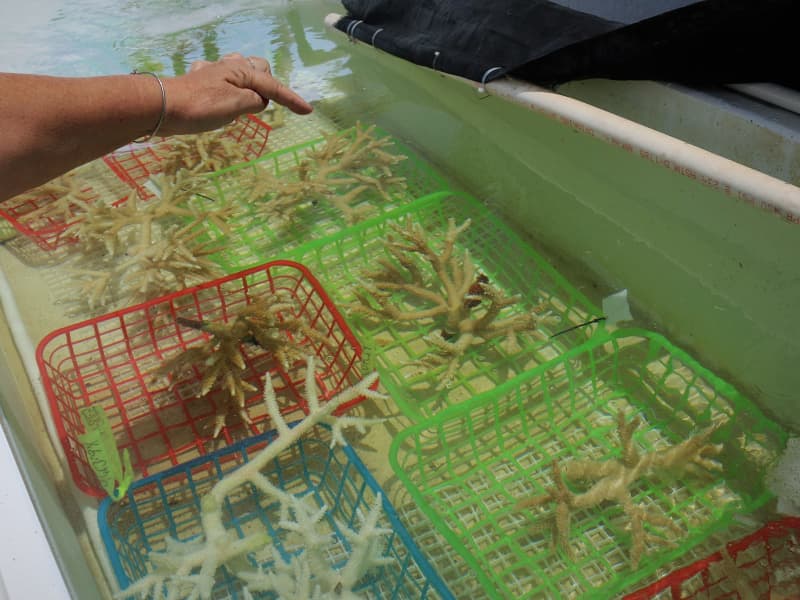
Cynthia Lewis, director of the Keys Marine Laboratory, points to staghorn corals that were recently bleached in an ongoing, unprecedented marine heatwave.
- Max Chesnes/Tampa Bay Times/TNS
When marine scientist Ian Enochs jumped into the water at Cheeca Rocks, a small reef in the Florida Keys known for vibrantly colorful corals, what he saw shook him to the core.
“Literally everything was white,” said Enochs, a research ecologist with the National Oceanic and Atmospheric Administration in Miami. “It does not look normal at all, it’s just like a different reef.”
It was July, still early in what would become the hottest summer on record in South Florida, and Enochs waswitnessing a mass event bleaching — a telltale trouble sign that corals are struggling in abnormally hot ocean waters. Keys reefs have been hit periodically by bleaching over the decades and recovered, the corals weakened but still alive. But prolonged bleaching can prove fatal. To Enochs, this looked severe and potentially lethal.
“The flesh, the tissue (of the soft corals) were just falling off of them,” Enochs said, “They were literally falling apart before our eyes.”
Now, as ocean temperatures cool, teams of scientists are engaged in an unprecedented effort to assess not only the heat wave damage but the future of South Florida long-ailing reef tract.
Cheeca Rocks, Enochs’ prime study spot for more than a decade, had been considered among the Keys’ healthiest reefs. In the months and years ahead, it will serve as a living — or dying — laboratory. The fate of its corals will help tell scientists like Enochs how and if reefs can survive climate change, which is driving sea temperatures to new highs. Record sea temperatures off South Florida
At Cheeca Rocks, Enochs’ team from NOAA’s Atlantic Oceanographic and Meteorological Laboratory on Virginia Key , recorded a temperature near 93 degrees Fahrenheit. In other parts of the Keys and up both Florida coasts, ocean surface temperature soared 4, 5 or more degrees above historic averages. It approached 100 in the some shallow areas. One sensor in the grass flats off Manatee Bay in Everglades National Park hit a staggering 101.1 degrees Fahrenheit. Consider that hot tubs typically range from 100 to 103 degrees.
“Globally, August 2023 set a record for the highest monthly sea surface temperature anomaly of any month in NOAA’s 174-year record,” the federal agency later reported.
Cheeca Rocks, a shallow nearshore reef popular with snorkelers, is particularly vulnerable to the hot weather and water. Butmuch of the South Florida reef tract — which stretches from off Palm Beach County down to the Dry Tortugas — saw impacts.
It was starkly evident to scientists and divers who frequent South Florida reefs. During bleaching, coral shed the algae that give them their dazzling colors and provide them important nutrients. The bleaching victims, with all or swathes of their hard exoskeletons turned pale white, stand out like bones.
It may take a year to see how much recovers and to assess the final toll. But it’s already clear that the record heat worsened what has been a precipitous decline for corals off South Florida. In just a half century, the undersea reefscape bordering the coast has profoundly and permanently changed. Two species of large and spectacular branching corals, staghorn and elkhorn, once formed dense forests and served as the primary reef builders in South Florida. Since the 1970s, scientists estimate 90% of those have disappeared. Losses have been even higher in the Caribbean.
Diego Lirman, a University of Miami associate professor in marine science, has monitored the region’s reefs for 30 years. When he started working in the field of disturbance ecology — research focused on forces that can wipe out existing systems — the typical reef boasted about 20% coral cover. Now, hard coral survives on just about 5% of the bottom. Soft corals, algae and other marine life have moved in instead, altering the marine food chain and reducing the shelter and prey that reefs provide to an array of marine life.
The forces of destruction that Lirman and other scientists have identified are many. Over the decades, Florida’s reefs have been hammered by humans with everything from pollution and dredging sediments to boat anchors, fishing lines and diver fins. In 1990, the 3,843-square-mile Florida Keys National Marine Sanctuary, which stretches from Biscayne National Park to the Dry Tortugas, was created to help protect reefs from continuing damage.
Anchor buoys were added and no fishing zones established around major reefs. Divers and snorkelers are taught not to touch corals and are typically now much more attuned to the fragility of the undersea world they have entered. Those steps have helped reduce coral damage loss from tourists, divers and anglers. Breeding heat-resistent corals
But battling climate change is a whole other level of challenge. Scientists believe rising sea temps have driven the increasing impacts from invasive smothering algae and helped spread coral-damaging diseases, from black-band and white-band disease to white plague and stony coral disease. It’s also made the ocean more acidic, which makes it harder for corals to built their hard skeletons. Weakened by repeated bouts of bleaching, some corals may not be healthy enough to survive all the mounting stressors..
One hope is to breed more resilient corals. Scientists have been growing coral in labs and underwater nurseries for years but newer tools like genetic sequencing have provided perhaps the latest and and maybe last chance for eventually reviving dying reefs. The hope is to pinpoint the most heat-tolerant genetic strains — ones that if cultivated, regrown and replanted on offshore reefs might have the best chance to survive and thrive.
The complication is that some coral strains may do better with hot water but might prove less resistant to disease or other issues. So it’s essential to have a selection of strong corals for the future and threats to come, some of the perhaps still not identified.
“We know there is no such thing as a super coral,’ said Phanor Montoya-Maya, program manager for theCoral Restoration Foundation in Tavernier. “We need to ensure that every single genotype that is alive today has the chance to live beyond these conditions.”
That’s part of the mission at NOAA’s Experimental Reef Laboratory on the campus of UM’s Rosenstiel School of Marine, Atmospheric, and Earth Science. NOAA’s Enochs and UM’s Lirman co-lead the lab and $4.2 million project launched last month involving seven different academic and research institutions that amounts to an largest collaborative effort yet to assess the health and future of South Florida’s reefs.
At the lab, scientists can manipulate conditions from temperature to water quality to assess the strength of samples of various species and genetic strains of corals. Those samples can be fragmented to grow as new individual corals. Then those small corals can be moved to nurseries in Biscayne Bay or elsewhere or eventually replanted on natural reefs.
“We watch them grow,” Lirman said, “and we build our restoration stocks.”
Lab-grown corals alone can’t replace all that has disappeared but, if they’re hardy enough, they might be the seeds for stronger natural reefs. Reef scientists turned emergency responders
The unprecedented summer sea temperatures turned many marine scientists into emergency reef responders, with an array of agencies and universities scrambling to save what they could. There was nothing to do about natural reefs but they could try to save the string of managed underwater coral nurseries all along the coast where researchers are growing thousands of coral fragments — the stock for future restoration efforts.
The staff at the Coral Restoration Foundation realized they had to move quickly to save their own four field nurseries, risking pulling them out of the ocean and moving them to land tanks with controlled temperatures — at least until the ocean waters returned to normal. Other groups did the same, pulling corals from offshore and putting them into tanks, creating a sort of Noah’s Ark of genetic diversity to ride out the heat wave.
In one case in August, UM scientists also did the opposite — planting nursery and lab-grown corals on the seafloor two miles east of Key Biscayne. It was a study that boiled down to survival of the fittest. Those corals, previously collected from a range of reefs off South Florida, are being put to a critical real-world heat-stress test.
Some likely won’t make it. But if some do, it could help identify coral types more likely to endure future climate change.
“We don’t want to keep doing this just to watch our corals die,” said UM’s Lirman. “We need to learn from the survivors.”
As waters cooled in late November, Montoya-Maya and other foundation staffers were able to return about 1,500 to field nurseries in the waters off Tavernier.
They carefully transferred the corals from a tank into coolers on a boat After about a 30-minute boat ride, scientists jumped into the water to pass down the shelves bristling with nubs of healthy corals. The shelves, made out of PVC tubing and mesh, were then attached to nursery “trees” in waters from about 10 feet to 30 feet deep.
Overall, scientists say that it will be hard to tell how much coral will rebound and survive to next summer. They will have a better idea as they collect more data in the coming year. But if the losses at offshore nurseries are any indication, the toll could be severe. As the year came to a close, the Coral Restoration Foundation estimated they’d lost just over half their nursery corals.
Since this summer’s heat wave, Enochs and his team have been back to Cheeca Rocks as often as possible. They are monitoring areas that are recovering, keeping an eye out for both outbreaks of disease among the weakened corals and natural pathways toward healing.
Was the biggest bleaching event perhaps ever the final nail in the coffin for the Keys’ reefs? It’s too soon to tell but at Cheeca, Enochs retains some hope.
“Things are not great, but they could be worse,” said Enochs. “And the fact that they aren’t worse means there’s a way out of this.”
When imagining corals, the picture that comes to mind is usually a stationary one: a garden of rock-like structures covering sections of the ocean floor. Reef conservation efforts typically focus on preserving established coral and protecting them from known stressors such as pollution, overfishing and runoff from coastline populations.
However, new research near Miloliʻi in the southwestern part of Hawai’i Island shows that identifying and protecting marine ecosystems, both down-current and up-current of coral reefs, specifically areas where coral larvae are more likely to survive and thrive, is crucial to future coral conservation and restoration efforts—especially as reefs face increasing pressure from the devastating effects of climate change.
The research, completed by Arizona State University scientists and their collaborators, appears in the current issue of Proceedings of the National Academy of Sciences.
Additionally, the ʻĀkoʻakoʻa Reef Restoration Program, a regional effort that fuses cultural leadership, multi-modal education, advanced science and government engagement, backed the research.
Carlson says this type of collaborative work—partnerships combining local, indigenous knowledge and Western science – is crucial to mapping out a future that ensures the survival of coral populations.
“There’s a lot of indigenous knowledge about coral spawning and fish populations in West Hawaiʻi. In this study, we addressed an open question: how connected are coral populations between embayments along this coastline?” said Carlson. “What we essentially found is that the major factors in helping the coral keiki, known as larvae, settle down and survive are the nearshore current and the structure of the reef.”
The study shows that the larvae more often settle in and inhabit areas with large boulders and uneven surfaces, or “chunky features,” said Carlson, who is also a Chancellor's Postdoctoral Fellow at the UC Davis Bodega Marine Lab. Adult coral will spawn millions of larvae into the water column and those larvae prefer to settle in places with large knolls and boulders.
This discovery is good news: these kinds of seafloor features have been mapped via ASU’s Global Airborne Observatory, a highly specialized aircraft that uses several types of remote sensing technologies to track both underwater and land-based habitats. This means that the researchers have the capability to help find and map priority reefs for conservation and restoration.
“This is foundational research in several important ways,” said Asner, the study’s senior author. “First, it gives us an understanding of the connectivity of different parts of reefs along our coastline and tells us the level of connectivity in the context of the birth, settlement, and growth of corals miles apart. Second, our unique remote sensing capabilities can identify reef sites where coral restoration could be most viable in the future. Finally, these findings provide a critical building block for future restoration efforts by our ʻĀkoʻakoʻa team and collaborators.”
The group’s goal is to preserve and restore vitality to Hawaii’s coral reefs and coastline health.
"We as lineal descendants of the Miloliʻi area have always relied on the reef for our ʻOhana (families). Our reef is our sustenance and is of enormous cultural value to us." said Kaʻimi Kaupiko, president of the non-profit organization Kalanihale, which manages the Miloliʻi Community-based Subsistence Fishing Area (CBSFA) where the study took place.
Asner said the intertwined nature of reefs along Hawai‘i’s coastlines is crucial to consider in reef protection strategies. Narrowing in on one area without consideration for the reproductive corridors of corals, he said, would be akin to worrying about planting trees in a certain place and not thinking about the forest as a whole. This sentiment is echoed by Martin, who said reef connectivity is an underutilized tool in reef restoration efforts globally.
“In Hawai‘i and worldwide, we're trying to figure out where we should place protections and restore areas to help reefs,” Martin said. “This study is highly technical, but it needs to be part of that conversation and part of that work because if you aren’t protecting the up-current reefs, you are cutting off important reproductive areas.”
Martin said reef restoration could, for example, expand a protected area of reefs beyond just the spots that have more dense coral coverage on the ocean floor: protection efforts would also be needed in the upcurrent path that the coral larvae traveled through before they settled in a new location.
Asner adds that this research could very well help conservation efforts expand to much greater distances than have been achieved previously.
“These kinds of studies of connectivity, flow, and movement are needed because the west Hawaiʻi island coastline is longer than the whole circumference of any other island,” Asner said. “We have a lot of degraded reefs along our coastline, so knowing where and how to help baby corals thrive is fundamental to the ʻĀkoʻakoʻa restoration effort.”
"Our students participated in the coral study, and that also helped us to connect the dots between cultural knowledge and Western science,” said Kaupiko. “The study supports our CBSFA by showing that our area is ecologically connected, and thus it needs to be managed and protected as one connected reef and coastline."
Through the long-standing community collaborations that have shaped the ʻĀkoʻakoʻa program, this coral reef work reflects both cultural knowledge and scientific research. This type of approach is crucial in places like Hawai‘i, where a deep connection between coral reefs and people calls for research that serves them both.
By Sandra Leander and Kateyn Reinhart
A new coral colony is established on a rock. A colony of the native Hawaiian coral Pocillopora meandrina settles and grows along the South Kona, Hawaiʻi Island reef.
Coral polyps: Close-up view of the Hawaiian coral Porites compressa growing on a reef in South Kona, Hawaiʻi.
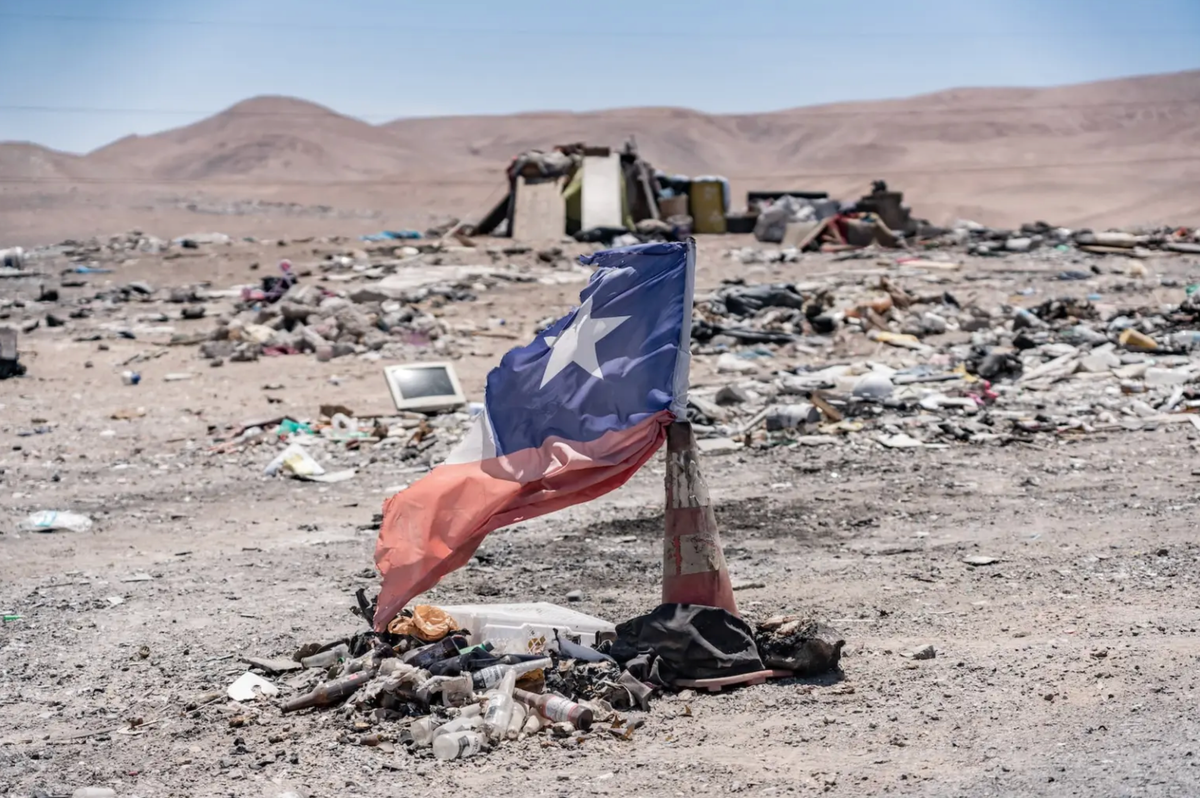
Grist January 8, 2024 A Chilean flag stands in a traffic cone among burned piles of clothing in the Atacama Desert. Fernando Alarcón
This story was originally published and produced by Grist and co-published with El País. A Spanish-language version can be read here.
On the morning of June 12, 2022, Ángela Astudillo, then a law student in her mid-20s, grabbed her water bottle and hopped into her red Nissan Juke. The co-founder of Dress Desert, or Desierto Vestido, a textile recycling advocacy nonprofit, and the daughter of tree farmers, Astudillo lives in a gated apartment complex in Alto Hospicio, a dusty city at the edge of the Atacama Desert in northern Chile, with her husband, daughter, bunny, and three aquatic turtles.
Exiting the compound, Astudillo pinched the wheel, pulled over next to a car on the side of the road, and greeted Bárbara Pino, a fashion professor, and three of her students, who were waiting inside.
They headed toward a mountain of sand known as El Paso de la Mula. Less than a mile from her home, squinting into the distance, Astudillo saw a thread of smoke rising from its direction. With her in the lead, the two vehicles caravanned toward the dune, the site of the second-largest clothes pile in the world.
As they got closer to El Paso de La Mula, the thin trail of smoke had expanded into a huge black cloud. Astudillo stopped the car and texted the academics behind her.
It looks like it’s on fire. Hopefully, it’s not there. :( :( :(
She then dialed them directly and asked, “Do you still want to go?”
Pino, director of Santiago’s Fashion System Observatory at Universidad Diego Portales, had planned this trip for months. Astudillo had volunteered to be their guide. The mound of discarded fabric in the middle of the Atacama weighed an estimated 11,000 to 59,000 tons, equivalent to one or two times the Brooklyn Bridge.
By the time the team reached the gates of El Paso de la Mula, more than half of the clothes pile was on fire. Smoke obscured everything, hanging like an opaque black curtain. Municipal authorities turned the group away, forbidding them to stay on the premises. But Astudillo knew the landscape, so she directed the team to the dune’s far side, where access was still unimpeded.
There, the students surveyed the inferno. It was “like a war,” Pino said. She felt waves of heat. Black smoke unspooled from the burning clothes. The air was dense and hard to breathe. Smoke coated the back of their throats and clogged their nostrils with the acrid smell of melting plastic. They covered their faces, trying not to breathe it in. Then the group heard a series of loud pops as mini explosions burst from within the vast expanse of burning garments.
Despite the danger, Pino and her students rummaged, pulling out specimens to examine from among unburned portions of the pile. On prior visits to the clothes dump, Astudillo had uncovered clothing produced by the world’s most well-known brands: Nautica, Adidas, Wrangler, Old Navy, H&M, Ralph Lauren, Tommy Hilfiger, Forever 21, Zara, Banana Republic. Store tags still dangled from many of her findings. The clothes had come to the Atacama from Europe, the United States, Korea, and Japan. Now, as Astudillo began taking pictures and uploading them to Instagram, Pino wandered the mound, horrified and fascinated by the grotesque volume and variety of apparel: ski jackets, ball gowns, bathing suits. She plucked out a rhinestone-encrusted platform stiletto in perfect condition. She crouched to search for its match, but the wind was getting stronger. If it shifted, the team realized, they’d be trapped in the spreading fire.
Ángela Astudilo holds a piece of discarded clothing from the Atacama Desert. Fernando Alarcón
For 14 years, no rain has fallen in Alto Hospicio or the surrounding Atacama Desert region. Those dry conditions, coupled with the nonbiodegradable, predominantly synthetic, petroleum-derived fibers that modern clothes are made with, meant that the pile never shrank. Instead, for more than two decades, it grew — metastasized — with every discarded, imported item that was added.
In 2021, six months prior to the fire, a photographer from Agence France Presse, Martín Bernetti, captured a bird’s-eye image of this sprawling mound of apparel, essentially an oil slick, strewn across the edge of the Atacama desert.
The aerial image was picked up by news outlets across the globe, from the front page of the New York Postto the BBC, and continues to circulate today. But the mountain of clothes depicted by that 2021 drone photo is utterly gone. As Astudillo, Pino, and the three students witnessed, and unwittingly tasted: The blaze tore through the pile, throwing black plumes of toxic ash into the air.
The town of Alto Hospicio sits on a cliff above the Pacific Ocean, a bedroom community for the seaside vacation city of Iquique below. Imagine if Atlantic City in New Jersey were simultaneously hemmed in and backed by a high Nevada plateau, and if the two locales were connected by a two-lane switchback highway.
Each day in Iquique’s port, giant cranes pluck containers full of discarded clothing from the decks of ships and deposit them onto flatbed trucks. No one really knows exactly how much clothing passes through the port every year; estimates range from 60,000 to 44 million tons. Next, they head to the nearby Free Trade Zone, known locally as “Zofri,” where trailers back into the warehouses of 52 used-clothes importers and forklift operators transfer sealed bales of clothing, or fardos, inside.
Chile is the biggest importer of secondhand clothing in South America, and between 2020 and 2021 it was the fastest-growing importer of used clothing in the world. The port of Iquique is an established tax-free zone, incentivizing this booming industry of castaway textiles.
From Zofri, bales of clothing are sold, uninspected, to merchants betting that at least some of the items inside are sales-worthy. “When you buy, you are buying with your eyes closed,” one former merchant said. Sometimes 80 percent of the garments in a bale are usable. Sometimes the opposite is true. Because bales are so cheap, however, most merchants need only sell 40 percent to turn a profit.
According to the global environmental advocacy group Ekō (formerly known as SumofUS), an estimated 85 percent of the used clothing imported into Iquique remains unsold. Chilean federal law states it’s illegal to dispose of textiles.
Considered Iquique’s backyard, Alto Hospicio is one of the poorest cities in Chile, widely known as a place to abandon pets and dump trash. In the late 1990s and early 2000s, the small desert town is where more than a dozen teenage girls mysteriously vanished, until their apprehended killer led authorities to bodies buried in desert graves.
In 2001, Manuela Medina*, a former gardener, saw an opportunity in Iquique’s growing textile abundance. Relocating to Alto Hospicio, she established an unauthorized compound on government lands at the base of El Paso de la Mula, the huge sand dune at the far side of an unregulated shantytown. Every few days, she hired a fletero — a driver with a jalopy — to travel the switchback roads, out of the brown dunes of Alto Hospicio, to arrive in the colorful oceanside city of Iquique, which sits a thousand miles north of the country’s capital, Santiago.
Near the dock where cranes unload massive container ships, inside Iquique’s free trade zone, Medina ventured into the contiguous warehouses, asking secondhand clothing importers, “Do you have any garbage?”
Shoes pile up in an illegal clothing dump in the Atacama Desert. Fernando Alarcón
Back at her compound, Medina unloaded her wares in piles on the ground where she had the luxury of storing them indefinitely — the Atacama Desert is one of the driest places on Earth, meaning items don’t undergo normal degradation from elements like rain. Here, Medina sold her piles to merchants and others for $10 each.
As more and more bales of ropa americana, or secondhand clothes, arrived in Iquique, the clothes flooded importers’ warehouses and overflowed vendors’ stalls in open air markets, including La Quebradilla — one of the largest open air markets in South America, located just a few miles from Medina’s unauthorized compound.
Soon, importers and secondhand merchants began to deliver surplus used clothes directly to Medina. Fed by daily truck deliveries, and then by multiple daily tractor trailer load deliveries, Medina’s pile grew.
By 2020, Medina’s gargantuan desert dump had become an open secret in Chile, stretching across dozens of acres. Others followed her model, creating mini-dumps across the desert and along roadsides, but Medina’s pile remained the largest.
On March 29, 2022, Paulin Silva, an environmental lawyer, stood before the Primer Tribunal Ambiental de Antofagasta, a regional tribunal in northern Chile that specializes in resolving environmental issues within its jurisdiction. She was presenting a lawsuit, brought on behalf of herself as a resident of Iquique, against the municipality and the federal Chilean government for their inaction over the sprawling, unregulated clothes dumps. For her submission of evidence, she asked the tribunal to join her in touring the mound of clothing.
For weeks, her informal team of supporters (a geographer, her sister, and her brother-in-law) had been documenting the problem, joking among themselves, “In which dump are we going to party tonight?”
Since obtaining her law degree, Silva has prosecuted a handful of environmental cases, but this one was personal, and she felt empowered to tackle it: “I have the education; I am a lawyer; I can do something,” she said. She’d grown up in northern Chile, a pencil thin country bordered by the Pacific Ocean. Her father is from Alto Hospicio and her mother is from Iquique. At 35, she’s several years older than Astudillo, the co-founder of the nonprofit Dress Desert, whom Silva asked to be a witness for the case. When Silva was a child, she observed people dumping clothes everywhere — the streets, yards, and city squares. Because this was the only place she knew for so much of her life, she thought, “It’s normal for people to live with … garbage accumulated around them.”
This local “clothes-blindness” was documented by Astudillo’s colleague, Bastián Barria, an engineering student and her co-founder of Dress Desert. In November 2020, he and others conducted a survey to ascertain local attitudes regarding the clothing waste. Of the almost 400 people in Alto Hospicio he surveyed, representing less than 1 percent of the town’s population, more than half did not think there was any issue.
Bastián Barria, co-founder of the organization Dress Desert with Ángela Astudillo, recently joined a government-sponsored committee to help push forward circular economy initiatives in Chile. Fernando Alarcón
When Silva was 18, she moved a thousand miles south, to Valparaiso in central Chile, to study law and that was where she remained until the pandemic, when she returned home. That’s when she realized the dump situation had worsened. Exponentially.
During the decades between Silva’s girlhood and today, clothing production worldwide doubled, while utilization — the number of times an item of clothing is worn before it is thrown away — declined by 36 percent. Countries like Chile, Haiti, and Uganda became depositories for fast fashion discards. In 2021 alone, Chile imported more than 700,000 tons of new and used clothing — the weight equivalent of 70 Eiffel Towers.
“Even if we stopped clothing production throughout the world tonight,” said Francisca Gajardo, an Iquique-born fashion designer, “we still have more garments than we need or that the Earth can safely hold. It won’t go away nicely, and we’re not stopping today.
***
Nine days after the giant fires, around 4 p.m., Silva was having a light meal, the Chilean equivalent of afternoon tea known as once (pronounced “on-say”), with her family in northern Chile. A few days prior, the Primer Tribunal Ambiental de Antofagasta had informed her it was ready to view her case evidence by touring the clothes pile in person. Silva took out her phone to share the good news on Instagram with Desierto Vestido, but before she could, she saw the images of the burning clothes Desierto Vestido had just uploaded and shared.
Silva sprang from her chair to process what was happening to the evidence in her case just a few miles away. She suspected why the court had been willing to view the landfill: “Because obviously the matter was burned,” she told Grist.
While no official cause of the fires has ever been reported, local residents claim it began late on Saturday night or in the early hours of Sunday. Days later, toxic air still clung to the area. Astudillo, who visited the site regularly, described the pile as “volcanic” — with clothes smoldering under the sand, venting smoke full of textile chemicals from synthetic materials. She warned, “You can’t be outside for long.”
In the days following the fire, on June 22, instead of leading the tour of the prosecutorial evidence, Silva filed a statement to the Primer Tribunal Ambiental de Antofagasta: “With sadness and shame I inform you that 11,000 tons of clothes in the textile dump were burned.”
Although Paulin provided the court with Dress Desert’s smartphone video recordings of the clothes in flames, the defense argued that the Instagram account where they’d posted the videos could not be verified and confirmed. Lacking a certifiable timestamp, the films were inadmissible.
One year later, in August 2023, the Primer Tribunal Ambiental de Antofagasta called a trial hearing so that all parties involved in the case — the Consejo de Defensa del Estado, the body that judicially represents the state in Chile, the municipality of Alto Hospicio, and Silva — could present evidence.
During the hearing, the Mayor at Alto Hospicio, Patricio Ferreira, said that one of his priorities is to “transform this problem into an opportunity to generate employment.” He alluded to discussions he had with European businessmen to explore initiatives related to recycling.
Silva got people to testify in her favor, activists and academics who have given statements to different media outlets about the environmental problem generated by the textile landfill in the Chilean desert. But on the day of the hearing, none of them arrived.
“At the end of the day, in practice, I am alone in this action,” she said.
***
Chile’s government recently voted to adopt recycling measures that make certain producers accountable for their waste. Known as the extended producer responsibility law, or REP using its Spanish acronym, the legislation passed in 2016 and took effect in January 2023. Currently, Chilean companies that make tires and packaging (such as bags, plastics, paper or cardboard, cans and glass) must comply.
Eventually, according to the Ministry of the Environment, Chile intends to incorporate clothing and textiles as a priority product into the REP law.
However, in the case of clothes, many describe the REP as a “paper solution” that lacks tangible enforcement, said Pino, from the Universidad Diego Portales.
In parallel, the Ministry of the Environment is developing a circular economy strategy for textile waste. Unlike the REP, the agency crafts public policy for the public and private sectors to prevent overproduction.
The ministry has been holding workshops and conversations to collect input from stakeholders, including academics, business executives, retailers and nonprofit leaders. It is also tabulating the results of a preliminary survey on consumer clothes-buying habits. The details of this circular economy strategy is expected to be published in March this year.
At the minister’s invitation, Pino has shared her fashion expertise — both in the markets and in the desert — with the group. “These two things are wonderful initiatives,” she said about both efforts, but she lamented that they fail to address the issue of used clothes.
A decade ago, when the REP was first being discussed, Denisse Morán, president of the Tarapacá Recyclers and the head of ServiREC, a recycling cooperative that operates within Iquique’s free trade zone, sought out her local representative to request that the law apply to both clothing producers and clothing importers.
“Oh, because you are from Iquique?” she recalled him asking her.
“Not only because I am from Iquique,” she replied, “but because we all wear clothes.”
For years, many residents in Alto Hospicio saw the piles of textiles as more of an opportunity than an eyesore or environmental threat, something that supported the local economy.
When Jazmín Yañez arrived in town from southern Chile in 2018 almost penniless and on the brink of homelessness, for example, someone gave her a few cast-off garments and household garbage — from towels, kitchen implements to furniture — to sell. Ever since, Yañez, now 28, has waged a zealous campaign to salvage, fix, and reutilize all “waste” materials. She operates an informal store from the kitchen of her house called Stop Recicla: “Your trash is my treasure,” where she sells, exchanges, and gifts items such as rugs, used clothing, school supplies, costumes, and electronics to impoverished mothers, like she once was.
It’s this trash/treasure duality that kept Astudillo and other locals from viewing the region’s booming used clothing trade as a problem. But six months before the fires, in January 2022, Nathalia Tavolieri, a Brazilian journalist, invited Astudillo to El Paso de La Mula, where she encountered Manuela Medina’s mountain for the first time.
Astudillo had seen numerous clothing dumps strewn and mounded throughout the desert, but nothing as big as this immense tangle of blouses and pants. “It was terrible,” she said, weeping as she recalled her first visit. “Maybe if I had been older, maybe I could have done more things [to stop this from happening].”
The experience galvanized her. She had already co-founded her nonprofit Dress Desert, or Desierto Vestido, two years before, to raise awareness and creatively respond to the country’s burgeoning waste clothing issue. As part of the project’s efforts, she and 20 other members host workshops and conversations. They upcycle castaway materials into new garments and craft household items. Seeing the vastness of Medina’s clothing pile, Astudillo stepped up her resolve, because “many people don’t see — or don’t want to see.”
“It was very, very hard,” she said, “to know that we live in a place that is so polluted and damaged by everyone’s waste.” Several months later, Astudillo brought Gajardo, the clothes designer and a fellow Iquiquean, to the dump, and gained an ally in her efforts. Despite growing up and shopping at the region’s numerous outdoor secondhand clothes markets, Gajardo was appalled by the scope of the waste. She developed rashes from rummaging among the fabrics.
Fire blazes through Manuela Medina’s clothes dump in the Atacama Desert on June 12, 2022. Cheng Hwa
“The fact that we have a desert, the fact that there’s a place to receive this, doesn’t mean that the place has to become the dump of the world,” she said. Since then, Gajardo’s conviction to never design clothes from virgin materials has deepened. Additionally, through her brand You Are the New Generation, she offers workshops in reusing garments, and visited Kansas City, Missouri, last year through the U.S. State Department’s Young Leaders of the Americas Initiative to teach people to make new clothes by harvesting old ones.
Other entrepreneurs have attempted to turn the clothes problem into revenue, but have faced a series of setbacks.
Franklin Zepeda is a celebrated Chilean entrepreneur who toured Europe’s textile recycling plants before returning to the region in 2013 to establish Ecofibre, now known as Procitex. (Its name is an acronym meaning Proceso Circular en Textil in Spanish).
With seed funding from CORFO, the Chilean economic development agency, and later from private capital, Zepeda was able to route textiles imported into Iquique to his plant, where they were disassembled, shredded, doused with flame retardant, and transformed into insulation panels. Zepeda got praise for this work in several major international news outlets, but he shuttered his plant in Alto Hospicio in 2021 because of unfavorable economics, including the taxes on shipping the insulation panels to other regions of the country.
Dario Blanco, manager of the ZOFRI User Association AG (AUZ), a trade association that brings together businessmen from the Iquique free zone, believes that the solution to the region’s problem of discarded clothing is out there — it will just take the right company and policies. And there are plenty of entrepreneurs, fashion designers, and environmentalists working on the issue of textile waste, both in Chile and internationally.
As Bloomberg reported in May,New York, California, Sweden, and the Netherlands are developing legislation similar to Chile’s extended producer responsibility law that went into effect this year, mandating that the fashion industry fund recycling programs via tariffs calibrated to the quantity of garments produced.
In order to help New York City uphold its existing law limiting or forbidding textiles in the waste stream, FabScrap, a nonprofit founded in 2016 by a former New York Department of Sanitation worker, receives 7,000 pounds of pre-consumer textile waste each week. Sorted by volunteers, the nonsynthetic scrap items are sent to a New Jersey facility that shreds the material, producing “shoddy,” a stuffing used to fill punching bags, sofas, and soft toys.
A Czech company called RETEX has been attempting to bring its fabric-macerating technology to Alto Hospicio. Blanco says that in exchange for securing a contract with Chile, the company promised to hire local workers. But, Blanco admitted, negotiations like these have fallen through in the past. For example, he said, a Spain-based company, Egreen, planned to open a fabric-waste processing plant, but the deal was scrapped late last year.
The governor’s sustainability adviser at the Regional Government of Tarapaca, Pablo Zambra, recently formed a 25-member committee that includes stakeholders such as Astudillo and Barria from Dress Desert and Morán, the president of the Tarapacá Recyclers, to publicize economic incentives for circular economy initiatives. Collectively, they hope RETEX will succeed in doing what Zepeda’s company failed to do: turn a profit. As of this writing, no importers are involved.
Meanwhile, every day, container ships continue to offload more cargo.
In the fall of 2022, Alto Hospicio’s mayor, Ferreira, acknowledged the unsolved problem but blamed clothing manufacturers, citing a “lack of global awareness of ethical responsibility.”
“Our land has been sacrificed,” he said.
Pino agrees that the fashion industry and its consumers are culpable. “We have to worry about the complete cycle: before, during, and after our clothes,” she wrote in an editorial published in 2021.
She believes a more comprehensive solution is necessary, including regulating the entry of textile materials to Chile, educating consumers about prolonging garments’ lives, promoting Chile’s homegrown fashion industry, and supporting research to design new uses for fabric waste.
Ecocitex, founded in 2020 by engineer Rosario Hevia in Santiago, has sprung up as another Chilean company addressing a surfeit of garments.
Ecocitex operates in a manner contrary to the country’s organized and informal secondhand clothes markets. It invites people to recyclehigh-quality clothing or pay $1.50 per kilogram to leave poor quality clothing and walk away empty-handed.
During the pandemic, Andrea Espinoza Pérez, a civil industrial engineer at the University of Santiago, initiated a study on the ecological impacts of projects like Ecocitex. She wanted to know: Did factory-processed, used clothing produce fewer emissions than the original clothing manufacturing process? With data provided by Ecocitex’s founder Hevia, scientists determined that the clothes deconstruction processis effective because it keeps waste clothes out of landfills, and it replaces the demand for virgin materials. While Ecocitex’s procedure is also energy-intensive, the study found, it uses just 73 percent of the energy required to produce the same product from raw materials.
Meanwhile, neither Zepeda’s Procitex nor Hevia’s Ecocitex in Chile, nor Fabscrap’s efforts in New York and Philadelphia, have matched the direct profitability of Medina’s now-defunct business. (Medina has started a new business storing tires.) In fact, all have relied heavily on a variety of underwriting measures, including subsidies, nonprofit funding, subscriptions, or volunteer labor to generate their products.
In recent years, Zepeda has earned his living as an employee of Chile’s largest retailer, CENCOSUD. He collects surplus clothes donated by customers, and produces insulation panels for buildings that are sold by the same retailer.
As for Ecocitex, in June, the business caught fire and the building was destroyed. The cause is still under investigation. Undeterred, Hevia has launched a campaign to rebuild. Meanwhile, she is raising funds by selling blankets made from recycled fibers to a mining company.
***
By last January, the height of the Chilean summer, the gigantic, unsightly clothes dump at El Paso de la Mula, the one Agence France Presse had shown the world, was nowhere to be found.
All that remained was a smattering of ashes and the tread marks of bulldozers. Here and there, across Medina’s unofficial backyard, small piles of garments peeked out of the sand dunes. But according to municipal officials, dumping and burning continues. Rey, an indigent man who lives by the side of a desert road in a blue and yellow tent emblazoned with “National Geographic,” attests that he and others accept money from nonprofit refuse-disposal contractors or freelance truckers in exchange for setting fires to whatever waste is discharged from a truck. This way, the trucker can keep more of his hauling profits, which would otherwise be whittled down by the official dump fees.
Astudillo says that beyond the limits of Manuela’s dune, there are as many as 200 micro-garbage dumps, and consequently, miles and miles of ashes in the desert — not just scattered over the ground, but also in the air. She told Grist in late December that this is an everyday thing. “You go out to buy bread and you smell the burning smell. You smell the materials that make up the clothes: oil and plastic. After 5 in the afternoon, I no longer let my 7-year-old daughter leave the apartment, and I close the windows to prevent smoke from coming in.” She also confirmed the abandoning of clothes continues: “They throw it away, they burn it immediately.”
On December 12, the Primer Tribunal Ambiental de Antofagasta issued its final ruling in the case with Silva, commissioning a unit of experts to carry out an on-site report on the accumulation of textile waste in different areas of Alto Hospicio, and to propose a solution to the accumulation of waste.
The municipality of Alto Hospicio, which claims it does not have the workforce to adequately address the problem, has also installed nearly 100 cameras along the main roads as a means of tracking polluters, and has begun doling out fines as high as $350 for illegal dumping. So far, trucks have been apprehended transporting domestic and industrial garbage, as well as bulky items such as mattresses, washing machines, and furniture.
Drone footage recorded by Cheng Hwa, one of Pino’s students, the day of the June 2022 fires captures the municipality fighting what was in essence an oil fire. Hwa, who grew up in Iquique and now works in tech for the hospitality industry, had long been aware of the desert dumps but didn’t comprehend the magnitude until he witnessed them at close range.
He’s haunted by what his drone footage made visible. “How the desert of sand starts to turn into a desert of clothes,” he said. “It has no limit; there is no closure … Clothes begin to appear on the ground until the horizon is completely covered.”
In Iquique, he often glances up toward the high plateau of Alto Hospicio. “You can’t see the dump, but [you can see] the column of smoke on days that [clothes] burn. That cloud of smoke lets you know … It makes [the issue] visible on a day-to-day basis.”
Thirty miles south of Iquique, toward the city’s main airport, on her family’s farm, Astudillo and her parents drop pieces of used clothing on the ground, but in a purposeful way. Over the past 20 years, Astudillo’s father has experimented with growing trees in the infertile, saline soils. Many of his efforts failed until he began using certain fabrics to mulch his trees. This improves the quality of the soil, enabling it to retain moisture. For the past year, Astudillo has been working with one of the Zofri importers, who asked to remain anonymous. She consults with his staff about the clothing bales and recommends ways of sorting the material into specific categories based on fiber content, some of which she collects personally. Those items — a pair of cotton shorts, a T-shirt, a blouse — become mulch for a pine and eucalyptus forest rising in the desert.
Recently, as Astudillo was leaving the farm, she stashed a few perennials in her truck and drove them to Manuela’s compound in Paso de La Mula. Just beyond Medina’s courtyard, where sky- blackening fires had once burned, Astudillo troweled a small hole for the plants. As she dug, she dislodged several odd socks and a faded blue sweatshirt — discarded clothes that had survived the fires, but were buried by bulldozers.
Astudillo filled the hole, amending the desert sand with compost and garden soil. “For me it’s like a Band-Aid for a wound that is so big in that place,” she said. Then she tucked in cardinal flowers — a native plant whose petals resemble shooting flames.
Editor’s note: During visits to her compound in Alto Hospicio, Manuela, the owner of the secondhand clothing dump, told Grist reporters her name was Manuela Medina. However, other outlets have used the surname Olivos. Her legal name is Manuela de Los Angeles Medina Olivos.
John Pilger, who died in his hometown of Sydney aged 84 on December 30, was a unique journalist, equipped with the combination of moral outrage, relentless sleuthing and unparalleled interviewing skills required to understand South Africa’s deep structural injustices. Setting aside all the scoops and awards elsewhere, no one else could have periodically parachuted into this country – first in 1967 when he was banned by apartheid, and lastly in 2017 – and then fit that half-century of dramatic turmoil into a hard-hitting film, Apartheid Did Not Die, and a dozen influential articles and book chapters.
Above all, John represented a chronicler of what can be considered the independent-left critique, one who connected the dots from imperialism to local power relations to suffering individuals with passion and eloquence. No one was spared his savage pen. He wrote in 2013,
In 2001, George Soros told the Davos Economic Forum, ‘South Africa is in the hands of international capital’… This led directly to state crimes such as the massacre of 34 miners at Marikana in 2012, which evoked the infamous Sharpeville massacre more than half a century earlier. Both had been protests about injustice. Nelson Mandela, too, fostered crony relationships with wealthy whites from the corporate world, including those who had profited from apartheid.
There were three distinct phases of his work here, resulting in scores of references to South African injustice peppering many of his other international observations – including about Israel’s version of apartheid in his 2002 film Palestine is Still the Issue.
In the first phase, during apartheid, his book Heroes (1986) contains a long chapter covering the gritty realities he encountered in 1967, before he was banned by Pretoria from visiting again.
In the second, after returning in 1995, Pilger was aghast at post-apartheid triumphalism, which meant his 1998 film Apartheid Did Not Die was received with outrage by old and new elite alike. Pilger asked Nelson Mandela what were probably the toughest ethical and practical questions about the new system the president ever received.
Likewise, debating FW de Klerk, Pilger was forthright:
“Didn’t you and your fellow white supremacists really win?”
It was as if a secret truth had been put to him. Waving away the smoke of an ever-present cigarette, he said: “It is true that our lives have not fundamentally changed. We can still go to the cricket at Newlands and watch the rugby. We are doing okay.”
“For the majority, the poverty has not changed, has it?” I said.
Warming to this implied criticism of the ANC, he agreed that his most enduring achievement was to have handed on his regime’s economic policies, including the same corporate brotherhood… “You must understand, we’ve achieved a broad consensus on many things now.”
Pilger’s mix of hectoring and charm compelled the likes of Anglo-American spokesperson Michael Spicer, real estate mogul Pam Golding and fashion trendsetter Edith Venter to reveal similar white-greed truths. Spicer’s team would later show the film to the firm’s management trainees, I’ve been reliably told, as providing the best example of what not to do in an interview.
Famed liberal journalist Alister Sparks headed up the SABC’s current affairs division in 1998, and was incensed at what he saw as Pilger’s distortions due to “reliance mainly on fringe sources and disaffected people” (such as community activist Mzwanele Mayekiso and lawyer Richard Spoor).
Rebutted Pilger in the Mail & Guardian, “The film’s primary source is Mandela himself, who reveals just how much he has changed his views.” The national broadcaster, he went on, “having bought the South African rights to my film, sought first to ban it, then to muffle it. Sparks’ explanation for this has a Kafkaesque tone similar to Cold War tracts denouncing journalists, writers and playwrights who begged to differ with the regime in the Eastern bloc. He describes me as ‘a man with an ideological mission.’”
Pilger had previously written admiringly of Sparks’ bravery as a journalist reformer, but now complained, “Inexplicably, my ideological masters and the color of my party card are never identified, no doubt because it would be too truthful to point out that I have never allied myself with any political group. Indeed, I have always been intensely proud of my independence.”
In a third phase of his engagement, Pilger continued to provoke the elite, especially when after his book Freedom Next Time was published in 2006 and excerpted here, Thabo Mbeki’s finance minister Trevor Manuel and minister in the presidency Joel Netshitenzhe were enraged. The Sunday Independent was the site of a fierce battle over whether progress was really being made.
In his essay, “ANC government has yet to free citizens from the fear of poverty,” Pilger wrote of the “arrogance that comes from undisputed power, which is the conundrum of South African political life – that the vote has given the nation democracy in many ways, but the price has been effectively a one-party state.”
Pilger’s last event here was the inaugural Saloojee Memorial Lecture just over six years ago: “South Africa: how a nation was misled and became a model for the world, and how the people can rise again.” He declared, “South Africa is where much of my political education took place,” and concluded, “what makes South Africa so interesting and so hopeful and probably unique because there are so many grassroots popular movements.”
In 2008, poet Dennis Brutus, journalist Ferial Haffajee and I hosted John at the Time of the Writer conference in Durban, just after an epic Pilger film fest at the University of KwaZulu-Natal (all his works are online. Within 20 months, Dennis had passed on, leaving John to lament, “I was so honored to meet Dennis last year, finally. He was a giant of a human being who changed the world in so many ways. His tenacious humanity inspired so many to go on and not let the bastards win in the long run.”
As can be testified by so many who met him here – or learned about our realities from him – Pilger deserves the same tribute, as his films and writing renew our sense of indignity and our instincts for justice.
Patrick Bond is professor of sociology at the University of Johannesburg in South Africa. He can be reached at: pbond@mail.ngo.za