Tuesday, January 09, 2024


U.S. Navy Sailor Gets 27 Months in Prison for Selling Secrets to China

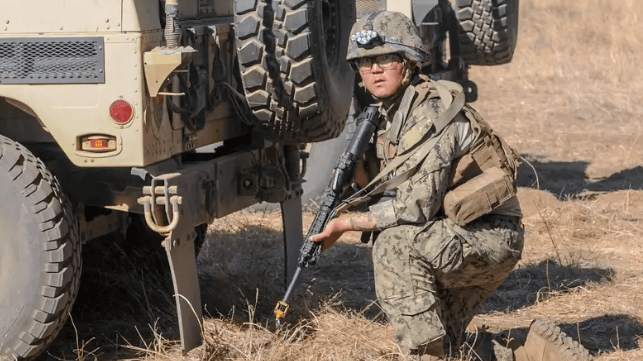
Construction Electrician 3rd Class Wenheng Zhao during an exercise in California, 2019 (USN file image)

PUBLISHED JAN 8, 2024 8:58 PM BY THE MARITIME EXECUTIVE


A Chinese-born U.S. Navy sailor has been sentenced to spend more than two years in jail for passing sensitive military secrets to the government of China.  

Petty Officer Wenheng "Thomas" Zhao, 26, worked at Naval Base Ventura County in Port Hueneme, California. In October 2023, he pleaded guilty to charges of bribery and conspiracy, and he admitted that he had passed military secrets to a Chinese intelligence officer. The information included plans for a maritime exercise in the Pacific; Navy operational orders; and "electrical diagrams and blueprints for a Ground/Air Task Oriented Radar system located in Okinawa."

For all this - and the risk of a long prison sentence - Zhao accepted just $15,000 in 14 separate payments, spaced out in installments over the course of 2021-23. 

Zhao could have been sentenced to up to five years for the conspiracy count and 15 years for the bribery charge, and prosecutors sought 37 months, claiming that the defendant had tried to obstruct their investigation. Zhao’s lawyer sought 12 months.  US District Judge R. Gary Klausner took the middle ground and settled on 27 months. 

“Officer Zhao betrayed his country and the men and women of the US Navy by accepting bribes from a foreign adversary,” U.S. Attorney Martin Estrada said last year in announcing the guilty plea. 

Another Chinese-born U.S. Navy sailor from California, Jinchao Wei, faces separate charges in connection with another alleged plot to pass information to a Chinese intelligence officer. Wei has pleaded not guilty. According to prosecutors, Wei had encouragement from his mother, who told her son that the betrayal would help him in a future career in the Chinese Communist Party.


Ships Flagged in Cameroon Banned by UAE in Shadow Fleet Crackdown

Cameroon registered ships
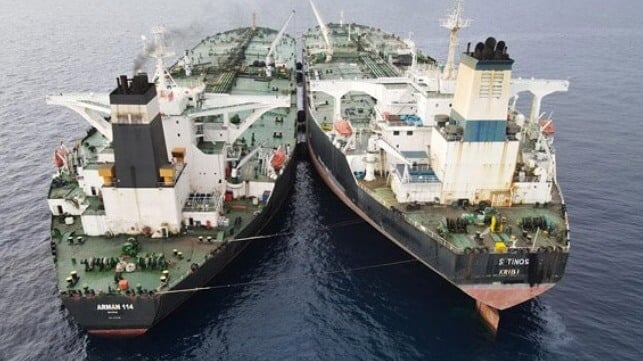
Shadow tanker registered in Cameroon was caught by Indonesia in an illegal STS operation in July 2023 ( Bakamla)

PUBLISHED JAN 9, 2024 1:45 PM BY THE MARITIME EXECUTIVE


The United Arab Emirates quietly joined the efforts to crack down on the growing fleet of so-called shadow tankers operating outside much of the regulatory framework of the shipping industry. Without explanation, they have banned vessels operating under the flag state of the Republic of Cameroon from calling in UAE waters and ports.

The UAE’s Ministry of Energy & Infrastructure released a circular dated January 2, 2024, which surfaced on the Port of Fujairah’s website. It announced an update to the list of flag states whose ships are required to have international classification to enter the UAE. 

“This administration has decided to include the vessels registered under the flag state of Cameroon to the existing list of restricted flag state vessels calling in UAE waters and ports, unless they are classified by a member of the International Association of Classification Societies (IACS) or by the Emirates Classification Society – Tasneef,” according to the circular. It goes on to warn that “maritime companies and ship agents in the UAE are requested not to provide the services to those vessels that are not complying with this circular to avoid legal accountability.”

Cameroon becomes the ninth national flag state listed by the Ministry. Others include similarly notorious havens for the dark fleet and vessels attempting to avoid the classification, safety, and insurance regimes of the shipping industry. Other flags listed by the UAE include Tanzania, the Republic of Congo, Equatorial Guinea, Tonga, and Sao Tome and Principe.

Cameroon has received attention as a haven for the shadow fleet as the operations of these vessels grew in response to the bans by the West on Russian oil exports. Historically vessels registered in Cameroon have been linked to other oil smuggling operations notably including Iran and Venezuela. 

Last July, Indonesia for example reported its forces had come upon two tankers illegally anchored during a ship-to-ship oil transfer. One of the vessels was an Iranian tanker that was operating dark, i.e. with its AIS signal turned off, while the other vessel in the transfer was identifying itself as registered in Cameroon. It however was using the identity of a vessel that had been scrapped five years earlier. 

A Suezmax tanker named Liberty flagged in Cameroon went aground in December 2023 near Singapore in the Strait of Malacca. The ship which was 23 years old illustrated the properties of the shadow fleet and a review of records showed it had come from a Russian oil port. 

Data collected by Bloomberg found that of 14 Cameroon-flagged tankers, 11 of them could be traced to Russian oil ports in the past year. 

The Paris MoU, one of the administration agencies for flag states, currently reflects six vessels registered in Cameroon as having received detention notices and are currently banned from the Paris MoU region, with two of the notices issued in September 2023. The Paris MoU lists Cameroon as only one of nine nations on its “Black List” with the highest excess factor and the only country currently ranked as “Very High Risk.”


Boiler Explosion Kills Engineer on Product Tanker off Italy

product tanker explosion
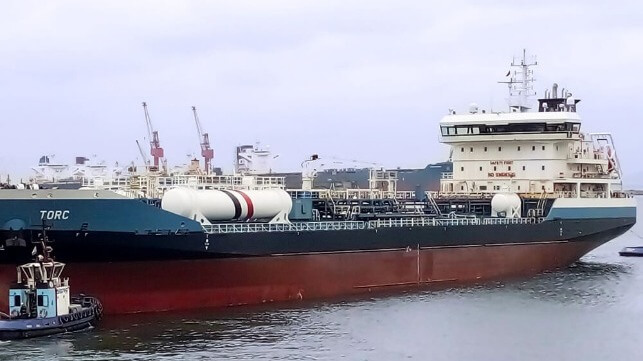
An explosion aboard the 2010-built tanker milled the second engineer (Besiktas)

PUBLISHED JAN 9, 2024 2:51 PM BY THE MARITIME EXECUTIVE


An engineer working aboard a Turkish-managed product tanker was killed on Monday, January 8, in an engine room explosion. The vessel, the MT Torc, was underway at the time in the Mediterranean and the shipping company is promising an investigation to determine the cause of the explosion.

Besiktas Shipping based in Istanbul reports there was a boiler explosion in the engine room of the Torc (13,200 dwt), while the tanker which is registered in Malta was sailing to Italy. They report that the second engineer, Mehmet Alta? of Turkey, was severely injured in the explosion. He passed away shortly after the incident before medical help could reach the vessel.

The Italian Port Authorities and Coast Guard, Ankara MRCC, and Republic of Türkiye Ministry of Foreign Affairs, were all contacted Besiktas reports. The ship was working with the authorities to arrange for an immediate medical evacuation of the injured crewmember. The Italian authorities however canceled the helicopter evacuation when they were informed that the engineer had succumbed to his injuries.

The product tanker was built in 2010 and it was acquired in 2020 coming under the management of Besiktas and operating in the Mediterranean and Black Sea. She is 419 feet (128 meters) in length with 14 tanks.

Records show the vessel had just completed what RINA terms an “expanded inspection” at the end of December while the vessel was in Greece. The data shows that no issues were identified and the vessel was not cited for any deficiencies. She departed Greece days later on January 2 and made a brief stop at the Malta anchorage on January 5.

The authorities initially instructed the vessel after the explosion to continue on her course to Genoa where she was expected to arrive on January 11. Her AIS signal however now shows that she is inbound to Naples where she will arrive this evening.

Besiktas said it is deeply saddened by the loss of its colleague and is working with the authorities to determine the cause of the explosion. In addition, after the investigation by the Italian Authorities, the company reports it has arranged an investigation to be performed by an international expert organization for the incident analysis.

The shipping company shows on its website that it has over 60 years experience managing vessels. Its current fleet is shown as 34 ships, mostly product tankers, as well as two each bulk carriers and crude oil tankers. They also have a containership and an ethylene carrier under management. The company works with major charterers in the crude oil, product, chemical, gas, container, and dry bulk shipping segments.


Two Crew Killed, Third Burnt in Fire Aboard Containership Docked in Houston

containership fire
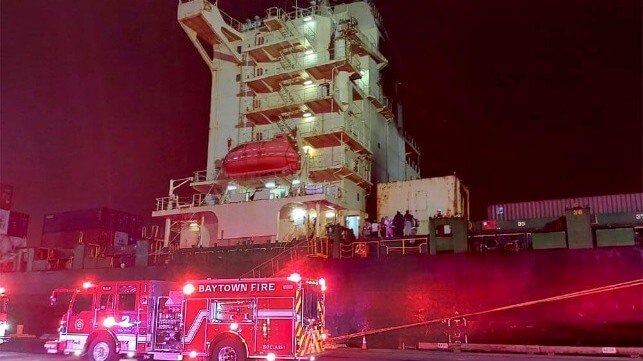
Local fire departments responded to the engine room fire and located three missing crewmembers (Baytown Fire Deptartment)

PUBLISHED JAN 8, 2024 1:19 PM BY THE MARITIME EXECUTIVE


A fire aboard the Panama-flagged containership docked in the Port of Houston killed two crewmembers and left a third in critical condition with burns. The local fire departments and U.S. Coast Guard are reporting the fire is out and an investigation is underway to determine the cause of the early morning blaze.

The containership Stride (24,777 dwt) arrived in the Port of Houston late on January 7 and was docked at the Barbours Cut Container Terminal. The vessel built in 1997 is 597 feet in length (182 meters) with a capacity of 2,174. It is owned by Danaos Shipping of Greece and was arriving from Guatemala and Honduras.

A fuel barge was alongside this morning when a fire was reported aboard the vessel at approximately 0330 local time. The Baytown Fire Department reports it was told three crewmembers were missing and that the fire was in the engine room. They searched the vessel locating the crewmembers and arranged for one who had been burnt to be airlifted by Life Flight in critical condition. The other two crewmembers were deceased when they were located. No other injuries or fatalities were reported.


A picture Tweeted by the local TV station shows soot on the rear of the funnel. The fire was extinguished and did not spread.

The U.S. Coast Guard and the Port of Houston Fire Department will be monitoring the vessel for at least the next 24 hours. 


CRIMINAL CAPITALI$M

Top Shipping Law Firm Admits to Anti-Money-Laundering Failures

Gavel

PUBLISHED JAN 9, 2024 3:44 PM BY THE MARITIME EXECUTIVE


The UK law firm Clyde & Co. has admitted to a failure to comply with British anti-money laundering regulations, and it will have to pay a substantial fine. 

The UK’s Solicitors Regulation Authority (SRA) has been investigating Clyde & Co. and one of its former shipping partners, Ed Mills-Web, for potential money laundering due diligence failures. Clyde & Co. self-reported the matter in question in early 2019 when it suspended Mills-Web and referred him to the SRA for investigation. 

Mills-Web ultimately resigned, along with four senior colleagues. Together they set up a new legal consultancy, Preston Turnbull LLP, focused on shipping disputes. The firm is a top-ranked London shipping law firm in the Chambers & Partners ranking, and four of its lawyers - including Mills-Webb - are on its top-performance list. 

Mills-Webb remained under investigation for his past activity at Clyde & Co. SRA ultimately decided to charge both Mills-Web and Clyde with “breaches of the money laundering regulations and procedures relating to a client and companies used by the client.” On Tuesday, Clyde & Co. and Mills-Webb both admitted to the breaches and agreed to pay fines of $125,000 and $19,000 respectively. 

Clyde & Co. is one of the world’s oldest operating shipping law firms, after the collapse of long-tenured Ince & Co.  The case is the second SRA enforcement action against the law firm since 2017, when three of its partners were fined and the firm was ordered to pay about $60,000 - at that time a record amount for the SRA - in connection with other alleged money-laundering breaches.

Going forward, under the UK’s new and much more stringent Economic Crime and Corporate Transparency Act, the SRA can impose unlimited fines on law firms or solicitors in connection with economic-crime cases.

“Solicitors should keep at the front of their minds that they can not only be struck off but also imprisoned if they do not abide by the legislation,” warned Clyde & Co. in a bulletin last year. 


Eversource Expects $1.4-$1.6B Charge as It Negotiates Sale of US Wind Farms

US offshore wind farm
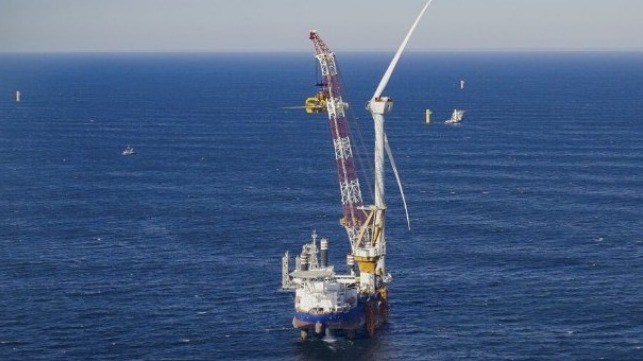
Eversource will record an impairment charge as it looks to sell its three U.S. wind farm investments (South Fork Wind)

PUBLISHED JAN 9, 2024 4:17 PM BY THE MARITIME EXECUTIVE


Eversource Energy which operates New England’s largest energy delivery system reports it is continuing with its efforts to exit its investments in the emerging U.S. offshore energy sector. Last fall the company sold some assets to its joint venture partner Ørsted and now it reports it is negotiating the sale of its interests in the wind farms. However, the changing market value of the projects due to rising construction costs will lead the company to take a $1.4 to $1.6 billion impairment charge.

The partnership has faced challenges as it works to develop some of the first large-scale offshore wind energy projects in the United States. Eversource and Ørsted are joint venture partners on the South Fork Wind project, a 130 MW wind farm located off Long Island, New York that in December became the first commercial-scale wind farm in the U.S. to generate power.  That wind farm is expected to complete construction this year, while the JV is also working on Revolution Wind, a 704 MW project that would supply power to Connecticut and Rhode Island, and Sunrise Wind, a 924 MW project proposed for a location east of Long Island and south of Rhode Island.

Eversource reports it is in negotiations with a selected buyer which it describes as “a leading global private infrastructure investor.” Terms have not been agreed for a deal in which the investor would acquire the company’s share in the three wind farms. The buyer would require regulatory approval and have to reach a partnership deal with Ørsted. In addition, Eversource notes that the scope of the transaction would also be subject to the developments in the Sunrise Wind rebid process, which remains in discussion with Ørsted at this time.

The process to divest its investments in the offshore wind sector began last year when Eversource agreed to sell its rights to a lease area to Ørsted. Despite its own questions about the economic viability of portions of the U.S. offshore wind sector, Ørsted also acquired port facilities and maintenance locations in Connecticut, Rhode Island, and New York and the charter for the first U.S.-built service operation vessel under construction in Louisiana.

“Offshore wind projects continue to experience major supply chain disruption and inflationary challenges in the early stage of this growing industry in the U.S.,” said Joe Nolan, Chairman, President, and CEO of Eversource discussing the company’s strategy. He called the planned impairment charges “an unfortunate reflection of the current market conditions.”

As it pursues the negotiations, Eversource reports it has also updated project construction forecasts to reflect additional expenditures for construction as well as scheduling-related pressures. They cited challenges that included the availability and increased cost of installation vessels as well as supply chain cost increases related to foundation fabrication. These elements are contributing to an $800 to $900 million impairment charge for Eversource across the three wind farms.

There is also uncertainty for the Sunrise Wind project that created an additional $600 to $700 million in impairment charges for Eversource. They report they remain in discussion with Ørsted to determine the strategy for the project. New York State regulators in October 2023 denied a petition for the project to amend its power agreements to cover increased costs and inflation. New York however expedited a new solicitation and Sunrise Wind was one of the projects that has the opportunity to cancel its existing power agreement and rebid in the new solicitation. Eversource says they are still working to determine if they will rebid Sunrise Wind and at what price, noting if they are successful, they would then have 90 days to negotiate new power agreements at a revised price. 

Nolan explains that during the fourth quarter of 2023, Eversource identified certain impacts that will require further adjustment to the carrying value of its offshore wind investments for the three projects. Those negative impacts he said required Eversource to evaluate its offshore wind business investments for an other-than-temporary impairment.

“Eversource remains focused on advancing the efforts to decarbonize the energy sector and accelerate electrification with much-needed investments in transmission and other clean energy infrastructure through our regulated utilities,” concluded Nolan.


U.S. Built CTV Delivered by St. Johns Ship Building for Vineyard Wind

wind CTV
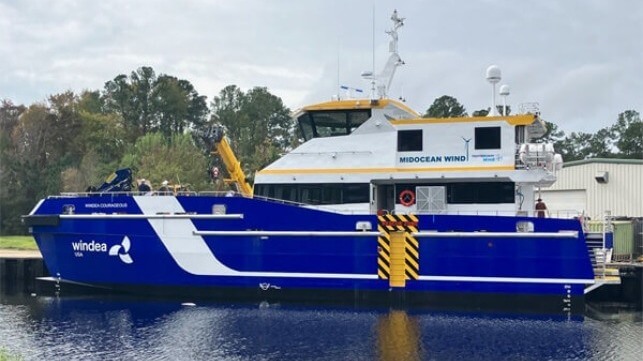
WINDEA Courageous is the first of three aluminum CTVs being built by St. Johns for Vineyard Wind 1 (St. Johns Ship Building)

PUBLISHED JAN 8, 2024 7:50 PM BY THE MARITIME EXECUTIVE


The first of three new crew transfer vessels being built to support the Vineyard Wind 1 wind farm off Massachusetts has been delivered as another example of the opportunities for U.S. shipbuilders coming for the developing offshore wind sector. Built by St. Johns Ship Building in Florida, the vessel is also part of the yard’s expansion into aluminum ship construction.

The 98-foot (30-meter) long CTV began construction in 2022 ordered by WINDEA CTV, a newly launched partnership of Hornblower Wind and MidOcean Wind to support the offshore wind sector. The three vessels which use an Incat Crowther design will be operating on a long-term charter for Vineyard Wind 1, the project being developed by Avangrid Renewables and Copenhagen Infrastructure Partners which recently delivered first power.

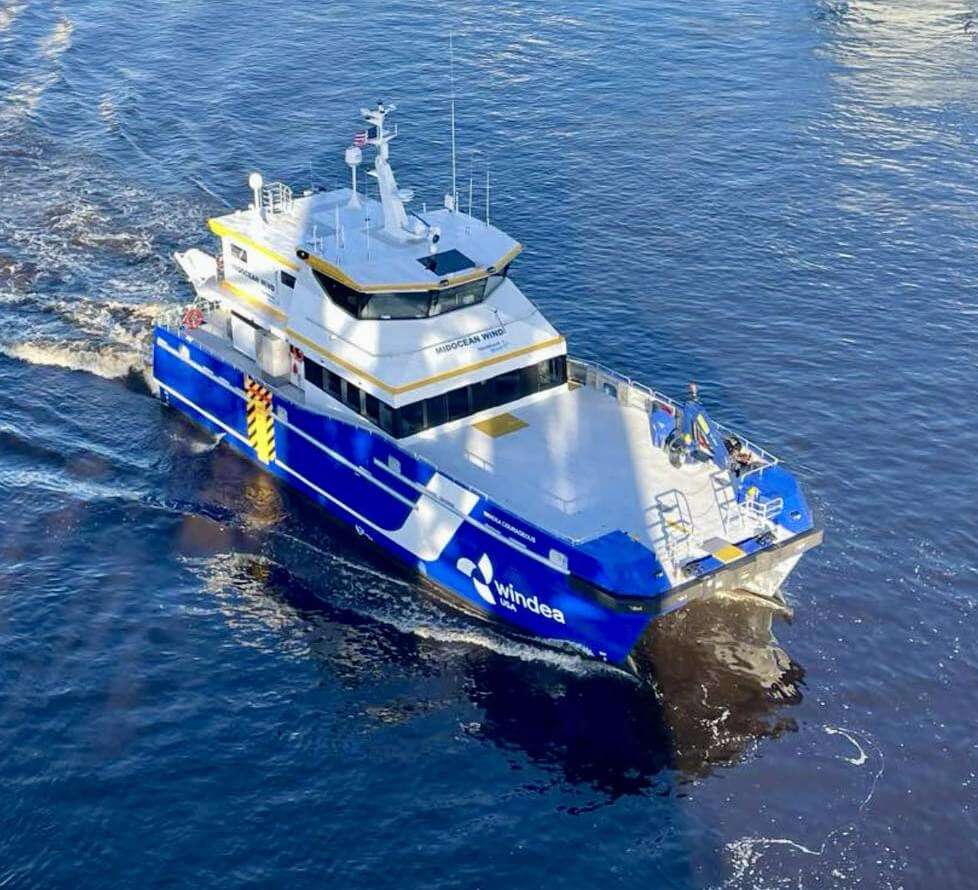
The vessels are built of aluminum. Each can transport a total of 30 people, including 24 technicians. The well-proven design of Incat has in addition been adapted to be future-ready. The vessels are labeled “hybrid-ready” meaning they have been designed for a possible future conversion to electric propulsion.

The first vessel, WINDEA Courageous has arrived at the new wind port facility in New Bedford, Massachusetts which will be used for the maintenance operations of Vineyard Wind 1. Construction is currently underway on the wind farm and is expected to be completed this year. The vessel is now available to support the construction project and will later be joined by two sister ships.


WINDEA Courageous was recently delivered to the operations base in New Bedford, Massachusetts (St. Johns)


The project also marks a key point for St. Johns which was acquired in 2022 in a deal with the Libra Group, a privately-owned business group owned by the Logothetis family. They formed Americraft Marine Group to support and strengthen the U.S. shipbuilding industry to meet the perceived need for Jones Act-compliant vessels. The company has invested in developing the construction capabilities at St. Johns including through multiple modifications of the facility and the acquisition of new production equipment.

“The WINDEA Courageous is a statement vessel for St Johns Ship Building and marks the first measurable accomplishment in what has been a two-year effort to convert the facility,” said Ed Sheets, executive vice president and director of business strategy for Americraft Marine Group, the parent company of St Johns Ship Building. He points out that the CTV marks the expansion of the yard from a history in building primarily steel vessels to constructing advanced design, high-speed, aluminum vessels.

In addition to the three vessels for WINDEA, St. Johns also is working on an order for CTVs for Atlantic Wind Transfer. Construction on the first two vessels in an order that could see a total of six vessels built began in September 2022. AWT ordered two Chartwell 24 aluminum catamaran CTVs from St. Johns with an option for four additional vessels. They will be used to carry personnel to and from wind turbines off the northeastern U.S. coast. The vessels were designed by UK-based Chartwell Marine and reported to be a fuel-efficient design that will comply with EPA Tier 4 emissions regulations.

St. John is located in Palatka, Florida near Jacksonville. It has a long history of building crew vessels, ferries, tugs, deck and tank barges, landing craft, and general cargo vessels.


Container Lost off Maersk Ship Releases Plastic Balls on Spain’s Beaches

plastic pollution on beach
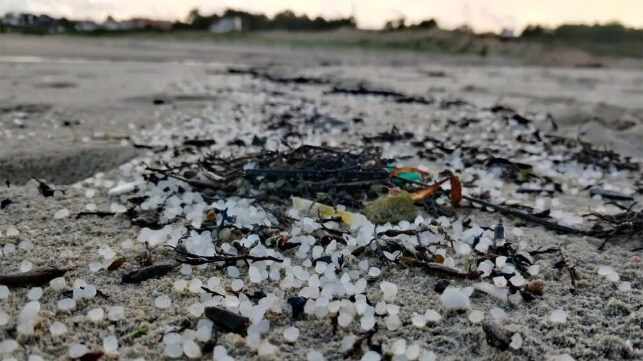
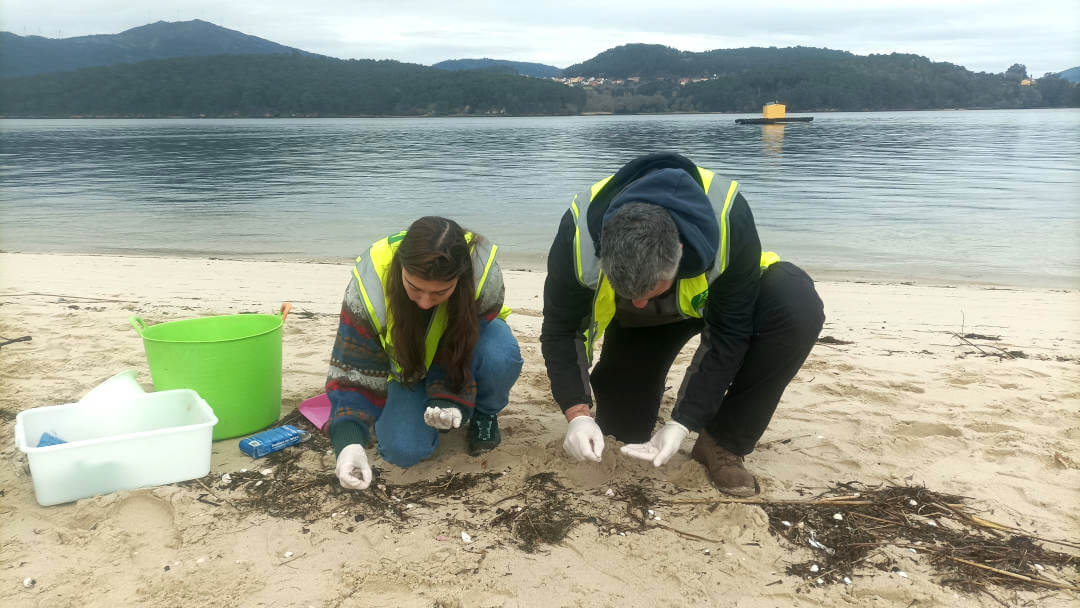
Possibly millions of nurdles are coming ashore after a container went overboard from a ship under charter to Maersk (photo courtesy of Greenpeace)

PUBLISHED JAN 9, 2024 5:41 PM BY THE MARITIME EXECUTIVE


Nearly a month after environmentalists and local officials began calling attention to plastic nurdles washing up on Spain’s beaches, the federal government is opening a formal investigation. The source of the small plastic balls used in the manufacture of plastic water bottles and similar food packing has been traced to a containership operating under charter to Maersk.

Environmentalists working with Spain’s Ecologistas en Accion, an environmental organization, began finding the small plastic bits washing up on the shoreline primarily in the Galicia region as soon as December 13. Volunteers began scouring the beaches collecting the small plastics while fears grew about how much might have been lost into the ocean. The environmental group is saying there could be billions of the nurdles floating in the ocean and coming ashore as they raise the alarm about the impact on fishing and the food chain.

Investigations traced the source of the nurdles to a containership that lost six boxes overboard on December 8 approximately 50 miles west of the coast of Portugal. Due to currents, most of the plastic has been found on Spanish beaches in Galicia as well as some in Asturias, although some reports are saying traces of it have reached the beaches of France.

The ship, the Liberia-registered Toconao (116,000 dwt) was sailing the Bay of Biscay from Algeciras to Rotterdam. It operates between the Mediterranean and Northern Europe currently under charter to Maersk and managed by Columbia Shipmanagement of Singapore.  Built in 2003, the ship has a capacity of 8,600 TEU.

Six of the containers went overboard with Maersk saying that none of the container cargo is officially listed as hazardous material. There is no word about what else was in the boxes, but one of them contained 1,050 bags of the nurdles (less than 5 millimeters in size). Each sack is reported to hold 55 pounds of the nurdles. Greenpeace estimates that are 22,500 nurdles per pound which means there could have been nearly 1.3 billion nurdles in the container. Maersk told the Associated Press that the vessel’s owners hired multiple cleanup specialists to support the efforts to remove the plastics from the beaches. 


Volunteers have been attempting to collect the balls from the beaches (photo courtesy of Ecologistas en Accion)


Ecologistas en Accion, however, is not satisfied with the slow response to the clean-up process. They are critical of the government as well as the shipping industry. The activist group said in a statement on January 5 that it would file an environmental complaint against the owner of the vessel.

The problem of nurdles is well known, with calls to regulate or outlaw their shipment. Just a year ago, France threatened legal action when the plastics began washing up on the beaches of Brittany. Sri Lanka faced a similar problem in 2021 when the feeder ship X-Press Pearl burnt and sunk off Colombo. They have been cleaning nurdles from their beaches with environmentalists projecting a decade or more of repercussions.

Greenpeace, along with Ecologistas en Acción, Friends of the Earth, SEO/BirdLife, and WWF joined together in calling for greater coordination between Spanish authorities in response to the current pellet spill. At the same time, the groups are using the event to call broader attention to the problems of microplastics in the oceans. 


Green ammonia could decarbonize 60% of global shipping when offered at just 10 regional fuel ports


Peer-Reviewed Publication

IOP PUBLISHING

Cargo container ship 

IMAGE: 

ARIEL VIEW OF CARGO CONTAINER SHIPS AT PORT.

view more 

CREDIT: IOP PUBLISHING


A study published today in IOP Publishing’s journal Environmental Research: Infrastructure and Sustainability has found that green ammonia could be used to fulfil the fuel demands of over 60% of global shipping by targeting just the top 10 regional fuel ports. Researchers at the University of Oxford looked at the production costs of ammonia which are similar to very low sulphur fuels, and concluded that the fuel could be a viable option to help decarbonise international shipping by 2050. 

Around USD 2 trillion will be needed to transition to a green ammonia fuel supply chain by 2050, primarily to finance supply infrastructure. The study shows that the greatest investment need is in Australia, to supply the Asian markets, with large production clusters also predicted in Chile (to supply South America), California (to supply Western U.S.A.), North-West Africa (to meet European demand), and the southern Arabian Peninsula (to meet local demand and parts of south Asia).  

90% of world’s physical goods trade is transported by ships which burn heavy fuel oil and emit toxic pollutants. This accounts for nearly 3% of the global greenhouse gas (GHG) emissions. As a result of this, the International Maritime Organization (IMO) committed to decarbonising international shipping in 2018, aiming to halve GHG emissions by 2050. These targets have been recently revised to net zero emissions by 2050. 

After investigating the viability of diesel vessel exhaust scrubbers, green ammonia, made by electrolysing water with renewable electricity, was proposed as an alternative fuel source to quickly decarbonise the shipping industry. However, historically there has been great uncertainty as to how and where to invest to create the necessary infrastructure to deliver an efficient, viable fuel supply chain. 

René Bañares-Alcántara, Professor of Chemical Engineering in the Department of Engineering Science at the University of Oxford, says: “Shipping is one of the most challenging sectors to decarbonize because of the need for fuel with high energy density and the difficulty of coordinating different groups to produce, utilize and finance alternative (green) fuel supplies.” 

To guide investors, the team at the University of Oxford developed a modelling framework to create viable scenarios for how to establish a global green ammonia fuel supply chain. The framework combines a fuel demand model, future trade scenarios and a spatial optimisation model for green ammonia production, storage, and transport, to find the best locations to meet future demand for shipping fuel. 

Professor Bañares-Alcántara continues: “The implications of this work are striking. Under the proposed model, current dependence upon oil-producing nations would be replaced by a more regionalised industry; green ammonia will be produced near the equator in countries with abundant land and high solar potential then transported to regional centres of shipping fuel demand.”   


Predominantly plant-based or vegetarian diet linked to 39% lower odds of COVID-19


Diet high in vegetables, legumes, nuts, and low in dairy and meat may be protective


Peer-Reviewed Publication

BMJ


A predominantly plant-based or vegetarian diet is linked to 39% lower odds of COVID-19 infection, finds research published in the open access journal BMJ Nutrition Prevention & Health.


The findings prompt the researchers to suggest that a diet high in vegetables, legumes, and nuts, and low in dairy products and meat may help to ward off the infection.

Several studies have suggested that diet may have an important role in the evolution of COVID-19 infection, as well as in the factors that heighten the risk of its associated complications.

The researchers therefore set out to evaluate the potential impact of dietary patterns on the incidence, severity, and duration of COVID-19 infection among 702 adult volunteers all of whom were recruited between March and July 2022.

Participants were surveyed on their usual eating patterns and food group frequency, as well as lifestyle and medical history, including vaccination against COVID-19. They were then divided into either omnivorous (424) or predominantly plant-based (278) dietary groups. 

The plant-based food group was further divided into flexitarians/semi-vegetarians who ate meat 3 or fewer times a week (87); and vegetarians and vegans (191).

Those who reported following predominantly plant-based or vegetarian diets routinely ate more vegetables, legumes, and nuts, and less/no dairy and meat.

There were no significant differences in sex, age, or vaccination uptake between the omnivores and plant-based groups. But a significantly higher number of people had been educated to postgraduate degree level in the latter. 

The omnivores also reported a higher rate of medical conditions and lower rates of physical activity. And the prevalence of overweight and obesity was significantly higher among the omnivores—all factors associated with higher COVID-19 infection risk and more severe symptoms/complications.

In all, 330 people (47%) said that they had had COVID-19 infection. Of these, 224 (32%) said they had mild symptoms and 106 (15%) moderate to severe symptoms. 

The omnivores had a significantly higher reported incidence of COVID-19 than the plant-based dietary groups: 52% vs 40%. And they were more likely to have had moderate to severe infection:18% vs just over 11%. 

There was no difference, however, in how long symptoms lasted.

After accounting for potentially influential factors, such as weight, pre-existing medical conditions, and physical activity levels, there was no overall difference in symptom severity between the omnivores and the plant-based dietary groups. 

But those following a predominantly plant-based or vegetarian/vegan diet were 39% less likely to become infected than the omnivores. 

It may be that predominantly plant-based diets provide more nutrients that boost the immune system and help to fight viral infections, they suggest, by way of an explanation for their findings.

“Plant-based dietary patterns are rich in antioxidants, phytosterols and polyphenols, which positively affect several cell types implicated in the immune function and exhibit direct antiviral properties,” they write.

This is an observational study, however, and as such, can’t establish causal factors. The researchers also acknowledge that the study relied on personal recall and subjective assessment, both of which are prone to error.

Nevertheless, they conclude: “In light of these findings and the findings of other studies, and because of the importance of identifying factors that can influence the incidence of COVID-19, we recommend the practice of following plant-based diets or vegetarian dietary patterns.”

"This research adds to the existing evidence, suggesting that diet may have a role in susceptibility to COVID-19 infection," comments  Shane McAuliffe, Senior Visiting Academic Associate, NNEdPro Global Institute for Food, Nutrition and Health, which co-owns BMJ Nutrition Prevention & Health with BMJ.

"But this remains an area of research that warrants more rigorous and high quality investigation before any firm conclusions can be drawn about whether particular dietary patterns increase the risk of COVID-19 infection," he adds.