Saturday, January 20, 2024

CANADA

Banking regulator increasing focus on money

laundering as risks rise: Routledge

Canada money

The head of Canada's banking regulator says he's ramping up scrutiny of money laundering in the financial sector as risks increase.

Peter Routledge, who leads the Office of the Superintendent of Financial Institutions, said regulators and banks are having to play catch-up on how criminals are trying to move funds. 

"The sophistication of money laundering techniques in a world of artificial intelligence and deep fakes and all that, has run out ahead a little bit of, certainly regulators, and financial institutions," he said on Friday.

"Not so far that we can't make adjustments in the next year or two to tighten things up, but enough that we need to move, and we are moving."

Speaking at the TD Securities Financial Services Conference in Toronto, Routledge said the regulator is also increasing its focus in the area after parliament amended OSFI's mandate last summer to explicitly include monitoring how well financial institutions protect against threats to their integrity and security.

Fintrac, Canada's financial intelligence agency, has also signalled increased scrutiny of the issue. In December, the agency levied a $7.4-million penalty against RBC and a $1.3-million penalty against CIBC for non-compliance with anti-money laundering and terrorist financing measures. In the 2022-2023 financial year, by comparison, it levied $1.1 million in total fines across all business lines.

Routledge said OSFI would be working more closely with Fintrac as digitization and the more integrated global economy lead to higher risks of money laundering. 

The regulator will also be taking its message to financial institutions that they need to step up efforts against the problem, he said in a media availability following the event.

"I can tell you going forward, we certainly will do that, and say to boards of directors, a core part of your responsibility is to ensure your institutions are complying with the laws and the jurisdictions in which they operate, and anti-money laundering laws are laws your institution needs to be redoubling its efforts to ensure compliance."

The scale of money laundering in Canada could range anywhere from $45 billion to $113 billion, Criminal Intelligence Service Canada estimated in a 2020 report, based on UN estimates that between two and five per cent of global GDP is laundered annually. 

Routledge said the regulator is also increasing focus on climate-related risks, saying they're fundamentally a financial risk.

The regulator has already mandated the big banks to prepare climate disclosures and transition plans, which will then inform any decisions on capital buffers and other potential measures, but it will be a multi-year process, he said. 

"We don't expect the perfect transition plan tomorrow, but we expect boards to envisage different futures, different transitions and then begin to build plans for adapting to those futures," said Routledge.

He said OSFI's mandate captures climate risk comprehensively, and it will continue to focus on capturing the financial risks that climate change could bring, but that it's best left to other agencies with deeper climate expertise to lead on policy.

"We don't see OSFI's role as an institution meant to instigate climate policy. We're an institution meant to instigate sound risk management of new and emerging risks."

This report by The Canadian Press was first published Jan. 19, 2024.


Loblaw 50% off stickers to return after public anger over discount reduction

Loblaw Cos. Ltd. is reversing course on a decision to reduce its discounts on grocery items nearing their best-before date. 

Spokeswoman Catherine Thomas confirmed Friday afternoon that after listening to feedback from customers and colleagues, Loblaw is reverting back to its previous discounting practice of marking down last-day sale items by between 30 and 50 per cent. 

"Customers can expect to see (50 per cent) stickers returning in the next few weeks," she said in an email. 

Canada's largest grocer drew public ire this week after it decided that all last-day sale items would be marked down by 30 per cent across the board to provide more predictability and consistency. 

The move even prompted NDP MP Alistair MacGregor to call for an investigation into potential anti-competitive practices, citing comments by Loblaw indicating they were changing the discount to align with their competitors. 

However, both the Retail Council of Canada and competition expert Michael Osborne said price-matching and discount-matching are normal practices in the industry. 

The shift put Loblaw in line with its competitors, J.C. Williams Group retail analyst Lisa Hutcheson said on Tuesday. 

With demand for discounted food going up, the grocers have more room to sell those items at a smaller discount, she explained. 

“What drives markdowns for retailers is whether it’s selling or not selling,” she said.

Metro told The Canadian Press earlier this week that it has marked down items nearing their best-before date by up to 30 per cent for more than two decades. 

The country's biggest grocers have been under scrutiny from the public and government alike as Canadians continue to grapple with rising food prices. 

While inflation and food inflation have come down from their highs as interest rate hikes continue to work their way through the economy, price growth is still elevated from the Bank of Canada's target rate of two per cent.

Overall inflation in December was 3.4 per cent year over year, Statistics Canada reported this week. Grocery price inflation was 4.7 per cent. 

Shoppers have increasingly turned to discount grocery stores in a bid to save money as the cost of living rises. 

These discount banners are usually under the umbrella of the major grocers, such as Loblaw's No Frills, and the grocers have been expanding their discount footprints to meet demand. 

With files from Ritika Dubey

This report by The Canadian Press was first published Jan. 19, 2024.
 

Fifty Ontario workers included in global layoff at home goods company Wayfair

Wayfair says about 50 Canadians are part of a layoff impacting 1,650 employees at the home goods company.

Spokesperson Susan Frechette says the 50 Canadians are all in Ontario.

They make up part of the 13 per cent reduction to Wayfair's global workforce, which also includes cutting 19 per cent of corporate staff.

Wayfair chief executive Niraj Shah says he's making the cut because the Boston-based company "went overboard" in hiring during a strong economic period.

He says Wayfair has since veered away from its core principles and now needs to eliminate excess and "get efficient."

Wayfair's layoff is expected to deliver annualized cost savings of more than $280 million and follows cuts at Google, Amazon and Duolingo.

This report by The Canadian Press was first published Jan. 19, 2024.

 

Vancouver bus union warns of shutdown, employer calls expectations 'unreasonable'

The union representing transit supervisors in British Columbia's Lower Mainland says it will be “withdrawing all services” on Monday if an agreement with Coast Mountain Bus Company isn't made.

CUPE Local 4500, representing more than 180 bus workers, says it has been waiting more than four weeks for Coast Mountain to respond to its latest proposal.

The union says its patience has now "been exhausted" as it waits for the company to take bargaining seriously, and unless an agreement is reached all services, including the SeaBus, will be suspended by 3 a.m. on Jan. 22, for two days.

Coast Mountain president Michael McDaniel called the move "disappointing," adding that it will disrupt thousands of people who depend on the bus and SeaBus each day.

He says the company is urging the union to end its job action and return to the bargaining table with "realistic expectations."

The move by the union comes after it began an overtime ban on Jan. 6.

McDaniel says Coast Mountain has made CUPE 4500 the same wage offer already agreed to by all other unions.

"The union has demanded 25-per-cent wage increases for transit supervisors over three years," his statement said. "Simply put, it is unreasonable for this group of supervisors to demand nearly double the increase that all other CMBC unions have accepted."

This report by The Canadian Press was first published Jan. 18, 2024.


Wallem Group Partners with BYD for Providing Commercial Management Services

Wallem Group
Wallem Group is providing BYD with day-to-day support on operations

PUBLISHED JAN 19, 2024 9:50 PM BY THE MARITIME EXECUTIVE


[By: Wallem Group]

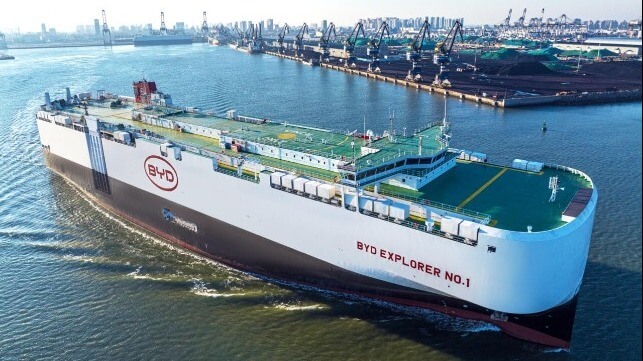
Wallem Group is pleased to partner Chinese automaker BYD by providing commercial services for its first fully chartered PCTC vessel, MV BYD Explorer No. 1. The vessel has completed its first loading operations and is on its inaugural voyage to Europe.

Wallem Group is providing BYD with day-to-day support on vessel operations including cargo stowage, route and bunker planning, and is liaising between the vessel, owner, and charterer. In addition, Wallem Group is working closely with BYD to explore possibilities to support the group on all other maritime functions such as cargo bookings and vessel performance management.

The PCTC vessel set sail from Yantai and Xiaomo ports in China, marking the first addition to BYD’s ‘sea fleet’. Utilising LNG as the primary fuel for its main engine and generators, the vessel boasts environmentally friendly features, significantly reducing carbon, nitrogen, and sulphur oxides emissions.

Anurag Mathur, Managing Director, Commercial Services, Wallem Group said, "We are proud to partner with BYD in providing commercial services for its inaugural vessel. Wallem’s Commercial Services aims to add efficiency not only to vessel performance but also to the charterer’s port, bunkering and cargo operations. We are also pleased to collaborate with a partner who holds sustainability at the heart of their business."

The products and services herein described in this press release are not endorsed by The Maritime Executive.


Industry Must Update STCW Standards Urgently to Train Seafarers in New Fuel

OneLearn Global
Marinos Kokkinis, Managing Director, OneLearn Global

PUBLISHED JAN 19, 2024 9:51 PM BY THE MARITIME EXECUTIVE


[By: OneLearn Group]

To keep up with the needs of 800,000 seafarers who must be able to work on ships using new fuels, regulators should prioritise updating STCW standards says e-learning provider OneLearn Global (OLG).

The maritime industry is on the cusp of a transformative era, driven by the ultimate move to green-fuelled ships to meet the IMO’s goals to reduce carbon emissions over the next decade. Leading training platform (OLG) believes the industry needs to act now to ensure companies are ready for the transition.

Managing Director at OLG, Marinos Kokkinis, said: “It is imperative the industry acts now so that we are prepared to transition over to green-fuelled ships. There is still so much we need to learn about green fuels, but we need to be looking at the framework of our training now and the STCW standards need to be updated to reflect how our landscape is changing. Basic safety training must include new fuels, focusing on alternative propulsion systems, energy management, and safety protocols."

Learning Solutions Program Manager at OLG, Malevi Manenti, added: “When it comes to new fuels, training courses are scattered and not yet aligned. The industry should be working together to foster collaboration among stakeholders to develop standardised training programmes, ensuring a cohesive approach globally. More and more information on new fuels is going to be developing and coming out continuously, so it is vital we are promoting a culture of continuous learning for seafarers and encouraging ongoing education on new technologies.”

OLG is leading the way in training opportunities for seafarers in new fuels with a number of initiatives, such as adopting customised learning plans tailored to the technical and safety requirements specific to green-fuelled ships, as well as cutting edge e-learning simulators. The company believes more companies should be looking at innovative technology solutions such as simulators to aid training.

Capt. Ioakeim Diplas, Marine Subject Matter Expert, OLG, added: “OLG is dedicated to remaining at the forefront of preparing maritime professionals for the challenges and opportunities presented by the transition to green-fuelled ships. By combining innovative training methodologies, global accessibility, and collaborative partnerships, we are poised to make a substantial impact on the successful adaptation of the industry workforce to the demands of a sustainable maritime future.”


ABS New Comprehensive Standards to Support Adoption of New Technology

ABS
Best-in-Class Rule Enhancements Result of Multi-Year Industry Collaboration

PUBLISHED JAN 18, 2024 11:40 PM BY THE MARITIME EXECUTIVE


[By: ABS]

In an industry first, ABS has introduced a comprehensive approach to support development of the next generation of designs and equipment employing the latest technology driven by decarbonization and digitalization.

ABS Marine Vessel Rules now include an extensive set of newly developed functional requirements and a standardized risk-based methodology which provides a path for class approval. These rule enhancements are a result of a multi-year collaboration with industry, shipyards, owners, equipment manufacturers, designers and regulators.

“ABS’ rules are built to adapt to a new and dynamic technological world,” said Christopher J. Wiernicki, Chairman and CEO of ABS. “By enhancing our rules with risk-based requirements and strengthening our technical content to add functional requirements aligned to prescriptive criteria, ABS enables the safe and rapid adoption of innovation and technology to support our clients’ and the maritime industry’s evolving decarbonization and digital ambitions.”

Under key safety and environmental objectives, the rules introduce categories of critical ship design elements, each underpinned by detailed functional requirements, which are comprehensive, easily accessible and provide clear technical guidance.

Alternative arrangements and new technologies may be accepted if designers, shipyards, owners, equipment manufacturers or others demonstrate compliance with the functional requirements. Applicable ABS prescriptive rules remain in place for conventional designs, technologies and arrangements that follow the traditional approval process.

“The new and improved interface for ABS rules helps simplify and clarify class requirements, preventing any interruptions in the plan review process. This risk-based approach allows us to innovate with confidence and incorporate new technology,” Seung-Ho Jeon, Senior Executive Vice President and Chief Technology Officer, HD Hyundai Heavy Industries.

Introduction of ABS’ approach for new technology and alternative arrangements is part of a series of enhancements ABS has made to its industry-leading rules and guides featuring a new, easily accessible and improved format with updated graphics, enhanced search capabilities, and greater transparency and clarity into technical criteria with the addition of more commentary, technical background and functional guidance to assist clients.

These updates follow enhancements made in 2023 where ABS launched industry’s only Custom Rule Book application, a powerful new tool which allows users to instantly create tailored rules sets for their specific vessel or project. Explore ABS’ latest rule enhancements here.

The products and services herein described in this press release are not endorsed by The Maritime Executive.


Damen Shipyards to Supply Four Fully Electric, Passenger Car Ferries

Damen Shipyards Group
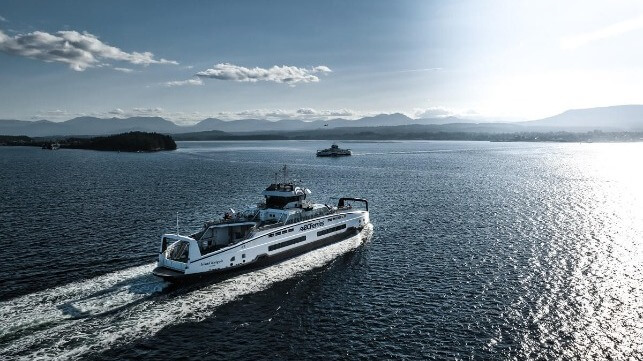
Road Ferry 8117 E3

PUBLISHED JAN 19, 2024 9:51 PM BY THE MARITIME EXECUTIVE


[By: Damen Shipyards Group]

In a competitive tender process that attracted many international bidders, Damen Shipyards has won the contract to build and supply four, fully electric, passenger car ferries for BC Ferries. These will be used for short-range services in the coastal waters of the Canadian province of British Columbia (BC). This order will take the total number of ferries that Damen has supplied to BC Ferries in recent years to ten. However, these latest additions will be the first to operate using 100% electrical power.

The vessels will be based on Damen’s double-ended Island-class RoRo 8117 E3 model. Each will be capable of carrying up to 47 vehicles and 390 passengers. Battery packs with a capacity of 2,000 kilowatts will supply the electricity for the power trains. Rapid recharging using renewable electricity will take place while the ferries disembark and embark their passengers and vehicles at each end. Each vessel will also have auxiliary diesel engines installed for back-up and general redundancy.

The shoreside charging equipment will also be supplied by Damen. A leader in this field, this will be the fourth time that Damen has provided this service, the first also being in Canada, in 2021, to support two hybrid Damen ferries delivered to the Ministry of Transportation, Ontario. These were followed by projects in Copenhagen, Denmark, and Dordrecht, the Netherlands.

“The new hybrid electric vessels will further standardize our fleet, both increasing capacity and improving our flexibility to move ships across routes so our passengers can have confidence that we’ll get them where they need to go,” said Nicolas Jimenez, BC Ferries’ President and CEO. “Adding more Island Class vessels will also make it easier to deploy crew, create efficiencies in training costs, and promote safe, reliable and environmentally conscious ferry services up and down the coast.”

Leo Postma, Damen’s Area Director Americas, added: “We are very excited and extremely pleased with the award of an order of four more Island Class type vessels for BC Ferries. We have been working alongside the technical staff at BC Ferries for seven years now and together we have developed a series totalling ten ferries that are highly efficient; meeting all the future requirements of safe, reliable and sustainable waterborne public transport.”

The four vessels are scheduled to begin operations by 2027 with two vessels each on the routes connecting Nanaimo Harbour and Gabriola Island, and Campbell River and Quadra Island.

The products and services herein described in this press release are not endorsed by The Maritime Executive.


Houthis Make Second Approach to GENCO Bulker Undeterred by U.S. Strikes

Genco Picardy bulker damaged in Houthi raids
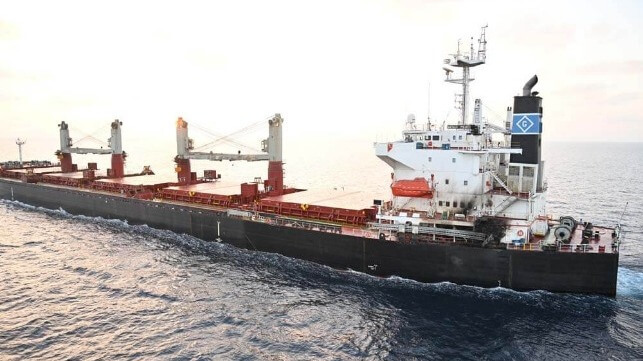
Genco Picardy underway after the first attack before being targeted by four additional drones (Indian Navy photo)

PUBLISHED JAN 19, 2024 1:41 PM BY THE MARITIME EXECUTIVE


The Houthi rebels are continuing undeterred by the military efforts of the U.S. and other nations vowing that they will continue to strike out at commercial shipping. Despite five strikes by the U.S., they continued their attacks on Thursday with two incidents targeting American ships, including a second approach to the GENCO bulker Genco Picardy.

U.S. Central Command on Thursday only confirmed the two missiles fired at the Chem Ranger (26,000 dwt), a U.S.-owned, Greek-managed chemical tanker sailing from Jeddah, Saudi Arabia to Kuwait. The report said the missiles were observed impacting the water near the ship without damage. The UK Maritime Trade Organizations however said around the same time four drones were observed flying close to an unnamed merchant ship approximately 85 miles southeast of Ash Shihr, Yemen.

The second vessel targeted has now been listed as the Genco Picardy (55,300 dwt), the U.S.-owned bulker registered in the Marshall Islands that was also targeted the previous night and struck by a drone. The Indian Navy reported that they had inspected the ship on Thursday to ensure that there were no explosives aboard and that it was continuing its voyage. Later Thursday, the Houthis again targeted the ship with four drones and one was seen exploding 800 meters from the vessel. The ship’s AIS signal now shows the Genco Picardy heading to the port at Tuticorin, India.

These incidents both happened in the Gulf of Aden showing that the U.S. strikes had possibly caused a shift from the southern Red Sea. The U.S. and UK initially last week struck infrastructure including radar. The U.S. on Wednesday and Thursday reported striking missiles that were prepared for launch bring to five the total number of reported sorties in the past week.

President Joe Biden speaking with reporters yesterday in Washington, D.C. said the U.S. efforts would continue including the strikes on Houthi assets. He admitted that the strikes have so far not stopped the Houthi aggression while the U.S. Defense Department emphasized the U.S. is in a defensive operation and not at war with the people of Yemen. Late on Friday, CENTCOM reported the sixth strike on Houthi position. They said that three Houthi anti-ship missiles that were aimed into the southern Red Sea and were prepared to launch, were destroyed in "self-defense."

The EU mission in the region, Atalanta, reports that with the two attacks on Thursday, a total of 40 merchant vessels have now been targeted. They also reflect several additional incidents of drones shot down in the Red Sea without a specific target.


Picture posted by the Houthi of the reported rally of support on January 19 in the capital of Yemen (X/Twitter)


In their analysis of the situation, the Atalanta command writes, “The Houthis are anticipated to persist in targeting vessels associated with Israeli interests along the Yemeni coast … Recent developments may also prompt them to focus on ships from other nations, notably the US and UK. However, the specific connections they will exploit between these ships and these nations remain unclear. Moreover, the increasing number of ships being targeted, despite no apparent evidence of a link with any of these countries, underscores the notion that any ship is susceptible to Houthi targeting.”

The attempts at boarding they observe might not be repeated due to the increased military presence and specifically the U.S. shooting of the rebels that approached the Maersk Hangzhou on December 31. Despite that, they are advising Israeli-related ships to limited AIS data and to prefer night transits in the south Red Sea to avoid skiffs and other supporting assets assisting the Houthi. For all ships, they are advising avoiding the waters near Yemen, only having essential crew on the navigation deck, other crew should remain away from the outside walls of the ship, and conducting a fire drill to check safety equipment before reaching the area near Yemen.

The Houthi today however reported a massive turnout for a rally at Al-Sabeen Square in the capital of Sana’a. They said that the crowd was “chanting slogans in support for the operations of the armed forces.” 


Livestock Begin “Cruise” Around Africa as Carrier Diverts From Red Sea

Bahijah livestock carrier
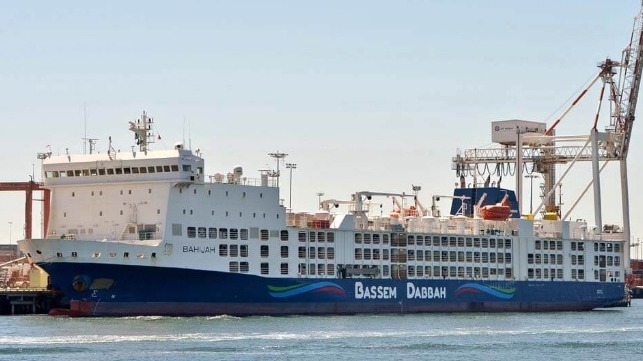
Bahijah in Fremantle in 2018 (Bahnfrend - CC BY-SA 4.0 DEED)

PUBLISHED JAN 19, 2024 2:59 PM BY THE MARITIME EXECUTIVE


Many vessels have diverted from planned transits for the Red Sea, but news that a loaded livestock carrier is changing course is raising concerns for the health and welfare of thousands of animals aboard the carrier Bahijah. Two weeks into a trip from Australia to Jordan, the Australian government confirmed that the vessel diverted saying that the exporter has a range of contingency options available.

Built in 2010, the livestock carrier Bahijah (7,900 dwt) is sailing under the flag of the Marshall Islands and is managed by a company in Croatia. It has a total of seven decks, four enclosed and three open, for the carriage of up to approximately 8,000 head of livestock and operates with a crew of 35. The vessel has been involved in past incidents, some when she was operating as the Ocean Outback for another company and experienced mechanical failures. Live export is a controversial trade that animal rights groups have long sought to ban.

Ship tracking indicates that Bahijah left Fremantle port for Aqaba, Jordan on January 5, after loading mostly sheep as well as some cattle. After 11 days, on January 16, the ship elected to change course away from the route to the Red Sea. This might in part be due to the ship having previously transported animals to Israel. Some reports indicate that the Bahijah is now heading to South Africa due to the worsening security situation in the Red Sea. The last signal on its AIS says “waiting orders.”

In a statement released on January 19, the Australian Department of Agriculture, Fisheries and Forestry (DAFF) said it is monitoring the passage of the vessel with the health and welfare of the animals on board being a top priority. Though the department did not disclose the number of livestock onboard, it stated that appropriate measures were undertaken before the ship left Australia aimed at guaranteeing the health and welfare of the animals.

The DAFF said that when the carrier departed Fremantle, it was satisfied that the arrangements for the transport of the livestock were appropriate to ensure their health and welfare. This ship is required to have a registered veterinarian and an accredited stockperson on board accompanying the consignment to attend to the health and welfare of the livestock.

As a condition of departure, the exporter was required to lodge contingency arrangements should the vessel not be able to reach the proposed destination in the Middle East. Among the contingency measures taken, DAFF reports the exporter loaded additional fodder and veterinary supplies above those required by Australian Standards for the Export of Livestock for the proposed voyage. However, the department did not mention how long the supplies would last.

“The department is monitoring the consignment closely and no significant animal health or welfare concerns have been reported at this time,” DAFF noted.

The exporter will be required to submit its contingency plan to DAFF, which they said would be reviewed by the department. They said they would consider future consignments on a case-by-case basis.

Animal rights groups are raising concern saying that the trip is stressful which would be compounded by a lengthy rerouting around Africa. They are calling on Australian exporters to voluntarily suspend shipments to destinations that are in or near regional conflicts.


Top photo of Bahijah in Fremantle in 2018 by Bahnfrend (CC BY-SA 4.0 DEED)


Video: Royal Navy Minehunter Backs into Fleet Mate Docking in Bahrain

UK minehunters collide
Minehunter HMS Chiddingfold backs into the docked HMS Bangor (screen grab from video)

PUBLISHED JAN 19, 2024 5:49 PM BY THE MARITIME EXECUTIVE


The UK’s Royal Navy will be dealing with an embarrassing video that is beginning to make the rounds on social media. Two of the navy’s elite minehunters, HMS Chiddingfold and HMS Bangor, based in Bahrain, were involved in an accident in which the Chiddingfold hit the Bangor. Both vessels are reported to have sustained damage but none of the personnel were injured.

A spokesperson for the Royal Navy is confirming the incident – it is hard to deny with the video online – but they are not providing any insights if there were weather conditions, mechanical issues, or a misjudgment in maneuvering. Reports are that a team is traveling to Bahrain to assess the full extent of the damage and investigate the circumstances.

"We are aware of an incident concerning two minehunters alongside in Bahrain. There are no casualties as a result of this incident and it would be inappropriate to comment further whilst investigations are ongoing,” the Royal Navy is responding to media inquiries.


Commissioned in 1983, the Chiddingfold is on long-term assignment in the Persian Gulf region as part of Operation Kipion to maintain freedom of navigation and the free flow of commerce. She is one of eight Hunt Class minehunters in the Royal Navy with six officers and 39 ratings aboard.

HMS Bangor is newer, commissioned in 1999, and according to the reports was secured alongside at the berth in Bahrain. She is one of seven Sandown Class Mine Counter-Measures Vessels in the Royal Navy. With a complement of 39 personnel, she has teams including Mine Warfare Specialists and Mine Clearance Divers. She is normally homeported in Scotland.

Last September, the Royal Navy highlighted the two vessels practicing close maneuvers and force protection skills as part of a training exercise with the Qatari Naval Force. During the exercise, they reported that the two vessels cooperated with the Qataris and practiced sailing in close quarters, to test the skills and abilities of the ships’ bridge teams.


As minehunters, they are made of unique materials to fulfill their roles without detection. According to the reports, the hulls are a composite of glass-reinforced plastic to reduce the threat from mines.

The Royal Navy is only saying that a plan of action will be developed after the investigation and inspection of both vessels.