Saturday, February 17, 2024

FREEDOM55
State pension age increase to 71 would have ‘severe consequences’ for workers in 50s and younger

UK issued 'crisis' warning as state pension age set to increase to 71

GB NEWS
By Patrick O'Donnell
Updated: 13/02/2024 -

The state pension age is currently set to rise to 67, then 68 under Government plans

Raising the state pension age to 71 would have “severe consequences” on the living standards of Britons in their 50s and younger, experts claim.

A think tank has proposed the state pension age must rise to 71 by 2050, amid growing life expectancy and falling birthrates, to maintain the current ratio of workers per retiree.


The UK state pension age is currently 66 and is expected to hit 67 between May 2026 and March 2028, with a further hike to 68 from 2044.

Critics are warning a hike to beyond 70 would add to the number of pensioners already suffering in poverty.

Speaking exclusively to GB News, co-founder of Raisin UK Kevin Mountford said that while it would reduce state pension spending, it would have a devastating impact on many approaching retirement.

He explained: "Although this proposal could save costs, the reality is that it could have severe consequences for middle-aged people who may be required to work longer before claiming their pension.

“This change would particularly impact those currently in their early 50s and younger and would add to the number of pensioners already living in poverty, which is one in four.”

The finance expert said such an age increase would likely only benefit Britons in higher-income groups, who are less likely to be reliant on the state pension.

Mr Mountford highlighted statistics which show only the top 10 per cent of the UK’s population stay healthy into their early 70s.

He also warned raising the state pension age this drastically would be considered a betrayal by voters at any upcoming General Election.

Raisin UK’s co-founder added: “The suggested policy update is also inflexible due to its unique eligibility criteria for state pension, which is part of every worker's social contract.

“Neither the NHS nor the UK labour market is prepared for this policy, too; the former faces significant health differences across the country, while the latter is rife with ageism.

This is what people in Lancashire thought after experts said UK state pension could rise to 71

Experts have suggested the state pension age could rise to 71 in the UK.

By The Newsroom
Updated 12th Feb 2024

Watch more of our videos on Shots!
and live on Freeview channel 276
Visit Shots! now

The current UK state pension age is 66 - one of the highest retirement ages (the age you can claim your state pension) in Europe.

But that could be about to change, with experts suggesting the retirement age could rise to 71 by 2050.

Lord David Willetts, President of the Resolution Foundation, called the current system "too generous."

This is what people in Lancashire had to say after experts said the state pension age could rise to 71

His words came as the Office for National Statistics revised its inactivity rate (the number of people outside the labour force between 16-64) to 21.9% - up from 20.8%.

The International Longevity Centre's Healthy Ageing and Prevention Index also suggested if the current retirement age stays the same, there will eventually be shortages in the workforce and the argument for raising the bar becomes clear.

But what does this mean for the people of Lancashire?

According to Lancashire County Council, the difference between the male and female life expectancy at birth, in the county, is 3.6 years – Females 82.1 | Males 78.5.

If 71 becomes the new age for downing your tools, many in the region would only have a handful of years after retirement.

With the potential that people will be expected to work for longer, let's see what people in Lancashire had to say on the matter:

Gail Power said: "The experts should try and do some of the jobs that hard-working people do, apart from sitting at a desk. It's ridiculous!"

Tony Codling believes we should take notes from our European neighbours.

He said: "Should do what the French do and bring the country to a halt.”

Whilst some like Jamie Townley had a much more morbid outlook as he said: "Sound, I will tell my employer to get the casket ready, literally worked to death."

On the other hand, others said the the increase may not affect them.

"Not bothered, I'm already there," David Bower said.

Ray Turner said: "There is no retirement age. "I'm 73 still working full time and very happy I can."

State pension age increase to 71 ‘would be greedy': ‘Some don’t make it to that age!

UK issued 'crisis' warning as state pension age set to increase again

GB NEWS
By Patrick O'Donnell
Updated: 17/02/2024 - 

The state pension age threshold is set to rise again in coming years but a recent proposal for a further hike been widely criticised by experts and GB News readers

Many GB News readers have been in uproar over a recent proposal to raise the state pension age to 71 in the near future.

Last week, The Longevity Centre recommended the state pension age was raised to this level by 2050 to maintain the number of working age Britons per retire amid growing life expectancy and falling birthrates.

This proposal was criticised by a pension expert who claimed it would have “severe consequences” on British workers aged 50 or under.

Members of the public have agreed, opposing the suggestion of hiking the state pension age to this degree in such a short space of time.


The proposal to raise the state pension age to 71 has been slammed by GB News readers


One reader highlighted that the think tank’s proposal does not take into account the millions of workers who are physically unable to work into their 70s.

They shared: “There's never a mention of those people who work manual jobs not being able to do their jobs even through their 50s.

“Men working down holes all weathers, carpenters on roofs, those working heavy work on factory lines. Some of those proposing increases in the retirement age haven't got a clue. At 50 plus, the body says no.

“It's fine for the office worker but not for manual workers outside who, in the winter, get cold through to the bone, or overheated under the sun outside in muck and dust.”

Another reader slammed the proposal as “greedy” with many households being forced to pay taxes, such as National Insurance, well into their older years.

The reader said: “All this country knows is to tax and scheme its citizens. it’s a greedy and increasingly desperate place.”

Another added: “We work until we're exhausted then we get taxed again on our money and now they want to increase the age for getting our money back?

“There will be some who don't make it to that age. Where does that money go? The government must be making a mint from this. It's daylight robbery.”


Finnish average effective retirement age rises to 62.8 years


The average effective Finnish retirement age rose to 62.8 years in 2023, an increase of more than half a year compared to 2022, the Finnish Centre for Pensions (ETK) has said.

ETK said there are two factors for the increase in the expected effective retirement age: First, the number of people starting to draw an old-age pension in 2023 fell significantly due to the increase in the retirement age, which means that not all people born in 1959 reached their retirement age in 2023.
Second, is the large indexation of pensions in 2022, which meant that people brought forward their retirement from 2023.

“The exceptionally large increase in the pension index at the beginning of last year led many people to bring forward their retirement to the year 2022. This increased the number of people who retired in 2022 and reduced the number of old-age pensions that started in 2023,” ETK development manager, Jari Kannisto, said.
In 2023, only 40,000 people drew the old-age pension, 25 per cent less than the year before.

“The number of people opting for a partial old-age pension also fell sharply. There were still more than 20,000 of them, but they are not counted as pensioners in the statistics,” Kannisto said.

The expected effective retirement age is a key indicator for pension policy. The target was set in the agreement between the social partners and the government. The agreement was first reached in March 2009. Since then, the target has been reaffirmed in Katainen’s government programme.

According to the target, the expected effective retirement age should rise to at least 62.4 years by 2025. This target has been achieved ahead of schedule. In 2023, the effective expected retirement age exceeded the target by 0.4 years.

“We are at the finish line, and a little further into the lap of honour. The increase in the effective retirement age has been surprisingly rapid. The main reason is the increase in the retirement age for the old-age pension. The good employment situation has also contributed to the positive trend. The target was already reached in 2021, but the year before last the expectation fell slightly due to the high number of new pensioners,” Kannisto said.


A third of Finns delay retirement for financial incentives


Around a third of newly retired Finnish people delayed their retirement for financial incentives, according to a study by the Finnish Centre for Pensions (ETK).

Meanwhile, just under a third felt that employer encouragement, improved leadership skills or valuing the experience of older workers would have persuaded them to continue working.

According to the survey, financial incentives were more effective amongst men, those who received a higher pension, and those who felt they have good health and wellbeing.

On the other hand, working conditions and employer attitudes were more important for women, those with lower pensions, and those who rated their pre-retirement health and wellbeing as poor.

Pre-retirement awareness of pensions was found to be “fairly high”, with almost all respondents having checked how much pension they would receive when they retired.

Nine in 10 survey respondents said they were aware of the increment for late retirement, which is paid when retirement is deferred past retirement age.

Seven in 10 stated they were familiar with the life expectancy coefficient, which reduces the amount of pension based on increases in average life expectancy.

“Almost one third of the respondents said that the pension that accrues from continuing to work or the increase for deferred retirement had encouraged them to retire later,” commented ETK economist, Satu Nivalainen.

“Slightly less than one fifth felt that the pension-reducing effect of the life expectancy coefficient had persuaded them to work longer.

“Changes in employer policies and working conditions would have encouraged continued working, particularly for those who felt that their pre-retirement working situation was not the best possible in these respects.

“Improved leadership practices would have encouraged people to continue working, particularly those who felt that their pre-retirement work situation was not well managed.”

ETK’s study also found that eight in 10 were satisfied with the time they had chosen to retire, while more than one in 10 would have liked to have retired later.

Respondents who were unaware of the impact of the life expectancy factor or the increase for deferred retirement were more likely to wish they had retired later.

“Awareness of how the timing of retirement affects the amount of the pension should be spread more widely among the age groups planning to retire,” Nivalainen said.

“In this way we could avoid situations where people retire with a full pension earlier than they would have liked due to a lack of information.”


Which European country has the best pension system and what does AI have to do with it?

By Doloresz Katanich

European countries are some of the best places for pensions in the world, analysis shows, and AI is having an increasing impact on how each system works.

The Netherlands is top of the class when it comes to comparing pension systems around the world, according to a recent global pensions report from the Mercer CFA Institute.

The ranking looked at more than 50 indicators and compared 47 retirement income systems, covering 64% of the world’s population.

The most relevant measurements were the level of private and public sector pension benefits available, the sustainability of the system to last decades into the future and the quality of its governance.

Iceland came second, being knocked off last year’s top spot, and Denmark came third in the 2023 index.

The majority of the European countries included in the report came out with a good grade. Only a few improvements are needed in Finland, Norway, Sweden, the UK, Switzerland, Ireland, Belgium, Portugal and Germany, according to the report.

On the other hand, France, Spain, Italy, Poland, Austria and Croatia, along with the US, have major risks and/or shortcomings that should be addressed, the report said.

Coming in at the bottom of the ranking are India, the Philippines and Argentina. Along with Turkey and Thailand, they share the worst ranking, grade D, suggesting that without any improvements, there are serious doubts about the efficacy and sustainability of these countries’ pension systems.

Risks in the system

The report acknowledges that ‘retirement income systems around the world are under pressure as never before’, due to the currently persistent inflation, the rising interest rates and the geopolitical uncertainty, which inevitably affects investment returns.

“The average age of populations around the world continues to rise in many markets, mainly more mature markets,” said Margaret Franklin, president and CEO at the CFA Institute.

“Inflation and rising interest rates have created a new market dynamic that poses significant challenges to pension plans. We also see continued fracturing as it relates to globalization,” she added. “These are just a few of the increasingly complex challenges that pension funds face that impact retirees in significant ways.”

The report quotes the OECD’s latest Pensions Outlook from 2022, which recommends that policymakers across the globe go through with the necessary reforms despite the current financial and economic uncertainty, to avoid putting the well-being of current and future pensioners at risk.

The report also recommends the strengthening of asset-backed pensions (as opposed to pay-as-you-go) which could contribute to the diversification of the sources to finance retirement, making pension systems more resilient.

The impact of artificial intelligence on pension systems

Artificial intelligence should improve pensions performance by cutting costs and highlighting upcoming risks, says the report.

Additional uses for AI could include building customised portfolios and identifying market anomalies, although AI was unlikely to be able to predict market movements with accuracy, so uncertainty will remain, the report said.

“The ongoing expansion of AI within the operations and decisions of investment managers could lead to more efficient and better-informed decision-making processes, which could potentially lead to higher real investment returns to pension plan members,” said David Knox, senior partner at Mercer, according to a Reuters article.

The annual survey also pointed to risks of AI models generating fake information when used in a new context, and of cyber-attacks against pension members’ data.


A 5th worker confirmed dead in Italian construction site collapse as workplace safety sparks debate

Italian rescuers have confirmed the death of a fifth worker after a concrete beam and layers of slabs collapsed at a supermarket construction site in the city of Florence a day earlier


ByGIADA ZAMPANO 
Associated Press
February 17, 2024, 

ROME -- Italian rescuers confirmed Saturday the death of a fifth worker after a concrete beam and layers of slabs collapsed at a supermarket construction site in the city of Florence a day earlier.

"I’ve just been informed that rescuers are recovering the body of a fifth worker,” said Tuscany Region’s president, Eugenio Giani.

Earlier, firefighters spokesman Luca Cari told RaiNews TV channel that they recovered the body of the fourth worker. “The mass of rubble is enormous,” he said.

A group of workers were putting together on Friday prefabricated concrete structures for a new Esselunga supermarket northwest of Florence’s main train when, according to initial reports, a reinforced concrete beam toppled over a layer of slabs, which then collapsed, trapping eight men under the rubble.

Rescue teams successfully pulled out three of the eight who were taken to local hospitals, where they were reportedly in serious but not life-threatening condition.

According to preliminary assessments, the accident happened due to a “structural collapse” of the concrete beam, which may have been caused by a misplacement or defect in its composition, officials said.

Florence prosecutors have ordered an investigation into the collapse, taking into consideration charges of negligence and multiple manslaughter, but no suspects have been named at this stage.

Marina Caprotti, the president of Esselunga, the supermarket being built, issued condolences on Friday and promised to cooperate with the investigation. She said the construction was outsourced to a third party.

The collapse rattled an already frazzled country that has suffered in recent years a string of deadly worker-related accidents amid heated political debates over poor and risky working conditions.

Most recently, in August, five rail workers were killed after being hit by a high-speed train while doing maintenance work on the railway.

In 2021, the last year for which there is official data from the statistics agency Eurostat, Italy registered 601 workplace deaths. It was the second-highest figure in the European Union after France that year. Across the EU, 22.5% of all fatal workplace accidents took place within the construction sector.

During a visit to the region of Calabria, right-wing Prime Minister Giorgia Meloni offered Friday her condolences to the families of the victims. “This is another story of people who go out to work, who simply go out to do their job, and do not come back home,” she said.

In a statement, Italy’s largest unions harshly criticized the government for not addressing workplace safety issues, particularly subcontracting criteria, and announced national strikes in the coming weeks.

“In 2023 there were 1,000 deaths at work and often these accidents were the result of subcontracting,” said the leader of Italy’s largest union CGIL, Maurizio Landini. He criticized the system that allows big companies, after winning major bids, to subcontract smaller companies to do the work at lower prices.

Landini added that it was Meloni's cabinet "that amended the procurement code and reintroduced the subcontracting cascade.”

The ruling League party slammed Landini saying his linking workplace deaths to the government's reintroduction of subcontracting was “disgusting.”

"The secretary of the CGIL ignores that the new rules were requested by Europe, so much that Italy was at risk of infringement, and that they have nothing to do with this tragedy,” the party said in a statement.

Florence’s Mayor Dario Nardella has marked Saturday a day of mourning in the city.


Will a watered-down EU law improve conditions for gig workers?

Negotiators have finally struck a deal after revisiting the European Union's rules on platform work. But for Uber drivers, Deliveroo riders and others in the gig economy, concessions that diluted the reforms mean the future remains precarious – especially in France.


Issued on: 17/02/2024 - 
Delivery riders wait for orders at Universitat square in Barcelona, Spain, on February 26, 2021. © REUTERS / ALBERT GEA

By:Jan van der Made

The draft law shifts the onus to each EU country to decide if gig workers count as employees – a status that grants them more rights.

Over the last decade, apps that connect customers with services have taken cities by storm. Order food from Deliveroo or Uber Eats, grab a ride with Uber or Bolt. Click the app and off you go. For many, it's become a way of life.

But the 28 million app workers in Europe – expected to rise to 43 million in two years – working across 500 platforms are poorly protected and lack labour rights compared to people in traditional employment.

The provisional deal reached earlier this month between the European Parliament and European Council may oblige EU countries to establish a "presumption of employment" to correct the power imbalance between the worker and the app.

But this deal – a watered-down version of an earlier proposal – has not made everyone happy.

Downfalls of the digital transition

The economic power of these apps skyrocketed in 2020-22, when many daily tasks became difficult during the Covid pandemic. People resorted to online services and trade boomed. Income from digital platforms grew some 500 percent.

But workers sweating on their delivery bikes or behind the wheels of their Ubers didn't share in the profits.

The EU's Platform Work Directive, first presented in 2021, seeks basic protections for such workers.

"If they decide not to go to work one day or to shorten the working time, they will go lower on the ranking."
01:03


"If they decide not to go to work one day or to shorten the working time, they will go lower on the ranking."

01:03

REMARK by Livia Spera General Secretary of the European Transport Workers Federation in Brussels

Jan van der Made


Although most workers are "correctly classified", up to 5.5 million risk misclassification as self-employed – when in fact they only work for one employer. This means they "face poor working conditions and inadequate access to social protection", the parliament was told.French food delivery workers to get minimum wage

"What we'd like to have is the presumption of employment," Livia Spera, general secretary of the European Transport Workers Federation (ETF), told RFI.

"At the moment, workers of most platforms – Uber, Uber Eats, Deliveroo, etc – are considered 'autonomous' because the companies say they don't do regular hours.

"But they respond to their requests. They wear their clothes. And they're not free to choose, because if they decide not to go to work one day or to shorten the working time, they will go lower on the ranking."

A Deliveroo delivery rider pushes a bicycle in London, UK
© REUTERS / TOBY MELVILLE

With de-ranking, workers risk losing work or being disconnected from the app.

Some workers make claims in court, but trials are costly and the outcome isn't guaranteed. Many cases involve people with immigrant backgrounds without full "access to their rights", says Spera.

This type of system also opens doors for "gangmasters" to recruit people without papers to work under someone else's name, she notes.
Gig auctions

Conditions for gig economy workers vary across EU member states.

"Some are acting more fairly than others, but some are using loopholes," Spera says. In one case, ETF discovered that one Portuguese platform was deploying a dubious "auction" function.

"They say: 'I want this food delivered'. And then the riders have to respond to the auction to say: 'I'm available at that price'," Spera explains.

She adds that some platforms experiment with employment models but "suffer from competition because their prices are higher".

Logos for various delivery apps on a mobile phone screen. © SOPA Images/LightRocket via Getty Images

Reclassifying gig workers as employees would grant rights such as a minimum wage, collective bargaining and social protections, aligning them with conventional employees.

But the proposed reforms have faced scrutiny from all sides: platforms worry about potential costs, while governments are wary about new administrative burdens coming from the gig economy.

French opposition

Under last year's original proposal, platform workers in Europe could be reclassified as employees if they met two of five criteria determining a platform's control over remuneration, appearance, performance, organisation of work and the freedom to work for others.

But France objected, leading a pack of other countries opposing the deal.

In December, French Labour Minister Olivier Dussopt said that "massive reclassifications" would impact "self-employed workers who value their self-employed status". Deliveroo in France ordered to pay substantial fine for not declaring 'gig economy' workers

After negotiations in early February, the rehashed proposal removed all criteria. Now it will be up to each member state to define what makes a worker an employee.

Spera says the previous provisions were the "bare minimum".

According to her, of the initial five criteria, "just one would be enough: if you are an employee, you are an employee".

The logo of car-sharing app Uber on a smartphone in front of a taxi lane in a street in Madrid on December 10, 2014. REUTERS/Sergio Perez

But the latest version of the directive risks fragmentation in the EU's single market, since it does not set bloc-wide criteria.

EU member states now have to ratify the proposal before it can become law, a process Spera expects to begin shortly.

According to the Gig Economy Project, a media network for gig workers in Europe, even if approved, the new law won't end the battle for better working conditions.

"Once countries' establish their own presumptions of employment, expect it to be tested by unions if it's weak and by platforms if it's strong," its co-ordinator Ben Wray warns.

"The same arguments... over the past three years over what criteria, how much criteria and whether to have criteria at all (or a general presumption) will now shift to all of the capitals of Europe."
Nike to cut two per cent of its workforce and reinvest in areas like health

February 17, 2024


NEW YORK (AP) – Nike is cutting two per cent of its global workforce, or little over 1,600 jobs, as the athletic wear giant aims to cut costs and reinvest its savings into what it sees as big growth areas like sport, health and wellness.

Nike, based in Beaverton, Oregon, United States joins a growing number of companies including Estee Lauder and Levi Strauss & Co that have announced job cuts in recent weeks.

“Nike’s always at our best when we’re on the offense,” Nike said in an emailed response confirming the layoffs. As of May 31, 2023, Nike employed roughly 84,000 workers, according to its annual report.

The Wall Street Journal’s website was first to report the cuts.

In December, Nike reduced its annual sales outlook for the fiscal year after reporting second-quarter sales results that fell short of company expectations.

The reduced outlook came as company executives told analysts that it has seen more cautious consumer behaviour worldwide in an “uneven macro environment”.

At the time, Nike said it would be cutting up to USD2 billion over the next three years as it aims to simplify product assortment and increase automation and use of technology. It said most of the savings would be used to accelerate innovation and drive speed and scale.

“We see an outstanding opportunity to drive long-term profitable growth,” said President and Chief Executive Officer John Donahoe in a statement in December.

“Today we are embracing a company-wide journey to invest in our areas of greatest potential, increase the pace of our innovation, and accelerate our agility and responsiveness.”


Greek farmers vow to step up protests


Farmers participate in an agricultural rally in Thessaloniki, as part of mobilizations due to the Agrotica exhibition, Thessaloniki. 
Photo: AAP via EPA/ACHILLEAS CHIRAS

Agence France-Presse
16 February 2024 

Greek farmers on Thursday vowed to continue blocking roads with tractors and to intensify their protests by converging on Athens next week.

The move comes just two days after conservative Prime Minister Kyriakos Mitsotakis met with the Federation of Agricultural Associations in a bid to ease tensions.

Greek farmers began protesting two weeks ago, joining a continent-wide movement that has seen tractors deployed to block roads or slow traffic in France, Germany, Poland, Italy and Spain, among other countries.

“We have no other choice but to continue our struggle,” said Nikos Maroudas, president of the agricultural federation, in quotes carried by local media following a meeting in the city of Larissa in central Greece.

That is the capital of the Thessaly region that was last year hit hard by flooding and forest fires.

Following the meeting earlier this week, Mitsotakis had said he was “open to discussion” but warned that there were “limited fiscal margins” for concessions to the farmers.

The government has offered to lower energy bills for farmers over the next 10 years, as well as to cut VAT on fertilisers and animal feed from 13 percent to six percent.

Mitsotakis also promised to deliver financial aid to those affected by natural disasters by the end of the month.

Having paid farmers between 2,000 euros ($2,150) and 4,000 euros last year, the government has promised more aid worth between 5,000 euros and 10,000 euros this year.

But that did not appease the farmers, with the agricultural federation on Wednesday saying it was “not satisfied with the extra measures announced by the government”.

Source: AFP

Thousands at anti-government rally in Croatia allege high-level corruption and demand an election


Thousands of people have joined an anti-government rally in Croatia accusing the ruling center-right party of corruption and demanding that this year’s parliamentary election be held as soon as possible


ByDARKO BANDIC 
Associated Press
February 17, 2024, 

ZAGREB, Croatia -- Thousands of people rallied in Croatia's capital on Saturday, accusing the ruling center-right party of corruption and demanding that this year's parliamentary election be held as soon as possible.

The gathering in Zagreb was organized by 11 center and left-leaning opposition parties, with political tensions in the European Union member nation rising.

Croatia is set to hold both parliamentary and presidential elections in 2024, as well as those for the European Parliament in early June. The dates for the domestic votes have not been determined yet.

The opposition parties want the parliamentary vote held immediately. They have lodged a formal demand to dissolve Croatia's parliament amid a row over the election of the country's new state attorney.

Powerful Prime Minister Andrej Plenkovic has defended the recent appointment of former judge Ivan Turudic to the post despite reports of his communication with people involved in corruption.

Plenkovic and his nationalist Croatian Democratic Union have ruled Croatia for years. The country joined the EU in 2013, following an era of wars and crisis, and last year Croatia joined Europe's visa-free travel zone and single currency market.

Government opponents at Saturday's rally — the biggest against Plenkovic in years — waved flags and posters showing a clenched first and reading “It's enough!" The crowd booed and jeered at the mention of the prime minister and his party, shouting “go!” and “elections now!”

Davorko Vidovic, of the Social democratic party, opened his speech by honouring Alexei Navalny, the main Russia's opposition leader, who died Friday in a remote prison.

Vidovic then accused Plenkovic of curbing democratic freedoms in Croatia.

“Our power is in our pens, in our hands,” he said referring to the upcoming elections. “Our land and our people deserve the best decision. We must not allow them to take us into an autocracy.”

Sandra Bencic, from the Mozemo, or We Can, group that holds municipal power in Zagreb, evoked a constant exodus from Croatia of young people toward richer EU nations. She urged the people to “go to the polling stations” instead.

“Let those go who should go! You are not the ones who should leave,” she said.

Croatia, a nation of some 3.8 million people, remains one of the poorest economies in the EU, surviving largely on tourism along the country's beautiful Adriatic Sea coast line that attracts millions of visitors every year.

ASSASSINATED
Death of Alexei Navalny decimates the Russian opposition

Agence France-Presse
February 16, 2024

Russian opposition leader Alexei Navalny February 2, 2021. © AFP

The death of Russian opposition leader Alexei Navalny has further diminished a rapidly shrinking Russian opposition, which has seen its members assassinated, sentenced to lengthy prison terms or forced into exile as Russian President Vladimir Putin makes it clear he will not tolerate challenges to his regime.

It was widely feared that Alexei Navalny was risking his life by positioning himself as Putin’s most vocal critic in an increasingly repressive Russia, even challenging him for the presidency in 2018.

Navalny narrowly survived being poisoned with novichok – a group of nerve agents developed by the Soviet Union – in 2020 and spent months recuperating in Germany. He earned admiration from Russia's disparate opposition for voluntarily returning to Russia the following year.

His death comes just a day before the official launch of campaigning ahead of a new round of presidential elections set for March 15-17.

Putin oversaw changes to the constitution in 2021 that will allow him to run for two more six-year terms, meaning he could stay in power until 2036. Putin is already the longest-serving Kremlin leader since Soviet dictator Josef Stalin, who died in 1953.

On December 8 Putin announced his candidature for re-election and is widely expected to win, given the lack of political alternatives and the Kremlin's iron grip on the state apparatus.

Those who have been brave enough to defy Putin ahead of the vote have been stymied by legal challenges.

Former legislator Yekaterina Duntsova was barred in December from challenging Putin when the Central Election Commission said it was refusing to accept her nomination, citing errors in submitted documents that included misspelled names. Duntsova said she would appeal the decision at the Supreme Court and appealed to the Yabloko (Apple) party to nominate her as a candidate after the party's founder and leader, Grigory Yavlinsky, said he would not be challenging Putin for the presidency.

Duntsova has said she wants to see a more “humane” Russia that is "peaceful, friendly and ready to cooperate with everyone on the principle of respect”.

Another anti-war candidate, Boris Nadezhdin, was also disqualified from next month's presidential election. Russia's Supreme Court on Thursday rejected legal challenges to the ruling but Nadezhdin said he would appeal and file a further claim against the electoral commission's refusal to register him as a candidate.

"I don't give up and I won't give up," he said.

An Arctic prison

Navalny was Putin's most vocal critic and the one who garnered the most international recognition, winning the EU's Sakharov Prize for human rights in 2021.

Unsurprisingly, the Kremlin found a way to remove him from the running. Navalny was sentenced to 19 more years in prison in August last year on extremism charges. He was already serving a nine-year term for embezzlement and other charges that he maintained were politically motivated.

Navalny briefly disappeared in December from the IK-6 prison colony in the Vladimir region, some 250 kilometres east of Moscow, where he had spent most of his detention. His disappearance provoked widespread international alarm, with US Secretary of State Antony Blinken releasing a statement on X shortly before Christmas to say he was "deeply concerned about the whereabouts of Aleksey Navalny".


After sending hundreds of requests to detention centres across Russia, Navalny’s allies managed to locate him. In a series of sardonic messages published on X shortly thereafter, Navalny said he was “fine” and “relieved” that he had arrived at his new, and much more remote, Arctic prison.

A BBC reporter said Navalny "looked to be fine" when he appeared via video link at a court hearing the day before his death.


A decimated opposition

When not waylaid by legal challenges, Putin's critics also have a habit of dying prematurely. Opposition politician and former deputy PM Boris Nemtsov was shot dead near Red Square in Moscow in 2015. At the time of his death, the 55-year-old Nemtsov was working on a report that he believed proved the Kremlin’s direct involvement in the pro-Russian separatist rebellion that had erupted in eastern Ukraine the year prior.

Journalist Anna Politkovskaya was an investigative reporter at top independent newspaper Novaya Gazeta and a fierce critic of the war in Chechnya. Politkovskaya, 48, was shot dead in 2006 at the entrance to her Moscow apartment block. Five men were sentenced and imprisoned over her death in 2014; one of them, a former policeman, was pardoned and released in 2023 after fighting in Ukraine.


Alexander Litvinenko, a former KGB agent turned Putin critic, died after drinking green tea laced with the radioactive isotope polonium-210 at London’s Millennium Hotel in November 2006, six years to the day after he fled Russia for Britain. In a 326-page report on his death, a UK judge said there is a "strong probability" that the killing was "probably approved" by Putin.

The leader of the Wagner mercenary group, Yevgeny Prigozhin, led a march on Moscow last June after becoming an increasingly vocal critic of Putin's handing of the war in Ukraine. After hours of uncertainty the rebellion fizzled and Prigozhin reportedly agreed to go into exile in Belarus.

He died in a private plane crash two months after launching his aborted challenge. Grenade fragments were found in the bodies of victims at the crash site, according to the Kremlin.

Others have found themselves behind bars, serving lengthy prison sentences. Amid the war in Ukraine, a law criminalising “discrediting the Russian armed forces” was adopted on March 4, 2022; in the three days that followed, more than 60 cases were opened against those accused of violating the new law, “the vast majority” of them peaceful anti-war protesters, according to Human Rights Watch.

Russian political activist and former journalist Vladimir Kara-Murza, 42, was sentenced last April to 25 years in prison for publicly condemning Russia’s invasion of Ukraine. He was convicted of treason and spreading "false" information about the Russian military, among other charges.

Kara-Murza, a member of the rapidly shrinking group of opposition figures who remain in Russia, said he was determined to be a voice against both Putin and the invasion of Ukraine.

State Department spokesperson Vedant Patel condemned the sentencing. "Mr. Kara-Murza is yet another target of the Russian government's escalating campaign of repression. We renew our call for Mr. Kara-Murza's release, as well as the release of the more than 400 political prisoners in Russia," Patel said at the time.

The death of Navalny further weakens a Russian opposition already decimated by death and imprisonment, with others having gone into exile over fears for their safety.

There are almost “no options for expressing criticism" in Russia, where repression has reached a scale "unequalled since the end of World War II", Russia expert Cécile Vaissié of Rennes-II University told FRANCE 24 shortly after Kara-Murza was sentenced.

But she said a few voices do remain, and their presence in Russia carries "symbolic weight" – even if they are prevented from wielding any real power.

(AFP, AP and Reuters)


'Mourners in Moscow laid flowers at a makeshift memorial for late opposition leader Alexei Navalny'

Issued on: 17/02/2024 - 

Photographs and flowers are left outside the Russian Embassy in London on February 16, 2024, following the news of the death of Russian opposition leader Alexei Navalny. 
© Daniel Leal, AFP

Video by: Matthew-Mary Caruchet

Despite warnings against public gatherings, mourners in Moscow laid flowers at a makeshift memorial for late opposition leader Alexei Navalny. While the reaction in Russia was muted, protesters in other cities did not pull their punches. In corners of the world with a large, emigrant Russian population, people gathered to protest, accusing Moscow of orchestrating his death less than a month before an election that will give President Putin another six years in power.


Hundreds detained across Russia at rallies in memory of Navalny

Agence France-Presse
February 17, 2024 

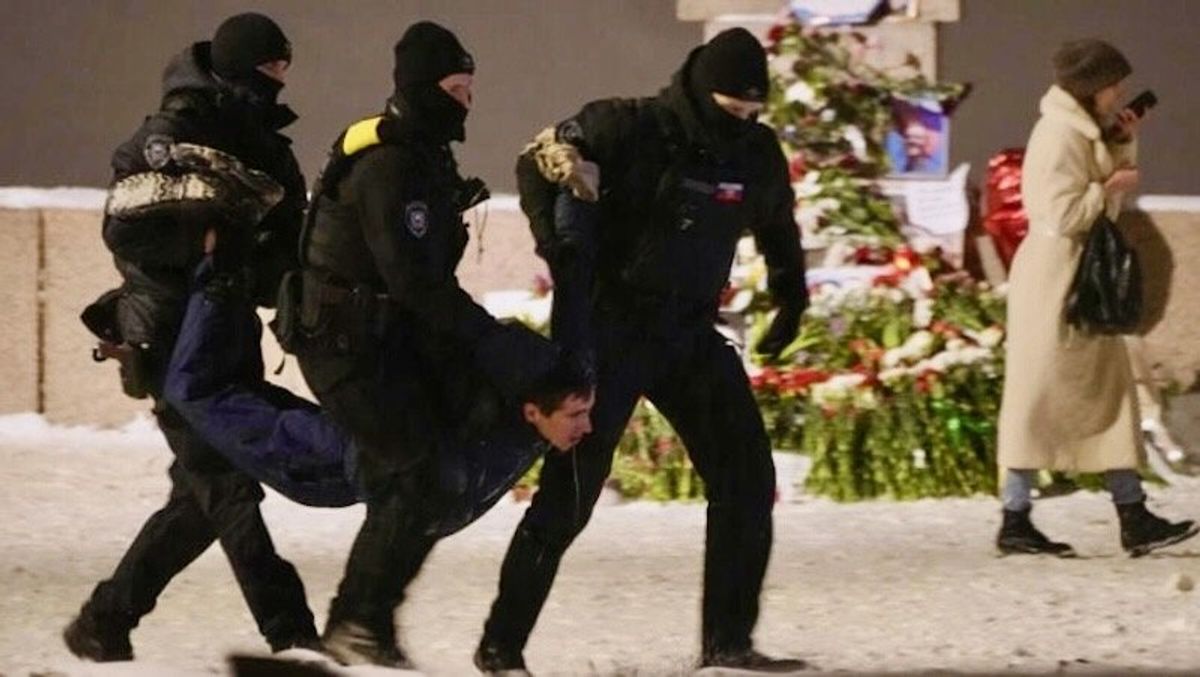
Police officers detain a man who laid flowers in tribute to Alexei Navalny at the Memorial to Victims of Political Repression in St. Petersburg, Russia, on February 16, 2024. © APAt least 212 people were detained at events in Russia on Friday and Saturday in memory of Alexei Navalny, Russian President Vladimir Putin's most formidable domestic opponent, who died on Friday, according to an independent Russian human rights group.


At least 212 people were detained at events in Russia on Friday and Saturday in memory of Alexei Navalny, Russian President Vladimir Putin's most formidable domestic opponent, who died on Friday, according to an independent Russian human rights group.

It would be the largest wave of arrests at political events in Russia since Sept. 2022, when more than 1,300 were arrested at demonstrations against a "partial mobilisation" of reservists for the military campaign in Ukraine.

Navalny, a 47-year-old former lawyer, fell unconscious and died on Friday after a walk at the "Polar Wolf" Arctic penal colony where he was serving a three-decade sentence, authorities said.

OVD-Info, which reports on freedom of assembly in Russia, said at least 212 people in 21 cities across Russia had been detained at spontaneous rallies and vigils as of 1127 GMT on Saturday.

OVD-Info said that police had detained at least 109 people in St Petersburg and at least 39 in Moscow, the country's two largest cities, where Navalny's mostly educated and urban supporters had been concentrated.

The group also reported individual arrests in smaller cities across Russia, from the border city of Belgorod, where seven were killed in a Ukrainian missile strike on Thursday, to Vorkuta, an Arctic mining outpost once a centre of the Stalin-era gulag labour camps.

Navalny team confirms his death

Navalny spokeswoman Kira Yarmysh confirmed his death on Saturday, saying official notice had been given to his mother Lydumila. Navalny died at 2:17pm local time (9:17 GMT) on Friday, according to the notice.

Yarmysh later said that Navalny's mother and lawyer went to see the morgue in Salekhard, the town near the prison complex, to find it closed. The lawyer called the morgue and was told that Navalny's body was not there, his team said on Telegram.

An employee at the morgue told Reuters that Navalny's body never arrived.

"Alexei's body is not in the morgue," Yarmysh said on X, formerly Twitter. She has demanded that his body be handed over to his family.

Police detain mourners at Moscow tribute


Arrests continued Saturday with Russian police detaining people who came to lay flowers at makeshift memorial sites in several cities, according to rights groups and independent media reports.

Video footage published by the independent media outlet Sota showed people in Moscow being taken away by masked police during the silent, peaceful tribute where dozens had gathered.

AFP reporters saw two people being detained and dozens of police surrounding the area, not allowing people to linger near the imposing bronze monument, known as the "Wall of Grief".

Footage filmed by Reuters in Moscow showed law enforcement bundling people to the ground in the snow, close to a spot where mourners had left flowers and messages in support of the dead opposition leader.

"In each police department there may be more detainees than in the published lists," OVD-Info said. "We publish only the names of those people about whom we have reliable knowledge and whose names we can publish."

Reuters could not immediately verify the count.


The hundreds of flowers and candles laid in Moscow on Friday to honour Navalny's memory were mostly taken away overnight in black bags. Russians paying their respects spoke of their despair and apathy after Navalny's death.

(FRANCE 24 with AFP, AP and Reuters)


Navalny's death is a message to the West

Navalny's death is a message to the West

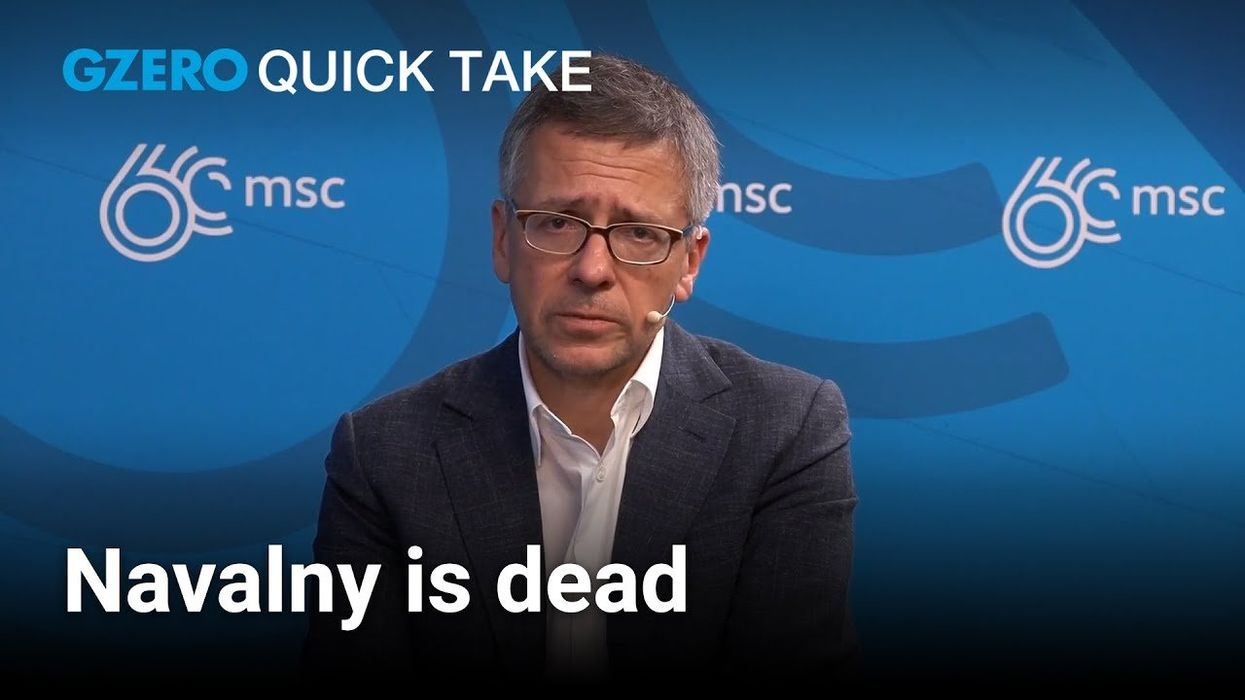
Ian Bremmer's Quick Take: Hi, everybody. Ian Bremmer here from the Munich Security Conference, just kicking off what is the most important security confab for NATO and the West every year. And the big news literally moments before the initial speeches for this conference, the announcement coming from Russia that Alexei Navalny had been imprisoned for years is now dead, looked fine yesterday, perfect health, when he was at a legal hearing today, suddenly died, supposedly of a stroke.

Putin, the Kremlin responsible, of course, and also a direct message. I think it's very clear to show the West to show the United States, to show NATO they can do what they want. They can act with impunity on their territory. They do not care if they are threatened. There was I remember after Biden met with Putin, this is back in 2021, and he said that it would be devastating. The consequences would be devastating for Russia if Navalny were to die in jail. Well, I mean, we've also said similar things to Putin about Russia invading Ukraine. And a couple of years on the Russian position, despite all of the economic damage they've taken, all of the military damage they've taken is that they will continue to engage in this war. They will continue to engage in human rights abuses. And it doesn't matter how the Americans or Europeans respond. The Russians will wait them out.

And that is the message that is being sent today. It's a very chilling message. I saw Vice President Harris and a number of European leaders all take to the stage, as well as Navalny's now widowed wife. All saying that this cannot be in vain, that there must be consequences. But ultimately, in an environment where rogue states feel like they have more ability to act on the global stage, Russia, Iran, North Korea, the so-called axis of resistance, terrorist actors, you will see more of this behavior. So the question is being put to the Munich Security Conference. Question is being put to NATO. Will you continue to work collectively? Will you take a stand against this sort of behavior? And Putin is watching that answer very, very carefully.

That's it for me. I'll talk to you all real soon.