Wednesday, February 28, 2024

 James Webb Space Telescope finds dwarf galaxies packed enough punch to reshape the entire early universe


"The main surprise is that these small faint galaxies had so much power, their cumulative radiation could transform the entire universe."
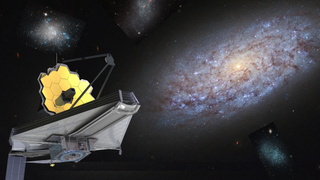

An illustration shows the James Webb Space Telescope as it studies an array of dwarf galaxies. (Image credit: NASA/ESA/Robert Lea)

News
By Robert Lea 

Astronomers have used the James Webb Space Telescope (JWST) and an effect predicted by Albert Einstein over 100 years ago to discover that small galaxies in the early cosmos packed a massive punch, shaping the entire universe when it was less than 1 billion years old.

The international team found the galaxies, which resemble dwarf galaxies that exist today, played a vital role during a crucial stage of cosmic evolution that occurred between 500 and 900 million years after the Big Bang. These small galaxies also vastly outnumbered larger galaxies in the infant universe, the scientists say, adding that it's likely the realms supplied most of the energy needed for a process called cosmic reionization. Cosmic reionization was critical to the growth and progression of the universe.

"We're really talking about the global transformation of the entire universe," Hakim Atek, research lead author and an astronomer at the Institut d'Astrophysique de Paris, told Space.com. "The main surprise is that these small, faint galaxies had so much power, their cumulative radiation could transform the entire universe."

Small driving forces behind major changes

Prior to around 380 million years after the Big Bang happened, during a period called the epoch of recombination, the now 13.8 billion-year-old universe had been opaque and dark. This was because, in its dense and ultra-hot state, free electrons endlessly bounced around particles of light, called photons.

Later, during the epoch of recombination, however, the universe had expanded and cooled enough to allow electrons to bond with protons and create the first atoms of hydrogen, the lightest and simplest element in the cosmos. This disappearance of free electrons meant photons were suddenly free to travel, and as a result, the "dark age" of the universe ended. The cosmos suddenly became transparent to light. This "first light" can seen today in the form of a cosmic fossil that uniformly fills the universe called the "cosmic microwave background" or "CMB."

Because electrons and protons have equal but opposite electric charges, these first atoms were electrically neutral, but they would soon undergo yet another transformation.

After 400 million years, the first stars and galaxies formed — then, during the era of reionization, neutral hydrogen, the predominant element in the universe, was transformed into charged particles. These particles are called ions. Ionization is caused by electrons absorbing photons and increasing their energy, breaking free from atoms. Until now, scientists weren't sure where this ionizing radiation came from.

Suspects for the radiation source behind reionization had included supermassive black holes feeding on gas from accretion disks surrounding them — causing these regions to eject high-energy radiation — large galaxies with masses in excess of 1 billion suns, and smaller galaxies with masses less than this.

"We've been debating this issue for decades, actually, whether it's massive black holes or massive galaxies. There are even exotic explanations, like dark matter annihilation that creates ionizing radiation," Atek said, "One of the best candidates was galaxies, and now we've shown that the contribution of small galaxies is huge.

"We didn't think small galaxies would be so efficient at producing ionizing radiation. It's four times higher than what we expected, even for normal-sized galaxies."

Identifying smaller dwarf galaxies as main sources of this ionizing radiation was a challenge for a long time, because of how faint they are.

"It was hard to get this kind of information and these observations, but the JWST has spectroscopic capabilities in the infrared. In fact, one of the reasons we built the JWST is to understand what happened during the epoch of reionization," Arek said.

Even with the impressive infrared observing power of the JWST, spotting these dwarf galaxies wouldn't have been possible without the help of Albert Einstein — more specifically, without the help of his 1915 theory of general relativity, and an effect on light it predicts.

A helping hand from Albert Einstein


General relativity suggests all objects of mass warp the very fabric of space and time, which are, in truth, united as a single entity called "spacetime." Our perception of gravity, the theory says, arises as a result of that curvature. The greater the mass of an object, the more "extreme" the curvature of spacetime is. Thus, the stronger its gravitational effects are.

Not only does this curvature tell planets how to move in orbits around stars and, in turn, tell those stellar bodies how to orbit the supermassive black holes at the centers of their home galaxies, but it also changes paths of light coming from the stars.

Light from a background source can take different paths around a foreground object as it travels toward Earth, and the closer that path is to an object of great mass, the more it gets "bent." Thus, light from the same object can arrive to Earth at different times as a result of the foreground, or "lensing," object.

This lensing can shift the location of the background object in the sky, or it can cause the background object to appear in multiple places in the same image of the sky. Other times, light from the background object is amplified, and thus that object is magnified in the sky.

This effect is known as "gravitational lensing," and the JWST has been using it to great effect to observe ancient galaxies near the dawn of time, which it would otherwise have had no chance of seeing.

To observe the newly studied distant and early dwarf galaxies, and analyze the light they emit, the JWST used a galaxy cluster called Abell 2744 as a gravitational lens. "Even for the JWST, these small galaxies are very faint, so we needed to add gravitational lensing to amplify the flux of from them," Atek said.

RELATED STORIES:


— James Webb Space Telescope spots neutron star hiding in supernova wreckage

James Webb telescope detects the earliest strand in the 'cosmic web' ever seen

— James Webb Space Telescope glimpses Earendel, the most distant star known in the universe

With the mystery of reionization potentially solved, the team now aims to extend this study to a larger scale with another JWST project called GLIMPSE. The researchers will first try to confirm that the particular location studied in this research is representative of the average distribution of galaxies in the universe.

Then, beyond studying the reionization process, Atek and colleagues will aim to better understand the formation of the very first galaxies, which, over the course of 12 billion years, grew into present-day galaxies.

"So far, we've been really studying mostly bright, massive galaxies, but they are not very typical in the early universe," Atek concluded. "So if we want to understand the formation of the first galaxies, we really need to understand the formation of tiny, low-mass galaxies. And this is what we will be trying to do with this upcoming program."

The team's research was published on Wednesday (Feb. 28) in the journal Nature.

James Webb Space Telescope finds 'extremely red' supermassive black hole growing in the early universe


An illustration shows an extreme red supermassive black hole in the early universe.
An illustration shows an extreme red supermassive black hole in the early universe. (Image credit: Robert Lea (created with Canva))

Using the James Webb Space Telescope (JWST), astronomers have discovered an "extremely red" supermassive black hole growing in the shadowy, early universe.

The red hue of the supermassive black hole, seen as it was around 700 million years after the Big Bang, is the result of the expanding universe. As the universe balloons outward in all directions, light traveling toward us gets "redshifted," and the redshifted light in this case indicates a cloak of thick gas and dust shrouding the black hole.

Examining JWST data, the astronomy team led by Lukas Furtak and Adi Zitrin of the Ben-Gurion University of the Negev, was also able to determine the mass of the supermassive black hole. At around 40 million times the mass of the sun, it is unexpectedly massive in comparison to the galaxy in which it resides. 

The team also found that the supermassive black hole, which is located around 12.9 billion light-years away from Earth, is rapidly feasting on the gas and dust around it. In other words, it's growing.

Related: Brightest quasar ever seen is powered by black hole that eats a 'sun a

"We were very excited when JWST started sending its first data. We were scanning the data that arrived for the UNCOVER program, and three very compact yet red-blooming objects prominently stood out and caught our eyes," Furtak said in a statement. "Their 'red-dot' appearance immediately led us to suspect that it was a quasar-like object."

The 'three red dots'

Quasars are created when copious amounts of matter surround supermassive black holes like this one. This matter forms a disk of gas and dust called an accretion disk that gradually feeds the black hole. The immense gravitational influence of the black hole churns this matter, generating intense temperatures and causing it to glow. 

Additionally, matter that doesn't fall into the supermassive black hole is channeled to the cosmic titan's poles. Particles in these regions are accelerated to speeds approaching that of light as highly collimated jets. As these relativistic jets are blasted out, the eruptions are accompanied by bright electromagnetic emissions.

As a result of these phenomena, quasars powered by supermassive black holes in active galactic nuclei (AGN) are often so bright that the light they emit often outshines the combined light of every star in the galaxy that surrounds them. 

The vast amount of radiation being emitted from around this particular supermassive black hole caused it to take on a small point-like appearance in JWST data. 

"Analysis of the object's colors indicated that it was not a typical star-forming galaxy. This further supported the supermassive blackhole hypothesis," Rachel Bezanson, from the University of Pittsburgh and co-lead of the UNCOVER program, said in the statement. "Together with its compact size, it became evident this was likely a supermassive black hole, although it was still different from other quasars found at those early times."

The early quasar wouldn't have been visible even to the powerful infrared eye of the JWST without a little help from an effect predicted by Albert Einstein in 1915.

Einstein's lens

Einstein's theory of general relativity suggests objects of mass warp the very fabric of space and time, which are truly united as a single entity called "spacetime." The theory continues on that gravity arises as a result of that curvature. The greater the mass of an object, the more "extreme" the curvature of spacetime is.

Not only does this curvature therefore tell planets how to move around stars and stars and how to move around the centers of their home galaxies, but it also changes paths of light coming from those stars.

The closer to the object of mass that light travels, the more its path is "bent." Different paths of light from a single background object can thus be bent by a foreground, or "lensing object," and shift the appearance of the background object's location. Sometimes, the effect can even cause the background object to appear in multiple places in the same image of the sky. Other times, light from the background object is simply amplified, and that object is magnified. 

This phenomenon is known as "gravitational lensing."


A diagram shows how light from a background object is curved by a foreground body. 
(Image credit: NASA, ESA & L. Calçada)

In this case, the JWST used a galaxy cluster called Abell 2744 as a foreground lensing body to amplify light from background galaxies, which are otherwise too distant to see. This revealed the extremely red quasar they zeroed-in on, originally in the form of three red dots.

"We used a numerical lensing model that we had constructed for the galaxy cluster to determine that the three red dots had to be multiple images of the same background source, seen when the universe was only some 700 million years old," Zitrin said

An artist's impression of a supermassive black hole and its powerful jet. Astronomers want to know how these objects reached tremendous masses in the early universe. (Image credit: S. Dagnello (NRAO/AUI/NSF))

Further analysis of the background source revealed its light must have come from a compact region.

"All the light of that galaxy must fit within a tiny region the size of a present-day star cluster. The gravitational lensing magnification of the source gave us exquisite limits on the size," team member and Princeton University researcher Jenny Greene said in the statement. "Even packing all the possible stars into such a small region, the black hole ends up being at least 1% of the total mass of the system."

The discovery further adds to the mystery of how supermassive black holes, which can be millions (or even billions) of times as massive as the sun, grew to such huge sizes during the universe's infancy.

"Several other supermassive black holes in the early universe have now been found to show a similar behavior, which leads to some intriguing views of the black hole and host galaxy growth, and the interplay between them, which is not well understood," Greene said.

The JWST has detected a wealth of "little red dots" over time. These could also indicate feeding supermassive black hole-powered quasars in the early universe, maybe meaning a striking black hole growth conundrum could soon be solved.

"In a way, it's the astrophysical equivalent of the chicken and egg problem," Zitrin concluded. "We do not currently know which came first — the galaxy or black hole, how massive the first black holes were, and how they grew."

The team's research was published on Feb. 14 in the journal Nature.


Activists allege ‘heavy-handed’ UAE restrictions at WTO talks

      A coalition of civil society groups on Wednesday accused the Emirati hosts of a World Trade Organization meeting of “heavy-handed restrictions”, saying some of its members have been detained at the talks.

Our World Is Not for Sale (OWINFS), representing more than a dozen civil society groups, said it has complained to the WTO following a series of incidents at the body’s 13th ministerial conference in the United Arab Emirates capital Abu Dhabi.

The “detainment, confiscation of materials, and heavy-handed restrictions on lobbying by civil society organizations… is putting the safety of civil society participants at risk,” the coalition said in a statement on Wednesday.

OWINFS facilitator Deborah James called the restrictions unprecedented.

“This is my 11th MC (ministerial conference) and I’ve never seen anything like this level of repression,” she said.

UAE authorities and the WTO did not respond to requests for comment. An official close to the WTO discussions said the organisation’s director general Ngozi Okonjo-Iweala met the Emirati chair of the ministerial conference after the complaints from civil society groups.

The OWINFS statement was released after a number of civil society organisers attending the WTO meeting were allegedly detained in separate incidents since Sunday.

They include a 24-year-old member of a Norwegian organisation that works on fair and just trade who was allegedly held in a room for an hour on Tuesday for taking a picture inside the venue.

“I was taking a picture of a colleague inside the venue that showed a security person in the background,” said the activist, who spoke on condition of anonymity citing security concerns.

“I was stopped and told it was illegal to take pictures of security personnel in the UAE,” she said.

The activist claimed she repeatedly offered to delete the picture, but was not released until WTO organisers intervened. 

“We are all very scared,” she said.

The United Arab Emirates bans unauthorised protests and limits forms of expression that it deems disruptive.

It allowed limited protests in designated areas at the COP28 climate talks in Dubai last year, but even then activists complained of severe restrictions.

OWINFS said the abuses at the WTO talks in Abu Dhabi went beyond detention.

Civil society members were barred from distributing informational flyers, holding signs, chanting about the negotiations and displaying banners.

In one instance, a civil society member was denied access to the venue for wearing the Palestinian keffiyeh headscarf, despite other participants being granted admission wearing their national dress, the group said.


Paris Olympics chief hopes strikes won’t ‘ruin the party’


The chief organiser of the Paris Olympics said on Wednesday he hoped trade unions would not “ruin the party” by calling strikes during the Games amid ongoing threats of industrial action.

Tony Estanguet, head of the Paris organising committee, said he was hoping for a “social ceasefire” during the Games which begin on July 26.

“I hope that we welcome the whole world in the best possible conditions and that we don’t ruin the party,” he told the Telematin programme on French television.

“I hope we can find solutions for people who are going to work on the Games. We’re aware that there are constraints,” he added.

Trade unions representing workers across France’s public services have been pushing for bonuses and extra resources for their members who will have to work through the summer holidays during the Games. 

Police officers and air traffic controllers have already agreed deals, but Paris metro employees, health workers, railways staff and street cleaners among others are staking demands. 

Senior hard-left MP Mathilde Panot has encouraged unions to use the Games to secure pay hikes to compensate for increases in the cost of living due to inflation.

“I think that if they have leverage, and because the government only understands leverage, then you need to use it,” she told the BFM channel on February 16.

Ahead of the 1998 football World Cup in France, the last time the country hosted such a major sporting event, pilots at national carrier Air France went on strike on the eve of kick-off along with taxi drivers and other transport workers.

cto-adp/iwd

© Agence France-Presse

Moldovan breakaway region appeals to Russia as a spat with the pro-Western government worsens


This image made available on the official Telegram channel of Supreme Council of the Pridnestrovian Moldavian Republic shows Alexander Korshunov, Chairman of the Pridnestrovian Moldavian Republic’s Supreme Council, addressing delegates during a session in Tiraspol, the capital of the breakaway region of Transnistria, in Moldova, Wednesday, Feb. 28, 2024. Legislators in Moldova’s Russia-backed breakaway region of Transnistria used a rare meeting on Wednesday to appeal to Moscow and the European Union and other international bodies for help amid mounting socio-economic pressure they blame on Moldova’s pro-Western government. (Supreme Council of the PMR telegram channel via AP)Read More


A combination of images made available on the official Telegram channel of Supreme Council of the Pridnestrovian Moldavian Republic shows, top, Alexander Korshunov, Chairman of the Pridnestrovian Moldavian Republic’s Supreme Council, addressing delegates and, bottom, delegates attending a session in Tiraspol, the capital of the breakaway region of Transnistria, in Moldova, Wednesday, Feb. 28, 2024. Legislators in Moldova’s Russia-backed breakaway region of Transnistria used a rare meeting on Wednesday to appeal to Moscow and the European Union and other international bodies for help amid mounting socio-economic pressure they blame on Moldova’s pro-Western government. (Supreme Council of the PMR telegram channel via AP)

BY STEPHEN MCGRATH AND AUREL OBREJA
Updated 8:55 AM MST, February 28, 2024

CHISINAU, Moldova (AP) — Officials in Moldova’s Russia-backed breakaway region of Transnistria appealed to Moscow for protection Wednesday, as tensions escalate with the pro-Western government.

Moldova, a candidate to join the European Union, imposed new customs duties on Jan. 1, 2024 on imports to and exports from Transnistria, which borders Ukraine and is not recognized by any United Nations member countries, including Russia which maintains close ties to the region.

On Wednesday, members of the Transnistrian congress used a rare meeting in the regional capital, Tiraspol, to ask the Russian Duma to “implement measures for defending Transnistria amid increasing pressure from Moldova, given the fact that more than 220,000 Russian citizens reside in Transnistria.”

A short war in the early 1990s led pro-Russian forces in Transnistria to declare a breakaway state. To this day, Russia stations about 1,500 troops in the region as so-called peacekeepers, who guard huge Soviet-era weapons and ammunition stockpiles.


Thousands from Russia-friendly party join anti-government protest in Moldova’s capital

With Moldova now on the path to EU membership, the foreign minister resigns

Moldova is working to align its economic legislation with the EU as it pursues full membership in the bloc. But the new customs duties leveled on Transnistria have angered officials there, who say the measures harm local residents and businesses.

In a declaration readout on Wednesday, officials in Tiraspol also appealed to the European Parliament to prevent what it described as pressure from Moldova from “violating the rights and freedoms” of local residents. They made similar appeals to the secretary-general of the United Nations; the European Parliament; and the International Committee of the Red Cross.

Ahead of Wednesday’s meeting, tensions mounted after an opposition legislator in Tiraspol last week said the gathering could used to announce a bid by Transnistria to join Russia.

A spokesperson for Moldova’s government dismissed those claims and labeled the meeting a “propaganda event,” adding that there was “no danger of escalation.”

Alexander Korshunov, chairman of the Transnistrian Supreme Council, said on Wednesday that Moldova was “taking advantage of the geopolitical situation” and using the economy “as a tool of pressure and blackmail.”

He added: “Moldova’s policy and goals regarding Transnistria have remained unchanged over the past decades: to destroy our economic potential, create unbearable living conditions for our citizens … and achieve the dismantling of our statehood.”

Maria Zakharova, Russian Foreign Ministry spokesperson, also commented on those annexation speculations on Wednesday. “For several days now, people in Chisinau have been speculating and wondering what decisions this forum might make,” she said. “Well, apparently, the same panic gripped NATO.”

In a 2006 referendum in Moldova, more than 95% of voters backed the option of joining Russia but the ballot wasn’t internationally recognized. The U.S. State Department at the time called it a “provocative referendum” that “cannot be taken seriously.”

Moldova was granted EU candidate status in 2022. It was further buoyed in December last year when Brussels said it would open accession negotiations, alongside neighboring Ukraine.

Transnistria, which has a population of about 470,000, is a thin strip of territory located between the eastern bank of the Dniester River and Moldova’s border with Ukraine. The unrecognized state, officially named the Pridnestrovian Moldavian Republic, has its own currency and flag.

Since Russia invaded Ukraine in February 2022, Moldova’s pro-Western leaders have routinely accused Moscow of conducting campaigns to try to destabilize the country, which was a Soviet republic until 1991.


Stephen McGrath reported from London; Dasha Litvinova contributed from Tallinn, Estonia.

Sandra Faber: 

“The Universe and Our Place in It”

February 28, 2024

(Conversation recorded on December 11th, 2023)

Show Summary

On this episode, astrophysicist Sandra Faber joins Nate for a wideview cosmological conversation on the development of the known-universe and the moral implications for humanity’s role within it. We are the first generation with the ability to truly understand the history of the universe and the extreme bottlenecks that Earth and life as we know it had to endure over the last billions of years. This understanding of where we come from gives us insight into who we are – and could perhaps give purpose to those searching for meaning in the vast universe. From the Big Bang on, how did the necessary conditions come together to create the environment so many of us take for granted today? How do the laws of physics restrict everything that has ever happened in the universe – and everything that ever will? Could a deeper understanding of the cosmos shift our culture towards one that values human’s survival into deep time – and incentivize biophysically and ecologically aligned systems?

About Sandra Faber

Sandra Faber is an American astrophysicist known for her research on the evolution of galaxies. She is the University Professor of Astronomy and Astrophysics at the University of California, Santa Cruz, and works at the Lick Observatory. She has made discoveries linking the brightness of galaxies to the speed of stars within them and was the co-discoverer of the Faber–Jackson relation. Faber was also instrumental in designing the Keck telescopes in Hawaii. At UCSC she focuses her research on the evolution of structure in the universe and the evolution and formation of galaxies. In addition to this, she led the development of the DEIMOS instrument on the Keck telescopes to obtain spectra of cosmologically distant galaxies. On August 1, 2012 she became the Interim Director of the University of California Observatories.

Watch on YouTube

Show Notes & Links to Learn More

PDF Transcript

00:00 – Sandra Faber works + info

03:42 – Reliable history of the Universe

04:10 – The Big Bang

04:23 – Kelvins

06:54 – Power LawHierarchical Gathering

10:15 – Where elements came from

15:54 – The Laws of Physics

16:45 – Evolutionary Psychology

18:35 – Current knowledge of Earth like planets

19:06 – Current understanding of the extent of the universe

22:01 – Critical components for an Earth-like planet

24:24 – Supernovae

25:24 – Fermi ParadoxEnrico Fermi

26:55 – Cambrian Explosion of Life

28:45 – Unique oxygen atmosphere of Earth and ability to burn things

30:53 – Sombrero Galaxy

31:41 – John CusackCassiopeia

33:21 – Don’t Look Up

34:15 – Finite lifetime of the sun and ability of life to survive on Earth

36:53 – Steven Weinberg

38:18 – Highest existential risks for life on Earth

41:05 – Optimal Foraging

45:15 – Animism

45:32 – Entropy

55:35 – Increasing heat death

56:44 – 10% of all human that ever lived are alive right now

57:50 – Homo Floresiensis

58:07 – Human domestication

59:35 – Advance Policy

1:00:21 – Exponential Growth

1:02:15 – Planetary limits

1:05:05 – 240 million humans in college globally

1:06:27 – Earth Futures Institute (UC Santa Cruz)

1:11:55 – Regenerative Agriculture

1:15:02 – State of mental health in the U.S.

1:19:26 – The Wall Street Journal

1:20:04 – Cognitive Dissonance