Monday, March 04, 2024

Mayorkas Says Texas Gov. Greg Abbott Trying to ‘Wreak Havoc’ on U.S. States

Corbin Bolies
Sun, March 3, 2024 

CNN

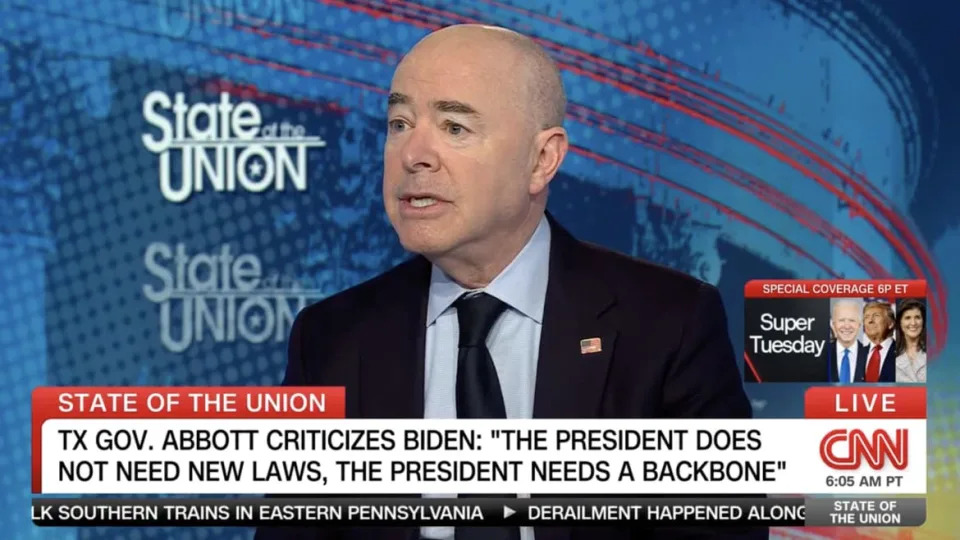
Homeland Security Secretary Alejandro Mayorkas is hitting back at Texas Gov. Greg Abbott’s criticism of the president, saying on Sunday that the governor’s suggestion that Joe Biden could hypothetically close the border “couldn’t be more wrong” and the governor was trying to “wreak havoc” on other U.S. states.

Abbott suggested on State of the Union last week that Congress already imbued Biden with the power to close the border, arguing Biden “needs a backbone” to enforce current immigration laws instead of demanding new ones. Appearing on the same program on Sunday, Mayorkas said Abbott’s preferred presidential candidate, Donald Trump, already tried that once—and failed.

“As a matter of fact, former President Trump tried to close the border and it was enjoined in the courts and never saw the light of day,” Mayorkas said. Trump attempted to close the Southern border through multiple channels—including travel bans, changes to asylum laws and the use of Title 42 during the COVID-19 pandemic. The latter effort stayed in place until Biden’s first term.

Mayorkas also didn’t hold back from criticizing Abbott directly, accusing him of bucking federal officials who sought to work with him and condemning him for sending buses of migrants to other U.S. cities.

“This coming from an individual who is purposefully refusing to coordinate, communicate, collaborate with other officials and trying to wreak havoc in other cities and states across the country,” Mayorkas said. “That is not a model of governance, and he couldn’t be more wrong.”
WAR IS ECOCIDE
Investigation: Why Ukraine is attacking Russian energy infrastructures
TIT FOR TAT

Lise Kiennemann
Mon, March 4, 2024 


Ukrainian drone attacks on Russian energy infrastructures have been increasing since early January, with targets including a fuel export terminal and processing complex in Ust-Luga, a refinery in Tuapse and another in Volgograd. Our investigations revealed that at least eight sites have caught on fire after drone attacks. Ukraine is likely carrying out their attacks to weaken the Russian economy – and to show off its military power, says analyst and energy expert Benjamin Schmitt

Images that circulated online show firefighters working to stop the flames consuming a petrol depot in the eastern Russian village of Polevaya the night of February 14.

The fires were caused by Ukrainian drone attacks, according to Roman Starovoyt, the governor of Kursk, the oblast, or region, where Polevaya is located. Ukrainian outlet Kyiv Post also reported that the fires were caused by Ukrainian drones, stating that this information came from "sources from Ukraine’s Military Intelligence”. l

The drone attacks in Polevaya are not isolated. Moscow has been targeting Ukrainian energy infrastructure for some time and, now, Ukraine is striking back. They’ve hit multiple Russian gas and petrol infrastructures in recent weeks.

In at least two other cases, Russia has claimed to foil a Ukrainian drone attack targeting Russian energy infrastructure.
Showing off Ukraine’s ability to strike

By hitting a target so far away, Ukraine is also demonstrating its potential to cause damage and destruction.


GREAT RUSSIAN CHAUVINISM & IMPERIALISM
Putin ally says 'Ukraine is Russia' and historical territory needs to 'come home
'

Andrew Osborn
Updated Mon, March 4, 2024 

Russia's Security Council deputy head Medvedev meets military personnel in Ulyanovsk region


By Andrew Osborn

(Reuters) -Dmitry Medvedev, deputy chairman of Russia's Security Council and an ally of President Vladimir Putin, described Ukraine on Monday as part of Russia and said what he called historical parts of Russia needed to "come home."

In a bellicose presentation that suggested Russia's military goals in Ukraine are far-reaching, Medvedev, who was Russia's president from 2008-2012, praised the Russian Empire and the Soviet Union and said Moscow would prosecute its "special military operation" until the Ukrainian leadership capitulated.

"One of Ukraine's former leaders said at some point that Ukraine is not Russia," Medvedev, a hawk who diplomats say gives a flavour of the thinking inside the Kremlin, told a youth forum in the Black Sea city of Sochi.

"That concept needs to disappear forever. Ukraine is definitely Russia," he said to applause. "Historic parts of the country need to come home."

There was no immediate reaction from Kyiv. Ukrainian officials have repeatedly accused Medvedev and other top Russian officials of waging an illegal war of conquest and said Ukraine and its people are distinct from Russia and Russians.

Medvedev was speaking in front of a giant map of Ukraine showing the country as a much smaller landlocked rump of land than its internationally recognised territory.

The map appeared to depict a scenario where Ukraine would be squeezed up against Poland, with Kyiv remaining its capital, but Russia would be in control of a swath of Ukrainian cities and its east, south and entire Black Sea coastline.

Russia has the initiative on the battlefield and controls just under one fifth of Ukrainian territory, which it claims as its own, but the scenario is sharply different from the situation on the ground.

PEACE TALKS RULED OUT

Medvedev, who the West once saw as a liberal reformer, said Russia's "geostrategic space" was indivisible from Ukraine and that any attempt to change that by force was doomed.

"All our adversaries need to understand once and for all a simple fact: that the territories on both banks of the Dnipro River (which bisects Ukraine) are an integral part of Russia's strategic and historical borders," he said.

Medvedev ruled out peace talks with the current Ukrainian leadership. He said any future Ukrainian government that wanted talks would need to recognise what he called the new reality.

Commenting on East-West relations, Medvedev said ties between Moscow and Washington were now worse than during the 1962 Cuban missile crisis when the two countries appeared on the brink of nuclear conflict.

"I will say one bitter thing," he said. "The current situation is much worse than the one in 1962. This is a fully fledged war against Russia with American weapons and with the participation of American special forces and American advisers. That's how it is."

(Reporting by Reuters, Writing by Andrew Osborn, Editing by Timothy Heritage)

Andrey Kurkov: ‘I expected Putin to escalate – but not to bomb us like Hitler’

David Knowles
Sun, March 3, 2024 

Mightier pen: Andrey Kurkov at home in Kyiv - Jack Leather

In 2024, two years on from the start of the full-scale invasion of his country, Andrey Kurkov has no illusions about Russia’s intentions in Ukraine and what it means for the West.

“Putin will not give up while he’s alive. If he manages to destroy Ukraine, he will fight against the West in Moldova, in Lithuania, in Poland. And European leaders and politicians should understand that this is a potential Third World War. And it will reshape Europe and the European Union.”

We meet in Kurkov’s flat in central Kyiv. One of its high windows is crisscrossed with tape, a technique used to minimise the impact of shattering glass after a missile strike or shelling. He tells me about the dinner he made for close friends on the night before the invasion.

“I cooked borscht, and we were joking. I was saying that this is probably the last borscht in Kyiv. After midnight, when we were saying goodbye to each other, suddenly everybody started exchanging mobile numbers, just in case. And I took photos of this moment. All the faces of my guests were very worried and very concerned, and there were no smiles at all.”

By morning, Russia’s war of aggression had started in earnest. Tanks and troops were rolling across the border and missiles were striking major cities. For Kurkov, the full-scale invasion was a shock. A veteran of travelling to the front lines, the author was no stranger to death and violence, but it was the size of the invasion that surprised him.

“It was clear that this frozen war is not going to stay like this forever. Russia will never be happy with Crimea. For me, it was no surprise that a full-scale invasion started, although I didn’t expect this scale of it. I was expecting an escalation in Donbas. I wasn’t expecting a 1941-style of bombing the whole country, like Hitler did.”

Now 62, with a neat moustache and bright eyes, Kurkov is at the height of his fame. Born in St Petersburg, he had a string of eclectic jobs, including prison warder and screenwriter, before gaining international success as a novelist. His first, translated into English as Death and the Penguin, became a worldwide bestseller and was translated into 30 languages. Often surreal, bitingly funny and eerily prescient, Kurkov’s work reflects the profound cultural changes in Ukraine and Russia over the past 30 years.

Even prior to the Russian invasion of Ukraine (he and his English wife, Elizabeth, escaped to their house in the country initially, before returning to the capital), Kurkov had written about working out how to live through a war.

'European leaders must realise that this is a potential Third World War'
 - AP Photo/Efrem Lukatsky

In his 2018 novel Grey Bees, his pro-Ukrainian protagonist, Sergey Sergeyich, is caught up in the Donbas war. His village lies near-abandoned as Ukrainian and Russian forces shell each other over the disputed “grey zone”, and Sergeyich must walk a delicate line between two rival armies and his “frenemy” in the village.

However, Kurkov tells me that the war curbed his ability to write fiction. He abandoned a new novel for which he had written 70 pages. “On the first day, I almost couldn’t write anything. Just a couple of sentences in the diary. For me, writing is pleasure. And when I write, I am living in two worlds, the world I created for the novel and the world with my real friends, my real family and real problems. So my imaginary life was immediately removed from me.” (His latest novel, The Silver Bone, which is published in the UK on Tuesday, was written before the war.)

Following the start of the war, Kurkov threw himself into journalism instead, writing hundreds of articles for publications across the globe. The full-scale invasion also changed how the people of Ukraine thought about the Russian language.

A local civilian in Ocheretyne, a village near the Avdiivka district, recently claimed by Russian troops in Donbas - Narciso Contreras/Anadolu via Getty Images

Although the Ukrainian language is historically oppressed (in the 1930s, the Soviet authorities carried out a brutal purge of Ukrainian culture and language), more and more people have started speaking Ukrainian in recent years, and many are bilingual. Since the 2022 full-scale invasion, some have even abandoned Russian altogether, rejecting any association with the “aggressor” country.

Kurkov, whose mother tongue is Russian, tells me: “My books are now not published in Russian, because bookshops in Ukraine don’t want to sell books in Russian, because Putin turned the language into the language of the enemy, in spite of the fact that 30 to 40 per cent of Ukrainians are Russian-speakers. Now, lots of people are changing language, switching to Ukrainian.”

Kurkov’s own works were banned in Russia in 2014, the year he first began to go to the front lines. But, he says: “There will be a niche for Russian-language literature. I don’t know if it will be a ghetto, or whether it will be a kind of club, closed-community literature. But it will survive.”

You can listen to David Knowles interview Andrey Kurkov on Ukraine: the Latest, The Telegraph’s daily podcast on war in Ukraine, using the audio player at the top of this article or on Apple PodcastsSpotify, or your favourite podcast app.


Russian security forces battle militants in Ingushetia region, Russian media report


Reuters
Sat, March 2, 2024 

March 3 (Reuters) - Russian security forces fought alleged militants all night in Russia's North Caucasus republic of Ingushetia, Russian state media reported on Sunday morning, leading authorities to introduce counter-terrorism emergency powers in the area.

During a search operation in one of the residential buildings in the town of Karabulak on Saturday, the alleged militants opened fire on Russian law enforcement forces, Interfax reported, citing the National Anti-Terrorism Committee.

"Law enforcement officers who arrived at the scene began a clash with the criminals," Interfax reported.

Russia's RIA state news agency reported that as of Sunday morning, "active measures" were underway to "neutralise" the militants.

A "counter-terrorism regime" that allows authorities greater powers to clamp down on people's movement and communications was introduced and nearby population evacuated to ensure safety, Interfax reported.

Ingushetia, the smallest region in Russia, is wedged between North Ossetia and Chechnya. It has a population of about half a million people.

For almost a decade until 2017, Russian security forces were battling an armed insurgency conducted by an array of Islamist militant groups in Ingushetia as well as in Dagestan and Chechnya. 

(Reporting by Lidia Kelly in Melbourne; Editing by Jamie Freed)

Ingushetia profile - BBC News


Moldova says Russia has no right to lecture on democracy

Sat, March 2, 2024
By Alexander Tanas

CHISINAU, March 2 (Reuters) - Russia has no right to lecture on democracy, the Moldovan Foreign Ministry said in a statement on Saturday, as tensions between the two countries have risen after Moldova's breakaway Transdniestria region asked Moscow for help.

Russian Foreign Minister Sergei Lavrov said earlier in the week that the Moldovan government "is following in the footsteps of Kyiv" after Transdniestria turned to Moscow to help its economy withstand "pressure" from the Moldovan government, which the Chisinau administration dismissed as a propaganda event.

"Minister Lavrov and the Kremlin regime have no moral right to lecture on democracy and freedom," Moldova's Foreign Ministry said in a statement issued on Saturday.

"A country that imprisons opposition politicians and kills them, unreasonably attacks its neighbours, has nothing to offer the world but blood and pain."

On Saturday, Russians queued to lay flowers on the grave of Alexei Navalny, President Vladimir Putin's fiercest critic inside Russia, who died at the age of 47 in an Arctic penal colony on Feb. 16. Supporters said he had been murdered.

Navalny's death came nearly two years after Moscow launched its full-scale invasion of Ukraine, a war that has no end in sight and in which civilians continue to die.

Russia's invasion of Ukraine sparked fears that Moscow might seek to sweep westward through southern Ukraine all the way to the Transdniestria separatist region, which says it has 220,000 Russian citizens.

Relations between Moldova and Russia have also frayed as the Chisinau government has steered a pro-European course and accused Moscow of trying to destabilise it.

"We are building a European future so that all our citizens, regardless of language and ethnicity, live in peace and prosperity," the Moldovan Foreign Ministry said in its Saturday's statement.

(Reporting by Alexander Tanas; additional reporting by Elaine Monaghan and Lidia Kelly; editing by Jonathan Oatis Writing by Lidia Kelly;)


Book Review: 'Means of Control' charts the disturbing rise of a secretive US surveillance regime

The Canadian Press
Mon, March 4, 2024


In the aftermath of the 9/11 terror attacks, former national security advisor John Poindexter launched Total Information Awareness, intent on preventing future assaults on the homeland by amassing extensive databases on people and their movements.

The Pentagon program had a creepy eye-surveilling-the-globe-from-a-pyramid logo and was roundly rejected by civil libertarians as Orwellian overkill. Adm. Poindexter, an Iran-Contra conspirator, was skewered by late-night talk show hosts and Congressional resistance moved to defund it.

Except TIA wasn't DOA. Not by a longshot.

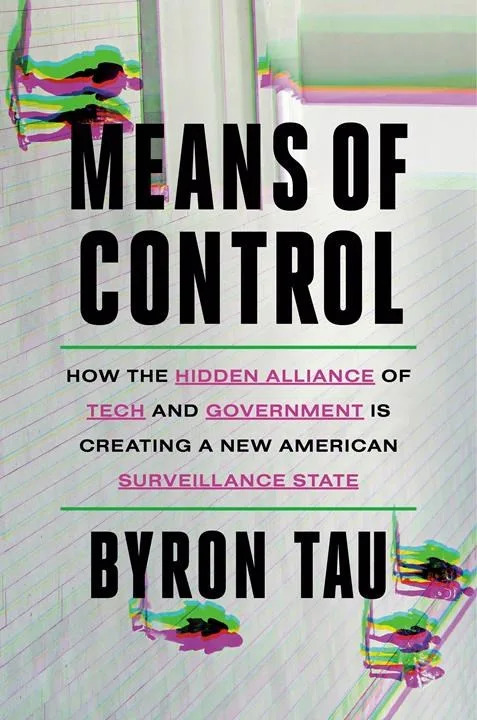
The data collection that Poindexter envisioned instead went underground, with code names such as “Basketball” and classified budgets. How private Beltway contractors grew what has become a secretive surveillance regime is exposed in disturbing detail by journalist Byron Tau in his first book, “Means of Control.” In the absence of a federal privacy law, the U.S. national security establishment has used commercially available data to craft a creeping panopticon.

As a Wall Street Journal reporter, Tau broke important stories on how the shadowy U.S. data collection and brokering industry has been indirectly — and legally, it seems — eavesdropping on tens of millions of Americans and foreigners in the service of U.S. military, intelligence and homeland security.

“In China, the state wants you to know you’re being watched. In America, the success lies in the secrecy," he writes. "The government does not want you to notice the proliferation of license plate readers. It does not want citizens to understand that mobile phones are a surveillance system... that social media is being eavesdropped on.”

“Means of Control” traces Tau's efforts to cut through thickets of secrecy to show how different kinds of data became available for purchase by the U.S. government post-9/11, how what author Shoshana Zuboff termed “surveillance capitalism” — the vacuuming up of personal data by Facebook, Google and others to feed the online ad market — stoked a thriving, under-the-radar bazaar of businesses selling data on people's habits, predilections and, importantly for soldiers and spies, physical movements.

“I've spent years trying to unravel this world — a funhouse of mirrors draped in nondisclosure agreements, corporate trade secrets, needlessly classified contracts, misleading denials, and in some cases outright lies,” he writes.

Unlike Edward Snowden, the former National Security Agency worker whose 2013 data dump sounded piercing alarms on U.S. government surveillance, Tau is an outsider. So he is often stymied. But he is not alone in this work, and generously credits his journalist competitors.

When Tau does get a breakthrough, it is often on surveillance partnerships that help foil a bad guy — like the U.S. border drug tunnel Department of Homeland Security agents uncover in 2018 with cellphone geolocation data obtained from a company called Venntel.

To gather intelligence, firms working closely with U.S. national security operators have embedded data-collecting software in smartphone apps — such as Muslim prayer apps popular in the Middle East. The app owners may or may not be aware of the software modules' surveillance mission, though there's a reason they're getting paid to include the data-gathering SDKs (software development kits).

Some of these tools have been developed with CIA funding and some, like VISR (Virtual Intelligence, Surveillance and Reconnaissance), have been widely shared inside U.S. intelligence and among U.S. military special operators, Tau writes. The companies involved come and go in the sort of musical chair game we've come expect in U.S. national security contracting.

Which hasn't prevented some from being outed by privacy warriors led by Sen. Ron Wyden of Oregon and, now, the Biden administration's activist Federal Trade Commission.

Take X-Mode, one firm Tau examines.

In 2021, X-Mode was found to have been selling access to location data to the U.S. military. In January, the FTC banned X-Mode and its successor, Outlogic, from sharing or selling data on cellphone users’ location without their explicit consent. It expressed concern such data could be used to track visits to places like abortion clinics, places of worship and domestic abuse shelters.

Near the end of the helpfully annotated 291-page book, Tau offers a chapter on how to protect yourself from digital tracking. There are privacy/convenience tradeoffs. But is complete erasure truly possible? He asks Michael Bazzell, an expert in the field.

“Of course,” Bazzell says. “Will you enjoy that life? Maybe not.”

—-

More AP book reviews: https://apnews.com/hub/book-reviews

Frank Bajak, The Associated Press


LA REVUE GAUCHE - Left Comment: Search results for SECURITY STATE 

Black women struggle to find their way in a job world where diversity is under attack

Mon, March 4, 2024


BOSTON (AP) — Regina Lawless hit a professional high at 40, becoming the first director of diversity and inclusion for Instagram. But after her husband died suddenly in 2021, she pondered whether she had neglected her personal life and what it means for a Black woman to succeed in the corporate world.

While she felt supported in the role, “there wasn’t the willingness for the leaders to take it all the way,” Lawless said. “Really, it’s the leaders and every employee that creates the culture of inclusion.”

This inspired her venture, Bossy and Blissful, a collective for Black female executives to commiserate and coach each other on how to deal with misogynoir — misogyny experienced by Black women — or being the only person of color in the C-suite.

“I’m now determined to help other women, particularly women of color and Black women, to see that we don’t have to sacrifice ourselves for success. We can find spaces or create our own spaces where we can be successful and thrive,” said Lawless, who is based in Oakland, California.

Many women in Lawless' group have no workplace peers, making them the “Onlys” — the only Black person or woman of color — which can lead to feelings of loneliness or isolation.

“Getting together helps us when we go back and we’re the ‘only-lonelies’ in a lot of our organizations," Lawless said.

With attacks on diversity, equity and inclusion initiatives raging, Black women looking to climb the corporate ladder face a more hostile landscape than ever. Aside from having to constantly prove themselves and talk in a manner that can’t be labeled as angry or emotional, obtaining top managerial positions doesn’t stop the double dilemma of racial and gender pay gaps. All this adds up to disproportionate representation of Black female senior leadership.

Claudine Gay's resignation in January as Harvard's first Black president following accusations of antisemitism and plagiarism was just the latest in a revolving door of Black women who have been aggressively questioned or abandoned after achieving a career pinnacle.

Black female professionals also were hit hard when an administrator at a historically Black college in Missouri accused the school's white president of bullying and racism then took her own life. This led some to build networking groups and mentorships. For others it triggered an exodus to entrepreneurship and reinvention.

In Boston, Charity Wallace, 37, a biotech professional, and Chassity Coston, 35, a middle school principal, reflected on their own career struggles in light of Gay's ordeal. Wallace said she was being more cognizant of her mental health, and that's where their young Black professionals group, sorority sisters and family come in.

“It’s a constant fight of belonging and really having your girlfriends or your homegirls or my mom and my sister. I complain to them every day about something that’s going on at work,” Wallace said. “So having that circle of Black women that you can really vent to is important because, again, you cannot let the things like this sit. We’ve been silenced for too long.”

Coston said she mourned Gay's resignation and, fearing something similar could happen to her, she reconsidered her future in education. But she didn't want to give up.

“Yes, we’re going to continue to be scorned as Black people, as Black women. It’s going to continue to happen. But we can’t allow that," Coston said. “I’m speaking from my strength right now because that wasn’t always how I felt in my stages of grief. We have to continue to fight just like Rosa (Parks), just like Harriet (Tubman)."

Gay struggled despite her resume full of accomplishments, Wallace said.

“I can’t imagine how she felt trying to do that and getting all these accolades, her degrees that she has, the credentials, and it just seemed like even that was not enough for her to stay," Wallace said.

The backlash to DEI efforts is only amplified with clashes over identity politics. Pulitzer Prize-winning journalist Nikole Hannah-Jones' tenure bid at the University of North Carolina at Chapel Hill stalled in 2021 because of her work with the 1619 Project, a collection of essays on race. The 2022 confirmation hearings for Ketanji Brown Jackson, the first Black woman confirmed to the Supreme Court, drew criticism for their harsh and race-based questioning.

President Joe Biden emphatically stating he only would consider a Black woman for the high court deepened resentment toward DEI, said Johnny Taylor, CEO of The Society for Human Resource Management.

“Contrast and compare a CEO standing in front of his workplace or her workplace saying, ‘I’m only gonna consider, the next candidates will only be this,’" Taylor said. "That created some real tension.”

Black women are questioning whether it's even worth trying for top positions, said Portia Allen-Kyle, chief advisor at social justice organization Color of Change. Extreme scrutiny and online vitriol are high prices to pay.

“What I’ve heard from quite a few Black women — family, friends and otherwise — is a little bit of feeling of frustration at the idea that excellence is not enough,” Allen-Kyle said. “The ‘Work twice as hard, be twice as good ... maybe you'll be able to be accepted on your merit.' That lesson that maybe that's not the case is hard and frustrating and disappointing all around.”

The number of Black women in the workforce is in danger of shrinking because of a lack of support and opportunities, according to advocates.

Black women comprise 7.4% of the U.S. population but they occupy only 1.4% of C-suite positions and 1.6% of senior vice-president roles, according to a 2020 report from Lean In, “The State of Black Women in Corporate America." U.S. Census data shows Black women working year-round and full-time in 2021 made 69 cents for every dollar a white man got. Meanwhile, white women made 80 cents on the dollar.

Lawless, who left Instagram/Meta in August, thinks more Black women will decide to be their own boss rather than enter a traditional workplace.

“There’s going to be a chilling effect and you’re going to see more Black women pivot and go into entrepreneurship, which we’re already doing at higher rates,” Lawless said. “Corporations have a real problem. They’ve lost more women at the director and above level since the pandemic.”

Even self-made businesses cannot avoid DEI resistance. The Fearless Fund, a small venture capital firm, is embroiled in a lawsuit accusing a grant program for Black women-owned companies of discrimination. The litigation has scared away potential investors, according to the firm's founders.

Job openings for diversity officers and similar positions have declined in recent months. The combined share of venture capital funding for businesses owned by Black and Latina women has dipped back to less than 1% after briefly surpassing that threshold — at 1.05% — in 2021, according to the nonprofit advocacy group digitalundivided.

Stephanie Felix, of Austin, Texas, just started her own DEI consulting firm in January. It's not something the 36-year-old, who worked in DEI for company review website Glassdoor, initially saw for herself.

“People say there’s risk in leaving but there’s also a lot of risk in staying,” Felix said.

Colleagues, family and even Felix herself had reservations about her career leap. But she said she has too often seen DEI hires go from “office pet to office threat.” Their arrival was heralded as a new chapter, but senior leaders wouldn't come through with promised resources or authority to effect change.

“I applaud women that choose to step away and choose themselves. I applaud myself for it too,” Felix said. "Even though it’s not easy, it gives you more sovereignty over your life which is, in my mind, definitely worth it.”

___

Associated Press business writer Alexandra Olson in New York contributed to this report.

___

Terry Tang reported from Phoenix. She is a member of the AP's Race and Ethnicity team. Follow her on X, formerly Twitter, at @ttangAP.

Terry Tang And Michael Casey, The Associated Press
Trump supporters target black voters with faked AI images


Marianna Spring - BBC Panorama and Americast
Mon, March 4, 2024 


Donald Trump supporters have been creating and sharing AI-generated fake images of black voters to encourage African Americans to vote Republican.

BBC Panorama discovered dozens of deepfakes portraying black people as supporting the former president.

Mr Trump has openly courted black voters, who were key to Joe Biden's election win in 2020.

But there's no evidence directly linking these images to Mr Trump's campaign.

The co-founder of Black Voters Matter, a group which encourages black people to vote, said the manipulated images were pushing a "strategic narrative" designed to show Mr Trump as popular in the black community.

A creator of one of the images told the BBC: "I'm not claiming it's accurate."

The fake images of black Trump supporters, generated by artificial intelligence (AI), are one of the emerging disinformation trends ahead of the US presidential election in November.

Unlike in 2016, when there was evidence of foreign influence campaigns, the AI-generated images found by the BBC appear to have been made and shared by US voters themselves.

One of them was Mark Kaye and his team at a conservative radio show in Florida.

They created an image of Mr Trump smiling with his arms around a group of black women at a party and shared it on Facebook, where Mr Kaye has more than one million followers.

At first it looks real, but on closer inspection everyone's skin is a little too shiny and there are missing fingers on people's hands - some tell-tale signs of AI-created images.

"I'm not a photojournalist," Mr Kaye tells me from his radio studio.

"I'm not out there taking pictures of what's really happening. I'm a storyteller."

Radio show host Mark Kaye told the BBC that it was the individual's problem if their vote was influenced by AI images

He had posted an article about black voters supporting Mr Trump and attached this image to it, giving the impression that these people all support the former president's run for the White House.

In the comments on Facebook, several users appeared to believe the AI image was real.

"I'm not claiming it is accurate. I'm not saying, 'Hey, look, Donald Trump was at this party with all of these African American voters. Look how much they love him!'" he said.

"If anybody's voting one way or another because of one photo they see on a Facebook page, that's a problem with that person, not with the post itself."

Another widely viewed AI image the BBC investigation found shows Mr Trump posing with black voters on a front porch. It had originally been posted by a satirical account that generates images of the former president, but only gained widespread attention when it was reposted with a new caption falsely claiming that he had stopped his motorcade to meet these people.

We tracked down the person behind the account called Shaggy, who is a committed Trump supporter living in Michigan.

"[My posts] have attracted thousands of wonderful kind-hearted Christian followers," he said in messages sent to the BBC on social media.

When I tried to question him on the AI-generated image he blocked me. His post has had over 1.3 million views, according to the social media site X. Some users called it out, but others seemed to have believed the image was real.

I did not find similarly manipulated images of Joe Biden with voters from a particular demographic. The AI images of the president tend to feature him alone or with other world leaders such as Russian President Vladimir Putin or former US President Barack Obama.

Some are created by critics, others by supporters.

In January, the Democratic candidate was himself a victim of an AI-generated impersonation.

An automated audio call, purportedly voiced by the president, urged voters to skip the New Hampshire primary where he was running. A Democratic Party supporter has admitted responsibility, saying he wanted to draw attention to the potential for the technology to be abused.

Cliff Albright, the co-founder of campaign group Black Voters Matter, said there appeared to be a resurgence of disinformation tactics targeting the black community, as in the 2020 election.

"There have been documented attempts to target disinformation to black communities again, especially younger black voters," he said.

Cliff Albright, who runs an organisation encouraging black people to vote, says younger black voters are targeted for disinformation

I show him the AI-generated pictures in his office in Atlanta, Georgia - a key election battleground state where convincing even a small slice of the overall black vote to switch from Mr Biden to Mr Trump could prove decisive.

A recent New York Times and Sienna College poll found that in six key swing states 71% of black voters would back Mr Biden in 2024, a steep drop from the 92% nationally that helped him win the White House at the last election.

Mr Albright said the fake images were consistent with a "very strategic narrative" pushed by conservatives - from the Trump campaign down to influencers online - designed to win over black voters. They are particularly targeting young black men, who are thought to be more open to voting for Mr Trump than black women.

On Monday, MAGA Inc, the main political action committee backing Trump, is due to launch an advertising campaign targeting black voters in Georgia, Michigan and Pennsylvania.

It is aimed at voters like Douglas, a taxi driver in Atlanta.

Panorama - Trump: The Sequel? 
Justin Webb and Marianna Spring travel from the frozen plains of Iowa to the swing state of Georgia to explore Donald Trump's enduring appeal and look ahead to an unprecedented American election year. 
Watch on BBC One at 20:00 on Monday 4 March (20:30 in Wales and Northern Ireland) - and later on iPlayer.


Douglas said he was mainly worried about the economy and immigration - issues which he felt Trump was more focused on. He said Democratic messaging about Trump's threat to democracy would not motivate him to vote, because he was already disillusioned with the electoral process.

The US economy is generally doing well, but some voters - like Douglas - don't feel better off because they've also been through a cost of living crisis.

What did he think of the AI-generated image of Trump sitting on a front porch with black voters? When I first showed it to him, he believed it was real. He said it bolstered his view, shared by some other black people he knows, that Trump is supportive of the community.

Then, I revealed it was a fake.

"Well, that's the thing about social media. It's so easy to fool people," he said.

"It's so easy to fool people" on social media, says cab driver Douglas, after viewing one of the AI fakes

Disinformation tactics in the US presidential elections have evolved since 2016, when Donald Trump won. Back then, there were documented attempts by hostile foreign powers, such as Russia, to use networks of inauthentic accounts to try to sow division and plant particular ideas.

In 2020, the focus was on home-grown disinformation - particularly false narratives that the presidential election was stolen, which were shared widely by US-based social media users and endorsed by Mr Trump and other Republican politicians.

In 2024, experts warn of a dangerous combination of the two.

Ben Nimmo, who until last month was responsible for countering foreign influence operations at Meta, the owner of Facebook and Instagram, said the confusion created by fakes like these also opens new opportunities for foreign governments who may seek to manipulate elections.

"Anybody who has a substantial audience in 2024 needs to start thinking, how do I vet anything which gets sent to me? How do I make sure that I don't unwittingly become part of some kind of foreign influence operation?" he said.

Mr Nimmo said that social media users and platforms are increasingly able to identify fake automated accounts, so as it gets harder to build an audience in this way "operations try to co-opt real people" to increase the reach of divisive or misleading information.

"The best bet they have is to try and land [their content] through an influencer. That's anyone who has a big audience on social media," he said.

Mr Nimmo said he was concerned in 2024 that these people, who may be willing to spread misinformation to their ready-made audiences, could become "unwitting vectors" for foreign influence operations.

These operations could share content with users - either covertly or overtly - and encourage them to post it themselves, so it appears to have come from a real US voter, he said.

All of the major social media companies have policies in place to tackle potential influence operations, and several - like Meta, which owns Facebook and Instagram - have introduced new measures to deal with AI-generated content during elections.

Leading politicians from around the world have also highlighted the risks of AI-generated content this year.

Narratives about the 2020 election being stolen - which were shared without any evidence - spread online with simple posts, memes and algorithms, not AI-generated images or video, and still resulted in the US Capitol riot on 6 January.

This time around, there is a whole new range of tools available to political partisans and provocateurs which could inflame tensions once again.


Jordan Peterson Whines Over ‘Woke’ Report on Drop in Traffic Deaths

Edith Olmsted
The Daily Beast.
Sat, March 2, 2024 

ATTILA KISBENEDEK/AFP via Getty Images

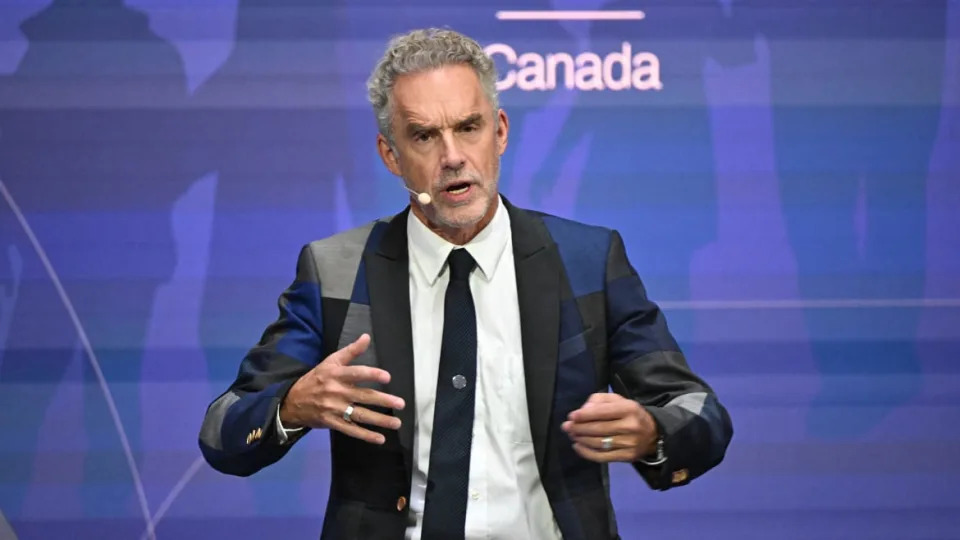
Right-wing pundit Jordan Peterson fumed over a report that traffic deaths in Hoboken, New Jersey, had decreased.

On Saturday, the Associated Press reported that since implementing “daylighting,” the removal of parking spaces near intersections seven years ago, the city had recorded zero traffic deaths.

The news incensed the conservative psychologist, and he took to X to slam the outlet for reporting the story. “You have become pathetic beyond comprehension @AP and the woke death will soon visit you,” he wrote.

To conservatives like Peterson, limiting parkings spaces is a dire infringement of individual liberties, and not worth the obvious benefit to public safety and human life.

Decrying the announcement that a city has become safer portrays a grim loss of perspective, not totally surprising from a culture warrior who recently displayed grave ignorance on Russia’s war with Ukraine.

Hoboken Mayor Ravi Bhalla, who oversaw many of the city’s changes after he was elected in 2018, responded to the post on X. “Being triggered by safe streets and Hoboken’s zero traffic deaths in 7 years is certainly a mood,” he wrote.

According to the Associated Press report, Bhalla was inspired to implement daylighting, lower speed limits, and staggered traffic lights in 2015 after the death of an 89-year-old woman.

“Our seniors, who we owe the greatest duty of safety to, should be able to pass that street as safely as possible,” Bhalla said. “For her to actually be killed was a trigger that we needed to take action.”


Trump tried to crush the 'DEI revolution.' Here's how he might finish the job.


Jessica Guynn, USA TODAY
Sun, March 3, 2024 at 9:00 a.m. MST·7 min read

On a cold January night before the New Hampshire primary, Donald Trump traveled to Rochester, a city of blue-collar, culturally conservative voters who swung his way in 2016 and again in 2020.

“We will terminate every diversity, equity, and inclusion program across the entire federal government,” the former president declared to a packed auditorium.

It was more than just a popular applause line at Trump rallies. Behind the scenes, a coalition of dozens of right-wing groups is preparing to make Trump’s words a reality.

Led by the Heritage Foundation think tank, which has helped mold the policies of Republican administrations since the Reagan presidency, conservative interests have drawn up a sweeping plan known as Project 2025 in anticipation of Trump’s return to power. Part of that agenda goes after the decades-long corporate drive to increase racial diversity in cubicles and executive suites.

“The Biden Administration has pushed ‘racial equity’ in every area of our national life, including in employment,” according to Project 2025 which runs nearly 900 pages.

Conservatives behind Project 2025 say the private sector has been corrupted by doctrines such as critical race theory which argues that historical patterns of racism are embedded in law and other American institutions, harming Black people and other people of color. They want to reverse “the DEI revolution in labor policy” in favor of more "race neutral" policies.

“Getting rid of critical race theory from federal agencies, diversity, equity and inclusion policies, unconscious bias — we are certainly going to have ideas and proposals ready for a possible new administration,” former Trump administration official Russ Vought, who is advising Project 2025, told USA TODAY in an interview.

Civil rights advocates say Project 2025 is the work of a small group of vocal conservatives who are laying the groundwork for a far-reaching rollback of civil rights laws that would water down federal safeguards against racial discrimination if Trump is re-elected.

“They are trying to take apart the legacy of these laws that made us a multiracial democracy,” said Alvin B. Tillery Jr., director of the Center for the Study of Democracy and Diversity at Northwestern University. “Trump is just picking up the mantle."
What Trump would do on DEI if elected

The presidential transition plan calls for purging liberal policies and dismantling some federal agencies.

“The next conservative president must make the institutions of American civil society hard targets for woke culture warriors,” Kevin Roberts, president of the Heritage Foundation, wrote in the foreword to the policy agenda.

The think tank declined to comment, but Project 2025’s director, Paul Dans, told Steve Bannon's "War Room" podcast: "We want everyone walking into office to be literally on the same page" for the first 180 days of the next Republican presidency.

The Trump campaign did not respond to a request for comment. Trump has said that he alone is responsible for the policies of a future administration, but Project 2025 − which outlines an agenda that touches every government agency − offers insights into what those policies might look like.

Jonathan Berry, a veteran of the Trump administration and lead author of a chapter on the Labor Department and related agencies, says Project 2025 continues the work of the first Trump White House which banned diversity training by the federal government and government contractors.

The plan broadly reflects where Trump's policy stood at the end of his presidency in 2020, Berry said, adding that "it also represents the direction you would expect to see a second Trump administration go.”

Among the recommended measures:

Bar the federal government and government contractors from using taxpayer dollars to conduct training about systemic racism;


Abolish the Labor Department’s Office of Federal Contract Compliance Programs, which is responsible for ensuring that federal contractors comply with antidiscrimination laws;


Eliminate “disparate impact” liability – evaluating whether the impact of a policy varies based on race, ethnicity or other factors, even if the conscious intent was not to treat people differently.


Prohibit racial classifications and quotas and halt the collection of employment data on the racial and ethnic makeup of the American private sector workforce.

“The Biden administration is abusing the law in ways that tend to flatten the human person into identity politics categories,” Berry said. “The goal here is to move toward colorblindness and to recognize that we need to have laws and policies that treat people like full human beings not reducible to categories, especially when it comes to race.”
'They’re advocating for the return of white privilege'

Marc Morial, president of the National Urban League, says Project 2025 peddles concepts like “race neutrality” to reverse the progress women and people of color have made in the workplace over the last 60 years.

Before the Civil Rights Act of 1964 made it illegal to discriminate, private-sector employment was mostly segregated. Even when Black people landed positions, they were mostly low-skill jobs with no authority or mobility.

“They are not advocating for colorblindness. They’re advocating for the return of white privilege. They’re advocating for the policies that were used during a segregated America,” Morial said. “Let’s just hide disparities. Let’s just pretend they don’t exist. Let’s sanction things that appear to be race-neutral but are discriminatory.”

National Urban League president Marc Morial in January 2019.

According to Justin Gomer, associate professor of American Studies at California State University, Long Beach, today’s conservative playbook contains much of the same wish list as its first edition which was prepared for Reagan's presidency: Ending “reverse discrimination,” repealing affirmative action, limiting the Justice Department’s ability to file discrimination lawsuits and preventing the Labor Department from tracking employment statistics.

“This is what Heritage does. It tries to entirely dismantle all government mechanisms from even assessing, let alone studying or addressing racial discrimination,” Gomer said.
Anti-DEI attacks after George Floyd murder

As the nation grows more diverse and research studies suggest that diverse companies outperform more homogeneous peers, businesses are working to make their workforces and leadership better reflect the communities they serve.

After the 2020 murder of George Floyd forced a historic reckoning with race in America, corporations redoubled those efforts.

Racial parity in the business world is a long way off. A USA TODAY investigation of the nation’s largest companies found that the top ranks are predominantly white and male, while women and people of color are concentrated at the lowest levels with less pay, fewer perks and little opportunity for advancement.

Corporate diversity efforts are broadly supported by the American public. A vast majority of adults – 81% – believe that corporate America should reflect the nation’s diversity, according to a recent study by The Harris Poll.

But the political environment shifted after Floyd's murder. Diversity pledges from businesses spurred a backlash against the “woke policies” of corporate America.

In September 2020, a Trump White House memo from Vought suggested rooting out "ideologies that label entire groups of Americans as inherently racist or evil" in diversity training materials by searching for keywords such as "white privilege," "systemic racism," "intersectionality" and "unconscious bias."

Soon after, a Trump executive order prohibited racial sensitivity training by the federal government and government contractors and the administration threatened to suspend or cancel federal contracts with companies that violated the order.

The order had an immediate chilling effect on reinvigorated efforts to reverse patterns of discrimination and exclusion in the workplace. Worried that the diversity training they routinely offered employees might run afoul of the new rules, companies protested.

Asked about his executive order during a presidential debate, Trump said: "They were teaching people that our country is a horrible place, it’s a racist place. And they were teaching people to hate our country. And I’m not gonna allow that to happen."

Joe Biden retorted, “Nobody’s doing that.” Biden rescinded the executive order after taking office.

Over the last several years as president of The Center for Renewing America think tank, Vought has joined other conservatives in fighting what he says taxpayer-funded “state-sanctioned racism.” Republican-led legislatures have introduced dozens of bills to restrict DEI in education but also state government, contracting and pension investments.

The anti-DEI backlash has only intensified in recent months.

Last year’s Supreme Court decision striking down affirmative action in college admissions set off a wave of legal threats against corporate diversity policies and programs from conservative activists like former Trump administration official Stephen Miller and anti-affirmative action activist Edward Blum. Billionaires Elon Musk and Bill Ackman have also assailed DEI efforts as “racist.”

“It gets to the very nature of what it means to be American, which is that we are all human beings made in the image of God and we should be equal in the eyes of the law,” Vought said. “And our law cannot be treating us differently based on our skin color.”

This article originally appeared on USA TODAY: Trump tried to decimate DEI. How the next GOP president might do it.


US White supremacist fitness clubs are fat-shaming Trump supporters and plotting a race war

Alia Shoaib
Sun, March 3, 2024 

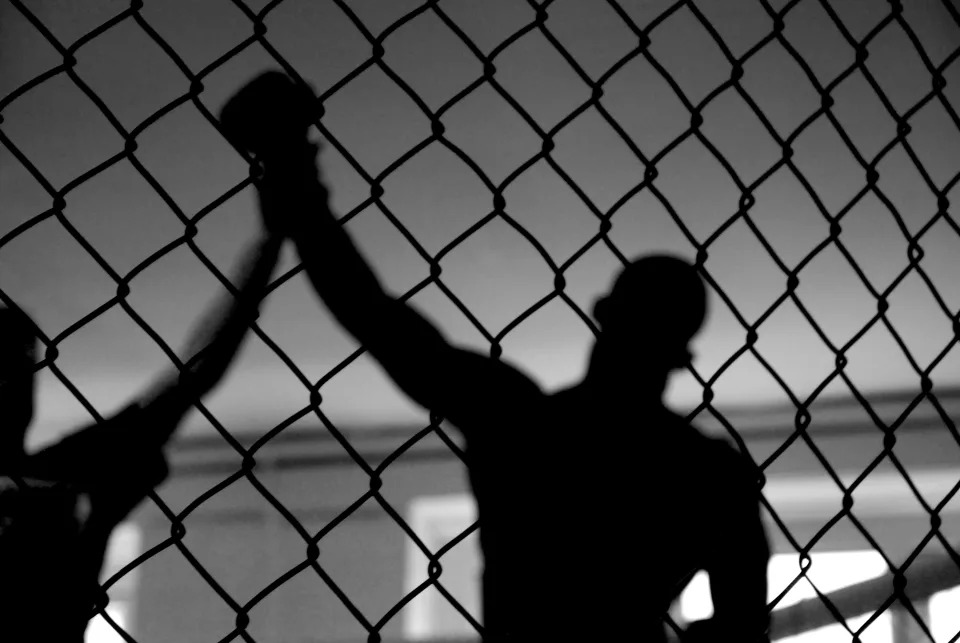
A fighter in a ring.Getty Images

White supremacist "active clubs" are spreading across the US.


The clubs recruit disaffected white men and promote physical fitness and masculinity.


The groups also sometimes mock and fat-shame Donald Trump and his supporters.

A network of white supremacist fitness clubs is spreading across the US, recruiting men to prepare for what they believe will be a race war.

The groups, known as "active clubs," target disaffected white men by offering a sense of community, with members regularly meeting to practice martial arts or work out.

But the groups have a much darker agenda that's rooted in white supremacist ideology.

Their Telegram channels reveal their extreme views — they are filled with neo-Nazi iconography, racist and antisemitic memes, and negative news articles about people of color and LGBTQ+ people.

"They are quickly becoming one of the most prominent vectors for white terrorist radicalization in the United States in recent years," Jon Lewis, a Research Fellow at the Program on Extremism at George Washington University, told Business Insider.

"They're training for what they view to be this kind of inevitable race war, this inevitable violent clash for the future of civilization," he added.

One former member of an active club told Vice News last year that the group would slowly introduce extremist ideology to new members by making racist jokes and talking about stories in the news in which ethnic minorities attacked white people.

"They believe that there's an inevitable cultural war that'll come and because they tie culture directly to race, a culture war means race war," they said.

"They never were like, 'You need to learn how to fight so you can beat up people of color. It was like, 'You need to learn how to fight because people want to kill you in the future,'" they added.

In a promotional video, the leader of the SoCal active club said that they were not terrorists and simply wanted to build a "positive community" and get white men "off the internet and into the real world."
White nationalism 3.0

One of the main strengths of the clubs is that they work as decentralized networks, with white men nationwide encouraged to set up and run their own clubs, Lewis said.

In the US, there are at least 46 active clubs across 34 states, a 2023 report from the Counter Extremism Project (CEP) said.

The investigative news outlet, Bellingcat, has also reported that the white supremacist active club movement had spread to Europe.

The movement was inspired by Robert Rundo, who founded the white supremacist MMA club known as the Rise Above Movement.

His concept of "white nationalism 3.0" advocates for nationalists to operate in smaller, decentralized groups and improve their online image to evade law enforcement scrutiny.

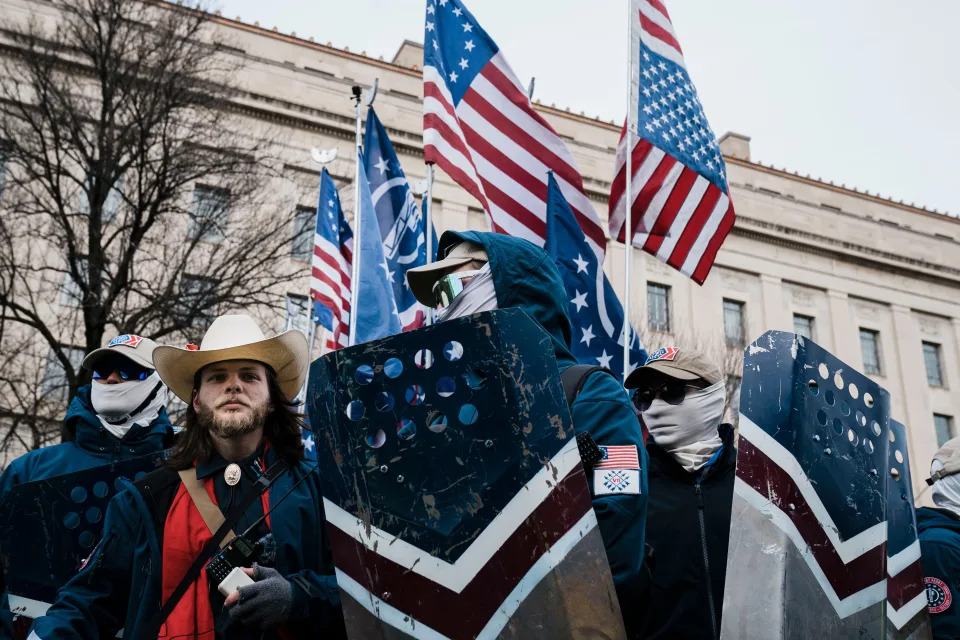
Members of the right-wing group the Patriot Front.Kent Nishimura / Los Angeles Times via Getty Images

While active club members do not regularly engage in overt violence, some are known to intimidate their enemies, particularly journalists.

The Tennessee active club has gained particular notoriety for its threats to local journalists, activists, and politicians and for the extreme views of its leader Sean Kauffman, who is a neo-Nazi and Holocaust denier.

"While the Tennessee active club on the surface seems like an outlier because of what the leader Kauffman says publicly, and he waves the Nazi flag publicly, the other active clubs are thinking that too, they're just not doing it in public," Jeff Tischauser, a researcher at the Southern Poverty Law Center, who investigates active clubs, told BI.

In an increasingly polarized climate, political extremism and threats to democracy have become a top concern for US voters, according to a recent Reuters/Ipsos poll.
The groups sometimes mock and fat-shame Trump and his supporters

Although many far-right groups once aligned themselves with former President Donald Trump, most have since grown disillusioned and criticize him for not doing enough to advance their extremist agenda.

"The groups I track have long since turned on Trump," Tischauser said, adding that some viewed Trump as a "puppet to Jewish interests who steals their nationalist rhetoric to win votes" and who "cannot be counted on to enact nationalist policies."

In one video, the Central CA active club also hit out at the former president for not being a true "revolutionary."

Some clubs have also taken to mocking and fat-shaming Trump and his supporters.

A video posted by the Alamo active club on Telegram shows clips of Trump rally attendees, all of whom appeared either overweight or were people of color, captioned: "Average conservatives."

The video then cuts to shots of white men sparring and lifting weights with a caption saying "average nationalists."

A Telegram channel run by the owner of the Lewis Country Store in Nashville, which is associated with the active club movement, also regularly mocks Trump for his weight, something he has been seemingly sensitive about in the past.

While some in the movement see Trump as a useful tool for helping shift policies to the right, their distrust in the political system likely means many won't vote or show support for any political candidate, Tischauser said.

Many of the groups believe there is no political solution and advocate for a societal breakdown from which a white ethnostate can emerge, Lewis added.

"They see a violent revolution, a violent racial conflict as the only way to get to their desired end state," he said.


Downtown Halifax getting new high-speed, net-zero commuter ferry service

The Canadian Press
Mon, March 4, 2024 


HALIFAX — The Nova Scotia government announced Monday a $258-million plan for a new high-speed ferry service that will link Halifax with Bedford, a rapidly growing suburb about 10 kilometres northwest of the port city's downtown.

The province will contribute $65 million, Ottawa will kick in $155 million and the Halifax Regional Municipality will spend $38 million on the Mill Cove ferry service.

The project calls for the construction of five electric ferries, a new ferry terminal in Bedford, and a new terminal in Halifax to replace the existing waterfront facility.

Nova Scotia Environment Minister Timothy Halman said the net-zero ferries and terminals will not produce air pollution. As well, a new bridge will be built over a CN Rail line in Bedford to provide access to the Mill Cove terminal.

The project is expected to be completed during the 2027-28 fiscal year.

"This project addresses road traffic in the area and helps us plan for future population growth," Halman said in a statement. "The new ferry route will also encourage people to use public transportation and help us meet our climate change goals."

The plan has been in the works since 2021 when the three levels of government announced they would spend more than $3 million on a study and design work. At the time, transit officials said they hoped the service would be in operation by this year.

The population of the Halifax region, which includes Bedford, has been rapidly growing since 2015.

Last year, Statistics Canada reported the growth rate in the metropolitan area around Halifax was second only to that of Moncton, N.B. The federal agency said the Moncton area grew by 5.3 per cent between July 1, 2021, and July 1, 2022, while Nova Scotia's capital grew by 4.4 per cent — growth rates that were more than twice that of the national average.

“With the growth we are continuing to see, so is the need to make sustainable transportation competitive with personal vehicles," Halifax Mayor Mike Savage said in a statement.

"Not only will this improved ferry service help people get around faster, it will also promote continuous growth surrounding the terminal and establish a consistent community hub."

The new ferry service is expected to help ease regular traffic congestion on the Bedford Highway, which runs along the west side of Halifax harbour.

The municipality currently uses a small fleet of diesel-powered ferries to link downtown Halifax with Dartmouth, on the east side of the sprawling harbour. The Dartmouth ferry is the oldest saltwater ferry service in North America, having started operations in 1752.

This report by The Canadian Press was first published March 4, 2024.