Monday, March 04, 2024

Behind big pharma is big intelligence

Stephanie Cain
Mon, March 4, 2024 


A competitive advantage is necessary for success across industries, but maybe nowhere so much as pharmaceuticals, where companies spend millions of dollars and thousands of hours researching how to get their developments through clinical trials and onto the market before their competitors.

But they don’t do it alone.

Behind the top pharmaceutical companies, as well as smaller biotech firms, consulting agencies like Lifescience Dynamics provide third-party credibility from dozens of academic scholars and analysts and, more important, supply valuable tools to provide pharma companies with insights and recommendations to speed up the development of their products and gain FDA approval.

“Pharma is a data-driven business,” explains Hussein Jaafar, a senior consultant at Lifescience Dynamics, who has largely led the charge on the team’s adoption of artificial intelligence. “To be able to consult our clients, we need to have access to as much data as possible.”

The power from Lifescience Dynamics comes from its five main technology products, which incorporate elements of artificial intelligence—including machine learning, large language models, and generative AI—to compute large data sets, amass information, and make educated recommendations.

On average, it takes eight to 12 years to discover, develop, and ultimately launch a drug. Along the way, pharmaceutical teams make several decisions, often under “conflicting, limited, or patchy data,” explains Lifescience Dynamics founder and president Rafaat Rahmani. To minimize risk, pharma companies are required to seek third-party research firms to validate their data and decision-making. That’s why Rahmani, who previously worked for Eli Lilly and other health care consultancies, started Lifescience Dynamics two decades ago.

Until the past few years with the explosion of AI capabilities, many of this team’s tasks were still done by hand, amassing thousands of hours of labor each year each. With more than 130 clients that hail from the majority of the world’s top 20 pharmaceutical companies, that was a hefty task but also left more opportunities for human error, a major challenge for something as regulated as the pharma industry.

Now, with the assistance of AI, some tasks take just 10 minutes, and confidence in the task is often 100%. Though Rahmani has long considered Lifescience Dynamics a technology-savvy company, the real benefit of that mentality has shown in its use of AI.

The areas of business where Jaafar has seen the biggest impact are possibly less sexy but unparalleled in value to clients and his own team: data collection, data analysis, and data visualization. Critical to the pharmaceutical industry is the tracking of clinical trials, especially by competitors. Jaafar explains that the team used to have “giant” Excel spreadsheets that a team member would need to physically click through, read updates online, then update the sheet. In 2021, they rolled out a machine-learning model that does this for the team by pulling information automatically from online registries like clinicaltrials.gov and continuously adding updates. The live feed automation, he says, has been key to streamlining their processes and increasing their effectiveness in meeting client expectations.

Similarly, he spearheaded a project that scrapes valuable information about sessions and drug updates from the major medical industry conference. Many of these events draw in upwards of 70,000 people with sometimes more than 5,000 sessions. It was a beast for a team to consolidate and analyze data before AI; now, the Lifescience Dynamics model pulls abstracts and details automatically, even summarizing and recommending sessions for attendance.

The insights gathered by Lifescience Dynamics all live in a client portal, allowing clients at any time to log on for a full look at their competitive intelligence projects, clinical trial data, and drug data. Jaafar explains that they are currently building AI models on top of that data to help clients query using natural language better understand the results. It not only adds transparency in the client-consultant relationship, but saves the Lifescience team from fielding time-intensive, resource-intensive questions from their clients.

More recently, Jaafar and his team looked at the benefits of generative AI, specifically around online surveys built to allow independent physicians to weigh in with critiques and recommendations for a particular drug. An important component of the peer review process, pharmaceutical companies reach out to physicians for real-world, patient-facing opinions on potential drugs. For Jaafar, generative AI and large-language models have allowed him to produce survey templates for online discussions among physicians as well as identify relevant experts for a specific survey.

“This was previously done entirely manually and we would just have to use our own experience and expertise to pull something together,” Jaafar says. “But with AI, we’re able to give it the background of the discussion guide we’d like to have, and it produces a very useful template that has us 80% of the way to a finalized guide.”

The team manually works on the remaining 20%.

While the team celebrates the success they have had with AI, Jaafar and Rahmani know bigger challenges await. Jaafar would like to build their own models for AI specific to their craft. Though Lifescience Dynamics can pull from its own historical data, the real value would come in more shared data from the industry. Unfortunately, he explains, the regulatory nature of health care and patient confidentiality combined with the competitive nature of the pharmaceutical industry means companies hold their own data close for a variety of reasons. A fear is that companies will continue to silo in fields of development rather than share collective data globally so that AI can learn at an exponential rate. There is simply less shareable data than other fields.

Rahmani predicts it will take more years to settle debates in pharmaceuticals over AI. For all the euphoria and excitement, there are old promises and leaders who just aren’t for technology, he says. He, however, feels confident in the future of AI as a tool to the industry’s collective success.

“I can understand why they aren't willing to connect, but it limits the utility of AI,” Rahmani says. “Our clients engage us to give them the insight and convert insight into foresight, in the shortest time possible and in the least expensive way. These AI tools squeeze the most out of our data and bring that data alive.”

This story was originally featured on Fortune.com
SPACE

Google-backed satellite to track global oil industry methane emissions

Mon, March 4, 2024 


By Valerie Volcovici

WASHINGTON (Reuters) - A new satellite backed by Alphabet Inc's Google and the Environmental Defense Fund group will launch from California on Monday with a mission to pinpoint oil and gas industry methane emissions from space.

The MethaneSAT sattelite will add to a growing fleet of spacecraft in orbit that are meant to help fight climate change by publishing data on emissions of the invisible but potent greenhouse gas.

While the European Space Agency and another satellite-based tracker called GHGSat are already providing methane emissions data, MethaneSAT will provide more detail and have a much wider field of view, its backers say.

The Environmental Defense Fund (EDF) said the data will bring accountability to the more than 50 oil and gas companies that pledged at the Dubai COP28 climate summit in December to zero out methane and eliminate routine gas flaring, and help those preparing to comply with forthcoming methane regulations in the EU and the U.S., including a methane pollution fee.

"We'll be able to see who the laggards are, but hopefully they will use that information in a constructive way to improve their performance," said Mark Brownstein, senior vice president for energy transition at EDF.

MethaneSAT was developed in conjunction with the New Zealand Space Agency and Harvard University, among others, and its data will be available to the public later this year, EDF said. Google Cloud will provide the computing capabilities to process the information.

Methane emissions - which come from oil and natural gas production, agricultural waste, and landfills - are many times more potent than carbon dioxide as a greenhouse gas.

Oil industry group the American Petroleum Institute said emissions data from third parties should not be used for regulatory purposes without verification.

"The environmental regulator is still going to be paramount here as the authority in terms of validating the data,” said Aaron Padilla, API vice president of corporate policy.

(Reporting by Valerie Volcovici; additional reporting by Nichola Groom in Los Angeles; editing by Jonathan Oatis)

Satellites burning up in our atmosphere may not be as harmless as first thought


Marianne Guenot
Sat, March 2, 2024 

An illustration of satellite re-entry next to a picture of polar stratospheric clouds.iStock / Getty Images Plus; Roy Rochlin/Getty Images; Insider

Spacecraft burning up in the atmosphere are leaving behind metal particles.


Scientists are racing to understand if that affects the climate.


One risk is that these particles may spark rainbow-colored clouds that damage the ozone layer.


Satellites and spacecraft burning up in our atmosphere are leaving metal particles in the stratosphere — and scientists are worried it could harm our planet.

About 10% of the particles floating around the stratosphere now come from the aerospace industry, and we don't know if this could impact the climate.

One risk is that these new particles could seed polar stratospheric clouds, which are spectacular rainbow-colored clouds that can damage the ozone layer, experts told Business Insider.

"This is a good demonstration of how important it is to have the basic research on the stratosphere," Daniel Murphy, a research scientist at the National Oceanic and Atmospheric Administration Chemical Science Lab, who led a survey of the particles, told BI.

"There is a whole phenomenon here that we didn't expect out and we don't fully understand the implications," he said.
Stratospheric particles can shape the ozone layer

Remember the ozone layer? If you were around in the 80s, that's likely the period you'd associated it with.

This crucial layer of the atmosphere, mostly contained in the stratosphere, protects us from ultraviolet radiation from the sun. It was frequently splashed across the headlines about 40 years ago when scientists raised the alarm about gaping holes growing over the poles made by chlorofluorocarbons (CFCs) rising up uncontrolled to the atmosphere.

The ozone hole, circa 2004.NASA

The ozone holes are not making the news quite so often today. Thanks to the 1987 Montreal Protocol, a global agreement that set out a trajectory to phase out ozone-damaging gases, they have been steadily healing.

Still, they are not gone. In September 2023, the hole above the Antarctic grew to its sixth-biggest size ever observed before snapping back, likely because of the particles spewed by the Hunga Tonga underwater volcano eruption in 2022.

That's why it's important to keep an eye on particles in the stratosphere. These nanometer-sized flecks, which naturally come from meteors crashing into the planet, can dramatically change the stratosphere's chemistry.

Clouds don't usually tend to form in the stratosphere, because it's much drier than the troposphere, where most clouds are born.

By bringing in elements you wouldn't usually see in the sky, like metals, these particles can combine with the sulfuric acid naturally present in the stratosphere to create a chemical reaction that can suck up passing water vapor, creating an ice crystal.

That, in turn, can spark a chain reaction that creates rainbow-colored polar stratospheric clouds.

On their own, these stunning clouds are harmless, but they can be terrifying when mixed with human-made gases. The clouds' edges offer perfect conditions to turn damaging chlorines and bromides into their active, ozone-busting form.

Polar stratospheric clouds (PSCs) are seen in the sky over Jukkasjarvi, northern Sweden, on December 17, 2023 in Jukkasjarvi, Sweden.Roy Rochlin/Getty Images
Metal from satellites and spacecraft is vaporizing into the atmosphere

Murphy and his colleagues recently conducted a survey of the state of stratospheric particles over Alaska using a sensitive detector aboard NASA's WB-57 high-altitude research plane.

The findings, published in the peer-reviewed journal PNAS in October 2023, revealed that about 10% of the stratospheric sulfuric acid particles they picked up could not be explained by natural causes.

"We weren't really looking for spacecraft, but it became apparent in the data that there were elements that couldn't be coming from the meteors," Murphy told BI.

The view from NASA's WB-57 cockpit during a SABRE high-altitude research flight.Thomas Parent, NASA

The particles contained "far too much aluminum, far too much lithium, far too much of a few other elements to be coming from meteors," he said.

Two elements found in the particles, niobium and hafnium, were particularly surprising, Murphy said.

These don't occur naturally, but have to be refined, the scientists said.

"The combination of aluminum and copper, plus niobium and hafnium, which are used in heat-resistant, high-performance alloys, pointed us to the aerospace industry," Murphy added.

A graphic illustrates where metal particles in the stratosphere could come from.Chelsea Thompson, NOAA

Right now, we simply don't know what these new particles could do. But scientists are eager to figure it out.

"This is a new problem and we're just beginning to understand it," said Murphy.

They may be able to spark polar stratospheric clouds. If so, this could be a big problem in the short term, Martin Chipperfield, a professor of atmospheric sciences from the University of Leeds, UK, told BI.

"The timescale for the ozone hole to disappear is about 2060 based on current predictions because the chlorine is going down very, very slowly," said Chipperfield, who was not involved in the study.

"So that still gives plenty of scope in the short term, if we greatly increase the burnout of space debris over next couple of decades, for the ozone hole get worse before it gets better," he said.

These new particles could also migrate to the troposphere, where they might influence the formation of feathery cirrus clouds. Unlike other clouds, cirrus clouds retain heat in our atmosphere, which could worsen the climate crisis.

It's also possible that the particles could create a completely new phenomenon. Or they could do nothing at all.

Their composition is unique, so it's unclear what to expect. Murphy said scientists will have to do experiments in the lab to test this out.

"It's very important to understand it because the space industry is growing so rapidly," Murphy told BI.

"If there are impacts, you'd rather understand it now before it grows than after it's already grown a lot."
We're realizing how little we know

With launch costs going down, the number of satellites orbiting the planet is only expected to grow to over 50,000 by 2030, up from about 8,000 now. Many of these satellites are expected to have a short lifetime.

"If you multiply those numbers out, a satellite will be reentering the atmosphere on average about once an hour," said Murphy.

Within the next few decades, Murphy and his co-authors estimate aerospace debris could make up 50% of the particles in the stratosphere, which makes the need to understand what they do even more pressing.


An illustration shows satellites around the Earth in 2019. Each dot represents one satellite, and is not scaled to size.NASA

Spacecraft decommissioning is only part of the equation, said Chipperfield.

"There's an increasing number of rocket launches for small satellites and tourism, which burn kerosene or other fuels that emissions in the atmosphere. Then some satellites and orbit have fuel like iodine that can come back to the atmosphere. And then the demise," he said.

"I think the whole life cycle of satellites is definitely one to watch, and this burn up is part of that," said Chipperfield.

Scientists are also seriously considering geoengineering the atmosphere to help shield our planet from the heat of the sun by sending billions of particles of sulfuric acid into the stratosphere.

For Murphy, this all goes to show just how little we know about how humans are affecting the stratosphere as more forays are reaching for the skies.

"That there was still a surprise in our understanding of the composition of particles in the stratosphere is relevant to conversations about adding more," said Murphy.

Internet cables cut in the Red Sea in ‘exceptionally rare’ incident, disrupting much of Asia, Europe, and the Middle East

Chris Morris
Mon, March 4, 2024 

David Oller/Europa Press via Getty Images


Internet service across swaths of Asia, Europe, and the Middle East has been disrupted following damages to undersea cables of major providers to the areas.

A statement from Hong Kong telecom HGC Global Communications says as much as 25% of the traffic in the areas has been impacted. The company is currently rerouting traffic to keep disruptions to a minimum and “extending assistance to affected businesses.”

There are more than 15 undersea internet cables in the Red Sea. To have four damaged at a single time is ”exceptionally rare,” HGC said in a separate earlier statement.

The disruption of the cables did not disconnect any country from the internet, but the Wall Street Journal reports service in India, Pakistan, and parts of East Africa was noticeably degraded.

No services have yet offered a reason for the cuts. Yemen’s telecom ministry denied speculation it was responsible for the failures, saying it was “keen to keep all telecom submarine cables…away from any possible risks.”

Underwater cables are responsible for most of the internet’s data traffic. They’re cheaper than land-based cables, but are prone to damage from ships' anchors.

The ongoing conflict in the Middle East has experts wondering about the timing and severity of this outage, though. Iran-based Houthi has been particularly aggressive in the Red Sea, including in mid-February when a cargo ship was abandoned by its crew following an Houthi attack. The ship, which had weighed anchor, drifted for weeks before sinking.

Houthi control of the region and the ongoing strife in Yemen makes repairing the damaged cables more complicated. One of the four companies affected said it expects to start that process early in the second quarter, though permit issues, weather, and the civil war in that country could impact that.

This story was originally featured on Fortune.com

Ohio foundation begins process to distribute millions in opioid settlement money

Mon, March 4, 2024


COLUMBUS, Ohio (AP) — Ohio is ready to begin doling out millions of dollars in opioid settlement money to community and government organizations, an influx eagerly anticipated since the first sums were secured in 2021.

The OneOhio Recovery Foundation, who has been tasked with distributing over $860 million of settlements reached with drugmakers and pharmaceutical companies for their roles in the national opioid crisis, plans to release its formal request for proposals Monday.

Drugmakers, wholesalers, pharmacies and other companies have agreed to settlements over the toll of opioids that are to pay state, local and Native American tribal governments more than $50 billion. Under the agreements, most of the money is to be used to address the overdose epidemic.

The foundation will allocate up to $51 million in its 2024 grant cycle for Ohio-based non-profits, for-profits and government entities alike who are “on the frontlines of Ohio’s opioid battle.” The program is the first of its kind in the United States.

Those applying must still follow certain parameters outlined by OneOhio, including that all programs and services proposed must be “evidence-based, forward-looking strategies for prevention, treatment, (and) recovery support services.”

Eligible projects may span one, two or three years and must be regionally-focused. Registration starts Monday and applications are due by May 3.

Alisha Nelson, executive director of OneOhio, said in a press release that the foundation understands how urgent the need to disperse the settlement money is as the state continues to feel the impact of the opioid epidemic.

“After months of carefully developing this first-ever program, we look forward to seeing the innovative ideas presented to combat the epidemic in every corner of the state," Nelson said.

The foundation is registered as a private non-profit organization, though it was launched by Republican Gov. Mike DeWine and GOP Attorney General Dave Yost in 2021. It's governed by a 29-member statewide board, many of which are state lawmakers and the appointees of state officials, but also includes addiction experts from across Ohio.

It has previously faced scrutiny, as well as a lawsuit, over lacking transparency.

Last summer, DeWine appointed Nelson as the foundation's first ever permanent executive director.

“After careful consideration, I selected Alisha to fill this role because I know that she shares my vision of intentionally using these settlement funds to help Ohioans struggling with substance use disorder for years to come,” DeWine said last year.

___

Samantha Hendrickson is a corps member for the Associated Press/Report for America Statehouse News Initiative. Report for America is a nonprofit national service program that places journalists in local newsrooms to report on undercovered issues.

Samantha Hendrickson, The Associated Press
First over-the-counter birth control pill in US begins shipping to stores

Mon, March 4, 2024 


WASHINGTON (AP) — The first over-the-counter birth control pill will be available in U.S. stores later this month, allowing American women and teens to purchase contraceptive medication as easily as they buy aspirin.

Manufacturer Perrigo said Monday it has begun shipping the medication, Opill, to major retailers and pharmacies. A one-month supply will cost about $20 and a three-month supply will cost around $50, according to the company's suggested retail price. It will also be sold online.

The launch has been closely watched since last July, when the Food and Drug Administration said the once-a-day Opill could be sold without a prescription. Ireland-based Perrigo noted there will be no age restrictions on sales, similar to other over-the-counter medications.

Opill is an older class of contraceptive, sometimes called minipills, that contain a single synthetic hormone, progestin, and generally carry fewer side effects than more popular combination estrogen and progestin pills.

The launch gives U.S. women another birth control option amid the legal and political battles over reproductive health, including the reversal of Roe v. Wade, which has upended abortion access across the U.S. Opill’s approval is unrelated to the ongoing court battles over the abortion pill mifepristone. And anti-abortion groups have generally emphasized that they do not oppose contraceptives to prevent pregnancies.

Birth control pills are available without a prescription across much of South America, Asia and Africa.

The drug’s approval came despite some concerns by FDA scientists about the company’s results, including whether women with certain medical conditions would understand that they shouldn’t take the drug.

Dr. Verda Hicks, president of the American College of Obstetricians and Gynecologists, in a statement, said studies have shown that patients, including adolescents, can effectively screen themselves to use the pills.

___

The Associated Press Health and Science Department receives support from the Howard Hughes Medical Institute’s Science and Educational Media Group. The AP is solely responsible for all content.

Matthew Perrone, The Associated Press
UNIONS
Thousands of flights and trains will be canceled again this week in Germany with new strikes

Mon, March 4, 2024 


BERLIN (AP) — Thousands of flights and trains are expected to be canceled again this week in Germany after two unions on Monday called for more strikes over wages and working conditions.

Negotiations continue for ground staff of German airline Lufthansa and German rail operator's Deutsche Bahn train drivers. German train drivers’ union GDL and Ver.di called for the strikes Thursday and Friday.

Around 200,000 air passengers will be affected by the two-day strike, according to an initial estimate by the Lufthansa Group, meaning that around 1,000 flights per day will be canceled as during previous strikes, German news agency dpa reported.

The strike on long-distance and regional train services begins at 2.00 a.m. (0100GMT) on Thursday and will affect millions of travelers. According to GDL, the strike is set to last until 1 p.m. Friday. In freight transport, the strike will begin on Wednesday at 6 p.m. (1700GMT) and is scheduled to last until 5 a.m. Friday.

In addition to pay raises, GDL has been calling for working hours to be reduced from 38 to 35 per week without a pay cut, which Deutsche Bahn has refused.

The Ver.di union seeks a 12.5% pay raise, or at least 500 euros ($542) more per month, in negotiations for nearly 25,000 Lufthansa ground workers including check-in, aircraft handling, maintenance and freight staff.

Coinciding contract negotiations have resulted in several recent walkouts in the railair and local transport sectors in Germany.

The Associated Press

South Korean doctors hold a mass rally against medical policy

By Hyun Young Yi and Hyonhee Shin
March 3, 2024


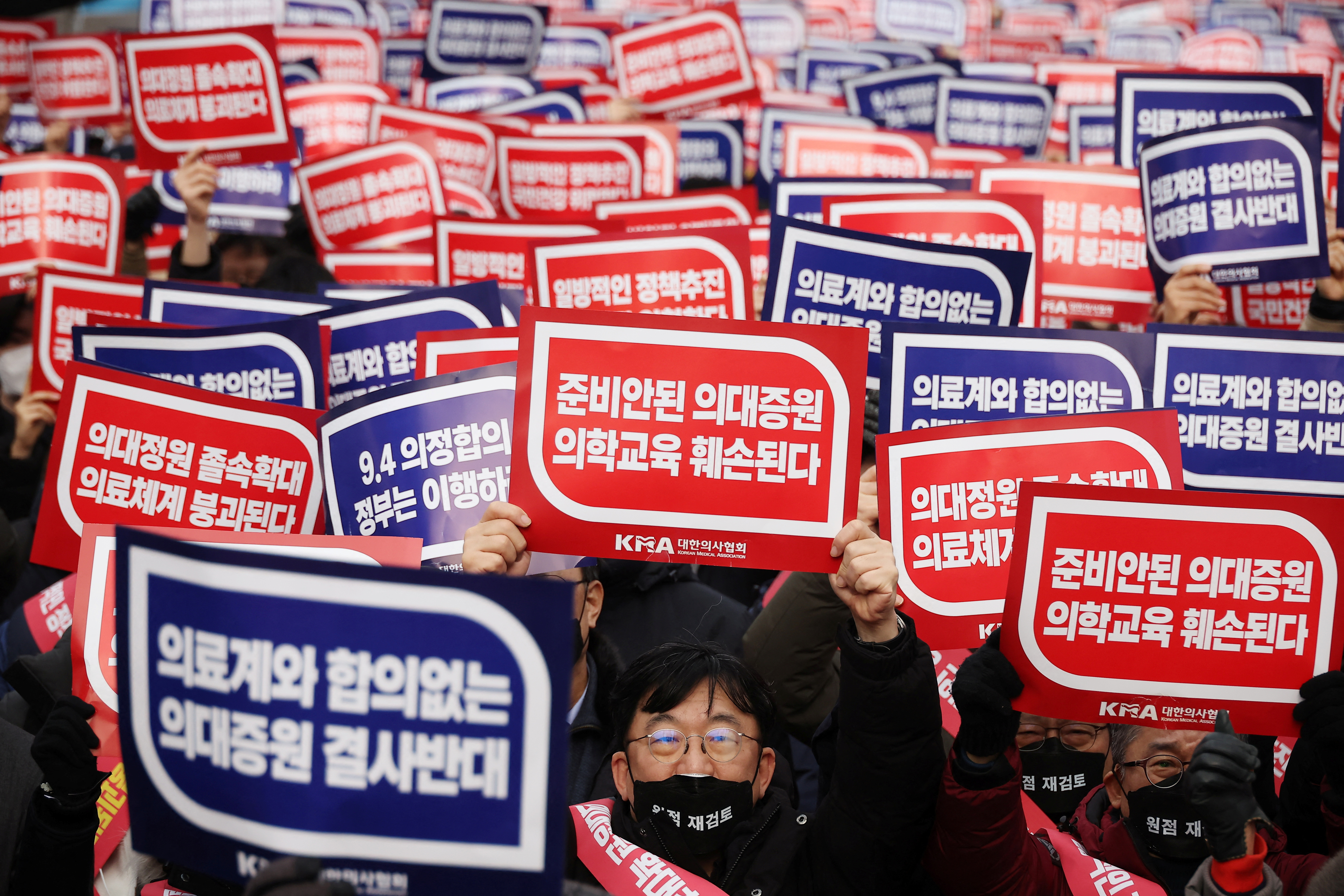
Doctors chant slogans during a rally to protest against government plans to increase medical school admissions in Seoul, South Korea. The banners read "Oppose increasing medical school admissions without talks with the medical community" (in blue) and "Medical education will be harmed in red.

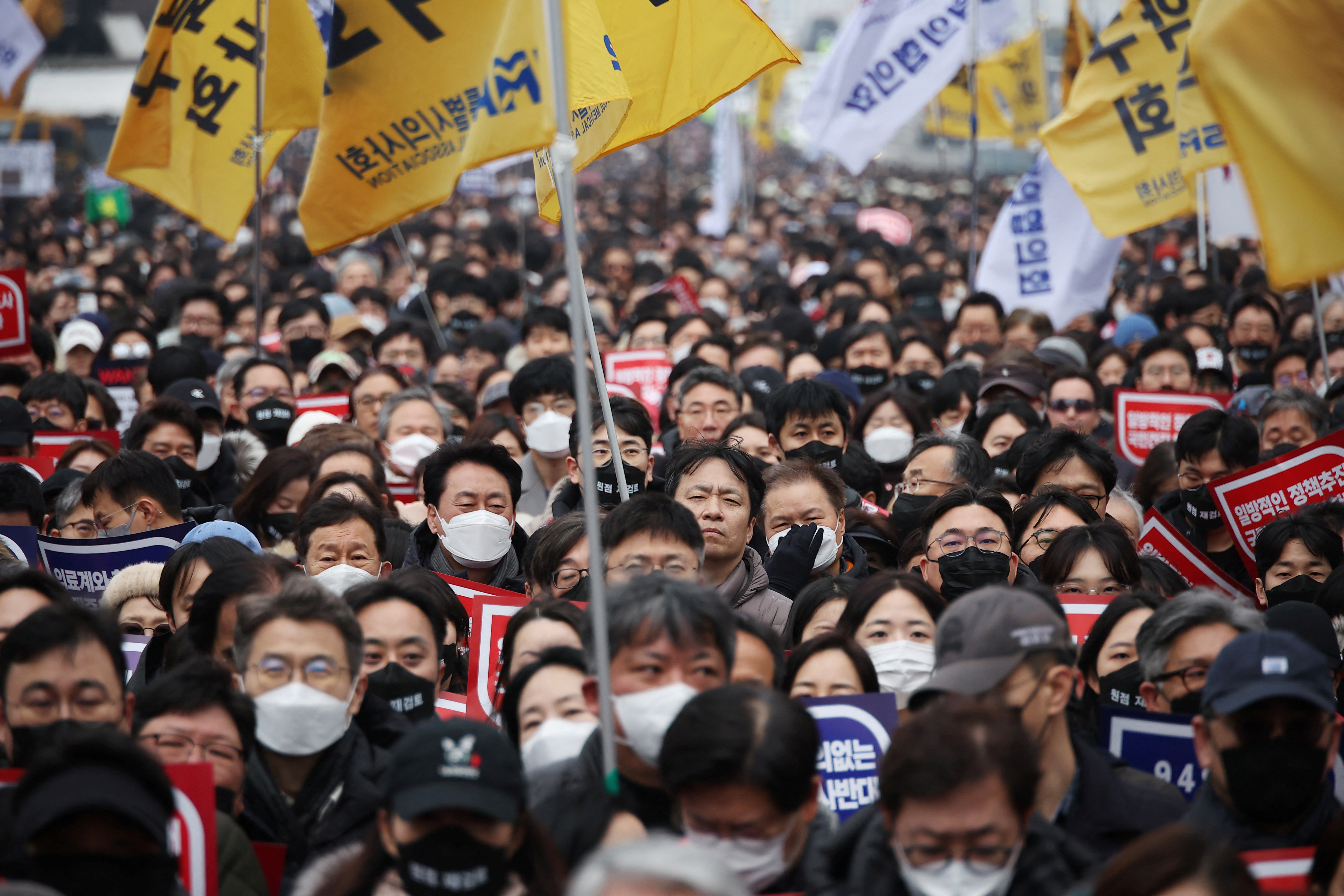
SEOUL, March 3 (Reuters) - Thousands of South Korean doctors held a mass rally on Sunday against government plans to increase medical school admissions, defying official calls for trainee physicians who had also walked off the job in protest to return to work.
Up to 40,000 doctors joined the rally, demanding the government scrap the plan, according to the Korean Medical Association (KMA), which represents private practitioners and had organised the protest.

Police put the number of demonstrators at about 12,000.

The rally comes a day after a government deadline for the trainee doctors to return to work expired. Nearly 9,000 resident and intern doctors at major hospitals, or about 70% of the country's total, walked off the job late February, leading to the cancellation of some surgeries and treatments and straining emergency departments.

Joo Soo-ho, an official at the KMA, said the government should reform the existing medical  system.

"It was the government that set the deadline, and regardless of the deadline and pressure, we will continue to push forward as we think," Joo said.

Prime Minister Han Duck-soo on Sunday urged the KMA to cease the protest and encourage trainee doctors to return to their patients.

Interior minister Lee Sang-min also said the young doctors would not be punished if they returned to work by Sunday, but if they fail to do so, they could face administrative and 
The government has publicly issued a back-to-work order for 13 doctors, including vocal critics of the plan, and raided some KMA officials on Friday.

Cho Ji-ho, commissioner of the Seoul Metropolitan Police Agency, said the police has banned several KMA members from leaving the country as part of an investigation into illicit activities linked to the protest.

South Korea takes steps to suspend licenses of striking doctors after they refuse to end walkouts


BY HYUNG-JIN KIM
March 3, 2024

SEOUL, South Korea (AP) — South Korea’s government began steps Monday to suspend the medical licenses of thousands of striking junior doctors, days after they missed a government-set deadline to end their joint walkouts, which have severely impacted hospital operations.

Nearly 9,000 medical interns and residents have been on strike for two weeks to protest a government push to sharply increase the number of medical school admissions. Their action has led to hundreds of canceled surgeries and other treatments and threatened to burden the country’s medical service.

On Monday, officials were sent to dozens of hospitals to formally confirm the absence of the striking doctors as the government began steps to suspend their licenses for at least three months, Vice Health Minister Park Min-soo told a briefing.

Park said authorities will later notify the striking doctors of their expected license suspensions and give them a chance to respond. He suggested the license suspensions would take weeks to go into effect.


What’s next for South Korean doctors who face license suspensions because of walkouts

“Despite repeated appeals by the government and other parts of society, the number of trainee doctors returning to work is very insignificant. Starting from today, we begin the execution of law with the on-site inspection,” Park said.

Park again repeated the government’s call for the doctors to end their walkouts.

“We again strongly urge them to return to patients by not ignoring the pains of patients hovering between life and death — and their families,” he said.

South Korea’s government earlier ordered the striking doctors to return to work by Feb. 29. South Korea’s medical law allows the government to make such back-to-work orders to doctors when it sees grave risks to public health. Anyone who refuses to follow such orders can be punished with a suspension of his or her license for up to one year, and three years in prison or a 30 million won (roughly $22,500) fine.

Last month, the South Korean government announced it would raise the country’s medical school enrollment cap by 2,000 starting next year, from the current 3,058. Officials said it’s urgent to have more doctors to deal with a fast-aging population and resolve a shortage of physicians in rural areas and essential yet low-paying specialties like pediatrics and emergency departments.

Officials say South Korea’s doctor-to-population ratio is one of the lowest among developed countries.

But many doctors have opposed the plan, arguing universities can’t offer quality education to such an abrupt increase in students. They also say adding so many new doctors would also increase public medical expenses since greater competition would lead to excess treatments. They also predict newly added students would also want to work in high-paying, popular professions like plastic surgery and dermatology.

Critics say many doctors oppose the government plan simply because they worry adding more doctors would result in a lower income.

The striking junior doctors are a small fraction of the country’s 140,000 doctors. But they account for 30-40% of the total doctors at some major hospitals, where they assist senior doctors while training.

Senior doctors have staged a slew of street rallies supporting the young doctors but haven’t joined their walkouts. Police said they were investigating five ranking members of the Korea Medical Association, a body that represents South Korean doctors, for allegedly inciting and abetting the walkouts.

American Airlines Flight Attendants To Stage Protest On Wall Street

The workers’ union has instructed all members to prepare “for a possible strike.”

BY CHANNING REID

SUMMARY

American Airlines flight attendants will protest in New York City on Monday.

The union-led protest coincides with American's Investor Day.

Negotiations continue as the workers push for pay raises and retro pay.

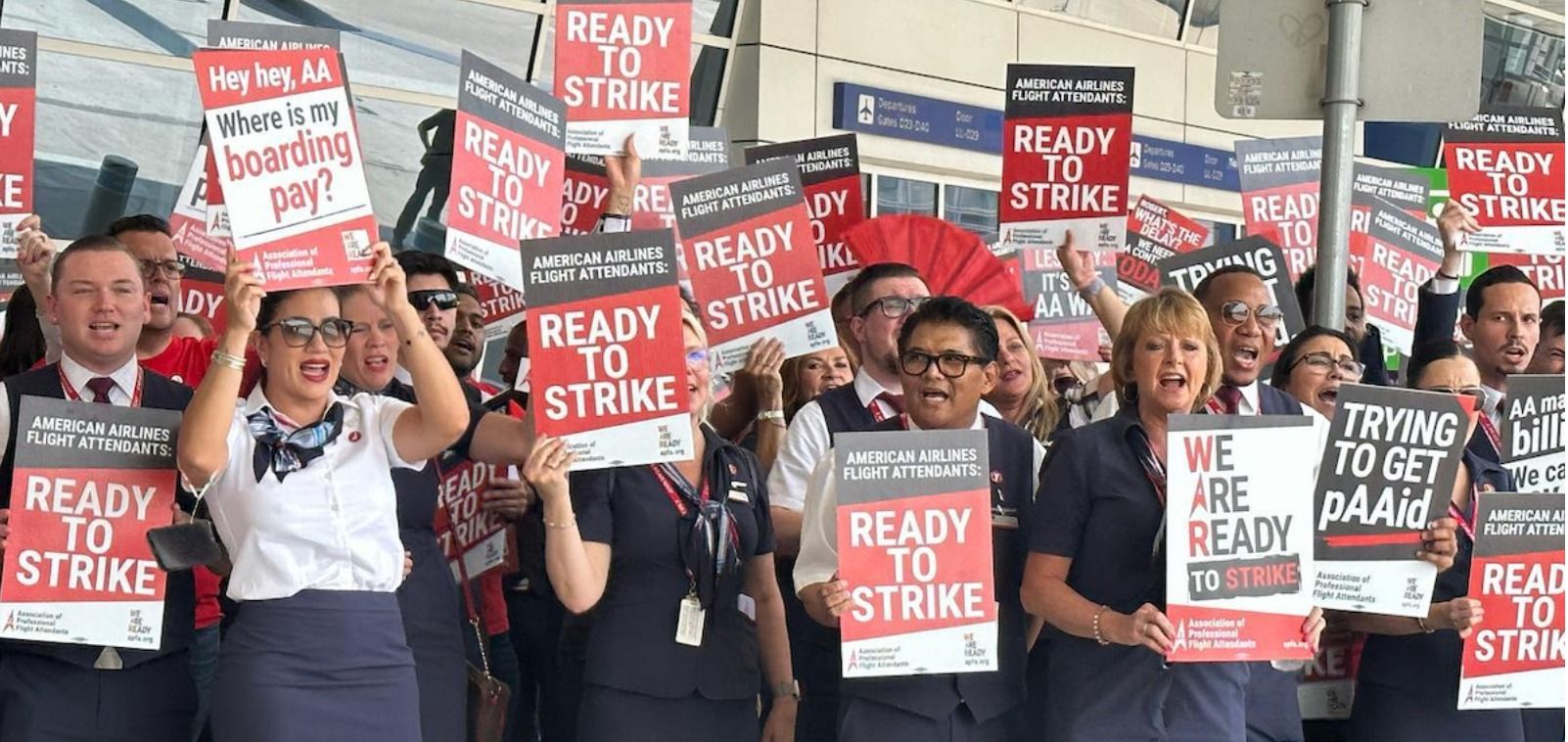
Flight attendants at Fort Worth, Texas-based American Airlines are headed to New York City to protest on Monday. It is the inflight worker’s latest effort to make their voices heard as they continue to fight for a new collective bargaining agreement.

Several reports in the last couple of years have highlighted the financial struggles that some flight attendants have encountered with their low wages. Last month, the crew members picketed at all of the airline’s bases across the country.
Taking action

As first reported by View From The Wing, the flight attendants will be meeting on Wall Street to stage a protest at 12:00 on Monday – the same day as American’s Investor Day, where the carrier’s CEO Robert Isom and senior leadership will present and meet with the company’s main investors.


Photo: Association of Professional Flight Attendants

The union representing American's flight attendants, the Association of Professional Flight Attendants (APFA), notified the workers of the planned protest in an internal memo obtained by View From The Wing. It instructs the crew members to wear their uniforms and meet on time near the Joe and Juice on Broad Street. Those running late are advised to “meet out front of the New York Stock Exchange” at 12:30 to join the protest.


It appears that the APFA wanted to keep its plan under wraps as the memo also instructs the workers to “invite flight attendants privately” and to “not post on social media.” During the protest, the flight attendants could chant the three phases in the memo or have them written on signs:

“AA: No Retro Pay / No Way!”
“AA Makes Billions - We Can’t Make Rent!”
“AA: Close Out This Contract NOW!”

Simple Flying has not independently verified the chant(s) details or signage phrasings.

Status of negotiations

Last September, American proposed a new contract to its 26,000 flight attendants, claiming it was industry-leading. However, the inflight workers said it fell short. The proposal included some positive changes for the flight attendants, such as allowing the workers to be paid during boarding periods, but did not address other demands, including pay raises by more than 30%.

APFA asked the National Meditation Board to allow the flight attendants to go on strike in November, but the board denied their request, forcing them to continue negotiations with the airline.

A status conference, requested by the union, will be held next week.

“The National Mediation Board has set a status conference, at the request of APFA, to directly hear from APFA on why we believe that we should be released into a thirty-day cooling-off period. The three members of the National Mediation Board will hear from APFA on the morning of March 13, 2024. The company will present to the NMB Board later that afternoon. At this meeting, APFA will update the Board on the status of our negotiations and will have an opportunity to present our position that our negotiations are at an impasse and we should be released.”

“Preparing for a possible strike”

Jule Hedrick, APFA’s National President, said the flight attendants have been working with wages negotiated in 2014; however, View From The Wing reports the inflight workers received a raise in 2019. Still, that was before the pandemic, when the economy was in a different environment.


Photo: American Airlines

As junior crew members have the lowest pay, first and second-year flight attendants based in Boston are reportedly eligible for food stamps. Others have allegedly reported that they cannot afford gas and live off snacks offered to first class passengers.

Among higher wages, the workers are fighting for retro pay to compensate for unpaid work for the last several years. Despite not being released from negotiations, APFA mailed a strike booklet to its members last month and reminded them that possible industrial action could still happen.

“All APFA Flight Attendants should be preparing for a possible strike at American Airlines,” the union said.

Germany: Union calls another Lufthansa ground staff strike4 hours ago4 hours ago

Trade union Verdi has called for airport ground staff to strike on Thursday and Friday of this week. It's the latest in a series of such actions affecting planes and trains.


https://p.dw.com/p/4d88V
Ground staff were also on strike on February 28 amid the long-running disputeI
mage: Carsten Koall/dpa/picture alliance

A major German trade union on Monday called on Lufthansa ground staff to strike again on Thursday and Friday, March 7 and 8, as it seeks to increase pressure ahead of another round of negotiations the following week.

It said that staff should stop work from at 4 a.m. on Thursday morning (0300 GMT/UTC) until 7:10 a.m. on Saturday.

Delays and cancellations are probable, with previous similar strikes disrupting flights and prompting criticism from Lufthansa.


"In the past few days we consciously left passenger travel out of our strikes," Verdi negotiator Marvin Reschinsky said. "Lufthansa is telling us by ignoring our demands for negotiations that it will only move once the pressure is increased further."


Thursday and Friday's strike will be tailored to impact passenger flightsImage: Carsten Koall/dpa/picture alliance

What Verdi y's second-largest by overall membership, is negotiating on behalf of roughly 25,000 employees in the dispute.

It's seeking pay rises of 12% for workers it represents, or a minimum of €500 ($542) per month, whichever is higher. Lufthansa has offered pay increases over an extended period but Verdi says they do not meet its demands.

"It is inexplicable to anyone that this company is about to announce a record annual performance this week, is going to increase bonuses for its board considerably, and that staff on the ground with an hourly wage of sometimes €13 don't even know how they're meant to make ends meet in some of Germany's most expensive cities," Verdi quoted negotiator Marvin Reschinsky as saying.

A fresh round of talks, the fifth in the dispute, are set for March 13 and 14. Verdi has said it will not return to the negotiating table earlier unless Lufthansa presents an improved offer in advance, a position Lufthansa criticized. Lufthansa had offered 

Trains and public transport services have also been disrupted by several strikes in recent weeks in Germany with negotiations faltering and no breakthrough in sight.

The disruptions to the movement of people and goods as a result was even mentioned by Germany's Bundesbank central bank last month as a cause for economic concern as it announced that the country could enter a technical recession by the end of the first quarter.
The DW News WhatsApp channel is live! Join us now for unbiased news that matters.

msh/ab (AFP, dpa, Reuters)


Lufthansa says its latest two-day strike by ground crews will disrupt travel for more than 200,000 passengers

Bloomberg |
Mar 04, 2024 

Ground crew are among workers in Germany’s transport industry that have walked out over salary levels as staff shortages and high inflation bite.

Deutsche Lufthansa AG expects the latest two-day strike by ground crews to disrupt travel for more than 200,000 passengers, putting pressure on the German airline to negotiate a deal.

\
Lufthansa ground staff attend a strike in Frankfurt, Germany.
(REUTERS)

Labor union Verdi has called Lufthansa ground staff walk off work on Thursday and Friday after failed negotiations over pay and working conditions. Lufthansa responded it’s willing to negotiate at short notice, provided that Verdi calls off the strike.
Hindustan Times - your fastest source for breaking news! Read now.

Ground crew are among workers in Germany’s transport industry that have walked out over salary levels as staff shortages and high inflation bite. Thousands of passengers and major German airports were hit three times last month after security staff and ground crews across the country went on strike. The latest disruption will likely get exacerbated by a strike called by workers at Deutsche Bahn AG, the German railway also negotiating improved working hours.

“With this uncompromising stance, the union is harming the company, many hundreds of thousands of customers and the employees of our companies,” Michael Niggemann, Lufthansa’s chief human resources officer, said in the statement.

Verdi said on Monday that no agreement was reached during the fourth round of negotiations. The union has demanded a 12.5% salary increase and an extra €3,000 ($3,254.9) inflation bonus for ground staff. The next meeting is scheduled for March 13 and 14.

Lufthansa said Verdi was “deliberately seeking escalation rather than a solution” to the dispute, and it will implement a special flight plan during the 59-hour warning strike.

Lufthansa reports earnings on Thursday.


Tunisia union announces release of official following arrest and political tensions
The Tunisian General Workers’ Union (UGTT) announced Friday that Tahar Mezzi, the union’s deputy general secretary and head of the union’s private sector, was released after being arrested on Thursday.

According to the UGTT, Mezzi was detained by government authorities in connection with an allegedly fabricated case regarding his extensive involvement in union activities. The incident occurred just a few days before the UGTT’s planned protest on March 2, aimed at denouncing what the UGTT described as “the violation of trade union rights and the disruption of social dialogue.”

In a statement released Thursday, the UGTT condemned Mezzi’s imprisonment and called for his immediate release and for the charges against him to be dropped. It also called for the preservation of the allegedly fabricated file aimed at undermining the union’s rights. According to the UGTT, Mezzi’s arrest is a purely political decision and part of a series of unfair trials of trade unionists. The UGTT claimed that the arrest, which took place just days before the workers’ protest rally in Kasbah Square, was intended to sow confusion and fear, in line with ongoing policy against striking trade union movements.

The UGTT urged trade unionists to nevertheless actively engage in the protest scheduled for Saturday, March 2, in Kasbah Square, and warned members to prepare for further action. Union activists hope to halt what they see as severe violations of the right to trade unions, as well as public and individual freedoms. This protest marked the union’s first in months and saw a large attendance.

The UGTT, which has around 1 million members, played a key role responding to the arrests of activists, businessmen and journalists when Tunisia’s President Kais Saied consolidated power in 2021 by closing parliament, a move the opposition called a coup. However, the influence of the union, widely recognized as the country’s most important force, has diminished significantly since last year with the arrest of some officials. Some political parties and activists have accused the UGTT of inertia, saying it has withdrawn from its influential role and chosen silence over confronting Saied’s authoritarian approach.

Tunisian judge releases union leader after one-day detention


Reuters
March 1, 2024

A person holds up a baguette as supporters of the Tunisian General Labour Union (UGTT) protest against President Kais Saied, accusing him of trying to stifle basic freedoms, including union rights, in Tunis, Tunisia March 4, 2023. 
REUTERS/Zoubeir Souissi/File \

TUNIS, March 1 (Reuters) - A judge on Friday released a top official in Tunisia's biggest labour union, one day after he was detained, the union said.

The Tunisian General Labour Union (UGTT) denounced the detention of Tahar Mezzi on Thursday, saying it was a politically motivated attempt to undermine union rights.

Mezzi is the deputy secretary-general and the head of private sector in the union. He was detained two days before a huge protest called by the UGTT against what it said was a "violation of union rights and the disruption of social dialogue".


A judicial official said the judge also ordered a travel ban on Mezzi.

The UGTT did not say on what grounds Mezzi was detained. Tunisian authorities were not immediately available for comment.

Since last year, police have arrested at least four senior union officials.

The UGTT, which has about 1 million members, had been a critical voice after the arrest of activists, businessmen and journalists since President Kais Saied seized most powers in 2021 when he closed parliament - a move that the opposition described as a coup.

But the voice of the union, which was widely seen as the biggest force in the country, has been significantly diminished since last year after the arrest of some officials.
Some political parties and activists have accuse UGTT of inaction, retreating from its role, and choosing silence instead of confronting Saied's authoritarian approach. Saturday's protest will be the first in months

Thousands protest Tunisia's falling living standards

Thousands protested deteriorating living standards outside the prime minister's office in Tunis on Saturday following a call from Tunisia's main trade union confederation.


Issued on: 02/03/2024 -

Trade unionists raise national flags and placards as they take to the streets of Tunis, Tunisia to protest against a proposed legislation that will grant the government sweeping powers over NGOs, March 2, 2024.
 © Fethi Belaid, AFP

By:NEWS WIRES


"The economic and social situation continues to worsen," the confederation's head, Noureddine Taboubi, said in a speech to protesters.

Taboubi said the state's ability to service its foreign debt in 2023 had been "to the detriment of the people and resulted in shortages of basic products".

He criticised the implementation of "diktats from the International Monetary Fund" (IMF) at the expense of ordinary Tunisians.

The Tunisian economy is at a standstill with growth of 0.4 percent and an unemployment rate of 16.4 percent in 2023, according to the National Institute of Statistics.

Unemployment stood at 15.2 percent at the end of 2022.

President Kais Saied has ruled by decree since a July 2021 power grab and last year rammed through a constitution that gave his office unlimited powers and neutered parliament.

Weathering a grave economic crisis, Tunis concluded an agreement with the IMF in October 2022 for a two billion dollar loan facility.

But loan tranches stalled when the president rejected reforms demanded by the IMF.

(AFP)


Tunisian civil society fears plan to limit foreign funding

Youcef Bounab and Francoise Kadri
Mar 3, 2024


Trade unionists shout slogans as they take to the streets of Tunis to protest against proposed legislation that will grant the government sweeping powers over NGOs
FETHI BELAID


The head of the Tunisian General Labour Union UGTT, Noureddine Taboubi, speaks during the protest
FETHI BELAID

Critics worry that the law would collapse Tunisia's vibrant civil society and exacerbate already dire unemployment rates

FETHI BELAID

Tunisian civil society groups fear the government is planning to starve them of foreign funding under the pretext of fighting money laundering and terrorism.

President Kais Saied, who launched a sweeping power grab in 2021 and rules by decree, has accused many non-government organisations of serving "foreign agendas".

Under a draft law he supported, state authorities would have to approve all foreign funding for NGOs that operate in the North African country.

Human rights groups worry it is another repressive measure in the country that became known as the birthplace of the Arab Spring protests more than a decade ago.

"The aim of the bill is to restrict civil society -- its financing, its activity and to limit its work to certain topics suggested by the political authority," said Bassem Trifi, president of the Tunisian League for the Defence of Human Rights.

If the draft law is enacted, Trifi warned, "Tunisia will lose its civil society and all the work it has done".

Amnesty International warned that the "absolute discretion given to the government to authorise or deny funding requests of civil society groups may constitute a disproportionate restriction of the right to freedom of association".

The Tunisian groups also worry that tens of thousands of jobs will be lost if funding from abroad dries up, given that most organisations receive little to no public money in the recession-hit and highly indebted country.

Saied, elected democratically in October 2019, sacked parliament in July 2021 and assumed most executive powers.

A number of Saied's opponents are behind bars as Tunisia prepares for presidential elections set to take place in October.

- 'Preserve the freedoms' -

The draft law would replace a 2011 decree that saw the creation of over 25,000 organisations after the uprising that ousted dictator Zine El Abidine Ben Ali and set in motion what later came to be known as the Arab Spring.

"According to a study we did, by limiting civil society's financial resources, we risk losing around 30,000 direct jobs" and about 100,000 indirect jobs, Trifi said.

Critics worry that this would exacerbate unemployment rates, which already stand at 16 percent overall and 40 percent among the youth.

Shanti, an association that employs 22 full-time workers and manages over 100 projects involving crafts, farming and eco-tourism nationwide, may be among those affected.

The group receives over 90 percent of its funding from abroad.

Their projects like L'Artisanerie, a workshop in Tunis that supports about 60 craftspeople selling items including handmade carpets, pottery and furniture, could also be impacted.

"We're on alert about what's going to happen," said Shanti's head Mehdi Baccouche.

He said that he is not opposed to new regulation, but that any change should result from "a permanent dialogue" between organisations and authorities.

"It's important to preserve the freedoms acquired by associations and to continue to develop access to national and foreign funds," Baccouche said.

"The development of the associative sector brings thousands of jobs and, beyond that, thousands of people are directly impacted."
- 'Achievement of the revolution' -

Clement Nyaletsossi Voule, the UN special rapporteur on freedom of assembly and association, said the proposed legislation also "gives excessive powers to the authority which can, according to its agenda, refuse an association".

"The 2011 decree is an achievement of the revolution that must be preserved," Voule told AFP.

The current law allows the creation of an organisation simply by notifying the government, without requiring approval.

This has allowed for the flourishing of NGOs working on political and social issues, such as women's and LGBTQ rights.

Their championing of freedoms, including of the press, saw the emergence of independent media outlets.

This "does not mean that the authorities turn a blind eye", Voule added, arguing that the government can still examine "the organisation's agenda and whether there is an imminent security risk".

Before making any sweeping changes to the system, the UN rapporteur argued, "authorities must open discussions with civil society".

boufka/ezz/ysm/srk/fz/lb
Let the unionisation begin!': Employees Get Cookies As Sephora Celebrates $10 Billion Revenue

Employees express dissatisfaction over what they perceive as inadequate recognition of their contributions.


By Jastine Beatrice Yap jastinebeatriceyap
03/03/24

The discontent among Sephora's workers sheds light on the broader issue of employee recognition and fair compensation. 
WIKIMEDIA COMMONS

Sephora, the global beauty retailer, recently celebrated a remarkable financial milestone, surpassing £10 billion in revenue.

However, amidst the festivities, a wave of discontent is sweeping through the workforce as employees express dissatisfaction over what they perceive as inadequate recognition for their contributions.

As news of the financial milestone circulated within Sephora's ranks, workers expressed their discontent, highlighting a disparity between the company's financial success and the recognition received by its frontline staff.

The focal point of their dissatisfaction? A seemingly token gesture in the form of a 'stale cookie.'

Reports from various Sephora outlets reveal that, in celebration of the revenue milestone, employees were merely offered a symbolic 'thank you' – a stale cookie.

The gesture, intended to acknowledge the collective effort of the workforce, has sparked frustration and disappointment among many employees who expected more tangible rewards for their role in the company's success.

According to one former employee, whose departure coincided with the cookie delivery, "They are consistently coaching us to meet our goals and expectations, and, of course, everyone goes above and beyond for the company, and all they give us is a stale cookie and a letter thanking us."

The discontent among Sephora's workers sheds light on the broader issue of employee recognition and fair compensation, especially in industries where frontline staff plays a pivotal role in delivering exceptional customer experiences.

The disparity between the monumental financial achievement and the perceived triviality of the reward has fueled discussions around the company's commitment to its workforce.

Sephora's success in the beauty retail sector is undeniable, with its revenue growth attributed to strategic marketing, a diverse product range, and an immersive in-store experience.

However, the current discontent poses challenges to the company's reputation as a fair and employee-centric employer.

In a statement, Sephora said it "had a great year thanks to our extraordinary team members who help create and build our incredible beauty community.

"We are proud of all our employees across our stores, distribution centres, and corporate offices who contributed to this shared success in North America.

"As the leading prestige beauty retailer, it's success like this that allows us to continue to offer highly competitive benefits and pay, performance bonuses, education, brand perks, training product, gratis, and substantial product discounts to our employees."

Employee testimonials reveal a sense of undervaluation, with some expressing the view that a 'stale cookie' falls short of recognising their daily efforts to uphold the brand's standards and contribute to the positive customer experience that underpins Sephora's success.

The issue has gained traction on social media, with employees and their supporters sharing their views on Reddit.

Referred to by Reddit users as the "notorious cookie," opinions on the pre-packaged treats varied.

Some playfully reviewed the taste of the goods, with one user rating it a 4 out of 10. Conversely, others expressed a sense of devaluation, describing the experience as feeling like "dirt on the bottom of their shoes."

The cookie even spurred a call to action from one user: "Let the unionisation begin!" they declared.

A departing employee, who received the cookie on her last day, noted that attaching a confidentiality notice to gifts from Sephora was "totally normal." While the gift left her disappointed, it did not come as a surprise.

"They really don't reward us for the work and mental energy it takes to be a Sephora employee," she lamented. "There's just so much more they could do, and they chose to send stale cookies."

IBT UK Morning Brief - Let the best of International News come to you
Sign up and stay up to date with our daily newsletter.
You can unsubscribe at any time. By signing up you are agreeing to our Terms of Service and Privacy Policy.

In the beauty industry, where brand image and customer perception are paramount, employee satisfaction plays a crucial role in shaping the overall experience for shoppers.

Dissatisfied employees can impact the quality of customer service, potentially affecting Sephora's customer loyalty and retention rates.

As the news of the 'stale cookie' controversy continues to circulate, industry experts speculate on the potential impact on Sephora's bottom line.

The beauty retailer may need to reevaluate its approach to employee recognition and compensation to foster a positive workplace culture that aligns with its brand values.
Nippon Steel exec to meet USW head to seek support for U.S. Steel deal

Mon, March 4, 2024 

 The logos of Nippon Steel Corp. are didplayed at the company headquarters in Tokyo


By Yuka Obayashi and Ritsuko Shimizu

TOKYO (Reuters) - A senior Nippon Steel executive told Reuters he is set to meet the United Steelworkers (USW) union chief this month to seek support for acquiring U.S. Steel, expressing confidence the deal can be finalised by the end of September.

Gaining their backing could help the world's fourth-largest steelmaker carry the $14.9 billion purchase of its U.S. rival over the line. The merger has drawn criticism from some Democratic and Republican lawmakers who worry about the national security implications of the takeover, even though the U.S. and Japan are close allies, and the powerful USW, who worry how their workers could fare under Nippon Steel's management.

"I think we've cleared the contractual issues," Executive Vice President Takahiro Mori said in an interview on Feb. 28, emphasizing Nippon Steel's plan to uphold all of the current agreements between the union and U.S. Steel.

Mori will meet the USW chief in early March after a non-disclosure agreement it signed with the union on Feb. 26, which he sees as a positive indicator since it signalled their willingness to talk.

"We will have heart-to-heart talks" to address concerns including jobs and mills, he said.

Nippon Steel thinks it can strengthen U.S. Steel's business without job cuts or plant closures through providing its advanced technologies, including those for high-grade electromagnetic steel sheets that are used in electric vehicles.

"The products could be a game changer in the U.S.," Mori said, adding other skills in blast furnace operation and decarbonisation will also help grow the U.S. company.

Nippon Steel aims to find common ground with the USW by early April when U.S. Steel is expected to hold a shareholder meeting to vote on approving the deal, which would be delayed from March because of additional paperwork needed with the Securities and Exchange Commission (SEC), Mori said.

Mori is optimistic about winning shareholder approval from the shareholders thanks to the hefty 40% premium it is paying.

POLITICAL ISSUE

Asked about the opposition of former U.S. President Donald Trump and some politicians, Mori said the Japanese company's priority now is to secure support from the union as then it will be "no longer a political issue."

"This deal will make U.S. Steel, the steel industry and its customers, such as automakers, get stronger. The entire supply chain will get stronger... and so will national security," Mori said, adding that there have been few objections from people in the U.S. business and economic worlds.

Nippon Steel is sticking to its goal to close the deal sometime between June and September, Mori said.

For Japan, the biggest foreign investor in the U.S., a collapse of the deal could give companies pause about acquisitions in other strategic sectors and force them to be more risk averse when sizing up deals, say former officials, lawyers, analysts and executives.

Mori also said if the U.S. dismisses the deal with "extrajudicial measures," it would cause major damage to the appetite for Japanese companies to invest in the U.S.

"It would affect investment behaviour from Japan and make other countries close to the U.S. wary," he said. "It's going to be a huge minus for both of us."

(Reporting by Yuka Obayashi and Ritsuko Shimizu; Editing by Christian Schmollinger)
TC Energy selling Portland Natural Gas Transmission System for US$1.14 billion


The Canadian Press
Mon, March 4, 2024


CALGARY — TC Energy Corp.'s plan to shore up its balance sheet with $3 billion or more in asset sales took a step forward Monday after a deal to sell a U.S. pipeline.

The Calgary-based company and its partner said they are selling the Portland Natural Gas Transmission System for US$1.14 billion to BlackRock, through a fund managed by its diversified infrastructure business, and investment funds managed by Morgan Stanley Infrastructure Partners.

The purchase price includes the assumption of US$250 million in debt.

The company is "steadfast"on achieving its divestment goals in 2024, chief executive François Poirier said last month on a conference call to discuss its fourth-quarter earnings. He said TC Energy was open to selling more than the previously targeted $3 billion figure.

The sale of Portland, a non-core asset, is a "unique opportunity to support our capital rotation and deleveraging priorities while continuing to meet the needs of the communities PNGTS serves," Poirier said in a statement on Monday.

TC Energy holds a 61.7 per cent stake in PNGTS, while its partner, a subsidiary of Énergir LP, owns 38.3 per cent.

The company said the sale will generate pre-tax cash proceeds of about $740 million or US$545 million net to TC Energy.

PNGTS is a 475-kilometre natural gas pipeline system that serves the upper New England and Atlantic Canada markets. It receives natural gas from the Trans Quebec and Maritimes Pipeline via the Canadian Mainline.

The PNGTS sale is expected to close in mid-2024, subject to regulatory approvals and customary closing conditions.

TC Energy sold a 40 per cent stake in its Columbia Gas and Columbia Gulf systems to New York-based Global Infrastructure Partners last year for $5.3billion.

TC Energy has been seeking to sell assets in order to pay off debt. The company has been under significant scrutiny from investors and credit rating agencies for its heavy debt load as well as for the spiralling costs of Coastal GasLink, the 670-km pipeline project it completed last fall.

Coastal GasLink — which will transport natural gas from Western Canada to the Shell-led LNG Canada processing and export facility currently being built in Kitimat, B.C. — was one of the largest energy infrastructure projects in recent Canadian history and its successful completion is a significant accomplishment for TC Energy.

But the project has also put pressure on the company's balance sheet. Throughout the course of construction, the project's budget ballooned from an initial $6.2 billion to $11.2 billion and then increased again to $14.5 billion.

TC Energy continues to try to pursue potential recoveries from contractors to offset a portion of the rising costs.

This report by The Canadian Press was first published March 4, 2024.

Companies in this story: (TSX:TRP)

The Canadian Press

BlackRock to Buy TC Energy Natural Gas Pipeline System in $1.14 Billion Deal


Kevin Orland
Mon, March 4, 2024


(Bloomberg) -- BlackRock Inc. and Morgan Stanley investment funds agreed to buy TC Energy Corp.’s Portland Natural Gas Transmission System in a deal valued at about $1.14 billion as the world’s largest asset manager bulks up in infrastructure.

The sale by TC Energy and partner Energir LP to BlackRock’s diversified infrastructure business and investment funds managed by Morgan Stanley Infrastructure Partners includes the assumption of $250 million in debt. TC Energy said Monday it will reap pretax cash equity proceeds of about C$740 million ($545 million).

BlackRock is working to become a player in the expanding market for alternative assets, snapping up Global Infrastructure Partners for about $12.5 billion and investing $500 million in an arm of Canadian Solar Inc. just this year. For TC Energy, the sale moves it closer to achieving a goal of selling C$3 billion in assets this year to reduce its debt.

The Portland Natural Gas Transmission System consists of 295 miles (475 kilometers) of natural gas pipelines in northern New England and Atlantic Canada.

Barclays provided financial advice to TC Energy and Energir on the sale. Bracewell LLP was legal adviser to TC Energy.

CANADA
Costs — not driver shortage — now biggest wrench in gears of trucking firms: Report


Mon, March 4, 2024


A new report from a trucking association finds that rising costs in the industry have overtaken the driver shortage as the biggest concern for employers.

Trucking HR Canada's survey results show that one-third of business owners said higher overheads such as fuel, equipment, insurance and labour now amount to their biggest challenge.

The outcome marks the first time in a decade that a dearth of drivers has not been at the top of companies' worry list.

However, that concern remains significant, as the trade organization says that vacancies — including those behind the wheel — will top 40,000 by decade's end unless more support to attract and keep workers is provided.

On the brighter side, the report found that the number of women in trucking rose by 26,200 or 27 per cent to nearly 123,400 between 2016 and 2021.

The findings are based on government data as well as a survey of 376 employers representing more than 48,000 drivers.

This report by The Canadian Press was first published March 4, 2024.