Sunday, March 10, 2024

CHINA
‘Faces of Sanxingdui’: Bronze Age relics shed light on mysterious ancient kingdom

Story by By Christy Choi, CNN •

A golden face with patinaed turquoise eyes stares out of the darkness. Illuminated around it stand three other bronze heads — some have flat tops, others round — all looked over by a giant bronze statue almost 9 feet high. All have the same piercing, angular eyes.

There’s something about the “Faces of Sanxingdui” — as this collection of sculptures is being billed — that feels both familiar and alien. Currently on display at the Hong Kong Palace Museum, they may appear Mayan or Aztec to the untrained eye, but these over-3,000-year-old sculptures weren’t unearthed anywhere near Mesoamerica’s ancient civilizations. They were discovered on China’s Chengdu Plain, at an archeological dig site called Sanxingdui (which translates as “three star mound”).

Thought to be the largest and oldest site left by the Shu kingdom, a civilization in southwestern China once only hinted at in myths and legends, Sanxingdui was not discovered until the 1920s, when a farmer stumbled across objects while digging an irrigation ditch. The site has since been found to contain the ruins of an ancient city made up of residences, sacrificial pits and tombs enclosed by high dirt walls. Archaeologists from the Sanxingdui Museum say the city was established some 4,800 to 2,800 years ago, until it was abandoned around 800 BC for unknown reasons.


A gold mask is among the thousands of ancient artifacts discovered at Sanxingdui in what is, today, in China's Sichuan province. - Noemi Cassanelli/CNN© Provided by CNN

The Chinese government has long promoted Sanxingdui as evidence of the country’s long, uninterrupted history — with the discoveries included in history textbooks for more than a decade. And while thousands of visitors have already flocked to the groundbreaking exhibition in Hong Kong, some analysts suggest that the items are also being used to support the Chinese government’s vision of national identity

The mysterious and talented Shu

The Shu kingdom, which emerged in the Sichuan basin during the Bronze Age, is believed to have developed independently of the Yellow River Valley societies traditionally considered the cradle of Chinese civilization. Its inhabitants created exquisitely crafted bronze, jade, gold and ceramic objects, depicting fantastical beasts, kings, gods and shamans with bulging eyes and enlarged ears.

Around 120 of the items are currently on display in Hong Kong, and it’s the first time many of these objects, most of which were excavated between 2019 and 2022, have been showcased outside Sichuan province.


Many of the artifacts from Sanxingdui were found buried in a series of sacrificial pits. - Shen Bohan/Xinhua/Sipa USA© Provided by CNN

Remarkably, the sculptures predate the Terracotta Army, a collection of earthenware statues depicting the armies of China’s first emperor Qin Shi Huang, by at least 1,000 years. Wang Shengyu, an assistant curator at the Palace Museum told CNN said the objects are far more advanced, imaginative, and artistic than those being produced anywhere else in China at that time.

“You can tell that it’s very sculptural and very artsy,” Wang told CNN at the exhibition opening, pointing to a roughly 1-foot-tall bronze figure whose fantastical, braided hair extends out to three times the height of its body and, had it not been broken, would stretch much further. “You can imagine how magnificent it was. From above his nose and all the way up, it would’ve been over 1.5 meters (4.9 feet) tall, according to the fragments (archeologists) found. The end of the pigtail is on his shoulder.”

Little is known about the Shu kingdom other than what’s been discovered on the 3.6-square-kilometer (1.4-square-mile) site outside Chengdu. There is no evidence of a written Shu language, and historical literature contains scant information about its culture other than a handful of myths and legends, including a reference to a Shu king called Can Cong whose eyes were said to have protruded — perhaps explaining why so many of the 13,000 relics recovered from the site feature bulging eyes.
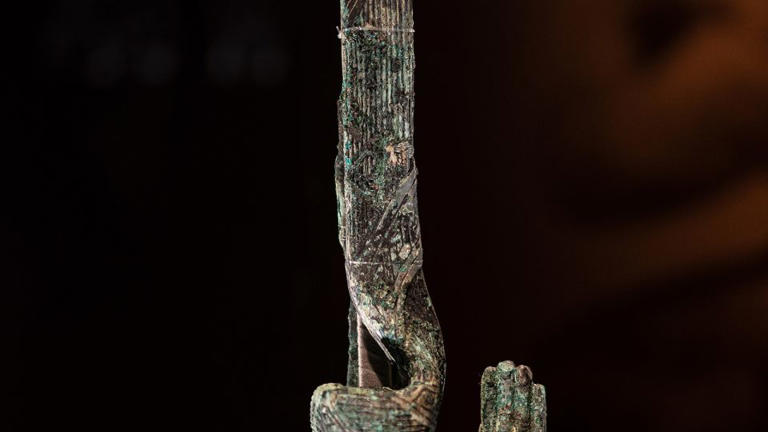

'Kneeling figure with a twisted head', bronze, at the Hong Kong Palace Museum in Hong Kong, China on September 26, 2023. - Noemi Cassanelli/CNN© Provided by CNN

After the Shu state was conquered by the Qin dynasty in 316 BC, Shu culture was “buried” under the “mainstream” culture that later emerged on China’s central plain, Chinese authorities wrote in a 2013 UNESCO submission seeking to have Sanxingdui and two nearby archeological sites recognized as World Heritage Sites. They are currently on UNESCO’s “tentative list.”

Since 1986, eight excavated pits at Sanxingdui have yielded giant masks of gods with bulbous, insect-like eyes and protruding ears, mythical creatures with gaping mouths and an almost 4-meter-tall (13-foot) bronze “tree of life” sculpture decorated with ornaments like a Christmas tree. All the items were found shattered, burned and buried, leading experts to believe the pits were used for ritual sacrifices. Some have now been painstakingly re-constructed by archaeologists. “It took 10 years to reconstruct the tree,” said Wang Shengyu, an assistant curator at the museum who helped curate the exhibition.

That tree is not on show in Hong Kong, as it is considered too precious to send abroad, but a section of one of six others discovered and ornaments are on display at the museum, as well as a 3D holographic projection of what experts think it would have looked like – its layers and branches adorned with birds, flowers, fruit, dragons, bells as well as jade and gold foil ornaments. The set are thought to have been part of a theater space.
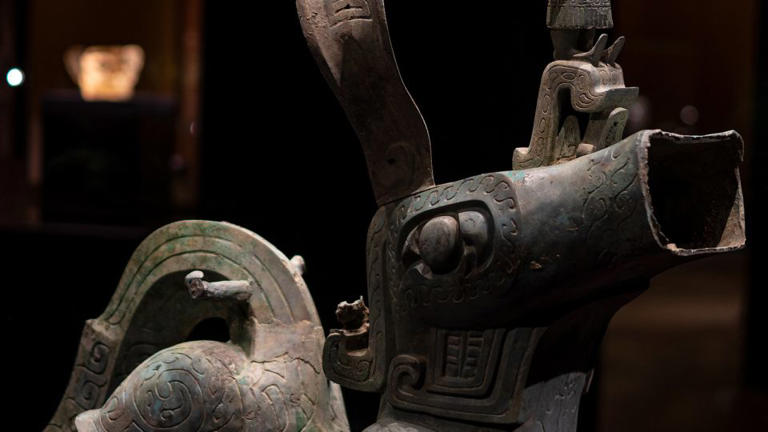

A mythical creature depicted in bronze. - Noemi Cassanelli/CNN© Provided by CNN
‘Historical myth’ of a continuous civilization

The exhibition places these items in the context of other ancient civilizations and includes the Shu among the many societies to have existed in the country’s “5,000-year history.” According to a press release from organizers, museum and Hong Kong government officials at the opening stressed the “continuity, inventiveness, unity, inclusiveness and emphasis on peace and harmony” of Chinese history.


Henry Tang, chairman of the governing body behind the West Kowloon Cultural District (where the Palace Museum is located) and a former candidate for Hong Kong’s top leadership role, said in a statement that the district and museum are looking to “promote cultural and artistic exchanges between China and the world, ‘tell China’s story well’, and strengthen the public’s cultural self-confidence.”

But the narrative that the Shu kingdom was innately Chinese is contentious, according to Ian Johnson, a senior fellow for China Studies at US think tank, the Council on Foreign Relations.


A figure on display at the Hong Kong Palace Museum. - Noemi Cassanelli/CNN© Provided by CNN

“Over the past few decades, the (Chinese Communist Party) has been trying to push a historical myth that all the peoples who have ever lived inside the current borders of the People’s Republic are ‘Chinese,’” he told CNN over email.

“The basic idea is that the PRC (People’s Republic of China) encompasses people who naturally belong together and therefore, from today’s standpoint, form a nation. Hence any effort to have autonomy or even independence is taboo — it runs against history.”

The People’s Republic of China was established in 1949, and its government has often used China’s continuous history as evidence that ethnic groups such as the Tibetans and the Uyghurs have always belonged to China.
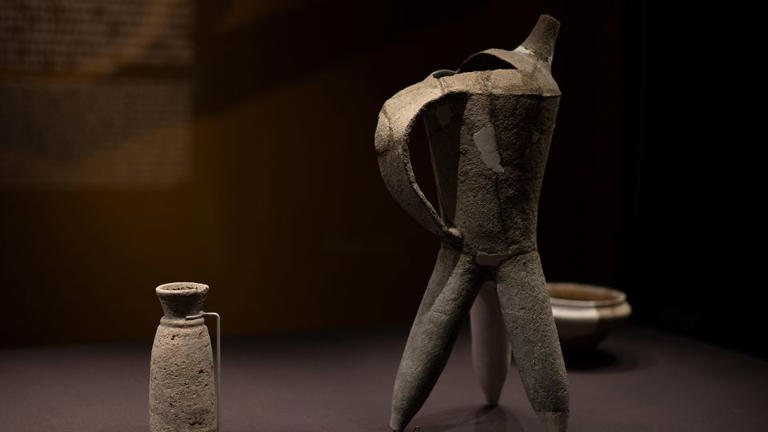

Vessels found at Sanxingdui. - Noemi Cassanelli/CNN© Provided by CNN

Johnson said that there was little support for the idea that civilizations along the Yellow River had much in common with those in the Sichuan Basin.

“They have commonalities but are not the same — just as ancient Assyrians and Phoenicians and Greeks weren’t the same, even if they shared certain things in common,” he said, adding: “sponsoring these kinds of exhibitions are popular and win the government credit.”

When asked to comment, the Hong Kong Palace Museum said the exhibition was “curated based on academic and archaeological research” and that it reinforces its mission to deepen audiences’ “understanding of the lives and cultures of various regions and ethnic groups as well as exchanges among them in ancient China, which have contributed to the magnificence of China’s civilization and its ‘diversity in unity’ pattern of development.”
Hong Kong's new national security bill includes stiff penalties and more power to suppress dissent

The bill allows prosecutions for acts committed anywhere in the world for most of its offenses.


HONG KONG (AP) — Hong Kong unveiled a proposed law that threatens life imprisonment for residents who “endanger national security" on Friday, deepening worries about erosion of the city’s freedoms four years after Beijing imposed a similar law that all but wiped out public dissent.

It’s widely seen as the latest step in a crackdown on political opposition that began after the semi-autonomous Chinese city was rocked by violent pro-democracy protests in 2019. Since then, the authorities have crushed the city's once-vibrant political culture. Many of the city’s leading pro-democracy activists have been arrested and others fled abroad. Dozens of civil society groups have been disbanded, and outspoken media outlets like Apple Daily and Stand News have been shut down.

Hong Kong leader John Lee has urged legislators to push the Safeguarding National Security Bill through “at full speed," and lawmakers began debate hours after the bill was released publicly. It's expected to pass easily, possibly in weeks, in a legislature packed with Beijing loyalists following an electoral overhaul.

The proposed law will expand the government’s power to stamp challenges to its rule, targeting espionage, disclosing state secrets, and “colluding with external forces" to commit illegal acts among others. It includes tougher penalties for people convicted of working with foreign governments or organizations to break some of its provisions.


Related video: Hong Kong Publishes Draft of New Security Law (Bloomberg)
Duration 3:09  View on Watch

The law would jail people who damage public infrastructure with the intent to endanger national security for 20 years — or life, if they collude with an external force to do so. In 2019, protesters occupied the airport and vandalized railway stations.

Similarly, those who commit sedition face a jail term of seven years, but colluding with an external force to carry out such acts increase that penalty to 10 years.

On Thursday, an appeals court upheld a conviction for sedition against a pro-democracy activist for chanting slogans and criticizing the Beijing-imposed 2020 National Security Law during a political campaign.

Its expansive definition of external forces includes foreign governments and political parties, international organizations, and “any other organization in an external place that pursues political ends” — as well as companies that are influenced by such forces. Beijing said the 2019 unrest was supported by external forces, and the city government has condemned what it called external interference during the protests.

The bill allows prosecutions for acts committed anywhere in the world for most of its offenses.

Critics say that the proposed law would make Hong Kong even more like mainland China.


The European Union said the bill covers “an even wider range” of offenses than previously disclosed, including sweeping bans on external interference and significantly hardened provisions on sentencing.

“The legislation risks exacerbating the erosion of fundamental freedoms in Hong Kong brought about, in particular, by the 2020 National Security Law,” it said.


However, Beijing insisted that the bill balances maintaining security with safeguarding rights and freedoms. The city government said it was necessary to prevent a recurrence of the massive anti-government protests that rocked the city in 2019, insisting it would only affect “an extremely small minority” of disloyal residents.

It defined national security as a status in which the state's political regime and sovereignty are relatively free from danger and threats, so are the welfare of the people and the state's economic and social development among other “major interests.”

The legislature's president, Andrew Leung, told reporters that the process was accelerated because the bill was necessary to safeguard national security.

“If you look at other countries, they enacted it within a day, two weeks, three weeks. … So why can't Hong Kong do it in a speedy manner? You tell me," the pro-Beijing politician said.

But the British consulate in Hong Kong urged authorities to “allow time for proper legislative scrutiny.” The city was a British colony until it returned to Chinese rule in 1997.

Hong Kong’s mini-constitution, the Basic Law, requires the city to enact a national security law, but a previous attempt sparked a massive street protest that drew half a million people, and the legislation was shelved.

Such protests against the current bill are unlikely, due to the chilling effect of the 2020 law after it was enacted to quell the 2019 protests.

During a one-month public comment period that ended last week, 98.6% of the views received by officials showed support, and only 0.72% opposed the proposals, the government said. The rest contained questions or opinions that did not reflect a stance on the law, it added.

But businesspeople and journalists have expressed fear that a broadly framed law could criminalize their day-to-day work, especially because the proposed definition of state secrets includes matters linked to economic, social and technological developments. The government has sought to allay concerns by adding a public interest defense under specific conditions in the proposal.

John Burns, an honorary professor of politics and public administration at the University of Hong Kong, said it remains to be seen how courts will interpret the provision that allows a public interest defense to charges of disclosing state secrets.

The bill, if passed as tabled, is likely to have chilling effect on local civil society, Burns said, especially political and public policy lobby groups that have benefited from connections to overseas counterparts.

“At least initially, I expect them to be especially cautious about expanding links with similar groups overseas,” he said.

Eric Lai, a research fellow at Georgetown Center for Asian Law, said fears about the law “are now materialized."

He called it “overbroad and vague," particularly for offenses involving state secrets and external forces, and said it would undermine due process by allowing extended detention without charges, and by limiting the right to a lawyer.

People arrested on suspicion of national security offenses and released on bail could face “movement restriction orders” which limit the places they can go and where they can live, as well as prevent them from communicating with certain people.

Police can also apply to the court to extend detentions and prohibit suspects from consulting certain lawyers.

Authorities would also be empowered to use financial sanctions to punish people who have fled abroad, such as preventing other people from hiring them, leasing them property, starting businesses with them, or providing economic support to them.

Last year, police offered bounties of 1 million Hong Kong dollars ($128,000) on more than a dozen activists living abroad, including former lawmakers Nathan Law and Ted Hui, whom they accuse of colluding with external forces to impose sanctions on Hong Kong and China.

Prisoners convicted of national security offenses will not be eligible for sentences reductions until authorities are confident early release would not risk national security. This would apply to all national security prisoners, even those whose sentences were imposed prior to the bill.

___

Follow AP's Asia-Pacific coverage at https://apnews.com/hub/asia-pacific

Kanis Leung And Zen Soo, The Associated Press


'Culture wars are getting us nowhere': Florida lawmakers tiring of DeSantis’ 'war on woke'

Story by Carl Gibson • 
AlterNet

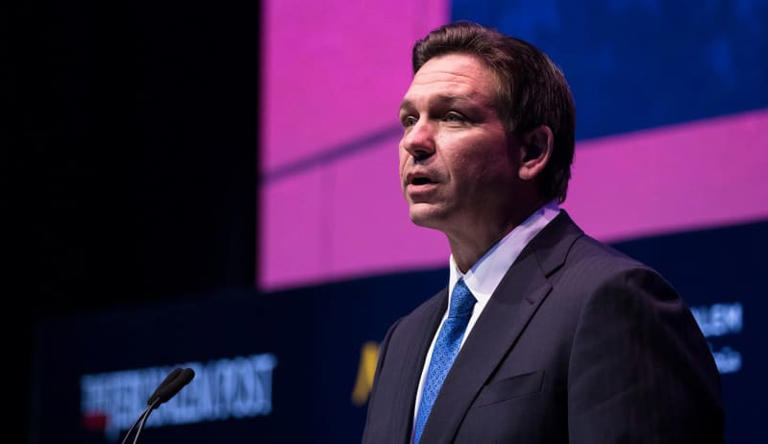
Florida Gov. Ron DeSantis gives a speech during the Jerusalem Post conference at the Museum of Tolerance on April 27, 2023 in Jerusalem, Israel.
 (Photo by Amir Levy/Getty Images)© provided by AlterNet

Ever since scuttling his presidential ambitions, Florida Governor Ron DeSantis (R) has been slowly losing influence in the Florida legislature.

The Sunshine State's annual legislative session gaveled out this week, with several of DeSantis' major culture war priority bills failing to advance through Florida's far-right Republican supermajority legislature. The Washington Post reported that one of the two-term Florida governor's biggest obstacles was Republican state senate president Kathleen Passidomo, who declined to bring up several hot-button bills for a vote.

One of those bills would have penalized municipal officials in towns that removed Confederate monuments. One speaker at a committee hearing reportedly extolled that bill to "push white culture, white supremacy." That legislation was praised by DeSantis, who said it was "totally appropriate," and likened efforts to remove Confederate statues to a "hyper-woke 21st century test." The bill advanced through its respective committee, but Passidomo never brought it up in the full senate, calling it "so abhorrent to everybody."

READ MORE: DeSantis admits he's 'looking' for 'credible case' to ban Biden from Florida's 2024 ballot

Another bill that would have banned public buildings from displaying rainbow flags — as some do during June, when LGBTQ+ Pride Month is celebrated — didn't even make it past the Florida House subcommittee where it was introduced. Other culture war-related bills suffered a similar fate: Legislation that would have forced transgender Floridians to use their assigned sex at birth on their driver's licenses didn't make it, nor did a bill that would have penalized public employees from using transgender individuals' chosen pronouns. A separate "fetal personhood" bill was also killed this session.

The Post reported that the Florida governor loudly supported all of those bills as part of his "war on woke," yet despite his party having a solid 86-34 majority in the house and a 28-12 majority in the senate, he wasn't able to sign them into law this session. Democratic state senator Shevrin Jones told the Post that "a lot of [DeSantis'] influence and power died" after DeSantis suspended his bid for the Republican presidential nomination.

"II think that people in Florida and across the country, including Republicans, are starting to see that the culture wars are getting us nowhere," Jones said.

Politico reported that DeSantis' grip on the legislature has waned considerably since he was swept into a second term in the 2022 election, and subsequently rammed numerous far-right bills through the statehouse in the 2023 session. Republican state representative Paula Stark remarked to the outlet that "everything was just crazy" in last year's session.

READ MORE: Ron DeSantis campaign blames 'election interference' after losing Iowa Caucus

"You had all these things that everybody wanted you to stand up and support because it was a governor’s initiative … Now this session has been calmer," she said.

DeSantis' presidential campaign sputtered out after the Iowa Republican Caucuses, in which he failed to win a single one of Iowa's 99 counties despite visiting all of them ahead of the 2024 nominating contest (colloquially known as a "full Grassley"). The Florida governor spent millions of dollars courting Iowa Republicans, only to come in a distant second place to former President Donald Trump. His prolonged absence from Tallahassee during his presidential campaign angered some of his constituents — along with his campaigning against the former president.

"He backstabbed our president," GOP voter Sally Maltais told NPR in November. "And now I have no respect for DeSantis. I'm sorry. I don't."

Trump also frequently mocked DeSantis, particularly amid the so-called "bootgate" controversy in which the Florida governor was accused of wearing inserts in his boots to appear taller. A Trump campaign press release suggested DeSantis' boots "are more appropriate for America’s Next Top Model than the campaign trail."

READ MORE: 'He backstabbed our president': Florida Republicans say they have 'no respect' for DeSantis
Related Articles:

'Is this 2023?' Miami newspaper rips Florida GOP lawmakers for playing 'fashion police' with female employees

DeSantis allies start to back off book bans amid national outrage: 'May have gone too far'

Lawmaker’s 'simple' attempt to push back against book bans becomes culture war flash point
Josie Cox's New Book Champions Gender Equality Through Remarkable Women's Stories   (Exclusive)

Story by Lizz Schumer • 5d • PEOPLE

One of the people featured in 'Women Money Power' is Mae Krier, 97, the last of the "Rosie the Riveters" who stepped into the workforce during WWII


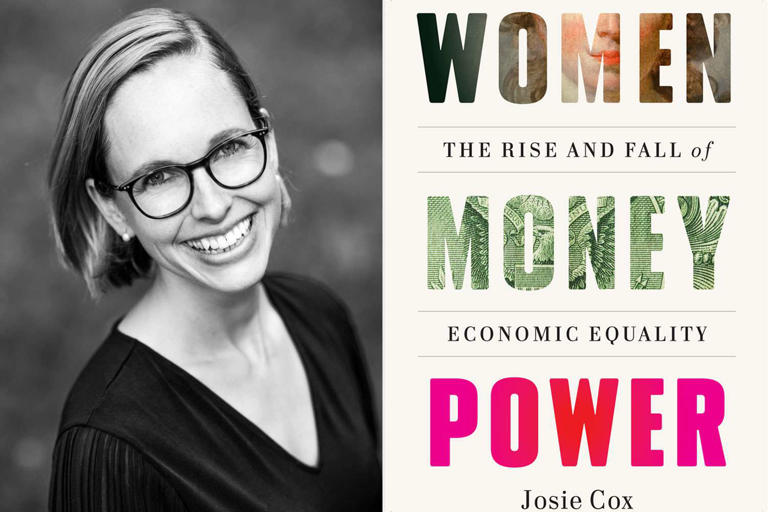
Nancy Borowick, Abrams Josie Cox with her book 'Women Money Power'
© Provided by People

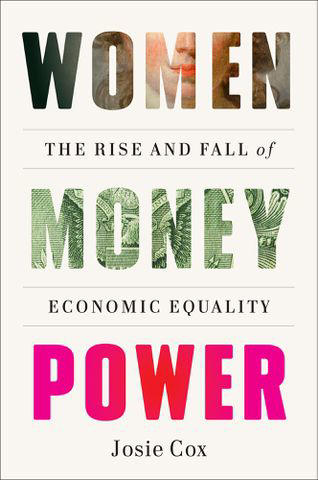
In a sense, business journalist Josie Cox has spent her whole career gearing up to write her new book. Women Money Power: The Rise and Fall of Economic Equality. But one interview with a wealthy business mogul crystallized its urgency.

When Cox asked an ”extremely prominent businessman” about the gender pay gap, he reasoned that “sometimes when women decide to start a family and leave the paid labor market briefly to take maternity leave, when they come back, they're just not as professionally ambitious as men,” Cox tells PEOPLE. "That infuriated me, and it made me realize that these views and these opinions are still so prevalent.”

That fury fueled Cox’s new book (out March 5 from Abrams), which charts women’s fight for financial freedom as well as the social and political hurdles that make it so challenging. It features pioneers who stood up to norms of their time, including the “Rosies” who filled industrial jobs left open by men during World War II, the heiress who helped create the birth control pill, the investor who breached the boys’ club of the New York Stock Exchange and the namesake of equal pay legislation who refused to accept less than she deserved.

As she researched, Cox expected to find a trajectory of progress, a story of hope. But what she found was that American culture has a long way to go.


Abrams Cover of Women Money Power: 
The Rise and Fall of Economic Equality by Josie Cox
© Provided by People


Related: Women's History Month: How It Started, Why We Celebrate in March and More Questions Answered

“Unlike the laws that were introduced in the 1970s and 1980s that prevented a woman from getting fired for getting pregnant, prevented men and women for from getting paid different amounts of money for doing exactly the same work, laws allowing women to get credit to start a business, to get a mortgage to open a bank account — that really led to tangible, measurable progress,” Cox says, explaining, “Culture is not tangible, and it's not measurable. And so that's the part of the equation that we're still struggling to fix.”

One of the pioneers who’s spent the last 40 years as a part of that struggle is Anna “Mae” Krier, 97, the last of the Rosies who took engineering jobs at Boeing when the men were called to fight in WWII. Krier joined the workforce when the country needed women to fill the boys’ shoes in 1941, and hasn’t stopped working for equality since.


courtesy of Anna "Mae"Krier Mae Krier, one of the original "Rosies"
© Provided by People

Mae still drives herself around in her red Ford pickup (she mused that she'll have to renew her license when she turns 100 in a couple of years) and recently got a chance to get behind the wheel of a Sherman tank when attending a ceremony in Texas. Although she declined the offer to skydive while she was there, she’s not afraid of much, least of all speaking her mind.
“When women went into the workplace, it was the men's world up until 1941. They didn't know how capable American women were, and we were amazing. We were much better than a lot of the men, and they'll even admit that sometimes,” she tells PEOPLE.

“But I've never stopped working for equal pay for the same job, because this was so unfair we were every bit as good or better than the men, and yet they got paid a lot more than we did,” Mae adds. “We’re not there yet, and we’ve got a ways to go.”

Related: Celebrating Women's History Month: These 20 Women's Words Will Undoubtedly Inspire You

It’s no exaggeration to say that Mae and her fellow Rosies helped win the war, but they weren’t treated that way when the troops came home. “The men came home to flying flags and praise, and we came home with the pink slip. The men got the G.I. Bill, education, mortgages. We didn't,” Mae recalls. “In our day, if a man and woman applied for the same job, the man would get his foot in the door, and the woman would go home. So it isn't fair at all.”


courtesy of Anna "Mae"Krier A younger Mae Krier
© Provided by People

Cox hopes her book sheds light not only on the persistent wage gap and how it continues to impact women today, but also help show her own daughter that gender shouldn’t be a deterrent to her dreams.

For her part, Mae travels around the country spreading that same message. “When I speak to these girls [in schools], I say to them, ‘You're just as capable as the boy next to you,’” she tells them. “‘Just don't let him think that he can do it better, because he's a male. That's not the case.’”

Through portraits of the women whose shoulders we all stand on and incisive commentary on how we reach higher from where we stand, Cox hopes her book makes its way to everyone who has a hand in working toward equality. That is, just about everyone.

“I really want to convey with this book that inequality is everybody's problem and as a result of that, everybody stands to benefit from a more equal society and a more equal economy,” Cox explains.

Or, one of Mae’s personal mantras: “Change has got to start somewhere.”


UN chief: Legal equality for women could take 300 years as backlash rises against women's rights


“Poverty has a female face; One in every 10 women in the world lives in extreme poverty.”

UNITED NATIONS (AP) — Legal equality for women could take centuries as the fight for gender equality is becoming an uphill struggle against widespread discrimination and gross human human rights abuses, the United Nations chief said on International Women’s Day.

Secretary-General Antonio Guterres told a packed U.N. commemoration Friday that “a global backlash against women’s rights is threatening, and in some cases reversing, progress in developing and developed countries alike.”

The most egregious example is in Afghanistan, he said, where the ruling Taliban have barred girls from education beyond sixth grade, from employment outside the home, and from most public spaces, including parks and hair salons.

At the current rate of change, legal equality for women could take 300 years to achieve and so could ending child marriage, he said.

Guterres pointed to “a persistent epidemic of gender-based violence,” a gender pay gap of at least 20%, and the underrepresentation of women in politics. He cited September’s annual gathering of world leaders at the U.N. General Assembly, where just 12% of the speakers were women.

“And the global crises we face are hitting women and girls hardest — from poverty and hunger to climate disasters, war and terror," the secretary-general said.

In the past year, Guterres said, there have been testimonies of rape and trafficking in Sudan, and in Gaza women women and children account for a majority of the more than 30,000 Palestinians reported killed in the Israeli-Hamas conflict, according to the Gaza Ministry of Health


France 24
Gender divide: The ideological gap emerging between young women & men
View on WatchDuration 12:16
France 24Calls for equality around the world on International Women's Day
1:40
WIONGreater economic participation of women essential for India's growth
8:07


He cited a report Monday by the U.N. envoy focusing on sexual violence in conflict that concluded there are “reasonable grounds” to believe Hamas committed rape, “sexualized torture” and other cruel and inhumane treatment of women during its surprise attack in southern Israel on Oct. 7. He also pointed to reports of sexual violence against Palestinians detained by Israel.

International Women’s Day grew out of labor movements in North America and across Europe at the turn of the 20th century and was officially recognized by the United Nations in 1977. This year’s theme is investing in women and girls to accelerate progress toward equality.

Roza Otunbayeva, the head of the U.N. political mission in Afghanistan, told the Security Council on Wednesday that what is happening in that country “is precisely the opposite” of investing in women and girls.

There is “a deliberate disinvestment that is both harsh and unsustainable,” she said, saying the Taliban’s crackdown on women and girls has caused “immense harm to mental and physical health, and livelihoods.”

Recent detentions of women and girls for alleged violations of the Islamic dress code “were a further violation of human rights, and carry enormous stigma for women and girls,” she said. It has had “a chilling effect among the wider female population, many of whom are now afraid to move in public,” she said.

Otunbayeva again called on the Taliban to reverse the restrictions, warning that the longer they remain, “the more damage will be done.”

Sima Bahous, the head of UN Women, the agency promoting gender equality and women’s rights, told the commemoration that International Women’s Day “sees a world hobbled by confrontation, fragmentation, fear and most of all inequality.”

“Poverty has a female face,” she said. “One in every 10 women in the world lives in extreme poverty.”

Men not only dominate the halls of power but they “own $105 trillion more wealth than women,” she said.

Bahous said well-resourced and powerful opponents of gender equality are pushing back against progress. The opposition is being fueled by anti-gender movements, foes of democracy, restricted civic space and “a breakdown of trust between people and state, and regressive policies and legislation,” she said.

“We all feel this pushback acutely,” Bahous said. “Our values and principles have never been as challenged as they are today.”

Guterres urged nations to prioritize equality for women and girls. He announced that the U.N. is launching a “Gender Equality Acceleration Plan” to support governments in designing and implementing policies and spending that respond to the needs of women and girls.

Bahous drew strong applause when she called for a humanitarian ceasefire in Gaza, which Guterres has long sought as well.

She also urged funding for women and girls, stressing that when this happens economies grow, governments thrive and peace is achieved sooner.

“But in spite of these clear facts, we continue to stubbornly invest in weapons more than we invest in women and girls,” Bahous said.

Edith M. Lederer, The Associated Press


Bring Back Corporate Pension Plans. 

Seriously.

Story by Telis Demos
 • The Wall Street Journal

Bring Back Corporate Pension Plans. Seriously.© Ruth Gwily

It sounds like an idea frozen in time: Spend your career working at a company and then keep getting checks for the rest of your life. Now rising interest rates could help thaw the traditional corporate pension plan.

Forty years ago, 88% of Americans had retirement coverage from defined-benefit plans, according to the Center for Retirement Research at Boston College. These are the classic pension plans in which employers make the contributions and promise a payout, taking on the risk of having earned enough to cover those payments over retirees’ expected lifetimes.


But by 2019, that was down to just 28%. While defined-benefit plans remain common for many state and local government workers, only 11% of employees in private industry were participating in one as of March 2022, according to the U.S. Bureau of Labor Statistics.

Instead, two-thirds of private employees now have access to defined-contribution plans in which they contribute to a retirement account such as a 401(k) and assume the risks of growing that portfolio. Defined-contribution plans have become a bedrock of the modern financial-services industry with more than $10 trillion in assets, according to the Investment Company Institute.


Meanwhile, many old pension plans have been sold off to insurance companies and transformed into annuities with their own fee streams. It is unlikely that many chief financial officers are eager to take back all of the risks of retirement back from their workers.

Still, some private workers might pine for a more old-fashioned retirement guarantee, as many families simply haven’t built up worry-free cushions on their own. The median value of retirement account for people 55 to 64 was just $185,000 as of 2022, according to the Federal Reserve’s Survey of Consumer Finances. Counting on Washington to ensure that Social Security will be there in its current form is hardly reassuring with its main old-age trust fund set to be depleted in 10 years, according to its trustees.

Even daydreaming about old corporate pension plans might have seemed pointless for a long time. Earlier this century, market disasters like the dot-com bust and the 2008 financial crisis contributed to a big funding problem. In 2000, the top 100 U.S. corporate pensions had assets representing 123% of their liabilities, according to J.P. Morgan Asset Management. That dropped to 82% in 2002 rose back to full funding in 2007, then hit a low of 77% in 2012. During those years many sponsors moved to freeze their plans from adding new benefits as they tried to climb out of those holes.

But now that conversation can at least start again. After some years of strong market returns, plus a surge in interest rates, the baseline for corporate pension funds has changed: Many of those funding gaps have closed. The top 100 corporate plans last year returned to better-than fully-funded status, at 103%, according to J.P. Morgan.

A big reason is that the Federal Reserve’s interest-rate hikes have made pensions’ future obligations cheaper—or in financial parlance, raised the rate at which their liabilities are discounted to present values. Assuming the current pension discount rate is maintained, actuarial and consulting firm Milliman projected a $60 billion surplus, or a funded ratio of 105%, by the end of 2024 for its index of the 100 largest defined-benefit pension plans sponsored by U.S. public companies.

Rising rates open up entirely new possibilities for those frozen plans, and even new plans. Higher bond yields have a big impact on the cost of adding new beneficiaries, as benchmark corporate bond interest rates help determine pensions’ discount rate. During the period of superlow interest rates after the start of the Covid-19 pandemic, around mid-2020, it would have cost about $1.2 million in today’s dollars to provide a $100,000 annual retirement annuity to a 45-year-old, according to calculations by J.P. Morgan. At the recent discount rate calculated by Milliman, it would cost around half a million.

There were also provisions in the 2021 American Rescue Plan Act and Infrastructure Investment and Jobs Act that will help lower the minimum cash funding requirements for plans, according to Zorast Wadia, principal and consulting actuary at Milliman. “These were game-changers for pension plans,” he says.

What it costs to offer a pension benefit can also be considered against the wider context of rising workforce expenses. Some companies have struggled to attract and retain workers over time.

“This is a conversation I’ve had more in the last year or two than in the prior decade,” says Jonathan Price, national retirement practice leader at benefits consulting firm Segal.

Defined-benefit pensions could be a powerful tool for retention, at least for people who might consider staying with the same employer for years. Workers who expect to hop between jobs may prefer the flexibility to change employers without worrying about their retirement benefits.

Meanwhile, 401(k)s are hardly free. J.P. Morgan calculates that the employer portion of defined-contribution plans, like matching, have risen at a compound rate of 5.9% since 1993, reaching $160 billion in 2020.

“A modern employer cannot escape the responsibility of providing retirement benefits,” says Jared Gross, head of institutional portfolio strategy at J.P. Morgan Asset Management. “But it can choose to deliver those benefits in the most cost effective way.” His opening keynote at the National Institute on Retirement Security’s annual meeting in February was titled, “Is It Time to Reopen Pension Plans?”

There are also ways for companies to share some of the potential costs of defined-benefit plans with workers. “Dinosaur” corporate plans that have payouts based on an employee’s highest wages might not come back, says Milliman’s Wadia. But there are hybrid plans that do things like shift some market risk to employees’ benefits, he says.

The return of the T. rex is science fiction. The corporate pension plan doesn’t have to be.

Write to Telis Demos at Telis.Demos@wsj.com

SAG-AFTRA's Duncan Crabtree-Ireland On The State Of Negotiations With Video Game Industry & Possible Strike: "We're Getting To The End Of The Road"

Story by Katie Campione
 • 
Deadline


Will Hollywood experience another actors strike in the coming months?

After more than a year of negotiating with the video game companies on a new Interactive Media Agreement, SAG-AFTRA National Executive Director Duncan Crabtree-Ireland indicated the guild might soon be walking away from the table due to sticking points regarding artificial intelligence.

"We have strike authorization on that contract and it is, at this point, at least 50/50, if not more likely, that we end up going on strike…in the next four to six weeks because of the inability to get past these basic AI issues," he said during a conversation with Brendan Vaughan, Editor-in-Chief of Fast Company, at SXSW focused on the intersection of Hollywood and AI.

In September, members overwhelmingly authorized a strike authorization on this current contract.

This is talk of another strike comes on the heels of the actors' 118-day work stoppage last year to achieve the latest film and TV contract, which did manage several gains when it comes to language regulating artificial intelligence. Many of the issues between the two contracts are similar, including wages and AI.

Following the panel, Crabtree-Ireland spoke with Deadline about the state of negotiations on the Interactive Media Agreement and how imminent a strike may actually be.

DEADLINE: You mentioned that some "basic AI issues" were the current sticking points in the video game negotiations. Can you expand upon what those issues are?

DUNCAN CRABTREE-IRELAND: I think some of them are very similar [to the film and TV contract issues], but I think the one that I mentioned [that is different], is applying AI protections to creature performers and other types of movement performers that don't have lines. They don't speak but are creating a performance and really central to the action of the game. I think that is an area where we haven't been able to achieve the results we need just yet. We've been in this bargaining for over a year. The results of the strike last year did move things a little bit in the right direction. A couple of the major video game companies are companies that are also part of the AMPTP, specifically Disney and Warner Brothers, for example. But I think what has to be recognized is that all performers should be entitled to the same type of AI protections and companies that are trying to distinguish performers from other performers and say, ‘Only some of them are gonna get protections and not the others…' That's not something we're going to be able to go along with.

DEADLINE: I know you had hoped the Replica Studios agreement might move things along. Did that yield any progress in these negotiations?

CRABTREE-IRELAND: I mean, I think the movement that we see is really the pressure that comes from having other legit companies in the space saying, ‘We can work with this, and we've signed a deal that says we will work with this.' So I think that creates pressure. On the other hand, these are very big companies, the ones that we're talking about in this bargaining group. So they aren't necessarily always as nimble as you might like. And of course, the acquisition of Activision Blizzard by Microsoft, it remains to be seen what impact that might have on the landscape.

DEADLINE: As you said, these negotiations have been ongoing for more than a year. You've had a strike authorization since September. What is indicating to you now that there could or should be a strike?

CRABTREE-IRELAND: I mean, a strike is always the last resort for us. So when we see that there is progress, or we see there's movement, then we always want to explore how far we can take that before we pull the trigger on a strike. It just feels like we're getting to the end of the road. Movement is sort of stopped. And if we're not where we need to be, and we're not getting indications from the companies that they are going to be prepared to move where we need to go, then that pretty much tells us what we need to know.

DEADLINE: So what indications would you need to know the companies are serious about moving forward?

CRABTREE-IRELAND: If the negotiating team on their side gives us some kind of concrete indications of new proposals or…new movement on the proposals that are on the table. That'd be the kind of thing that we would take into account, but this has been a really long process. So we also aren't going to just let it drag on indefinitely. The reality is if the companies are not going to go there without us taking that step, then we'll take that step.


DEADLINE: About how many SAG-AFTRA members would be affected by this strike?

CRABTREE-IRELAND: It would affect thousands in total. Not as many as the film and television strike obviously, but a substantial amount of our members are engaged in production work, whether it's voice work or performance capture, or on camera performance work for these companies. So I expect it would affect quite a significant number of people fairly quickly.

DEADLINE: You are speaking on another panel about AI soon, and this panel is one of many you've participated in. How do these panels and conversations shape your perception of AI regulations as you look to the future of all SAG-AFTRA negotiations?

CRABTREE-IRELAND: It's great to get the chance to hear from members everywhere about what their experiences are, because I don't think everyone's experience engaging with AI is the same. But I also think it's part of our role to help to help prompt a dialogue in the industry about what AI ought to look like and how it ought to be implemented, and it would be wrong for us to let only the companies dominate that conversation. There's too much of that already in the tech world and too much of it in our world. So I think what we need is the balance in that conversation. And whenever I get the chance to help balance that conversation out, I'll take it. I know my colleagues from other unions are doing the same as well.

DEADLINE: Anything else you wanted to add?

CRABTREE-IRELAND: Our new tiered agreements for indie game developers [are] really gaining quickly traction in the indie industry, because they there's a recognition that the permissions are really quite reasonable and not hard to work with. I'm going to be speaking on a panel at GDC, and we'll also be there helping make sure that the entire indie game community is very well aware of our tiered agreements. I think that will - to your point - also provide work opportunities for our members in the event we go on strike, because, just like with interim agreements last year, any companies who are willing to have fair terms, we're happy for our members to continue working with them during that process.


More from Deadline
SAG-AFTRA "50/50, If Not More Likely" To Strike Against Video Game Companies Soon, Duncan Crabtree-Ireland Says

ONTARIO

CUPE 1331 and HPPH reach tentative agreement

Story by The Canadian Press
 • 

After over three years of negotiations, Huron Perth Public Health (HPPH) and Canadian Union of Public Employees (CUPE) members have reached a tentative agreement.

The tentative agreement was reached Feb. 15 after more than eight hours of bargaining. The union is pleased to have reached a tentative deal it says will improve working conditions for members. 

With the assistance of a ministry of labour conciliator, this agreement aims to offer fair working conditions for CUPE members currently employed at HPPH. 

At this time, details of the negotiation are not available, however CUPE 1331 president Pam Hanington says more details will come once the board of health votes on the tentative agreement on March 8. 

CUPE Local 1331, representing a wide range of HPPH employees from health promoters to custodians, were seeking a 35-hour work week and increased wages and benefits.

“The possibility of labour disruption is there should conciliation not lead to a deal these workers deserve,” a CUPE Local 1331 representative told the Stratford Times before a tentative agreement was reached.

CUPE Local 1331 was formed in July 2020 after the locals of the former Huron County and Perth District health units merged. 

CUPE Local 1331 advocates for workers who deliver the public services people depend on. They aim to help members by providing the highest level of service by ensuring they are safe and healthy at work and they get fair pay and benefits for the services they provide.

Amanda Modaragamage, Local Journalism Initiative Reporter, Stratford Times

Union calls on cabin crew at German airline Lufthansa to strike

Story by DPA International • 15h • 

Employees demonstrate in front of the Lufthansa Technik premises in Hamburg. The warning strike for passenger-related areas is due to end at 7.10 a.m. on 9 March. According to Lufthansa, around 200,000 passengers are likely to be affected by cancellations and delays in air traffic. 
Ulrich Perrey/dpa© DPA International

The Ufo union is calling on some 19,000 flight attendants at German carrier Lufthansa and its subsidiary Lufthansa Cityline to go on strike on Tuesday and Wednesday, the union announced.

The strike will affect all departures from Frankfurt from 4 am (0300 GMT) to 11 pm on Tuesday and all departures from Munich on Wednesday, the union said on Saturday evening.

More than 96% of flight attendants of the core company and at Lufthansa Cityline had previously voted for industrial action in separate strike ballots, Ufo said.

The union stressed that Lufthansa had announced a record result of almost €1.7 billion ($1.86 billion) in net profit on Thursday - the third best in the group's history.

"The cabin must now also be involved in this success and the concessions made during the coronavirus crisis must be sufficiently compensated," said Joachim Vázquez Bürger, UFO board chairman.

UFO is essentially demanding a 15% increase for the cabin crew and also wants to achieve an inflation compensation bonus of €3,000.

The union has rejected Lufthansa's offers in separate collective bargaining negotiations as inadequate.

Last week, ground staff organized by another union, verdi, paralyzed much of Lufthansa's passenger traffic with what was now their fifth wave of warning strikes.


Airport ground staff, which includes technicians, logistics and counter staff, previously went on strike in February.

The two unions Ufo and verdi operate independently of one another and are considered rivals.

The final effects of the most recent strike, which lasted more than two days, were still felt on Saturday morning with some flight cancellations and delays.


Employees demonstrate in front of the Lufthansa Technik premises in Hamburg. The warning strike for passenger-related areas is due to end at 7.10 a.m. on 9 March. According to Lufthansa, around 200,000 passengers are likely to be affected by cancellations and delays in air traffic. Ulrich Perrey/dpa© DPA International
German Farmers' Association willing to compromise on diesel subsidies

Story by DPA International • 13h • 

Bernhard Kruesken, Secretary General of the German Farmers' Association
© DPA International

The German Farmers' Association (DBV) has signalled its willingness to reach an agreement in the dispute over the tax exemption for agricultural diesel, saying it will not insist on the subsidy being retained in full.

"We are prepared to compromise if, in return for additional fuel costs, there is real relief in other areas," DBV Secretary General Bernhard Krüsken told the newspaper Welt am Sonntag.

"We don't want to pretend to our members that whoever shouts the loudest will be heard the best."

The conservative opposition Christian Democratic Union (CDU) and sister party the Christian Social Union (CSU) parliamentary group in the German lower house of parliament, the Bundestag, is calling for a swift agreement.

"It is advisable to accommodate the farmers now - not only for reasons of content, but also to remove the basis for any radicalization tendencies of individuals who do not represent the broad mass of peacefully protesting farmers," said the deputy CDU/CSU parliamentary group leader Steffen Bilger.

Any possible compromise would have to be discussed with the farmers, otherwise it would miss its target, he said.

But regional farmers' groups in Saxony-Anhalt state indicated they are less willing to compromise.

Martin Dippe, President of the Farmers' Association of Saxony-Anhalt, said on Saturday that farmers did not take to the streets for months only to walk things back meekly now

In a joint statement, three regional associations in Saxony-Anhalt said they are sticking to their demand that the tax exemption is retained.

Farmers in Germany have been protesting for months by blocking traffic on motorway on-ramps and choking traffic in major cities, over government plans to scrap agricultural diesel subsidies.
B.C. class action alleges menstruation cycle tracking app breached users' privacy


VANCOUVER — A British Columbia Supreme Court judge says a class-action lawsuit can move forward over alleged privacy breaches against a company that made an app to track users' menstrual and fertility cycles.

The ruling published online Friday says the action against Flo Health Inc. alleges the company shared users' highly personal health information with third-parties, including Facebook, Google and other companies.

The ruling says the company's Flo Health & Period Tracker app is available in more than 100 countries with millions of users around the world, assisting women by tracking "all phases of their reproductive cycle."

The decision that certifies the class-action says it would cover more than one million users, who added personal information about their menstrual cycles, and other data including their bodily functions and when and how often they had sexual intercourse.

The proposed action covers more than a million Canadians who used the app between June 2016 and February 2019, excluding those in Quebec, where a separate class-action lawsuit was already certified in November 2022.

The lawsuit alleges that Flo Health misused users' personal information "for its own financial gain," claiming breach of privacy, breach of confidence and "intrusion upon seclusion."

The lawsuit was spurred by a U.S. Federal Trade Commission decision where Flo Health admitted it had sent users' private information about their periods and pregnancies to data analytics divisions of Google, Facebook and two other firms.

B.C. Supreme Court Justice Lauren Blake agreed to certify the class-action and appoint a representative plaintiff, saying "the ever-increasing modern capacity to capture, store and retrieve information in our digital age has led to a corresponding need for the legal capacity to protect privacy. "

"Privacy legislation has been recognized as being accorded quasi-constitutional status. In a similar manner, privacy torts — such as intrusion upon seclusion and breach of confidence — continue to evolve, and their proper scope in our modern world must continue to be addressed by our courts," Blake's ruling says.

This report by The Canadian Press was first published March 8, 2024.

The Canadian Press