Sunday, March 10, 2024


The Public Bank That Wasn’t: New Jersey’s Excursion into Public Banking

In 2017, Phil Murphy, a former Goldman Sachs executive, made the establishment of a public, state-owned bank a centerpiece issue during his run for New Jersey governor. He regularly championed public banking in speeches, town halls and campaign commercials. He won the race, and the nation’s second state-owned bank following the stellar model of the Bank of North Dakota (BND) appeared to be in view.

Due to the priority of other economic-policy goals, the initiative was largely kept on the back burner until November 2019. Then, in an article titled “Murphy Takes First Key Step Toward Establishing a Public Bank,” the New Jersey Spotlight announced:

Gov. Phil Murphy is planning to sign an executive order Wednesday [Nov. 13] that will create a 14-member “implementation board” to advance his goal of establishing a public bank in New Jersey.

The basic premise of such an institution is to hold the millions of dollars in taxpayer deposits that are normally kept in commercial banks and leverage them instead to serve some sort of public purpose. …  [Emphasis added.]

North Dakota currently is the only state that operates a public bank wholly backed by the deposit of government funds. [Emphasis added.] Founded a century ago to help insulate farmers from predatory out-of-state lenders, the Bank of North Dakota offers residents, businesses and students low-cost services like checking accounts and loans. It has also been used to advance projects that boost infrastructure and economic development, and has even produced revenue for the state budget’s general fund, according to the bank’s promotional materials, thanks to lending operations that regularly turn a profit.

Gov. Murphy signed Executive Order 91 on Nov. 13, 2019, and the Implementation Board worked diligently for the next 3-1/2 years to advance its goals. In June of 2023, the governor signed bill S3977/A5670 into law, creating the New Jersey Social Impact Investment Fund (SIIF) along with a $20 million appropriation for seed funding. The State engaged Next Street, a mission-driven advisory firm, to create a report with guidance and input from the Public Bank Implementation Board, and on Feb. 2, 2024, Next Street submitted its “Recommendations for Implementing a Public Bank in New Jersey” to the governor.

The report did a commendable job of identifying the extensive needs for increased financing by a wide variety of interests in New Jersey, including support for small business, affordable housing, home ownership, student loans, education, better infrastructure, and many others. Also commendable were its recommendation that the Community Advisory Board be constituted of local stakeholders that could most benefit from public bank funding, and its assurance of accountability to the State and the public through transparency, detailed annual public disclosure, and an independent annual audit.

When Is a Bank Not a Bank?

Public banking advocates have serious concerns, however, about other aspects of the report. Most concerning is its apparent attempt to redefine a “public bank.” The report recommends creation of a public bank as a successor to the SIIF but asserts that the public bank should not be a depository institution. This recommendation is repeated throughout the report.

Many authorities confirm that a financial institution is not a “bank” unless it takes deposits. See e.g. Investopedia: “A bank is a financial institution licensed to receive deposits and make loans.” See also SoFi’s “Guide to Depository Institutions,” stating “There is no difference between a bank and a depository. A bank is a type of depository institution.” And see Wikipedia: “A bank is a financial institution that accepts deposits … and creates a demand deposit while simultaneously making loans.”

The Wikipedia definition highlights the stellar advantage of a “bank” over a “revolving fund” of the sort the Next Street report recommends: banks actually create money as deposits when they make loans. It is this authority that gives bankers their enormous power in the economy and in government, and it is a power backed by the credit of the people. It should therefore belong to the people; and as Governor Murphy recognized in 2017, it can be reclaimed by the people through their own publicly-owned banks.

The nation’s sole state-owned public bank, the Bank of North Dakota, takes deposits. Taking deposits is what makes it a “bank.” Being owned by the state is what makes it a “public bank.” Because it is a bank, BND can create new money in the amount of the loan when it extends credit; and it is permitted to make a profit through its loans. It can convert its profits or a portion of them quickly to new capital, which can generate new loans up to 10 times the bank’s capital base.

A New Jersey public bank on this model would be able to grow quickly, eventually reaching the size needed to fully fund the state’s large unmet needs. See for reference “Why a Sovereign State Bank Is Good for Tennessee” by Prof. Richard Werner, who proposes initial capitalization of $500 million for a Tennessee state-owned bank. A $20 million revolving fund would be barely sufficient to cover New Jersey’s startup costs. The Next Street proposal is to leverage this fund with private capital, but that approach has repeatedly been shown to be inadequate to fund infrastructure and other major public projects. In many states it is unlawful for a lending institution that does not take deposits to call itself a “bank.” Public banking advocates contend that such misuse of the term “bank” confuses public officials and the public and hinders the public banking movement. The Public Banking Institute definition of “public banks” is “banks with a depository bank charter (or equivalent direct license) that the public owns through their representative government and that work to benefit local communities.” The PBI website also features an infographic distinguishing various types of financial institutions, titled “U.S. Public Banks, Banks, and NonBanks At-A-Glance: How Public Banks Excel.”

A Bank Is Not a Charitable Revolving Fund

Among other concerns are the Next Street presumption that the New Jersey public bank would be making risky, unprofitable loans (e.g. loans to uncreditworthy businesses otherwise unable to get affordable credit), and the recommendation that the bank could be majority privately owned and operated. The BND is more profitable than some of the largest Wall Street banks; and to be a public bank, the institution must by definition be either majority or 100% publicly owned and operated.

On the BND model, the New Jersey bank would be run by professional bankers who prioritize safe lending. BND has been safely operated for 105 years, despite a majority of its board occasionally shifting political parties. Experienced bankers make its loans free from board or political influence and from conflicts of interest. BND’s principal depositor, the state of North Dakota, by law must keep its funds in the bank, thus protecting BND from a run on its deposits. The Standard & Poor’s credit rating for the BND is A+/stable. The S&P report states, “BND has one of the highest risk-adjusted capital (RAC) ratios for rated U.S. banks.”

BND’s profitability has helped strengthen community banks and credit unions in North Dakota by making loans in partnership rather than in competition with them. In the Great Recession, it also bought loans from stressed local banks to prevent bank failures and keep the economy running smoothly. BND operates with very low overhead and stresses productive and local lending rather than lending to buy existing assets. The latter is the sort of speculative, nonproductive, bubble-creating lending engaged in by the giant commercial banks from which Gov. Murphy originally sought to divest. North Dakota’s revenues are safer in its own bank than in the largest Wall Street banks, which “insure” their capital with interconnected derivatives backed by rehypothecated collateral, a practice that the Office of the Comptroller of the Currency has declared to be “unsafe and unsound.”

A Litany of Contrary Studies

In contrast to the conclusions of the Next Street report, other detailed studies have recommended establishing true public depository banks and have demonstrated that this can be done safely, profitably and sustainably. Here are a few:

Exploring a Public Bank for New Jersey: Economic Impact and Implementation Issues by Prof. Deb Figart (2018). “Figart estimates that every $10 million in new credit or lending by a state bank would yield between $15 million and almost $21 million in gross state output and between $3.5 million and $5.2 million in state earnings. Between 60 and 93 new jobs would be created.”

Public Bank East Bay Viability Study (2022). “This Study and the accompanying financial projections show that the PBEB [Public Bank East Bay, California] can achieve [its] goals while operating in a conservative and secure way, minimizing the financial risk to its sponsor governments.”

White Paper: Public Banking in the Northeast and Midwest States. This 2019 report by The Northeast-Midwest Institute “recommends that all NEMW states adopt a public bank and do so with close attention to their circumstances and needs, tailoring the bank’s specifics to the nuances of the state.”

Why a Sovereign State Bank is Good for Tennessee (2023). Prof. Werner states, “Banking is one of the most profitable industries. The State Bank of Tennessee will be profitable and constitutes a sound investment for the State of Tennessee. However, the benefits abound and go beyond merely commercial attractiveness. The establishment of the State Bank of Tennessee is a crucial step that can be built upon in a variety of ways in order to be able to counter future possible threats to financial and economic stability and economic and political autonomy and freedoms.”

Whether the final stage of New Jersey’s efforts will be a true public bank, as advocated by Gov. Murphy in 2017, remains to be seen. Meanwhile other states and cities are making impressive progress toward that goal. For updates, see the Public Banking Institute newsletter.

• The Public Banking Institute team contributed to this article, which was first posted on ScheerPost

Ellen Brown is an attorney, founder of the Public Banking Institute, and author of twelve books, including the best-selling Web of Debt, The Public Bank Solution, and Banking on the People: Democratizing Money in the Digital Age. She also co-hosts a radio program on PRN.FM called “It’s Our Money.” Her 400+ blog articles are posted at EllenBrown.com. This article was first published in Scheer Post. Read other articles by Ellen.


Dwardmac.pitzer.edu

http://dwardmac.pitzer.edu/Anarchist_Archives/proudhon/dana.html

Though the Bank of the People, as an institution of mutual credit and exchange, will need no gold and silver as the instrument of its transactions when it is ...

WW3.0 PROVOCATION

France creates alliance of countries ready to send troops to Ukraine

Story by Oleksandra Zimko
 • 


Stephane Sejourne, French Foreign Minister (photo: Getty Images)© RBC-Ukraine (CA)

France is assembling an alliance of countries that are open to sending Western troops to Ukraine.

On Friday, March 8, French Foreign Minister Stephane Sejourne arrived in Lithuania to meet with his Baltic counterparts and Ukrainian Foreign Minister Dmytro Kuleba.

"It is not for Russia to tell us how we should help Ukraine in the coming months or years. So we decide it among us," the French minister emphasized after the meeting.

According to Politico, the ministers discussed the possibility of foreign troops helping to clear Ukrainian territory of mines. Sejourne has repeatedly referred to demining operations as a "possibility," noting that this could mean the presence of certain personnel in Ukraine, but not participation in the war.

Macron's idea of troops in Ukraine

In late February, French President Emmanuel Macron did not rule out sending Western troops to help Ukraine. The main problem, he said, is that there is currently no consensus in NATO on this issue.

A few days ago, the French president explained the conditions under which he is ready to send French troops to Ukraine.

Several NATO countries opposed sending troops to Ukraine, including Germany, the Czech Republic, Bulgaria, Poland, Spain, and Italy. But some countries are ready to consider such a possibility, such as Lithuania, Latvia, and Estonia.

Canada, which is also a NATO member, has stated that it is ready to send troops to Ukraine, but only to train Ukrainian defenders in areas far from the front.
Stratolaunch performs first powered Talon flight

Jeff FoustMarch 9, 2024

Stratolaunch's Roc aircraft, with the Talon TA-1 vehicle attached between its fuselages, takes off March 9 from Mojave Air and Space Port in California.
 Credit: Stratolaunch/Matt Hartman
WASHINGTON — Stratolaunch conducted the first powered flight of its Talon vehicle March 9, reaching “high supersonic” speeds in the uncrewed test.

The Talon-A vehicle, designated TA-1, took off attached to the company’s Roc aircraft from the Mojave Air and Space Port in California at 10:17 a.m. Eastern according to flight tracking data. The plane flew west to a location in the Pacific off the central California coast, where it released TA-1 at an unspecified time. Roc returned to Mojave more than four hours after takeoff.

Stratolaunch executives said in a call with reporters that they could not disclose the top speed or altitude of the TA-1 on its flight, citing “proprietary agreements” with unspecified customers. They were, though, satisfied with the flight.

“As part of our successful achievement of the test objectives, we did reach that high supersonic regime approaching hypersonic flight,” said Zachary Krevor, president and chief executive of Stratolaunch. Hypersonic flight is typically defined as speeds higher than Mach 5.


Aaron Cassebeer, senior vice president of engineering and operations, said the TA-1 achieved its major test objectives, including release from Roc and ignition of its engine, sustained acceleration and climb through high supersonic speeds while maintaining control, then decelerating and gliding to an ocean splashdown. TA-1, an expendable vehicle, was not recovered.

“Overall, we’re incredibly pleased with how TA-1 performed today,” he said. “As it stands right now, we are well positioned to continue our planned test series.”

The company’s next vehicle, TA-2, is its first reusable hypersonic vehicle. It is scheduled to begin flight tests in the second half of the year, with another reusable vehicle, TA-3, under construction. Stratolaunch is also modifying a Boeing 747 is acquired last year in Virgin Orbit’s bankruptcy auction to serve as a second air-launch platform.

Stratolaunch was founded more than a decade ago by Microsoft co-founder Paul Allen with the initial goal of providing air-launch services using a giant twin-fuselage, six-engine aircraft. The company at various times considered a variant of SpaceX’s Falcon 9, a vehicle concept called Thunderbolt by Orbital ATK (now part of Northrop Grumman) and that company’s existing, but much smaller, Pegasus XL rocket. It then started work on its own launch vehicle and engine.

The company pivoted after the 2018 death of Allen. The company dropped plans for its own launch vehicle and was later sold to a private equity firm, Cerebus. The company announced in 2020 it would focus instead on developing hypersonic vehicles that would be air-launched by Roc.

The TA-1 flight was also a milestone for Ursa Major Technologies, the company that developed the Hadley engine that powers the vehicle. That engine, which uses liquid oxygen and kerosene propellants, is designed to produce 5,000 pounds-force of thrust. Ursa Major had not disclosed any flight tests of that engine before the TA-1 flight.

Cassebeer said the Hadley engine fired for about 200 seconds on the flight. “The Hadley engine performed very well today. It met all of our expectations,” he said.

Stratolaunch conducts first powered flight of new hypersonic vehicle off California coast


LOS ANGELES (AP) — U.S. aerospace company Stratolaunch conducted the first powered test flight of a new unmanned craft for hypersonic research on Saturday and called it a success.

Hypersonic describes flights at speeds of at least Mach 5, or five times the speed of sound.

Chief Executive Officer Zachary Krevor said in a statement that the Talon-A-1 vehicle “reached high supersonic speeds approaching Mach 5 and collected a great amount of data at an incredible value to our customers.”

Krevor said he could not release the specific altitude and speed because of proprietary agreements with customers.

The company's massive six-engine carrier aircraft Roc carried the Talon aloft, attached to the center of its gigantic wing, and released it off the central coast of California.

The Talon, powered by a liquid-fuel rocket engine, ended its flight by descending into the ocean as planned. While this Talon was expendable, a future version will be capable of landing on a runway for reuse.

Stratolaunch said the primary objectives for the flight included a safe air-launch release of the vehicle, engine ignition, acceleration, sustained climb in altitude, and a controlled water landing.

The company called the result a major milestone in the development of the United States' first privately funded, reusable hypersonic test capability.

Stratolaunch conducted two captive-carry flights, in December and February, in which the Talon was taken aloft with live propellant but was not released from the mothership.

Stratolaunch is based at Mojave Air and Space Port in the Mojave Desert north of Los Angeles.

The Roc aircraft, named after an enormous mythological bird, has a wingspan of 385 feet (117 meters) and twin fuselages that give the impression of two big jets flying side by side.

It was developed by Microsoft co-founder Paul G. Allen, who died just months before it flew for the first time in April 2019.

Allen intended to use it as a carrier aircraft for space launches, carrying satellite-laden rockets beneath the center of the wing and releasing them at high altitude.

That project was canceled, and new owners then repurposed Stratolaunch for launches of reusable hypersonic research vehicles.

Stratolaunch has announced flight contracts with the U.S. Air Force Research Laboratory and the Navy's Multiservice Advanced Capability Test Bed program as a subcontractor to technology company Leidos of Reston, Virginia.

John Antczak, The Associated Press
The ‘subversive spirituality’ of Bob Marley is still being overlooked

Story by Analysis by John Blake, CNN • 5d 

Dean MacNeil couldn’t eat. Couldn’t sleep. He was on emotional autopilot because something “tore a hole in the soul of my family and me.”

It was the summer of 1991, and MacNeil had taken a road trip from Connecticut to Vermont with his younger brother, Scott. They hiked, jet-skied and spent much of the time listening to Scott’s favorite musician, reggae superstar Bob Marley.

A couple of weeks after the trip, a phone call came at midnight. Scott had been killed in a car accident. He was a passenger in another teenager’s car when it slammed into a tree. He was on his way home from a reggae concert. MacNeil was devastated.

He found refuge, though, in Marley’s music. He started listening to Marley’s songs again and discovered something: Biblical verses were scattered like gems through virtually every one of them. The lyrics weren’t just nods to the Bible but lengthy scriptural quotations that called the listener to believe that no matter what kind of “changes” and “rages” they were experiencing, they could “never be blue,” as Marley says in “Forever Loving Jah,” a nod to the Rastafarian religion’s name for God.

“That accident really sent my sister, mom, dad and myself into a tailspin,” MacNeil says today. “But Bob Marley’s music is what got us through. It helped us deal with the grief and the despair by listening to these messages of hope and perseverance. I went to the classroom of Bob Marley, because my very survival depended on it.”

MacNeil found new meaning in the Marley adage: “You never know how strong you are until being strong is your only choice.” He started leading Bible studies at his church and completed a master’s degree in theology. He also became a musician and author of a book, “The Bible and Bob Marley: Half the Story Has Never Been Told.”

Today, as Marley’s life is celebrated in a new hit movie, MacNeil and others make a bold claim: Marley’s spiritual impact is as significant as his musical legacy. The two are, in many ways, inseparable. These Marley fans and scholars say it’s time to stop glossing over or editing out Marley’s “subversive spirituality.”

“The Bible was as important to Marley’s music as his guitar,” MacNeil says. “You really need to know the Bible to understand Marley’s message.”
Marley’s lyrics are saturated with Biblical verses

That’s not the typical message about Marley’s legacy that his fans get today. Since Marley’s untimely death in 1981, he has been defined as a musical icon.

His smiling visage adorns T-shirts, bags, key chains, scented candles, lip balm, iPhone cases and posters in college dorm rooms. His album, “Exodus,” was selected as the best album of the 20th century by Time magazine. His song, “One Love” was named the song of the century by the BBC. Some critics even say Marley was the most influential songwriter of the 20th century.

This is the version of Marley that primarily appears in the current hit film, “Bob Marley: One Love.” It offers a glimpse into Marley’s life in the late ’70s, when he became a symbol of reconciliation in his home country of Jamaica.

But there’s another reason why many people don’t see Marley as a religious figure. There’s a less savory aspect to his personal life that the current film only touches on: Marley was a married man who reportedly fathered at least 11 children, some of them outside of his marriage to Rita Marley.


Kingsley Ben-Adir as Marley in "Bob Marley: One Love," now in theaters. - Chiabella James/Paramount Pictures© Chiabella James/Paramount Pictures

So how can a man who fathered illegitimate children and smoked marijuana be considered a holy man?

The answer can be found in the way that Marley lived and died. Start with his music. His musical career began and ended with a Biblical verse.

Marley would often start concerts by reciting Biblical passages, MacNeil says. His first published song, “Judge Not,” recorded when he was 17, was based on Matthew 7:1 — a passage in which Jesus warned his followers to “Judge not, that ye be not judged.”

The last track on his final album was “Redemption Song” (“How long shall they kill our prophets while we stand aside and look?”). It was based on Luke 13:34, (“Jerusalem, Jerusalem, you who kill the prophets and stone those sent to you”).

“His faith was central not only to his music but to what Rastafarians would call his ‘livity,’ which is his whole lifestyle, his whole approach to life,” says Vivien Goldman, a British journalist and educator who befriended Marley while working as his publicist.

Marley invented a new species of musician: the holy rocker. Other musicians like Bob Dylan and Johnny Cash sang about their faith. But none cherished the Bible like Marley. Several biographers have noted that while on tour, Marley would often withdraw to a secluded spot on his bus to ponder scripture. He would then return to the rest of his bandmates and debate — not over women or song credits — but the meaning of biblical verses.

There are classic stories of musicians who were inseparable from their instruments. Jimi Hendrix supposedly slept with his guitar. Marley had the same attitude toward his Bible.

Goldman says that Marley never went anywhere without his weathered King James Bible, which had a photocopied portrait of the Lion of Judah in full regalia pasted on the cover, and photos of Haile Selassie I, the former emperor of Ethiopia, on the inside cover. Rastafarians consider Selassie, who died in 1975, as the second coming of Jesus, a Black messiah.

“His spiritual practice was absolutely a crucial part of his life,” says Goldman, author of “The Book of Exodus: The Making and Meaning of Bob Marley and the Wailers’ Album of the Century.”

“He would make time no matter what — if he was in a busy airport, he would retreat to the side so he could sit and study his Bible.”

For some, God and the Bible are symbols of oppression. Both have been used to justify slavery, homophobia and imperialism. But Marley saw God as a liberator, a deliverer from political and personal oppression.

In his song “Exodus,” he sang: “Jah come to break downpression, rule equality, wipe away transgression, set the captives free.”

MacNeil says it’s almost impossible to listen to any Marley song without bumping up against the Bible. He examined 83 Marley songs and identified 137 Biblical references, comprised of 39 quotations and 98 allusions.

Marley’s song, “Forever Loving Jah,” is a prime example. When Marley sings, “Because only a fool lean upon his own misunderstanding,” he’s quoting a scripture from Proverbs 3. And Marley’s album “Exodus” is named after a famous book in the Bible, revered by Jews and Christians.

“He’s not just quoting the Bible,” MacNeil says. “He’s actively engaged with it. He’s interpreting it. He’s making it relevant to his own experience. He’s making it relevant to a wide audience.”


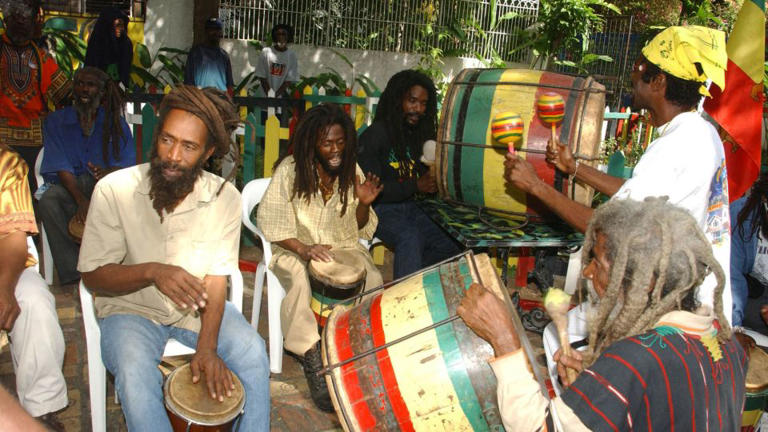
Rastafarians beat on African drums to mark the 59th birthday of late reggae legend Bob Marley on February 6, 2004, in Kingston, Jamaica. - Collin Reid/AP© Provided by CNN
He was the apostle of the Rastafari religion

Marley also made something else relevant to a wider audience: the Rastafari religion. No musical figure has, arguably, done more to popularize a religion than Marley. His beliefs revolved around Rastafarianism.

But in the years since Marley’s death, his religious and political beliefs have been sanded down, reduced to a fuzzy, marijuana-inspired haze call for “One love, one heart. One destiny.” Some critics call this the “Disneyfication” of Marley’s legacy.

But the Rastafari religion has a much gritter and more defiant edge. It was spawned by the tremendous suffering Afro-Jamaicans experienced for centuries. The slave trade, for example, was even more lethal in Jamaica, where Marley was born, than the Deep South of the US. More than twice as many slaves were shipped to Jamaica alone than all thirteen North American colonies. Most were tortured, raped and worked to death, according to Adam Hochschild, author of “Bury the Chains,” a history of the abolition movement in the United Kingdom.

“The Caribbean was a slaughterhouse,” Hochschild wrote, describing the region’s slave trade.

The grinding poverty, suffering and political disenfranchisement of Afro-Jamaicans persisted under British colonial rule. Marley was born in rural Jamaica to an Afro-Jamaican teenage mom and a White father. It is impossible to understand him and the Rastafari faith, which emerged in Jamaica during the 1930s, without knowing the country’s violent history.

“Rastafari is a religion of resistance that blended Afrocentrism, Judaism, and Christianity,” says Deepak Sarma, a religious studies professor at Case Western Reserve University in Ohio.

“Though it is often categorized as a religion, it is also a revolutionary ideology to right the wrongs of British imperialism, the slave trade, and colonization of Jamaica and other Caribbean islands.”

Marley saw his music as a divine calling.

“God sent me on earth. He send me to do something, and nobody can stop me,” he once said. “If God want to stop me, then I stop. Man never can.”

Rastafarians, though, are known primarily by many casual observers for two elements of their religion: dreadlocks and the smoking of marijuana. The dreadlocks are inspired by an Old Testament passage from Leviticus 21:5, (“They shall not make baldness upon their head, neither shall they shave off the corner of their beard, nor make any cuttings in the flesh”). Marijuana, or “ganja,” was seen as a sacrament for Rastafarians to deepen spiritual awareness.


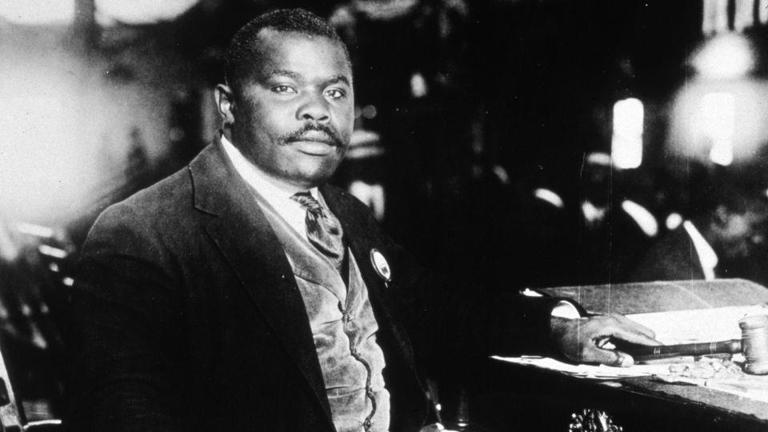
Marcus Garvey was a Jamaican activist whose teachings on Black self-pride and self-reliance are credited with inspiring the formation of the Rastafarian religion. - MPI/Getty Images© Provided by CNN

If there is a founder of the Rastafari religion, many point to Marcus Garvey, a Black Jamaican and activist who preached Black self-reliance, self-pride and led a “Back to Africa” movement in the first half of the 20th century. Selassie is also a central figure to Rastafarians in ways that puzzle some outsiders: How can Rastas worship a Black political figure who was also seen by some as a dictator?

Goldman, Marley’s former publicist, recalled asking Marley about the wisdom of worshipping Selassie. She wrote that he was stunned by her question, asking:

“So, you want me to worship a white god?”
The universality of Marley’s spiritual message is why it endures

If an outsider fixates on the bitterness of Marley’s quote about a White god, it’s easy to fall for the myth that Rastafarians demonize White people. But one of the reasons Marley’s spiritual beliefs still resonate is his religion didn’t go that route.

Marley didn’t limit oppression to one color.

“I can’t be prejudiced against myself,” he once said when someone asked him if he was prejudiced against White people.

“My father was a White and my mother Black, you know. Them call me half-caste, or whatever. Well, me don’t dip on the Black man’s side nor the White man’ side. Me dip on God’s side, the one who create me and cause me to come from Black and White.”

Marley didn’t just live for his beliefs. He also died, in part, because of them.

In 1977, Marley visited a doctor after noticing a blackened lesion under his big toenail. He was diagnosed with a rare form of skin cancer. The doctor advised Marley to amputate his toe to prevent the spread of cancer. But he refused because he thought it would violate the Rasta prohibition against the “cutting of the flesh,” and opted for a less invasive procedure.

The cancer eventually spread. Marley died on May 11, 1981, in Miami while trying to return to his beloved Jamaica for his final days. A man who was a fitness and health food fanatic died at 36.


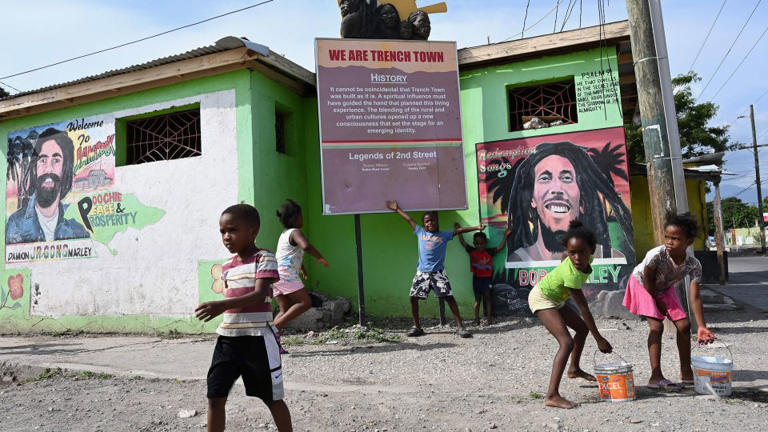
Children play in the Trench Town neighborhood of Kingston, Jamaica on May 18, 2019. In the 1960s, Trench Town was known as the Hollywood of Jamaica and is the birthplace of reggae music, as well as the home of Bob Marley. - Angela Weiss/AFP/Getty Images© Provided by CNN

Marley was honored with a state funeral in Jamaica at the National Arena in Kingston. He was buried with his favorite Gibson Les Paul guitar and his personalized Bible, opened to Psalm 23, which begins with, “The Lord is my shepherd, I shall not want.”

In an interview several years before his death, Marley said a person achieves a sense of immortality by having a right relationship with God.

“I don’t believe in death, neither in flesh nor in spirit . . . Death does not exist for me. I truly know God,” Marley said.

His musical legacy has found an afterlife. Marley’s stature on the international stage has only grown in the decades since his death. It’s ironic that Marley, a fierce critic of capitalism and materialism, posthumously generated $16 million through his estate in 2023, according to Forbes magazine, right behind John Lennon of the Beatles.

That type of immortality, of course, wasn’t what Marley was talking about. He alluded to an “ever-living” legacy. It’s the faith of an abandoned kid from the slums of Jamaica who knew hardship and abandonment but assured his listeners in his classic “Three Little Birds,” “Don’t worry about a thing, ‘Cause every little thing is gonna be alright.”

Somewhere in the world right now someone is playing a Bob Marley song to help them get through a difficult time — the kind that tears a hole in someone’s soul.

Marley was right. When it comes to his music and his spiritual message — death does not exist.

He is more alive today than ever before.

John Blake is the author of “More Than I Imagined: What a Black Man Discovered About the White Mother He Never Knew.”


Tiny Worms Living Near Chernobyl Have Evolved a Remarkable New Talent

Story by Michelle Starr

Microscopic worms that live their lives in the highly radioactive environment of the Chernobyl Exclusion Zone (CEZ) appear to do so completely free of radiation damage.

Nematodes collected from the area have shown no sign of damage to their genomes, contrary to what might be expected for organisms living in such a dangerous place. The finding doesn't suggest the CEZ is safe, the researchers say, but rather the worms are resilient and able to adroitly adapt to conditions that might be inhospitable to other species.

This, says a team of biologists led by Sophia Tintori of New York University, could offer some insights into DNA repair mechanisms that could one day be adapted for use in human medicine.

Since the explosion of a reactor at the Chernobyl Nuclear Power Plant in April 1986, the area around it and the nearby town of Pripyat in Ukraine have been strictly off-limits to anybody without government approval. The radioactive materials deposited into the environment expose organisms to extremely unsafe levels of ionizing radiation, greatly enhancing the risk of mutation, cancer, and death.

It's going to be thousands of years before 'Chornobyl', as it is spelt in Ukraine, is safe for human habitation again. Most of us know that and steer clear accordingly. But animals … well, they don't understand to stay away. They go where they want, and the exclusion zone has since become a strange sort of radioactive, 2,600-square kilometer (1,000 square mile) animal sanctuary.

Tests of animals that live in the region have shown clear genetic differences from animals that don't. But there's still a lot we don't know about the effects of the disaster on the local ecosystems.

"Chornobyl was a tragedy of incomprehensible scale, but we still don't have a great grasp on the effects of the disaster on local populations," Tintori says. "Did the sudden environmental shift select for species, or even individuals within a species, that are naturally more resistant to ionizing radiation?"


One way to gain insights into this question is to look at nematodes – microscopic roundworms that live in a range of habitats (including the bodies of other organisms). Nematodes can be remarkably hardy; there have been multiple cases of nematodes reawakening after thousands of years frozen in permafrost.

They have simple genomes, and live short lives, which means multiple generations can be studied in a short space of time. This makes them excellent model organisms for studying a range of things, from biological development, to DNA repair and toxin response. This is why Tintori and her colleagues went digging in Chornobyl to find nematodes of the species Oschieus tipulae, which typically lives in soil.

They collected hundreds of nematodes from rotten fruit, leaf litter, and the soil in the CEZ, using Geiger counters to measure ambient radiation and wearing protective suits against radioactive dust. The researchers cultured nearly 300 of their collected worms in a laboratory, and selected 15 specimens of O. tipulae for genome sequencing.

These sequenced genomes were then compared to the sequenced genomes of five specimens of O. tipulae from elsewhere in the world – the Philippines, Germany, the United States, Mauritius, and Australia.

The CEZ worms were mostly more genetically similar to each other than they were to the other worms, with the genetic distance corresponding to the geographic distance for the entire 20-strain sample. But signs of DNA damage from the radiation environment were lacking.

The team carefully analyzed the worms' genome, and found no evidence of the large-scale chromosomal rearrangements expected from a mutagenic environment. They also found no correlation between the mutation rate of the worms, and the strength of the ambient radiation at the location each worm hailed from.

Finally, they conducted tests on the descendents on each of the 20 worm strains to determine how well the population tolerates DNA damage. Although each lineage had a different tolerance level, this, too, had no correlation with the ambient radiation to which their ancestors were exposed.

The team could only conclude that there is no evidence of any genetic impact of the CEZ environment on the genomes of O. tipulae.

And what they did find could help researchers try to figure out why some humans are more susceptible to cancer than others.

"Now that we know which strains of O. tipulae are more sensitive or more tolerant to DNA damage, we can use these strains to study why different individuals are more likely than others to suffer the effects of carcinogens," Tintari says.

"Thinking about how individuals respond differently to DNA-damaging agents in the environment is something that will help us have a clear vision of our own risk factors."

The research has been published in the Proceedings of the National Academy of Sciences.


GEMOLOGY
Lab-grown diamonds come with sparkling price tags, but many have cloudy sustainability claims


PHILADELPHIA (AP) — The muted sounds of hammering and sanding drift down to the first floor of Bario Neal, a jewelry store in Philadelphia, where rustic artwork that mimics nature hangs on warmly-lit walls.

Waiting for one of those rings is Haley Farlow, a 28-year-old second grade teacher who has been designing her three-stone engagement ring with her boyfriend. They care about price and also don't want jewelry that takes a toll on the Earth, or exploits people in mining. So they're planning on buying diamonds grown in a laboratory.

“Most of my friends all have lab-grown. And I think it just fits our lifestyle and, you know, the economy and what we’re living through,” said Farlow.

In the U.S., lab-grown diamond sales jumped 16% in 2023 from 2022, according to Edahn Golan, an industry analyst. They cost a fraction of the stones formed naturally underground.

Social media posts show millennials and Generation Zs proudly explaining the purchase of their lab-grown diamonds for sustainability and ethical reasons. But how sustainable they are is questionable, since making a diamond requires an enormous amount of energy and many major manufacturers are not transparent about their operations.

Farlow said the choice of lab-grown makes her ring “more special and fulfilling” because the materials are sourced from reputable companies. All of the lab diamonds at Bario Neal are either made with renewable energy or have the emissions that go into making them countered with carbon credits, which pay for activities like planting trees, which capture carbon.

Related video: Lab-grown diamonds (Action News Jax)
Duration 2:55   View on Watch


But that's not the norm for lab-grown diamonds.

Many companies are based in India, where about 75% of electricity comes from burning coal. They use words like “sustainable” and “environmentally-friendly” on their websites, but don't post their environmental impact reports and aren’t certified by third parties. Cupid Diamonds, for example, says on its website that it produces diamonds in “an environmentally friendly manner,” but did not respond to questions about what makes its diamonds sustainable. Solar energy is rapidly expanding in India and there are some companies, such as Greenlab Diamonds, that utilize renewables in their manufacturing processes.

China is the other major diamond manufacturing country. Henan Huanghe Whirlwind, Zhuhai Zhong Na Diamond, HeNan LiLiang Diamond, Starsgem Co. and Ningbo Crysdiam are among the largest producers. None returned requests for comment nor post details about where it gets its electricity. More than half of China's electricity came from coal in 2023.

In the United States, one company, VRAI, whose parent company is Diamond Foundry, operates what it says is a zero-emissions foundry in Wenatchee, Washington, running on hydropower from the Columbia River. Martin Roscheisen, CEO and founder of Diamond Foundry, said via email the power VRAI uses to grow a diamond is "about one tenth of the energy required for mining.”

But Paul Zimnisky, a diamond industry expert, said companies that are transparent about their supply chain and use renewable energy like this “represent a very small portion of production.”

“It seems like there are a lot of companies that are riding on this coattail that it’s an environmentally-friendly product when they aren’t really doing anything that’s environmentally friendly,” said Zimnisky.

HOW IT'S DONE


Lab diamonds are often made over several weeks, subjecting carbon to high pressure and high temperature that mimic natural conditions that form diamonds beneath the Earth’s surface.

The technology has been around since the 1950’s, but the diamonds produced were mostly used in industries like stone cutting, mining and dentistry tools.

Over time the laboratories, or foundries, have gotten better at growing stones with minimal flaws. Production costs have dropped as technology improves.

That means diamond growers can manufacture as many stones as they want and choose their size and quality, which is causing prices to fall rapidly. Natural diamonds take billions of years to form and are difficult to find, making their price more stable.

Diamonds, whether lab-grown or natural, are chemically identical and entirely made out of carbon. But experts can distinguish between the two, using lasers to pinpoint telltale signs in atomic structure. The Gemological Institute of America grades millions of diamonds annually.

MARKETING COMPETITION


With lower prices for lab-grown and young people increasingly preferring them, the new diamonds have cut into the market share for natural stones. Globally, lab-grown diamonds are now 5-6% of the market and the traditional industry is not taking it sitting down. The marketing battle is on.

The mined diamond industry and some analysts warn lab-grown diamonds won't hold value over time.

“Five to ten years into the future, I think there’s going to be very few customers that are willing to spend thousands of dollars for a lab diamond. I think almost all of it’s going to sell in the $100 price point or even below,” said Zimnisky. He predicts that natural diamonds will continue to sell in the thousands and tens of thousands of dollars for engagement rings.

Some cultures view engagement rings as investments and choose natural diamonds for their value over the long term. That’s particularly true in China and India, Zimnisky said. It's also still true in more rural areas of the United States, while lab-grown diamonds have taken off more in the cities.

Paying thousands of dollars for something that drops most of its value in just a few years can leave the buyer feeling cheated, which Golan said is an element that is currently working against the lab-grown sector.

“When you buy a natural diamond, there’s a story that it is three billion years in the making by Mother Earth. This wondrous creation of nature … you cannot tell that story with a lab-grown,” said Golan. “You very quickly make the connection between forever and the longevity of the love.”

“If we really want to get technical here, the greenest diamond is a repurposed or recycled diamond because that uses no energy,” Zimnisky said.

Page Neal said she co-founded Bario Neal in 2008 to “create jewelry of lasting value that would have a positive impact on people and the planet.” All of the materials in her jewelry can be traced throughout their supply chain. The store offers both lab-grown and natural diamonds.

“Jewelry is a powerful symbol ... it’s a keeper of memories,” she said. “But when we’re using materials that have caused harm to other people and the environment to create a symbol of love and commitment or identity, to me it feels at odds. We want to only work with materials that we feel like our clients would be proud to own."

___

The Associated Press’ climate and environmental coverage receives financial support from multiple private foundations. AP is solely responsible for all content. Find AP’s standards for working with philanthropies, a list of supporters and funded coverage areas at AP.org.

Isabella O'malley, The Associated Press
Jason Momoa: From the ashes we rise — how nature can still heal

Opinion by Opinion by Jason Momoa
Editor’s Note: Jason Momoa is an actor and UN Environment Programme’s Global Advocate for Life Below Water. The opinions expressed in this commentary are his own.

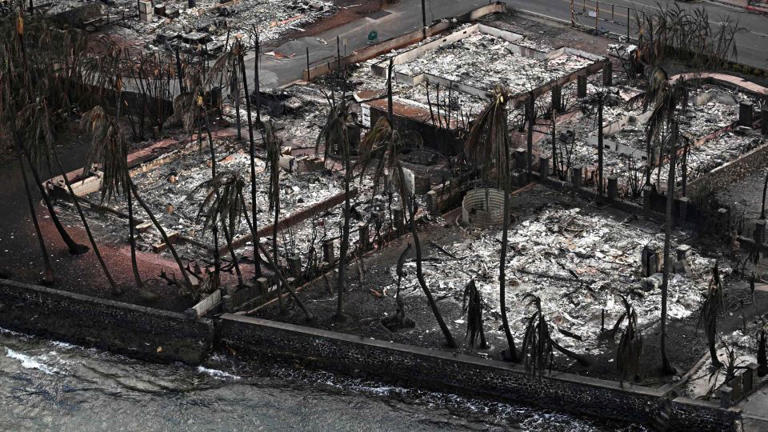
Seven months ago, a fiery blaze raged through my ancestral land of Hawaii, consuming thousands of acres, with Lahaina in Maui at the epicenter. Experts say the fires were supercharged by climate change, and native plant species being replaced with less fire-resistant ornamental species.

Almost 100 human lives were claimed, along with those of countless domestic and wild animals. Thousands of buildings were destroyed, with rebuilding costs estimated at over $5 billion. Cancerous pollutants have turned up in the public water system, and accelerated soil erosion stands to further degrade the island’s corals.


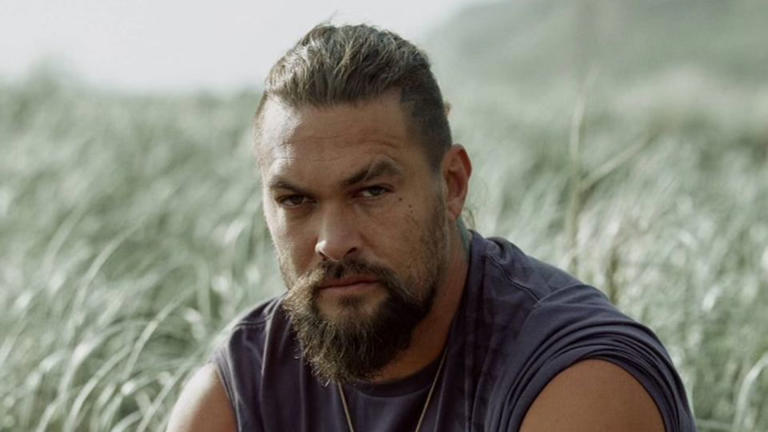
Jason Momoa - Courtesy Jason Roman© Provided by CNN

Many more hearts are broken as wildfires spread across the continents all the way to the Arctic. The UN Environment Programme, for which I am a Global Advocate for Life Below Water, says that by the end of the century, the number of global wildfires could rise by 50%.

Wildfires are just one cause for alarm over the future of the world’s ecosystems. There is no shortage of signals of the breakdown of nature itself at the hands of mankind. Around 1 million animal and plant species are now threatened with extinction. Freshwater sources and coastlines are rapidly degrading. So are forests, grasslands, shrublands, and peatlands. From vast savannahs and mountainous landscapes to urban and rural microecosystems, three-quarters of the Earth’s land surface has been significantly altered by human actions, as has two-thirds of the world’s ocean, which makes up 70% of Earth’s surface.

An aerial image taken on August 10, 2023, shows buildings burned to the ground in Lahaina by wildfires in western Maui, Hawaii. - Patrick T. Fallon/AFP via Getty Images© Provided by CNN

Several weeks after fires turned much of our historic town of Lahaina into ashes, newspapers raved about a colossal 150-year-old banyan tree that was charred and then sprouted new green leaves. As encouraging as nature’s resilience and spontaneous rebirth may be, it is not enough to heal nature at the rate we need.

The harm caused to nature since the dawn of the industrial era is so extensive that efforts must be taken to protect what is left and restore what has been degraded. This means immediate action, joining hands, and working together from the poles to the Pacific islands.

Key to this success will be putting Indigenous peoples’ traditional knowledge and community voices at the heart of our decision-making going forward. Western systems have blinded our vision. Indigenous people protect the land, the Earth. We need to go back to allowing them to do so. We must apply this thinking towards the recovery of Lahaina, with local organizations and grassroots initiatives at the forefront and working tirelessly to support their community.

Benefiting from the collective wisdom of the Hawaiian people, who have been traveling across the Pacific for over 2,000 years, using traditional navigational methods to migrate the 2,400-mile path to and from Tahiti, requires recognizing them as the Indigenous people of the ocean.

Governments are also starting to act: All 193 countries that are members of the United Nations committed to a Decade of Restoration and to build back one billion hectares by the end of this decade, an area about the size of China. In the twilight of 2022, a historic deal to protect nature was reached, followed by a first-ever deal to protect the high seas, and other landmark decisions.

On the ground, the world’s most visionary efforts towards building back nature are happening now, reclaiming more and more human-encroached spaces. From an initiative to save Andean forests across seven countries and 3,000 miles, to the expansion of Sri Lanka’s mangrove cover by 50%, and a restored forest that helped double Nepal’s tiger population; from regreening efforts in collaboration with farmers from Senegal to Tanzania to create hundreds of thousands of jobs and bring vast areas affected by desertification back to life, through investments by Pakistani communities in restoring over 30% of the Indus River Basin following deadly floods that struck the country, to the largest-ever restoration initiative to prevent wildfires across the Mediterranean.


In Nepal, the Terai Arc Landscape initiative has helped wildlife to bounce back.
 - Muna Thapa© Provided by CNN

These seven initiatives have now been recognized as UN World Restoration Flagships. Last week in Nairobi, in an assembly of the world’s environment ministers, restoration featured prominently in discussions of ministers of environment and other leaders from more than 180 nations.

There is a viral quality to acts of kindness towards nature, and they can inspire additional action from individuals, communities, NGOs, celebrities, scientific institutions, corporations, and governments. Solutions are bound to breed more hope, and every individual action can build up to a massive wave of change, which I call mana (spiritual life-force) nalu (wave).

Even without superpowers, we’re the most powerful creatures in Earth’s history. It remains entirely up to us to determine how that power shall be unleashed.

Do we restore Lahaina and other degraded areas using nature-based solutions that build on what had worked for centuries before, or do we let powerful profit-driven corporations steamroll our voices? My appeal to our generation is to embrace and advocate for the restoration of nature and start making waves.

First Nations Life Expectancy Has Plummeted. How to Change That

Story by The Canadian Press
 

Due to the toxic drug crisis and later the COVID-19 pandemic, life expectancy for First Nations people in British Columbia decreased by 7.1 years between 2015 to 2021.

The largest drop happened between 2019 and 2021 when life expectancy shortened 5.8 years, says Dr. Nel Wieman, chief medical officer at the First Nations Health Authority. Wieman is Anishinaabe from Little Grand Rapids First Nation.

The unregulated toxic drug supply is the leading cause of the decrease, with First Nations people “vastly overrepresented” in toxic drug deaths, Wieman says.

In comparison, life expectancy of non-Indigenous residents of B.C. decreased by 1.1 years between 2019 to 2021.

Some of the biggest factors are inequities and trauma caused by colonialism; Indigenous-specific racism in every part of the health-care system, as reflected in the 2020 “In Plain Sight” report; stigma around drug use; and a lack of services available for First Nations people, experts told The Tyee.

For the last 50 years, First Nations life expectancy had been increasing annually by 0.2 years, says Dr. Danièle Behn Smith, deputy provincial health officer for Indigenous health. Behn Smith is Eh Cho Dene of Fort Nelson First Nation and Franco-Manitoban/Métis from the Red River Valley.


Related video: Pierre Poilievre commits to giving First Nations control of tax and resource funds (The Canadian Press)   Duration 4:35   View on Watch


In 2011, life expectancy was 75.9 years. Then 2014 hit, when the powerful synthetic opioid fentanyl entered the unregulated drug market and drove up toxic drug deaths for First Nations and the general population alike. The COVID-19 pandemic exacerbated harm by isolating people, keeping them from harm reduction services and driving them to use alone.

Historic and present-day colonial impacts create inequity in almost every part of society for First Nations people, Behn Smith says. There is food insecurity when people are unable to access traditional food systems. There is “manufactured poverty” — where Canada has gotten rich from resource extraction, but the majority of First Nations have not. There are high rates of overcrowding or being unhoused.

For these reasons and others, First Nations have higher rates of underlying health conditions that, for example, affect lung health and increase rates of diabetes.

Then there’s intergenerational trauma from a history of colonialism and system of oppression.

Tania Dick, Indigenous nursing lead at the University of British Columbia’s school of nursing, says residential schools added “hugely traumatic layers to our existence that are still raw and fresh.” Indigenous Peoples are trying to work their way through the trauma and heal but society at large isn’t helping them do that, she adds. Some Indigenous people use drugs and alcohol as a coping mechanism, leading to high rates of addiction.

Behn Smith says that when she worked as a family doctor, she would acknowledge drug use as “really powerful medicines that they need right now,” and then see if she could shift a patient to something with less harmful side-effects over time.

The increasing toxicity of illicit drugs has increased the chances these side-effects will be deadly. Behn Smith compares the current unregulated drug supply to “Russian roulette” because the drugs are so potent and likely contaminated with a toxic level of other substances.

Then there’s Indigenous-specific racism, pushing Indigenous people away from health services the same way getting repeatedly burned after touching a hot object teaches you to stay away, Dick says.

Wieman says she’s heard racism called the third undeclared public health emergency because it negatively affects people’s ability to access harm reduction services or prescribed safer supply.

“People choose not to access health services because they fear the treatment or are worried because of a past experience or stories they heard from friends and family,” Wieman says.

Canada has also had “decades and decades of approaching drugs in quite a punitive way that created a lot of stigma,” Behn Smith says. This pushes people to use alone, not access harm reduction services and not ask for help when they need it.

There’s also the issue of access.

Impact from lack of services

Dick, who is a member of Dzawada̱ʼenux̱w First Nation of Kingcome Inlet, says nurses fly into her community to offer health care, but two weeks can go by without a visit.

Health-care providers often must fly into an Indigenous community, or people are expected to drive out to access mainstream services that can be culturally unsafe, she says.

“Our people are unwell and want to deal with their issues but they only see harm and fear, so they generally avoid the health-care industry,” Dick adds. “It has so many layers and complexities to it. Nurses are on the ground and often people’s first and last point of contact. We can do better.”

One improvement Dick would like to see is the regular deployment of registered psychiatric nurses to communities to offer mental health services.

Geography can also prohibit people from accessing services. Prescribed safer supply programs, for example, may require a pharmacist to supervise someone every time they take their medication, which can mean hours of daily driving for some patients, Wieman says.

People who want to access culturally safe mental health services, detox and treatment programs are also often put on waiting lists that can take two to nine weeks, Dick says.

“If someone wants to stop using drugs and wants to access medically supervised detox, we need to respond to them that minute because the odds are they will end up back on the street and using drugs if they can’t get help that day,” Dick adds.

Intergenerational trauma and effects on youth

First Nations communities are seeing a lot of toxic drug deaths in younger generations. “The youth being affected in these numbers is devastating,” Dick says. “This is heartbreaking. We look at these children as our future.”

Dick’s village has lost a couple of people who were in their early 20s and living outside of the community to go to school. The deaths “absolutely rocked our village and turned it upside down,” she says.

“People are grieving and they don’t have time to finish grieving before there’s another death,” Behn Smith says. This can push people back towards medicating emotional, physical and spiritual pain with substances.

The COVID-19 pandemic further disconnected people from their families, community and services.

“It made us sit still in our own skin, which let traumas come up because you can’t keep busy,” Dick says.

Dick says she isolated with aunts, uncles and cousins during the lockdowns. Her parents are both residential school survivors, and she was surprised at how many complex feelings came up during that time. But she was grateful to be surrounded with family where they could all talk about what they were thinking and feeling.

“Imagine what it was like for people disconnected from their community or away from home who weren’t able to unpack everything,” she says. “They just had to sit in it and spiral.”

Because of the likelihood of other underlying health conditions, Indigenous people were more likely to suffer severe infections, be hospitalized and die, Behn Smith says.

“Every time one of our relatives or member of our nation dies, it’s a threat to our cultural community,” she says. “Many people hold teachings in our communities, and if they die suddenly, then that knowledge is gone. Every Elder we lose, especially in communities with few fluent language speakers, is truly an existential threat in many ways.”

Where to go from here

Each expert had their own recommendations for how to improve First Nations’ life expectancy.

The studies showing us where to go have already been done, Behn Smith says. We just need to implement them. She points to the Truth and Reconciliation Commission’s Calls to Action, the “In Plain Sight” report, the final report of the National Inquiry into Missing and Murdered Indigenous Women and Girls and the Declaration Act Action Plan. All the solutions emerge in simply listening to Indigenous people, “who have been very clear and articulate for what are life-saving solutions for us,” she says.

Behn Smith also echoed Dr. Bonnie Henry’s call for B.C. to explore a medical and non-medical prescribed safer supply program. The existing prescription model has been accessed by only about five per cent of the total estimated people who could benefit from it. A different model could reach more people by reducing barriers.

Wieman says that for First Nations people the recovery journey should offer harm reduction, treatment and healing. This can be participation in traditional activities, ceremonies or other cultural involvement.

“Substance use is in many cases a symptom of trauma and not knowing how to deal with trauma,” she says. “We need to look at short-term and long-term healing so people don’t feel compelled to use substances as coping mechanisms when distressed.”

Dick also highlights the importance of culture.

She says she went home for a potlatch recently and saw youth taking on roles and responsibilities in the ceremonies and engaging with traditions and language. They had such confidence and an aura of intense joy to have this path and purpose, she says.

The legacy of residential schooling means that Dick does not speak her language — her parents were not able to teach her. Through her learning, she says, she’s showing younger generations how to reconnect with culture.

“We’re reclaiming space and culture and knowledge and finding more resources to relearn and reclaim,” Dick says. “It’s happening more and more and having a big impact.”

Michelle Gamage, Local Journalism Initiative Reporter, The Tyee

Italy's migrant detention centers in spotlight after death of Guinean and calls to close them down


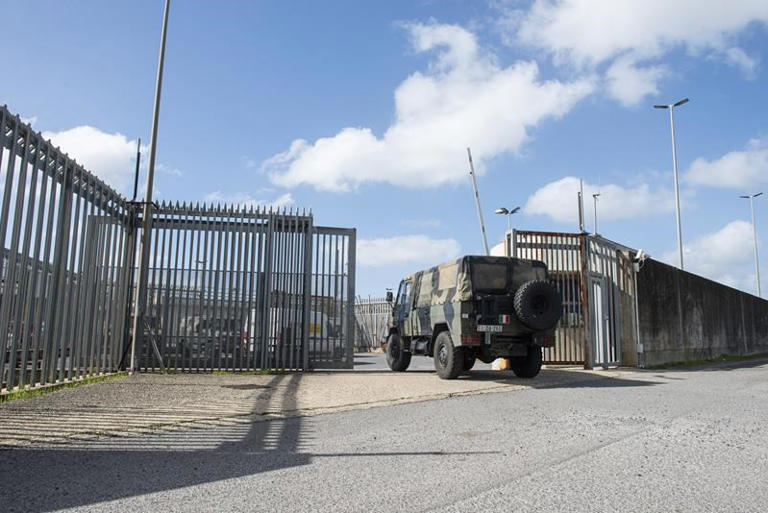
ROME (AP) — Pressure is building on authorities in Italy to close a notorious Rome migrant detention center where a 19-year-old Guinean allegedly hanged himself last month. Visiting opposition senators have decried “undignified” conditions for people ordered to leave Italy but awaiting repatriation.

Italy’s 10 migrant repatriation centers have long been criticized by human rights groups. They describe them as black holes of human rights violations where undocumented migrants are essentially detained for months without charges in conditions worse than prisons.

The centers are supposed to be temporary holding facilities for migrants whose asylum bids failed, or foreigners who have been ordered expelled for criminal or other reasons while the paperwork is completed to send them home.

But because of bureaucratic delays and a lack of repatriation agreements with countries of origin, only around half of the detainees are actually sent back and the centers end up acting as de facto prisons but without a prison’s rehabilitation, educational or proper medical facilities, rights groups say.

The right-wing government of Premier Giorgia Meloni has defended the use of the centers and even called to expand them as a necessary component of a broader strategy to manage Italy’s migration flows. Her government has extended the amount of time migrants can be held to 18 months as part of a deterrent strategy to persuade would-be refugees and their traffickers to stay home.


The Radicali Roma, an association affiliated with the Italian Radical Party, started an online petition Friday calling on center-left Mayor Roberto Gualtieri to close Rome’s repatriation center in Ponte Galeria, citing repeated episodes of violence, suicide and protests by desperate detainees.

Last month, the body of Ousmane Sylla was found in the center after he apparently hung himself. He had been ordered expelled from the country, but Italy has no repatriation agreement with his native Guinea. After his body was discovered, detainees set mattresses on fire and threw objects at law enforcement personnel, resulting in 14 arrests. The center has a maximum capacity of 125 people.

In recent days, another six migrants attempted to kill themselves at the same facility, said Marco Stufano, the head of the office of Rome’s prefect. One remained hospitalized, two were returned to the center and three were transferred to other facilities because their conditions were deemed “incompatible” with detention at Ponte Galeria, he said.

Last month, Rome’s city assembly called on Gualtieri to open “urgent” negotiations with government authorities to close the Ponte Galeria, given the “serious violations of human rights suffered by people detained there.”

Even Italy's national guarantor for the rights of prisoners, Mauro Palma, weighed in after visiting the center in December. In letters to Rome's prefect and police chief, Palma decried the lack of monitoring at the center, saying any facility that deprives people of their freedom must have a functioning system of registering critical events and medical interventions for violence that results in injury, riots and attempted escapes to ensure the basic rights of detainees are being respected.


This week, three opposition senators visited the center and emerged stunned by what they saw.

“This place is worse than a penitentiary,” said Sen. Ivan Scalfarotto, of the Italy Alive party. “The rooms where they live are absolutely unwatchable, toilets are below any human standard. Inside this place people do nothing all day, there is no labor, training, no education, something that is normally provided in all our penitentiaries. People are kept here without any hope.”

Sen. Walter Verini, with the opposition Democratic Party, said while criticism of the centers had been continuous for years, the government’s new provisions allowing for detention of up to 18 months required immediate action.

“We have to fight because this is something unworthy of a civilized and democratic country,” he said.

Interior Minister Matteo Piatedosi has described the expansion of the network of repatriation centers as a “fundamental” element in the government’s overall migration strategy, and said the difficult conditions found in them are the result of riots and vandalism by the detainees.

At a recent press briefing, he said 50% of the detainees are repatriated, that there had been an increase of 20%-30% in repatriations so far this year compared to the previous year, and that he expected the numbers to grow.

But the actual number of repatriations is among the lowest in Europe, with an average of 3,000 people sent back every year out of more than 150,000 arrivals in 2023 and more than 105,000 in 2022.

“There is no prospective to deny any human rights, but in these centers are people who – after a long process of checks of irregularity in their residency permits -- present conditions of danger that are confirmed by judicial authorities,” he said.


___
Associated Press writer Nicole Winfield in Rome contributed to this report.

___

Follow AP’s coverage of migration issues at https://apnews.com/hub/migration

Paolo Santalucia, The Associated Press