Sunday, March 10, 2024

With war in Gaza, American Muslims plan Ramadan of protest and activism

'Ramadan is not the month of taking a break or relaxation. It is a month of action and organization for us as an organization and as a community,' said an activist. 'We hope Ramadan will be a reinvigoration of the work we have been doing over the last five months.'
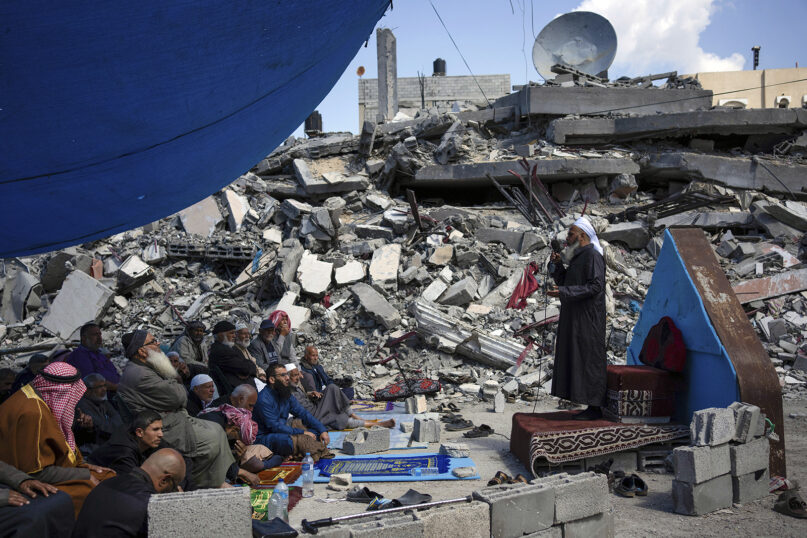

Palestinians pray in front of a mosque destroyed by the Israeli airstrikes in Rafah, Gaza Strip, Friday, March 8, 2024, ahead of the holy Islamic month of Ramadan.
 (AP Photo/Fatima Shbair)


March 8, 2024
By Rhonda Roumani

(RNS) — Every weekend during the month of Ramadan for the past six years, tens of thousands of Muslims have flocked to Dearborn, Michigan, to attend a late-night Suhoor Festival, named for the meal eaten before the daylong fast starts during Ramadan.

From 10 p.m. until 3 a.m., the festival’s attendees, who will fast from food and water once the sun comes up, spend the pre-dawn hours eating and drinking with family and friends from specialty food trucks and shopping in the warmth of vendors’ heated tents. The joyous occasion has become a hallmark of Dearborn life, where more than half the residents are Arab Americans.

But this year, in light of the war and starvation taking place in Gaza, as well as Muslim-majority countries such as Yemen and Sudan, the organizers of the festival have scaled it down, rebranding it as “Suhoor for Humanity.”

“This year, we are not looking to be festive, but to bring people together for a good cause,” said Ali Sayed, owner of Hype Athletics, a youth center in Dearborn Heights where the rebranded event will take place. A handful of food trucks and vendors will be on-site, but organizers are focused on raising money for three charities that provide aid to Palestine, Yemen and Lebanon, which is currently facing a devastating financial crisis.

RELATED: Once marginalized, New York’s Muslims celebrate growing political influence on Muslim Day

They are also hoping to add spiritual and religious speakers to their roster of events this year. “We are hurt and devastated by the atrocities taking place in Palestine, and the city as a whole is hurt and torn by it all, especially with the lack of trust and support by our government.”

As Israel’s war on Gaza enters its sixth month, Muslim Americans are struggling to make sense of the level of death, destruction and displacement that has befallen Gaza, with more than 85% of the population forced from their homes and more than 31,000 Palestinians killed, according to local authorities, including an estimated 13,000 children.
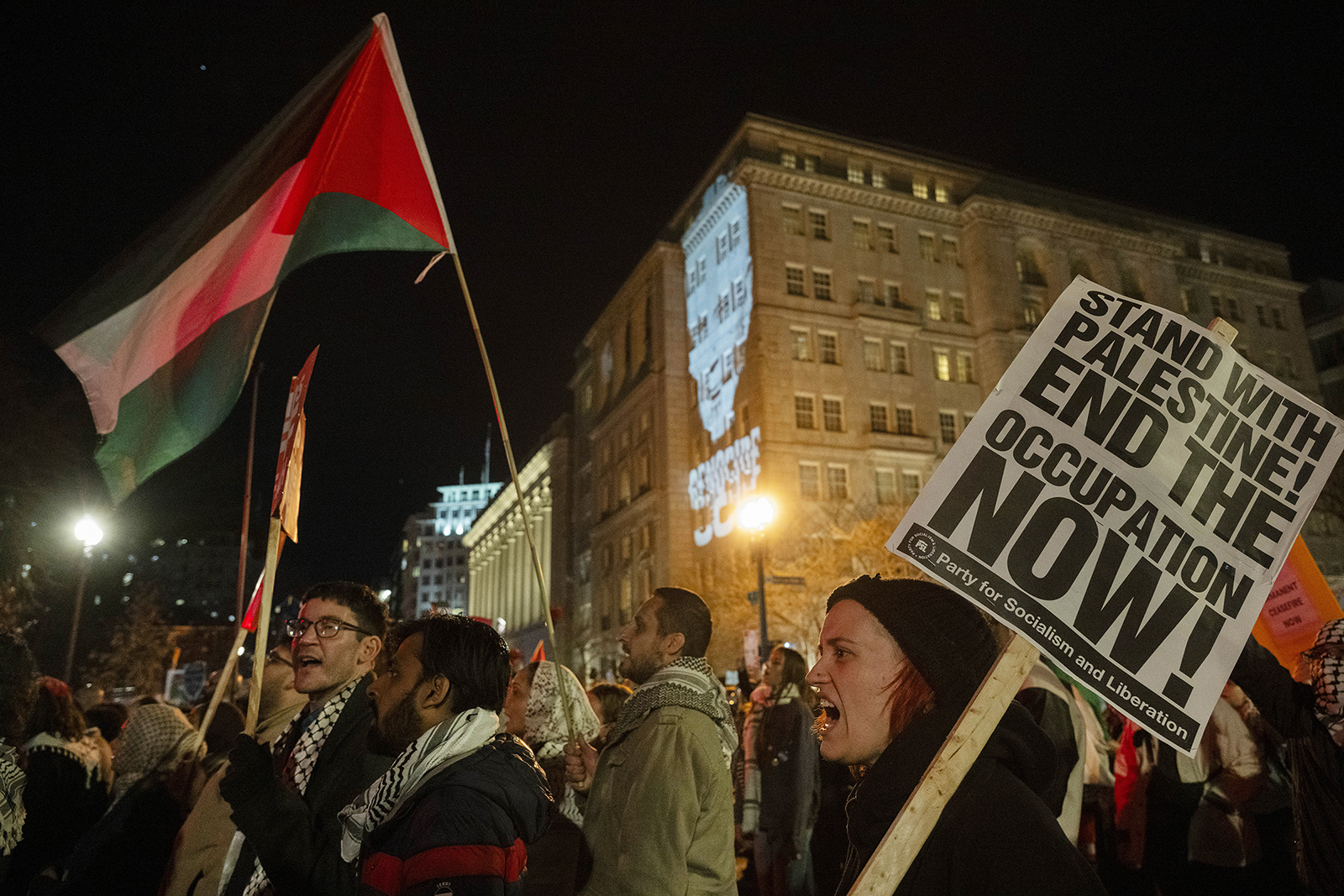

Protesters rally near the White House demanding a permanent cease-fire and end to U.S. funding to Israel, on Wednesday, March 7, 2024, in Washington. (AP Photo/Kevin Wolf)

They are angry, too, at President Joe Biden’s and other American politicians’ slowness in calling for a cease-fire or even initially in acknowledging the loss of life. Many have stopped watching mainstream media and instead are livestreaming graphic images posted by Palestinian and other citizen journalists, which have left them feeling raw and demoralized.

“People are crying, trying to make sense of it all,” said Hanan Hashem, an assistant professor of clinical psychology at William James College in Boston and a community educator at the Family & Youth Institute, which focuses on mental health among young Muslims. “They’re finding it very difficult to function, very difficult to show up in class, to pay attention, to finish their assignments, to have conversations with their coworkers, to show up to meetings.”

Hashem, whose family hails from Yemen, said the closer they are to people in the conflicts, the more trauma they suffer and the harder it is to know how to respond.

The holy month of Ramadan, experts say, might be arriving just as these Muslims need it most. The most sacred time of the year, Ramadan is a time for reflection and deep prayer, and mosques are often buzzing with people gathered to recite the Quran. It is also a time to highlight Muslim values of selflessness and philanthropy and of unity: Besides refraining from food and drink, Muslims are to abstain from fighting and gossip.


Hanan Hashem. (Courtesy photo)

These disciplines tend to focus participants on their spiritual goals. Hashem and others have been looking to popular imams to explain how to use Ramadan’s time of discipline and prayer to turn Muslims’ empathy for those caught in the war zone into action.

“Ramadan is not the month of taking a break or relaxation. It is a month of action and organization for us as an organization and as a community. We hope to gain more from the momentum of Ramadan,” said Taher Herzallah, director of outreach and grassroots organizing for American Muslims for Palestine. “We hope Ramadan will be a reinvigoration of the work we have been doing over the last five months.”

Since October, Herzallah, whose family is from Gaza, has lost nine close relatives to the war. Family members who have survived so far have been detained and stripped naked. His elderly aunts, he said, are “stuck in a starvation apocalyptic scenario.”

Yet Herzallah said the war has inspired a level of activism beyond any he’s seen in 15 years as an organizer. Muslim groups have led and organized mass protests, organized national phone bank trainings and urged city governments around the country to adopt cease-fire resolutions. Pro-Palestinian campus groups have reignited boycott Israel movements, and Muslims have been instrumental in convincing Democratic primary voters to mark their ballots “uncommitted” as a show of protest against Biden’s pro-Israel stance.

Over the last few months, AMP has also organized national marches, built coalitions with non-Muslim groups to shut down highways and demonstrated outside military suppliers’ offices and factories.



Taher Herzallah. (Photo courtesy American Muslims for Palestine)

“I’ve never seen it where old khaltos (aunts) in the community are calling to ask me, ‘If we protest at the mall, will we get arrested?’” said Herzallah. “My kids even went to a kids’ protest for Gaza. Never seen this level of engagement from all segments of our community.”

Some of their activism in recent weeks has been oriented toward Ramadan. As it is traditional to break their day’s fast by eating the Middle Eastern fruit dates, following a practice of the Prophet Muhammad (Muslims are major consumers of dates in the United States), American Muslims for Palestine’s annual campaign to boycott dates grown in Israel is getting a “huge response” this year, said Herzallah.

Activists are also using Ramadan worship and other gatherings as venues to reach Muslims. AMP is sending people to 29 mosques across the country during the Taraweeh, the late evening prayers that draw Muslims to their mosques during the month, to talk about Palestine and the work that they are doing.
RELATED: Jerusalem Palestinians prepare for Ramadan amid holy month’s uneasy politics

Hashem believes the war has caused Muslims from different racial and ethnic groups to bridge their cultural divides. “Muslims are paying more attention to the ways that a lot of our oppression is connected,” she explained. “People are paying attention to Congo,” referring to fighting between armed groups in eastern Democratic Republic of the Congo that has devolved into indiscriminate violence against the Muslim minority. “People are paying attention to what’s happening here in America towards marginalized communities.”

In New Haven, Connecticut, Salwa Abdussabur, a Black Muslim, is the founder of Black Haven Arts and Culture, an art and activism collective that released a statement in late December denouncing “the ongoing atrocities and genocide unfolding in Palestine.”

Now Abdussabur is hoping Ramadan will inspire the Muslim community to channel its spiritual power for change. Since taking a phone bank training with Celebrate Mercy, an Ohio-based Muslim charitable and educational organization, she has joined with CT Muslims and Friends for Palestine, a TikTok group of Muslims of all ethnic and racial backgrounds, to make daily calls to public officials, advocating for peace in Gaza.

. “This is a month of miracles,” Abdussabur said.

Cut From the Same Cloth: The United States and Israel in Palestine


 MARCH 8, 2024
Facebook

Photograph by Nathaniel St. Clair

Revolutionaries in Iran in the 1970s referred to the United States as the “Great Satan” and to its ally, Israel, as the “little Satan.” The truth of their rallying cry resounds today as Israel executes, unimpeded, its scorched earth policy in Gaza.

The Israeli war on Gaza has been oiled by the military, financial and diplomatic benefaction of the United States.  While President Joe Biden makes passive public appeals for Israel to show restraint, behind closed doors, he reaffirms America’s continued support.  

The administration’s recent indulgence of Israel was visible during a 4 March 2024 meeting in the White House between Israeli minister Benny Gantz and Vice President Kamala Harris. At that meeting, the vice president stated the administration’s displeasure with the dire humanitarian crisis in Gaza; but in the same breath, told Gantz that the United States wanted to continue supporting Israel, but that Tel Aviv needed to do its part; stating, help us, help you.”  

The infamous “hug that was seen around the world” has come to haunt even a committed Zionist like Biden.  In order to retrieve a modicum of domestic and international credibility—after Israel’s massacre of more than 100,000 Palestinians—the administration has put on its “humanitarian face.” Salvage efforts that have been for Palestinians obviously too timid and too late.

The language, action and inaction that has emanated from the Biden White House indicates that either Israel is calling the shots in Washington, or the administration is on board with Israel’s genocidal plan to empty Gaza and the West Bank of Palestinians.  It also seems evident, that Biden, who has said on a number of occasions “I am a Zionist,” has been beguiled by the myths and fantasies that the Jewish state has created.   

In the face of domestic and global condemnation, the administration has embraced the right-wing regime in Tel Aviv.  It has continued to block United Nations resolutions calling for an immediate ceasefire.  Recently, on 29 February, the United States alone, among the 15 members of the UN Security Council, opposed a statement expressing “deep concern” over the Israeli military’s killing of Palestinians who had gathered near trucks carrying food to Gaza City.  At least 112 were killed and another 760 injured in what is now called the “flour massacre.” 

In a symbolic display of concern following the massacre, the United States began airdropping humanitarian aid into Gaza, while simultaneously supplying Israel with bombs to drop on Gaza.  

During the administration’s first photo-op on 2 March, the U.S. and Jordanian air forces dropped 38,000 meals to some 1.5 million Palestinians.   Water and medical supplies were not included.  Biden refused to blame Israel for blocking aid into Gaza, but said he would “insist” that Israel open additional routes and allow more aid trucks to enter.     

In its eagerness to indulge Israel, the administration has been willing to break U.S. laws.  The Biden administration has used emergency powers to bypass arms sales reviews and Congressional oversight to expedite its arms transfers to Israel.   It is currently violating the Foreign Assistance Act, 1961; Arms Export Control Act, 1976; War Crimes Act,1996; Genocide Convention Implementation Act (Proxmire Act), 1987-88; and the Leahy Laws, 1997-98. 

The White House is awash in rhetoric.  It has, however, refused to put any real limits on Israeli violence, choosing instead to stoke the Israeli war machine.

U.S. Secretary of State Antony Blinken, for example, during discussions in February 2024 with Israeli leaders in Tel Aviv, sheepishly stated: “it will be up to Israelis to decide what they want to do, when they want to do it, how they want to do it. No ones going to make those decisions for them….”

The administration’s actions, even when confronted with Israel’s systematic violence against the Palestinians, clearly indicate that U.S. financial and military hegemonic interests outweigh what little is left of its humanity.

Like his predecessors, Biden has shown no genuine concern for the Palestinians, for the region and its people.  He has, however, been dedicated to integrating Israel into the Arab Middle East, with Saudi Arabia seen as the prize.  

To realize his integration policy, Biden has continued to expand on former President Donald Trump’s objective of strengthening military cooperation and economic ties among family-ruled Arab dictators and Israel.  He has pressed ahead with the Trump era Abraham Accords—a set of Arab-Israeli normalization agreements initiated in September 2020 and signed by the United Arab Emirates, Bahrain, Morocco and Sudan. 

When the accords were initiated, the Trump administration and its Arab partners believed that Palestinians could be ignored; that they were irrelevant; and that they would simply accept their slow death.  Biden has amplified that disregard.

The administration is under the impression that deepening economic and military ties with Arab despots will lead to regional stability—which ultimately translates into U.S.-Israeli hegemony. It is worth noting that the region remains volatile, even though Riyadh and Tel Aviv have cooperatedcovertly for years, as have Bahrain, the UAE, Oman, Qatar and Egypt.  

After close to five months of Israeli atrocities, Biden continues to push for what Egypt’s president, Abdel Fatah al-Sisi, once called the “deal of the century” —  a normalization pact between Saudi Arabia and Israel.  The United States sees Saudi Arabia as the integration linchpin.  If Riyadh—the largest and wealthiest Gulf regime—allies with Israel, the White House believes that others will fall in line.   

In addition to encouraging Israel-Arab economic ties, Washington has been actively promoting the furtherance of cybersecurity linkages.  The U.S. Department of Homeland Security, for example, at a Cybertech Conference in Tel Aviv on 3 February 2023, announced an expansion of the Abraham Accords to include an agreement on cybersecurity.   By giving official recognition to intelligence sharing and security agreements between Israel and the Arab states, the accords have made the spyware business easier and more lucrative.  

The Gulf regimes, believing that linkages with Israel will shore up their security ties with the United States, have become eager customers of advanced surveillance technology; which they also see as useful in policing their populations.  Israel—one of the world’s top spyware exporters—has been more than willing to sell its technology, with little regard for human rights abuse.  

The United States, Israel and Arab dictators have become deeply enmeshed in the cybersecurity/intelligence world.  Israel has positioned itself in the international “order” through its global cybersecurity/surveillance web and the lucrative global tech weapons industry that have developed around it.  

Washington’s steadfast support for and unwillingness to criticize Israel can plausibly be attributed to the cyber power and economic clout that together they have been able to wield in the region and globally.  

The ongoing collaboration between the U.S. National Security Agency and its Israeli equivalent, the secretive Cyber Unit 8200—the tech intelligence unit of the Israel Defense [occupation] Forces—is just one example of the cybersecurity network that has linked the two countries.  

Former soldiers of the elite 8200 cyber warfare unit, for example, have gone on to found and occupy top positions at cybersecurity and international IT companies and in Silicon Valley.   Google, for one, has two offices and over 2,000 employees in Israel.  

Washington cares little that Israeli cybersecurity companies (numbering 700) export their spyware around the world or that Unit 8200 honed its intelligence skills through mass surveillance of innocent civilians in the occupied West Bank and Gaza; personal information that was used to blackmail Palestinians, to turn them into Israeli collaborators. 

Zionist hubris, facilitated by the United States, has no bounds.  After stealing Palestinian land, water and pillaging Gaza, Israel has been seeking to plunder the maritime offshore natural gas reserves that are the property of Palestine.   

On 29 October 2023, amidst its brutal war in Gaza, the Israeli Ministry of Energy and Infrastructure announced that it had awarded licenses for natural gas exploration in areas that overlap with the recognized maritime borders of Gaza.  As an occupying power, Israel has no legal right under international law to award licenses in areas it does not hold sovereignty over.  

The bidding process for the illegal licenses was launched in December 2022, a year before Israel’s horrific assault on Gaza.  Licenses were issued to six companies: Ratio Energies and NewMed Energy (Israeli), ENI (Italian); Dana Petroleum (UK subsidiary of Korea National Oil Company); SOCAR (Azerbaijans national oil company); and British owned BP.

The U.S.-Israeli economic and military stranglehold over the region has been challenged by the colonized Palestinians in Gaza who have bravely resisted despite having no sizable army, air force or sophisticated surveillance technology or weaponry.  Gaza has become an inspirational symbol of resistance in the Middle East and worldwide; a reality the U.S. and Israel will be powerless to overcome.

To understand the unsavory alliance that has held the United States and Israel together, is to understand that they are cut from the same cloth.   Both countries share a ruthless exploitative settler-colonial ideology and psychology, that has set them on parallel social, political and economic paths. They have existed by exploitation and churning the cauldron of division and conflict among countries in the region. 

After a half century of steadfast support, it has become virtually impossible for Washington to imagine a regional reality that does not have Israel at its core. The United States has finally been forced to confront the brutishness of its ally,” and to recognize that Zionists, and they, have no place or future in the Middle East.