Sunday, March 10, 2024

The New Atheism at 20: How an Intellectual Movement Exploited Rationalism to Promote War


 
 MARCH 8, 2024
Facebook

Photograph Source: Steve Jurvetson – CC BY 2.0

As Western bombs rain on Gaza’s starving civilians, the New Atheism turns 20. The philosophical genre, which argues for secularism over organized religion, was kick-started by Sam Harris. His 2004 book, The End of Faith, promoted neuroscience-based spirituality in place of irrational groupthink. The philosopher, Daniel Dennett, soon followed with Breaking the Spell (2006), as did the evolutionary biologist, Richard Dawkins, with his 2 million unit-selling, The God Delusion. The late essayist, Christopher Hitchens, completed the quartet, known as the Four Horsemen, publishing God Is Not Great (2007).

Inspired by the attacks of September 11th, the genre appeared on the scene shortly after the invasion of Iraq in 2003. It became immediately clear that the Four Horsemen were exploiting Enlightenment principles to justify the bombing of women and children in third world nations.  Muslim terrorists are not aggrieved by Western foreign policy, the authors claim, but rather by their fanatical devotion to their faith. The decimation of Iraq was not motivated by elite US strategies to control oil markets, but because “god” told Bush to invade. The state does not exploit religious differences for cynical realpolitik; but rather, hateful mobs randomly attack each other because of their different belief systems.

As I document in my latest book, The New Atheism Hoax, the authors concocted a major fraud. In case after case, their own sources say the opposite of what they claim. This doesn’t happen a few times. It happens almost every time. Examples are cherry-picked, context is removed, and counter-evidence suppressed. In tribute to the suffering people of Palestine, consider these Arab-Israeli examples alone:

SAM HARRIS

“Most Muslims who commit atrocities are explicit about their desire to get to paradise,” says Harris in The End of Faith(Free Press edition) citing the single example of Zaydan Zaydan, a failed Palestinian suicide bomber. Zaydan:

described being “pushed” to attack Israelis by “the love of martyrdom.” He added, “I didn’t want revenge for anything. I just wanted to be a martyr.” … With regard to the suffering that his death would have inflicted upon his family, he reminded his interviewer that a martyr gets to pick seventy people to join him in paradise. He would have been sure to invite his family along. (p. 31)

Source(s): James Bennett, ‘In Israeli Hospital, Bomber Tells of Trying to Kill Israelis’, New York Times, June 8, 2002.

Here’s what Harris left out. Bennett describes the painful circumstances that led Zaydan to try to become a bomber. Crucially, Bennett also emphasizes Zaydan’s efforts to kill Israeli occupational soldiers, not Israeli civilians. Zaydan makes clear that he does not hate ordinary Israelis. Bennett also implies that Zaydan wanted revenge not for particular Israeli atrocities, but rather as a means of resisting occupation and the threat of further raids into the Jenin refugee camp in 2002. Bennett (omitted by Harris) writes:

[Zaydan] gave a rare glimpse into the blend of religion, desperation, low technology and cruelty that can produce suicide bombers …  Mr. Zaydan, who is 18, spoke of his hopeless search for a job, of long days spent in pool halls before he found his way deeper into Islam, and of how his recruiter composed his last, videotaped statement for him, because, as a fifth-grade dropout, he can read but not write.

This is in direct contradiction not only to Harris’s rendering of events, but also his other claims, that no or few Palestinian bombers are motivated by poverty and desperation. Bennett provides some background: Israel raided the Jenin refugee camp in 2002; Israeli soldiers “could enter Jenin at any time”; Zaydan “sought to kill only soldiers.” Zaydan is quoted by Bennett, not by Harris, as saying: “As long as life continues like this … you will have people who think like me.”

DANIEL DENNETT

In one chapter, Dennett writes about the Palestinian lawyer and activist, Raja Shehadeh. Dennett says: “Palestinian society, if Shehadeh is right, is beset with a virulent case of the ‘punish those who won’t punish’ meme … [W]e mustn’t assume that policies that are benign in our own culture will not be malignant in others.” (Breaking the Spell, Penguin edition, pp. 329-30)

According to Dennett’s largely vacant account, the alleged and largely undefined dogma within Palestinian society is a result of religion. Dennett is careful not to quote Shehadeh’s explanation of this condition of prolonged tension, namely the Israeli occupation and the political collusion with Israeli occupiers by the Palestinian authorities in the occupied West Bank.

The collaborationist PLO is the largely secular Palestinian Liberation Organization (PLO), also known as the Palestinian Authority and Fatah, which rules the West Bank as a dictatorship, much in the way that the Islamist group Hamas rules Gaza.

Shehadeh explains (here’s what Dennett leaves out): “The prevailing local Palestinian politics were of the crudest kind … It was feared that [judiciaries] might use their position to challenge the political hegemony of the PLO.”  Palestine, writes Shehadeh, is “a society that had to survive under difficult and trying conditions.” He goes on to recount the painful experience of meeting West Bankers living in the United States and how their American enculturation led to a naiveté among the expats concerning the daily struggles of life under occupation. Shehadeh writes of his encounter with one such individual in the US:

He did not have to worry about being stopped and harassed [by the Israeli occupiers and PLO collaborators]. He did not have to be concerned that soldiers could enter his home and do what they wished under the authority of military law. He did not live with the constant news of bombs exploding here and there and injuries and deaths and bloodshed and collective punishments and hatred and fear and no certainty from day to day whether you can go on with the education of your children or with your business or profession.

Dennett omits all of the above, reducing the roots of Palestinian terrorism to the supposedly backward culture of the peoples.

RICHARD DAWKINS

Following the pattern, Richard Dawkins quotes the testament of ‘S’, “a polite young Palestinian aged twenty-seven.” ‘S’ is reported as saying:

We were floating, swimming, in the feeling that we were about to enter eternity … We made an oath on the Koran, in the presence of Allah – a pledge not to waver. This jihad pledge is called bayt al-ridwan, after the garden in Paradise that is reserved for the prophets and the martyrs. I know that there are other ways to do jihad. But this one is sweet – the sweetest. (Quoted in The God Delusion, Black Swan edition pp. 344-45. Ellipsis added).

This makes ‘S’ and by association all suicide bombers sound like lunatics motivated by visions of “paradise.” Dawkins again conveniently omits the background details.

Source(s): Nasra Hassan, ‘An Arsenal of Believers: Talking to the “human bombs”’, The New Yorker, 19 November 2001.

The rest of the article—not quoted by Dawkins—says that ‘S’ was one of 11 children born to a middle-class family that had to flee from Majdal, Palestine, to a refugee camp in Gaza due to the founding of the State of Israel in 1948.

‘S’ joined Hamas in his early-teens as a street activist. In 1989, he was jailed by the Israeli occupiers for his part in the overwhelmingly non-violent Palestinian Intifada (‘Uprising’ against the occupation). Hassan notes that over half of the suicide bombers he studied “were refugees from what is now Israel.” Like Harris with his case of Mr. Zaydan, Dawkins leaves out all of the crucial details.

The would-be bombers told Hassan: “The Israelis humiliate us. They occupy our land, and deny our history.” When asked why they condone the murder of Israeli civilians and in contrast to Zaydan, they told Hassan: “The Israelis kill our children and our women. This is war, and innocent people get hurt.”

CHRISTOPHER HITCHENS

In God Is Not Great, Hitchens writes of a young Palestinian woman, Yusra al-Azami, who was shot to death in Gaza in April 2005 “for the crime of sitting un-chaperoned in a car with her fiancé. The young man escaped with only a vicious beating,” says Hitchens. The culprits, he alleges, were the Hamas Vice and Virtue Squad, whose members roam the streets of Israeli-occupied Gaza looking for fellow Palestinians to harass for alleged immoral and un-Islamic behavior. “In once secular Palestine, mobs of sexually repressed young men are conscripted to snoop around parked cars, and given permission to do what they like” by the upper echelons of Hamas. (p. 24).

The New Humanist article indeed says what Hitchens claims it does.  Other accounts of al-Azami’s murder differ somewhat. Ghazi Ahmed in The Palestine Report notes that “Yusra was in fact a member of the Islamic Front”: Hamas’s student division. Her murder “shocked the Gaza Strip, and was condemned and discussed across the board by Palestinian factions, residents, officials at the PA [Palestinian Authority], writers and journalists.”

The alternative report says that “Yusra was killed on April 8, while walking with her fiancé, her sister, Majduleen, and her sister’s fiancé on Gaza’s beach,” not in a parked car. The group headed to their car when armed men shot at their tyres but hit Yusra in the head. “Hamas has been emphatic that, while the individuals are members of the movement, they acted at their own behest and not with any approval from the movement.” Ahmed notes that Israeli media picked up the story and added lies about a Hamas ‘Decency’ unit that was responsible for the murder. Ergo, the New Humanist article was probably based on Israeli propaganda.

Returning to the New Humanist, the article gives the background details on the origins of Hamas and fundamentalism in Palestine. The background is excised by Hitchens. The article says that Hamas developed from the Egyptian Muslim Brotherhood. The Israeli occupation of Egypt (1967-82), Palestine (’67-present), and Syria (’67-present) boosted the popularity of the Muslim Brotherhood among Arabs in the region. The article goes on to note that successive Israeli administrations backed Hamas as an Islamic weapon against the secular PLO, which was then reluctantly accepting a two-state solution.

CONCLUSION

At the time of writing, the two surviving New Atheists—Dawkins and Dennett—have been rather quiet about the Gaza genocide. Dawkins signed an open letter in support of Israel’s supposed right of self-defense, which in reality no country has while it illegally occupyies another. But he has not written or tweeted about it, as far as I know. Harris, on the other hand, has published thousands of words on the subject (transcripts from his podcast). If his previous record is anything to go by, prepare, dear reader, to be twisted into logical pretzels and to be lied to by omission.

With the exception of Hitchens whom, in his final years, became a right-winger, the attention of liberals was diverted by the seductive, anti-religiosity of the New Atheists. Instead of analyzing the world through the only lens that matters—realpolitik—progressives were invited to divide the world into the simple dialectics promoted by George W. Bush and Osama bin Laden’s speechwriters: that of a “clash of civilizations,” to use a phrase popularized by Samuel P. Huntington.

For the New Atheists’ many critics who spent time trying to argue points of logic, none seemed to notice that the Four Horsemen had perpetrated an intellectual hoax by systematically misrepresenting their own sources.

T. J. Coles is director of the Plymouth Institute for Peace Research and the author of several books, including Voices for Peace (with Noam Chomsky and others) and  Fire and Fury: How the US Isolates North Korea, Encircles China and Risks Nuclear War in Asia (both Clairview Books).


Empire Decline and Costly Delusions


 MARCH 8, 2024
Facebook

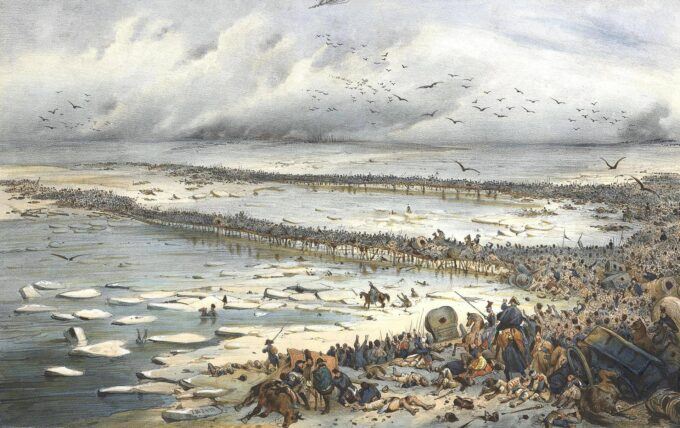
Пераправа цераз раку Бярэзіну (Biarezina)

When Napoleon engaged Russia in a European land war, the Russians mounted a determined defense, and the French lost. When Hitler tried the same, the Soviet Union responded similarly, and the Germans lost. In World War 1 and its post-revolutionary civil war (1914-1922), first Russia and then the USSR defended with far greater effect against two invasions than the invaders had calculated. That history ought to have cautioned U.S. and European leaders to minimize the risks of confronting Russia, especially when Russia felt threatened and determined to defend itself.

Instead of caution, delusions prompted ill-advised judgments by the collective West (roughly the G7 nations: the U.S. and its major allies). Those delusions emerged partly from the collective West’s widespread denial of its relative economic decline in the 21st century. That denial also enabled a remarkable blindness to the limits that decline imposed on the collective West’s global actions. Delusions also flowed from a basic undervaluation of Russia’s defensiveness and its resulting commitments. The Ukraine war starkly illustrates both the decline and the costly delusions it fosters.

The United States and Europe seriously underestimated what Russia could and would do to prevail militarily in Ukraine. Russia’s victory—at least so far after two years of war—has proven decisive. Their underestimation stemmed from a shared inability to grasp or absorb the changing world economy and its implications. By mostly minimizing, marginalizing, or simply denying the decline of the U.S. empire relative to the rise of China and its BRICS allies, the United States and Europe missed that decline’s unfolding implications. Russia’s allies’ support combined with its national determination to defend itself have so far defeated a Ukraine heavily funded and armed by the collective West. Historically, declining empires often provoke denials and delusions that teach their people “hard lessons” and impose on them “hard choices”. That is where we are now.

The economics of the U.S. empire decline constitutes the continuing global context. The BRICS countries’ collective GDP, wealth, income, share of world trade, and presence at the highest levels of new technology increasingly exceed those of the G7. That relentless economic development frames the decline of the G7’s political and cultural influences as well. The massive U.S. and European sanctions program against Russia after February 2022 has failed. Russia turned especially to its BRICS allies to quickly as well as comprehensively escape most of those sanctions’ intended effects.

UN votes on the ceasefire issue in Gaza reflect and reinforce the mounting difficulties facing the U.S. position in the Middle East and globally. So does the Houthis’ intervention in Red Sea shipping and so too will other future Arab and Islamic initiatives supporting Palestine against Israel. Among the consequences flowing from the changing world economy, many work to undermine and weaken the U.S. empire.

Trump’s disrespect for NATO is partly an expression of disappointment with an institution he can blame for failing to stop empire’s decline. Trump and his supporters broadly downgrade many institutions once thought crucially central to running the U.S., empire globally. Both the Trump and Biden regimes attacked China’s Huawei corporation, shared commitments to trade and tariff wars, and heavily subsidized competitively challenged U.S. corporations. Nothing less than a historic shift away from neoliberal globalization toward economic nationalism is underway. An American empire that once targeted the whole world is shrinking into a merely regional bloc confronting one or more emerging regional blocs. Much of the rest of the world’s nations—a possible “world majority” of the planet’s people—are pulling away from the U.S. empire.

U.S. leaders’ aggressive economic nationalist policies distract attention from the empire’s decline and thereby facilitate its denial. Yet they also cause new problems. Allies fear that economic nationalism in the United States already has or will soon adversely affect their economic relations with the United States; “America first” targets not only the Chinese. Many countries are rethinking and reconstructing their economic relations with the United States and their expectations about those relations’ futures. Likewise, major groups of U.S. employers are reconsidering their investment strategies. Those who invested heavily overseas as part of the neoliberal globalization frenzies of the last half century are especially fearful. They anticipate costs and losses from policy shifts toward economic nationalism. Their pushback slows those shifts. As capitalists everywhere adjust practically to the changing world economy, they also quarrel and dispute the direction and pace of change. That injects more uncertainty and volatility into a thereby further destabilized world economy. As the U.S. empire unravels, the world economic order it once dominated and enforced likewise changes.

“Make America Great Again” (MAGA) slogans have politically weaponized U.S. empire’s decline, always in carefully vague and general terms. They simplify and misunderstand it within another set of delusions. Trump will, he promises repeatedly, undo that decline and reverse it. He will punish those he blames for it: China, but also Democrats, liberals, globalists, socialists, and Marxists whom he lumps together in a bloc-building strategy. There is rarely any serious attention to the economics of the G7’s decline since to do so would critically implicate capitalists’ profit-driven decisions as key causes of the decline. Neither Republicans nor Democrats dare do that. Biden speaks and acts as if the U.S. wealth and power positions within the world economy were undiminished from what they were across the second half of the 20th century (most of Biden’s political lifetime).

Continuing to fund and arm Ukraine in the war with Russia, like endorsing and supporting Israel’s treatment of Palestinians, are policies premised on denials of a changed world. So too are successive waves of economic sanctions despite each wave failing to achieve its goals. Using tariffs to keep better, cheaper Chinese electric vehicles off the U.S. market will only disadvantage U.S. individuals (via such Chinese electric vehicles’ higher prices) and businesses (via global competition from businesses buying the cheaper Chinese cars and trucks).

Perhaps the greatest, costliest delusions that follow from a denial of years of decline dog the upcoming presidential election. The two major parties and their candidates offer no serious plan for how to deal with the declining empire they seek to lead. Both parties took turns presiding over the decline, yet denial and blaming the other is all either party offers in 2024. Biden offers voters a partnership in denial that the empire is declining. Trump promises vaguely to undo the decline caused by bad Democratic leadership that his election will remove. Nothing either major party does entails sober admissions and assessments of a changed world economy and how each plans to cope with that.

The last 40 to 50 years of the economic history of the G7 witnessed extreme redistributions of wealth and income upward. Those redistributions functioned as both causes and effects of neoliberal globalization. However, domestic reactions (economic and social divisions increasingly hostile and volatile) and foreign reactions (emergence of today’s China and BRICS) are undermining neoliberal globalization and beginning to challenge its accompanying inequalities. U.S. capitalism and its empire cannot yet face its decline amid a changing world. Delusions about retaining or regaining power at the top of society proliferate alongside delusional conspiracy theories and political scapegoating (immigrants, China, Russia) below.

Meanwhile, the economic, political, and cultural costs mount. And on some level, as per Leonard Cohen’s famous song, “Everybody Knows.”

This article was produced by Economy for All, a project of the Independent Media Institute.

Richard Wolff is the author of Capitalism Hits the Fan and Capitalism’s Crisis Deepens. He is founder of Democracy at Work.


Is Tehran Winning the Middle East?

From TomDispatch:

You know we’re in an increasingly extreme world when a young American airman burns himself to death outside the Israeli embassy in Washington to protest Israel’s nightmarish war in Gaza. (“Today, I am planning to engage in an extreme act of protest against the genocide of the Palestinian people,” he wrote in an email to the media before setting himself aflame.) And given that President Biden and his administration have backed just about every last murderous action taken by the Israeli government and ensured that the American-supplied weaponry Israel is using keeps on flowing, it’s small wonder that he’s finding himself in political trouble.

Honestly, when you consider how Prime Minister Benjamin Netanyahu and crew have dealt with their utter devastation of Gaza without, like so many countries that have committed striking crimes, in any way denying what they’re doing or trying to cover it up, it’s as if Hamas were running their propaganda campaign. And sadly enough, nothing seems to be improving in that largely destroyed 25-mile strip of land, whose population has been almost totally displaced. The casualties in Gaza only continue to grow as ever more of its inhabitants find themselves lacking the basics of life and in danger of dying, while the 1.4 million or so refugees now sheltering in the southern city of Rafah are to be “allowed” to flee yet again (but not return to their homes) before Israel launches full-scale operations there.

And Washington, with barely a whimper of protest, has backed this nightmare to the hilt. No wonder, then, that, as TomDispatch regular Juan Cole, who also runs the must-read Informed Comment website, explains today, longtime American foe Iran has been making hay while the sun shines (but only on Iran) in the Middle East. ~ Tom Engelhardt


Is Tehran Winning the Middle East?

How the Gaza Conflict Made Democracy’s Name Mud for Millions

by Juan Cole

In the midst of Israel’s ongoing devastation of Gaza, one major piece of Middle Eastern news has yet to hit the headlines. In a face-off that, in a sense, has lasted since the pro-American Shah of Iran was overthrown by theocratic clerics in 1979, Iran finally seems to be besting the United States in a significant fashion across the region. It’s a story that needs to be told.

“Hit Iran now. Hit them hard” was typical advice offered by Republican Senator Lindsey Graham after a drone flown by an Iran-aligned Iraqi Shiite militia killed three American servicemen in northern Jordan on January 28th. The well-heeled Iran War Lobby in Washington has, in fact, been stridently calling for nothing short of a U.S. invasion of that country, accusing Tehran of complicity in Hamas’s October 7th terrorist attack on Israel.

No matter that the official Iranian press has vehemently denied the allegation, while American intelligence officials swiftly concluded that the attack on Israel had taken top Iranian leaders by surprise. In mid-November, Reuters reported that Iranian leader Ayatollah Ali Khamenei informed a key Hamas figure, Ismail Haniya, that his country wouldn’t intervene directly in the Gaza war, since Tehran hadn’t been warned about the October 7th attack before it was launched. He actually seemed annoyed that the leadership of the Hamas paramilitary group, the Qassam Brigades, thought they could draw Tehran and its allies willy-nilly into a major conflict without the slightest consultation. Although initially caught off-guard, as the Israeli counterattack grew increasingly brutal and disproportionate, Iran’s leaders clearly began to see ways they could turn the war to their regional benefit — and they’ve done so skillfully, even as the Biden administration in its full-scale embrace of the most extreme government in Israeli history tossed democracy and international law under the bus.

The gut-wrenching Hamas attacks on civilians at a music festival and those living in left-wing, peacenik Kibbutzim near the Israeli border with Gaza on October 7th initially left Iran in an uncomfortable position. It had allegedly been slipping some $70 million a year to Hamas — though Egypt and Qatar had provided major funding to Gaza at Israel’s request through sanctioned Israeli government bank accounts. And after decades of championing the Palestinian cause, Tehran could hardly stand by and do nothing as Israel razed Gaza to the ground. On the other hand, the ayatollahs couldn’t afford to gain a reputation for being played like a fiddle by the region’s young radicals and so drawn into conventional wars their country can ill afford.

The Adults in the Room?

Despite their fiery rhetoric, their undeniable backing of fundamentalist militias in the region, and their depiction by inside-the-Beltway war hawks as the root of all evil in the Middle East, Iran’s leaders have long acted more like a status quo power than a force for genuine change. They have shored up the rule of the autocratic al-Assad family in Syria, while helping the Iraqi government that emerged after President George W. Bush’s invasion of that country fight off the terrorist threat of the Islamic State of Iraq and the Levant (ISIL). In truth, not Iran but the U.S. and Israel are the countries that have most strikingly tried to use their power to reshape the region in a Napoleonic manner. The disastrous U.S. invasion and occupation of Iraq, and Israel’s wars on Egypt (1956, 1967), Lebanon (1982-2000, 2006), and Gaza (2008, 2012, 2014, 2024), along with its steady encouragement of large-scale squatting on the Palestinian West Bank, were clearly intended to alter the geopolitics of the region permanently through the use of military force on a massive scale.

Only recently, Ayatollah Khamenei bitterly asked, “Why don’t the leaders of Islamic countries publicly cut off their relationship with the murderous Zionist regime and stop helping this regime?” Pointing to the staggering death toll in Israel’s present campaign against Gaza, he was focusing on the Arab countries — Bahrain, Morocco, Sudan, and the United Arab Emirates — that, as part of Trump son-in-law Jared Kushner’s “Abraham Accords,” had officially recognized Israel and established relations with it. (Egypt and Jordan had, of course, recognized Israel long before that.)

Given the anti-Israel sentiment in the region, had it, in fact, been rife with democracies, Iran’s position might have been widely implemented. Still, it was a distinct sign of terminal tone deafness on the part of Biden administration officials that they hoped to use the Gaza crisis to extend the Abraham Accords to Saudi Arabia, while sidelining the Palestinians and creating a joint Israeli-Arab front against Iran.

The region had already been moving in a somewhat different direction. Last March, after all, Iran and Saudi Arabia had begun forging a new relationship by restoring the diplomatic relations that had been suspended in 2016 and working to expand trade between their countries. And that relationship has only continued to improve as the nightmare in Israel and Gaza developed. In fact, Iranian President Ebrahim Raisi first visited the Saudi capital, Riyadh, in November and, since the Gaza conflict began, Foreign Minister Hossein Amir-Abdollahian has met twice with his Saudi counterpart. Frustrated by a markedly polarizing American policy in the region, de facto Saudi ruler Crown Prince Mohammed Bin Salman and Iran’s Ayatollah Ali Khamenei resorted to the good offices of Beijing to sidestep Washington and strengthen their relations further.

Although Iran is far more hostile to Israel than Saudi Arabia, their leaderships do agree that the days of marginalizing the Palestinians are over. In a remarkably unambiguous statement issued in early February, the Saudis offered the following: “The Kingdom has communicated its firm position to the U.S. administration that there will be no diplomatic relations with Israel unless an independent Palestinian state is recognized on the 1967 borders with East Jerusalem as its capital, and that the Israeli aggression on the Gaza Strip stops and all the Israeli occupation forces withdraw from the Gaza Strip.” Significantly, the Saudis even refused to join a U.S.-led naval task force created to halt attacks on Red Sea shipping by the Houthis of Yemen (no friends of theirs) in support of the Palestinians. Its leaders are clearly all too aware that the carnage still being wreaked on Gaza has infuriated most Saudis.

In late January, President Raisi also surprised regional diplomats by traveling to Ankara for talks on trade and geopolitics with Turkish President Recep Tayyip Erdoğan, another sign of his country’s changing role in the region. At the end of the visit, while signing various agreements to increase trade and cooperation, he announced: “We agreed to support the Palestinian cause, the axis of resistance, and to give the Palestinian people their rightful rights.” That’s no small thing. Remember that Turkey is a NATO member and considered a close ally of the United States. To have Erdoğan suddenly cozy up to Iran, while denouncing Israeli Prime Minister Benjamin Netanyahu’s war on Gaza as a Hitlerian-style genocide, was an unmistakable slap in Washington’s face.

Meanwhile, Iran, Turkey, and Russia recently issued a joint communiqué that “expressed deep concern over the humanitarian catastrophe in Gaza and stressed the need to end the Israeli brutal onslaught against the Palestinians, [while] sending humanitarian aid to Gaza.” From the Biden administration’s point of view, Moscow’s bombing of civilian sites in Ukraine and Iran’s role in crushing Sunni Arab rebels in Syria had been the atrocities that needed attention until Netanyahu suddenly pulled the rug out from under them by upping the ante from mere atrocities to what the International Court of Justice has ruled can plausibly be labeled a genocide. One thing was clear: Washington’s long struggle to exclude Iran from regional influence has now visibly failed.

Iran’s Rising Popularity

At the Gulf International Forum (GIF) last November, Abdullah Baaboud, a prominent Omani academic, said that there had been a “very strong condemnation of Israel from Iran and Turkey, embarrassing some Arab countries that are not using the same language. My worry is that this conflict is leading to the empowerment of Turkey and Iran among the Arab public.” GIF’s executive director, Dania Thafer, concurred. Of that public, she said, “Grief and anger have reached unprecedented levels,” and added, “with each photo out of Gaza, Iran gains more influence across the region.” In short, at remarkably little cost, Iran is unexpectedly winning the battle for regional public opinion and its standing in the Arab world has risen strikingly. Meanwhile, the reputation of the United States has been indelibly tarnished by Washington’s full-throated support for what most in the region do indeed see as a merciless slaughter of thousands of children and other innocent civilians.

A recent opinion poll of Arabs in 16 countries, conducted jointly by the Arab Center in Washington, D.C., and the Arab Center for Research and Policy Studies in Doha, Qatar, found that 94% of them considered the American position on Israel’s war “bad.” In contrast, a surprising 48% of them considered the Iranian position positive. To grasp just how remarkable such a finding was, consider that a Gallup poll conducted in 2022 found that Shiite Iran’s name was mud in most Sunni Arab countries and approval of its leadership fell somewhere between 10% and 20%.

In recent months, Iran has made striking use of the weakness of Washington’s case in the region. While the State Department likes to contrast Iran’s “dictatorship” with Israel’s “democratic character,” only recently foreign ministry spokesperson Nasser Kanaani observed, “The disaster in Gaza removed the mask from the face of the so-called advocates of human rights and showed the extent of vileness, brutality, and lies hidden within the nature of the Israeli regime, whose supporters used to refer to [it] as a symbol of democracy.” Although Iran has among the world’s worst human-rights records, Netanyahu has even managed to take the focus off of that.

Losing the Middle East, Washington-Style

Iran’s allies in the region include Iraqi Shiite militias like the Party of God Brigades (Kata’ib Hizbullah), which first gained prominence in the struggle against the ISIL terrorist group from 2014 to 2018. Those were years when the regular Iraqi army had essentially collapsed and was only gradually being rebuilt. Washington was also focused on destroying ISIL then and so developed a wary de facto alliance with them in its campaign to crush that “caliphate.” In January 2020, however, President Trump was responsible for the drone assassination of the group’s leader, Abu Mahdi al-Muhandis, along with Iranian General Qasem Soleimani, just after their arrival by plane at Baghdad International Airport in what was evidently an attempt to prevent them, through the Iraqis, from forging an agreement with Saudi Arabia to reduce tensions with Iran.

That assassination led to a long-running, low-intensity conflict between the Shiite militias of Iraq and the 2,500 remaining American troops stationed there. With the onset of the Gaza conflict last October, the Party of God Brigades began launching mortars and drones against Iraqi military bases hosting American soldiers, as well as against small forward operating bases in southeast Syria where some 900 U.S. military personnel are stationed, ostensibly to support the Syrian Kurds in mopping up operations against ISIL. After more than 150 such attacks, on January 28th one of their drones hit Tower 22, a support base where U.S. troops were stationed in northern Jordan, killing three American soldiers, while wounding dozens more.

Iran’s leaders generally back those Shiite militias, but whether they had anything to do with the attack on Tower 22 remains unknown. Officials in Tehran did, however, immediately recognize the danger of escalation once American troops had actually been killed. And indeed, the Biden administration responded with dozens of air strikes on bases and facilities of the Party of God Brigades in Iraq and Syria. Washington Post reporters were told by Iraqi and Lebanese officials that Iran had actually urged caution on the militias with clear effect. Their attacks on bases hosting U.S. troops ceased. At the same time, the Iraqi parliament and government complained bitterly about Washington’s violation of the country’s sovereignty, while heightening preparations to force the withdrawal of the last U.S. troops from their land. In other words, President Biden’s fierce backing of Israel’s war, his decision to increase weapons shipments to that country, and his bombing of pro-Palestinian militias may have led to the achievement of a longstanding Iranian aim: seeing American troops finally leave Iraq.

Meanwhile, in southern Lebanon, where the militant group Hezbollah has been exchanging occasional fire with Israeli forces in support of Gaza, according to the Post reporters, one Hezbollah figure told them that Iran’s message was: “We are not keen on giving Israeli Prime Minister Benjamin Netanyahu any reason to launch a wider war on Lebanon or anywhere else.” Wars are unpredictable, and the Lebanon-Israeli border could still erupt dramatically. Moreover, Iranian pleas for restraint appear to have had far less effect on the Houthi leadership in Yemen’s capital Sanaa, leading to an ongoing American and British bombing campaign on that city and elsewhere in that country that has so far done little to stop Houthi missile and drone attacks against ships in the Red Sea.

So far, however, despite the Republican urge to devastate Iran, that country’s leaders have taken deft advantage of the butchery in Gaza (in which the Israeli military has killed more civilian noncombatants each day than belligerents have in any other conflict in this century). The ayatollahs have significantly increased their popularity even among Arab and Muslim publics that had not previously shown them much favor. They have strengthened their relationship with the Shiites of Iraq and may be on the verge of finally achieving their goal of ending the U.S. military missions in Iraq and Syria.

They have also achieved closer ties with Turkey, while improving relations with Saudi Arabia and the other Gulf Arab oil states. In doing so, they have distinctly blunted the Biden administration’s aim of isolating Iran while tying the wealthier Arab states ever more firmly to Israel through arms and high-tech deals.

In addition, through its backing of and weaponizing of Israel in these last grim months, Washington has made a mockery of the human rights talking points that the U.S. has long deployed against Iran. In the process, Joe Biden has done more than any recent president to undermine both international humanitarian law and democratic principles globally. With 94% of Arab poll respondents viewing American policy in the region as “bad,” one thing is clear: for the moment at least, Iran has won the Middle East.

Follow TomDispatch on Twitter and join us on Facebook. Check out the newest Dispatch Books, John Feffer’s new dystopian novel, Songlands (the final one in his Splinterlands series), Beverly Gologorsky’s novel Every Body Has a Story, and Tom Engelhardt’s A Nation Unmade by War, as well as Alfred McCoy’s In the Shadows of the American Century: The Rise and Decline of U.S. Global Power, John Dower’s The Violent American Century: War and Terror Since World War IIand Ann Jones’s They Were Soldiers: How the Wounded Return from America’s Wars: The Untold Story.

Juan Cole, a TomDispatch regular, is the Richard P. Mitchell collegiate professor of history at the University of Michigan. He is the author of The Rubáiyát of Omar Khayyam: A New Translation From the Persian and Muhammad: Prophet of Peace Amid the Clash of Empires. His latest book is Peace Movements in Islam. His award-winning blog is Informed Comment. He is also a non-resident Fellow of the Center for Conflict and Humanitarian Studies in Doha and of Democracy for the Arab World Now (DAWN).

Copyright 2024 Juan Cole