Monday, October 28, 2024

American Healthcare Workers Plead for End to Gaza Bombing

On October 3, 2024, 99 American healthcare workers in Gaza released an open letter to the White House pleading for an end to Israel’s bombing of little children.

The letter was sent by American physicians, surgeons, nurse practitioners, and nurses who had volunteered a combined five years to treat the besieged people of Palestine.

The letter said: “Every day that we continue supplying weapons and munitions to Israel is another day that women are shredded by our bombs and children are murdered with our bullets. President Biden and Vice President Harris, we urge you: End this madness now!”

The letter writers also said that “every one of us who worked in an emergency, intensive care, or surgical setting treated pre-teen children who were shot in the head or chest… It is impossible that such widespread shooting of young children throughout Gaza sustained over the course of an entire year is accidental or unknown to the highest Israeli civilians and military authorities.”

Dr. Mark Perlmutter said, “Gaza was the first time I held a baby’s brains in my hand, the first of many.”

A U.S. Veterans Affairs trauma and critical care surgeon said: “I’ve never seen such horrific injuries, on such a massive scale, with so few resources. Our bombs are cutting down women and children by the thousands. Their mutilated bodies are a monument to cruelty.”

The American healthcare workers also wrote: “We quickly learned that our Palestinian healthcare colleagues were among the most traumatized people in Gaza, and perhaps in the entire world… they had lost family members and their homes. Most lived in and around their hospitals with their surviving family, in unimaginable conditions.”

Because Israel claimed hospitals were sometimes used by Hamas, the letter signatories said: “We wish to be absolutely clear: not once did any of us see any type of Palestinian militant activity in any of Gaza’s hospitals or other healthcare facilities.”

The authors also estimate that more have now died from starvation and disease and untold thousands buried under the rubble than by military deaths. They estimate what they described as a very conservative total of over 118,000 who have died in the past year in Gaza. In July, the well-respected British medical journal, The Lancet, had estimated 186,00 deaths there.

On October 8, Jeffrey Sachs, a Columbia professor who is one of the world’s most respected foreign policy experts, spoke on Judge Andrew Napolitano’s “Judging Freedom” podcast.

Professor Sachs is a Jew who has been a very outspoken critic of Israeli Prime Minister Benjamin Netanyahu. Sachs said, “Israel is less safe today, by far, than a year ago despite 40,000, 100,000, 200,000 deaths.”

He deplored what he called the “cruel bombing of apartment buildings, hospitals, clinics, schools – it’s been horrendous.”

Sachs said, “Netanyahu is leading Israel into the greatest insecurity of its modern history – complete diplomatic isolation.” He added that “Israel can never be safe with Netanyahu’s delusional plan.”

The professor said Netanyahu has been “selling” a regional war in the Middle East for over 20 years in his speeches, writings, and congressional testimony, and that he is “counting on the U.S. military and the U.S. taxpayer” to make Israel the dominant power so it can “rule in an apartheid manner over millions of people.”

Sachs also said “the war in Iraq in 2003 was strongly promoted by Netanyahu. He wanted a war against Saddam Hussein by the United States for Israel’s sake.”

He added that America is “not served by a blind obedience to the Israel Lobby” and that Americans “do not want another disastrous Middle East War.”

Now Netanyahu has expanded his war into Lebanon, and he will go further – into Syria, Jordan, Iran and perhaps other places – if the U.S. does not stop him.

Sachs said the “American people do not want a nuclear war over Israel’s claim over Gaza or the occupied territories.”

I wish every member of Congress would read the letter from the American healthcare workers in Gaza and listen to the Judging Freedom podcast of Oct. 8. Sadly, I don’t believe any of them will read or listen to either one. Hopefully, you will.

Reprinted with author’s permission from the Knoxville Focus.

John James Duncan Jr. is an American politician who served as the U.S. representative for Tennessee’s 2nd congressional district from 1988 to 2019. A lawyer, former judge, and former long serving member of the Army National Guard, he is a member of the Republican Party.

Women and Children Pay the Highest Price


 October 28, 2024
Facebook

Illustration by Paola Bilancieri.

The Israel Defense Forces (IDF) are widely considered one of the most powerful armies in the world. And, according to Israeli leaders, they are “the most moral army in the world.” How, then, to reconcile these statements with what is happening now in Gaza and Lebanon, where tens of thousands of women and children have been slaughtered or injured in the conflict with the Palestinians?

On October 13 and 14, dozens of Palestinians civilians were killed and many more wounded by the IDF’s attacks on a Gaza hospital and several refugee camps. The dead included women waiting for food to be delivered and children at play. The IDF claims that they only operate against terrorists and are investigating the incident, a lame excuse when practically never these investigations by the Israeli military result in punishment for those guilty of serious crimes.

The United Nations Relief and Works Agency for Palestine Refugees in the Near East (UNRWA) states that the IDF shelled dozens of hungry people waiting for food at a distribution center in the Jabalia refugee camp. Dozens of homes were destroyed in these incidents. The humanitarian organization Save the Children estimated last June that around 21,000 kids are missing in the Gaza Strip, and that roughly 4,000 children are buried under debris. “No parent should have to dig through rubble or mass graves to try to find their child’s body,” said Jeremy Stoner, Save the Children’s regional director for the Middle East.

UNICEF reports that in Gaza cases of diarrhea among children under five have soared, while cases of scabies, lice, chicken pox, skin rashes and respiratory and gastrointestinal infections have also climbed. Hundreds of thousands of children have been killed or injured, and more than half a million children are in need of psychological support due to sustained trauma. Malnutrition is rampant; when left untreated malnutrition and disease are a deadly combination.

Last August, a 10-month-old baby became partially paralyzed after contracting polio in Gaza. According to the World Health Organization, Gaza has not registered a polio case for 25 years. Because of the dismal sanitary conditions, type 2 poliovirus had been detected in samples collected from the territory’s wastewater last June. Poliovirus, most frequently spread through sewage and contaminated water, is highly infectious.

Humanitarian organizations blame the re-emergence of polio in Gaza on the disruption of vaccination programs and the massive damage to water and sanitation systems. “Hundreds of thousands of children in Gaza are at risk,” said UN Secretary General António Guterres. UNICEF’s Executive Director Catherine Russel said that the re-emergence of the virus in the strip after 25 years is “another sobering reminder of how chaotic, desperate and dangerous the situation has become.” The Gaza Ministry of Health accused the IDF of intensifying “its targeting of the health system” in north Gaza as more hospitals came under siege or fire.

The IDF’s actions in Gaza and Lebanon, which have resulted in the deaths of thousands of women and children, have been widely condemned. According to Lebanon’s Health Ministry, at least 2,412 people have been killed during the IDF attacks. The Gaza Health Ministry reports that 42,519 people have been killed in Gaza. According to the Gaza Ministry of Health, dozens of people were killed or injured after an IDF attack in the town of Beit Lahia.

During a recent trip to Belgium, Pope Francis suggested that the IDF’s attacks in Gaza and Lebanon have been “immoral” and disproportionate, saying that they go beyond the rules of war. According to International Humanitarian Law, “The harm caused to protected civilians or civilian property must be proportional and ‘not excessive in relation to the concrete and direct military advantage anticipated’ by an attack on a military objective.”

Luis Moreno-Ocampo, the Chief Prosecutor at the International Criminal Court investigated allegations of war crimes during the 2003 invasion of Iraq. In an open letter containing his findings, he elucidates the use of proportionality. In the letter he states, “A crime occurs if there is an intentional attack directed against civilians (principle of distinction) (Article 8(2)(b)(i)) or an attack is launched on a military objective in the knowledge that the incidental civilian injuries would be clearly excessive in relation to the anticipated military advantage (principle of proportionality) (Article 8(2)(b)(iv)).”

The IDF consistently violates elemental rules of war. As Omer Bartov, a Professor of Holocaust and genocide studies at Brown University wrote, “If we truly believe that the Holocaust taught us a lesson about the need –or really, the duty—to preserve our own humanity and dignity by protecting those of others, this is the time to stand up and raise our voices, before Israel’s leadership plunges it and its neighbors into the abyss.”

As 2,000 pound-bombs continue falling on women and children, Prime Minister Netanyahu struts among his troops. He is totally unconcerned to the evil he is causing, as Gaza and Lebanon become not only a cemetery for people, but a cemetery for hope and peace in the region.

Dr. Cesar Chelala is a co-winner of the 1979 Overseas Press Club of America award for the article “Missing or Disappeared in Argentina: The Desperate Search for Thousands of Abducted Victims.”

Western Support for Israel: A Colonial Legacy


Western support for Israel’s high-tech genocide, justified in the name of the Holocaust, exposes the blatant hypocrisy of so-called ‘liberal values.’ The stakes of the current conflict extend beyond Palestinian liberation, challenging the deeply ingrained colonial mindset of the West at the heart of both global and domestic systems of oppression.

For over a year now, Israel’s relentless bombardment and military operations in Gaza have been supported not only by diplomatic backing but also by military assistance and distorted media narratives all over the “collective West.” Often, this unconditional support is explained through two conventional arguments: a historical guilt tied to the Holocaust, depicting Israel as a perpetual victim of “Islamic terrorism” and/or antisemitism, and shared values between the West and Israel. However, these explanations fall short of explaining the depth and persistence of Western complicity. A third and more convincing hypothesis suggests that Israel is fulfilling the same colonial and racist impulses that Western powers were forced to restrain after decolonization.

The Holocaust Guilt Argument: A Flawed Explanation

The idea that the West supports Israel because of guilt from the Holocaust is often cited as a driving factor. While it is true that Western nations, particularly the United States, were initially sympathetic to the establishment of a Jewish state in the wake of World War II, this narrative of guilt does not explain the breadth of support Israel continues to receive today.

Before 1967, U.S. support for Israel was more restrained and pragmatic, reflecting broader Cold War interests in the Middle East. While the U.S. recognized Israel immediately in 1948, its aid and support remained relatively limited, balancing its ties with Arab nations. The U.S. did not view Israel as a strategic ally before the Six-Day War. During the 1950s and early 1960s, the U.S. was cautious about deep involvement in the Arab-Israeli conflict and sought to maintain relationships with oil-rich Arab nations that were key in its geopolitical strategy against the Soviet Union.

During the Suez Crisis of 1956, the U.S. reined in Israel and its British and French allies, forcing them to retreat disgracefully after their invasion of Egypt, which had been prompted by Nasser’s nationalization of the Suez Canal. This incident underscores how, prior to 1967, the U.S. was not yet committed to unconditional support for Israel and even aligned itself with international condemnation of its actions. However, after the Six-Day War, this dynamic shifted, as Israel’s military prowess made it an invaluable Cold War asset, leading to a much deeper alliance between the U.S. and Israel. The U.S. began providing significant military and economic aid to Israel, transforming the relationship into the close strategic partnership it is today.

The Holocaust narrative also gained renewed prominence post-1967, shaping U.S. and Western perceptions of Israel. Before this period, the memory of the Holocaust, while acknowledged, was not as central in American public discourse or foreign policy. The Eichmann trial in the early 1960s played a role in bringing Holocaust memory to the forefront, but it was after 1967 that the Holocaust narrative became deeply intertwined with Israel’s legitimacy in Western discourse. The Holocaust was increasingly invoked to justify the need for a strong, secure Jewish state, whitewashing or deflecting criticism of its policies toward Palestinians and other Arab nations.

In The Holocaust Industry, Norman Finkelstein explains how the memory of the Holocaust has been instrumentalized to shield Israel from criticism. He argues that before 1967, American Jewish elites used the Holocaust primarily to denounce anti-Semitism in the Soviet Union, drawing parallels with Nazism. Skeptical of the Jewish state, they feared that its creation would reinforce accusations of dual loyalty, especially in the context of the Cold War. However, the 1967 war changed all that: Israel’s military display impressed the United States, which made it a strategic pillar in the Middle East. For American Jewish elites, this alignment enabled a smoother assimilation into the United States: Israel was now perceived as a defender of American interests. The Holocaust took on a central place in American Jewish memory, serving to reinforce Israel’s legitimacy as an outpost against common enemies. American Jewish intellectuals, hitherto largely indifferent to Israel’s fate, increasingly rallied behind the Hebrew state, which they presented as a bastion of Western civilization. After 1973, this memory was consolidated as a tool of mobilization and influence, aimed at justifying support for Israel, whatever the circumstances. This allowed Israel to present itself as a permanent victim, despite its growing military and geopolitical dominance, thereby deflecting scrutiny of its actions, especially concerning the occupation of Palestinian territories.

Western intervention in the Middle East has historically been driven by control, exploitation, and domination, not altruistic motives. As Frantz Fanon argued in The Wretched of the Earth,

The colonizer, who is himself the product of a history of violence, has, in the final analysis, only one way of dealing with the violence that is directed against him: he must point out that the violence comes from the victim. He must show that he is the one who is oppressed.

Colonizers often invoke past suffering to justify current oppression, manipulating historical victimhood to evade responsibility for their own violence. In this case, Israel has weaponized its historical trauma to deflect criticism of its actions, transforming the Holocaust into a shield to justify its violence against Palestinians. This perverse exploitation is bolstered by Western nations, who eagerly participate in the narrative, masking their own complicity in the ongoing colonial project. The irony and outrage of this defense of current agressions, massacres and ethnic cleasing in the name of a past genocide become clear when we reflect on the words of Aimé Césaire, who saw in Europe’s colonial crimes the roots of modern barbarism.

Césaire famously argued in his Discourse on Colonialism that Europe’s greatest crime was not the rise of fascism per se, but the fact that “what [Hitler] inflicted on Europe, Europe had previously inflicted on the colonies.” He highlights the deep hypocrisy of the West, which only recoiled in horror at Nazism when it became a victim of its own tools of oppression, which had long been honed through colonization in Africa, Asia, and the Americas. As Césaire states,

What the very distinguished, very humanistic, very Christian bourgeois of the twentieth century cannot forgive Hitler for is not crime in itself, the crime against man, it is not the humiliation of man as such, it is the crime against the white man, the humiliation of the white man, and the fact that he applied to Europe colonialist procedures which until then had been reserved exclusively for the Arabs of Algeria, the coolies of India, and the blacks of Africa.

By participating in Israel’s genocidal project, the West is not atoning for the Holocaust; rather, it is perpetuating the same logic of exclusion and dehumanization that enabled colonialism and Nazism. This is why Israel’s invocation of the Jewish people’s tragedy rings hollow in the context of its ongoing violence — because what was once condemned when perpetrated in Europe is now justified in Palestine. This selective application of moral outrage underscores the reality that the West’s real concern is not with human rights or justice, but with protecting colonial interests and racial hierarchies.

Ultimately, the West’s relationship to Israel is less about historical guilt than about using Israel as an instrument to perpetuate a colonial and imperialistic project in the Middle East. The same crimes the West claims to condemn in its past are the ones it now supports in the present, showing that its commitment to “never again” has never truly extended beyond Europe’s borders — that paradoxically include the Jewish population of Israel, a pure product of “Western civilization”.

The Myth of “Shared Values”

Another common justification for the West’s support of Israel is the claim that it upholds Western humanist and democratic values, making it a natural ally in a region often depicted as autocratic and hostile to Western ideals of progress. This argument is frequently strengthened by referencing the so-called “Judeo-Christian roots” of Western identity, which frame Israel as part of a shared cultural heritage. These supposed roots are presented as the moral foundation of the West, positioning Israel as a guardian of civilization against a perceived Middle Eastern “otherness” — particularly Islam, seen as irreconcilable with these values.

As Edward Said famously observed, “Every empire tells itself and the world that it is unlike all other empires, that its mission is not to plunder and control but to educate and liberate.” Israel, with steadfast Western support, replicates this narrative. But the true aim is not liberation — it’s about maintaining power through violence and subjugation. The West has long framed the Arab world as the civilizational “other” to justify intervention and alliances that are first and foremost about domination. The West’s support for Israel is less about common democratic principles and more about maintaining colonial power structures through an “us versus them” dynamic.

Israel is often hailed as the only democracy in the Middle East, a civilizational outpost in a supposedly barbaric and chaotic region, yet its treatment of Palestinians — both within its borders and in the occupied territories — completely contradicts the democratic values it claims to uphold, exposing it as a full-fledged apartheid regime. Said’s critique of Orientalism shows how such perceptions have historically allowed Western powers to rationalize their support for oppressive regimes under the guise of protecting civilization.

In practice, Western nations turn a blind eye to Israel’s violations of principles and norms when it comes to the treatment of Palestinians. Discriminatory policies, ethnic cleansing, and gross abuses of human rights are overlooked by Western governments that would vehemently condemn such actions elsewhere. After October 7, the hypocrisy of “Western values” has been unmasked and discredited for ever by the torrents of crocodile tears shed for 40 Israeli babies decapitated only in the putrid imagination of propagandists, while indifference prevails towards the thousands of Palestinian babies and children torn apart, with images and videos circulated daily on social media. Human rights have been exposed as nothing but a rhetorical tool used to justify political agendas rather than a genuine commitment to humanist ideals. The West prides itself on defending even animal rights, yet it seems that “human animals” — Palestinians and all so-called “inferior races” — are, in its eyes, granted only the right to die in silence, the
sole “blessing” of Western civilization.

A Colonial, Racist, and Islamophobic Project Fulfilled

The most compelling explanation for Western support lies in the fact that Israel’s actions resonate with colonial, racist, and Islamophobic ideologies that Western powers still harbor, despite the postcolonial era. Israel’s ongoing expansion of settlements, displacement of Palestinians, brutal military occupation and regular massacres reflect the same colonial practices that enabled Western powers to conquer America between the 16th and 19th centuries, but were forcibly abandoned in Africa and Asia due to the decolonization movements of the mid-20th century.

As Fanon highlighted in Black Skin, White Masks, colonialism inherently dehumanizes, dividing the world into compartments “inhabited by different species.” This process is central to Israel’s treatment of Palestinians, who are reduced to a status below that of full human beings. Palestinians are portrayed as terrorists or existential threats, a narrative used to justify Israel’s ongoing occupation, military assaults, and outright extermination. The West’s complicity in this dehumanization is rooted in its own colonial legacy, where indigenous peoples were displaced, exploited, and erased from existence in the name of progress and civilization.

Furthermore, Islamophobia plays a crucial role in maintaining this alliance. The demonization of Muslims and Arabs as inherently backward, violent and irrational has become a central tenet of Western foreign policy, particularly after the events of 9/11. Israel capitalizes on this Islamophobic discourse, portraying itself as a bulwark against “Islamic extremism” in the region. Western nations, particularly the U.S., use this narrative to justify their support for Israel, despite its blatant disregard for international law and human rights. The Netanyahu government exemplifies the very fanaticism and bloodlust attributed to Arabs and Muslims, as seen in its leaders’ messianic rhetoric, violent calls for the annihilation of Palestinians and genocidal actions.

In this sense, Israel is not simply a rogue state acting independently; it is fulfilling the very impulses that Western powers were forced to moderate after the end of formal colonialism. The support for Israel’s policies towards Gaza, the broader Palestinian question and neighbouring Arab countries is not an aberration but rather a continuation of colonial violence by other means. As Fanon argued, colonialism is not just a physical occupation but a psychological and ideological project that persists long after the formal end of empire.

Israel as a Proxy for Western Oppression

The West’s unwavering support for Israel, despite its clear violations of fundamental universal norms, cannot be fully attributed to Holocaust guilt or a purported alignment of values. Instead, Israel serves as an outlet for Western powers to express their suppressed colonial instincts, racism, and Islamophobia. The settler-colonial project in Palestine mirrors the violence that Western powers once inflicted upon colonized peoples across the globe. Just as European empires sought to “civilize” non-Western populations through domination, Israel perpetuates this colonial legacy by asserting control over Palestinians. Having been forced to abandon their formal colonial empires, Western nations now view Israel as a proxy to continue their project of domination by alternative methods.

This support for Israel isn’t only about geopolitics or strategic alliances and interests. It’s about preserving the colonial order in a world increasingly calling for justice and liberation. Former colonial powers in the West are not just contending with this externally, in global power struggles between unipolar and multipolar systems, but also internally from marginalized groups, often coming from their former colonies. These groups challenge the legacies of racism, oppression, and inequality that were established during the colonial era. In this context, support for Israel helps suppress these growing movements by reinforcing the belief that colonial power structures — whether global or domestic — must remain intact.

If Israel were to be defeated, it would pave the way for a second wave of decolonization — this time, a decolonization of minds. Just as the early victories of Hitler during World War II demonstrated that European colonial powers could fall, emboldening indigenous populations to rise against their masters, Israel’s defeat would similarly expose the fragility of the global neocolonial order. This would inspire more developing countries to break free from US hegemony and oppressed groups within Western nations to push harder against segregation in their societies, exposing the hypocrisy and injustices of policies rooted in oppression. This notably explains why Western media, acting as guardians of the social order, eagerly parrots Israeli military rhetoric, praising its supposed successes, even when they amount to mass terrorism, war crimes, and crimes against humanity.

Israel must remain “invincible,” not just for geostrategic reasons but as a psychological fortress. Its dominance reassures Western powers that the colonial mindset endures, allowing them to justify oppression at home and abroad, paying tribute to “worthy” victims and preserving “the lives that count,” all under the guise of hollow “values.” The struggle in Gaza is not solely for Palestinian freedom — it’s a stand for the freedom and dignity of all humankind.
TwitteRedditEmail

Alain Marshal is a plebeian by nature and nurture. Contact: alainmarshal2 [at] gmail [dot] com. Read other articles by Alain.

The U.S.-Israel Plan for the Gazans

Dan Cohen, an American Jew whose family in Lithuania had been wiped out by Hitler’s forces, is one of the great investigative journalists on Israel-Palestinian affairs, and he headlined on October 21, “US authorizes CIA mercenaries to run biometric concentration camps in Gaza Strip.” He opened:

The Biden administration has approved the deployment of 1,000 CIA-trained private mercenaries as part of a joint U.S.-Israeli plan to turn Gaza’s apocalyptic rubblescape into a high-tech dystopia.

Starting with Al-Atatra, a village in the northwestern Gaza Strip, the plan calls to build what the Israeli daily Ynet calls “humanitarian bubbles” – turning the remains of villages and neighborhoods into tiny concentration camps cut off from their environs and surrounded and controlled by mercenaries.

These mercenaries will be hired by the CIA. “The plan, approved by White House National Security Advisor Jake Sullivan, calls for the Israeli military to clear out pockets of Palestinian resistance. … 48 hours after stamping out resistance, they plan to erect separation walls around the neighborhood, forcing its residents, and no one else, to enter and exit using biometric identification under the CIA contractors’ control. Those who do not accept the biometric regime would be refused humanitarian aid.” In other words: they will starve to death. The Gazans who do accept “the biometric regime” won’t be starved to death. Biometrics includes fingerprinting but also other physical — and also behavioral — measurements of an individual who is being kept under surveillance.

The company at the forefront of this plan is called Global Development Company, described in its promotional materials as an “Uber for war zones.” Israeli-American businessman Moti Kahana owns it and employs several top Israeli and American military intelligence officials, including retired U.S. Navy Captain Michael Durnan, retired U.S. Special Forces captain Justin Sapp, former Israeli military intelligence division head Yossi Kuperwasser, and former Israeli military chief intelligence officer David Tzur.

[That is GDC’s promotional video, “GDC- Global Delivery Company.”]

Kahana has played a key role in the dirty war against Syria in the 2010s and worked with the CIA-backed Free Syrian Army [the “FSA,” which the U.S. Government under Obama hired to help overthrow and replace the Russia-and-Iran-supported President of Syria, Bashar al-Assad; and Dan Cohen’s FSA link is to an article in Britain’s Independent heroizing Kahana, headlining him as “Israeli man starts ‘Good Samaritan’ charity to get injured Syrian women and children to Israel for medical help.” That article opens with a video in which he speaks as a “philanthropist.”]

… GDC has also been involved in Ukraine, where it collaborated with the Zionist organization, the American Joint Distribution Committee, to operate a refugee camp in Romania near its border with Ukraine. …

Kahana’s Gaza plan has been in the works since at least February 2024. He presented the plan to establish these electronic cantons – what Jewish News referred to as “gated communities” – to the White House, State Department, and Defense Department, as well as Netanyahu. U.S. officials did not respond. While the Israeli military had agreed, the Israeli prime minister shot it down. “What’s the rush?” he quipped. …

However, as Hamas has maintained its civil control throughout Gaza and Israel has failed to defeat armed resistance groups, the Netanyahu government is relying on the U.S. to do its bidding. …

While the [original version of the] proposal called for the United Arab Emirates, Bahrain, or Saudi Arabia to assume civilian control over the Gaza Strip, that has failed to materialize, prompting the United States to approve deployment of CIA contractors.

In other words: finally, Netanyahu, too, approved the plan.

The Jewish News article that Cohen refers to was dated 4 April 2024, and praises Kahana’s plan for Gaza, calls it “humanitarian,” and says:

The meticulous plan, seen by Jewish News, envisages the creation of “gated communities” in a safe space in the Strip and biometric recognition put in place for civilian recipients of aid. Those who did not pass the biometric tests would not have received aid. The gated communities are described as a Secure Humanitarian Logistics Corridor which, the plan states, “once established, can process and securely deliver humanitarian assistance from other sources across Gaza”.

In other words: the plan is as Cohen describes it, but employs euphemistic phrasings to deceive fools into believing that Kahana, his GDC, and his concentration camps for cooperative Gazan survivors, are “humanitarian,” and “gated communities,” such as that phrase is used in America to refer to protected oases of peace amidst a surrounding environment of war — like saying, “We’ll protect you Gazans.”

Cohen’s article didn’t mention the U.S. ‘Defense’ Department’s Defense Forensics & Biometrics Agency (DFBA), but this federal Agency (which he does link to without mentioning it) was, in fact, established by President Obama in 2012, and is crucially involved in what Kahana’s GDC is doing in Gaza. In 2016, DFBA’s “Overview” stated: “Biometrics and forensics are critical to identifying known and unknown individuals by matching them with automated records (such as for access control) or with anonymous samples (such as crime scene investigations).” In other words: the surviving Gazans will be tracked not by a number that is tattoed onto their arms like was done at Auschwitz to prisoners who weren’t immediately sent to their deaths, but instead tracked by the person’s “biometrics.” So: Israel’s Jews use Hitler’s — the original form of  — nazism, but against different people, and with modern technology.

Furthermore: their propaganda is far more sophisticated than Joseph Goebbels’s was.

The link that Cohen provides to DFBA is to its current promotional video, their latest “Overview.”

It makes clear that DFBA is being used by the federal Government not ONLY in order to control the surviving Gazans, but ALSO in order to control the American people, as well as to extend the American empire throughout the world.

In other words: Yesterday it was the Jews who were the target; today it is the surviving Gazans who are, and also an increasing percentage of Americans are (targeted by our own Government); and, in the future, this system is to become expanded to everyone.

Cohen’s article also (at the word “worked”) linked to (but unfortunately out of context) a self-promotional youtube by and for Kahana himself, that appears to have been intended by him to promote himself to both Russians and Syrians, as being a magnanimous israeli philanthropist who rescues victims of his hated Assad, because he cares so much about the Syrian people.

We are already well beyond George Orwell’s prophetic novel 1984. This is the reality of today’s U.S. empire.

On October 24 was posted to X an exposé by James Li, of the top people at the U.S. magazine the Atlantic, which opens, “Jeffrey Goldberg, Atlantic‘s Editor-in-Chief who compared Trump to Hitler, was an IDF prison guard at a facility known for torture and sex abuse. He also pushed the false Saddam-Al-Qaeda link that led to the Iraq War and keeps pushing for war in the Middle East.” And the magazine’s owner is Steve Jobs’s deeply neoconservative widow, and she pitches her propaganda to Democratic Party voters, to keep them backing her candidates.

On October 15, ZeroHedge headlined “US Threatens Israel With Arms Embargo As Evidence Of War Crimes Becomes Impossible to Deny.” This is how successful U.S. politicians win votes from their suckers. Biden publicly threatens Israel at the same time as he privately authorizes — and arms to the teeth — what it is doing that he publicly condemns. Both of America’s political Parties are fully complicit in this deceit — this genocide.FacebookTwitterRedditEmail

Eric Zuesse is an investigative historian. His new book, America's Empire of Evil: Hitler’s Posthumous Victory, and Why the Social Sciences Need to Change, is about how America took over the world after World War II in order to enslave it to U.S.-and-allied billionaires. Their cartels extract the world’s wealth by control of not only their ‘news’ media but the social ‘sciences’ — duping the public. Read other articles by Eric.

Crippling UNRWA: The Knesset’s Collective Punishment of Palestinians


The man has a cheek.  Having lectured Iranians and Lebanese about what (and who) is good for them in terms of rulers and rule (we already know what he thinks of the Palestinians), Israeli Prime Minister Benjamin Netanyahu has been keeping busy on further depriving access and assistance to those in Gaza and the West Bank.  This comes in draft legislation that would prevent the United Nations Relief and Works Agency for Palestine Refugees in the Near East (UNRWA) from pursuing its valuable functions in the Occupied Palestinian Territory.

The campaign against UNRWA by the Israeli state has been relentless and pathological.  Even before last year’s October 7 attacks by Hamas, much was made of the fact that the body seemed intent on keeping the horrors of the 1948 displacements current.  Victimhood, complained the amnesiac enforcers of the Israeli state, was being encouraged by treating the descendants of displaced Palestinians as refugees.  Nasty memories were being kept alive.

Since then, Israel has been further libelling and blackening the organisation as a terrorist front best abolished. (Labels are effortlessly swapped – “Hamas supporter”; “activist”; “terrorist”.)  Initially came that infamous dossier pointing the finger at 12 individuals said to be Hamas participants in the October 7 attacks.  With swiftness, the UN commenced internal investigations.  Some individuals were sacked on suspicion of being linked to the attacks. Unfortunately, some US$450 million worth of donor funding from sixteen countries was suspended.

UNRWA Commissioner-General Philippe Lazzarini was always at pains to explain that he had “never been informed” nor received evidence substantiating Israel’s accusations.  It was also all the more curious given that staff lists for the agency were provided to both Israeli and Palestinian authorities in advance.  At no point had he ever “received the slightest concern about the staff that we have been employing.”

In April, Lazzarini told the UN Security Council that “an insidious campaign to end UNRWA’s operations is under way, with serious implications for peace and security”.  Repeatedly, requests by the agency to deliver aid to northern Gaza had been refused, staff barred from coordinating meetings between humanitarian actors and Israel, and UNRWA premises and staff targeted.

Israel’s campaign to dissuade donor states from restoring funding proved a mixed one.  Even the United Kingdom, long sympathetic to Israel’s accusations, announced in July that funding would be restored.  In the view of UK Foreign Secretary David Lammy, UNRWA had taken steps to ensure that it was meeting “the highest standards of neutrality.”

In August, the findings of a review of the allegations by former French foreign minister Catherine Colonna, instigated at the request of the UN Secretary-General António Guterres, were released. It confirmed UNRWA’s role as “irreplaceable and indispensable” in the absence of a political solution between Israel and the Palestinians, a “pivotal” body that provided “life-saving humanitarian aid and essential social services, particularly in health and education, to Palestinian refugees in Gaza, Jordan, Lebanon, Syria and the West Bank.”

In identifying eight areas for immediate improvement on the subject of neutrality (for instance, engaging donors, neutrality of staff, installations, education and staff unions), it was noted that “Israel has yet to provide supporting evidence” that the agency’s employees had been “members of terrorist organizations.”

On October 24, UNRWA confirmed that one of its staffers killed by an Israeli strike in Gaza, Muhammad Abu Attawi, had been in the agency’s employ since July 2022 while serving as a Nukhba commander in Hamas’s Bureij Battalion.  Attawi is alleged to have participated in the killing and kidnapping of Israelis from a roadside bomb shelter near Kibbutz Re’im in October last year.  His name had featured in a July letter from Israel to the agency listing 100 names allegedly connected with terrorist groups.  But no action was taken against Attawi as the Israelis failed to supply UNRWA with evidence.  Lazzarini’s letter urging, in the words of Juliette Touma, the agency’s director of communications, “to cooperate … by providing more information so he could take action” did not receive “any response”.

Having been foiled on various fronts in its quest to terminate UNRWA’s viable existence, Israeli lawmakers are now taking the legislative route to entrench the collective punishment of the Palestinian people.  Two bills are in train in the Knesset. The first, sponsored by such figures as Yisrael Beytenu MK Yulia Malinovsky and Likud lawmaker Dan Illouz, would bar state authorities from having contact with UNRWA.  The second, sponsored by Likud MK Boaz Bismuth, would critically prevent the agency from operating in Israeli territory through revoking a 1967 exchange of notes justifying such activities.

Even proclaimed moderates – the term is relative – such as former defence minister Benny Gantz support the measures, accusing the UN body of making “itself an inseparable component of Hamas’s mechanism – and now is the time to detach ourselves entirely from it”.  It did not improve the lot of refugees, but merely perpetuated “their victimisation.”  Evidently for Gantz, Israel had no central role in creating Palestinian victims in the first place.

By barring cooperation between any Israeli authorities and UNRWA, work in Gaza and the West Bank would become effectively impossible, largely because Jerusalem would no longer issue entrance permits to the territories or permit any coordination with the Israeli Defense Forces.

UN Secretary-General Guterres was aghast at the two bills.  “It would effectively end coordination to protect UN convoys, offices and shelters serving hundreds of thousands of people.”  Ambassadors from 123 UN member states have echoed the same views, while the Biden administration has, impotently, warned that the proposed “restrictions would devastate the humanitarian response in Gaza at this critical moment” while also denying educational and social services to Palestinians in the West Bank and Jerusalem.

In their October 23 statement, the Nordic countries also expressed concern that UNRWA’s mandate “to carry out […] direct relief and works programmes” for millions of Palestinian refugees as determined by UN General Assembly Resolution 302 (IV) would be jettisoned.  “In the midst of an ongoing catastrophic humanitarian situation in Gaza, a halt to any of the organisation’s activities would have devastating consequences for the hundreds of thousands of civilians served by UNRWA.”

The statement goes on to make a warning.  To impair the refugee agency would create a vacuum that “may well destabilise the situation in [Gaza, and the West Bank, including east Jerusalem], in Israel and in the region as a whole, and may fundamentally jeopardize the prospects of a two-state solution.”

These are concerns that hardly matter before the rationale of murderous collective punishment, one used against a people seen more as mute serfs and submissive animals than sovereign beings entitled to rights and protections.  Israel’s efforts to malign and cripple UNRWA remains a vital part of that agenda.  In that organisation exists a repository of deep and troubling memories the forces of oppression long to erase.FacebookTwitterRedditEmail

Binoy Kampmark was a Commonwealth Scholar at Selwyn College, Cambridge. He lectures at RMIT University, Melbourne. Email: bkampmark@gmail.comRead other articles by Binoy.

The Escalator Grinds to a Halt

It is apparently not much of an exaggeration to say that Israel’s attack on Iran fizzled. Some targets were hit and at least two Iranian soldiers were killed, but the ineffectiveness of the operation was probably due to several factors:

  1. Israel just doesn’t have the weaponry. Most of its missiles don’t have the distance, and those that do, just barely so. That’s true for a lot of its drones, too, and they are too easily detected and don’t have the carrying power.
  2. The US didn’t aid, in particular with refueling manned aircraft. It’s just as well. It would have been a good way to lose both pilots and aircraft.
  3. Most of the nations geographically in between Israel and Iran would not permit overflights from either Israel or the US. Iran told these nations that they prefer to remain on good terms with them, and that they would consider it an act of war to lend their airspace to Israeli operations.
  4. Iranian antiaircraft systems were apparently quite effective.

Other factors may have been involved. It is possible that cooler heads prevailed in the Israeli and US militaries, for example, but we may never know, or at least not soon. Nevertheless, the main reason that Israel did not cause more damage appears not to be a question of intention, but of capability. There’s no question that Israel was hoping for an escalation that would widen the war and force the US to enter on Israel’s side. That appears to have been avoided. Iran will have to respond, but unlike Israel, neither Iran nor the US wants escalation. Iran’s response will therefore be measured, and they will declare the matter settled.

The Netanyahu government now finds itself squarely in check, though not yet checkmated. Nevertheless, the best it can do now is probably a stalemate. This is not good in the short run for Gaza and the Palestinians, nor for Lebanon, but it’s also not good for Israel, whose population is emigrating, whose economy is tanking, and which is generally a pariah throughout the world. Its decades of building its image as glamorous, progressive and a technological powerhouse is gone. It is now the redoubt of religious fanatics and criminals that even much of the international Jewish community is loathe to support. Its current mainstay is the international network of influence peddlers such as AIPAC, whose power has not dwindled in the US and other western governments, due to its ability to enrich the military industrial complex and to control the elective processes in these governments. With the loss of a wider base in the Jewish community, however, that power is likely to decline.FacebookTwitteRedditEmail

Paul Larudee is a retired academic and current administrator of a nonprofit human rights and humanitarian aid organization. Read other articles by Paul.

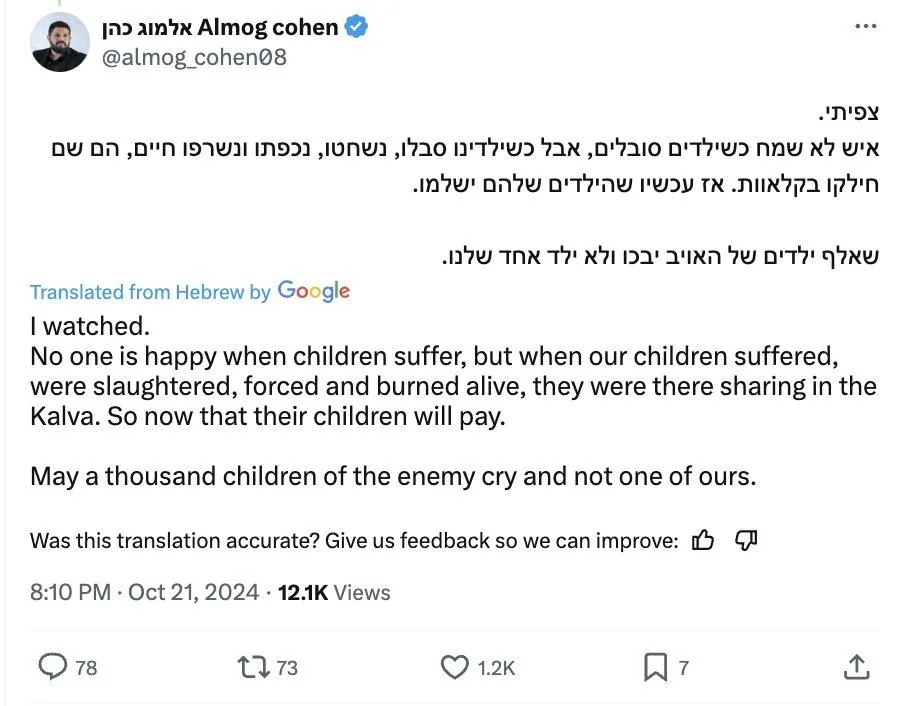
Almog Cohen, member of the Israeli Knesset, Using Lies about the 10/07 Attack to Justify Targeting and Killing of Palestinian Children


X/Twitter screen cap from Almog Cohen. He is perpetuating lies about the 10/07 attack to justify targeting and killing of Palestinian children.
FacebookTwitterRedditEmail

Dissident Voice Communications (DVC) is a non-profit meta-company in the public interest (well, depends on which public), we aim to challenge the hegemony of Big Media by communicating... all sorts of stuff. Read other articles by Dissident Voice Communications.

City elections show Brazil shifted right but not far-right

Mon, October 28, 2024 

Municipal elections in Sao Paulo

By Anthony Boadle

BRASILIA (Reuters) - Conservative and center-right parties were the big winners in Brazil's city elections on Sunday, but right-leaning voters preferred moderates to candidates endorsed by harder line former President Jair Bolsonaro.

The left won only two races in the 26 state capital cities electing new mayors in two rounds of voting that ended in Sunday's runoffs.


Four center-right parties, led by the Social Democratic Party (PSD) and the traditional Democratic Movement Party (MDB) won the most mayoral races, while Bolsonaro's Liberal Party (PL) fared worse than expected.

The results underscore the complex legacy of Bolsonaro's divisive presidency, marked by evangelical and gun rights fervor, vaccine skepticism, disregard for indigenous rights and active encouragement of illegal mining and logging.

Candidates backed by the populist firebrand lost in large cities like Belo Horizonte and Fortaleza, and even in Goiania, the capital of farm state Goias, where Bolsonaro campaigned.

In Sao Paulo, Latin America's largest city, Mayor Ricardo Nunes won handily against Guilherme Boulos, the leftist candidate endorsed by President Luiz Inacio Lula da Silva. Nunes was backed by Sao Paulo Governor Tarcisio de Freitas, who emerges as a likely successor to Bolsonaro as standard-bearer of the right.

Bolsonaro's support for Nunes of the MDB party was tepid and he hardly campaigned for him, because his strongest supporters backed far-right influencer Pablo Marcal. Marcal has sought to position himself as Bolsonaro's political heir, but he did not make it to the run-off between Nunes and Boulos.

"The conservative movement that Bolsonaro started in Brazil has outgrown him," said Leonardo Barreto, a political scientist at Think Policy consultancy.

Center-right parties want to have Bolsonaro as their ally because he draws crowds of right-wing voters, but they do not want his leadership, Barreto said.

Bolsonaro, whose own political future is unclear, lost political capital in several city races where his candidates failed to get elected, such as Belo Horizonte, Fortaleza, Belem and Curitiba, according to Andre Cesar at Hold Assessoria Legislativa consultancy.

"Bolsonaro's leadership is being questioned today and other names are emerging on the far-right," Cesar said. "But it was the center and center-right that won these local elections."

The big winner was the PSD led by Gilberto Kassab, who backed Nunes in Sao Paulo and whose party won more city halls than any other, making him a major player in Brazilian politics, Cesar said.

The municipal elections showed that Bolsonaro is still a fixture on the political stage, even though he was banned by Brazil's electoral authority from seeking elected office until 2030 for baseless attacks on the integrity of the country's electronic voting system.

His PL party is banking on Congress passing an amendment that would overturn the court order banning Bolsonaro for eight years, but the chances of lawmakers approving that legislation appear more remote after the local elections, analysts said.

(Reporting by Anthony Boadle; Editing by Bill Berkrot)


Brazil runoff vote in city elections confirms right-wing trend

Updated Sun, October 27, 2024 


Sao Paulo mayor candidate center-right Mayor Ricardo Nunes meets with supporters in Sao Paulo


By Anthony Boadle

BRASILIA (Reuters) -Sao Paulo Mayor Ricardo Nunes was reelected on Sunday to serve another four years in Brazil's largest city, defeating leftist challenger Guilherme Boulos in municipal runoffs that confirmed a rightward swing by voters that could shape the country's 2026 presidential and congressional elections.

Voters cast ballots in mayoral runoff elections in 51 cities, including 15 state capitals. The right and center-right won 14 mayoral races in the capitals - though hard-right former President Jair Bolsonaro's Liberal Party (PL) did not do as well as expected. President Lula da Silva's leftist Workers' Party prevailed in just one of those races.

Brazil's electoral authority said Nunes won with 59.5% of the votes against 40.5% for Boulos. Nunes was backed by Sao Paulo Governor Tarcisio de Freitas, who emerges as the likely standard-bearer of Brazil's right to succeed Bolsonaro.

The Sao Paulo race was important in setting the stage for the 2026 elections, showing that Bolsonaro's right-wing movement remains strong even though he was banned by Brazil's electoral authority from seeking elected office until 2030 for his baseless attacks on the integrity of Brazil's electronic voting system.

The electoral growth of the right has led to divisions in its ranks. In Sao Paulo, Bolsonaro supporters were split between Nunes, whom he supported, and far-right influencer Pablo Marcal, who has sought to position himself as Bolsonaro's political heir.

The defeat of Boulos was a setback for Lula, whose party won the mayor's seat in only one state capital, Fortaleza, in his political bastion in northeastern Brazil.

In the agricultural state Goias, the PL party lost the mayoral race in state capital Goiânia to the candidate of the conservative Uniao Brasil, who was backed by center-right state Governor Ronaldo Caiado.

Lula's PT party fared poorly in part due to his falling popularity and to his reluctance to campaign for candidates at risk of being defeated. A head injury a week ago kept him from campaigning in the closing days of the race. Heading a minority government, Lula has become increasingly hostage to a Conservative Congress in Brasilia to be able to govern.

"The new conservative wave underlines the dawn of a post-Bolsonaro age - and its leadership is up for grabs," risk intelligence company Verisk Maplecroft said.

"Leftist parties struggled to assert their relevance, and Lula's absence from final rallies suggests a strategic distancing from a meager performance - even in the northeast, a traditional stronghold for his Workers Party," Maplecroft added.

The voting was held on Sunday in cities of more than 200,000 voters where no candidate secured a majority in the first round vote on Oct. 6.

(Reporting by Anthony Boadle; editing by Diane Craft, Will Dunham and Mark Heinrich)
'Girls Will Be Girls' review: A movie that pushes against the shame of female sexuality

Shuchi Talati's coming-of-age drama screened at the St. John's International Women's Film Festival (SJIWFF)
CBC
Fri, October 25, 2024 

In Shuchi Talati's film Girls Will Be Girls, shame around female bodies and sexuality is evaluated through the eyes of a 16-year-old student at a Himalayan boarding school. Starring Preeti Panigrahi, Kani Kusruti and Kesav Binoy Kiron the film, which won the World Cinema - Dramatic Audience Award at the Sundance Film Festival and was screened during the St. John's International Women's Film Festival (SJIWFF), is an interesting look at a mother-daughter relationship.

Mira (Panigrahi) is the first girl to hold the position of head prefect in her school, something the teenage boys aren't particularly thrilled about. She's tasked with being the student who helps to enforce the school uniform dress code and other rules.

This model student soon has a crush on classmate Sri (Kiron), but the teachers at this strict school are very much against girls dating. The female students are encouraged to not speak to boys "more than necessary."

As her feelings for Sri get stronger, Mira's mother Anila (Kusruti) has her daughter invite Sri to their home, where she tells him Mira's academics can't suffer and they can't be more than friends.

There's already a bit of tension between Mira and her mother, with Anila seen as the "cool mom" by her friends, but things take a turn when Anila's position as a supervisor between Mira and Sri seems to shift. Anila starts giving Sri more attention than her daughter, having more private conversations with him. It's like Mira and Anila are competing for Sri's attention.


Girls Will Be Girls

Girls Will Be Girls is very much a quiet film, in the best way possible. While the film takes a strong stance against the long history of women feeling like their sexuality is shameful, it's delicate in it's storytelling by leaning into the silence and lingering on the expression of emotions.

What Girls Will Be Girls does is eliminate the shame that comes with growing up and evaluating sexual desires, from Mira practicing kissing on her hand, to researching how to have sex.

As we get into the relationship between Anila and Sri, the story is positioned in a way that suggests that a line could be crossed, but never is. It's awkward to watch, but Talati approaches this element of the story from a place of empathy for Anila, who is seemingly a bit envious that her daughter is being afforded freedoms as a teen that she never had.

Talati also never loses sight of putting a mirror up to normalized sexism. For example, when Mira tells the school principal that boys are taking pictures of girls walking up the stairs in their school uniform skirts, her principal's reaction is to tell Mira to ignore them, and to make sure the girls have longer skirts on.

It's a complex balance that Talati has to strike in this film, with the story occasionally feeling murky in its execution, starting off with a slower pace than you may want, but nonetheless, it captures a uniquely raw vulnerability on screen.


Anora and the changing depiction of sex work in Hollywood

Story by Jackson Weaver
 • CBC

 Andrea Werhun didn't have to wait long to see her influence play out onscreen.

Because as the Toronto-based artist and former sex worker watched just the opening scenes of Anora, she already saw something so familiar, and yet groundbreaking. As the Oscar-frontrunner for best picture introduced its main character — Anora, an exotic dancer and sex-worker about to be taken on an equal parts exciting and terrible trip by a client from hell — we first get a quieter moment. 

Sitting in the breakroom of the stripclub where she works, the film shows Anora casually, carefully, eating packed lunch from a plastic container. It's a seemingly everyday activity, one that Werhun specifically suggested to director Sean Baker when he hired her as a consultant, advising on how to ground the film in reality.

It's also a moment that one might more expect to see from a different sort of character, like an office worker — and perhaps not from someone in Anora's line of work.

But Werhun knew different. 


"When I saw that on the big screen, I was like, 'Yes, yes, because that's real,'" she said. "And that's not something that as an outsider, as someone who's never spent any time in a strip club locker room, you're ever going to notice, think about or consider."

However small that action seemed on the surface, to Werhun and others with experience working in or studying sex work, it represented much more. Because, Werhun said, for as long as they've appeared in film, sex work and the sex workers have largely been depicted as either wrongdoers needing to be vilified, or victims needing to be saved. 

And that kind of perception, she says, has real life repercussions.  

"We're victims were villains, we're dead, we've got hearts of gold," she said. "These are such shallow depictions that flatten our humanity and remove nuance and complexity from who we are as human beings, as people."

Heartbreak, reform or tragedy

The usage of sex workers in media is no new thing in general: Lauren Kirshner, an assistant professor at Toronto Metropolitan University and author of Sex Work in Popular Culture, pointed to it as the most common job portrayed by best actress winners at the Oscars. Numerous performers have received the award for their work in such defining Hollywood classics as BUtterfield 8I Want To Live! and The Sin of Madelon, ahead of the next most common professions of singer and teacher. The tradition even goes as far back as the very first winner, Janet Gaynor, who took home the trophy in 1929 for her work in three films. In two of those, Street Angel and 7th Heaven, she played a sex worker. 

The majority of those roles though, she said, also featured shared storylines that ended with "love and implied marriage, heartbreak and reform … or tragedy, murder, suicide, or accident." Otherwise, they are often supporting characters used to tempt or simply define the actual protagonist — such as in the long-running series House M.D., which saw the rule-breaking doctor visit sex workers throughout its run to outline his character.

Anora, Kirshner said, is part of the change seen in the past few years, alongside other films like Oscar-winner Poor Things and the Canadian film Paying For It, a film in which Werhun stars. Anora — which follows its star as she first is offered the chance to be saved from her circumstances before plunging back into the realities of her world — never uses her as a prop, and never wavers from her point of view. 


This image released by Neon shows Mark Eydelshteyn, left, and Mikey Madison in a scene from Anora. It is part of a series of films changing how sex work and sex workers are depicted. (Neon/The Associated Press)

"The sex worker character is becoming that dynamic character. So we're seeing it more and more. She's centre stage, she is the main character," Kirshner said. "And I think the sex worker finally being the main character and not an accessory and not a pretense to show something sexy or dangerous, that is a sign of how far pop culture has come."

The beginnings of that shift, she said, can perhaps most famously be seen in Pretty Woman, the Julia Roberts-led film about a sex worker eventually swept off her feet by a rich lawyer.

Kirshner said that film and others like it, like its spiritual predecessor Klute starring Jane Fonda, were actually in many ways watershed moments: films that depicted sex workers as extremely likable, dynamic and with an inner life and backstory. 


Emily Lê and Daniel Beirne star as romantically challenged couple Sonny and Chester in Sook-Yin Lee’s autobiographical film Paying for It — which follows their relationship to sex work and sex workers. (Courtesy St. John's International Women's Film Festival)

But those films also perpetuated the idea that a happy ending is escaping from a lifestyle forced on them. That, Kirshner says, makes it seem like those characters — and real people like them — have little or no agency.

"There's still a lot of moral judgment attached to the decisions women make. There's a lot of assumptions that no sex worker could truly choose sex work," Kirshner said.

"I mean, all workers are choosing their work within constraints, and sex workers are no different. The only difference is their work is criminalized."

Fraught realities

And it is films like Anora, she said, that make the important distinction of what sex workers may actually want to escape from. In that movie, Anora wants to be lifted out of the workforce that all workers struggle to survive in, instead of being lifted out of an inherently shameful profession.

That depiction is particularly important for the wider perception of sex workers in real life, said Chandra Ewing, the executive director of Maggie's Toronto Sex Workers Action Project. Though the act of selling sexual services is not illegal in Canada, purchasing sexual services is. While this distinction was meant to protect sex workers while still decreasing prostitution, Ewing said it creates a grey area. 

Because sex work has some protections as a legitimate business, alongside legislation making it more clandestine, she said sex workers are often in a constant state of fear of being "outed." That could put them at risk of having their profession "weaponized against them" due to preconceptions, and lead to them potentially losing custody of their children, their housing, or status as residents and be removed from the country. 

"So it's not even really like an implicit choice that sex workers are making. This is a very real reality that they do not have rights and agency and autonomy over their own lives," she said. "Because of that, sex workers do unfortunately have to exist in the margins." 

Cinema's changing depiction of sex workers as more fully-fleshed characters is important, she said, as it humanizes them and can work to undo the idea that they should be stigmatized. But, she said, that has to be done hand in hand with a realistic depiction of the fraught realities sex workers face.

In Werhun's opinion, that can only be done by getting those with direct experience in the industry to tell their own stories — or at least influence the way they are told. 

"Because otherwise it's civilians — that's what we call people who don't do sex work — telling stories for us," she said. "And that's just never going to be good enough."


Mikey Madison and Sean Baker talk 'complex' “Anora” ending and her most surprising costar


Christian Holub
Sat, October 26, 2024 


"We’re dealing with some complex relationships, especially at the end," director Sean Baker tells "Entertainment Weekly."

Warning: This article contains spoilers for Anora.

Before Anora, director Sean Baker would usually cast a minimal amount of professional actors in his movies. In The Florida Project (2017), for instance, he cast Willem Dafoe alongside newcomers like young Brooklynn Prince. In Red Rocket (2021), he surrounded Simon Rex with first-time actors, many of whom Baker asked to audition after running into them on the street near the filming locations.


But Mikey Madison is far from the only experienced actor in Anora, which won the Palme d'Or at the Cannes Film Festival earlier this year and is now shaping up as a possible Best Picture contender at the Oscars. Part of the reason for the different casting is that the COVID-19 safety protocols that were in place during the production of Red Rocket (which made it hard to transport a large cast across state lines) are no longer as restrictive. But the casting choices are also a product of the story that Anora is telling, about a Brooklyn sex worker who falls into a whirlwind romance with the son of a Russian oligarch.

“This is my first film in which almost all the leads and the supporting actors are all seasoned, trained actors,” Baker tells Entertainment Weekly. “There was budget, and there was time, which are always the biggest factors. Plus, a significant percentage of our dialogue is in Russian and Armenian, and I don’t know those languages. So that was another reason why I really had to have seasoned actors on board.”

Neon/Courtesy EverettYura Borisov, Mark Eidelshtein, Karren Karagulian, and Mikey Madison in 'Anora'

Baker continues, “In the past, when I've worked with first-timers that I grab off the street, that's an amazing experience, but it wouldn't really work for this film. This film was, as you can probably tell, tightly scripted from beginning to end.”

But even within that tight script, these seasoned actors could make suggestions that impressed Baker. For instance, Yura Borisov (who plays Igor, one of the Russian henchmen employed by the oligarch to fix this marriage situation) came up with an idea during the film’s epic fight scene that the director loved.

Related: Anora star Mikey Madison and director Sean Baker, Best Picture predictions, and more in EW's Awardist digital magazine

“All great actors will bring something to the table that you never expected ever,” Baker says. “When Yura is doing that screaming in her face, ‘Stop screaming!’, he understood my sensibility enough where he pitched that to me. He was like, ‘I want to just scream to the point that it takes to the next level, and I'm screaming louder than she's screaming.’ I'm like, ‘You're so right. That would really help in this moment and take it to a very unexpected place.’ These wonderful actors would bring this stuff to the table, pitch it to me, and then we could figure out how to work it in.”

Baker wasn’t the only one who was impressed by Borisov. As the film goes on and Ani’s relationship with Vanya (Mark Eidelstein) starts to sour, she ends up forging an unexpected connection with Igor. The characters’ chemistry developed in parallel with the actors’ working relationship.

“Yura is an incredible, really serious, professionally trained actor in the Russian Stanislavsky school,” Madison says. “Working with him was really different, he’s so soulful and sensitive. He was constantly surprising me with the way that he was approaching his character, which I think in turn made me feel differently about him, as Ani feels differently about Igor.”


NeonMikey Madison and Yura Borisov in 'Anora'

By the end of Anora, it almost seems like the title character may have actually found a possibility for true love with Igor, who seems to genuinely care about her more than Vanya. But there’s also a lot of bitterness and disappointment to go around, and the final emotions are complicated and ambiguous. That’s another benefit of working with seasoned actors like Borisov, who previously earned acclaim for his performance in 2021’s Compartment No. 6.

Related: Cannes-winning Anora director on mashing genres: 'I love tonal jumps. I love roller coasters.'

“It was so great to have Mikey, Mark, and Yura really get into the development of their characters and understand why things are happening,” Baker says. “We’re dealing with some complex relationships, especially at the end with Ani’s gravitation towards Igor. That stuff was discussed a lot, like what’s going on in Ani’s head in that ending scene? It was great to have actors who were so invested because they wanted to discuss this.”

Anora is in theaters now.


Anora confirms near-perfect Rotten Tomatoes rating ahead of UK release

Stefania Sarrubba
Mon, October 28, 2024 

Anora confirms near-perfect Rotten Tomatoes rating  NEON

Sean Baker's NYC-set fable Anora has wowed critics, confirming an almost perfect Rotten Tomatoes score.

The filmmaker's latest tale of characters on the margins follows titular heroine Anora AKA Ani (Scream's Mikey Madison), a sharp-tongued stripper who embarks on an unlikely, whirlwind romance with Vanya (Mark Eydelshteyn), the bratty son of a Russian oligarch.

The 139-minute runtime feels breezy as the joyous movie descends into pure, messy madness, packing an emotional punch in a cathartic, if polarising, finale.

Related: Best movie box sets to buy

Months after its Palme d'Or win at Cannes, Anora is Certified Fresh thanks to a 99% score on Rotten Tomatoes, with critics blown away by Madison's performance and Baker's direction.

Released in the US on October 18, Anora is ready to hit UK cinemas on November 1. Ahead of its release this side of the pond, let's have a look at what has been said about one of the most anticipated movies of the year.

Slate

It's a crowd-pleaser, funny and sexy and raucous, while also being startlingly wise and tender.

Autostraddle

Anora's practically seamless tonal shifts and sharp performances make for a strong, defined comedy with dramatic weight. Although the film carries its head high for nearly the entire runtime, it might just undersell itself in the last moments.

Rolling Stone

[Mikey Madison] exits stage left as an above-the-title star. Then, just when you've think you've seen the full multitudes of this working-class martyr, the actor downshifts and manages to crack you in two.

Neon

Related: The highest-grossing movies of 2024 to date

Associated Press

Anora both embraces and transcends the cliches. It's not trying to pretend that it's not exploitative on some level; that might even be the point. And anyway, you might be surprised just how quickly you commit to this once-in-a-lifetime ride.

The New York Times

Sometimes a movie actually earns the old cliché of a 'star-making turn', and I'm here to say that Sean Baker's Anora is this year's star maker.

Los Angeles Times

Baker wrote the part for her, and Madison returned the favor with a star-making performance, leaning into Ani's audacity while revealing the fragile façade, the vulnerabilities and self-deception lurking underneath.

Time Out

It shouldn't all be so funny, but it is, and it's to Baker's huge credit that he's able to inspire laughs and huge enjoyment from this madcap story without leaving you feeling that the woman at the heart of this mess has been short-changed.

Mashable

Altogether, Anora is a visceral experience, making its audience not voyeurs but one of the crew. Thus embedded, our pulses race, our eyes grow wide, our hearts dance as our heroes do. Anora offers a glorious thrill, as bold as it is brilliant.

Related: The best and most anticipated movies of 2024

RogerErbert.com

Anora is boundlessly alive with a quality we've seen continually in the movies of Sean Baker, among the most humanist filmmakers working today. There is joy next to sadness. There is comedy inside a tragedy.

BBC.com

Anora fizzes with energy and laugh-out-loud moments, but it isn't recommended for anyone with high blood pressure.

Little White Lies

While the film remains entertaining thanks to the calibre of the performances, there are few surprises in store and not many places for Ani's character to go.

The Daily Beast

The film is very funny, until it punches you in the gut with a beautiful ending, and it entirely rests on Madison's performance as the tough-as-nails Anora.

Anora is out in US cinemas now. In the UK, the film is released on November 1.
  

Philadelphia DA sues Elon Musk over $1 million giveaway to swing state voters, days after Justice Department issues warning

Katie Mather
·Reporter
Updated Mon, October 28, 2024

Elon Musk at a town hall in support of former president Donald Trump in Folsom, Pa., on Oct. 17. (Matt Rourke/AP)


The Philadelphia District Attorney's office has filed a civil lawsuit against Elon Musk and his pro-Trump America PAC, one week after Musk announced plans to give $1 million once a day to a random registered Pennsylvania voter who signs the group's petition.

“America PAC and Musk must be stopped, immediately, before the upcoming Presidential Election on Nov. 5,” Philadelphia DA Larry Krasner wrote in a statement released Monday. “That is because America PAC and Musk hatched their illegal lottery scheme to influence voters in that election.”

The lawsuit comes days after CNN reported that the U.S. Justice Department warned Musk that his $1 million giveaway could violate federal law against paying people to register to vote. One day after the DOJ issued its warning, Musk's PAC awarded $1 million to registered voters in Michigan and Wisconsin.


Musk, the Tesla and SpaceX founder, announced the prize money at an America PAC event in Harrisburg, Pa. last weekend. He said the money would be awarded every day “from now until the election” on Nov. 5. Musk even handed a giant check to a petition signer at the event.

Musk is the wealthiest person in the world, with an estimated net worth of $242 billion. As of Oct. 16, he had already spent at least $75 million to help reelect Trump. Earlier this month, Musk offered supporters $47 for each registered voter they recruited in seven battleground states — Arizona, Georgia, Michigan, Nevada, North Carolina, Pennsylvania and Wisconsin — to sign his petition.

Trump, who was campaigning in Pennsylvania on Sunday, was asked about Musk’s $1 million giveaway and said, “I haven’t followed that,” the Associated Press reported.

While Musk and his PAC have not publicly commented on the debate, Musk’s allies have argued that since Musk is not paying for voter registration, but for a petition signature, then it’s not illegal, according to the New York Times. But some legal experts suggest that Musk’s latest stunt is pushing the boundaries of election law.
What exactly is a PAC?

As defined by the Federal Election Commission, PACs are tax-exempt committees that may receive unlimited finance contributions that go toward financing political activity, like campaigns. Super-PACs can also accept money from corporations and other entities that are usually barred from donating directly to candidates.

America PAC is categorized as a super-PAC, which means it can also get donations from other PACs.
What is Elon Musk doing with his PAC?

Musk’s PAC aims to get signatures on a petition supporting the First Amendment to the U.S. Constitution, which protects freedom of speech, and the Second Amendment, which guarantees the right to keep and bear arms.

America PAC’s website also mentions supporting the “values” of secure borders, sensible spending, safe cities and a fair justice system. The supporting evidence for why each value is a priority is links to X posts — including some from Musk himself.

“One of the challenges we’re having is how do we get people to know about this petition,” Musk said at the town hall on Oct. 19. “The legacy media won't report on it; not everyone’s on X. So, I figure, how do we get people to know about it? This news, I think, is really gonna fly.”

In a post on X, which Musk owns, he wrote, “The goal of the $1M/day prize is to maximize awareness of our petition to support The Constitution.”

As of Oct. 21, two people from Pennsylvania have won $1 million from the America PAC, according to the petition site. The America PAC filed its first mandatory contribution financial report in early October, The Hill reported, and is expected to file its second on Oct. 24.
Is this legal?

Musk has not commented publicly on the debate over whether his PAC’s incentive campaign is legal or not. During an appearance on NBC’s Meet the Press Sunday, Pennsylvania Gov. Josh Shapiro called Musk’s efforts “deeply concerning” and “something that law enforcement could take a look at.” Musk simply responded with, “Concerning that he would say such a thing.”

A source familiar with the PAC’s effort told The Hill that they believe the PAC is in “full compliance with the law.”

Initially, Musk’s $47-per-referral proposal was within legal bounds because it’s not illegal to pay voters to sign a petition or to pay people persuading others to sign, campaign finance lawyer Brendan Fischer told the New York Times. But this new version, which requires eligible winners to be registered to vote, comes “much closer to the legal line,” Fischer said in a second interview.

“There would be few doubts about the legality if every Pennsylvania-based petition signer were eligible, but conditioning payments on registration arguably violates the law,” Fischer said.

“Though maybe some of the other things Musk was doing were of murky legality, this one is clearly illegal,” Rick Hasen, a professor of political science at UCLA School of Law, said in a blog post.

Hasen refers to subsections in Title 52 of the United States Code, an official list of federal statutes, published by the U.S. House of Representatives Office. He emphasizes a section that reads, “Whoever knowingly or willfully … pays or offers to pay or accepts payment either for registration to vote or for voting shall be fined not more than $10,000 or imprisoned not more than five years, or both…”

In his blog post, Hasen also points out that the Department of Justice Election Crimes Manual states that it’s a violation to “bribe” with “anything having monetary value, including cash, liquor [and] lottery chances” — anything to “induce” people to vote. Any monetary benefits that violate the law “must have been intended to induce or reward the voter for engaging in one or more acts necessary to cast a ballot.”

Musk isn’t directly paying these residents to vote, but because the PAC’s prerequisite for winners is to be registered voters within specific states, and it’s happening so close to Election Day, it’s hard to argue that this isn’t financially incentivizing people to register to vote, Michael Kang, an election law professor at Northwestern’s School of Law, told CBS News.

In a social media post on Sunday night, America PAC reworked the language of the giveaway to state the winners would be an official “spokesperson” affiliated with the PAC. It's not clear whether the Justice Department's letter to the PAC was responsible for the change.

In terms of whether there can be this level of coordination between campaigns and super-PACs, that was illegal up until recently. Super-PACs, which were created in 2011, were required under campaign finance laws to operate independently from the candidates and their campaigns. However, in August, the FEC got rid of its anti-corruption law that prevents super PACs from coordinating with the political candidates they support.
UCP ALBERTA

Calgary mobile home park residents push for stronger protections amid fee increases

INCREASES ARE INFLATION

CBC
Mon, October 28, 2024 

A sign for Greenwood Village in northwest Calgary. The 500-unit mobile home park sits atop a hill and is separated from Bowness by a wooded area. (Danielle Nerman/CBC - image credit)


A group of mobile home park residents in Calgary is pushing for stronger protections under provincial laws, as they face increasing fees they say could drive people out of the community and make it harder to sell their homes.

Greenwood Village, a 500-unit mobile home park, is just north of Calgary Farmers' Market West, off the Trans-Canada Highway.

Like most mobile home communities, Greenwood Village residents own their homes but not the land. Instead, they pay monthly fees to rent the pads their homes sit on. The fees pay for water and sewer utilities, waste, recycling, green bin collection, park maintenance and road repairs.


Resident and real estate agent Claudette Boniface said lot fees for new residents recently jumped to $1,275 a month from a previous increase of $1,150 in January.

"A lot of people just cannot afford that," said Boniface, noting they also have mortgages.

Resident and real estate agent Claudette Boniface is asking the province to review its Mobile Home Sites Tenancies Act to improve protections for mobile home residents.

Resident and real estate agent Claudette Boniface is asking the province to review its Mobile Home Sites Tenancies Act to improve protections for mobile home residents. (Karina Zapata/CBC)

Additionally, she said, lot fees for existing residents are also climbing. This year, many residents' monthly fees went up by $60, which she said is a big financial hit for the park's many senior citizens on fixed incomes.

"They're taking from their food budget and they're putting it toward [fees] and then they're not eating properly," said Boniface.

As a real estate agent, she said the increased fees for new residents are making it difficult to sell homes in the community. She currently has seven listings in the community.

It's leaving residents at an impasse, she said — some can't afford to stay, but they also can't afford to leave without selling their home.

It's why she and other community members are asking the province to review its Mobile Home Sites Tenancies Act to better protect mobile home residents at Greenwood Village and beyond.

Trouble selling homes

Randi Mayan, a real estate agent with CIR Realty, agrees it's been tough to sell homes in the park.

She listed a Greenwood Village property in the spring, which she expected to be sold by the fall — just in time for her clients' new home to be built and ready to be moved into.

A view of Greenwood Village Mobile Home Community in Calgary, Alberta.

A view of the Greenwood Village mobile home community in Calgary. (Danielle Nerman/CBC)

But after several months, no one purchased the home.

So last week, Mayan and her clients decided to terminate the listing. They aim to relist in the spring, but in the meantime Mayan's clients can't move into their new home as planned.

"The No. 1 feedback that we get from people that come to view the properties is that the lease fee is just too high when you don't even own the property and you're paying … basically a mortgage payment, and then you also have to pay your mortgage payment," said Mayan.

Greenwood Village is located in northwest Calgary, by Calgary Farmers' Market West and the new Greenwich community.

Greenwood Village is in northwest Calgary, by the Calgary Farmers' Market West and the new Greenwich community. (Google Maps)

She said the location of the park — near the busy farmers' market and the new community of Greenwich — is also a barrier in getting properties sold.

"They're thinking the park is probably going to get sold. So they're like, there's no security in us even leasing and purchasing in here."

Pushing for legislation changes

Willi Sperlich, a senior who has lived in the community for four years, is worried the park will get sold to developers.

He also fears the lot lease fee for existing residents will continue climbing to a rate he can no longer afford. He now pays $940 a month, but he said he'd be in financial trouble if it increased to $1,275 like the fee for new residents.

"Then I'm stuck. I can't afford it. I can't sell it because the new people aren't going to pay that either. So what do I do?" said Sperlich.

"It's a no-win situation. It's helpless."

Sperlich was among a dozen Greenwood Village residents who gathered last Thursday to share their concerns for the first time and create a path forward to fight for better protections.

A dozen Greenwood Village residents gathered last week to discuss their concerns.

A dozen Greenwood Village residents gathered last week to discuss their concerns. (Karina Zapata/CBC)

"Mobile home legislation needs to change entirely," said Sperlich.

He said he wants to see a limit on rent increases to keep mobile homes affordable.

More broadly, he also wants mobile home owners to qualify for certain government subsidies, including rebates for retrofitting homes with solar panels and energy efficient windows.

Mobile Home Sites Tenancies Act

Boniface is urging the Alberta government to consider guidelines set out in British Columbia, which has rent increases for mobile home tenancies capped at 3.5 per cent this year.

Anna Lund, a law professor at the University of Alberta, wrote a research paper on mass evictions of mobile homes — focused on Calgary's Midfield Mobile Home Park — which was published in 2021.

She said residential tenancies and mobile home park protections in Alberta tend to be weaker than in other Canadian provinces.

However, she said implementing stronger rent controls is a tough feat in Alberta.

"There has yet to be much appetite because there is sort of that political opposition to it," said Lund.

The office of Minister of Service Alberta and Red Tape Reduction Dale Nally said landlords of mobile homes in Alberta can increase rents once a year, with no limit on the amount, as long as they give six months' notice.

"The Mobile Homes Sites Tenancies Act offers a balanced approach to landlord-tenant issues to foster a healthy rental market and ensure adequate mobile home site availability," said Brandon Aboultaif, Minister Nally's press secretary, in a statement.

He said tenants who believe their landlord isn't following the rules can apply to the Residential Tenancy Dispute Resolution Service to resolve disputes.

Despite multiple requests by CBC News, Greenwood Village management declined to comment.
Fanafjord ferry could have been bought for half the price, says marine expert

CBC
Mon, October 28, 2024 

Russell Compton, concerned about the state of P.E.I.'s ferries, went to Norway in 2016 to search for solutions. (CBC - image credit)

If the federal government had moved more quickly, it could have had the Fanafjord ferry in service now between Nova Scotia and P.E.I. after buying it at half the price, says the owner of a marine design firm in eastern P.E.I.

In 2016, MV Holiday Island, one of two ferries Northumberland Ferries was operating on the Nova Scotia-P.E.I. route at the time, spent the entire summer in drydock.

Russell Compton, the owner of NorCan Marine in Montague, told Island Morning host Laura Chapin he was concerned about the age of the ferries on the service. The Holiday Island was launched in 1970, and MV Confederation in 1993.

Compton took it on himself to look for possible replacements for the ferries. He travelled to Norway, where he has friends in the industry, and looked at three ships.

One of those boats was the Fanafjord, which the federal government purchased last year as a replacement ferry for $38 million, but is now estimated to have a price tag of $43.5 million, according to Transport Canada officials.

MV Fanafjord, launched in 2007, in a photo from the Public Services and Procurement Canada Facebook page.

MV Fanafjord, which was launched in 2007, in a photo from the Public Services and Procurement Canada Facebook page. (Submitted by Transport Canada)

Compton said the Fanafjord was available in 2016 for only $19 million. He let the government know about that availability when he returned, at a meeting with Cardigan MP Lawrence MacAulay, the federal Department of Transport, Northumberland Ferries, and then P.E.I. premier Wade MacLauchlan.

He said he addressed MacAulay directly at the meeting, saying: "Lawrence, you should buy three of these and get them over here because these ferries are old that are here.

I said there's nine of these boats for sale in Norway. They're six years old, they're clean, green, faster, and they fit into our docks. And nothing happened. — Russell Compton

"I said there's nine of these boats for sale in Norway. They're six years old, they're clean, green, faster, and they fit into our docks. And nothing happened."

In an emailed statement, MacAulay's office said it could not comment on any sort of price quotes that Compton may or may not have received, as a private citizen and not a representative of the Government of Canada, during a trip to Norway eight years ago.


Fire fighters approach the MV Holiday Island ferry after a fire broke out on it, in Wood Islands, Prince Edward Island, Canada on Friday.

MV Holiday Island caught fire during a crossing in 2022 and had to be scrapped. (John Morris/Reuters)

The Holiday Island suffered an engine fire during a crossing in 2022 and had to be scrapped. The Fanafjord is a temporary replacement ferry for that vessel. It was purchased last year, but required work, and is currently in Norway undergoing sea trials.

Northumberland Ferries has had no ferries available for its service since Sept. 23, when the replacement vessel Saaremaa, on loan from Quebec, had engine issues. A technical problem with Confederation in Sept. 15 caused it to crash into the wharf and it is still being repaired.

Questions about refit

At the time it was bought, the Fanafjord operated on liquefied natural gas, and Transport Canada made the decision to convert it to diesel-electric.

There have been questions about that decision. While P.E.I. does not currently have a supply of LNG, some have suggested it could have been transported and have noted that LNG is a greener fuel than diesel.

Minister of Agriculture and Agri-Food Lawrence MacAulay is pictured in a file photo during Question Period in the House of Commons on Parliament Hill, in Ottawa on April 18, 2024.

Lawrence MacAulay's office says it can't comment on any quotes that might have been provided to Russell Compton in 2016. (Patrick Doyle/The Canadian Press)

The decision was Transport Canada's, but Northumberland Ferries CEO Mark Wilson said his company was consulted, and there were issues with Fanafjord's LNG engines that went beyond supply of fuel.

"It was on what I would consider to be first-generation LNG technology," Wilson said of the ship, which was launched in 2007. "We were concerned, number one, that that current technology wouldn't meet Canadian standards so that vessel could not be flagged to come into Canada."

He also said it would not have met Northumberland Ferries' own safety standards, which "advanced significantly."

Wilson noted that ferries in Canada that are operating on LNG have dual fuel systems, and can operate on diesel, if LNG is not available. Fanafjord would have been stuck in the dock if there was an interruption in the LNG fuel supply.

Fanafjord's retrofit is complete, but it will not enter service in Canada until the 2025 ferry season, at the earliest.

'A reliable ship'

A permanent replacement for Holiday Island was announced in the 2019 federal budget.

The federal government signed a contract with Davie Shipyard in Quebec for that vessel in November that same year, and the new vessel was expected to be delivered in 60 months later.

Sept. 15, 2024

Following a collision with the wharf in September, MV Confederation had to be pulled from service. (Stacey Janzer/CBC)

If that had happened, MV Holiday Island II would be here next month. But the design for the ferry is only just being completed. Delivery is now expected in 2029 or 2030.

In the meantime, Wilson said the Fanafjord will fill in well.

"I think that the Fanafjord is going to be well liked. It's going to be a reliable ship," he said.

After some trouble-filled years, Wilson said he is looking forward to earning back the trust of the public next season.
Former senator recalls being told Canada asked Sudan to hold Abdelrazik in detention

Jim Bronskill
Mon, October 28, 2024 


OTTAWA — Former senator Mobina Jaffer says she was told by the Sudanese intelligence director that he felt Canadian officials had asked him to detain Montreal man Abousfian Abdelrazik.

Jaffer, who retired from the Senate earlier this year, testified today in Federal Court in Abdelrazik's lawsuit against Ottawa over his detention and alleged torture in Sudanese custody two decades ago.

She recalled her September 2004 meeting in Sudan with Salah Gosh, who was then the director of the country's intelligence service.


Jaffer, Canada's special envoy for peace in Sudan at the time, said Gosh told her Canada thought Abdelrazik was a terrorist and wanted him to find out if he was indeed an extremist.

She said Gosh informed her Sudanese intelligence tried "all kinds of ways" to find out, but was completely satisfied he was not a terrorist, and that it was time for Canada to take him back.

Jaffer said it was no secret the intelligence service used brutal methods, so she immediately knew that Abdelrazik did not have a pleasant experience in custody.

This report by The Canadian Press was first published Oct. 28, 2024.

Jim Bronskill, The Canadian Press