Monday, October 28, 2024


Four African Stowaways Survive 2,000 NM Trip on Rudder of MSC Boxship

stowaways
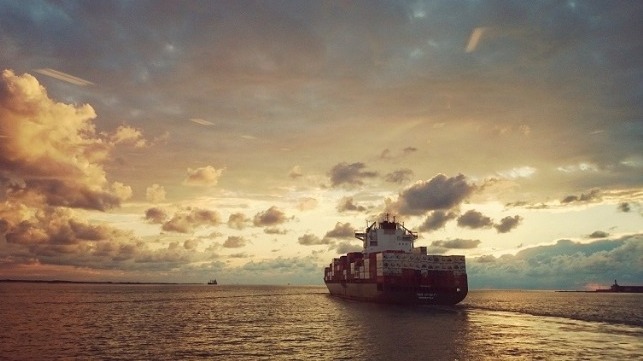
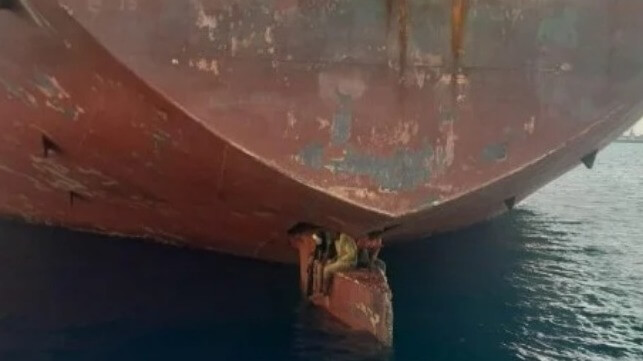
Authorities in the Canary Islands reported four stowaways found on the rudder of containership similar to the 2023 situation seen here (Canary Island Police)

Published Oct 28, 2024 1:24 PM by The Maritime Executive


It has happened again in the Canary Islands where Nigerian stowaways have been found sitting on the top of a vessel’s rudder having survived the perilous trip from Africa. Salvamento Maritimo and the national police in the Canary Islands reported the detention of four stowaways after an MSC Mediterranean Shipping Company vessel arrived in Las Palmas de Gran Canaria on October 26. 

Dockworkers aiding in the arrival of the MSC Fiammetta (73,355 dwt) late on Saturday afternoon spotted the stowaways and reported them to the maritime authorities. Salvatore Maritimo sent its patrol boat Salvamar Nunki and it was able to retrieve the individuals and bring them ashore for processing. The containership built in 2008 has a capacity of 5,770 TEU.

According to media reports, the four men were identifying as Nigerian citizens. They said they had climbed onto the vessel while it was in Abidjan, Ivory Coast. Tracking data indicates that the ship had been at sea for six days making an approximately 2,000 nautical mile trip during which time the stowaways would have been exposed to the sea and wind conditions. In past cases, it was reported the stowaways had been able to make their way up from the rudder into the steering gear room.

The authorities said the four individuals appeared to be in good health despite the conditions of their voyage. They were being processed and in most cases under Spanish law, they are placed back on the ship which is responsible for reparations. In some cases, such as three Nigerian stowaways in November 2023 that arrived on the oil tanker Alithini II, Spain grants asylum on humanitarian grounds.

 Spanish authorities are reporting an increase in the number of migrants trying to escape to the islands. There have been cases of small boats being spotted and rescued. There have also been cases of stowaways on commercial ships, such as two from Ivory Coast detected in June 2023 on another MSC containership. Another case of “rudder sitters” was discovered in July 2023 when two young Nigerians, ages 18 and 22, were found on MSC Marta when it arrived in the Canary Islands arriving from West Africa.

MSC Fiammetta was showing on its AIS transmission that it got back underway from the Canary Islands late on Monday, October 28, bound for Fos-sur-Mer. France.

WWIII

Military Challenges to China's South China Sea Claims are Increasing

HMCS Montreal
Courtesy Royal Canadian Navy

Published Oct 27, 2024 7:00 PM by The Strategist


[By Joe Keary]

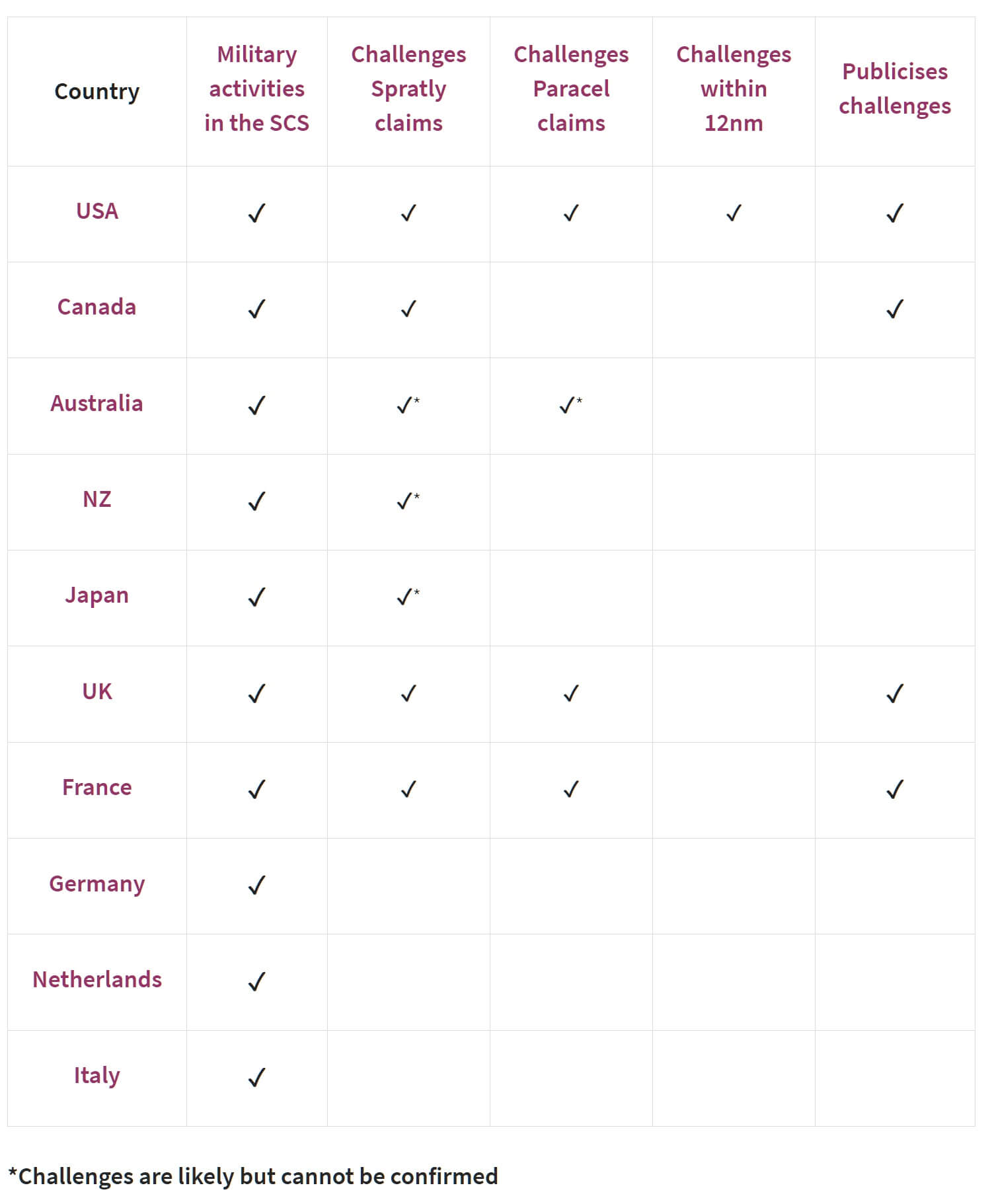
Deployments of ships and aircraft to challenge China’s illegal claims in the South China Sea are increasing. European ships are appearing more often, while Asia-Pacific countries are increasingly conducting activities in areas that China regards as sensitive.

Several nations have claims in the South China Sea, but China’s claim is the most extensive and controversial. Beijing seeks to enforce sovereign rights and jurisdiction over all features within the nine-dash line, including the islands, rocks and atolls that make up the Paracel and Spratly Islands. China claims this territory despite a 2016 ruling that found that China’s claims had no basis in international law.

With international law doing little to curb China’s ambitions, more countries are using their militaries to challenge China’s claims. In 2024, more European navies operated in the South China Sea than previously in recent years, with Britain, France, Germany, Italy and the Netherlands all sending ships to the region. Meanwhile regional counties, such as Japan, Canada, New Zealand and Australia, stepped up their engagement, including via joint sailings with the Philippines in the South China Sea.

Different countries take different approaches to challenging China’s illegal claims in the South China Sea. Some militaries are operating within the nine-dash line. Others sail naval ships directly through the Spratly Islands. Some advertise their activities; others do not.

Only a few have conducted activities close to the Paracels, because doing so is unusually risky. A 2022 incident in which a Chinese pilot dumped chaff in front of an Australian P-8 Poseidon surveillance aircraft is an example of the risk.

The US is the only country to send aircraft or ships within 12 nautical miles of claimed features. By doing so, it would be entering territorial waters if China did in fact own the territory.

These military activities to challenge China’s claims have occurred since 2015:

Apart from countries around the South China Sea, which must routinely operate on or over it, the US has by far the most public and active military presence. In 2023, the US military conducted 107 activities, including six specific operations to challenge China’s illegal claims under the US Freedom of Navigation program. US activities are always accompanied by strong public statements.

France and Canada are both active in the region, including within the Spratlys. Both advertise their military presence and actions. Canada now carries journalists on some South China Sea transits. It has operated close to the Paracel Islands, but, as demonstrated when a Chinese fighter fired flares near a Canadian helicopter in 2023, doing so comes with risks. In 2015, France boldly exercised its right to freedom of navigation by sailing a task force through the Paracels.

Australia has an active military presence in the South China Sea. There’s evidence that Australia operates close to China’s illegal claims. However, the tempo and nature of its military challenges are hard to determine, because Canberra does not advertise them. China’s military has been aggressive in seeking to deter Australia from operating near the two island groups by engaging in unsafe intercepts.

New Zealand has a semi-regular presence inside the nine-dash line, commensurate with the size of its armed forces. Meanwhile, Japan has a growing military presence in the region and is increasingly working with partners, such as the US, Australia and the Philippines. As with Australia, there are signs that Japan and New Zealand operate close to, or within, the Spratly group, but neither publicise specific actions, so the nature of them is hard to determine.

Britain sent a carrier strike group through the South China Sea in 2021 and intends to do so again next year. The British military operates close to the Spratly and Paracel Islands and uses public messaging to reinforce the importance of sailing in these areas.

Signalling growing European interest in the region, Germany, the Netherlands and Italy sent navy ships to the area in 2024. But none seems to have overtly challenged China’s claims within the Spratlys or Paracels.

The most notable regional absentee is South Korea. In 2018, a South Korean destroyer, Munmu the Great, took refuge from a typhoon in the Paracel Islands. But Seoul quickly clarified that the ship was not there to challenge China’s claims. Likewise, when the littoral states of South East Asia routinely operate there, they do not directly challenge China’s claims via freedom of navigation transits.

The growing presence of European navies in the South China Sea and stepped-up activity of Asia-Pacific countries there is welcome. It’s helping to push back on China’s growing aggression and reinforce longstanding rules and norms that underpin regional prosperity.

Joe Keary is a senior analyst at ASPI. This article appears courtesy of The Strategist and may be found in its original form here

The opinions expressed herein are the author's and not necessarily those of The Maritime Executive.

China Tailors its History for South China Sea Propaganda

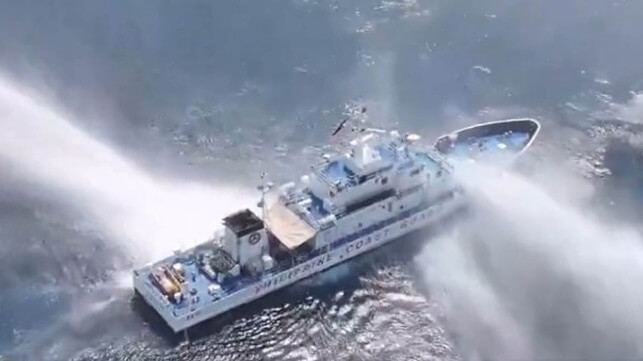
Two China Coast Guard cutters on a "rights protection" mission water-cannon a Philippine cutter in the Philippine EEZ (Courtesy PCG)

Published Oct 27, 2024 2:24 PM by The Lowy Interpreter


[By Mahbi Maulaya]

Historians in China need to play a dual role. Not only do they contribute to the advancement of knowledge, but they also need to actively defend their country’s national interests in the South China Sea. According to a report by the South China Morning Post, Chinese scholars gathered at the end of June were urged to “give a forceful response to false narratives” to strengthen their nation’s claims in the South China Sea.

At the seminar held in Hainan Province, China, Wu Shicun, founder of the National Institute for South China Sea Studies, emphasised the critical importance of “narrative construction and discourse building” for China. He said that the strategy would effectively defend the nation’s rights and interests in the South China Sea.

Many Chinese strategies have focused significant attention on the South China Sea conflict.

China asserts its claim to more than three million square kilometres of the Sea through the “nine-dash line” concept – contrary to international law. History has become a battleground in the dispute waters. Beijing has sought to draw upon the Western Han dynasty (200BCE to 9CE) to illustrate that China has historically fished in the waters for thousands of years. Yet a 2016 international tribunal decision on the United Nations Convention on the Law of the Sea did not concur, concluding that there was no legal basis for China’s historic rights claim.

At the June seminar, Wu Shicun encouraged the 100 historians and numerous legal experts in attendance to help China defend its “rights and interests” in the legal field of the South China Sea. The aim was to rebut the 2016 arbitration ruling invalidating China’s claims to most of the South China Sea, including contested areas in the Philippines’ Exclusive Economic Zone and areas claimed by Vietnam, Brunei, Malaysia, and the Philippines.

Wu was reported to have said that the international academic community had developed “some strange theories that deliberately distort the history of the South China Sea and maliciously smear China’s rights and claims”. He urged the audience to restore the “correct” historical and legal background.

As a consequence, it seems likely we will witness a form of history warfare as part of China’s new propaganda to boost its South China Sea claim, drawing on documents, maps, and records that purportedly portray China’s long-standing rights. It could also help China galvanise domestic support.

The gathering of Chinese historians in June, with the express intention of crafting narratives around China’s ownership of the South China Sea, should not be underestimated.

Many studies have indicated that governments have the ability to influence public opinion by directing citizens’ attitudes towards history. Political scientists Yiqing Xu and Jiannan Zhao found that the historical narrative of China’s humiliation in the past has contributed to its society’s scepticism towards foreign governments and support for China’s aggressive foreign policies. This illustrates the powerful effect of propaganda in Chinese society.

Propaganda based on China’s history may also be directed at individuals who are not Chinese citizens. It is reasonable to anticipate that China’s interpretation of the South China Sea history will be taught in mainland China’s universities, where international students are pursuing their degrees. China may also choose to communicate this interpretation to the international community through public diplomacy channels that it has established globally.

Add to this China’s active construction of artificial islands in the South China Sea, and the claim becomes magnified. According to Asia Maritime Transparency Initiative data, China has established 3,200 acres of new land in the South China Sea since 2013. A scenario can be imagined where in the next ten years China claims historical rights to the territory because it has developed the region’s geography, habitats and facilities.

The gathering of Chinese historians in June, with urging to craft narratives around China’s ownership of the South China Sea, should not be underestimated. It is crucial to consider the potential outcomes of China’s proposed strategy.

Mahbi Maulaya is a private researcher who graduated from Universitas Muhammadiyah Yogyakarta’s International Relations Department. His research interests concern Security and Strategic Studies surrounding the Asia-Pacific, the South China Sea, and Indonesia. 

This article appears courtesy of The Lowy Interpreter and may be found in its original form here

The opinions expressed herein are the author's and not necessarily those of The Maritime Executive.


Australia is Sinking Indonesian Poachers' Boats to Deter Illegal Fishing

IUU fishing
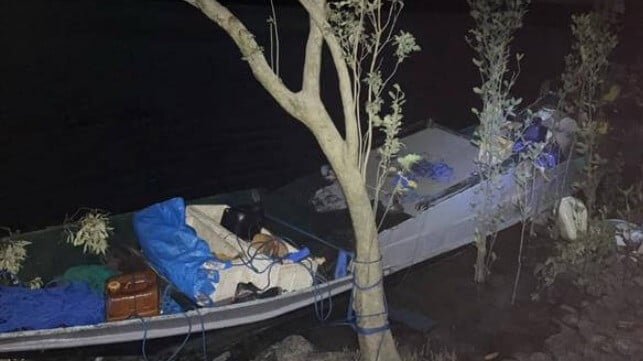
This boat was caught with 350 kilos of sea cucumber aboard, and the suspects pleaded guilty to illegal fishing charges. The vessel was sunk (ABF)

Published Oct 23, 2024 8:02 PM by The Maritime Executive


Australia has been making a concerted effort to crack down on foreign fishing vessels operating illegally in its waters, and its border agency is warning would-be perpetrators that they could be jailed and their vessels seized and sunk.

Last week, in the latest case, nine Indonesian fishermen pleaded guilty to charges of illegal fishing in Australian waters. A court in Darwin sentenced the skipper and two other crewmembers (both repeat offenders) to three weeks in jail - a duration equal to the time they had already served while awaiting trial. 

The nine men were spotted and caught near Augustus Island in Western Australia on September 19, and they were found to be in possession of 350 kilos of sea cucumber, a lucrative species in some Asian markets. The Australian Border Force estimated the value of the seizure at about $20,000. The suspects were also in possession of 175 kilos of salt, typically used as a preservative for sea cucumber poaching, along with a variety of equipment for fishing. 

The suspects' boat was destroyed at sea, and they were brought back to shore in Darwin to face trial. 

The intercept was just one of more than 80 interdictions that the Australian Border Force has carried out this year. Last week alone, in a period of 48 hours, ABF officers caught seven illegal foreign fishing vessels and 51 fishermen - all before the suspects had a chance to start poaching. These intercepts were off Western Australia and the Northern Territories, in coastal waters where Indonesian fishermen like to operate unlawfully. One occurred in a designated marine protected area, the North Kimberley Marine Park. 

These seven boats were escorted out of Australian waters along with their crews, but not all have gotten off so easily. Over the year to date, the ABF has prosecuted 48 Indonesian fishermen. 

"Our message to illegal foreign fishers is simple: Australia does not tolerate illegal activity in our waters. We will intercept you, you will lose your catch, your equipment and possibly even your vessel," said the head of the ABF's Maritime Border Command, Rear Admiral Brett Sonter.

Indonesia used to have a similar policy for deterring foreign illegal fishing operators: their vessels would be seized and destroyed, often with explosives. The policy was domestically popular, and it disposed of more than 500 illegal vessels over the course of five years, but it ended with the exit of former fisheries minister Susi Pudjiastuti in 2019.  


Stuttering Progress on 30x30 Ocean Protections

Only 8% of the ocean is protected and a global pledge to safeguard 30% by 2030 faces huge challenges

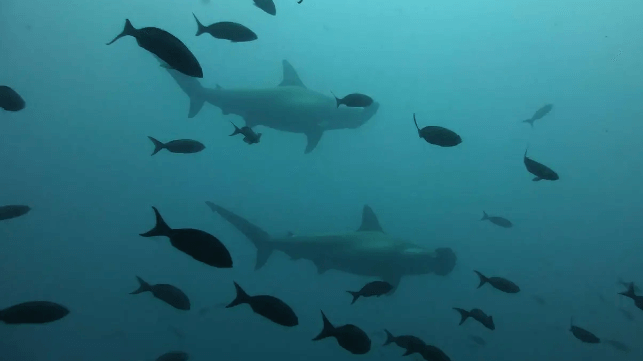
Hammerhead sharks in the Galapagos

Published Oct 27, 2024 10:48 PM by Dialogue Earth


[By Daniel Cressey]

Progress towards an international target to protect nearly a third of the ocean by 2030 is faltering: much of the protection enacted so far is largely ineffective, and thousands more protected areas are needed.

These warnings have been issued by leading marine experts as national negotiators meet in Cali, Colombia, for the 2024 UN Biodiversity Conference (COP16).

At COP15 in 2022, countries signed up to the Kunming-Montreal Global Biodiversity Framework, which includes the so-called “30×30” goal. Its aim is to protect at least 30% of Earth’s lands and oceans by 2030.

But a global assessment of progress, commissioned by the Bloomberg Ocean Fund and published last week, suggests the ocean target remains a long way off.

“Marine protected areas” (MPAs), and what are known in conservation circles as “other effective area-based conservation measures”, cover just 8.3% of the ocean, the report states. Even worse, the total area where such measures are actually being implemented to deliver high or full protection is thought to amount to only 2.8%.

More MPAs are being created all the time. Just this month, Australia’s environment minister, Tanya Plibersek, proudly announced that the country “protects more ocean than any other country on Earth”. Plibersek was remarking upon the incorporation of 310,000 square kilometres of waters around the Heard and McDonald Islands into an existing marine park in the Southern Ocean. And last week, the Azores’ government approved protections for an area of nearly the same size in the North Atlantic.

“There have been more and more MPAs created … but it’s not enough,” says Monica Medina, a former US Assistant Secretary of State who now works on ocean issues at Conservation International.

Based on the current rate of growth, the global assessment team estimates that only 9.7% of the ocean will be protected by 2030.

The 30×30 goal

Another report released this month suggests that protecting 30% of the ocean will require an additional 300 large and 190,000 small MPAs in waters under government control. This does not include the high seas, a vast area that lies outside national jurisdiction.

“The results are alarming. But this is not an insurmountable challenge,” says the report’s author, Kristin Rechberger. She is the CEO of Dynamic Planet, a Washington DC-based company that works on environmental finance.

Indonesia, Canada, Russia and the US would each have to designate over 15,000 protected areas to hit 30%, the report states. China would need nearly 6,000 additional protected areas. This assumes each country would protect 30% of its own waters, something the target itself does not specify. In fact, earlier this year, one team of researchers suggested in the journal Science that countries should be allowed to trade their ocean conservation obligations.

Adding to the problem is the fact that many of the roughly 13,000 MPAs currently in existence have been found to be poorly managed “paper parks”, with little enforcement. Some allow activities such as bottom trawling, which can cause huge damage to the environment.

Rechberger’s team also looked at this problem, analyzing how many more MPAs were needed while excluding those that already exist but are incompatible with conservation. The team found another 70 large and 24,000 small protected areas would be required, in addition to their previous calculation. And, if this analysis was based only on highly and fully protected areas, the total number of large and small MPAs still needed to hit 30×30 rises to 422 and 334,000 respectively.

Paper parks

Rechberger’s work builds on a study released earlier this year, which looked at the 100 largest MPAs in the world. These cover 7.3% of the ocean and account for nearly 90% of the area of all MPAs globally.

Beth Pike, the report’s lead author and director of a marine protection database (Marine Protection Atlas), found that in a quarter of the area covered, protections had not actually been implemented. A third of the area was deemed “incompatible with the conservation of nature”, due to the supposed protections allowing for activities such as mining or industrial fishing.

“Things that are fully, highly protected and implemented or actively managed is really the gold standard for what it going to give us the most return on investment,” says Pike, who also contributed to the 30×30 progress report.

The conference runway

Many conservation experts are hoping the COP16 meeting in Cali ends with major government commitments to create more and better protections for the ocean.

Other meetings are also on their agenda.

This week in Samoa, 56 Commonwealth countries’ heads of government are expected to agree a declaration on the importance of ocean protection. Also overlapping the Cali meeting is the latest gathering of the Commission for the Conservation of Antarctic Marine Living Resources (CCAMLR) in Hobart, Australia. There, nations involved in the Antarctic are discussing long-mooted and long-deadlocked plans to expand marine protection in the Southern Ocean.

But, arguably, the key areas for the 30×30 goal are outside of national jurisdiction, on the high seas. These areas make up two thirds of the ocean but just 1.4% of them are currently protected, under agreements such as the convention governing the Antarctic.

In 2023, a deal was struck for an international treaty that would make it easier to create protected areas on the high seas. The treaty requires ratification by 60 countries before it comes into force. To date, only 13 nations have done so.

So, while the 30×30 goal may be simple to explain, achieving it looks anything but.

What’s more, Pike points out that there are 23 targets in the Kunming-Montreal Global Biodiversity Framework. These include halting extinctions, ensuring sustainable harvesting of wild species, reducing pollution, and minimizing the impact of climate change on biodiversity.

“There are 22 other targets in regards to the sustainable use of those oceans, without which the 30% could never succeed, even if we got to it,” she says.

Daniel Cressey is ocean editor at Dialogue Earth. Based in London, he worked as a journalist for two decades at publications including Nature and Research Professional News before joining Dialogue Earth in 2024. He has degrees in chemistry, history of science and journalism. 

This article appears courtesy of Dialogue Earth and may be found in its original form here

The opinions expressed herein are the author's and not necessarily those of The Maritime Executive.


Houthi Forces Attack Greek Bulker in Red Sea

Missiles
Courtesy Houthi Military Media

Published Oct 28, 2024 2:55 PM by The Maritime Executive


Yemen's Houthi rebels have launched another attack on a merchant ship, ending a comparatively peaceful gap of 18 days in the Red Sea. The attack followed two days after Israel's long-expected airstrike on Iran, the Houthi organization's primary sponsor. 

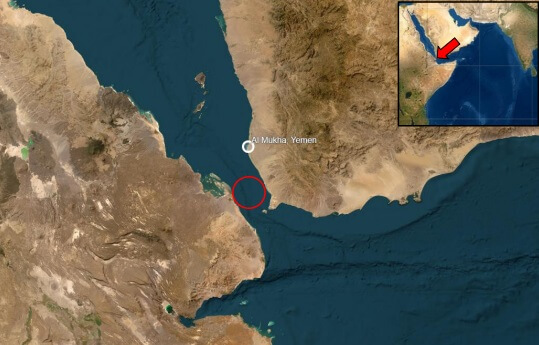
On Monday at about 1435 hours GMT, the master of a merchant ship reported an explosion near his ship. A second explosion followed at 1503, followed by a third at 1637. The vessel and the crew are reported safe and are continuing to the next port of call, according to the Royal Navy's UK Maritime Trade Operations (UKMTO). The multiple-strike pattern follows the recent Houthi practice of targeting a vessel repeatedly as it transits past the Strait of Bab el-Mandeb.

EOS Risk Group has identified the target as the 80,000 dwt bulker Motaro. The vessel's AIS signal was last detected southbound in the Red Sea on October 27, declaring the Chinese port of Changjiangkou as her destination. 

Approximate attack location (UKMTO)

The Houthi group claims to target vessels connected to Israel and its allies, either by operational activity or ownership. Motaro is Greek-owned and operated, and her Pole Star AIS record shows no visits to Israel in the last three years. 

On Monday night, a Houthi military spokesman confirmed an attack on the Motaro and also claimed unconfirmed strikes on the SC Montreal and Maersk Kowloon in the Arabian Sea. The spokesman claimed that the attacks were in retaliation for "the violation by the companies that own them of the decision to ban entry to the ports of occupied Palestine."

U.S. Central Command has yet to confirm any of the strikes. It was the first confirmed Houthi anti-shipping activity since U.S. Air Force bombers hit the militant group's underground missile storage facilities on October 17.  

American security sources recently told the Wall Street Journal that Russia provides satellite targeting data to Iran, which Iranian agents pass on to Houthi leaders for operational use against Western shipping. Iran also provides most of the Houthi group's missile technology and is suspected of conducting on-scene intelligence gathering on the Houthis' behalf in the Gulf of Aden. 

Report: Russia is Providing Targeting Data to Houthis for Attacks on Ships

Explosions aboard the tanker Sounion after it was disabled and boarded by Houthi forces (Houthi Military Media)

Published Oct 27, 2024 11:56 PM by The Maritime Executive


An exclusive in the Wall Street Journal has confirmed that Russia has been providing details of ship movements to enable Houthi attacks in the Red Sea.

The middlemen between the Russians and the Houthis are the Iranians. A brigadier from the Islamic Revolutionary Guard Corps Quds Force sits on the Houthi Jihad Council as deputy to its leader, Abdulmalik al-Houthi. A second IRGC member also sits on the Council, with particular responsibility for drones and missiles.

The IRGC gets the intelligence to feed to the Houthis from its own sources, including long-range drones and Iranian naval vessels permanently on station in the Red Sea area. The Houthis also have their own reconnaissance drones and a fleet of fishing boats acting as spotters as well.

The Russian feed of intelligence to the Iranians, and thence to the Houthis, is well established. 

In August 2022, a Russian Soyuz 2.1b rocket launched an Iranian intelligence satellite from Kazakhstan. The Khayyam satellite, jointly built and based on the Russian Kanopus-V imagery satellite, was placed in a 500-kilometer low earth orbit, and is now giving the Iranians access to one-meter resolution imagery, sufficiently accurate to use for targeting an area of a ship. 

The Khayyam’s orbit allows it to visit any specific point of interest about four times a day, but then the satellite needs to be in position to download the imagery back to Earth. This limits the utility of the system in targeting moving targets such as ships. However, the Khayyam system is almost certainly being used in an intelligence-swap arrangement alongside Russia’s own Kanopus-V constellation of spy satellites, meaning that ship movement information available to the Iranians is likely to be much more up to date.

The Khayyam satellite is far more effective than the three satellites that the Iranians have built and launched themselves. One of these, the size of a washing machine, was described by US Space Command General John Raymond as “a tumbling webcam in space, unable to generate any useful intelligence.” Even so, the Khayyam is significantly less responsive and accurate than Western systems, and it is no surprise that the Houthis have attacked Russian ships in error on several occasions


New Mein Schiff Cruise Ship Completes Maneuvers During Sea Trials

cruise ship trials
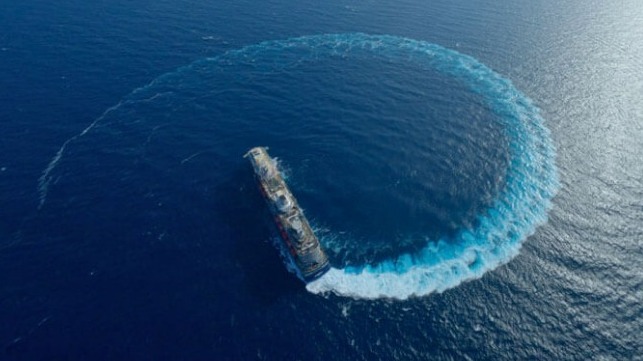
Mein Schiff Relax maneuvering during sea trials (Mein Schiff)

Published Oct 28, 2024 2:49 PM by The Maritime Executive


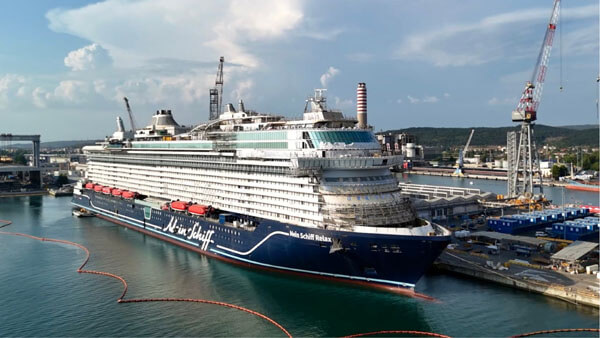
The innovative new cruise ship under construction at Fincantieri in Monfalcone, Italy for Germany’s Mein Schiff completed her first sea trials in October. At 160,000 gross tons, she will be the largest cruise ship in the fleet and the company’s first LGN dual-fuel cruise ship.

Named Mein Schiff Relax, the ship left the yard in Monfalcone and after a brief dry docking to clean its hull, began its first maneuverability tests. In addition to the zigzag course and basic maneuvering turns, the ship ran full astern tests and conducted a crash stop. The most spectacular tests caught in drone video were the 360-degree turning circle maneuver and a “Williamson turn,” a crash 180-degree turn used in man overboard and similar emergency situations. 

German travel company TUI reports Mein Schiff Relax demonstrated great maneuverability at top speed and passed all the first-round tests. The ship, which is 1,093 feet (333 meters) in length, is scheduled to undergo its first tests of its new dual-fuel LNG propulsion system in the coming weeks.

The ship is powered with two Azipods and incorporates new design elements including an innovative bridge and improved catalytic converts, as well as a shore power connection. In the future, the ship and a sister ship still under construction at Fincantieri can also operate using future bio- or e-LNG fuels.


Passengers will also find new design elements aboard the ship which is the first the line has built in Italy. Previously they built seven cruise ships at Meyer Turku in Finland. The new ship will have features ranging from 14 restaurants and 17 bars and lounges to a 25-meter (82-foot) swimming pool, a new design for a roof over the pool and deck areas, and a design that emphasizes relaxation. The line is calling the new ship the “feel good ship.”

The two new ships are part of a large expansion of the brand which caters to German-speaking passengers. It is a joint venture with Royal Caribbean Group.

CEO Wybcke Meier highlights that the company introduced one new cruise ship, Mein Schiff 7, in June 2024, Mein Schiff Relax in 2025, and the sister ship to be named Mein Schiff Flow in 2026. “This will increase the capacity of the fleet by almost 60 percent,” said Meier. “The expansion of the fleet not only creates more capacity but also enables us to reach different target groups and open up new markets.”


Mein Schiff relax will be the largest cruise ship and first LNG-fueled in the line's fleet (TUI)


Construction for Mein Schiff Relax began in June 2022 and the ship was floated out in November 2023. The ship will enter service in March 2025 sailing from Malaga, Spain to the Canary Islands. Mein Schiff announced a unique christening event scheduled for April 9, 2025, where two other ships of the fleet, Mein Schiff 5 and Mein Schiff 7, will join Mein Schiff Relax.

The line reports work is underway on its ninth cruise ship, Mein Schiff Flow. The second LNG vessel is due to enter service in 2026.


Prosecutors Seize Potentially Toxic Cargo from Cargo Ship Off Albania

containership
Environmentalists are using a now impounded cargo to highlight the regulations regarding the shipment of toxic waste (file photo)

Published Oct 28, 2024 4:12 PM by The Maritime Executive


A shipment of approximately 100 containers has made a roundtrip from Albania to Southeast Asia and is now back to its origin as the NGO Basel Action Network alleges the boxes contain a banned toxic substance. On Monday, October 28, prosecutors in Durres, Albania moved to impound the cargo for testing as part of an investigation into possible violations of international shipping regulations by local companies.

The containers made the last leg of their long journey arriving back in Albania aboard a Turkish-owned general cargo ship Moliva (12,000 dwt) that anchored offshore overnight. They departed in July transshipped and ultimately loaded on two containerships operating under charter to Maersk. 

The NGO reports it was informed by a whistleblower that the containers contained an estimated 2,100 tons of electric arc furnace dust which is classified as a toxic waste and strictly regulated under the Basel Convention. It is a dust removed from filters in steel production plants and as such if the reports are accurate would contain high levels of metals and chemicals believed to be carcinogenic. 

Prosecutors responded to public demonstrations and calls from the NGO to impound the cargo as evidence in the investigation into the shipment. They have ordered that the containers be offloaded and placed into a secure storage facility and not opened. The group is demanding that they be opened publicly and that they be permitted to take a sample of the material for independent testing.

Basel Action Network along with another environmental NGO called EARTH last month went to the facility in Thailand where the containers were being shipped. They report soil samples at the facility showed high levels of toxic materials such as arsenic, lead, and nickel. They are using this shipment to call attention to the regulations while demanding that Albania and other countries tighten their routines to restrict the export of toxic materials and that ports and businesses are aware of the restrictions. 

The controversy began when the group demanded that a suspected 160 containers aboard the two vessels had to be intercepted. The ships were due to reach Singapore in mid-August and the containers were booked for delivery to Thailand.

Maersk responded by saying it was in contact with the governments and local authorities while noting the boxes were being carried for another carrier that had originated the shipment and that they had been cleared by customs authorities. The authorities in Thailand said they would refuse the containers when they arrived responding that they had never given authorization to the company in Albana and the recipient in Thailand for the shipment. Maersk later reported it was handing the suspect containers over to the authorities and that arrangements were being made for their return to Albania.


Massachusetts Provides Approvals for Large, Two-State Offshore Wind Farm

Brayton Point Somerset Massachusetts
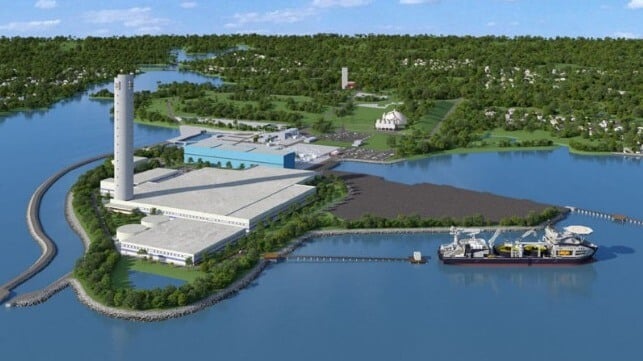
SouthCoast Wind is part of a plan for converting a former coal-fired power plant into a new offshore energy hub (Commercial Development Company rendering)

Published Oct 28, 2024 5:16 PM by The Maritime Executive


New England’s next large offshore wind farm known as SouthCoast Wind and one of the first projects to supply power to two states has moved a step closer with key regulatory approvals. Ocean Winds, a joint venture between EDP Renewables and ENGINE, has received several important approvals from Massachusetts in the permitting process for its first offshore wind project while Rhode Island continues to review the applications. 

The Commonwealth of Massachusetts’s Energy Facilities Siting Board (EFSB) unanimously approved SouthCoast Wind’s request to construct and operate transmission facilities at Brayton Point in Somerset, MA. The Massachusetts Department of Environmental Protection also granted a Ch. 91 Waterways license for project-related nearshore equipment and work and the Massachusetts Office of Coastal Zone Management signed off on the project’s Federal Consistency Review.

“These important permitting milestones bring our project closer to construction,” said Jennifer Flood, Head of Permitting for SouthCoast Wind and Ocean Winds North America. She notes these approvals keep the SouthCoast Wind 1 project on track to deliver its offshore wind energy to the New England regional electric grid by 2030.

The MA EFSB noted that SouthCoast Wind 1 Project “is superior to the other alternatives evaluated with respect to cost, environmental impact, meeting the identified need, and providing a reliable energy supply for the Commonwealth with minimum impact on the environment at the lowest possible cost.” The EFSB approval includes set construction hours and ongoing monitoring of air and seabed conditions by SouthCoast Wind.

The company continues to target commencing project construction in late 2025, once it has received all federal, state, and local permits. The company however has not made a final investment decision on the plan.

SouthCoast Wind’s offshore lease area is in federal waters 23 miles south of Nantucket and the proposed cable route runs through federal and Massachusetts state waters, Rhode Island’s Sakonnet River, across a portion of Portsmouth, Rhode Island, and into Mt. Hope Bay. The permit also approves a cable route that will go from Mt. Hope Bay, travel up the Lee River, and enter Brayton Point in Somerset, MA close to the location of its planned converter station and electric grid connection.

SouthCoast Wind was awarded power purchase agreements with Massachusetts and Rhode Island to provide a total of 1,287 MW. It is currently negotiating contracts with each state’s largest utilities.

Ocean Winds notes that the project represents one of the largest ever energy investments in southern New England and will revitalize Brayton Point, a former coal-fired power plant, as a clean energy hub. The plant located in Somerset, was once the largest coal-fired power plant in New England.

The plan calls for two phases that would provide up to 2.4 GW of electric power. The lease area is off the coast of Massachusetts, but the neighboring states launched a coordinated solicitation which was completed earlier this year. The coordinated approach allowed companies to balance their risks and develop more efficient plans to meet New England’s broader power requirements.

Halloween 2024 issue of Distinctively Dionysian

Oct
26
2024


From Distinctively Dionysian

Bonsoir, lovelies. Yesterday, on Max Stirner’s birthday, we finished printing the first round of Distinctively Dionysian’s Halloween issue. Inside the spooker edition, you will find mischief, mayhem, the macabre, Mallarmé, German Expressionist Cinema et Theatre, and a riot of Cabaret magic, with new writings, anarchic troublemaking, and more. The Halloween issue, with its fluorescent orange cover, was much too fun to create and layout. It is one of our favorites, indeed.


To receive the Halloween (or any single) issue in the U.S. or Canada, send $15 to

Distinctively Dionsyan, PO BOX 1332, Astoria, Oregon, USA 97103.

If you’re anywhere else, do the task, factor your shipping cost, add it on to the issues cost of $15, & send it along to:

Distinctively Dionysian, 750 Commercial St. Box #1332, Astoria, OR, 97103

For our subscribers who have prepaid for several issues, your latest playful issue is on the way!

Have a devilishly mischievous Halloween, darkling ones

XOXOXO


Anathema: Volume 10 Issue 2

Anathema: Volume 10 Issue 2

From Anathema, A Philadelphia Anarchist Periodical

Volume 10 Issue 2

Volume 10 Issue 2 (PDF for reading 8.5×11)

Volume 10 Issue 2 (PDF for printing 11×17)

In This Issue:

  • What Went Down
  • The Secret Is To Really Complain
  • Cherelle Parker Is An Image From The Future
  • Where Is The Anti-War Movement?
  • Imperial Wargaming
  • Don’t Vote?
  • Palestinian Solidarity & Anarchist Interventions In Philly
  • Skilling Up In Shifting Waters