Monday, October 28, 2024

US Energy Dept finalizes $2.26bn loan for Lithium Americas’ Nevada mine

ALL CAPITALI$M IS STATE CAPITALI$M

Reuters | October 28, 2024 |

Thacker Pass is projected to begin lithium production in the second half of 2026. 
(Image courtesy of Lithium Americas.)

The US Department of Energy finalized a $2.26 billion loan for Lithium Americas on Monday to build Nevada’s Thacker Pass lithium mine, one of Washington’s largest mining industry investments and part of a broader push to boost critical minerals production.


The loan, provisionally approved in March, is a key part of US President Joe Biden’s efforts to reduce dependence on lithium supplies from China, the world’s largest processor of the electric vehicle battery metal. Biden officials permitted a similar lithium project under development by ioneer last week.

The Thacker Pass project is slated to open later this decade and be a key supplier to General Motors, which earlier this month boosted its investment in the mine to nearly $1 billion.

“The Biden-Harris Administration recognizes mineral security is essential to winning the global clean energy race,” said Ali Zaidi, the White House national climate advisor.

Former President Donald Trump had permitted the mine just before leaving office. Initial construction at the site, just south of Nevada’s border with Oregon, started last year after the company won a long-running and complex court case brought by conservationists, ranchers and Indigenous communities.


With the loan now closed, Vancouver-based Lithium Americas plans to start major construction, a process that could take three years or longer. The mine’s first phase is expected to produce 40,000 metric tons of battery-quality lithium carbonate per year, enough for up to 800,000 EVs.

The project is expected to employ about 1,800 people during construction, and provide 360 full-time jobs once the mine is operational. The loan will have a 24-year term, with interest rates based on the US Treasury rate as each tranche is drawn.

“This essential loan helps us reduce dependence on foreign suppliers and secure America’s energy future,” said Lithium Americas CEO Jon Evans.

The mine’s cost had been increased from a previous estimate of $2.27 billion to nearly $2.93 billion due to higher engineering costs, an agreement to use union labor, and the company’s decision to build a housing facility for workers and their families in the remote region.

(By Ernest Scheyder; Editing by Richard Chang)


Biden administration approves ioneer’s Nevada lithium mine

Reuters | October 24, 2024 | 

Rhyolite Ridge lithium project in Nevada. (Image courtesy of ioneer.)

The US Interior Department on Thursday gave final approval to ioneer’s Rhyolite Ridge lithium mine in Nevada, the first domestic source of the battery metal to be permitted by President Joe Biden’s administration and one that will become a key supplier to Ford and other electric vehicle manufacturers.


Shares of the Australia-based critical minerals miner jumped more than 20% in New York trading on Thursday afternoon before easing down.

The approval ends a more-than six-year review process during which regulators, ioneer and conservationists tussled over the fate of a rare flower found at the mine site, a tension that exposed the sometimes competing priorities between climate change mitigation efforts and biodiversity protection.

The permit, which had been expected by the end of the year, comes amid a flurry of recent moves by Biden officials to support critical minerals production and offset China’s market dominance.

It also unlocks a $700 million loan from the US Department of Energy, as well as a $490 million equity investment from Sibanye Stillwater to fund the project.


“This is a science-based decision,” Laura Daniel-Davis, the Interior Department’s acting deputy secretary, told Reuters. “We’re trying to send a signal that there’s no topic with greater importance than addressing climate change.”

The US Bureau of Land Management, which is controlled by the Interior Department, on Thursday issued the Rhyolite Ridge project’s record of decision – essentially the mine’s permit – and said the project will “include significant protections for the local ecosystem” and help create hundreds of jobs in the rural region.

The project, roughly 225 miles (362 km) north of Las Vegas, contains enough lithium to power roughly 370,000 EVs each year. Construction is slated to begin next year, with production commencing by 2028, a timeline that would make Rhyolite Ridge one of the largest US lithium producers alongside Albemarle and Lithium Americas.

The US Geological Survey has labeled lithium a critical mineral vital for the US economy and national security.

“We’re proud to be the first US lithium mine permitted by the Biden administration,” James Calaway, ioneer’s chairman, told Reuters.

The project will extract lithium as well as boron – a chemical used to make ceramics and soaps – from a clay-like deposit. The lithium will be processed on site into two main derivatives used to make batteries, and the company said it plans to recycle half of all the water used at the site, higher than the industry average.

Ford and a joint venture between Toyota and Panasonic have agreed to buy lithium from the mine.

Endangered flower

In addition to the lithium and boron deposits, Rhyolite Ridge is home to the Tiehm’s buckwheat flower, which is found nowhere else on the planet and was declared an endangered species in 2022.

The Center for Biological Diversity (CBD) and some other conservation groups thus oppose ioneer’s project, saying it would push the flower to the brink of extinction.

After the permit was announced on Thursday, the CBD said it plans to sue the federal government to block the project.

“By greenlighting this mine, the Bureau of Land Management is abandoning its duty to protect endangered species like Tiehm’s buckwheat and it’s making a mockery of the Endangered Species Act,” said the CBD’s Patrick Donnelly.

The Interior Department’s Daniel-Davis declined to comment on the potential litigation, but noted the changes made to the mine’s operating plan as a result of the permit review process, including new design plans and propagation efforts that included construction of a greenhouse. Department officials also released an opinion stating their belief that the mine would not harm the flower.

“We have run a transparent process,” said Daniel-Davis. “The company was willing to reconfigure its entire project to take into account Tiehm’s buckwheat.”

The death of more than 17,000 flowers near the mine site in 2020 sparked allegations of a “premeditated” attack. Ioneer denied harming the flowers. The government later blamed thirsty squirrels.

(By Ernest Scheyder; Editing by Marguerita Choy)


USGS Finds Enough Lithium to Meet Annual Demand Nine Times Over

By Alex Kimani - Oct 27, 2024

The USGS reported a lithium discovery the size of nine times the global lithium demand by 2030.

The U.S. relies on imports for more than 25% of its lithium.

The deposits are mostly concentrated in one spot, limiting the area impacted by mining.


The United States Geological Survey (USGS) and the Arkansas Department of Energy and Environment's Office of the State Geologist have discovered a vast lithium reserve containing more than nine times the International Energy Agency's projection of global lithium demand for electric vehicles in 2030. A relic of an ancient sea that left an extensive, porous, and permeable limestone geologic, the Smackover Formation extends under parts of Arkansas, Louisiana, Texas, Alabama, Mississippi, and Florida, and could contain between 5 and 19 million tons of lithium reserves.

"Our research was able to estimate the total lithium present in the southwestern portion of the Smackover in Arkansas for the first time. We estimate there is enough dissolved lithium present in that region to replace U.S. imports of lithium and more. It is important to caution that these estimates are an in-place assessment. We have not estimated what is technically recoverable based on newer methods to extract lithium from brines," said Katherine Knierim, a hydrologist and the study's principal researcher.

The USGS estimates there is enough lithium brought to the surface in the oil and brine waste streams in southern Arkansas to cover current estimated U.S. lithium consumption. The U.S. relies on imports for more than 25% of its lithium.


Source: USGS


The Smackover Formation is the latest among a series of large lithium discoveries made by the USGS in recent years. Last year, USGS fortuitously discovered lithium deposits bigger than Bolivia's salt flats, home to the world's biggest lithium reserves. While the discovery itself was not news, a new study published in the journal Science Advances estimates that the McDermitt Caldera, a volcanic crater on the Nevada-Oregon border, harbors 20 to 40 million metric tons of lithium deposits, nearly double Bolivia's 23 million metric tonnes at the upper range.

"If you believe their back-of-the-envelope estimation, this is a very, very significant deposit of lithium. It could change the dynamics of lithium globally, in terms of price, security of supply and geopolitics," Anouk Borst, a geologist at KU Leuven University who was not involved in the study, has told Chemistry World.

The caldera is estimated to have formed approximately 16.4 million years ago after a massive magma eruption. The lithium is deposited in a uniquely lithium-rich illite over 600 feet deep. To sweeten the deal further, the deposits are mostly concentrated in one spot, limiting the area impacted by mining.

"They seem to have hit the sweet spot where the clays are preserved close to the surface, so they won't have to extract as much rock, yet it hasn't been weathered away yet," Borst has told Chemistry World.

One small conundrum for the burgeoning U.S. lithium industry: although the McDermitt Caldera's lithium is locked up in clay, meaning mining costs are likely to be cheaper compared to mining spodumene deposits, extracting lithium from clay has never been done commercially. Bolivia has tried unsuccessfully for years to commercially produce lithium using its state-owned firm. It's the reason why industry experts remain skeptical about the real value of Mexico's newly nationalized vast lithium deposits because the country's lithium is found mostly in clay.

A few months later, the U.S. Department of Energy discovered a massive lithium deposit beneath California's Salton Sea, holding an estimated 18 million tons of lithium. According to the DoE, with expected technology advances, the Salton Sea region's total resources could produce more than 3,400 kilotons of lithium, worth up to $540 billion and enough to support over 375 million batteries for electric vehicles (EV)—more than the total number of vehicles currently on U.S. roads.

"Lithium is vital to decarbonizing the economy and meeting President Biden's goals of 50% electric vehicle adoption by 2030," said Jeff Marootian, Principal Deputy Assistant Secretary for Energy Efficiency and Renewable Energy.

"This report confirms the once-in-a-generation opportunity to build a domestic lithium industry at home while also expanding clean, flexible electricity generation. Using American innovation, we can lead the clean energy future, create jobs and a strong domestic supply chain, and boost our national energy security," the DoE declared.

The Salton Sea lithium deposit appears to be a real goldmine. After all, the DoE has revealed its Known Geothermal Resource Area (KGRA) has about 400 megawatts (MW) of geothermal electricity-generation capacity currently installed but has the potential for up to 2,950 MW. The DoE notes that the combined subsurface geology and geothermal activity in the Salton Sea's KGRA result in high concentrations of lithium, among the highest concentrations of lithium contained in geothermal brines across the globe.

However, the DoE acknowledged that the United States currently has limited capabilities to extract, refine, and produce domestically sourced lithium. Indeed, the country typically imports nearly half of the lithium it consumes, almost all coming from Chile and Argentina.

Lithium Bear Market

These massive lithium finds are probably not the kind of news that lithium bulls will be celebrating, with the lithium price selloff showing no signs of abating. Lithium carbonate prices fell to CNY 71,500 ($10,042) per tonne in October, the lowest level since March 2021, as the overcapacity for electric vehicle batteries in China continues to drive lower asking prices for inputs across the supply chain. Aggressive subsidies by the Chinese government have not been helping matters, helping trigger a large wave of oversupply of EV batteries and driving carbonate prices 23% lower so far in the current year after an 80% plunge in 2023. Market players have predicted that global supply will soar by nearly 50% in 2024. Chile has already signaled it will double output over the next decade, while China is expanding lithium projects in Africa.

Recently, mining giant Rio Tinto Group (NYSE:RIO) announced an all-cash $6.7 billion deal for Arcadium Lithium Plc (NYSE:ALTM), good for a hefty 90% premium to the Oct. 4 closing price. Both company boards unanimously approved the merger, with the deal expected to close mid-2025. Arcadium Lithium was formed in January 2024 following the US$10.6 billion merger of equals between U.S.-based Livent and Australia's Alkem. The acquisition is seen as a major win for Rio Tinto, with the company having struggled to get traction in the lithium market after its Jadar project in Serbia ran into local opposition. This means that Rio Tinto now owns the world's third-largest lithium reserves, behind only Corporacion Minera de Bolivia, also known as COMIBOL, and SQM (NYSE:SQM).

Alex Kimani for Oilprice.com
BIDENOMICS

Average U.S. Gasoline Price Set to Drop Below $3 for the First Time Since 2021

By Charles Kennedy - Oct 28, 2024

The U.S. national average gasoline price is expected to fall below $3 per gallon for the first time since 2021.

This decline is primarily driven by lower oil prices, which have been impacted by de-escalation in the Middle East and weaker global demand.

The upcoming winter season will further reduce demand for gasoline, contributing to the price decline.


The U.S. national average price of gasoline is set to soon fall below $3 per gallon for the first time since 2021, amid lower seasonal demand and a decline in international oil prices, according to fuel platform GasBuddy.

Over the last week, the U.S. national average price fell for the second consecutive week and was at $3.07 per gallon early on Monday, according to GasBuddy data compiled from more than 12 million individual price reports covering over 150,000 gas stations across the country.

The national average price is now down by 12.9 cents from a month ago and 39.8 cents per gallon lower than a year ago.

The national average price of diesel has also been falling, and is already at a three-year low of $3.54 per gallon, according to GasBuddy’s data


The U.S. is likely to see the average U.S. gas prices fall below $3 per gallon in the next 7-12 days if the current bearishness on oil markets holds, Patrick De Haan, head of petroleum analysis at GasBuddy, said today.

A drop below $3 per gallon for the national average would be the first since 2021, he added.

WTI Crude prices were plummeting by 6% early on Monday after Israel’s measured response to Iran’s missile attack early this month. The limited Israeli strike on targets in Iran over the weekend sent prices plunging on Monday as concerns about an oil supply disruption from the region began to abate.

If the tentative signs of de-escalation hold, the U.S. could see the national average price of gasoline below $3 as soon as next week.

“While many Americans may incorrectly credit the upcoming election for the declines, politicians have little influence over the strong seasonal forces that drive prices lower in autumn,” De Haan wrote today.

“With winter gasoline soon to reach the rest of California, and demand continuing to decline as Americans grapple with colder weather, the drop in demand is pushing gas prices down — not politicians on either side, as much as they might like to think they do.”

De Haan expects the drop in gasoline prices will continue into and even beyond the presidential election.

By Charles Kennedy for Oilprice.com
Hydrogen Stocks Crash as Hype Faces Reality Check

By Tsvetana Paraskova - Oct 28, 2024

The initial excitement surrounding low-carbon hydrogen has faded due to high project costs, regulatory uncertainty, and weak demand.

Only a small percentage of hydrogen projects in North America and Europe have reached final investment decisions.

Major energy companies like Shell and Equinor have paused green hydrogen plans in Europe, citing poor project economics and unclear regulatory frameworks.


The low-carbon hydrogen hype has begun to fade in recent months as companies and investors realize that their ambitions face the reality of costly projects amid regulatory stumbling blocks and uncertain future demand.

The momentum behind green hydrogen from two years ago, generated by the U.S. Inflation Reduction Act (IRA), has slowed amid still high costs and macroeconomic headwinds. In addition, regulatory uncertainty and a lack of committed demand are undermining the 2030 production goals for low-carbon hydrogen, both in the United States and Europe.

As a result, investors are re-thinking funding, companies are re-drawing hydrogen production strategies, and share prices of major hydrogen players are crashing.

For example, Denmark’s Green Hydrogen Systems (CPH: GREENH), a provider of standardized, modular alkaline electrolyzers, has plunged by 65% year to date. U.S.-based Plug Power (NASDAQ: PLUG) has seen its stock tumble by 53% year to date, and Ballard Power Systems Inc (NASDAQ: BLDP) has crashed by 58%.

Other firms focused on green hydrogen and technologies have also seen their share prices battered amid signs that despite progress in project announcements, project commitments with final investment decisions (FID) are a fraction of the total pipeline of projects.

Just 18% of U.S. low-carbon or renewable hydrogen projects in North America, and only 5% of such projects in Europe that aim to begin operations by 2030 have reached FID so far, McKinsey & Company and the Hydrogen Council said in a report last month.

“A key sector-specific challenge for the hydrogen industry is uncertainty associated with a number of regulatory frameworks,” including the EU regulatory framework and the rulebook for the investment tax credit in the IRA. All of this “impedes project bankability,” the authors of the report wrote.

“Coupled with cost increases for renewable power and electrolysers, this has led to delays and cancellations of projects – in particular, renewable hydrogen projects,” they added.

In Europe, the European Commission has set unrealistic hydrogen production and import targets—the EU is not on track to achieve them, the European Court of Auditors, the supreme audit institution of the EU, said in a report this summer.

The Commission has been partially successful in creating the necessary conditions for the emerging hydrogen market and the hydrogen value chain in the EU, but it now needs “a reality check,” the European Court of Auditors said.

Even the International Energy Agency (IEA), the most vocal backer of all things renewable, has warned that policy and demand uncertainty are slowing down green hydrogen adoption globally.

According to the IEA, the main reasons for the slow uptake of low-carbon hydrogen “include unclear demand signals, financing hurdles, delays to incentives, regulatory uncertainties, licensing and permitting issues and operational challenges.”

A lack of visibility on demand and regulatory uncertainties have halted several major projects in Europe this year alone.

Spanish energy firms Repsol and Cepsa, for example, are pausing green hydrogen investments in Spain, as one of the most promising EU markets for renewable hydrogen is considering making the windfall tax on energy firms permanent.

The idea that a version of the tax could become permanent infuriates many major companies, including energy firms with plans to invest in green energy projects.

The Spanish firms halting projects are the latest European firms to pause or ditch green hydrogen plans due to either policy or demand concerns.

Most recently, Shell and Equinor have ditched plans for low-hydrogen production and transportation in north Europe due to a lack of demand.

Investors are not rushing to invest in backing green hydrogen projects, either, due to poor economics and potential returns.

“Green hydrogen is still not investable. It’s rubbish in terms of investment,” Mark Lacey, head of thematic equities at UK asset manager Schroders, told the Financial Times.

By Tsvetana Paraskova for Oilprice.com
Coal Remains On Its Throne Despite Transition Push

By Irina Slav - Oct 28, 2024

Both India and China have stated quite plainly that they will not be following the example of the UK and shutting down any coal power plants in the observable future.


Coal power provides the cheap energy that Chinese and other Asian manufacturers of wind and solar components and equipment—not to mention EVs—use to keep their products cheap.


These two countries will be driving coal demand growth over the near to medium term.


Report upon report sings praises to energy transition efforts that are leading to record wind and solar electricity generation. Outside the spotlight, however, things look very different. There, coal remains king—and this is not about to change anytime soon.

Reuters recently reported that India’s coal power generation had fallen for the second month in a row in September thanks to higher solar output and lower electricity demand. Time for some solar praise, perhaps? Not really, because at the same time, India’s coking coal imports surged to a six-year high over the first half of the country’s latest fiscal year.

Meanwhile, in neighboring China, coal remains the largest contributor to the country’s power supply despite China being the largest developer of wind and solar capacity in the world—and by a wide margin. The latest domestic production figures point to an increase. The latest demand figures point to an increase in coal in response to growing demand. Coal accounts for 60% of China’s power generation, and this is not about to change soon.

Both India and China have stated quite plainly that they will not be following the example of the UK and shutting down any coal power plants in the observable future. Both India and China have officially prioritized energy supply security and affordability over emissions, even as they both pursue a more diverse grid.


Ironically, it is coal power that is essentially fueling the energy transition. Coal power provides the cheap energy that Chinese and other Asian manufacturers of wind and solar components and equipment—not to mention EVs—use to keep their products cheap. Also ironically, the surge in demand for electricity from data centers will quite likely add a boost to coal demand in some parts of the world where natural gas is not as cheap as it is—for now—in the United States.

In its latest World Energy Outlook, the International Energy Agency expended a lot of words in praise of the energy transition and how future energy demand growth was going to be met entirely by wind and solar capacity that will be added.

Citing recent ramp-ups in wind and solar investment in the past couple of years, the IEA wrote in the executive summary that the combined capacity of the two would “rise from 4 250 GW today to nearly 10 000 GW in 2030 in the STEPS, short of the tripling target set at COP28 but more than enough, in aggregate, to cover the growth in global electricity demand, and to push coal-fired generation into decline.”

What the IEA did not write in the executive summary but kept for the full report was that at least until 2030, coal demand is not about to start going down—despite its own projections that demand for all hydrocarbons would be in decline before 2030, stifled by wind and solar growth.

“In the STEPS, the outlook for coal has been revised upwards particularly for the coming decade, principally as a result of updated electricity demand projections, notably from China and India. Total coal demand is 300 million tonnes of coal equivalent (Mtce) or 6% higher in 2030 than in the WEO-2023. Even with this revision, coal demand declines by an average of 2% each year through to 2050.”

This is what the IEA wrote in its report, where STEPS is the stated-policies scenario that the agency uses for its forecasts. In other words, the IEA is admitting that it was wrong last year to project the demise of coal. In this year’s edition of the WEO, it is correcting that incorrect assumption. To be fair, it ends that correction on a transition-positive note, but chances are it will have to revise its projections yet again next year. Because no one outside Europe and the Anglosphere is giving up coal—not least in order to keep supplying Europe and the Anglosphere with the components of their top-priority electrification of everything. As Bloomberg’s Javier Blas put it, the energy transition is powered by coal.

It wasn’t hard to see where that urge to electrify everything would end. The visions were that the electrification of everything would be covered by surging wind and solar capacity that would have the decency to deliver the supply when there is demand for it. China, however, quickly realized this was not going to happen, and as it built huge solar installations after a huge wind park, it also built coal power plants. This is what India is doing right now, too. These two countries will be driving coal demand growth over the near to medium term. That’s because they know that supplying the power that their economies and voters demand is more important than counting CO2 molecules.

Meanwhile, the UK is preparing scenarios for blackouts because its baseload capacity just got decimated with the shutdown of the country’s last coal power plant. Billions are being slated for investment in things like batteries and flywheels to store energy from wind and solar installations, but the realization that this cannot work without baseload capacity is yet to dawn on the Starmer government—as it is on the European authorities that are still pushing for an end to coal. If there is a perfect time to learn something important from China and India, that time is right now.

By Irina Slav for Oilprice.com


China Ramps Up Coal Power as Energy Demand Surges

By Tsvetana Paraskova - Oct 27, 2024, 4:00 PM CDT

Coal still accounts for about 60% of China’s power generation, despite a surge in hydropower earlier this year.

Hydropower in China saw a sharp decline in September, which boosted the use of thermal coal for power generation.

Power consumption in data centers, big data, and cloud computing jumped by 33% between January and June compared to the same period in 2023.


Although the share of coal in China’s electricity generation has been declining in recent years with the renewables boom, Chinese coal power generation and demand remains strong.

Coal still accounts for about 60% of China’s power generation, despite a surge in hydropower earlier this year after abundant rainfall, which reduced the share of coal in the country’s energy mix during the summer.

But hydropower saw a sharp decline in September, which boosted the use of thermal coal for power generation amid surging power demand in the world’s second-largest economy.

China’s thermal power generation, which is overwhelmingly coal-fired, jumped by 8.9% last month, per official data cited by Reuters’s columnist Clyde Russell.

Total power generation rose by 6% in September from a year earlier as electricity demand has started to outpace China’s economic growth in recent years.

Power demand jumped by 8.5% in September from the same month last year, while year to date, Chinese power consumption also rose by a similar percentage, 7.9% year-over-year, per the data quoted by Reuters’s Russell.

The surge in Chinese power consumption has led to high coal demand, too, as the power sector continues to rely on thermal generation for a stable supply of electricity amid soaring demand.

This demand is not only the result of a growing economy. China’s economy has expanded by less than 5% so far this year, and analysts fear the country could miss its own 2024 growth target of “about 5%.”

The surge in power demand has also been attributed to the increased use of household appliances amid rising numbers of middle-class residents, as well as the surge in power use for data centers and electric vehicle charging.


Chinese electricity consumption in the data services industry and for charging and battery services soared in the first half of 2024, driven by technology and electric vehicles, data from the China Electricity Council has shown.

Power consumption in data centers, big data, and cloud computing jumped by 33% between January and June compared to the same period in 2023.

In addition, China’s EV sales have already topped conventional car registrations for three consecutive months. EV and plug-in hybrid sales surged by 50.9% in September from a year earlier, grabbing a 52.8% share of total sales, the latest Chinese data showed earlier this month.

Electricity consumption per capita in China already exceeded that of the European Union at the end of 2022 and is set to rise further, the International Energy Agency (IEA) said in its Electricity Mid-Year Update report in July.

“The rapidly expanding production of solar PV modules and electric vehicles, and the processing of related materials, will support ongoing electricity demand growth in China while the structure of its economy evolves,” the IEA noted.


Despite continued growth in coal-fired power generation, China reached a momentous milestone in clean energy in the first half of the year, as rising hydropower, solar, and wind output pushed down the share of coal in power generation to below 60% for the first time ever.

Solar and wind power contributed to this achievement, but it was mostly the result of a rebound in hydropower generation, which squeezed coal in the late spring and summer, thanks to heavy rainfalls.

Come September, however, hydropower generation crashed by 14.6% from a year earlier. And rising coal power generation filled in the gap.

Coal-fired generation will be a pillar of China’s electricity generation system for many years to come, as the country’s electricity demand growth is set to continue outpacing economic growth in the coming years and as electrification is booming with the energy transition and expansion of data centers.

By Tsvetana Paraskova for Oilprice.com


Coal Continues to Dominate India's Power Mix Despite Gas Growth


By Rystad Energy - Oct 24, 2024

India's gas demand is projected to double by 2040, fueled by economic growth, urbanization, and a shift towards cleaner energy sources.

Domestic gas production is increasing but will not be sufficient to meet the rising demand, necessitating continued reliance on imports.

India is securing long-term LNG contracts, particularly with Middle Eastern suppliers, to ensure energy security and mitigate price volatility.


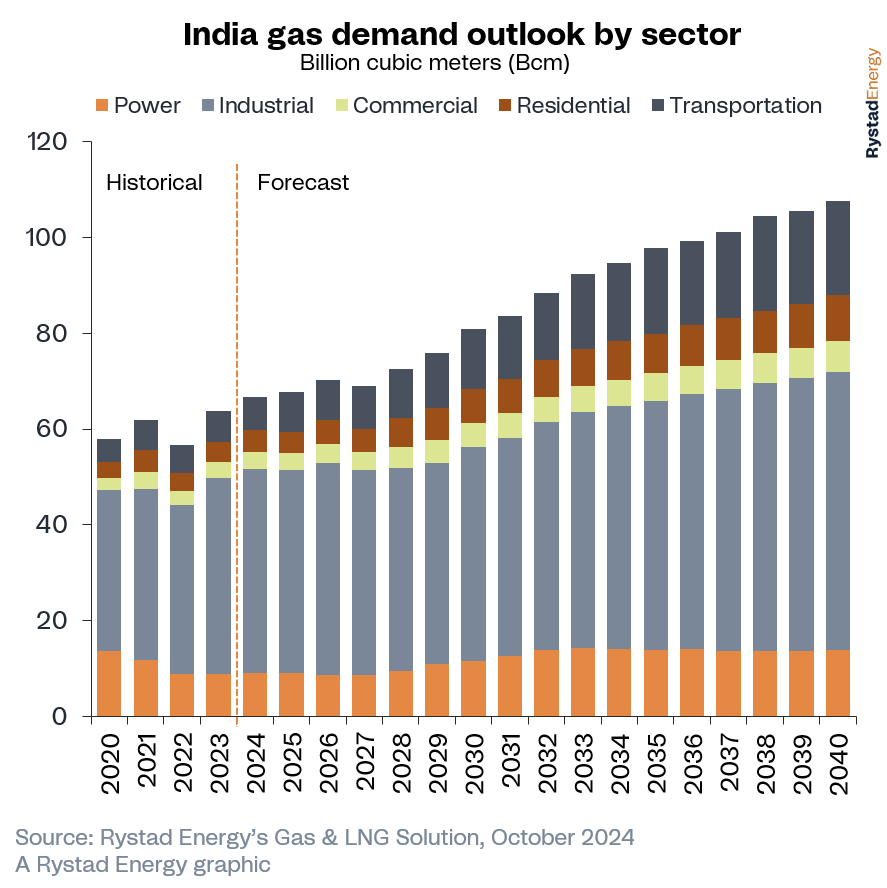
Fueled by population growth, economic development and a shift towards cleaner energy, India’s gas consumption is expected to nearly double to 113.7 billion cubic meters (Bcm) by 2040 from 65 billion cubic meters (Bcm) in 2023, according to Rystad Energy's research. Near-term demand is supported by a 51% jump in domestic gas production since 2020 to 36.7 Bcm by 2025, but this will not be enough to meet the country’s growing demand for natural gas. The result is that India will continue to rely heavily on imports to satisfy its future energy needs.

Recognizing this uptick in gas demand, India has bolstered its trade security by signing long-term contracts extending into 2030 and beyond. These agreements help shield India from global price fluctuations and supply chain disruptions, ensuring a steady flow of gas to support its growing economy. By securing these agreements, the country not only enhances its energy security but also strengthens its position in the global liquified natural gas (LNG) market, advancing its shift toward a cleaner energy mix.

The nation’s heavy reliance on coal is clear, particularly during recent heatwaves which have temporarily driven up coal usage alongside LNG for power generation. Gas, on the other hand, currently accounts for just 2% of the country’s power mix, as the focus remains on more cost-effective options like coal and renewables – in fact, coal-generated power is not projected to start falling this side of 2040. While gas-for-power isn’t expected to be a major driver for gas demand, the sector could still see growth, however, depending on future policies to promote coal-to-gas switching or introduce carbon pricing.

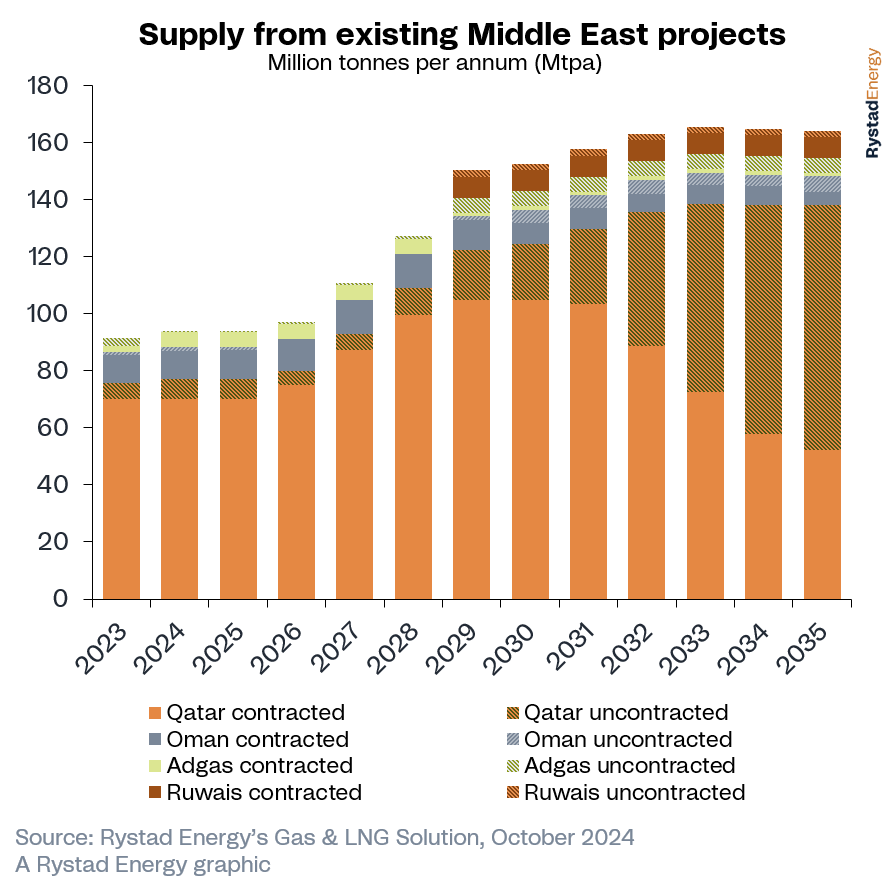
India’s LNG sector is experiencing significant growth. Looking ahead, a strategic next step could involve continued dealings with the Middle East. The geographical proximity of the two regions, combined with the substantial volume of uncontracted LNG production in the Middle East, presents an excellent opportunity for India to secure favorable terms – it’s an ideal buyer-seller relationship that could help fuel India’s needs. The nation is well-positioned to attract aggressive targeting from Middle Eastern producers and offtakers, with nearly 100 million tonnes per annum of Middle East LNG remaining uncontracted by 2035,

Kaushal Ramesh, Vice President, Gas & LNG Research, Rystad Energy


Learn more with Rystad Energy's Gas & LNG Solution.

Demand drivers: Food security comes first
Looking ahead, India’s gas demand will come from several sectors, including the country’s expanding city gas distribution (CGD) network as well as the fertilizer, refining and petrochemicals industries. Urea production in India heavily depends on natural gas as a key input, with limited alternatives available in the short term. As the government aims for complete food security, it continues to provide substantial subsidies for urea production, resulting in steady demand for gas in this sector, regardless of price fluctuations.

Following the successful restart of four gas-based fertilizer plants in 2021 and 2022, Indian urea production reached 30 million tonnes in 2023. This was still short of that year’s urea demand of 35 million tonnes, suggesting further growth potential in the near term. Meanwhile, rising demand for oil products and petrochemicals could increase India’s refining capacity to around 335 million tonnes per annum (Mtpa) by 2030, with many expansions expected to occur near LNG terminals.

The CGD sector also supports gas use across transportation, industrial, commercial and domestic applications through the development of compressed natural gas (CNG) stations and piped natural gas (PNG) networks. India’s CGD network has expanded rapidly in recent years, with the number of CNG stations rising more than fivefold since 2015 to 5,710 by April of last year and the number of PNG connections more than quadrupling to 12 million over the same period. After the latest CGD bidding rounds, nearly 100% of India’s geographical area is expected to be covered by the CGD network, reaching a population of over 1.4 billion.

Potential pitfalls
While there are positive signs for the Indian gas sector, several challenges could hinder its growth. A key issue is Indian buyers’ history of renegotiating or even abandoning near-complete deals, which creates uncertainty for suppliers. This preference for flexibility and cost-effectiveness over long-term commitments highlights India's focus on securing the best prices for its consumers in a volatile global market – but it could limit LNG growth prospects.

Additionally, slow infrastructure development has hampered the growth of India’s gas sector. Regasification terminals remain concentrated in the western part of the country, and efforts to expand the gas pipeline network to other regions have been inconsistent. This slow progress is due to regulatory hurdles, challenges in securing investments, difficult terrain, and competing priorities as India channels significant resources into renewable energy development alongside its gas infrastructure.

By Rystad Energy
Mali threatens to let Barrick mine permit lapse over dispute

Bloomberg News | October 25, 2024 |


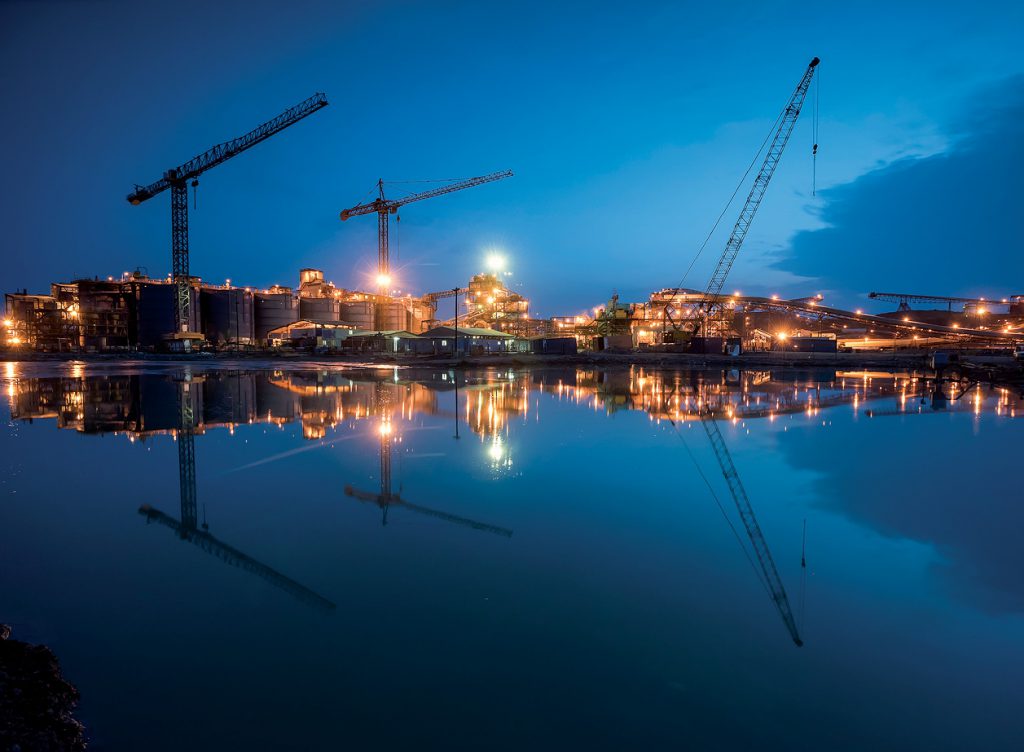
The Mali-based Loulo-Gounkoto complex includes Loulo underground mines, Yalea Gara and the Gounkoto open pit mine. (Image by Randgold Resources)

Mali’s military government has threatened to take back Barrick Gold Corp.’s Loulo mine concession when the current permit expires in 2026, amid an escalating dispute over how to divide the economic benefits from operations in the country.


Mali is considering letting the permit for Loulo lapse when it expires in February 2026, Finance Minister Alousseni Sanou said in an Oct. 18 letter sent to Barrick’s chief executive officer Mark Bristow, and seen by Bloomberg. Mali “reserves the right not to renew the operating permit” and invited Barrick to talks on the mine’s “transition phase” starting later this month, Sanou wrote.

The move comes as the junta has taken an increasingly hard line against the world’s second biggest gold miner, including briefly jailing four of its local executives last month over alleged “financial crimes.” Mali this week accused Barrick of failing to honor a September agreement aimed at resolving their disputes, which the Canadian company has denied.

A spokesman for Barrick declined to comment when reached by phone. Mali’s Finance Minister Sanou declined to comment in a text message.

The Loulo concession forms part of the Loulo-Gounkoto complex, in which Barrick owns 80% and the government holds the rest. The larger site represented roughly 13% of Barrick’s attributable gold production in 2023, according to its annual report.

CEO Bristow has visited the West African country repeatedly over the last year — including a stop at the mine in March where he told local media that it contributed more than $1 billion to the Malian economy in the past 12 months.

The country last week rejected Barrick’s proposal to divide the economic benefits from Loulo-Gounkoto 55% for Mali and 45% for the company.

The junta’s demands on Barrick follow a 2023 audit of mining contracts and a push to renegotiate existing agreements with mining companies — including B2Gold Corp, Allied Gold Corp and AngloGold Ashanti Plc — in a bid to boost the state’s revenue from its mineral resources through a new mining code adopted last year.

The new code comes as Mali seeks to shore up its revenue following a 2020 coup that saw the country cut off from aid and the regional debt market. The code says that the state and “national interests” could increase stakes in mining projects to 35% from 20% previously. It also reduces the duration of mining licenses to 10 years from 30 years and adds a provision for more Malian nationals in leading positions in mining entities.

Mali has been pushing foreign mining companies including Barrick to align with the new regulations, which should only apply to new contracts and renewals of existing permits, Assane Sidibe, the president of the mining commission within the National Transitional Council told Bloomberg last year.

The junta hasn’t taken any steps to implement the agreed extension of the Loulo mining convention, which Barrick negotiated with the civilian government the military ousted in 2020, according to the company.
Escalating tensions

Tensions between Barrick and the government have escalated in the past month, after Mali briefly detained the four executives, all Malian nationals.

In a letter on Oct. 14, also seen by Bloomberg, Bristow proposed a 225 billion CFA franc ($371 million) financial settlement and the conclusion of a memorandum of understanding relating to Barrick subsidiary Société des Mines de Loulo’s operational permit.

Barrick’s changes to the government’s draft “are essential to preserve the economic viability of the Loulo-Gounkoto complex,” Bristow said. “These changes aim at assuring a just and fair split of the economic benefits generated by the complex.”

In the letter on Oct. 18, Sanou rejected Barrick’s proposal saying it was “fundamentally different” to Mali’s version.

(By Katarina Höije, Diakaridia Dembele and William Clowes)
Could seaweed farms become the next generation of mines?

Amanda Stutt | October 25, 2024

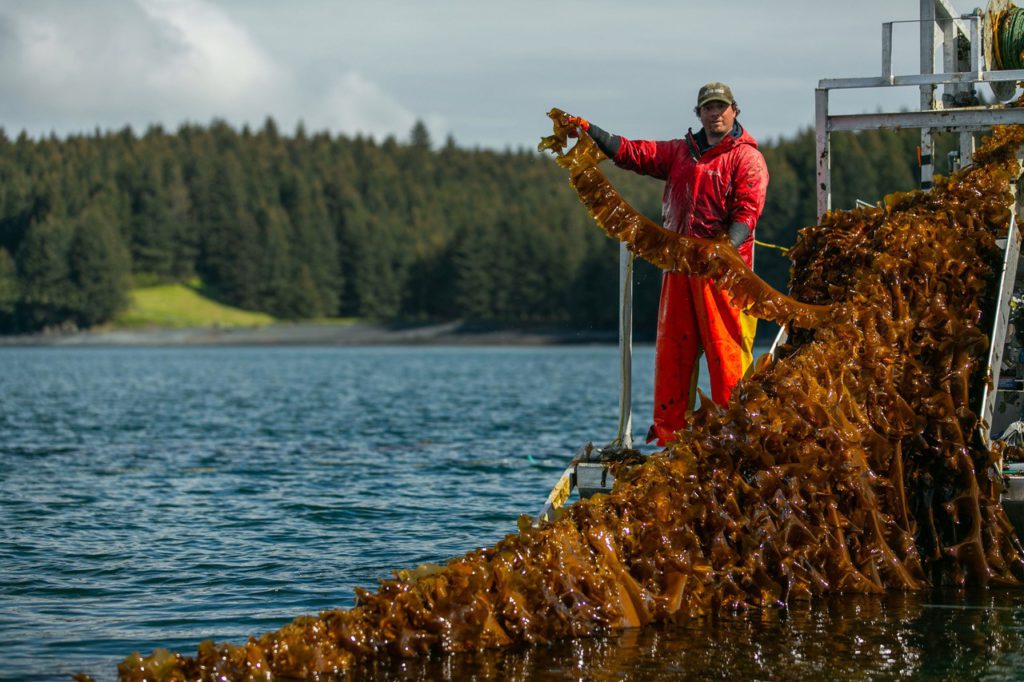
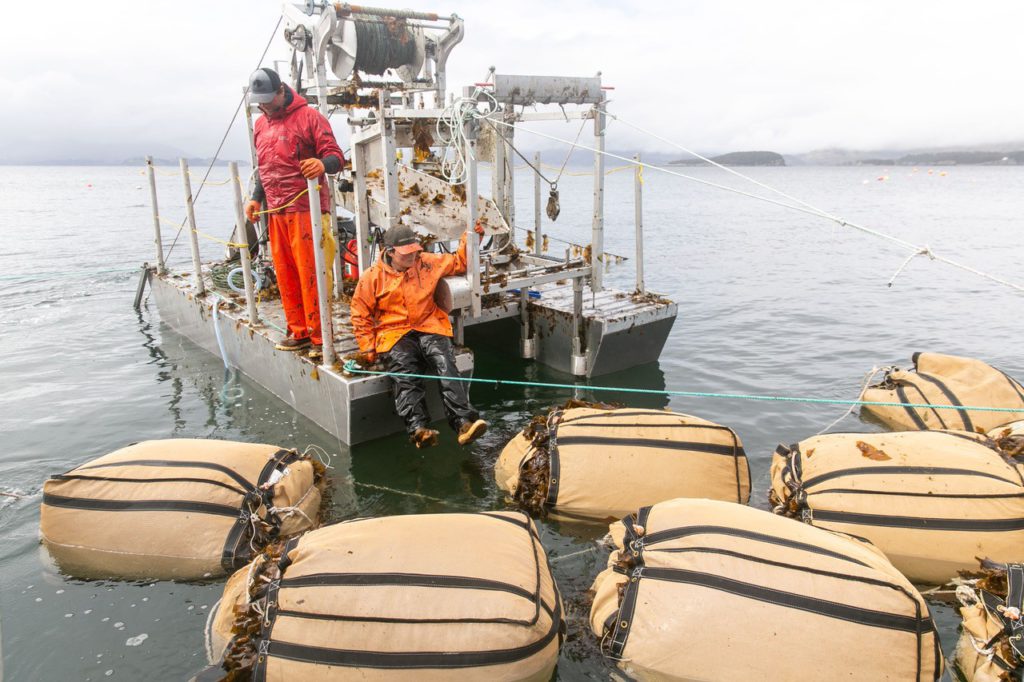
Seaweed farming in Kodiak, Alaska. Image credit: Rachelle Hacmac.

Blue Evolution, a California-based regenerative ocean farming company, announced Thursday it has merged with Blu3, a company specializing in regenerative ocean technologies.


The move, Blue Evolution said, creates a combined entity that will leverage enhanced R&D capabilities to drive innovation and commercialize new seaweed-based products across multiple sectors – agriculture, biomaterials – and critical minerals.

In December of last year, the US Advanced Research Projects Agency–Energy (ARPA-E) first announced its selection of scientific teams to explore the feasibility of extracting critical minerals from ocean macroalgae.

In July this year, Blue Evolution announced a groundbreaking advancement in sustainable biomining after it partnered with Pacific Northwest National Laboratory (PNNL) and Virginia Tech to develop a revolutionary method for sustainably extracting critical minerals and rare earth elements from seaweed.

The company operates seaweed farms in California and Alaska, and this month finalized a joint venture with the Māori Iwi Tribe to scale regenerative seaweed farming in Aotearoa, New Zealand.

From biofuels to rare earths

Blue Evolution CEO Beau Perry has been working with ARPA-E since 2017, first on large-scale systems for cultivation of seaweed for biofuels in Kodiak, Alaska, testing new hardware to grow seaweed in abundance, sustainably and economically.

Alaska is unparalleled in the US in terms of seaweed farming because of its size, environmental conditions and infrastructure. Perry noted both the state and the public are much more receptive to seaweed farming than to mining projects.

“It’s a relatively new industry. In post-war Japan, the coastal seaweed the Japanese had harvested for a long time was kind of destroyed…A British woman had closed the life cycle on nori in the early 50s. Seaweed farming was fairly new as a major agricultural sector, but now we grow, globally, 30 million tons of it,” Perry told MINING.com in an interview.

More than half of it is grown in China, but also Japan, Korea, Philippines and Indonesia.

The United States only entered the market ten years ago, and Perry said the US has grown a couple thousand tons so far.

Of over 10,000 species of seaweed worldwide, 300 species have been commercialized. Blue Evolution is working with six different species – four that they are growing in Alaska. Perry said seaweed has the potential to enter multiple markets because of its sustainability.

“It soaks up a lot more carbon than any terrestrial biomass per area, and it really only needs sunlight and seawater,” he said.

“We were looking [at] how to render biofuels from seaweed. PNNL was doing very in-depth content analyses of different samples of different species from different locations in our farmer network. We worked with different farmers that we’ve helped set up in Alaska, including the first ever commercial farm in Kodiak.”

Blue Evolution Kodiak kelp harvest, Alaska. Image credit: Rachelle Hacmac.

The team started to find some unusual levels of minerals designated as in the strategic interest of US economic development and national security, but Perry said what got the Department of Energy’s attention was the rare earths.

The discovery is a positive development for a nascent North American rare earths market and taps into the broader issue of the glaring lack of domestic production. China has a near monopoly on mining and refining the group of 17 metals that are crucial to the development of smart electronic devices and wind turbines, and which are notoriously difficult to extract and expensive to process.

“This was sort of a beautiful accident, and it’s all a function of what’s in the water where the seaweed is growing,” Perry said.

“They’re a prolific sponge – they soak up nitrogen, phosphorus, carbon and a lot of minerals, and so in this first pass at the content analysis, we got a certain set of signals around REEs and precious metals, like rhodium, palladium and scandium.”

Each species of seaweed is metabolically prone to take up a certain set of minerals, and Perry noted some are really fascinating.

“We’ve seen sort of peaks and flat lines from different locations around the globe, and now we’re starting to fill in the puzzle of which seaweed could grow where to get what minerals,” he said.

“It’s clear that each one is taking up some combination of precious minerals, REEs and these other strategic minerals.”

The team has preliminary data and is working to understand which species, where, how they are grown, and determining scalable extraction methods.

“There’s kind of this matrix of ‘what am I growing the seaweed for?’ I think critical minerals past a certain scale will always be part of that based on what we’re seeing,” Perry said. “ In certain locations, that might be the primary one if we find a species that really soaks this stuff up. We’re talking parts per million, and even parts per billion as a baseline. It’s perfectly standard in mining.”
Doubling seaweed value

Perry said the company is forging ahead with a “very critical mineral centric expedition” to find if there are places to focus on critical minerals and develop farms that are primarily oriented towards producing them.

“It’s possible that the critical minerals are disruptive to seaweed farming economics generally. They could double the value of the biomass,” he said.

“If I were to grow at a level where … at a significant scale relative to that market, the amount of critical minerals that will be running through our supply chain will be significant. In some cases, maybe fundamentally changing the supply picture for specific critical minerals.”

“There are some tricks that we’re going to explore to really enhance the amount of rare earths per ton of biomass. It’s taking these things up all the time.

There are ways to coax maybe orders of magnitude more than we’re finding by accident, not really trying. We can do things at the genetic level, selecting for strains that are going to bioaccumulate more of a given target critical mineral.”

The goal, Perry said, is to really understand what’s possible from an extraction standpoint.

“There’s a certain amount of critical minerals that are economically recoverable from a site, but around it are a million years of sediment that the seaweed will be sort of steeped in, like a sponge. And that yield should actually increase over time, given that the baseline of those minerals should stay the same pretty much over a long period of time. And we’re going to get better at getting the seaweed to accumulate them and getting them out.”

When you think about a seaweed farm as a mine, it’s unlikely to run out anytime soon,” Perry said. “It will be replenished constantly by the ocean. So that, I think, from a mining perspective is pretty radical – I don’t need to spend $100 million to maybe break ground on a mine in 20 years.”


Van Oord Cable-laying Vessel Calypso Makes Debut & is Now Fully Operational

Van Oord

Published Oct 28, 2024 7:27 AM by The Maritime Executive


[By: Van Oord]

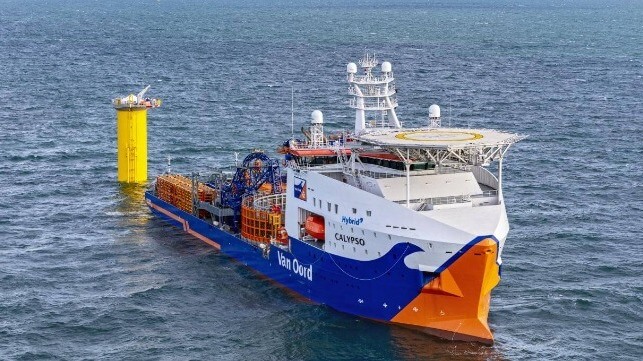
Van Oord’s brand new cable-laying vessel Calypso has made its official debut by installing cables on its first offshore wind project. After the Nexus, the Calypso is Van Oord’s second cable-laying vessel. Custom-built and featuring the latest sustainable technologies, the vessel is a key strategic addition to Van Oord’s offshore wind fleet. The Calypso’s first project is RWE’s prestigious Sofia Offshore Wind Farm in the UK, one of the largest offshore wind projects in the world. 

By investing in state-of-the-art equipment like the Calypso, Van Oord is anticipating an increase in scale in the offshore wind industry and contributing to the energy transition. The Calypso is purpose-built to install inter-array grid and export cables for offshore wind projects worldwide, including high-voltage direct current (HVDC) cables. Van Oord’s highly innovative cable trenchers can also be operated from the vessel.  

The Calypso is equipped with not just one, but two cable carousels, one on deck and another below deck, providing a total cable-carrying capacity of 8,000 tonnes and capable of laying two HVDC cables simultaneously. The vessel’s design incorporates the latest sustainable technologies to reduce its carbon footprint. Apart from the ability to run on biofuel, this hybrid vessel has future-ready engines with built-in flexibility to anticipate e-fuels. It has a large battery pack, a shore supply connection, and a state-of-the-art energy management system.  

Arnoud Kuis, Managing Director Offshore Energy: ‘With the Calypso now operational, we have significantly strengthened our cable installation fleet. This milestone reflects our commitment to continuously reinforcing our leading position in the market by investing in sustainable technology. With two cable installation vessels at our disposal, along with our extensive experience and expertise, we have the resources and flexibility needed to provide value to our clients and excel in this dynamic industry. It’s exciting to see the Calypso in action, installing its first cables on the Sofia project, and we look forward to its successful deployment on many more offshore wind projects.

The products and services herein described in this press release are not endorsed by The Maritime Executive.


SF Bay Ferry Given $12M Grant for Electrification of Harbor Bay Ferry Route

San Francisco Bay Ferry

Published Oct 28, 2024 7:35 AM by The Maritime Executive


[By: San Francisco Bay Ferry]

San Francisco Bay Ferry today announced it was awarded $12.5 million grant from the California State Transportation Agency (CalSTA) to bring zero-emission, battery-electric ferry service to the Harbor Bay Ferry Terminal in Alameda.

The award advances SF Bay Ferry’s Rapid Electric Emission-Free Ferry (REEF) Program, a transformative suite of projects to transition the agency’s fleet to zero-emission propulsion technology. The grant, provided through CalSTA’s Transit and Intercity Rail Capital Program (TIRCP), will support procurement and installation of an electrified universal charging float with battery storage, electric vessel charging infrastructure and terminal modernization at the existing Harbor Bay Ferry Terminal on Bay Farm Isle in the City of Alameda.

“SF Bay Ferry is committed to providing the region with the nation’s first zero-emission fleet of fast ferries and we are making tremendous progress thanks to this latest investment from the Newsom Administration,” said Jim Wunderman, Chair of SF Bay Ferry’s Board of Directors. “California understands that decarbonizing the transportation sector is essential to meeting the State’s ambitious greenhouse gas reduction goals and this project makes Harbor Bay’s ferry service a part of that effort.”

This grant leverages $5 million awarded for the project by the California Energy Commission and $4 million in additional local matching funds. The project will expand electric propulsion ferry service to the Harbor Bay route by providing the necessary infrastructure for fully electric ferries to rapidly charge while docked at this location. It will also increase electric vehicle charging capacity for ferry riders and improve operational safety at the terminal.

“Ron Cowan, who envisioned and developed Harbor Bay, was also the visionary behind the creation of SF Bay Ferry, and he partnered with the Bay Area Council to create it,” Wunderman added. “He foresaw a San Francisco Bay known for its extensive, world class ferry system.  Ron passed away in 2017 – he would be very pleased and proud today.”

Supported by the grant, SF Bay Ferry will partner with the Working Waterfront Coalition to provide young adults from disadvantaged communities with opportunities to enter the marine construction and maintenance job market through this project.

The ferry system has carried more than 268,000 passengers on the Harbor Bay route over the past year and more than 2.5 million passengers overall.

SF Bay Ferry has now secured roughly $154 million in funding from local, state and federal agencies to implement its REEF Program. This includes state and federal funding for system planning, new battery-electric vessels and shoreside infrastructure.

The REEF Program includes procurement of three new 150 passenger battery-electric vessels, two new 400-passenger battery-electric vessels, conversion of four diesel 400-passenger ferries to zero-emission technology, terminal electrification across the system, and expansion and electrification of the agency’s Central Bay Operations and Maintenance Facility in Alameda.

In August, SF Bay Ferry unveiled designs of the vessels that will operate on the Emerging Waterfront Neighborhoods Network. The agency expects to award procurement contracts for those ferries and the 400-passenger vessels in the coming months. Operation of the nation’s first high-speed battery electric ferry is expected to begin in 2026.

The products and services herein described in this press release are not endorsed by The Maritime Executive.


Contractor Goes Missing From Anchor Handler at Norfolk

Atlantic Oceanic
Courtesy Atlantic Oceanic

Published Oct 27, 2024 3:10 PM by The Maritime Executive


A search is under way for a missing maintenance worker aboard a tug at the port of Norfolk, Virginia. 

Derrick Fluellen, 33, was working aboard the anchor handler Atlantic Oceanic at the Portsmouth Marine Terminal when he disappeared Saturday afternoon. He was a member of a contracted maintenance crew and was stationed on fire watch, Coast Guard Sector Virginia told local media. 

The Coast Guard is operating on the assumption that Fluellen fell over the side, and it has launched a search and rescue operation accordingly. Sector Virginia dispatched one helicopter and one response boat, accompanied by first responders from local agencies, and is covering a broad swath of the region. Sonar and ROV search assets have also been deployed at the scene. 

Personnel at the terminal have been interviewed, along with Fluellen's coworkers, and the Port Authority is involved in the search process. The Coast Guard also checked cell phone data to see where Fluellen's device was located, and went to Fluellen's listed residence to check with his family. 

The service put out a rare public appeal, asking for anyone with information about Fluellen’s status to call Sector Virginia Command Center at 757-638-6637.

Atlantic Oceanic is a converted anchor handler, reconfigured for offshore wind support operations and operated by a firm of the same name. Last week, Miami police medevaced the master of another vessel in the firm's fleet, Atlantic Power, after he suffered a serious fall. The captain was delivered alive and alert to a local trauma center for treatment. 


What Do Sustainable Solutions for Ship Hotel and Catering Areas Look Like?

ALMACO

Published Oct 28, 2024 1:24 PM by ALMACO


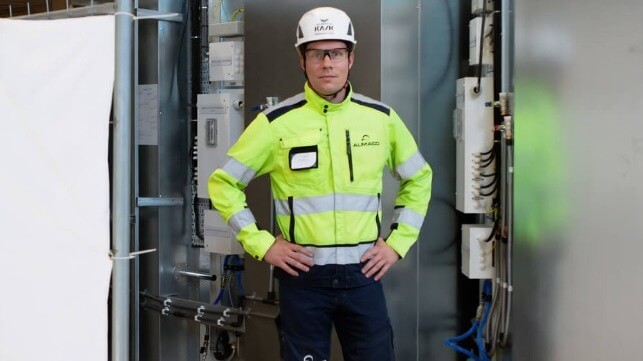
The marine industry is rapidly developing sustainable solutions in all aspects of operations, still recognizing that much work remains. In ship hotel and catering areas, environmental benefits can be achieved by prolonging equipment life, smart design, reducing energy, water, and steam consumption, minimizing waste, and increasing recycling and reuse.

Quality That Lasts with Recycling and Reuse

Recycling and reuse options for demolished materials and environmentally friendly alternatives significantly impact ship construction and modernization. Extending product lifetimes and promoting circularity support sustainability goals. By identifying solutions that extend the lifetime of products and promoting circularity in the industry, we can support the owners in achieving their sustainability goals.

Optimized and Smart Designs

Optimizing designs and layouts enhances sustainability and efficiency. Lighter materials reduce fuel consumption. In catering and laundry areas, fewer pieces of equipment and smaller areas reduce material and energy usage. Well-designed layouts increase safety, well-being, and productivity.

Modular cabin solutions optimize material usage, minimize waste, and reduce human errors. This approach enhances operational efficiency and results in a more sustainable outcome. The more we repeat the same solutions and materials on a ship or even a series of ships, the less waste we will generate, and the smaller relative material margins are needed.

Planned Maintenance and Condition Visibility

Planned maintenance and condition monitoring extend equipment life, prevent breakdowns, and optimize performance. Digital solutions track conditions and manage maintenance schedules efficiently. Like in any other industry or commodity, this proactive approach helps us address issues early, optimize performance, and reduce downtime, leading to more efficient and sustainable operations.

Consumption Monitoring Systems

Sustainable solutions that reduce consumption often lead to cost savings. ALMACO’s GEM (Galley Energy Management System) and REM (Refrigeration Equipment Monitoring System) help galley crews save energy by recommending optimal times to turn equipment on and off. There is a saying that what gets measured gets done, and this is especially true when good results are celebrated and rewarded.

Paradigm Shift in Refrigeration Technology

Freon, commonly used in refrigeration, is harmful to the environment. ALMACO supports CO2 refrigeration solutions for new builds, minimizing greenhouse gas emissions. Switching from traditional solutions to CO2 refrigeration solutions helps minimize greenhouse gas emissions.

Logistics and Mobile Factories

ALMACO’s Mobile Cabin Factory concept reduces carbon emissions and supports local economies. Building cabins on-site reduces emissions from material shipment. With a Mobile Cabin Factory, we don’t have to transport fully assembled cabins from the factory to the site. Instead, we can build the cabins on the site or very close to it. This drastically reduces emissions caused by the shipment of materials, as we can ship them directly to the site instead of first sending them to a distant factory.

Global Network of Suppliers and Partners

Choosing the right partners, subcontractors, and suppliers is essential. ALMACO collaborates with entities that share a sustainable mindset, accessing innovative solutions aligned with sustainability goals. We have established a global network of suppliers and partners who share our sustainable mindset, and we are also opting for sustainable solutions from our current suppliers.

Culture Eats Strategy for Breakfast

Peter Drucker famously said, “Culture eats strategy for breakfast.” This is also true when it comes to strategies to become more sustainable. A strong culture drives sustainability in product development and customer solutions. Employees aligned with a sustainable mindset are more likely to innovate and implement eco-friendly practices. This kind of culture is cultivated by living as we preach throughout the organization and ensuring sustainability is always on the table and demanded constantly.

ALMACO strives to decrease operation costs as well as collect measurable data for the owners. We also make sure to train and engage hotel and galley crew already before boarding, as well as continuously during operation. Both for internal operations and service portfolio development, ALMACO emphasizes sustainable practices. In 2023, the Finnish subsidiary earned the WWF Green Office Certification.

Safety and Quality are Nonnegotiable

Prioritizing worker safety and adhering to rigorous standards is crucial. ALMACO complies with the 45001:2018 Occupational Health and Safety Management System and the 14001:2015 Environmental Management System, ensuring employee protection and environmental standards. Our quality processes, including the 9001:2015 Quality Management System Standard, guarantee operational excellence. Commitments like these ensure that our employees work safely while following environmental and sustainability standards.


This article is sponsored by ALMACO. For more information, visit ALMACO online.

The opinions expressed herein are the author's and not necessarily those of The Maritime Executive.