Tuesday, January 14, 2025

Jean-Marie Le Pen dies—but his fascist legacy lives

His daughter Marie Le Pen has tried to distance her party from its former, outwardly fascist leader. But, argues Yuri Prasad, Jean-Marie Le Pen created the conditions for the rise of the far right in France


The odious figure of Jean-Marie Le Pen (Photo: Wikimedia commons)

Yuri Prasad
Sunday 12 January 2025  
SOCIALIST WORKER Issue 2938

On the night fascist leader Jean-Marie Le Pen died last week there was dancing on the streets of Paris. Thousands partied, and some carried signs that read, “The dirty racist is dead”, or more simply, “Beautiful day”.

Mainstream politicians were aghast that the joyous protesters seemed to have “no respect”. “Nothing, absolutely nothing justifies dancing on a corpse,” said interior minister Bruno Retailleau. “The death of a man, even if he is a political opponent, should inspire only restraint and dignity. These scenes of jubilation are deeply disgraceful.”

Really? What respect did the former leader of the National Front (FN) ever show his enemies?

Was he “respectful” when he dismissed the Nazi gas chambers? He told a press conference in 1987, “If you take a 1,000-page book on the Second World War, the concentration camps take up only two pages and the gas chambers 10 to 15 lines. This is what one calls a detail.”


Or how about when he described the German occupation of France during the Second World War—during which about 76,000 French Jews were sent to death camps—as “not particularly inhumane”.

Le Pen in 1988 dismissed a Jewish minister called Durafour with a sick pun on “four”, meaning oven—“Durafour-crématoire.” Did Durafour not deserve respect?

What about the many people that testified that Le Pen had tortured them while a paratrooper in France’s war against the Algerian Front de Liberation Nationale? Are Algerians not to be respected?

And what about the Muslims Le Pen repeatedly targeted? Courts fined him for inciting racial hatred against them in 2003, 2005, 2008 and 2011. These days, of course, it is almost pointless to demand politicians not demonise Islam—it has become their national sport.

Le Pen showed no respect and deserved none when he died.

Obituaries in the mainstream press talk of Le Pen as “gaffe-prone” or dismiss him as a “provocateur”. His outbursts are those of a buffoon, they say. Yet Le Pen’s racist statements were calculated and very much part of a plan.

Le Pen was a convinced Nazi who began his political life street fighting the left while at university. Before founding the FN, he ran a record label that produced albums heralding Nazi war marches and celebrating French intellectuals who had collaborated with the German occupation.

France, he said, was in need of “purification”, because it had strayed from Gallic and Roman Catholic roots—and what he called “the natural order, which is family, homeland, teaching and respect for the living world.”

To get to the France Le Pen craved, he knew it would take a movement that could seize control of the state and transform it in its own image. That movement was fascism.

But in the wake of the Second World War, and particularly after the discovery of the Nazi death camps, fascism was hard to sell. Millions of people who had seen the consequences of the Nazis first hand despised fascism’s ideas of racial purity and its hatred of democracy.

Those few activists that remained committed to the far right recognised they could not simply repeat the strategies of the 1930s. When the FN was born in the early 1970s, its leaders knew that it had to avoid being labelled “fascist” lest it be barred from the political mainstream.

At the same time, they also knew of fascism’s need for a disciplined core of supporters that understood that the road to power would be bloody.

From the early 1970s onwards, Le Pen and other FN leaders developed a way of speaking that could push at the limits of what authorities deemed acceptable. It was what Jim Wolfreys and Peter Fysh in their book refer to as “dual discourse”.

One part was “official and explicit, presenting itself as a legitimate part of the political establishment,” they wrote, while the other was “unofficial and implicit, reflecting its anti-democratic, authoritarian agenda.”

The FN’s hard talk “deliberately creates a tension between the organisation and its periphery, between ‘hard’ and ‘soft’ support, seeking to address sympathisers where they are and take them where the Front wants to go.”

So, rather than mis-spoken words, Le Pen’s attacks were a calculated attempt to enlarge and toughen his party’s inner fascist core.

But the statements had another purpose too. In the 1990s, the FN created its own immigration catch phrases for its spokespersons and activists to endlessly repeat. They included the word “invasion” and the expressions “levels of tolerance” of immigration and the “noise and smell” of foreigners.

So, when mainstream right politician Jacques Chirac—then mayor of Paris but a future national president—talked of immigrants as noisy and smelly, victory bells rang in the FN headquarters.

As mainstream politicians started to pepper their speeches with fascist phrases and talking points, FN leaders could then say, “Which do you prefer—the original or the copy?”

The fascists had successfully shifted both the language and the policies of the centre on immigration towards its own agenda. And it was this that allowed the FN entrance to the centre stage of French politics—the presidential elections.

In addition to his racism, Le Pen charged that all politicians at the Parisian centre, whether of the left or the right, were “tous pourris, tous complices, tous lointaines”—“all rotten, all accomplices, all distant”.

In 2002, he caused consternation when he emerged from the first round of the presidential race as the sole challenger to Chirac. Though he eventually came a distant second, Le Pen won nearly five million votes for a hard, racist programme.

But for the most politically ambitious in the FN, the vote was nowhere near close enough. They decided that the party would do better without Le Pen at the helm. The FN brand needed further detoxifying, they said.

Le Pen’s daughter Marine took the helm after the election and began a cleansing operation in an attempt to win support from more mainstream right voters and to make cooperation with their parties possible. She distanced herself from her father’s antisemitism, declaring Nazi concentration camps “the height of barbarity.”

And she ousted her father from the party in 2015, when he was its honorary president, and said his repeated Holocaust denial showed that “his goal is to cause harm” to the party. Three years later, she renamed it National Rally (RN).

But despite the cosmetics, RN’s aim is the same as that of the FN. It is to organise the radical right under the leadership of fascists. Party candidates are regularly revealed to have spent time in openly Nazi associations and as having made recent racist and antisemitic speeches.

And the FN strategy of dual discourse continues in RN but the target has moved almost exclusively to Muslims.

Marine Le Pen talks of the “incessant demands of minorities” and Muslim face veils being an ideological marker “as dangerous as Nazism”. The intention is to take the commonplace ideology of Islamophobia and push it further than those of the mainstream parties.

And a key RN policy is to change the French constitution so that immigrants have fewer rights than those born in the country. This policy of “national preference” would be used to ensure “French people” have priority over migrants in benefits, housing and health.

Much of the RN membership have embraced this hardline but mainstream political shift as necessary. But within the ranks there are many that understand well what Jean-Marie learned in his 20s, that the kind of France they want can only be obtained by in “revolutionary” nationalist means.

Le Pen senior warned the FN’s youth wing in 1996 of what to expect. “Crisis is the great midwife of history,” he said. “When situations are blocked, it’s generally the drive of human nature that forces a breakthrough into new times…

“There is a time when all that will end… at a certain point the worm-eaten structures of our system are going to collapse.”

Le Pen may be right about the coming crisis. But it’s our job to ensure that very different forces from his take advantage of those circumstances.The Politics of Racism in France by Peter Fysh and Jim Wolfreys, published by Palgrave Macmillan, £27.99. Available from Bookmarks Bookshop
What causes child sexual exploitation?

Sexual violence against children and young people is a wider problem than one of “grooming gangs”—it is rooted in the way the family operates in class society


The family can be a haven and a hell


By Sarah Bates
Sunday 12 January 2025    
SOCIALIST WORKER   Issue 2938

The right has used ­genuine ­outrage around “grooming gangs” to build its base of support. But if you’re a child, the person most likely to rape you isn’t your local taxi driver or takeaway worker. It is your father.

This abuse probably won’t be reported when it happens, and is unlikely to be noticed by local authorities.

That’s one devastating insight from the Centre of Expertise on Child Sexual Abuse think tank, which ­published a report into familial sexual abuse in September 2023.

It found that child sexual abuse (CSA) within the family accounted “for almost half of all sexual offences reported to the police in England and Wales”. This is despite the fact that this type of abuse is often not reported to the authorities, making the true scale of CSA hard to quantify.

“One in ten children, 15 percent of girls and 5 percent of boys, experience some form of sexual abuse before the age of 16,” the report estimated.

“It may be especially ­traumatic because of the betrayal, stigma and secrecy it involves. For those who are abused, it has been linked to poor physical and mental health, lower income, relationship difficulties and re-victimisation across the life course.”

One survey showed ­64­ ­percent of respondents who had experienced rape or penetrative sexual abuse from a parent or parent figure didn’t disclose it at the time.

This isn’t the picture painted by the right wingers and ­racists looking to ­capitalise on the ­genuine horror of the high ­profile child sexual exploitation (CSE) cases. They are spreading lies about the nature of abuse in an attempt to further their racist hatred.

As a result, it’s more ­important now than ever to understand what CSE looks like, who is ­perpetrating it and how.

CSE is a specific form of abuse, where children and teenagers are groomed by men who then rape them, often in exchange for money, or items such as ­cigarettes or food.

Some of the victims are promised the possibility of affection and attention after a programme of manipulation and coercion makes them believe they’re in a consensual relationship. Many victims do not even understand that what they have experienced is CSE until they reach adulthood.

Every case of CSE is shaped by cruelty and violence—where some of the most vulnerable young people in our society are deliberately targeted.

But these young women aren’t just victims of violence at the hands of their ­attackers. They are routinely belittled, dismissed and sometimes criminalised by authorities that should protect them.

They aren’t believed partly because sexual violence and abuse is generally not taken seriously in society. But, when the victims are children, and especially poor children, it means they are ignored more than usual.

From churches, to youth offender institutions, care homes to boarding schools, child abuse is a recurring feature. Hierarchal cultures within these environments makes it easy to dismiss people who complain of abuse and ­harassment. And these are environments where dangerous adults are placed in positions of trust, supposedly to care for children, instead take it as an ­opportunity to abuse.

The recurring themes of children being dismissed and ignored also reflect the way young people are not taken seriously as human beings in their own right.

Children are not always treated as independent human beings—with their own rich lives, ­experiences and pressures.

They are too often just seen as walking reflections of their parents, or as representatives of their wider community.

This is partly reflected in law. For instance, children have less legal defence against physical violence than adults. In England, it is legal for ­parents to smack their children if it is considered “reasonable punishment”.

It’s also legal for a childcare worker independently contracted by the parents, such as a nanny or a babysitter, to smack children if mum and dad say it’s okay.

There is a specific context for why the home under capitalism provides such a fertile breeding ground for abuse. The capitalist nuclear family isn’t just a product of the wider system—it plays an important role in reinforcing it.

It’s through the family that children are taught to trust their parents above everyone else, and to obey adults more generally.

There is a cloud of secrecy that envelops and obscures domestic life. There is an idea that “blood is thicker than water” and it’s important to “keep it in the family”.

It is through the family that most of our basic human needs are met—the need to eat and sleep, the need for human ­interaction and security. We are taught to ­prioritise familial and romantic ­relationships above all other types of kinship or connection. And a lot of the time, it is a positive experience and our family members support us in a difficult and hostile world.

Everyone in the working class is left exhausted by the experience of the grind under capitalism. But as a result, people—even those who love each other—can treat each other terribly.

This is partly because the experience of the family doesn’t match up to the ideal we’re told to expect. We are told that it is with our parents, partners and children that we will find the love, fulfilment and connection that human beings need.

And families today are put under increasing pressure due to attacks on health, education and social services.

If all this is true, that family life can be extremely dangerous, why isn’t anyone doing anything? The answer is simple—the nuclear family unit is simply too beneficial to capitalism as a whole.

It is the environment where people are most likely to experience abuse—but it’s also the vehicle through which most care in society is delivered. This is mostly performed by women, who overwhelmingly shoulder the burden of ­cooking, cleaning and caring.

They do this mostly for free, with almost no state intervention.

By essentially ­outsourcing the caring of everyone—­especially the young and old, sick or disabled people—to individual women, the ruling class can wash its hands of any ­financial responsibility. The capitalist class as a whole has an interest in ­maintain familial relationships as they are—even if that degrades human relationships and puts individuals in harm’s way.

They want to protect the family from criticism because it is a hugely efficient ­mechanism for keeping people ­generally healthy, educated and ­socialised.

As such, it plays a vital role in the transmission of ruling class ideology.

Human ­society under capitalism is not arranged in a way that fosters good relationships. Instead, family life is ­organised around trying to exploit adults and care for children in the cheapest way.

The ideology that insists that each family is its own isolated unit means parents are forced to accept total responsibility for their children, even when they don’t have the resources to care to a high standard.

Because the private family unit is judged to be above criticism it means that people can do terrible things that often go virtually unnoticed.

Today, the state has a ­complex but critical role in supporting the institution of the family that goes beyond simply ­valorising its role. The state intervenes directly through legislation on marriage, divorce, property ­ownership and so on. But it also does it in a more indirect fashion through how it reinforces the ideology of the family.

So politicians regularly espouse the importance of “family values” and claim ­to ­support “hard working families.”

This ideology—that keeps the family together in the face of almost any circumstance—can actively place children in harms’ way.

This provides a fertile ­breeding ground for CSA to flourish within the family home.

It is within this context that billionaire Elon Musk and Tory leader Kemi Badenoch are mischaracterising abuse as they whip up racism over CSE scandals.

Meanwhile, the situation for children abused at home is ­getting worse. The Centre of Expertise on CSA argues that, “It’s been estimated that only one in eight victims of child sexual abuse in the family environment comes to the attention of statutory authorities.”

It explains that one factor endangering children is how local authorities have focused on other forms of abuse outside the family, such as CSE.

It is possible, and indeed ­necessary, to condemn the actions of violent individuals while drawing on a wider analysis about the structural reason why and how people behave the way they do.

And it is impossible to ­understand the reality of familial abuse without interrogating why it takes the form it does within the capitalist system.


Syria's New Rulers May Block Russia From Evacuating Naval Base

And one Russian amphib is having equipment troubles while awaiting access, according to Ukrainian intelligence

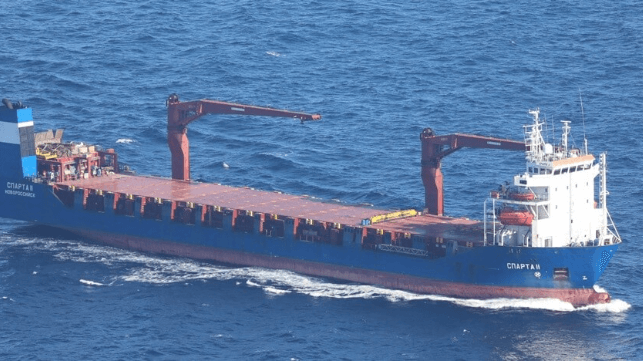
Sparta II
Sparta II is among the Russian military cargo vessels loitering off Syria (file image courtesy Portuguese Navy)

Published Jan 13, 2025 5:02 PM by The Maritime Executive


Ukraine's military intelligence agency claims that Russia is encountering difficulties in gaining access to its longtime naval base in Tartus, where it appears to have staged large quantities of military equipment for outward shipment. One of the Russian naval vessels stuck offshore Syria, the amphib Alexander Otrakovsky, has now developed technical issues with its water desalination plant and with leaking fuel tanks - but it cannot enter port for repairs, according to Ukraine's HUR.

In early December, U.S.-designated terror group Hay'at Tahrir al-Sham (HTS) began an offensive against the government forces of dictator Bashar al-Assad, the latest in a long series of battles in Syria's 13-year civil war. This time, Assad's forces rapidly collapsed under pressure, and his Russian backers retreated ahead of the advancing rebels. As HTS seized the capital city of Damascus, the Russian military pulled back and concentrated its assets in Tartus and Latakia, where Russia has operated military bases since the Soviet era. 

As an apparent precautionary measure, the Russian Navy's Mediterranean Flotilla sortied from Tartus and took up station off the coast, where it has remained since. Satellite imagery confirms that the Russian berths in the port are empty of seagoing vessels, and the quaysides have filled up with Russian trucks and equipment. 

The timeline for Russia to regain access and retrieve that equipment appears uncertain, according to the HUR. The spy agency reports that Russian Rear Adm. Valery Vladimirovich Varfolomeyev attempted to negotiate with HTS on an agreement for port access on January 9, but was rebuffed.

While the Ukrainian report could not be immediately verified, three Russian military cargo ships are loitering in the area, along with the tank landing ships Ivan Gren and Alexander Otrakovsky. The landing ships are often used to augment Russian logistics capabilities (in addition to their amphibious assault role). None of these vessels have re-entered port.

Depending upon the degree of access Russia eventually negotiates, at least some of the gear may end up being left behind. Pro-Ukraine news service Euromaidan reports that Russian troops have orders to burn any non-operational equipment on the ground if it cannot be evacuated, in order to prevent it from falling into HTS' hands. 

Syria: "The West is sacrificing dozens of peoples and faiths"

Tuesday 14 January 2025, by Fabienne Dolet, Berivan Firat


The new government in Syria has received European ministers and seems to have won the goodwill of Western states. The situation of the Kurds who are fighting for their rights remains complicated. Berivan Firat of the CDKF (Kurdish Democratic Council in France) gives his point of view. This interview was conducted b by Fabienne Dolet, on January 4, 2025

What consequences does the new situation in Syria have on the Kurdish resistance?

There is conflicting information circulating, especially around the Tishrine Dam. This bridge connects the west and east of the Euphrates, if it falls, it will no longer have this significance and both sides will be occupied. So if Turkey and the SNA (Syrian National Army) who are trying to seize this dam succeed, they will at the same time have control of the international road connecting Iraq to Syria. If it is occupied, Kobane will be surrounded and threatened from Raqqa to Jizir. It would really be a disaster for us Kurds.

For more than ten days now there have been constant attacks from Turkey, supported by Turkish drones. And despite this, the resistance continues. Turkey has taken a huge slap in the face. There are more than a hundred bodies of jihadists who died in the clashes that were left behind. The Kurds, the SDF (Syrian Democratic Forces), it must be emphasized, have managed to resist. Contrary to everyone’s expectations. Everyone thought that in one or two days the Kurdish resistance would fall.

The aggressions have not ended, so the resistance continues. For the moment, the Kurds have the advantage, despite Turkey’s air superiority. Turkey has been bombing for years, less Kobane than other places, but bombing infrastructure, civilians and all that. And this, in the complicit silence of everyone. Kobane has been bombed several times with drones, which directly drop bombs, therefore causing victims. There have been targeted attacks.

There was political duplicity. When Turkey was bombing, when Turkey was massacring the Kurds, saying we are very worried and extremely concerned, that was the only reaction there was. Turkey remains an important ally for the West, although it is the representative of terrorists, of international terrorism. We can say it like that, now that we have rehabilitated the terrorists, the head cutters.

You mean the new leaders of Syria who ousted Bashar Al-Assad ...

They were given suits, their beards were trimmed, and overnight they became ministers, representatives of the army. For example, among them, there is the one who openly killed, mutilated, raped Hevrin Khalaf, who was the co-chair of the Future of Syria Party, a very young Kurdish woman, who was assassinated. Today, without any embarrassment, he is one of the representatives of the new transitional government of Syria. As for Jolani, he has dozens of deaths, dozens of beheadings behind him. That doesn’t bother anyone in the West.

While the West still considers the PKK as terrorist…

On the other hand, an organization like the PKK, which has never directly targeted civilians , which fights with a regular army and fights for its rights, for the rights of the Kurdish people, is still considered terrorist. What is most tragic, or tragicomic, is that these individuals who were brought to the head of the Syrian transitional government were for the most part not Syrians. In one night, they were naturalized to be able to stay there. There are Uzbeks, there are Uighurs, there are French, people of all origins who have massacred people for decades, who have kidnapped Yazidi women.

During the visit of the French minister, Jolani greeted him with the tips of his fingers. The German minister (a woman) was not greeted. So there is this disgust, this belittling of the West which is flagrant, but to supposedly avoid a flow of refugees, for the supposed stability of Syria, especially to thwart Iran, the West sacrifices dozens of peoples and faiths, condemns them to live in trauma, in fear of being decapitated, raped, kidnapped from one second to the next.

It is the West that gives moral lessons to the whole world that validated these people, that rehabilitated them. While the Kurds, who were long considered to be the fighters for the future of humanity (but it was mainly because we died for the interests of the West), are still denied The Belgian Court of Cassation, if I am not mistaken, had decided that the PKK was not a terrorist organization, but an armed movement born of an internal conflict, notably with Turkey. However, they order the PKK activists who went to fight against the jihadists, who went to die there (including my son) to leave Syria because they do not have Syrian nationality, are not Syrian citizens

But the jihadists were naturalized overnight. We are forbidden to stay on our lands, because for us Kurds, the borders on Kurdish territory have never been accepted. Whether in Rojava on the Syrian side, in Rhojelat on the Iranian side, in Bachour on the Iraqi side or in Bakour on the Turkish side, it is Kurdish territory on which the borders have been installed.

This new Syrian government is not good news...

We see how ridiculous realpolitik becomes when it comes to political and economic interests, such as the new Silk Road that they want to build in Syria. It is not to protect the people, it is not for the stability of Syria, it is not for the future of the Kurds. Everyone is there to protect their interests.

The West’s policy of duplicity towards the Kurds continues. The Kurds, who were forced to surrender, that is, to give up their weapons in one way or another, continue to keep their weapons. The Syrian democratic forces continue to resist, to hold discussions with those individuals who are the representatives of Syria. For us, the resistance continues and will continue. In any case, there is no alternative. It is either die on your knees or die standing... to have victory

In France, that means that there is even more need of solidarity to respect the memory of the murdered activists, men and women, and to demand justice and truth...

Absolutely. These two political attacks of 2013 and 2022 are not unrelated to the international situation or the situation of the Kurds. It is not insignificant to kill women from a community that, despite a progressive project, is quite patriarchal and feudal. The honour of women is extremely important. So they wanted to bring the Kurds to their knees.

In 2013, the anti-terrorism prosecutor’s office was immediately called upon to investigate the case. From the first moments of the triple murder of Sakine Cansiz, Fidan Dogan and Leyla Saylemez , on January 9, we were told about an internal settling of scores, that is to say that it was the PKK or a small group within the PKK that had killed them. Things turned out to be different, with the effort of journalists and Kurdish people, who went digging for evidence on the terrain, to find the videos that show when the individual enters and leaves the building. Afterwards, there was a message ordering assassinations that had been committed by three individuals from the Turkish secret services. Afterwards, there is an audio cassette that prepares the assassinations ,that was edited. It was shown that the Turkish secret services were behind it.

For the assassinations of December 23, 2022 of Evîn Goyî (Emine Kara), Mîr Perwer and Abdurrahman Kizil, we know that the man who killed them was not an ordinary guy — he had all the characteristics of an agent on a mission. For whom? Russia? Turkey? The jihadists? There are many leads. He was a man behind whom there are forces that premeditated, that prepared, that fomented this triple assassination, especially those who targeted the head of the Kurdish women’s movement, Emine Kara. This is not nothing.

The first time, they targeted a woman who was one of the co-founders of the country. The second time, they targeted the activist of the Kurdish women’s movement, the person in charge. They didn’t just kill Emine Kara by chance. In 2022, the anti-terrorism prosecutor’s office was not notified.

On Thursday, January 9, there will be a silent march in memory of the activists who were murdered . In the evening at 6:30 p.m. at the town hall of the 10th arrondissement, there will be a debate with lawyers and activists from the Kurdish women’s movement.

On Saturday, January 11, at Gare du Nord from 10 a.m., we invite everyone who wants to join us for a large “Truth and Justice” march which is semi-European.

More than ever, we need the solidarity of our friends to talk about what the Kurds, the Halevis , the Druze, and all the martyred minorities in Syria are experiencing.

Published in the weekly l’Anticapitaliste) issue 736 on January 9, 2025 .


Attached documentssyria-the-west-is-sacrificing-dozens-of-peoples-and-faiths_a8817.pdf (PDF - 913.4 KiB)
Extraction PDF [->article8817]


Fabienne Dolet
Fabienne Dolet is a activist of the NPA.

Berivan Firat
Berivan Firat is external relations spokesperson for the CDK-F (Kurdish Democratic Council in France).


International Viewpoint is published under the responsibility of the Bureau of the Fourth International. Signed articles do not necessarily reflect editorial policy. Articles can be reprinted with acknowledgement, and a live link if possible.

The Drought That Felled Assad


 January 14, 2025
Facebook

Image by Zetong Li.

The meteorological drought that swept through the Fertile Crescent (stretching from the Tigris and Euphrates to the Nile Valley) in the 2000s finally ended up undoing the Assad regime in Syria and forcing Bashar al-Assad to flee to Moscow under the cover of night last month. At first glance, drought or its driver in climate change seems to have little to do with a geopolitical event like the fall of the Assad regime. However, the fall of the regime has been years in the making, and climate-related issues played a large role.

The decline of the Assad regime began with a protracted drought in 1998, the likes of which the Middle East had not seen in the past nine centuries. The drought’s severity reached its peak in 2006-2011 in northeastern Syria, which is the country’s breadbasket, comprising the Euphrates and Jazira regions. These regions produce two-thirds of the country’s crop yield, especially Syria’s staple, wheat.

At its peak, the drought caused agriculture, the green anchor of the Syrian economy, to collapse. Agricultural production, which generates one-fourth of the country’s GDP, dropped to 17 percent. But this aggregate impact doesn’t capture the devastation it wrought on millions of rural residents, farmers, and herders whose individual farm production fell to zero or near-zero. Syria, which was the only country in the Fertile Crescent (Egypt, Iraq, Israel, Jordan, Lebanon, Palestine) that was self-sufficient in foodgrain production, became an importer of wheat in 2008.

Hafez al-Assad, Bashar al-Assad’s father, who ruled the country from 1971 to 2000, founded his reign on Baathist socialist ideology. He helped expand agriculture by subsidizing the ever-growing cost of farm inputs and even insuring against the crop failures that were frequent in the dryland agricultural system. State subsidies buffered millions of rural residents, farmers, and herders against unexpected meteorological and market-driven shocks. His son, on the other hand, reversed all that. Introducing neoliberal policies, Bashar al-Assad left everyone on their own. On his watch, capital-rich farmers prospered while the rest kept falling through the cracks.

Although dryland agriculture is the mainstay of the Syrian economy, the country has a significant portion of irrigated agriculture that is predominantly drained by the Euphrates, and to a far lesser degree by the Tigris. But with climate change, both waterways were drying up, especially the Khabur, Syria’s main tributary to the Euphrates, which saturates the northeastern region of Hasaka. The Khabur has been the iconic source of Syrian agriculture for millennia, whose significance to farming earned it a mention in the Old Testament as “Habor.” Desiccated, the Khabur couldn’t now reach the Euphrates, a failure that had long sown suspicions in downstream Iraq, which is the largest beneficiary of Euphrates water.

Hit by another drought in the mid-1970s, the Euphrates saw its flow of 15.3 billion cubic meters (BCM) to Iraq in 1973 drop drastically to 9.4 BCM in 1975. Iraq accused Syria of diverting its share of water. Syria blamed Turkey, which is home to the headwaters of the Euphrates, Tigris, and Khabur, for the reduced flow. Unconvinced, Iraq deployed tens of thousands of troops to the Iraq-Syrian border in 1975. Damascus answered in kind. A shooting war between upstream and downstream neighbors nearly erupted before the former Soviet Union disengaged the two thirsty foes.

The drought in 2006-11 triggered a mass migration from the rural hinterlands to urban centers. An estimated 1.5 million rural residents were displaced to the fringes of urban centers. Displaced Syrians were all “climate refugees” who were without jobs, income, and, above all, any hope to begin a new life. The concentration of despair was highly combustible, and it could easily turn into a conflagration. The spark that ignited this highly flammable situation was the influx of even more drought-driven refugees from neighboring Iraq, bringing urban centers and their scarce services under unprecedented strain.

The influx of Iraqi refugees peaked in 2007 at 1.5 million, bringing the total along with internally displaced Syrians to 3 million. By 2010, these climate refugees amounted to one-fifth of the Syrian urban populationIn 2002-2010, Syria added 50 percent moreto its urban population of $22 million. The drought-driven ecological instability shook the Assad regime to its foundation in 2011, when the urban uprising erupted, and for the first time Assad’s grip on power began to slip.

The first major protest occurred in the “impoverished drought-stricken rural province of Daraa” in March 2011. As protests spread, Homs, Syria’s largest city in terms of territory, became the epicenter of political uprising. In July 2012, Syria’s most populous city of Aleppo fell to the opposition. In 2013, Raqqa on the Euphrates, which sits next to the country’s largest dam (Tabqa Dam) and the biggest reservoir (Lake Assad), was occupied by the Syrian opposition. In January 2014, Raqqa was seized by the Islamic State to become the capital of its caliphate.

The Assad regime, completely resourceless and under a ruthless sanctions regime, had few means to help desperate Syrians struggling to survive. Although poor in ecological and economic resources to cope with a natural disaster, Assad still had a monopoly over violence, the defining feature of a Weberian state. Unable to provide any relief to millions of his masses, Assad simply deployed violence to keep a lid on mass eruptions. By 2016, he regained control of major cities including Aleppo. By 2020, the civil war had ended.

But Assad’s repressive measures, including the alleged use of chemical weapons against his own people, elicited a global response that left him and his regime further weakened and those arrayed against him even more emboldened. Soon he was losing the one resource that he thought he controlled: the monopoly over violence. His opposition, meanwhile, was receiving support from the United States, Turkey (a NATO member with the largest military in Europe), Israel and the United Arab Emirates.

Unbeknownst to him, Assad’s sclerotic regime was fast hollowing out. Four years after regaining control over much of Syria, the Assad regime fell in just 10 days, when a coalition of the opposition in Hayat Tahrir-al-Shaam (HTS) overran it. The opposition’s blitzkrieg began with the fall of the drought-stricken city of Aleppo in the north on November 29. Buoyed by the biggest prize, HTS troops advanced to Hama. The next were Daraa, the cradle of the anti-Assad revolution, and Homs, the crown jewel of Syria’s irrigated farming, which were captured on December 7. Aleppo, Hama, Daraa, and Homs had all been at some point agriculturally well-endowed regions.

On December 7, HTS troops reached the peripheries of their ultimate prize, Damascus, the capital. Many of HTS troops defied their command and entered the city, overtaking the main buildings. The next day, the Syrian military practically dissolved itself and Russia whisked Assad away to Moscow. HTS advanced from the north to the south all the way to Damascus and Deir ez-Zor in the east.

Can the incoming rulers save Syria from future drought disasters? Fifty-five percent of Syria is desert that burns with aridity. Due to ever-soaring temperatures, two-thirds of the Euphrates, Tigris, and Khabur have evaporated, leaving behind little for irrigated farming. The incoming rulers, whose credentials are anchored in lifelong careers fueling an insurgency, can hardly match the looming existential threats in climate change or its manifestations in meteorological droughts.

This first appeared on Foreign Policy in Focus.

Tarique Niazi teaches environmental sociology at the University of Wisconsin at Eau Claire and can be reached via email: niazit@uwec.edu.