Thursday, February 06, 2025

The Aga Khan, spiritual leader of Ismaili Muslims and a philanthropist, dies at 88

SCION OF THE OLD MAN OF THE MOUNTAIN HASAN ibn SABAH

Issued on: 05/02/2025 -

The Aga Khan, who became the spiritual leader of the world’s millions of Ismaili Muslims at age 20 as a Harvard undergraduate and poured a material empire built on billions of dollars in tithes into building homes, hospitals and schools in developing countries, died Tuesday. He was 88.

ISMALI MUSLIMS ARE CONSIDERED  HERETICS!


LA REVUE GAUCHE - Left Comment


New Aga Khan takes helm of Ismaili Shi'ite Muslims

New Aga Khan takes helm of Ismaili Shi'ite Muslims
A new Aga Khan has taken the helm as the spiritual leader of the Ismaili Muslims following the death of his father aged 88.

Prince Rahim al-Hussaini has been named the new Aga Khan, becoming the spiritual leader of around 15mn Ismaili Muslims worldwide following the death of his father in Lisbon aged 88.

The 53-year-old was appointed in his father's will, unsealed on February 5, as the fifth Aga Khan and 50th imam of the Nizari Ismaili branch of Shia Islam, continuing a 1,300-year dynasty that claims direct descent from the Prophet Muhammad. Ismailism shares its beginnings with other early Shi’ite Muslim sects that emerged during the succession crisis that spread throughout the early years of Islam. Prior to the collapse of the Pahlavi monarchy in Iran in 1979, the Ismailis held a royal title second only to the Shah of Iran Mohammad Reza Pahlavi. 

Through the Aga Khan Development Network (AKDN), Prince Rahim has focused on climate issues and will now oversee a vast portfolio of humanitarian institutions and business interests estimated to be worth between $1bn-$13bn, spanning airlines, real estate and media.

"My expectation would be that there is a continuation of that legacy, because it is ingrained in Islam and it is substantiated in these institutions," said Eboo Patel, founder of Interfaith America, who studied Ismaili institutions at Oxford University.

The late Aga Khan, who was given the title "His Highness" by Queen Elizabeth II in 1957, built the AKDN into a global force for development. it was particularly active in Asia and Africa through hospitals, schools and universities.

"We have no notion of the accumulation of wealth being evil," he told Vanity Fair in 2012. "The Islamic ethic is that if God has given you the capacity or good fortune to be a privileged individual in society, you have a moral responsibility to society."

Prince Rahim, educated at Phillips Academy and Brown University, inherits the leadership of a community known for pluralism and humanitarian work.

The AKDN has invested more than $1bn in Tajikistan alone since 1995, though recent tensions have seen Tajik authorities nationalise some properties amid separatism accusations.

In November, Central Asia specialist Bruce Pannier reported for bne IntelliNews on how the former imam of the Ismaili community served as the chief beneficiary to the Pamiri—but in a grievous blow to the minority, was being cut off from further cooperation by Tajikistan’s Rahmon regime.

"They have really been at the forefront of relief efforts and humanitarianism on behalf not only of Ismailis, but of all the people affected in the communities where they work," said Jonah Steinberg, associate professor at the University of South Carolina.

The succession marks a return to tradition after the late Aga Khan's own unexpected appointment.

In 1957, his grandfather bypassed other heirs to name the then 20-year-old Harvard student as successor, citing the need for youthful leadership in a rapidly changing world.

The late Aga Khan is survived by three sons and a daughter.


What are sanctuary cities, and how are they being targeted by Trump?

Trump has promised to fix the immigration system in the US by carrying out mass expulsions. Yet certain cities across the country – known as “sanctuary cities” – have policies that limit cooperation with federal immigration officials. FRANCE 24 spoke to Muzaffar Chishti, director of the Migration Policy Institute at New York University's School of Law, on how some local governments respond to the crackdown.


Issued on: 04/02/2025 - 
FRANCE24
Explainer
By: Sonya CIESNIK


San Francisco Police Chief William Scott speaks at a rally of city leaders opposing President Trump's immigration crackdown on the steps of City Hall in San Francisco on January 28, 2025. © Terry Chea, AP


President Donald Trump released a barrage of executive orders related to immigration on his first day in office, following up on his campaign promise to crack down on immigration and proceed with mass deportations.

The president focused part of his ire on sanctuary cities, which limit their cooperation with federal agents from Immigration and Customs Enforcement (ICE) to varying degrees. Hundreds of US cities consider themselves sanctuaries, as do about a dozen states. Such policies began in the 1980s, when churches offered refuge to Central American refugees fleeing war regardless of their US legal status.

The Department of Justice issued a memo on January 22 outlining the new administration’s plans to challenge city sanctuary laws.

“Federal law prohibits state and local actors from resisting, obstructing, and otherwise failing to comply with lawful immigration-related commands or requests,” said the document.

Trump told Fox News the same day that he would try to block federal funding to sanctuary cities. “We’re trying to end them, and a lot of the people in those communities don’t want them,” he said, without offering evidence.

About a dozen states and hundreds of cities across the United States have declared themselves as “sanctuaries” for undocumented immigrants (others have balked at using this term, preferring to call themselves “welcoming” cities).

The United States currently has around 14 million undocumented immigrants, many of whom have families in or other longstanding ties to the United States.

FRANCE 24 spoke to Muzaffar Chishti, director of the Migration Policy Institute office at New York University School of Law.

What does it mean to be a "sanctuary city" and how does it make ICE operations more difficult?

There is no legal, popular, Oxford-dictionary definition of a sanctuary city. The term quickly gained popular usage in a political context, and it depends on what your politics are: some cities like to associate as a place with sanctuary laws. If people want to attack a place as being non-cooperative, they will dub it a “sanctuary city”.

The term has its origins in the '80s with the arrival of Central American refugees to the United States.

There is no city or state jurisdiction, that I know of, which says: “We will not at all cooperate with ICE.” No city or jurisdiction hides immigrants, or prevents ICE from approaching them. The term has come to mean the degree of cooperation between ICE and local jurisdiction.

Every city sets its own limits on when to cooperate with ICE. There could be scores of crimes, for example, and the city of New York would hand the immigrants over to ICE. Another city could have scores of crimes, but they would not hand the immigrants over to ICE.

Each jurisdiction makes its own priorities for handing over undocumented immigrations, but the line generally gets drawn on violent crime.

The possession of marijuana, making a wrong turn at a traffic light, even identity theft: all of these don’t rise to the level of needing to cooperate with deportation efforts for certain jurisdictions.

What kind of retaliation can the Trump administration take?

The Trump administration’s view is, any jurisdiction that doesn’t cooperate with federal law is violating federal pre-emptive authority. Any lack of full cooperation is a ground to penalise the state and local authorities.

That is a doctrine to be accepted. At the same time, we have a parallel doctrine: You cannot commandeer a state to do your job. This is rooted in the 10th amendment [which states that any powers not specifically delegated to the federal government by the Constitution are reserved for the states]. That’s why we are stuck.

The only way to make a cop do ICE’s work is through a consensual agreement called the 287(g) program. This is a contract in which ICE delegates specific immigration-officer duties to state and local law enforcement partners.

Yet to say local cops don’t do their job is not true. This Trump administration believes that anyone who doesn’t cooperate fully is violating federal law. It says Department of Justice officers will investigate state and local officials who resist the federal immigration crackdown.

The only way the federal government could make the state do their job is to stop funding directed to them. The Trump administration could withhold funding from states and localities which it perceives as uncooperative on immigration policies.

The president will likely run up against the federalism principle, which states that federal funds cannot be withheld for reasons of retaliation.

What happens is that some states are more than willing to comply with the federal government, while others aren’t. The result is a patchwork situation across the country. Two neighbouring counties, with two different policies for immigration – that’s not good for national unity. Also, your level of anxiety as an immigrant largely depends on which county you live in.

How has public opinion on sanctuary cities evolved since Trump’s first term?

Public opinion on immigration took a big hit during former president Joe Biden’s term. Biden’s years as president were marked by high numbers of immigrants arriving illegally to the United States. The Republicans took advantage, calling it the “Biden border crisis”, or “BBC”.

The numbers of arrivals were very high, with the conflation of wars, climate change and political instability abroad. There were migrants from places including Venezuela, Peru, Ecuador, Morocco and Sudan. And this happened to coincide with Biden’s administration.

The succession of Biden, who wasn’t perceived as a president who was tough on migration, by Trump, also played a role. Smuggling rings rushed to get people into the US in the interlude between the two administrations. More people came, and immigration levels came to a high-water mark in December 2023.

Two years ago, Republicans like the governor of Florida, Ron DeSantis, started busing people into sanctuary cities, which happened to be in 'blue' (Democratic) states. These cities started to feel the pressure. It’s not easy to accommodate people in expensive cities like New York.

The shift went beyond the struggle to house people. There was a reaction to the spectre of national disorder and this was visible at the Democratic National Convention, when the speakers advocated for tougher border measures and policies on asylum seekers.
Trump resistance? A 1940s US sabotage manual goes viral

Analysis

Since the inauguration of Donald Trump in January, tens of thousands of people have downloaded the “Simple Sabotage Field Manual”, a guide written by a US intelligence agent in 1944 to help the allied resistance during World War II. Its newfound popularity comes amid an emerging grassroots opposition to waves of executive orders from the new president.

AVAILABLE FROM LOOMPANICS


Issued on: 05/02/2025 - 
FRANCE24
By: Sébastian SEIBT
US President Donald Trump speaks with the world's richest man Elon Musk in Texas, US, on November 19, 2024. © Brandon Bel, Reuters


The first time Donald Trump was elected US president in 2017, George Orwell’s dystopian thriller “1984” made a surprise return to the top of bestseller lists as readers discovered a new appetite for the novel that examines how a totalitarian government’s use of “double speak” fatally erodes the concept of truth.

Eight years later, Trump’s return to the White House has ignited interest in another decades-old publication, this time from the non-fiction aisle.

The “Simple Sabotage Field Manual” was produced in 1944 by the US Office of Strategic Service (OSS) – predecessor to the CIA – and on February 1 became the most popular book on Project Gutenberg, the world’s biggest platform for downloading open-source free and public domain ebooks.

American spies used the manual when they were on the ground in Europe towards the end of World War II.

“It was meant as a tool for OSS ground operatives to recruit and train citizens in occupied territory and teach them simple and efficient sabotage techniques while minimizing the risk of getting caught,” says Simon Willmetts, associate professor of Intelligence Studies at Holland’s Leiden University.

But in the final week of January this year – one week after Trump’s inauguration – there were 158,421 downloads of the 80-year-old document. On February 2, there were 34,000 downloads in a single day.

Downloads of the how-to guide, written by former OSS director William Donovan, overtook literary classics including Shakespeare’s “Romeo and Juliette”, Herman Melville’s “Moby Dick”, and Lewis Caroll’s “Alice in Wonderland”.

Willmetts says the 20-page publication, declassified by the CIA in 2008, “is just a document that presents in a dry and bureaucratic fashion ordinary sabotage, as opposed to big complex operations, like blowing up a factory or a bridge”.
Citizen-saboteurs

According to the manual, “simple” sabotage can be executed by normal citizens using everyday objects, and “carried out in such a way as to involve a minimum danger of injury, detection, and reprisal”.

It details how to spot opportunities for small-scale sabotage in a variety of everyday situations, especially in the workplace, often through making clumsy “mistakes” or sewing discord among other employees.

In short, the guide is “good for training you to become incompetent at work”, Willmetts says.

For instance, railway workers were advised to print multiple tickets for the same seat on trains used by German soldiers, and secretaries to make callers wait for long periods or even to “forget” to connect important calls. Saboteurs working in factories that were important for the German war effort were even encouraged to let whole rolls of toilet paper fall into the toilet bowl to block facilities.

It encouraged managers to “lower morale” and production by promoting inefficient workers, complaining about those who did good work and finding excuses to waste time.

“Make ‘speeches’. Talk as frequently as possible and at great length. Illustrate your ‘points’ by long anecdotes and accounts of personal experiences. Never hesitate to make a few appropriate ‘patriotic’ comments,” it reads.

Meanwhile, lower-level employees were encouraged to scrupulously apply company rules to slow down the workflow as much as possible.

“Insist on doing everything through ‘channels’. Never permit short-cuts to be taken in order to expedite decisions," the guide advises.

Broadly speaking, the manual says citizen-saboteurs should seek out opportunities “to make faulty decisions, to adopt a non-cooperative attitude, and to induce others to follow suit”, subtly ramping up poor-workplace behaviour that is “frequently responsible for accidents, delays, and general obstruction even under normal conditions”.

The overall objective was to introduce so many small obstructions in individual workplaces that it slowed the wider economy in occupied territory.

"There are historical examples of success using this method,” says Robert Dover, professor of Intelligence and International Security at the UK’s University of Hull. Towards the end of World War II “in some production factories they managed to build unreliable engines that lasted less long than the usual ones," he adds.
Opposition to Trump?

The idea that a large number of small gestures can combine to create collective force is also known as “the war of the flea”, first conceptualised by former Chinese Leader Chairman Mao. “There is an analogy with fleas that constantly keep coming back to a dog to create massive irritation," Dover says.

It was perhaps an unusual technique for US intelligence forces to champion during World War II. But “the OSS has a unique history with all these interesting creative people who came up with a lot of original ideas,” Willmetts says. Donovan also authored a manual for spies detailing how to come up with a temporary disguise.

It is not at all surprising that the idea of simple sabotage is finding a new audience in 2025, says Willmetts.

"The manual was already trending last year, before Trump, when it was said to be linked to the quiet quitting movement," he says.

But now the political landscape in the US has changed, the concept seems to appeal to an even wider audience. “I can understand the appeal for both the far-right movement who want to fight the establishment and preppers who want to go off-grid, but also for opponents to Donald Trump and Elon Musk,” Dover says.

Among Trump opponents, calls for resistance are proliferating. On the social network Reddit, some federal workers are discussing how to stay in their jobs and also oppose changes mandated by Trump that would see the institutions they work for changed beyond recognition.

Read moreTrump offers 2 million federal employees eight months pay to quit

If Trump’s first presidency prompted soul-searching among his opponents, his second looks set to provoke a different – perhaps more confrontational – response.

Dover says, “as opposed to a more intellectual book like ‘1984’, this time around a practical guide sits better with where people are right now”.

This article was adapted from the original in French by Joanna York.
January sets 'surprising' heat record, defying La Nina cooling expectations

Europe's climate monitor reported last month as the hottest January on record, with temperatures 1.75C above pre-industrial levels, extending a trend of record-breaking highs through 2023 and 2024. Climate scientists are debating additional factors that may be driving persistent, unprecedented global warming.


Issued on: 06/02/2025 -
FRANCE24
By: NEWS WIRES
An aerial view shows homes burned in the Eaton Fire on February 05, 2025 in Altadena, California. © Mario Tama, AFP

Last month was the hottest January on record, Europe's climate monitor said Thursday, despite expectations that cooler La Nina conditions might quell a streak of record-breaking global temperatures.

The Copernicus Climate Change Service said January was 1.75C hotter than pre-industrial times, extending a persistent run of history-making highs over 2023 and 2024, as human-caused greenhouse gas emissions crank up the global thermostat.

Climate scientists had expected this exceptional spell to subside after a warming El Nino event peaked in January 2024 and conditions gradually shifted to an opposing, cooling La Nina phase.

But the heat has lingered at record or near record levels ever since, sparking debate among scientists about what other factors could be driving heating to the top end of expectations.

"This is what makes it a bit of a surprise... you're not seeing this cooling effect, or temporary brake at least, on the global temperature that we were expecting to see," Julien Nicolas, a climate scientist from Copernicus, told AFP.

La Nina is expected to be weak and Copernicus said prevailing temperatures in parts of the equatorial Pacific Ocean suggested "a slowing or stalling of the move towards" the cooling phenomenon.

Nicolas said it could disappear completely by March.


Ocean warmth


Last month, Copernicus said that global temperatures averaged across 2023 and 2024 had exceeded 1.5 degrees Celsius for the first time.

This did not represent a permanent breach of the long-term 1.5C warming target under the Paris climate accord -- but a clear sign that the limit was being tested.

Scientists warn that every fraction of a degree of warming above 1.5C increases the intensity and frequency of extreme weather events like heatwaves, heavy rainfall and droughts.

Copernicus said Arctic sea ice in January hit a monthly record low, virtually tied with 2018. Analysis from the US this week put it at the second-lowest in that dataset.

Overall, 2025, is not expected to follow 2023 and 2024 into the history books: scientists predict it will rank the third hottest year yet.

Copernicus said it would be closely monitoring ocean temperatures throughout 2025 for hints about how the climate might behave.

Oceans are a vital climate regulator and carbon sink, and cooler waters can absorb greater amounts of heat from the atmosphere, helping to lower air temperatures.

They also store 90 percent of the excess heat trapped by humanity's release of greenhouse gases.

"This heat is bound to resurface periodically," said Nicolas.

"I think that's also one of the questions -- is this what has been happening over the past couple of years?"

Sea surface temperatures have been exceptionally warm over 2023 and 2024, and Copernicus said readings in January were the second highest on record.

"That is the thing that is a little puzzling -- why they remain so warm," Nicolas said.
Debate

Scientists are unanimous that burning fossil fuels has largely driven long-term global warming, and that natural climate variability can also influence temperatures one year to the next.

But natural warming cycles like El Nino could not alone explain what had taken place in the atmosphere and seas, and answers were being sought elsewhere.

One theory is that a global shift to cleaner shipping fuels in 2020 accelerated warming by reducing sulphur emissions that make clouds more mirror-like and reflective of sunlight.

In December, another peer-reviewed paper looked at whether a reduction in low-lying clouds had let more heat reach Earth's surface.

"It's really still a matter of debate," said Nicolas.

The EU monitor uses billions of measurements from satellites, ships, aircraft and weather stations to aid its climate calculations.

Its records go back to 1940, but other sources of climate data -- such as ice cores, tree rings and coral skeletons -- allow scientists to expand their conclusions using evidence from much further in the past.

Scientists say the period being lived through right now is likely the warmest the Earth has been for the last 125,000 years.

(AFP)

WHEN ROCKERS GET OLD 

THEY PERFORM FROM THEIR ROCKING CHAIRS


Unions Sue to Revoke Musk Cronies' Access to Critical Payment System


"It is disgraceful that the Trump administration has allowed unelected billionaires and their lackeys unfettered access to the personal and financial information of Americans."


Jake Johnson
Feb 04, 2025
COMMON DREAMS

A pair of labor unions and an advocacy group representing retirees sued the U.S. Treasury Department on Monday in an effort to halt Elon Musk's team's dangerous access to a critical government payment system—access granted by U.S. President Donald Trump's handpicked Treasury chief.


In a lawsuit filed with the U.S. District Court for the District of Columbia, the Alliance for Retired Americans, the American Federation of Government Employees (AFGE), and the Service Employees International Union (SEIU) said they're seeking to stop the Trump Treasury Department's "unlawful, ongoing, systematic, and continuous disclosure of personal and financial information" to Musk and members of his so-called Department of Government Efficiency( DOGE).

"The scale of the intrusion into individuals' privacy is massive and unprecedented," the complaint states. "Millions of people cannot avoid engaging in financial transactions with the federal government and, therefore, cannot avoid having their sensitive personal and financial information maintained in government records."

Treasury Secretary Scott Bessent's decision last week to give DOGE "full, continuous, and ongoing access to that information for an unspecified period of time means that retirees, taxpayers, federal employees, companies, and other individuals from all walks of life have no assurance that their information will receive the protection that federal law affords," the lawsuit adds.

The coalition urged the court to immediately enjoin the Treasury Department from "continuing to permit such access," which has sparked calls for Bessent's impeachment as observers characterize the Musk team's infiltration of key federal agencies as a coup.

"It is disgraceful that the Trump administration has allowed unelected billionaires and their lackeys unfettered access to the personal and financial information of Americans," AFGE national president Everett Kelley said in a statement Monday. "Together, we can stop this violation of American citizens' privacy."

Richard Fiesta, executive director of the Alliance for Retired Americans, said that "we are outraged and alarmed that the Trump administration has allowed so-called DOGE staff to violate the law and access millions of older Americans' sensitive personal and financial data."

"Seniors are already the most vulnerable Americans to fraud and scams, with FBI data showing losses of $3.4 billion in 2023 alone," Fiesta added. "We urge the court to quickly act to stop this unlawful theft of our data."

"We are living a nightmare created by Donald Trump and Elon Musk, and we need to wake up."

The lawsuit was filed as Bessent reportedly assured Republican lawmakers behind closed doors that Musk and his cronies "do not have control over" the Treasury payment system overseen by the Bureau of the Fiscal Service.

But reporting out Tuesday morning suggests that's not true. According toWired, "a 25-year-old engineer named Marko Elez, who previously worked for two Elon Musk companies, has direct access to Treasury Department systems responsible for nearly all payments made by the U.S. government."

Citing unnamed sources, Wired reported that "Elez's privileges include the ability not just to read but to write code on two of the most sensitive systems in the U.S. government: The Payment Automation Manager (PAM) and Secure Payment System (SPS) at the Bureau of the Fiscal Service (BFS)."

Researcher Nathan Tankus wrote in his newsletter early Tuesday that "we are in such a catastrophic situation I do not have the words to describe."

"It is getting worse and very little is being done. Lawsuits have been launched to stop this on privacy grounds, but we need so much more. Strongly worded letters from Congress are not enough," wrote Tankus. "There is a protest at the Treasury today. This is not a newsletter to tell you how to organize or engage in political action. But wherever you are, whatever your context, get involved in resisting the Trump administration's catastrophic lawlessness and destruction. And get the word out about the Trump-Musk Treasury Payments Crisis of 2025, which is the crisis above all the crises happening concurrently."

At a press conference on Monday, Sen. Elizabeth Warren (D-Mass.) said that "when unelected billionaires start ransacking our government offices, this is not business as usual."

"We are living a nightmare created by Donald Trump and Elon Musk, and we need to wake up," Warren added. "We need to use every tool we have to fight back, and in the Senate, we can start by saying no to dangerous Trump nominees like Tulsi Gabbard or Russ Vought."

This story has been updated with new reporting from Wired.


Musk Slammed for Claiming It's Unlawful to Publicly Identify DOGE Personnel

"It's illegal to publish the names of government workers? What???" remarked one Capitol Hill reporter.


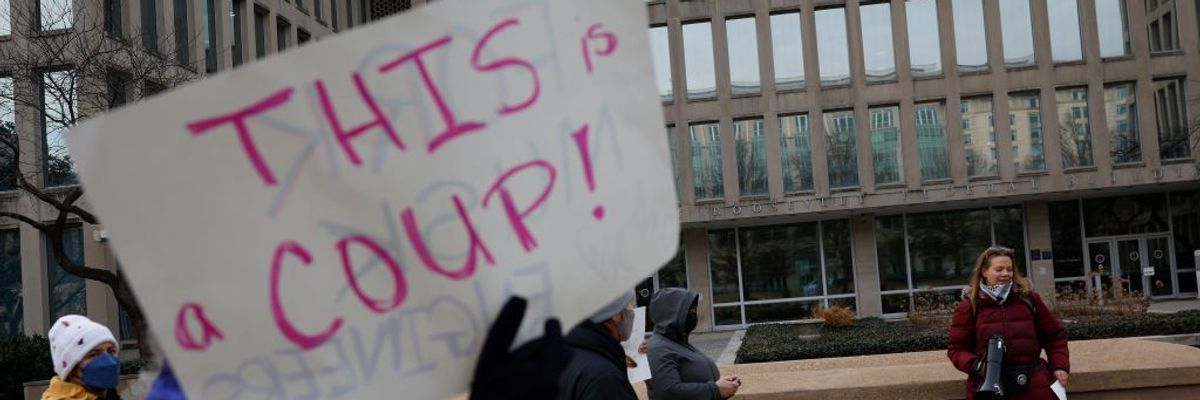
Employees and supporters protest outside the United States Agency for International Development headquarters in Washington, D.C. on February 3, 2025, after Elon Musk posted on social media that he and President Donald Trump would shut down USAID.
(Photo: Bill Clark/CQ-Roll Call, Inc. via Getty Images)


Jessica Corbett
Feb 04, 2025
COMMON DREAMS

Self-described " free speech absolutist" Elon Musk—the billionaire leading U.S. President Donald Trump's new Department of Government Efficiency—claimed this week that revealing the names of people working for DOGE is somehow illegal, provoking swift backlash from journalists and experts.

Responding to Musk's Tuesday morning post on X, the social media platform the billionaire bought in 2022, Washington Post reporter Jeff Stein challenged the claim that identifying individuals working for the government is unlawful and highlighted his hypocrisy.

"It's illegal to publish the names of government workers?" Stein wrote in part. "What???"


Trump announced DOGE and its leadership shortly after he won the November election, boosted by over a quarter-billion dollars from Musk, the richest person on Earth. After the president returned to the White House for a second term last month, the Musk-led presidential advisory commission quickly got to work on its agenda of cutting spending and regulations, amid a flurry of lawsuits.

The legal battles continue. On Monday, the Alliance for Retired Americans, the American Federation of Government Employees, and the Service Employees International Union sued to revoke Musk and DOGE's access to a key government payment system, provided by Trump's treasury secretary. Wiredreported Tuesday that two federal employees "are seeking a temporary restraining order as part of a class action lawsuit accusing a group of Elon Musk's associates of allegedly operating an illegally connected server from the fifth floor of the U.S. Office of Personnel Management's (OPM) headquarters."

Wired on Sunday also "identified six young men—all apparently between the ages of 19 and 24, according to public databases, their online presences, and other records—who have little to no government experience and are now playing critical roles" in DOGE. The reporting named the following individuals: Akash Bobba, Edward Coristine, Luke Farritor, Gautier Cole Killian, Gavin Kliger, and Ethan Shaotran.

"The six men are one part of the broader project of Musk allies assuming key government positions," the outlet continued, explaining that "Musk's lackeys—including more senior staff from xAI, Tesla, and the Boring Company—have taken control of" the General Services Administration (GSA), OPM, and the Treasury payment system.

After a now-suspended X user shared those six names on the platform—describing them as "techies on the ground helping Musk gaining and using access to the U.S. Treasury payment system," and suggesting that fired FBI agents may want to "dox them and maybe pay them a visit"—Musk responded early Monday, saying, "You have committed a crime."

Cliff Lampe, professor of information and associate dean for the School of Information at the University of Michigan, toldForbes on Tuesday that "doxxing has a broad definition, but is typically described as releasing private details about an individual into the public, specifically with the purpose of harming that person, where harm can range from embarrassment to promoting violent action against the individual."

"Typically, government employees have less privacy protections than do private citizens. Listing individuals who are working on behalf of the government would not fall into previous definitions of doxxing, though of course definitions can always change over time," Lampe said. "Whether doxxing is a crime has traditionally been related to the type of information that has been released and how that information was acquired."

Late Monday morning, Ed Martin, U.S. attorney in the District of Columbia, posted on X a letter to Musk that says in part: "I ask that you utilize me and my staff to assist in protecting the DOGE work and the DOGE workers. Any threats, confrontations, or other actions in any way that impact their work may break numerous laws."


Forbes noted that one legal expert said he couldn't understand "what on Earth Musk or the U.S. attorney" thinks was violated.

Less than 10 minutes after Martin's post, Musk said on X Monday morning: "Time to confess: Media reports saying that DOGE has some of world's best software engineers are in fact true."

However, as the Daily Beastdetailed Monday, "he was wrong—not all the group are even 'software engineers.' Three do not even have degrees. And one who does is trying to cash in on his new job by charging people to read his Substack entry which boasts, 'Why DOGE: Why I gave up a seven-figure salary to save America.'"

In a Monday evening statement on the official X account for Martin's office, the U.S. attorney signaled that legal action may be coming.

"Our initial review of the evidence presented to us indicates that certain individuals and/or groups have committed acts that appear to violate the law in targeting DOGE employees," Martin said. "We are in contact with the FBI and other law enforcement partners to proceed rapidly. We also have our prosecutors preparing."

Musk then returned to his claim of illegal behavior. After businessman and software engineer Marc Andreessen said on X late Monday, "I'm so old, I remember when doxxing and threatening federal employees was considered bad," the DOGE leader replied Tuesday, "It is against the law."

Stein wasn't alone in calling out Musk's Tuesday morning post. White House speechwriter-turned-podcaster Jon Favreau said: "Threatening anyone: very bad, possibly against the law depending on the threat. Knowing the names of the people who work for us, the American taxpayers, is an entirely legal and appropriate expectation. This isn't one of your companies. This is our government. Understand?"

Chris Anderson, chair of the Democratic Party in Ohio's Mahoning County, responded: "Imagine being in charge of auditing the government and knowing so little about the government that you don't know that salaries of federal employees, what department they work for, and yes, their names, are all public record. And not only that, THERE'S AN ENTIRE WEBSITE FOR IT."

In fact, there are multiple: the Library of Congress has a webpage that details sources for federal employee data and there are some nongovernment sites that compile it, such as FederalPay.org, GovSalaries.com, and OpenPayrolls.com.
DOGE's Tentacles Aim to Squeeze Department of Education


"They want to destroy public education," wrote one observer.


Eloise Goldsmith
Feb 04, 2025
COMMON DREAMS


The U.S. Department of Education is reportedly the next agency in the crosshairs of the so-called Department of Government Efficiency, an Elon Musk-led White House team tasked with slashing government regulation and spending.

Roughly 20 people with DOGE are working inside the Department of Education with the aim of cutting spending and staff, The Washington Postreported Monday, citing three unnamed sources familiar with the situation and records the outlet obtained. The Wall Street Journal also reported that representatives from DOGE are working out of the Department of Education building, and sources told the outlet that DOGE is eyeing the agency as a target for its efforts to slash bureaucracy.

But in the long term, the Trump administration has even more drastic plans for the department that was established by Congress back in 1979. Both papers report that the administration is prepping an executive order aimed at dismantling the agency entirely.

According to the Journal, officials are discussing the an executive order that "would shut down all functions of the agency that aren't written explicitly into statute or move certain functions to other departments" and would also "call for developing a legislative proposal to abolish the department," according to people familiar with the matter. Timing and specifics are still being hammered out.

Because the agency was created by Congress, it therefore can only be fully eliminated by Congress, according to the Post.

Musk on Monday night wrote on his platform X that U.S. President Donald Trump's efforts to fully dismantle the Department of Education "will succeed." Trump pledged to get rid of the Department of Education on the campaign trail and the priority was also listed among the Heritage Foundation's "Project 2025" policy proposals.

"They want to destroy public education," wrote Alejandra Caraballo, an instructor at Harvard Law School Cyberlaw Clinic, in response to the Post's reporting.

Since Trump's inauguration, Musk and his lieutenants at DOGE have moved swiftly to gain influence over multiple government agencies. Last week, DOGE fired officials at the U.S. Agency for International Development and earlier this week Musk said he intended to shut it down completely. Secretary of State Marco Rubio said Monday that he's now in control of the agency.

DOGE representatives were also given access to a Treasury Department payment system that processes trillions of dollars worth of financial transactions and holds personal financial data on millions of Americans. Two unions and an advocacy group sued Treasury Secretary Scott Bessent and the Treasury Department in federal court Monday for giving DOGE access to the system, citing privacy concerns.


Federal Workers Sue Over Musk-Led 'Exfiltration' of Data Using Illegal Server

"Millions of Americans and the collective interests of the United States desperately need emergency intervention from the courts," said a supporter of the new lawsuit. "The constitutional crisis is already here."


Protesters gather outside of the headquarters of the U.S. Office of Personnel Management on February 3, 2025 in Washington, D.C.
(Photo: Kevin Dietsch/Getty Images)

Jake Johnson
Feb 04, 2025
COMMON DREAMS

A pair of unnamed federal employees filed a lawsuit on Tuesday seeking to stop lackeys of billionaire Elon Musk from using an illegally connected server to "ingest and store vast quantities" of highly sensitive personal information about government workers and contractors.

The complaint and request for a temporary restraining order, first reported by Wired, was filed with the U.S. District Court for the District of Columbia, and it marks the latest in a flurry of high-stakes legal actions aimed at countering Musk's lawless and hostile takeover of key federal agencies and operations.

The new lawsuit was filed against the Office of Personnel Management (OPM), an obscure but important agency that has effectively been seized by Musk associates.


"At some point after 20 January 2025," the complaint states, "OPM allowed unknown individuals to simply bypass its existing systems and security protocols and install one or more new systems to ingest and store vast quantities of [personally identifiable information] about Executive Branch employees (as well as an unknown number of contractors and Judicial Branch employees) for the stated purpose of being able to communicate directly with those individuals without involving other agencies."

"In installing these systems, OPM ignored entirely the rules Congress established in the E-Government Act of 2002 which would safeguard the personal data being transferred into and stored by these systems," the lawsuit continues. "In utilizing these systems to send numerous email messages to individuals across the Executive Branch and beyond, and then insisting that Executive Branch employees must reply by email to the same systems, OPM further exacerbated the situation."

"We are witnessing an unprecedented exfiltration and seizure of the most sensitive kinds of information by unelected, unvetted people with no experience, responsibility, or right to it."

The complaint points to reporting from Caleb Ecarma and Judd Legum, who wrote Tuesday that "a new server being used to control [government databases] has been placed in a conference room" at OPM "that Musk's team is using as their command center."

An anonymous OPM worker described the server as "a piece of commercial hardware they believed was not obtained through the proper federal procurement process," Ecarma and Legum reported.

According toReuters, "some senior career employees at OPM have had their access revoked to some of the department's data systems" including "a vast database called Enterprise Human Resources Integration, which contains dates of birth, Social Security numbers, appraisals, home addresses, pay grades and length of service of government workers."

Sean Vitka, policy director at the Demand Progress Action Fund—an advocacy group that's supporting the new lawsuit—said in a statement Tuesday that "Elon Musk and his team's incompetent and rapid efforts are putting millions of Americans in danger."

"We are witnessing an unprecedented exfiltration and seizure of the most sensitive kinds of information by unelected, unvetted people with no experience, responsibility, or right to it—all orchestrated by the richest man in the world, with billions on the line in other countries, including ones that have recently hacked exactly this kind of sensitive data," said Vitka. "Millions of Americans and the collective interests of the United States desperately need emergency intervention from the courts. The constitutional crisis is already here."

As the two federal employees brought their lawsuit, top Democrats on the House Oversight Committee demanded answers about the "server of unknown nature and origin" that was reportedly installed on OPM premises by Musk associates.

In a letter to Acting OPM Director Charles Ezell, Reps. Gerry Connolly (D-Va.) and Shontel Brown (D-Ohio) demanded the names of "the individuals who installed and/or accessed the equipment" and information on "whether they were OPM employees at the time of their installation/access of the equipment."

"At best, the Trump administration's actions at OPM to date demonstrate gross negligence, severe incompetence, and a chaotic disregard for the security of our government data and the countless services it enables our agencies to provide to the public," Connolly and Brown wrote. "At worst, we fear that Trump administration officials know full well that their actions threaten to break our government."


Does Trump Really Want to Cap Credit Card Rates at 10%? Bernie Sanders Aims to Find Out

"When large financial institutions charge over 25% interest on credit cards, they are not engaged in the business of making credit available," said Sen. Bernie Sanders. "They are engaged in extortion and loan sharking."


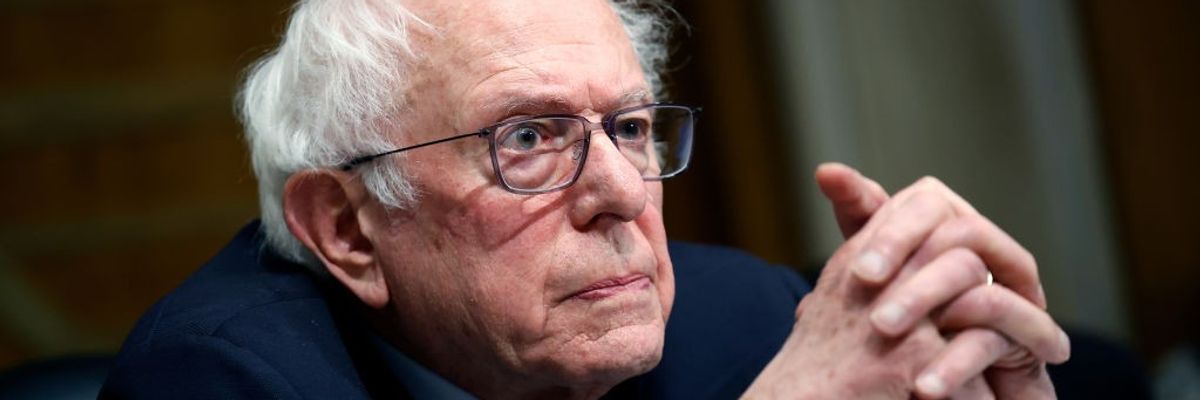
U.S. Sen. Bernie Sanders (I-Vt.) looks on during a Senate hearing on January 30, 2025 in Washington, D.C.
(Photo: Kevin Dietsch/Getty Images)

Jake Johnson
Feb 04, 2025
COMMON DREAMS

In an effort to hold U.S. President Donald Trump to a promise he made on the campaign trail, Sen. Bernie Sanders on Tuesday introduced legislation alongside Republican Sen. Josh Hawley that would cap credit card interest rates at 10% for five years, targeting a major cash cow for Visa, Mastercard, and other corporate giants.

"During the campaign, President Trump pledged to cap credit card interest rates at 10%," Sanders (I-Vt.) said in a statement Tuesday. "I am proud to be introducing bipartisan legislation with Senator Hawley to do just that. When large financial institutions charge over 25% interest on credit cards, they are not engaged in the business of making credit available. They are engaged in extortion and loan sharking."

"We cannot continue to allow big banks to make huge profits ripping off the American people," the Vermont senator added. "This legislation will provide working families struggling to pay their bills with desperately needed financial relief."

During his 2024 White House bid, Trump said he would support a "temporary cap" on credit card interest rates "at around 10%," declaring, "We can't let them make 25% and 30%."

One recent estimate put the average credit card interest rate in the U.S. at close to 27%, and an analysis released last year by the Consumer Financial Protection Bureau (CFPB) found that credit card interest rates have surged over the past decade—a boon for card issuers and a disaster for Americans falling deeper into debt.

"Working Americans are drowning in record credit card debt while the biggest credit card issuers get richer and richer by hiking their interest rates to the moon. It's not just wrong, it's exploitative. And it needs to end," Hawley (R-Mo.) said Tuesday. "Capping credit card interest rates at 10%, just like President Trump campaigned on, is a simple way to provide meaningful relief to working people. Let's do it."


It's not clear whether Sanders and Hawley's bill stands a chance in a Congress fully controlled by Republicans, many of whom have shown a willingness to play defense for the predatory banks and credit card firms that help fund their campaigns.

The Trump White House did not respond to media requests for comment on whether the administration would throw its support behind the Sanders-Hawley proposal, which is sure to face Wall Street opposition.

During a Senate confirmation hearing last month, Sanders asked billionaire U.S. Treasury Secretary Scott Bessent whether he supports Trump's call for a 10% cap on credit card interest rates.

Bessent replied that he would "follow what President Trump wants to do" on the issue.

During Trump's first term in the White House, Sanders and Rep. Alexandria Ocasio-Cortez (D-N.Y.) introduced legislation that would have capped credit card interest rates at 15%.

Just nine Democrats in the House and one in the Senate co-sponsored the bill, which received zero Republican support.
State Farm Accused of Trying to 'Cash in on a Terrible Tragedy' With $740 Million 'Bailout'

The head of Consumer Watchdog argued the company is "detouring the rules that protect state consumers from insurance price gouging."


A State Farm insurance company sign sits amid the rubble of a building destroyed by the Palisades Fire on Sunset Boulevard in the Pacific Palisades neighborhood of Los Angeles on January 16, 2025.
(Photo: Frederic J. Brown / AFP)

Eloise Goldsmith
Feb 04, 2025
COMMON DREAMS

The insurance giant State Farm on Monday asked California state insurance regulators to approve an emergency interim rate hike of 22%, drawing pushback from the nonprofit Consumer Watchdog, which accused the company of not providing the financial data necessary to justify the increase.

"State Farm wants to fill its bank accounts on the backs of California homeowners, some of whose homes are in ashes," said Carmen Balber, Consumer Watchdog's executive director. "Insurance Commissioner [Ricardo] Lara must require State Farm to prove it needs this staggering increase."

Devastating wildfires ravaged the Los Angeles area starting in early January, compounding an already escalating insurance crisis in the state and causing between $35 to $45 billion in insured property losses, according to one estimate. The fires, which are now either out or fully contained, generated over 8,700 claims for State Farm General, the California homeowners insurance affiliate of the firm State Farm Mutual Automobile Insurance Company. The compnay said it has paid over a billion to customers due to the blazes.

State Farm General is the largest insurance group in the state. The firm stopped writing any new policies in May 2023, and last spring the company announced it would not renew plans for tens of thousands of homeowners—though it has said it will renew policies for those impacted by the recent fires in Los Angeles County.

In a letter to the California Department of Insurance, leaders at State Farms General requested that the department take "emergency action to help protect California's fragile insurance market," by allowing interim rate increases of 22% for homeowners, 15% for renters, 15% for condo owners, and 38% for rental dwellings.

"State Farm General's rate filings raise serious questions about its financial condition," department spokesman Gabriel Sanchez said, according to the outlet Insurance Business.

Proposition 103, a measure passed in 1988 which sought to protect consumers from arbitrary insurance rate hikes, requires insurance companies to back up their rate applications with "comprehensive data," according to the California's insurance commissioner.

Consumer Watchdog said that State Farm General is asking for an increase on an interim basis, meaning "without having to prove that it needs that increase, or the impact higher premiums will have on the ability of consumers to afford coverage."

The letter from State Farm General to the department includes an "illustration of State Farm General financial deterioration" as an attachment.

According to Consumer Watchdog, the requested 22% hike on home insurance rates amounts to $740 million a year for the company. The group has called the request a "bailout."

The request comes after State Farm General last summer asked for a 30% rate increase for its homeowners, a 52% rate increase for renters, and a 36% rate increase for condominium owners. In December 2023 it was approved for a 20% increase for homeowners and condominium owners.

The insurance company is "trying to cash in on a terrible tragedy by detouring the rules that protect state consumers from insurance price gouging—at a time when those safeguards are more important than ever," said Balber.