Truth of War, War for Truth
Nicolas Tenzer
Feb 23, 2025
LONG READ
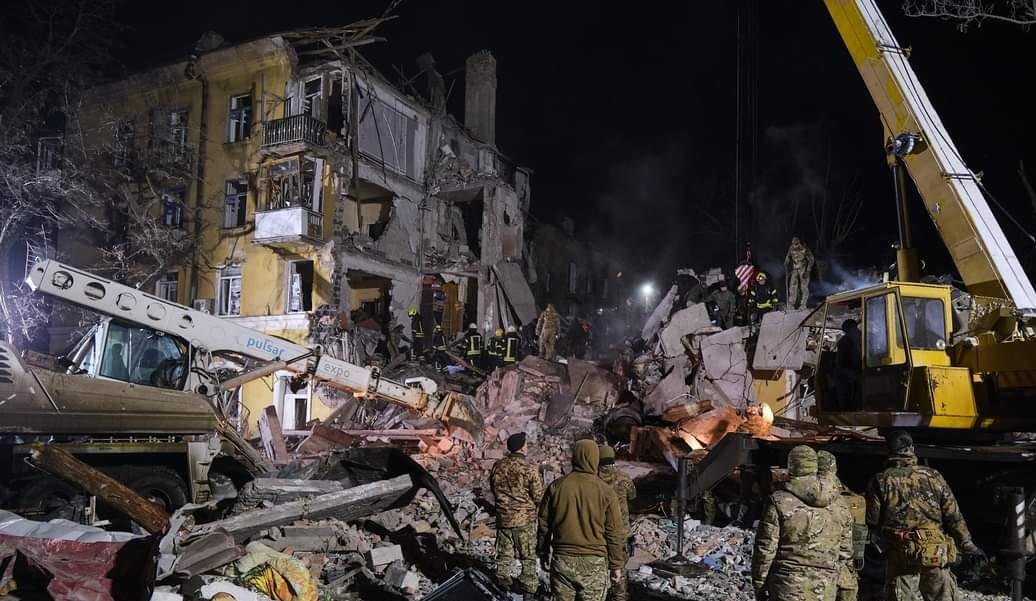
Residential building in Kramatorsk (Donetsk region of Ukraine) after Russian strike with Iskander-K missile on February 1, 2023 at 21:45. Source: State Emergency Service of Ukraine, February 2, 2023.
It has become a commonplace in recent weeks: Europe is facing an unprecedented security risk. Admittedly, the abandonment of Europe by the United States seemed to be taking shape for several years, but for the first time Washington is turning against it, in an unprecedented and, for a long time, unimaginable reversal of alliances. Beyond any other element of possible compromise, there is an ideological collusion of Trump with Russia that I had already pointed out before he was officially inaugurated for a second time. His words since then lead to the conclusion of what I had called the end, for a period of time that I cannot predict, of transatlanticism. In concrete terms, I do not see how NATO could resist the new American administration: it may survive institutionally; it is doubtful that it will survive operationally.
Let’s not be blind: the world is subject to forces of brutal destruction of the principles and values that had, somehow, structured the post-war world. It was far from perfect and had left its long litany of crimes and horrors. But at least what was once called the “free world”, despite its own renunciations, still had these principles to respect. An area, such as Europe, but also other peoples on other continents, had set about building spaces of freedom and law. They are increasingly threatened and risk becoming increasingly narrow. These ideologies of destruction and hatred have now gained a foothold in America, but also among certain crowds within the European continent. In his last text of 1942, entitled “Hartrott and Hitler”, shortly before his suicide, speaking of the contamination of Nazi ideology, Stefan Zweig wrote: “What was once the diabolical dream of a few isolated individuals has become the aspiration of millions of people—and the greatest danger threatening the world”. Perhaps we have returned to that point.
Europe, with its allies and partners in Asia, Africa and America, sharing the same fundamental rules, has as its primary mission to defend the law, in particular international law, which is, ultimately, the first guarantee for its own security. Some analysts in a hurry to analyze international relations had rejected it from the analysis of threats as well as remedies and obligations. Today, it appears more clearly as not only a weapon to oppose the claims of domination of one state over another, but also as a necessary reminder to public opinion which, in the shifting of all reference points, needs stable reference points. What I called a new kind of Kulturkampf has the law at its center: revisionist forces, from Putin to Trump, have made it their primary target, both domestically and internationally. In a way, they have made the judicious choice of tool to use in their ideological struggle, the first of which involves mass crimes of incredible intensity: delegitimizing the law and turning it into an empty shell is the precursor to a murderous attack on the very idea of humanity.
If this reminder was essential, it is also because it guides what Europeans must do, first of all to counter the Russian war against Ukraine and allow its total liberation—because there can be no half-measures—from the criminal yoke of Moscow. In view of Trump’s desire to sacrifice Ukraine, which he considers to be non-existent, going so far as to use the well-known lies about Russian aggression through his very Russian reversals of reality, this is where the Europeans must act urgently. They must certainly first do so in concrete terms by decisively arming Kyiv so that it can repel the Russian aggressor, but also by constructing a predictive narrative about Ukraine’s victory. Europeans cannot follow in Trump’s footsteps and act in reaction, but must impose their own agenda, whatever that of the White House boss may be.
A narrative for victory
On the one hand, it is now certain that most European heads of state and government understand that American betrayal could have devastating consequences for Europe and deal a fatal blow to its security. They understand, more precisely, the effect that Trump’s attempted preparation for Ukraine’s defeat at the hands of Russia would have. They seem, beyond their dangerously persistent disagreements on the financing of the war effort, the modalities of troop deployment or the seizure of frozen Russian assets, to have integrated into their reasoning the reality of the Russian threat, if not, no doubt, having completely grasped the nature of the regime and, for some, taken the measure of the totality of its ideology of destruction.
On the other hand, since well before Trump in fact, some Europeans were already beginning, like the Biden administration, to talk about possible peace talks, even negotiations—certainly on the terms set by the Ukrainians and when it wanted. They were already saying, in veiled terms, in discussions that I sometimes had first-hand knowledge of, that Ukraine would have to agree to “make concessions”, i.e. give up some of the territories occupied by the Russians. Some thus claimed that Kyiv would never have the means to retake the lost territories—a statement held with a certain indecency by those who refused to give it all the means necessary to do so.
Admittedly, Trump is pursuing this path in an infinitely more brutal way than Joe Biden and the Europeans would have done, accompanying this gesture of capitulation with infamous remarks about Ukraine and a proposed deal on rare earths that would despoil the country. Biden and the Europeans would, despite everything, have tried to preserve the essential, while Trump is ready to sell everything off, without compensation, and would not be opposed, or even worse, to the replacement of President Zelensky by a new sort of Yanukovych. There is therefore a difference in nature between the likely cowardice of a Biden and several European heads of state and government and the pure and simple betrayal that Trump is carrying out. Nothing is more astonishing in this respect, although not surprising, than the whitewashing he is about to carry out of Putin’s war crimes, crimes against humanity and genocide. Similarly, he refuses to denounce or even identify Russian aggression. Neither the law nor the truth matter to him—they are even regularly targeted as adversaries and principles to be defeated. He is even prepared, by lifting sanctions and concluding contracts with Russia, to revive the Russian economy and thereby possibly encourage the Russian defense industry. Russia could lose the war in two or three years. Trump would save it. There is no need to imagine what Putin would do with this windfall in a few years' time: re-attack Ukraine, which he has not given up on, and go further in his aggression towards European countries that are members of a now ghostly NATO.
But it is precisely because Trump is pushing to the extreme what some would have resigned themselves to doing that he must be resisted. Europeans will have to be careful not to fall for Trump’s story-line and the trap of the process he has set in motion. In other words, they must keep control of the agenda, which means rejecting Washington's. It is particularly crucial not to repeat his story of “peace talks”, as this would already be giving in to Putin. In other words, we must refuse to endorse this very phase of discussions between Trump and Putin. It will have to be declared null and void. Moreover, the fact of not having been involved should not be regretted by the Europeans or even by Ukraine. It is even rather fortunate, because it allows the Europeans to distance themselves from it and to remain entirely on Ukraine’s side. In short, Europe must now adopt a narrative of victory. Until now, its leaders, with the exception of some of those in Central and Eastern Europe, had not formulated it as such. It is their duty now more than ever.
Some tell me that such a narrative is not enough. This is certainly true, but without it, in other words without setting the total victory of Ukraine as an objective, it is impossible to put in place a strategy and policies that will lead to it. This is what the United States and Europe have done so far, always stopping halfway, and not providing Kyiv with all the weapons necessary to win the war, not to mention direct military action on their part, as I have been calling for from the start. A narrative is not an ineffective fable or a kind of wishful thinking. It is the basis of any consistent and resolute action.
In the present circumstances as much as yesterday, such a narrative presupposes silencing allusions to “peace talks”, a fortiori to negotiations. It must be repeated: there can be no negotiations with Russia until it is defeated. Any form of peace agreement, especially one à la Trump, would not only herald the destruction of Ukraine and war in Europe, but also mean giving up the prosecution of criminals, the return of deported children and Ukrainian prisoners of war, and the payment of war reparations. Negotiating with Putin means giving him immunity after he is indicted for war crimes by the International Criminal Court; it also means depriving Ukraine of a victory, almost definitively; it is, in short, a violation of international law.
Act for Ukraine, immediately
After three years of total war and eleven years of Russian war against Ukraine, there is no need to emphasize the urgency of decisive action. Over the past three years, I have regularly pointed out the immense and irreparable guilt of the so-called free world for not having put all its resources into the battle. Russia could have been defeated by now if we had wanted it to be, and the Allies could have saved tens of thousands of Ukrainian lives. The reality is that they did not want it to happen. I will not dwell here again on this necessary blame and will leave it to the historians. The alliance reversal initiated by Trump will at least have to result in decisive action by the Europeans. They have the means. After all, contrary to the false allegations of the Mar-a-Lago resident, Europe has already provided more weapons and humanitarian and financial assistance to Ukraine than the United States. Now that the latter has, in fact, become a hostile power, it will have to make do.
Emmanuel Macron recently began preparing public opinion in a chat with internet users, considering at least doubling France’s military spending at a forced pace. This is also what the Prime Minister of Denmark, Mette Frederiksen, has undertaken by announcing a transition to a war economy. Such an effort has also been undertaken by the Baltic States and Poland. The others European countries should follow suit and this will be the priority task of the new German government. They should not stop there, even if some, including the United Kingdom, still seem hesitant in announcing their future efforts.
This effort has two objectives.
On the one hand, European countries will have to strengthen their arms industry and accelerate their production in an unprecedented way, mobilizing all their resources to do so, including civilian industries as required by any war economy. Several countries already have legal provisions that allow them to requisition these. This makes it essential to have adjusted and permanent communication on the direct threat, in its multiple components, posed by Russia. This communication has been delayed for too long, with some still claiming until recently that we were not at war with Russia. This effort, it must be reiterated, does not involve the military mobilization of all groups below a certain age, as the Moscow relays in Europe say, in order to panic the population and turn them against their governments, but a form of civilian mobilization and awareness raising.
On the other hand, this considerable war effort since the end of the Second World War, which will even be more important in the long term than during the Cold War, will have to be largely directed towards Ukraine. It is first and foremost Ukraine, which is fighting to protect Europe, that should be the first to benefit from this additional effort. This means that it will be necessary to give it not only the means to resist Russian aggression and protect the civilian population, but also to repel the enemy and strike blows on Russian territory. This is also why it is necessary to define a strategy for victory.
The renewed debate on sending allied troops to Ukraine—a position that I have defended from the start—takes place in this context, but it can also lead to confusion. Until now, without going over all the possible scenarios I had mentioned after the public debate was initiated by Emmanuel Macron on February 26, 2024, the presence of European armed forces on Ukrainian soil had been envisaged independently of any peace agreement.
These troops could have a mission of training, more direct assistance to operations, or even a more or less open engagement; they were also largely to fulfill a deterrent function since it was very likely that Moscow would not take the risk of launching strikes that might hit soldiers from NATO member countries. They were certainly not combat forces, at least not directly, intended to fight the enemy alongside Ukrainian forces.
Nor, in the minds of those who came up with the idea, were they peacekeeping forces, intervening forces or garrison troops destined to remain there on a long-term basis after the end of the war. In short, sending troops, as had been suggested, was a way of helping Ukraine win the war, not a way of guaranteeing its future security. In this spirit, once Ukraine was victorious and had joined NATO, it could certainly welcome troops from certain member countries, but, on the one hand, this was not a priori mentioned, and on the other hand, the proposals at the time did not aim for that time frame, but were much more immediate.
I still think that this was the right approach and that it is still possible to defend it now.
The current perspective is quite different: it is a question of the possible sending of troops to guarantee the application of a possible ceasefire, or even a peace agreement, negotiated by Putin and Trump and to which, if necessary, the Ukrainians and the Europeans would have given their approval. This does indeed look like a possible trap.
Firstly, it would require Ukrainians and Europeans to accept such a situation, which today seems highly risky, as I pointed out above.
Secondly—which would be most unacceptable in my view and in that of a probable majority of Ukrainians—it would require us to accept Russia’s de facto confiscation of part of Ukraine’s sovereign territory. It is all very well to proclaim that this does not amount to recognition of the legality of their occupation by the Russians, but it could turn into an unacceptable fait accompli.
Finally, from the point of view of the European countries concerned, it would mean that a substantial part of their troops would be “frozen” for an indefinite period of time for tasks of protecting the territory of Ukraine and not directly for their own defense. This may be conceivable for conventional peacekeeping operations in limited territories for a fixed period and with reduced troops, but not for such a mission in a large territory with necessarily substantial forces.
It is certainly understandable that, in the nauseating scenario in which Ukraine is forced to cede part of its territory, these security guarantees provided by NATO troops in Ukraine would be a kind of minimum requirement. However, it is not a preferred solution and we must avoid giving it too much credit for fear of becoming accustomed to it. This would be to the detriment of the victory scenario, the only one legally and from a security point of view acceptable for the whole of Europe—regardless of any considerations of morality. For the time being, however, Europeans are divided, even if—which is already a positive step in itself—more and more countries are accepting it. Some are talking about troops to be amassed along the border. Others talk about armed forces inside the country. It is not certain that, at this stage, European countries have enough soldiers to guard the border, nor that this would be the most effective solution. Troops inside Ukraine itself, with forces capable of reaching distant targets and, above all, deterring attacks on civilians, might be more effective.
But other questions arise. Some countries seem to be demanding a kind of backstop provided by the United States, something that Pete Hegseth’s speech of February 12, 2025, seems to have ruled out. At this stage, no one has raised the issue of the weapons that these troops should be equipped with, let alone the common doctrine in case of an attack by Russia. Some also mention the need for a European army, which I think pollutes the debate, because such an army could not see the light of day for at least a decade in operational terms, not to mention the problems of decision-making and commitment.
The risk is, in fact, to evoke scenarios that are necessary in the worst-case scenario, but which are hardly really satisfactory for the security of Ukraine and Europe—they could be highly dangerous.
Don’t give substance to defeatist discourse
The new Washington-Moscow axis is certainly the primary risk in itself—it could in fact be an axis to which China would be added. I do not see any credible counterweight within the United States on the horizon today. Everything will ultimately rest on Europe and a few other powers such as Japan, Canada, South Korea and Taiwan, perhaps a few countries in Africa and Asia that will see in this triad the completed figure of contemporary imperialism.
But there is a more insidious risk that Russian propaganda has been playing on within democracies for several times now, if not for over a year: defeatism. It is increasingly invading the minds of the masses, who are always inclined to lean towards fatalism. The rhetoric of Moscow’s relays knows how to use it easily. “Ukraine has lost the war” or “Ukraine will never be able to reconquer the lost territories” are fabricated stories, sometimes innocently repeated, which pervert even the souls of the leaders. It can also win over the minds of Ukrainians exhausted by war and unspeakable suffering, who have experienced loneliness and abandonment by Westerners from the start.
Trump’s rise to power and his bromance with Putin, accompanied by the assiduous repetition of Russian propaganda narratives, have further increased this defeatism. Even the discourse, sometimes heard in Western capitals, according to which a possible Putin-Trump agreement should be taken as a starting point, even if it is not accepted, increases this fatalism.
Little by little, the discourse on inevitable concessions takes hold in the minds of leaders, or rather it resurfaces with even more force. Perhaps, in many cases, it had never disappeared—and it certainly animated the main advisers of the Biden administration, with the exception of Antony Blinken. Trump certainly radicalizes this discourse by agreeing to give in completely. But among European leaders, it is making a comeback even though they know they cannot accept to give in completely as Trump wants.
Why is this narrative so dangerous? Above all because it reflects a fundamental misunderstanding of the reality of the Russian war and the security issues it raises. Everyone can see that giving in to Putin in the Trump way would drag not only Ukraine but also the European continent into the abyss. Everyone also logically understands the virtuous effects for the whole of Europe and the rest of the world of a Russian defeat—I have already written several articles on this. However, many do not realize that a semi-defeat for Russia, which would still be a form of victory for it, which would see Ukraine re-established in 80% of its territory, even with security guarantees, would logically lead to its future defeat and, even more so, that of Europe and its legitimacy. Putin would be able to sell to his friends, his clients and the countries still undecided the fact that the West has finally given in on the essential: the law. It would indeed have abandoned territories conquered by force. Furthermore, it would have accepted that the most serious crimes not only go unpunished, but can continue, in Ukrainian territories, with complete impunity.
Defeatism is not just a state of mind, a pessimistic tendency of the soul; it easily turns into a prophecy—that is to say, defeat. We must rationally counter its persistence and its invasion of our brains. When the truth of war is that it is a fight to the death, fighting for the truth also means banishing the very irrationality of defeatism.
Tenzer Strategics is a reader-supported publication. To support Nicolas’s work, please consider becoming a full-fledged subscriber, and you will have access to the entire archive
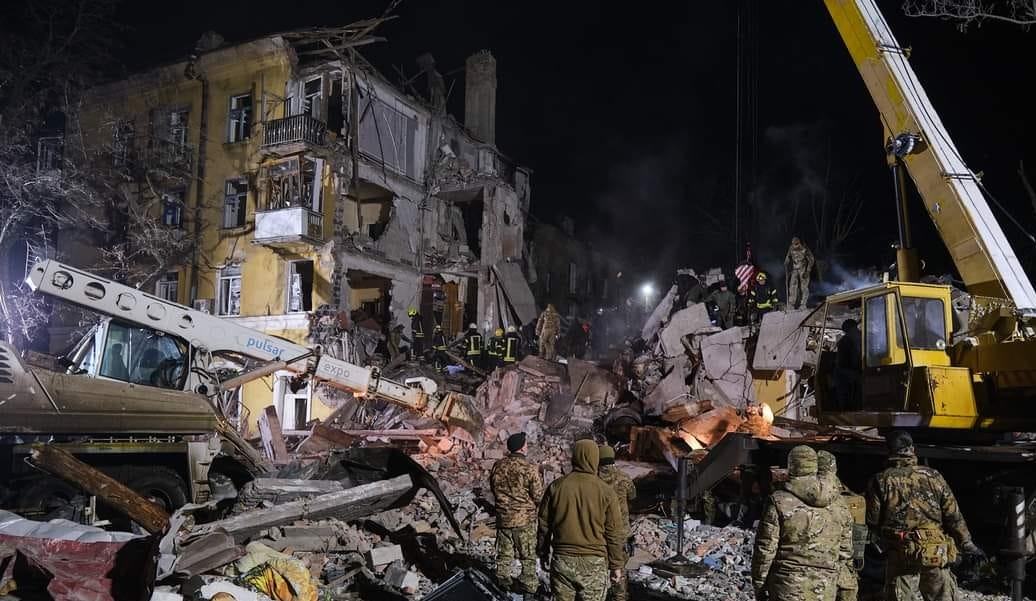
Residential building in Kramatorsk (Donetsk region of Ukraine) after Russian strike with Iskander-K missile on February 1, 2023 at 21:45. Source: State Emergency Service of Ukraine, February 2, 2023.
It has become a commonplace in recent weeks: Europe is facing an unprecedented security risk. Admittedly, the abandonment of Europe by the United States seemed to be taking shape for several years, but for the first time Washington is turning against it, in an unprecedented and, for a long time, unimaginable reversal of alliances. Beyond any other element of possible compromise, there is an ideological collusion of Trump with Russia that I had already pointed out before he was officially inaugurated for a second time. His words since then lead to the conclusion of what I had called the end, for a period of time that I cannot predict, of transatlanticism. In concrete terms, I do not see how NATO could resist the new American administration: it may survive institutionally; it is doubtful that it will survive operationally.
Let’s not be blind: the world is subject to forces of brutal destruction of the principles and values that had, somehow, structured the post-war world. It was far from perfect and had left its long litany of crimes and horrors. But at least what was once called the “free world”, despite its own renunciations, still had these principles to respect. An area, such as Europe, but also other peoples on other continents, had set about building spaces of freedom and law. They are increasingly threatened and risk becoming increasingly narrow. These ideologies of destruction and hatred have now gained a foothold in America, but also among certain crowds within the European continent. In his last text of 1942, entitled “Hartrott and Hitler”, shortly before his suicide, speaking of the contamination of Nazi ideology, Stefan Zweig wrote: “What was once the diabolical dream of a few isolated individuals has become the aspiration of millions of people—and the greatest danger threatening the world”. Perhaps we have returned to that point.
Europe, with its allies and partners in Asia, Africa and America, sharing the same fundamental rules, has as its primary mission to defend the law, in particular international law, which is, ultimately, the first guarantee for its own security. Some analysts in a hurry to analyze international relations had rejected it from the analysis of threats as well as remedies and obligations. Today, it appears more clearly as not only a weapon to oppose the claims of domination of one state over another, but also as a necessary reminder to public opinion which, in the shifting of all reference points, needs stable reference points. What I called a new kind of Kulturkampf has the law at its center: revisionist forces, from Putin to Trump, have made it their primary target, both domestically and internationally. In a way, they have made the judicious choice of tool to use in their ideological struggle, the first of which involves mass crimes of incredible intensity: delegitimizing the law and turning it into an empty shell is the precursor to a murderous attack on the very idea of humanity.
If this reminder was essential, it is also because it guides what Europeans must do, first of all to counter the Russian war against Ukraine and allow its total liberation—because there can be no half-measures—from the criminal yoke of Moscow. In view of Trump’s desire to sacrifice Ukraine, which he considers to be non-existent, going so far as to use the well-known lies about Russian aggression through his very Russian reversals of reality, this is where the Europeans must act urgently. They must certainly first do so in concrete terms by decisively arming Kyiv so that it can repel the Russian aggressor, but also by constructing a predictive narrative about Ukraine’s victory. Europeans cannot follow in Trump’s footsteps and act in reaction, but must impose their own agenda, whatever that of the White House boss may be.
A narrative for victory
On the one hand, it is now certain that most European heads of state and government understand that American betrayal could have devastating consequences for Europe and deal a fatal blow to its security. They understand, more precisely, the effect that Trump’s attempted preparation for Ukraine’s defeat at the hands of Russia would have. They seem, beyond their dangerously persistent disagreements on the financing of the war effort, the modalities of troop deployment or the seizure of frozen Russian assets, to have integrated into their reasoning the reality of the Russian threat, if not, no doubt, having completely grasped the nature of the regime and, for some, taken the measure of the totality of its ideology of destruction.
On the other hand, since well before Trump in fact, some Europeans were already beginning, like the Biden administration, to talk about possible peace talks, even negotiations—certainly on the terms set by the Ukrainians and when it wanted. They were already saying, in veiled terms, in discussions that I sometimes had first-hand knowledge of, that Ukraine would have to agree to “make concessions”, i.e. give up some of the territories occupied by the Russians. Some thus claimed that Kyiv would never have the means to retake the lost territories—a statement held with a certain indecency by those who refused to give it all the means necessary to do so.
Admittedly, Trump is pursuing this path in an infinitely more brutal way than Joe Biden and the Europeans would have done, accompanying this gesture of capitulation with infamous remarks about Ukraine and a proposed deal on rare earths that would despoil the country. Biden and the Europeans would, despite everything, have tried to preserve the essential, while Trump is ready to sell everything off, without compensation, and would not be opposed, or even worse, to the replacement of President Zelensky by a new sort of Yanukovych. There is therefore a difference in nature between the likely cowardice of a Biden and several European heads of state and government and the pure and simple betrayal that Trump is carrying out. Nothing is more astonishing in this respect, although not surprising, than the whitewashing he is about to carry out of Putin’s war crimes, crimes against humanity and genocide. Similarly, he refuses to denounce or even identify Russian aggression. Neither the law nor the truth matter to him—they are even regularly targeted as adversaries and principles to be defeated. He is even prepared, by lifting sanctions and concluding contracts with Russia, to revive the Russian economy and thereby possibly encourage the Russian defense industry. Russia could lose the war in two or three years. Trump would save it. There is no need to imagine what Putin would do with this windfall in a few years' time: re-attack Ukraine, which he has not given up on, and go further in his aggression towards European countries that are members of a now ghostly NATO.
But it is precisely because Trump is pushing to the extreme what some would have resigned themselves to doing that he must be resisted. Europeans will have to be careful not to fall for Trump’s story-line and the trap of the process he has set in motion. In other words, they must keep control of the agenda, which means rejecting Washington's. It is particularly crucial not to repeat his story of “peace talks”, as this would already be giving in to Putin. In other words, we must refuse to endorse this very phase of discussions between Trump and Putin. It will have to be declared null and void. Moreover, the fact of not having been involved should not be regretted by the Europeans or even by Ukraine. It is even rather fortunate, because it allows the Europeans to distance themselves from it and to remain entirely on Ukraine’s side. In short, Europe must now adopt a narrative of victory. Until now, its leaders, with the exception of some of those in Central and Eastern Europe, had not formulated it as such. It is their duty now more than ever.
Some tell me that such a narrative is not enough. This is certainly true, but without it, in other words without setting the total victory of Ukraine as an objective, it is impossible to put in place a strategy and policies that will lead to it. This is what the United States and Europe have done so far, always stopping halfway, and not providing Kyiv with all the weapons necessary to win the war, not to mention direct military action on their part, as I have been calling for from the start. A narrative is not an ineffective fable or a kind of wishful thinking. It is the basis of any consistent and resolute action.
In the present circumstances as much as yesterday, such a narrative presupposes silencing allusions to “peace talks”, a fortiori to negotiations. It must be repeated: there can be no negotiations with Russia until it is defeated. Any form of peace agreement, especially one à la Trump, would not only herald the destruction of Ukraine and war in Europe, but also mean giving up the prosecution of criminals, the return of deported children and Ukrainian prisoners of war, and the payment of war reparations. Negotiating with Putin means giving him immunity after he is indicted for war crimes by the International Criminal Court; it also means depriving Ukraine of a victory, almost definitively; it is, in short, a violation of international law.
Act for Ukraine, immediately
After three years of total war and eleven years of Russian war against Ukraine, there is no need to emphasize the urgency of decisive action. Over the past three years, I have regularly pointed out the immense and irreparable guilt of the so-called free world for not having put all its resources into the battle. Russia could have been defeated by now if we had wanted it to be, and the Allies could have saved tens of thousands of Ukrainian lives. The reality is that they did not want it to happen. I will not dwell here again on this necessary blame and will leave it to the historians. The alliance reversal initiated by Trump will at least have to result in decisive action by the Europeans. They have the means. After all, contrary to the false allegations of the Mar-a-Lago resident, Europe has already provided more weapons and humanitarian and financial assistance to Ukraine than the United States. Now that the latter has, in fact, become a hostile power, it will have to make do.
Emmanuel Macron recently began preparing public opinion in a chat with internet users, considering at least doubling France’s military spending at a forced pace. This is also what the Prime Minister of Denmark, Mette Frederiksen, has undertaken by announcing a transition to a war economy. Such an effort has also been undertaken by the Baltic States and Poland. The others European countries should follow suit and this will be the priority task of the new German government. They should not stop there, even if some, including the United Kingdom, still seem hesitant in announcing their future efforts.
This effort has two objectives.
On the one hand, European countries will have to strengthen their arms industry and accelerate their production in an unprecedented way, mobilizing all their resources to do so, including civilian industries as required by any war economy. Several countries already have legal provisions that allow them to requisition these. This makes it essential to have adjusted and permanent communication on the direct threat, in its multiple components, posed by Russia. This communication has been delayed for too long, with some still claiming until recently that we were not at war with Russia. This effort, it must be reiterated, does not involve the military mobilization of all groups below a certain age, as the Moscow relays in Europe say, in order to panic the population and turn them against their governments, but a form of civilian mobilization and awareness raising.
On the other hand, this considerable war effort since the end of the Second World War, which will even be more important in the long term than during the Cold War, will have to be largely directed towards Ukraine. It is first and foremost Ukraine, which is fighting to protect Europe, that should be the first to benefit from this additional effort. This means that it will be necessary to give it not only the means to resist Russian aggression and protect the civilian population, but also to repel the enemy and strike blows on Russian territory. This is also why it is necessary to define a strategy for victory.
The renewed debate on sending allied troops to Ukraine—a position that I have defended from the start—takes place in this context, but it can also lead to confusion. Until now, without going over all the possible scenarios I had mentioned after the public debate was initiated by Emmanuel Macron on February 26, 2024, the presence of European armed forces on Ukrainian soil had been envisaged independently of any peace agreement.
These troops could have a mission of training, more direct assistance to operations, or even a more or less open engagement; they were also largely to fulfill a deterrent function since it was very likely that Moscow would not take the risk of launching strikes that might hit soldiers from NATO member countries. They were certainly not combat forces, at least not directly, intended to fight the enemy alongside Ukrainian forces.
Nor, in the minds of those who came up with the idea, were they peacekeeping forces, intervening forces or garrison troops destined to remain there on a long-term basis after the end of the war. In short, sending troops, as had been suggested, was a way of helping Ukraine win the war, not a way of guaranteeing its future security. In this spirit, once Ukraine was victorious and had joined NATO, it could certainly welcome troops from certain member countries, but, on the one hand, this was not a priori mentioned, and on the other hand, the proposals at the time did not aim for that time frame, but were much more immediate.
I still think that this was the right approach and that it is still possible to defend it now.
The current perspective is quite different: it is a question of the possible sending of troops to guarantee the application of a possible ceasefire, or even a peace agreement, negotiated by Putin and Trump and to which, if necessary, the Ukrainians and the Europeans would have given their approval. This does indeed look like a possible trap.
Firstly, it would require Ukrainians and Europeans to accept such a situation, which today seems highly risky, as I pointed out above.
Secondly—which would be most unacceptable in my view and in that of a probable majority of Ukrainians—it would require us to accept Russia’s de facto confiscation of part of Ukraine’s sovereign territory. It is all very well to proclaim that this does not amount to recognition of the legality of their occupation by the Russians, but it could turn into an unacceptable fait accompli.
Finally, from the point of view of the European countries concerned, it would mean that a substantial part of their troops would be “frozen” for an indefinite period of time for tasks of protecting the territory of Ukraine and not directly for their own defense. This may be conceivable for conventional peacekeeping operations in limited territories for a fixed period and with reduced troops, but not for such a mission in a large territory with necessarily substantial forces.
It is certainly understandable that, in the nauseating scenario in which Ukraine is forced to cede part of its territory, these security guarantees provided by NATO troops in Ukraine would be a kind of minimum requirement. However, it is not a preferred solution and we must avoid giving it too much credit for fear of becoming accustomed to it. This would be to the detriment of the victory scenario, the only one legally and from a security point of view acceptable for the whole of Europe—regardless of any considerations of morality. For the time being, however, Europeans are divided, even if—which is already a positive step in itself—more and more countries are accepting it. Some are talking about troops to be amassed along the border. Others talk about armed forces inside the country. It is not certain that, at this stage, European countries have enough soldiers to guard the border, nor that this would be the most effective solution. Troops inside Ukraine itself, with forces capable of reaching distant targets and, above all, deterring attacks on civilians, might be more effective.
But other questions arise. Some countries seem to be demanding a kind of backstop provided by the United States, something that Pete Hegseth’s speech of February 12, 2025, seems to have ruled out. At this stage, no one has raised the issue of the weapons that these troops should be equipped with, let alone the common doctrine in case of an attack by Russia. Some also mention the need for a European army, which I think pollutes the debate, because such an army could not see the light of day for at least a decade in operational terms, not to mention the problems of decision-making and commitment.
The risk is, in fact, to evoke scenarios that are necessary in the worst-case scenario, but which are hardly really satisfactory for the security of Ukraine and Europe—they could be highly dangerous.
Don’t give substance to defeatist discourse
The new Washington-Moscow axis is certainly the primary risk in itself—it could in fact be an axis to which China would be added. I do not see any credible counterweight within the United States on the horizon today. Everything will ultimately rest on Europe and a few other powers such as Japan, Canada, South Korea and Taiwan, perhaps a few countries in Africa and Asia that will see in this triad the completed figure of contemporary imperialism.
But there is a more insidious risk that Russian propaganda has been playing on within democracies for several times now, if not for over a year: defeatism. It is increasingly invading the minds of the masses, who are always inclined to lean towards fatalism. The rhetoric of Moscow’s relays knows how to use it easily. “Ukraine has lost the war” or “Ukraine will never be able to reconquer the lost territories” are fabricated stories, sometimes innocently repeated, which pervert even the souls of the leaders. It can also win over the minds of Ukrainians exhausted by war and unspeakable suffering, who have experienced loneliness and abandonment by Westerners from the start.
Trump’s rise to power and his bromance with Putin, accompanied by the assiduous repetition of Russian propaganda narratives, have further increased this defeatism. Even the discourse, sometimes heard in Western capitals, according to which a possible Putin-Trump agreement should be taken as a starting point, even if it is not accepted, increases this fatalism.
Little by little, the discourse on inevitable concessions takes hold in the minds of leaders, or rather it resurfaces with even more force. Perhaps, in many cases, it had never disappeared—and it certainly animated the main advisers of the Biden administration, with the exception of Antony Blinken. Trump certainly radicalizes this discourse by agreeing to give in completely. But among European leaders, it is making a comeback even though they know they cannot accept to give in completely as Trump wants.
Why is this narrative so dangerous? Above all because it reflects a fundamental misunderstanding of the reality of the Russian war and the security issues it raises. Everyone can see that giving in to Putin in the Trump way would drag not only Ukraine but also the European continent into the abyss. Everyone also logically understands the virtuous effects for the whole of Europe and the rest of the world of a Russian defeat—I have already written several articles on this. However, many do not realize that a semi-defeat for Russia, which would still be a form of victory for it, which would see Ukraine re-established in 80% of its territory, even with security guarantees, would logically lead to its future defeat and, even more so, that of Europe and its legitimacy. Putin would be able to sell to his friends, his clients and the countries still undecided the fact that the West has finally given in on the essential: the law. It would indeed have abandoned territories conquered by force. Furthermore, it would have accepted that the most serious crimes not only go unpunished, but can continue, in Ukrainian territories, with complete impunity.
Defeatism is not just a state of mind, a pessimistic tendency of the soul; it easily turns into a prophecy—that is to say, defeat. We must rationally counter its persistence and its invasion of our brains. When the truth of war is that it is a fight to the death, fighting for the truth also means banishing the very irrationality of defeatism.
Tenzer Strategics is a reader-supported publication. To support Nicolas’s work, please consider becoming a full-fledged subscriber, and you will have access to the entire archive








 Olaf Scholz, the self-style “peace chancellor”, has said he will not form part of the SPD team in any coalition. | Andreas Rentz/Getty Images