Wednesday, February 26, 2025

Erosion of multilateralism threatens global stability: South Africa leader

Agence France-Presse
February 26, 2025 

President Cyril Ramaphosa addresses the opening of G20 finance talks
 (RODGER BOSCH)

The erosion of multilateralism threatens global growth and stability, President Cyril Ramaphosa warned Wednesday at a G20 finance meeting in South Africa marked by the absence of the U.S. Treasury secretary.

Two days of talks by finance ministers and central bank governors from the world's leading economies opened a week after a meeting of G20 foreign ministers was snubbed by US Secretary of State Marco Rubio, who complained of its "anti-Americanism".

"The erosion of multilateralism presents a threat to global growth and stability," Ramaphosa said in his opening address.

"At this time of heightened geopolitical contestation, a rules-based order is particularly important as a mechanism for managing disputes and resolving conflict," he said.

The G20, a grouping of 19 countries as well as the European Union and the African Union, is divided on key issues from Russia's war in Ukraine to climate change, with world leaders scrambling to respond to drastic policy shifts from Washington since the return of US President Donald Trump.

"Multilateral cooperation is our only hope of overcoming unprecedented challenges, including slow and uneven growth, rising debt burdens, persistent poverty and inequality, and the existential threat of climate change," Ramaphosa said.

South Africa this year holds the rotating G20 presidency and has chosen the theme "Solidarity, Equality, Sustainability".

U.S. Treasury Secretary Scott Bessent said on February 20 that he would not attend the Cape Town meeting because he was too busy.

Just days before, Rubio had accused the G20 hosts of an "anti-American" agenda. It followed criticism from President Donald Trump about land reforms in South Africa aimed at redressing inequalities perpetrated during the apartheid era.


"South Africa is doing very bad things. Expropriating private property. Using G20 to promote 'solidarity, equality, and sustainability,'" Rubio wrote on social media.

The Group of 20 brings together the world's largest economies, which together represent around 85 percent of global GDP, to discuss international economic and financial stability.


- 'Dangerous world' -


The Cape Town meeting was attended by finance ministers from Britain, Switzerland and France as well as deputy ministers and other senior central bank and finance officials.

Britain's Finance Minister Rachel Reeves would stress at the talks that bolstering defense spending was necessary for economic growth, the UK Treasury said in a statement.

"It's clear we are facing a more dangerous world," Reeves was quoted as saying. "National security will always be the first responsibility of this government and is the bedrock economic growth."

British Prime Minister Keir Starmer pledged Tuesday to boost defence spending to 2.5 percent of the economy by 2027, as uncertainty reigns over Trump's commitment to European security while he pursues talks with Russia over its war in Ukraine.

Ramaphosa said South Africa's priorities for its year at the helm of the G20 included strengthening the resilience of poorer countries to cope with natural disasters.

"The increasing rate of climate-induced natural disasters is disproportionately affecting countries that can least afford the costs of recovery and rebuilding," he said, calling for "innovative financing and insurance mechanisms" to boost funding for disaster prevention and reconstruction.

Another priority is to help developing economies cope with debt repayments, he said.

"In recent years, low- and middle-income countries have seen their levels of sovereign debt and the cost of servicing that debt rise substantially," he said.

"Debt service costs are increasingly crowding out spending on education, healthcare and other social services, as well as infrastructure needed for economic development."


The UN Development Programme said in a statement ahead of the meeting that ballooning debt service payments in the poorest countries had reached alarming levels and called for "bold, immediate" action to overhaul the borrowing system.

Interest payments exceed 10 percent of government revenue in 56 developing countries, nearly double the number from a decade ago, it said.

© Agence France-Presse

Absences and disputes disrupt G20 talks on global poverty amid foreign aid cuts

After US Treasury Secretary Scott Bessent confirmed he would not attend, finance ministers from Japan, India and Canada also pulled out  
WTF?!

Reuters Published 26.02.25

 

People walk at the Cape Town International Convention Centre during the G20 Finance Ministers meeting in Cape Town, South Africa February 25, 2025.Reuters

South Africa sought to salvage international talks on tackling global poverty on Wednesday as finance chiefs of several leading economies skipped a gathering of Group of 20 nations in Cape Town held against a backdrop of foreign aid cuts.

The two-day meeting comes after the Trump administration announced plans to gut its USAID arm and Britain slashed its aid budget by 40% to divert funds towards defence spending.

Disputes over trade, the Ukraine war and how to tackle climate change have long made it hard for the G20 grouping to make serious progress on global challenges, but the latest no-shows risk further undermining its credibility.

Also Read
China backs Trump’s Russia-Ukraine deal at G20, says it supports efforts for peace



After U.S. Treasury Secretary Scott Bessent confirmed he would not attend, finance ministers from Japan, India and Canada also pulled out. Others cut short their presence and the European Union's top economic official chose to stay away.

"It is now more important than ever that the members of the G20 work together," South African President Cyril Ramaphosa said in opening remarks appealing for multilateral cooperation.

"It is vital to ensuring that the rights and interests of the vulnerable are not trampled beneath the ambitions of the powerful," he said.

The high-profile absences further reduce chances of agreement on a meaningful communique at the end of the meeting.

There also seemed little hope of major progress on issues that Ramaphosa as host wanted to target: scant climate finance from rich nations and reform of a financial system that penalises poor countries, as well as widening inequalities.

South Africa's central bank governor, Lesetja Kganyago, noted that a number of recent G20 meetings had finished without agreement on a communique and that the fact that some countries were being represented by deputy ministers was not a problem.

"There is no one in the room then saying ... 'I'm going to make this point, but I think I am too junior so they might ignore it'," he told Reuters.

British finance minister Rachel Reeves defended her country's diversion of foreign aid funds towards greater defence spending.

"It's clear we are facing a more dangerous world, and I will not hide from this reality," she said in a statement, adding that investment, free trade and reforms were the best ways of achieving sustainable growth.

Alex van den Heever, political scientist at the University of Witwatersrand in Johannesburg, said the absence of the United States from G20 talks - it also declined to send its top diplomat to a meeting of G20 foreign ministers last week - "makes it very difficult to see how people will move forward".

Climate woes

South Africa had hoped to make the G20 a platform for putting pressure on rich countries to do more to tackle climate change, and to give more towards poorer countries' transitions to green energy and adaptation to worsening weather.

Energy Minister Kgosientsho Ramokgopa told Reuters the climate change scepticism of U.S. President Donald Trump would "reconfigure the conversation" on green energy.

"Where it leads is anyone's guess," he said, adding that some countries might reconsider the scale and pace of their transition from fossil fuels to green energy as a result.

Some analysts said the retreat of the G20's biggest economy from the discussions raised questions about its relevance. Others saw an opportunity for moving ahead without the United States.

"There could very well be synergies between large portions of what's left by excluding the U.S. on particular issues," said Daniel Silke, director of the Political Futures Consultancy.

"It's an opportunity for South Africa to take its leadership role."


S Africa's G20 presidency to prioritise climate finance as US cuts support

Africa, which has about 30 percent of the world's critical minerals reserves but attracts only three percent of global energy investments each year, wants to rely on that wealth to fund climate action.


"Significantly more funding is required to limit (the) global temperature rise in line with the goals of the Paris Agreement", Ramaphosa says. / Photo: Reuters


South Africa's G20 presidency this year will prioritise efforts to help developing countries finance their shift to a low-carbon economy, President Cyril Ramaphosa has said, even as the United States radically scales back its support.


President Donald Trump's administration, whose top officials have skipped two meetings of the Group of 20 nations held in South Africa this week and last, has cut overseas aid programmes, raising concerns of a potential clean energy funding shortfall.


"Significantly more funding is required to limit (the) global temperature rise in line with the goals of the Paris Agreement, and to do so in a manner that is equitable and just," Ramaphosa said on Wednesday at the opening of a G20 finance ministers and central bankers' meeting in Cape Town.


Despite being the first country to agree to a so-called Just Energy Transition Partnership (JETP) deal, to help it shift away more quickly from burning climate-damaging coal for energy, South Africa has struggled to get the money it needs.

Launched at the UN climate conference in 2021, JETPs aim to bring together money from governments, multilateral lenders and the private sector to renewable energy projects in a way that benefits local communities.

Similar deals have been struck with countries including Indonesia and Vietnam.

However, the US move to cut development funding, and similar actions in Europe where some governments including the United Kingdom are redirecting overseas development cash to defence budgets, has been weighing on minds at the gathering in Cape Town. Major energy companies are also slashing investment in renewables, refocusing on oil and gas.

Annual global climate financing has risen since 2018, but the share going to poorer nations in, for example, Africa has lagged, with officials estimating the continent's share at under 5 percent.

Ambitious targets for COP30

South Africa will push G20 members to spearhead the drive to set ambitious targets for climate action for the next round of UN climate talks in Brazil later this year, Ramaphosa said.

"We continue to advocate for greater concessional and grant funding to support the energy transition in developing economies," he said.

As droughts, floods and other extreme weather events pick up in frequency and severity, he called for more funding to cushion the least-polluting countries from the worst impacts of climate change, and further development of carbon markets.

South Africa will also push for an agreement to harness critical minerals - which are key to the world's energy transition - to support economic growth and decarbonisation, Ramaphosa said.

Africa, which has about 30 percent of the world's critical minerals reserves but attracts only 3 percent of global energy investments each year, wants to rely on that wealth to fund climate action.

"As minerals extraction accelerates to match the needs of the energy transition, the countries and local communities endowed with these resources must be the ones to benefit the most," Ramaphosa said.


AMNESTY INTERNATIONAL 


Joint letter: Tax the super-rich for a green and just future for everyone

This open letter calls on G20 Finance Ministers to engage cooperatively to ensure that ultra-high-net-worth individuals are effectively taxed. This means investing in more progressive taxation for individuals and corporations, closing tax loopholes, and supporting a more inclusive platform for international tax negotiations that is rooted in equity and justice.

View Report in English

Can robots fall in love? A sci-fi musical from South Korea is now a hit on Broadway.


“Maybe Happy Ending” is an intimate science fiction story that has been performed many times in Seoul, South Korea. Now, its adapted version is playing on Broadway. The story, about a pair of robots, sheds light on the human condition in this digital age.

.
“Maybe Happy Ending” has established itself as a stealth hit. Unlike many current shows, it’s not based on well-known intellectual property and doesn’t feature big Hollywood stars.
Courtesy of Polk & Co.


The World
February 26, 2025
Updated on Feb 26, 2025By Jeff Lunden

Broadway musicals often try out in citis like Boston and Philadelphia before debuting in New York. But a new show has traveled a much farther distance. “Maybe Happy Ending” has been produced six times in South Korea over the past decade.

The performance opened on Broadway last fall and has established itself as a stealth hit. That means, unlike many current shows, it’s not based on well-known intellectual property, and it doesn’t feature big Hollywood stars.

“Maybe Happy Ending” is an intimate science fiction story about two retired robots who fall in love. Their situation is an attempt to shed light on the human condition in this
 digital age.“Maybe Happy Ending” debuted on Broadway last fall after being performed in Seoul, South Korea, for years.

When director and choreographer Michael Arden was approached to work on the production, he said the basic premise of the idea didn’t appeal to him.

“It’s not a great elevator pitch,” he recalled. “When I first received the script and read the tagline, I thought, ‘Oh no.’ And then, by the time I finished reading and listening to it, I was completely devastated and overcome with emotion.”

The show’s authors, South Korean-born Hue Park and American Will Aronson, began working on the script over a decade ago. Park, who has written lyrics for Top 20 K-Pop hits, said he was inspired by Damon Albarn’s song “Everyday Robots” while sitting in a Brooklyn coffee shop.

The song started with, “We are everyday robots on our phone in the process of getting home,” Park explained. “And I was like, ‘Oh, I want to see a little quiet, intimate show about who we are becoming in this digital era.’ But the protagonists are human-like robots.”
“Maybe Happy Ending” attempts to shed light on the human condition in the digital age.
Courtesy of Polk & Co.

He texted his writing partner, Will Aronson, and they got to work. The pair has premiered several musicals together in South Korea, and Aronson also speaks Korean fluently.

“Maybe Happy Ending” is set in Seoul, where the show had a tryout production in 2015, with several subsequent productions since.

“Shows in Korea don’t do open runs generally,” Aronson explained. “They’re usually two- to three-month runs. And then, if it’s going well, it’ll come back a year or two years later. We’ve been very fortunate that the audience did respond and it’s come back consistently.”

Even as the show became a hit in South Korea, Aronson said the team had plans to perform in the United States. There was a reading of the English language script in 2016. “And at that point, we paired with our current producers,” Aronson said. “And there are several new songs. We took some Korean songs out and put some new songs into this version.”

The Korean version is about 15 minutes longer, but the story is basically the same: A pair of retired Helperbots — humanoid servants Oliver and Claire — embark on a surprising romantic relationship

Darren Criss, who starred in the “Glee” series, plays Oliver in the Broadway production. He draws on everything from Commedia dell’arte to Kabuki styles and even silent film stars like Buster Keaton to create his mechanical man.

“In order for me to make it seem like this person is clearly not a human being, it has to be over-expressive,” he explained. “Overexaggeration, like you would with a child: This is happy; this is sad; this is scared.”

Helen J. Shen made her Broadway debut as Claire. “I have found since opening, since previews, my portrayal of Claire has really evolved,” Shen said, “and gotten more ‘roboty’ [or] less ‘roboty’, kind of seeing how going through that spectrum can help tell the story better.”

The two robots discover they really need each other. Claire has to borrow Oliver’s charger since hers is on the fritz. They eventually go on a road trip to an island off the coast of South Korea.
Helen J. Shen holds up an electronic chip during her performance in “Maybe Happy Ending” on Broadway.
Courtesy of Polk & Co.

Composer Will Aronson added that sometimes the characters’ emotions come out in the music that’s not actually sung.

“We knew that because they were robots, they couldn’t really sing, say, power ballads because it just would not be in character,” he said. “It would break the world of the show. But of course, we want big moments in theater, right? The show has several big musical sequences that have no dialog that are purely staging and music.”
Darren Criss performing in “Maybe Happy Ending” on Broadway.
Courtesy of Polk & Co.

One example is a magical moment where Claire and Oliver see fireflies — which they call tiny robots. And despite themselves, they fall in love. Co-author Hue Park said writing “Maybe Happy Ending” was a “self-meditative journey.” He started it after breaking up from a long-term relationship, losing a close friend to cancer and turning 30.

“It was around the time of my life, I was sort of like growing up or coming out of a certain age,” Park recalled. “And I got to thinking … ‘Why am I putting myself in that situation, depending on my significant other or sharing my life with a friend?’ Because it’s really painful when they inevitably have to end.”

In “Maybe Happy Ending”, a pair of retired Helperbots embark on a surprising romantic relationship.
Courtesy of Polk & Co.

But robots, like humans, have a shelf life — their batteries run out, their components wear out. And, after having a romantic, goofy love affair, Oliver and Claire decide to wipe their memories. Or do they?

“There’s nothing cynical about this piece, and I think that’s key to it,” said director Michael Arden. “That actually, I think we’re desperate to go to the theater to feel things that, hopefully, when we leave, cause us to kind of make the more loving, more hopeful, more generous choice. And I think I have to believe that that’s what’s happened here.”
India tunnel collapse sparks race to find 8 trapped workers, but chances of survival deemed "very remote"


By Arshad R. Zargar
 February 26, 2025 
CBS News

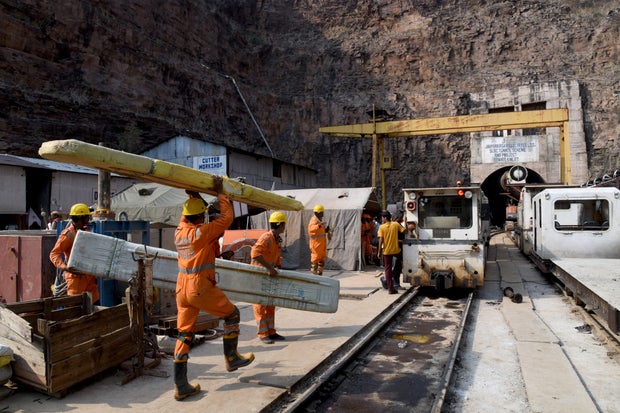
New Delhi — Rescuers in India were still racing Wednesday to save eight workers four days after they were trapped underground by a collapse in a tunnel under construction in the southern state of Telangana. Rescue crews had not managed to established contact with the trapped men for more than 100 hours, and the efforts to reach the men have come up against a series of challenges.

A portion of the Srisailam Left Bank Canal tunnel collapsed Saturday morning, causing water and mud to rush into the huge tunnel, which has a diameter of about 33 feet. Officials have said that about 50 workers were inside the tunnel when part of its ceiling caved in. Forty-three of them managed to escape, but eight were left trapped.

There has been no confirmation on the condition of the trapped men as no contact has been made with them by rescuers. Personnel with several agencies, including the Indian Army and the National Disaster Response Force, have been involved in the rescue efforts.

They have faced repeated setbacks due to loose soil and mud inside the tunnel.


Members of the National Disaster Response Force (NDRF) carry equipment during a rescue operation outside the Srisailam Left Bank Canal (SLBC) tunnel after a portion of the tunnel collapsed, in Nagarkurnool district in the southern state of Telangana, India, Feb. 24, 2025.STRINGER/REUTERS

Work on the 27-mile-long tunnel, which would be one of the world's longest irrigation tunnels if it is completed, has been delayed several times since construction began in 2005.


On Tuesday, the rescuers worked to clear a train track inside the tunnel so it can be used to transport equipment to pump water out from around the site of the collapse. A path was also being cleared to take earthmoving machines into the tunnel.

"As of now we are dewatering and going forward. But for the last 40 or 50 meters (yards) we are not able to go," B Santhosh, administrative head of the Nagarkurnool district, where the tunnel is being constructed, told India's PTI news agency.

A team of "rat miners" who successfully rescued 41 workers who were trapped in a Himalayan highway tunnel for 17 days in 2023 joined the rescue operations Monday.

About 20 miles of the new tunnel has been excavated so far, with about seven miles left to go, officials said Tuesday.

On Monday, a state minister overseeing the rescue work told journalists near the site that the chances of the eight men being found alive were slim.

"To be honest, the chances of their survival are very, very, very, very remote," Jupally Krishna Rao, a senior official in the Telangana state administration, said Tuesday. "I went up to the end, almost just 50 meters short [of the collapse site]… When we shouted their names, there was no response."

"I can't predict the chances of survival, but the chances are not very good," Rao said, adding that "even if there is the slightest chance, we will try to save them."


Why Canada must look beyond the U.S. to Africa’s economic boom

The economic surge of a youthful Africa offers Canada a chance to diversify trade beyond the erratic United States.

20 YEARS AGO PM CHRETIEN MADE AFRICA
A CANADIAN TRADING PARTNER


Workers unload cargo at Lamu Port in Kenya shortly after it opened in 2021. It was built by the China Communications Construction Company ZHANG NANFANG /XINHUA/THE CANADIAN PRESS)


by Zack Ahmed 
February 26, 2025
POLICY OPTIONS


As Canadians prepare to choose their next government in the face of a protectionist and unpredictable White House, Canada risks turning inward as it stands on guard for its economy and jobs.

While this might seem like the intuitive move when facing such an unfamiliar and erratic landscape, Canada may be overlooking a largely untapped economic behemoth staring at us from across the Atlantic.

No matter who wins the next election and whether they form a majority or a minority in Parliament, debates surrounding the economy and immigration will shape the national dialogue. All the while, much attention will unavoidably continue to be directed south of the border.
A rising economic power

All these events and their intended and unintended consequences provide a unique moment to up Canada’s engagement with Africa – for mutual benefit.

Initiatives such as the Feminist International Assistance Policy (FIAP) and Canada-Africa Economic Cooperation Strategy (CA-ECS) were introduced by the current Liberal government. Still, Canada’s engagement with African nations remains limited in breadth, nuance and co-ordination.

Africa’s rapid demographic and economic boom presents an extraordinary opportunity as well as corresponding challenges.

Africa’s population boom is one of the most striking developments in the 21st century. According to the United Nations Economic Commission for Africa, the continent will be home to roughly 2.5 billion people by 2050, many of whom will be under the age of 25.

This represents not only a vast consumer base, but also a burgeoning pool of entrepreneurial talent and a potential workforce that could spur innovation across multiple sectors. At the same time, the Intergovernmental Panel on Climate Change (IPCC) warns that Africa is already grappling with disruptions tied to climate change – from droughts and floods to resource scarcity – which invariably fuels conflict and displacement at large scales.

Economic data paints a clear picture that Africa merits closer attention and greater cooperation. In recent years, countries such as Ethiopia and Côte d’Ivoire have posted GDP growth rates that outpace the global average, showing that African economies are poised to become drivers of global prosperity.

And while free trade in North America appears to be coming apart at the seams, the African Continental Free Trade Area (AfCFTA), an ambitious initiative uniting 1.5 billion people within a single market, is projected to be worth more than US$3.4 trillion, radically transforming Africa’s trade and economic landscape.

For Canada, which has traditionally relied on the United States as its chief trading partner, these developments suggest that failing to open greater dialogue with Africa runs the risk of missing out on valuable opportunities for trade, investment and innovation.
Trade diversification and climate

With protectionist currents rising not just in the U.S. but around the world, a future-oriented approach to trade diversification is in Canada’s best interest. This has been further amplified by the re-election of a mercantilist President Donald Trump and his tariff rattling threats.

A more balanced approach that actively incorporates emerging African markets can help reduce Canada’s exposure to such risks.

Such an initiative could involve a specialized task force within Global Affairs Canada that focuses on opening up new trade partnerships with AfCFTA member states. Collaborating with Export Development Canada would help ease financial risks and provide support for Canadian businesses seeking entry into these dynamic new markets.

Climate security is another realm in which Canada has much to gain by working collaboratively with African nations.

Climate change already influences migration patterns, fuels resource-driven conflicts, and strains humanitarian systems – challenges that extend far beyond national borders. By forging consensus on climate adaptation, water resource management, and renewable energy, Canada could bolster regional stability while also opening new market possibilities for its clean-energy and tech sectors.

These joint efforts might take shape under a Canada-Africa Climate Security Partnership, bringing together government agencies, NGOs, businesses, and academic institutions to share knowledge, build capacity and develop early warning systems for climate-related emergencies.
The power of the African diaspora

Equally pivotal is the role of the African diaspora in Canada. Immigration has been a cornerstone of this country’s growth, and Africa offers unique avenues for cross-continental innovation and collaboration.

Skilled professionals in fields such as healthcare, engineering and technology can help Canadian businesses tailor products and services to local markets and navigate potential cultural and regulatory barriers. Encouraging diaspora-led trade missions and entrepreneurial accelerators, supported by local and provincial governments, could foster meaningful alliances that benefit both Canada and African economies.

Immigration, Refugees and Citizenship Canada might explore more specialized pathways and scholarship programs to bring African professionals and students to Canada, thereby enriching our talent pool and strengthening bonds between the two regions.

Ultimately, viewing Africa solely through the lens of economic potential or humanitarian assistance is too limiting. Its youthful population and evolving institutions point to great untapped potential for transatlantic collaboration.

By respecting African ownership of local development priorities and by engaging in long-term, capacity-building partnerships, Canada can position itself not just as a donor or a market-seeker but as a genuine long-term ally in Africa’s ongoing transformation.

Looking ahead, the next government has a rare opportunity to recalibrate Canada’s foreign policy strategy in a way that better aligns with a rapidly changing global order. By diversifying trade beyond traditional partners, strengthening ties through climate security initiatives, and fully harnessing the power of the African diaspora, Canada can safeguard its own economic and geopolitical interests while becoming a key contributor to Africa’s development goals.


Zack Ahmed is a SSHRC doctoral fellow in global governance at the Balsillie School of International Affairs and a researcher with MIFOOD Networks. With more than 14 years of experience in public policy, global governance and international development, he has worked on cross-sectoral projects - spanning private, public, and non-profit organizations across Africa and Canada.


Pioneering work generates feline embryonic stem cells in boon for cats


Advancement in veterinary regenerative medicine can help domestic and endangered wild cats alike


Osaka Metropolitan University

Embryonic stem cells from felines 

image: 

New advancements in veterinary regenerative medicine plausible with these pluripotent cells.

view more 

Credit: Osaka Metropolitan University


As different as they may seem, humans and cats have similar ailments, but in terms of health care, veterinary regenerative medicine is not as advanced.

A possible solution rests in embryonic stem cells, which can differentiate into various types of cells and be transplanted to restore internal damage. Further, they are characterized by their near-natural state similar to induced pluripotent stem (iPS) cells. Recent research has successfully generated feline iPS cells, but not embryonic stem cells, so research on these cell lines is essential to improve the quality of iPS cells.

Osaka Metropolitan University Professor Shingo Hatoya led a Graduate School of Veterinary Science team in pioneering the generation of feline embryonic stem cells using lab-grown blastocysts. The team performed in vitro fertilization of sperm and oocytes taken from discarded reproductive organs during feline sterilization surgeries.

Through the isolation of inner cell mass from blastocyst stage embryos and culturing them, the researchers succeeded in generating high-quality feline embryonic stem cells. These can be maintained in an undifferentiated state and can differentiate into the three germ layers endoderm, ectoderm, and mesoderm.

“Embryonic stem cells are pluripotent cells, so we believe that comparative studies with iPS cells will further promote veterinary regenerative medicine research,” stated Professor Hatoya. “The successful establishment of feline ES cells in this study can advance veterinary regenerative medicine by enabling comparative studies with feline iPS cells. Moreover, the potential to derive sperm and oocytes from feline ES cells could contribute to the conservation of endangered wild cat species.”

The findings were published in Regenerative Therapy.

###

About OMU 

Established in Osaka as one of the largest public universities in Japan, Osaka Metropolitan University is committed to shaping the future of society through “Convergence of Knowledge” and the promotion of world-class research. For more research news, visit https://www.omu.ac.jp/en/ and follow us on social media: XFacebookInstagramLinkedIn.


Taking sports science in her stride: How Dr. Nerea Casal García aims to maximize performance on the track


Frontiers
Dr Nerea Casal García 

image: 

Dr Nerea Casal García

view more 

Credit: Nerea Casal García


The following is a Q&A with Dr Nerea Casal García, a sports scientist focusing on sports training and performance optimization. To speak to the author, or to receive an advance copy of the paper, please write to: press@frontiersin.org The paper will be published on 27 Feb 2025 06:15 CET]

Dr Nerea Casal García is an athlete, personal coach, and injury readaptation specialist who last year completed a PhD on observational analysis in elite sports. Today, she is a professor at the Institut Nacional d'Educació Física de Catalunya of the University of Lleida, focusing on the theory and practice of training and performance optimization.

Casal García is the corresponding author on a new study in Frontiers in Sports and Active Living, which revealed major shift over the past five years in the stride patterns of female elite athletes during 400 meter hurdle competitions  a change that went together with a marked improvement in performance. Here, she answers our questions about her research and career as an sportswoman, coach, and scientist.

What inspired you to become a researcher?

In my case, curiosity played the most significant role. During my years studying sports sciences, I constantly wondered how different training methods might work or how to optimize the performance of the athletes I coached. Moreover, I have always enjoyed teaching, so the opportunity to combine research and education led me to pursue an academic career after completing my master's degree. Having always practiced athletics, I became increasingly aware, through my experience as a coach, of the gaps in training information that could benefit both coaches and athletes. This realization ultimately inspired me to focus on research in this field.

Can you tell us about the research you’re currently working on?

I am currently continuing my work in performance analysis in athletics. Specifically, along with my research group, I conduct biomechanical analyses in high-level competitions. At the same time, I combine this with new projects aimed at studying the different athlete profiles and identifying the key variables that determine performance in various events. We hope that these projects can provide valuable insights on how to tailor athlete training based on their individual characteristics.

In your opinion, why is your research important?

In sports, every athlete strives for maximum performance, dedicating countless hours to achieving even the slightest improvement. This is why coaches seek ways to optimize performance within the available time and conditions. To enhance performance as efficiently as possible, it is essential to conduct studies on different events to understand which variables are key to performance and which methods or techniques may be most effective. At the same time, such research allows us to explain individual variability in athletes’ performances. I believe that the research we conduct is crucial for supporting coaches by providing valuable information and ensuring they have access to the most relevant data to enhance their athletes’ performance.

Are there any common misconceptions about this area of research? How would you address them?

I believe that results obtained from very specific samples, such as Olympic finalists, are sometimes overly generalized. While having as much information as possible is essential, it is equally important to recognize that individualization is a fundamental principle in sports training. At the same time, I believe this is a field that requires a high degree of applicability. Therefore, it is essential to produce scientific knowledge that is clearly applicable to the real-world context of performance and is easily understandable for coaches.

What are some of the areas of research you’d like to see tackled in the years ahead?

I believe that technology is advancing rapidly, and in the coming years, we will be able to obtain much more precise data on internal load and biomechanical variables. This will allow us to take research to the next level. I hope we will have a wealth of real-time information on athletes' performance in the near future.

How has open science benefited the reach and impact of your research?

Many sports coaches are not connected to the academic world, making it difficult for them to access this information, which is often used only by researchers. However, open-access research allows all coaches to access this knowledge, bridging the gap between academia and practical application.


Nuns contribute 30 years of critical insight into dementia disorders, UT Health San Antonio study reveals


Landmark ‘Nun Study’ initiative now housed at Biggs Institute


University of Texas Health Science Center at San Antonio


SAN ANTONIO, Feb. 26, 2025 – Catholic nuns don’t make a habit of participating in long-term studies on aging and dementia, but one notable exception has yielded critical insights into cognitive resilience, neuropathology and aging-related disorders.

Researchers at The University of Texas Health Science Center at San Antonio (UT Health San Antonio) published a study analyzing more than 30 years of aging and dementia patterns of 678 nuns from the School Sisters of Notre Dame enrolled in the aptly named Nun Study, conceived by epidemiologist and neurology professor David A. Snowdon, PhD, in 1986.

It now is housed at UT Health San Antonio’s Glenn Biggs Institute for Alzheimer’s and Neurodegenerative Diseases, under the direction of Margaret Flanagan, MD, tenured associate professor of pathology and laboratory medicine.

Among takeaways from this latest analysis: Some individuals showed resilience to cognitive decline despite an Alzheimer’s diagnosis, indicating unknown protective mechanisms at work, and that early-life linguistic ability and grammatical complexity correlated with a lower risk of impairment in later life.

Also, advanced digital pathology techniques and artificial intelligence are reshaping the study of Alzheimer’s and related dementias. It all portends advancement for preventive intervention in cognitive decline.

“By leveraging this unique cohort of Catholic nuns with homogeneous lifestyles and rigorous longitudinal assessments, the study has clarified key factors influencing dementia risk and protection,” Flanagan said. “The work underscores the need for multilayered comprehensive approaches that account for multiple pathologies in dementia research and highlights the promise of AI-driven neuropathology.”

Flanagan is senior author of the study titled, “The Nun Study: Insights from 30 years of aging and dementia research,” published Feb. 26 by Alzheimer’s & Dementia: The Journal of the Alzheimer’s Association. Other authors also are with the Biggs Institute and the departments of pathology or neurology at UT Health San Antonio. First author of the study is MD/PhD student Kyra Clarke.

One of the most significant

The new Nun Study analysis describes “one of the most significant longitudinal aging and dementia studies.”

Snowdon founded the initiative while at the University of Minnesota and then later took it with him to the University of Kentucky. With his retirement in 2008, the study returned to the University of Minnesota. The study briefly moved again to Northwestern University in 2021 when Flanagan was there, and then to UT Health San Antonio.

Cloistered and homogenous, the cohort of American nuns 75 years of age or older at the School Sisters of Notre Dame, a worldwide institute of Roman Catholic sisters, proved ideal for study, minimizing variables like smoking or differences in access to health care that may have confounded similar research.

While all 678 participants now have passed away, the study remains alive and vibrant at the Biggs Institute, with research currently being performed on donated brain autopsy material and the extensive data collected during the nuns’ lives, Flanagan said.

The participants consented to undergoing annual neuropsychological assessments, allowing researchers access to convent archives and medical records, plus the post-mortem brain donation. The new study investigated the associations between epidemiological factors, cognitive function and brain pathology.

Among the findings:

  • Cognitive resilience and neuropathology: The study identifies factors contributing to cognitive resilience despite the presence of Alzheimer’s pathology. Some individuals exhibited high neuropathological burden but remained cognitively intact, indicating unknown protective mechanisms.
     
  • APOE genotypes and dementia risk: The article discusses the role of APOE e4 and e2 in Alzheimer’s risk and cognitive preservation. The Apolipoprotein E (APOE) gene plays a role in the metabolism of fats in the brain. APOE e4 is a risk gene that increases the likelihood of developing Alzheimer’s disease. APOE e2 is a protective gene that may reduce the risk.
     
  • Early-life predictors of cognitive health: The relationship between early-life linguistic ability and later-life cognitive function is a major finding. High idea density and grammatical complexity in young adulthood correlated with a lower risk of cognitive impairment in later life.
     
  • Comorbid neuropathologies and dementia risk: The study emphasizes that most cases of dementia involve mixed pathologies, including LATE, HS-A and vascular pathology, rather than pure Alzheimer’s disease. LATE refers to Limbic-predominant age-related TDP-43 encephalopathy, a type of dementia that affects people as they age. It is often caused by abnormal clumps of a protein called TDP-43 in the brain. HS-A, or hippocampal sclerosis of aging, is damage in the hippocampus that happens with age, affecting memory. LATE and HS-A are underrecognized but impactful. LATE is distinct from Alzheimer’s disease but frequently co-exists with it. HS-A is a major contributor to dementia in the oldest-old. The presence of these multiple brain pathologies suggest that multi-targeted therapeutic strategies may be necessary.
     
  • Advancements in digital pathology: The study highlights how digital spatial profiling and machine learning are revolutionizing neuropathological assessments today. Digital pathology and AI are reshaping neuropathology research. Whole slide imaging, spatial transcriptomics and machine-learning models are providing novel insights into brain pathology and paving the way for precision diagnostics.

“The findings from the Nun Study have significantly advanced our understanding of Alzheimer’s disease and related disorder neuropathologies,” Flanagan said. “As all the studies comprehensively described in this review have indicated, there is still a need for ongoing investigation into the multifactorial nature of cognitive decline, particularly in aging populations.

“However, we also highlight promising opportunities for biomarker development and providing us with the opportunity to identify and delineate potential targets for preventive intervention in cognitive decline,” she said.

Separately, Flanagan, a native of Ireland who completed her medical training at Trinity College Dublin, recently was highlighted by the Women in Medicine in Ireland Network. Each Sunday, it chooses “another great female medic, past or present,” and acknowledges “their contribution to medicine in Ireland,” according to its website. The initiative posted an article highlighting her roles at UT Health San Antonio.

Last year, she received a $100,000 Rising STARs award from the University of Texas Board of Regents to advance research relating to Alzheimer’s Disease and other neurodegenerative diseases.

UT Health San Antonio is a world-class research university, ranking at the top 5% among institutions globally for clinical medicine according to U.S. News & World Report. It is No. 12 in the world among universities for the impact of its discoveries – in normalized citation impact, which compares the number of citations its research receives per paper to the average for similar published work, a recognized core measure of research impact.


The Nun Study: Insights from 30 years of aging and dementia research

Kyra M. Clarke, Shahroo Etemadmoghadam, Benjamin Danner, Cole Corbett, Ali Ghaseminejad-Bandpey, Matthew Dopler, Julie Parker-Garza, Mohammad Alhneif, Sahana Babu, Oluwaseun B. Ogunbona, Angelique D. Gonzalez, Arash Salardini, Margaret E. Flanagan

First published: Feb. 26, 2025, Alzheimer’s & Dementia: The Journal of the Alzheimer’s Association

Link to full study: https://alz-journals.onlinelibrary.wiley.com/doi/10.1002/alz.14626


The University of Texas Health Science Center at San Antonio (UT Health San Antonio), a primary driver of San Antonio’s $44.1 billion health care and biosciences sector, is the largest academic research institution in South Texas with an annual research portfolio of more than $436 million. Driving substantial economic impact with its six professional schools, a diverse workforce of more than 9,400, an annual expense budget of $1.67 billion and clinical practices that provide 2.5 million patient visits each year, UT Health San Antonio plans continued growth over the next five years and anticipates adding more than 1,500 higher-wage jobs to serve San Antonio, Bexar County and the South Texas region. To learn about the many ways “We make lives better®,” visit UTHealthSA.org.

The Glenn Biggs Institute for Alzheimer's and Neurodegenerative Diseases is dedicated to providing comprehensive dementia care while advancing treatment through clinical trials and research. The Biggs Institute is a National Institute on Aging (NIA)-designated Alzheimer’s Disease Research Center (ADRC). In addition to patient care and research, the Biggs Institute partners with the School of Nursing at UT Health Science Center San Antonio to offer the Caring for the Caregiver program. 

Stay connected with The University of Texas Health Science Center at San Antonio on FacebookTwitterLinkedInInstagram and YouTube.