Friday, March 14, 2025


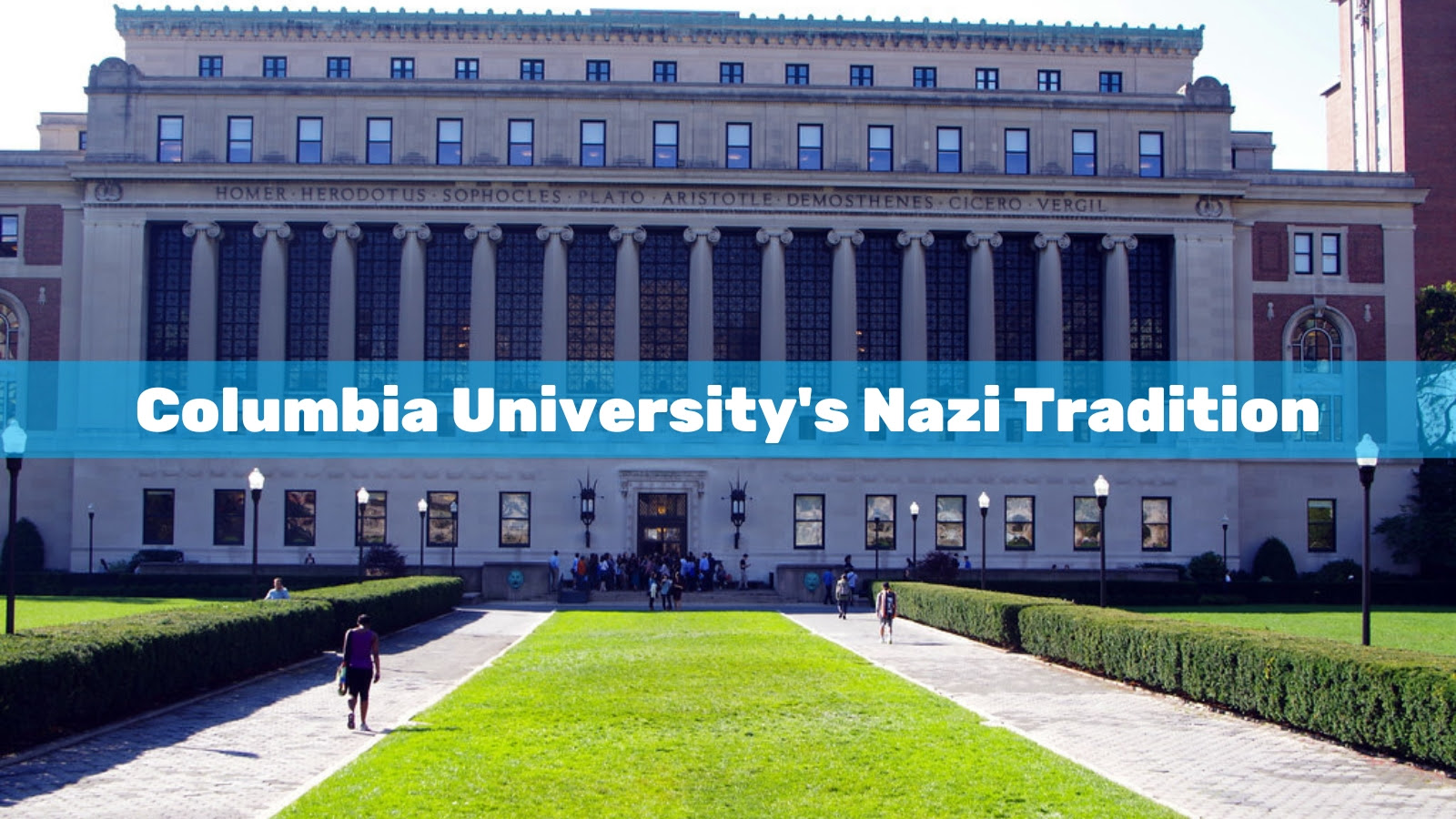
Columbia University’s Nazi Tradition


According to Columbia Magazine, published by Columbia University’s Office of Alumni and Development, but ultimately named for a brutal imperialist mercenary, in 1933 while Nazis in Germany were burning books by Jews, Columbia’s president — and future Nobel Peace Prize recipient — Nicholas Murray Butler “welcomed Hans Luther, the German ambassador to the United States, to Morningside Heights, insisting that he be accorded ‘the greatest courtesy and respect.’” Columbia’s Daily Spectator newspaper “denounced what it saw as Butler’s courtship of the German government and its universities.”

Butler — “a longtime admirer of Benito Mussolini” — mocked protests of his relations with Nazi Germany. In 1934, Butler “fired Jerome Klein … a promising young member of the fine arts faculty, for signing an appeal against the Luther invitation; and he expelled Robert Burke, a Columbia College student, for participating in a 1936 mock book burning and anti-Nazi picket on campus.”

Or, as a 2006 column by Stephen H. Norwood in the Columbia Spectator tells it, “Butler had Burke expelled for leading pickets protesting the Columbia administration’s insistence on sending a delegate and friendly greetings to a major propaganda festival the Nazi leadership orchestrated in 1936 in Germany, the 550th anniversary celebration of Heidelberg University. Although he was a fine student and had been elected president of his class, Burke was never readmitted. [Columbia provost Alan] Brinkley and former associate dean Michael Rosenthal … show little sympathy for Burke and trivialize Columbia administration actions that helped Nazi Germany enhance its standing in the West. Although the Nazis had expelled Jews from university faculties and the professions, and savagely beat Jews in the streets, Butler joined with the presidents of Harvard and Yale to plan how to deflect criticism of their decisions to send university representatives to Heidelberg. No British university would send delegates. Butler selected professor Arthur Remy as Columbia’s representative, who pronounced the reception at which Josef Goebbels presided ‘very enjoyable.’ … Butler’s insensitivity to Nazi outrages against Jews was influenced by his own anti-Semitism. Columbia spearheaded universities’ efforts to sharply restrict Jewish admissions. Butler strongly supported Harvard president James Conant, an early supporter of anti-Jewish quotas, when he invited Nazi academics to Harvard’s tercentenary celebration later in 1936.”

Now, in 2025, Columbia is back, for the first time since 1936, to expelling students for nonviolently protesting Columbian support for genocide — and this time not just threatened genocide but a genocide actively happening and available in reports, photographs, and videos in real time, already identified and condemned by the International Court of Justice, the International Criminal Court, and numerous human rights groups and governments.

Is Columbia bowing to U.S. fascist demands to ban speech and assembly against the genocide in Palestine because a small fraction of its funding comes (or came) from the U.S. government?

Or does Columbia have a strong loyalty to whoever is engaged in mass murder?

Or — and this seems the most likely — is Columbia fiercely committed to whatever powerful people deem proper at the moment, even if at one time it’s anti-Semitism and at another time it is a Palestinian genocide with advocacy of peace denounced as “anti-Semitism”?

It’s rather a shame to have institutions of so-called higher learning be run by people so dedicated to avoiding thought, no matter the cost to humanity.

  • First published at World BEYOND War.
  • David Swanson is an author, activist, journalist, and radio host. He is director of WorldBeyondWar.org and campaign coordinator for RootsAction.org. Swanson's books include War Is A Lie. He blogs at DavidSwanson.org and War Is a Crime.org. He hosts Talk Nation Radio. Follow him on Twitter: @davidcnswanson and FaceBookRead other articles by David.


    On Stupidity


    Stupidity, stupidity everywhere – and not a word to witness.

    “Stupid” is a commonplace term casually used in everyday conversation. Much less so in writing – especially when the subject is political personalities. It is heavily weighted with inhibition. Why this hesitation? Why at a time when manifest stupidity in speech and action is rampant?

    “Stupid” is both blunt and conclusive. Straight-forward. It does not welcome qualification or discussion. It implies: matter settled, closed. Moreover, it suggests a character flaw as well as low intelligence. That somehow makes us uncomfortable. So we prefer: dense, slow, thick, dim or dim-witted; or pithy euphemisms, e.g. “not the sharpest tool in the kit” or “none too swift” or “slow on the uptake” or “not playing with a full deck” or “in so far over his head that the bubbles don’t reach the surface.” In addition, there are those words that refer directly to intelligence: moron, imbecile, idiot. They, too, are in currency but suffer from the disability of taking in vain a descriptive word that refers to the poor souls who are born with mental deficiencies.

    “Stupid” is used as an epithet 95% of the time. Not as a depiction of someone’s Intelligence Quotient (IQ). To do so in the latter sense is to complicate matters. Intelligence, as we now are aware, is a broad concept that covers 5 or 6 or 7 mental attributes whose correlations are quite low. So, almost no one thinks that through before throwing the word around. To the degree that one might consider meanings, it implies lack of logic – the core characteristic of conventional IQ intelligence.

    Squirt kerosene on a simmering barbecue – that’s stupid. Sending more troops to Afghanistan in 2017 when you’ve failed miserably to achieve your (undefined) objective over the past 15 years with much larger contingents is stupid, i.e., illogical. Denouncing China as America’s enemy on whom it plans to impose severe economic sanctions while senior officials publicly predict war within 10 years, and then beseeching Beijing for assistance in keeping the dollar the global currency by ending its sale of U.S. securities; and then demanding that China slow its economic growth because 1) it causes balance-of-trade imbalances, and 2) that would reduce its oil imports thereby minimizing Russian revenue from its sales on a softer world market (as did Janet Yellin on two separate visits) – that’s stupid. Silently letting Turkey provide crucial material support to ISIS and al-Qaeda in Syria while decrying terrorist acts by jihadis in the US and Europe is stupid, i.e., illogical. (The Obama administration soon joined in supplying arms indirectly those same groups, then helped secure their control of the Idlib enclave which was their base for the eventual breakout a few months ago; now in power they are massacring Alawites and Christians). Bestowing praise and honors on the Saudi leaders as declared brothers in the “war on terror” when in fact these very persons have done more to propagate the fanatical creed that inspires and justifies acts of terror is stupid, i.e., “illogical.”

    These instances of stupid behavior draw our attention to the connections between intelligence and knowledge – between “stupidity” and “ignorance.” Stupid (illogical) behavior is more likely when you don’t know what you’re doing because important information is missing. In the examples cited, though, the information that is the foundation for logical thinking was known to the parties taking those actions. Not just accessible – it is lodged (somewhere) in the brain of the actor. “Dumb”1 in popular usage is the word that combines “stupid” and “ignorant” – with the connotation that the ignorance is willful. That is a pertinent notion to which we’ll return.

    Assuming that the “stupid’ actors are not mentally deficient, why do they act as if they are? That is the persistent question that crops us as we see and read the antics of public officials, commentators, and a host of celebrity personalities. Several explanations, not excuses, come to mind.

    One is that there exists an implicit logic that is not acknowledged but salient for the person(s) involved. The Pentagon brass may well have been less concerned about “winning” in Afghanistan, whatever that means, than they were living with the intolerable perception that they “lost.” No general cum security policy-maker wants to be saddled with the label of “loser.” That sensitivity can become institutionally generalized;

    One is that there exists an implicit logic that is not acknowledged but salient for the person(s) involved. The Pentagon brass may well have been less concerned about “winning” in Afghanistan, whatever that means, than they were living with the intolerable perception that they “lost.” No general cum security policy-maker wants to be saddled with the label of “loser.” That sensitivity can become institutionally generalized; General Jones (National Security Adviser), Admirals Mullen (Chairman, Joint Chiefs of Staff) and Blair (Director, CIA) were in little danger of being blamed personally for failure in Afghanistan.  What seems to count is that they did not want the U.S. military to be stigmatized as a failure. They were acutely aware of how much the image of the uniformed military suffered as a result of America losing its first war in Vietnam. It follows that they might hope against hope that the outcome can be fudged enough so as to escape that fate. There is a practical side to this concern, too. Failure, as perceived in the public eye, could tarnish the resplendent image so successfully cultivated during the “war on terror” era. That could translate into less support for bigger budgets, less lucrative consultancies after retirement, and less acclaim. And a weaker voice in policy debates.

    If one were to postulate that these are cardinal objectives, then campaigning to send several thousand more troops on a strategically pointless mission is logical – and the plan’s promoters not as stupid as they appear. What of senior policymakers in and around the White House who did not share those particular interests? They, indeed, were stupid.

    Another instructive example is Barack Obama’s announcing the conclusion of an historic, arduously negotiated nuclear treaty with Iran (JPOA) in a speech that vilifies the Tehran regime as a tyranny that sponsors terrorism, aims to dominate the Persian Gulf, and endangers Israel. Thereby, he emboldened opponents of the accord to attack it – clearing the way for its abrogation by Trump a few years later. The net result: we now are on the brink of war with Iran because of its nuclear activities. Stupidly illogical? Perhaps not. Obama, on narrow political grounds, was trying to insulate himself from a barrage of criticism from Washington hard-liners and the Zionist lobby. Only two years earlier, he had infuriated them by scotching plans for American military strikes against government forces in response to chemical attacks blamed on the Assad regime (in fact, a false flag operation by MI-6 and their White Hats in collaboration with the jihadi rebels); hence, the perceived need to mollify them. So, it can be seen as logical given his weighting of interests and priorities. Not stupid – just self-centered and unresponsive to the public good, vintage Obama.

    A second reality to keep in mind is that governments are plural nouns – or, pronouns with multiple antecedent nouns. The numerous organizations, bureaucracies and individuals involved in decision-making typically lead to a convoluted process wherein it is easy to lose track of purposes, priorities and coordination. Where little discipline is imposed by the chief, the greater the chances that the result will be contradictory, disjointed, sub-optimal and often poorly executed policies. At the present moment, we are witnessing a disjointed Trump administration, that in regard to Ukraine/Russia, 6 individuals are pursuing 7 different lines as indicated by their public remarks – an octopus trying to put on a pair of mismatched socks. All exacerbated by a scatterbrained Chief Executive who contradicts himself – as well his senior deputies – on a nightly basis.

    Another kind of impediment to coherent, reality-based policymaking arises when the opposite condition prevails: an elaborate process involving several parties with divergent perspectives and parochial interests concludes with an agreement on a lowest common denominator basis. Arduously reached, that decision becomes frozen, insulated from new information or changes in the environment due to the fear that any revision would unravel the consensus – a form of groupthink. An extreme example of this phenomenon is provided by the EU where 27 sovereign states must agree before any policy can be enunciated. In Brussels, success is proclaimed when they reach accord as if negotiating among themselves is tantamount to negotiating an accord with other governments. A similar example is presented by the current campaign of the Trump administration to press Ukraine into negotiations with Russia. The tussle between Washington and Kiev is taken to be the crucial step toward resolution of the conflict. In fact, the ideas being bandied about as key ingredients of a settlement already have been absolutely rejected by Moscow – in particular, the much ballyhooed ceasefire that is a Western pipedream. As yet, they have not even been formally conveyed to the Russians. Stupid – or pathological?

    Finally, we should recognize that rigorous thinking is far from the norm – at the highest levels of government as well as in everyday life. It takes a combination of education/training, experience, intellectual integrity, a cultivated sense of responsibility, discomfort with deciding on the basis of skimpy or suspect information, and an ingrained preference for knowing why you’re doing something instead of flying by the seat of your pants. True, when practiced and reinforced, rigorous thinking can become habitual – just like other modes of human behavior. There are multiple influences, though, that militate against that habit taking root and being sustained. They include the lure of celebrity, time pressures due to an excess of travel and/or summonses to mind-numbing TV interviews, long-tedious-inconclusive meetings (such as those presided over by Susan Rice which drove Chuck Hagel out of government), endless bureaucratic games-playing, distracted Chief Executives who demand ‘yes’ or ‘no’ answers to complex issues. Altogether, the tumult can soften the toughest mind. Weaker minds simply latch onto whatever conventional wisdom and catch phrases are floating around in order to remain relevant and minimally functional in the kaleidoscopic setting of most administrations.

    All of these patterns with attendant adverse consequences are more likely to crystallize into stupid acts when the man nominally in charge lacks the intelligence, emotional stability, self-awareness and/or advisors to recognize either the requirements for sound policymaking or for implementation. A lack of capacity to accept responsibility and to be held accountable exacerbates matters.

    A business career such as Trump’s is not the desired preparation. Not only is that world fundamentally different from the world of public affairs (and especially foreign policy) Further, Trump partially compensated for his flaws through coercion, cheating, and duplicity. And at the end of the day, he could rig the books. That modus operandi doesn’t fly in the Middle East or in dealing with the likes of Vladimir Putin or Xia Jinping. It could, and does, win elections in a country where ignorance and “obtuseness”, in its many inglorious forms, are commonplace.

    “Willful ignorance,” or “studied ignorance,” is an increasingly familiar phenomenon. Not just in Washington but among heads of large organizations of all stripes (e.g. universities). The inclination to avoid acquiring knowledge about a matter either at hand or looming is not necessarily a sign of stupidity. Here, too, there may be hidden considerations at play. American foreign policymakers may have wish to mask the Kabul government’s faltering popular support because doing so means a fundamental rethink of aims- an agonizing reappraisal for which they are unprepared intellectually, politically, and diplomatically. (MB: substitute Ukraine)

    Making no effort to uncover the facts only becomes “stupid” where the responsible official then does things, as a consequence, that harm his interests. That has been the case in Syria where Barack Obama refused to come to terms with the uncomfortable truth that the “rebels” were overwhelmingly Salafist jihadis. In this case, an admission of that cardinal truth would pose the stark choice between continuing to back an al-Qaeda2-led cause or reversing course in tilting toward the Assad regime. The President lacked the courage to deal with the wide-ranging ramifications of that; so, he deluded himself into pursuing a will-o’wisp that existed only in the imaginings of those who were keen on an American military intervention. By surrounding himself with a rogue Secretary of Defense, a strategically disoriented Secretary of State, a self-absorbed, unpracticed National Security Advisor, and an obstreperous UN Ambassador, Obama fostered an environment that enabled his escapist behavior. So, too, did his ritual deference to the warped liturgy of the foreign policy Establishment that they represented.

    For a President to avoid acting “stupidly,” he need not have an exceptional IQ – or score remarkably high on other dimensions of intelligence. Two things are most important: he must be honest with himself; and he must put in place a policy system that is both logical in process and self-aware as to why decisions are taken with what end in mind. To borrow an analogy from the football terminology favored in the corridors of Washington power: you can win a championship with a simply competent quarterback if the other pieces are in place and he follows a disciplined script. (Bart Starr of the old Green Bay Packers). An emotionally handicapped or narcissistic quarterback – however talented – will cripple a team sooner or later. One who suffers from the latter condition(s), along with a lack of athletic talent, is a guarantor of disaster. “Stupidity” will be the least of the derogatory terms applied to the ensuing performance; that word should be reserved for those who chose him.

    Moral: we should not hesitate to call things as they are. Feigned politeness in situations marked by systematic deceit, ill-will and harm to the nation serves no good purpose. Concerned about the proverbial “dignity of the office?” Take your shoes off before entering the Oval Office. If “stupidity” displayed by stupid people is what we observe, virtue lies in calling it by its name.

    The foregoing discussion pertains directly to government leaders. What of those non-official members of the “foreign affairs community” – the think tank pundits, the media personalities, the op ed columnists? These days, the thinking of most mirrors that of those in government positions. The unstated or unconfirmed premises, the partial or selective information, the logical flaws. The main differences are that they write/speak at far greater length, compose longer sentences, and use polysyllabic words. The level of intellectual rigor, though, is pretty much the same.

    UPDATED 12 March: In paragraph 9, I mistakenly ascribed to Generals Mattis and McMaster responsibility for the dubious decision in December 2009 to expand American forces in Afghanistan. The honor should have gone to General Jones (National Security Adviser), Admirals Mullen (Chairman, Joint Chiefs of Staff) and Blair (Director, CIA). The most forceful advocates were two civilians: Secretary of Defense Bobby Gates and Secretary of State Hillary Clinton.

    ENDNOTES:

    • 1
      “Dumb” as a pejorative has been out of favor for some time. It sounds stale to the post-modern ear. Only be adding the suffix “SOB” or “bastard” does it make any impact. That may be changing, though. The comeback of “dumb” could well have something to do with the fact that it rhymes with “Trump.” The German spelling “Drump” has even truer resonance.
    • 2
      Abu Mohammad al-Julani, nom de guerre of Ahmed Hussein al-Sharaa, and Abu Bakra al-Baghdadi of ISIS notoriety were confederates in the al-Qaeda subsidiary al-Qaeda in Mesopotamia that had been active in Iraq after the 2003 American invasion and occupation. Soon after the civil war in Syria broke out in 2011, they went their more or less separate ways: al-Baghdadi leading the Islamic State and Julani controlling al-Nusra as it came to be known. Over time, al-Nusra became the dominant force in the opposition coalition. It used its non-jihadi allies as convenient cover. American aid, along with that of European supporters, was laundered through those other groups. In effect, they served as a postal drop box. Over the eight years when al-Nusra ran the Idlib pocket under Turkish protection, they set up a repressive Islamic autocracy. They also assembled a multiethnic force including ISIS remnants, Uigurs, Uzbeks, Afghans, Chechens that acted as Turkish mercenaries in Libya, Azerbaijan and Kazakhstan. Now, they enjoy a measure of independence as militias in the new-found regime of Jalani’s Hay’at Tahrir al-Sham (HTS) – its latest organizational incarnation. However, they could not commit the massacres against the Alawites without Jolani’s tacit approval, and HTS security forces, too, were involved.

      For the record: among Syria’s 4.5 million Alawites, few supported Assad to the end and active opposition to the HTS takeover was very limited.

    Michael Brenner is Professor Emeritus of International Affairs at the University of Pittsburgh and a Fellow of the Center for Transatlantic Relations at SAIS/Johns Hopkins. He was the Director of the International Relations & Global Studies Program at the University of Texas. Brenner is the author of numerous books, and over 80 articles and published papers. His most recent works are: Democracy Promotion and IslamFear and Dread In The Middle EastToward A More Independent Europe Narcissistic Public Personalities & Our TimesRead other articles by Michael.


    Two Anti-China French “Reporters” Were Caught Lying


    And they pulled Adrian Zenz down with them


    A popular French TV show recently aired an undercover investigation by two young French journalists, Justine Jankowski and Marine Zambrano, who snuck into multiple clothing factories in China with one aim: to find evidence of forced labor.

    And if you watched their program, part of France 2’s “Cash Investigation” series, you might be convinced that they found astonishing and scandalous evidence.

    The fact of the matter, though, is that the show’s creators used blatant lies to come to that conclusion, and I have all the evidence on today’s show.

    What is even more delicious is that the show also featured seasoned anti-China “academic” Adrian Zenz, who has ended up being exposed by this show at the same time. Two birds with one stone!

    Grab a cuppa and come with me as I explain all of the tricks the two female reporters used, and highlight clearly why they are lies.

    This is Reports on China, I’m Andy Boreham in Shanghai. Let’s get reporting!

    Reports on China, which analyzes Western reports on China is created and hosted by Andy Boreham, a columnist and video producer with Shanghai DailyRead other articles by Report on China, or visit Report on China's website.


    Complicity in the Mass Murder of Children, Women, and Men


    I have sent the following Letter to major Australian media and to nearly all Federal and Victorian State MPs:

    Mainstream Western media (e.g. the BBC) have published the estimate in the leading medical journal The Lancet that violent (direct) deaths in Gaza totalled 64,260 in 9 months i.e. 111,000 by the Ceasefire on 20 January 2025. However they resolutely ignore expert estimates also published in The Lancet that non-violent (indirect) deaths from imposed deprivation may be 4 times greater, this indicating Gaza deaths from violence and imposed deprivation totalling about 553,000 or 23% of the pre-war population by 20 January 2025. Noting that under-5 infants are 70% of avoidable deaths from deprivation in impoverished countries (Gideon Polya, “Body Count. Global avoidable mortality since 1950”), it is estimated that these deaths include those of 393,000 children, 51,000 women and 113,000 men. As is my duty I have informed nearly all Federal and Victorian State MPs. The only MPs consistently demanding an immediate and permanent Ceasefire and an end to the deadly Occupation have been the Greens and several Independents (notably Senators Lidia Thorpe and Fatima Payman). Silence is complicity. Informed Australians voting for Gaza Genocide-complicit Labor, the worse Coalition and indeed nearly all non-Green candidates are complicit in the mass murder of children, women and men (cc MPs).

  • See also “Western Media and Politician Complicity in US-Israeli Massacre of Palestinian Children” by Gideon Polya, Dissident Voice, 8 February 8th, 2024.FacebookTwitter
  • Gideon Polya taught sience students at La Trobe University, Melbourne, Australia over 4 decades. He has published the following huge books Body Count. Global avoidable mortality since 1950Jane Austen and the Black Hole of British HistoryUS-Imposed Post-9/11 Muslim Holocaust & Muslim Genocide (2020), and Climate Crisis, Climate Genocide & Solutions (2020). Read other articles by Gideon.


    Nowhere to Belong: The Refugee’s Dilemma


    Political gains and dominance are some of the most notable captivating culpable twin objectives cum baits behind waging war. But on the other hand, the hardships and struggle of being a refugee is one of the most dreadful tumultuous aftermaths a war can shave out in the hands of an ordinary man. Fear, uncertainty, and arguably the most dominant element, finding oneself amongst many more displaced lost like a grain of sand, are excruciating and provocative to one’s stimuli.

    For refugees, life straddles between a lovely lost homeland and an unwelcoming new land, leaving them suspended in a fragile existence. This is what the enigmatic life of a refugee straddles incessantly. It constantly seeks and combats plausible answers via scraping out a layer of heavy dust over the infinite, eternal truth of WHO, WHEN, AND HOW. A refugee’s FUTURE, PRESENT, AND PAST seem somewhat blurry and uncertain, longing for a golden ray of hope. Thereby losing a sense of identity are some inexorable shiny traits that a refugee’s life mirrors.

    The Burden of Alienation

    Refugees perpetually experience a dilemma itching back in their heads of an unwanted weed relentlessly. They strive to trace out a sense of desirable congruence commonality, attempting both to absorb a fruitful and futile mental cum psychological satisfaction in a place that never was, never is, and never would be, at least in near future generation presently to be fondly labeled as your MOTHERLAND drenched in utmost pride without any grudges. Earlier NOWHERE but now NOW HERE, suddenly appearing from SOMEWHERE out of the blue behind the bush. At first sight, bridging this deep, endless gap to equilibrium via killing the buoyancy of a persistent enigma behind the curtain between the WORLD and THEIR WORLD filled with dubious contradictory beliefs stuffed with qualms, problems, and hesitation ought to become the sole self-motto and essence of both their straddled life and inner conscience.

    Psychological Meaningless Toll of War on Refugee Life

    That outsider alienated feeling lingering in their soul both haunts and hunts them on a regular note induced with a bittersweet chorus from inside on a heartfelt rhythmic tune. War leaves deep wounds, bleeding, stitches, and scars on the heart, marching them towards a slow, numb emotional breakdown. Parallel to this, it pulls them inside an escape room, rooting them to an eventual smothering and choking state in all possible “ideal” manners, i.e., culturally, environmentally, psychologically, socially, physically, lingual, mentally, aesthetically, spiritually, morally, and an array of other ways, alas! Regrettably.

    But as the legendary 20th-century French Nobel prize-winning philosopher Albert Camus’s theory circling his core philosophical principle theme and beliefs in his writings gets beautifully sculpted in his magnum opus 1942 novel The Stranger, the inherent nature of MEANINGLESSNESS is brightly evident even here! These factors appearing in a diabolical dystopia distantly have a significant disparity and impact, ultimately leading to an utter sense of both nonsensical AMBIGUITY AND ABSURDITY, later bearing quite nearly zero output and value except driving a dark fruit of sadism or even masochism in both overall view and perception after summing it all thoroughly.

    The Historical Cycle of Refugee Crises

    Dissolution of empires, independence, freedom struggle, war, partition, and many others are the grounds where refugees are born, being a victim and paying the ridiculously hefty price of someone else’s crime. It is traumatically complex and challenging to commute like an innocent culprit under the wires across the borders, moving from one place to another, lying unnoticed in a concentration camp, nearly like a lifeless being, and that too forcefully! Being ‘transported’ over millennia, again and again, innumerable times.

    In the 19th century, the world witnessed the first mass displacement, later during the Balkan Wars and both World Wars I and II, with more than 100 million ordinary civilians officially tagged as refugees (UNHCR History). These relentless incidents have marked mass population and demographic disruptions around the globe, leaving a lasting impression for centuries to come.

    Widely acknowledged as one of the most influential and greatest philosophers of all time (even by meticulous critics), the German genius Karl Marx rightly quoted, “History repeats itself, first as a tragedy, second as a farce”. True to his words, another such eye-opening illustration is seen in the advent of the 21st century, dated on February 20, 2014, when the world oversaw yet another refugee emergency amidst the war between Russia and Ukraine. The crisis has “manufactured” more than 5 million war refugees globally, and the count continues to rise.

    Global Refugee Statistics

    According to UNHCR reports, around 100 million people have been displaced in the past decade. Approximately 72% of refugees come from just five countries: Venezuela, Turkey, South Sudan, Afghanistan, and Ukraine. Approximately 36% of refugee-hosting countries are only five countries: Pakistan, Turkey, Uganda, Colombia, and Germany. Children alone constitute 36.5 million of the refugee population, with 1.5 million children born yearly carrying the refugee ‘birthmark.’

    Examining the Indian refugee scenario, the country houses more than 400,000 refugees belonging to the Muslim and Sikh communities, with the Afghan Rohingya genocide group as an eminent example (World Data on India). Conversely, countries like the UK, the USA, and Canada also have Indian refugees. Meanwhile, nations like Hungary, Croatia, Serbia, and Bosnia accept the least number of refugees, as per the Migrant Acceptance Index (US News Report).

    Economic Burden and Surveillance

    Around 85% of the funds spent on refugees under UNHCR come from the European Union (EU), with another 25% from miscellaneous sources. In 2015 alone, host countries shouldered an enormous financial aid burden of $131.6 billion (OECD Report). This expense could soon fracture many world economies.

    The canvas of living such a discriminatory, xenophobic, painful life gets painted in shades of grey, gripping one’s actions and deeds under a watchful radar—sometimes both intentionally and unintentionally. The biggest irony is the battle with both external and internal suffocation. One seeks solace and peace, striving to explore the inner self in a new, colorful manner.

    The Bitter Irony of Homeland

    Observing the volatile nature of world politics makes one quickly realize the high value of safety, freedom, political stability, and peace that a native country provides! It is a striking and thought-provoking contrast. However, drawing lessons from a refugee’s dilemma, one sees the bitter irony: those fortunate enough to have a homeland often take it for granted, complaining about trivial matters instead of appreciating their privilege. The refugee’s dilemma is not just a burden- it is a global responsibility. In this crisis, millions will be stranded between worlds, searching for a place they belong. Their struggle is not just one of survival but of reclaiming dignity in a world that too often sees them as burdens rather than victims of circumstances beyond their control.

    Prabhav Khandelwal ... Read other articles by Prabhav.


    The UK’s Grooming Gang Narrative


    Facts, Myths, and the Impact on Pakistani Communities


    The Media’s Role in Fueling Misinformation

    British society has been dealing with organised child exploitation through grooming gangs for an extended period. Official data contradicts media perceptions about who engages in these criminal activities by showing Pakistani men are not the main offenders. Official Home Office data indicates that defendants facing child sexual abuse prosecution in England and Wales are predominantly white since their number reaches 88 percent. News reports on offences by South Asian individuals receive unusually high attention from media outlets thus perpetuating racial misconceptions that deepen societal rifts.

    The Origins of a Racialized Narrative

    Forces of public discussion concerning grooming gangs grew stronger as three important cases occurred in Rotherham, Rochdale, and Telford during the early 2010s. Policing and child protection institutions revealed organisational breakdowns in their investigations while media discussion primarily focused on the racial backgrounds of the offenders. The Independent Inquiry into Child Sexual Abuse (IICSA) produces reports showing child exploitation happens throughout all racial and social backgrounds but Pakistani and South Asian men still face political accusations as chief perpetrators.

    The selective nature of this presentation has occurred previously. A series of investigative reports from The Times during 2011 identified Pakistani men as responsible for most grooming incidents. The overall issue of child sexual abuse transcends specific ethnic groups even though select cases linked South Asian offenders to the crime. Statistics from the National Crime Agency (NCA) confirm that white men carry out most cases of organised child exploitation but these crimes remain substantially underreported in the media.

    How the Stereotype Affects Pakistani Families

    The institutionalised stereotyping of Pakistani families in the United Kingdom has produced severe negative results. The students of Pakistani descent experience school discrimination through stereotype abuse which links them to sex exploitation gangs. A 2020 Runnymede Trust report documented Pakistani students who described teacher and peer bullying together with being labelled as “rapists” and experiencing suspicion. Community members and employers also share the same prejudice toward Pakistani families that starts in educational institutions.

    Research shows doses of bigotry against Muslim communities have grown because of recent media accounts. Statistics gathered by Tell MAMA demonstrate that reports about South Asian male grooming incidents led to an increase in Islamophobic incidents. Social isolation and vandalism attacks against Pakistani businesses and their families can be found in certain areas.

    Systemic Failures in Addressing Child Exploitation

    The genuine matter at hand concerns institutional missteps rather than the ongoing focus on ethnicity in political discussions. Vulnerable children received failed protection from both the police force and social services departments and government agencies because these institutions did not respond to abuse reports because of limited resources and poor management. The Jay Report (2014) uncovered that agency authorities neglected multiple reports of child exploitation in the Rotherham child abuse scandal for more than a decade.

    The collective resources should move away from ethnic considerations so they focus on enhancing child protection legislation while training police forces and improving victim assistance services. The Children’s Commissioner has reported significant issues in both the reporting and handling of child sexual abuse incidents regardless of the racial background of abusers.

    Why Pakistanis Are Targeted in This Narrative

    The way grooming gang discussion has turned racial shows how British society generally views Asians and Muslims. Right-wing media together with politicians exploit this topic to advance immigration control measures and strengthen Muslim community monitoring. The English Defence League (EDL) uses Pakistani and Muslim communities as a focal point to rally their members while they organise protests that lead to violent incidents.

    Throughout history the United Kingdom tends to blame minority communities for addressing broader social issues. The criminal investigation of Pakistani men for grooming gangs matches historical patterns of moral panics that previously targeted black muggers during the 1970s and Irish immigrants throughout the 20th century. Extending responsibility to an individual ethnicity creates diversion from institutional breakdowns that exist in police organisations and welfare agencies.

    A Call for Evidence-Based Solutions

    To combat child exploitation effectively, the UK must adopt a zero-tolerance policy that is not influenced by racial biases. Recommendations include:

    • Improved police training to handle child exploitation cases effectively.

    • Better data collection on grooming gangs that avoids racial profiling.

    • Stronger victim support services to ensure survivors receive adequate care.

    • Accountability for institutional failures, including oversight of law enforcement agencies.

    The UK is implementing key recommendations to combat child exploitation effectively. These include improved police training, better data collection, stronger victim support services, and accountability for institutional failures. Police training should focus on recognising signs of exploitation and understanding grooming complexities. Data collection methods should focus on behaviours and patterns, avoiding racial profiling. Stronger victim support services should ensure survivors receive adequate care and support. Independent oversight bodies should monitor law enforcement and other institutions. Additional strategies include community engagement and awareness campaigns, partnership and collaboration between law enforcement, social services, schools, and community organisations, and the development and enforcement of robust legal frameworks. These strategies aim to move towards a more equitable approach to combating child exploitation. For more insights, refer to the UK Anti-Slavery Commissioner’s report.

    National authorities in the UK execute essential recommendations to overcome child exploitation better. The UK is adopting four primary measures to enhance child exploitation combat through upgraded police teaching combined with better statistical data acquisition and enhanced victim care programs and institutional oversight systems. The training curriculum for police officers must teach them to detect exploitation indicators as well as complex grooming procedures. Data collection systems should analyse behavioural activities and detect patterns instead of adapting racially biased approaches. The delivery of victim support should achieve complete care and support for survivors through improved service approaches.

    External supervision institutions need to monitor both law enforcement departments along with other institutions. Effective child exploitation prevention strategies necessitate active collaboration between law enforcement, social services, schools, and community organisations, as well as community outreach and public education programs. Strict legal systems are also necessary. Such measures work toward building a more fair method of fighting child exploitation. The complete UK Anti-Slavery Commissioner’s report contains additional detailed information about this subject.

    Conclusion: Separating Fact from Fiction

    The obsessive focus on Pakistani males in grooming gang stories produces misleading information which proves detrimental to both social harmony and genuine investigation. Racial stereotyping exacerbates social tensions, obscures institutional shortcomings, and places an undue burden on communities that bear no responsibility. The UK needs to stop blaming racial groups for its child protection problems while establishing complete child safety measures that approach the fundamental causes of child exploitation. Society guarantees child protection for children of every background through such measures alone.

    Syed Salman Mehdi is a freelance writer and researcher with a keen interest in social, political, and human rights issues. He has written extensively on topics related to sectarian violence, governance, and minority rights, with a particular focus on South Asia. His work has been published in various media outlets, and he is passionate about raising awareness on critical human rights concerns. Read other articles by Syed.