Wednesday, March 19, 2025


Energy CEOs Call on Canada to Accelerate New Pipeline Plans

The chief executives of some of the largest Canadian energy companies called on Canada’s main political parties to declare a Canadian energy crisis and key projects in the “national interest,” which would speed up reforms, planning, and construction of new oil and gas pipelines and LNG terminals.

The open letter from 14 CEOs representing the four largest pipeline companies and 10 largest oil and natural gas companies was delivered to Canada’s political party leaders on Wednesday.

“This is in answer to inquiries on how Canada can respond to escalating global energy security challenges and the urgent need for pragmatic energy strategies,” the signatories say.

“We are at a turning point in Canada’s history and national interest. There is increasing public support to urgently grow our energy sector and build energy infrastructure, including new oil and natural gas pipelines and LNG terminals, to expand Canada’s energy exports,” the industry leaders said.

“Canadians increasingly see the importance of using our abundant energy to ensure Canada can defend its sovereignty, play a role in the world as a force for good, and improve our overall economic competitiveness and prosperity.”

According to the CEOs, “By declaring a Canadian energy crisis and key projects in the “national interest,” the federal government will be able to use all its available emergency powers to ensure that the dramatic regulatory restructuring required to expand the oil and natural gas sector is rapidly achieved.”

For new infrastructure to be built, Canada’s federal political leaders can create an environment that will simplify regulation, commit to firm deadlines for project approvals, grow production, attract investments, and encourage Indigenous co-investment opportunities, the industry executives noted.

Canadian policymakers are now more inclined than ever to find alternative export avenues for Canadian oil, almost all of which currently flows south to the U.S.

The province of Saskatchewan in Western Canada will consider all permits for pipelines crossing its territory as “pre-approved,” Premier Scott Moe said last month, writing “Effective Immediately: All pipeline permits going east, west, or south received in Saskatchewan will be considered pre-approved.”

“We encourage all provinces and the federal government to do the same,” Moe wrote on X.

The U.S. tariff threat was a wake-up call for Canadian policymakers that the federal and provincial governments may have too hastily scrapped over the past decade Alberta-to-coast pipeline projects that could have diversified Canada’s oil and gas exports.   

By Charles Kennedy for Oilprice.com


Ecuador’s NOC Declares Force Majeure After Pipeline Leak

Ecuador's state-run oil company, Petroecuador, has declared force majeure at the operations of its SOTE pipeline after a landslide ruptured the pipeline, releasing tens of thousands of barrels of oil. Petroecuador has yet to determine the size of the spill, but has so far removed 225,000 cubic metres of material that collapsed on the pipeline. The company says the force majeure will last up to 60 days in a bid to give it enough time to take all necessary actions to minimise the incident.

Petroecuador added it has enough oil in its inventories to supply the local fuel market; however, it has suspended exports of the Oriente crude due to the force majeure clause. Oriente crude is one of two varieties that the South American country produces.

Ecuador’s last major oil spill occurred in July 2023 when ~1,200 barrels of crude spilled in the Pacific Ocean. The spill occurred after a tank belonging to Petroecuador exceeded its maximum capacity of 188 barrels and spilled into a containment pool at the company’s Esmeraldas maritime terminal. Around four kilometres of coastline were affected by the spill. 

Ecuador is one of South America’s top oil producers. In 2021 Ecuador's production clocked in at 550,000 barrels, the 28th highest in the world. Oil consumption in the country is about 260,000 b/d, with the balance being exported. Ecuador has oil reserves of more than 8 billion barrels, ranking the country as number 19 globally.

In 2023, Ecuadorians voted against drilling for oil in Yasuni National Park, home to the Tagaeri and Taromenani who live in self-isolation. Yasuni, designated a world biosphere reserve by UNESCO in 1989, encompasses a surface area of over 1 million hectares (2.5 million acres); 121 reptiles species, 610 species of birds and 139 amphibian species. Former Ecuadorian President Guillermo Lasso strongly advocated for oil drilling in Yasuni in a bid to boost oil exports. However, the results of the referendum meant that Petroecuador was forced to abandon operations there.

By Alex Kimani for Oilprice.com

U.S. Steel Market Faces Supply Constraints

By Metal Miner -
 Mar 18, 2025

US steel prices have significantly increased due to new tariffs, causing buyers to rush into the market and mills to constrain output.
Despite rising prices, concerns about long-term demand sustainability persist as the manufacturing sector shows signs of slowing growth and new orders are contracting.
The steel futures market indicates potential for a price peak, with backwardation suggesting spot prices may soon decline after the tariff-induced surge.


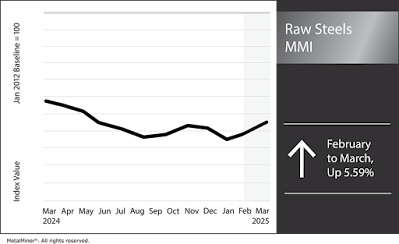
Rising steel prices saw the Raw Steels Monthly Metals Index (MMI) jump by 5.59% from February to March.


Steel Prices Surge on Tariff News

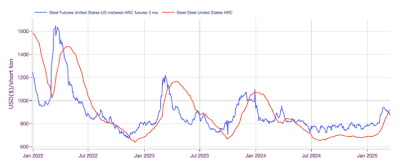
As of mid-March, steel prices remained decidedly bullish and in search of a new peak as U.S. tariffs set the market on fire. Hot rolled coil prices hit their highest level since February 2024, up over 34% since the start of the year. Meanwhile, the steel plate market, which closed last year plagued by oversupply, saw prices jump nearly 38% during the same period, a development recently covered in MetalMiner’s weekly newsletter.

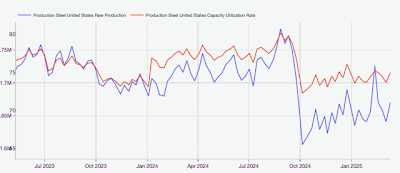
Buyers rushed back into the market ahead of tariffs, attempting to refill inventories before the duties hit steel prices. Simultaneously, service centers reported increased difficulty obtaining material from mills, which continued to capitalize on the chaos by constraining output to keep the market tight. As of March 12, American Iron and Steel Institute data showed that U.S. raw steel production remained constrained, more than 6% below its 2024 peak.


Source: MetalMiner Insights, Chart & Correlation Analysis Tool
Mill Lead Times Extend

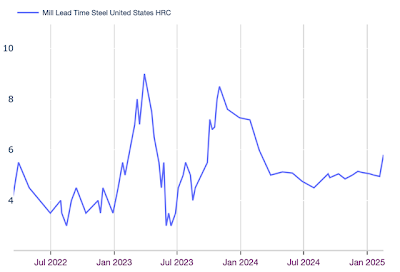
Meanwhile, mill lead times reflected the increasingly tighter market. For example, HRC mill lead times lengthened significantly, increasing back to where they stood in February 2024. It is worth noting that the current busy market contrasts sharply with where things stood at the end of last year. Suppliers faced weak conditions throughout 2024. While some attributed falling steel prices to the pressure of competitively priced imports, others noted slower demand caused by the long-term contraction of the U.S. manufacturing sector.


Source: MetalMiner Insights, Chart & Correlation Analysis Tool
Will High Prices Kill High Prices?


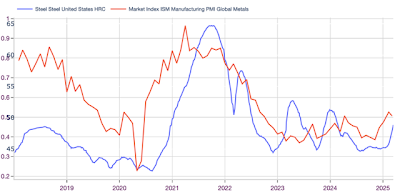
Despite what appears to be surging demand, questions remain as to how long tariffs can prop up prices. After more than a year of shrinking, the U.S. manufacturing sector only recently returned to growth over the past two months.


Source: MetalMiner Insights, Chart & Correlation Analysis Tool

However, that growth trend appeared to slow by February, with the ISM Manufacturing PMI moving from 50.9 in January to 50.3. Not surprisingly, bullish material prices helped the Prices Index jump 7.5 percentage points to 62.5. But while prices rose, the New Orders Index echoed fears of demand destruction. That index dropped 6.5 percentage points to 48.6, returning back to contraction.
Long-Term and Short-Term Outlooks

While the trend of manufacturing nearshoring will offer long-term support to the Manufacturing PMI, rising prices remain a short-term threat. Indeed, some steel suppliers expressed concern as to how long demand would last. While many buyers have already locked in volume commitments for the year, the spot-demand outlook appears increasingly murky.


Amid the sharp price increases, suppliers anticipate demand to pull back, which will likely be worsened by still-elevated interest rates. After tariffs go into effect, steel buyers appear likely to pause. This could help steel prices find a peak, as suppliers saw no meaningful change in overall market conditions outside of the tariffs.

Although few expected any relief to come in the form of carveouts and exemptions, sources noted having little confidence that U.S. demand would sustain the uptrend at its current pace. Thus far, President Trump has maintained his intentions to forgo exemptions or quotas like those implemented after he imposed Section 232 duties in 2018.
Backwardation Returns as HRC Three-Month Futures Peak

Like suppliers, investors also appear weary of the current bull trend. This comes as HRC three-month futures found a peak in late February, followed by a modest downside correction. That decline saw spot prices secure a premium over futures for the first time since April 2024.


Source: MetalMiner Insights, Chart & Correlation Analysis Tool


While futures are not always accurate in determining where spot prices will peak, they typically lead when it comes to shifts in trend. This makes them a reliable indicator when markets are on the verge of shifts. Should the recent inversion of the two price points from contango to backwardation hold, spot prices may soon follow futures into the downside. Read MetalMiner’s 2025 steel price forecast in our Monthly and Annual Metal Outlook reports.

By Nichole Bastin
Report Shows Geothermal Can Meet 64% of AI Energy Demand Boom

By Haley Zaremba - Mar 19, 2025

A new report suggests that geothermal energy could meet up to 64% of the expected growth in data center energy demand by the early 2030s, providing a significant solution to the AI energy boom.

Despite facing challenges like high up-front costs and technical barriers, advancements in geothermal technology and increased investment from Big Tech are driving the development of this renewable energy source.

Geothermal energy has the potential to fulfill a substantial portion of data center demand in major US markets, but its success depends on factors such as continued tax credits and supportive policy mechanisms.


An independent research body says that geothermal energy could almost single-handedly solve the AI energy demand boom. A new report from the Rhodium Group says that “geothermal could economically meet up to 64% of expected demand growth by the early 2030s” as long as their baseline assumptions hold true.

Advanced geothermal technology is still in its most nascent stages of development, but could be a gamechanger for baseload clean energy production if it can become commercially viable at scale. “To grow as a national solution, geothermal must overcome significant technical and non-technical barriers in order to reduce cost and risk,” says the introduction to a 2019 U.S. Department of Energy (DOE) report — GeoVision: Harnessing the Heat Beneath Our Feet. “The subsurface exploration required for geothermal energy is foremost among these barriers, given the expense, complexity, and risk of such activities.”

These barriers and prohibitive up-front costs have deterred investments over the years. “Analysts estimate just over $700 million in financing has been contributed to overall geothermal projects since 2020,” the report added. At present, geothermal accounts for just 0.5% of renewable energy on a global scale.

But continued breakthroughs are being made to bring geothermal development closer to reality. Technologies borrowed from other energy sectors, from nuclear fusion to fracking, have unlocked key solutions for drilling down to access the heat from the Earth’s core from nearly anywhere on Earth. While geothermal is already viable in places like Iceland, where the Earth’s heat naturally escapes the the surface through geysers and other natural phenomena, it's much less accessible in places without these geographical and geologic anomalies.

As geothermal technologies improve, Big Tech is starting to throw its weight behind the technology, helping to relieve the historic investment bottleneck. Meta and Alphabet (the companies behind Facebook and Google) are among the major tech firms partnering with geothermal startups. New and innovative geothermal companies are now popping up around the country and particularly in Texas, “due to an abundance of identified geothermal resources, 1-stop shopping permitting process and our regulatory certainty” according to Matt Welch of the Texas Geothermal Energy Alliance (TxGEA).


Big Tech’s growing interest in geothermal and other next-gen clean energies comes in response to the sector’s runaway energy demand growth rate. Google’s 2024 Environmental Report divulged that the company’s greenhouse gas emissions have grown nearly 50% since 2019. As a result, the company now publicly acknowledges that its emissions targets are growing increasingly difficult – if not impossible – to reach.

This surging energy demand is being driven by the proliferation of energy-hungry artificial intelligence, the energy use of data centers is rising sharply and will continue to balloon in the coming years. According to The Register, “the amount of electricity consumed by data centers in the US has increased from around 2 percent in 2020 to around 4.5 percent in 2024.” Already, AI demand growth has placed a major strain on energy grids around the world and caused serious concern for energy security and climate goals on an international scale.

But geothermal, if applied at a commercial scale, could provide something close to a silver-bullet solution to this runaway problem. And thanks to increased support from the public and private sectors, this could become a reality in the not-too-distant future. The Rhodium Group calculates that geothermal energy would potentially be able to fulfill all of the anticipated demand growth from data centers in 13 of the 15 largest U.S. markets and at least 15% of demand in 20 out of 28 national markets.

"Much of the opportunity we find is in the West, but geothermal can provide power for some or all growth, even in growth markets in the central and eastern US including the Washington, DC/Northern Virginia cluster, Chicago, Columbus, OH, and Memphis," the report states.

The report says that while this future is possible, a lot of assumptions will have to hold true to support these findings. Data center operators will have to be willing to spend a “green premium” on geothermal energy, tax credits will have to remain in place, and supportive policy mechanisms will be needed at all levels.


By Haley Zaremba for Oilprice.com

Abandoned Oil Wells Pose Growing Risks in Permian Basin

By Haley Zaremba - Mar 19, 2025, 4:00 PM CDT

Depleted and abandoned oil wells in West Texas are causing environmental issues such as sinkholes and blowouts, leading to significant financial costs for cleanup.

The Texas Railroad Commission has requested additional funding to address the increasing number of emergency well issues, highlighting the urgency of the problem.

There are millions of orphan wells nationwide that have not been sealed, leaving taxpayers responsible for cleanup and posing ongoing risks to water sources and the environment.


As the number of depleted and abandoned oil wells in the West Texas Permian Basin continues to grow in the long shadow of the United States shale revolution, associated environmental and public health hazards are ballooning in tandem. “From sinkholes to blowouts to persistent leaks, more than a century of oil drilling in the region has left a daunting array of environmental hazards,” the Texas Tribune wrote in a collaborative report with InsideClimate News earlier this week.

This is not a new issue in the United States. Back in December 1990, a federal oversight agency issued a warning that environmental devastation was all but guaranteed if oil and gas wells across the country were not sealed – and sealed well – after being depleted or abandoned. The memo noted that the responsibility for this maintenance lay in the hands of cash-strapped drillers sitting on unproductive wells who simply could not afford to properly seal the wells, creating a ticking time bomb for future generations.

And now, that bomb is set to blow. Aging wells are springing leaks left and right across rural Texas, creating major environmental and health issues for local communities and racking up massive bills. Just this week, the Texas Tribune reported on a giant sinkhole that has opened up under an old oil well on a family ranch in West Texas. The Kelton Ranch well was plugged in 1977, but now it has turned into a 200-foot sinkhole that could comfortably fit an entire four-story building. This is just one of many such cases across the Permian Basin. A long series of blowouts has wreaked havoc for the region and cost the state millions, and the urgency of the situation continues to mount.

Twin blowouts took place in 2022 and 2023 just 40 miles away from the Kelton Ranch sinkhole. The December 2023 blowout, which caused brine ponds to flood ranch lands around Crane County, took over a month and $2.5 million to fix. In 2024, a similar blowout popped in Reeves County, and just last month a leak was detected in Pecos County.

The Railroad Commission, the state’s oil and gas drilling and plugging regulator, requested an additional $100 million from the Legislature in late 2024 in an attempt to keep up with the ballooning issue. “The number and cost of emergency wells has significantly increased over the last five years,” Railroad Commission deputy executive director Danny Sorrells wrote to legislators last year. The surprised funding request would increase the current budget for well plugging by 72%, underscoring the scale and urgency of what the Houston Chronicle refers to as “the problem simmering beneath the surface in West Texas.”


In addition to all of the inadequately sealed wells across the region and the country, there are many more “orphan wells” which have not been sealed at all – more than 2 million nationwide. “Many leak contaminants like brine, methane and benzene into waterways, farmland and neighborhoods,” ProPublica reported late last year. “The industry has already left hundreds of thousands of old wells as orphans, meaning companies walked away, leaving taxpayers, government agencies or other drillers on the hook for cleanup.”

This issue is costing taxpayers tens of millions of dollars, threatening their water sources, and creating long-term environmental ills. A Texas republican bill was recently introduced to set deadlines to plug more than 150,000 inactive wells across the state over the next 15 years, and to enhance oversight and transparency mechanisms that would help ensure that oil and gas companies make good on their obligations. But the bill has been met with resistance from a Texas Senate panel due to concerns that it will place an unmanageable financial burden on small operators.

By Haley Zaremba for Oilprice.com
Copper price nears record as market braces for tariffs

Bloomberg News | March 19, 2025 | 


Stock image.


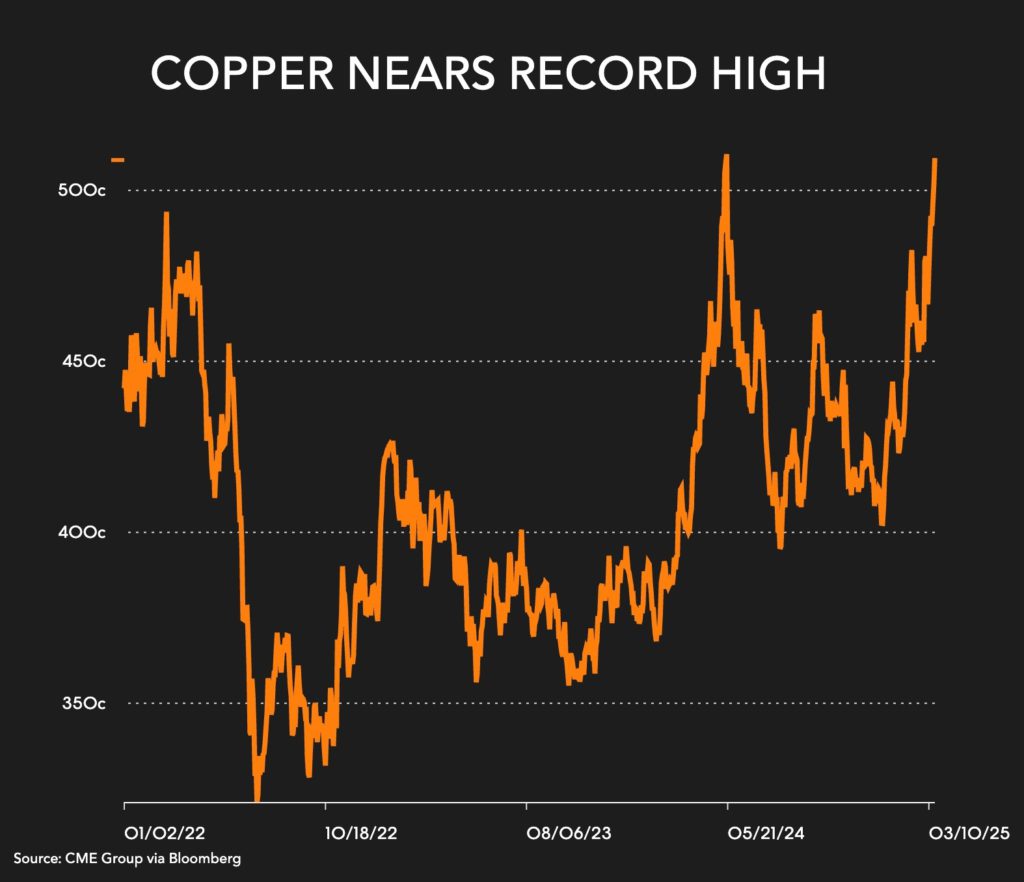
Expectations that the US will add copper to the list of metals subjected to tariffs have send its price near record highs. The key industrial metal crossed the $5-a-pound mark for the first time in months, suggesting that supply concerns will outweigh headwinds from disruptions to the global economy.


Copper’s rise is being driven “solely by supply concerns surrounding the potential for universal tariffs to be placed on all imports of copper into the US,” said Natalie Scott-Gray, a senior metals demand analyst at StoneX, on Tuesday.

Copper price nears record high.

The US is “heavily reliant on foreign copper, with imports accounting for [around] 45% of demand,” she added.
Record shipments

The US is about to be flooded with a massive wave of copper as a worldwide dash to front-run potential tariffs by US President Donald Trump comes to a head.

Between 100,000 and 150,000 metric tons of refined copper is expected to arrive in the US in the coming weeks, according to four people surveyed by Bloomberg with direct knowledge of some of the shipments. If the full volume arrives within the same month, it would surpass the all-time record of 136,951 tons set in January 2022.

Commodities traders including Trafigura Group, Glencore Plc and Gunvor Group are redirecting large volumes of metal earmarked for Asia to the US. The quantity is so big that traders are booking additional warehousing space in New Orleans and Baltimore to accommodate the shipments, some of the people said. The three firms declined to comment.

The surge of foreign copper into the US has widespread ramifications as it drains supplies in other markets including China, the top consuming nation. Copper prices in the US are at levels well above other overseas markets, giving American manufacturers a taste of the kind of cost inflation and supply-chain disruptions that may be triggered by a full-blown trade war.


Trump late last month ordered the US Commerce Department to conduct a probe into possible copper tariffs on national security grounds, in a move that sent copper futures in New York surging above other global price benchmarks.

And while Trump’s earlier musings on such levies sparked concerns on whether traders could get copper into the US before they take effect, a lengthy Commerce investigation opens a longer window to ship the metal.

The differential between prices on New York’s Comex commodities exchange and the London Metal Exchange rose above $1,200 a ton on Wednesday, approaching a record high reached in mid-February. That’s a 12% premium, and it creates a huge incentive for traders and producers to keep moving copper to the US before tariffs are imposed.

Goldman Sachs Group Inc. and Citigroup Inc. anticipate the US will impose 25% import levies on copper by year end. Even with tariffs, American copper buyers have little choice but to keep buying imported metal given that US consumes twice as much as it produces.


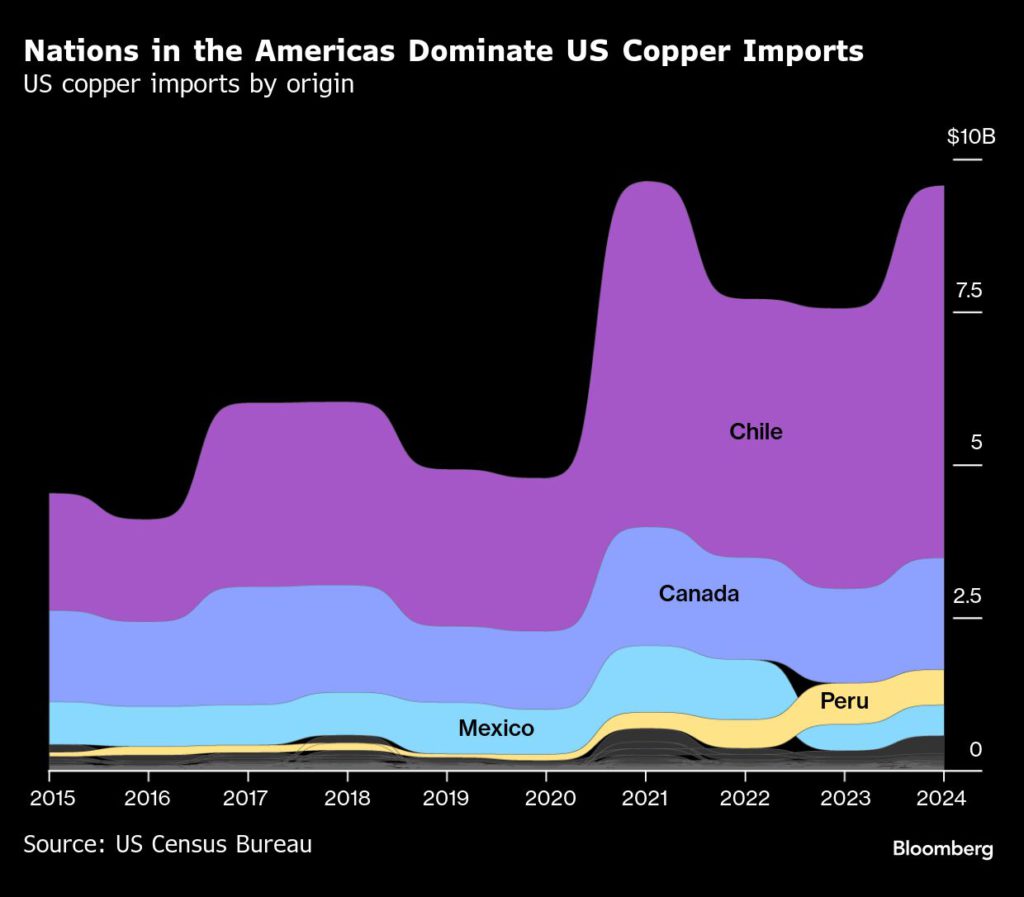
American buyers are already looking to source more from countries such as Chile and Peru amid a broader buildup of copper stockpiles. Some metal from Mexican and Canadian mines is likely to get diverted to Europe given Trump’s sweeping tariffs on the key US trading partners. Chile’s state-run producer Codelco — already the top shipper to the US — is striving to meet additional demand from its US customers after meeting them last month.

“Everyone sees demand for copper as very strong and they all ask Codelco for more copper,” chairman Maximo Pacheco said in a March 13 interview. That’s partly because “there’s an open discussion about whether copper will have a tariff.”

Potential US tariffs could also upend the copper trading dynamics between Chile and China, which is by far the world’s largest metals consumer. In recent months, more Chilean metal than usual has headed to the US after buyers were caught in a short-squeeze on Comex last year. Tariffs could keep that flow elevated.


That marks a shift for China, which last year bought about 4 million tons of the metal and accounted for about 40% of the world’s refined copper, according to the International Copper Study Group. For the time being at least, the US is usurping China as the preferred sales destination for the world’s top producers and traders, leaving the Asian nation at a disadvantage.

That creates a lucrative environment for producers and traders, allowing them to exploit pricing differences between the US and other markets.

“There’s a broader reshaping of supply chains that is potentially on the cards,” Citigroup analyst Tom Mulqueen said in an interview.

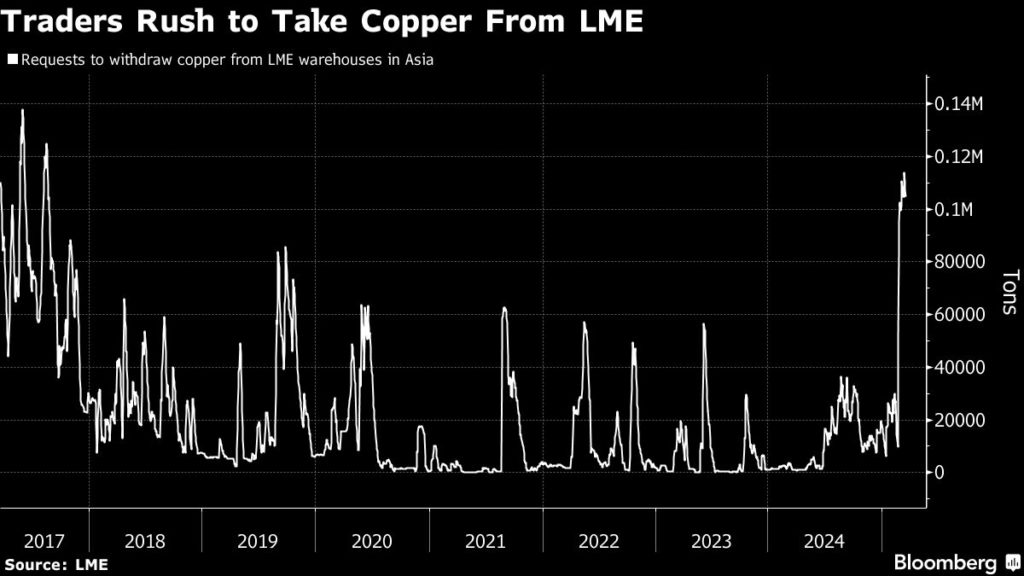
Monthly shipments into Chinese ports for April and May could drop by as much as a third compared to the same period last year, according to one large trader active in the Asian market. Requests to move copper out of London Metal Exchange warehouses in Asia have surged to the highest since August 2017.


Goldman Sachs analysts expect all forms of copper shipped to the US to be hit with tariffs by the end of this year, keeping prices on Comex trading at a hefty premium over other benchmarks. Tariffs could cause China to refine less copper — to the tune of 10,000 to 20,000 tons a month within the first three months. That’s in a global market that Goldman already expected to be facing a 180,000-ton deficit this year.

“The good news is that we see very strong and clear demand,” Codelco’s Pacheco said. “We see this turbulence and uncertainty, but we’ve lived with it many times before.”

(By Julian Luk, James Attwood and Yvonne Yue Li)


Global silver market faces strains as Trump’s tariffs hit

Bloomberg News | March 18, 2025 | 


Stock image.


The silver market faces mounting stress as trade-war concerns intensify, with higher rates to borrow metal adding to signs of global dislocation.


A surge in lease rates for the precious metal has become the latest sign of alarm, with anxiety building over the impact of further tariffs from US President Donald Trump. That’s sparked a dash to ship silver into the US in a bid to capture premium prices in New York, possibly causing a squeeze in London.


Precious metals — gold as well as silver — have been upended this year, as Trump challenges the global trade order. That’s spurred demand for havens, and also opened up rare pricing dislocations between key markets. While spot silver has gained about 17% this year — making it one of the best performing commodities — futures in New York have done even better.

On a physical level, the tariff concerns — especially levies against Canada and Mexico, as well as wider reciprocal curbs that may kick in next month — have drawn vast quantities of both gold and silver out of London into US vaults. But given their relative value and density, gold tends to be air-freighted, with silver often taking far longer voyages, typically by ship.

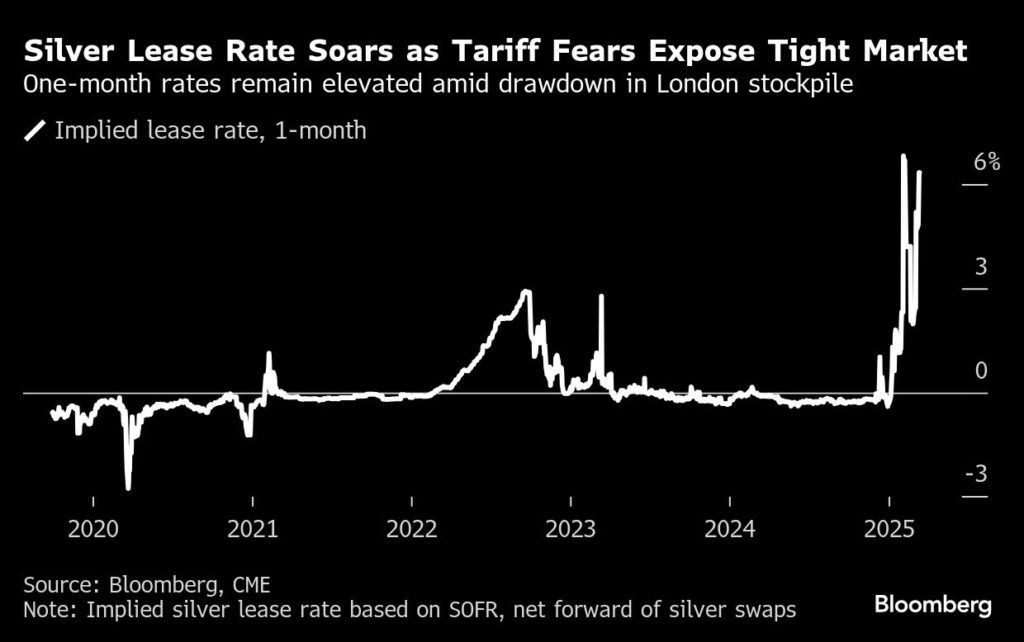
Lease rates — the cost of borrowing metal, generally for a short period — have jumped. One-month rates for silver topped 6% this month after a larger spike in February. That partly reflects concerns about fast-depleting stockpiles in the UK capital, with holdings hitting a record low last month. In addition, not all of what remains is available given it’s tied to exchange-traded products.


“I expect the lease rate in London to remain high for about two to three months,” said Cao Shanshan, an analyst at COFCO Futures Co. With the UK-to-US transfer under way, “silver is a lot bulkier than gold, so the transfer of silver will likely take longer,” she said.

Exchange-reported totals in the US reflect the turmoil. Comex-tallied inventories of silver have expanded to the highest level ever in data going back to 1992 after surging by 40% so far this quarter, a record rise. While New York is still drawing in metal at present, there are also concerns the flows may be thrown into a drawn-out reverse if silver faces a shortage in London vaults.

“Should the long-fabled ‘silver squeeze’ materialize, this slower tradeflow will be a key contributor to prolonging” any potential disruption BMO Capital Markets analyst George Heppel said in a note. That’s because it would take time for silver stockpiles to flow from the US back to London, he said.

The US imports about 70% of its silver from Canada and Mexico, which have borne the brunt of the Trump administration’s moves on trade so far. Ottawa subsequently announced 25% counter tariffs on about C$30 billion ($20.8 billion) of US-made items, including silver. Since then, Trump has reiterated his desire for April 2 to mark a wave of new levies.

“The market may be underpricing the scale and impact of the upcoming April 2 US reciprocal tariffs,” Citigroup Inc. analysts including Max Layton said in a note, highlighting the pricing dislocation. There may be “substantial potential upside should reciprocal tariffs be implemented over the next six months,” they said, adding that silver is unlikely to be exempted from levies.

Spot silver traded a little above $34 an ounce on Tuesday, with Comex futures almost 70 cents higher.

TD Securities also signaled its concern. “If reciprocal tariffs are really like-for-like, you would expect retaliatory tariffs on Canadian silver and that’s about 20% of US imports — so there is a higher risk associated with silver,” said Daniel Ghali, senior commodity strategist at TD. “Even if the disruptions were to completely resolve overnight, we can’t go back to the prior world because you’d never know what will happen the next day.”

(By Sybilla Gross)


European bismuth prices rocket to record highs on China export curbs


Bismuth prices in Europe have surged to all-time highs as China’s export controls squeeze supplies of the mineral used in atomic research, cosmetics and pharmaceuticals, according to traders and experts.

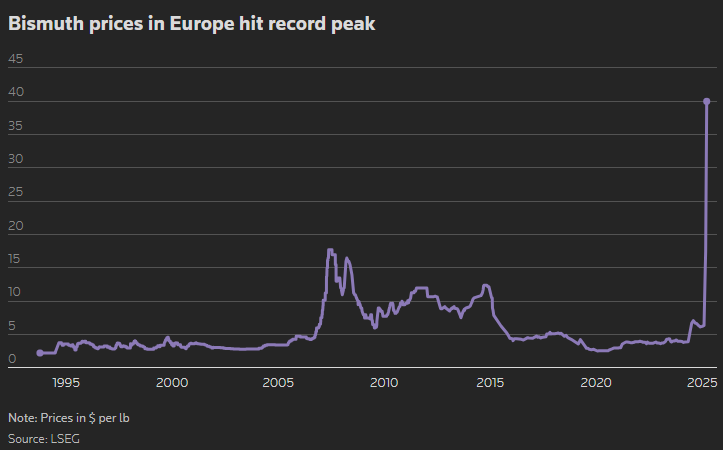
Prices of bismuth have jumped to $40 a lb on the European spot market, an all-time high, up from $6 per lb in late January, a more than six-fold rise.

In the United States, bismuth prices are even higher – at $55 a lb compared with $6.5-$7 before China’s export curbs.

Traders said U.S. prices were also higher because of the tariffs imposed by U.S. President Donald Trump on imports from top producer China.

China in February announced plans to impose export controls on five key metals – tungsten, tellurium, molybdenum, bismuth, and indium – in response to Trump’s import tariffs.

“At the moment there are no supply sources to fully replace Chinese material,” commodity analysts with business intelligence company CRU Group told Reuters.

“As much of the supply tightness is based on policy, it can ease very quickly. But assuming a full stop of Chinese bismuth exports, new capacity ex-China would be necessary.”

According to the U.S. Geological Survey (USGS), China was responsible for producing around 13,000 metric tons of mined bismuth last year or more than 80% of the global total. The rest comes from countries such as Japan, South Korea, and Laos.

Prices have risen significantly, making it risky to ship materials for stockpiling since delivery takes about two months and no one knows where the market will be by then, said a Europe-based trader.

“This situation is causing a very low unsold inventory level internationally, keeping the price for prompt material at a very high level,” he added.

Meanwhile, the most active bismuth contract on the Wuxi Stainless Steel Exchange was trading at 163,800 yuan ($22,677) per metric ton on Tuesday, 105% higher than at the beginning of the year.

(Reporting by Ashitha Shivaprasad and Anmol Choubey in Bengaluru, additional reporting by Amy Lv in Beijing. Editing by Pratima Desai and Mark Potter)


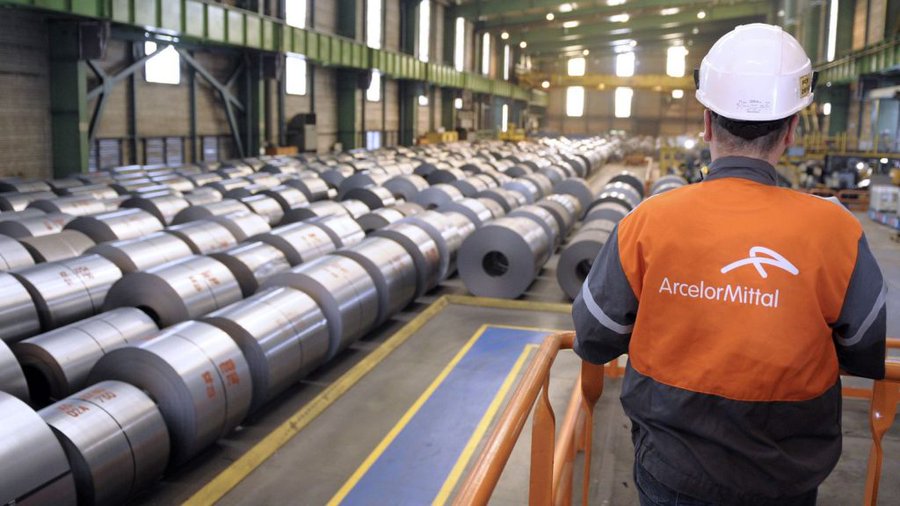
ArcelorMittal, South Africa near funding deal to save mills

Image courtesy of ArcelorMittal.

South Africa is nearing a deal to provide funding to ArcelorMittal SA’s local unit and ensure its steel mills, which are crucial for the nation’s economy, remain open, people with knowledge of the matter said. The unit’s shares rose.

The government plans initial support of about 500 million rand ($28 million) specifically to pay steelworkers over a period of six to eight months, said the people, who asked not to be identified because the information is private.

It is also discussing additional bridge financing through the state-owned Industrial Development Corp., which will then raise its stake in the company from its current level of 8.2%, the people said.

The government, working through the state’s trade department and the IDC, also wants ArcelorMittal South Africa Ltd., known as AMSA, to consider offers for the two mills it plans to close, according to the people. The plants are situated in the towns of Vereeniging and Newcastle.

In a statement later on Wednesday, the government confirmed approval of nearly 417 million rand to sustain 2,982 employees over the next 12 months.

“The South African government continues to engage with ArcelorMittal South Africa to prevent the planned wind-down of the longs steel plant in Newcastle and to recalibrate the steel industry’s role in the South African economy,” the Department of Trade, Industry and Competition said. The government “considers this matter a priority and remains steadfast in its efforts to secure a long-term and sustainable future for the country’s steel sector.”

Winding down

AMSA hasn’t stopped the wind-down process but is engaging stakeholders on funding, it said in a statement Wednesday. Without an agreement on this and other matters, deferring the plans to idle the operations “will not be feasible,” the steel producer said. While it has received approaches on “strategic alternatives,” none of these constitute a firm intention to make an offer, it said.

Securing a deal to keep the mills open, which provide so-called long products including steel grades that can’t currently be made by local rivals, is crucial to the government’s plans to revive the economy through a massive infrastructure push. The car-making and mining industries are also the nation’s biggest foreign-exchange earners.

A decision may be announced as early as this week, according to the people, with one saying that AMSA’s board is meeting to consider the proposals.

The company, backed by Indian billionaire Lakshmi Mittal, is seeking about 3 billion rand to keep its mills open for another 12 months and build up inventory for carmakers such as Volkswagen AG and Isuzu Motors Ltd., the people said.

AMSA declined to comment. The IDC said it’s in talks with AMSA to help it find a solution to keep the mills open. It declined to comment on potential bids for the plants.

Earlier this year, the IDC provided AMSA with working capital to keep the operations open. That’s at least the second time the development-finance institution — the steelmaker’s biggest shareholder after its parent company — has helped the company.

The IDC is also investing in a 12 billion-rand car-manufacturing plant with Beijing Automotive International Corp. and other downstream auto manufacturing, making products produced by AMSA, such as spring steel, a flexible grade of the metal used in vehicles, essential to its broader mandate of driving manufacturing growth.

“Securing long steel supply, particularly outside of the commodity products, is a key strategic focus for the IDC,” it said.

AMSA South African rivals — so-called mini mills that use scrap metal obtained at discounted prices under a government program to make steel — have also received funding from the IDC, undercutting AMSA, which uses iron ore.

AMSA’s share price has fallen more than 90% since the end of 2005, valuing the company at about 1.6 billion rand even though its annual sales are about 40 billion rand. The stock surged as much as 21%, the most since October, before paring gains to close 7.7% higher in Johannesburg.

(By Loni Prinsloo and Antony Sguazzin)


Russian billionaire Potanin eyes rare earth metals exploration

Vladimir Potanin – Image courtesy of Wikimedia Commons

Russian billionaire Vladimir Potanin, CEO and shareholder of metals giant Nornickel, said on Tuesday he is considering projects in rare earths, noting that reserves in Russia and Russian-controlled Eastern Ukraine have been poorly studied.

Rare earths and other critical metals, essential for high-tech industries, have gained global attention in recent months due to US President Donald Trump’s efforts to counter China’s dominance in the sector.

“Many deposits within our territory and the new Russian territories are inadequately explored. Many geological studies and their results were lost after the Soviet Union,” Potanin told reporters.

“Therefore, all of this needs to be restored now. We are contemplating and working on it,” he added. It was not immediately clear from Potanin’s remarks whether Nornickel would be involved in such projects.

President Vladimir Putin has offered the US the opportunity, under a future economic deal, to jointly explore Russia’s rare earth metal deposits, which he claims are more extensive than those of Ukraine.

Potanin emphasized that due to the small size of many deposits and challenging exploration conditions, Russian firms will need partners who can provide the necessary technology.

“Since these are complex projects, technological support from various partners would be beneficial for us,” Potanin said.

Nornickel, a major global producer of refined nickel and palladium, currently does not hold any licenses for rare earth metals exploration.

(By Olesya Astakhova and Gleb Bryanski; Editing by Kim Coghill)


Russian court transfers zinc producer Dalpolimetall to state ownership


Credit: MMC Dalpolimetall JSC

A Russian court on Tuesday said it had transferred ownership of major zinc and lead producer Dalpolimetall to the Russian state, after considering a claim brought by the Russian Prosecutor’s Office.

Russia is quickening the pace of domestic asset seizures after courts ruled early this year that a leading grain trader, Moscow’s sprawling Domodedovo airport and strategic warehouse assets be handed over to the state.

Russia’s finance ministry on Tuesday said it intends to revive plans for major privatizations in 2025 and also expects to bring in more than $1.2 billion by selling assets seized through the courts.

Dalpolimetall, which produces lead and zinc ores at two mines in Russia’s Far East and employs more than 1,500 people, did not immediately respond to a request for comment.

Foreign companies have grappled with the risk of state seizure ever since Russia sent its army into Ukraine in February 2022, but Moscow, under the auspices of strategic stability and domestic security, has increasingly brought domestic assets too into the crosshairs.

(By Anastasia Lyrchikova and Alexander Marrow; Editing by Kirsten Donovan)


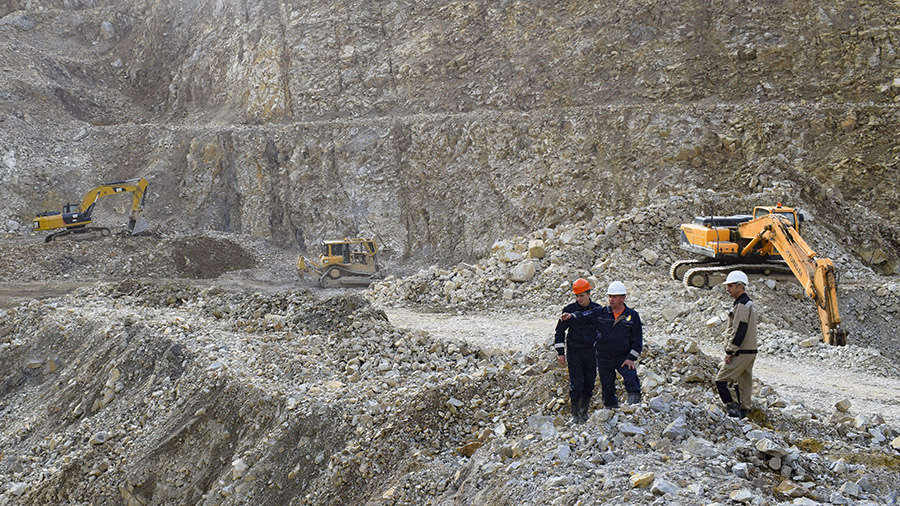
China flexes rare earth dominance with million-tonne discovery


Mountains in China’s Yunnan province. Stock image.

China solidified its global dominance in rare earth elements mining with a new discovery that its experts say is likely to be the largest middle and heavy rare earth deposit in the country.

The discovery was first reported in the Chinese paper Workers’ Daily late January, then confirmed and published by the China Geological Survey (CGS) under the Ministry of Natural Resources.

According to the CGS, the deposit could host as much as 1.15 million tonnes of resources containing key rare earth elements such as praseodymium, neodymium, dysprosium and terbium, which are being sought after globally. Once tapped, it would yield about 470,000 tonnes of these strategic minerals, it estimated.

The discovery is located in the southwestern province of Yunnan, which is known for its rich endowment of minerals and has some of the largest deposits of aluminum, zinc and tin in China.

Breakthrough discovery

Chinese media claim that the new discovery represents another breakthrough in its mineral exploration, as it is the first super-large ion-adsorption type deposit found in the country in over half a century.

Rare earth minerals on this type of deposit are naturally concentrated and absorbed onto clay surfaces, making them relatively easy to extract through environmentally sensitive methods like ion exchange. The last such discovery dates back to 1969 in the eastern Chinese province of Jiangxi.

The new find, according to CGS experts, is predominantly middle and heavy rare earth minerals, which are essential raw materials for electric vehicles, renewable energy and national defense security. Light rare earths used in permanent magnets, on the other hand, are much more abundant in China and mainly distributed in areas such as Inner Mongolia.

“The discovery is highly significant for strengthening China’s advantage in rare earth resources, improving the rare earth industry chain, and further consolidating China’s strategic dominance in medium and heavy rare earth resources,” the CGS posted on its public WeChat account, later reported by the South China Morning Post (SCMP).

This massive rare earth find follows the CGS’s recent establishment of a national geochemical baseline network, which is designed to help generate extensive data and advance mineral exploration techniques.

Rare earth dominance

The discovery reinforces China’s world-leading position in the rare earth mining sector. The Asian powerhouse controls roughly 60% of rare earth production and 85% of processing capacity worldwide. As of 2023, its total mine production was 240,000 tonnes, nearly six times that of the US, the next leading producer and its main rival.

According to the US Geological Survey, China’s catalog of REE deposits currently includes 17 metal oxides contained within 44 million tonnes of resources. These include the world’s largest rare earths mine, Bayan Obo, in Inner Mongolia.

Customs data showed that Chinese rare earth exports rose 6% last year to 55,431 tonnes.